
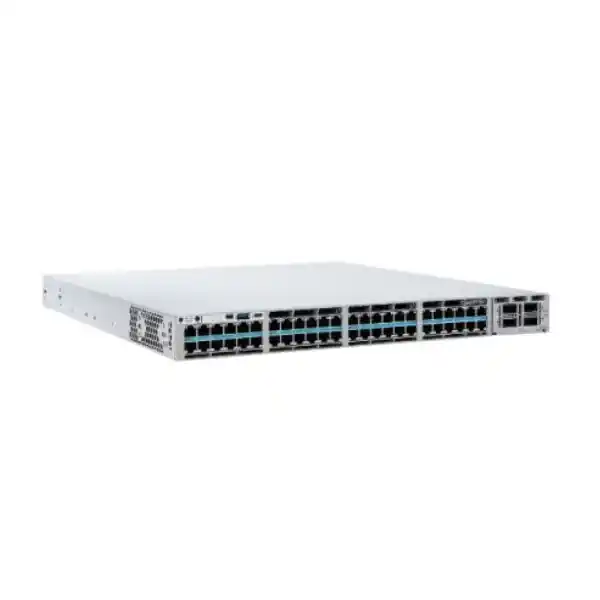
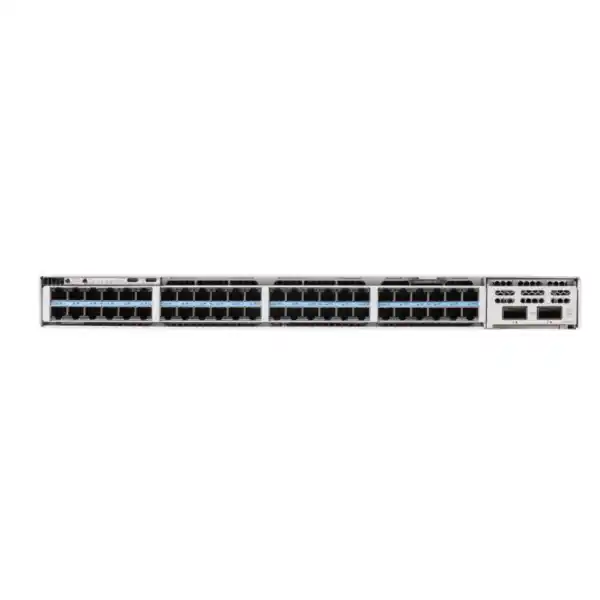
Cisco C9350-48TX Smart Switch
A 48-port, data-only multigigabit access switch engineered for enterprises that need copper connectivity from legacy Ethernet through 10 Gigabit Ethernet, high-speed modular uplinks, resilient stacking and modern Cisco IOS XE operations without paying for an integrated PoE budget they do not intend to use.
Direct answer: who should deploy the C9350-48TX?
The Cisco C9350-48TX is the appropriate C9350 model when the access layer must provide high-density copper multigigabit Ethernet but connected devices are powered independently. All 48 downlink ports are data ports and support 10M, 100M, 1G, 2.5G, 5G and 10G operation, with the important qualification that the lowest legacy rate is supported in full-duplex operation. This makes the platform useful for high-performance desktop estates, engineering workstations, content-production suites, storage or compute edge devices, security appliances, network-service nodes, building systems with local power, lab environments and Wi-Fi access points that receive power from an external source rather than from the switch.
For UAE architects, the most important design distinction is that C9350-48TX is not a PoE switch. A Wi-Fi 7 access point may need a multigigabit Ethernet link and may therefore benefit from a 5G or 10G C9350-48TX access port, but the access point still needs a supported local DC supply, AC adapter, midspan injector or another engineered power method. Where the business wants one cable to carry both data and power, the C9350-48HX family is typically the more natural comparison. Where high-density data-only access is the requirement, the C9350-48TX avoids allocating chassis and power architecture to PoE delivery.
FourTeck can position this switch as part of a complete campus refresh rather than as an isolated line item. Customers can coordinate switching and network procurement through FourTeck UAE, align segmentation and perimeter controls with the specialists at Firewall Dubai, and plan implementation, migration and managed operational work with IT Services UAE. Organizations extending a common access design across African operations can also coordinate regional standards through FourTeck Africa.
Cisco C9350-48TX technical specification summary
Why 48 ports of 10G-capable copper change access-layer design
Traditional access switches were planned around an assumption that almost every endpoint would remain at 1 Gigabit Ethernet. That assumption is increasingly restrictive. Modern Wi-Fi radios can aggregate several gigabits of client traffic, content-creation workstations can move large media assets to shared storage, engineering teams routinely work with high-volume datasets, and distributed compute appliances may require more bandwidth at the access edge than an old 1G port can deliver. Replacing every copper endpoint with fiber is neither necessary nor operationally attractive. The C9350-48TX addresses this transition by extending the familiar RJ-45 access model to multiple negotiated rates, allowing a migration from 1G to 2.5G, 5G or 10G according to the capability of each endpoint and the installed cabling plant.
The practical benefit is not that every port must run at 10G on day one. The benefit is optionality. A floor can contain standard 1G office devices, 2.5G wireless access points, 5G high-performance endpoints and selected 10G devices while remaining within a single switching platform. This reduces the architectural pressure to create separate switch families for different endpoint classes. It also provides a useful migration path for UAE organizations that are renovating facilities in stages: the network can support older endpoints during transition without constraining the next generation of devices.
Cabling still matters. 10GBASE-T performance is strongly influenced by cable category, channel length, termination quality, patching, electromagnetic environment and installation workmanship. A switch capable of 10G does not make an underperforming copper channel suitable for 10G. During a C9350-48TX rollout, engineers should validate the structured cabling records and, where practical, certify channels to the desired Ethernet rate. Existing Cat6 or Cat6A installations may have very different practical headroom depending on length and quality, so a port-by-port rate plan is more responsible than assuming that a building label alone guarantees 10G.
The multi-rate design also helps procurement teams avoid false choices. A customer does not need to declare the whole building either 1G or 10G. It can use multigigabit negotiation to align rate with endpoint need, while standardizing hardware, spares, configuration templates and support processes. This is particularly valuable in mixed-use campuses where administration floors, media studios, technical labs, classrooms and network equipment rooms have different traffic characteristics but are managed by the same infrastructure team.
Silicon One A100/L architecture: what it means in practice
Dual-ASIC access design
Cisco positions the C9350-48TX around dual Silicon One A100/L ASICs. That matters because the switch must service 48 multigigabit access ports while also providing a high-bandwidth path to modular uplinks and stacking. Cisco documents 1.3 Tbps of throughput per A100/L ASIC for this model family. Rather than treating the switch as a simple 48-port edge device, network architects should view it as a compact access system intended for sustained east-west and north-south traffic at rates well above those of legacy 1G access designs.
Capacity must be designed end to end
High switch silicon capacity does not remove uplink oversubscription. If forty-eight clients can potentially operate above 1G, the uplink design becomes a first-class architectural decision. A branch using mostly 1G clients may be comfortable with a modest uplink set, while a content production floor, data science environment or Wi-Fi aggregation layer may require 100G-class uplinks. The C9350-48TX is useful precisely because its network-module options let the uplink design scale without replacing the base access chassis.
Performance planning should therefore start with workload classes rather than port counts. For each access block, identify the normal and peak throughput of endpoints, expected simultaneous utilization, local versus routed traffic patterns, backup and replication windows, wireless aggregation, video or imaging flows, application burstiness and future device upgrades. A simple calculation that multiplies 48 ports by 10G produces an unrealistic worst-case number for most office networks, while assuming that no endpoint ever exceeds 1G wastes the advantage of the platform. The right design models concurrency and traffic concentration.
The dual-ASIC architecture is also relevant to resilience planning. Engineers should understand how interfaces map to forwarding resources, how uplink and stack capacity are distributed, and how failure scenarios affect traffic paths. For critical environments, the design review should test not only the steady-state topology but also the surviving capacity after loss of one uplink, one aggregation device, one stack member or one power feed. High nominal bandwidth is valuable only when the topology retains enough bandwidth during the failures the business expects the network to tolerate.
Port-speed planning from 10 Mbps to 10 Gbps
The C9350-48TX supports an unusually broad set of copper access rates. That is operationally useful when a campus contains devices from multiple technology generations. At the low end, legacy embedded systems may still require 10 or 100 Mbps Ethernet. Standard desktops, printers, control systems and many network appliances remain satisfied with 1G. Newer wireless access points and workstations increasingly use 2.5G or 5G. Storage-facing systems, advanced workstations and selected infrastructure appliances may justify 10G. The switch can host those categories within a single 48-port access block.
Rate flexibility does not eliminate the need for endpoint validation. Before migration, capture current duplex and speed settings, identify manually forced legacy interfaces, verify network interface card capabilities and document devices that are sensitive to auto-negotiation changes. Cisco notes a specific behavior for the lowest speed on this platform: 10 Mbps is full-duplex only. That can matter for old industrial, building-control or specialist devices that still expect historical half-duplex behavior. Such endpoints should be lab-tested rather than moved during a broad production change without validation.
Use for conventional office endpoints where higher bandwidth produces no material application benefit.
Useful for newer APs, client devices and systems that exceed 1G but do not require a 10G access channel.
Balances higher endpoint throughput with copper reuse where devices support NBASE-T style multigigabit rates.
Reserve for endpoints that can consume sustained multi-gigabit capacity and for channels engineered to support 10GBASE-T.
A good implementation uses policy and telemetry to keep the rate plan visible after deployment. Engineers should record intended port speed, endpoint class, VLAN or fabric role, security policy, expected utilization and cabling capability in the source of truth. When a port unexpectedly negotiates at a lower speed, operations can then distinguish between a normal endpoint limitation, a cabling fault, a patching problem or a configuration issue. Multigigabit access becomes much easier to support when speed is treated as an intentional design attribute rather than a value discovered only during troubleshooting.
Modular uplinks: choosing between 2C, 4C and 8Y
The C9350-48TX supports three important uplink module families. C9350-NM-2C provides two 40/100 Gigabit Ethernet QSFP28 interfaces. C9350-NM-4C provides four 40/100 Gigabit Ethernet QSFP28 interfaces and is specifically supported on the higher-bandwidth C9350-48TX and selected related models. C9350-NM-8Y provides eight 1/10/25 Gigabit Ethernet interfaces or a mode in which four interfaces can operate at 50G, depending on supported software and configuration. Cisco documents all of these network modules as hot-swappable, although production change procedures should still follow approved operational controls.
| Module | Physical interfaces | Best-fit design intent |
|---|---|---|
| C9350-NM-2C | 2 × 40/100GE QSFP28 | Dual high-speed uplinks to a redundant distribution pair when two 100G paths are sufficient. |
| C9350-NM-4C | 4 × 40/100GE QSFP28 | Maximum uplink flexibility, diverse aggregation, high-throughput access blocks and designs needing up to 400G total uplink capacity. |
| C9350-NM-8Y | 8 × 1/10/25GE or 4 × 50GE mode | Granular fiber fan-out, migration from 10G/25G aggregation, or environments where interface count matters more than 100G ports. |
The correct module is determined by architecture, not by a desire to order the largest number. A two-uplink 100G design can be extremely resilient when each link terminates on a separate upstream system and the control plane is designed correctly. Four 100G interfaces are valuable when the access block genuinely needs additional parallel bandwidth, extra physical path diversity, separate service domains or growth headroom. The 8Y module can be preferable in environments where the installed aggregation layer offers 25G interfaces or where gradual migration is more important than immediately deploying 100G optics.
Optics, breakout behavior, cable type and transceiver compatibility should be validated against Cisco’s current compatibility information at the time of order. Do not assume that an optic already used in an older Catalyst platform is automatically supported in the new switch. The bill of materials should explicitly list network module, transceiver SKU, fiber type, connector type, patch lead length, upstream interface type and required software release. That discipline prevents the common situation in which the chassis arrives on schedule but the project cannot connect it because optics or patching were treated as accessories rather than as architectural components.
StackWise-1.6T and access-layer resiliency
StackWise-1.6T is a central reason to consider the C9350 family for large access environments. It provides a high-speed stacking architecture that allows multiple physical switches to participate in a unified operational design. Cisco specifies up to 1.6 Tbps of stacking bandwidth for the C9350 platform. In practical terms, stacking can simplify management, create more flexible link-aggregation designs, provide rapid access to neighboring member resources and reduce the operational overhead associated with treating every access switch as an isolated system.
A resilient stack design begins with physical topology. Engineers should document stack cable paths, member numbering, rack position, power-feed mapping and failure domains before installation. Stack cabling should not be an afterthought routed wherever there is remaining space. In high-density racks, front-to-back and rear cable management, service loops and separation from power can determine whether a member can later be replaced without disturbing adjacent systems. The final rack elevation should show stack links as clearly as uplinks and power connections.
The stack also needs a capacity model. Although a multi-member system can expose a large number of multigigabit ports, upstream bandwidth must remain adequate if traffic from one member is carried across the stack to an uplink attached to another member. For this reason, critical deployments often distribute uplinks across members rather than concentrating all northbound connectivity on a single chassis. The design objective is to preserve both connectivity and sufficient performance when one member, uplink, transceiver or upstream node fails.
Power resiliency should be planned at the same level of detail. The C9350 chassis provides three power-supply bays, and the C9350 family also supports StackPower+ capabilities. The exact supply population, capacity and power-sharing design should be matched to the chassis configuration and operational policy. The C9350-48TX does not have a PoE load, which simplifies power-budget calculations compared with high-power UPOE+ models, but redundant power is still important for availability. A network that requires dual electrical paths should map switch PSUs to independent PDUs and, where available, separate UPS or facility power feeds.
Finally, stacking should not be used simply because the feature exists. Some architectures prefer independent switches with routed access or other fault-domain strategies. The C9350-48TX supports sophisticated switching and routing capabilities under IOS XE, so architects can choose the model that fits their operational philosophy. Stacking is compelling when unified access blocks, multi-chassis link aggregation and simplified administration are priorities; independent operation may be preferable when strict blast-radius separation is more important. FourTeck design work should capture that decision explicitly instead of defaulting to one model for every site.
IOS XE, programmability and flexible management
Cisco IOS XE is the operating system for the C9350 Series Smart Switches. For experienced Cisco teams, this preserves a familiar operational foundation while adding modern programmability and management choices. Cisco describes support for NETCONF, RESTCONF and YANG-based model-driven interfaces, on-box Python scripting, streaming telemetry and container-oriented application hosting. These capabilities make the C9350-48TX relevant not only to traditional CLI-driven teams but also to organizations building infrastructure-as-code, automated compliance checks, telemetry pipelines and standardized configuration workflows.
The key operational advantage is consistency. A UAE enterprise can manage a C9350 deployment through an on-premises Cisco management model, cloud-based operations or a hybrid approach, subject to selected licensing and platform support. Cisco positions the smart-switch generation around unified hardware that can participate in different management experiences. This can be important during organizational transition. A network team may begin with established IOS XE processes and later adopt more centralized automation without replacing the access hardware merely because its management model evolves.
CLI and structured automation
Use mature IOS XE operational practices while progressively adopting templates, APIs, model-driven configuration and scripted validation. This allows engineering teams to automate repetitive tasks without abandoning the troubleshooting visibility of direct device access.
Catalyst Center workflows
Centralized discovery, image management, assurance and configuration workflows can reduce variance across large campus estates. Exact capabilities depend on software release, licensing tier and feature support, so they should be validated during design rather than assumed from prior Catalyst generations.
Cloud and hybrid management
Current C9350 licensing and product positioning support flexible management choices, including Cisco Meraki dashboard options. Organizations should decide which operational model owns configuration, monitoring and lifecycle processes before onboarding production devices.
Streaming telemetry
Model-driven telemetry can expose high-frequency operational data to monitoring systems, enabling stronger baselines, faster anomaly detection and better capacity planning than occasional manual polling alone.
Automation should be introduced with guardrails. Templates need version control, peer review and environment-specific variables. API credentials should be protected and scoped. Rollouts should include pre-checks and post-checks rather than assuming that a successful API response means the business service is healthy. A mature workflow validates uplink adjacency, spanning-tree or fabric state, routing neighbors, VLAN or VRF membership, endpoint authentication, interface errors and telemetry after a change.
For brownfield migrations, programmatic discovery is especially valuable. The legacy switch can be used to collect MAC address tables, ARP or neighbor information, interface descriptions, VLAN assignment, trunking state, port-security behavior, authentication settings and utilization history. That data becomes the migration inventory for the C9350-48TX. Instead of copying an old configuration line for line, architects can translate the business intent into a new standardized template and eliminate years of accumulated exceptions.
Security architecture at the access edge
An enterprise access switch is part of the security boundary because it is where users, workstations, access points, cameras, appliances and operational systems first enter the wired network. The C9350 Series is designed with modern security capabilities and Cisco positions the platform for zero-trust enforcement across users, devices and workloads. The exact policy implementation depends on topology, identity infrastructure, license level and software release, but the architectural opportunity is clear: segmentation and identity decisions can begin at the port rather than being deferred until traffic reaches a distant firewall.
The first layer is access control hygiene. Every port should have an explicit role. User access, AP trunk, infrastructure device, out-of-band management, lab system and unused port are not interchangeable categories. Unused interfaces should be administratively controlled according to policy. Trunks should permit only required VLANs or services. Native VLAN choices should be deliberate. Endpoint-facing ports should use the appropriate authentication and anti-spoofing controls supported by the design. Management access should be isolated and protected from ordinary user segments.
Identity-based segmentation can reduce dependence on physical VLAN sprawl. Where Cisco TrustSec, software-defined access or related policy systems are part of the architecture, security group constructs can help define who or what may communicate independently of a device’s physical switch location. This is especially useful in large UAE campuses where users move between floors, buildings or branches. Policy follows identity and role more effectively than a model based only on static port numbers. However, identity systems must be highly available; authentication failure behavior should be explicitly designed so a server outage does not create an uncontrolled access condition or an unacceptable business interruption.
Cisco also highlights post-quantum cryptography support in the C9350 smart-switch platform and hardware readiness for emerging inline threat protection capabilities such as Cisco Live Protect. These are forward-looking platform characteristics, not a reason to assume that every security function is active in every software train. Procurement documentation should separate present production requirements from roadmap capabilities. If a project specifically requires PQC algorithm support, advanced threat protection, MACsec behavior or another specialized control, FourTeck should validate the required IOS XE release, license tier, transceiver constraints and deployment mode before the bill of materials is finalized.
Control-plane protection and management-plane security remain essential even on a modern platform. AAA should integrate with enterprise identity services where appropriate. Administrative protocols should use secure versions. Role-based access should follow least privilege. Logs and telemetry should be forwarded to monitoring or security analytics platforms with reliable timestamps. Configuration backups should be protected as sensitive data because they contain topology, addressing and policy information. Software images should be managed under a lifecycle policy rather than upgraded reactively only after an incident.
The access switch does not replace the firewall. It complements it. The switch is strong at local enforcement, segmentation, endpoint visibility and forwarding; the firewall remains central for stateful security inspection, north-south policy, many threat-prevention functions and controlled inter-zone communication. A well-designed campus uses each enforcement point for the tasks it performs best, with consistent identity and segmentation intent across the switching, routing and security stack.
Application hosting and observability at the switch
Cisco positions the C9350 Series for enhanced application hosting using x86 multicore CPU resources, DDR5 memory, dedicated high-speed application connectivity and local SSD options. This matters because an access switch can increasingly participate in observability rather than merely forwarding traffic. Cisco cites container-oriented services such as ThousandEyes and Cisco Spaces as examples of workloads that may run close to the network edge. Feature availability, resource requirements and supported software release should be confirmed for the intended application at deployment time.
From an operational perspective, local application hosting can reduce the need to deploy a separate appliance at every branch solely for visibility or a lightweight service. A monitoring agent placed at the access edge can observe path performance from the user’s network location, which is often more useful than testing from a central data center. If a SaaS application is slow, the team can distinguish between local LAN delay, WAN path behavior, DNS, internet transit and application-side problems more quickly when measurements originate near the affected users.
The design still needs resource governance. Hosting an application on the switch should not be treated as free compute. Engineering should validate supported CPU, memory, storage and interface requirements, define who owns the application lifecycle, monitor resource consumption and include app-hosting behavior in change procedures. A switch replacement process must account for locally hosted services, including data persistence, credentials and reactivation steps. Without that operational discipline, a feature intended to simplify the branch can create hidden dependencies.
For UAE organizations with many remote offices, the greatest value may be standardized observability. If every branch access stack can provide consistent telemetry and selected hosted measurement functions, the NOC gains a more comparable view across sites. That supports service-level baselines, proactive capacity management and faster root-cause isolation. The C9350-48TX then becomes part of an operational platform rather than a collection of independent Ethernet ports.
Sizing methodology for a UAE campus or branch
Sizing the C9350-48TX correctly starts with understanding the endpoint population. Count active wired devices, planned devices, growth, spare ports, high-speed endpoints, APs with external power, local servers, security appliances and special systems. Do not design a 48-port switch to run perpetually at 48 occupied ports. Operational capacity is easier to maintain when some ports remain available for moves, adds, changes and troubleshooting. The appropriate spare percentage depends on site volatility, rack space, project horizon and the cost of adding another stack member later.
Next, classify speed requirements. Record the number of endpoints that need 1G, 2.5G, 5G and 10G today, then estimate the likely mix over the intended lifecycle. A floor with forty 1G desktops and four 10G workstations has a very different uplink profile from a wireless-heavy floor with dozens of 5G AP links. The same switch can serve both, but the network module and aggregation design should differ. If the endpoint mix is uncertain, telemetry from the current environment and pilot testing can reduce guesswork.
Then calculate expected northbound traffic. Not all access traffic leaves the switch at the same time. Some communication stays local, some is routed between segments, some reaches cloud applications, and some targets centralized storage or data centers. Use real utilization where available: 95th percentile traffic, peak backup windows, conference or event spikes, large engineering transfers and wireless busy-hour data. Add reasonable growth and failure headroom. The objective is to select uplink capacity that is economical in steady state and still acceptable under a link or upstream-node failure.
Power is simpler than on a PoE switch but still needs formal calculation. Determine the selected PSU type, number of supplies, expected redundancy model, PDU connector and facility circuit. The C9350 platform offers multiple power-supply choices and three supply bays, but not every project needs the same population. The bill of materials should define the intended normal and failure mode. If the design expects operation after loss of one PSU or one feed, validate that surviving capacity and electrical distribution meet that objective.
Rack depth and serviceability are equally important. The C9350-48TX chassis is deeper than some 1G C9350 variants, at approximately 18.6 inches before considering cabling and the installed power supply extension. Confirm cabinet usable depth, rear door clearance, PDU position, bend radius, stack cable routing and airflow. A nominally 600 mm-deep cabinet may be uncomfortable once power leads and cable managers are included. The site survey should measure actual clearances rather than relying only on cabinet marketing dimensions.
Finally, size the operational model. Decide whether the site is managed independently, from Catalyst Center, from a cloud management experience or through a hybrid workflow. Determine the licensing tier required by the desired features. Identify Smart Account ownership, subscription term, support level and RMA expectations. A switch is not fully sized until the organization has accounted for software, support, optics, stack accessories, power, rack requirements and management integration in addition to the base chassis.
Deployment topology 1: high-performance office access
In a high-performance office, the C9350-48TX can consolidate mixed-speed data endpoints while keeping the access architecture straightforward. Standard business desktops remain at 1G, power users can connect at 2.5G or 5G, and selected engineering or creative workstations can operate at 10G when the cabling and NIC support it. The access stack then uses 100G uplinks to redundant distribution or core switches. This design is particularly attractive when desk devices receive local AC power and there is no requirement to power phones, cameras or access points directly from the access switch.
A practical deployment should map endpoint classes to policy templates. General user ports may receive one authentication profile and segmentation policy; engineering devices may have a different security group; management appliances may live in a protected infrastructure segment. The C9350-48TX’s multigigabit capability does not require security policy to become speed-specific. Instead, port speed and identity policy can be independent dimensions of the design. That separation helps teams upgrade an endpoint from 1G to 10G without redesigning its network security role.
For meeting rooms, phones and access points that require PoE, the office may use a mixed access strategy. C9350-48TX members handle high-speed data-only endpoints while PoE-capable C9350 models or dedicated PoE switches support powered devices. This can be more efficient than forcing every switch to carry a large power budget. The tradeoff is operational complexity: mixed models require clear rack labeling, capacity planning and patching standards so technicians connect a powered endpoint to the correct switch.
Deployment topology 2: Wi-Fi 7 data aggregation without switch PoE
Wi-Fi 7 can create an unusual design requirement: the access point may need a 5G or 10G Ethernet link, but power may come from a local supply, a dedicated midspan or another building-power design. In that scenario the C9350-48TX is a logical data platform because every downlink is multigigabit capable. The architecture avoids a PoE budget on the switch while preserving high-rate copper connectivity for the radios.
This design must be intentional. If APs rely on external power, the site survey should document where that power originates, how it is backed up, what happens during local circuit failure, and whether the operational team can service injectors or adapters installed above ceilings or in telecom rooms. A PoE switch centralizes power and UPS protection; external power distributes that responsibility. Choosing C9350-48TX for Wi-Fi is therefore not simply a networking decision. It changes the electrical and maintenance model of the wireless infrastructure.
Bandwidth planning should include realistic wireless concurrency. A 10G AP interface does not imply a constant 10G data stream, but high-density environments can generate large bursts and aggregate load. When many APs connect to one C9350-48TX, 100G-class uplinks can protect against the access switch becoming the bottleneck. The uplink calculation should consider wireless busy hour, application mix, internet breakout location, east-west traffic, roaming architecture and the surviving capacity after one uplink fails.
Security policy should also reflect the AP role. AP-facing ports may operate as trunks or use specific fabric constructs rather than as ordinary access interfaces. Configuration templates should restrict allowed services, protect the management plane and support the wireless controller or cloud management architecture. During migration, test AP boot, management reachability, client onboarding, roaming, DHCP, DNS and application traffic, not just Ethernet link state.
Deployment topology 3: technical labs, media and data-intensive workgroups
Technical labs and media teams often have bursty, high-volume traffic that does not resemble conventional office use. A video editor may pull hundreds of gigabytes from shared storage, a research workstation may transfer datasets, and a lab may stage images across many systems in parallel. In these environments, the C9350-48TX provides a practical copper access layer that can offer 10G to selected endpoints without requiring fiber network adapters at every desk.
The key is to avoid moving the bottleneck upstream. If many 10G endpoints share one switch, a pair of 10G uplinks would undermine the reason for choosing the platform. Use the supported 100G uplink options when the traffic model justifies them, and verify that the aggregation layer, firewall, WAN or storage network can continue the flow. End-to-end capacity is especially important for centralized storage: the network path, storage front-end interfaces, controllers and disks must all be able to absorb the traffic before a faster access port produces a meaningful application improvement.
Quality-of-service policy may be needed when latency-sensitive collaboration shares links with large bulk transfers. Classification should be based on trusted application or endpoint policy, not on an assumption that every high-bandwidth flow deserves priority. Large backups can be rate-managed or scheduled; interactive traffic may need protected queues. The objective is to use the C9350-48TX’s bandwidth to increase total productivity without allowing one workstation to create avoidable contention for an entire access block.
Operational visibility is valuable here because users notice performance variation quickly. Baseline interface utilization, errors, retransmission indicators from higher-layer tools, application response and uplink congestion before the migration. After cutover, compare those baselines. A successful 10G link is not itself proof of a successful user experience; the metric that matters is whether end-to-end workflow time and consistency improve.
UAE physical-environment and rack planning
The UAE’s climate makes disciplined environmental control important even though enterprise switches operate inside conditioned technical spaces. Cisco specifies the C9350-48TX for temperatures up to 45°C at lower altitude ranges, with a lower maximum at higher altitude. That specification is a device operating boundary, not a target room temperature. Telecom rooms should be designed for stable cooling, controlled humidity, clean airflow and adequate heat removal, especially when a rack contains multiple high-density switches, UPS equipment and other active systems.
Airflow can be degraded by poor cable management. Forty-eight copper patch leads, uplink fibers, stack cables and redundant power cords create significant rack density. Use horizontal and vertical management so patch cords do not block ventilation or force tight bends. Keep fiber paths protected from crushing. Label both ends of every copper and optical channel using the site’s naming standard. Leave enough service loop to replace a switch without reterminating cables, but avoid excess bundles that obstruct airflow.
Power compatibility should be planned using the exact PSU and facility connection. Cisco documents AC input support in the 100V to 230V range for the platform, which aligns with typical UAE facility supply when the correct power-supply option, approved cord and PDU outlet are selected. The final electrical design should still be checked by the responsible facilities team. Circuit loading, UPS autonomy, dual-feed requirements, outlet type and grounding are building-specific matters and should not be inferred from the switch’s input-voltage range alone.
Dust control matters in construction-adjacent or industrial sites. A technical room that appears air-conditioned can still ingest fine dust through doors, cable penetrations or poorly maintained filters. Establish housekeeping and filter-maintenance practices before installing high-value network equipment. Do not place spare switches or optics unprotected in uncontrolled storage. Cisco specifies a wide storage-temperature range, but professional storage should also control humidity, contamination, electrostatic risk and physical handling.
A FourTeck site survey should therefore record cabinet dimensions, available rack units, front and rear clearance, cooling condition, PDU type, available circuits, UPS source, grounding, cable pathways, fiber type, patch-panel locations and structured-cabling certification status. These details are inexpensive to capture before procurement and expensive to discover during an overnight cutover.
Power architecture without PoE: still a resilience decision
Because the C9350-48TX is data-only, it does not need to reserve power for dozens of endpoint loads. That can simplify UPS and power-supply sizing, but it does not make power design unimportant. The switch itself remains critical infrastructure. Cisco provides three power-supply bays on the C9350 chassis, enabling engineers to select a supply population that matches availability requirements. A branch with modest criticality may choose a simpler design; a campus core-access block serving hundreds of users may justify more redundancy.
A proper redundancy design identifies failure domains. Two power supplies connected to the same PDU provide protection from one PSU failure but not from PDU or upstream circuit failure. If the business requires electrical path diversity, supplies should be mapped to independent distribution where the site supports it. The rack elevation and commissioning record should show which PSU connects to which PDU and UPS feed. During maintenance, this documentation prevents a technician from accidentally disconnecting both active paths.
StackPower+ can add flexibility across compatible stack designs, but engineers should validate the exact topology, supported components and software requirements before relying on it for critical availability. The absence of PoE load can create more predictable switch power behavior, yet add-on components such as network modules, SSDs and hosted applications still contribute to the complete platform configuration. Quote validation should therefore use the final bill of materials rather than a generic chassis estimate.
UPS autonomy should reflect business recovery requirements. If a building has generator backup that starts quickly, the UPS may primarily bridge the transfer interval and smooth disturbances. If a remote branch has no generator, the network may need longer runtime so users can save work, maintain communications or complete an orderly shutdown. The C9350-48TX power architecture should be integrated into that facility strategy, not designed separately by the network team.
Licensing: Essentials versus Advantage
The current C9350 generation uses Cisco’s unified licensing approach for smart switches. Cisco documents Switching Essentials and Switching Advantage tiers for the C9350, with 48-port systems falling into the large access tier. The Cisco Networking Subscription model combines management and support elements around the platform while IOS XE device functionality is associated with the selected entitlement. Cisco also publishes current license SKUs and subscription term options. Because licensing evolves, the exact commercial SKU and term should be validated against the active Cisco ordering guide at quotation time.
Essentials is intended for fundamental network operation and management. Advantage adds capabilities associated with more advanced security, assurance and analytics. The decision should therefore be feature-driven. If a customer selects Advantage merely because it sounds more complete, it may pay for capabilities that are not part of the operating model. If it selects Essentials to minimize initial cost but later requires advanced functions, the design may face commercial or operational friction. FourTeck should map required features to the current licensing matrix before the purchase order is issued.
Management mode also influences licensing decisions. The C9350 platform is positioned for flexibility across Cisco Catalyst Center, Cisco Meraki dashboard and hybrid operations, but exact capabilities and entitlement behavior vary. The network team should decide whether cloud management, on-premises automation, AI-assisted analytics, software image management, assurance or advanced security features are project requirements. That list becomes the basis for license selection rather than treating the license as a generic accessory to the chassis.
Smart Account governance should be settled early. Identify which legal entity owns the licenses, who has administrative access, which virtual account will contain the devices, and who receives subscription or renewal notifications. Multinational companies sometimes discover after delivery that hardware was ordered by one entity while licenses need to be managed by another. Resolving ownership before shipment avoids delays during onboarding and helps maintain a clean asset record.
Support coverage is equally important. Current Cisco Networking Subscription positioning includes product support elements, and optional RMA upgrades may be available depending on the offer. For a UAE deployment, the quote should state the intended support and replacement objective in plain language. A customer operating a 24×7 facility needs a different replacement strategy from a small office that can tolerate a longer hardware-replacement window. Spare strategy, support level and stack design should be evaluated together.
C9350-48TX versus adjacent C9350 models
The C9350-48TX is not automatically the right switch just because an organization wants the newest C9350 platform. Model selection should follow endpoint speed and power requirements. Cisco offers 1G data-only models, PoE+ models, UPOE models and higher-power multigigabit models in the same family. The C9350-48TX occupies a specific position: maximum copper multigigabit flexibility on 48 data ports without integrated endpoint power.
| Model type | Access speed profile | Power delivery | Use when |
|---|---|---|---|
| C9350-48TX | 48 × multigigabit up to 10G | Data only | You need high-density mGig copper but endpoints are powered independently. |
| C9350-48HX | 48 × multigigabit up to 10G | High-power UPOE+ | You need the same high-speed access concept plus integrated power for APs, cameras or other powered devices. |
| C9350-48T | 48 × 1G-class data ports | Data only | Your endpoints are expected to remain at 1G and mGig investment is unnecessary. |
| C9350-48P / 48U | 1G-oriented access | PoE+ or UPOE depending model | Power delivery matters more than 5G/10G endpoint access speeds. |
One common mistake is choosing C9350-48TX for Wi-Fi 7 solely because it offers 10G access. If the wireless design expects the switch to power the AP, that model choice is incomplete. Conversely, choosing a high-power PoE model for a data center-adjacent workgroup where every endpoint has local power may create unnecessary power and commercial overhead. The right comparison looks at both bandwidth and power.
Another mistake is choosing only by today’s endpoint count. A building refresh often has a five- to ten-year network horizon even when user devices are replaced more frequently. If a site already has strong structured cabling and expects higher-speed endpoints, the C9350-48TX may provide useful lifecycle headroom. If the site is a low-bandwidth branch with static 1G devices, a simpler model may deliver better value. FourTeck’s role is to fit the platform to the lifecycle rather than maximize the model number.
Migration from Catalyst 9300-class and legacy access switching
A migration to C9350 should be treated as an architecture refresh rather than a mechanical chassis swap. Start by collecting the current state: hardware models, software versions, stack topology, VLANs, VRFs, trunks, EtherChannels, routing protocols, authentication, QoS, spanning-tree roles, DHCP snooping, IP device tracking, security policy, management access, SNMP or telemetry, NTP, syslog, port utilization and error history. Record any local workarounds or special endpoint requirements that are not visible in the standard configuration template.
Next, classify each configuration element as retain, redesign or retire. A VLAN may still be required but its old trunking pattern may not be. A local ACL may be replaceable by a more consistent identity policy. Legacy SNMP polling may remain temporarily while model-driven telemetry is introduced. A switch refresh is one of the rare opportunities to remove stale configuration without creating a separate change project, but that cleanup must be intentional and tested.
Build the C9350-48TX configuration in a staging environment. Load the approved software release, register or prepare licensing, configure management, validate stack behavior and test the selected uplink module with the actual optics. Where possible, connect representative endpoint types. Test 1G, 2.5G, 5G and 10G devices, especially any legacy 10/100 Mbps equipment. Validate authentication, DHCP, DNS, routing, critical applications, monitoring and backup. A lab that contains only a laptop on a single access VLAN does not represent a production campus.
The cutover plan should specify patching order and rollback. For a large floor, moving ports in logical groups can limit fault domain and make validation easier. Keep an endpoint-to-port map so technicians do not rely on patch-cord color or memory. After each group, validate link speed, VLAN or policy, addressing, gateway reachability and application access. If the old switch remains available for rollback, preserve its configuration and physical connectivity until the acceptance criteria are met.
Post-migration monitoring is as important as the cutover. Compare interface error rates, uplink utilization, authentication failures, spanning-tree events, routing stability, CPU and memory health, telemetry coverage and user incident volume. Look specifically for ports that negotiated below expected speed. A 10G-capable workstation that settles at 1G may indicate a cabling issue or NIC configuration problem. Finding those anomalies in the first operational review prevents the project from declaring success while performance opportunities remain unrealized.
Finally, update documentation. The source of truth should show final rack position, serial and asset identifiers, stack member mapping, network module, optic types, uplink destinations, power feeds, license ownership, management IP, software baseline and support details. Good documentation converts a successful installation into a supportable service.
High availability beyond the switch stack
Availability is a system property. A resilient C9350-48TX stack can still be undermined by a single upstream switch, one fiber path, one PDU, one DHCP server or one firewall. The design should trace every dependency that users require to reach critical applications. For each dependency, identify whether the business expects automatic failover, manual recovery or accepted downtime. That exercise often reveals more meaningful improvements than simply adding a second power supply to every switch.
Uplinks should terminate in a topology that can survive expected failures without loops or long convergence. Depending on the architecture, that may involve Layer 2 port channels, routed links, software-defined fabric constructs or other Cisco-supported designs. Avoid copying a topology from an older access layer without reviewing whether higher port speed and new platform capabilities justify a different approach. A migration is a chance to simplify the control plane and reduce unnecessary spanning-tree dependence where the broader architecture supports it.
Path diversity should be physical as well as logical. Two fibers routed through the same tray or riser can fail together. Critical campuses may use separate pathways to distribution rooms. Similarly, dual upstream devices should not share a single unsupported environmental dependency. Network resilience discussions should include facilities teams because cooling, power and physical pathways often define the real failure domain.
Test the design. Planned failover exercises should include one uplink down, one distribution node unavailable, one stack member removed and one power source lost where operational policy permits. Record application impact and convergence time rather than verifying only that a routing neighbor reformed. The objective is business continuity, not a green interface icon.
Cabling and 10GBASE-T readiness
The C9350-48TX can expose 10G capability on every copper downlink, but the copper plant determines whether that capability is usable. The most reliable project approach is to treat cabling as part of the network system. Review cable category, installed length, patch-panel quality, outlet condition, patch-cord category, bundle size and certification history. Where 10G is a requirement, test to the appropriate channel or permanent-link standard using calibrated certification equipment operated by qualified technicians.
Older Cat6 installations may support 10G over shorter distances in suitable conditions, while Cat6A is generally the more predictable foundation for full-distance 10GBASE-T. Real buildings contain cross-connects, consolidation points, patch leads and pathway constraints that affect the channel. Instead of relying on theoretical maximum length, validate the actual installed channel. A technically correct switch specification cannot compensate for poor termination, crushed cable, excessive untwist or uncontrolled alien crosstalk.
Multigigabit rates provide a useful fallback and migration path. If a channel cannot reliably sustain 10G but the endpoint supports 5G or 2.5G, the network may still achieve a substantial improvement over 1G without immediate recabling. That should be an engineered decision, not an accidental negotiation result. Document the expected rate for each high-performance endpoint and use monitoring to flag deviations.
For new UAE fit-outs, network and structured-cabling teams should coordinate early. Outlet density, telecom-room placement, maximum horizontal run, pathway fill, EMI exposure and testing requirements all influence how much value the C9350-48TX can deliver over its lifecycle. Designing the physical layer for future multigigabit access often costs less than retrofitting an occupied office after users have moved in.
Operational monitoring and telemetry
Monitoring should answer three questions: is the switch healthy, is the network path healthy, and are users receiving the expected service? Device health includes power-supply state, fan state, temperature, CPU, memory, stack status, interface state, optics and software events. Network health includes errors, drops, queue behavior, routing or Layer 2 stability, authentication, uplink utilization and latency. User service includes DNS, DHCP, application reachability and real transaction performance. The C9350’s IOS XE telemetry capabilities can feed a richer operational model than simple periodic interface polling.
High-speed ports need appropriate baselines. A 100G uplink that normally runs at 3% may experience a significant relative increase long before it is technically congested. A 10G workstation port that bursts to 8G for a few seconds may be completely normal. Static thresholds should therefore be combined with historical behavior and application context. Capacity planning should look at busy periods, sustained utilization, burst patterns and failure scenarios rather than relying only on daily averages.
Error monitoring is particularly useful during a copper multigigabit migration. Rising CRC or physical-layer errors can indicate cabling or transceiver issues. Repeated speed renegotiation can point to endpoint drivers, cabling or interface problems. Operations should correlate physical counters with the expected port speed and cable certification results. This is more efficient than troubleshooting user complaints from the application layer downward without physical context.
Telemetry retention should support trend analysis. A network refresh is often justified by future growth, so the business should be able to demonstrate how traffic evolves after deployment. Six to twelve months of useful history can inform when to add a stack member, upgrade uplinks, redistribute endpoints or change QoS policy. The C9350-48TX’s headroom then becomes measurable capacity rather than speculative future proofing.
Procurement architecture: what belongs on the bill of materials
A production C9350-48TX quote should contain more than the chassis. At minimum, the bill of materials should identify the switch PID, selected software or subscription tier, subscription term, power supplies, fans if separately required by the ordering structure, network module, stack accessories, optics, fiber or DAC/AOC connectivity, SSD or application-hosting components if needed, rack accessories and support or RMA service. Each item should map to a design requirement so the procurement team can understand why it exists.
The network module is one of the most important choices. Ordering a C9350-48TX without the intended uplink module may delay commissioning. Similarly, a network module without compatible optics is not a usable uplink. Quotes should avoid ambiguous wording such as “100G uplink supported” without listing whether the customer receives the module and transceivers required to create that link. If optics are customer-supplied, state that explicitly and validate compatibility responsibility.
Stacking accessories need similar precision. State how many switches will form the initial stack, the physical rack arrangement and the cable lengths required. If future stack growth is expected, confirm that rack space, power, uplink design and software standards can accommodate it. A spare switch strategy should specify whether the spare includes a compatible network module, power supplies and license process or whether those components will be moved from a failed unit.
Licensing should be quoted with exact tier and duration. For a 48-port C9350 system, Cisco’s large access-tier SKUs apply under the current ordering model. If the customer needs Advantage features, ensure the quote does not substitute Essentials merely to reduce price. Conversely, do not assume that every enterprise needs Advantage. Match the license to documented features and management requirements.
UAE procurement also benefits from lead-time planning. High-end switch modules and specific optics may have different availability from the base chassis. Request a complete delivery estimate for the full BOM and identify long-lead items before scheduling the cutover. If the project spans multiple buildings or countries, decide whether equipment should be staged centrally for configuration and testing before distribution. Central staging can improve software consistency and reduce onsite effort, but serial-number tracking and shipping procedures must be well controlled.
Finally, separate “included” from “compatible.” A product can support a module, license or transceiver without that item being included in the base chassis price. FourTeck quotations should identify supplied components explicitly, helping technical and procurement teams evaluate proposals on equivalent scope instead of comparing headline chassis prices that represent different usable systems.
When the C9350-48TX is an excellent fit—and when it is not
Strong fit
Choose it when many endpoints may exceed 1G, when 48 ports of copper mGig are useful, when high-speed modular uplinks are required, when StackWise-1.6T operational scale is valuable, and when endpoint power is provided independently.
Typical examples include engineering floors, media and creative teams, technical labs, high-performance office access, data-only Wi-Fi aggregation, appliance access and branch environments where 10G copper flexibility is a priority.
Reconsider the model
Use another C9350 variant when most connected devices require switch-delivered PoE, when the access estate is expected to remain strictly 1G, when a smaller port count is operationally preferable, or when the site does not have the cabling or upstream capacity to benefit from multigigabit access.
Also reconsider if external AP power adds unacceptable maintenance complexity. In that case a UPOE-capable multigigabit model can simplify the architecture even if its initial power and commercial footprint are higher.
Implementation sequence for enterprise projects
- Discover the current environment. Capture endpoint count, port speed, VLANs, routing, authentication, QoS, uplinks, errors, cabling records, rack conditions and operational dependencies.
- Define target architecture. Decide stack size, uplink topology, required network module, power redundancy, management mode, licensing tier, segmentation and software standard.
- Validate the physical layer. Check rack depth, airflow, PDU capacity, UPS feeds, copper certification, fiber path and optics requirements.
- Create the complete BOM. Include chassis, subscription, PSUs, network module, stack hardware, optics, patching, SSD or app-hosting components where needed and support services.
- Stage hardware. Inspect serials, install approved IOS XE release, prepare licenses, build stack, install uplink module, validate optics and apply baseline configuration.
- Run representative tests. Validate endpoint negotiation at required speeds, routing or Layer 2 adjacency, authentication, DHCP, DNS, management, telemetry and business applications.
- Execute controlled cutover. Move ports in logical groups with documented validation and rollback criteria rather than shifting all patch leads before testing.
- Verify resilience. Where policy allows, test uplink, member and power-path failure behavior and measure application impact.
- Monitor and tune. Review physical errors, negotiated speeds, uplink utilization, authentication and user incidents during the early-life support window.
- Close documentation. Update asset, rack, topology, licensing, software, support and configuration records so operations inherits a complete service.
Frequently asked technical questions
Does C9350-48TX provide PoE?
No. It is a data-only 48-port multigigabit model. If connected devices require switch-delivered power, compare the PoE/UPOE-capable C9350 variants.
Can all 48 ports operate above 1G?
The model provides multigigabit capability across all 48 copper downlinks. Actual negotiated rate depends on endpoint NIC support, cabling and configuration.
Which uplink modules are supported?
C9350-48TX supports C9350-NM-2C, C9350-NM-4C and C9350-NM-8Y, providing different combinations of 1/10/25/40/50/100G connectivity.
Is it suitable for Wi-Fi 7?
It can provide high-speed mGig data links for Wi-Fi 7 access points, but AP power must come from another supported source because this model is non-PoE.
What is the stacking bandwidth?
Cisco specifies StackWise-1.6T for the C9350 platform, enabling a high-bandwidth stacked access design.
What software does it run?
The C9350 Series runs Cisco IOS XE and supports model-driven programmability, telemetry and flexible management models subject to software and licensing.
How deep is the chassis?
Cisco documents the C9350-48TX chassis at approximately 18.6 inches deep, before planning for cable bend radius and installed rear power connections.
Which license tier should we choose?
Choose between Switching Essentials and Switching Advantage by mapping required management, assurance, analytics and security features to Cisco’s current licensing matrix.
Decision recap for technical and procurement teams
The Cisco C9350-48TX is best understood as a high-performance, non-PoE access platform. Its value comes from combining 48 copper multigigabit data ports, dual Silicon One forwarding resources, StackWise-1.6T scaling, high-capacity modular uplinks and IOS XE operational capabilities in a 1RU enterprise switch. It is not designed to replace every access model. It is designed for environments where endpoint bandwidth is rising and power delivery is handled separately.
For large projects, the most efficient decision process is to submit the endpoint inventory, desired port-speed mix, current switch models, rack information and upstream topology. FourTeck can then translate the requirement into a complete architecture and BOM rather than quoting the switch chassis in isolation.
Quotation input checklist
Providing the following information with the RFQ helps FourTeck size the switch, uplinks, licensing, power and accessories correctly on the first pass.
Structured consultation for Cisco C9350-48TX UAE deployments
A productive consultation should end with a technical decision, not just a unit price. FourTeck can review the endpoint mix, expected multigigabit adoption, uplink topology, stack strategy, cable readiness, power redundancy, licensing and support model. The result should be a BOM that explains every module and accessory, an implementation approach that fits the site, and clear identification of any assumptions that still need field validation.
Bring these three items first
1. Current switch model and uplink topology.
2. Port count with expected 2.5G/5G/10G endpoint quantities.
3. Confirmation of whether any endpoint requires switch-delivered PoE.

Reviews
There are no reviews yet.