
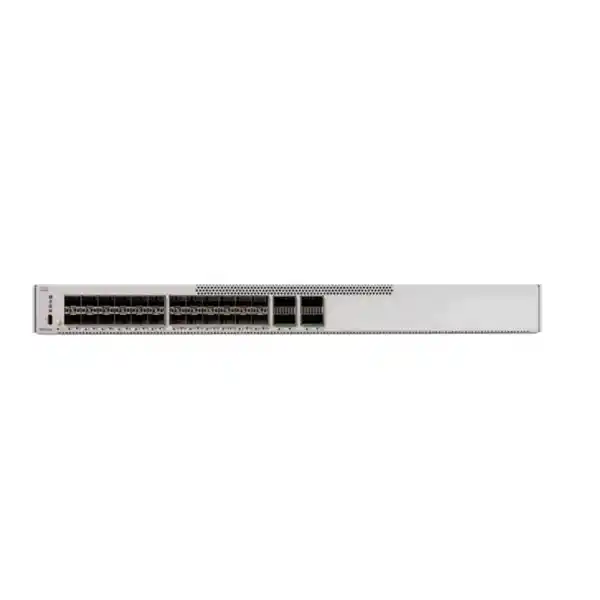
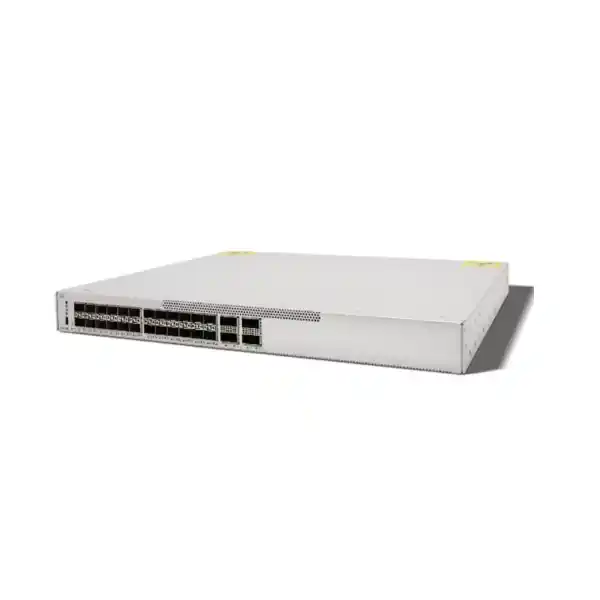
Cisco C9550-24L4CD Smart Switch in Dubai, UAE
A compact 1RU Cisco C9550 fixed core platform for organizations that need dense 50/25/10/1G aggregation, 100G or 400G backbone connectivity, advanced routing, segmentation, telemetry, resiliency, and flexible cloud or device-led operations without moving to a modular chassis.
Direct answer: what is the Cisco C9550-24L4CD?
The Cisco C9550-24L4CD is a fixed enterprise core and distribution smart switch designed for small to medium campus cores, aggregation blocks, and fabric-border roles. It is particularly useful when an organization has multiple access or distribution switches presenting 1G, 10G, 25G, or 50G optical links and needs to consolidate those connections into a compact switch with high-speed 100G or 400G uplinks toward another core switch, a server or services block, a data-center handoff, or a campus backbone.
The model combines 24 SFP56 downlink interfaces with four QSFP-DD uplink interfaces. The downlink ports can operate at 50G, 25G, 10G, or 1G according to the supported optic and configuration, while the uplink group supports 100G or 40G operation and can be used as two 400G links. This port mix makes the C9550-24L4CD attractive to UAE enterprises that want to modernize from 10G aggregation without replacing every downstream device on day one. Existing links can remain at a lower supported speed while new high-bandwidth access or distribution connections are introduced over time.
The switch uses Cisco IOS XE and Cisco Silicon One E104 forwarding hardware. Cisco publishes up to 2.4 Tbps of system bandwidth for the C9550-24L4CD itself, while the E104 ASIC platform has a higher switching capability; the distinction is important for accurate sizing. The switch also supports StackWise Virtual, stateful switchover with StackWise Virtual, in-service software upgrades, enterprise Layer 2 and Layer 3 services, multicast, IPv6, BGP EVPN, Flexible NetFlow, programmability, out-of-band management, and security functions intended for modern campus architectures.
Where the C9550-24L4CD fits in a UAE network
Campus core
Use a pair of C9550-24L4CD switches as a compact resilient core for an office campus, education environment, healthcare site, hospitality complex, logistics facility, or multi-floor commercial building where 25G and 50G aggregation growth is expected but a modular chassis would be excessive.
Distribution aggregation
Aggregate multiple access switches over 10G, 25G, or 50G while preserving high-speed northbound connectivity. This role is useful in large buildings where each floor or zone has an access stack and the aggregation layer must provide high route and policy scale.
Fabric border
In a software-defined campus, the platform can be positioned at the fabric boundary where virtualized campus services meet traditional routing domains, shared services, data-center networks, WAN infrastructure, or internet and security zones.
Backbone modernization
The multi-rate port design supports phased upgrades. A network team can migrate selected uplinks from 10G to 25G or 50G, then introduce 100G or 400G core interconnects as bandwidth demand grows, reducing the need for a disruptive all-at-once refresh.
Verified hardware and scale specification
| Product ID | C9550-24L4CD |
| Form factor | 1RU fixed core/distribution switch |
| Downlink interfaces | 24 × SFP56 supporting 50/25/10/1G |
| Uplink interfaces | 4 × QSFP-DD supporting 100/40G operation or 2 × 400G |
| Data-plane ASIC | 1 × Cisco Silicon One E104 |
| Published system bandwidth | Up to 2.4 Tbps for the C9550-24L4CD SKU |
| Forwarding rate | Up to 2.6 Bpps |
| CPU | AMD x86, up to 3.8 GHz, 4 cores |
| System memory | 16 GB DDR5 DRAM |
| Flash | 18 GB |
| Optional SSD | Up to 960 GB SATA SSD for local storage and application hosting |
| Packet buffer | 64 MB shared-memory system buffer |
| MAC scale | Up to 64,000 MAC addresses |
| IPv4 route scale | Up to 512,000 routes |
| IPv6 route scale | Up to 256,000 routes |
| VLAN IDs / active VLANs | 4094 / 4094 |
| SVIs | Up to 4000 |
| Jumbo frame size | Up to 9216 bytes |
| Power supply bays | 2, supporting 1+1 redundancy; one PSU ships by default |
| Default PSU | C9K-PWR-750WAC |
| Fan trays | 5 field-replaceable fan positions |
| Dimensions / weight | 4.39 × 44.45 × 46.1 cm; approximately 9.15 kg with two PSUs and fans |
Port architecture: how to use the 24 SFP56 and QSFP-DD interfaces
The defining characteristic of the C9550-24L4CD is not merely the number of interfaces; it is the combination of multi-rate SFP56 downlinks and very-high-speed QSFP-DD uplinks in a 1RU fixed platform. In a traditional campus refresh, access switches may still present 10G uplinks, newer distribution switches may present 25G or 50G, and the core may need 100G or 400G for inter-core, data-center, firewall, or aggregation connectivity. A switch that can accommodate those speed transitions reduces the number of specialized aggregation devices required.
The 24 SFP56 downlink ports support 50G, 25G, 10G, and 1G. That allows a network designer to reserve higher-speed links for traffic-intensive buildings, wireless aggregation, high-density user areas, virtualization zones, or server-connected distribution while retaining lower-speed optics for legacy areas. Port-by-port speed planning should be performed before procurement because the switch interface capability is only one part of the design. The optic, fiber type, connector, distance, peer interface capability, breakout method if applicable, and software support all need to match.
The four QSFP-DD front-panel uplinks provide the backbone side of the design. Cisco describes them as supporting 40G, 100G, and 400G operation, with the C9550-24L4CD specifically supporting four 100/40G uplinks or two 400G links in its fixed-uplink design. In practice, that gives architects multiple ways to build redundancy. A pair of 100G links can be directed toward separate upstream systems, 400G can be reserved for very high-capacity east-west traffic, and a StackWise Virtual design can use front-side interfaces while still preserving sufficient bandwidth for routed or switched production links.
For a Dubai deployment, FourTeck recommends creating a port map before the bill of materials is finalized. The map should identify every peer switch, intended speed, media type, optic SKU, fiber pair, patch-panel location, redundancy group, logical role, and expected day-one utilization. That exercise prevents common implementation problems such as ordering a 25G optic when the peer is locked to 10G, choosing an incompatible fiber reach, consuming all high-speed ports for normal access traffic, or discovering during migration that a legacy uplink requires a transceiver type that was never included in the purchase.
A well-planned port map also leaves growth space. A core switch should not be sized only to the interfaces connected on commissioning day. Capacity for an additional access block, a second data-center link, a future firewall cluster, a new building, or a 100G-to-400G migration should be considered. The 24-port density of this model is best suited to sites where this headroom remains realistic. If a design consumes nearly all 24 downlinks immediately and a large expansion is already funded, a higher-density C9550 model may produce a cleaner long-term architecture.
Silicon One E104 performance: throughput, buffers, and forwarding scale
The C9550-24L4CD uses a single Cisco Silicon One E104 ASIC for the data plane. Cisco publishes an E104 ASIC switching capacity of up to 3.2 Tbps and forwarding performance up to 2.6 billion packets per second for E104-based C9550 models. For this specific 24-port SKU, however, Cisco publishes system bandwidth of up to 2.4 Tbps. Those figures should not be conflated. The ASIC capability describes the forwarding silicon family; the product-specific system figure is the more relevant number for chassis-level capacity planning.
Forwarding capacity matters because a campus core often handles a diverse traffic mix: large backup flows, small collaboration packets, east-west application traffic, multicast, internet-bound traffic, security-service chains, and routing control traffic. A high packet-per-second ceiling reduces the likelihood that a design which looks sufficient in gigabits per second becomes constrained by small-packet forwarding. The appropriate sizing method therefore looks at both aggregate bandwidth and packet rate, while also considering oversubscription, burst behavior, failure scenarios, and future speed upgrades.
The platform provides a 64 MB low-latency shared-memory system buffer. Buffering should be understood as part of an end-to-end congestion strategy, not as a substitute for capacity planning. Short bursts can be absorbed, but sustained oversubscription still needs quality-of-service design, traffic engineering, adequate uplink capacity, and realistic application behavior. For example, several 50G downlinks converging toward a smaller 100G path can create congestion if simultaneous demand exceeds the available upstream bandwidth. QoS can prioritize critical traffic, but it cannot create missing bandwidth.
The default core SDM template is designed to allocate forwarding resources for a core role. On E104-based C9550 models, Cisco documents scale including 64,000 MAC addresses, 80,000 IP host routes, up to 512,000 longest-prefix-match IP routes, 16,000 multicast routes, 8,000 IGMP/MLD snooping entries, 24,000 security/object groups, up to 32,000 NetFlow entries in each direction, up to 21,000 security ACL entries in each direction, 5,000 QoS ACL entries, 8,000 policy-based-routing entries, and 1,000 GRE tunnels. IPv4 and IPv6 entries share certain tables, and IPv6 entries consume additional resources, so mixed-protocol designs should be modeled rather than simply adding maximum values together.
For most enterprise campus deployments, the practical advantage is flexibility. The C9550-24L4CD is not only a high-speed Layer 2 aggregation box. It can carry a substantial routing and policy workload, which allows collapsed-core designs, routed-access designs, fabric-border functions, segmentation gateways, and multicast-heavy environments to be implemented on the same hardware class when the selected IOS XE release and license support the required features.
Routing, VLAN, multicast, and campus-fabric capabilities
The C9550 Series supports enterprise Layer 2 switching, IP routing, IP multicast routing, IPv6 routing, IPv6 multicast routing, Software-Defined Access functions, and BGP EVPN. That makes the C9550-24L4CD suitable for conventional campus architectures as well as more modern overlay-based designs. A network team can continue using established VLAN, SVI, routing, first-hop redundancy, and multicast operational practices while introducing more automated fabric models where they create measurable value.
At Layer 2, the model supports up to 4094 VLAN IDs and 4094 active VLANs, with up to 4000 switched virtual interfaces. It also supports PVST and MST scale appropriate for enterprise use. Even when a switch can technically support thousands of VLANs, a good design avoids unnecessary Layer 2 sprawl. Limiting broadcast domains, moving routing closer to the access layer where appropriate, and using clear segmentation boundaries generally produce easier troubleshooting and better failure containment than simply extending every VLAN everywhere.
At Layer 3, the route scale enables the switch to operate as a serious campus core rather than a small aggregation device. Static routes, dynamic routing, summarization, route filtering, equal-cost paths, and policy boundaries can be designed according to business requirements. In a multi-building UAE campus, for example, each building distribution layer can advertise summarized prefixes to the C9550 core. The core can then provide default or summarized routes toward the WAN, firewall, data center, or internet edge, reducing control-plane complexity while still maintaining high availability.
BGP EVPN support provides a path toward scalable overlay and fabric designs. EVPN can carry endpoint reachability and segmentation information in a control-plane-driven model rather than relying entirely on flood-and-learn behavior. Whether this is appropriate depends on the organization’s operational maturity, controller strategy, address plan, and need for mobility or multi-tenant segmentation. FourTeck can design the C9550-24L4CD as a traditional routed core, an SD-Access border, or part of an EVPN-based architecture, but the design should be chosen for operational simplicity as much as for feature richness.
Multicast capabilities are also important in surveillance, IPTV, financial information distribution, building systems, and collaboration environments. IGMP and MLD snooping constrain Layer 2 multicast replication, while multicast routing controls traffic between routed boundaries. Correct rendezvous, source, receiver, and redundant-path planning is essential. The raw multicast scale is meaningful, but configuration quality determines whether the resulting network behaves predictably during link failures and topology changes.
High availability with StackWise Virtual, SSO, ISSU, and redundant hardware
Core-switch availability must be designed at the system level. The C9550 Series supports Cisco StackWise Virtual using front-side ports, together with stateful switchover. Two physical switches can be operated as a resilient logical system for designs that benefit from a simplified control and forwarding topology. This can reduce dependence on spanning tree for core redundancy, enable multi-chassis port-channel designs, and provide a more deterministic failure model than two unrelated standalone switches.
StackWise Virtual does not eliminate the need for failure-domain analysis. The two switches should be connected to independent upstream and downstream paths where possible, powered from separate circuits or UPS feeds, and cabled so that a single patch-panel, fiber tray, or accidental disconnect cannot remove both redundant paths. If both switches are installed in the same rack, the design should consider rack-level power and cooling risks. If placed in different racks or rooms, the StackWise Virtual link and dual-active detection design need appropriate fiber reach and physical diversity.
The C9550-24L4CD provides two power-supply bays and supports 1+1 power redundancy. Cisco ships one 750W AC power supply by default for this model, so a truly redundant design requires ordering the second PSU rather than assuming it is included. Five fan trays are used in the 1RU platform, and the selected airflow direction should match the rack’s hot-aisle/cold-aisle design. Redundancy is weakened if two PSUs are connected to the same PDU or if opposite airflow components are mixed incorrectly.
Cisco IOS XE also supports operational continuity functions including in-service software upgrades and software maintenance upgrades. These capabilities can reduce interruption during planned maintenance, but change planning remains necessary. Network teams should verify the exact upgrade path, feature compatibility, redundancy state, configuration synchronization, image integrity, and rollback method before a production change. Stateful forwarding during an upgrade is only one element of service continuity; connected devices and upstream systems also need stable link and routing behavior.
For UAE organizations with strict change windows, the preferred implementation is normally a two-switch core with redundant power, diverse links, pre-tested software, and an agreed migration sequence. FourTeck can stage both switches off-site or in a lab, apply baseline configuration, establish StackWise Virtual where required, validate optics, test routing adjacencies and port channels, and then migrate production links in controlled groups. This approach reduces the number of unknowns during the live cutover.
Security, segmentation, encryption, and traffic visibility
A modern campus core is part of the security architecture. The C9550 platform supports hardware access control, segmentation technologies including VXLAN and Cisco TrustSec, line-rate MACsec capability, AES-GCM-256 encryption support, telemetry, SPAN and ERSPAN traffic mirroring, IP Device Tracking, switch-integrated security functions, and hardware capabilities intended for newer protection mechanisms. Some advanced functions, including specific IPsec, post-quantum, and Cisco Live Protect capabilities, can depend on software release and licensing status, so they should be validated against the target IOS XE release before inclusion in a compliance or security design.
Access control lists remain one of the most direct enforcement tools. The E104-based C9550 scale supports large security ACL tables, allowing policy to be enforced at high speed without forcing every packet through an external appliance. This is useful for separating server, user, voice, wireless, building-management, guest, and administrative networks. However, ACLs should be governed by a clear object and naming strategy. Thousands of technically valid entries can still become operationally unsafe if administrators cannot understand why they exist, who owns them, and when they can be removed.
Cisco TrustSec can be used to express policy through security-group concepts rather than relying solely on IP address boundaries. In environments that use identity-driven segmentation, this can make policy more portable as users and devices move. VXLAN provides an overlay mechanism that can separate logical networks from the physical underlay. Together with SD-Access or EVPN architectures, these technologies can reduce the need to stretch conventional VLANs across large areas while still maintaining consistent segmentation.
MACsec is particularly relevant on campus backbone links where encryption of Ethernet traffic is required. Instead of assuming that fiber inside a building is automatically trusted, organizations can protect high-value links between network devices. Encryption planning must account for supported optic and port combinations, key management, failure behavior, operational monitoring, and interoperability. The objective is not simply to enable a command; it is to maintain encrypted forwarding during normal operation and predictable recovery during maintenance or failures.
Flexible NetFlow gives network teams flow-level visibility that can support troubleshooting, capacity management, security analytics, and application understanding. On E104-based C9550 models, Cisco documents up to 32,000 NetFlow entries in ingress and 32,000 in egress. SPAN and ERSPAN can mirror packets for deeper analysis. Used together, these tools help answer operational questions such as which source is generating unexpected bandwidth, which applications dominate a congested uplink, whether a route change altered traffic direction, and where to attach a packet analyzer without physically relocating equipment.
For organizations that need wider security architecture assistance, FourTeck can combine the switch design with firewall and segmentation planning through the Firewall Dubai practice, ensuring the campus core, security edge, and routed zones are designed as one system rather than as isolated products.
Operations: IOS XE, telemetry, programmability, and management choices
Cisco IOS XE provides the operating environment for the C9550 Series. For the C9550-24L4CD, Cisco identifies IOS XE 26.2.1 as the minimum software requirement in the current data sheet. The platform combines a familiar enterprise CLI with programmatic interfaces, telemetry, automation, and modern management options. This matters because a switch installed today may remain in service for many years, and operational scalability often becomes more important than the first-day feature checklist.
Traditional device-led management remains available through console, SSH, and CLI workflows. For teams with established network engineering practices, this provides detailed local control and predictable troubleshooting. At the same time, Cisco’s unified hardware approach allows organizations to select cloud or device-oriented management models without buying a completely different physical switch. The current C9550 positioning includes Meraki dashboard options and device configuration workflows, while on-premises controller integration should always be checked against the exact software release and compatibility matrix planned for deployment.
Streaming telemetry can provide a richer operational model than periodic polling alone. Rather than waiting for a five-minute polling cycle to reveal an interface spike, telemetry can export time-series state more continuously to supported collectors. Network teams can use this data for capacity planning, anomaly detection, change validation, and service-level reporting. The value depends on the monitoring architecture: collectors must be sized, data retained sensibly, alerts tuned, and dashboards built around operational decisions rather than collecting every available metric without a purpose.
Programmability is equally important for repeatability. Common configuration fragments, interface descriptions, VLAN assignments, routing policies, QoS templates, and compliance checks can be automated. In a multi-site enterprise, a tested automation workflow can reduce configuration drift and typing errors. Automation should be introduced with version control, peer review, pre-change validation, and rollback capability. A script that makes mistakes faster is not an improvement; the objective is controlled consistency.
FourTeck can integrate the switch deployment into broader UAE network operations through FourTeck IT Services UAE, including baseline configuration, monitoring integration, configuration backup, firmware governance, change procedures, and structured handover documentation.
Application hosting and local compute resources
The C9550-24L4CD includes an x86 control-plane architecture with an AMD processor running up to 3.8 GHz across four cores, 16 GB of DDR5 memory, and 18 GB of flash. The platform can also be ordered with up to 960 GB of SATA SSD storage for local application hosting. Cisco documents up to 4 GB of DRAM and up to two vCPUs for application hosting on E104-based models, together with two 10G AppGig interfaces.
On-box application hosting can reduce the need for a separate server in use cases where a lightweight containerized network service benefits from proximity to the forwarding platform. Examples might include telemetry collection, localized analysis, approved troubleshooting tools, or operational agents. The correct use case should be selected carefully. A campus core remains critical infrastructure, and application hosting should not compete unnecessarily with switching operations or turn the network device into an unmanaged general-purpose server.
If the SSD is needed, it must be included during ordering according to Cisco’s current ordering guidance. That requirement should be captured early in the bill of materials. A later assumption that local storage is present can cause project delay. The same applies to the application image, resource reservation, security controls, lifecycle ownership, logging, backup, and upgrade procedure. Every hosted application should have a documented owner and maintenance policy.
Where heavier compute is required, it is normally better to keep the application on dedicated infrastructure. FourTeck’s Server Dubai portfolio can be used for dedicated virtualization, management, logging, analytics, or network-services workloads while the C9550 remains focused on high-performance switching and routing.
Power, cooling, rack, and environmental planning for Dubai
The C9550-24L4CD is a 1RU switch measuring approximately 4.39 cm high, 44.45 cm wide, and 46.1 cm deep including fan and tray handles. Cisco lists a weight of approximately 9.15 kg when equipped with two power supplies and built-in fans. These dimensions are compact for a core switch, but rack planning must still allow space for front and rear cabling, transceiver bend radius, power leads, fiber management, service access, and airflow.
The model supports two 750W AC power supplies. One C9K-PWR-750WAC is the default according to Cisco ordering guidance, while the second PSU is optional and should be ordered for 1+1 redundancy. The PSU accepts 90 to 264 VAC at 47 to 63 Hz. Cisco publishes power-supply efficiency of approximately 96 percent at 230 VAC and 50 percent load, with an IEC 60320 C16 input receptacle. UAE data-center and equipment-room deployments should select the appropriate power cords and PDU connector types at ordering time rather than relying on adapters after installation.
Cisco publishes heat dissipation of 1,880 BTU per hour for the C9550-24L4CD with the 750W AC PSU class. This figure is useful for cooling calculations, especially where several high-speed switches are concentrated in a small communications room. The value should be included in the overall rack heat budget together with firewalls, servers, UPS equipment, optical transport systems, and other network devices. Air-conditioning capacity should be planned for the full room load and expected growth, not only the switch itself.
The 1RU C9550 uses five fan modules. Cisco provides airflow variants: C9550-FAN-1U-R for front-to-back cooling and C9550-FAN-1U-F for back-to-front cooling. The operating-temperature range depends on the selected airflow configuration, with Cisco documenting up to 45°C for the front-to-back variant and up to 35°C for the back-to-front variant, starting from -5°C. The rack should use a consistent airflow direction so that hot exhaust from one device is not drawn directly into the intake of another.
In Dubai, ambient outdoor temperature is not the same as equipment inlet temperature. The relevant condition is the controlled temperature at the switch intake. However, communications rooms close to external walls, warehouses, temporary facilities, and sites with intermittent cooling can experience high inlet temperatures. Monitoring temperature sensors and integrating high-temperature alarms into network operations is therefore an important part of deployment, even when the nominal room set point is well within limits.
Power redundancy should be physically independent. Two PSUs connected to a single PDU protect against a PSU failure but not a PDU, circuit, UPS, or upstream breaker failure. Where business continuity requires it, use separate A and B power feeds and confirm that both are able to carry the switch load independently. Label both feeds, document the rack elevation, and capture the physical design in the handover pack.
Optics, fiber, DAC/AOC, and cabling design
High-speed switching projects are frequently delayed by optics rather than by the switch itself. The C9550-24L4CD accepts multiple interface speeds, but the complete link only works when both endpoints support the same Ethernet mode and when the transceiver, cable, wavelength, fiber type, and reach are compatible. Cisco’s supported-optics matrix changes over time, so the final transceiver bill of materials should be checked against the exact switch model and software release at the time of purchase.
For short in-rack or adjacent-rack links, direct-attach copper or active optical options may be suitable where supported. For longer campus links, multimode or single-mode fiber is typically selected according to distance and existing cabling infrastructure. A design should avoid choosing the optic solely on price. Connector type, patch-panel density, fiber loss budget, splices, distribution frames, cable pathway, cleaning procedures, and future reuse can materially affect reliability and lifecycle cost.
Migrating from 10G to 25G or 50G may expose limitations in older fiber plants. A link that worked at one speed does not automatically guarantee performance at a higher speed or with a different optic type. Before a large cutover, critical backbone fibers should be documented and, where appropriate, tested. For single-mode links, optical power and cleanliness are especially important; for multimode links, distance and fiber grade must align with the transceiver design.
The four QSFP-DD uplink positions require additional planning because the ports are valuable. A design that uses all high-speed interfaces for local connections may leave no flexible path for a future 400G core interconnect. Conversely, reserving every QSFP-DD port for future growth while current uplinks are congested also makes little sense. FourTeck normally prepares a day-one, failover, and three-year port-use view so that the selected optic mix supports both present traffic and practical expansion.
Fiber patching should be labeled from both ends and mapped to logical interface descriptions. The switch configuration should identify the peer device, peer port, service, speed, and circuit or fiber identifier. That small operational discipline can save hours during a failure when engineers need to determine whether a loss of light is caused by a transceiver, patch lead, ODF, campus fiber, or remote device.
Cisco unified licensing for the C9550-24L4CD
The C9550 generation uses Cisco’s newer unified licensing model. For this specific model, Cisco’s ordering guide maps the C9550-24L4CD to the LIC-CS-CO-M-A license, described as Cisco Switching Advantage Core Fixed License, Medium. Cisco currently states that only the Advantage tier is available for C9550 Series Smart Switches. For a new subscription, the unified switching license requires a minimum term of 36 months.
This differs from older Catalyst 9000 buying patterns that many IT teams may be familiar with. A procurement team should therefore avoid copying a previous C9500 license line blindly into a new C9550 order. The hardware, subscription, support level, management preference, power supply count, power cable, optics, SSD option, and any special rack accessories should be reviewed together as one configured solution.
Cisco describes unified licensing as a per-device model that can support flexible management options. License assets are associated with Cisco Smart Account processes, so organizations should identify the correct Smart Account and virtual account before order placement. This prevents hardware arriving on-site while the software entitlement is associated with the wrong business unit or a temporary account controlled by an external contractor.
The correct support level should also be included. Cisco’s current unified support model can include hardware and software coverage, access to TAC, software updates, and related support functions, with optional RMA upgrades at the device level. Exact entitlement depends on the purchased subscription and support configuration, so service expectations should be confirmed in the quote instead of assuming a particular replacement SLA from the hardware model alone.
FourTeck can provide the C9550-24L4CD as a complete UAE bill of materials rather than as a standalone chassis line. Customers can work through FourTeck UAE for commercial sourcing, technical validation, licensing alignment, implementation, and ongoing support coordination.
Design methodology: sizing the switch for real workloads
A correct switch selection begins with traffic and topology, not with the largest specification in the data sheet. First identify every physical uplink that will terminate on the core: access stacks, distribution pairs, wireless aggregation, servers, storage or virtualization blocks, firewalls, WAN routers, internet edges, data-center interconnects, voice systems, surveillance networks, and building-management networks. Each connection should have a current average, current peak, expected three-year peak, resilience requirement, and intended Ethernet speed.
Second, model failure conditions. A network with two 100G uplinks may appear comfortable when both are active, but the surviving link must carry the load when one path fails. If normal utilization is already above roughly half of the combined design capacity, the single-link failure state may become congested. The precise threshold depends on application tolerance and QoS, but the principle is universal: size redundancy based on the degraded state, not only the healthy state.
Third, consider traffic direction. Campus traffic is no longer simply user-to-internet. Collaboration, local SaaS gateways, on-premises applications, Wi-Fi roaming, backups, security inspection, virtualization, and east-west workloads can create multiple simultaneous paths. A core that connects both access aggregation and a local server zone may carry the same flow twice if routing or security service insertion causes hairpinning. Flow telemetry from the existing network can reveal these patterns before migration.
Fourth, compare interface count with route and policy scale. A small number of very fast links can still carry a large number of endpoint routes, VRFs, ACLs, security groups, or flows. Conversely, a network with many physical links may have a simple default-route topology. The C9550-24L4CD provides substantial scale for a compact device, but very large internet-routing or massive campus deployments may be better served by higher-scale members of the C9550 family.
Fifth, preserve practical growth. Leaving two or four downlink ports unallocated is not enough if every future project requires 100G or 400G. Headroom must be preserved in the correct interface type. A growth plan should identify which QSFP-DD port will serve the next backbone upgrade, whether the remaining system bandwidth can support it, and whether the opposite core switch, firewall, or router can accept the same speed.
FourTeck can perform this sizing exercise during pre-sales design. The result is a defensible architecture that links each requested hardware line to a network requirement. That is more valuable than purchasing a powerful switch and discovering later that the constraint is actually fiber reach, firewall capacity, power availability, licensing, or an upstream interface running at a lower speed.
Recommended deployment patterns
Pattern 1: dual-switch collapsed core
Deploy two C9550-24L4CD switches in a resilient pair. Connect each access or distribution block redundantly to both core members, use routed links or multi-chassis EtherChannel according to the design, and provide dual 100G or 400G northbound paths to security or data-center services.
Best for medium campuses that need high availability but want to avoid the rack space, power, and cost of a modular chassis.
Pattern 2: dedicated distribution pair
Use the C9550 pair to aggregate multiple access domains while a separate core or data-center platform provides higher-level routing. This is useful when a large building requires many 25G or 50G access uplinks but the enterprise already has an established central core.
Best for phased campus expansion, building aggregation, or organizations separating operational domains.
Pattern 3: fabric border and fusion handoff
Place the switch at a campus fabric boundary to connect virtualized segments to shared services, WAN, internet, data center, or traditional routing domains. High route and ACL scale supports policy-rich border designs.
Best for enterprises adopting SD-Access or controlled overlay segmentation while retaining existing non-fabric services.
Pattern 4: 10G-to-50G migration core
Retain supported 10G links for legacy access while migrating priority areas to 25G or 50G. Use 100G initially for core interconnects and preserve QSFP-DD capacity for future 400G where justified.
Best for organizations that need a staged refresh with minimal disruption and clear speed-growth milestones.
Migration from an older Catalyst core or distribution layer
A successful migration is more than translating configuration syntax. Older Catalyst platforms may use license models, stacking methods, port numbering, transceiver support, QoS defaults, spanning-tree behavior, routing scale, and management workflows that differ from the C9550 generation. The existing configuration should therefore be reviewed line by line and classified into required services, obsolete statements, temporary workarounds, and features that need a new design.
Begin with inventory. Capture every active interface, speed, optic, VLAN, port channel, routing neighbor, first-hop redundancy group, ACL, QoS policy, multicast configuration, management source, authentication method, SNMP or telemetry destination, NTP source, DNS setting, logging server, certificate, and automation integration. Compare this inventory with traffic statistics so that unused configuration is not migrated simply because it exists in the old running configuration.
Next, create a dependency map. A VLAN may appear local to the core but support a firewall subinterface, wireless controller, call manager, virtual server cluster, or monitoring appliance. A routing neighbor may be a critical WAN path. An ACL may be referenced by a management plane control or route map. Dependencies should be understood before any simplification is attempted.
Build and test the new C9550 configuration before the outage window. Where practical, connect test devices or a small non-production segment and validate Layer 2, routing, telemetry, authentication, logging, and management. Confirm that optics come up at the intended speed and that both power supplies, fans, and redundant links report healthy state. If StackWise Virtual is used, test a member failure, link failure, and switchover under controlled conditions.
During cutover, migrate in controlled groups rather than moving every cable simultaneously. Maintain a live port map and record the old and new interface for each link. Verify the first migrated service end to end before continuing. Routing adjacency alone is not enough; test application reachability, DNS, internet access, internal services, voice, wireless, and any business-critical systems identified in the change plan.
Finally, retain a rollback plan that can be executed within the available change window. A rollback should identify the exact trigger for reverting, which cables move back, whether the old configuration remains unchanged, and how routing convergence will be controlled. After migration, monitor interface errors, drops, CPU, memory, temperature, routing stability, NetFlow, and application complaints before closing the change.
UAE procurement and project planning
For a Dubai or UAE project, the purchasing request should identify more than the base switch model. The C9550-24L4CD normally needs a complete configured bill of materials that includes the hardware chassis, required Cisco unified license, one or two 750W AC power supplies, a matching power cable for each PSU, the correct airflow fan selection, rack mounting hardware, optics or cables for every active interface, optional SSD if application hosting is required, and the desired support service.
Lead time should be checked for the entire solution. A switch can be physically available while a required 400G optic, special cable, spare PSU, or accessory is not. Project dates should therefore be based on the slowest critical line item. If the network must be live before a fixed office opening, data-center migration, or audit date, order planning should include staging, configuration, burn-in testing, delivery, rack installation, migration, and post-cutover observation.
Commercial comparison should also be like-for-like. One quote may include a second PSU, three-year subscription, support, optics, and installation while another lists only the chassis. Comparing only the top-line price can therefore create a misleading impression. FourTeck can provide an itemized BOM so procurement can see which components are mandatory, which are recommended for resiliency, which are optional, and which are project services.
Asset ownership should be planned at the same time. Record serial numbers, rack location, Smart Account assignment, support entitlement, subscription dates, management IPs, device names, and configuration backup location. For large enterprises with multiple offices, this information should be added to the CMDB or asset platform immediately after acceptance rather than reconstructed months later during a failure.
Organizations with operations beyond the UAE can also coordinate multi-country network programs through FourTeck Africa, while maintaining a consistent switching, security, documentation, and support approach across regional sites.
Implementation runbook for the C9550-24L4CD
1. Discovery and design
Document the existing topology, VLANs, routes, uplink utilization, optics, rack power, fiber paths, management systems, business-critical services, and change constraints. Define whether the new switch is core, distribution, fabric border, or a combination.
2. Bill of materials
Select C9550-24L4CD hardware, LIC-CS-CO-M-A licensing, redundant PSU if required, power cords, airflow direction, optics, cables, optional SSD, spares, support, and installation services. Validate optic support against the planned IOS XE release.
3. Staging
Inspect hardware, verify serials, install power supplies and fans, load the approved software version, establish baseline security, configure management access, synchronize time, enable logging, apply naming conventions, and record all software and hardware versions.
4. Resiliency configuration
Build StackWise Virtual if selected, configure redundant port channels or routed links, validate stateful operation, test each power feed, verify fan and environmental status, and confirm the switch remains reachable through the approved management path.
5. Service configuration
Apply VLANs, SVIs, routing, multicast, ACLs, QoS, telemetry, NetFlow, authentication, NTP, DNS, SNMP or streaming telemetry, banners, certificate requirements, and any fabric or EVPN functions included in the design.
6. Migration and acceptance
Move links according to the approved sequence, test each service, monitor counters and routing, validate redundancy, capture final configuration and diagrams, update asset records, hand over credentials securely, and obtain technical acceptance before decommissioning the old platform.
Frequently asked technical questions
Is the C9550-24L4CD a Layer 2 switch or a Layer 3 switch?
It supports both advanced Layer 2 and Layer 3 operation. Cisco lists IP routing, IPv6 routing, multicast routing, SD-Access, BGP EVPN, ACLs, QoS, telemetry, and other enterprise features. It is designed for core and distribution roles rather than only access-layer switching.
How many 400G ports does the C9550-24L4CD provide?
The switch has four QSFP-DD uplink positions, with the fixed-uplink design supporting four 100/40G links or two 400G links. A port plan should therefore be created before deciding how many links are reserved for StackWise Virtual, upstream routing, data-center connectivity, or future backbone growth.
Does it support 1G, 10G, 25G, and 50G at the same time?
The 24 SFP56 downlinks are multi-rate and support 50/25/10/1G. The actual combination depends on supported transceivers, peer capabilities, and configuration. Mixed-speed migration is one of the model’s strongest design advantages.
Is the switch 3.2 Tbps or 2.4 Tbps?
Cisco documents the E104 ASIC family at up to 3.2 Tbps switching capacity, but the current product-specific table lists the C9550-24L4CD system bandwidth at up to 2.4 Tbps. For chassis sizing, use the product-specific system figure and keep the ASIC capacity as a separate architectural specification.
Does it include redundant power supplies?
The chassis supports two 750W AC PSUs and 1+1 redundancy, but Cisco’s current ordering guide lists one PSU as the default. A second C9K-PWR-750WAC must be included when redundant power is required.
What license should be quoted?
Cisco maps this model to LIC-CS-CO-M-A, the Switching Advantage Core Fixed License, Medium. C9550 currently uses the Advantage tier, and new unified switching subscriptions require at least a 36-month term. The final quotation should confirm subscription and support selections.
Can the switch be cloud managed?
Cisco positions the C9550 as unified hardware with flexible cloud and device-led management choices, including Meraki dashboard workflows. Exact management functions and controller compatibility should be validated against the IOS XE release and operating mode selected for the project.
Does it support MACsec and security segmentation?
The C9550 platform supports line-rate MACsec capability, hardware ACLs, VXLAN, Cisco TrustSec, and other enterprise security functions. Some newer security capabilities can depend on software availability and licensing, so implementation should follow the feature matrix for the deployed release.
What is the best deployment in a medium enterprise?
A pair of C9550-24L4CD switches is often the most resilient pattern: dual power, diverse links, StackWise Virtual or routed redundancy, separate uplinks toward security and data-center services, and enough unused SFP56 and QSFP-DD capacity for growth. The exact topology depends on route scale, failure requirements, cabling, and whether the campus uses traditional routing or a fabric.
Why source the Cisco C9550-24L4CD through FourTeck
A core-switch purchase carries architectural consequences for years. FourTeck approaches the C9550-24L4CD as a design and lifecycle project rather than only a hardware transaction. The engagement can begin with requirement discovery, where interface counts, traffic growth, optics, routing, security zones, high availability, licensing, power, and rack constraints are collected before a bill of materials is issued.
The technical team can then produce a port map, high-level design, low-level configuration plan, migration method, staging checklist, test procedure, and rollback plan. This is especially useful when the C9550 is replacing an existing Catalyst core and the old configuration contains years of accumulated policies. Rather than copying everything unchanged, the migration can preserve required services while removing obsolete configuration and introducing consistent naming, telemetry, security, and documentation standards.
FourTeck can also coordinate the surrounding infrastructure. The switch may connect to firewalls, servers, wireless controllers, WAN routers, IP telephony, surveillance, or cloud gateways. Treating these dependencies as a single architecture reduces late-stage surprises. Where customers need broader technology sourcing and integration, the main FourTeck UAE site provides a consolidated point of contact for enterprise networking and infrastructure requirements.
Post-deployment support can include configuration backup, software lifecycle review, hardware health monitoring, incident troubleshooting, capacity review, and planned change assistance. The goal is to keep the new core predictable and supportable after the project team has handed it over to operations.
Decision recap: is the C9550-24L4CD the right model?
Strong fit when
You need up to 24 multi-rate 1G/10G/25G/50G downlinks in a compact core or distribution role.
You need 100G today with a practical path to two 400G backbone links.
You require StackWise Virtual, advanced routing, high ACL and route scale, telemetry, SD-Access or EVPN capability, and Cisco IOS XE operations.
You want a fixed 1RU platform instead of the size and complexity of a modular chassis.
Consider a larger model when
Most of the 24 downlinks will be consumed on day one and funded expansion is already planned.
The design needs materially more system bandwidth, more 100G interfaces, or substantially higher route and MAC scale.
A very large campus, internet edge, or aggregation environment requires the scale of the 96-port or XL C9550 platforms.
The project requires a modular architecture with field-expandable line cards rather than a fixed switch.
The most reliable decision is made from the port map, failover bandwidth model, route and policy counts, optics design, power plan, and three-year growth forecast. FourTeck can review those inputs and confirm whether the C9550-24L4CD, a larger C9550 model, or a different architecture is the better fit.
Quotation input checklist
For an accurate Cisco C9550-24L4CD quotation in Dubai or elsewhere in the UAE, provide the following information where available. Missing items can be worked through during the technical discovery call.
Plan the Cisco C9550-24L4CD as a complete core solution
FourTeck can validate whether the C9550-24L4CD is correctly sized for your Dubai or UAE environment, prepare the optics and licensing bill of materials, design a resilient topology, stage the switches, migrate the existing core, and provide structured handover documentation.
For the fastest technical response, share your existing core model, number and speed of uplinks, desired 100G or 400G backbone design, rack power arrangement, fiber distances, and whether you require a redundant switch pair. This allows the engineering team to return a configuration-focused recommendation rather than a generic hardware quote.

Reviews
There are no reviews yet.