
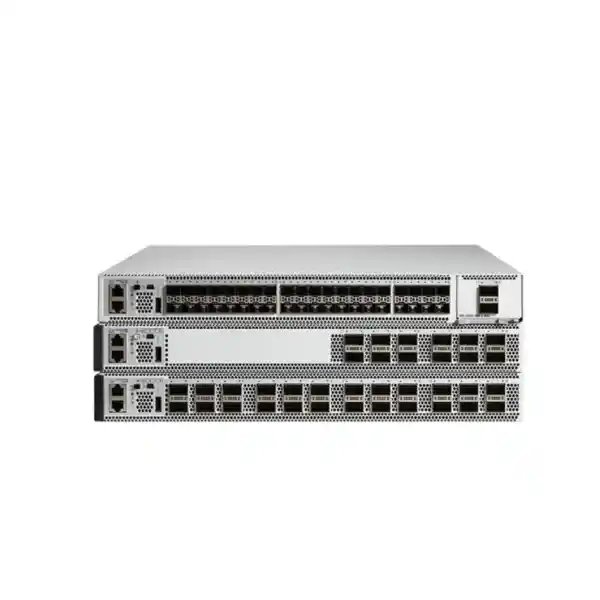
Enterprise Core & Distribution Switching — Dubai, UAE
Cisco C9550-48L4CD Smart Switch
A high-density 1RU fixed core and aggregation switch for organizations that need 50G-capable access aggregation, 100G and 400G backbone connectivity, predictable hardware forwarding, resilient campus design, advanced segmentation, and a modern IOS XE operational model. The C9550-48L4CD is positioned for medium-to-large enterprise campuses where the distribution or collapsed-core layer must absorb increasing east-west traffic, Wi-Fi aggregation, AI-enabled application demand, storage flows, high-performance user access, and security telemetry without forcing an immediate move to a modular chassis.
Platform snapshot
Direct answer: what is the Cisco C9550-48L4CD and who should deploy it?
The Cisco C9550-48L4CD Smart Switch is a fixed-format enterprise core and distribution switch in Cisco’s C9550 Series. It is designed to aggregate multiple high-speed access or distribution blocks while providing large Layer 2 and Layer 3 forwarding scale in a compact 1RU footprint. The model supplies forty-eight multi-rate downlink interfaces that can operate at 50G, 25G, 10G, or 1G, plus four QSFP-DD uplink positions that support 100G or 40G connectivity, with an option to use two 400G uplinks. Its data plane uses the Cisco Silicon One E104 ASIC and delivers up to 3.2 Tbps system switching bandwidth and up to 2.6 billion packets per second of forwarding performance. For UAE buyers, this combination is particularly relevant to enterprise campuses, financial organizations, universities, healthcare groups, government environments, transport operators, hospitality estates, large commercial buildings, and multi-site organizations consolidating high-speed access switching into a resilient core.
This is not an access switch intended to power desktop endpoints. Its value is in aggregation: collecting many 1G, 10G, 25G, or 50G uplinks from downstream switches and moving that traffic into a high-capacity backbone. A campus that is upgrading access switches to 25G or 50G uplinks, introducing dense Wi-Fi access points behind higher-speed access layers, adopting high-resolution video, edge compute, large-scale virtualization, or increasingly data-heavy security inspection can use the C9550-48L4CD as a compact consolidation point. The four high-speed uplink interfaces can connect toward another core block, a data-center gateway, a metro-Ethernet handoff design, or a redundant peer using StackWise Virtual and routed or switched interconnects.
The design question is therefore not simply whether forty-eight ports are required. Engineers should model the number of downstream switches, the speed of each uplink, expected oversubscription, peak traffic patterns, east-west versus north-south flows, route and MAC scale, multicast requirements, resilience expectations, optics distances, fiber type, routing protocol choices, segmentation architecture, management model, and anticipated three-to-five-year growth. FourTeck can assist UAE organizations with this sizing process through its UAE networking and infrastructure practice, helping ensure the selected switch, optics, licensing, power, cooling, rack design, and redundancy model form one coherent deployment rather than a collection of individually correct components.
C9550-48L4CD hardware architecture explained
Cisco Silicon One E104 data plane
At the center of the C9550-48L4CD forwarding architecture is one Cisco Silicon One E104 ASIC. The switch is specified for up to 3.2 Tbps of system switching capacity and up to 2.6 Bpps of packet forwarding. For campus architects, the importance of the ASIC is less about a headline number and more about deterministic forwarding across multiple services at the same time. A core or distribution switch may need to route IPv4 and IPv6, enforce access-control policy, sample traffic for telemetry, process multicast state, support segmentation, and maintain high interface utilization concurrently. Hardware-based forwarding allows those functions to be handled at scale without making the control-plane CPU the normal packet-forwarding path.
Modern x86 control plane
The E104-based C9550 models use an AMD x86 control plane with four CPU cores running up to 3.8 GHz and 16 GB DDR5 memory. The control plane is responsible for routing protocols, management functions, orchestration, software processes, telemetry, and platform services. Separating the high-throughput packet path from the general-purpose control plane means operational services can evolve while switching and routing remain anchored in dedicated forwarding silicon. The platform also includes 18 GB flash and can support up to 960 GB of local SSD capacity, which is relevant for application hosting, local storage requirements, and containerized operational use cases supported by the software release and selected configuration.
Low-latency shared-memory buffering
The C9550-48L4CD provides 64 MB of dedicated low-latency shared-memory-system buffering. Buffering is a crucial design point at aggregation layers because traffic often arrives in bursts from many slower interfaces and must exit through fewer faster interfaces, or the reverse. A correct design therefore considers microbursts, queue scheduling, quality-of-service policy, application sensitivity, and oversubscription rather than evaluating raw bandwidth alone. The buffer architecture, combined with QoS capabilities in IOS XE, helps the switch manage mixed enterprise traffic such as voice, video, transactional applications, storage flows, backup windows, SaaS access, and large file transfers across the same physical infrastructure.
Compact 1RU mechanical design
The C9550-48L4CD occupies one rack unit and measures approximately 1.73 by 17.5 by 18.15 inches, or 4.39 by 44.45 by 46.1 centimeters, including fan or tray handles. With two power supplies and built-in fans, Cisco lists a weight of about 20.79 lb, or 9.45 kg. A shallow fixed switch can be attractive in branch aggregation rooms, campus distribution closets, compact core racks, and retrofits where a modular chassis would consume more rack space. Rack depth, cable bend radius, optics clearance, rear service access, power-cord routing, airflow direction, and safe extraction distance should still be validated before installation.
Port map, uplink strategy, and bandwidth planning
The defining characteristic of the C9550-48L4CD is its balanced port mix. Forty-eight SFP56-class downlink positions support 50G, 25G, 10G, or 1G operation, giving network architects a migration path across multiple generations of access and aggregation equipment. A campus can keep existing 10G fiber uplinks during an initial migration, introduce 25G links where traffic justifies the upgrade, and reserve 50G for dense access blocks or specialist systems. The same chassis therefore supports gradual modernization rather than requiring every downstream device to move to one interface speed on day one. This flexibility matters in UAE estates where facilities may be renovated building by building, where different business units replace access infrastructure on different budget cycles, or where a central IT team supports mixed campus generations.
The four fixed high-speed uplink positions support 100G or 40G, while the model can use two 400G uplinks. The exact combination must be planned against the approved transceiver and breakout options for the software and hardware release. In practice, uplink design should begin with traffic engineering. If twelve downstream access blocks each use dual 25G uplinks to redundant distribution switches, the aggregate offered load can be substantial, but the simultaneous peak is usually lower than the sum of every physical port. Architects should estimate realistic concurrency, application behavior, failover conditions, maintenance scenarios, and growth. A design that is acceptable in normal state may become oversubscribed when one uplink, one switch, one fiber path, or one aggregation node is unavailable. Therefore, failure-state bandwidth is as important as steady-state bandwidth.
For a typical two-switch distribution pair, one common approach is to divide access switches across both peers and use multi-chassis or routed resiliency patterns so that loss of one peer does not isolate downstream services. StackWise Virtual can allow two physical switches to operate with system-level redundancy and support stateful switchover capabilities where the selected software and topology support them. An alternative is a routed access architecture using Layer 3 point-to-point uplinks and a dynamic routing protocol. Routed access reduces Layer 2 fault domains and can simplify convergence behavior, but it changes how VLANs, first-hop gateways, segmentation, and operational troubleshooting are handled. The right choice depends on the campus architecture, application constraints, and skill model of the operations team.
Performance and scale for enterprise campus networks
A core switch must carry more than bandwidth. It also maintains control-plane and hardware state for MAC addresses, ARP and neighbor entries, IPv4 and IPv6 routes, VLANs, switched virtual interfaces, multicast groups, ACL entries, NetFlow records, QoS policy, and other platform tables. The E104 family profile used by the C9550-48L4CD supports up to 64,000 MAC addresses, up to 512,000 IPv4 routes, up to 256,000 IPv6 routes, 64,000 ARP entries, 64,000 IPv6 neighbor-discovery entries, 4,094 VLAN IDs and active VLANs, and up to 4,000 switched virtual interfaces. It also supports large ACL and NetFlow scales appropriate for enterprise policy and visibility. These published values provide a ceiling for design analysis; actual usable scale depends on feature combinations, software release, template allocation, and configuration.
For a conventional enterprise campus, 512,000 IPv4 routes is far above the number of internal prefixes normally required, but route scale can become important when the switch participates in more complex BGP, EVPN, segmentation, cloud-connectivity, or service-provider-style environments. Engineers should avoid assuming that maximum values for every table can always be reached simultaneously. Hardware forwarding resources are shared and feature combinations can influence available table space. The correct method is to establish expected routes, MAC addresses, endpoints, VRFs, multicast groups, ACL terms, and flow records, then compare those requirements against the documented scale for the chosen IOS XE release and feature set.
The switch supports jumbo frames up to 9,216 bytes. Jumbo frame capability can improve efficiency for storage, virtualization, backup, and specialized data movement, but enabling a larger MTU only on the core does not create an end-to-end jumbo path. Every intermediate interface, tunnel, security device, WAN handoff, and endpoint path must be evaluated. Mismatched MTU can produce fragmentation, drops, PMTUD problems, or application symptoms that appear intermittent. UAE enterprises with mixed campus and data-center paths should document MTU policy centrally and validate it through packet testing before large migrations.
Forwarding capacity also has to be read in the context of packet size. The up-to-2.6-Bpps forwarding rate indicates the packet-processing scale of the E104 platform and is particularly relevant when traffic contains large volumes of smaller packets. A network dominated by bulk file transfers may reach throughput limits differently from a network with very high packet rates generated by real-time applications, security events, transaction systems, or east-west service traffic. When the C9550-48L4CD is being proposed for a critical core, a design review should model both bit-rate and packet-rate behavior, including the temporary traffic concentration created by failover.
High availability: designing beyond a single switch
StackWise Virtual
Cisco StackWise Virtual provides system-level redundancy by pairing physical switches into a logical resiliency architecture. The C9550 Series supports StackWise Virtual and stateful switchover, and Cisco also lists in-service software upgrade capabilities for the platform. In a properly designed deployment, this can simplify dual-homing and reduce operational complexity at the distribution layer. The design still requires careful planning of virtual links, dual-active detection, peer connectivity, downstream port channels, routing adjacencies, and failure domains. Redundancy works when the entire topology is engineered, not simply because two switches are installed.
Dual power and field-replaceable cooling
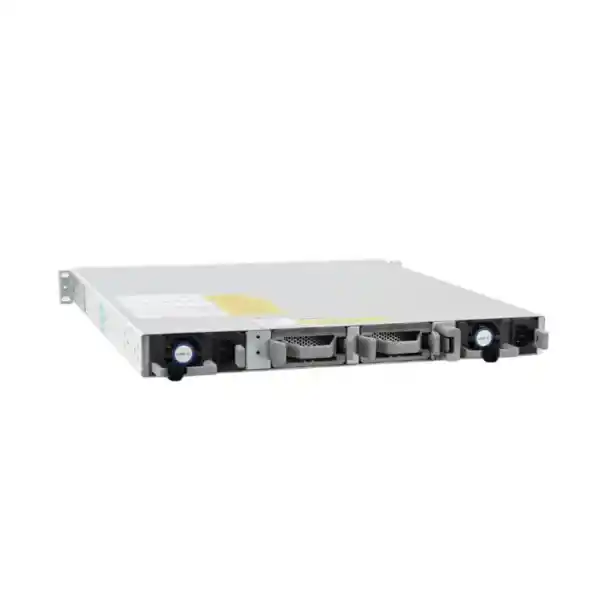
The 1RU C9550 chassis has two power-supply bays and requires a minimum of one power supply. Cisco ships the 1RU models with a 750W AC power supply by default, while a second PSU can be added for 1+1 redundancy. The platform uses five field-replaceable fan modules with N+1 fan redundancy. Redundant hardware only delivers the intended benefit when feeds are separated. In a data room, the two PSUs should ideally connect to independent PDUs or UPS-backed circuits rather than the same failure point. Airflow direction must also match the rack’s hot-aisle and cold-aisle design.
Routed resiliency
Organizations that prefer independent control planes can build a resilient routed core using dynamic routing rather than a logical multi-chassis system. OSPF, BGP, IS-IS, ECMP, routed port channels, or fabric technologies may be used according to the wider design. The benefits can include smaller fault domains, explicit path control, and fewer Layer 2 dependencies. The tradeoff is that configuration and operational visibility become more distributed, and application teams may need to adapt to routed access or different first-hop designs. The choice should be made from architecture requirements, not from habit.
Maintenance and lifecycle planning
High availability includes software operations. IOS XE maintenance strategy should define validated releases, upgrade windows, configuration backup, golden-image policy, rollback procedures, feature compatibility, and pre/post checks. Even when ISSU is available for a specific release path, engineers should confirm prerequisites and operational impact before relying on it. For mission-critical UAE environments, a staging or lab validation step is valuable when introducing new routing, segmentation, telemetry, security, optics, or management capabilities.
Layer 2, Layer 3, multicast, and campus routing capabilities
Cisco IOS XE on the C9550 Series provides enterprise Layer 2 switching, IP routing, IPv6 routing, IP multicast routing, IPv6 multicast routing, quality of service, security policy, Flexible NetFlow, programmability, and out-of-band management. This makes the C9550-48L4CD suitable for traditional campus cores, collapsed-core designs, routed distribution, and fabric architectures. A conventional deployment may use VLANs and SVIs at the distribution layer, with first-hop gateway services located on the C9550 pair. A more routed design can terminate Layer 3 links directly from access switches. Fabric deployments can use VXLAN and EVPN-oriented capabilities where the broader Cisco architecture and selected license support them.
At Layer 2, spanning-tree design remains important even when the core has enormous bandwidth. Loops can consume capacity rapidly, destabilize MAC learning, and cause broadcast or multicast storms. A modern campus should minimize unnecessary Layer 2 extension, define root placement, use deterministic port-channeling, activate edge protections on access ports, and understand every path where VLANs cross distribution boundaries. The C9550 platform supports Per-VLAN Spanning Tree and Multiple Spanning Tree scale appropriate for large campus environments, but technical scale is not a reason to extend failure domains further than applications require.
At Layer 3, the model can form a highly capable routing layer for internal prefixes and external adjacencies. OSPF can be appropriate for enterprise interior routing, while BGP becomes useful for policy-rich interconnection, multi-domain segmentation, WAN edge integration, EVPN, or cloud-oriented designs. Engineers should define route summarization, equal-cost paths, convergence timers, graceful-restart behavior, redistribution boundaries, route filtering, maximum-prefix controls, and monitoring. Route scale should be treated as a safety envelope, while operational simplicity and deterministic convergence remain the primary design objectives.
Multicast support matters for IPTV, video distribution, market data, building systems, collaboration platforms, and specialized industrial or media applications. The E104 profile supports thousands of multicast states, but correct multicast design requires more than capacity. IGMP or MLD snooping should align with Layer 3 multicast routing, rendezvous-point strategy where applicable, querier placement, VLAN design, and receiver behavior. Troubleshooting tools should be prepared before production cutover because multicast faults can appear as intermittent application failures rather than obvious link outages.
IPv6 should be designed alongside IPv4 rather than added as an afterthought. The platform provides hardware IPv6 forwarding and supports IPv6 routing and multicast. A dual-stack campus should address neighbor discovery protection, RA controls, IPv6 ACLs, prefix allocation, DNS behavior, DHCPv6 or SLAAC policy, security logging, telemetry, and monitoring parity. Organizations in Dubai that are modernizing large estates can use a core refresh as an opportunity to build consistent IPv4 and IPv6 operational standards even if application migration remains gradual.
Security architecture: segmentation, policy, telemetry, and cryptographic readiness
The modern campus core is also a policy enforcement and visibility point. The C9550 Series supports hardware ACLs, segmentation capabilities, enterprise security functions, Flexible NetFlow, and modern cryptographic features. Cisco positions the series for zero-trust-oriented environments and describes hardware support for post-quantum cryptography algorithms and encryption capabilities intended to address emerging decryption risks. The practical value for a buyer is that the platform is designed for a longer security horizon than simple packet forwarding. However, hardware capability alone does not create a zero-trust architecture. Identity systems, endpoint posture, access policy, segmentation, logging, firewalls, cloud controls, and incident response must work together.
ACL scale is particularly important in large environments where policy is pushed into the network. The E104 model family supports substantial ingress and egress security ACL entries and separate QoS policy scale. Architects should still simplify rules where possible. Large duplicated ACLs increase operational risk, make change review harder, and complicate troubleshooting. A better design often groups users and services by identity, role, VRF, VLAN, or security group and applies policy at clear control points. Cisco TrustSec and software-defined segmentation can help reduce dependence on long address-based rule lists when the organization adopts the supporting architecture.
Flexible NetFlow is valuable for traffic visibility, capacity planning, anomaly investigation, and security analytics. The E104 platform profile supports tens of thousands of ingress and egress flow entries. Export design should define collectors, sampling or full-flow strategy, template intervals, retention, privacy requirements, and expected collector load. NetFlow is not packet capture; it summarizes conversations and can answer who communicated with whom, over which protocol, and at what volume. For a core switch carrying many campus segments, this visibility can reveal unexpected east-west traffic, backup congestion, shadow applications, abnormal connection patterns, or capacity trends before they become incidents.
Security design should also include management-plane protection. Dedicated out-of-band management should be used where feasible, with role-based administration, centralized AAA, strong authentication, SNMPv3 where SNMP is required, secure API access, SSH, certificate lifecycle management, configuration-change logging, time synchronization, and restrictions on management source networks. A core switch is a critical infrastructure asset; unrestricted management from general user VLANs creates unnecessary exposure. UAE organizations with formal governance or audit requirements should map switch controls to their internal security baseline and retain configuration evidence as part of change management.
The C9550 should be integrated with the organization’s firewalls rather than viewed as a replacement for them. Core switching is optimized for deterministic high-speed forwarding and network policy, while next-generation firewalls provide deeper inspection, application control, threat prevention, secure internet edge functions, and security-policy enforcement at boundaries. FourTeck’s Firewall Dubai practice can align campus segmentation with perimeter and internal firewall zones so routing, ACLs, VRFs, and security inspection paths do not conflict or create asymmetric flows.
Software, automation, telemetry, and application hosting
The Cisco C9550 Series runs Cisco IOS XE, a programmable enterprise network operating system. Cisco identifies IOS XE 26.2.1 as the minimum software requirement for the platform in its current data sheet, with the C9550-48L4CD introduced in the 26.2 train. Software lifecycle planning should always use the release actually supported at deployment time. Network teams should validate the exact features needed against Cisco Feature Navigator and the applicable release notes because a hardware capability may not be operationally available in every initial release, and feature behavior can change as the train matures.
Programmability is useful when the campus has grown beyond manual CLI-only operations. IOS XE can integrate with model-driven APIs, structured telemetry, configuration automation, and controller-based workflows. Instead of logging into dozens of devices to compare configuration lines, engineers can maintain intended state in a source-controlled system, validate changes before deployment, and collect consistent operational data. Automation should start with repeatable, low-risk tasks such as inventory, interface descriptions, compliance checks, configuration backup, NTP, AAA, SNMP, telemetry, and VLAN validation before progressing to large routing or policy changes.
Streaming telemetry offers a more scalable way to collect high-frequency operational information than repeatedly polling thousands of counters through traditional methods. The core can publish structured state for interfaces, queues, routing, system health, and other supported models to telemetry collectors. This supports time-series dashboards, capacity alerts, failure correlation, and proactive operations. A useful telemetry design defines exactly which metrics matter, how often they are sampled, how long data is retained, who can access it, and how alerts map to service impact. Collecting everything at maximum frequency without an operational objective can create a data problem rather than solving one.
The x86 control plane and optional local SSD support container-based application hosting use cases. Cisco lists up to 4 GB of application-hosting DRAM allocation and up to two vCPUs for the E104 model family, along with two 10G AppGig ports. Application hosting can reduce the need for a separate appliance for selected operational workloads, but resource planning and software support must be verified. Any container running on a core network device should be treated as production infrastructure, with image provenance, patching, logging, resource limits, access controls, and rollback policy defined before installation.
Management architecture can be on-premises, cloud-oriented, or hybrid depending on Cisco support and the organization’s chosen operational model. Cisco has positioned the C9550 within a unified hardware, licensing, and support approach intended to reduce the historical separation between management modes. For buyers, the procurement process should capture not only the switch hardware but also the planned management platform, subscription, support entitlement, feature requirements, identity integrations, and automation tooling. A hardware-only quotation may be incomplete even when the physical SKU is correct.
Unified licensing and procurement considerations
Cisco uses unified licensing for the C9550 Series, available through a Cisco Networking Subscription or an Enterprise Agreement. Licenses are associated with software capabilities and support, while Smart Accounts and Cisco Smart Software Manager provide a centralized framework for entitlement management. The correct license should be selected according to actual feature requirements rather than simply matching a previous-generation switch order. If the design needs advanced segmentation, fabric functions, specific security capabilities, controller integration, analytics, or other software services, those requirements should be identified during technical scoping and mapped to the current Cisco licensing matrix.
Smart Account readiness is an important procurement detail. The customer should know which corporate Smart Account and virtual account will own the assets, who is authorized to accept or manage subscriptions, and how licenses will be assigned across environments. Delaying this administrative step until installation can create avoidable activation or ownership confusion. Large organizations operating across multiple UAE entities or regional subsidiaries may also need a clear governance model so licenses purchased by one entity are visible to the correct operational team.
Cisco’s ordering guide lists the C9550-48L4CD as a forty-eight-port 25/50G class switch with four 100G or two 400G uplinks and indicates the C9K-PWR-750WAC as the default power supply. The platform has two PSU slots, but the second redundant supply is a planning decision and may need to be ordered. The SSD is also an option that should be selected if local application hosting or storage requirements justify it. Non-standard mounting brackets, RFID options, optics, patch leads, spare transceivers, console requirements, and support should likewise be checked. A useful bill of materials therefore covers the entire deployment, not just the base switch.
For UAE projects, procurement should also account for delivery location, installation schedule, rack readiness, power standards, fiber availability, optics lead times, maintenance windows, configuration responsibility, acceptance testing, support escalation, and spare strategy. If the switch is part of a wider infrastructure refresh, FourTeck’s IT Services UAE team can coordinate implementation activities such as rack installation, cabling validation, migration planning, configuration staging, cutover support, and post-deployment documentation.
Power, cooling, rack, and data-room engineering
A high-capacity switch must be treated as a physical infrastructure load as well as a networking device. Cisco specifies dual PSU support with 1+1 redundancy for the C9550 Series. The 1RU models use the 750W AC power supply. The published input range for the C9K-PWR-750WAC is 90 to 264 VAC at 47 to 63 Hz, making it compatible with the electrical environment typically encountered in UAE enterprise data rooms when correct cords and distribution are used. Cisco lists power-supply efficiency figures up to 96 percent at 230 VAC and 50 percent load, which is relevant to energy planning in dense racks. Actual consumption varies with platform load, optics, configuration, and installed components.
Cisco publishes approximately 2,000 BTU per hour of heat output for the C9550-48L4CD with its AC power-supply design reference. Cooling capacity should not be planned from one switch in isolation. Engineers should total switch, router, firewall, server, storage, UPS, PDU, and other rack loads and apply the organization’s required headroom. Dubai’s ambient climate makes facility cooling reliability especially important, although correctly designed data rooms should maintain controlled inlet temperatures independent of outside conditions. Hot spots often result from airflow recirculation, blocked exhaust, missing blanking panels, or mismatched fan directions rather than insufficient nominal HVAC tonnage alone.
The 1RU C9550 uses five field-replaceable fan modules and supports N+1 fan redundancy. Cisco provides airflow options that move air in opposite directions, but all fan units in a switch must be the same type. Before ordering, determine the rack airflow convention. Installing a switch with reverse airflow relative to neighboring equipment can cause hot exhaust to be pulled back into an intake. This is particularly risky in compact communications rooms where front and rear thermal separation is imperfect. Fan direction should be included explicitly in the bill of materials and acceptance checklist.
The hardware installation guide specifies an operating temperature range that depends on fan direction, with certain configurations rated up to 35°C and others up to 45°C. Relative humidity, altitude, and acoustic output should also be considered. The C9550-48L4CD is designed for data-room installation, not quiet office placement; Cisco lists a sound-power level that can exceed typical office-equipment expectations. A dedicated network or server room with controlled access and cooling is therefore preferable.
Rack engineering should confirm 19-inch mounting compatibility, available RU space, rail or bracket requirements, rear clearance, fiber routing, patch-panel location, transceiver serviceability, and safe cable bend radius. High-density SFP56 connectivity can produce a significant fiber count. Color coding, labeling, structured patching, and port documentation reduce errors during migration. If the C9550 core is installed near compute platforms or storage, FourTeck’s Server Dubai infrastructure team can help coordinate rack power, physical layout, and interconnect planning so the switching and compute environment are engineered together.
Optics and fiber planning for 10G, 25G, 50G, 100G, and 400G
Selecting the switch is only half of the physical network design; the transceiver and fiber plant determine whether intended link speeds can actually be delivered. The C9550-48L4CD supports multiple Ethernet rates across its downlinks and high-speed uplinks, but not every optic is interchangeable, and compatibility evolves with software releases. Engineers should validate the exact Cisco-supported transceiver part number, switch port mode, required software version, fiber type, connector, reach, and breakout behavior before procurement. Never assume that an optic working in another Catalyst generation will be supported merely because the form factor appears similar.
For short campus links, multimode fiber can be appropriate when distance and transceiver standards allow it. For longer building-to-building links, single-mode fiber provides greater reach and often better long-term flexibility. A campus modernization project should inventory existing fiber cores, connector types, patch panels, splice loss, attenuation, cleanliness, polarity, available strands, and pathway diversity. A 400G backbone may impose different optical requirements from legacy 10G links. The cost of replacing or augmenting fiber can exceed the price difference between switch models, so a physical audit should happen before final architecture approval.
Redundant links should be physically diverse where the business requirement justifies it. Two fibers in the same conduit, same riser, same patch panel, or same external duct can fail together. High availability at the switching layer cannot compensate for a backhoe cutting both paths or a patch-panel incident disconnecting every uplink. Critical UAE campuses may use separate risers between floors, separate building entrances, geographically diverse ducts, or redundant telecom rooms. The network design should identify which failures it is expected to survive and ensure physical routing matches that requirement.
Optical power budgets are also important. Every connector, splice, patch panel, and kilometer of fiber introduces loss. Links near the maximum reach of an optic should be tested, documented, and monitored. Dirty connectors are a common cause of elevated attenuation and intermittent errors. A deployment process should include inspection and cleaning, light-level validation where appropriate, interface error monitoring, and post-cutover baselining. High-speed links can be sensitive to issues that did not prevent a lower-speed service from operating on the same physical fiber.
Spare optics strategy deserves attention. A core switch may have redundant physical links, but if a failed specialized 100G or 400G optic has a long replacement lead time, the network can remain in a degraded state for days. Organizations should identify critical transceiver types and keep an appropriate number of tested spares locally or under a support arrangement. Spare parts should be stored correctly, labeled, and included in configuration documentation so operations teams know exactly which component is approved for each link.
Sizing methodology for Dubai and UAE enterprise deployments
The most reliable way to size the C9550-48L4CD is to model the network as a system. Begin by counting downstream devices that require aggregation. Record the number of uplinks per device, current speed, target speed, port-channel structure, and physical route. Then calculate the maximum number of switch ports consumed in normal operation and during maintenance. Reserve sufficient spare ports for growth. A design using forty-six of forty-eight downlinks on day one is technically valid but operationally restrictive. Expansion, temporary migration links, test circuits, replacement equipment, or a new building can quickly consume the remaining capacity.
Next, estimate bandwidth. Start with observed interface utilization from the existing network rather than only theoretical line rates. Review average, 95th percentile, and peak utilization over representative business periods. Separate normal traffic from backup windows, replication, software distribution, surveillance export, large data transfer, or event-driven bursts. Model the new access speeds and consider whether faster links will change application behavior. When a bottleneck is removed at one layer, traffic may shift to the next constraint. The uplink architecture should provide enough bandwidth that the core upgrade does not merely move congestion upstream.
Then evaluate route, MAC, ARP, IPv6 neighbor, VLAN, SVI, multicast, ACL, NetFlow, and VRF scale. Most enterprise campuses will remain well below the C9550-48L4CD’s published limits, but large fabrics, highly segmented environments, service-provider-like campuses, or multi-tenant estates can consume tables more rapidly. The projected state should include growth, disaster-recovery scenarios, temporary route leaks during migration, and the control-plane impact of failures. If the design approaches platform scale in several dimensions simultaneously, a larger model or different architecture may be more appropriate.
Availability requirements should be converted into topology. If the service requires no single point of failure, deploy a redundant core or distribution pair and separate power, fiber, and upstream dependencies. If maintenance without user disruption is required, validate the software upgrade strategy, routing convergence, dual-homing, and application tolerance. If critical systems cannot tolerate even brief reconvergence, application architecture and transport diversity may need to be examined alongside switching. Network hardware can reduce downtime, but end-to-end service continuity depends on every layer.
Finally, consider lifecycle. A campus core is often kept longer than access switches. Size not only for today’s traffic but for expected access upgrades, wireless evolution, cloud connectivity, building expansion, security architecture, telemetry volume, and application growth. The C9550-48L4CD’s 50G downlinks and 400G uplink capability make it attractive where 10G and 40G networks are approaching end-of-design-life but a full modular core would be excessive. Conversely, an extremely large campus with hundreds of high-speed links or unusually large route tables may be better served by higher-density C9550 models or a modular architecture.
A practical sizing output should state the chosen model, quantity, role, port utilization at deployment, projected three-year utilization, normal and failure-state uplink bandwidth, optics matrix, fiber distances, redundant power plan, airflow direction, software release, licensing, support level, management integration, security controls, implementation sequence, and rollback strategy. This becomes the technical basis of the quotation and avoids ambiguity between procurement and engineering teams.
Common deployment topology 1: redundant campus distribution pair
In a medium-to-large campus, two C9550-48L4CD switches can form the distribution layer for multiple access stacks or fixed access switches. Each access block is dual-connected, either through a multi-chassis logical design such as StackWise Virtual or through independent Layer 3 routed links. The distribution pair then connects upstream toward a campus core, data-center core, WAN edge, or firewall cluster using 100G or 400G uplinks. This topology provides a strong balance between port density, capacity, and rack efficiency.
Where StackWise Virtual is used, the two physical C9550 switches function as a resilient pair for many operational purposes. Downstream links can be bundled across both chassis, allowing access switches to use active bandwidth on each peer. The architecture should include appropriately engineered StackWise Virtual links and dual-active detection. Traffic should be tested under peer failure, link failure, supervisor or control-plane events, and maintenance scenarios. The team should know which traffic becomes suboptimal during a failure and how much bandwidth remains available.
Where routed access is used, each access switch or stack forms Layer 3 adjacencies to both distribution switches. Equal-cost multipath can use both links, and route convergence handles failures. VLANs remain local to access blocks unless there is a specific requirement to stretch them. This design can improve fault isolation and reduce spanning-tree dependency. It is especially useful in new builds where application teams do not require broad Layer 2 adjacency. It may require a different approach to default gateways, wireless mobility, multicast, and operational troubleshooting.
Both designs should incorporate out-of-band management, redundant DNS and NTP reachability, centralized AAA, telemetry collectors, logging, configuration backup, and documented emergency access. A redundant data plane is incomplete if both switches depend on a single management path or authentication service. Management survivability should be tested as part of acceptance, including the ability to reach a device when production routing is impaired.
Common deployment topology 2: collapsed core for a high-performance campus
A collapsed core combines core and distribution functions into one redundant pair. This architecture is common when the campus is large enough to require resilient high-speed aggregation but not large enough to justify separate core and distribution tiers. The C9550-48L4CD is well suited to this role because it offers forty-eight multi-rate aggregation ports, high-speed backbone interfaces, enterprise routing, segmentation, and strong resiliency features in a compact footprint.
The main design advantage is reduced complexity. Traffic from access blocks reaches the collapsed core directly, and the same pair can connect to firewalls, WAN routers, internet edge systems, data-center networks, or service-provider handoffs. Fewer layers mean fewer devices, less rack space, fewer optics, and fewer routing hops. The tradeoff is concentration: the collapsed-core pair becomes a very important shared dependency. Power, cooling, software maintenance, security policy, and change control must therefore be treated with the rigor normally associated with a core layer.
Port planning is essential. An organization may begin with twenty access uplinks, four firewall links, four data-center interconnects, and two WAN paths, leaving comfortable spare capacity. A later building expansion or wireless refresh may consume ports quickly. Engineers should reserve enough downlinks and high-speed uplink capacity for predictable expansion. If the projected port count approaches the physical limit, the design should evaluate the 96-port C9550 model or a more modular core rather than planning a near-saturated fixed switch from day one.
The collapsed core should also be evaluated for security-zone placement. Some organizations route user, server, guest, IoT, OT, voice, CCTV, and building-management networks directly on the core and apply ACLs or segmentation. Others force traffic between sensitive zones through firewalls. The correct choice depends on risk and performance requirements. High-throughput trusted east-west traffic may remain routed in hardware, while high-risk boundaries may require deeper inspection. Route leaking, VRF design, firewall interfaces, and return paths should be mapped explicitly to prevent asymmetric traffic.
Common deployment topology 3: fabric border and high-speed aggregation
Cisco identifies the C9550-48L4CD for fabric border or aggregation roles in medium-to-large fabric networks. In an SD-Access or EVPN-oriented architecture, the switch can act as a high-performance point where campus fabric connectivity meets external routing domains, shared services, data centers, WAN, internet security zones, or traditional networks. This role requires significant control-plane and policy scale because the device may carry multiple VRFs, overlay mappings, routing adjacencies, policy boundaries, and high-bandwidth external links simultaneously.
Fabric deployments can simplify user and endpoint mobility by decoupling logical segmentation from the physical topology, but they also introduce additional operational layers. Underlay routing, overlay control-plane state, VXLAN encapsulation, identity policy, border roles, edge roles, and controller integration must all be understood. The C9550 hardware provides the forwarding scale and feature foundation, but successful deployment depends on disciplined design and automation. A fabric should not be adopted solely because the switch supports it; it should solve a clear requirement such as scalable segmentation, consistent access policy, mobility, or operational simplification.
At the border, bandwidth planning must account for traffic leaving the fabric. If most application resources are external to the campus, border traffic can be much larger than expected from internal east-west estimates. Cloud SaaS, internet browsing, security inspection, remote data centers, video conferencing, backup, and public-cloud connectivity may all traverse the border. Two 400G uplinks provide substantial headroom, but connected firewalls, WAN routers, and service-provider circuits may have far lower capacities. The architecture should identify the real bottleneck and place telemetry at each boundary.
Fabric border resilience should use independent paths and redundant devices, with controller behavior and failover explicitly tested. A failure can affect both reachability and policy, so test plans should include endpoint movement, route withdrawal, external connectivity, identity enforcement, and restoration. Operational teams need documented commands and dashboards for diagnosing underlay, overlay, and policy issues separately.
Migration from existing Catalyst cores and distributions
A core migration should be approached as a controlled service transition rather than a hardware swap. Start with discovery. Collect running configurations, interface status, routing tables, spanning-tree state, VLAN databases, VRFs, ARP and MAC counts, multicast state, port channels, ACLs, QoS policies, NetFlow configuration, AAA, NTP, SNMP, syslog, management routes, optics inventory, and cabling maps. Identify unused configuration and legacy dependencies. Core switches often accumulate years of settings that are no longer required but are difficult to distinguish during a rushed cutover.
Next, build the target architecture. Decide whether the migration preserves the existing Layer 2 and Layer 3 topology or modernizes it. If the current design relies on large stretched VLANs, a refresh may be an opportunity to introduce routed access or smaller fault domains. If the old core uses a virtual switching technology, determine whether StackWise Virtual provides the intended operational model. Map every interface from source to destination, including speed, optic, fiber, VLANs, port-channel ID, routing role, and dependency.
Staging should include software installation, license readiness, Smart Account association, base hardening, management access, AAA testing, NTP, logging, telemetry, routing protocol configuration, VLAN and VRF creation, port-channel templates, ACLs, QoS, and interface descriptions. Where possible, build the pair in a lab or staging rack and validate configuration before moving it into the production room. Automated configuration comparison can detect missing lines or unintended differences between peers.
Cutover sequencing should minimize simultaneous changes. One method is to establish new core uplinks and routing adjacencies first, then migrate downstream blocks in batches. Another is to physically replace an existing redundant pair during a defined outage. The right method depends on available ports, rack space, spare fiber, routing design, and business tolerance. Each step should have a verification checklist and rollback point. Testing should cover gateway reachability, routing, DNS, authentication, internet access, key applications, voice, wireless, multicast, monitoring, and management access.
After migration, leave time for stabilization. Compare interface errors, CPU, memory, routes, MAC counts, NetFlow, latency, packet loss, and application performance against the pre-change baseline. Confirm both normal and redundant paths. Remove temporary migration configuration only after the network has been stable for the agreed period. Update diagrams, IP plans, rack elevations, support records, license ownership, spare inventory, and operational runbooks so the new core is maintainable by the wider team.
Operations, monitoring, and troubleshooting model
A modern core should be observable from the first day of production. Monitoring should cover interface state, optical receive and transmit power where available, CRC and symbol errors, discards, queue drops, port-channel health, CPU, memory, temperature, fan status, PSU status, routing neighbors, route counts, MAC counts, ARP and NDP utilization, multicast state, ACL resource use, NetFlow health, and controller reachability. Thresholds should be based on service impact and trend, not on arbitrary values copied from another platform.
Interface utilization should be monitored in both directions and at intervals short enough to expose bursts. Five-minute averages can hide microbursts that fill queues and affect voice or transactional traffic. Queue telemetry, drops, ECN behavior where applicable, and QoS statistics can reveal congestion invisible in simple link utilization graphs. High-speed 100G and 400G links can move a large amount of data during short bursts, so operational tools must collect at an appropriate cadence.
Routing monitoring should include adjacency uptime, flap counts, prefix count changes, unexpected next-hop changes, and convergence events. For BGP, maximum-prefix and route-policy controls can limit damage from accidental leaks. For OSPF or IS-IS, area or level design, route summarization, interface types, and timer consistency should be verified. Log correlation between the C9550 pair and upstream or downstream devices speeds diagnosis because many apparent switch failures are actually fiber, optic, routing, firewall, or application events.
Configuration management should record every change. Backups should be automated and tested for recovery. Source-of-truth systems can store interface intent, IP addresses, VLANs, VRFs, cabling, asset identifiers, and support information. Where automation is used, peer review and validation remain essential; automation can distribute a mistake faster than manual configuration. Safe pipelines use templates, syntax validation, diff review, staged deployment, verification, and rollback.
Operational documentation should include normal-state diagrams, failover behavior, emergency console access, management addresses, AAA fallback, power-feed mapping, fiber mapping, StackWise Virtual or routing topology, software image, license ownership, support contract, spare inventory, and escalation contacts. Core troubleshooting during an outage is much faster when the team knows what “normal” looks like and can isolate control-plane, data-plane, physical-layer, and application-layer symptoms methodically.
Why the C9550-48L4CD is a strong fit for UAE enterprise modernization
Many UAE enterprises are at a transition point between established 10G/40G campus designs and a new generation of 25G, 50G, 100G, and 400G connectivity. Access switches are becoming faster because Wi-Fi, high-end workstations, video, AI-enabled applications, edge computing, and large data flows increase aggregation demand. The C9550-48L4CD provides a practical bridge: it can retain lower-speed links while supporting 25G and 50G downlinks and a 400G backbone. This allows upgrades to be staged according to business priority rather than forced into one simultaneous replacement.
The 1RU form factor is valuable in commercial buildings where communications rooms may have limited rack capacity. Forty-eight aggregation ports in one rack unit can replace several lower-density devices, reducing power cords, patch complexity, and management points. The design still supports dual power and redundant cooling. For a resilient deployment, two 1RU switches can provide a high-capacity distribution pair while consuming only two rack units before patching and cable management.
The platform’s advanced routing, segmentation, security, telemetry, and programmability are equally important. A network refresh should improve operational consistency, not just raw speed. Organizations can use the new platform to standardize routing policy, improve identity integration, collect richer telemetry, automate configuration checks, and reduce large Layer 2 domains. When these operational improvements are planned alongside the hardware upgrade, the return on investment includes fewer troubleshooting hours and more predictable changes.
The C9550-48L4CD also provides useful headroom without forcing every organization into the highest-capacity model. The 96-port and 64-port C9550 variants target even larger deployments, but many enterprise campuses need a balanced density rather than maximum scale. Forty-eight multi-rate downlinks are enough to aggregate numerous access blocks while four high-speed uplink positions provide backbone flexibility. If future growth exceeds this footprint, the same C9550 family offers larger models, which can simplify architectural consistency.
Regional deployment quality depends on the complete solution. Correct Cisco hardware, supported optics, redundant PSUs, compatible fan direction, clean fiber, validated software, appropriate licensing, careful staging, and a rehearsed cutover are all required. FourTeck can provide supply and project coordination in Dubai and across the UAE, with regional capability backed by its broader global FourTeck infrastructure practice for organizations operating across multiple countries.
Technical specification reference for C9550-48L4CD
| Product role | Fixed enterprise core and distribution switch; also suitable for fabric border and aggregation roles in medium-to-large campus networks. |
| Form factor | 1RU fixed chassis. |
| Downlink ports | 48 × multi-rate 50/25/10/1G SFP-class interfaces. |
| High-speed uplinks | 4 × 100/40G or 2 × 400G fixed uplink operation, subject to supported optics and port mode. |
| ASIC | 1 × Cisco Silicon One E104. |
| System switching | Up to 3.2 Tbps. |
| Forwarding | Up to 2.6 Bpps. |
| CPU | AMD x86, four cores, up to 3.8 GHz for E104 C9550 models. |
| System memory | 16 GB DDR5 DRAM; 18 GB flash. |
| Optional local storage | Up to 960 GB SSD capacity for supported application-hosting and storage uses. |
| Packet buffer | 64 MB dedicated low-latency shared-memory-system buffer. |
| MAC addresses | Up to 64,000 for the E104 platform profile. |
| IPv4 routes | Up to 512,000 for the E104 platform profile. |
| IPv6 routes | Up to 256,000 for the E104 platform profile. |
| ARP / NDP entries | Up to 64,000 ARP and 64,000 NDP entries in the E104 profile. |
| VLAN scale | Up to 4,094 VLAN IDs and active VLANs. |
| SVIs | Up to 4,000 switched virtual interfaces. |
| Jumbo frames | Up to 9,216 bytes. |
| Redundancy | StackWise Virtual, stateful switchover support, dual PSU bays, N+1 field-replaceable fan design. |
| Power | C9K-PWR-750WAC default PSU for the 1RU model; two power-supply slots for optional 1+1 redundancy. |
| Fans | Five field-replaceable fan modules; all installed fans must use the same airflow type. |
| Dimensions | Approximately 1.73 × 17.5 × 18.15 in / 4.39 × 44.45 × 46.1 cm including handles. |
| Approximate weight | About 20.79 lb / 9.45 kg with two PSUs and built-in fans according to Cisco’s hardware guide. |
| Software | Cisco IOS XE; current Cisco documentation lists IOS XE 26.2.1 as the minimum software requirement for the series. |
| Licensing | Unified licensing through Cisco Networking Subscription or Enterprise Agreement options, managed through Cisco Smart Account tooling as applicable. |
Technical values are planning references based on current Cisco documentation available for the C9550 Series. Final quotations and implementation designs should verify the exact IOS XE release, license entitlement, optics compatibility, ordering options, supported feature combinations, and regional availability at the time of purchase.
Frequently asked technical questions
Is the C9550-48L4CD an access switch?
It is primarily a core and distribution platform, not a user-edge PoE access switch. Its forty-eight fiber-oriented multi-rate downlinks are designed to aggregate other switches or high-speed network systems. It does not replace an access switch whose primary job is connecting and powering desktop phones, cameras, access points, or ordinary copper Ethernet endpoints.
Can it aggregate 25G access-switch uplinks?
Yes. The downlink ports support 25G among their supported rates, which makes the platform suitable for aggregating many modern access-switch uplinks. The correct optic, cable, software support, and port configuration must be confirmed. Redundant designs should also calculate the number of physical ports consumed per downstream access block.
Does the switch support 400G?
The C9550-48L4CD provides high-speed uplink positions that can be used as two 400G uplinks, subject to the supported port mode and transceiver combination. This makes it suitable for a compact high-capacity campus backbone or aggregation connection where upstream devices also support 400G.
What is the switching capacity?
Cisco specifies up to 3.2 Tbps system switching for the E104-based C9550 models including the C9550-48L4CD, with forwarding performance up to 2.6 Bpps. Design calculations should still consider traffic mix, packet size, interface concurrency, QoS behavior, and failure-state oversubscription.
Can two C9550-48L4CD switches operate as a resilient pair?
Yes. The C9550 Series supports StackWise Virtual and stateful switchover capabilities. A resilient design also requires correct virtual-link and dual-active-detection engineering, separated power feeds, redundant fiber paths, and validation of downstream and upstream failover behavior.
Does it support application hosting?
The E104 platform includes an x86 control plane and supports local SSD capacity up to 960 GB plus dedicated application-hosting CPU and memory resources in the platform profile. Exact container applications and resource availability should be validated against the chosen software release and Cisco documentation.
How should I choose between C9550-48L4CD and larger C9550 models?
Choose by port density, bandwidth, forwarding scale, route scale, growth, and physical design. The 48-port model is balanced for medium-to-large campuses. The 96-port model offers greater 50G-class density and higher system capacity, while the XL model targets very large 100G-rich environments and higher routing scale.
What should be included in a UAE quotation?
A complete quotation should identify switch quantity, second PSU where required, airflow direction, optics, fiber or DAC/AOC requirements, SSD option if needed, software licensing, support, rack accessories, spare components, management requirements, implementation scope, migration services, and acceptance testing. The correct bill of materials depends on topology and distances.
Engineering checklist before you request pricing
For an accurate Cisco C9550-48L4CD quotation in Dubai, prepare the technical facts below. A switch can be quoted from a part number alone, but a production-ready solution requires enough context to avoid missing optics, redundancy components, licenses, or services.
Decision recap: when to select the C9550-48L4CD
Choose it for balanced density
Forty-eight multi-rate downlinks are a strong fit when a campus needs meaningful aggregation density without moving to a larger 2RU or modular chassis. It supports phased migration from 10G toward 25G and 50G.
Choose it for backbone growth
Up to two 400G uplinks give the platform a high-speed path toward new campus backbones, while 100G and 40G options preserve compatibility with established environments.
Choose it for modern operations
IOS XE, telemetry, programmability, Flexible NetFlow, advanced routing, segmentation, and application-hosting resources support an operational model beyond traditional CLI-only switching.
Reconsider if 48 ports are already nearly full
If the day-one design consumes almost every downlink, a higher-density model may reduce future expansion pressure and avoid adding an additional aggregation layer too soon.
Reconsider if route scale is extreme
Very large routing environments should compare the E104 route scale against higher-scale C9550 variants and confirm simultaneous hardware table requirements before procurement.
Reconsider if modular expansion is essential
The C9550-48L4CD is a fixed switch. Organizations that require line-card modularity, very large interface counts, or chassis-level expansion should evaluate an architecture designed around those requirements.
Quotation input checklist for Cisco C9550-48L4CD Dubai
Sending the following information with your enquiry allows the engineering and sales teams to prepare a more precise bill of materials and identify dependencies early. You do not need to know every field; provide what is available, and the remaining items can be resolved during technical consultation.
Structured consultation panel
Plan the complete C9550-48L4CD solution, not only the chassis
A successful core or distribution upgrade aligns switching capacity, routing scale, optics, fiber, redundancy, power, cooling, security policy, software, licensing, management, monitoring, migration sequencing, and support. FourTeck can review your current topology and convert those requirements into a deployment-ready bill of materials for Dubai and other UAE locations.
For best results, share a network diagram or a simple port list showing current access-switch uplinks and backbone speeds. The engineering review can then identify whether the C9550-48L4CD provides the right density and headroom, whether a larger C9550 model is more appropriate, which optics are required, and how to structure the redundant pair.
Consultation deliverables
- Model and quantity validation
- Port and bandwidth sizing
- Optics and fiber compatibility plan
- Dual-power and airflow recommendation
- License and support checklist
- Migration and acceptance-test outline
- UAE delivery and implementation coordination

Reviews
There are no reviews yet.