
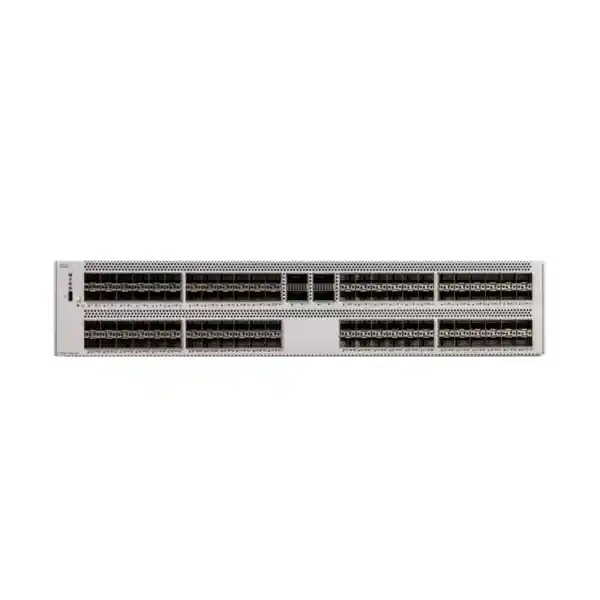
Cisco C9550-96L4D Smart Switch in UAE
A high-density 2RU campus switching platform built for very large enterprise networks that need 96 multi-rate SFP56 interfaces, four high-capacity QSFP-DD uplinks, large routing scale, modern telemetry and a clear path toward 50G and 400G campus architectures.
Direct answer: what is the Cisco C9550-96L4D?
The Cisco C9550-96L4D is a fixed-form-factor, high-scale Cisco C9550 Series Smart Switch designed for demanding enterprise campus environments. The platform provides ninety-six SFP56 downlink ports capable of operating at 50G, 25G, 10G or 1G and four QSFP-DD uplink ports that can support 400G, 100G or 40G. Cisco positions the model for the edge, core and distribution layers of very large enterprise networks, as well as for fabric-border, aggregation and internet-gateway roles where substantial IPv4 or IPv6 route scale is required. Its combination of dense multi-rate interfaces and 400G uplinks allows a design team to consolidate many access, distribution or services connections into a compact two-rack-unit chassis without moving immediately to a modular platform.
At the forwarding layer, the C9550-96L4D uses a Cisco Silicon One E100 ASIC and delivers up to 6.4 Tbps of system bandwidth with forwarding performance of up to 3.9 billion packets per second. Its control plane uses an AMD x86 processor running at 3.3 GHz with eight cores, paired with 32 GB of DDR5 memory and 18 GB of flash. The platform also supports optional SATA SSD storage up to 960 GB for container-based application hosting. These characteristics make the switch relevant not only as a fast packet-forwarding device but also as an automation-ready and telemetry-rich infrastructure component for modern campus operations.
For UAE organizations, the practical value lies in density, transition flexibility and architectural longevity. A business can continue operating established 10G or 25G fiber links while introducing 50G server, access, distribution or service-node connections and reserving 400G capacity for high-bandwidth uplinks. This enables phased modernization in Dubai, Abu Dhabi, Sharjah and multi-site UAE environments without forcing every connected device to migrate to the same speed at once.
High-density 50/25/10/1G connectivity for large campus aggregation and distribution designs.
Support for 400/100/40G uplinks to core, peer, data-center or backbone infrastructure.
Substantial forwarding capacity for very large enterprise campus traffic patterns.
High packet-processing capability for mixed application, routing and policy workloads.
Why the C9550-96L4D matters in a modern campus architecture
Campus networks are being asked to carry traffic that previously lived in separate infrastructure domains. High-resolution video, collaboration platforms, wireless aggregation, endpoint security telemetry, east-west application flows, private cloud access, internet breakout, SD-WAN handoff, large-scale segmentation and AI-assisted operational systems all compete for bandwidth and policy resources. A core or distribution switch therefore needs more than raw port count. It must combine predictable forwarding, scalable control-plane resources, adaptable interface speeds, resilient software behavior and enough route, MAC, ACL and telemetry capacity to avoid becoming a design constraint as the organization grows.
The C9550-96L4D is especially relevant when an enterprise wants to retain the operational simplicity of a fixed switch while reaching interface densities that would once have pushed the design toward a modular chassis. Ninety-six SFP56 ports in a 2RU form factor can support a large number of fiber-connected access blocks, server or service appliances, campus distribution nodes or routed links. The four QSFP-DD ports can create high-capacity northbound paths without consuming downlink interfaces. For brownfield modernization, multi-rate operation is critical: installed 1G, 10G or 25G optical links can coexist with newer 50G connections, allowing a staged upgrade plan rather than a disruptive all-at-once replacement.
FourTeck can align this platform with broader UAE infrastructure projects through the FourTeck UAE portfolio, including switching design, security integration, structured migration and enterprise rollout. For customers combining switching upgrades with operational support, the FourTeck IT Services UAE team can be considered as part of the implementation and lifecycle plan.
Port architecture: 96 multi-rate SFP56 interfaces
The defining feature of the C9550-96L4D is its ninety-six SFP56 downlink interfaces. Each of these ports can be designed around 50G, 25G, 10G or 1G operation subject to the selected optic, cable, software support and peer capability. This multi-rate characteristic gives network architects a powerful migration tool. A large campus can aggregate older 10G distribution blocks and new 25G or 50G infrastructure on the same platform, maintaining consistent policy and operations while avoiding separate switch families for every link speed.
For 50G deployments, the higher per-link bandwidth is useful where Wi-Fi aggregation, high-density access, large branch consolidation, data-intensive engineering environments or campus services exceed comfortable 10G or 25G margins. For 25G, the same chassis can interoperate with a broad installed base of server and aggregation interfaces. The 10G and 1G modes remain important for legacy appliances, out-of-band links, monitoring devices and staged cutovers.
From a design perspective, port density should not be interpreted as a requirement to populate all ninety-six interfaces immediately. A more useful approach is to reserve a defined percentage of ports for growth, spares, migration overlap and emergency bypass. This is particularly valuable in UAE enterprise refresh projects where phased floor, building or campus migrations may run over multiple change windows.
400G uplinks: high-capacity paths without sacrificing density
The four QSFP-DD uplink ports support 400G, 100G or 40G, allowing the C9550-96L4D to connect into high-speed backbone, core, peer or services infrastructure. In a dual-core design, architects can allocate uplinks across independent physical paths to preserve resilience. In a StackWise Virtual pair, uplink placement can be balanced across both switches so that fiber-path diversity aligns with control-plane and power diversity.
A 400G uplink is not simply a speed upgrade; it changes oversubscription options. When dozens of 25G or 50G downstream links are active, 100G uplinks can become the limiting resource during simultaneous demand peaks. 400G enables higher aggregate northbound capacity and provides more headroom for growth. Where current traffic does not justify 400G, the same uplink positions can operate at lower rates and be migrated later as optics and peer platforms evolve.
Optical design must still be treated as an engineering discipline. Reach, fiber type, connector cleanliness, patch-panel loss, breakout requirements and the exact supported transceiver matrix should be verified before ordering. FourTeck can help map the final bill of materials to the installed fiber plant rather than selecting optics by nominal link speed alone.
Cisco Silicon One E100 data plane: architecture and operational implications
The C9550-96L4D is built around a single Cisco Silicon One E100 ASIC. Cisco specifies up to 6.4 Tbps of full-duplex system bandwidth and up to 3.9 Bpps of forwarding performance for the model. This is significant because enterprise campus workloads increasingly mix large data transfers with enormous quantities of smaller packets created by DNS, voice, collaboration, wireless control, IoT, security and telemetry systems. A platform that combines high bandwidth with high packet-rate handling is better positioned to maintain deterministic forwarding under mixed traffic profiles.
The switch includes 64 MB of dedicated low-latency shared-memory system buffer. Buffer design matters most during transient congestion, speed transitions and traffic bursts. For example, a set of 50G ingress flows converging on a 100G egress path can temporarily exceed the output capacity even when long-term utilization looks acceptable. Queueing, QoS policy and traffic engineering determine how those bursts are handled. The switch platform provides the forwarding foundation, but the final network behavior depends on class maps, policy maps, queue design and congestion-management settings appropriate to voice, video, transactional and bulk-data applications.
Silicon One also supports flexible allocation of forwarding resources. Cisco documents large tables for Layer 2 switching, IPv4 and IPv6 routing, multicast, ACLs and NetFlow. This matters because a very large enterprise core often serves several roles at once: it may learn large MAC populations, hold internal and external routes, enforce security policy, export flow telemetry and terminate numerous routed interfaces. Engineering should therefore be based on the combined scale profile rather than a single headline number.
For organizations moving toward policy-driven campus designs, the ASIC is the hardware base for capabilities such as SD-Access, BGP EVPN, scalable segmentation and hardware-assisted policy enforcement. These functions should be planned as an architecture rather than enabled feature-by-feature in production. Route allocation, endpoint scale, policy groups and telemetry consumption should be modeled during low-level design.
Platform scale: the numbers that matter for large enterprise networks
| Resource | C9550-96L4D capability | Why it matters |
|---|---|---|
| MAC addresses | Up to 128,000 | Supports large endpoint populations and extensive Layer 2 domains where required. |
| IPv4 routes | Up to 1,000,000 total routes | Provides substantial routing headroom for campus, border and gateway use cases. |
| IPv6 routes | Up to 500,000 total routes | Enables large-scale IPv6 adoption without treating IPv6 as a secondary forwarding path. |
| ARP entries | Up to 128,000 | Supports large routed endpoint populations. |
| NDP entries | Up to 128,000 | Provides equivalent scale for IPv6 neighbor discovery. |
| Active VLANs | Up to 4094 | Supports complex segmentation and multi-tenant campus structures. |
| SVIs | Up to 4000 | Allows a large number of routed VLAN interfaces where design requires them. |
| Jumbo frames | Up to 9216 bytes | Useful for selected storage, virtualization and large-payload application workflows when end-to-end MTU is controlled. |
Scale figures should always be interpreted in context. Enterprise designs rarely consume one resource in isolation, and some tables can be affected by feature combinations, software releases or allocation profiles. A professional sizing exercise therefore starts with expected endpoints, route counts, multicast requirements, ACL entries, flow records, VLANs and growth assumptions, then verifies the target profile against the exact software release and feature set planned for production.
Control plane, memory and local application hosting
The C9550-96L4D control plane uses an AMD x86 3.3 GHz eight-core processor with 32 GB of DDR5 memory and 18 GB of flash. Cisco also supports optional SATA SSD capacity up to 960 GB. Up to 8 GB of DRAM and up to four virtual CPUs can be allocated for application hosting, and the platform provides two 10G AppGig interfaces for app-hosting connectivity. These capabilities support a more programmable campus infrastructure where selected containerized functions can run closer to the switching environment.
Control-plane sizing matters during routing reconvergence, automation operations, telemetry collection, configuration changes and high-event scenarios. Large routing tables, frequent topology updates or complex policy environments can create workload patterns that are different from simple Layer 2 forwarding. An eight-core CPU and 32 GB memory provide a substantial foundation, but operational design still requires sensible routing timers, logging policies, telemetry frequencies and automation concurrency.
Application hosting should be treated as an intentional use case rather than free compute capacity. Teams should define resource limits, image lifecycle, security ownership, patching responsibilities and monitoring before placing operational software on the switch. The optional SSD is particularly useful where local storage is part of the selected application architecture, but it should not be assumed to replace centralized logging, configuration backup or enterprise data protection systems.
Layer 2 foundation
The platform supports enterprise Layer 2 switching, VLANs, spanning-tree mechanisms and large MAC-table scale. In a traditional campus, this allows the C9550-96L4D to aggregate multiple access blocks while maintaining deterministic VLAN and redundancy behavior. However, large Layer 2 domains should still be justified. Extending VLANs widely can increase failure domains and troubleshooting complexity, so many modern designs use routed access or limited Layer 2 boundaries where possible.
When Layer 2 is required, engineers should document root-bridge placement, loop-protection features, port-channel behavior, VLAN pruning and failure scenarios. The switch’s capacity provides headroom, but disciplined topology remains essential.
Layer 3 and IPv6
Cisco IOS XE provides IP routing, IPv6 routing, multicast routing and enterprise routing capabilities suitable for core and distribution layers. The C9550-96L4D’s million-route IPv4 scale and half-million IPv6-route scale are particularly relevant for large internal route domains, route-rich border designs and organizations accelerating IPv6 adoption.
Routing protocols should be selected according to administrative boundaries and convergence requirements. OSPF or IS-IS may suit internal underlay roles, while BGP is often selected for policy-rich borders, EVPN fabrics and larger routed domains. The correct protocol is determined by architecture, not by platform feature availability alone.
BGP EVPN, SD-Access and fabric-ready campus design
The C9550 Series supports Software-Defined Access and BGP Ethernet VPN capabilities, giving architects multiple paths toward more structured segmentation and fabric operations. In an SD-Access environment, policy and segmentation can be abstracted from physical topology through Cisco’s fabric architecture. In an EVPN-oriented design, BGP can distribute endpoint and network reachability information in a scalable control plane, reducing dependence on broad Layer 2 flooding.
The C9550-96L4D is particularly suitable for fabric-border and aggregation roles because of its interface density, route scale and high-speed uplinks. A border node must often translate between internal fabric constructs and external networks such as data centers, WAN, internet or shared services. This role can consume routing, policy and telemetry resources simultaneously, making the model’s scale characteristics valuable.
A successful fabric deployment begins with identity, addressing and policy design. Segmentation groups, virtual networks, IP pools, route leaking, shared-service access and internet breakout need to be defined before configuration. The physical underlay must also be stable and observable. High-speed switching hardware cannot compensate for inconsistent addressing, uncontrolled policy sprawl or incomplete dependency mapping.
For UAE enterprises with multiple buildings or campuses, fabric designs can provide consistent policy while reducing repetitive per-switch configuration. They are especially useful where different departments, contractors, IoT devices and guest services share the same physical infrastructure but require strong logical separation. FourTeck can help translate business segmentation requirements into a practical campus architecture and implementation sequence.
StackWise Virtual, resiliency and nonstop campus design
The C9550 Series supports Cisco StackWise Virtual and stateful switchover in a StackWise Virtual design. This allows two physical switches to operate as a coordinated logical system for selected control-plane and multi-chassis use cases, simplifying downstream port-channeling and creating a resilient aggregation or core pair. The C9550-96L4D also supports front-side StackWise Virtual links on its network interfaces, giving architects flexibility in how inter-switch capacity is allocated.
Resilience is more than buying two switches. A proper high-availability design separates power feeds, rack positions where possible, fiber routes, upstream devices and downstream attachment points. If both core switches share one PDU, one cable tray or one upstream firewall, the logical redundancy can be undermined by a physical common-mode failure. UAE data-center and campus projects should therefore include a dependency map showing utility power, UPS, PDU, rack, patch panel, optical path and peer-device relationships.
Stateful switchover can reduce disruption during control-plane failure, while in-service software upgrade support can help reduce maintenance impact in supported topologies. Even with these capabilities, organizations should maintain tested change procedures, rollback plans and out-of-band access. Software upgrades can include protocol and feature interactions that require validation, especially in environments using advanced multicast, EVPN, security or automation.
For a resilient core, FourTeck typically recommends validating failure behavior under realistic conditions: loss of one uplink, one switch, one power supply, one upstream path and one downstream member link. This creates operational confidence before the platform carries critical production traffic.
Security and policy enforcement at the campus core
Scalable ACL resources
The C9550-96L4D supports substantial security ACL scale, allowing policy to be enforced close to traffic aggregation points. ACL design should use objects, naming standards and centralized policy governance to avoid rule duplication and troubleshooting complexity.
Segmentation
VLANs, VRFs, SD-Access constructs and routed boundaries can be combined to separate departments, production systems, contractors, IoT and guest services. Segmentation should follow business risk and communication requirements, not organizational charts alone.
Telemetry-backed security
Flexible NetFlow can provide high-value traffic visibility for security analytics, anomaly investigation and capacity planning. Export strategy should balance visibility with collector capacity and control-plane overhead.
Identity integration
Cisco Identity Services Engine can complement switching policy with identity- and posture-aware access control. The design should include authentication failure modes, critical endpoints and remediation workflows.
Switching security should be layered with perimeter and internal firewall controls. Organizations integrating campus segmentation with next-generation firewall policy can review FourTeck’s Firewall Dubai services for broader security architecture planning.
Flexible NetFlow, observability and operational telemetry
Large campus environments become difficult to operate when the core is treated as a black box. Flexible NetFlow enables traffic metadata to be exported for analysis, helping teams understand who is communicating, which applications or protocols consume capacity, where traffic changes originate and whether unusual flows correlate with an incident. Cisco documents up to 32,000 ingress and 32,000 egress NetFlow entries for the C9550-96L4D, providing meaningful telemetry scale for enterprise use cases.
Telemetry design should be selective. Exporting every conceivable field at aggressive intervals can burden collectors and generate more data than operations teams can use. A stronger approach is to define operational questions first: which sites are approaching uplink capacity, what traffic crosses a security boundary, which application classes are affected by congestion, which endpoints create unexpected east-west flows, and how quickly can the team identify the source of a path change? Flow templates and retention policies can then be mapped to those questions.
Streaming telemetry, SNMP, syslog and controller-based analytics can complement NetFlow. The goal is to create a common operational picture that includes interface health, optical levels, error counters, queue drops, routing adjacency state, CPU and memory utilization, environmental alarms and configuration changes. For mission-critical UAE deployments, monitoring should include alert thresholds that distinguish short normal bursts from sustained degradation.
Operations teams should also maintain baseline data after commissioning. Knowing normal peak utilization, typical route counts, expected MAC learning, queue behavior and optical receive levels makes incident triage dramatically faster. A baseline created during healthy operation is one of the most useful deliverables of a professional switching deployment.
Cisco IOS XE software
Cisco IOS XE provides the software foundation for the C9550 Series. The platform supports enterprise Layer 2 switching, IP routing, IPv6, multicast, SD-Access, BGP EVPN, Flexible NetFlow, programmability and out-of-band management. Cisco’s current documentation identifies IOS XE Release 26.2.1 as the minimum software requirement for the C9550 Series.
Production software selection should be deliberate. Teams should review feature support, recommended releases, known caveats, interoperability with adjacent platforms and internal qualification results. A new hardware platform should not automatically be deployed with the newest available image without considering the organization’s operational standards.
Programmability and automation
Modern Cisco platforms support API- and model-driven operations that can reduce repetitive CLI configuration. Automation is useful for standardizing interface templates, routing policy, telemetry, backups and compliance checks across many switches.
Automation should be introduced with guardrails: version control, peer review, validation, staged execution and rollback. A script that can configure one switch can also misconfigure hundreds very quickly. For large UAE campuses, a controlled automation pipeline can improve consistency while preserving change-management discipline.
Unified licensing and subscription planning
The Cisco C9550 Series introduces a unified licensing approach through Cisco Networking Subscription or eligible enterprise agreements. Cisco’s ordering guidance identifies the C9550-96L4D with the LIC-CS-CO-XL-A Cisco Switching Advantage Core Fixed License, XL. Cisco also states that new unified switching subscriptions require a minimum term of thirty-six months, and the C9550 Series ordering flow provides the Advantage tier for the platform.
The licensing model is designed to combine software entitlement, management flexibility and support. A per-device license can unlock management through Cisco Catalyst Center and Cisco Meraki dashboard options, allowing organizations to align operations with their preferred management model. Smart Accounts and Virtual Accounts remain important for asset and license administration, so procurement should involve the team responsible for the organization’s Cisco account structure before the order is finalized.
Licensing should be treated as part of the architecture, not an administrative afterthought. The required features, controller choice, support level, subscription term and renewal process should be documented alongside the hardware bill of materials. If a project requires SD-Access, advanced routing, automation or centralized assurance, those dependencies need to be confirmed before purchase. This prevents a situation where hardware arrives but cannot be deployed according to the intended design because licensing or account readiness was overlooked.
FourTeck can assist UAE customers with license mapping, account coordination and the commercial bill of materials so that switch hardware, optics, power, support and software subscriptions are aligned before the purchase order is released.
Power, cooling, rack space and physical planning
The C9550-96L4D is a 2RU platform with two power-supply slots and three fan trays. Cisco’s hardware guidance lists support for redundant power-supply configurations and provides 750W and 1100W AC options in the C9550 ordering ecosystem. Exact power selection should be based on the final hardware configuration, redundancy requirement, input circuit design and Cisco’s current ordering rules.
Physical dimensions for the 2RU C9550 class are approximately 3.47 inches high and 17.5 inches wide, with chassis depth around 17.85 inches including handles for the relevant model group. Rack design should allow additional clearance for fiber bend radius, power connectors, airflow and service access. The switch should not be installed merely because two rack units are free; technicians need enough front and rear working space to replace optics, fan trays and power supplies without disturbing adjacent equipment.
Cooling design is particularly important in UAE environments because high outdoor temperatures increase the burden on facility HVAC systems. Data rooms must maintain the manufacturer’s environmental requirements independently of ambient outdoor conditions. Hot-aisle/cold-aisle discipline, unobstructed vents, blanking panels and proper cabinet ventilation can materially improve equipment reliability. The installation plan should also confirm airflow direction consistency with neighboring switches, servers and security appliances.
Power resilience should include more than dual power supplies. Ideally, redundant PSUs are connected to independent PDUs backed by separate UPS paths where facility design permits. The project should document circuit capacity, connector type, cable length and labeling. For enterprise core equipment, power-feed tests should be performed during commissioning to confirm that loss of one feed does not interrupt service.
For environments refreshing both switching and compute infrastructure, FourTeck’s Server Dubai practice can help coordinate rack, power, server and network requirements as part of a wider infrastructure design.
Optics and cabling strategy for 1G through 400G
1G / 10G
Useful for legacy infrastructure, service appliances and staged migration. Confirm optic coding, wavelength, reach and peer compatibility.
25G
A common migration target for server, access and aggregation links, providing a substantial uplift over 10G while using compact optical interfaces.
50G
Ideal where modern access or distribution blocks require more bandwidth per fiber pair without jumping directly to 100G.
100G / 400G
High-capacity backbone options through QSFP-DD uplinks, suitable for peer, core, data-center or high-traffic service paths.
Optics are often the most underestimated part of a switching project. Two modules with the same nominal speed may differ in wavelength, reach, fiber type, connector, lane structure, operating temperature and supported breakout behavior. Before procurement, the engineering team should map every link by endpoint model, port type, distance, fiber media, patch-panel count and required speed. Existing fiber should be tested where condition or documentation is uncertain.
For 400G links in particular, insertion loss and connector hygiene become increasingly important. Cleaning, inspection and proper patching procedures should be part of commissioning. Spare optics should also be sized according to criticality and lead time. A core switch with ample redundancy can still suffer prolonged degradation if a failed long-lead optical module has no local spare.
Sizing methodology: how to decide whether C9550-96L4D is the right model
A correct switch choice begins with workload and topology, not with the largest available specification. Start by counting required physical links and classifying them by present and future speed. Separate downlinks, uplinks, peer links, firewall links, data-center links, monitoring connections and temporary migration ports. Apply a growth reserve so the chassis is not fully consumed on day one. In large environments, twenty to thirty percent spare physical capacity is often a useful planning range, although the right figure depends on expected growth and procurement lead times.
Next, calculate bandwidth. Aggregate theoretical port speed is not the same as sustained traffic demand. Measure existing utilization and identify peak periods, burst behavior and application changes. For distribution aggregation, evaluate oversubscription from downstream blocks toward the core. For core use, model traffic between buildings, internet exits, data centers, cloud gateways and shared services. The four 400G-capable uplinks give the C9550-96L4D significant options, but topology determines whether those links are used for northbound capacity, peer connectivity, StackWise Virtual or a combination.
Then validate scale resources. Document current and projected IPv4 and IPv6 routes, MAC addresses, ARP/NDP entries, multicast routes, VLANs, SVIs, ACL entries and NetFlow requirements. If the switch will act as an internet or WAN gateway, routing scale can be more significant than port density. If the switch is a campus fabric border, policy and route resources may dominate. If it is a large Layer 2 aggregation node, MAC and VLAN behavior may be more important.
Finally, test resilience requirements. Determine whether the design needs a pair of C9550-96L4D switches, how they will interconnect, where downstream port-channels terminate and how upstream redundancy is constructed. Identify every single point of failure. Include power, rack, fiber, patch panel, firewall, WAN and controller dependencies. The best switch model is one that fits the complete failure-domain design, not just the port count.
FourTeck can perform this sizing exercise using existing diagrams, interface inventories and traffic data, then produce a proposed topology and bill of materials for procurement approval.
Common deployment patterns in UAE enterprises
Large campus core
A pair of C9550-96L4D switches can aggregate building distribution nodes, security services, internet gateways and data-center links. 400G uplinks provide a path to a high-capacity backbone while the 50/25/10/1G ports support mixed-speed edge connections.
This pattern suits universities, large headquarters, healthcare campuses, government facilities and industrial estates where many network zones converge at a central core.
Distribution consolidation
The ninety-six SFP56 ports can consolidate numerous access-switch uplinks, reducing the number of separate distribution switches required. Multi-rate capability allows legacy and new access blocks to coexist during phased refresh programs.
This pattern is useful for multi-building offices, schools, hospitality groups and mixed-use developments with a large number of fiber-fed wiring closets.
Fabric border
In SD-Access or EVPN-oriented architectures, the switch can provide a high-scale boundary between campus fabric domains and shared external services. Its route, ACL and telemetry scale are particularly valuable in this role.
Design attention should focus on route leaking, segmentation policy, external connectivity and border redundancy.
Campus edge or gateway
Cisco positions the model for edge and internet-gateway deployments that require substantial IPv4 or IPv6 route scale. This can be appropriate where enterprise WAN, cloud, internet or partner connectivity converges on a high-performance routed platform.
Firewall and security-service placement must be designed carefully so routing scale and security enforcement are aligned.
UAE procurement considerations: availability, support and lifecycle planning
Enterprise switching procurement in the UAE involves more than selecting the chassis SKU. The complete order can include switch hardware, power supplies, power cables, rack accessories, optics, direct-attach or active cables, SSD options, software licensing, support and spare components. Because the C9550 platform is a current-generation Cisco switching family, customers should build the bill of materials from current Cisco ordering guidance rather than reusing accessory assumptions from older Catalyst generations.
Lead time is another design variable. Core and distribution refreshes often have fixed project deadlines linked to building handover, data-center migration or contract renewal. If certain optics or accessories have longer lead times than the chassis, the project can be delayed despite having the switch on site. FourTeck can help create a dependency-based procurement list that identifies which components are mandatory for installation, which are optional and which should be stocked as operational spares.
Support should match business impact. Cisco’s current unified support model can include hardware and software coverage, access to technical assistance, software updates and optional RMA service levels. Critical environments should review replacement expectations in the context of local operational requirements. A four-hour or next-business-day objective is meaningful only if the support contract, logistics path and local access process are prepared to use it.
Organizations should also consider lifecycle ownership. Who manages the Smart Account? Who approves renewals? Who has TAC access? Where are configuration backups stored? Which team owns software qualification? Who maintains spare optics and power supplies? These questions are operationally important because a high-performance switch can become difficult to support if licensing and support administration are fragmented.
For companies operating across the Middle East and Africa, FourTeck can support broader multi-country infrastructure coordination through FourTeck Africa, while UAE-specific project planning and procurement can remain anchored through the local FourTeck team.
Migration planning from an existing campus core or distribution layer
Replacing a campus core is one of the highest-risk network changes because nearly every service depends on it. A migration plan should begin with discovery: physical links, port channels, VLANs, SVIs, routing protocols, static routes, multicast dependencies, first-hop redundancy, QoS, ACLs, NetFlow, management systems, AAA, NTP, DNS and monitoring. Configuration should not simply be copied from an old platform because legacy settings may no longer be necessary or may map differently to the C9550 architecture.
The next step is dependency classification. Identify which links can move independently and which must move as a group. A dual-homed access stack may be migrated one member at a time if the existing design allows it, while a single-homed firewall or service appliance may require a brief outage. Routing adjacencies should be tested in a staged manner so unexpected route preference changes do not propagate across the campus.
For brownfield environments, the C9550-96L4D’s multi-rate ports are especially valuable. Existing 10G or 25G optical links can be retained where supported, while new capacity can be introduced at 50G or through 100G/400G uplinks. This reduces pressure to replace every remote switch during the core migration. It also allows a multi-phase program where the core is modernized first and access or distribution layers follow later.
A rollback plan must be realistic. It should specify the exact point at which rollback is triggered, which cables return to which ports, how routing is restored and how success is verified. Labeling and pre-staged patch plans are essential. In complex UAE campuses, technicians may be working across multiple rooms during a narrow maintenance window; clear port mapping and communication procedures reduce human error.
Post-migration verification should include more than ping tests. Validate routing tables, redundant paths, application reachability, voice, wireless, DNS, DHCP, multicast where used, security policy, telemetry exports, CPU and memory levels, interface errors, optical receive values and expected traffic distribution across uplinks.
Implementation blueprint for C9550-96L4D deployment
Discovery and high-level design
Collect diagrams, configurations, interface inventories, traffic baselines, routing tables and business availability requirements. Define target topology, redundancy model, link speeds and management approach.
Low-level design and BOM
Map every port, optic, power supply, license, support item and cable. Define IP addressing, routing, VLANs, VRFs, policy, telemetry, naming and configuration standards.
Staging and validation
Upgrade to the approved software image, apply base configuration, verify licensing, test management access, validate optics and simulate key routing and redundancy scenarios before site installation.
Migration and handover
Execute a controlled cutover, verify applications and paths, capture post-change baselines, update diagrams and inventory, document support procedures and hand over to operations.
Operations after go-live: keeping the core healthy
A successful deployment transitions from project mode into repeatable operations. The operations team should monitor interface utilization, error rates, optical levels, routing adjacencies, CPU, memory, power status, fan health, temperature, queue drops and telemetry exports. Thresholds should reflect the organization’s baseline rather than generic values. A 70 percent utilization alarm may be appropriate on one link and meaningless on another if traffic routinely bursts for seconds without congestion.
Configuration backups should be automated and stored outside the switch. Changes should be tracked in version control or a configuration-management platform so the team can compare before-and-after states. AAA should use centralized identity systems with local emergency access protected and audited. NTP, DNS and syslog settings should be consistent across the switching estate to make event correlation reliable.
Software lifecycle management deserves a calendar. Rather than upgrading only after a security advisory or incident, organizations should review Cisco software guidance on a scheduled basis, test target releases and plan maintenance windows. Critical features such as StackWise Virtual, BGP EVPN, multicast or specialized optics should be included in lab or pilot validation before broad rollout.
Capacity reviews should also be periodic. Track port consumption, uplink growth, route counts, MAC entries and telemetry table usage. Because the C9550-96L4D provides substantial scale, problems are unlikely to appear immediately, which makes proactive trend analysis even more valuable. It is easier to plan a 400G uplink upgrade six months in advance than to react after a recurring congestion problem affects business services.
Finally, maintain accurate diagrams. Logical and physical documentation should show port channels, routing boundaries, fiber paths, power feeds and management addresses. In an outage, current documentation can save more time than almost any single troubleshooting command.
C9550-96L4D technical profile
| Form factor | 2RU fixed enterprise smart switch |
| Downlink interfaces | 96 × SFP56 supporting 50/25/10/1G |
| Uplink interfaces | 4 × QSFP-DD supporting 400/100/40G |
| ASIC | Cisco Silicon One E100 |
| System bandwidth | Up to 6.4 Tbps |
| Forwarding rate | Up to 3.9 Bpps |
| Control-plane CPU | AMD x86, 3.3 GHz, 8 cores |
| DRAM | 32 GB DDR5 |
| Flash | 18 GB |
| Optional SSD | Up to 960 GB SATA SSD |
| Packet buffer | 64 MB shared-memory system buffer |
| MAC addresses | Up to 128,000 |
| IPv4 routes | Up to 1,000,000 total |
| IPv6 routes | Up to 500,000 total |
| VLAN IDs / active VLANs | 4094 / 4094 |
| SVIs | Up to 4000 |
| Jumbo frames | Up to 9216 bytes |
| Power-supply slots | 2 |
| Fan trays | 3 |
When should you choose the Cisco C9550-96L4D?
Choose the C9550-96L4D when your design needs a very high density of fiber interfaces at 10G, 25G or 50G, when 400G-capable uplinks are valuable, when routing and policy scale exceed the comfortable limits of smaller fixed switches, or when a large campus core or distribution layer must be consolidated into a compact fixed platform. It is also a strong candidate for fabric-border and gateway roles that combine large routing tables with policy enforcement and telemetry.
A smaller model may be more appropriate if the project requires far fewer links and has modest route scale. A modular platform may be preferable if line-card modularity, larger physical expansion or specialized interface diversity is a stronger requirement than fixed-switch density. The right choice depends on five factors: required port count, speed mix, northbound bandwidth, resource scale and resilience architecture.
The C9550-96L4D is therefore best evaluated as part of a complete campus design. FourTeck can review the target topology and determine whether this model, another C9550 variant or a different Cisco architecture better matches the intended lifecycle and growth plan.
Frequently asked technical questions
Does C9550-96L4D support 400G?
Yes. It includes four QSFP-DD uplink ports that support 400G, 100G or 40G operation, subject to supported optics, software and peer configuration.
Can the 96 downlink ports run at different speeds?
The SFP56 downlink interfaces support 50/25/10/1G. A final mixed-speed design must follow Cisco’s supported transceiver and port configuration guidance.
Is this suitable for a campus core?
Yes. Cisco identifies the model for very large enterprise edge, core and distribution deployments as well as fabric-border, aggregation and gateway use cases.
What is the switching capacity?
Cisco specifies up to 6.4 Tbps of system bandwidth and up to 3.9 Bpps forwarding for the C9550-96L4D.
Does it support StackWise Virtual?
Yes. The C9550 Series supports Cisco StackWise Virtual and stateful switchover for resilient paired-switch designs.
Can it support IPv6 at scale?
Yes. Cisco documents hardware IPv6 forwarding and up to 500,000 total IPv6 routes for the C9550-96L4D class.
UAE deployment recommendations for enterprise buyers
For enterprise customers in Dubai and the wider UAE, the first recommendation is to purchase the C9550-96L4D only after the optical and licensing plan is finalized. High-density switches frequently arrive before the final transceiver matrix is approved, creating project delays. Every link should be documented with speed, distance, fiber type, connector, optic SKU and peer platform. This is especially important when existing OM3, OM4 or single-mode fiber is being reused.
Second, plan redundancy at the facility level. Use dual power supplies where the design requires high availability, connect them to independent power paths where possible, and ensure the paired core switches do not share unnecessary common failure points. Route fiber through diverse paths for the most critical links. Confirm that management access remains available if the production network is partially unavailable.
Third, align licensing and support with the expected service life. A three-year minimum subscription is a commercial and operational commitment, so renewal ownership should be known from the start. Maintain accurate Smart Account records and ensure more than one authorized administrator can manage entitlements and open support cases.
Fourth, create a software standard. The C9550 is a newer generation platform, so organizations should define an approved IOS XE release after checking feature requirements, interoperability and operational guidance. Document the upgrade method, fallback image, boot settings and maintenance process.
Fifth, complete a performance baseline after go-live. Record route counts, MAC entries, CPU, memory, uplink utilization, queue drops, interface errors and optical power. These baseline values become the reference point for future troubleshooting and capacity planning.
Decision recap: is C9550-96L4D the right fit for your network?
The Cisco C9550-96L4D is a strong fit when a campus requires dense, high-speed fiber aggregation with a clear growth path to 50G and 400G. Its ninety-six multi-rate SFP56 ports make it practical to consolidate many access, distribution or service links, while four QSFP-DD uplinks provide substantial backbone options. Up to 6.4 Tbps system bandwidth, up to 3.9 Bpps forwarding, large MAC and routing tables, StackWise Virtual, SD-Access, BGP EVPN, Flexible NetFlow and modern IOS XE programmability give the platform the scale and feature depth expected of a current-generation enterprise core switch.
Strong fit when you need
- Dozens of 10G, 25G or 50G fiber connections.
- 400G-capable northbound or peer connectivity.
- High IPv4 and IPv6 routing scale.
- Campus fabric-border or high-scale distribution roles.
- Fixed-form-factor operational simplicity.
- Modern telemetry, automation and policy capabilities.
Reconsider the model when
- Your port requirement is small and unlikely to grow.
- You need modular line-card expansion rather than a fixed platform.
- Your environment is primarily copper access rather than fiber aggregation.
- You do not require large route, policy or telemetry scale.
- A smaller C9550 model can meet the same resilience design at lower overall cost.
- Facility power or cooling constraints make a different architecture preferable.
Quotation input checklist for Cisco C9550-96L4D UAE
To obtain an accurate technical and commercial quotation, provide the following information. This reduces assumptions and helps FourTeck build the switch, optics, licensing, power and support requirements into one coherent bill of materials.
1. Port requirements
Number of 1G, 10G, 25G and 50G downlinks; number of 40G, 100G or 400G uplinks; expected growth percentage; and whether temporary migration ports are required.
2. Optics and distances
Fiber type, approximate distance, connector type, patch-panel count, peer-device model and any breakout requirements for every critical link.
3. Resiliency
Single or dual switch, StackWise Virtual requirement, redundant power feeds, diverse uplink paths and required recovery objectives.
4. Routing and policy
Routing protocols, approximate IPv4/IPv6 route counts, VRFs, VLANs, multicast requirements, ACL scale, SD-Access or EVPN role and firewall integration.
5. Licensing and management
Cisco Smart Account readiness, preferred management model, subscription term, support level and any Catalyst Center or Meraki dashboard requirements.
6. Site information
UAE delivery location, rack availability, PDU type, UPS design, maintenance window, staging requirements and target implementation date.
Consult FourTeck for C9550-96L4D design, supply and deployment
FourTeck can support the complete lifecycle of a Cisco C9550-96L4D deployment in the UAE: architecture review, port and bandwidth sizing, optics validation, high-availability design, Cisco licensing alignment, bill-of-material preparation, staging, configuration, migration and post-deployment validation. The objective is to deliver a core or distribution platform that is not only correctly specified but also operationally ready for the organization’s growth, security and availability requirements.
For the most useful consultation, share your current network diagram, existing core or distribution models, approximate uplink counts, required link speeds, site location and target project timeline. FourTeck can then map the C9550-96L4D into a practical UAE deployment plan with the required accessories and services.

Reviews
There are no reviews yet.