
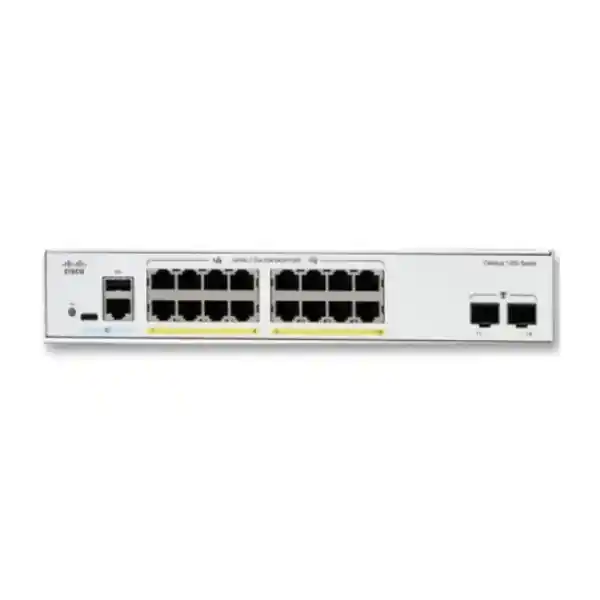
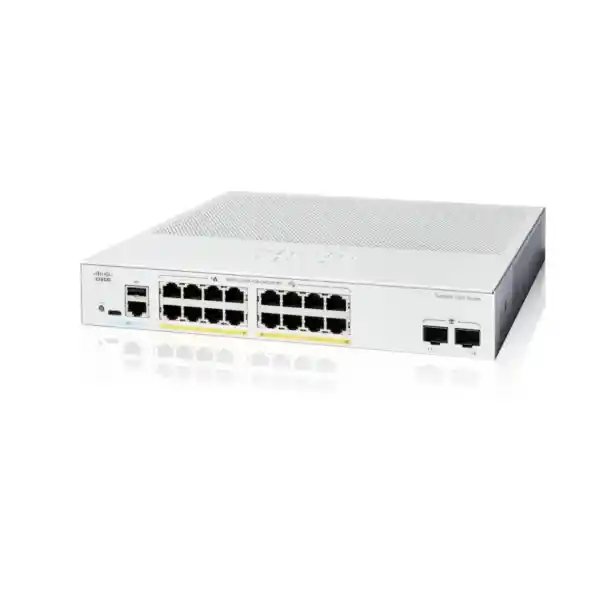
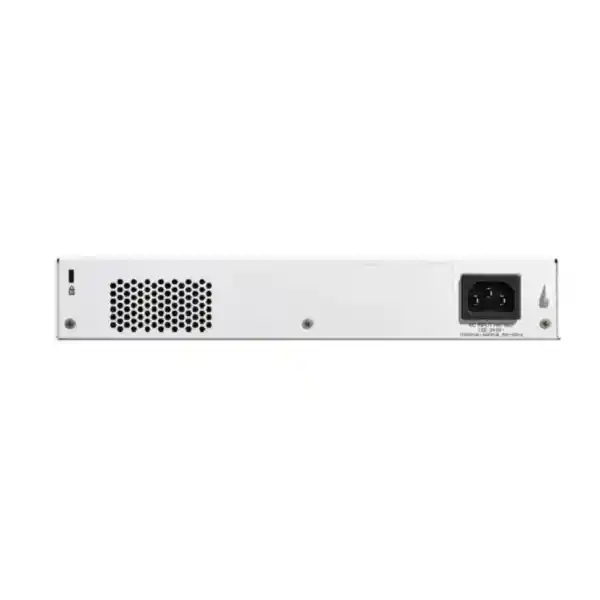
Cisco Catalyst C1200-16P-2G Network Switch UAE
A compact, fanless managed Gigabit switch with 16 PoE+ access ports, a 120 W shared PoE budget and two 1 Gigabit SFP uplinks. The C1200-16P-2G is designed for small and medium business networks that need stronger control, segmentation and visibility than an unmanaged switch without paying for capacity they may not use.
Direct answer: what the Cisco C1200-16P-2G is and who should consider it
The Cisco Catalyst C1200-16P-2G is a managed access switch in the Catalyst 1200 Series. It combines sixteen 10/100/1000 Ethernet ports that can provide IEEE 802.3af PoE and 802.3at PoE+ with two dedicated 1 Gigabit SFP uplink slots.
It is mainly used to connect and power small-business endpoints such as IP phones, wireless access points, security cameras and ordinary wired devices while adding VLANs, QoS, access controls, monitoring and static routing capabilities.
It fits offices, clinics, shops, schools, hospitality back offices, small branches and other sites that can work within sixteen access ports, a 120 W total PoE allowance and 1 Gigabit uplinks.
Confirm the real PoE wattage of all powered devices and the expected uplink traffic. The switch can supply up to 30 W on an individual Gigabit port, but all sixteen ports share only 120 W, so the per-port headline cannot be multiplied across every port.
FourTeck can help validate port count, PoE headroom, fibre optics, VLAN and uplink architecture, rack installation and whether a 24-port, higher-PoE or 10G-uplink Catalyst 1200 model would reduce future replacement risk.
Where the C1200-16P-2G fits in a business network
The C1200-16P-2G occupies a useful middle ground in Cisco’s small and medium business switching portfolio. It is not a basic plug-and-play unmanaged switch, because it provides VLAN segmentation, link aggregation, spanning-tree controls, access control lists, management interfaces, monitoring features, QoS and static Layer 3 routing. At the same time, it is not intended to replace a larger enterprise campus switching architecture where high-density access, 10 Gigabit or faster uplinks, sophisticated dynamic routing, redundant power, advanced stacking designs or extensive automation are primary requirements.
That positioning matters during procurement. Many small sites buy a switch only by counting Ethernet sockets, then discover later that the real constraint is power, uplink bandwidth, fibre media or growth capacity. The C1200-16P-2G gives sixteen powered copper ports and two dedicated SFP uplinks, so it is attractive when a site needs more than an 8-port PoE switch but does not yet need 24 or 48 access ports. Because the two uplinks are 1 Gigabit SFP rather than 10 Gigabit SFP+, the model makes most sense where aggregate traffic toward the firewall, server layer or distribution switch remains comfortably inside a Gigabit-oriented design.
The model is also fanless. For a quiet office, reception, classroom, consultation room or retail back office, that can be a practical advantage because there is no switch fan contributing acoustic noise. Fanless construction does not remove the need for sensible thermal conditions. The published operating range for this model family extends to 50°C, but a closed wall cabinet in the UAE can become significantly hotter than the room around it. Good cabinet ventilation, sensible equipment spacing and controlled room temperature remain important, especially when the switch is providing PoE and its internal power supply is carrying a meaningful load.
Good fit: compact PoE access
A site with roughly eight to fourteen powered endpoints plus some spare port capacity can make efficient use of the chassis, provided the combined PoE draw remains inside the 120 W budget with suitable headroom.
Good fit: quiet edge location
Fanless operation suits spaces where a small rack or cabinet is close to staff or customers, as long as airflow around the installed equipment remains adequate.
Reconsider: high uplink demand
If multiple high-throughput access points, storage systems, video streams or server workloads are expected to push aggregate traffic well beyond 1 Gigabit, a Catalyst 1200 model with SFP+ uplinks should be evaluated.
Reconsider: heavy PoE estate
If many endpoints require 15 W to 30 W each, the 120 W budget can become the limiting factor before all sixteen physical ports are occupied. A higher-power model may be the more economical long-term choice.
Cisco Catalyst C1200-16P-2G key specifications
The following specification summary focuses on the exact C1200-16P-2G and on product-family limits that directly affect network design. Values such as switching capacity, forwarding rate, PoE budget, dimensions and uplink type are important because they set the physical and performance boundaries of the proposed deployment.
| Specification | C1200-16P-2G detail | Buyer relevance |
|---|---|---|
| Access ports | 16 x 10/100/1000 Gigabit Ethernet RJ-45 PoE+ ports | Count every powered and non-powered copper endpoint, then retain sensible spare capacity for growth, troubleshooting and moves. |
| Uplinks | 2 x 1 Gigabit SFP | Useful for fibre links or dedicated uplinks, but they are 1G rather than 10G. Optics must match fibre type, connector and distance. |
| PoE standard | IEEE 802.3af PoE and 802.3at PoE+, up to 30 W to an individual Gigabit port while budget remains | Device maximums and actual operating draw are not the same. Size from the powered-device requirements, not only the port count. |
| Total PoE budget | 120 W shared across the 16 PoE ports | This is the primary sizing constraint for a dense phone, AP or camera deployment. |
| Switching capacity | 36 Gbps | Cisco rates the family for wire-speed, nonblocking switching. Real application performance still depends on endpoints, cabling, topology and uplinks. |
| Forwarding rate | 26.78 Mpps for 64-byte packets | Useful when comparing models within the series, although normal SMB workloads are usually constrained by topology or uplink design first. |
| MAC address table | 8,000 addresses | Comfortable for a normal SMB access layer, but very large Layer 2 domains should still be designed deliberately rather than left flat. |
| Jumbo frames | Up to 9,000 bytes; default MTU 2,000 bytes | Larger MTU values should be end-to-end compatible. Do not enable jumbo frames only on one device and expect an application benefit. |
| Packet buffer | 1.5 MB aggregate, dynamically shared | Burst-heavy traffic and speed mismatches deserve attention even when nominal port bandwidth looks sufficient. |
| Form factor | Rack-mountable, 268 x 297 x 44 mm; approximately 2.38 kg | The chassis is narrower than a full-width 19-inch switch, so use the supplied/appropriate mounting hardware and check cabinet depth and cable bend radius. |
| Cooling | Fanless | Quiet, but cabinet temperature and airflow remain installation responsibilities. |
| Power input | 100 to 240 V AC, 50 to 60 Hz, internal universal power supply | Suitable for UAE mains when installed with the correct power cord, earthing and UPS design. |
| Operating temperature | -5°C to 50°C for the model family excluding the separate 8T-D exception | A UAE installation still benefits from climate-controlled equipment space rather than relying on the upper environmental limit. |
PoE planning: the 120 W figure is more important than the 16-port count
The most common purchasing error with the C1200-16P-2G is to read “16 PoE+ ports” and assume every port can continuously provide the 30 W maximum associated with PoE+. The switch can deliver up to 30 W to an individual Gigabit Ethernet port while power remains available, but the entire chassis has a 120 W PoE budget. Sixteen ports at 30 W would require 480 W, which is four times the available budget. Even sixteen devices at 15 W each would require 240 W. The correct design method is therefore to build a power schedule for every powered endpoint and compare the expected maximum total with the switch budget.
A simple equal-distribution calculation shows why this matters. If all sixteen PoE ports were simultaneously occupied and the 120 W allowance were divided evenly, the mathematical average would be 7.5 W per port. Real deployments are not evenly distributed: an IP phone might draw only a few watts, while an access point or PTZ camera can request considerably more. That variation is precisely why a device-by-device power plan is more useful than an average. The switch can support a mix of low and higher power devices as long as the aggregate requirement stays inside the budget and the individual devices remain compatible with 802.3af or 802.3at power delivery.
Illustrative PoE load examples
These are planning examples rather than claims about any specific phone, camera or access point. Actual devices must be checked against their own datasheets and configured operating modes.
Good PoE planning also accounts for what the device does under load. A wireless access point may consume more power when additional radios, USB functions or higher transmit settings are active. A camera may change draw when infrared illumination, heaters or motors operate. An IP phone may pass power onward to an accessory or have different consumption when a color screen or sidecar is attached. The switch cannot compensate for an undersized power design simply because unused Ethernet ports are available.
For a new installation, it is sensible to reserve some PoE headroom instead of designing exactly to 120 W. The appropriate margin depends on the endpoint specifications, operating modes, growth plan and procurement policy. Where the calculated load is already near the limit, compare the C1200-24P-4G with its higher 195 W budget or a higher-power model rather than forcing a marginal design. A larger switch is not automatically better, but spare power capacity can be more valuable than spare port count when the endpoint mix is power intensive.
Two 1 Gigabit SFP uplinks: useful, but not a 10G design
The C1200-16P-2G has two dedicated 1 Gigabit SFP slots in addition to the sixteen copper access ports. This is different from the smaller 8-port models that use copper/SFP combo interfaces. On this model, the SFP slots can be used as dedicated fibre or copper-transceiver uplinks without sacrificing one of the sixteen RJ-45 access ports. That is useful for linking a floor cabinet to a core switch, connecting a detached office over fibre, creating a redundant Layer 2 path under an appropriate spanning-tree design, or separating an upstream connection from a local fibre-connected device.
The key limitation is speed. These are 1 Gigabit SFP ports, not 10 Gigabit SFP+ ports. A single uplink therefore provides 1 Gbps of nominal line rate. Two links can sometimes be aggregated where the upstream device, topology and configuration support the same LACP design, but link aggregation does not turn an individual session into a 2 Gbps stream and it does not remove all congestion scenarios. Traffic distribution depends on hashing and flow characteristics. For many small offices, this is still perfectly adequate; for a site with several high-throughput Wi-Fi 6/6E/7 access points, heavy local server traffic, frequent large backups or dense video flows, an SFP+ model can be a more future-proof choice.
Optics are another procurement item. The switch supports compatible Gigabit SFP modules, but the right optic depends on fibre type, wavelength, connector, distance and the device at the far end. A multimode link inside a building is a different requirement from a single-mode link between facilities. If copper is required in an SFP slot, a supported 1000BASE-T SFP option may be appropriate, but copper transceiver distance and thermal characteristics should also be considered. Do not order “an SFP” without stating the media and distance.
Performance and traffic behavior in practical terms
Cisco specifies 36 Gbps switching capacity and 26.78 million packets per second forwarding for the C1200-16P-2G, with the Catalyst 1200 family described as wire-speed and nonblocking. Those figures indicate that the internal switching fabric is sized to forward traffic across the available Gigabit interfaces without an obvious fabric bottleneck under the vendor’s test assumptions. They should not be interpreted as a promise that every application will achieve its theoretical Ethernet line rate. End systems, packet sizes, protocol overhead, storage performance, wireless conditions, security appliances, cabling quality and uplink contention all affect the result users actually experience.
The switch uses an 8,000-entry MAC address table and a 1.5 MB aggregate packet buffer that is dynamically shared across ports. For a typical sixteen-port SMB access layer, the MAC scale is generous. The packet buffer is more context dependent. Bursty traffic entering a fast interface and leaving through a congested or oversubscribed path can fill buffers regardless of nominal switching capacity. QoS, traffic shaping, sensible uplink sizing and avoiding unnecessary broadcast domains are therefore more important than treating the switching-capacity number as the only performance metric.
Jumbo frames up to 9,000 bytes are supported, while Cisco lists a 2,000-byte default MTU. Jumbo frames can reduce per-packet overhead in specific storage or server workflows, but they only work properly when the complete path supports the intended MTU. A mixed path with inconsistent MTU values can create fragmentation, drops or application problems that are harder to diagnose than the theoretical gain is worth. For a normal office network using phones, cameras, Wi-Fi and standard client devices, default Ethernet behavior is often the simpler choice unless there is a defined requirement for larger frames.
Layer 2 segmentation, loop prevention and link aggregation
The C1200-16P-2G is much more than a set of powered Ethernet sockets. It supports up to 255 active VLANs, including port-based and 802.1Q tagged VLAN operation, along with management, guest, voice and surveillance-oriented VLAN functions in the Catalyst 1200 feature set. VLANs allow a business to separate traffic classes that should not share the same Layer 2 broadcast domain. A practical branch design might place corporate PCs, voice handsets, guest wireless, cameras and network management in separate VLANs while trunking the required VLANs to a firewall or upstream switch.
Segmentation is useful only when the routing and policy layers are designed with it. Creating a camera VLAN does not automatically secure the cameras from every other network. The inter-VLAN path must enforce the intended access policy. Similarly, a voice VLAN can help apply QoS and simplify endpoint placement, but the phone system, DHCP options and upstream routing must understand that network. VLAN design should therefore be planned with IP addressing, DHCP, firewall rules and management access instead of configured as isolated switch settings.
For resilience and loop control, the series supports classic Spanning Tree Protocol as well as RSTP and MSTP. Cisco also lists PVST+ and Rapid PVST+ support. This matters if the switch is integrated into an existing Cisco-oriented Layer 2 network where redundant links are present. A physical loop in Ethernet can create a broadcast storm severe enough to disrupt the site, so redundant cabling must be combined with a correct spanning-tree design or an appropriate link-aggregation design. Loopback detection provides an additional mechanism that operates independently of STP, but it should not be treated as a substitute for deliberate topology design.
IEEE 802.3ad LACP link aggregation is supported with up to four groups and up to eight ports per group, subject to the family limits and topology. LAGs can increase aggregate bandwidth between compatible devices and provide link resilience, but both ends must be configured consistently. They also consume physical interfaces. On a sixteen-port access switch, dedicating multiple copper ports to a LAG can reduce endpoint capacity, while using the two SFP uplinks may be preferable when fibre is already planned. The right design depends on whether the priority is endpoint density, uplink resilience or aggregate traffic.
Static Layer 3 routing: useful local routing without pretending to be a core router
The Catalyst 1200 Series includes Layer 3 static routing features that go beyond what an unmanaged switch can provide. Cisco lists wire-speed IPv4 routing, up to 32 static routes and up to 16 IP interfaces, together with IPv6 routing capabilities and Layer 3 interfaces on physical ports, LAGs, VLAN interfaces or loopback interfaces. DHCP relay is also available for forwarding DHCP requests across Layer 3 boundaries. These features can let a small business route selected internal VLANs on the switch instead of sending every internal flow through an external router.
That can be useful, for example, when an office wants local communication between a trusted workstation VLAN and a local server VLAN at switch speed while reserving the firewall primarily for internet-bound traffic. It can also simplify a small routed access design. However, static routing is fundamentally different from a dynamic routing architecture. If the environment requires complex route exchange, multiple routed paths, automated convergence across a large topology or advanced campus routing policy, the product class should be reconsidered. The C1200-16P-2G is strongest when routing needs are limited, well understood and stable.
Security policy is another consideration. Routing traffic on the switch can bypass a firewall path that would otherwise inspect or filter that communication. Before moving inter-VLAN routing onto the switch, decide which traffic genuinely needs local switching and which traffic should pass through a security appliance for policy enforcement, logging or threat inspection. In many SMB networks the best design is a hybrid: the switch provides efficient access-layer segmentation and selected local routing while the firewall remains the policy boundary for sensitive or internet-facing flows.
Security controls available at the access layer
Access switches sit close to users and endpoints, so they are a practical enforcement point for several security controls. The Catalyst 1200 family supports IEEE 802.1X in the authenticator role with RADIUS, guest VLAN behavior and multiple host/session modes. Port security can restrict learned MAC addresses, while storm control can limit broadcast, multicast and unknown-unicast conditions. Cisco also lists denial-of-service prevention functions and extensive access control list support.
The ACL scale is up to 512 rules for the series. Rules can be based on attributes such as source or destination MAC address, VLAN, IPv4 or IPv6 address, protocol, port and several QoS-related fields, and the platform supports ingress and egress application. This gives a small network useful control at the switch boundary, but ACL design should be documented carefully. A large set of loosely organized rules can become difficult to troubleshoot, especially when the firewall, wireless controller and endpoints also enforce policy.
Management security matters as much as traffic security. The series supports secure browser management over HTTPS, SSH for command-line access, SNMPv3 for monitored environments, user privilege levels and mechanisms for protecting sensitive configuration data. Management access should be placed on a dedicated or restricted management network where practical. Default or shared passwords, open management access from user VLANs and unnecessary legacy protocols undermine the value of buying a managed switch in the first place.
A switch is not a replacement for a next-generation firewall. It can enforce local access policy and reduce the attack surface around edge ports, but it does not provide the complete threat inspection, internet security and application control associated with a dedicated security gateway. Buyers designing a new branch can review network-security architecture through Firewall Dubai by FourTeck while keeping the C1200-16P-2G focused on access switching, segmentation and PoE delivery.
QoS for IP telephony, wireless and video
Voice and real-time media are sensitive to delay, jitter and packet loss. The Catalyst 1200 Series provides eight hardware queues and supports strict-priority and weighted round-robin scheduling, together with classification based on 802.1p class of service, DSCP and other fields. It also includes voice-oriented discovery and VLAN functions. In a converged branch network, these capabilities can help protect voice signaling and media from large file transfers or other bursty traffic.
QoS is not a way to create bandwidth that does not exist. If a 1 Gigabit uplink is saturated by sustained traffic, prioritization can decide which classes receive better treatment, but lower-priority traffic still has to wait or be dropped. The most effective design combines adequate uplink capacity with classification and queuing that reflect actual business priorities. For many small offices, simply identifying voice traffic correctly and preventing backup or guest traffic from overwhelming the uplink is more useful than building a highly complicated class hierarchy.
IP phones also interact with LLDP-MED, CDP, voice VLAN and PoE behavior. The C1200-16P-2G supports LLDP with LLDP-MED extensions and Cisco Discovery Protocol, allowing neighboring devices to advertise information and capabilities. When third-party phones are involved, test the intended discovery method, VLAN assignment, PoE class and DHCP requirements. Standards support improves interoperability, but it does not guarantee that every phone model will auto-configure exactly the way a Cisco endpoint would.
Management, monitoring and deployment options
The C1200-16P-2G supports multiple management methods, which is helpful when a small business wants simplicity today but more structured operations later. Cisco provides a built-in web user interface with basic and advanced modes, configuration wizards, monitoring and maintenance functions. The series also integrates with Cisco Business Dashboard and supports an embedded probe, avoiding the need for a separate onsite probe server in supported deployments. Cisco Business mobile app support is intended to simplify local setup and management.
For administrators who prefer standard network tools, the platform supports command-line access, SNMP versions 1, 2c and 3, syslog-related functions, RMON groups, port and VLAN mirroring, SCP file transfer and dual firmware images. SNMPv3 should normally be preferred over older community-string-based monitoring when the monitoring platform supports it, because it provides stronger security options. Central logging is valuable because it gives the support team evidence when a port flaps, a loop occurs, an authentication request fails or a configuration changes.
Cisco Network Plug and Play support can reduce manual effort in repeat branch deployments. The practical value depends on how many switches are being rolled out and whether the organization already uses the supporting management workflow. A single standalone office may be perfectly manageable through the local web interface. A business deploying many similar branches benefits more from standardized templates, preplanned VLAN IDs, consistent management addressing, backup configurations and a naming convention that makes remote support predictable.
Configuration should be treated as an operational asset rather than an undocumented one-time task. Record the management IP, VLAN design, trunk settings, PoE priorities, LAGs, ACLs, admin accounts, firmware version and connected uplinks. Store configuration backups outside the switch. For ongoing UAE infrastructure support, FourTeck IT Services UAE can be used as a reference point for broader installation and support requirements that extend beyond the switch itself.
Use cases that match the C1200-16P-2G well
Small office voice and data
A branch with IP phones, PCs and one or two access points can use the switch as a compact converged access layer. Voice VLAN and QoS features help separate and prioritize telephony, while PoE removes local power adapters from compatible phones and wireless devices. The design must still check total PoE draw and decide whether PCs connect through phone pass-through ports or consume separate switch ports.
Retail or hospitality back office
A shop, café, boutique hotel office or point-of-sale support network may need a quiet switch for payment terminals, back-office computers, phones, cameras and Wi-Fi. VLANs can separate business systems from guest connectivity. Fanless operation is useful near occupied space, while the 1G SFP uplinks support fibre runs back to a larger equipment room where required.
Clinic or professional practice
A clinic, consultancy or legal office often has a moderate port count but still benefits from managed segmentation. Staff PCs, VoIP, guest wireless and building devices can be separated logically. The switch can provide local access controls and monitoring, while sensitive application traffic remains governed by the firewall and server architecture.
Small camera deployment
A modest IP surveillance network can use the PoE ports to power compatible cameras and carry traffic to a recorder or upstream security network. The camera wattage, recording bitrate and uplink utilization need to be calculated. High-resolution, high-frame-rate or many concurrent streams can make uplink bandwidth and PoE budget more important than the number of camera ports alone.
Small education or training room
Training rooms and smaller classrooms may require powered wireless access points, IP phones, instructor systems and fixed wired devices. Managed VLANs and loop protection are useful when temporary equipment is frequently connected. A fanless switch is also less intrusive acoustically in teaching space than a high-power fan-cooled access switch.
Remote branch with fibre uplink
Where a branch needs sixteen or fewer copper endpoints and a fibre connection to a distribution point, the two SFP slots are convenient. One can carry the primary uplink and the second may serve another fibre path or device, subject to topology and redundancy requirements. If the branch is expected to grow into a high-throughput site, a 10G-uplink model should be considered early.
When the C1200-16P-2G may be the wrong switch
A balanced product page should identify limitations as clearly as benefits. The first limitation is the 120 W PoE budget. A deployment with many high-power access points, PTZ cameras, video phones or other demanding PoE+ endpoints may exhaust power well before all sixteen ports are used. If the required load is near the budget from day one, selecting a higher-power switch is safer than assuming future firmware settings or lower average consumption will make the design acceptable.
The second limitation is uplink speed. The C1200-16P-2G uses 1G SFP uplinks. That suits a large number of conventional small-business networks, but it may not suit an access layer expected to aggregate several multi-gigabit wireless access points or significant local server traffic. The access ports themselves are Gigabit Ethernet rather than 2.5G/5G multigigabit. If the endpoint roadmap includes high-performance wireless requiring multigigabit copper, another switching family or model class should be evaluated instead of treating PoE support alone as sufficient.
The third limitation is scale. Sixteen copper access ports can be an efficient fit in a compact office, but a site that expects twenty endpoints soon should not buy sixteen ports merely because the current count is fourteen. Moving to a 24-port model may reduce the need to add a second switch, another uplink, another power feed and another management point. Conversely, a site with only five powered endpoints may be better served by an 8-port PoE model if there is little realistic growth.
The fourth limitation is architectural role. Static Layer 3 routing and SMB management features are useful, but they do not automatically make this device a replacement for an enterprise distribution or core switch. Requirements such as advanced dynamic routing, high-availability chassis behavior, redundant field-replaceable power, large-scale stacking, sophisticated campus automation or much higher uplink speeds point toward a different product class. The correct switch is the one that matches the role, not the one with the longest feature list.
Compare nearby Cisco Catalyst 1200 options before ordering
The C1200-16P-2G is often shortlisted against adjacent models in the same series. A useful comparison starts with the constraint that is most likely to change: port density, PoE wattage or uplink speed. The table below shows why each alternative exists rather than simply presenting a larger model as an automatic upgrade.
| Model | Access / uplink profile | PoE profile | When it is worth considering |
|---|---|---|---|
| C1200-16T-2G | 16 x 1G data, 2 x 1G SFP | No PoE output | Choose when powered endpoints are not required and buying PoE capacity would add no value. |
| C1200-16P-2G | 16 x 1G PoE+, 2 x 1G SFP | 120 W shared budget | Balanced choice for a moderate port count, moderate PoE load and Gigabit-oriented uplinks. |
| C1200-24P-4G | 24 x 1G PoE+, 4 x 1G SFP | 195 W shared budget | Consider when port growth or PoE load is likely to exceed the 16P model, while 1G uplinks remain sufficient. |
| C1200-24FP-4G | 24 x 1G PoE+, 4 x 1G SFP | 375 W shared budget | Better fit when a 24-port estate contains many devices with higher PoE draw. It uses active cooling, so acoustic and cabinet considerations differ. |
| C1200-24P-4X | 24 x 1G PoE+, 4 x 10G SFP+ | 195 W shared budget | Evaluate when the site needs more access ports and the uplink roadmap has already moved beyond 1 Gigabit. |
The smaller C1200-8FP-2G can also be relevant when eight powered ports are enough but the site still needs a 120 W PoE budget. It provides the same headline total PoE budget as the 16P model across fewer powered ports, which can make it attractive for a compact set of higher-draw endpoints. The trade-off is reduced port count and a different uplink arrangement on the compact 8-port platform. This illustrates why “bigger” and “smaller” should be evaluated against the actual endpoint schedule rather than treated as simple performance tiers.
UAE deployment considerations: heat, cabinets, power and fibre
For UAE installations, environmental planning deserves more attention than it receives in a simple bill of materials. The C1200-16P-2G is fanless and its family operating range extends to 50°C, but equipment should still be installed in a controlled environment. A small closed cabinet mounted in a utility area can trap heat from the switch, firewall, UPS and other devices. PoE delivery increases electrical load, and a fanless chassis depends on passive heat dissipation. Leave ventilation paths open, avoid packing hot equipment directly around the unit and measure cabinet temperature if the location is known to be warm.
Power quality is another practical consideration. The internal universal power supply accepts 100 to 240 V AC at 50 to 60 Hz. In a business environment, the switch is commonly connected through a correctly sized UPS so brief utility interruptions do not drop phones, wireless access points and cameras at the same time. The UPS must be sized for the switch’s own consumption plus the powered-device load and any other equipment connected to it. A switch providing close to its maximum PoE budget places a very different load on a UPS from the same switch with only a few low-power phones attached.
Cabinet layout should allow room for copper patch cords, SFP modules and fibre bend radius. Because the chassis is approximately 268 mm wide and 297 mm deep, it is compact, but that does not mean it should be placed loose on top of other equipment. Use appropriate rack mounting, ensure the cabinet can support the required accessories and maintain safe cable management. Label both ends of uplinks and important access cables. If fibre is used, record the optic model, fibre type and patching path so future support work does not depend on visual guesswork.
Availability and warranty handling should be checked on the quotation rather than assumed from a generic global listing. Cisco states that Catalyst 1200 products are supplied through distributors and partners rather than ordered directly by end users from Cisco. For UAE sourcing and project coordination, buyers can review FourTeck UAE. The quotation should identify the exact C1200-16P-2G model, quantity, any SFP modules, power accessories, installation scope and support expectations so a similar-looking non-PoE or different-uplink model is not substituted unintentionally.
Installation and commissioning checklist
A reliable installation is more than connecting cables and seeing link LEDs. The steps below are deliberately focused on decisions that affect future support. A small switch is often left undocumented because the site seems simple; that is exactly how avoidable outages become difficult to resolve months later.
1. Validate the physical bill of materials
Confirm the exact switch model, rack-mount hardware, power cord, patch leads, SFP optics, fibre patch cords and any UPS requirement. The “2G” suffix refers to two 1G SFP uplinks; it should not be interpreted as two 10G ports.
2. Build a port and PoE schedule
List the device on every planned port, the required VLAN, whether PoE is needed, expected wattage and whether the device has a special priority. Add the total PoE load and retain an agreed margin below the 120 W ceiling.
3. Define management before user traffic
Assign management addressing, restrict administrative access, set strong credentials, configure time and logging, and decide how configuration backups will be stored. Management should not remain exposed simply because the local web interface is convenient.
4. Configure VLANs and trunks deliberately
Document access VLANs, tagged VLANs, native VLAN assumptions and which networks are carried upstream. Confirm the firewall or upstream switch uses matching tags and that DHCP exists for each client network that needs it.
5. Test fail and recovery conditions
Verify what happens if an uplink is disconnected, the switch reboots or a PoE endpoint is power-cycled. Where redundant links exist, test spanning-tree or LAG behavior rather than assuming the configuration will converge as intended.
6. Record the as-built state
Save the final configuration, port map, firmware version, serial information, uplink optic details, rack location and administrator ownership. A short as-built document saves substantial time when the first incident occurs.
Licensing, software and lifecycle questions
The Catalyst 1200 Series is positioned as an affordable managed switching platform for small and medium businesses, and the core switch functions discussed on this page are built into the platform rather than presented here as a separate feature subscription. However, buyers should still distinguish between switch functionality, optional management services, support entitlements and any broader software used elsewhere in the network. A quote for the hardware alone is not automatically a managed-service contract or a guarantee of onsite support.
Firmware maintenance should be part of the operational plan. The series supports browser-based upgrades, TFTP and SCP-based image transfer, along with dual images for more resilient firmware management. Before an upgrade, review release information, back up the configuration and confirm maintenance-window expectations. A switch that carries phones, Wi-Fi and cameras can affect several business functions at once during a reboot, so even a small branch deserves a planned change rather than an ad-hoc update in working hours.
Cisco lists a limited lifetime warranty for the Catalyst 1200 Series and complimentary one-year access to its Small Business Support Center in the current data sheet. Exact regional entitlement, replacement process and reseller support should be confirmed on the commercial offer because operational responsibility can vary depending on how the product is sourced. Businesses that require guaranteed onsite response, spare hardware or a defined service-level agreement should purchase those requirements explicitly instead of assuming the hardware warranty provides them.
Lifecycle planning is also about capacity. A switch can remain technically supported while becoming operationally undersized for a growing site. If a branch expects to add more cameras, high-throughput access points or additional desks, compare the next port and uplink tier before procurement. Replacing a switch early because the uplinks are too slow or the PoE budget is exhausted is usually more disruptive than choosing the right capacity at the initial design stage.
Frequently asked buyer questions about the C1200-16P-2G
Does every one of the 16 ports support PoE+?
Yes. Cisco lists sixteen Gigabit Ethernet ports that support PoE, with 802.3af and 802.3at support for the PoE-capable models. The total C1200-16P-2G PoE budget is 120 W, so having sixteen PoE-capable ports does not mean sixteen devices can each receive 30 W simultaneously.
Can the switch power 16 IP phones?
Potentially, but the answer depends on each phone’s actual maximum PoE requirement. Sixteen devices averaging 5 W would total 80 W and fit inside the nominal budget; sixteen devices at 10 W would require 160 W and would not. Phone model, accessories and operating mode must be included in the calculation.
Can it power wireless access points?
Yes, provided the access points are compatible with the available PoE standards and the combined load stays within 120 W. Also check Ethernet speed requirements. The access ports are 1 Gigabit, so an AP designed to benefit from 2.5G or faster wired backhaul may be better matched with a multigigabit switch.
Are the two SFP ports 10 Gigabit?
No. The C1200-16P-2G uses two Gigabit SFP uplinks. Buyers who need 10 Gigabit fibre uplinks should compare Catalyst 1200 models with the “4X” uplink configuration, such as the C1200-24P-4X, rather than assuming all SFP-shaped ports operate at the same speed.
Is the switch fanless?
Yes. Cisco identifies the C1200-16P-2G as fanless. This makes it well suited to acoustically sensitive spaces, but it still generates heat and should be installed with adequate ventilation. A fanless design should not be placed in a sealed cabinet that runs near environmental limits.
Can it route between VLANs?
Yes. The Catalyst 1200 family supports static Layer 3 routing, including IPv4 routing with up to 32 static routes and up to 16 IP interfaces. Whether inter-VLAN routing should happen on the switch is a security and architecture decision; some traffic may be better routed through the firewall for policy inspection.
Does it support VLANs for voice and cameras?
Yes. The series supports up to 255 active VLANs, with voice VLAN and Auto Surveillance VLAN functions among the available features. The rest of the network must also be designed for those VLANs, including DHCP, firewall rules, trunks and any recorder or call-control connectivity.
Does it support link aggregation?
Yes. IEEE 802.3ad LACP is supported. Cisco specifies up to four aggregation groups with up to eight ports per group in the series. Both ends of the LAG must use compatible settings. Aggregation improves total path capacity and resilience for multiple flows but does not make every single connection use the sum of all member-link speeds.
Is the C1200-16P-2G suitable for CCTV?
It can be suitable for a modest camera network, especially where cameras are Gigabit or Fast Ethernet devices using standard PoE/PoE+. Calculate camera wattage and aggregate video bitrate rather than counting ports only. High-power PTZ cameras or a large number of high-bitrate streams can make the 120 W budget or 1G uplink the limiting resource.
Can it be used without fibre?
Yes. The sixteen RJ-45 access ports provide standard copper Gigabit Ethernet. Fibre is optional and usually used for uplinks or longer building links. If the upstream device is nearby and copper is preferred, the network design can use a copper access port or a compatible copper SFP depending on port availability and the desired topology.
What SFP should be ordered?
There is no universal answer. Specify whether the link is copper, multimode fibre or single-mode fibre, the connector type, approximate distance and the optic at the far end. Compatible 1G SFPs include Cisco-listed options for multimode, single-mode and copper media, but the exact module should be selected for the actual link.
Is it rack mountable?
Yes. Cisco lists the model as rack-mountable and includes mounting hardware in the family package contents. The chassis is approximately 268 mm wide, 297 mm deep and 44 mm high. Check the specific cabinet and kit because the chassis itself is narrower than a standard full-width 19-inch rack device.
Can it be managed from a browser?
Yes. The series includes a built-in web interface for configuration and monitoring and also supports Cisco Business Dashboard, Cisco Business mobile app functions, CLI, SNMP and other standard management methods. For production use, management access should be secured and backed by configuration backups and central logs where practical.
Does it support SNMPv3?
Yes. Cisco lists SNMP versions 1, 2c and 3, with SNMPv3 User-Based Security Model support. Monitoring platforms can use this to collect device information and receive events. SNMPv3 is generally preferable when supported because it offers stronger authentication and privacy options than older community-string methods.
What is the main difference between 16P and 24P?
The 24P model increases access ports from sixteen to twenty-four, increases the PoE budget from 120 W to 195 W and provides four 1G SFP uplinks rather than two. It is a better fit when either endpoint growth or PoE load is likely to exceed the 16P model, while the 16P remains more compact for smaller sites.
What is the main difference between 16P and 16T?
The C1200-16T-2G is a data-only model without PoE output, while the C1200-16P-2G provides PoE+ across its sixteen copper ports with a 120 W budget. If all powered devices already use local adapters or there are no powered endpoints, the 16T can avoid buying unnecessary PoE capability.
Is 36 Gbps switching capacity enough?
For the switch’s sixteen 1G access ports and two 1G uplinks, Cisco rates the product as wire-speed and nonblocking. In real SMB networks, uplink contention, endpoint speed and application behavior often matter more. If the network requires sustained multi-gigabit aggregation toward servers or the internet edge, the uplink architecture should be upgraded rather than focusing only on fabric capacity.
Should all unused ports be left enabled?
That is an operational policy choice, but security-conscious deployments often disable or restrict unused access ports and document which ports are intended for visitors, phones, cameras or staff devices. Port security and 802.1X can add control where the organization has the identity infrastructure and support process to manage them correctly.
Can the switch replace the firewall?
No. Switch ACLs and VLANs are useful for local segmentation, but they do not provide the full internet security, application inspection and threat-protection role of a dedicated firewall. Use the switch for access-layer connectivity and policy controls while keeping the security gateway responsible for the traffic that requires firewall inspection.
How much spare capacity should be planned?
There is no single percentage that fits every site. Retain enough spare Ethernet ports and PoE power for realistic near-term growth, maintenance swaps and temporary devices. A site already using fifteen ports and 110 W on day one is technically close to the limits even if the configuration works at commissioning.
What information is needed for an accurate quotation?
Provide quantity, endpoint count, PoE device models or wattage, fibre media and distance, rack location, required optics, installation expectations, desired support coverage and any migration requirements. This avoids a quote that covers only the switch chassis while omitting the components required to make the uplinks and powered endpoints operational.
Procurement guidance for Dubai and the UAE
Cisco identifies Catalyst 1200 switches as products purchased through distributors and partners rather than directly by end users from Cisco. That distribution model makes exact part identification important. “Cisco 16-port PoE switch” is not a sufficient purchase description because the Catalyst portfolio contains multiple families, uplink types and power budgets. The quotation should name C1200-16P-2G explicitly, together with any SFP modules and required services.
For a UAE project, commercial comparison should go beyond the chassis price. A complete cost view includes compatible optics, fibre or copper patching, rack accessories, UPS capacity, installation labor, configuration, documentation, migration and support. If an existing switch is being replaced, identify whether the old device currently performs routing, DHCP relay, voice VLAN, link aggregation or monitoring functions. A like-for-like port count does not guarantee a like-for-like operational role.
Where multiple branches are involved, consistency can be more valuable than obtaining a slightly lower unit price on mixed switch models. Standardizing port templates, management addressing, firmware, SFP types and spare holdings reduces support complexity. For organizations sourcing beyond the UAE as part of a wider project, FourTeck can serve as a broader regional reference while the UAE-specific design remains based on local site conditions.
Decision recap: six checks before choosing the C1200-16P-2G
What FourTeck needs from the buyer for an accurate recommendation
A useful quotation should be based on the network the switch will actually serve. Sending the following information allows the proposed bill of materials to include the right model and avoid obvious omissions.
How many switches are needed and whether they are for one office or multiple branches.
Number of PCs, phones, access points, cameras, printers and other wired devices.
Device models or maximum wattage so the 120 W shared budget can be tested properly.
Copper or fibre, multimode or single-mode, distance, connector type and expected traffic.
Required VLANs, routing, voice, surveillance, QoS, ACL, monitoring and LAG requirements.
Current firewall, upstream switch, IP phone platform, wireless system and management tools.
Rack or cabinet details, available power, UPS, ambient conditions and cable-path constraints.
Supply only, installation, migration, documentation, remote support or ongoing maintenance.
Confirm the C1200-16P-2G against your actual PoE and uplink plan
The Cisco Catalyst C1200-16P-2G is a strong compact choice when sixteen Gigabit access ports, a 120 W shared PoE budget and two 1G SFP uplinks match the site. The decision changes when the project needs heavier PoE, more ports, multigigabit access or 10G uplinks. Provide the device list and uplink requirements and the quotation can be built around the real constraints instead of a generic port count.
For UAE projects requiring supply, optics, installation or migration planning.

Reviews
There are no reviews yet.