
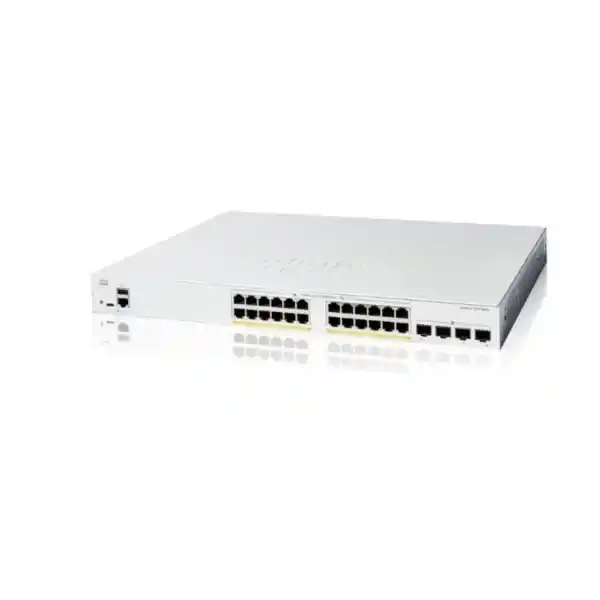
Managed PoE+ access switching for Dubai business networks
Cisco Catalyst C1200-24P-4G Network Switch Dubai
The Cisco Catalyst C1200-24P-4G is a 24-port Gigabit Ethernet PoE+ managed switch designed for small and medium business access networks. It combines 24 powered copper access ports, four 1 Gigabit SFP uplinks, a 195W shared PoE budget, wire-speed switching, VLAN and QoS controls, security features, browser and CLI management, and static Layer 3 routing in a rack-mountable, fanless platform. The most important buying decision is not simply whether 24 ports are enough: buyers should also confirm the total PoE requirement and whether 1G optical uplinks provide sufficient headroom for the intended aggregation design.
195W PoE budget
4 × 1G SFP uplinks
56 Gbps switching capacity
Fanless rack-mountable design
Direct answer: what is the C1200-24P-4G and who should consider it?
What exactly is it?
It is a managed Cisco Catalyst 1200 Series Ethernet switch with 24 Gigabit RJ-45 ports that support PoE+ and four dedicated Gigabit SFP ports. Cisco specifies a 195W switch-wide PoE power budget, 41.67 million packets per second forwarding capacity for 64-byte packets, and 56 Gbps switching capacity. It is designed to provide more control, segmentation, security, monitoring, and routing capability than an unmanaged switch while staying in the small and medium business segment.
What is it mainly used for?
Its natural role is the access layer: connecting desktop users, IP phones, wireless access points, CCTV cameras, printers, controllers, servers with modest access requirements, and other Ethernet devices. PoE+ lets suitable endpoints receive network connectivity and electrical power through the same copper cable. The SFP ports can connect the switch to an upstream distribution switch, another cabinet, or fibre infrastructure using compatible optics.
Who should consider it?
Consider it when a site needs up to 24 powered Gigabit access ports, expects a total connected-device PoE demand that fits comfortably inside 195W, and can operate effectively with 1G SFP uplinks. Typical candidates include small offices, retail branches, clinics, schools, warehouses, hospitality back-office networks, security-system cabinets, and branch sites where straightforward managed switching is more important than high-density 10G aggregation.
What is the most important factor to confirm?
Confirm two shared resources before ordering: PoE power and uplink bandwidth. All 24 copper interfaces are PoE capable, but the 195W budget is shared across them, so the switch cannot simultaneously deliver the full 30W PoE+ maximum to every port. The four fibre uplinks are 1G SFP rather than 10G SFP+, so a network expecting heavy east-west traffic, high-speed server access, dense Wi-Fi aggregation, or large camera backhaul may need a 4X model instead.
What can FourTeck help determine?
FourTeck can translate the endpoint list into a practical port and PoE budget, confirm whether 1G uplinks are sufficient, identify suitable SFP optics for the fibre type and distance, review VLAN and uplink requirements, check rack and power conditions, and compare the C1200-24P-4G with higher-PoE, 10G-uplink, 48-port, or non-PoE alternatives before a UAE quotation is finalized.
Why the exact model suffix matters
Cisco Catalyst 1200 model names encode practical differences that directly affect procurement. In C1200-24P-4G, the “24P” identifies a 24-port PoE model, while “4G” distinguishes the four Gigabit SFP uplinks from “4X” versions that provide 10 Gigabit SFP+ uplinks. That difference is easy to miss when quotations are prepared from abbreviated descriptions such as “Catalyst 1200 24-port PoE switch.” A buyer who needs only Gigabit fibre uplinks can avoid paying for capability that may not be used, while a buyer designing a high-throughput aggregation link may discover that the 4G version constrains the architecture even though the copper access ports are adequate.
The C1200-24P-4G also sits between nearby models with different power envelopes. The C1200-24T-4G provides 24 Gigabit access ports and four Gigabit SFP uplinks but does not provide the PoE+ budget of this model. The C1200-24FP-4G keeps the same basic 24-access-port and four-1G-uplink structure but increases the PoE budget to 375W. This makes the 24P-4G attractive when a site needs PoE on many ports but expects moderate per-device power draw rather than a large population of high-power PoE+ endpoints. A simple port count therefore does not provide enough information to select between them.
The same naming logic becomes especially important during replacements. If an existing switch is being refreshed, capture the full old model, how many ports are actually active, which ports currently deliver PoE, current power consumption if available, optic types, uplink speeds, VLAN assignments, trunk configuration, link aggregation, and any static routes. Replacing a switch with the same physical port count but a smaller power budget or slower uplink class can create an avoidable bottleneck. Conversely, buying a higher-end model without a workload reason can increase project cost without improving user experience.
Verified technical profile of the Cisco C1200-24P-4G
| Specification | C1200-24P-4G value | Buyer relevance |
|---|---|---|
| Copper access ports | 24 × 10/100/1000 Gigabit Ethernet RJ-45 | Provides a conventional 24-port access layer for office, voice, wireless, camera, and endpoint connectivity. |
| PoE capability | IEEE 802.3af and 802.3at PoE+ on all 24 RJ-45 ports; up to 30W to an individual Gigabit port while total budget remains available | Port capability and switch-wide budget are different. Plan the total watts of all attached powered devices. |
| Total PoE budget | 195W | Adequate for many moderate-power endpoint mixes, but not enough to supply 30W to all 24 ports simultaneously. |
| Fibre uplinks | 4 × 1 Gigabit SFP | Suitable for Gigabit fibre uplinks; evaluate 4X models where 10G SFP+ aggregation is required. |
| Forwarding performance | 41.67 mpps for 64-byte packets | Cisco specifies wire-speed, nonblocking operation for the series; practical network throughput still depends on topology and uplinks. |
| Switching capacity | 56 Gbps | Matches the aggregate full-duplex port-speed structure of 28 Gigabit interfaces. |
| Packet buffer | 1.5 MB, dynamically shared | Relevant when considering bursty traffic, though application design and uplink contention usually matter more to an SMB access-layer decision. |
| MAC address table | 8,000 addresses | Supports normal endpoint learning for typical small and medium business access networks. |
| Jumbo frames | Up to 9000 bytes; default MTU 2000 bytes | Useful only when the wider network path and attached systems are configured consistently. |
| Memory platform | Dual-core ARM 1.4 GHz CPU, 1 GB DDR4 DRAM, 512 MB flash | Supports the switch operating environment and management functions; these are not server-compute resources. |
| Dimensions | 445 × 299 × 44 mm | A 1U-class rack format; confirm cabinet depth, cable bend radius, ventilation, and PDU access. |
| Weight | 3.53 kg | Relevant to handling and rack planning, particularly in compact wall-mounted cabinets. |
| Power input | 100–240V AC, 50–60 Hz, internal universal supply | Suitable for standard UAE commercial electrical environments when deployed through appropriate protected rack power. |
| Cooling | Fanless | Reduces acoustic noise and removes a fan as a moving component, but rack ventilation and ambient temperature still matter. |
| Operating temperature | -5°C to 50°C | Do not interpret the upper limit as a target operating temperature; properly conditioned communications rooms improve reliability. |
| Warranty | Cisco limited lifetime warranty; Cisco also states complimentary one-year access to its Small Business Support Center for the series | Confirm local support process, entitlement, replacement logistics, and any optional support service required by the project. |
PoE planning: why 24 powered ports does not mean 24 ports at 30W
The PoE budget is the first sizing calculation for many C1200-24P-4G projects. Cisco specifies that the switch supports IEEE 802.3af PoE and 802.3at PoE+ across all 24 RJ-45 ports, with up to 30W available to an individual Gigabit Ethernet port until the total switch budget is reached. The C1200-24P-4G dedicates 195W to PoE. Dividing 195W by 24 gives an average of approximately 8.1W per port if every access port were simultaneously supplying power. That average is not a per-port limit; it is simply a useful planning illustration. Some devices may draw 3W to 7W, others 10W to 15W, and more demanding endpoints may approach higher PoE+ levels. The correct design uses the endpoint power requirements rather than an assumed equal split.
Consider a mixed office. IP desk phones may have relatively modest draw, while dual-radio wireless access points, pan-tilt-zoom cameras, video intercoms, access-control terminals, and other powered devices can demand considerably more. If the switch is selected only because it has 24 PoE-capable ports, the site can run out of the shared wattage budget before it runs out of physical interfaces. That can become visible only after the final wave of devices is connected. A better bill of materials lists every planned powered device, the manufacturer’s maximum or design power value, the quantity, and a sensible growth allowance. The sum should fit comfortably beneath 195W rather than relying on optimistic typical consumption.
The closest family comparison is important. Cisco lists the C1200-24FP-4G with the same 24 copper access ports and four 1G SFP uplinks but a 375W PoE budget. That is the stronger choice when port count is correct but power density is not. The 24P-4G remains attractive where endpoints are numerous but comparatively light, or where only a subset of the 24 ports will provide power. It can also be appropriate when expansion is controlled and the customer knows the expected PoE load. Using an oversized power model may be unnecessary, but undersizing PoE is often more disruptive because it can force a switch replacement or an unplanned redesign.
Cisco also lists time-based PoE and perpetual PoE among Catalyst 1200 features. Time-based PoE can turn power on or off according to a configured schedule, which can support energy policies or controlled endpoint operation. Perpetual PoE is intended to keep delivering power to connected powered devices while the switch itself is rebooting. These capabilities can be useful operationally, but they do not increase the 195W budget. The physical power calculation remains the governing constraint, and the exact endpoint behavior during maintenance should be validated in the intended design.
Uplink design: four SFP ports are useful, but they are 1 Gigabit
The C1200-24P-4G provides four dedicated SFP interfaces in addition to its 24 copper ports, giving 28 total Gigabit Ethernet interfaces. This is valuable in cabinets where fibre is used to connect floors, buildings, distribution switches, or a core switch. The key procurement detail is speed: the uplinks are Gigabit SFP, not 10 Gigabit SFP+. A network can still use multiple uplinks for resilience or link aggregation where the topology and configuration support it, but the raw speed of each port remains 1G.
For many branches, that is entirely adequate. A small office with normal cloud traffic, voice, printing, line-of-business applications, and moderate Wi-Fi usage may have a WAN connection well below 1 Gbps and no local server workload that justifies 10G. In that environment, a Gigabit fibre uplink can be practical and cost-efficient. The decision changes in denser deployments. If many Wi-Fi access points feed high-speed clients, several surveillance streams cross the same upstream path, workstations regularly access large files on local storage, or multiple VLANs converge on a single uplink, the aggregation point can become the bottleneck even though each user port itself is only Gigabit.
Cisco offers C1200 4X models with SFP+ uplinks, including the C1200-24P-4X, which keeps a 195W PoE budget while changing the uplink class to four 10 Gigabit SFP+ interfaces. That nearby model deserves a direct comparison whenever the customer expects the access switch to remain in service through future bandwidth growth. The extra uplink headroom may be more valuable than adding more copper ports. Conversely, where the upstream switch exposes only 1G fibre ports and the traffic profile is modest, selecting a 4X model may not produce a practical benefit until the rest of the network is upgraded.
Optics must also be matched to the installed fibre. The Catalyst 1200 datasheet lists supported SFP modules for multimode and single-mode links at different reach values. Fibre type, connector presentation, link distance, patching, and the optic on the remote device should be confirmed before the SFP is ordered. “Four SFP ports included” should never be read as “four transceivers included.” The switch provides the slots; the optical modules are separate design items unless a quotation explicitly bundles them.
Switching performance and what 56 Gbps means in practice
Cisco rates the C1200-24P-4G at 56 Gbps switching capacity and 41.67 mpps forwarding capacity for 64-byte packets, and describes Catalyst 1200 switches as wire-speed and nonblocking. The 56 Gbps figure aligns with the full-duplex aggregate of twenty-eight 1G interfaces: 28 Gbps in one direction and 28 Gbps in the other. This is a useful indicator that the internal switching fabric is not the obvious choke point for normal access-layer forwarding.
That number should not be confused with application throughput between any two parts of the network. A workstation connected at 1G is still limited by its 1G access link. A group of users sending traffic through a single 1G uplink shares that uplink. Internet performance is limited by the firewall, WAN service, policy, remote service, and other path elements. Server access depends on the server interface, storage performance, upstream links, and protocol behavior. The switch fabric can therefore be adequately sized while an uplink or endpoint becomes the actual bottleneck.
For procurement, the more useful question is where traffic converges. If most traffic is local between access ports on the same switch, the internal switching capacity is helpful. If most traffic exits through one fibre uplink toward a firewall or core, the uplink speed matters more. If several VLANs are routed on an upstream firewall, all inter-VLAN traffic may also cross that upstream path. A design review should identify these convergence points so the buyer does not select hardware based on the largest published number while overlooking the narrower link in the real topology.
Layer 2 controls for segmentation, resiliency, and traffic discipline
VLAN segmentation
IEEE 802.1Q VLAN support lets a business logically separate user, voice, wireless, guest, camera, building-system, and management traffic when the wider network design supports that segmentation. This is valuable because a 24-port switch can serve different endpoint classes without putting every device into one flat broadcast domain. VLAN design should still be coordinated with the firewall, router, wireless platform, DHCP scopes, and any upstream switch trunks.
Spanning Tree and loop protection
The series supports STP, RSTP, and Multiple Spanning Tree along with loopback detection and loop-guard-related protections. These features matter when redundant links or accidental cable loops are possible. They reduce the risk that a Layer 2 loop consumes the switching domain with broadcast traffic. The correct spanning-tree root, edge-port behavior, and redundant topology still require deliberate configuration rather than assuming the switch will infer the intended network design.
Link aggregation
LACP support allows compatible links to be grouped where the network architecture benefits from additional aggregate capacity or resiliency. This can be useful for uplinks, but both ends must be configured consistently and the traffic-distribution behavior of an aggregate should be understood. A bundle of 1G links can increase total aggregate bandwidth, yet a single traffic flow does not automatically become faster than the capacity of one member link.
Multicast handling
IGMP snooping and querier capabilities help constrain IPv4 multicast traffic so it is delivered where requested instead of being unnecessarily flooded across the entire Layer 2 domain. This can matter for video distribution and other multicast-dependent applications. Multicast design should be reviewed end to end, particularly if traffic crosses routed boundaries or multiple switches.
Discovery protocols
LLDP, LLDP-MED, and Cisco Discovery Protocol help switches and neighboring devices exchange identity and capability information. LLDP-MED is especially useful in voice environments because it extends discovery for media endpoints such as IP phones. Discovery improves operational visibility, but it should be enabled and scoped according to the site’s security and management policy.
Jumbo frame support
Frames up to 9000 bytes are supported, but jumbo frames only help in environments where the complete path is configured consistently and the application benefits from them. Enabling a larger MTU on one switch does not solve a mismatch elsewhere. For ordinary office endpoints, standard Ethernet MTU behavior is usually the safer default unless a storage, virtualization, or specialist application design specifically calls for jumbo frames.
Static Layer 3 routing: useful inside an SMB network, but not a replacement for a full routing or security platform
Cisco positions Catalyst 1200 above unmanaged and consumer-grade switching by including Layer 3 static routing features. The datasheet states wire-speed IPv4 routing, up to 32 static routes, and up to 16 IP interfaces. It also lists IPv6 routing, Layer 3 interfaces on physical ports, LAGs, VLAN interfaces, or loopbacks, CIDR support, DHCP relay, and UDP relay. This allows the switch to route between selected internal subnets rather than forcing every internal packet to traverse an external router.
This can be practical in a branch where several VLANs need efficient internal communication. For example, a business may route between a user VLAN and an internal application VLAN on the switch while still sending internet-bound traffic toward a firewall. Static routing can keep the design simple when routes rarely change. However, the C1200-24P-4G should not be treated as a substitute for a next-generation firewall, advanced dynamic routing platform, or enterprise core switch. Security inspection, VPN termination, advanced threat prevention, complex dynamic routing, and other functions belong on platforms designed for those tasks.
The routing decision also affects security architecture. If inter-VLAN traffic is routed directly by the switch, that traffic may not traverse a firewall policy engine unless the topology is deliberately built to enforce such inspection. That may be acceptable between trusted internal segments but inappropriate between user, guest, camera, OT, or sensitive server zones. Buyers should decide whether performance, simplicity, and local routing convenience outweigh the need to pass traffic through security controls.
For a small network, static routes can reduce infrastructure complexity. For a larger environment with frequent topology changes, multiple sites, dynamic path selection, advanced redundancy, or more sophisticated segmentation requirements, a higher routing tier should be evaluated. The feature is best understood as a capable SMB switching function that expands design options, not as a reason to collapse every network role into one device.
Security features and where they fit in the overall control model
The Catalyst 1200 feature set includes HTTPS management through SSL, SSH, IEEE 802.1X authentication, RADIUS support, port security, storm control, denial-of-service prevention, multiple CLI privilege levels, access control lists, and platform-integrity features. These controls are meaningful for access-layer hardening because the switch is often the first infrastructure device directly connected to user and IoT endpoints. A well-configured switch can limit which devices gain access, reduce accidental or unauthorized topology changes, control traffic classes, and protect the management plane.
IEEE 802.1X is especially relevant where organizations use centralized network access control. In the authenticator role, the switch can participate in a design using RADIUS to validate endpoints or users before granting ordinary network access. Cisco also lists guest VLAN and single- or multiple-host/session modes. This is not a one-click security outcome: deployment depends on a working RADIUS or identity service, endpoint supplicants where applicable, certificate or credential policy, exception handling for devices that cannot perform 802.1X, and a staged rollout process that avoids unintentionally disconnecting business-critical equipment.
ACL support can apply filtering or rate-limiting decisions based on MAC, VLAN, IPv4 or IPv6 information, protocol, transport ports, DSCP, and other fields. Cisco states support for up to 512 rules and the ability to apply ACLs on ingress and egress. This gives the switch useful local enforcement capability. However, ACLs are not equivalent to stateful firewall policy, application identification, malware inspection, or threat intelligence. Their value is strongest when used for predictable infrastructure controls, management-plane protection, traffic containment, or carefully defined segmentation in conjunction with a broader security architecture.
Port security can limit learned MAC addresses and bind source identities to ports, helping reduce casual unauthorized attachment or unexpected endpoint changes. Storm control can constrain broadcast, multicast, and unknown unicast storms. These controls can reduce risk but must be tuned. An overly restrictive MAC policy can cause operational issues when users move devices, docking stations change, virtualization introduces multiple MAC addresses, or IP phones bridge attached computers. Security configuration should therefore align with endpoint behavior rather than being copied mechanically from another site.
For Dubai businesses, switch security should be designed alongside firewall policy, wireless authentication, endpoint security, identity services, monitoring, and physical rack controls. The access switch is one layer in that model. Organizations with higher assurance requirements may also need centralized configuration governance, formal logging retention, change control, and redundant architecture beyond what a standalone SMB switch is intended to provide.
QoS, voice VLANs, and real-time traffic
The C1200 family includes eight hardware queues, strict-priority and Weighted Round-Robin scheduling, classification based on 802.1p, DSCP and other fields, ingress policing, egress shaping, and rate controls. These features make the switch suitable for mixed networks where voice, video, business applications, guest traffic, backups, and ordinary web usage share the same access infrastructure. Quality of Service is most useful when there is contention. It cannot create bandwidth that does not exist, but it can influence which traffic receives preferred treatment when a link is busy.
Voice VLAN functionality can automatically assign voice traffic to a voice-specific VLAN and apply appropriate QoS treatment. LLDP-MED also helps media endpoints such as IP phones exchange network information. In a well-designed voice deployment, the switch configuration works together with the IP-PBX or call-control platform, DHCP options where used, handset configuration, firewall policy, WAN QoS, and upstream switches. Marking voice packets on the access switch provides limited benefit if a congested WAN edge ignores or rewrites those markings.
For a branch that carries only modest voice and cloud traffic, default configurations may need relatively little tuning. In a busier site, map the traffic classes and identify the actual bottlenecks before changing queue policies. Over-prioritizing too many applications defeats the purpose of priority. The objective is not to label everything critical; it is to reserve predictable treatment for genuinely latency-sensitive services while maintaining fair access for the rest of the network.
Management options for local and multi-site operations
Cisco provides several ways to manage the Catalyst 1200 Series. The built-in web user interface supports browser-based configuration, monitoring, maintenance, dashboards, and setup wizards. The switch also supports CLI access, SSH, SNMP versions 1, 2c, and 3, syslog-related functions, and Cisco Network Plug and Play capabilities. For organizations without a large network-operations team, the web interface can reduce the learning curve for common tasks. Experienced administrators can use more traditional CLI and monitoring workflows where that fits their operating model.
Cisco Business Dashboard integration is relevant for businesses managing multiple supported Cisco small-business devices. Cisco states that the switch can host an embedded probe for the dashboard, reducing the need for a separate onsite probe appliance or virtual machine. As of Cisco Business Dashboard version 2.11.1, Cisco removed the requirement for paid device-management licenses, including the previous licensing threshold for managing larger device counts. That change concerns the Dashboard management platform; it should not be confused with hardware warranty, optional support services, or any separate commercial service a customer may choose to buy.
SNMPv3 is preferable to older SNMP versions when the monitoring platform supports it because it offers stronger authentication and privacy controls. Syslog should be directed to a central log platform if the organization needs event history beyond the local device. Configuration backups are equally important. A managed switch contains business-specific settings for VLANs, trunks, ACLs, routing, PoE schedules, port descriptions, and management access. Losing that configuration can turn a straightforward hardware replacement into a prolonged outage.
Operationally, decide who owns the switch after installation. A site can have perfectly suitable hardware yet still suffer repeated issues if no one is responsible for firmware review, configuration backups, monitoring, port documentation, and change control. For small businesses, a simple runbook describing management IP, admin access process, uplink ports, VLAN IDs, PoE-heavy devices, optic types, and restore procedure can provide more day-to-day value than a complex management platform that nobody actively uses.
Physical deployment in UAE racks, cabinets, and communications rooms
The C1200-24P-4G measures 445 mm wide, 299 mm deep, and 44 mm high, and weighs approximately 3.53 kg. Cisco lists it as rack-mountable and includes a mounting kit in the package. The dimensions make it suitable for a conventional 19-inch rack environment, but cabinet depth should still be checked because useful depth is reduced by front and rear cable bend, PDU placement, patch panels, and door clearance. A shallow wall cabinet that physically accepts a 299 mm device may still be uncomfortable once power and fibre patching are added.
The switch uses an internal universal power supply accepting 100–240V AC at 50–60 Hz. For UAE business deployments, connect it through appropriate rack power distribution and, where uptime requirements justify it, a UPS sized for the complete communications load rather than the switch alone. PoE changes UPS sizing materially because the switch may be supplying power to phones, access points, or cameras that also need to remain operational during a mains interruption. A UPS selected only from the switch’s idle consumption can provide far less runtime than expected once the powered endpoints are active.
Cisco specifies worst-case power consumption with PoE of approximately 235.2W at 110V and 230.8W at 220V for this model, and heat dissipation of 802 BTU/hr. Those figures are useful when sizing electrical and cooling infrastructure. Actual consumption varies with connected devices and traffic, but the room must be designed for the credible operating load. In Dubai, small network cabinets are sometimes placed in back offices, storage rooms, or other spaces where ambient temperature can rise if air-conditioning is reduced after working hours. Network equipment should not be treated like passive patching; thermal conditions affect reliability.
The C1200-24P-4G is fanless. That is attractive in noise-sensitive areas because it avoids the continuous fan sound associated with many higher-power switches. It also removes a fan as a mechanical wear component. Fanless does not mean ventilation-free. Air around the chassis must still circulate, vents must remain unobstructed, and heat from nearby firewalls, UPS systems, NVRs, servers, or other switches can raise the effective temperature in a tightly packed cabinet.
Cisco specifies an operating range of -5°C to 50°C and 10% to 90% relative humidity, noncondensing. These are environmental limits, not recommended targets for a communications room. A stable, clean, conditioned environment with proper rack spacing, cable management, grounding, protected power, and documented maintenance access will generally produce a better long-term installation than operating equipment close to the edge of its environmental specification.
Cabling, SFP optics, and compatibility checks before ordering
Cisco states Category 5e or better cabling for 1000BASE-T operation. Existing cabling should therefore be checked for category, termination quality, patch-panel condition, and certification if the site has a history of intermittent links. PoE can expose weak cabling that appeared acceptable for light data use, particularly on longer runs or poor terminations. A switch replacement will not correct damaged pairs, high resistance, inappropriate couplers, or patching faults. For structured-cabling projects, label both ends and record the switch-port mapping before cutover.
For fibre, identify whether the installed plant is multimode or single-mode, the connector type, the path length, and the optic used at the remote device. The C1200 datasheet lists supported 1G SFP options including multimode and single-mode modules with different maximum reach. Selecting an optic solely from connector appearance is risky. The transmitter type, wavelength, fibre grade, and remote optic must be compatible. In multi-building environments, also review patch-panel losses and whether any media converters are currently in the path.
The switch provides both a Cisco-standard RJ-45 console port and USB Type-C console capability, with USB Type-C also listed for file and image management. Cisco lists console cables as accessories. Confirm whether the deployment team needs a specific console cable, spare optics, fibre patch leads, rack cage nuts, power-cable retention, or other installation items. The core switch SKU is only one line in a complete bill of materials.
Compatibility also extends beyond physical interfaces. The upstream switch must support the selected VLAN trunks and any LACP design. The IP addressing plan must reserve a management address if static management is used. RADIUS, SNMP, syslog, NTP, and DNS services should be reachable from the management network. If 802.1X is planned, endpoint and identity-service readiness should be validated before enforcement. These dependencies are easier to solve during design than during a short maintenance window.
Practical deployment fits
Small and medium offices
The model can consolidate user PCs, IP phones, printers, access points, and room devices in a 24-port access layer. It fits best when the PoE sum is moderate and 1G uplinks are sufficient for the office’s internal and internet traffic. Port growth should be considered because a nominal 24-user office may consume more than 24 ports once phones, APs, cameras, and infrastructure are counted.
Retail and branch locations
A branch can use the switch for point-of-sale devices, office endpoints, wireless access points, IP phones, cameras, and back-office systems while maintaining VLAN separation. Fibre uplinks are useful where the switch cabinet connects to another floor or building segment. Where branch resilience is critical, the surrounding firewall, WAN, power, and switch redundancy strategy should be reviewed rather than focusing only on the access switch.
IP telephony networks
PoE+, voice VLAN functions, LLDP-MED, and QoS make the platform suitable for powering and connecting many business IP phones. The phone model’s power draw and any attached sidecar or expansion module still count toward PoE planning. If PCs are daisy-chained through phone switch ports, user traffic and voice design must be coordinated carefully, especially where 802.1X or VLAN policies are enforced.
Wireless access layer
PoE+ can power compatible wireless access points without separate local adapters. The limiting question is whether the AP fleet’s combined power fits within 195W and whether 1G access ports and 1G uplinks align with expected wireless throughput. Modern high-density WLAN designs can justify multi-gigabit access switching or faster uplinks, so the wireless design should lead the switch choice rather than simply reusing an older Gigabit assumption.
CCTV and security systems
The switch can power compatible IP cameras and carry surveillance traffic, with VLAN and multicast controls available for segmentation. Camera resolution, frame rate, codec, continuous recording behavior, NVR location, retention design, and camera power draw all matter. A large high-resolution camera population can create both PoE and uplink pressure, so calculate watts and bandwidth independently.
Education and training sites
Classrooms and training rooms often combine wired endpoints, access points, phones, AV devices, and cameras. VLAN segmentation and PoE can simplify cabling, while static routing may support internal segmentation in smaller sites. Dense computer labs or media workflows can generate much more east-west traffic than ordinary offices, making uplink capacity a particularly important check.
Fit matrix: when the C1200-24P-4G is a strong choice and when to compare another model
| Requirement | C1200-24P-4G fit | What to compare if it does not fit |
|---|---|---|
| Up to 24 Gigabit wired endpoints | Strong fit when spare-port headroom remains acceptable. | A 48-port Catalyst 1200 model when near-term growth or current device count exceeds practical 24-port capacity. |
| Moderate PoE requirement | Strong fit if the engineered maximum stays comfortably within 195W. | C1200-24FP-4G or another higher-budget platform if the device mix needs substantially more PoE. |
| No PoE required | Technically usable but may be unnecessary. | C1200-24T-4G where powered ports provide no project value. |
| 1G fibre uplinks | Designed for this requirement, with four SFP ports. | Confirm optics, fibre type, distance, and remote-port compatibility. |
| 10G uplinks required | Not the right uplink class. | C1200-24P-4X or another platform with SFP+ uplinks. |
| Simple inter-VLAN static routing | Can fit, using the series’ static Layer 3 capabilities. | A more advanced routing platform for dynamic routing, larger route scale, or more complex redundancy. |
| High availability requiring redundant switching hardware | One switch alone does not remove the access-switch single point of failure. | A design using redundant switches, diverse uplinks, redundant upstream devices, and protected power according to business impact. |
Migration from an existing switch: information to capture before the maintenance window
A switch replacement is often described as a hardware swap, but the operational risk lies in configuration and dependencies. Before removing the existing device, export its configuration where possible and record port descriptions, VLAN membership, tagged and untagged behavior, uplink trunks, native VLANs, LACP groups, spanning-tree settings, management addressing, default gateway or static routes, DHCP relay settings, QoS policies, ACLs, SNMP targets, syslog servers, time synchronization, 802.1X configuration, and any port-security rules. A photograph of the patching can help, but it is not a substitute for a labeled port map.
PoE endpoints need additional attention. Record which ports feed phones, cameras, access points, intercoms, door controllers, or other powered devices. If the current switch can report PoE draw, capture both typical and peak values. A migration is a good opportunity to discover whether a historical switch was oversized or whether the new 195W budget is too small. Devices that use external injectors should also be identified so they are not accidentally counted as switch-powered loads.
Fibre uplinks require physical validation. Confirm the existing optic part numbers, speed, fibre medium, patching, remote device, and whether the old switch used 1G or a faster link. A customer can have a 1G SFP installed in an SFP+ slot on the old platform, or the old platform may actually be operating at 10G. The connector alone does not reveal the speed. Migrating to C1200-24P-4G would be a regression if the existing uplink is 10G and that performance is needed.
Plan the cutover order. Configure the new switch off-network where practical, validate management access, create required VLANs, set the uplink, then move a controlled set of ports. Critical endpoints should be identified in advance. If the site depends on IP telephony, access control, cameras, or Wi-Fi, those systems can affect business continuity even when ordinary PCs are temporarily offline. A rollback plan should define what triggers a return to the old switch and how long the team can troubleshoot before reverting.
After migration, verify more than link lights. Test DHCP, DNS reachability, internet access, internal application paths, voice registration, call quality, Wi-Fi adoption, camera recording, printer access, routing between approved VLANs, blocked paths that should remain blocked, monitoring visibility, and configuration backup. A technically successful cutover is one in which the business services are restored and documented, not merely one in which every switch port shows an active LED.
Operational monitoring and lifecycle considerations
Once deployed, a managed switch should be monitored for health rather than left untouched until users report a problem. Useful operational signals include interface status, error counters, link flaps, PoE utilization, CPU and memory trends where exposed, temperature alarms, spanning-tree changes, authentication failures, and uplink utilization. SNMP and centralized logging make it easier to distinguish a switch issue from an endpoint, cabling, firewall, WAN, or application problem.
PoE utilization deserves its own threshold. If a site operates close to 195W under normal conditions, adding a new access point or camera later can cause unexpected allocation issues. Keeping documented headroom makes the network more resilient to device replacement because a newer endpoint may draw more power than the old one. The same principle applies to ports: a 24-port switch with twenty-three permanent connections has almost no growth margin even if the original project requested “twenty-four ports.”
Firmware should be reviewed as part of maintenance. Updates may address bugs, interoperability, security, or operational improvements. The upgrade method, configuration backup, release notes, maintenance window, and rollback process should be established before applying changes to a production access switch. Cisco lists dual images in the broader series feature set, which can support safer software management, but administrators should still follow the release-specific upgrade guidance rather than assuming every transition is risk-free.
Cisco lists a limited lifetime warranty for the Catalyst 1200 Series and complimentary one-year access to the Small Business Support Center. Warranty is not the same as an onsite replacement SLA. A business that cannot tolerate a prolonged access-switch outage should decide how it will restore service: keep an onsite spare, purchase an appropriate support service, design redundant access switching where justified, or maintain another operational contingency. The correct choice depends on the cost of downtime rather than the purchase price alone.
Lifecycle planning should also track the network around the switch. A 1G-uplink design that is well matched today may become restrictive after a WAN upgrade, Wi-Fi refresh, local storage deployment, camera expansion, or office growth. Periodic capacity review can identify that change before it becomes a user complaint. The goal is not to replace hardware early; it is to understand which business changes would invalidate the assumptions used when the switch was selected.
Licensing, support, and commercial scope
The Catalyst 1200 datasheet describes the switch’s built-in Layer 2, static Layer 3, security, QoS, PoE, IPv6, and management functions without identifying a separate feature license required to operate those switch capabilities. That makes the hardware straightforward for many SMB purchases. Buyers should nevertheless distinguish three different commercial topics: the switch hardware, optional support or service entitlements, and any external management platform or implementation service. Those items can have different terms even when they appear on the same quotation.
Cisco Business Dashboard licensing changed in 2026. Cisco states that starting with version 2.11.1, paid device-management licenses are no longer required and the previous restriction tied to paid licensing for larger device counts was removed. This is useful for organizations that want centralized visibility of supported Cisco small-business devices. It does not mean every possible Cisco software, support, or cloud service is free; it specifically concerns Cisco Business Dashboard device management.
A UAE quotation should state exactly what is included: switch quantity, power cords or regional power expectations, SFP modules if required, fibre patch leads if required, rack accessories beyond the standard mounting kit, installation, configuration, migration, testing, documentation, and post-deployment support. If the project expects configuration of 802.1X, RADIUS, VLAN redesign, routing, or monitoring integration, that work should be scoped rather than assumed to be part of basic physical installation.
This separation prevents a common procurement mismatch in which the hardware arrives correctly but the project still lacks optics, patching, credentials, IP addressing information, remote configuration details, or a maintenance window. Good commercial scoping mirrors the technical design so the implementation team can execute without discovering missing dependencies on site.
Buying the C1200-24P-4G in Dubai and the UAE
For a Dubai purchase, start with a requirement rather than a bare SKU. Provide the number of switches, endpoint count, number of PoE devices, expected power per device, uplink media and speed, rack location, and whether the switch is new deployment or replacement. If the site uses fibre, include the fibre type and approximate distance. If the switch is replacing another model, provide the existing model and a configuration export where possible. This information helps determine whether the C1200-24P-4G is the right member of the series and whether the quote needs optics, cabling, or installation services.
Cisco states that Catalyst 1200 Series products are available through distributors and are not ordered directly from Cisco by end users; end customers obtain them through partners. Availability, lead time, and regional stock can therefore vary. Avoid treating an online indication as a guaranteed delivery commitment for a specific project date. A formal quotation should identify the exact model, quantity, commercial validity, delivery assumptions, and included accessories.
UAE projects can combine supply with design and implementation support through FourTeck IT Services UAE. Where the switch is part of a broader security refresh involving firewalls, segmentation, or secure branch connectivity, buyers can also review Firewall Dubai by FourTeck. For broader company information and multi-region technology sourcing, FourTeck global provides an additional reference point.
The objective of the quotation process should be to eliminate model ambiguity. “24-port Cisco PoE switch” is not specific enough. A proper line item should preserve C1200-24P-4G, confirm whether SFP modules are included or separate, and identify configuration or installation services explicitly. This is especially important when several Catalyst 1200 models share similar port counts but differ in PoE budget or uplink speed.
Common buyer questions about the Cisco Catalyst C1200-24P-4G
Does every one of the 24 RJ-45 ports support PoE+?
Yes. Cisco lists 802.3af PoE and 802.3at PoE+ on all 24 RJ-45 ports for this model, with up to 30W to an individual Gigabit port while the shared power budget remains available. The total switch-wide PoE budget is 195W, so the full 30W cannot be delivered to all 24 ports at the same time. Always size from the combined powered-device requirement.
Are the four SFP uplinks 10 Gigabit?
No. The C1200-24P-4G provides four 1 Gigabit SFP interfaces. Cisco uses “4X” in nearby Catalyst 1200 models to indicate 10 Gigabit SFP+ uplinks. If the design requires 10G aggregation, compare the C1200-24P-4X or another model with suitable SFP+ interfaces rather than assuming the 4G slots will operate at 10G.
Does the switch include SFP transceivers?
The model includes SFP slots, but optics should be treated as separate design and quotation items unless the seller explicitly bundles them. Select the transceiver from the fibre type, required reach, connector and patching environment, and compatibility with the remote port. A mismatched optic can prevent the link from coming up even when both devices have SFP slots.
Is this a Layer 3 switch?
It includes useful Layer 3 static-routing functions. Cisco states wire-speed IPv4 routing with up to 32 static routes and up to 16 IP interfaces, along with IPv6 routing, DHCP relay, and related functions. It is best viewed as an SMB managed switch with static Layer 3 capability rather than a replacement for a more advanced dynamic-routing, core-routing, or security appliance.
Can it power 24 IP phones?
Potentially, but the answer depends on the phones’ actual or design power requirements, including any expansion modules. Twenty-four low-power phones may fit comfortably inside 195W, while a mix of high-power phones and other PoE+ devices may not. Add the maximum expected consumption of all powered endpoints and preserve practical headroom instead of counting only ports.
Can it power wireless access points?
Yes, if the access points accept supported PoE standards and their combined power draw fits the 195W budget. Also confirm data-side requirements. Some newer high-performance APs can benefit from multi-gigabit Ethernet or faster upstream aggregation, whereas the C1200-24P-4G provides Gigabit access ports and 1G SFP uplinks. Power compatibility alone does not guarantee the best performance match.
Is the switch noisy?
Cisco lists the C1200-24P-4G as fanless. That makes it quieter than models that require active cooling and can be useful in offices or small communications spaces near occupied areas. It still produces heat, particularly while powering endpoints, so adequate cabinet ventilation and environmental control remain necessary.
Does it require a paid management license?
Cisco’s Catalyst 1200 datasheet does not identify a separate license for the built-in switch feature set. Cisco Business Dashboard also moved to license-free device management beginning with version 2.11.1 in 2026. Optional support services, implementation work, or other products can still have separate commercial terms, so distinguish switch operation from service and support scope.
Should I choose the 24P-4G or 24FP-4G?
Choose based primarily on PoE requirement. Both provide 24 Gigabit copper ports and four 1G SFP uplinks, but Cisco lists 195W of PoE for the C1200-24P-4G and 375W for the C1200-24FP-4G. If the powered-device calculation approaches or exceeds the 195W envelope, the higher-power model deserves comparison before purchase.
Should I choose the 24P-4G or 24P-4X?
The key difference is uplink class. Both are 24-port PoE models with a 195W PoE budget, but the 24P-4G uses four Gigabit SFP uplinks while the 24P-4X provides four 10 Gigabit SFP+ uplinks. Choose 4X when present or expected aggregation traffic justifies 10G and the upstream network can support it.
Can it be used for CCTV?
Yes, for compatible PoE cameras within the power and bandwidth design. Count each camera’s maximum PoE demand and estimate aggregate video traffic toward the NVR or recording platform. High-resolution cameras, high frame rates, multiple streams, and centralized recording can create substantial upstream traffic even when each camera uses well below 1 Gbps individually.
What should be confirmed before a Dubai quote?
Confirm quantity, endpoint count, PoE device list and wattage, required spare ports, uplink speed, fibre type and distance, SFP quantity, rack location, power and UPS needs, VLAN and routing requirements, management method, migration scope, installation window, testing requirements, and support expectations. These inputs determine whether the exact switch and accessories fit the project rather than merely matching a generic port count.
Important limitations to understand before buying
The C1200-24P-4G is intentionally positioned as an affordable managed switch for small and medium business networks. That positioning explains both its strengths and its boundaries. The first limitation is the 195W shared PoE budget. The second is the 1G SFP uplink speed. The third is that its Layer 3 capability is static-routing oriented rather than designed to replace a feature-rich enterprise routing platform. None of these are defects; they are sizing conditions that determine whether the model is appropriate.
A fourth consideration is resilience. A single switch remains one hardware failure domain for endpoints connected only to it. Link aggregation can provide uplink resiliency in suitable designs, but it does not keep local access ports operating if the switch itself loses power or fails. Businesses with high availability requirements need to examine redundant access switching, dual-attached endpoints where supported, diverse upstream paths, redundant power architecture, and rapid replacement strategy.
A fifth consideration is growth. Twenty-four access ports can disappear quickly when a project counts only user desks. IP phones, access points, cameras, printers, door controllers, meeting-room devices, management interfaces, and temporary connections all consume ports. If a site is already expected to use more than roughly three-quarters to four-fifths of the ports on day one, the economics of a 48-port model or an additional switch should be compared rather than assuming future expansion will somehow fit.
Finally, do not equate a managed-switch security feature list with complete network security. 802.1X, ACLs, port security, storm control, and secure management are valuable access-layer controls, but they complement rather than replace firewalling, secure wireless, endpoint protection, identity governance, vulnerability management, and monitored operational processes. The best purchase is the model that fits its intended role inside a complete architecture.
Decision recap for UAE buyers
Model fit
Select the C1200-24P-4G when 24 Gigabit PoE+ access ports are enough and four 1G SFP uplinks match the aggregation requirement. Compare 4X variants if the uplink should be 10G.
PoE capacity
The 195W budget is shared by all powered ports. Calculate the endpoint list, not just the port count, and preserve headroom for replacement devices and growth.
Optics and cabling
SFP slots do not remove the need to specify optics. Confirm fibre medium, distance, remote interface, patching, and transceiver compatibility before ordering.
Management and security
Use VLANs, secure management, monitoring, QoS, and access controls deliberately. Static routing can simplify internal traffic flows but should fit the broader firewall and segmentation design.
Installation scope
Rack depth, UPS sizing, ventilation, port mapping, configuration migration, and acceptance testing belong in the project plan, not as afterthoughts after the switch arrives.
Support strategy
Cisco lists a limited lifetime warranty, but the organization should separately decide its replacement SLA, spare strategy, monitoring ownership, and maintenance process.
What FourTeck needs from the buyer for an accurate quotation
For related infrastructure sourcing and implementation, buyers can also use FourTeck UAE as the regional technology reference. Providing these inputs at the beginning usually produces a more accurate comparison than requesting price first and discovering scope differences after competing quotations arrive.
Confirm the right Catalyst 1200 configuration before you order
The C1200-24P-4G is a strong access-switch candidate when a Dubai or UAE site needs 24 Gigabit PoE+ ports, moderate shared PoE capacity, practical SMB management, and 1G fibre uplinks. The two checks that most often change the model decision are the 195W PoE envelope and the 1G uplink class. Share the endpoint list, fibre details, expected growth, and migration requirements so the final quotation can include the correct switch, optics, accessories, and implementation scope without model ambiguity.

Reviews
There are no reviews yet.