
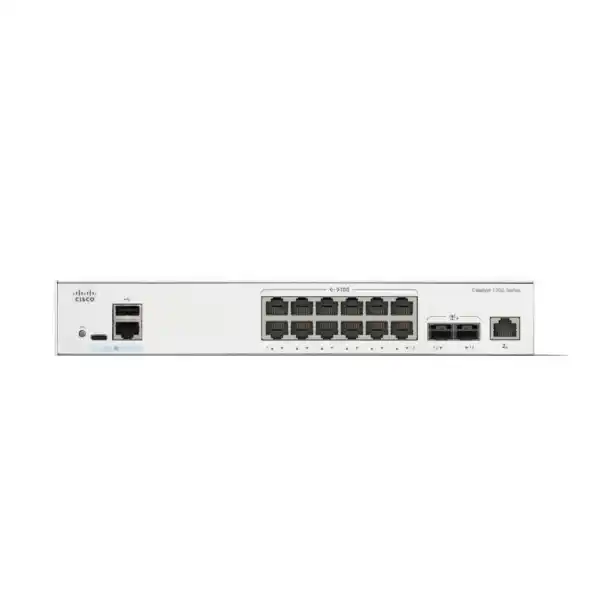
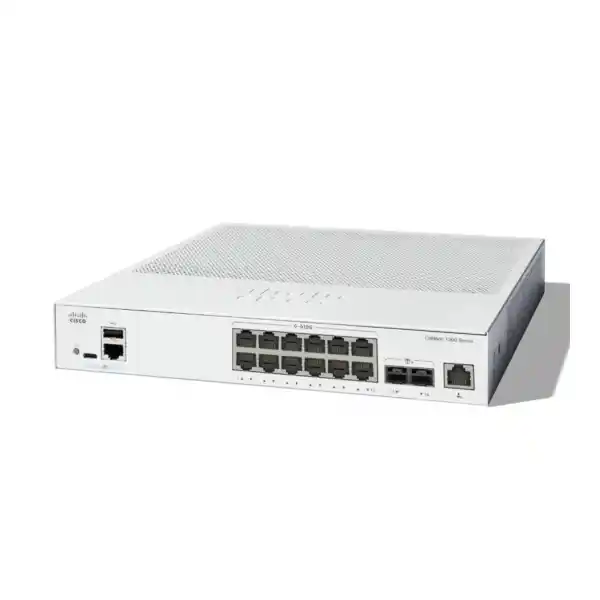
Cisco Catalyst C1300-12XT-2X Network Switch
A compact high-density 10GbE switching platform for UAE server rooms, virtualization clusters, storage networks, professional workgroups and aggregation designs that need twelve 10G copper interfaces, two 10G SFP+ interfaces, a dedicated management port, Layer 3 capabilities and hardware stacking without the cost or operational weight of a large chassis.
Choose the C1300-12XT-2X when you specifically need a compact, data-only 10GbE switch with copper-heavy server or workstation connectivity, fiber-capable uplinks, nonblocking performance, secure management and the option to build a resilient stack. It is not a PoE access switch and it is not a Catalyst 1300X OSPF platform.
What the Cisco Catalyst C1300-12XT-2X is designed to solve
The Cisco Catalyst C1300-12XT-2X sits in a useful space between conventional 1 Gigabit access switching and larger enterprise aggregation systems. Many UAE businesses reach a point where the LAN itself becomes the bottleneck: virtualization hosts can easily sustain multiple gigabits of east-west traffic, modern network-attached storage can exceed 1GbE during backup or replication windows, media teams move multi-gigabyte project files, engineering users work directly from shared storage, hypervisors host dozens of virtual machines behind a small number of physical NICs, and security appliances may expose 10GbE inside or outside interfaces. In these environments, adding another ordinary 1GbE switch does not solve the underlying bandwidth constraint. The C1300-12XT-2X addresses that problem by making 10 Gigabit Ethernet the primary access medium rather than a premium uplink feature.
Its port layout is intentionally copper-heavy. Twelve 10G copper interfaces make it practical to connect servers, high-performance workstations, storage systems, firewalls, routers or other switches using familiar twisted-pair cabling where 10GBASE-T is appropriate. Two additional 10G SFP+ interfaces provide a natural place for fiber uplinks, inter-switch links, stacking connectivity or connections where optical reach and electrical isolation are preferred. A separate Gigabit Ethernet out-of-band management port isolates administrative access from the production data plane, which is especially valuable in properly designed server rooms where management traffic belongs on a dedicated infrastructure network.
Cisco specifies the model at 280 Gbps switching capacity and 208.33 million packets per second using 64-byte packets, with the platform described as wire-speed and nonblocking. Those numbers matter because fourteen 10GbE interfaces represent a substantial aggregate traffic surface. A switch bought for 10GbE should not merely have 10GbE sockets; its internal forwarding architecture must also be capable of carrying simultaneous traffic without turning the switching fabric itself into the limiting factor. For server aggregation, storage, virtualization and high-speed workstation applications, that distinction is fundamental.
For organizations evaluating the model in Dubai, Abu Dhabi, Sharjah or elsewhere in the Emirates, FourTeck can position the switch as part of a complete LAN refresh rather than as an isolated hardware purchase. Network architects can combine switching design with structured implementation, firewall integration, VLAN planning, server connectivity, optics selection and operational handover through FourTeck UAE, while broader deployment and support requirements can be aligned with FourTeck IT Services UAE.
Technical specification snapshot
| Specification | Cisco Catalyst C1300-12XT-2X |
|---|---|
| Primary data ports | 12 × 10 Gigabit Ethernet copper ports |
| Fiber / uplink interfaces | 2 × 10 Gigabit SFP+ |
| Out-of-band management | 1 × Gigabit Ethernet management port |
| Switching capacity | 280 Gbps |
| Forwarding rate | 208.33 Mpps for 64-byte packets |
| Packet buffer | 3 MB |
| MAC address scale | Up to 32,000 MAC entries for Catalyst 1300 10GbE SKUs |
| Jumbo frames | Up to 9,000 bytes; default MTU 2,000 bytes |
| IPv4 routing scale | Up to 7,168 dynamic + static IPv4 routes and up to 256 IP interfaces on 10GbE C1300 SKUs |
| ACL scale | Up to 2,048 rules on Catalyst 1300 10GbE SKUs |
| Stacking | Hardware stacking up to 8 switches; C1300-12XT-2X belongs to Catalyst 1300 Family 2 and stacks with supported models in the same family |
| PoE | No — this is a data-only 10GbE model |
| Dimensions | 268 × 300 × 43.94 mm |
| Weight | 2.64 kg |
| Power input | Internal universal 100–240V AC, 50–60 Hz |
| Operating temperature | -5°C to 50°C; minimum ambient temperature for cold start is 0°C |
| Acoustics / fan | 1 fan; 28.5 dBA at 25°C |
| MTBF at 25°C | 1,198,404 hours |
Specification values should be validated against the current Cisco regional datasheet and the exact ordered part number at quotation stage, particularly for accessories, transceivers and country-specific power cords.
Port architecture: why twelve 10G copper ports plus two SFP+ ports is useful
The defining characteristic of this switch is not simply that it supports 10 Gigabit Ethernet; it is that the majority of its production ports are 10G copper. That makes the C1300-12XT-2X particularly attractive where endpoint hardware already exposes 10GBASE-T interfaces. Many tower and rack servers, workstation-class systems, storage appliances and security platforms can be fitted with 10GbE RJ-45 network adapters. Using copper can simplify moves, adds and changes because technicians can work with familiar patch panels and structured cabling rather than managing an optical transceiver at every endpoint.
For a server room, twelve copper ports can be allocated deliberately rather than consumed randomly. A small virtualization cluster might use four ports for two dual-homed hypervisors, two for storage controllers, two for a backup appliance, two for a firewall pair and two as spare or growth capacity. A creative studio could use several ports for editing workstations and reserve others for shared storage and rendering nodes. A branch data center can connect application servers and local storage at 10GbE while using the SFP+ ports for fiber uplinks to another communications room. The fixed combination is simple enough for a small team to operate but dense enough to remove multiple 1GbE bottlenecks.
The two SFP+ interfaces add media flexibility. In a multi-floor office, fiber is often preferable between communications rooms because it avoids copper distance limitations and provides electrical isolation. In a data center or rack-to-rack design, SFP+ can support short-reach optical links or other Cisco-supported media depending on the approved transceiver matrix. Those ports can also participate in high-availability designs, link aggregation or the switch family’s hardware stacking architecture. The correct use depends on topology, reach, resiliency objectives and available port capacity.
Cabling quality is a major part of any 10GBASE-T deployment. The switch cannot compensate for a poorly planned horizontal cabling system. For new UAE installations where full-distance 10GbE is a requirement, Category 6A structured cabling is generally the safe design target, with patch-panel, patch-cord, termination and pathway quality treated as part of the channel rather than as afterthoughts. Existing Cat6 runs can sometimes support 10GbE over shorter lengths depending on installation conditions, but qualification should be based on certified testing rather than assumption. Where electromagnetic environment, cable congestion, reach or inter-building connectivity complicates copper, SFP+ fiber is often the cleaner engineering choice.
Performance engineering: interpreting 280 Gbps and 208.33 Mpps correctly
Switching capacity
A 280 Gbps switching fabric matches the full-duplex bandwidth mathematics of fourteen 10GbE interfaces: 14 ports × 10 Gbps × two directions equals 280 Gbps. In practical terms, the internal fabric is sized so the port set can operate without the switch fabric being an artificial oversubscription point. This is especially important for east-west server traffic, parallel backup flows, storage transfers and simultaneous workstation-to-storage sessions, where traffic patterns can produce several concurrent high-bandwidth conversations.
Nonblocking does not mean every application will automatically achieve 10 Gbps. End-to-end throughput still depends on server NICs, storage media, host CPU, protocol efficiency, cabling, transceivers, flow characteristics, security devices and the capabilities of every intermediate hop. It means the switch is not designed with a fabric deficit relative to its own port bandwidth.
Packet forwarding rate
The 208.33 Mpps rating matters when traffic consists of small packets, because packet-per-second processing rather than raw bits per second can become the harder workload. Firewalls, transaction systems, east-west service architectures, monitoring traffic and busy virtual environments can generate large packet counts even when average bandwidth is below the headline 10GbE line rate.
The 3 MB packet buffer should be considered together with traffic engineering and QoS. Buffers absorb short bursts; they do not replace capacity planning. Persistent oversubscription should be solved through link sizing, topology design, aggregation or workload distribution rather than relying on buffering. For storage and backup, engineers should understand whether the application creates sustained sequential flows or short microbursts and size uplinks accordingly.
For a UAE procurement team, this performance profile means the product should be evaluated as infrastructure rather than by port count alone. Twelve 10GbE server-facing ports can concentrate up to 120 Gbps of one-direction access demand before uplink traffic is considered. If most of those endpoints communicate with devices behind only one external 10GbE uplink, the topology is intentionally oversubscribed at that uplink even though the switch fabric itself is nonblocking. That may be perfectly reasonable, but it should be a documented design decision. If traffic frequently crosses the switch boundary, use both SFP+ links where appropriate, aggregate links where the peer supports it, distribute workloads across multiple switching paths, or design the C1300-12XT-2X as part of a same-family stack.
Important: this model does not provide PoE
The C1300-12XT-2X is a data-only 10 Gigabit Ethernet switch. That is an advantage when the intended endpoints are servers, storage appliances, routers, firewalls, workstations and other self-powered equipment because power budget, PoE class and endpoint wattage do not need to be managed on these ports. It is not the correct access switch if the requirement is to power IP phones, wireless access points, cameras, door controllers or other Power over Ethernet devices directly from the switch.
In mixed environments, use a role-based design: the C1300-12XT-2X can provide high-speed aggregation or server connectivity while a separate PoE-capable access layer powers edge devices. This keeps the switch selection aligned with actual requirements and prevents buying expensive PoE capacity where it is not needed. It also clarifies UPS sizing because the electrical load of attached endpoints is not hidden inside this switch’s power budget.
Layer 2 switching features for segmented business networks
A high-speed switch must do more than forward Ethernet frames. The C1300 family provides the controls needed to build a structured Layer 2 network: 802.1Q VLANs, spanning-tree variants, link aggregation, private VLAN behavior, multicast controls and protections against common loop conditions. Cisco lists support for up to 4094 VLAN IDs, with a reserved internal range, enabling far more logical segmentation than a typical small or medium deployment will require. The practical value is not the maximum count but the flexibility to separate server tiers, management networks, backup traffic, storage, user subnets, guest services, voice infrastructure and security zones without dedicating one physical switch to every purpose.
Spanning Tree Protocol remains essential anywhere Layer 2 redundancy can create loops. The family supports classic 802.1D STP, Rapid Spanning Tree using 802.1w, Multiple Spanning Tree using 802.1s, and Cisco-oriented PVST+/Rapid PVST+ modes. Network architects can therefore match the switch to existing campus conventions rather than redesigning the entire Layer 2 control plane simply to insert a 10GbE access or aggregation device. BPDU Guard, Root Guard and loopback protections should be incorporated into the deployment standard rather than treated as optional tuning. On server-facing ports, edge behavior can speed convergence, but protection against accidental switching loops is equally important.
Link aggregation with LACP allows multiple physical ports to operate as a logical group. Cisco specifies up to eight groups and up to eight ports per group for the Catalyst 1300 family. On the C1300-12XT-2X, LAG design must balance redundancy with the fact that every 10G port consumed in an aggregate is one less port available for endpoints. A two-port 20GbE logical uplink can be a strong choice to a capable upstream device, while multi-chassis aggregation across a supported hardware stack can improve resilience by spreading member links across different physical switches.
Multicast handling is another area where managed switching matters. IGMP snooping versions 1, 2 and 3 prevents multicast traffic from flooding every access port, and Cisco lists up to 4000 multicast groups for the 10 Gigabit Ethernet Catalyst 1300 SKUs. IGMP querier and proxy capabilities add flexibility in networks carrying surveillance video, streaming, market data, imaging or other multicast-oriented applications. The result is more controlled bandwidth usage, especially important when high-rate multicast would otherwise replicate unnecessarily across 10GbE links.
Additional features such as Q-in-Q, selective Q-in-Q, VLAN translation, private VLANs, protected ports and DHCP relay broaden the deployment envelope. They can support service-provider-style handoffs, tenant separation, managed office environments and security segmentation. These functions should be introduced only where the operational team understands the resulting design; sophistication without documentation can create troubleshooting difficulty. A strong implementation records VLAN purpose, tagged and untagged behavior, native VLAN choices, spanning-tree roots, LAG membership and allowed VLAN lists before production cutover.
Layer 3 routing: capable, useful and clearly scoped
The C1300-12XT-2X is not limited to pure Layer 2 operation. Cisco specifies wire-speed IPv4 and IPv6 routing for the Catalyst 1300 platform, and the 10GbE C1300 SKUs scale to as many as 7,168 combined dynamic and static IPv4 routes and up to 256 IP interfaces. A Layer 3 interface can be configured on a physical port, link aggregation group, VLAN interface or loopback interface. This enables the switch to route directly between selected local VLANs instead of sending every inter-VLAN packet to an upstream firewall or router.
That capability can reduce unnecessary hairpin traffic. For example, a backup server VLAN and a storage replication VLAN can be routed locally when the security policy permits, keeping high-volume flows on the switching platform rather than consuming firewall interfaces. At the same time, sensitive inter-zone traffic can still be forced through a next-generation firewall for inspection. The architecture should distinguish traffic that needs stateful security controls from traffic that merely needs fast local routing.
Cisco lists Routing Information Protocol version 2 for dynamic routing and supports policy-based routing so selected IPv4 or IPv6 traffic can be directed to a different next hop based on access-control criteria. Static routes remain appropriate for many compact topologies because they are easy to reason about and limit control-plane complexity. DHCP server, DHCP relay and UDP relay functions can further simplify branch or lab environments where the switch must provide basic infrastructure services.
For many UAE SMB and branch networks, this scope is a good fit. It offers materially more routing capability than an unmanaged or Layer 2-only 10GbE switch while avoiding the complexity of buying a high-end routing platform for a small server-room topology. The correct question is not whether the switch can route; it is whether its routing feature set matches the organization’s protocol, scale, resiliency and operational requirements.
Hardware stacking and high availability
Cisco Catalyst 1300 hardware stacking changes the way this compact switch can be used. Cisco states that C1300 and C1300X platforms support stacks of up to eight switches, with active/standby stack control, auto-numbering, hot-swap support, ring and chain options, automatic stacking port speed and flexible stacking port selection. The C1300-12XT-2X is part of Catalyst 1300 Family 2, which includes other 10 Gigabit oriented models such as the C1300-12XS, C1300-16XTS, C1300-24XS, C1300-24XT and C1300-24XTS. Cisco requires members to be in the same stacking family; cross-family stacking is not supported.
A stack is operationally useful because multiple physical switches can be managed as one system, while hardware failover provides resilience if the active stack control role changes. Link aggregation can span multiple stack members, allowing a server, storage array or upstream switch with multiple links to distribute those links across separate physical units. This reduces the chance that one switch failure disconnects the entire logical aggregate.
Stacking does not eliminate the need for failure-domain planning. The stack still depends on power, cabling, rack environment and correct interconnect design. Dual power feeds are not automatically created simply by stacking two units, and a common UPS or rack PDU remains a shared dependency. Likewise, if both uplinks from the stack terminate on one upstream switch, the upstream device remains a single point of failure. High availability is achieved by designing independent paths and power domains, not by counting the number of switches.
The two SFP+ interfaces on this model are valuable but finite. If they are used for stack interconnects, fewer SFP+ ports remain for optical uplinks. If copper ports are used in other logical roles, endpoint capacity changes accordingly. A quotation should therefore include a port-allocation drawing rather than simply a quantity of switches. Engineers should identify endpoint ports, stack ports, upstream ports, spare capacity and future expansion before ordering optics and patching.
For a compact virtualization or storage environment, two or more C1300-12XT-2X units can provide an attractive path from a single-switch design to a resilient architecture while preserving high-density 10GBASE-T connectivity. Where larger port counts or more advanced routing protocols are required, other Catalyst models may be a better fit. The value of stacking is flexibility, not an instruction that every installation should use it.
Security controls for a managed 10GbE access and aggregation layer
Fast switching without access control can move unwanted traffic just as efficiently as legitimate traffic. The Catalyst 1300 family includes a broad set of protections that are directly relevant to server-room and business access networks. Administrative sessions can use HTTPS and SSH, while RADIUS and TACACS+ support centralizes operator authentication. Multiple CLI privilege levels let organizations separate basic operational access from full administrative control. For production deployments, insecure legacy management methods should be disabled where possible, management should be restricted to dedicated subnets or the out-of-band interface, and configuration access should be logged.
At the access-control layer, IEEE 802.1X can authenticate endpoints through RADIUS. The platform supports guest and unauthenticated VLAN behavior, dynamic VLAN assignment and MAC authentication, enabling differentiated network access for devices that can and cannot perform full 802.1X authentication. Web-based authentication is also available for environments where browser-driven admission is useful. These mechanisms can be integrated into a broader identity strategy but should not be confused with a next-generation firewall; the switch enforces network access and segmentation, while a firewall performs stateful inspection and higher-layer security functions.
First-hop security features are especially valuable in shared Ethernet domains. DHCP snooping identifies trusted DHCP paths and helps prevent rogue DHCP servers. IP Source Guard can block packets whose source IP information does not match learned or configured bindings. Dynamic ARP Inspection validates ARP behavior against binding information and helps mitigate address-spoofing and man-in-the-middle conditions. When these controls are designed together, they materially strengthen the trust boundary at the switch port.
The C1300-12XT-2X benefits from the larger ACL scale specified for 10GbE Catalyst 1300 models: up to 2,048 rules. ACL criteria can include source and destination MAC, VLAN, IPv4 and IPv6 addresses, protocol, TCP or UDP ports, DSCP, 802.1p priority, ICMP, IGMP and TCP flags, with rules applied on ingress or egress and support for time-based policies. This provides granular traffic control for management-plane protection, server segmentation, service restrictions and controlled inter-VLAN communication.
Other protective controls include port security, storm control for broadcast, multicast and unknown unicast traffic, denial-of-service prevention, Private VLAN and protected-port isolation, BPDU Guard, Root Guard and loopback protection. Cisco also describes Secure Core Technology, Secure Sensitive Data handling, runtime defenses, chip guard and boot integrity visibility in the Catalyst 1300 family. These protections create a stronger platform foundation, but the operational configuration remains decisive. Default credentials, broad management access or undocumented trunk ports can undermine even a feature-rich switch.
For customers deploying the switch next to security appliances, integration can be coordinated with FourTeck Firewall Dubai so VLAN trunks, routed interfaces, gateway placement, firewall zones and failover paths are designed as one system instead of as unrelated products.
Quality of Service for storage, voice infrastructure and priority applications
Ten-gigabit interfaces reduce congestion risk, but they do not make traffic prioritization irrelevant. A 10GbE link can still become busy during backup, replication, large media transfers or bursty virtualization workloads. The Catalyst 1300 family provides eight hardware queues, strict-priority and weighted round-robin scheduling, DSCP and 802.1p classification, DiffServ behavior, ACL-based classification and remarking, ingress policing, egress shaping and flow-based rate control. This lets administrators define which traffic should be protected during contention rather than allowing every application to compete equally.
Storage is a good example. Cisco includes iSCSI traffic optimization, which can prioritize iSCSI relative to other traffic. That does not remove the need for storage-vendor design guidance, correct MTU planning or capacity testing. Where storage traffic shares switching infrastructure with general server or user traffic, QoS should reflect actual application behavior. If dedicated storage VLANs and ports are available, separation can simplify troubleshooting. If traffic is converged, carefully controlled QoS becomes more important.
Rate limiting is equally useful for controlling noncritical workloads. Backup jobs, replication tasks or bulk transfers can be scheduled and shaped so they do not dominate business-critical traffic during working hours. Conversely, a high-priority queue should not be allowed to become so broad that everything is marked important; doing so destroys the meaning of prioritization. A good policy keeps classes few, measurable and tied to documented service objectives.
Voice VLAN features are present in the Catalyst 1300 platform, but on this specific data-only 10GbE model they are more likely to matter when the switch carries trunks or aggregated traffic from a PoE access layer rather than directly powering phones. LLDP-MED and Cisco discovery capabilities can still contribute to topology visibility. The design should reflect the physical role of the switch instead of enabling every available feature by habit.
Management, monitoring and troubleshooting
The C1300-12XT-2X is designed for organizations that want enterprise-style managed switching without requiring a heavyweight campus management stack. Cisco provides a browser-based web interface with simple and advanced modes, configuration wizards, dashboards, maintenance tools and monitoring functions. A full scriptable command-line interface is also available, which matters for engineers who prefer deterministic configuration, change-control records and reusable templates.
Cisco Business Dashboard integration can use an embedded probe on the switch, reducing the need to deploy a separate on-site probe for supported management scenarios. The Cisco Business mobile app can also assist with local setup and management. Cisco Network Plug and Play supports streamlined provisioning for branch or campus device rollouts. These options give smaller IT teams several operational entry points, from GUI-led administration to more structured CLI and centralized workflows.
SNMP versions 1, 2c and 3 are supported, including SNMPv3 security. For new deployments, SNMPv3 is typically preferable because authenticated and encrypted monitoring can be implemented instead of exposing community-string-based management. Syslog, SNTP, RADIUS, TACACS+, ping and traceroute support help integrate the switch into standard network operations. Time synchronization should be treated as foundational because useful logs require consistent timestamps across switches, firewalls, servers and monitoring systems.
Traffic visibility tools include port mirroring, VLAN mirroring, flow-based redirection and mirroring, RSPAN, RMON and sFlow export. These features are valuable when diagnosing intermittent packet loss, validating application paths, investigating suspected security events or measuring traffic distribution. A switch in a 10GbE environment can carry very large traffic volumes, so external analysis tools must be sized appropriately; mirroring a saturated 10GbE source into an underpowered analyzer can create misleading conclusions.
Dual firmware images improve upgrade resilience, while upgrades can be performed through supported web, TFTP and secure copy mechanisms. Text-editable configuration files and secure auto-configuration can simplify standardized rollouts. The correct operational approach is to maintain backups, document firmware versions, test upgrades against critical integrations, and preserve a rollback path. High-speed networks often carry high-value workloads; change management should be proportional to business impact, not to the physical size of the switch.
The dedicated out-of-band Gigabit Ethernet management interface deserves special emphasis. When connected to a separate management network, it gives administrators a path to the switch that does not depend on the production VLAN topology. This can be crucial during a routing, VLAN or spanning-tree incident. Proper OOB design should extend beyond the switch itself to include secure administrative access, management gateways, resilient addressing and controlled remote access.
10GbE cabling and transceiver planning for UAE installations
A 10 Gigabit switch purchase should always include a media plan. For the twelve copper interfaces, the core decision is whether the existing structured cabling can reliably carry the desired 10GBASE-T link at the required length. New permanent links intended for 10GbE should generally be designed around Category 6A components and tested with suitable certification equipment. Patch cords, patch panels and outlet modules are part of the total channel. A network may appear stable during light testing and then develop errors under sustained traffic if termination quality, alien crosstalk, bend radius or pathway conditions are poor.
Heat density also changes as copper 10GbE becomes common in racks. While a single connection is straightforward, a bundle of high-speed copper links behind several servers should be dressed cleanly to protect airflow and serviceability. Short, correctly sized patch cords reduce cable bulk. Front-to-rear airflow paths should not be blocked by unmanaged cable loops. In UAE data rooms, where ambient conditions can be challenging if cooling is marginal, rack airflow discipline is more than cosmetic.
For SFP+ ports, the optical module must match the fiber type, wavelength, reach and remote interface. Multimode short-reach optics are common inside buildings and data centers; single-mode options are appropriate for longer runs when supported. Direct-attach or other media options should be selected only where Cisco compatibility and distance requirements are clear. Mixing unsupported optics to save a small amount on the bill of materials can create disproportionate troubleshooting and support problems later.
When linking two communications rooms, document whether the fiber is OM3, OM4, OS2 or another type, the connector format, patch-panel path, measured loss and spare strands. The switch port is only one part of that optical path. For redundant links, try to provide physical route diversity where the building permits; two fibers in the same conduit do not protect against a single cable cut.
The quotation should identify every required SFP+ module, fiber patch lead, rack accessory and power cord explicitly. This avoids a common procurement failure where switches arrive before the media needed to connect them. FourTeck can also align high-speed switching with rack and server connectivity through FourTeck Server Dubai when the project includes virtualization hosts, storage or server upgrades.
Server and virtualization use cases
Virtualization is one of the strongest reasons to move from 1GbE to 10GbE. A physical host may consolidate many virtual machines, each with independent traffic patterns. Even if no single VM needs more than a few hundred megabits per second, aggregate demand can exceed a 1GbE uplink quickly. Hypervisor management, live migration, backup, storage and tenant traffic may all share the same physical interfaces. A switch with twelve 10G copper ports gives architects enough density to separate some of those functions physically or aggregate multiple host interfaces for resilience and throughput.
A sensible design starts with traffic classes and failure domains. Hypervisor production traffic might use one pair of NICs, storage another, and management a lower-bandwidth interface depending on the host platform. Alternatively, fewer 10GbE links may carry tagged VLANs where the virtualization platform provides strong logical separation. The switch’s VLAN, LACP, QoS and Layer 3 capabilities support either model, but the final topology should follow hypervisor and storage vendor guidance.
Live migration traffic is often bursty and bandwidth hungry. A 10GbE path can dramatically reduce migration windows compared with 1GbE, but only if both hosts, NICs and switch path are configured consistently. Jumbo frames can reduce per-packet overhead in some workloads, yet they must be end-to-end. The C1300 family supports frames up to 9000 bytes, but enabling a larger MTU only on the switch while leaving servers or storage at incompatible values creates difficult-to-diagnose behavior. Engineers should verify the MTU across NIC, virtual switch, physical switch and storage interfaces.
Backup and replication traffic can similarly benefit from 10GbE. The faster link reduces the time required to move large datasets and can help organizations meet narrower backup windows. However, backups can saturate links precisely because they are designed to move as much data as possible. QoS or scheduling may be appropriate if the same physical fabric carries latency-sensitive workloads. Capacity planning should consider worst-case simultaneous backup jobs, not just average daytime traffic.
For small private clouds, lab environments, edge compute and branch virtualization, the C1300-12XT-2X offers a high-speed footprint without requiring dozens of unused ports. That density is often more economical and easier to cable than buying a much larger 10GbE switch simply because the organization needs ten or twelve high-speed endpoints.
Storage, NAS and iSCSI considerations
Shared storage can expose the limitations of 1GbE faster than almost any other workload. Modern arrays, SSD-based NAS platforms and clustered storage systems can deliver several gigabits per second, but the network must carry that traffic without creating bottlenecks or unnecessary contention. The C1300-12XT-2X can connect multiple storage controllers and application hosts at 10GbE while keeping spare ports for backup, replication or firewall paths.
For iSCSI deployments, Cisco’s traffic optimization capability is useful, but switch selection is only one component of storage performance. Queueing, NIC offloads, multipathing, VLAN design, MTU, flow-control behavior, host drivers, array controller limits and disk performance all influence the result. Engineers should follow the storage vendor’s validated architecture and avoid unsupported tweaks merely because a switch exposes the setting.
Multipath designs deserve deliberate physical separation. Two storage paths connected to two ports on the same standalone switch protect against a port failure but not against switch failure. Connecting redundant storage and host paths across two members of a supported stack can reduce that single-device risk, provided the storage architecture and host multipathing model support it. For maximum fault isolation, independent switching fabrics may be preferred in higher-criticality SAN-style environments. The right choice depends on recovery objectives and budget.
NAS file services present a different pattern. SMB or NFS traffic from many users can converge on one or two storage interfaces. If a 10GbE NAS serves dozens of 1GbE clients through another access switch, the C1300-12XT-2X can act as a high-speed aggregation point. If several 10GbE workstations access the NAS directly, the storage appliance itself may become the limiting factor, so performance testing should include real application workloads rather than only synthetic network benchmarks.
Storage networks also benefit from the switch’s visibility features. Port counters, sFlow, RMON and mirrored traffic can help separate network congestion from host or disk bottlenecks. Before blaming the switch for slow transfers, engineers should examine interface utilization, errors, retransmissions, queue drops, server CPU, storage latency and protocol behavior. A 10GbE upgrade is most valuable when the end-to-end system is measured as a whole.
Media production, CAD, engineering and high-performance workgroups
Not every 10GbE deployment belongs in a data center. Video editors, post-production teams, CAD engineers, GIS analysts, architecture firms and scientific workgroups often manipulate very large files directly from shared storage. In those environments, a 1GbE desktop connection can limit productive throughput even when the workstation and storage array are fast. Twelve 10G copper ports provide a straightforward way to connect a concentrated group of high-performance users without deploying optical interfaces at every desk.
These workloads are sensitive to sustained throughput and latency consistency. A single large file copy can use much of a 10GbE link, while several editors reading media concurrently can stress the storage system and uplinks. Network architecture should account for aggregate demand from the whole team, not only the peak capability of one workstation. If the storage system has two 10GbE interfaces, LACP or multipath mechanisms may provide higher aggregate capacity depending on protocol and application behavior, but a single flow generally follows one member link in typical Ethernet hashing designs.
For office-floor deployment, cable length and pathway design become especially important. Long 10GbE copper runs should use qualified structured cabling, and any path between floors or buildings should normally be treated as a fiber design problem. The compact dimensions of the C1300-12XT-2X make it possible to place high-speed switching closer to the workgroup, but ventilation, rack security, acoustic requirements and power still need to be considered.
The result can be a clean two-tier architecture: a 1GbE or PoE access layer serves phones, standard users and wireless infrastructure, while the C1300-12XT-2X serves high-bandwidth workstations and storage. VLANs allow both layers to participate in the same logical network where appropriate, while fiber or aggregated 10GbE uplinks connect the high-performance island to the broader campus.
Firewall, router and security appliance integration
Modern firewalls increasingly offer 10GbE interfaces even in midrange platforms, but those interfaces only deliver value if the surrounding switching fabric can carry the traffic. The C1300-12XT-2X can connect high-speed inside, DMZ, server or aggregation interfaces while preserving VLAN segmentation. A single trunk can carry multiple security zones to a firewall, or separate physical switch ports can be assigned to distinct zones where stronger physical separation is preferred.
The design choice between switch-based routing and firewall-based routing is critical. If the C1300 performs inter-VLAN routing locally, traffic between those VLANs may not traverse the firewall for stateful inspection. This can be desirable for trusted high-volume infrastructure traffic, but inappropriate for user-to-server, guest-to-corporate or DMZ-to-internal paths. Architects should explicitly define where each default gateway lives and which flows must cross the security appliance.
Policy-based routing on the switch can steer selected traffic to a different next hop, but it should not be used to create an opaque substitute for a well-structured security topology. Simpler routing is generally easier to troubleshoot. Where service chaining is required, document each path, failover condition and expected return route to avoid asymmetric traffic that can break stateful firewall sessions.
For active/passive firewall pairs, the switching design should support redundant data and heartbeat connections according to the firewall vendor’s guidelines. Two C1300-12XT-2X switches in a supported stack can help distribute firewall links across physical members, but the exact LACP or HA behavior depends on the firewall platform. Do not assume every firewall supports aggregated interfaces across every HA mode; validate the final topology before implementation.
Physical design, power and environmental planning
The C1300-12XT-2X measures 268 mm wide, 300 mm deep and 43.94 mm high, with a listed weight of 2.64 kg. The roughly 1RU height makes rack integration straightforward, while the narrower chassis footprint is convenient for compact communication spaces. Rack-mountable does not mean rack accessories should be assumed; verify the exact regional bundle and required mounting hardware at order time, especially where a standardized 19-inch rack installation is planned.
Power is provided through an internal universal 100–240V AC, 50–60 Hz supply. Cisco lists worst-case system consumption for this model at approximately 50.3 W at 110V and 52 W at 220V, with idle figures around 20.7 W and 22.8 W respectively, and listed heat dissipation of 218.38 BTU per hour. These are useful inputs for UPS and cooling calculations. In a stack of several switches, add the power of every member and include realistic headroom for other rack equipment rather than sizing the UPS at nameplate equality.
Cisco specifies an operating range from -5°C to 50°C, with a 0°C minimum ambient for cold start, and storage from -25°C to 70°C. Relative humidity is listed at 10% to 90% noncondensing. These ratings do not justify poor facility cooling. UAE server rooms should be maintained at a controlled environmental setpoint with clean airflow, monitored temperature and humidity, protected electrical distribution and appropriate dust management. The external climate makes HVAC failure an especially serious risk even when a device’s maximum operating temperature appears generous.
The model uses one fan and Cisco lists 28.5 dBA acoustic noise at 25°C. That is relatively modest for a 10GbE switch, but the final perceived noise depends on rack location, room acoustics and fan behavior under warmer conditions. It is better suited to a communications room or enclosed rack than to a silent desk environment. Cisco lists MTBF at 25°C as 1,198,404 hours, which is a statistical reliability measure rather than a warranty duration or prediction of an individual unit’s service life.
Energy Efficient Ethernet and link-based power-saving capabilities in the Catalyst 1300 family can reduce consumption during low activity, and signal strength can be adjusted based on cable length. Energy efficiency is useful, but network stability should take priority. Any power-saving setting that interacts with a sensitive attached device should be validated under the real workload before broad deployment.
Sizing methodology: how many C1300-12XT-2X switches do you actually need?
Start with a port ledger, not a guess. List every device that requires 10GbE copper, every device that requires SFP+, every planned stack or uplink port and every spare connection needed for growth. Then classify each link as primary, redundant or optional. A switch has twelve copper data ports, but a resilient design may consume two ports per server or storage appliance. Likewise, the two SFP+ ports can disappear quickly if both are reserved for stacking or dual uplinks.
Second, estimate traffic direction. If ten servers communicate mostly with each other inside the same switch, east-west capacity can remain local. If those ten servers all send backup traffic through one SFP+ uplink to a remote storage array, the uplink becomes the obvious constraint. If the switch is primarily an access leaf, consider aggregate upstream bandwidth. If it is primarily a storage or server switch with local traffic, consider endpoint concurrency and buffer behavior.
Third, define the resilience target. A single switch may be acceptable for a lab, test environment or noncritical workgroup. Production virtualization or storage often requires at least two independent physical paths. A same-family stack can improve operational simplicity and link resilience, but some organizations may prefer two independent switches to reduce shared control-plane risk. The availability model should follow the business recovery objective.
Fourth, reserve expansion capacity. A design that uses all twelve copper ports on day one has no simple growth path. A practical target is to retain at least one or two free high-speed ports or to choose a larger related model if near-term growth is likely. Port utilization should be forecast for the expected equipment lifecycle, not merely current device count.
Fifth, verify feature fit. If the design requires OSPF, PoE, 25GbE uplinks, higher port density or a different stack family, select another model rather than forcing the C1300-12XT-2X into an unsuitable role. If the requirement is a compact, copper-dense 10GbE managed switch with strong Layer 2 features, useful Layer 3 routing, hardware stacking and straightforward Cisco Business management, this model aligns very well.
Finally, include optics, cabling, rack hardware, UPS capacity, firmware standardization and implementation services in the bill of materials. A switch-only quotation is rarely a complete deployment plan.
Deployment patterns in Dubai and the UAE
Compact server-room aggregation
Connect application servers, backup appliances and storage over 10G copper, then use SFP+ uplinks toward the core or another communications room. This is a strong fit where the server estate is substantial enough to exceed 1GbE but not large enough to justify a dense chassis or 48-port 10GbE platform.
Virtualization leaf
Provide dual 10GbE links to hypervisors, storage and backup systems. A second same-family switch or supported stack design can distribute redundant host connections while keeping management centralized.
High-performance workgroup
Serve video editing, CAD, GIS or design workstations at 10GbE copper with a shared storage system attached to one or more high-speed ports. Use VLANs and QoS to keep project traffic controlled and measurable.
Security and firewall distribution
Aggregate 10GbE firewall, router and internal server connections where multiple VLANs or physical security zones need high-speed switching. Keep gateway placement and inspection paths documented so local Layer 3 routing does not bypass required security controls.
Lab and test infrastructure
Use the large VLAN and ACL scale to host segmented test networks, appliance evaluation, packet capture and performance validation. The dedicated management port is useful when experimental VLAN changes should not compromise switch administration.
Branch or edge data center
Build a small routed server network with local inter-VLAN forwarding, DHCP relay, RIP or static routes, then connect to the WAN/security edge through 10GbE. This provides more capability than a basic unmanaged 10G switch while remaining compact.
Migration from 1GbE to 10GbE: a controlled approach
Moving to 10GbE should be treated as a staged infrastructure change. Begin by identifying the workloads that actually suffer from 1GbE constraints. Server monitoring, backup windows, storage statistics and workstation file-transfer measurements can show where throughput is being limited. Upgrading links that never exceed a few hundred megabits per second may provide little immediate benefit, whereas a storage or virtualization path pinned at 940 Mbps during critical operations is a clear candidate.
Next, validate endpoint interfaces and drivers. A switch port cannot create 10GbE if the server NIC is only 1GbE, if the operating system uses a conservative power profile, or if an old driver limits performance. Check PCIe lane availability, NIC firmware, teaming or bonding configuration and offload settings. On workstations, storage speed can be the limiting factor; a computer copying from a slow SATA disk may not use a 10GbE link fully.
Migrate cabling in parallel with electronics. Certify copper channels, label both ends, confirm patch-panel records and preserve a rollback path. For fiber, verify polarity, cleanliness, optical budgets and transceiver compatibility. A phased approach can connect a few high-value endpoints first, observe errors and utilization, then expand once the baseline is stable.
VLAN migration should be similarly controlled. Export the old switch configuration, map existing VLAN IDs, trunks, native VLANs, LAGs, spanning-tree priorities and management addresses, then recreate only what is needed. Do not blindly copy years of accumulated configuration into a new platform. The refresh is an opportunity to remove unused VLANs, stale ports and insecure management practices.
After cutover, validate not only ping reachability but application performance, failover, monitoring, syslog, authentication, NTP/SNTP, backups and management access. Measure interface errors and queue drops over a realistic business cycle. A successful 10GbE migration is defined by stable production behavior and improved service performance, not simply by link LEDs showing 10G.
Common design mistakes to avoid
Lifecycle, software and operational ownership
Cisco positions the Catalyst 1300 family for small and medium business networks with straightforward lifecycle economics. Current Cisco product information notes that there is no separate license to purchase for the core switch software and that software updates are available without an additional software license fee. This is important for budgeting because the purchase decision can focus on hardware, support, implementation and accessories rather than a mandatory recurring feature subscription for basic operation. Support entitlement and warranty handling should still be confirmed for the exact regional SKU and procurement channel.
Cisco also describes a limited lifetime warranty with Return-To-Factory replacement for the family and complimentary one-year access to the Small Business Support Center. Warranty terms are subject to Cisco’s current regional policies, so UAE buyers should validate coverage at the time of quotation. Mission-critical environments may still justify spare units, enhanced support or a design with redundant switches because warranty replacement time is not equivalent to high availability.
Operational ownership is equally important. Define who maintains firmware, who approves configuration changes, where backups are stored and how emergency access works. A managed switch that nobody owns gradually accumulates configuration drift. Use standardized names for ports and VLANs, preserve diagrams, store a golden configuration and review unused interfaces periodically.
Security hardening should include management-plane restrictions, strong administrator authentication, SNMPv3 where practical, disabling unused services, shutting unused ports, protecting trunks, and monitoring logs. Firmware should be kept within an approved release strategy rather than upgraded impulsively or ignored for years. Before any major update, review Cisco release notes and compatibility information relevant to the deployed firmware train.
For multi-site customers, global standards can be coordinated through FourTeck Global, while UAE deployment can retain local procurement and implementation alignment. Standardizing switch templates across branches reduces configuration variance and makes incident support easier.
Who should choose the Cisco Catalyst C1300-12XT-2X?
Strong fit
Organizations with several servers, storage appliances or high-performance workstations that already support 10GbE copper; branch or edge data centers needing compact Layer 3 switching; virtualization clusters; backup networks; creative and engineering workgroups; security appliance aggregation; and customers who value Cisco management, VLAN, ACL, QoS and stacking capabilities in a relatively small chassis.
Choose another model when
The requirement centers on PoE or PoE++ endpoints, when dozens of 1GbE user ports are needed, when 25GbE uplinks are required, when OSPF is mandatory, when more than twelve copper 10GbE endpoints must be connected per switch, or when the environment needs a larger enterprise campus feature set than Catalyst 1300 provides.
The key is role alignment. The C1300-12XT-2X is excellent at being a compact, high-throughput, data-only 10GbE managed switch. It should not be selected simply because 10G sounds future-ready. A correct design maps the ports, protocols and availability model to an actual workload, then verifies that every adjoining system can use the bandwidth.
Procurement considerations for UAE organizations
Enterprise network procurement in the UAE often involves more than choosing a model number. Confirm the exact Cisco product identifier, country power cord, rack-mount accessories, optics, support entitlement and delivery expectations before issuing a purchase order. Similar product names can refer to different regional variants or bundles, and a technically correct switch can still be incomplete if the required SFP+ modules or rack hardware are missing.
For replacement projects, capture the existing network before procurement. Record switch models, port counts, VLANs, trunks, LAGs, spanning-tree roles, management addresses, transceiver types and cable destinations. This allows the new bill of materials to be sized from evidence. If the current switch is failing or capacity-constrained, prioritize business-critical ports and build a migration matrix that can be executed in a controlled maintenance window.
Lead time matters for infrastructure. If several switches will be stacked, ordering units from the same project cycle can simplify firmware standardization and staging. Optics and patch leads should arrive with the switches so the system can be assembled and tested before site installation. Where possible, stage VLANs, management, authentication and firmware in a controlled environment, then install a prevalidated configuration during the change window.
UAE businesses with multiple Emirates or branch locations should also decide whether the deployment will follow one standard design or several site-specific variants. Standardization improves spares, documentation and support, but local site constraints may require different fiber reaches, rack sizes or uplink designs. The network template should therefore separate mandatory standards from site-specific values.
FourTeck can prepare a quotation around the actual topology rather than the switch alone: switch quantity, supported optics, copper patching, fiber patching, rack requirements, UPS assumptions, staging, configuration, migration, testing and handover. This reduces the risk of change-day surprises and gives procurement a clearer total project scope.
Decision recap: where this model delivers the most value
Quotation input checklist
To price and design the Cisco Catalyst C1300-12XT-2X correctly, provide as much of the following information as possible. Even approximate values help determine whether one switch, a stack, a larger model or a different Catalyst platform is the right choice.
Plan the C1300-12XT-2X as part of the complete network
The best outcome comes from matching the switch to the workload, media, routing policy and resilience model before purchase. FourTeck can help UAE customers validate port counts, compare related Catalyst options, select SFP+ modules, review 10G copper readiness, map VLANs and uplinks, integrate firewalls, design stack connectivity and prepare an implementation plan.
For a precise quotation, include the number of 10GbE copper endpoints, required fiber links and distances, rack location, redundancy requirement and any mandatory routing or security features. That information is enough to determine whether a single C1300-12XT-2X, a same-family stack or another Catalyst model offers the best technical and commercial fit.
Cisco Catalyst C1300-12XT-2X UAE consultation notes
This model is most compelling when the network already has a clear need for multiple 10GbE copper endpoints and wants a managed Cisco platform with fiber flexibility, strong segmentation, useful Layer 3 routing and stacking. Its compact form factor makes it suitable for smaller racks and focused high-speed workgroups, while the dedicated management interface supports disciplined operations.
Before ordering, verify the exact Cisco regional SKU, current firmware support, rack accessories, optics compatibility, cabling capability and the routing protocol requirements of the surrounding network. If PoE or OSPF is mandatory, choose a different model designed for those requirements. If the need is dense 10GBASE-T with SFP+ uplinks and manageable SMB/branch operations, the C1300-12XT-2X is a focused and technically strong choice.
A final bill of materials should include all transceivers, patch leads, rack items and services required to produce a working deployment rather than a box-only purchase. That keeps implementation predictable and gives the business a network that is ready for production traffic from the first maintenance window.

Reviews
There are no reviews yet.