
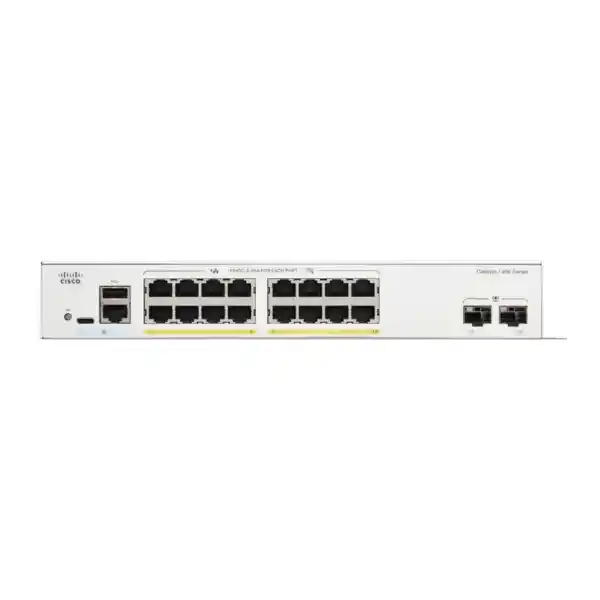
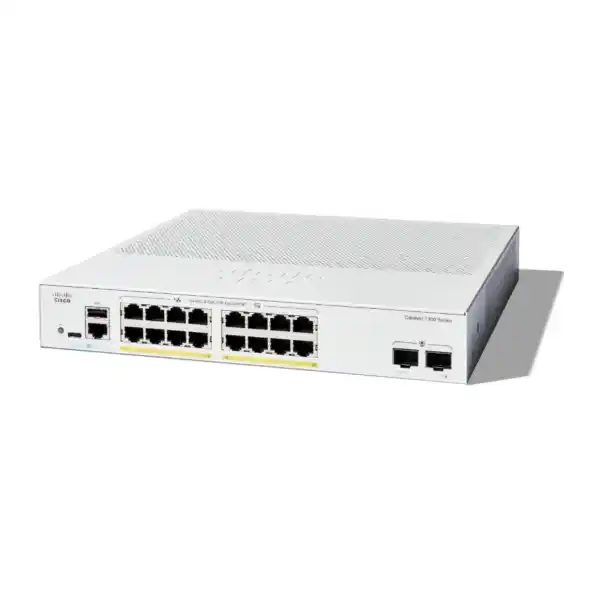
Cisco Catalyst C1300-16P-2G Network Switch in UAE
The Cisco Catalyst C1300-16P-2G is a compact managed Gigabit Ethernet switch for organizations that need business-grade switching, PoE+ endpoint power, Layer 3 traffic control and practical network security in a quiet branch or edge form factor. With sixteen 10/100/1000 PoE+ access ports, two dedicated 1G SFP uplinks and a 120W shared PoE budget, it is well suited to UAE offices, stores, clinics, training centers, schools, warehouses and hospitality sites that are converging user access, IP telephony, wireless access points, cameras and other Ethernet devices on one managed platform.
Direct answer: what is the Cisco Catalyst C1300-16P-2G?
The Cisco Catalyst C1300-16P-2G is an 18-port managed Ethernet switching platform when its sixteen copper access interfaces and two SFP uplink interfaces are counted together. The sixteen front-facing copper interfaces operate at 10/100/1000 Mbps and support IEEE 802.3af PoE and IEEE 802.3at PoE+, with up to 30W available to a compatible powered device subject to the overall 120W PoE budget. The two dedicated SFP interfaces provide optical or compatible copper-transceiver uplink flexibility at 1 Gigabit Ethernet. Cisco specifies a nonblocking switching capacity of 36 Gbps and a forwarding rate of 26.78 million packets per second for 64-byte packets, which aligns with wire-speed forwarding across the available Gigabit interfaces.
The model sits in Cisco’s Catalyst 1300 family, which targets small and medium-sized businesses as well as branch-office deployments that need stronger functionality than an unmanaged switch but do not necessarily require a large modular campus platform. It combines Layer 2 switching, VLAN segmentation, access security, QoS, link aggregation, monitoring, IPv4 and IPv6 support, and Layer 3 capabilities in a compact 1RU-height chassis. For UAE buyers, that combination is particularly useful in distributed environments where a local wiring closet may serve phones, cameras, access points, printers, staff workstations and operational systems while the switch still needs manageable uplinks to a firewall, router, server room or upstream aggregation switch.
Key specifications and engineering facts
| Model | Cisco Catalyst C1300-16P-2G |
| Copper access ports | 16 x 10/100/1000BASE-T Gigabit Ethernet |
| PoE capability | IEEE 802.3af PoE and IEEE 802.3at PoE+, up to 30W per compatible port subject to total budget |
| PoE budget | 120W shared across 16 PoE-capable ports |
| Uplink interfaces | 2 x 1 Gigabit Ethernet SFP |
| Switching capacity | 36 Gbps, wire-speed and nonblocking design |
| Forwarding performance | 26.78 Mpps at 64-byte packet size |
| MAC address table | 16,000 addresses for Catalyst 1300 1G SKUs |
| Packet buffer | 1.5 MB aggregate, dynamically shared |
| Memory | 1 GB DDR4 DRAM and 1 GB SLC flash for Catalyst 1300 platform |
| CPU | ARM dual-core at 1.5 GHz |
| Jumbo frames | Up to 9000 bytes |
| Dimensions | 268 x 297 x 43.94 mm (W x D x H) |
| Weight | Approximately 2.38 kg |
| Cooling | Fanless |
| Power input | Internal universal 100–240V AC, 50–60 Hz |
| Operating temperature | -5°C to 50°C; minimum ambient temperature for cold start is 0°C |
| Rack deployment | Rack-mountable compact form factor |
Why the C1300-16P-2G fits branch and SMB networks
The practical value of the C1300-16P-2G is not simply that it has sixteen ports. Its importance is the balance between port density, PoE capacity, uplink flexibility, forwarding performance and management depth. A small office rarely needs every function found in a large enterprise chassis, but it still benefits from controlled segmentation, secure authentication, traffic prioritization, loop protection, routing between local VLANs, remote monitoring and predictable PoE behavior. The C1300-16P-2G brings those capabilities into a compact platform that can operate as the principal access switch for a small site or as a managed edge switch within a larger distributed design.
A sixteen-port footprint is particularly useful when the expected endpoint count is neither tiny nor campus-scale. A typical branch may have eight to twelve employee devices, two or three IP phones, one or two wireless access points, a printer, a camera, an access-control controller and perhaps one locally connected server or appliance. Designing with some spare ports is important because growth, temporary equipment, testing and incident response all consume capacity. The two SFP uplinks allow the copper access ports to remain available for endpoints while the switch connects upstream through fiber. In buildings where the firewall, server room or distribution switch is beyond the practical copper distance, or where electrical isolation is desirable, fiber uplinks can be a major architectural advantage.
PoE+ design: understanding the 120W budget correctly
All sixteen copper access interfaces can participate in PoE delivery, but the key sizing figure is the 120W total power budget. This means a buyer should not calculate capacity by multiplying sixteen ports by 30W and assume the switch can provide 480W simultaneously. The 30W figure is the per-port ceiling associated with PoE+ capability, while 120W is the shared system budget available across connected powered devices. The correct design process is therefore to list each device, identify its expected and maximum PoE class or wattage, include a reasonable operating margin, and confirm that the resulting total remains within budget.
For example, a branch might connect six desk phones that each use around 6W in normal operation, four fixed cameras that each use about 9W, and two wireless access points that each draw around 16W. That illustrative load totals roughly 104W. It is under 120W, but the remaining headroom is modest, and the procurement team should confirm the actual maximum requirements of the chosen endpoints rather than relying on typical consumption. If the wireless access points use higher power modes, if cameras add infrared illumination or heaters, or if phones support expansion modules, the real worst-case load can be higher. The C1300-16P-2G is therefore best treated as a 120W power source with sixteen eligible delivery ports, not as a full-power 30W-on-every-port model.
Cisco also supports persistent PoE behavior in the Catalyst 1300 family, which can help maintain endpoint power while the switch itself is rebooting in supported conditions. Time-based PoE operation can be useful for scheduled policies, such as powering selected noncritical endpoints only during working hours. These functions become operationally relevant in UAE retail, education and branch deployments where energy management, physical-site access windows and maintenance schedules may need to be coordinated centrally. PoE monitoring also gives administrators a clearer picture of power allocation and can help distinguish a cabling or endpoint problem from an actual power-budget issue.
PoE sizing examples for common UAE deployments
Office voice and Wi-Fi
A 20-to-35-user office may use PoE primarily for IP phones and access points. If only selected phones are powered by the switch and the AP count is modest, 120W can be comfortable. The design should reserve capacity for access-point peak demand, especially when radios transmit at higher power or multiple bands are active. Separating user VLANs, voice VLANs and wireless management VLANs gives the switch a central role beyond simple powering.
Retail branch
A store may combine point-of-sale terminals, phones, small cameras, access points and back-office devices. PoE load can remain well within 120W when camera counts are low. VLAN separation is important because payment, staff, guest and surveillance traffic should not automatically share the same broadcast and security domain. QoS can protect voice and transaction traffic during bursts such as software updates or cloud backups.
Clinic or professional office
Clinics often require quiet operation, controlled segmentation and predictable uptime. Fanless switching avoids local fan noise, while PoE can serve phones, wireless access points, cameras and selected building systems. Network design should keep clinical or business application traffic logically separate from guest internet access and operational devices, using ACLs and routing policy where appropriate.
Training room or classroom
A training facility may have many wired endpoints but only a handful of powered devices. In that case the 16-port copper density is useful and the PoE budget is focused on access points, phones or cameras. VLANs can separate instructors, students, management and guest wireless networks, while rate limits and QoS policies reduce the chance that a single activity overwhelms shared uplink capacity.
Two dedicated SFP uplinks and why they matter
The C1300-16P-2G provides two 1 Gigabit SFP uplinks rather than using combo ports that share functionality with copper interfaces. That distinction matters in practical network planning. Dedicated uplinks allow all sixteen 10/100/1000BASE-T access ports to remain available to endpoint devices while the switch uses one or both SFP interfaces for upstream connectivity. Fiber is often selected for building-to-building links, risers, longer horizontal runs, electrically noisy environments or any situation where the designer wants optical isolation between network segments.
The two SFP interfaces can also provide design flexibility for redundancy and link aggregation, depending on the upstream architecture and configuration. In a small site, one SFP may connect to the firewall or distribution switch while the second is reserved for an alternate path, another switch or future expansion. In a more structured topology, both can participate in a link aggregation group where supported at both ends. Administrators must remember that a pair of 1G uplinks does not transform the switch into a high-capacity 10G access platform; the aggregate traffic model still needs to reflect the 1 Gigabit line rate of each SFP interface.
This is especially important when many access ports can produce simultaneous heavy flows. Sixteen Gigabit access ports do not mean sixteen Gigabits of northbound throughput through a single SFP. The switch is internally nonblocking, but uplink oversubscription is a separate architectural question. For general branch traffic, voice, cloud applications, normal file access and light surveillance, one or two 1G uplinks may be entirely appropriate. For environments with intensive local backup, high-resolution video concentration, large media transfers or virtualization hosts, a model with 10G uplinks may be the better design choice. FourTeck can use traffic patterns, concurrency and growth assumptions to determine whether the 2 x 1G uplink profile is the correct fit.
36 Gbps switching capacity and 26.78 Mpps forwarding
Switching capacity expresses the amount of full-duplex traffic the switching fabric can theoretically move. For sixteen 1G copper ports plus two 1G SFP ports, there are eighteen Gigabit interfaces. At full duplex, counting one gigabit per second in each direction, the theoretical aggregate reaches 36 Gbps. Cisco lists exactly 36 Gbps for the C1300-16P-2G, which indicates a wire-speed nonblocking architecture at the stated interface speeds. This matters because the switch fabric is not designed as the primary internal bottleneck when multiple ports communicate concurrently.
The forwarding rate of 26.78 Mpps is the packet-processing figure measured using small 64-byte packets, which create a more demanding packets-per-second workload than large frames. In real networks, traffic contains a mix of packet sizes and applications, but the published figure gives engineers a reference point for comparing switching platforms. Buyers should still assess uplink oversubscription, Layer 3 policy complexity, multicast behavior, broadcast domains and endpoint patterns. A nonblocking switching fabric solves the internal port-to-port capacity question; it does not replace proper topology and traffic engineering.
Layer 2 segmentation with VLANs
VLANs are one of the primary reasons to select a managed switch rather than a simple unmanaged device. The Catalyst 1300 family supports extensive VLAN functionality, including port-based VLANs, IEEE 802.1Q tagged VLANs, management VLANs, private VLAN concepts, guest VLAN behavior, dynamic VLAN assignment and additional mechanisms for service-provider or specialized edge scenarios. For a normal branch, the practical objective is to create separate logical networks for traffic that should have different security, broadcast or operational policies even when all devices connect to the same physical switch.
A common UAE office design might use a corporate user VLAN, voice VLAN, wireless management VLAN, guest VLAN, CCTV VLAN, printer or IoT VLAN and network-management VLAN. The switch can place access ports into the correct untagged network while trunks carry multiple tagged VLANs toward an upstream firewall, router, access point or another managed switch. This structure prevents the network from becoming a single flat broadcast domain and gives the security gateway or Layer 3 switch clearer boundaries for access control. It also improves troubleshooting because endpoint behavior can be mapped to a known logical segment.
Voice VLAN functions can simplify deployment of IP phones by classifying phone traffic into a voice-specific VLAN and applying suitable quality-of-service treatment. LLDP-MED support helps exchange endpoint information with compatible phones. For guest connectivity, the switch can participate in a broader design where guest devices are isolated from internal systems. Private VLAN and protected-port concepts provide additional options for preventing selected hosts on the same access switch from communicating directly. The best configuration depends on the firewall policy, authentication architecture and desired level of east-west isolation.
Layer 3 switching and local routing
The C1300 family is described by Cisco as an enterprise-class managed Layer 3 switching platform for small and medium-sized business and branch environments. On the C1300 series, IPv4 and IPv6 routing can move traffic between Layer 3 interfaces without forcing every local inter-VLAN flow through an external router. Cisco documents wire-speed IPv4 and IPv6 routing, Layer 3 interfaces on physical ports, link aggregation groups, VLAN interfaces and loopback interfaces. It also supports static routing and RIP v2 on the C1300 platform, while OSPF is associated with C1300X models rather than the standard C1300 1G SKU discussed here.
This distinction matters during architecture selection. If the branch requires straightforward inter-VLAN routing, static routes and modest dynamic-routing needs, the C1300-16P-2G can reduce dependency on the firewall for every local flow. For example, staff devices in one VLAN may access a local server VLAN through switch routing, while internet-bound traffic follows a default route to the firewall. That can make local traffic paths more efficient. However, security policy must still be considered carefully. A firewall provides application-aware inspection and threat prevention that ordinary Layer 3 switching does not replace. Moving routing to the switch can improve performance, but it may also bypass firewall inspection if ACLs and topology are not designed correctly.
For many SMBs, the best design is selective. High-trust local infrastructure VLANs may route on the switch where low-latency east-west communication is beneficial, while guest, IoT, CCTV or sensitive user networks may still route through the firewall so security policy remains centralized. The correct choice is not simply “Layer 3 switch or firewall.” It is an allocation of routing responsibility based on risk, traffic volume, operational complexity and the capabilities of the existing gateway.
Access security for business networks
Physical access to an Ethernet wall outlet should not automatically imply trusted access to the business network. The Catalyst 1300 family includes multiple control mechanisms that allow administrators to decide which devices or users can use a port and what happens when unexpected behavior occurs. IEEE 802.1X authentication can place the switch in the authenticator role and use a RADIUS server to validate connecting endpoints. Port security can restrict learned MAC addresses or respond to violations. Web-based authentication can provide an alternative method for devices that do not support an 802.1X supplicant.
The switch also supports protections such as DHCP snooping, Dynamic ARP Inspection and IP Source Guard. These mechanisms are useful because many attacks on local networks exploit trust in address assignment or Layer 2 resolution. DHCP snooping can distinguish trusted and untrusted DHCP paths and build binding information. Dynamic ARP Inspection can use trusted bindings to detect invalid ARP claims, reducing the risk of certain man-in-the-middle techniques. IP Source Guard can restrict traffic from endpoints whose source information does not match expected bindings. These features should be planned together because enabling them without understanding uplinks, trusted ports, static devices and DHCP design can cause legitimate traffic to be blocked.
IPv6 security requires equal attention. Modern endpoints often enable IPv6 even when an organization thinks of itself as an IPv4 network. Catalyst 1300 capabilities include IPv6 first-hop security functions such as Neighbor Discovery inspection, Router Advertisement guard and DHCPv6 guard. These controls help prevent rogue or spoofed IPv6 infrastructure from changing client behavior. In a professionally managed branch, IPv6 should be either deliberately deployed and secured or deliberately controlled; it should not simply be ignored.
QoS for voice, video and critical applications
Quality of Service becomes important whenever different application types compete for shared bandwidth. A small office can still experience congestion when cloud backup, operating-system updates, large file transfers, surveillance streams and voice calls converge on the same uplink. The C1300 platform supports classification and policy mechanisms that allow traffic to be identified using Layer 2 or Layer 3 criteria and treated according to business priority. Class maps can reference MAC, IPv4 or IPv6 access-control logic, giving administrators a structured way to identify flows before applying QoS policy.
The objective is not to make bandwidth appear from nowhere. QoS controls which traffic experiences delay or drops first when a queue is congested. Voice is highly sensitive to latency, jitter and packet loss, so it is commonly prioritized. Bulk backups can tolerate delay more easily. Surveillance may need sustained throughput but not necessarily the lowest possible latency. A well-designed policy aligns queue treatment with application sensitivity rather than simply marking every “important” service as highest priority. When the switch feeds a firewall, WAN router or internet circuit, markings and policies should be coordinated end to end so that prioritization does not disappear at the next hop.
Spanning Tree, loop protection and link resiliency
Layer 2 loops can destabilize an Ethernet network quickly because broadcast, multicast and unknown unicast frames may circulate repeatedly. Managed switching platforms therefore need mechanisms that protect against accidental redundant paths, cabling mistakes and failed topology assumptions. The Catalyst 1300 family supports Spanning Tree functions as well as loop-detection capabilities that can operate independently of STP on selected ports. Properly configured, these features help maintain a loop-free forwarding topology while still allowing planned redundancy.
Link Aggregation Groups provide another form of resiliency and capacity scaling by combining compatible physical links into one logical interface. A two-link LAG can increase aggregate capacity across multiple flows and protect against the loss of one member, provided the connected device is configured consistently. Administrators should understand that a single individual flow normally follows one member according to the hashing algorithm; link aggregation does not automatically make one TCP session run at twice the speed of one physical interface. Its major benefits are aggregate throughput, predictable redundancy and simplified logical management.
Where multiple switches are deployed, the broader Catalyst 1300 family also supports front-panel stacking for compatible models and configurations, allowing multiple switches to be administered as a unified stack. Stack design should be validated against the selected interfaces, bandwidth requirements, software versions and intended resiliency model. For a single C1300-16P-2G branch installation, conventional uplink redundancy and link aggregation may be sufficient; for growth beyond one access switch, a structured stacking or aggregation plan becomes more important.
Management options for local and distributed IT teams
Operational simplicity is a major selection criterion for branch infrastructure. The Catalyst 1300 family supports graphical management, command-line access and standards-based remote monitoring. Cisco Business Dashboard can be used to discover and manage supported Cisco small-business and Catalyst 1200/1300 devices, while the switch also supports a full CLI for administrators who prefer text-based configuration, repeatable templates and detailed troubleshooting. SNMP enables integration with network-management systems for inventory, status monitoring, alerts and performance visibility.
Cisco also documents an embedded probe capability for Business Dashboard environments, which can reduce the need for a separate probe appliance or virtual machine at a small site. Network Plug and Play features can assist with rollout and provisioning workflows. These options are useful when a company has several UAE branches and wants a repeatable process for staging, onboarding and maintaining access switches. The management method should be selected with security in mind: administrative interfaces should be placed on controlled management networks, default credentials must be changed, SSH should be preferred over insecure protocols where possible, SNMP versions and community settings should be hardened, and access should be limited to trusted management sources.
For organizations outsourcing administration, clear ownership is essential. The switch configuration should be documented, backups should be retained, firmware lifecycle responsibilities should be assigned, and monitoring alerts should route to a team that can respond. A managed switch only improves control when its management plane is itself managed. FourTeck can integrate the switch into a broader support model through FourTeck IT Services UAE, covering practical areas such as deployment, segmentation, migration planning, documentation and operational handover.
Fanless design for quiet edge locations
The C1300-16P-2G is fanless, which has practical consequences beyond acoustic comfort. Without an internal cooling fan, there is no fan motor to wear out, no fan noise in open offices and fewer moving components. This makes the model attractive for locations where the switch must be placed in a small wall cabinet, reception-area enclosure, classroom cabinet, meeting-room rack or other environment close to occupants. It also reduces one source of dust movement through the chassis, although general environmental cleanliness and airflow around the device remain important.
Fanless does not mean thermally unrestricted. Cisco lists an operating temperature range up to 50°C for the C1300-16P-2G, but cabinet temperature must be considered rather than only room temperature. UAE installations can face high ambient heat, particularly in poorly ventilated storage rooms, outdoor-adjacent cabinets, warehouses, telecom closets near rooftops or locations where air conditioning is reduced after business hours. PoE load generates additional heat, and other devices in the same enclosure may raise local temperature further. Good practice includes providing adequate ventilation, keeping the cabinet away from direct solar exposure, maintaining clean airflow paths, avoiding stacking heat-producing devices without space, and ensuring the UPS and power distribution equipment are also rated for the environment.
UAE environmental and power planning
Cisco specifies an internal universal AC power input covering 100–240V at 50–60 Hz for this model, which aligns well with normal UAE mains environments when the correct approved power cord and power-distribution arrangement are used. The switch should generally be connected through a quality UPS when supporting critical phones, access points, cameras or transaction devices. A UPS protects against short interruptions and provides time for a controlled response to utility issues, but its capacity must include both the switch’s own consumption and the PoE power delivered to endpoints.
Cisco lists worst-case system power consumption around 20.5W at 220V without PoE and about 151.8W with PoE load for the C1300-16P-2G. These figures are useful when sizing UPS runtime and thermal load, though actual consumption varies with traffic, endpoint power and operating conditions. A designer should not size a UPS using only the switch’s idle power because a PoE-heavy branch may draw far more during normal operation. If the goal is thirty minutes of runtime, the complete protected load must include firewall, router, switch, ONT or ISP CPE, wireless controllers if any, and any other critical equipment connected to the same UPS.
For sites with cameras or access-control equipment, the business continuity impact of PoE power loss should also be reviewed. If the switch goes down, both network connectivity and power to attached devices may disappear simultaneously. Critical environments may therefore require redundant power planning at the system level, a higher-capacity UPS, selected locally powered devices or a second switch serving a separate failure domain. Availability is an architectural property of the overall design rather than a single hardware specification.
Port planning methodology before purchase
A switch purchase should start with a port map rather than only a headcount. One employee does not necessarily equal one switch port. A desk may have a phone with a PC connected through the phone’s pass-through interface, consuming one switch port for two endpoint functions. Another employee may work entirely over Wi-Fi and consume no dedicated access port. Cameras, printers, door controllers, digital signage, access points, conference systems and IoT gateways each add their own requirements. The correct count is therefore the number of physical network drops that must terminate on the switch, plus capacity for spare ports and future changes.
For a sixteen-port switch, it is usually prudent not to plan day-one utilization at sixteen out of sixteen ports unless the installation is fixed and expansion is impossible. Spare capacity supports troubleshooting, temporary equipment, an additional access point, an emergency replacement device, relocation or a new service. If the current design already needs fourteen to sixteen copper ports, a 24-port model may be more economical over the lifecycle even if its initial cost is higher. Conversely, if the branch uses only eight or nine access ports and growth is limited, the C1300-16P-2G can provide sensible headroom without moving to a physically larger switch.
PoE planning must be performed separately from port count. A port can be occupied by a non-PoE workstation while consuming no PoE budget, whereas a high-power access point may consume a meaningful share of the 120W total. FourTeck recommends documenting each expected device with four values: port speed, VLAN role, PoE maximum and uplink dependency. That table turns a vague shopping question into a defensible network design and makes it easier to compare the C1300-16P-2G with full-PoE or higher-uplink alternatives.
How to evaluate uplink oversubscription
The two SFP uplinks are 1 Gigabit Ethernet interfaces. For many small sites, this is fully adequate because endpoint traffic is bursty and the internet circuit may itself be well below 1 Gbps. However, the design should be examined when many wired clients perform heavy local transfers or when multiple cameras send continuous streams through the same uplink. Oversubscription is not automatically a problem; it is the deliberate ratio between potential edge bandwidth and available upstream bandwidth. The goal is to select a ratio that matches actual concurrency.
Consider ten office computers, six phones and two access points. The theoretical sum of access port line rates is much larger than one gigabit, but most users do not transmit at 1 Gbps continuously. Email, SaaS applications, web browsing and voice have modest sustained throughput. In that environment, one 1G uplink can be efficient. Contrast this with a post-production team editing large files from a central NAS, a surveillance aggregation point carrying many high-bitrate streams, or a branch hosting local virtualization servers. Those workloads create sustained traffic that can push a 1G uplink much harder.
If both SFP links are available, a LAG may increase aggregate throughput across multiple flows, provided the upstream equipment supports the matching configuration. Alternatively, one link may be dedicated to another segment or used for redundancy. If sustained requirements exceed what 1G uplinks can support, the correct solution is generally to select a Catalyst 1300 variant with 10G uplinks rather than trying to work around a fundamental interface-speed limit. Product selection should follow traffic engineering, not the other way around.
Wireless access point integration
The C1300-16P-2G can power and connect many common business access points that operate within PoE+ and 1G Ethernet limits. The switch can carry multiple wireless VLANs across a tagged trunk to each AP, allowing SSIDs such as corporate, guest, voice or IoT to map into separate wired segments. This gives the wired network consistent policy boundaries instead of treating Wi-Fi as a separate island. QoS markings, DHCP services, routing and firewall rules can then be aligned across wired and wireless access.
The limiting factor is that newer high-performance Wi-Fi access points may use 2.5G or higher multigigabit Ethernet interfaces and may require PoE++ for full functionality. Connecting such an AP to a 1G PoE+ port can create a speed or power constraint even if basic connectivity works. When selecting the C1300-16P-2G for a Wi-Fi refresh, the AP model should therefore be checked for Ethernet rate, maximum PoE requirement and intended client density. If the wireless design depends on multi-gig uplinks or 60W PoE++, a multigigabit Catalyst 1300 or Catalyst 1300X model may be more appropriate.
For standard Wi-Fi 5, Wi-Fi 6 or other business APs whose expected traffic and power remain within 1G PoE+ limits, the C1300-16P-2G can be a strong access-layer match. The important point is to validate the complete AP requirement rather than using Wi-Fi generation alone as a purchasing rule. Radio capability, number of spatial streams, wired interface rate, PoE class and expected client concurrency all influence the correct switch choice.
IP telephony and unified communications
IP phones are one of the most natural workloads for this model. PoE eliminates the need for individual desk power adapters, while voice VLAN and LLDP-MED features simplify classification and endpoint onboarding. A switch can place the phone’s own traffic into the voice VLAN while a connected PC uses the ordinary data VLAN, depending on phone capability and switch configuration. This design reduces cabling and preserves access-port capacity in offices where the phone provides a downstream PC port.
Voice quality depends on more than the switch. QoS must be coordinated through the LAN, firewall, WAN and service-provider path. The switch can identify and prioritize voice traffic, but if an internet circuit is saturated and the upstream router ignores markings, users may still hear clipping or delay. Network design should also consider DHCP options, DNS, NTP, call-server reachability, SIP traversal and firewall policy. The switch provides the access foundation, while the complete communications service depends on the rest of the network.
For buyers considering a broader voice deployment, FourTeck also maintains resources through its approved communications infrastructure portfolio and main UAE presence at FourTeck UAE. A quotation can be scoped around the switch alone or around a complete branch solution that includes PoE endpoints, cabling, rack preparation, VLAN design, firewall integration and post-installation testing.
IP surveillance and security-device connectivity
PoE switches are frequently selected for IP cameras, but surveillance design requires careful bandwidth and power analysis. A fixed indoor camera may use relatively little power, while outdoor models with heaters, high-power infrared illumination, PTZ motors or analytics can draw considerably more. Sixteen PoE-capable ports therefore do not automatically mean the C1300-16P-2G is the right switch for sixteen cameras. The aggregate PoE requirement must remain within 120W, and the uplink must carry the combined video traffic toward the recorder or video-management platform if that traffic crosses the switch uplink.
Surveillance is also a good candidate for VLAN segmentation. Cameras generally do not need unrestricted access to user networks. They can be placed in a dedicated CCTV VLAN with ACL or firewall policy limiting communication to recorders, management stations, time servers and required cloud services. Port security, DHCP controls and management-plane restrictions can further reduce exposure. This is important because cameras and IoT devices are often deployed in physically accessible locations and may not receive the same endpoint security management as corporate computers.
Where the branch uses a firewall for security segmentation, the switch should be configured so the CCTV VLAN reaches only approved services. For broader security architecture and gateway integration, FourTeck’s Firewall Dubai practice can align switching, inter-VLAN policy and perimeter controls rather than treating the switch as an isolated purchase.
Cabling, optics and physical layer considerations
Cisco specifies Category 5e or better UTP for 1000BASE-T operation. In new UAE installations, Category 6 or higher is often selected to provide improved margin and a better upgrade path, but the actual cabling category should be chosen against distance, certification requirements, bundle conditions, electromagnetic environment and future multigigabit plans. Copper links should be tested and labeled rather than assumed to work because a link light appears. Poor terminations, pair faults and excessive insertion loss can create intermittent errors that are difficult to diagnose after the site is occupied.
PoE adds another layer to cable planning because current flows through the twisted pairs. Large bundles, high ambient temperatures and poor-quality conductors can increase heat. Structured cabling should use compliant cable, patch panels and connectors rated for the intended category and PoE application. The patching layout should also keep switch ports easy to trace. A compact sixteen-port switch can become operationally messy if every patch lead crosses randomly through the cabinet.
For the SFP uplinks, transceiver selection must match fiber type, wavelength, connector type, link distance and the capabilities of the device at the far end. Multimode and single-mode optics are not interchangeable merely because they fit the same SFP cage. The two endpoints must use compatible optics and the fiber plant must be appropriate for the selected transceiver. Where copper SFP modules are considered, thermal and compatibility guidance should be checked. FourTeck can include compatible optics and patch cords in the bill of materials so the switch is not delivered without the components needed to reach the upstream device.
Monitoring, visibility and troubleshooting
A managed switch should help administrators answer practical questions: which port is a device using, what speed did the link negotiate, how many errors are present, how much PoE is allocated, which MAC addresses are learned, whether a trunk is carrying the expected VLANs, and whether an interface is flapping. The C1300 platform supports the management and discovery tools needed to build that visibility, including SNMP, CLI, graphical administration, LLDP and Cisco Discovery Protocol. These functions reduce dependence on physical inspection and allow a support engineer to work methodically from topology and interface evidence.
Port mirroring can be used for packet capture and deeper diagnostics by copying selected traffic to an analysis port. This is useful for investigating application latency, DHCP problems, unusual broadcasts or device behavior. Statistics should be interpreted carefully: a small number of errors over a long operational period may not indicate an active fault, while rapidly increasing CRC errors, discards or link transitions can point to cabling, negotiation or congestion problems. Baselines make troubleshooting more effective because the engineer can compare current behavior with known healthy conditions.
Good deployment practice includes saving the final configuration, documenting VLAN IDs and names, recording uplink destinations, labeling SFP types, noting PoE-critical ports and confirming management access. Monitoring should then alert on conditions that matter, such as device unreachable state, excessive interface errors, uplink down events or abnormal PoE conditions. The purpose is not to generate as many alerts as possible but to detect faults early enough to reduce business impact.
Where this model is a strong fit
Branch offices
A branch that needs roughly ten to sixteen wired connections, moderate PoE and one or two Gigabit uplinks can use the C1300-16P-2G as its principal access switch. VLANs separate business roles, while Layer 3 features support local routing where appropriate.
Retail and hospitality
Stores, cafes and small hospitality sites can converge POS devices, phones, cameras, wireless access points and staff systems while keeping guest or operational traffic segmented. Fanless operation is useful in occupied areas.
Clinics and professional practices
Quiet operation and managed segmentation suit offices where client-facing areas, staff systems, phones and wireless services must share a compact network cabinet without operating as one flat LAN.
Education and training
Classrooms and training rooms can use VLANs and access controls to separate students, instructors, administration and guest services while PoE powers selected wireless and voice endpoints.
When to choose a different Catalyst 1300 model
The C1300-16P-2G is not intended to be the answer to every branch requirement. A buyer should move to another model when the design needs materially more access ports, substantially more PoE power, multigigabit access speeds or faster uplinks. If sixteen powered devices each need close to the full 30W available under PoE+, the 120W budget is insufficient; a full-PoE model with a larger budget should be evaluated. If the site already needs more than roughly fourteen or fifteen copper connections, a 24-port switch may provide healthier expansion capacity.
If the branch is deploying high-performance access points with 2.5G or 5G Ethernet interfaces, a standard 1G access switch can become the wired bottleneck. Catalyst 1300 multigigabit models provide higher edge rates. Similarly, if the switch must aggregate heavy server, storage or surveillance traffic, 10G SFP+ uplinks may be more appropriate than two 1G SFP links. For more demanding routing or stack requirements, Catalyst 1300X options may provide additional capabilities and higher uplink or stacking performance.
Choosing the smallest switch that technically works on day one can increase long-term cost if it forces an early replacement. Choosing a much larger switch than necessary can also waste budget and power. The best model is the one that satisfies current port, PoE and uplink requirements with a deliberate growth margin and an architecture that matches likely applications over the expected service life.
Migration from an unmanaged or older managed switch
Replacing an existing switch should be treated as a network change, not only a physical swap. An unmanaged switch may have no explicit VLAN configuration, so introducing a managed platform is an opportunity to improve segmentation. An older managed switch may already contain trunks, voice VLANs, LAGs, spanning-tree settings, access policies, static MAC entries or custom QoS. Those functions must be documented before migration. Copying cable positions without understanding logical configuration can result in endpoints landing in the wrong network or losing access to required services.
A controlled migration begins with inventory. Record every connected device, port number, VLAN, PoE state, link speed and upstream path. Identify critical devices that cannot tolerate interruption. Build the new switch configuration offline where possible, including management IP, VLANs, trunks, access ports, spanning-tree parameters, LAGs, security policies and monitoring. Verify the firmware baseline and retain a backup of the configuration. During the change window, move the uplink first or according to the approved plan, then migrate endpoints in logical groups so problems are easier to isolate.
Post-migration checks should include DHCP operation, DNS resolution, internet access, inter-VLAN policy, phone registration, wireless AP status, camera recording, printer access and monitoring visibility. Interface counters should be reviewed for unexpected errors. PoE allocation should be checked to confirm that the expected devices are powered and that budget remains available. A rollback plan should exist if a critical dependency was missed. This process turns a switch replacement into a predictable change rather than an improvisation.
IPv6 readiness without disrupting IPv4 operations
IPv6 support is increasingly important even for organizations that primarily use IPv4 today. Operating systems, cloud services and service-provider networks continue to adopt IPv6, and modern equipment may generate IPv6 traffic by default. Catalyst 1300 switching supports IPv4 and IPv6 functions, allowing a branch to migrate gradually rather than replacing switching infrastructure solely because the addressing strategy evolves. Administrators can implement dual-stack networks where required and apply IPv6-aware controls rather than treating IPv6 as invisible traffic.
Security is the most important operational point. An organization that has no intentional IPv6 deployment should still decide how IPv6 is handled. Rogue router advertisements or unauthorized DHCPv6 services can influence endpoint behavior. Features such as RA Guard and DHCPv6 Guard can help enforce the intended first-hop topology. Where IPv6 is deployed, addressing, routing, ACLs, monitoring and firewall policy should be designed with the same discipline as IPv4. Dual-stack doubles some operational dimensions because both protocol families must be observed and secured.
The C1300-16P-2G therefore offers value as a lifecycle choice: it can serve a conventional IPv4 branch today while retaining the switching and routing features needed for future IPv6 adoption. Procurement teams should evaluate not only today’s configuration but also whether the switch can remain useful as network standards and endpoint behaviors evolve.
Energy efficiency and scheduled operation
The Catalyst 1300 family supports IEEE 802.3az Energy Efficient Ethernet on copper Gigabit interfaces. EEE can reduce consumption during quiet link periods by placing portions of the link into a low-power state when traffic is absent. Cisco also documents automatic power shutoff when a port has no link and cable-length intelligence that can adjust signal strength for shorter copper connections. These features are incremental rather than transformational, but across many branch switches they can contribute to lower operational consumption.
Time-based port and PoE controls allow administrators to schedule selected interfaces or PoE delivery. A school might power certain classroom devices only during operating hours. A retail environment might schedule noncritical digital signage or lab devices. This functionality should be used carefully for systems that require overnight updates, monitoring or emergency operation. Saving energy is useful only when the schedule matches the actual business requirement.
The fanless architecture also avoids continuous fan power and noise. When evaluating lifecycle cost, buyers should consider the switch’s own consumption, PoE endpoint consumption, UPS efficiency and cooling load together. The switch is one component in a larger energy system, and efficient design comes from matching hardware capacity to real requirements rather than leaving unnecessary high-power equipment running without purpose.
Firmware, configuration and lifecycle discipline
Network switches are long-lived infrastructure and should be managed as software-bearing systems rather than passive cabling devices. Firmware updates can address defects, security issues and feature behavior. The Catalyst 1300 family supports dual images, which can reduce operational risk during software upgrades by maintaining alternate software images. Before an upgrade, administrators should review release information, confirm compatibility, back up configuration and select a maintenance window appropriate to business impact.
Configuration should be treated as controlled data. Keep dated backups after material changes, document the management IP and administrative access model, and store credentials in an approved password-management system. If configuration is centrally automated, maintain the source template and change record. For manually administered environments, at minimum record VLANs, trunks, LAGs, routing, DHCP-related security settings, ACLs, PoE schedules and special port behavior. This documentation reduces recovery time when staff change or when a replacement unit must be commissioned urgently.
Procurement should also include a support and lifecycle plan. Cisco’s current Catalyst 1300 positioning includes limited lifetime warranty coverage and access to support resources according to applicable terms. Actual entitlement, replacement process and service level should be confirmed for the specific UAE transaction. Businesses with strict uptime requirements may need local sparing or an enhanced support arrangement because warranty replacement alone does not guarantee immediate restoration if a switch fails during critical operations.
Security hardening checklist for deployment
Use a dedicated management VLAN or controlled management path, restrict administrator source addresses, enable secure management protocols and disable unnecessary services.
Use strong unique administrator credentials, integrate RADIUS or centralized access control where appropriate, and apply 802.1X to access ports when the endpoint environment supports it.
Plan DHCP snooping, Dynamic ARP Inspection, IP Source Guard, port security and spanning-tree protections together so legitimate infrastructure remains trusted while access ports are constrained.
Disable unused interfaces or place them in an unused VLAN with no route to production services. Physically label reserved ports to prevent accidental reconnection.
Secure or restrict IPv6 first-hop behavior even when production applications are mainly IPv4, because endpoints may still generate IPv6 traffic.
Collect logs and SNMP data, alert on uplink failures and repeated security violations, and retain enough history to distinguish normal patterns from genuine incidents.
Performance expectations in real business traffic
A switch’s headline forwarding figures are only one part of user experience. Application performance depends on endpoint hardware, server response time, WAN latency, firewall inspection, wireless conditions, DNS, cloud-service performance and congestion at every shared link. The C1300-16P-2G provides wire-speed switching at its interface speeds, but a user copying a file to a remote cloud service may still be limited by the internet circuit. Likewise, a Wi-Fi client connected to an access point may be limited by radio airtime before the switch port reaches saturation.
Within the LAN, the 16,000-entry MAC table is ample for the intended small and medium branch context. The 1.5 MB shared packet buffer helps absorb short bursts, while QoS can prioritize sensitive flows under contention. Jumbo frames up to 9000 bytes are supported, which may be useful in certain storage or server scenarios, but jumbo MTU should only be enabled when the complete path supports the same frame size. Inconsistent MTU can create difficult application problems, so standard 1500-byte Ethernet framing remains appropriate for many branches.
The strongest way to set expectations is to map applications to flows. Identify which devices communicate locally, which send traffic across the firewall, which use the SFP uplinks, and which generate constant streams rather than bursts. This reveals whether bottlenecks are likely to be switch ports, uplinks, WAN bandwidth or server performance. A network becomes predictable when capacity is based on traffic paths instead of port counts alone.
Procurement considerations for UAE organizations
Enterprise and SMB buyers in the UAE should confirm more than the base model number. The quotation should state the exact Cisco product identifier, regional power cord where applicable, transceivers, rack accessories, warranty or support entitlement, delivery expectations and any professional services included. If the switch is being installed into an existing rack, confirm available rack depth, power distribution, patch-panel position and airflow. If it will be placed in a wall cabinet, confirm physical depth and cable bend radius because the chassis is approximately 297 mm deep before connectors and cable service loops are considered.
For fiber uplinks, the bill of materials should identify SFP type and corresponding patch cord. A vague line item such as “fiber module” is not enough for a clean installation. The fiber plant must be known: single-mode or multimode, connector type, estimated distance and far-end transceiver. If structured cabling work is included, the handover should contain labels and test results. For PoE endpoints, the quotation should include a power-budget worksheet or at least the maximum power requirement of each endpoint family.
For wider procurement and technology sourcing, buyers can also review FourTeck’s global portfolio at FourTeck Global. The goal of a professional quotation is to eliminate hidden dependencies before purchase so that the switch, optics, cabling, power protection and configuration services arrive as one coherent solution.
Example branch topology with C1300-16P-2G
Consider a Dubai branch with twenty-five employees, a next-generation firewall, two business access points, six PoE desk phones, four IP cameras, a network printer, two meeting-room devices and several wired PCs. The C1300-16P-2G may serve as the primary access switch if the physical drop count remains within sixteen copper ports, perhaps by using phone PC pass-through ports and Wi-Fi for some users. One SFP uplink can connect to the firewall or an upstream distribution switch. The second can provide another upstream path or connect to a nearby network segment where topology permits.
The configuration might assign VLAN 10 to corporate users, VLAN 20 to voice, VLAN 30 to managed Wi-Fi infrastructure, VLAN 40 to guest access, VLAN 50 to CCTV and VLAN 99 to switch management. Trunk interfaces carry the required VLANs to the firewall and access points. Phones use the voice VLAN while connected PCs remain in the user VLAN. Cameras are placed in the CCTV VLAN and permitted to reach only the recorder and required management services. Guest traffic is routed to internet access without permission to reach internal addresses.
The two APs may draw approximately 15–20W each depending on model and operating mode, phones around 5–8W each, and cameras around 7–12W each. The designer totals maximum documented values and verifies the 120W PoE budget with margin. QoS prioritizes voice signaling and media. DHCP snooping and ARP protections are configured on the access network with the correct uplinks marked trusted. SNMP monitoring and configuration backups are enabled. The result is a branch network where one compact switch supports multiple business services without collapsing them into one uncontrolled LAN.
This example illustrates why the C1300-16P-2G should be viewed as a managed infrastructure platform rather than a simple port multiplier. The hardware is only the foundation; segmentation, security, traffic policy, power planning and documentation determine the operational quality of the deployment.
Frequently asked technical questions
Does every port support PoE+?
The sixteen 10/100/1000 copper access ports are PoE-capable. The critical limitation is the shared 120W PoE budget, so all sixteen ports cannot simultaneously draw the maximum 30W PoE+ level.
Are the SFP uplinks 10 Gigabit?
No. This specific model provides two 1 Gigabit Ethernet SFP uplinks. Buyers needing 10G SFP+ uplinks should evaluate another Catalyst 1300 family variant.
Is it a Layer 3 switch?
Yes. Catalyst 1300 switches support Layer 3 interfaces and IPv4/IPv6 routing capabilities. The standard C1300 line supports static routing and RIP v2; OSPF is positioned on C1300X models.
Is the C1300-16P-2G fanless?
Yes. Cisco lists the model as fanless, making it suitable for quiet office-adjacent environments when temperature and ventilation requirements are still respected.
Can it power Wi-Fi access points?
Yes, when the AP’s Ethernet rate and power demand fit within 1G PoE+ capability and the total 120W budget. Multigigabit or PoE++ APs may require a different switch model.
Can it replace a firewall?
No. Its Layer 3 routing and ACL capabilities can handle internal traffic policy, but they do not replace the application inspection, VPN, threat prevention and internet-edge security functions of a next-generation firewall.
Can the two uplinks be aggregated?
Link aggregation can be used where the C1300 configuration and the upstream device are designed consistently. A LAG improves aggregate capacity and resilience across multiple flows, not the speed of every single session.
Is it rack mountable?
Yes. The model is rack-mountable and uses a compact chassis approximately 268 mm wide, 297 mm deep and 43.94 mm high, with installation space also required for cables and airflow.
Decision recap: should you buy the Cisco C1300-16P-2G?
Choose the C1300-16P-2G when the site needs up to sixteen Gigabit copper access connections, a moderate 120W PoE+ budget, two dedicated 1G SFP uplinks, business-grade VLAN and security functions, Layer 3 routing capability and quiet fanless operation. It is a particularly good match for branch offices and SMB environments where phones, access points, cameras and user devices share one managed access layer but traffic still needs controlled separation and monitoring.
Do not choose it simply because sixteen PoE ports sound sufficient. First confirm the total PoE draw, expected number of copper drops, uplink traffic, fiber type and future wireless roadmap. If the network will need more than 120W PoE, more than sixteen copper ports, multigigabit endpoint interfaces or 10G uplinks, selecting a larger Catalyst 1300 model now can avoid an early replacement. If the workload is light and the branch is stable, the C1300-16P-2G can provide an efficient balance of feature depth and compact deployment.
For organizations that want one supplier to align switching with broader infrastructure procurement, FourTeck can coordinate product sourcing, optics, rack and cabling requirements, configuration scope and security dependencies. The outcome should be a documented network design rather than an isolated box purchase.
Quotation input checklist
Providing the following information allows FourTeck to validate the switch size and prepare a more accurate UAE quotation without unnecessary back-and-forth:
Number of PCs, phones, printers, cameras, APs, controllers and other Ethernet devices that require direct switch connections.
Exact model and quantity of every PoE endpoint, preferably with maximum wattage or IEEE PoE class.
Whether the upstream device is a firewall, router or switch; whether fiber is required; and the estimated distance to the far end.
Existing VLAN IDs, required segmentation, whether routing stays on the firewall, and any inter-VLAN access-control requirements.
Rack size, available depth, PDU type, UPS capacity, environmental conditions and whether rack accessories are already available.
Supply only, preconfiguration, onsite installation, migration, testing, documentation, monitoring integration or ongoing support.
Structured consultation for the C1300-16P-2G
A useful pre-sales consultation should confirm five decisions: the copper port count, PoE power budget, SFP optic type, uplink bandwidth and segmentation model. Once those are known, it becomes straightforward to determine whether the Cisco Catalyst C1300-16P-2G is the correct fit or whether another Catalyst 1300 variant offers better lifecycle value.
FourTeck can scope the switch as part of a complete UAE branch architecture that includes firewall integration, access points, IP telephony, structured cabling, rack organization and management handover. Product selection is based on actual endpoint and traffic requirements so the deployed switch has enough capacity without unnecessary oversizing.
Before approval, verify
• Maximum PoE total remains safely below 120W.
• Two 1G SFP uplinks are sufficient for expected traffic.
• Sixteen copper ports leave acceptable growth capacity.
• Selected SFP modules match the installed fiber.
• VLAN, routing and security responsibilities are documented.

Reviews
There are no reviews yet.