
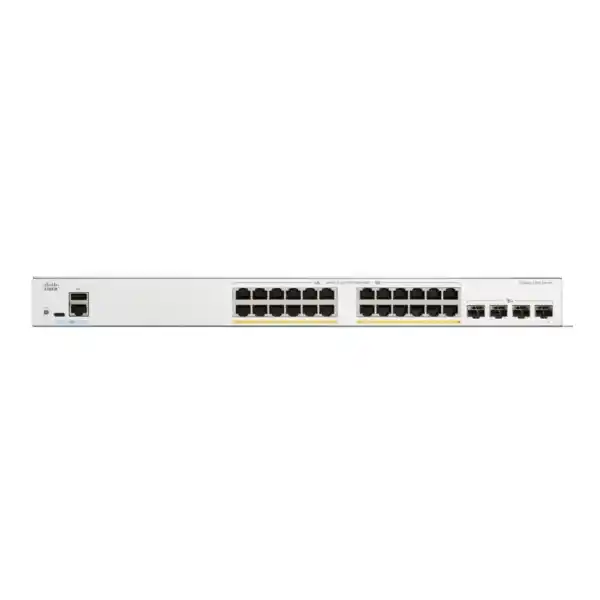
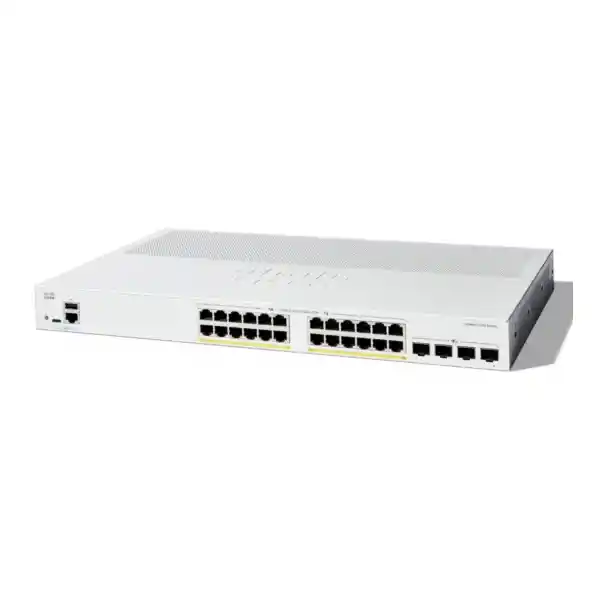
Cisco Catalyst C1300-24P-4X Network Switch
A compact, fanless Layer 3 managed access switch with 24 Gigabit PoE+ downlinks, a 195W PoE budget and four 10G SFP+ interfaces for high-speed uplinks, resilient aggregation and front-panel hardware stacking.
Choose the C1300-24P-4X when a site needs twenty-four 1G powered access ports, more uplink headroom than 1G SFP models, practical Layer 3 segmentation, and Cisco stacking without moving to a larger 48-port or higher-PoE platform.
10/100/1000BASE-T ports support IEEE 802.3af/at powered devices, with up to 30W available per port subject to the shared budget.
Suitable for mixed fleets of IP phones, cameras and access points when the calculated simultaneous load remains within the switch budget.
High-speed fiber or supported direct-attach uplinks reduce aggregation bottlenecks and can also participate in front-panel stacking.
Cisco specifies wire-speed, nonblocking switching with 95.23 Mpps forwarding for 64-byte packets on this model.
What the C1300-24P-4X is designed to do
The Cisco Catalyst C1300-24P-4X sits in the part of the access-switching market where small and midsize organizations need genuinely managed networking features without the space, power draw and procurement complexity of a large modular campus platform. It is a fixed, rack-mountable Layer 3 switch intended for branch offices, growing businesses, distributed sites and focused enterprise access deployments. The model is especially practical where the access layer must power endpoint devices while still providing 10 Gigabit uplink capacity to a firewall, core, aggregation switch, virtualization host, storage network or another wiring closet.
Its basic port map is easy to understand: twenty-four copper Gigabit Ethernet ports form the client-facing access layer, while four SFP+ interfaces provide up to 10 Gigabit Ethernet each. All twenty-four copper ports are PoE-capable, but the important engineering figure is the 195W total PoE budget. A procurement team should therefore treat the switch as a twenty-four-port PoE+ platform with a shared power envelope, not as a device that can deliver the maximum 30W PoE+ allocation to every port simultaneously. In a typical office, however, endpoint draw is mixed. Desk phones may consume modest power, cameras may vary significantly by optics and heaters, and wireless access points can draw more under full radio load. When those actual requirements are inventoried correctly, 195W can be a strong fit.
The four 10G uplinks are a defining advantage over similarly sized switches limited to 1G SFP. Twenty-four active access ports can collectively create far more than 1 Gbps of northbound demand, particularly when workstations use cloud applications, local file servers, video collaboration, surveillance recording and Wi-Fi access points at the same time. A 10G uplink materially reduces oversubscription risk, and multiple SFP+ ports allow link aggregation, redundant paths, inter-switch connectivity or stacking design options. This makes the C1300-24P-4X suitable not only as a basic edge switch but also as a well-structured access-layer building block.
For UAE organizations evaluating a branch refresh, the model also addresses operational concerns. It is fanless, which can be important in meeting rooms, retail back offices, classrooms and small network cabinets where acoustic noise matters. It supports an internal universal 100-240V AC power supply, broad management options, Layer 2 resiliency, wire-speed IPv4 and IPv6 routing capabilities, security controls for endpoint admission and spoofing prevention, and hardware stacking with compatible Catalyst 1300 family members. FourTeck can align this switching layer with wider UAE network infrastructure requirements including firewall handoff, wireless access, IP telephony, structured cabling and deployment services.
Verified hardware architecture and performance envelope
Switching and forwarding
Cisco rates the C1300-24P-4X at 128 Gbps switching capacity and 95.23 million packets per second forwarding using 64-byte packets. The 128 Gbps figure is consistent with a nonblocking full-duplex fabric for twenty-four 1G interfaces plus four 10G interfaces: the one-direction aggregate line rate is 64 Gbps, and full-duplex accounting doubles that value. This matters because the fabric is not designed around a low shared backplane that forces ports to contend simply because all interfaces are active.
Wire-speed switching does not remove every possible performance constraint. Packet bursts, queueing policy, ACL processing, oversubscribed external links, endpoint NIC speeds and server capacity still affect application experience. The correct interpretation is that the switch itself provides a fabric sized for its physical line-rate portfolio, while the network architect must still design uplink ratios and traffic classes around real workloads.
CPU, memory and buffers
The Catalyst 1300 platform uses an ARM dual-core processor at 1.5 GHz, with 1 GB DDR4 DRAM and 1 GB SLC flash on standard C1300 models. The C1300-24P-4X has a 1.5 MB dynamically shared packet buffer. These control-plane resources support management, routing protocols, monitoring, configuration and platform functions while the forwarding path handles traffic at hardware speed.
Cisco does not identify the merchant-silicon or proprietary ASIC family in the public product data sheet for this model. FourTeck therefore does not invent an ASIC name or speculative pipeline. For engineering decisions, the published nonblocking capacity, forwarding rate, buffer size, forwarding features, queue count and table scale are the defensible design inputs. That approach is more useful than relying on an undocumented chip label that may change across hardware revisions.
Technical specification table
| Category | Cisco Catalyst C1300-24P-4X | Design meaning |
|---|---|---|
| Access ports | 24 x 10/100/1000BASE-T PoE+ | Connect users, IP phones, cameras, APs, printers and IoT endpoints |
| Uplinks | 4 x 10G SFP+ | Fiber, supported DAC/AOC, aggregation, redundant paths or stacking |
| PoE standards | IEEE 802.3af and 802.3at PoE+ | Up to 30W class on a port, constrained by the 195W total budget |
| PoE budget | 195W | Requires endpoint-by-endpoint power sizing |
| Switching capacity | 128 Gbps | Nonblocking fabric sized to the port portfolio |
| Forwarding | 95.23 Mpps at 64-byte packets | Wire-speed packet forwarding specification |
| Packet buffer | 1.5 MB dynamic shared | Shared buffering across interfaces for bursts and queueing |
| Memory | 1 GB DDR4 DRAM, 1 GB SLC flash | Control plane, images, management and configuration resources |
| MAC table | 16,000 addresses for C1300 1G SKUs | Comfortable endpoint scale for typical access networks |
| QoS | 8 hardware queues | Classify and prioritize voice, video, transactional and best-effort traffic |
| Jumbo frames | Up to 9000 bytes | Useful where end-to-end MTU design supports larger frames |
| Chassis | 444.3 x 299 x 43.94 mm; 3.95 kg | Standard rack width, approximately 1RU height |
| Cooling | Fanless | Low acoustic impact and no fan as a moving component |
| Input power | 100-240V AC, 50-60Hz internal universal PSU | Appropriate for UAE mains environments with correct cord and UPS planning |
| Operating range | -5°C to 50°C; 10%-90% RH noncondensing | Cabinet ventilation and room conditions remain critical in UAE installations |
PoE+ engineering: how to size the 195W budget correctly
Power over Ethernet is often the deciding factor in choosing between the C1300-24P-4X and a higher-budget model such as the C1300-24FP-4X. Both can expose twenty-four PoE-capable Gigabit ports, but their total available power is different. The C1300-24P-4X provides 195W dedicated to PoE, so the correct design process starts with the maximum expected simultaneous draw of all powered devices rather than the port count alone. A common mistake is to see twenty-four PoE+ labels and assume twenty-four devices can each receive 30W continuously. Twenty-four times 30W would be 720W, far beyond this model’s power budget.
A better method is to create a power ledger. Record every planned powered device, its negotiated PoE standard, vendor maximum draw, realistic operating draw, startup behavior and whether accessories such as USB modules, cameras with infrared illuminators, PTZ motors or heated enclosures increase consumption. Then add a growth margin. For example, a voice-heavy office with twenty IP phones drawing approximately 5W each and four access points drawing approximately 18W each would total about 172W, leaving only modest headroom. The same switch supporting twelve phones, six cameras at 8W and four access points at 16W would consume roughly 172W as well. Exact values must come from the endpoint data sheets, because device generations can vary considerably.
The C1300-24P-4X supports IEEE 802.3af and 802.3at, and Cisco also lists legacy pre-standard PoE support in the family. It does not belong to the Catalyst 1300X PoE++ group that provides 802.3bt capabilities. This distinction matters when planning Wi-Fi 7 access points, video devices, building systems or other high-power endpoints that may request more than PoE+ can deliver. If an endpoint requires 60W Type 3 PoE++, the right answer is not to hope the switch negotiates it; select a model designed for 802.3bt or use an appropriate external power method.
The platform also supports operational PoE features that can improve uptime and energy management. Persistent PoE is designed to keep PoE power available while the switch itself is rebooting, reducing unnecessary endpoint power cycles during certain maintenance events. Time-based PoE can turn power on or off according to an administrator-defined schedule, which can be useful for noncritical devices outside operating hours. These features should still be applied with business context. Security cameras, access-control components and emergency communications usually require continuous power, while signage, lab devices or nonessential wireless radios may be candidates for scheduled power control.
For a UAE quotation, FourTeck recommends submitting the powered-device schedule with the switch request. The schedule should include model number, quantity and maximum wattage for every phone, access point, camera, sensor or IoT device. That single step prevents one of the most common switch-selection problems and makes it easier to decide whether 195W is sufficient or whether a full-power variant is justified. Organizations that need assistance with deployment planning can combine the hardware supply with FourTeck IT services in the UAE for implementation, migration and validation.
10G SFP+ uplinks, optics and oversubscription planning
The four 10 Gigabit SFP+ ports are what make the C1300-24P-4X substantially more capable as an access-layer platform than a switch with only 1G optical uplinks. With twenty-four 1G edge interfaces, a single 1G uplink could theoretically create a 24:1 access-to-uplink oversubscription ratio before traffic patterns are considered. A 10G uplink reduces that theoretical ratio to 2.4:1, and two active 10G links in a properly designed aggregate can reduce it further. Real networks rarely drive all access ports at line rate at once, but modern cloud use, backups, collaboration, local storage and wireless aggregation can generate short high-volume bursts where uplink headroom is valuable.
Cisco lists a broad set of supported transceiver types for the Catalyst 1300 family, including 10G SR and LR optics, longer-reach ER variants, bidirectional modules, copper SFP+ options and direct-attach or active optical cable assemblies. The exact optic should be selected by fiber type, connector path, distance, patching topology, environmental conditions and compatibility requirements. In a data rack, a short supported DAC can be cost-effective for an adjacent server or aggregation device. Across a building, multimode SR may fit existing OM3 or OM4 infrastructure. Between buildings or over longer campus runs, single-mode LR or another supported optic may be appropriate after checking optical budget and pathway design.
When multiple uplinks are available, they can serve distinct design purposes. One pair may form an LACP EtherChannel toward redundant or stacked aggregation switches, another port may connect to a storage or server environment, and a remaining port can be reserved for migration or future expansion. Alternatively, some SFP+ interfaces may participate in the switch’s front-panel hardware stack. Because stacking and northbound connectivity draw from the same high-speed physical interface portfolio on this family, the bill of materials must account for how many SFP+ ports remain available for production uplinks after the chosen stack topology is implemented.
LACP is supported with up to eight link-aggregation groups and up to eight ports per group, with a larger candidate set for dynamic aggregation. Link aggregation provides bandwidth distribution and resiliency, but it does not turn multiple 10G links into a single 20G path for one ordinary flow. Hashing distributes separate flows across member links, so the performance gain depends on traffic diversity. This distinction is important for storage, backup and virtualization use cases where a single TCP session might otherwise be expected to exceed the speed of one physical member.
Cabling quality is equally important on the copper side. Cisco specifies Category 5e or better UTP for 1000BASE-T. In real Dubai deployments, FourTeck generally recommends validating cable certification, patch-panel quality, termination, grounding practices, cabinet routing and PoE heat density rather than assuming a link LED proves the channel is healthy. High packet error rates, marginal PoE voltage conditions and intermittent link renegotiation are often physical-layer problems that switching configuration cannot fix.
Layer 2 segmentation and resiliency
The C1300-24P-4X provides the Layer 2 controls expected in a modern managed access switch. It supports IEEE 802.1Q VLAN tagging, port-based VLANs, MAC-based VLANs, protocol-based VLANs, IP-subnet-based VLANs, management VLANs, guest and unauthenticated VLAN workflows, private VLAN capabilities and dynamic VLAN assignment through RADIUS in conjunction with 802.1X authentication. The platform can support up to 4094 VLAN identifiers, with a portion reserved for internal use. This scale is far above what most twenty-four-port branch sites will require, but it allows the switch to participate in more complex distributed segmentation schemes.
Voice VLAN functionality can automatically place voice endpoints into a dedicated logical segment and apply appropriate quality-of-service treatment. LLDP-MED and Cisco discovery capabilities make it easier for compatible phones and neighboring network devices to exchange identity and media-related information. Auto surveillance VLAN support helps create a similar operational model for video endpoints. These features should still sit inside a documented VLAN plan rather than being activated without governance. A well-designed branch may have separate VLANs for corporate users, voice, wireless infrastructure, guest Wi-Fi, security cameras, printers, building automation and switch management, each with an explicit routing and firewall policy.
Spanning Tree support includes traditional 802.1D STP, Rapid Spanning Tree under 802.1w, Multiple Spanning Tree with up to sixteen instances and Cisco-oriented PVST+ and Rapid PVST+ options with a higher instance count. Rapid convergence is important in redundant access designs where a failed uplink must be bypassed quickly. However, spanning tree is not a substitute for a clean topology. Administrators should define the intended root bridge, choose edge-port behavior carefully, apply BPDU Guard where appropriate and avoid unmanaged loops created by users connecting wall outlets together.
UDLD can help detect unidirectional link conditions that are especially problematic on fiber paths, where one optical direction may fail while the other still appears active. Loopback detection provides another mechanism for identifying forwarding loops independent of STP. Storm control can limit broadcast, multicast and unknown-unicast traffic during abnormal conditions. Together these controls reduce the blast radius of cabling mistakes, endpoint faults and accidental loops, which are common causes of apparent network-wide outages in small and midsize environments.
Multicast features include IGMP snooping for versions 1, 2 and 3, an IGMP querier, IGMP proxy and Multicast VLAN Registration. These capabilities can be useful for surveillance, IPTV, signage and application delivery where multicast traffic should reach only interested receivers rather than flood every access port. For IPv6 environments, MLD snooping and related multicast controls provide comparable functionality. The result is an access switch that can support more than ordinary unicast office traffic when configured with an application-aware topology.
Layer 3 routing capabilities and boundaries
Unlike a purely Layer 2 access switch, the Catalyst 1300 family can route IPv4 and IPv6 traffic in hardware. This allows the C1300-24P-4X to act as the gateway for local VLANs where the architecture calls for inter-VLAN routing at the access or distribution layer. Layer 3 interfaces can be created on physical ports, link-aggregation groups, VLAN interfaces and loopbacks. CIDR is supported, along with IPv4 DHCP server functions, DHCP relay and UDP relay for services that depend on broadcast discovery across routed boundaries.
For standard C1300 scale, Cisco specifies up to 990 combined dynamic and static IPv4 routes and up to 128 IP interfaces. The platform supports RIP version 2 for dynamic routing and Policy-Based Routing for directing traffic to different next hops based on IPv4 or IPv6 ACL conditions. OSPF version 2 and 3 are listed for the Catalyst 1300X family only, so buyers should not assume that a C1300-24P-4X provides the same OSPF feature set. If a site requires OSPF as a mandatory branch routing protocol, that requirement should be surfaced before the switch is purchased.
Inter-VLAN routing on the switch can reduce traffic hairpinning through a firewall, but it also changes the security architecture. If user, server, voice and IoT VLANs are routed locally, some east-west flows may bypass the firewall unless switch ACLs are used or the topology intentionally forces sensitive traffic through a security appliance. A strong design therefore separates performance decisions from security decisions. High-volume trusted flows may be routed locally, while guest, camera, server or regulated traffic may still traverse a firewall for inspection and logging.
The C1300-24P-4X is consequently best viewed as a capable Layer 3 access switch, not a replacement for a next-generation firewall or a large routing platform. It can provide VLAN gateways, static and RIP-based routing, IPv6 forwarding and policy-based traffic steering, but perimeter security, application inspection, VPN termination, internet threat prevention and advanced WAN services remain separate architectural functions. FourTeck can integrate the switch with firewall solutions in Dubai when a branch design requires both high-performance LAN segmentation and controlled north-south or east-west security.
A practical deployment pattern is to use the switch for local VLAN termination and resilient access, then create a routed or trunked connection to the firewall depending policy requirements. Another is to keep all VLAN gateways on the firewall when the traffic volume is moderate and centralized inspection is the priority. The switch supports either style; the correct choice depends on throughput, compliance, failure domains and the organization’s operational model.
Access security: 802.1X, DHCP protection, ARP inspection and ACLs
The access layer is a security boundary because every wall jack, camera cable, phone connection and wireless access point eventually terminates on a switch port. The C1300-24P-4X provides a broad set of controls intended to make that boundary enforceable. IEEE 802.1X authentication can require users or devices to authenticate through a RADIUS infrastructure before receiving normal network access. The switch supports multiple host and session modes, guest and unauthenticated VLAN behavior, dynamic VLAN assignment and MAC-based authentication workflows, giving administrators flexibility for endpoints that cannot run a full 802.1X supplicant.
DHCP snooping can restrict DHCP server responses to trusted interfaces and build bindings that associate addresses with legitimate leases. IP Source Guard can then use those bindings to reject packets whose source IP does not match the expected state. Dynamic ARP Inspection verifies ARP behavior against trusted bindings, helping protect users from spoofing and man-in-the-middle attacks. Cisco describes the combination of DHCP snooping, IPSG and DAI as IP/MAC/port binding capabilities. These mechanisms are most effective when trust boundaries are carefully configured; marking every interface trusted defeats their purpose.
Port security can limit or lock learned MAC addresses, while Private VLAN and Private VLAN Edge capabilities isolate devices even when they share higher-level segmentation. This is useful for guest rooms, public access, camera networks and IoT environments where endpoints may need upstream services but should not communicate directly with each other. BPDU Guard, Root Guard and loopback protections defend the Layer 2 control plane from accidental or malicious topology changes. Storm control and DoS prevention features can further protect availability during abnormal traffic conditions.
Access Control Lists provide granular filtering by source or destination MAC, VLAN, IPv4 and IPv6 addresses, protocols, TCP or UDP ports, DSCP values, 802.1p priority, ICMP, IGMP, TCP flags and additional fields. Cisco specifies up to 1024 ACL rules for Catalyst 1300 1 Gigabit Ethernet SKUs, with support for ingress and egress application and time-based policies. ACLs are powerful, but they should be treated as structured security policy. A long list of undocumented permit and deny statements can become more dangerous than no ACL at all because later administrators may not understand the intended traffic path.
Management security is also important. The switch supports SSH, HTTPS, SNMPv3, RADIUS and TACACS+ client functionality. Secure Sensitive Data features are designed to protect stored credentials and keys, and Cisco lists run-time defenses and boot-integrity mechanisms under its trustworthy-system features. Administrators should disable unused management services, restrict management access to dedicated VLANs or jump hosts, use centralized authentication where possible, send logs to a syslog platform and maintain controlled configuration backups.
No access switch is secure simply because features exist in the data sheet. Security comes from selecting the controls that match the threat model, testing failure behavior and monitoring the environment over time. For example, 802.1X should be tested with phones that bridge user PCs, printers that may use MAB, guest devices, APs and emergency endpoints before enforcement is enabled across an entire office. A staged rollout prevents a security project from becoming an availability incident.
QoS for voice, video, wireless and business applications
The C1300-24P-4X provides eight hardware queues and supports strict-priority and Weighted Round-Robin scheduling. Traffic can be classified using port, 802.1p, IPv4 or IPv6 precedence, DSCP and ACL-driven criteria, with remarking and trusted-QoS models available. Ingress policing and egress shaping can be applied in several contexts, allowing the switch to protect latency-sensitive classes while preventing a bulk flow from consuming disproportionate resources.
For voice, a common design trusts markings only from known IP phones or managed call-control endpoints, maps voice signaling and media into defined queues and preserves those markings across uplinks. Wireless deployments require more nuance because one AP can carry voice, video, corporate data and guest traffic simultaneously. The switch should not blindly classify an entire AP port as high priority. Instead, the wired QoS policy should align with the WLAN controller or AP marking strategy so that only appropriate applications enter preferred queues.
Surveillance traffic can be bandwidth-intensive but is usually more sensitive to sustained throughput than ultra-low latency. Camera recording streams may be assigned a controlled queue or rate policy that prevents them from interfering with interactive applications while still maintaining recorder continuity. Backup jobs, file replication and software distribution can be shaped during business hours if necessary. These examples illustrate why QoS is not simply a feature to enable; it is an end-to-end policy that should match application behavior and uplink capacity.
The presence of 10G uplinks reduces the likelihood that the access switch uplink itself becomes a chronic congestion point, but queueing can still occur on slower WAN links, firewall interfaces, server NICs and internet circuits. QoS markings are most useful when every hop understands the same policy. A branch can classify traffic correctly at the C1300-24P-4X, yet still experience poor voice quality if the firewall or service-provider edge discards the markings or if the WAN is oversubscribed without corresponding queuing.
Hardware stacking and high availability
Cisco supports front-panel hardware stacking on the C1300-24P-4X and other compatible members of the same Catalyst 1300 stacking family. A stack can contain up to eight switches, with Cisco describing a unified data, control and management plane and up to 400 ports managed as a single system across supported configurations. The architecture uses high-speed 10 Gigabit Ethernet interfaces for the stack interconnect, with ring and chain topologies, active/standby control, automatic numbering, hot-swap capabilities and fast failover features.
For a growing Dubai office, stacking can simplify operations because multiple access switches can be configured and monitored as one logical system rather than as independent devices with separate management addresses. Cross-stack LAG is especially valuable when an uplink bundle is split across different physical stack members. If one member fails, the remaining member can maintain part of the aggregate, improving resilience compared with a link bundle whose members all terminate on the same chassis.
Stacking should nevertheless be designed rather than merely enabled. The network architect must decide which SFP+ ports are reserved for stack links, which remain available for upstream connectivity, whether a ring is required for resiliency, how the stack members are distributed in the rack and how power is protected. A stack creates a unified operational system, but it does not make power failures disappear. If all members share one UPS, one PDU or one circuit, that common dependency can still take the entire access layer offline.
The same-family rule is critical. Cisco states that product IDs from the same defined stacking family can stack together and that cross-stacking between families is not supported. Procurement teams should therefore avoid assuming that every device carrying a Catalyst 1300 or 1300X name can join one stack. A mixed future design should be validated against Cisco’s current compatibility matrix at the time of purchase.
Where stacking is not required, the four 10G ports can instead be used for conventional redundant uplinks between separate switches. STP, LACP, Layer 3 routing or a combination of those technologies can provide resilience without making the switches a single logical stack. The better design depends on operational preference, failure isolation and the capabilities of the upstream network.
Management, monitoring and lifecycle operations
The Catalyst 1300 series is designed to be managed through several interfaces rather than forcing one operational model. Cisco Business Dashboard support can provide centralized discovery, monitoring and lifecycle functions, and the switch can run an embedded probe so a separate onsite probe appliance or virtual machine is not always required. Cisco Business mobile capabilities are available for local setup and management, while Cisco Network Plug and Play can support streamlined provisioning of new sites or replacement devices.
Engineers who prefer traditional workflows can use the built-in web interface, a full command-line interface, SSH, SNMP or other management protocols. SNMP versions 1, 2c and 3 are supported, with SNMPv3 providing stronger security for modern deployments. RADIUS and TACACS+ integration can centralize administrator authentication. Syslog export, time synchronization, ping, traceroute, port mirroring, cable diagnostics and configuration/image transfer mechanisms support day-to-day troubleshooting and monitoring.
Operational maturity depends on process. A production deployment should define an out-of-band or isolated management path where practical, use HTTPS and SSH rather than insecure alternatives, synchronize time with reliable NTP/SNTP sources, forward logs, back up the running and startup configuration, document software versions and test upgrades before wide rollout. Cisco supports dual images on the family, which helps reduce risk during software maintenance by preserving an alternate image path.
The public data sheet does not identify a mandatory feature subscription for the core switching functions described on this page. However, buyers should distinguish the switch hardware entitlement from optional support services, cloud or management offerings, partner services and lifecycle contracts. A commercial quotation should explicitly state hardware SKU, included warranty position, optional Cisco support coverage if required, optics, power cord variant and implementation scope so there is no assumption that every service is bundled.
Cisco lists a limited lifetime warranty with return-to-factory replacement for the Catalyst 1300/X series and complimentary one-year access to the Small Business Support Center. Organizations with stricter restoration objectives should evaluate whether that baseline aligns with business requirements. A hospital branch, call center or revenue-generating retail site may need additional spare strategy or support coverage even when the hardware itself has a lifetime warranty.
Physical design, thermals and UAE installation conditions
The C1300-24P-4X measures approximately 444.3 mm wide, 299 mm deep and 43.94 mm high, with a unit weight of about 3.95 kg. The 24-port models include 19-inch mounting brackets according to Cisco’s package information, making the switch suitable for standard racks and cabinets. The internal universal power supply accepts 100-240V AC at 50-60Hz, which is convenient for UAE deployments when paired with the correct local power cord, protected PDU and UPS design.
A fanless chassis is attractive for quiet locations because it avoids fan noise and removes a moving component. It does not mean thermal planning can be ignored. Cisco specifies operation from -5°C to 50°C with a minimum cold-start ambient of 0°C, and 10%-90% relative humidity noncondensing. Dubai network rooms can encounter high ambient temperatures if cooling is poor or a cabinet is placed in a utility area. The switch’s temperature rating is not a license to operate a rack permanently at the upper edge of the range.
PoE switching also changes cabinet heat dynamics because the switch power supply converts significant electrical energy while supplying endpoints. Cisco lists worst-case power consumption with PoE of approximately 235.8W at 110V and 232.9W at 220V for this model, with heat dissipation around 804.1 BTU per hour in the published table. Actual consumption depends on PoE load and traffic, but these values help facilities teams size UPS capacity and rack cooling conservatively.
For an equipment room, maintain clear airflow around the chassis, avoid blocking ventilation openings, keep cable bundles from resting against vents, and separate high-density copper bundles where practical. Label both switch ports and patch-panel positions. Use horizontal and vertical cable managers so a future technician can replace an optic or switch without disturbing twenty-four unrelated links. Where dust is a concern, maintain the room and cabinet rather than sealing the switch into an unventilated enclosure.
Electrical resilience should also be engineered. A correctly sized UPS must support not only the switch’s own electronics but also the powered endpoint load. If the switch powers cameras, phones and access points, an undersized UPS may shut down much sooner than expected during an outage because the PoE load can dominate consumption. Runtime calculations should use the expected aggregate load plus margin, and critical endpoints should be prioritized if load shedding is part of the continuity plan.
Deployment topology 1: branch office with voice, Wi-Fi and secure internet edge
A common C1300-24P-4X deployment is a branch office with around fifteen to twenty-five wired endpoints, several IP phones, two to four wireless access points and a security appliance. In this design, user PCs can connect directly to switch access ports or through the PC port of an IP phone. The switch supplies PoE to the phones and access points, places voice and corporate traffic into separate VLANs and uses LLDP-MED plus QoS to preserve voice markings. Guest wireless traffic can be mapped to its own VLAN and forwarded to the firewall without receiving direct access to the corporate LAN.
One or two 10G SFP+ links can connect the switch to a firewall or aggregation switch, depending the upstream interface type. When the firewall provides VLAN gateways, the uplink carries an 802.1Q trunk and inter-VLAN traffic is inspected by security policy. When the switch provides selected VLAN gateways, a routed uplink can carry summarized traffic toward the firewall. Either model works, but documentation must specify where every subnet terminates and where security inspection occurs.
Access security can be layered gradually. Corporate ports can use 802.1X with RADIUS, phone-plus-PC ports can use multi-domain or supported session modes, printers and specialized appliances can use MAC-based authentication where appropriate, and unused interfaces can remain administratively disabled. DHCP snooping and DAI can protect user segments from rogue services and address spoofing. Management should reside in a dedicated VLAN reachable only from authorized administration systems.
This topology uses the switch’s strengths without stretching the platform into roles it was not designed to replace. The firewall remains responsible for internet security and VPN, while the C1300-24P-4X handles deterministic LAN switching, PoE delivery, access control, VLAN separation and high-speed uplink transport.
Deployment topology 2: IP surveillance and building edge
The switch can also support a surveillance-oriented edge where cameras are distributed through one floor or zone and video is transported to a recorder or server over 10G uplinks. The twenty-four PoE+ ports provide a clean physical fit for camera aggregation, while Auto Surveillance VLAN, multicast controls, ACLs and QoS can help contain and prioritize traffic. The most important constraint remains power. Camera specifications can change dramatically when infrared illuminators, PTZ motors, heaters or analytics processors are active, so a 195W budget should be validated against worst-case camera draw rather than average daytime consumption.
A camera network should normally be segmented from user endpoints. Private VLAN or protected-port functions can limit camera-to-camera communication where that behavior is desirable, while ACLs can permit cameras to reach only the recorder, NTP, DNS or management services they actually need. DHCP snooping and source protections can be applied when addressing is dynamic; static-camera deployments can use a different policy model. Management access should be restricted to authorized systems, and camera web interfaces should not be broadly reachable from user VLANs.
Video bandwidth sizing must account for codec, resolution, frame rate, scene complexity and retention architecture. Twenty-four 8 Mbps streams total about 192 Mbps before protocol overhead, which is easy for a 10G uplink, while very high-resolution or multi-stream cameras can consume more. The 10G interface is therefore less about one camera and more about aggregate headroom, recorder bursts, playback traffic and future expansion. If the recorder is local and supports 10G, a dedicated SFP+ path can keep video traffic away from a slower shared uplink.
Facilities deployments often place switches in cabinets outside conventional data rooms. The fanless design helps acoustically, but temperature, dust, UPS runtime and physical security become more important. In the UAE, a cabinet near an exterior wall, warehouse area or plant room should be assessed for ambient conditions before equipment is installed. A network switch rated for commercial environments should not be treated as an outdoor industrial device unless the enclosure and environmental controls are engineered accordingly.
Deployment topology 3: stacked access layer for a growing office
A business that begins with twenty endpoints can grow quickly once IP phones, cameras, access points, printers, meeting-room devices and IoT systems are counted. Instead of replacing the first switch when port demand increases, compatible Catalyst 1300 units can be added into a hardware stack. A two- or three-member stack can present a single management plane while providing more physical ports and allowing cross-stack link aggregation toward the upstream network.
A resilient stack design typically considers at least four independent resource categories: data path, power, physical cabling and control. The stack interconnect should avoid a single easy-to-break path when high availability matters. Uplink members can be distributed across different stack units so the failure of one chassis does not remove the entire northbound bundle. Power feeds should be diversified where facilities allow, and configuration backups should be stored outside the stack itself. The rack should be labeled so a technician can identify member numbers and stack links without tracing cables under pressure.
Stacking also affects procurement. The bill of materials may need additional supported SFP+ modules, DAC or fiber assemblies for stack links, separate optics for upstream connections and spare transceivers. Because the C1300 front-panel stack uses high-speed interfaces that can otherwise serve as uplinks, capacity planning must reserve enough ports for both roles. A designer should not order four uplink optics for production traffic and then discover that the planned stack requires some of the same interfaces.
For multi-rack sites or networks that require stronger fault isolation, independent switches with Layer 3 links may be preferable to one large stack. Stacking reduces management complexity, but independent failure domains can sometimes be more desirable. FourTeck’s role is to match the topology to the business continuity objective rather than promote one architecture universally.
Sizing methodology: is the C1300-24P-4X the right model?
Start with physical ports, but do not stop there. Count every wired endpoint expected on day one, then add ports for phones, access points, cameras, printers, access-control devices, building systems, conference-room equipment, uplink handoffs, test connections and at least a practical growth reserve. A twenty-four-port switch is most comfortable when the planned steady-state access count leaves room for maintenance and expansion. If the design already needs twenty-three or twenty-four copper interfaces on the first day, a 48-port model or a planned stack may be more economical than immediately adding another switch.
Second, calculate PoE. Use endpoint maximum power figures, not only the PoE class printed on a marketing sheet. Some devices advertise a class that represents the upper allocation while consuming less in normal operation, but procurement must still understand worst-case behavior. Add the maximum simultaneous requirement, include growth and compare the result with 195W. If the total approaches the limit too closely, choose a higher-PoE model so future firmware, radios, USB accessories, cold-start behavior or additional endpoints do not create instability.
Third, size uplink bandwidth. Estimate peak traffic toward internet, servers, storage, cameras and other VLANs. A single 10G uplink is already generous for many twenty-four-port branches, but redundant 10G connections may be justified for availability. If the switch will be stacked, reserve ports for the stack. If an upstream firewall supports only 1G copper, do not assume the switch’s 10G optics magically remove that bottleneck; the slowest relevant link still limits end-to-end throughput.
Fourth, identify routing requirements. The C1300-24P-4X can perform wire-speed IPv4/IPv6 routing, static and dynamic route functions including RIP v2, and policy-based routing. If the project requires OSPF, very large routing tables, advanced campus automation, EVPN, sophisticated telemetry or other enterprise-core features, validate those requirements against a more appropriate platform. Buying extra capability for its own sake raises cost, but buying a switch that misses one mandatory protocol creates a redesign later.
Fifth, identify security and identity requirements. If the organization needs 802.1X, RADIUS/TACACS+, DHCP snooping, DAI, IP Source Guard, VLAN isolation and access-list enforcement, this model provides relevant tools. The next question is whether the existing identity and monitoring systems can operate them. A feature is only useful when there is a RADIUS server, certificate or credential strategy, logging destination, administration process and support team prepared to maintain it.
Sixth, consider acoustic and environmental conditions. Fanless switching is valuable in quiet offices, but a fanless switch still generates heat and depends on ambient air. Verify cabinet depth, side and rear clearance, UPS load, room cooling, dust conditions and cable access. The chassis is about 299 mm deep, but patch cords and fiber bend radius require additional practical space behind or in front of the switch depending cabinet layout.
Finally, compare lifetime operations rather than only purchase price. Include optics, patching, UPS capacity, support coverage, configuration labor, rack space, future port expansion and replacement strategy. A slightly higher initial cost may be justified if it removes the need for a second switch, while a smaller model may be better when a branch is genuinely fixed and low density. FourTeck can coordinate switching requirements with server infrastructure in Dubai when uplink, virtualization and local application traffic must be sized as one system rather than as separate purchases.
When to choose another Catalyst 1300 variant
Need more PoE power
If the endpoint ledger exceeds the 195W budget or the project expects many higher-draw APs and cameras, consider a full-power variant such as the C1300-24FP-4X, subject to current availability and exact specifications.
Need more copper ports
If the access count is already close to twenty-four, a 48-port C1300 model may provide cleaner growth than deploying two switches immediately, provided rack, power and PoE requirements align.
Need multigigabit access
High-performance Wi-Fi access points can benefit from 2.5G or 5G copper interfaces. A multigigabit Catalyst 1300 or 1300X model is a better fit when 1G downlinks would constrain planned AP throughput.
Need PoE++ or OSPF
Projects requiring 802.3bt PoE++ or OSPF should be validated against Catalyst 1300X options or another Cisco platform because those capabilities are not the defining feature set of this C1300-24P-4X model.
Model selection should follow requirements rather than naming. The “P” model provides PoE with a moderate power budget; “FP” variants increase PoE capacity; multigigabit models increase edge speed; 1300X extends parts of the feature and stacking architecture. A quotation should therefore list exact PID rather than relying on a family name that could hide meaningful differences.
Migration from older Cisco access switches
The C1300-24P-4X is listed by Cisco as a replacement path for select older Cisco Business CBS350 and Catalyst 1000 models with similar 24-port PoE and 10G-uplink characteristics. That makes it relevant for organizations refreshing aging branch switches while preserving a familiar port density. A replacement project should still be treated as a migration, not a one-for-one cable swap, because software behavior, command syntax, default settings and supported management workflows can differ between product generations.
Before migration, export and document the existing VLAN list, trunk settings, access-port assignments, voice VLANs, LAGs, spanning-tree parameters, authentication configuration, ACLs, DHCP snooping trust settings, SNMP, syslog, NTP and management addressing. Identify ports that are administratively disabled or intentionally rate-limited. Record PoE draw under normal operation. This creates a requirements map that can be translated into the new platform rather than blindly copying commands.
The cutover plan should include a rollback method. Stage the C1300-24P-4X with current firmware, management access and baseline security. Preconfigure access ports and trunks where possible, then move a controlled group of endpoints first. Test DHCP, DNS, internet access, internal application reachability, voice registration, camera recording, Wi-Fi authentication and monitoring. Only after those validation steps should the remaining ports be migrated.
For a PoE environment, monitor powered-device negotiation during the cutover. A phone that powers on is not enough; confirm that the switch records the expected draw and that the aggregate budget remains stable after all devices are connected. If the old switch had a larger PoE budget, migrating to 195W without a ledger can create a hidden capacity problem even when the port count is identical.
Where the old switch used 1G uplinks, migration is an opportunity to move the aggregation path to 10G rather than recreating the old bottleneck. That may require new SFP+ optics, fiber validation and an upstream switch or firewall capable of 10G. FourTeck can provide project-level supply and integration through its broader global FourTeck network solutions portfolio when a refresh spans multiple offices or countries.
UAE procurement and bill-of-materials guidance
A complete switch quotation is more than a chassis line item. For the C1300-24P-4X, procurement should confirm the exact product ID, region-appropriate power cord, required number and type of SFP+ transceivers, patch leads, rack mounting, UPS capacity, implementation services and any optional support coverage. If the switch will join an existing stack, compatibility and current software requirements should be validated before ordering. If it will uplink to a firewall or core switch, both ends of each link must support the chosen optic and speed.
Lead time can matter in Dubai projects where office handover, fit-out and ISP activation dates are fixed. A useful procurement plan separates mandatory day-one items from optional growth items. Mandatory items include the switch, power cord, required uplink optics and any stack interconnects. Growth stock may include one spare optic, additional patch cords or a spare access switch for sites with strict restoration objectives. This prevents a single missing transceiver from delaying an otherwise complete installation.
Regional power and thermal conditions should be reflected in the bill of materials. Specify a rack PDU appropriate for the site, a UPS sized for the switch plus expected PoE load, and environmental monitoring where network availability is important. Because the C1300-24P-4X can supply 195W to endpoints, UPS runtime based only on the switch’s idle power will be unrealistic. Use measured or worst-case planning values consistent with the continuity requirement.
For structured cabling, verify copper certification and fiber type before ordering transceivers. An existing multimode run may support 10G at the required distance with the right optic, while an older or longer path may call for single-mode fiber. Do not select SR or LR simply by price; use the installed medium and distance. Likewise, SFP+ direct-attach cables are ideal in some same-rack connections but are not a substitute for building fiber.
Commercial buyers should also separate warranty from service-level requirements. Cisco’s limited lifetime return-to-factory warranty provides useful hardware protection, but a return process is not the same as an onsite four-hour restoration commitment. Critical branches may justify spare hardware, advanced support or partner-managed services. Less critical offices may accept return-to-factory replacement and maintain a standardized spare centrally.
When requesting pricing from FourTeck, provide site location, quantity, desired delivery window, number of 10G links, fiber type and distance, PoE endpoint list, stacking requirement and implementation scope. Those details allow the quotation to include the right accessories and reduce revision cycles.
Implementation checklist for network engineers
Before rack installation
Confirm rack depth, mounting hardware, PDU outlet, UPS capacity, ambient temperature, patch-panel mapping and fiber pathway. Verify that the switch PID matches the approved design and that ordered optics are supported for the intended medium. Record serial numbers for asset management and stage the device in a controlled environment where firmware and baseline configuration can be tested.
Prepare a port schedule showing interface number, endpoint, VLAN, voice VLAN, PoE requirement, authentication method, description and patch-panel position. A port schedule turns deployment from a trial-and-error process into a repeatable implementation and later becomes valuable troubleshooting documentation.
Baseline configuration
Set hostname, management addressing, default route or routing protocol as required, secure administrator credentials, time synchronization, DNS, syslog and SNMPv3. Disable or restrict unused management services. Build VLANs, trunks and access ports from the approved design, then configure spanning-tree priorities and edge protections before connecting production users.
Apply security controls in stages. Enable DHCP snooping only after trusted uplinks are identified. Add DAI and IP Source Guard after bindings behave as expected. Test 802.1X with every endpoint category. Apply ACLs from a documented matrix and verify both permitted and denied traffic paths.
PoE and uplink validation
Connect powered devices gradually and record per-port and aggregate consumption. Confirm that devices negotiate the expected PoE state and remain stable during peak functions such as AP radio activity or camera night mode. Test persistent PoE behavior only if it is part of the operational plan.
For each 10G link, verify transceiver recognition, optical levels where available, negotiated speed, LACP state and error counters. Run traffic tests that are appropriate for the environment rather than relying only on ping. A clean ICMP response can coexist with duplex, optic or queueing problems that appear only under load.
Handover and operations
Save the final configuration, export a backup, document software version and capture a post-installation status report covering ports, PoE, VLANs, spanning tree, routes, stack state and uplinks. Update network diagrams with the actual rack position, uplink destination and IP address rather than leaving design-stage placeholders.
Define who receives alerts, who can change configuration and how emergency access works if centralized authentication is unavailable. Schedule configuration backups and firmware review. A well-installed switch should be maintainable by an engineer who did not participate in the original deployment.
Frequently asked technical questions
Can all 24 ports deliver 30W PoE+ at the same time?
No. Each access interface is PoE+-capable, but the total dedicated PoE budget is 195W. The number of simultaneously powered devices depends on their actual or allocated consumption. If a design genuinely requires close to 30W on every port, a much higher PoE budget is necessary.
Does the C1300-24P-4X have 10G copper access ports?
No. The twenty-four downlinks are 10/100/1000BASE-T copper. The four 10G interfaces are SFP+ ports intended for supported optical, DAC, AOC or other compatible SFP+ connectivity.
Does it support hardware stacking?
Yes. Cisco lists the C1300-24P-4X in the hardware-stacking group, with up to eight compatible switches in a stack. Product IDs must belong to the same defined stacking family, and front-panel high-speed interfaces are used for stack connectivity.
Can the switch route between VLANs?
Yes. It provides Layer 3 interfaces and wire-speed IPv4/IPv6 routing. Standard C1300 capabilities include static and dynamic IPv4 routing scale, RIP v2, policy-based routing, DHCP server and relay functions. OSPF is specified for C1300X, not this standard C1300 model.
Is the switch fanless?
Yes. Cisco lists the C1300-24P-4X as fanless. That reduces acoustic noise, but cabinet ventilation and environmental control are still required.
What is the switching performance?
Cisco specifies 128 Gbps switching capacity and 95.23 Mpps forwarding for 64-byte packets, with the series described as wire-speed and nonblocking.
Can it secure user access with 802.1X?
Yes. The platform supports 802.1X authenticator functions with RADIUS, multiple host and session modes, guest and unauthenticated VLAN options, dynamic VLAN assignment and MAC-based authentication workflows. Implementation still requires a compatible identity service and a tested endpoint policy.
Is a recurring license required for basic switching?
Cisco’s public Catalyst 1300 data sheet describes the switching, routing, security and management functions without identifying a mandatory recurring feature subscription for them. Optional support, management or partner services should be quoted separately and confirmed for the intended operational model.
What warranty does Cisco state?
Cisco lists a limited lifetime warranty with return-to-factory replacement for the Catalyst 1300/X series and one year of complimentary Small Business Support Center access. Organizations needing a faster restoration objective should consider appropriate support coverage or spare hardware strategy.
Decision recap: who should buy the C1300-24P-4X?
Strong fit
Branches, offices, retail sites, clinics, schools and SMB networks that need up to twenty-four 1G access ports, moderate PoE power, four 10G uplinks, practical Layer 3 features and fanless operation.
Validate first
Deployments with many high-draw cameras or APs, strict dynamic-routing requirements, high-density stacking plans, unusual optics, or security architectures that depend on specific authentication workflows.
Choose another model
Sites needing 802.3bt PoE++, substantially more than 195W PoE, multigigabit copper downlinks, more than twenty-four access ports without stacking, or OSPF on this switch platform.
The core value of the C1300-24P-4X is balance. It combines meaningful PoE capability, 10G uplink bandwidth, advanced access security, Layer 3 routing and hardware stacking in a one-rack-unit, fanless format. It is neither the smallest unmanaged edge device nor an oversized campus-core platform. For many Dubai branch networks, that middle position is exactly the requirement.
Quotation input checklist
For an accurate Cisco Catalyst C1300-24P-4X quotation, send the technical inputs below. Providing these details at the beginning lets the supplier size optics, PoE, stacking and services correctly instead of treating the switch as an isolated box.
Dubai/UAE delivery location, number of switches, rack locations and target deployment date.
Phone, AP, camera and IoT models with quantity and maximum power requirement.
Required 10G link count, upstream device, fiber type, distance and redundancy model.
Standalone or stacked deployment, number of members and preferred resilient topology.
VLAN count, gateway placement, 802.1X, RADIUS/TACACS+, ACL and firewall integration requirements.
Supply only, staging, onsite installation, migration, documentation, support coverage or managed operations.
Plan the complete access layer, not only the switch
A reliable deployment combines the C1300-24P-4X with correctly sized PoE, supported 10G optics, structured cabling, UPS protection, VLAN and security policy, monitoring, documentation and a tested migration plan. FourTeck can provide the switching hardware together with architecture and implementation support for UAE offices, branch sites and multi-location networks.
For broader infrastructure sourcing, visit FourTeck UAE, coordinate implementation through FourTeck IT Services, align security through Firewall Dubai, or integrate local compute through Server Dubai.
Recommended PID, PoE validation, optic/BOM list, uplink topology, stack design, implementation scope and support options matched to the site.

Reviews
There are no reviews yet.