
Cisco Catalyst 1300 Series | UAE Business Switching
Cisco Catalyst C1300-24T-4G Network Switch
The Cisco Catalyst C1300-24T-4G is a 24-port Gigabit Ethernet managed switch with four dedicated 1 Gigabit SFP uplinks, designed for organizations that need dependable wired access, Layer 2 segmentation, Layer 3 routing, security controls, traffic visibility and straightforward administration in a compact fanless 1U platform. For UAE offices, branch locations, schools, clinics, retail sites, professional services firms, hospitality back offices and small data rooms, it provides a practical middle ground between basic smart switching and larger enterprise campus platforms.
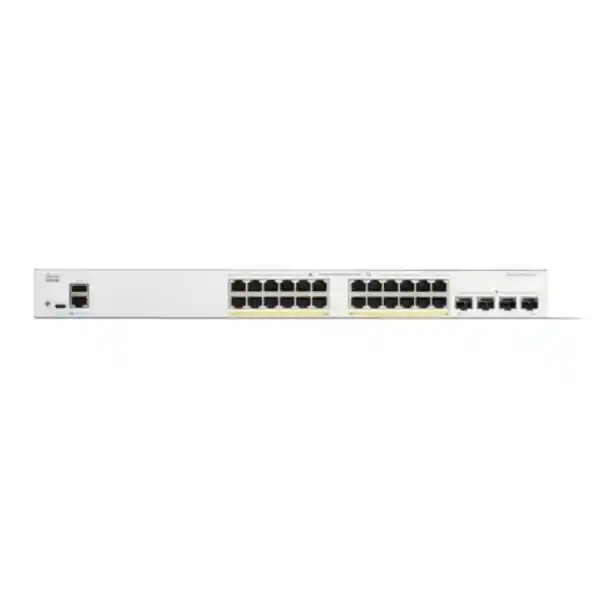
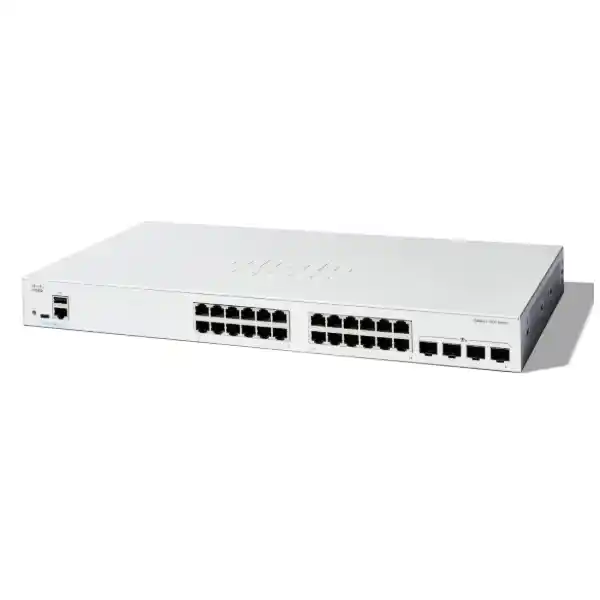
This page focuses specifically on the C1300-24T-4G hardware profile. It is the non-PoE model: the twenty-four RJ-45 access ports provide 10/100/1000 Mbps Ethernet data connectivity but do not supply PoE power. The four SFP ports are 1 Gigabit fiber uplinks rather than 10 Gigabit SFP+. That distinction matters when planning wireless access points, IP phones, cameras, server uplinks or future aggregation bandwidth. FourTeck can help UAE buyers match this model to the correct access-layer requirement and avoid paying for PoE or 10G capability where it is unnecessary.
Direct answer: what is the C1300-24T-4G built for?
The C1300-24T-4G is built for a wired access layer where most endpoints communicate at 1 Gigabit Ethernet and where uplinks to routers, firewalls, distribution switches or remote network areas can be carried over copper or, through its SFP interfaces, fiber. It is particularly appropriate when endpoint power comes from local adapters or separate injectors, because this SKU intentionally omits PoE. A typical installation might connect desktop PCs, printers, NAS devices, building systems, non-PoE phones, appliances, servers with modest bandwidth requirements, management interfaces and wired infrastructure ports while using one or more SFP uplinks for fiber runs between cabinets or floors.
Cisco publishes a switching capacity of 56 Gbps and a forwarding rate of 41.67 million packets per second for this model. Those figures align with a nonblocking design for its twenty-eight total Gigabit interfaces. The platform supports managed features such as 802.1Q VLANs, spanning tree, LACP, IPv4 and IPv6 routing, RIP v2, policy-based routing, DHCP server and relay functions, access control lists, 802.1X, DHCP snooping, Dynamic ARP Inspection, IP Source Guard, QoS, multicast controls, sFlow, RMON, SNMP, secure web management and CLI administration. The result is a switch that can act as far more than a simple port expander in a growing business network.
Twenty-four 10/100/1000 Mbps RJ-45 data ports for wired endpoints.
Four dedicated Gigabit SFP interfaces for fiber or supported transceiver options.
Published nonblocking wire-speed switching capacity for the model.
Packet forwarding rate measured using 64-byte packets.
Product positioning for UAE networks
Choosing an access switch is fundamentally a sizing exercise. The correct question is not simply whether a switch has twenty-four ports; it is whether its port speeds, uplink design, PoE capability, forwarding resources, routing features, security controls and management workflow fit the intended topology. The C1300-24T-4G is strongest when the network edge is predominantly 1G and the uplink requirement can also be satisfied at 1G per physical SFP link, optionally using link aggregation where the topology and peer device support it. It is well suited to branch offices in Dubai, Abu Dhabi, Sharjah and other UAE locations where predictable Gigabit access is more important than multigigabit Wi-Fi backhaul or 10G aggregation.
The model also fits organizations that want stronger traffic control than an unmanaged or entry-level web-managed switch can provide. VLAN segmentation can separate employee, server, guest, voice, CCTV, building-management and administrative traffic. Layer 3 interfaces can route between selected VLANs locally, reducing unnecessary dependence on an upstream router for internal east-west communication. ACLs can constrain which networks or services may talk to each other. 802.1X, port security and first-hop security tools can reduce the risk created by unauthorized endpoints or spoofed addressing. QoS can prioritize time-sensitive applications, and multicast controls can prevent unnecessary flooding from video or discovery traffic.
For organizations evaluating a broader infrastructure refresh, FourTeck can align switching with network security, compute and support requirements through the FourTeck UAE technology portfolio. The important design principle is to treat the switch as part of an end-to-end architecture rather than a standalone box. Firewall throughput, Internet bandwidth, WAN design, server NIC speeds, Wi-Fi standards, structured cabling, optical reach, power availability and growth expectations should all inform the final bill of materials.
Hardware port map and physical connectivity
The front-panel data plane provides twenty-four 10/100/1000BASE-T Ethernet ports. Auto-negotiation allows attached devices to establish the appropriate Ethernet speed and duplex mode, while modern structured cabling should normally be designed around Category 5e or better for Gigabit connectivity. In a new UAE office fit-out, Category 6 or better is commonly selected to create additional cabling margin and to protect the structured-cabling investment, although the switch itself remains a 1G copper access platform. Port planning should reserve capacity for both day-one users and infrastructure devices such as printers, access-control panels, conferencing systems, NAS appliances and management connections.
Four dedicated Gigabit SFP interfaces provide separation between endpoint access ports and optical uplinks. This is operationally useful because fiber uplinks do not consume the same copper ports needed for local endpoints. SFP selection must be based on fiber type, connector plant, distance and peer optics. Short-range multimode deployments, longer single-mode runs and building-to-building links require the correct optical transceiver pair and tested fiber path. The SFP interfaces on this SKU are Gigabit interfaces; they should not be confused with SFP+ or SFP28 ports found on faster models in the Catalyst family. If a design needs a sustained 10G uplink, a C1300 variant with 10G uplinks or another appropriate aggregation platform should be evaluated instead.
The unit is designed for rack mounting and measures approximately 444.3 mm wide, 240 mm deep and 43.94 mm high, corresponding to a conventional one-rack-unit height. Published unit weight is approximately 2.63 kg. Twenty-four-port and forty-eight-port models include 19-inch mounting brackets, which simplifies deployment into standard communications racks. Rack depth, cable-management clearance, power-strip placement, fiber bend radius and front/rear service access still need to be checked during site planning.
The platform includes a Cisco standard RJ-45 console port and a USB Type-C port that can support console and file/image management functions. These local interfaces matter during staging and recovery because an engineer can access the device even when production VLAN addressing is not yet available. A reset button is also provided. For structured deployments, FourTeck normally recommends that console procedures, configuration backups and asset labels be documented before installation so future troubleshooting does not depend on institutional memory.
Forwarding architecture, capacity and what the numbers mean
Cisco specifies the C1300-24T-4G as wire-speed and nonblocking with 56 Gbps switching capacity and 41.67 Mpps forwarding performance for 64-byte packets. A useful way to interpret the 56 Gbps figure is to consider that the switch exposes twenty-eight 1G interfaces in total: twenty-four copper access ports plus four Gigabit SFP uplinks. Full-duplex switching counts traffic in both directions, producing a theoretical aggregate of 56 Gbps across all interfaces. The published forwarding rate reflects the packet-processing demand generated by minimum-size Ethernet frames, a more stressful packet-per-second condition than large data transfers.
For buyers, these specifications mean the switch is engineered so the internal forwarding fabric is not an obvious oversubscription bottleneck for the port set. Actual application performance still depends on traffic patterns, endpoint capability, uplink design and protocol configuration. Twenty-four users transferring to a single 1G upstream server cannot collectively exceed that server or uplink bottleneck simply because the switch fabric is nonblocking. Likewise, a single 1G SFP uplink can become constrained if many busy access ports converge on it. Where practical, multiple uplinks can be bundled with LACP to increase aggregate capacity and add path resiliency, but traffic distribution occurs across individual flows rather than turning several 1G links into a single faster serial flow.
The switch maintains a MAC address table sized for 16,000 addresses on Catalyst 1300 1G SKUs. Jumbo frames up to 9000 bytes are supported, while Cisco documents a default MTU of 2000 bytes. Jumbo-frame use should be planned end to end. Enabling larger frames on one switch does not guarantee benefit if servers, storage, firewalls, routed interfaces or downstream devices retain smaller MTUs. Mismatched MTU values can cause fragmentation, drops or application behavior that is difficult to diagnose.
Cisco’s public datasheet describes performance and hardware capabilities but does not identify a specific internal switching ASIC part number for this SKU. FourTeck therefore avoids inventing an ASIC name. The buyer-relevant architectural facts are the published nonblocking throughput, MAC resources, hardware QoS queues, ACL scale and forwarding feature set. These measurable characteristics are more useful for sizing than an undocumented silicon label.
Layer 2 design: VLANs, trunks, spanning tree and link aggregation
The C1300 platform supports extensive Layer 2 segmentation, with support for up to 4094 VLAN identifiers while a portion of the high-numbered range is reserved for internal use. Administrators can build conventional port-based and 802.1Q tagged VLAN designs and can also use additional mechanisms such as MAC-based, protocol-based and IP-subnet-based VLAN classification where appropriate. Management VLAN, guest VLAN, unauthenticated VLAN and private VLAN capabilities make the platform suitable for segmented business environments that need more policy control than a simple flat LAN.
In a typical UAE office, VLANs might separate corporate users, finance systems, guest access, voice, CCTV, facilities, printers, servers and device management. Segmentation reduces broadcast scope and establishes boundaries that can then be controlled with routing policy and ACLs. VLAN design should be driven by security and operational requirements rather than by arbitrary department names. For example, devices with similar trust level and policy requirements can often share a VLAN even if they belong to different teams, while sensitive systems may warrant dedicated segmentation despite having only a few endpoints.
Spanning Tree support includes classic IEEE 802.1D, Rapid Spanning Tree using 802.1w, Multiple Spanning Tree using 802.1s, and Cisco-oriented PVST+ and Rapid PVST+ options. The switch supports up to sixteen MST instances and up to 126 PVST+/RPVST+ instances. These functions protect Ethernet networks from forwarding loops where redundant links exist. BPDU Guard and Root Guard add important safeguards at the edge by preventing unintended switches or malformed topology changes from destabilizing the spanning-tree domain.
Link aggregation uses IEEE 802.3ad LACP. Cisco specifies support for up to eight aggregation groups with up to eight ports per group and sixteen candidate ports for each dynamic 802.3ad aggregation. LAGs can combine links between the C1300-24T-4G and compatible upstream switches, servers or appliances. Design teams should confirm that the peer device supports the same LACP configuration and VLAN tagging model. LACP can provide useful aggregate bandwidth and link resilience, but no single flow exceeds the line rate of one member interface.
Private VLAN, Private VLAN Edge, VLAN translation, Q-in-Q and selective Q-in-Q capabilities give the platform additional flexibility for managed properties, multi-tenant segments and provider-style handoffs. These features are valuable but should only be enabled when the operational team understands their forwarding behavior. Overly complex Layer 2 designs can make troubleshooting harder, so FourTeck generally recommends using the simplest segmentation method that satisfies the security, tenancy and service requirements.
Layer 3 routing for branch and small-campus segmentation
The Catalyst 1300 Series is positioned as a managed Layer 3 switching platform rather than a Layer 2-only device. On the 1G C1300 family, Cisco documents wire-speed IPv4 routing, IPv6 routing, up to 990 combined dynamic and static IPv4 routes and up to 128 IP interfaces. A Layer 3 interface can be created on a physical port, link aggregation group, VLAN interface or loopback interface. This enables the C1300-24T-4G to route traffic locally between selected networks, which can reduce traffic load on an upstream security appliance when policy permits.
Static routing is often sufficient for a compact branch. For example, the switch can host user, printer, voice and infrastructure VLAN interfaces and use a default route toward the edge firewall. The firewall can remain responsible for Internet security, VPN, content inspection and inter-zone controls that require advanced threat protection, while the switch handles defined internal routes. Whether this is appropriate depends on the desired security boundary: if every inter-VLAN conversation must traverse next-generation firewall inspection, then routing those VLANs on the firewall may be preferred despite the added traffic load.
For dynamic routing, the Catalyst 1300 supports RIP v2. Policy-Based Routing can direct packets to an alternate next hop based on IPv4 or IPv6 ACL criteria, providing more control than destination-only forwarding. OSPF should not be assumed on the C1300-24T-4G. Cisco lists OSPF v2 and v3 specifically for C1300X SKUs, so a network design that requires OSPF at the access or distribution layer should use a model that explicitly supports it. This model-specific distinction is important in tenders and migrations where feature names are sometimes generalized across an entire switch family.
The switch can function as an IPv4 DHCP server with multiple address pools or scopes, and it supports DHCP relay across IP domains. UDP relay can assist discovery and legacy bootstrap use cases. In production networks, DHCP placement should be selected based on resilience, logging and administration. A small isolated branch might benefit from local DHCP capability, whereas a multisite organization often prefers centralized DHCP services with relay configured at each routed VLAN interface.
IPv4 and IPv6 dual-stack operation allows gradual migration instead of forcing a disruptive transition. IPv6 features include host mode, neighbor and router discovery, stateless address autoconfiguration, path MTU discovery, duplicate address detection, DHCPv6 client operation and first-hop security functions. Organizations that do not yet actively route IPv6 should still define an IPv6 policy; leaving it unplanned can create a blind spot because modern operating systems may enable IPv6 by default.
Security controls at the access layer
Access switching is a security boundary because every wired endpoint enters the network through a physical port. The C1300-24T-4G supports IEEE 802.1X authentication with RADIUS accounting, guest and unauthenticated VLAN handling, single-host and multi-host modes, multiple sessions, time-based 802.1X, dynamic VLAN assignment and MAC authentication. This allows an organization to move from a model where possession of a wall jack implies network trust toward one where device or user identity influences access.
Port security can restrict source MAC addresses and limit the number of addresses learned on an interface. This is useful for fixed assets, kiosks, appliances or controlled areas where unexpected endpoint changes should be investigated. Private VLAN and protected-port functions can isolate endpoints that share the same broader segment, which is valuable for guest or semi-trusted device networks. Web-based authentication provides another admission-control mechanism for devices or scenarios where a traditional 802.1X supplicant is impractical.
First-hop protections address common local-network attacks. DHCP snooping builds trusted binding information and helps stop rogue DHCP behavior. IP Source Guard can filter packets whose source IP does not match an allowed or learned binding. Dynamic ARP Inspection checks ARP traffic against trusted IP/MAC associations to reduce spoofing and man-in-the-middle risk. Together, Cisco refers to combinations of these techniques as IP/MAC/port binding. Storm control can constrain broadcast, multicast and unknown-unicast traffic, while denial-of-service prevention and Secure Core Technology help protect switch operation under adverse conditions.
ACL capacity on Catalyst 1300 1G SKUs is up to 1024 rules. Rules can evaluate attributes such as source and destination MAC, VLAN ID, IPv4 or IPv6 addresses, protocols, ports, DSCP, TCP/UDP port values, 802.1p priority, EtherType, ICMP, IGMP and TCP flags. ACLs can be applied to ingress and egress directions, and time-based policies are supported. This scale is substantial for a branch or SMB access layer, but the configuration should still be designed carefully. Hundreds of poorly documented rules can create operational risk even when the hardware supports them.
IPv6 First Hop Security extends protection to neighbor discovery and router advertisement behaviors through RA Guard, ND inspection, DHCPv6 Guard and neighbor-binding functions. This is especially important in dual-stack environments because an organization that secures only IPv4 can remain vulnerable to unauthorized IPv6 routers or spoofed neighbor messages. For centralized perimeter and application security, the switch should operate alongside a suitable next-generation firewall; buyers can review FourTeck’s Firewall Dubai solutions when designing that upstream control point.
Management-plane security also matters. HTTPS protects browser-based administration, SSH provides encrypted CLI access, and RADIUS/TACACS+ integration can centralize administrator authentication. SNMPv3 is preferable where supported by the monitoring platform because it offers stronger security than earlier SNMP versions. Operational practice should include dedicated management VLANs, restricted source networks, unique administrator accounts, strong credentials, configuration backups and timely firmware review.
QoS for voice, video and business applications
Quality of Service is important when several application classes compete for the same link. The C1300 platform provides eight hardware queues, supports strict-priority and Weighted Round-Robin scheduling, and can classify traffic using port, 802.1p, IP precedence, Type of Service, DSCP, DiffServ and ACL criteria. Administrators can trust or remark classification values and assign traffic to queues according to business policy.
For unified communications, voice VLAN functionality can automatically place voice endpoints into a dedicated VLAN and apply suitable QoS treatment. LLDP-MED and Cisco Discovery Protocol can help connected devices exchange capabilities and configuration information. The absence of PoE on the C1300-24T-4G does not prevent voice transport, but it means IP phones must receive power from an external source, local power adapter, injector or another PoE-capable switch. If desk phones are a major part of the deployment, the C1300-24P-4G or another PoE model may reduce cabling and power complexity.
QoS cannot create bandwidth that does not exist. If a 1G uplink is consistently saturated, prioritization can protect selected traffic but cannot make bulk transfers disappear. Capacity planning should therefore measure peak utilization and identify converged traffic paths before defining queue policy. Voice and interactive applications generally benefit from low latency, jitter and loss, while backups or large file transfers can tolerate more delay. The objective is a predictable policy tied to application requirements, not simply enabling every QoS feature.
For UAE branches connected through SD-WAN or Internet VPN, local switch markings should align with WAN QoS treatment. If the access switch marks voice with a certain DSCP value but the firewall or carrier rewrites or ignores it, end-to-end behavior will not match expectations. FourTeck can coordinate LAN, firewall and WAN configuration so the classification model remains consistent across the path.
Multicast, surveillance and discovery traffic control
Video distribution, surveillance platforms, paging systems and service-discovery protocols can generate multicast traffic that should be controlled rather than flooded indiscriminately. The Catalyst 1300 1G family supports IGMP snooping for versions 1, 2 and 3 with support for up to 2000 multicast groups. IGMP snooping listens to membership signaling and forwards multicast streams only toward ports that requested them, preserving bandwidth on unrelated access links.
An IGMP querier function can support a Layer 2 multicast domain when a multicast router is absent. IGMP proxy and Multicast VLAN Registration offer additional options for architectures where multicast services need controlled distribution across subscriber or endpoint VLANs. IPv6 multicast is addressed through MLD v1/v2 snooping and MLD proxy capabilities.
For CCTV environments, remember that this exact SKU does not provide PoE. Cameras may therefore need local power or dedicated PoE infrastructure. The C1300-24T-4G can still be useful as an aggregation or non-PoE data switch, particularly when camera traffic arrives from powered access switches or media converters. Before procurement, calculate camera bitrates, recording-server location, uplink concentration and fault domains. A 1G link can carry many conventional camera streams, but high-resolution, high-frame-rate deployments can quickly create concentrated traffic toward recorders.
Management options: dashboard, browser, CLI and automation-oriented operations
Cisco designed the Catalyst 1300 Series to be approachable for commercial IT teams while retaining advanced configuration options. The platform can be managed through Cisco Business Dashboard, which supports an embedded probe on the switch so a separate onsite probe appliance or virtual machine may not be required. Cisco Business mobile app support provides another workflow for local network setup and management. A built-in web interface offers browser-based configuration using HTTP or HTTPS, including simplified and advanced views, setup wizards, dashboards, maintenance and monitoring tools.
Engineers who prefer text-based administration can use a full CLI. SSH should be preferred to unencrypted management methods. SNMP versions 1, 2c and 3 are supported, with traps and a broad set of standard and private MIBs for monitoring integration. Syslog, SNTP, ping, traceroute, cable diagnostics and other common operations tools are available. For organizations with a centralized NMS, these functions make the switch easier to incorporate into an existing monitoring, alerting and configuration-governance process.
Cisco Network Plug and Play provides a near-zero-touch provisioning approach for new switch rollouts or configuration updates. This can be useful for UAE organizations deploying standardized branches where engineers want to reduce the amount of manual configuration performed onsite. The operational model should still include staging standards, golden configuration templates, change control and post-deployment validation. Zero-touch provisioning is most effective when the underlying IP addressing, DNS, DHCP, Internet reachability and inventory processes are already disciplined.
Firmware upgrades can be performed through a browser, TFTP or SCP over SSH. Dual software images improve resilience during upgrades by allowing administrators to maintain an alternate image. A production upgrade process should always include configuration backup, release-note review, compatibility checks, maintenance-window planning, rollback preparation and post-upgrade verification of VLANs, uplinks, routing, authentication and monitoring.
For customers that prefer outsourced lifecycle assistance, FourTeck’s IT Services UAE team can support network implementation, configuration, troubleshooting and operational handover. This can be especially useful for organizations without a dedicated network engineer at every branch.
Visibility and troubleshooting: sFlow, RMON, mirroring and diagnostics
A managed switch is valuable not only because it forwards traffic but because it can help explain what the network is doing. The C1300 platform includes sFlow export, allowing sampled traffic information to be sent to an external collector for flow-level visibility. RMON support covers history, statistics, alarms and events. SNMP can expose interface state, counters and system information to monitoring platforms, while syslog can centralize event messages. Together, these capabilities support proactive monitoring rather than waiting for users to report a problem.
Port mirroring can copy traffic from selected source ports to an analyzer interface, and Cisco specifies up to eight source ports mirrored to one destination. VLAN mirroring can likewise select source VLANs, and RSPAN can transport mirrored traffic across a Layer 2 domain to a remote monitoring port. Flow-based redirection and mirroring provide more targeted visibility when a broad packet capture would generate too much data.
Cable diagnostics can help identify physical-layer faults before engineers replace switches unnecessarily. A good troubleshooting sequence starts at Layer 1: verify link state, negotiated speed, errors, cabling and optics; then review VLAN membership and spanning-tree state; confirm MAC learning and ARP/neighbor information; check routing and ACL policy; and finally inspect application behavior. Logging timestamps should be synchronized through SNTP so switch events correlate accurately with firewall, server and endpoint logs.
Operational documentation should record switch hostname, management IP, physical rack location, serial number, uplink peer, port descriptions, VLAN assignments, LAG memberships, firmware release and backup location. This level of detail turns a managed switch into a maintainable network component rather than a black box.
Power, cooling, acoustic profile and UAE environmental planning
The C1300-24T-4G is fanless. That characteristic can be more significant than it first appears. Fanless operation removes a moving component, lowers acoustic output and can reduce the amount of dust pulled actively through the chassis. Cisco publishes an MTBF figure of 664,987 hours at 25°C for this model. MTBF is a statistical reliability measure, not a promise that an individual unit will run for that number of hours, but it is useful for comparing platform reliability assumptions.
Cisco lists worst-case system power consumption at approximately 14.6 W on 110 V and 14.8 W on 220 V, with idle consumption around 4.9 W and 5.2 W respectively. Heat dissipation is listed at 50.5 BTU per hour. Energy Efficient Ethernet under IEEE 802.3az is supported on copper Gigabit ports. The switch can also reduce energy use through link-state power behavior, cable-length-aware signal adjustment and optional LED control. These savings are modest per unit but become relevant across many branches or dense network estates.
Published operating temperature is -5°C to 50°C, with a minimum cold-start ambient of 0°C. Operating humidity is 10% to 90% relative, noncondensing. Those ratings do not remove the need for proper environmental control in the UAE. A communications room can exceed comfortable ambient conditions quickly when air conditioning fails, especially when firewalls, UPS systems, servers and PoE switches share the rack. Fanless switches still rely on passive thermal transfer and surrounding airflow, so rack vents should not be blocked and equipment should not be packed into an overheated enclosed cabinet.
Power design should include a correctly sized UPS, surge protection appropriate to the site, labeled power feeds and a grounding plan. Because this switch is low power and non-PoE, UPS runtime may be comparatively long, but the full network stack determines service continuity. The router, firewall, optical network terminal, access points, phone system and ISP equipment must also remain powered if the business expects connectivity during utility interruptions.
Cisco lists a limited lifetime warranty with return-to-factory replacement for the Catalyst 1300/X family and one-year access to the Small Business Support Center in the published product information. Warranty handling, support terms, regional availability and replacement logistics should be verified against the exact purchasing channel and quote at the time of order.
Four practical deployment architectures
1. Small branch access switch
In a compact branch, the C1300-24T-4G can connect employee desktops, printers, local servers, management ports and business appliances. One SFP uplink can connect to an upstream firewall or distribution switch, while a second path can be retained for resilience or a separate building link. VLANs can separate corporate, guest and infrastructure traffic.
This design is attractive where the branch already uses separately powered Wi-Fi access points and phones or has no PoE endpoints. The switch can host local VLAN gateways when desired, or remain primarily Layer 2 if the firewall must inspect all inter-VLAN traffic. Monitoring via SNMP, syslog and sFlow provides remote visibility to a central IT team.
2. Fiber-linked floor or department
A floor cabinet can use the twenty-four copper ports for local endpoints and one or two SFP ports for fiber uplinks to a main communications room. Fiber is valuable when the distance exceeds practical copper limits, electrical isolation is desired, or building pathways already contain multimode or single-mode cabling.
The design team should verify optical standards on both ends, loss budget, connector condition and fiber pair availability. If two fiber links are aggregated, the upstream device must support a matching LACP bundle. If the business expects floor-level traffic to exceed 1G materially, a 10G-uplink model should be selected before cabling and hardware are finalized.
3. Quiet office or meeting-area rack
Because the model is fanless, it can suit installations where a network cabinet is located closer to occupied space than ideal. Removing fan noise can make a noticeable difference in executive offices, studios, clinics, training rooms or small professional environments.
Fanless does not mean ventilation-free. The cabinet should still dissipate heat from all installed equipment, and dust management remains important. The switch’s modest power draw helps, but an adjacent firewall, UPS or server may dominate heat output. Environmental monitoring is recommended for enclosed or lightly conditioned rooms.
4. Server and appliance access layer
The switch can provide 1G management and service connectivity for servers, storage appliances, hypervisor management ports, backup devices or infrastructure controllers that do not require 10G. VLAN interfaces and ACLs can segment management from user-facing services, while LACP can provide aggregated links where supported.
For new virtualization clusters or high-throughput storage, 1G may be too restrictive. Buyers can combine a correctly sized network design with compute planning through FourTeck’s Server Dubai infrastructure solutions. The decision should be based on measured application traffic, backup windows and east-west data requirements rather than on port count alone.
Sizing methodology: how to know whether this is the right 24-port switch
Start with endpoint count, but do not stop there. List every wired device expected at the site: desktops, printers, access points, phones, cameras, servers, storage, door controllers, time-attendance units, conference systems, environmental sensors, UPS management cards, firewalls and any special appliances. Separate devices that require PoE from devices that need only data. If a substantial percentage requires PoE, buying a non-PoE switch and adding many injectors is usually operationally inferior to choosing an appropriate PoE model.
Next, calculate practical port headroom. A twenty-four-port switch should not necessarily be filled to twenty-four ports on day one. Spare ports accommodate staff growth, relocations, temporary troubleshooting, new printers or unexpected equipment. In a stable ten-user branch, twenty-four ports may provide comfortable headroom. In an office already using twenty-two wired ports, it may be more sensible to choose a forty-eight-port model or a deliberate two-switch architecture instead of operating immediately at the limit.
Then model uplink demand. Count traffic that leaves the switch toward Internet security, servers, storage or other VLANs. Office productivity traffic often fits comfortably within Gigabit uplinks, but centralized backups, media workflows, large CAD files, VM movement, Wi-Fi aggregation and high-bitrate video can exceed them. Where multiple 1G links are used with LACP, remember that hashing distributes flows. A single TCP transfer generally remains constrained by one physical member link even if aggregate capacity across many clients is higher.
Review routing protocol requirements. The C1300-24T-4G supports static routing, RIP v2 and policy-based routing, but Cisco reserves OSPF support for C1300X SKUs. If the site participates in an OSPF campus core, choosing a model that supports the desired protocol may be simpler than inserting a translation or redistribution layer elsewhere. Likewise, this specific SKU is not listed among the C1300 hardware-stacking models in Cisco’s current specification table. If the architecture requires several switches to operate as a hardware stack with unified control and data behavior, select a model explicitly listed for that feature.
Finally, evaluate lifecycle growth. A switch can remain in service for years. If the organization expects Wi-Fi 6E/7 access points, multigigabit endpoints or 10G server connections, a 1G-only access model may become the limiting factor before its normal replacement cycle. Conversely, paying for multigigabit and PoE++ capability in a simple wired office can be unnecessary. Good procurement aligns capability with credible growth, not hypothetical maximums.
FourTeck can translate these questions into a port schedule, uplink plan and BOM so the selected SKU is justified by the actual site requirement rather than by model familiarity alone.
C1300-24T-4G versus nearby Catalyst 1300 choices
| Model consideration | C1300-24T-4G | C1300-24P-4G | C1300-24T-4X |
|---|---|---|---|
| Copper access | 24 × 1G | 24 × 1G | 24 × 1G |
| PoE | No | PoE+ model | No |
| Uplinks | 4 × 1G SFP | 4 × 1G SFP | 4 × 10G SFP+ |
| Typical reason to choose | Lowest-complexity 24-port managed data access | Power phones, APs or cameras from the switch | Need 10G uplink headroom and stacking-capable family |
The C1300-24P-4G is the closest conceptual alternative when the requirement is identical port density but endpoints need PoE+. Cisco lists a 195 W PoE budget for that model. The choice therefore depends on the powered endpoint mix rather than on switching performance alone. If most connected devices are standard PCs and printers, the non-PoE C1300-24T-4G can be simpler and more energy efficient. If the rack will feed IP phones, wireless access points or cameras, centralized PoE may justify the higher-powered model.
The C1300-24T-4X addresses a different constraint: uplink bandwidth. Its twenty-four copper access ports remain Gigabit, but its four uplink interfaces are 10G SFP+ rather than 1G SFP. Cisco also lists the -4X family among hardware-stacking-capable C1300 models. If multiple access switches will converge into a distribution layer or if high-throughput servers and Wi-Fi infrastructure drive substantial northbound traffic, the 10G-uplink option may offer a cleaner growth path.
These models should not be selected purely by price. A cheaper switch that requires later replacement because of missing PoE or uplink capacity can create a higher total cost than the correctly sized model. Equally, buying 10G and PoE for a branch that will never use them consumes budget that could improve UPS, firewall, Wi-Fi or cabling quality elsewhere.
UAE deployment considerations beyond the switch specification
Network hardware procurement in the UAE should account for the complete site environment. Office towers may have separate building telecom rooms, landlord-controlled risers or structured-cabling contractors. Villas and converted commercial spaces can present less standardized cable paths. Warehouses and industrial facilities may involve long runs, dust, heat or electrical noise. Fiber may be appropriate for inter-floor or inter-building links where copper distance, grounding or interference becomes a concern.
Power sockets and UPS capacity should be verified before installation, even though the C1300-24T-4G itself has modest power demand. If the same UPS also supports a firewall, router, ISP modem or ONT, server and other switching equipment, runtime should be calculated from the combined load. Organizations with business-critical connectivity may want dual WAN services or failover connectivity, but those features sit primarily at the router or firewall layer rather than the access switch.
Environmental planning is particularly important because equipment rooms can become much hotter than general office areas. Cisco rates the switch up to 50°C operating ambient, but network reliability improves when equipment is kept within a stable, clean, conditioned environment. Fanless operation reduces noise and removes fan maintenance, yet passive heat still needs a route out of the cabinet. Rack layout should provide enough clearance for cabling and ventilation, and fiber jumpers should not be sharply bent or crushed by doors.
Documentation should match the multicultural operational environment common in UAE organizations. Port labels, rack diagrams, VLAN names and handover notes should be clear enough for both internal IT teams and external support engineers. A consistent English technical baseline is usually helpful even where local teams work in additional languages. Change-control records should include device configuration, firmware level, optical part numbers, uplink peers and test results.
Regional availability, lead time, exact country power cord, warranty route, support entitlement and transceiver compatibility should be confirmed on the final quotation. Product families and commercial terms can change over time, so a procurement document should distinguish permanent technical requirements from quote-specific commercial details.
Migration from an unmanaged or older managed switch
A switch replacement should be treated as a controlled migration rather than a cable swap. Begin by documenting the existing topology: which ports connect to users, printers, access points, servers, firewalls and uplinks; which VLANs are tagged or untagged; whether any trunks carry native VLAN traffic; which links participate in LACP; and where spanning-tree root roles currently sit. If the old switch is unmanaged, observe addressing, DHCP, gateway paths and any device that may depend on a fixed physical port.
Build the new C1300-24T-4G configuration before the maintenance window where possible. Assign management addressing, administrator security, SNTP, syslog and monitoring settings first. Then create VLANs, access-port profiles, trunk configuration, LAGs, spanning-tree protections, routing interfaces, ACLs and authentication. Save a baseline backup. Staging reduces outage time and creates an opportunity to review the configuration without the pressure of live users waiting.
During cutover, migrate uplinks carefully and validate the management path before moving all endpoints. Check VLAN reachability, DHCP, DNS, Internet access, server connectivity, voice registration where relevant, printing and any site-specific applications. Watch interface counters for errors or unexpected negotiation. If fiber is introduced as part of the migration, clean connectors and confirm optical compatibility rather than assuming that any SFP will function in any path.
After stabilization, capture the final running configuration, device inventory and port map. Retire the old switch only after a defined rollback period if the maintenance plan allows it. Update monitoring and documentation so alarms point to the new device. Where security is being improved, avoid simply reproducing every weakness of the old flat network; migration is a good opportunity to introduce VLAN segmentation, secure management and first-hop protections in a controlled sequence.
FourTeck can supply the switch as part of a broader migration that includes firewall policy, VLAN redesign, wireless integration, server connectivity and remote support. That is often more valuable than treating each infrastructure component as a separate purchasing exercise.
Implementation baseline for production deployment
A production-ready configuration begins with management hygiene. Change default credentials, create named administrator accounts where policy allows, restrict management access to trusted subnets, prefer HTTPS and SSH, enable SNMPv3 for monitoring integrations that support it, synchronize time, configure syslog and back up the configuration. If TACACS+ or RADIUS is available, centralized authentication can improve accountability and simplify administrator lifecycle management.
At Layer 2, explicitly define access and trunk ports rather than leaving behavior ambiguous. Disable unused ports or place them into a non-production VLAN. Apply descriptive port labels. Enable BPDU Guard on genuine edge ports where downstream switches should never appear, and use Root Guard where appropriate to preserve intended spanning-tree hierarchy. Configure storm-control thresholds based on expected traffic rather than copying arbitrary values.
For DHCP snooping, Dynamic ARP Inspection and IP Source Guard, establish the correct trust boundaries before enabling enforcement. Uplink ports toward legitimate DHCP servers or trusted infrastructure require different treatment from user-facing ports. Incorrect trust configuration can block normal traffic, so these features should be staged and validated methodically. The same principle applies to 802.1X: test authentication, fallback and guest/unauthenticated VLAN behavior with representative endpoints before a broad rollout.
At Layer 3, use a documented IP addressing plan. Summarize routes where possible, define a clear default path and keep ACL intent readable. If PBR is needed, document why normal routing is insufficient and how failure behavior should work if the alternate next hop becomes unavailable. The C1300-24T-4G can perform substantial routing for a small network, but architectural simplicity remains a reliability feature.
Before handover, test both normal service and failure scenarios. Disconnect one member of an aggregated uplink. Verify that spanning-tree redundancy behaves as expected. Confirm that management remains reachable from authorized networks and blocked from unauthorized ones. Validate that monitoring receives alerts. Restore a configuration backup to a lab or spare device if operational requirements justify the test. A switch is truly production-ready when the team understands not only how it works during normal operation but how it fails and how it is recovered.
The final handover package should contain the approved configuration, network diagram, logical VLAN and IP plan, physical port schedule, firmware version, optical inventory, warranty information, monitoring references and escalation procedure. These artifacts materially reduce recovery time when staffing changes or incidents occur months later.
Server, storage and virtualization connectivity
The C1300-24T-4G can connect servers and storage appliances at Gigabit Ethernet, which remains sufficient for many directory servers, small application servers, backup targets with moderate windows, management interfaces and branch-file services. However, modern virtualization and high-performance storage workloads can exceed 1G quickly. Buyers should examine actual traffic rather than assuming every server needs 10G or, conversely, that 1G is always enough.
A server with two 1G NICs can use LACP for aggregate multi-flow bandwidth and resilience when the operating system, hypervisor and switch are configured consistently. The benefit depends on flow distribution. Multiple clients can utilize both links, but a single large transfer may remain on one 1G member. Teaming modes that are not standards-based can behave differently, so the server-side bonding configuration should be chosen together with the switch design.
Management networks deserve separation. Hypervisor management, remote server controllers, backup infrastructure and storage management interfaces can be placed in restricted VLANs with ACLs permitting only authorized administrative systems. This limits accidental exposure and creates cleaner audit boundaries. If the switch routes those management VLANs locally, ACL policy should enforce the same security intent that would otherwise be implemented on an upstream firewall.
Jumbo frames may be attractive for storage traffic, but all devices across the path must support the selected MTU. Mixed MTU environments can be troublesome, especially when storage, virtualization and routed segments intersect. Configure larger frames only after confirming the entire path and after establishing a test method that can detect fragmentation or drops.
Licensing, software and lifecycle expectations
Network buyers frequently ask whether a switch requires a recurring software subscription. Cisco’s public Catalyst 1300 data sheet emphasizes built-in switching, routing, security and management capabilities and does not present the core feature set in the same subscription-oriented format used by some larger enterprise platforms. Nevertheless, commercial entitlements, support coverage, cloud or dashboard services and terms can evolve. The quotation should therefore state exactly what hardware, support and service components are included rather than relying on assumptions about another Cisco product family.
Software lifecycle management is still required even when the switch is purchased as an appliance. Firmware should be reviewed for security fixes, bug corrections and operational improvements. Dual-image support provides a safer upgrade workflow, but change control remains necessary. Configuration backups should be stored in a protected repository, and the device inventory should track firmware release and last review date.
Cisco Business Dashboard, web management, CLI, SNMP, Plug and Play and mobile management give organizations several operating models. A small company may prefer the graphical interface, while a managed service provider may use CLI templates and centralized monitoring. The presence of multiple tools is useful only when governance remains consistent. Decide which interface is authoritative for configuration changes and how out-of-band emergency changes will be documented.
When evaluating total cost of ownership, include support process, spare strategy, configuration labor, UPS, optics, patch leads, rack accessories and engineer time. Switch hardware is only one line in a reliable network deployment. A slightly more expensive but correctly designed project can cost less over its useful life than an inexpensive hardware-only purchase that requires repeated troubleshooting or early replacement.
What the C1300-24T-4G does not provide
Clear product selection includes understanding exclusions. First, this SKU does not provide PoE on its twenty-four copper ports. It cannot directly power standard PoE phones, wireless access points or cameras. Those devices need independent power or a different switch. Second, its four optical uplinks are Gigabit SFP, not 10G SFP+. If the design requires 10G northbound links, use a suitable -4X model or another platform.
Third, the C1300-24T-4G should not be represented as a hardware-stacking model. Cisco’s current stacking table lists specific C1300 -4X, multigigabit and 10G families, but not this -4G SKU. Multiple C1300-24T-4G switches can certainly coexist in the same network and be centrally managed, but that is different from forming the unified hardware stack described for supported models.
Fourth, OSPF is not listed for this base C1300 SKU; Cisco assigns OSPF v2/v3 support to C1300X models. The C1300-24T-4G supports static routing, RIP v2 and PBR, which may be entirely adequate for a branch. If dynamic link-state routing is a design requirement, select the correct family rather than assuming feature parity.
Finally, a managed switch is not a replacement for a next-generation firewall. ACLs, port security, 802.1X and first-hop protections strengthen the LAN, but they do not provide the full Internet-facing threat inspection, VPN, application security and security-services role expected from a perimeter firewall. A layered design uses the switch and firewall together, each handling the controls it is designed to perform.
Procurement and bill-of-material planning
A complete quote should identify more than the switch model. If SFP uplinks will be used, specify compatible transceivers, wavelength, multimode or single-mode fiber type, required reach and connector format. Include the required fiber patch cords and any rack-side cable management. If copper uplinks or endpoints use existing cabling, confirm that the installed plant passes Gigabit requirements and that patch leads are in good condition.
Power planning should identify the local mains cord supplied for the UAE order, UPS connection and available rack PDU sockets. The C1300-24T-4G is low power, but the complete cabinet load may not be. If a UPS is included, calculate both watt capacity and expected runtime. If the customer needs extended runtime, external battery modules or larger UPS sizing may be more important than the switch’s own energy use.
Implementation scope should distinguish supply-only from configured deployment. A supply-only order normally provides hardware and agreed accessories. A deployment service can include staging, firmware review, VLAN and routing configuration, security hardening, rack installation, labeling, monitoring integration, testing and handover documentation. Buyers should make this distinction explicit so price comparisons evaluate equivalent scopes.
For multi-site procurement, standardize model selection where technically appropriate but allow exceptions where a branch needs PoE, 10G uplinks or different port density. Standardization reduces spare inventory and configuration variation, while site-specific exceptions prevent one lowest-common-denominator design from constraining every location.
Frequently asked technical questions
Does it support PoE?
No. The C1300-24T-4G is a non-PoE data switch. If endpoints need power from the switch, select a PoE-capable model such as the C1300-24P-4G or another appropriately sized option.
Are the SFP ports 10G?
No. This SKU provides four 1 Gigabit SFP ports. Models ending in -4X use 10G-class uplinks and should be evaluated where additional northbound capacity is required.
Can it route between VLANs?
Yes. The Catalyst 1300 family supports Layer 3 interfaces and wire-speed IPv4/IPv6 routing. The design should determine whether inter-VLAN routing belongs on the switch or on an upstream firewall.
Does this SKU support OSPF?
Cisco lists OSPF v2/v3 for C1300X models, not the C1300-24T-4G. This SKU supports static routing, RIP v2 and policy-based routing.
Is the switch fanless?
Yes. Cisco specifies the C1300-24T-4G as fanless, which can be useful in quiet offices and small communications rooms, provided the cabinet still has suitable passive ventilation and ambient control.
Can it be hardware stacked?
This -4G model is not listed among Cisco’s hardware-stacking-capable C1300 SKUs. If hardware stacking is a requirement, select a supported -4X, multigigabit, 10G or C1300X family model as appropriate.
Why technical validation matters before ordering
The Cisco Catalyst C1300 family contains models that look similar but differ materially in PoE budgets, uplink speeds, multigigabit capability, physical depth and stacking support. A product name containing “24” and “4” is not enough to establish equivalence. The exact suffix is part of the engineering specification. For the C1300-24T-4G, the essential identity is twenty-four 1G copper data ports, four 1G SFP uplinks, no PoE and no listed hardware stacking support.
FourTeck’s role is to help convert that specification into a working site design. That means asking whether the rack contains powered endpoints, how much uplink traffic is expected, which fiber plant exists, where routing will occur, how the firewall is connected, which VLANs are required, what monitoring platform is in use and how much growth should be reserved. These questions prevent common procurement mistakes such as ordering a non-PoE switch for an IP-phone rollout or choosing 1G uplinks for a branch that will aggregate several high-throughput Wi-Fi access points.
For customers with operations outside the UAE, FourTeck’s global technology presence can support broader infrastructure planning while keeping the local UAE deployment aligned with the same architecture and documentation standards.
Decision recap: when the C1300-24T-4G is the right choice
Choose it when
Your site needs up to twenty-four copper Gigabit access connections, endpoint power is handled separately, four 1G SFP uplinks provide sufficient topology flexibility, and you want managed VLAN, routing, security, QoS and monitoring features in a quiet fanless 1U platform. This is a strong profile for conventional business desktops, printers, appliances and modest server connections.
Move to another model when
You need centralized PoE for phones, cameras or access points; sustained 10G uplinks; multigigabit access for modern wireless; OSPF on the switch; or hardware stacking. Those requirements are not minor configuration differences. They change the hardware family that should be quoted.
Validate before PO
Confirm endpoint count, PoE demand, SFP type, fiber distance, rack depth, UPS capacity, uplink peer, VLAN design, routing location, monitoring method, support expectations and deployment scope. A technically complete quotation should reflect all of these elements rather than only the base switch part number.
Plan for lifecycle
Assess expected bandwidth and endpoint growth over the normal replacement horizon. If 10G or PoE is likely to become mandatory soon, selecting the more capable model today may reduce disruption. If the environment is stable and data-only, the C1300-24T-4G avoids unnecessary power and complexity.
The final decision should be based on the network architecture, not on a single feature. The C1300-24T-4G is valuable precisely because it is focused: it delivers comprehensive managed switching and Layer 3 capability without adding PoE or 10G hardware that every site does not need.
Quotation input checklist for Cisco C1300-24T-4G UAE
To produce an accurate switch quotation and implementation scope, provide the following technical information. Where exact values are not yet known, FourTeck can help derive them during design review.
Providing these inputs prevents hidden dependencies from appearing after purchase. It also allows alternatives to be compared fairly because the quote can show whether additional optics, PoE capacity, 10G uplinks or professional services are genuinely required.
Structured consultation panel
For a Cisco Catalyst C1300-24T-4G deployment in the UAE, FourTeck can review the site requirement before the purchase order and map it to the correct switch, optics, rack accessories and implementation scope. A useful consultation begins with the current topology and the business reason for the change: new office, port expansion, replacement of an aging switch, VLAN/security improvement, fiber extension, branch standardization or wider infrastructure refresh.
Architecture review
Validate access port density, uplink bandwidth, VLANs, routing boundaries, firewall placement, redundancy and whether the non-PoE 1G profile matches the intended workload.
BOM confirmation
Confirm switch SKU, compatible SFPs, patch leads, rack mounting, power and UPS requirements, support expectations and any migration or configuration services.
Deployment planning
Define staging, maintenance window, cutover sequence, testing, rollback, monitoring integration, final documentation and operational handover.
Lifecycle readiness
Review growth assumptions, firmware governance, configuration backup, support escalation and whether a 10G, PoE or stacking-capable model would better protect the investment.
A well-selected switch should disappear into the background of daily business operations: ports remain stable, segmentation is predictable, monitoring is clear, changes are controlled and growth can be handled without redesigning the entire site. The C1300-24T-4G is a strong candidate when the environment needs comprehensive managed Gigabit access without PoE, but the final model should always be confirmed against the actual topology and growth plan.

Reviews
There are no reviews yet.