
Cisco Catalyst 1300 Series • UAE
Cisco Catalyst C1300-24XT Network Switch
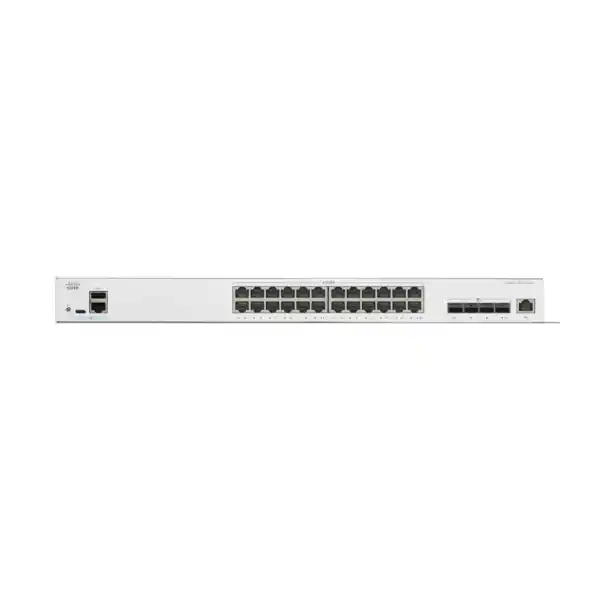
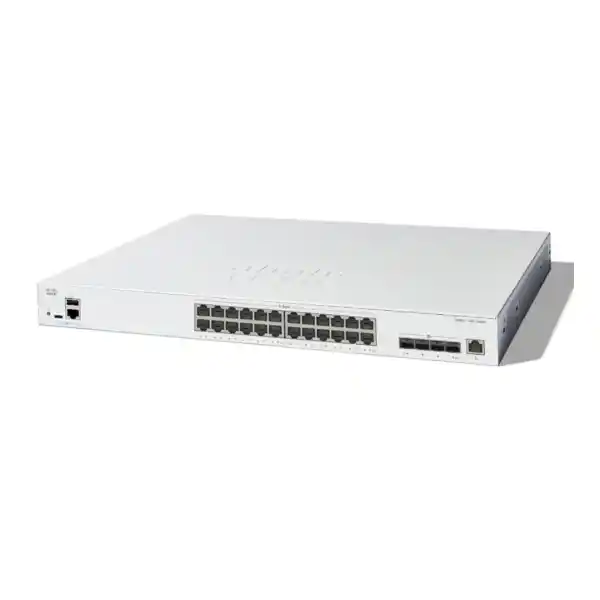
The Cisco Catalyst C1300-24XT is a compact 1RU managed Layer 3 switch built for organizations that need a large number of native 10 Gigabit Ethernet connections without moving immediately to a larger enterprise campus chassis. Its port map is optimized for copper-heavy server rooms, high-performance workgroups, storage traffic, aggregation, virtualization hosts, content-production systems, fast NAS platforms, and mixed copper/fiber environments. Twenty dedicated 10GBASE-T ports are complemented by four combo positions that can operate as 10G copper or 10G SFP+, giving architects flexibility to connect nearby rack devices over copper while reserving fiber for backbone, building, or stack interconnects.
Direct answer
Choose the C1300-24XT when your design requires up to 24 active 10G links in a single rack unit, prefers 10GBASE-T for most endpoints, and still needs SFP+ flexibility on four combo interfaces.
It is not a PoE access switch and it is not a C1300X model. For this SKU, the design emphasis is high-density 10G connectivity, Layer 2/Layer 3 control, security, QoS, monitoring, and stackable operation.
C1300-24XT at a glance
What makes the Cisco Catalyst C1300-24XT different?
Many fixed switches aimed at small and medium-sized environments combine one-gigabit access ports with a small number of faster uplinks. The C1300-24XT takes a different approach. Its front panel is essentially a dense 10 Gigabit Ethernet fabric. That matters when the attached devices themselves are already capable of saturating or materially exceeding one gigabit per second. Examples include virtualization hosts with multiple virtual machines, high-speed backup targets, media-editing workstations, NAS appliances with 10G interfaces, database servers, replication nodes, local private-cloud infrastructure, edge compute appliances, security platforms, and aggregation links from downstream access switching.
The practical port map must be read correctly. There are twenty dedicated 10G copper ports. Four additional physical positions are combo interfaces: each combo position provides a 10G copper connection and an SFP+ interface that represent the same logical port. You select copper or fiber on that position rather than using both simultaneously. Therefore, the design provides twenty-four active 10G system ports, not twenty-eight concurrent data ports. This is an important planning point for bills of materials, rack elevations, patching schedules, and uplink counts.
A separate Gigabit Ethernet out-of-band management interface lets administrators keep management traffic distinct from production forwarding. In disciplined server-room and branch designs, this interface can connect to a dedicated management network, secure jump-host segment, or operations switch. Keeping management reachable through a controlled path can improve troubleshooting and reduce the operational dependence on the data-plane VLAN configuration during maintenance events.
Verified hardware architecture and performance
| Specification | C1300-24XT | Design relevance |
|---|---|---|
| 10G data ports | 20 × dedicated 10G copper + 4 × 10G copper/SFP+ combo | Dense 10GBASE-T access with four fiber-capable positions. |
| Management | 1 × GE out-of-band management port | Dedicated operations path independent of user traffic. |
| Switching capacity | 480 Gbps | Matches full-duplex line-rate arithmetic for 24 active 10G ports. |
| Forwarding rate | 357.14 Mpps | Supports wire-speed forwarding under small-packet conditions. |
| Processor | ARM dual-core, 1.5 GHz | Runs management and control-plane services. |
| Memory / flash | 1 GB DDR4 / 1 GB SLC flash | Supports the switch operating environment, images, configuration, and control functions. |
| Packet buffer | 8 MB aggregate, dynamically shared | Important for temporary microbursts and mixed traffic patterns. |
| Jumbo frame support | Up to 9000 bytes | Useful where servers, storage, hypervisors, and end-to-end path design support larger MTUs. |
The 480 Gbps capacity is especially meaningful because it corresponds to twenty-four 10G interfaces operating in full duplex: 24 × 10 Gbps × two directions equals 480 Gbps of switching bandwidth. In other words, the published capacity aligns with the basic requirement for a nonblocking 24-port 10G fabric. The 357.14 Mpps figure represents forwarding performance at 64-byte packet sizes, which are much more demanding on packet-processing rates than large frames. When evaluating a switch for storage or server workloads, it is useful to consider both bandwidth and packet-rate behavior rather than relying on a single headline number.
10GBASE-T design: when copper is the right choice
The C1300-24XT is particularly attractive when servers and endpoints already expose RJ-45 10GBASE-T interfaces. Copper can simplify moves, adds, and changes because many engineers and support teams are familiar with twisted-pair patching and RJ-45 troubleshooting. In a single equipment room, short Cat6A patch runs can be operationally straightforward. Copper ports also provide an easy path for systems whose network interface cards do not accept pluggable optical transceivers.
For new 10GBASE-T structured cabling in the UAE, Cat6A is normally the safer design basis. The reason is not branding preference; it is engineering margin. Ten-gigabit signaling places higher demands on insertion loss, return loss, alien crosstalk, patching quality, and channel construction than one-gigabit Ethernet. Existing Cat6 may support 10G over shorter qualified channels, but a production deployment should be validated against the actual channel length, patch-panel components, environmental conditions, and certification results rather than assuming every installed Cat6 link will behave identically.
Copper also has a power and thermal profile that differs from optical links. A high-density 10GBASE-T switch therefore deserves proper rack airflow, unobstructed ventilation, and sensible cable management. The C1300-24XT uses an active fan, and Cisco lists the acoustic level at 25°C as 28.7 dBA. It is quiet for a performance-oriented rack switch, but it should still be treated as infrastructure equipment rather than a silent desktop device.
A practical design pattern is to use copper for nearby servers and appliances while assigning the four combo positions to SFP+ optics or DAC/AOC connectivity where fiber reach, electrical isolation, smaller cable diameter, or backbone integration is more important. Because each combo pair is one logical port, the port schedule should clearly identify which medium is planned for each of the four positions.
SFP+ options and fiber uplink strategy
The four combo interfaces let the C1300-24XT participate in fiber-based designs without sacrificing the copper density that defines the model. Cisco lists 10G SFP+ options that cover short-reach multimode, long-reach single-mode, extended-reach optics, bidirectional modules, direct-attach copper, and active optical cables. Examples include SFP-10G-SR for multimode links, SFP-10G-LR for single-mode links up to 10 km, SFP-10G-ER variants for longer single-mode spans, and several SFP-H10GB direct-attach copper cable lengths for short rack or adjacent-rack connections.
Selection should be made from Cisco’s compatibility information for the target firmware and deployment rather than treating all physically compatible SFP+ modules as functionally identical. Fiber type, connector cleanliness, patch-panel loss, wavelength, link distance, and optical power budget should be validated together. For a same-room uplink, SR over OM3/OM4 or a supported DAC/AOC can minimize cost and complexity. For building-to-building or campus links, single-mode LR may provide more design margin and future flexibility.
The combo architecture is useful for phased migrations. A rack can begin with copper on all twenty-four logical data interfaces, then move selected backbone positions to SFP+ as fiber becomes available. Alternatively, two or more fiber positions can be reserved for redundant uplinks or stack interconnects while copper serves the high-throughput devices inside the rack.
Layer 2 switching for segmented business networks
The C1300-24XT is not limited to basic unmanaged forwarding. It supports the switching controls expected in a carefully segmented business environment. VLAN capabilities include port-based and 802.1Q tagged VLANs, MAC-based VLANs, protocol-based VLANs, IP-subnet-based VLANs, management VLANs, private VLAN constructs, guest and unauthenticated VLANs, and dynamic VLAN assignment through RADIUS with 802.1X authentication. The platform supports up to 4094 VLAN identifiers, with Cisco reserving the upper range 4078 through 4094 for internal use.
Spanning Tree support includes classic IEEE 802.1D, Rapid Spanning Tree, Multiple Spanning Tree, PVST+, and Rapid PVST+. This flexibility helps the switch integrate with both standards-based and Cisco-oriented Layer 2 designs. Rapid convergence matters when redundant uplinks are used, because the network must prevent loops while still restoring forwarding quickly after a topology change. Multiple Spanning Tree can reduce protocol overhead in larger segmented networks by mapping multiple VLANs to a controlled number of spanning-tree instances.
Link aggregation uses IEEE 802.3ad LACP. Cisco specifies up to eight groups with up to eight active ports per group and additional candidate ports for dynamic 802.3ad aggregation. On a 10G switch, LAGs can build 20G, 40G, or higher logical paths when the peer device and traffic hashing pattern support that architecture. Aggregation can increase total capacity and resilience, but it does not make a single flow exceed the speed of one member link; per-flow hashing still matters.
Multicast functions include IGMP snooping versions 1, 2, and 3, IGMP querier, IGMP proxy, and Multicast VLAN Registration. On C1300 10G SKUs, Cisco lists support for up to 4000 multicast groups. These features can be relevant to surveillance viewing, IPTV-style distribution, market-data feeds, imaging systems, or any application where efficient one-to-many delivery must be constrained to interested receivers rather than flooded across a VLAN.
Layer 3 routing: powerful, but know the model boundary
The C1300 family provides wire-speed IPv4 and IPv6 routing, making the switch capable of handling inter-VLAN traffic locally rather than forcing every internal flow through a separate router or firewall. On the 10 Gigabit C1300 SKUs, Cisco specifies up to 7,168 combined dynamic and static IPv4 routes and up to 256 IP interfaces. Layer 3 interfaces can be built on physical ports, LAGs, VLAN interfaces, or loopback interfaces. The platform also supports Classless Interdomain Routing, RIP version 2, policy-based routing, DHCP server functions, Layer 3 DHCP relay, and UDP relay.
This can materially improve east-west traffic handling in a server room. For example, a virtualization VLAN, backup VLAN, management VLAN, and application VLAN can be routed at the switch when the security policy permits it. The upstream firewall can remain responsible for WAN connectivity, Internet security, remote-access VPNs, advanced inspection, and traffic that must traverse security zones. This division of work prevents unnecessary hairpinning while preserving control over where security enforcement belongs.
Important: OSPF v2/v3 is a C1300X capability in Cisco’s current datasheet. The C1300-24XT is a C1300, not a C1300X, so a design that specifically requires OSPF should not assume that protocol is available on this SKU. RIP v2 and policy-based routing remain available routing tools, while static routes and Layer 3 interfaces cover many branch and SMB segmentation needs.
This distinction is useful during procurement because model names can look similar. A requirement sheet should state the routing protocol requirement explicitly instead of simply saying “Layer 3 switch.” Layer 3 can mean very different things: static routing only, basic dynamic routing, policy-based routing, or full interior-gateway protocol support. Matching the protocol requirement to the exact SKU avoids redesign after purchase.
Security controls at the access and aggregation layer
A high-speed switch should not be treated as a transparent pipe with no security role. The C1300-24XT includes controls that can reduce the attack surface inside the local network and strengthen trust boundaries between connected systems. IEEE 802.1X supports RADIUS authentication and accounting, dynamic VLAN assignment, guest and unauthenticated VLAN handling, and MAC authentication. The switch can also operate as an 802.1X supplicant when it is itself connecting into an authenticated upstream environment.
DHCP snooping helps identify trusted and untrusted DHCP sources, which reduces the risk of rogue DHCP services taking over client configuration. IP Source Guard uses bindings to filter traffic with invalid source information, and Dynamic ARP Inspection checks ARP messages against expected IP/MAC relationships. Used together, these functions can limit spoofing and man-in-the-middle behavior in networks where endpoint identity and address assignment are controlled.
Port security can lock or limit source MAC addresses learned on an interface. Private VLANs and Private VLAN Edge can isolate attached systems even when they share a broader Layer 2 context. Storm control can limit broadcast, multicast, and unknown-unicast storms before they consume excessive bandwidth. BPDU Guard, Root Guard, and loopback protections add safeguards against accidental or malicious Layer 2 topology changes.
For management, SSH and HTTPS provide encrypted administrative channels, and RADIUS or TACACS+ can centralize administrator authentication. The platform supports multiple privilege levels in the CLI. Cisco also describes Secure Core Technology for protecting management and protocol processing under heavy traffic, Secure Sensitive Data for handling credentials and keys, and runtime defenses associated with its trustworthy-systems architecture.
Access Control Lists are substantial for this class of device. Cisco lists up to 2048 ACL rules for C1300 10G SKUs. Matching criteria can include MAC addresses, VLAN IDs, IPv4/IPv6 addresses, protocol identifiers, TCP/UDP ports, DSCP, IP precedence, Ethernet type, ICMP, IGMP, and TCP flags. ACLs can be applied on ingress and egress, and time-based ACLs are supported. This gives administrators a practical policy tool for restricting server-management access, separating tenant or department traffic, controlling service ports, and limiting lateral movement.
Quality of Service for storage, voice, video, and critical applications
The C1300-24XT provides eight hardware queues, strict-priority and Weighted Round-Robin scheduling, and classification based on port, 802.1p priority, IPv4/IPv6 precedence, ToS, DSCP, DiffServ, and ACL criteria. Rate controls include ingress policing, egress shaping, per-VLAN and per-port controls, flow-based controls, and dual-rate three-color policing. Cisco also includes iSCSI traffic optimization so storage flows can receive priority treatment relative to less critical traffic.
QoS should be designed end to end. Marking traffic on the switch is useful only when upstream switches, routers, firewalls, wireless systems, and endpoints either trust or intentionally remark those values. A common mistake is to enable strict priority broadly and then unintentionally starve best-effort traffic. A more disciplined policy identifies a small set of truly latency-sensitive or loss-sensitive applications, assigns predictable DSCP/CoS behavior, and uses shaping or policing to keep large backup, replication, and bulk-transfer jobs from monopolizing oversubscribed uplinks.
Because the C1300-24XT offers 10G on every active data port, local congestion is often less about access-port speed and more about where traffic converges: a storage target, upstream firewall, WAN router, inter-building link, or a limited number of server NICs. The eight queues and flow controls help manage these contention points, but the architecture should first remove avoidable oversubscription where practical.
Hardware stacking and scale-out design
Cisco supports hardware stacking on the C1300-24XT as part of the C1300 Family 2 stack group. The current C1300/X data sheet states that up to eight switches can operate in a stack and that the stack provides unified management and control. Active/standby stack control, auto-numbering, hot-swap behavior, ring and chain topologies, LAG across stack members, and fast failover features are designed to reduce operational complexity as port counts expand.
The family boundary matters. Cisco groups C1300-12XT-2X, C1300-12XS, C1300-16XTS, C1300-24XS, C1300-24XT, and C1300-24XTS together for stacking. Product IDs from the same family can stack together; cross-family stacking is not supported. Therefore, a future expansion plan should consider which switch models are likely to be added later. A stack design is not merely a physical cabling choice; it is also an SKU compatibility decision.
Stack interconnects use front-panel high-speed 10G fiber interfaces in the C1300 design. This means stack topology consumes interfaces that might otherwise be available for data uplinks. The port plan must reserve those positions and calculate remaining usable ports accordingly. For resilience, a ring topology is generally preferable to a simple chain because it maintains an alternate path if one stack link fails, provided the physical design follows supported Cisco guidance.
A stack can be valuable when administrators want one logical management domain and the ability to create link aggregation across different physical units. It can also simplify growth from 24 to 48, 72, or more 10G interfaces. However, a pair of independent switches connected through routing or MLAG-like designs on other platforms may sometimes be preferable when operational or fault-domain requirements demand stricter physical independence. FourTeck can review these tradeoffs before the rack layout and bill of materials are finalized.
Management, visibility, and troubleshooting
The Catalyst 1300 software environment is designed to offer both graphical and CLI-based operations. Administrators can use a browser-based interface, full or menu-style CLI, HTTPS, SSH, SNMP-related monitoring, RMON, syslog, ping, traceroute, cable diagnostics, and other standard management functions. Firmware can be upgraded through the web interface, TFTP, or SCP, and dual software images provide additional resilience during image management.
For packet-level troubleshooting, the switch supports local port mirroring, VLAN mirroring, flow-based redirection and mirroring, and RSPAN. Cisco specifies that up to eight source ports can be mirrored to a destination port and up to eight source VLANs can be mirrored. RSPAN extends visibility across a Layer 2 domain so an analyzer does not always need to be physically connected to the switch where the interesting traffic enters.
sFlow can export traffic samples to an external collector, giving operations teams flow-level visibility without capturing every packet. In a 10G environment, this is important because full packet capture at aggregate line rates can require specialized monitoring hardware and large storage capacity. Flow sampling can answer practical questions such as which servers are producing the most traffic, which protocols dominate an uplink, or whether a backup job is responsible for a sudden utilization increase.
Cisco Discovery Protocol and LLDP/LLDP-MED help identify neighboring infrastructure and endpoints. Smartports and Auto Smartports can apply predefined QoS and security roles based on discovered device types. These features are useful during standardized deployments, but automated role assignment should be reviewed so that operational convenience does not override intentional security policy.
Physical design, power, acoustics, and environmental planning
The C1300-24XT chassis measures approximately 444.3 mm wide, 286 mm deep, and 43.94 mm high, corresponding to a standard 1RU rack form factor. Unit weight is about 4.29 kg. The internal universal power supply accepts 100 to 240 VAC at 50 to 60 Hz, which suits standard UAE data-room electrical environments when the correct power cord, PDU outlet, and protective infrastructure are provided.
Cisco lists worst-case system power consumption at approximately 87.3 W on 110 V and 88 W on 220 V, with idle figures of about 36.5 W and 37.8 W respectively. Heat dissipation is specified at roughly 341.21 BTU/hr. These figures matter when multiple 10G switches are installed in a small rack or communications room. The power requirement may look modest compared with a PoE switch, but accumulated switch, firewall, server, storage, and UPS heat must still be considered in cooling calculations.
The published operating temperature range is -5°C to 50°C, with cold start at 0°C. Storage temperature extends from -25°C to 70°C, and operating humidity is 10% to 90% relative, noncondensing. In UAE deployments, the upper temperature specification should never be interpreted as a reason to run communications rooms hot. Maintaining controlled cooling, clean airflow, low dust ingress, and sensible cable routing improves system reliability and leaves thermal margin for cooling faults or maintenance periods.
The C1300-24XT includes one fan and is listed at 28.7 dBA at 25°C, with an MTBF figure of 945,878 hours at 25°C. MTBF is a statistical reliability indicator, not a promise that an individual unit will operate for that many hours. Operational continuity still depends on power quality, cooling, firmware management, configuration backups, spare strategy, and network redundancy.
Six deployment patterns that fit the C1300-24XT
1. Virtualization host access
Connect multiple hypervisors over 10GBASE-T, use VLAN trunks for virtual networks, apply LACP where servers have multiple NICs, and route selected infrastructure VLANs locally when policy permits. This is suitable for SMB private-cloud clusters that have outgrown 1G server access.
2. Backup and NAS fabric
Use dedicated 10G links for backup servers, NAS targets, replication nodes, and high-throughput workstation access. Jumbo frames and iSCSI optimization can be evaluated when the complete path supports the chosen MTU and storage design.
3. Small data-room aggregation
Aggregate several downstream switches or security appliances using 10G copper or SFP+ links. LACP, VLAN trunking, STP, ACLs, and Layer 3 routing provide the controls needed to build a compact distribution layer without a chassis platform.
4. Media and production workgroup
Editors, render nodes, shared storage, and ingest systems can consume multi-gigabit flows that quickly overwhelm a 1G network. Twenty-four active 10G positions provide significantly more headroom for parallel content workflows.
5. High-speed security zone
Use the switch to interconnect firewalls, inspection appliances, servers, and routed VLANs at 10G. ACLs, private VLANs, DHCP security, port security, and authenticated administration help reduce unnecessary trust inside the zone.
6. Stacked 10G access block
Scale beyond one chassis by stacking compatible Family 2 C1300 models. Cross-stack LAG can improve uplink resiliency, while unified stack management reduces the number of individually operated switch nodes.
Server and storage sizing methodology
Selecting a 10G switch should begin with traffic profiles rather than port count alone. First identify the number of physical interfaces that must connect on day one, then add a realistic expansion allowance. A server with two 10G NICs may require two switch ports for redundancy or LACP. A firewall cluster may consume four or more 10G interfaces across inside, outside, HA, and specialized zones. A storage array can expose multiple active controllers and front-end ports. When these requirements are mapped explicitly, a “24-port switch” can become fully allocated faster than expected.
Second, separate north-south and east-west traffic. North-south traffic moves toward WAN, Internet, or external services and may be bounded by a firewall or provider circuit. East-west traffic moves between local servers, storage, hypervisors, and internal services. The C1300-24XT is particularly valuable when east-west demand is high because local 10G switching and routing can prevent the internal fabric from being constrained by 1G links.
Third, review oversubscription. If twenty servers each have 10G access but all traffic ultimately converges on one 10G uplink, aggregate application performance will be limited by that bottleneck. Multiple uplinks with LACP can increase aggregate throughput, but traffic distribution depends on hashing. For predictable high-volume flows, consider the number of simultaneous conversations, their source and destination diversity, and whether the peer device can support the same LAG design.
Fourth, calculate failure behavior. If a switch fails, which services stop? If a stack member fails, do servers have links to another member? If an uplink fails, is there a second physical path? Are routing adjacencies, spanning tree, or LACP configured to reconverge cleanly? High port speed does not equal high availability. Redundancy is an architectural property created by independent paths, power sources, devices, and validated failover behavior.
Finally, reserve monitoring and management capacity. Packet captures, SPAN destinations, out-of-band management, backup configuration, syslog, NTP, AAA, and flow monitoring should be included in the implementation plan rather than added after an incident. A switch that is instrumented from day one is much easier to operate under pressure.
C1300-24XT for virtualization clusters
Virtualized environments combine many logical workloads behind a relatively small number of physical NICs. A single host can carry production virtual-machine traffic, management, live migration, backup, replication, storage, and cluster heartbeat flows. At one gigabit, these functions compete aggressively. Ten-gigabit access provides substantially more headroom and lets administrators separate logical functions with VLANs while maintaining high aggregate throughput.
The C1300-24XT can trunk multiple VLANs to each host and use LACP when supported by the hypervisor and server NIC teaming mode. However, LACP should be aligned with the virtualization platform’s supported teaming model. Some hypervisors distribute virtual interfaces or flows in ways that do not benefit equally from every hash algorithm. The network design should therefore include both switch configuration and hypervisor configuration as one combined system.
For live migration and backup traffic, QoS can prevent bulk transfers from affecting latency-sensitive application traffic. If storage uses iSCSI, Cisco’s iSCSI optimization feature can be evaluated alongside end-to-end MTU design. Jumbo frames should be enabled only when every device along the complete path supports the same effective MTU. A mismatch can create difficult-to-diagnose fragmentation or black-hole behavior.
A separate management VLAN, protected with ACLs and accessible only from administrative networks, is strongly preferable to exposing hypervisor and switch management broadly. The dedicated GE out-of-band management interface can further separate switch administration from production traffic, especially where an independent management switch or console network is available.
C1300-24XT for backup, replication, and NAS
Backup windows are one of the clearest reasons to move a server room from 1G to 10G. A theoretical one-gigabit link carries 125 MB/s before protocol overhead, while a 10G link raises the theoretical line rate to 1.25 GB/s. Real application throughput is lower than raw line rate, but the order-of-magnitude increase can materially reduce backup and restore time when the storage system, server disks, CPU, and backup software can keep pace.
The network should still be sized for concurrency. If ten backup clients transfer to one NAS target, the target interfaces and storage media become the bottleneck. Multiple 10G links on the storage system, LACP where appropriate, or distributed storage targets may be needed to exploit the switch fabric. The C1300-24XT’s 480 Gbps nonblocking capacity ensures the internal switch does not introduce a lower aggregate ceiling than its port map implies.
Replication traffic often crosses a firewall, WAN, or inter-building fiber link. In that case, the local 10G port simply ensures the endpoint is not restricted before traffic reaches the slower external segment. Rate limiting and QoS can then control how aggressively replication uses the constrained link. sFlow and port counters can help validate whether tuning is effective.
For NAS traffic serving creative teams, engineering groups, or large datasets, 10G copper is operationally convenient because workstations can connect through standard RJ-45 network adapters and Cat6A infrastructure. The four SFP+ combo positions can be used for fiber uplinks to another room or to connect storage that exposes optical interfaces.
Firewall integration and routed segmentation
The C1300-24XT can sit directly behind a next-generation firewall and provide high-speed VLAN aggregation for internal networks. The design question is where each inter-VLAN flow should be routed. Traffic that requires inspection, application control, threat prevention, user-based policy, or zone-to-zone firewall enforcement should traverse the firewall. Traffic that is trusted, high-volume, and purely internal may be routed on the switch when policy allows.
This hybrid approach is often more scalable than forcing every server-to-server packet through the security appliance. For example, a backup VLAN and storage VLAN might communicate through Layer 3 switching with ACL restrictions, while user-to-server traffic remains firewall-inspected. The exact boundary should be defined by risk and compliance requirements rather than performance alone.
When integrating with a firewall, use explicit VLAN documentation, consistent trunk/native VLAN policy, and LACP only when both sides support the intended mode. Avoid ambiguous untagged networks across infrastructure links. Configure switch management so it is reachable only from approved administrative sources, and send logs to centralized monitoring where available.
FourTeck can combine the switch with firewall architecture through the Firewall Dubai practice, helping UAE organizations align routing, security zones, uplink capacity, and switch segmentation rather than treating each device as an isolated purchase.
Choosing between C1300-24XT, fiber-heavy models, and C1300X
The C1300-24XT is best when the majority of 10G endpoints are copper. If the deployment is predominantly optical, a fiber-heavy model such as the C1300-24XS may be operationally cleaner because it provides twenty dedicated 10G SFP+ ports and four copper/SFP+ combo positions. If the environment is mixed evenly between copper and fiber, the C1300-24XTS provides twelve 10G copper and twelve 10G SFP+ interfaces. Matching the front-panel media mix to the actual rack avoids buying unnecessary external media conversion or consuming combo ports inefficiently.
C1300X adds capabilities and models aimed at different scaling requirements. The most important routing distinction for many engineers is OSPF support, which Cisco lists for C1300X rather than C1300. C1300X models also introduce SFP28 on several SKUs, with 25G available for stacking in supported designs. If OSPF, higher stack bandwidth, 25G stack connectivity, or newer multigigabit access profiles are mandatory, the requirement should be evaluated against C1300X instead of assuming the C1300-24XT is interchangeable.
Conversely, if the network simply needs high-density 10GBASE-T, VLANs, ACLs, QoS, RIP v2 or static routing, policy-based routing, hardware stacking, and strong management features, the C1300-24XT can be a very direct fit. Paying for an architecture that solves requirements you do not have can add cost and complexity without improving the application.
FourTeck’s role is to translate port counts, media, routing protocols, security policies, and future expansion into an exact SKU recommendation. The wider FourTeck UAE portfolio can also support adjacent switching, wireless, infrastructure, and integration requirements.
Operational hardening checklist
Identity and administration
Use HTTPS and SSH, centralize administrator authentication with RADIUS or TACACS+ where practical, disable unused services, set privilege levels deliberately, restrict management-source networks with ACLs, and preserve emergency local access credentials securely.
Layer 2 protection
Enable BPDU Guard on edge ports where appropriate, use Root Guard intentionally, implement storm control, disable unused ports, place unused interfaces in an isolated VLAN, and apply port security or 802.1X according to endpoint identity requirements.
Address integrity
Use DHCP snooping, Dynamic ARP Inspection, and IP Source Guard where the address-assignment model supports them. Define trusted DHCP interfaces carefully so legitimate infrastructure remains reachable while rogue DHCP responses are blocked.
Logging and time
Configure NTP or SNTP, remote syslog, meaningful hostnames, interface descriptions, and monitoring. Accurate time is essential for correlating switch events with firewall, server, authentication, and application logs during investigations.
Configuration resilience
Keep versioned backups of running and startup configurations, document firmware versions, use dual images carefully during upgrades, and maintain a rollback procedure. Test configuration restore rather than assuming backup files are usable.
Physical controls
Secure the rack, label copper and fiber clearly, protect fiber bend radius, keep airflow open, provide clean UPS-backed power, and prevent unauthorized console access. Physical access can bypass many logical protections.
UAE rack and cabling considerations
Dubai and UAE deployments range from climate-controlled enterprise data rooms to compact branch closets. The C1300-24XT should be installed in a rack environment that supports its depth, cable bend radius, fan airflow, power connection, and service access. A 1RU switch may appear physically simple, but dense 10G copper patching can create significant cable bulk. Horizontal and vertical cable managers should keep RJ-45 bundles from blocking the front panel or placing strain on connectors.
For 10GBASE-T, certify channels with suitable test equipment and document results. Patch cords should match the category and shielding design of the structured cabling system. In electrically noisy environments, grounding and bonding practices matter. Fiber uplinks should use clean connectors and documented optical budgets. Dust caps should remain in place until a transceiver or patch cord is installed.
Power design should include the switch’s approximately 88 W worst-case system draw at 220 V plus headroom for associated devices. If the switch is part of a critical server environment, feed it from a UPS-backed PDU and document which devices share the same UPS. A stack with several switches can still represent a single power fault domain if all members connect to one upstream breaker or UPS, so electrical redundancy should be assessed separately from network redundancy.
FourTeck’s IT Services UAE team can assist with rack planning, structured cabling coordination, switch commissioning, VLAN implementation, monitoring, migration windows, and post-deployment validation for organizations that need engineering support beyond hardware supply.
Integration with servers and data-room infrastructure
A 10G switch is most valuable when the connected compute and storage systems are designed to use it. Server NICs should support the desired 10GBASE-T or SFP+ media, operating-system drivers should be current, and NIC offload features should be validated for the application. Where servers use bonding or teaming, switch LACP configuration must match the host-side mode. Storage multipathing should be designed according to the storage vendor’s architecture rather than substituted with generic Ethernet teaming.
Rack placement should consider server-to-switch cable length. Short, well-managed copper patching minimizes bulk and simplifies tracing. Fiber can be preferable between racks or where electrical isolation is desired. For very short SFP+ connections, supported DAC cables can avoid separate optical transceivers and fiber patch cords. Active optical cables provide another compact option at longer in-room distances.
Server administrators and network engineers should agree on VLAN IDs, trunking, native VLAN behavior, MTU, LACP mode, DNS/NTP dependencies, management addressing, and failover testing before the maintenance window. Many “switch problems” during migrations are actually mismatches between host and network assumptions.
For projects that include new compute platforms, FourTeck can align the switching design with the Server Dubai infrastructure portfolio so server NIC counts, storage interfaces, transceiver media, rack layout, and uplink bandwidth are sized as one integrated system.
Firmware lifecycle and change management
Switch firmware should be managed as part of the infrastructure lifecycle, not only when a fault appears. Before an upgrade, review the Cisco release notes for the exact firmware train, confirm the supported upgrade path, back up the configuration, verify available image space, and record a rollback procedure. Dual-image support adds resilience, but it does not replace a tested change plan.
In a stacked environment, firmware consistency is especially important. Stack members should run a supported common software version and the maintenance plan should account for stack-wide behavior. Validate the impact on connected LAGs, routing, authentication, and management systems. After the change, confirm not only that ports are up but that VLANs, routes, ACL counters, AAA, monitoring, syslog, and application flows behave as expected.
Configuration changes should be documented and reviewed. Interface descriptions should identify the connected device and purpose. VLAN names should be meaningful. Static routes should include ownership and justification. ACLs should use clear rule ordering and avoid broad temporary permits that become permanent. Stale configuration increases troubleshooting time and security risk.
For organizations with formal IT service management, switch changes can be linked to tickets, approved windows, pre-change tests, success criteria, rollback triggers, and post-change evidence. This approach is particularly valuable when the C1300-24XT carries storage, server, or aggregation traffic because the business impact of an incorrect change can be immediate.
Capacity planning beyond the headline 10G number
Ten-gigabit Ethernet is a link rate, not an application guarantee. Real throughput depends on frame size, protocol overhead, TCP windowing, storage speed, CPU capability, NIC offloads, application behavior, packet loss, retransmissions, and the slowest segment in the path. A server with a 10G NIC connected to the C1300-24XT may still transfer at much lower rates if its disk subsystem can only read at a few hundred megabytes per second.
Latency and packet rate can matter as much as bulk bandwidth. Small-packet workloads stress forwarding capacity differently from large sequential transfers. The published 357.14 Mpps forwarding rate indicates the switch is designed for wire-speed behavior even with minimum-size packets across its 24 active 10G ports. The 8 MB dynamically shared buffer can absorb short bursts, but no finite buffer can compensate indefinitely for sustained oversubscription.
For backup, media, and storage environments, measure actual traffic over representative business periods. sFlow, interface counters, server telemetry, and storage metrics can identify peak rates and queue behavior. Size uplinks and storage targets based on concurrent demand rather than the maximum speed of one client. If multiple 10G clients converge on a single 10G destination, application throughput will be shared no matter how fast the access switch is.
The most effective capacity plan therefore combines port-speed headroom with topology awareness. The C1300-24XT solves the access-fabric portion of the problem very well when many systems need 10G. The surrounding firewall, router, storage, server, and WAN design must be sized to preserve that performance where the application needs it.
High availability design with the C1300-24XT
Hardware stacking can reduce management complexity and provide fast stack failover, but high availability begins with the workload connection model. A server with two NICs connected to two different stack members can retain physical connectivity if one member fails, provided the host teaming mode and switch configuration support the intended cross-stack LAG behavior. A server with both NICs connected to the same physical switch cannot gain protection from failure of that member merely because other members exist in the stack.
Uplinks should also be distributed across members when practical. LAG across stack units can keep aggregate uplink service available during a member failure. For routed uplinks, the exact design depends on the supported protocol and upstream architecture. Remember that OSPF is not a C1300-24XT feature; if OSPF-based convergence is a hard requirement, evaluate C1300X or a different switching platform.
Power redundancy requires a separate strategy because the C1300-24XT has an internal power supply rather than dual hot-swappable supplies. Multiple switches can be fed from separate UPS-backed power paths where the facility supports that approach, and critical servers can be dual-homed across different switches. This produces device-level resilience even though each individual switch has one power input.
Test failover under controlled conditions. Disconnect one uplink, remove one stack link, disable one server NIC, and simulate a switch member failure during an approved window. Record reconvergence times and application impact. Redundancy that has never been tested is an assumption, not an operational capability.
What the C1300-24XT does not provide
A precise product page should state limitations as clearly as strengths. The C1300-24XT does not provide PoE on its 10G ports, so it is not intended as a power source for access points, phones, cameras, or other PoE endpoints. Those devices require separate PoE switching or power injectors. It also does not provide twenty-four independent copper ports plus four additional independent SFP+ ports. The four copper/SFP+ positions are combo ports, so only one medium in each combo pair is active.
The model is a C1300, not C1300X. Cisco reserves OSPF support for C1300X SKUs in the current data sheet. If your routing design depends on OSPF v2 or v3, do not purchase this model based solely on the generic phrase “Layer 3 switch.” It supports substantial Layer 3 functionality, including wire-speed IPv4/IPv6 routing, RIP v2, policy-based routing, static routing, DHCP server and relay functions, but OSPF is outside this SKU’s listed feature set.
The chassis also has a single internal power supply rather than dual field-replaceable supplies. Resilience therefore comes from network architecture, multiple switches, diverse links, UPS design, and spare strategy rather than PSU redundancy inside one chassis. These boundaries are not weaknesses when the product is matched to the right requirement; they are simply design facts that should be included in procurement.
Procurement and bill-of-material planning in the UAE
The switch SKU alone may not complete the project. A production bill of materials can include rack mounting hardware, compatible power cord, UPS/PDU capacity, Cat6A patch cords, patch panels, SFP+ transceivers, DAC or AOC cables, fiber jumpers, cable managers, labeling materials, and spare optics. If stacking is planned, reserve the required front-panel interfaces and include supported stack interconnect media.
For fiber, specify the exact link type and distance rather than writing “10G SFP.” SR, LR, ER, BiDi, DAC, and AOC options solve different physical problems. For copper, document whether the installed channel is certified for 10G at the required distance. If the project reuses old cabling, budget for testing and remediation before the migration window.
Licensing and support requirements should be confirmed at quotation time against Cisco’s current commercial policies. Product lifecycle, firmware eligibility, support entitlements, and replacement process can change over time. Cisco currently lists a limited lifetime warranty with return-to-factory replacement for Catalyst 1300/X and complimentary one-year access to the Small Business Support Center, but a procurement team should still verify the exact regional terms applicable to its order and contract.
FourTeck can prepare a quotation that separates the base switch from optional optics, cabling, implementation, rack services, and support so buyers can see exactly what is included. This avoids a common problem in 10G projects: the switch arrives, but the correct optics, fiber type, or Cat6A patching is missing.
For broader sourcing and project coordination outside the UAE, the FourTeck global site can support organizations managing multi-country infrastructure standards.
Migration from 1G to 10G: a practical sequence
A successful migration begins with discovery. Record every existing switch port, VLAN, trunk, LAG, route, ACL, spanning-tree role, management address, DHCP relay, monitoring target, and connected device. Capture interface utilization over several business cycles. Identify which endpoints truly need 10G and which can remain on existing one-gigabit access switching.
Next, validate media. Check server NIC type, copper category, fiber type, transceiver compatibility, connector type, and distance. For each C1300-24XT combo position, state whether the port will operate as copper or SFP+. Build a rack elevation and patch schedule before installation so the migration does not depend on improvised cabling.
Preconfigure the new switch using a documented template. Set hostname, management addressing, AAA, NTP, syslog, SNMP or telemetry settings, VLANs, trunks, LAGs, routing, ACLs, QoS, and security controls. Where possible, test the switch in a staging environment with representative endpoints. Confirm firmware and save a verified configuration backup.
During the change window, move low-risk links first, then uplinks and critical services according to a dependency plan. Validate each stage with ping, routing tables, ARP/MAC tables, application tests, and performance measurements. If a problem appears, distinguish physical link, VLAN tagging, routing, ACL, LACP, DNS, and application issues systematically instead of changing multiple variables at once.
After migration, monitor errors, discards, utilization, temperature, logs, and application performance. Remove abandoned legacy configuration only after stability is confirmed. Update diagrams and the asset register so future troubleshooting starts from accurate documentation.
Troubleshooting 10G copper links
If a 10GBASE-T link fails to come up or negotiates unexpectedly, begin at the physical layer. Verify both endpoints support 10GBASE-T, confirm the cable category and channel length, reseat connectors, replace the patch cord with a known-good certified cable, and inspect patch-panel termination. Use the switch’s cable diagnostics where appropriate. High-speed copper is less forgiving of marginal cabling than one-gigabit Ethernet.
Next, check administrative state, speed/duplex settings, error counters, and port configuration. Avoid forcing settings without understanding the peer behavior. Review whether the interface is part of a LAG and whether LACP parameters match. If the physical link is up but traffic fails, inspect VLAN membership, tagging, native VLAN configuration, MAC address learning, spanning-tree state, and ACL counters.
Performance complaints require a different method. Confirm end-host disk and CPU capability, test with a controlled tool such as iperf between capable systems, measure packet loss and retransmission, and inspect switch interface counters for errors or congestion. A slow file transfer does not automatically prove a switch issue; storage, SMB/NFS settings, antivirus inspection, TCP configuration, and endpoint drivers can be limiting factors.
For intermittent problems, sFlow, port mirroring, RSPAN, syslog, and time-synchronized packet captures can reveal transient events. Record the exact time and affected source/destination so switch, firewall, server, and application telemetry can be correlated.
Troubleshooting SFP+ and fiber links
For an SFP+ link, verify that both ends use compatible speed, wavelength, fiber type, and optics. SR optics require suitable multimode fiber, while LR and ER optics use single-mode fiber. A transceiver can physically fit yet still be incompatible with the opposite optic or the installed plant. Confirm Cisco support for the module and firmware combination.
Inspect and clean fiber connectors before assuming the switch is faulty. Contamination is a common cause of optical loss. Check polarity, connector seating, patch-panel mapping, and received/transmit optical levels when diagnostics are available. For long single-mode links, compare the measured loss with the expected optical budget and account for connectors, splices, and patch panels.
For DAC and AOC links, use supported lengths and cable types. Passive DAC is attractive for short rack connections, but distance is limited. AOC reduces cable bulk and electrical coupling at longer in-room distances. If a cable is not recognized, verify part number compatibility before replacing switch hardware.
Remember that each SFP+ on the C1300-24XT is paired with a combo copper interface. If SFP+ is active on that logical port, the corresponding copper side is not an additional usable data port. Documentation and front-panel labeling prevent accidental double-allocation.
Monitoring the C1300-24XT in production
A baseline should be captured shortly after commissioning. Record normal interface utilization, error rates, CPU usage, memory status, temperature, MAC table size, routing table size, stack state, and key uplink traffic patterns. Baselines make future anomalies easier to identify because operations teams can compare a fault state with known normal behavior.
Interface counters deserve regular review. Rising CRC or physical errors may indicate copper or fiber issues. Discards can point to congestion, QoS policy, or buffer pressure. Rapid changes in MAC learning can indicate topology changes or loops. Authentication failures may identify endpoint or RADIUS problems. Stack events should be monitored because a member reset or stack-link failure may not be obvious to users if redundancy masks it.
sFlow is useful for understanding who is using bandwidth. It complements SNMP-style counter monitoring, which shows how much traffic crosses an interface but not necessarily which conversations produced it. Centralized syslog gives event history, while NTP or SNTP ensures those logs can be correlated with firewall and server timestamps.
Alert thresholds should be meaningful. Constant alerts on brief benign spikes create noise and teach teams to ignore monitoring. Prefer sustained-utilization thresholds, error-rate triggers, stack-state changes, authentication anomalies, temperature warnings, and link transitions on critical interfaces. Monitoring should support decisions, not merely generate notifications.
Frequently asked technical questions
Does the C1300-24XT have 24 copper 10G ports?
It can provide 24 active 10G copper connections: 20 are dedicated 10GBASE-T ports and four are copper sides of combo ports. If an SFP+ side of a combo port is used, the corresponding copper side is not simultaneously available.
Is it nonblocking?
Cisco lists the C1300-24XT at 480 Gbps switching capacity and 357.14 Mpps forwarding, consistent with full-duplex line-rate capacity across 24 active 10G ports.
Does it support PoE?
No. The C1300-24XT is a high-density 10G data switch, not a PoE access switch. Powered endpoints require separate PoE infrastructure.
Does it support OSPF?
No OSPF support is listed for C1300 in Cisco’s current data sheet; OSPF v2/v3 is specified for C1300X SKUs. C1300 supports other Layer 3 functions including RIP v2 and policy-based routing.
Can it be stacked?
Yes. Hardware stacking supports up to eight switches, subject to Cisco’s family compatibility rules. The C1300-24XT belongs to the C1300 Family 2 stack group.
What is the packet buffer?
Cisco specifies 8 MB of aggregate dynamically shared packet-buffer memory for the C1300-24XT.
Does it support jumbo frames?
Yes, up to 9000-byte frames. End-to-end MTU compatibility must be verified before larger frames are enabled.
Can it route between VLANs?
Yes. It supports wire-speed IPv4 and IPv6 routing and Layer 3 interfaces on VLANs, physical ports, LAGs, and loopbacks.
Why use FourTeck for the C1300-24XT in Dubai and the UAE?
The value of a 10G switch depends on correct integration. FourTeck can help convert a project requirement into a port-level bill of materials: number of 10GBASE-T connections, number and type of SFP+ optics, expected cable distances, stack topology, server NIC design, firewall uplink capacity, VLAN structure, routing requirements, out-of-band management, and monitoring. This reduces procurement risk because the switch is evaluated as part of the network rather than as an isolated part number.
For existing environments, FourTeck can review current switch configurations, map VLANs and uplinks, identify where one-gigabit bottlenecks exist, and create a staged migration plan. For new server rooms, the team can coordinate switching with rack layout, servers, storage, firewalls, UPS capacity, and structured cabling. Deployment scope can include configuration, firmware validation, VLAN and LAG setup, stack implementation, basic hardening, migration assistance, and operational handover.
Organizations that want a broader infrastructure discussion can engage FourTeck for network, security, server, and IT-service requirements across the UAE, with project planning that keeps device capabilities, licensing, physical media, and operational responsibilities aligned.
Decision recap: is the C1300-24XT the correct switch?
Choose it when
You need a dense 10GBASE-T switch; most endpoints are copper; four SFP+ capable combo interfaces are enough for fiber requirements; 480 Gbps nonblocking capacity fits the traffic model; VLAN, ACL, QoS, Layer 3 routing, RIP v2, policy-based routing, monitoring, and stacking cover the feature requirements.
Choose another model when
You need PoE, predominantly SFP+ access, twelve or more independent fiber ports, OSPF routing, C1300X-specific stack capabilities, 25G-oriented stacking, or a chassis with redundant field-replaceable power supplies.
The strongest reason to buy the C1300-24XT is not simply that it is “fast.” It is that its physical port mix and software feature set solve a specific class of problem: many 10G copper endpoints in a compact rack, with enough fiber flexibility, Layer 3 capability, security controls, and stack scale to support a serious business network without moving to a much larger platform.
Quotation input checklist
For an accurate UAE quotation, provide the information below. This lets the hardware, optics, cabling, and implementation scope be sized together rather than estimated separately.
Final consultation panel
If your requirement is “24-port 10G switch,” the C1300-24XT is a strong candidate, but the final selection should still be checked against media, routing, stack, resilience, and support requirements. FourTeck can review the design before purchase and identify whether this exact SKU, another Catalyst 1300 variant, or a C1300X model better matches the project.
For Dubai and UAE deployments, send the endpoint count, copper/fiber mix, rack location, firewall model, server/storage details, VLAN requirements, and expected growth. From that information, FourTeck can prepare a technically aligned quotation with the switch, compatible connectivity components, and optional implementation services.
Recommended pre-order validation
✓ Confirm 10GBASE-T vs SFP+ port mix
✓ Verify transceiver and cable compatibility
✓ Confirm no PoE requirement
✓ Confirm OSPF is not mandatory
✓ Reserve stack ports if stacking is planned
✓ Validate UPS, cooling, rack space, and management design

Reviews
There are no reviews yet.