
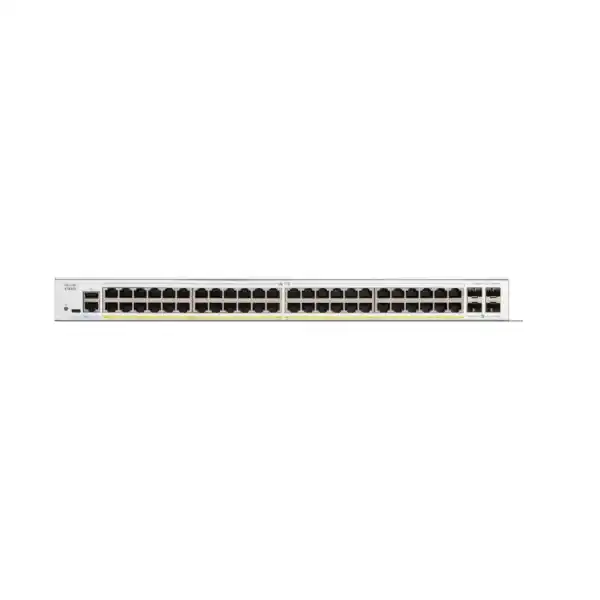
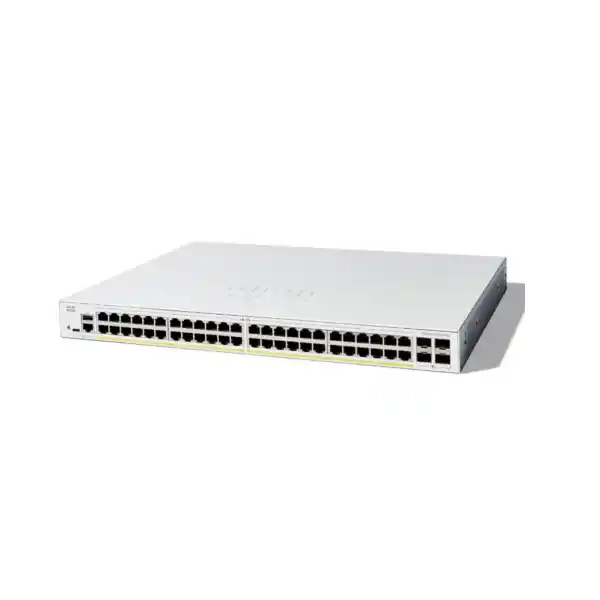
Cisco Catalyst C1300-48P-4X Network Switch
A 48-port Gigabit PoE+ managed switch with four 10GbE SFP+ uplinks, hardware stacking, advanced Layer 2 controls and practical Layer 3 routing for high-density business access networks in Dubai, Abu Dhabi, Sharjah and across the UAE.
Direct answer: where the C1300-48P-4X fits
The Cisco Catalyst C1300-48P-4X is best suited to organizations that need one rack-mountable switch to consolidate a large number of standard 1 Gigabit wired endpoints while also supplying IEEE 802.3af/802.3at Power over Ethernet. Typical loads include IP phones, Wi-Fi access points, fixed surveillance cameras, door controllers, thin clients, point-of-sale terminals, printers and office workstations. Four 10 Gigabit SFP+ uplinks provide the higher-speed northbound capacity required to connect an access layer to an aggregation switch, server room, firewall pair, distribution stack or another Catalyst 1300 switch used for stacking.
For UAE deployments, the practical attraction is density without forcing every access port into a multigigabit or PoE++ cost class. Forty-eight 10/100/1000BASE-T ports cover the majority of common edge devices, while the SFP+ uplinks preserve room for fiber backbones and 10GbE aggregation. Cisco specifies a nonblocking switching architecture with 176 Gbps aggregate switching capacity and 130.94 million packets per second at 64-byte packets for this model, enough to operate the physical port set at wire speed when the design is correctly engineered.
The C1300-48P-4X is therefore a strong choice for medium-sized floors, branch campuses, schools, clinics, hospitality sites, warehouses and mixed office/voice/video networks that need managed switching features beyond an unmanaged or web-smart switch. It is not the correct choice when most edge devices require 2.5G, 5G or 10G copper, or when many endpoints require 60 W PoE++. In those cases, a multigigabit or C1300X design should be evaluated instead of oversizing this model beyond its intended access role.
Key hardware specifications
Access ports
48 × 10/100/1000BASE-T RJ-45 ports. The model is optimized for conventional Gigabit Ethernet access and uses Category 5e or better cabling for 1000BASE-T.
Uplink ports
4 × 10 Gigabit SFP+ interfaces for fiber or compatible direct-attach interconnects, supporting high-capacity uplinks, aggregation and Catalyst 1300 family stacking designs.
PoE capability
All 48 copper ports support IEEE 802.3af PoE and 802.3at PoE+. Cisco’s detailed specification lists 375 W dedicated to PoE for the C1300-48P-4X.
Performance
176 Gbps switching capacity and 130.94 Mpps forwarding rate. Cisco describes the Catalyst 1300 switching path as wire-speed and nonblocking.
System resources
ARM dual-core CPU at 1.5 GHz, 1 GB DDR4 DRAM, 1 GB SLC flash and a 1.5 MB dynamically shared aggregate packet buffer for this SKU.
Physical platform
Rack-mountable chassis approximately 444.3 × 350 × 43.94 mm and about 6.37 kg, with an internal universal 100–240 V, 50–60 Hz power supply.
Port architecture and traffic engineering
A 48-port access switch is often judged only by port count, but the uplink and forwarding architecture matter just as much. The C1300-48P-4X exposes forty-eight 1GbE edge interfaces and four 10GbE SFP+ interfaces. If every copper port were simultaneously receiving and transmitting at line rate, the aggregate full-duplex fabric requirement is significant. Cisco’s 176 Gbps switching-capacity figure corresponds to the total physical bandwidth represented by 48 Gigabit access ports plus four 10 Gigabit uplinks when bidirectional traffic is considered. This is why the platform can be described as nonblocking at the switching-fabric level rather than as a switch that relies on a heavily oversubscribed internal backplane.
In real enterprise access networks, the design is normally intentionally oversubscribed northbound because not every user port transmits at full line rate at once. A pair of 10GbE uplinks in an LACP bundle may be sufficient for a typical office floor, while four 10GbE links can be allocated across redundant upstream switches, server segments or stack interconnect requirements. Capacity planning should be based on actual traffic classes: user data, wireless backhaul, video surveillance, voice, backup traffic, building systems and east-west traffic to local servers. A CCTV-heavy site can generate sustained upstream load that behaves very differently from a conventional office where user traffic is bursty.
The C1300-48P-4X includes a 1.5 MB dynamically shared packet buffer. Buffer capacity does not replace correct uplink sizing, but shared buffering helps the switch absorb short bursts and speed transitions between 1GbE access ports and higher-speed 10GbE uplinks. Engineers should still use QoS, traffic classification and sensible oversubscription ratios when mixing latency-sensitive voice, real-time video and large data transfers. The switching ASIC itself is not named by Cisco in the public data sheet, so architectural claims should be based on published forwarding capacity and feature behavior rather than an assumed chipset identity.
PoE+ engineering: budget the watts, not only the ports
375 W-class shared PoE budget
The switch can provide PoE or PoE+ on all 48 access ports, but the available power is shared across the chassis. Cisco’s detailed PoE table lists 375 W dedicated to PoE for the C1300-48P-4X. The current ordering summary also describes the product in the 370 W class, so project documentation should treat the platform as a roughly 370–375 W PoE-budget model and confirm the exact regional supply specification at quotation stage.
That budget is ample for many mixed endpoint estates. For example, forty-eight low-power IP phones drawing around 5–7 W each may fit comfortably. A mix of phones, cameras and moderate-power Wi-Fi access points can also fit. By contrast, forty-eight devices each attempting to draw the full 30 W allowed by 802.3at would exceed the chassis budget by a large margin. Port capability and total power capacity are separate limits.
Practical sizing method
Create an endpoint power table before ordering. Record the maximum negotiated PoE draw, not just the average, for every planned device. Add design margin for startup behavior, replacements and future moves. Reserve extra capacity for devices likely to be upgraded to higher-power models. If the calculated requirement regularly approaches the switch budget, either distribute loads across additional switches or use a higher-power model such as the C1300-48FP-4X rather than accepting unpredictable power denial.
The platform supports useful operational controls including time-based PoE and persistent PoE. Time scheduling can shut off power to suitable endpoints outside operating hours. Persistent PoE is valuable because powered devices can remain energized during certain switch restart events, reducing disruption to phones, cameras or access points when the switch control plane is being rebooted.
Layer 2 switching for segmented enterprise networks
The Catalyst C1300 family offers a deeper Layer 2 feature set than basic small-office switching. The C1300-48P-4X supports standard IEEE 802.1Q VLAN segmentation, port-based VLANs, MAC-based VLANs, protocol-based VLANs, IP-subnet-based VLANs, private VLAN constructs, guest and unauthenticated VLANs, management VLANs and dynamic VLAN assignment through RADIUS with 802.1X. Cisco lists support for up to 4094 VLAN IDs, with the upper internal range reserved for system use. This enables a design to separate corporate users, voice endpoints, guest wireless, CCTV, building management, printers, IoT equipment, server management and other security zones even when the same physical switch serves all of those devices.
Spanning Tree support includes classic 802.1D, Rapid Spanning Tree under 802.1w and Multiple Spanning Tree under 802.1s. Cisco also documents PVST+ and Rapid PVST+ support. These options matter when the C1300 is introduced into an existing Cisco-oriented campus where spanning-tree behavior is already standardized. The switch supports link aggregation using IEEE 802.3ad LACP, with up to eight groups and up to eight ports in a group. LACP is commonly used to build redundant 10GbE uplinks, aggregate links to servers or NAS systems, or create resilient logical connections within a distribution design.
Multicast controls are also important for surveillance, IPTV, digital signage and discovery-heavy networks. IGMP snooping versions 1, 2 and 3 help limit multicast forwarding to interested receivers instead of flooding every port. IGMP querier and proxy functions are available, while Multicast VLAN Registration can simplify shared multicast services. For service-provider or multi-tenant scenarios, the product family includes VLAN translation and Q-in-Q capabilities that can carry customer VLANs through a provider domain while preserving separation.
The operational advantage is not merely the number of supported protocols. A properly segmented access layer limits broadcast scope, reduces accidental device visibility and creates policy boundaries that can be enforced by a firewall, router or Layer 3 interface. For UAE businesses with mixed administrative departments, guest access, telephony and IP surveillance, this allows one physical access platform to serve several logical trust zones without compromising basic network hygiene.
Layer 3 routing and gateway design
The C1300-48P-4X is more than a Layer 2 access switch. Cisco specifies wire-speed IPv4 and IPv6 routing, Layer 3 interfaces on physical ports, LAGs, VLAN interfaces and loopback interfaces, as well as CIDR, RIP v2, policy-based routing, DHCP server functions and DHCP relay. For C1300 1 Gigabit Ethernet SKUs, Cisco lists up to 990 dynamic plus static IPv4 routes and up to 128 IP interfaces. These capabilities are sufficient for many branch and access-layer routing tasks, including inter-VLAN routing between local segments and routed uplinks toward a firewall or distribution layer.
Architecture decisions should still be deliberate. If the firewall must inspect traffic between user, voice, camera and guest VLANs, those VLAN gateways may belong on the firewall or a higher-level distribution layer rather than on the access switch. If the objective is local high-speed routing between trusted segments with minimal hairpinning, switch virtual interfaces on the C1300 can be appropriate. Policy-based routing can direct selected traffic toward different next hops based on ACL criteria, which can be useful for service insertion, dual WAN paths or separating operational technology traffic from standard corporate routes.
OSPF is an important boundary to understand. Cisco’s current Catalyst 1300/1300X data sheet restricts OSPF v2 and v3 to C1300X SKUs, so the C1300-48P-4X should not be purchased on the assumption that it provides the same dynamic-routing depth as a C1300X. RIP v2 and static or policy-driven routing remain available, but networks that rely on OSPF adjacency at the access layer should move the requirement into the correct product family or retain routing at the distribution tier.
For branch deployments, DHCP relay is often more valuable than an on-switch DHCP server because it allows endpoints in many VLANs to receive addresses from centralized DHCP infrastructure. The switch can also act as an IPv4 DHCP server where a self-contained site needs local address assignment. Engineers should decide which model simplifies operations and disaster recovery before enabling local services on multiple access switches.
Hardware stacking and high availability
Up to eight switches
Cisco documents hardware stacking for the C1300-48P-4X and supports up to eight compatible switches in one stack, with up to roughly 400 ports managed as a single system depending on the selected member models.
Family compatibility
The C1300-48P-4X belongs to Catalyst 1300 Family 1 for stacking. Cisco permits stacking among product IDs in the same defined family but does not support cross-stacking between the separate C1300 families or C1300X family.
Resilient control
Stack operation includes active/standby control behavior, fast failover, auto-numbering, ring or chain options and hot-swap capabilities for supported member replacement workflows.
Distributed LAG
Cisco documents link aggregation across multiple units in a stack. This can improve uplink resilience by allowing a logical LAG to survive failure of an individual stack member when the topology is designed correctly.
Stacking is most valuable when several access switches serve the same floor, rack or building and operations teams want one logical management system rather than many independent devices. It can also reduce failure domains when uplinks and port channels are distributed across members. However, stacking consumes high-speed interfaces and should be included in the uplink plan from the start. A design that assumes all four SFP+ ports are available for upstream traffic and later adds stack links may need to be reworked. The optics or DAC media, topology, redundancy model and interface allocation should therefore be part of the bill of materials rather than treated as installation-day details.
Access security and trust enforcement
The access switch is the first infrastructure device that sees most user and endpoint traffic, so port security features matter. The C1300 platform supports IEEE 802.1X authentication with RADIUS, dynamic VLAN assignment, guest and unauthenticated VLANs, MAC authentication options and multiple host or session modes. This lets an organization move beyond a model in which any device connected to an office wall outlet automatically joins a trusted network. Where endpoints cannot run an 802.1X supplicant, web-based authentication or MAC-driven methods can be integrated into a broader access-control policy.
Layer 2 attack controls include DHCP snooping, IP Source Guard and Dynamic ARP Inspection. Used together, these functions establish bindings between trusted DHCP information, source addresses and access ports. They can reduce the risk of rogue DHCP servers, source-IP spoofing and manipulated ARP traffic. Port security can lock or limit learned MAC addresses. BPDU Guard, Root Guard and loopback protection help keep edge devices from destabilizing the spanning-tree topology through accidental cabling or unauthorized bridging devices.
Management security includes SSH, SCP and HTTPS, while RADIUS and TACACS+ can centralize administrative authentication. Secure Sensitive Data mechanisms are designed to protect credentials and keys stored or handled by the switch. Cisco also documents trustworthy-system capabilities, runtime defenses, chip-guard behavior and boot-integrity visibility. These are meaningful controls for organizations that want network infrastructure to participate in a defense-in-depth strategy rather than act as an unmonitored forwarding appliance.
A secure deployment should still disable unused ports, place them in a nonproduction VLAN, restrict management-plane access to dedicated administrator subnets, synchronize time, forward logs to a central collector, apply role-appropriate ACLs and maintain a controlled firmware process. Switch security is strongest when configuration, identity services, firewall policy and physical rack security are designed together.
QoS for voice, video, wireless and business applications
High port density is valuable only if important traffic receives predictable treatment during congestion. The Catalyst 1300 family supports differentiated QoS mechanisms appropriate for an access-layer switch. In a mixed UAE office, several traffic classes may share the same uplink: Teams or Webex calls, SIP voice, cloud applications, CCTV streams, Wi-Fi client traffic, software updates and file transfers. Without classification and queue policy, a burst of backup or surveillance traffic can increase latency and packet loss for interactive workloads.
Voice VLAN support helps identify and place telephony endpoints into a dedicated VLAN, while LLDP-MED and Cisco discovery mechanisms can assist endpoint recognition and service assignment. Auto Smartports can apply predefined role intelligence based on discovered device type, reducing repetitive configuration in environments with many similar phones, access points or cameras. Manual engineering remains preferable for tightly controlled enterprise templates, but automated role recognition can reduce deployment time in standardized branches.
For a production design, QoS markings should be trusted only where appropriate. An access port connected to an unmanaged user device should not necessarily be allowed to assert high-priority DSCP or CoS values without policy. Phone-plus-PC ports, wireless access-point trunks and camera ports may require different trust models. The switch should classify, police and queue traffic in accordance with the upstream firewall, WAN and collaboration platform. End-to-end consistency matters more than any single queue configuration.
When multiple 10GbE uplinks are aggregated, QoS also protects against microbursts and unequal flow distribution. LACP hashes individual flows rather than splitting every packet evenly across links, so one large flow may still be limited by a single member’s line rate. Proper queueing, monitoring and capacity planning are therefore still required even when aggregate uplink bandwidth looks generous on paper.
Operations, visibility and troubleshooting
The C1300-48P-4X can be administered through a browser interface or scriptable command-line interface. Cisco documents HTTPS, SSH, SNMP, RMON, syslog, ping, traceroute, cable diagnostics, TFTP, SCP and other familiar management methods. A dual-image firmware design provides a degree of resilience during software upgrades, while configuration files can be exported, edited and reused across similar switches. For organizations with several branches, repeatable configuration templates are important because manual per-device setup quickly produces drift.
Traffic visibility includes port mirroring, VLAN mirroring, flow-based redirection and mirroring, RSPAN and an sFlow agent. These capabilities help engineers analyze application behavior, security incidents or congestion without placing an inline appliance on every segment. For example, a suspected camera stream problem can be mirrored to a packet analyzer, while sFlow data can be exported to a collector for broader utilization trends. RSPAN allows mirrored traffic to cross a Layer 2 domain to a remote analyzer port when physical access to the local switch is inconvenient.
Network discovery uses LLDP, LLDP-MED and Cisco Discovery Protocol. Accurate neighbor data is useful for documenting uplinks, mapping IP phones and identifying access points. In large racks, labeling should still match logical interface descriptions so that physical and electronic documentation reinforce each other. An operationally mature deployment maintains a port schedule containing interface number, patch-panel reference, endpoint role, VLAN, PoE requirement, expected speed, authentication policy and support owner.
For remote support, management should normally sit in a dedicated infrastructure VLAN reachable only from approved administration networks or VPN paths. Logging and monitoring should be configured before the switch enters production. Waiting for a fault before enabling syslog, SNMP or flow visibility leaves engineers without the historical data needed to distinguish a transient event from a persistent design issue.
Performance sizing for real UAE workloads
Office floor
A normal office mix of PCs, phones and Wi-Fi access points usually creates bursty northbound traffic. Two resilient 10GbE uplinks can often provide comfortable headroom, but the design should validate peak backup, video meeting and wireless loads rather than rely on average utilization.
Surveillance aggregation
Cameras generate sustained traffic, not just bursts. Multiply codec bitrate by camera count, add recording overhead and allow for future resolution increases. Ensure NVR paths and uplinks are engineered for continuous load and failover conditions.
Wi-Fi backhaul
The 1GbE access ports can bottleneck modern high-throughput access points capable of more than 1Gbps aggregate wireless traffic. Use this model where the AP wired requirement remains Gigabit; select multigigabit access when 2.5G or 5G backhaul is required.
Server edge
The switch can connect ordinary 1GbE servers or appliances, but high-I/O virtualization hosts and storage should normally use dedicated 10GbE or faster server switching. The C1300-48P-4X is fundamentally an access platform rather than a data-center leaf.
A useful design practice is to calculate both bandwidth and failure-state bandwidth. If two 10GbE uplinks normally carry a combined 8Gbps peak, losing one uplink still leaves 10Gbps and may be acceptable. If four links normally run near 70 percent utilization, the surviving capacity during a member or upstream failure may be inadequate. The same logic applies to stack members and PoE budgets. Capacity planning should include the degraded state because that is when users most need the network to remain stable.
Uplink optics, fiber and copper planning
The four SFP+ ports are one of the most important reasons to choose the “4X” model rather than a version with only Gigabit uplinks. A 10GbE optical backbone gives an access switch enough northbound headroom for dozens of edge ports and is well suited to UAE buildings where floor switches connect back to a main equipment room over multimode or single-mode fiber. The selected transceivers must match fiber type, wavelength, connector type and distance. Patch-panel loss, splice count and optical budget should be checked for longer runs rather than assuming that any SFP+ will work over any existing fiber.
Within the same rack, compatible direct-attach copper can reduce cost and power for short 10GbE links. For inter-floor or inter-building links, optical modules are normally preferable. Redundant uplinks should avoid shared physical failure points where possible. Two fibers in the same damaged riser are not truly independent, so mission-critical buildings may need diverse pathways or redundant communications rooms.
If the switch will participate in a hardware stack, reserve the required SFP+ interfaces and media in the bill of materials. Do not order four uplink optics per switch and later discover that some ports are required for stack interconnects. Likewise, if LACP is used to aggregate uplinks, ensure both ends have compatible port speed, VLAN trunk configuration, MTU assumptions and link-aggregation settings. A mismatch at either end can produce asymmetric forwarding, blocked members or intermittent connectivity.
For installations involving existing fiber, FourTeck can help validate the practical migration path as part of broader UAE IT infrastructure services, including switch replacement sequencing, optical compatibility review, uplink design and post-cutover testing. The objective should be a tested Layer 1 through Layer 3 path rather than a switch-only purchase.
Physical deployment, power and environmental planning
The C1300-48P-4X is a 1RU-class rack-mountable switch measuring approximately 444.3 mm wide, 350 mm deep and 43.94 mm high. Cisco lists a unit weight of about 6.37 kg. Rack depth is easy to overlook in compact wall cabinets, especially when rear power plugs, front patch leads and bend radius are included. Before procurement, verify the actual usable cabinet depth, not just the nominal enclosure depth. Leave adequate front and rear clearance for cabling and airflow, and avoid pressing fiber jumpers against closed doors.
Cisco specifies internal universal 100–240 V, 50–60 Hz power for this model. In UAE equipment rooms, power should normally be fed through a properly sized UPS and rack PDU rather than an unprotected wall outlet. PoE switches draw more power than non-PoE access switches when endpoints are heavily loaded, so UPS runtime calculations must include both switch system consumption and downstream PoE delivery. A UPS sized only for the switch’s idle draw may provide much less runtime once dozens of phones and cameras are powered.
Cisco lists an operating range of -5°C to 50°C for the applicable C1300 models, with cold start at 0°C, and relative operating humidity of 10 to 90 percent noncondensing. UAE ambient conditions make proper air conditioning essential. The product should be installed in a controlled communications space, not treated as outdoor or unconditioned industrial equipment merely because the maximum temperature specification is high. Heat from nearby PoE switches, UPS systems and firewalls can raise rack inlet temperature well above the room average.
The C1300-48P-4X uses a fan and Cisco lists approximately 37.3 dBA acoustic noise at 25°C for this model, so it is better suited to a wiring closet or equipment room than a silent meeting room. Environmental design should consider dust, service access, cable management, grounding, rack load and maintenance clearances as part of the complete installation.
C1300-48P-4X versus nearby Catalyst 1300 choices
Selecting the correct Catalyst 1300 SKU is primarily a question of port density, PoE budget, uplink speed and edge-port speed. The C1300-48T-4X provides the same basic 48-port Gigabit density and four 10GbE SFP+ uplinks but without PoE, making it suitable for data-only environments. The C1300-48P-4X adds PoE+ with a mid-range chassis budget appropriate for mixed phones, cameras and access points. The C1300-48FP-4X raises the PoE budget to approximately 740 W for higher powered-device density while retaining Gigabit access and 10GbE uplinks.
The important sizing question is therefore not “Do I need PoE?” but “How much PoE will the final endpoint mix draw at peak?” If a 48-port switch is expected to power 35 phones and a few cameras, the P-class model can be efficient. If the same switch will power many high-draw wireless access points, PTZ cameras or other 802.3at devices, the FP model may avoid operating too close to the power ceiling. If endpoints require 60 W PoE++ or multigigabit copper, the requirement moves beyond this SKU and into other models such as C1300X or multigigabit Catalyst 1300 variants.
The “4X” suffix is also strategically important. Models with 4G uplinks use Gigabit SFP uplinks, which can create a bottleneck in a dense 48-port access layer. The four 10GbE SFP+ ports on C1300-48P-4X provide a much more balanced design for modern office and surveillance networks. Unless an existing environment has very low uplink requirements and cost pressure dominates, the 10GbE uplink model generally offers better lifecycle headroom.
FourTeck can help compare this switch with alternative campus and branch platforms through the FourTeck UAE technology portfolio so that port density, optics, firewall capacity, wireless design and support requirements are aligned before purchase.
Deployment topology 1: office access layer
In a conventional office-floor design, the C1300-48P-4X sits in the intermediate distribution frame and connects user outlets, IP phones, printers, meeting-room devices and wireless access points. Separate VLANs can be created for corporate clients, voice, guest wireless, AV systems, building controls and network management. Two 10GbE SFP+ interfaces can form an LACP uplink toward the building distribution pair, with additional SFP+ interfaces reserved for redundancy, local server connectivity or stacking.
Voice endpoints can use the voice VLAN feature, while 802.1X authentication can place users or devices into appropriate VLANs. DHCP snooping and Dynamic ARP Inspection can reduce common access-layer spoofing risks. The management interface should be reachable only from the IT administration network. Syslog, SNMP and sFlow should feed monitoring systems so that the operations team can see port flaps, PoE status, errors and utilization trends.
PoE planning is usually straightforward in an office because most phones draw relatively little power, but wireless access points can materially increase the total. If a floor has 20–30 phones, several access points and a handful of cameras, calculate the worst-case draw using each endpoint data sheet. Maintain margin for future AP refreshes because newer Wi-Fi generations may need more wired bandwidth or power than older models.
This topology works particularly well when the organization wants a managed access layer without the licensing and operational complexity of a larger enterprise campus platform. It still provides sophisticated segmentation, routing, authentication and stacking options, but should be integrated into a documented network architecture rather than deployed as an isolated smart switch.
Deployment topology 2: IP surveillance and security systems
For IP surveillance, the 48 PoE+ access ports make the C1300-48P-4X a natural aggregation point for fixed cameras, video intercoms and selected access-control devices. The design must focus on both PoE power and sustained bandwidth. A camera that averages several megabits per second may appear lightweight individually, but dozens of cameras generate continuous traffic toward NVRs or a video management platform. High-resolution streams, high frame rates and low compression can increase the aggregate substantially.
Place camera ports in dedicated surveillance VLANs and use ACLs or upstream firewall policy to prevent cameras from initiating unnecessary connections to corporate networks. DHCP snooping, port security and IP Source Guard can add access-layer protection where compatible with the addressing model. If cameras use static IP addresses, binding and inspection policy should be designed accordingly rather than copied from a DHCP-based user network.
The 10GbE SFP+ uplinks are valuable because they reduce the chance that the recording path becomes constrained by a 1GbE trunk. If the NVR infrastructure is centralized, at least two redundant uplinks should be considered. If recording servers reside in the same equipment room, one or more SFP+ ports may connect directly to a local aggregation or server switch. Engineers should avoid mixing high-volume camera replication or backup traffic with latency-sensitive business traffic without QoS and capacity analysis.
A surveillance deployment also benefits from persistent PoE behavior because cameras can remain powered through relevant switch reboot scenarios. For organizations designing camera networks together with perimeter security and routing, the Firewall Dubai solutions team can help align VLAN policy, recording flows, remote access and security-zone boundaries.
Deployment topology 3: hospitality, retail and multi-service branches
Hotels, retail stores, clinics and service branches often place many different device types on one physical access switch. The C1300-48P-4X can consolidate POS terminals, phones, access points, printers, signage players, cameras, building-control gateways and staff workstations while keeping them in separate VLANs. This reduces the number of small unmanaged switches scattered through a site and centralizes power, monitoring and policy at the rack.
Segmentation should follow business function and security risk. Payment terminals should not share a broad user VLAN. Guest Wi-Fi should be isolated from staff resources. Building systems and IoT devices should have tightly controlled reachability. Cameras should communicate only with required management and recording services. Voice should receive appropriate QoS treatment. These logical boundaries can be created at the switch and enforced at a firewall or routed policy layer depending on the selected architecture.
Branch resilience is often limited by a single switch, power feed or uplink. Where uptime matters, use two access switches or a stack, distribute critical endpoints between members, and provide redundant upstream connectivity. Consider the impact of a PoE failure: losing one access switch may simultaneously remove phones, Wi-Fi and cameras. Redundant switching therefore protects more than data connectivity; it protects multiple business services that now depend on Ethernet power.
For multi-site rollouts, template-based configuration is especially valuable. Standard VLAN IDs, port profiles, management addressing, authentication policies and monitoring settings make remote support easier. Text-editable configurations, secure file transfer and centralized operational practices can reduce the variation that otherwise accumulates when dozens of branches are installed by different technicians.
Integration with firewalls, servers and wireless infrastructure
An access switch should be specified as part of the complete network path. Upstream, the C1300-48P-4X may connect to a firewall, core switch or distribution stack. Downstream, it powers and transports traffic for phones, cameras and wireless access points. Each adjacent system can become the bottleneck if sized independently. Four 10GbE uplinks are useful only if the upstream platform has suitable 10GbE interfaces and enough forwarding capacity. Likewise, a firewall that can process only a fraction of the site’s east-west or internet traffic may constrain performance even though the switch is operating correctly.
For server access, 1GbE copper ports are appropriate for management interfaces, appliances and moderate-throughput servers. Virtualization hosts, backup repositories and storage systems may require 10GbE or faster connectivity on a dedicated server switch. Organizations planning a server-room refresh can coordinate switching and compute requirements through Server Dubai infrastructure solutions so that NIC speed, VLAN design, uplink bandwidth and redundancy are matched.
Wireless design needs particular attention. Many Wi-Fi 6 and Wi-Fi 6E access points can exceed 1Gbps aggregate throughput under favorable conditions and may use 2.5GbE wired interfaces. Those APs will negotiate at 1GbE when compatible, but the switch port can then be the throughput ceiling. If the wireless design relies on multigigabit backhaul, use a Catalyst model with 2.5G or 5G access ports instead. If access points are standard 1GbE devices or actual site demand is lower, the C1300-48P-4X remains appropriate.
The most reliable bill of materials therefore starts with endpoint requirements and traffic flows, not a preferred switch model. Count ports, classify power draw, identify access speeds, size uplinks, define routing boundaries, select firewall capacity, then choose switching hardware that meets the complete requirement with growth margin.
Management architecture and configuration standards
A production C1300-48P-4X should have a documented baseline configuration before user ports are enabled. Start with a management IP strategy, DNS and NTP settings, secure administrator authentication, SSH and HTTPS access, syslog targets, SNMP monitoring and configuration-backup procedures. Disable insecure or unnecessary management protocols where operational policy allows. Use TACACS+ or RADIUS for centralized administrator identity if the organization already operates an AAA platform, while retaining a controlled local recovery account for outage scenarios.
Port configuration should be template-driven. A user-data port may need an access VLAN, 802.1X policy, BPDU Guard, storm control and a descriptive interface label. A phone-plus-PC port may need voice VLAN handling and QoS trust rules. An access-point port may need a trunk with allowed VLAN restrictions. A camera port may use a dedicated access VLAN, PoE, port security and a limited ACL. Uplink ports should use explicit trunk VLAN lists, LACP settings and spanning-tree roles. Treating all access ports as interchangeable increases the risk of security and troubleshooting problems.
Configuration backup should be automated or at least scheduled. Cisco supports SCP and text-editable configuration files, making it practical to store validated versions in a secure repository. Record firmware versions and change dates. When upgrading a stack, confirm release compatibility, feature changes and rollback procedure. The dual-image capability improves upgrade resilience but does not replace a maintenance plan.
Monitoring thresholds should be meaningful. Alert on uplink utilization, link flaps, PoE budget pressure, power-supply events, stack changes, high error counters and environmental warnings. Avoid alerting on every access-port down event in a user environment because normal laptop disconnects can create noise. Good monitoring highlights conditions that require action rather than overwhelming the support team with expected edge behavior.
UAE procurement and lifecycle considerations
Network-switch procurement in the UAE should address more than unit price. Confirm the exact Cisco product ID, power specification, required optics, rack accessories, support entitlement, expected lead time and warranty path. The C1300-48P-4X is a specific 48-port PoE+ model with 10GbE SFP+ uplinks; similarly named variants can differ materially in PoE budget or uplink speed. Quotations should therefore list the complete model rather than a generic “Catalyst 1300 48-port PoE switch” description.
Optics and stacking components should be included at the same time as the switch. A common procurement mistake is to purchase the base chassis and later discover that compatible SFP+ modules, fiber patch cords or DAC cables were omitted. Another is to size the PoE budget from port count alone. The BOM should include the powered-device inventory and reserve capacity, especially if wireless access points or surveillance cameras may be upgraded during the switch lifecycle.
Support planning should reflect the site’s business criticality. Cisco documents a limited lifetime warranty and Small Business Support Center access for this product family, but organizations may need additional service arrangements, local spares or replacement-stock strategy. A retail outlet can often tolerate a replacement window different from a hospital department, hotel front office or security control room. High-impact sites may justify a cold spare configured with the same baseline or a redundant stacked design.
For customers with multiple regional locations, standardizing model families can simplify training, spares and configuration. FourTeck’s global technology delivery capability can support projects that need a common network standard across UAE and international offices while still accounting for local cabling, power and support requirements.
When not to choose the C1300-48P-4X
This switch should not be positioned as a universal answer to every 48-port requirement. The first exclusion is multigigabit access. If a significant number of edge devices require 2.5GbE or 5GbE copper, particularly high-throughput Wi-Fi access points, the 1GbE access ports will constrain them. A multigigabit Catalyst 1300 or C1300X model is more appropriate. The second exclusion is high-power PoE. If many endpoints require 60 W PoE++ under 802.3bt, this PoE+ model does not meet the requirement.
The third exclusion is extreme PoE density. Even though all 48 ports can provide PoE/PoE+, the chassis does not have enough power to deliver 30 W to all ports simultaneously. If the calculated load approaches or exceeds roughly 370–375 W, choose the higher-budget FP model or distribute the endpoints across additional switches. The fourth exclusion is OSPF-based access routing. Cisco documents OSPF only on C1300X SKUs, so dynamic-routing designs that depend on OSPF should not assume feature equivalence.
The fifth exclusion is data-center leaf switching. Although the C1300-48P-4X has 10GbE uplinks and wire-speed forwarding, its 48 access ports are Gigabit and its feature positioning is business/campus access. Modern virtualization and storage fabrics often need 10/25/40/100GbE server-facing connectivity, larger buffers and data-center-specific designs. Use the appropriate switching class instead of forcing an access switch into that role.
Finally, do not choose this model solely because it has a familiar Cisco name. Validate the endpoint count, power draw, uplink design, routing protocols, stack topology and support plan. Correct sizing is more important than brand consistency alone.
Migration from an older 48-port access switch
Replacing an existing access switch is a configuration and cabling project, not merely a hardware swap. Begin by exporting the current port map and identifying every interface role, VLAN, trunk, PoE device, static binding, authentication setting and special QoS policy. Capture spanning-tree root information, LACP membership, DHCP snooping trust ports, management addressing and monitoring configuration. If the old switch has undocumented ports, perform discovery before the maintenance window rather than troubleshooting live after cutover.
Map old interfaces to the C1300-48P-4X in advance. Preconfigure VLANs, management services and access-port templates. Confirm uplink optics and fiber polarity. If moving from 1GbE uplinks to 10GbE, check the upstream switch interface, optics and LACP configuration. Validate that the upstream device supports the intended trunk VLAN set and that native VLAN expectations match. Mismatched trunk settings are a common cause of partial connectivity after migration.
PoE migrations require additional checks. Record current powered-device consumption if the old platform exposes it. Compare the total and per-port needs with the new switch budget. Devices may renegotiate power differently after reboot, so do not assume a low observed steady-state load is the only relevant value. Sequence critical phones, cameras and access points so that support teams can verify service groups in stages rather than powering all endpoints simultaneously and investigating a large fault domain.
After cutover, verify link speeds, VLAN reachability, default gateways, DHCP, DNS, voice registration, wireless controller connectivity, camera recording, monitoring alarms and PoE status. Run an uplink throughput test where practical and check interface error counters after several hours. Keep the old switch available until acceptance criteria are complete and configuration backups are secured.
Technical specification reference
| Parameter | Cisco Catalyst C1300-48P-4X |
|---|---|
| Copper access | 48 × 10/100/1000BASE-T RJ-45 |
| Uplinks | 4 × 10GbE SFP+ |
| PoE standards | IEEE 802.3af PoE and IEEE 802.3at PoE+ |
| PoE budget | 375 W dedicated PoE in Cisco detailed specification; current order summary describes 370 W class |
| Switching capacity | 176 Gbps, wire-speed nonblocking |
| Forwarding rate | 130.94 Mpps at 64-byte packets |
| CPU | ARM dual-core, 1.5 GHz |
| DRAM / Flash | 1 GB DDR4 / 1 GB SLC |
| Packet buffer | 1.5 MB dynamically shared aggregate |
| MAC table | 16,000 addresses for C1300 1GbE SKUs |
| VLAN capability | Up to 4094 VLAN IDs, with 4078–4094 reserved for internal use |
| Jumbo frame | Up to 9000 bytes; default MTU 2000 bytes |
| Stacking | Hardware stacking, up to 8 switches within supported family rules |
| IPv4 routing | Wire-speed; up to 990 dynamic + static IPv4 routes and 128 IP interfaces for C1300 1GbE SKUs |
| IPv6 routing | Supported |
| Dynamic routing | RIP v2 supported; OSPF is specified for C1300X only |
| Dimensions | Approx. 444.3 × 350 × 43.94 mm |
| Weight | Approx. 6.37 kg |
| Power input | Internal universal 100–240 V AC, 50–60 Hz |
| Operating environment | -5°C to 50°C operating; 10–90% RH noncondensing; cold start minimum 0°C |
Specifications should be validated against the latest Cisco regional data sheet and final quotation because product documentation, firmware capabilities and ordering details can change over time.
Decision recap: is this the right 48-port switch?
Choose the Cisco Catalyst C1300-48P-4X when the access layer requires forty-eight standard Gigabit copper ports, PoE+ for a mixed endpoint estate, 10GbE optical uplinks and business-grade management features. Its strongest fit is a network where most endpoints remain comfortably within 1GbE, where total PoE demand fits inside the roughly 370–375 W chassis class, and where the organization benefits from VLAN segmentation, 802.1X, DHCP snooping, Dynamic ARP Inspection, link aggregation, hardware stacking and practical Layer 3 routing.
Strong fit
48-port office floors, voice networks, surveillance access, retail branches, hospitality networks, school or clinic closets, and mixed PoE environments with 10GbE uplink requirements.
Validate first
High-density Wi-Fi, large PTZ-camera estates, heavily loaded PoE designs, complex dynamic routing, multi-building stacks and environments where all four SFP+ interfaces are already committed.
Choose another model
When edge devices need 2.5G/5G multigigabit, 60 W PoE++, OSPF on the access switch, or data-center-class 10/25GbE server-facing density.
Lifecycle advantage
Four 10GbE SFP+ uplinks provide substantially better aggregation headroom than Gigabit-uplink variants and make the switch easier to integrate into modern fiber backbones.
Quotation input checklist
A technically accurate quotation starts with the site requirement. Provide the following information so the switch, optics, PoE capacity, support and installation scope can be sized correctly without avoidable revisions.
1. Port inventory
Total active ports now, growth target, endpoint type per port, required copper speed, special trunk ports and any server or appliance connections.
2. PoE inventory
Number and model of phones, cameras, wireless APs, intercoms and other powered devices, including maximum wattage rather than only average draw.
3. Uplink requirement
Number of 10GbE links, upstream switch or firewall model, fiber type, approximate distance, connector format and whether links require LACP or physical path diversity.
4. Stack design
Number of switches per stack, preferred ring or chain topology, required member distribution, stack media and how many SFP+ interfaces must remain available for upstream traffic.
5. Network policy
VLAN list, routing location, 802.1X requirements, DHCP model, firewall zones, voice VLAN, surveillance isolation, QoS classes, monitoring and central authentication requirements.
6. Site conditions
Emirate and site address, rack depth, UPS capacity, PDU type, cooling, maintenance window, existing patch panels, labeling standard and whether migration services are required.
Including this information prevents common project errors such as insufficient PoE headroom, missing optics, incompatible fiber, inadequate UPS runtime, unexpected multigigabit requirements or a stack design that consumes uplink ports needed elsewhere.
FourTeck UAE consultation and deployment support
FourTeck can supply the Cisco Catalyst C1300-48P-4X as part of a complete access-network solution covering switch sizing, PoE calculations, VLAN and routing design, SFP+ optics, fiber compatibility, rack integration, firewall connectivity, migration planning and post-installation validation. This is particularly useful for customers replacing aging 48-port access switches, consolidating unmanaged switches, introducing PoE for IP telephony or cameras, or moving from Gigabit uplinks to a 10GbE fiber backbone.
For a new project, begin with the endpoint and traffic inventory rather than the switch alone. FourTeck can review the number of users, phones, cameras and access points; estimate peak PoE draw; determine whether 1GbE edge connectivity remains suitable; and calculate the number of 10GbE uplinks needed under both normal and failure conditions. The same review can identify whether the C1300-48P-4X is the most efficient model or whether a higher-PoE, multigigabit or C1300X platform is more appropriate.
For existing environments, the engagement can include port-map discovery, configuration translation, VLAN cleanup, uplink migration, switch-stack planning, management hardening and verification of connected services. Coordinating firewall, server and switching changes through one technical plan reduces the risk that independent component upgrades create mismatched speeds, VLANs, MTUs or redundancy assumptions.
Share the current network diagram, required port count, endpoint power requirements, uplink distances and preferred deployment date to receive a technically scoped quotation. FourTeck can align the switch with the broader UAE network architecture rather than treating it as a standalone box purchase.

Reviews
There are no reviews yet.