
Cisco Catalyst C1300-48T-4G Network Switch
A 48-port managed Gigabit Ethernet access switch with four 1G SFP uplinks, advanced Layer 2 controls, Layer 3 routing, strong endpoint admission security, and enterprise-oriented traffic management for UAE business networks.
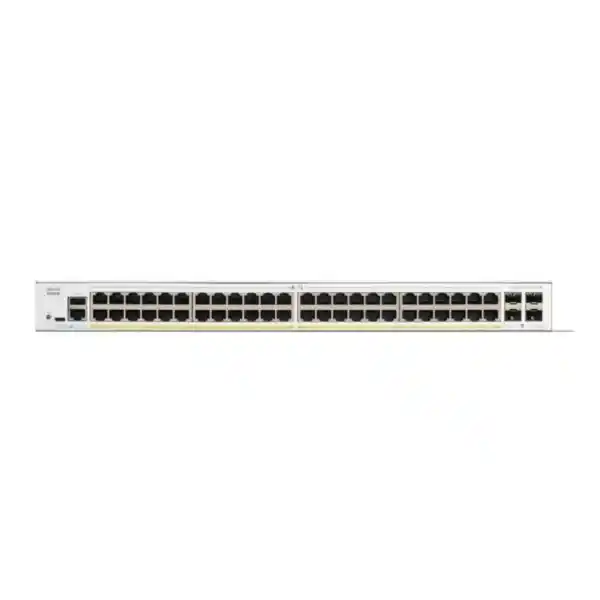
The C1300-48T-4G is particularly well suited to organisations that need a dense wired access layer but do not need to power endpoints from the switch. That distinction matters in real deployments. Desktops, printers, servers, storage interfaces, building systems, industrial controllers, CCTV recorders, access-control panels, digital signage players, meeting-room controllers, and many fixed network appliances only need data connectivity. In those environments, buying a non-PoE model can simplify power planning, reduce unnecessary power-supply overhead, and keep the access design focused on forwarding performance, segmentation, uplink resilience, and manageability. The model offers forty-eight copper Gigabit Ethernet user or device ports and four Gigabit SFP interfaces for fiber or copper transceivers, delivering a total of fifty-two Gigabit Ethernet interfaces for practical distribution-layer or server-room connectivity.
Model Snapshot
Direct Answer: What Is the Cisco C1300-48T-4G?
The Cisco Catalyst C1300-48T-4G is a fixed-configuration, rack-mountable managed Ethernet switch designed for high-density 1 Gigabit access. Its front-panel connectivity consists of 48 auto-negotiating 10/100/1000BASE-T copper interfaces and four 1 Gigabit SFP uplink interfaces. The switching fabric is rated at 104 Gbps and the forwarding rate at 77.38 million packets per second for 64-byte packets, which aligns with wire-speed, nonblocking operation across the available Gigabit interfaces. This makes the model a practical access-layer choice when the business requirement is many wired endpoints, predictable Gigabit performance, fiber uplink flexibility, and a richer management and security feature set than an unmanaged or lightly managed switch.
The most important buying detail is the exact suffix. C1300-48T-4G is the non-PoE, four-Gigabit-SFP model. It should not be confused with C1300-48P-4G or C1300-48FP-4G, which add PoE, or with C1300-48T-4X, which changes the uplink design to four 10 Gigabit SFP+ interfaces. If a Dubai office is connecting standard desktop computers, printers, servers, thin clients, IP-enabled building systems with their own power, or aggregation points that do not need switch-delivered power, the 48T-4G can be an efficient fit. If the deployment includes many IP phones, Wi-Fi access points, cameras, or other powered devices, a PoE variant should be evaluated instead. If uplink traffic may regularly exceed a single Gigabit per link, the 4X model or a higher-speed architecture deserves consideration.
FourTeck positions the switch as an access-layer platform rather than as a universal answer for every campus. It delivers substantial Layer 2 segmentation, Layer 3 forwarding, policy controls, multicast functions, access authentication, and operational tooling, but the physical uplink ceiling remains four 1G SFP ports. Correct sizing therefore starts with endpoint count and then examines northbound traffic, inter-VLAN traffic, server placement, backup windows, internet bandwidth, east-west application flows, and expected growth. A site with fifty users but only modest SaaS, printing, and internet traffic can have very different uplink requirements from a creative studio, surveillance network, virtualisation cluster, or backup-heavy engineering office with the same number of copper endpoints.
Core Hardware and Platform Specifications
Port Architecture: Why 48 Copper Ports Plus Four SFP Uplinks Matters
The physical port layout gives the C1300-48T-4G a clear operational role. Forty-eight copper Gigabit Ethernet ports match the density of a common office access block. In a typical structured-cabling design, one 48-port switch can map cleanly to a 48-port patch panel, reducing cross-rack patching and making port labelling easier to maintain. This does not mean every project should consume all 48 ports immediately. Good designs reserve capacity for moves, additions, failures, meeting rooms, printers, IoT devices, maintenance laptops, temporary endpoints, and future expansion. A reasonable spare-port policy is more valuable than forcing every available interface into service on day one.
Each copper port can negotiate 10, 100, or 1000 Mbps operation, allowing legacy devices to coexist with Gigabit-capable endpoints. In a modern deployment, however, the design target should normally be 1 Gbps full duplex wherever cabling and endpoint interfaces support it. Slow links can indicate old equipment, damaged cabling, poor termination, unsuitable cable category, or accidental manual speed settings. Operational baselines should therefore include port speed, duplex, error counters, discarded packets, link flaps, and interface utilisation. A managed switch only delivers its full value when telemetry is used to identify physical-layer problems before users experience them as intermittent application performance.
The four SFP interfaces are especially important in the UAE, where office floors, warehouses, villas converted to commercial use, compounds, schools, hotels, and mixed-use sites may contain wiring closets separated by distances or electromagnetic environments that make fiber attractive. With the correct SFP optics and fiber plant, an uplink can electrically isolate buildings, span distances beyond copper Ethernet limits, and provide a clean path between access and aggregation layers. Two or more uplinks can also be used for independent paths or link aggregation when the topology and upstream equipment support the intended configuration. The engineering objective is not merely to “use fiber” but to select optical type, wavelength, connector standard, fiber grade, route diversity, patching method, and transceiver compatibility as one complete channel.
Because these are 1 Gigabit SFP ports, each uplink is limited to 1 Gbps at the physical layer. That is usually adequate for user access networks where traffic is distributed and the internet circuit is well below a gigabit, but it can become a bottleneck when many endpoints simultaneously access central servers, NAS appliances, virtual desktop platforms, surveillance archives, backup repositories, or very high-speed internet services. Link aggregation can provide more aggregate bandwidth across multiple flows, but it does not normally turn a single flow into a multi-gigabit session. Hashing algorithms distribute flows across member links, so application behaviour and traffic diversity affect real results. This is why FourTeck evaluates uplink demand separately from endpoint count.
The model also does not provide PoE on the 48 copper interfaces. This is a design advantage when power delivery is unnecessary and a limitation when powered endpoints are part of scope. An IP phone, Wi-Fi access point, or camera connected to the C1300-48T-4G must have its own suitable power source or use an external injector, which can increase cabling and support complexity. If a significant percentage of ports need power, the 48P or 48FP variants are usually cleaner choices. If only one or two devices need PoE, external injectors may still be reasonable. The correct decision depends on port count, power budget, redundancy expectations, UPS capacity, rack heat, maintenance procedures, and how frequently powered devices are expected to change.
Switching Fabric, Forwarding Rate, and Real-World Performance
A switch should be sized by more than its port count. The C1300-48T-4G has a 104 Gbps switching capacity because fifty-two 1 Gbps interfaces can each send and receive simultaneously in full-duplex operation. The internal fabric therefore aligns with the aggregate duplex bandwidth of the physical interfaces. The 77.38 Mpps forwarding figure expresses packet-processing capacity at the challenging 64-byte Ethernet frame size. Small packets create more packets per second for the same bit rate than large packets, so Mpps is a useful companion metric to switching capacity. Together, these specifications show that the platform is engineered for wire-speed forwarding rather than an oversubscribed low-end switching core.
Real networks are still governed by contention at the egress port. If twenty access ports each send sustained traffic to one server attached through a single 1 Gbps uplink, the internal fabric is not the bottleneck—the one-gigabit egress is. Buffers and QoS can absorb and prioritise short bursts, but they cannot create bandwidth. The same principle applies to internet-facing traffic. A 1 Gbps firewall interface or routed uplink becomes the ceiling regardless of how many Gigabit endpoints are attached. Good network design therefore combines switch fabric sizing with an application traffic model. Users browsing SaaS applications behave differently from engineers transferring large CAD projects, developers pulling container images, media teams moving raw video, or backup agents synchronising tens of endpoints at the same scheduled time.
The 1.5 MB packet buffer helps handle microbursts, which are brief periods when arriving traffic temporarily exceeds the transmission rate of an egress interface. Microbursts can be invisible in five-minute utilisation graphs yet still produce drops and application retransmissions. QoS classification, queue scheduling, rate controls, and careful uplink design are therefore as important as average bandwidth. The C1300 platform supplies eight hardware queues, strict-priority and weighted scheduling options, ingress policing, egress shaping, and classification based on Layer 2 through Layer 4 information. Those mechanisms are valuable for protecting interactive voice, business-critical transactional flows, network-control traffic, or storage traffic from bulk transfers when multiple classes compete for the same port.
Jumbo-frame support up to 9,000 bytes can improve efficiency in carefully controlled server or storage segments by reducing packet-processing overhead for large transfers. Jumbo frames should not be enabled casually across an entire network. Every device in the path—including servers, virtual switches, firewalls, storage arrays, routers, and intermediate switches—must support the intended MTU. A mismatch can produce fragmentation, dropped packets, or hard-to-diagnose application failures. FourTeck treats jumbo MTU as a path-level design decision and verifies the complete traffic path before enabling it for production workloads.
Layer 2 Design: VLANs, Spanning Tree, Link Aggregation, and Loop Control
The Cisco Catalyst 1300 family provides a much richer Layer 2 feature set than a basic smart switch. VLAN support enables separation of users, servers, guests, voice systems, cameras, building management devices, printers, operational technology, management interfaces, and other trust zones even when they share the same physical switching infrastructure. The platform supports thousands of VLAN identifiers, with common 802.1Q tagging as well as specialised VLAN functions. In practical UAE office deployments, the important design question is not the maximum VLAN count but how segmentation maps to business policy. Too few VLANs can mix devices with different security requirements; too many can create unnecessary operational complexity. A useful design defines each VLAN by purpose, subnet, DHCP scope, gateway, security policy, naming standard, monitoring requirement, and allowed inter-VLAN communication.
Voice VLAN capabilities can simplify IP telephony deployments by identifying voice endpoints and placing them into an appropriate VLAN with the desired QoS treatment. Even though the C1300-48T-4G does not power phones, it can still carry voice traffic when phones have independent power or an upstream/downstream power arrangement. Guest and unauthenticated VLAN options are valuable in 802.1X environments because they provide controlled handling for devices that do not complete the preferred authentication workflow. Dynamic VLAN assignment through RADIUS can also move policy decisions away from manually configured port numbers and toward user or device identity.
Spanning Tree Protocol remains essential whenever redundant Layer 2 paths exist. The platform supports classic STP, Rapid Spanning Tree, Multiple Spanning Tree, and Cisco-oriented per-VLAN spanning-tree variants. Rapid convergence is particularly useful where a failed uplink or topology change must recover quickly without leaving a long service interruption. Root-bridge placement should be deliberate: the most appropriate distribution or core switch should normally be configured to win the root election rather than allowing an arbitrary access switch to become root because of default bridge priorities. BPDU Guard and Root Guard can then protect edge boundaries from accidental loops and undesirable root changes caused by users connecting small unmanaged switches or bridging devices in office areas.
Link Aggregation Control Protocol supports bundling compatible physical links into a logical port channel. The C1300 platform can create multiple LAG groups with multiple member ports. In a branch design, this may be used between the access switch and an upstream aggregation device, between the switch and a server with bonded NICs, or between network devices requiring additional aggregate capacity and redundancy. LACP improves operational safety compared with static aggregation because participating devices negotiate membership, but design discipline is still required. All member links should use consistent speed, VLAN configuration, trunk policy, and physical routing assumptions. Fiber links in the same LAG should ideally follow diverse paths if the goal includes protection against a cable route failure.
Loopback detection and UDLD provide additional safeguards for conditions that conventional spanning tree may not catch cleanly. Unidirectional fiber faults are a classic example: one optical direction can fail while the other remains active, creating a dangerous mismatch in link-state perception. UDLD can detect this type of failure and help prevent blackholing or loops. Loopback detection can protect ports where an accidental physical loop is introduced. Together with BPDU Guard, Root Guard, storm control, and sensible edge-port configuration, these mechanisms create a more fault-tolerant access layer.
Private VLAN and protected-port functions add another isolation layer when endpoints in the same IP subnet should not communicate directly. This can be useful in hospitality, shared-office, lab, residential-service, or device-access networks where clients need upstream connectivity but should not discover or directly contact neighbouring clients. Multicast VLAN, VLAN translation, Q-in-Q, and selective Q-in-Q capabilities support more specialised service-provider or multi-tenant use cases. Those features are powerful but should be applied with a documented encapsulation plan, because overlapping customer VLANs, provider VLANs, and native VLAN assumptions can otherwise become difficult to troubleshoot.
Layer 3 Capabilities: Inter-VLAN Routing Without Overcomplicating the Branch
The C1300 is more than a Layer 2 access switch. Cisco specifies wire-speed IPv4 routing, IPv6 routing, Layer 3 interfaces, CIDR support, RIP version 2, policy-based routing, DHCP server functions, DHCP relay, and UDP relay across the family. For C1300 1 Gigabit Ethernet platforms, the route scale is up to 990 combined dynamic and static IPv4 routes with up to 128 IP interfaces. This is a substantial feature set for a branch or growing business environment. It allows the switch to act as the default gateway for multiple VLANs and move permitted traffic locally instead of sending every inter-VLAN packet to an external router or firewall.
Local routing can reduce unnecessary traffic on northbound links. Consider a design where engineering workstations in one VLAN access a local file server in another VLAN. If the switch owns both gateway interfaces and policy allows the traffic, packets can be routed at the access or distribution layer instead of traversing a remote gateway. The tradeoff is security policy placement. Firewalls provide advanced inspection, application identification, threat prevention, logging, user identity, VPN, and other controls that a campus switch does not replace. Therefore, deciding where inter-VLAN routing occurs should be tied to trust boundaries. Low-risk operational VLANs may route locally, while sensitive user-to-server, guest, IoT, surveillance, or regulated traffic may still be forced through a firewall for stateful inspection.
Policy-Based Routing adds another layer of control by allowing selected traffic to use a different next hop based on ACL classification. In practical deployments, PBR can steer traffic toward a security appliance, alternative gateway, WAN service, or specialised path without changing the normal destination-based routing table. It should be documented carefully because policy routing can make packet paths less intuitive during troubleshooting. Network diagrams should show both the conventional route and any PBR exceptions, while monitoring should validate next-hop reachability and application behaviour after changes.
RIP v2 is available for dynamic IPv4 routing, but OSPF support is reserved for the Catalyst 1300X SKUs rather than this standard C1300 model. That distinction is important when integrating with a routed campus that expects OSPF adjacencies at the access or distribution layer. The C1300-48T-4G can still participate in a routed design through connected routes, static routes, RIP v2, and policy-based routing, but organisations standardised on OSPF should evaluate topology carefully or select a platform aligned with their routing protocol requirements.
The built-in DHCP server can serve multiple IPv4 pools, which may be useful in standalone branches, temporary environments, labs, or small sites without a central DHCP service. Larger organisations often prefer centralised DHCP for unified reservation management, auditing, naming, and high availability. In that case, Layer 3 DHCP relay forwards client requests between VLANs and remote DHCP servers. Option 82 support at Layer 2 can add access-port context to DHCP transactions where the service design uses that information. UDP relay can also forward selected broadcast-dependent application traffic across routed boundaries.
IPv6 support is not an afterthought. The platform supports IPv6 routing, IPv6 ACLs, IPv6 QoS, neighbor discovery, stateless address configuration, DHCPv6 client functions, ISATAP tunnelling, MLD snooping, MLD proxy, and IPv6 first-hop security mechanisms. Businesses may not be running production IPv6 everywhere today, but new devices and operating systems commonly enable IPv6 by default. An access switch that understands IPv6 policy and first-hop protection helps prevent an unmanaged parallel control plane from appearing beside an otherwise disciplined IPv4 network.
Security Architecture for User and Device Access
Access-layer security begins at the point where an endpoint connects. The C1300 platform supports IEEE 802.1X authentication in the authenticator role, RADIUS authentication and accounting, MAC authentication, dynamic VLAN assignment, guest VLANs, unauthenticated VLANs, web-based authentication, port security, and central administrative authentication using RADIUS or TACACS+. These controls make it possible to move beyond the traditional assumption that “anything plugged into an office wall socket is trusted.” Instead, network access can be linked to identity, device state, policy, or explicitly configured exceptions.
802.1X is most effective when deployed as a programme rather than as a checkbox. The organisation needs a RADIUS service, certificate or credential strategy, endpoint supplicant policy, fallback method for devices that cannot run 802.1X, guest onboarding process, monitoring procedure, and emergency bypass workflow. Printers, CCTV equipment, conference-room controllers, badge readers, building systems, and specialised appliances often require MAC Authentication Bypass or another exception. Those exceptions should not become unrestricted holes. They can be assigned to dedicated VLANs with narrow ACLs, rate limits, monitoring, and only the minimum reachability required for their function.
DHCP snooping, IP Source Guard, and Dynamic ARP Inspection form a complementary protection stack. DHCP snooping identifies trusted and untrusted DHCP paths and helps block rogue DHCP servers from handing clients false gateways or DNS settings. The resulting binding information can be used by IP Source Guard to reject traffic with unexpected source addresses and by Dynamic ARP Inspection to validate ARP messages against legitimate IP-to-MAC bindings. This combination helps reduce spoofing, man-in-the-middle attacks, accidental addressing conflicts, and some denial-of-service scenarios inside the LAN.
IPv6 first-hop security deserves equal attention. Router Advertisement Guard can prevent unauthorised devices from presenting themselves as IPv6 routers. Neighbor Discovery inspection, DHCPv6 Guard, and neighbor binding validation help protect the local IPv6 control plane. A network that secures IPv4 but ignores IPv6 can remain vulnerable because endpoints may still establish IPv6 connectivity automatically. FourTeck therefore recommends checking IPv6 policy explicitly: either operate it intentionally with appropriate controls or define how IPv6 is restricted. Simply assuming that “we do not use IPv6” is not a robust security posture.
Port security can restrict the number or identity of MAC addresses learned on an interface. It is useful for fixed-function ports, but configuration must match real endpoint behaviour. An IP phone with a PC connected through the phone may legitimately present multiple MAC addresses. Virtualisation hosts, docking stations, small downstream switches, and certain specialised appliances can also present more than one source MAC. Setting the limit too aggressively can cause intermittent outages that appear only when a second device becomes active. Security controls should therefore be based on the expected topology, not arbitrary numbers.
The switch supports ACL processing suitable for access and routed policy enforcement. Catalyst 1300 1 Gigabit Ethernet SKUs support up to 1,024 ACL rules. Rules can match combinations of Layer 2, IPv4, IPv6, transport-protocol, port, DSCP, precedence, ICMP, IGMP, and TCP flag information, with ingress and egress application options and support for time-based rules. ACLs are excellent for deterministic network-layer restrictions such as preventing guest VLANs from reaching management networks, limiting IoT controllers to specific servers, or allowing branch devices to contact only approved infrastructure services. They are not a substitute for application-aware firewall inspection when threats, users, sessions, or content need deeper analysis.
Secure management matters just as much as data-plane controls. SSH provides encrypted CLI access and SCP can protect file transfer workflows. HTTPS encrypts browser-based administration. Administrative privilege levels, RADIUS, TACACS+, and logging should be integrated into an operational standard so that changes are attributable and local shared accounts are minimised. For security architecture beyond the switch itself, FourTeck’s Firewall Dubai practice can align switch segmentation with firewall policy, VPN, internet security, and inter-VLAN inspection requirements.
Quality of Service: Protecting Voice, Applications, and Critical Traffic
Quality of Service becomes important when traffic competes for the same egress link. The C1300 platform provides eight hardware queues, strict-priority scheduling, weighted round-robin scheduling, Layer 2 and Layer 3 classification, DSCP and 802.1p handling, ACL-based classification and remarking, rate controls, and shaping. These capabilities allow the switch to distinguish delay-sensitive flows from bulk transfers instead of treating every packet identically during congestion.
Voice is a classic example. IP telephony uses relatively little bandwidth, but jitter, loss, and delay have immediate human impact. A large file copy that fills an uplink can harm call quality unless voice packets are classified and given suitable queue treatment. Strict priority can protect a genuinely real-time class, but it should be bounded by a sane admission policy so that an incorrectly marked traffic source cannot starve other applications. Weighted queues then allocate service among important but less latency-sensitive traffic classes. A practical policy might distinguish voice media, voice signalling, interactive business applications, infrastructure control, normal user data, backup traffic, and scavenger traffic, but the exact design should follow the organisation’s applications and WAN policy.
Trust boundaries are critical. If every endpoint is allowed to mark its own traffic as highest priority, QoS loses meaning. Access ports should either classify traffic locally or trust markings only from recognised devices, such as managed IP phones or authenticated endpoints. The network can then rewrite or preserve DSCP values according to policy. Consistency across switch, firewall, router, SD-WAN, wireless, and service-provider equipment matters because an end-to-end application path crosses multiple devices. A perfectly configured access switch cannot guarantee low latency if the upstream firewall or WAN circuit discards the markings.
Rate limiting can be used to prevent a device, VLAN, or traffic class from consuming an excessive share of a constrained link. Egress shaping is useful where the downstream service has a known bandwidth limit and bursty traffic might otherwise be dropped by a provider. Policing and shaping solve different problems and should not be applied interchangeably. FourTeck can integrate the C1300 QoS policy with wider UAE IT services, helping customers align switching configuration with application requirements, WAN circuits, server workloads, and support operations.
Multicast, CCTV, Video Distribution, and Discovery Traffic
Multicast is often overlooked in office switching until a video, IPTV, financial feed, paging, discovery, or surveillance application begins flooding traffic to ports that did not request it. The Catalyst 1300 1 Gigabit Ethernet platform supports IGMP snooping for versions 1, 2, and 3 and can handle up to 2,000 multicast groups. IGMP snooping observes membership reports so multicast frames are forwarded only toward interested receivers instead of behaving like broadcast traffic across the VLAN.
An IGMP querier can maintain group membership in a Layer 2 multicast domain that does not contain a multicast router. IGMP proxy functions can support multicast forwarding based on group information without deploying a full multicast-routing protocol. Multicast VLAN Registration allows a common multicast source VLAN to serve receivers located in separate subscriber VLANs, which can be useful in hospitality or controlled video-distribution environments. IPv6 multicast receives equivalent attention through MLD snooping and MLD proxy functionality.
CCTV deserves particular care because camera traffic is continuous rather than bursty. The C1300-48T-4G can switch camera data, but it cannot power cameras, so the camera-side power design must be separate. If a surveillance project uses central NVR servers, the uplink path must be sized for the sum of camera bit rates, not merely the number of cameras. Forty cameras at 8 Mbps each already represent around 320 Mbps before overhead and playback activity. Higher-resolution codecs, multiple streams, analytics traffic, backups, and simultaneous viewing can increase utilisation substantially. Where surveillance forms the primary workload, the uplink architecture and PoE requirements may point toward a different model even if the port count looks appropriate.
Management, Monitoring, and Operational Control
A managed switch becomes part of the organisation’s operational platform, so configuration access and monitoring must be designed alongside forwarding. Catalyst 1300 supports browser-based management and command-line administration. For engineers who prefer deterministic configuration, the CLI enables repeatable templates and precise change control. For smaller teams, the graphical interface can simplify common tasks such as VLAN creation, interface configuration, firmware management, monitoring, and troubleshooting. The best operating model is usually standardised rather than personal: every switch should follow a common hostname pattern, management VLAN, management IP plan, DNS and NTP settings, authentication method, logging target, SNMP policy, backup procedure, and firmware lifecycle.
The platform provides console access and USB-based functions, and Cisco documents support for an external Bluetooth dongle that can provide management access when configured appropriately. Out-of-band or local recovery options are valuable because they remain available when normal production VLANs are misconfigured. A site should document how an engineer reaches the switch if a trunk is broken, an ACL blocks management, routing changes remove reachability, or an upstream firewall policy fails. That recovery path may include local console, remote hands, a dedicated management network, or a secure jump-host design depending on the importance of the site.
SNMP, syslog, time synchronisation, and event monitoring should be configured from the beginning, not after the first outage. Interface counters reveal CRC errors, drops, packet errors, bandwidth saturation, and link flaps. Spanning-tree events identify topology changes. Authentication logs show rejected access attempts. DHCP snooping or security violations can reveal rogue behaviour. CPU, memory, temperature, and system events can help detect abnormal operating conditions. Centralised monitoring allows the support team to correlate a user complaint with the exact port, time, and switch state rather than relying on guesswork.
Configuration backups are equally important. A replacement switch is much easier to deploy when the current configuration, firmware version, transceiver list, port map, VLAN database, IP addressing, uplink design, and rack documentation are known. Backups should be captured after approved changes and stored securely with access controls. Passwords and sensitive settings require protection; configuration repositories should not become a source of credential leakage. Change records should describe why a modification was made, what ports or VLANs were affected, how it was validated, and how to roll back if an application fails.
For organisations without an internal network operations team, FourTeck can combine switch deployment with broader lifecycle services through FourTeck UAE. This can include rack planning, structured connectivity review, switch configuration, VLAN migration, firewall coordination, endpoint cutover, validation, documentation, and support handover. The objective is to deliver a switch that is integrated into the environment rather than merely mounted and powered on.
Physical, Electrical, Thermal, and UAE Rack Planning
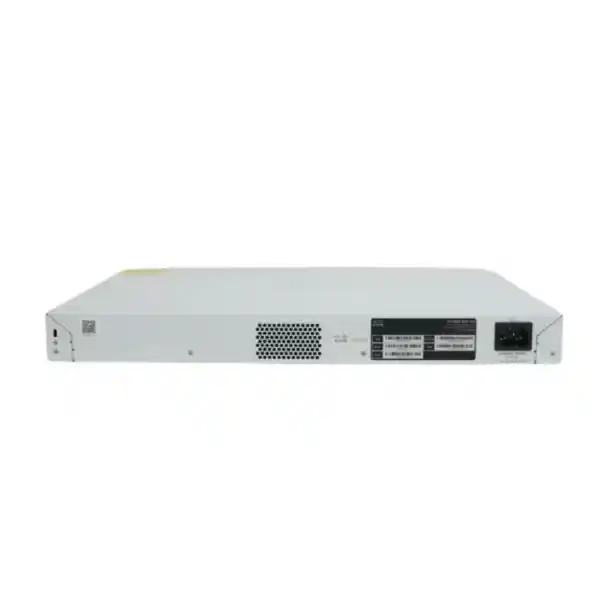
The C1300-48T-4G measures approximately 444.3 mm wide, 288 mm deep, and 43.94 mm high, making it a conventional 1U-class rack-mount platform. The depth is moderate compared with high-power PoE or data-centre switches, but rack planning should still account for rear power-cable bend radius, front patch-cord management, nearby PDUs, airflow, vertical cable managers, and service access. A rack that technically has one free unit may still be unsuitable if patching blocks ventilation or the power lead cannot be routed cleanly.
Cisco specifies universal internal 100–240V AC, 50–60 Hz power. Worst-case system consumption for the model is roughly 38.8 W at 110V and 38.07 W at 220V, while the documented idle figures are materially lower. Because this is a non-PoE model, there is no large external endpoint power budget to add to the switch’s own consumption. That simplifies UPS sizing compared with a fully loaded PoE switch, but network power should still be treated as critical infrastructure. The switch, firewall, internet edge, ISP equipment, core services, and any required optical devices should be mapped to UPS-backed circuits with realistic runtime assumptions.
The specified operating temperature reaches 50°C under the applicable conditions, but that should never be interpreted as permission to ignore cooling. UAE equipment rooms can experience significant heat load, especially in small closets with poor air exchange, top-floor locations, warehouses, or spaces where air conditioning is switched off outside office hours. Component life and reliability generally benefit from stable, moderate temperatures and clean airflow. Dust accumulation can obstruct vents and fans. Preventive maintenance should therefore include environmental checks, rack cleaning, filter maintenance where present, verification of room cooling, and alerts for abnormal temperature.
The switch uses one fan and Cisco lists an acoustic level around 29.7 dBA at 25°C. That is comparatively modest, but acoustics still depend on ambient temperature, rack enclosure, surrounding equipment, and room characteristics. If the rack sits in an occupied meeting room, reception area, clinic, classroom, or quiet office, the entire rack—not just one switch—should be evaluated. Firewalls, servers, UPS systems, storage arrays, and PoE switches can be much louder. Where servers or storage share the rack, FourTeck can coordinate network design with Server Dubai infrastructure planning to ensure power, cooling, cabling, and uplink capacity are treated as a unified system.
The published MTBF figure for C1300-48T-4G is high, but availability in production depends on the whole architecture. A single switch still represents a failure domain for every device attached to it. Where service continuity is critical, endpoints may need dual NICs connected to separate switches, servers may use bonded interfaces across independent devices, uplinks may require redundant paths, and key network services may need redundant gateways. Because the 4G model is not one of the C1300 PIDs listed for hardware stacking, designs that specifically require a hardware stack should evaluate the stack-capable 4X or other supported models instead of assuming all Catalyst 1300 switches share the same stacking capability.
Deployment Topologies for Dubai and UAE Sites
1. Single-Switch Branch Office
A branch with twenty to forty-five wired devices can use one C1300-48T-4G as the primary access switch. User, printer, server, guest, and management traffic can be separated into VLANs. One or two SFP links can connect to the firewall or upstream router, while remaining SFP ports can be reserved for growth or secondary paths. This design is simple, but the switch is a single failure domain. It suits sites where short outages are acceptable and where rapid replacement procedures are documented.
2. Access Switch Below a Firewall
In security-sensitive branches, the C1300 can provide Layer 2 access while a firewall owns selected VLAN gateways. Trunked VLANs travel over the uplink to the firewall, which applies stateful inspection between trust zones. Local switch ACLs can still restrict edge behaviour, while DHCP snooping, 802.1X, DAI, and IPSG protect the first hop. The architecture centralises security policy but increases traffic on the firewall uplink, so bandwidth must be sized for inter-VLAN as well as internet traffic.
3. Routed Access for Local Services
Where local east-west performance is more important, the switch can host VLAN interfaces and route selected trusted traffic locally. A default route then points toward the firewall for internet and WAN access. ACLs control which local VLANs can communicate. Sensitive zones can still use the firewall as their gateway. This hybrid design reduces unnecessary uplink traffic while preserving inspection where it matters, but it demands clear documentation of which device owns each subnet gateway.
4. Fiber-Linked Secondary Closet
In a warehouse, school, hotel, large office, or multi-floor property, the switch can serve a remote closet and uplink over fiber to a distribution switch. Fiber provides distance, electrical isolation, and a tidy backbone path. If uplink resilience is needed, two diverse fibers can be used with LACP or an appropriate spanning-tree design. The constraint is that C1300-48T-4G uplinks are 1G, so traffic projections should verify that the closet’s aggregate demand fits within the chosen uplink capacity.
Sizing Methodology: When the C1300-48T-4G Is the Right Choice
The first sizing question is usable access-port count. Count every permanent wired endpoint, not only employees. Include printers, meeting-room devices, badge controllers, building management gateways, access-control panels, storage appliances, servers, wireless controllers, CCTV recorders, digital signage players, UPS management cards, environmental sensors, maintenance ports, and uplink-connected appliances. Then add growth and operational reserve. If the requirement already exceeds the low forties, a single 48-port switch may leave too little headroom even if exactly 48 sockets appear sufficient on paper.
The second question is PoE. Make a device-by-device list and mark whether each endpoint needs IEEE 802.3af, 802.3at, or higher power. The C1300-48T-4G supplies none of that power. A design with thirty IP phones and ten wireless access points should almost certainly use a PoE switch instead. A design with forty desktops, six printers, and two servers may be ideal for the non-PoE model. A mixed environment can split powered and non-powered devices across separate switches, but that introduces more hardware and should be justified by rack, budget, power, and operational considerations.
The third question is uplink bandwidth. Estimate steady-state and peak traffic from the access layer toward the firewall, server network, storage, and WAN. Internet bandwidth alone is not enough. Local backups can consume more capacity than the ISP circuit. Cloud backup, software deployment, patch management, endpoint detection platforms, VDI, large file servers, imaging systems, and CCTV exports can create synchronised peaks. If multiple independent flows need more than one gigabit of aggregate bandwidth, a multi-link LAG may help. If individual hosts or applications need more than one gigabit end-to-end, the 4G model cannot deliver that through a single uplink and a 10G-uplink model should be considered.
The fourth question is routing and security architecture. Determine whether VLAN gateways sit on the switch, firewall, router, or a combination. If the switch routes locally, define ACL boundaries and route scale. If a firewall routes all VLANs, verify trunk bandwidth and firewall interface capacity. If dynamic routing is needed, check protocol requirements. This standard C1300 supports RIP v2 but not the OSPF capability listed for C1300X. A site standard built around OSPF should therefore not select this model simply because the Layer 2 specifications look adequate.
The fifth question is resiliency. The C1300-48T-4G is not listed among the hardware-stacking PIDs, so a design requiring stack control-plane resilience should evaluate a supported alternative. Resilience can still be created at the network level using independent switches, redundant uplinks, suitable spanning-tree or routing design, dual-attached servers, and spare hardware, but that is architecturally different from operating a hardware stack. FourTeck uses these five questions—ports, PoE, uplinks, routing/security, and resilience—to prevent model selection from being driven by port count alone.
C1300-48T-4G vs Common Adjacent Model Choices
| Model Type | Access Ports | Uplinks | PoE | Best Fit |
|---|---|---|---|---|
| C1300-48T-4G | 48 × 1G copper | 4 × 1G SFP | No | Dense wired access where 1G uplinks are sufficient and endpoints do not need switch power. |
| C1300-48P-4G | 48 × 1G copper | 4 × 1G SFP | PoE+ | Mixed user, phone, camera, and Wi-Fi access requiring switch-delivered power. |
| C1300-48FP-4G | 48 × 1G copper | 4 × 1G SFP | Higher PoE budget | Power-dense deployments with many PoE endpoints. |
| C1300-48T-4X | 48 × 1G copper | 4 × 10G SFP+ | No | Non-PoE access where high-speed uplinks or hardware stacking support are required. |
The comparison highlights why suffix-level accuracy matters during procurement. “Cisco Catalyst 1300 48-port switch” is not a complete specification. The T, P, FP, 4G, and 4X designations materially affect endpoint power, uplink bandwidth, physical power draw, and architecture. Quotations should always name the exact PID, SFP modules, support requirement, rack accessories, patching, and any configuration service rather than relying on a family-level description.
Migration from Older Access Switches
Cisco identifies C1300-48T-4G as a replacement path for the older Catalyst 1000 C1000-48T-4G-L. A migration project should still treat the new platform as a fresh deployment rather than blindly copying every line of legacy configuration. VLAN definitions, trunks, access ports, spanning-tree priorities, port security, voice settings, QoS, SNMP, logging, NTP, user accounts, AAA, ACLs, static routes, DHCP relay, multicast, and management IP settings should be reviewed against current requirements. Old configurations frequently contain unused VLANs, temporary exceptions, disabled ports, obsolete management hosts, weak credentials, and naming conventions that no longer reflect the business.
A safe cutover begins with a port-by-port inventory. Record each existing interface, patch-panel position, endpoint type, VLAN, speed, PoE requirement, authentication method, and business owner. Validate optics and fiber types before the maintenance window. Pre-stage the new switch with management addressing and baseline security, then test uplinks and a sample endpoint in each required VLAN. During migration, move ports in logical batches so faults are easier to isolate. After cutover, verify gateway reachability, DHCP, DNS, internet access, local servers, printing, voice, remote management, monitoring, and any specialised application paths.
The old switch should remain available for rollback until the new platform has passed agreed validation. Configuration backups, screenshots, cable labels, and change records should be captured before and after the migration. For multi-site rollouts, the first branch can be treated as a pilot to refine templates and timing. Once stable, the same standards can be reproduced across the remaining sites with site-specific IP addresses, port mappings, and uplink details.
UAE Procurement and Deployment Considerations
Network hardware procurement in the UAE should cover more than the switch chassis. The quotation should specify the exact C1300-48T-4G PID, power cord type, rack-mounting hardware, required SFP transceivers, fiber patch leads, copper patch cords, structured-cabling changes, configuration service, installation location, and support expectations. Optical modules must match both the switch and the installed fiber. A single-mode optic should not be ordered for a multimode design without an intentional engineering reason, and connector type must match the patch panel. Fiber length, loss budget, wavelength, and far-end transceiver also need to align.
Warranty and support planning should be tied to business criticality. A small office that can tolerate a day of reduced connectivity has different requirements from a clinic, hotel, logistics facility, trading operation, school, or customer-support centre that depends on continuous LAN availability. Spare strategy can range from relying on standard replacement processes to holding a preconfigured local spare. If a spare is maintained, it should be kept at a known firmware level with documented restoration steps so it can be introduced quickly without creating a compatibility surprise.
The switch must also fit the organisation’s wider security and IT operating model. A new managed switch should be added to asset inventory, configuration backup, monitoring, vulnerability management, credential rotation, firmware review, and change-control processes. Default accounts should be changed or disabled as appropriate. Management access should be limited to designated networks and administrators. Logs should have accurate time. Unused ports should be disabled or placed into a restricted state. Edge-port templates should be consistent so that security does not depend on manual memory.
FourTeck can coordinate these elements as a single implementation scope across Dubai and other UAE locations, including site survey, rack review, model confirmation, transceiver selection, configuration, cutover, and documentation. For customers with international or multi-region requirements, the FourTeck global site provides an additional point of reference for broader technology engagement.
Frequently Asked Technical Questions
Does C1300-48T-4G provide PoE?
No. The 48T model is data-only on its 48 copper interfaces. Select a 48P or 48FP model when the switch must provide power to phones, wireless access points, cameras, or other PoE endpoints.
Are the uplinks 10 Gigabit?
No. The “4G” suffix indicates four Gigabit SFP uplinks. The C1300-48T-4X is the adjacent model with four 10 Gigabit SFP+ uplinks.
Can the switch route between VLANs?
Yes. The platform supports IPv4 and IPv6 routing, Layer 3 interfaces, static routing, RIP v2, policy-based routing, DHCP server and relay functions. Routing design should still align with firewall trust boundaries.
Does it support OSPF?
The current Catalyst 1300 family specifications reserve OSPF v2/v3 support for C1300X SKUs. Standard C1300 deployments should be planned around their documented routing options rather than assuming OSPF support.
Can it be hardware stacked?
C1300-48T-4G is not listed among the PIDs Cisco identifies for hardware stacking. If a hardware stack is a requirement, choose a model explicitly listed as stack-capable, such as relevant 4X variants.
Is it suitable for a 1 Gbps internet connection?
Potentially yes, but internet speed is only one factor. If inter-VLAN, server, storage, backup, or surveillance traffic shares the same uplink, total demand may justify multiple uplinks or a 10G-uplink model.
Does it support 802.1X and RADIUS?
Yes. The platform supports 802.1X authentication, RADIUS authentication and accounting, dynamic VLAN assignment, MAC authentication, guest or unauthenticated VLANs, and web-based admission options.
What size rack is required?
The unit is a standard rack-mount form factor roughly 1U high and 444.3 mm wide. Rack depth, cable management, airflow, and PDU clearances should still be checked before installation.
Decision Recap: Choose C1300-48T-4G When These Conditions Are True
If any of these conditions are not true, the answer may be a different Catalyst 1300 model rather than a different vendor. PoE requirements point toward 48P or 48FP. High-speed aggregation points toward 4X. Hardware stacking requirements point toward models Cisco explicitly lists as stack-capable. Multi-gigabit endpoints, Wi-Fi 7 access, or deeper routing requirements can justify stepping into a different platform tier. FourTeck’s role is to match the model to the traffic, power, topology, security, and lifecycle requirement rather than forcing the project into a preselected SKU.
Quotation Input Checklist
For a precise Cisco C1300-48T-4G quotation and implementation scope in the UAE, provide the information below. Supplying these details reduces model changes later and allows transceivers, cabling, power, and configuration services to be sized correctly.
Number of desktops, printers, servers, appliances, phones, cameras, access points, controllers, and expected spare ports.
Which endpoints need PoE, their required standard or wattage, and whether external injectors already exist.
Copper or fiber, number of uplinks, expected bandwidth, link distances, fiber type, connector type, and far-end equipment.
Required VLANs, subnets, gateways, DHCP location, static or dynamic routing, and which traffic must pass through a firewall.
802.1X, RADIUS, TACACS+, port security, DHCP snooping, DAI, IPSG, ACL, guest access, or IoT isolation requirements.
Rack location, free rack units, UPS availability, PDU sockets, cooling, patch-panel position, and cable-management constraints.
Existing switch model, current port map, acceptable outage window, rollback requirements, configuration backup, and testing responsibility.
Installation-only, configuration, onsite support, managed monitoring, documentation, spare strategy, and post-cutover assistance.
FourTeck UAE Consultation for Cisco Catalyst C1300-48T-4G
The C1300-48T-4G is a strong fit for organisations that need a high-density, non-PoE Gigabit access layer with manageable fiber uplinks and enterprise-style control features. Its value comes from combining straightforward 48-port copper density with VLAN flexibility, routed interfaces, ACL enforcement, 802.1X access control, DHCP protection, IPv6 first-hop security, multicast management, QoS, and standardised operations. Those capabilities are most effective when they are designed as part of the wider network rather than enabled in isolation.
FourTeck can review your existing topology, determine whether the 4G uplink model is sufficient, confirm whether PoE is required, size optical modules, define VLAN and gateway placement, align switch ACLs with firewall rules, develop management and monitoring standards, and plan a controlled migration. We can also help determine whether a 4X model, PoE variant, or another Cisco platform better matches growth and resilience requirements.
For branch offices, schools, warehouses, professional services firms, retail environments, hospitality sites, clinics, and distributed UAE operations, the final recommendation should be based on measurable requirements: number and type of endpoints, traffic behaviour, security zones, fiber paths, internet and WAN capacity, application latency sensitivity, routing protocol requirements, support model, and acceptable failure domain. That approach keeps the switch investment aligned with the business for its full operational lifecycle.
Consultation Scope
• Exact model validation
• Fiber and SFP selection
• VLAN and IP addressing plan
• Layer 3 and firewall integration
• 802.1X and access security design
• QoS and multicast planning
• Rack, UPS, and cabling review
• Migration, testing, and documentation

Reviews
There are no reviews yet.