
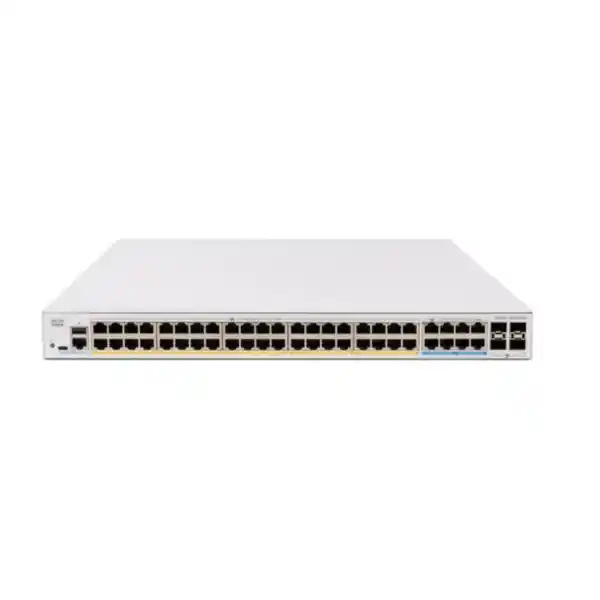
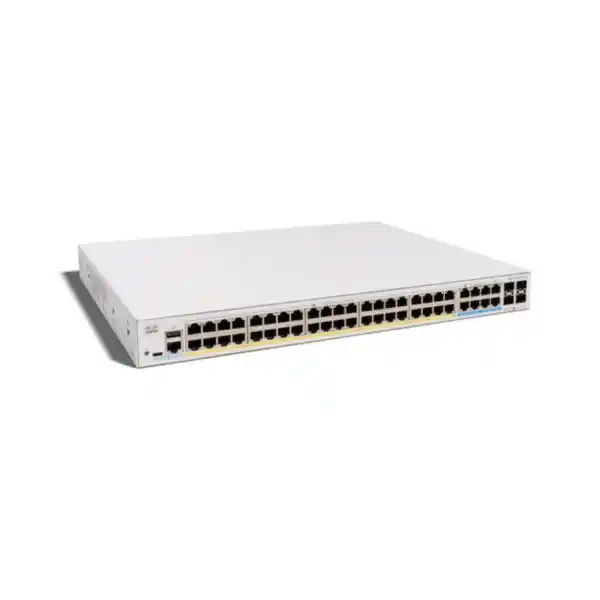
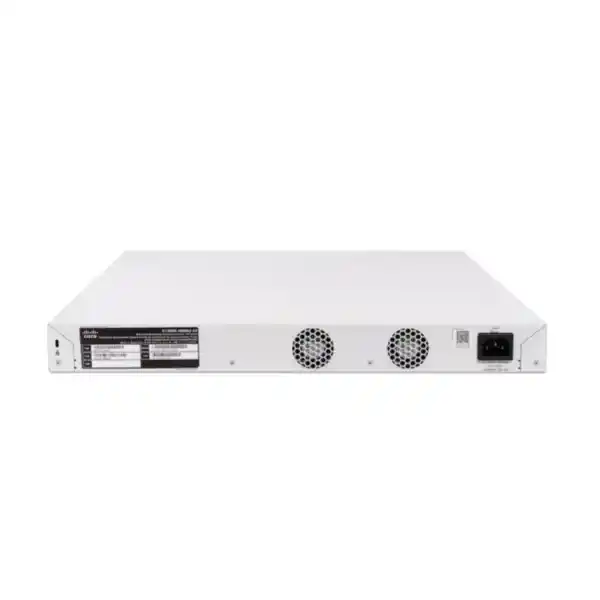
Cisco Catalyst C1300X-48NGU-4X Network Switch
A high-density, multigigabit, PoE++ and stackable managed switch for branch, campus access, hospitality, education, healthcare, retail and distributed enterprise networks that need a practical path from conventional 1 Gigabit access to high-throughput wireless and powered edge devices.
10/100/1000BASE-T ports delivering up to 30W class PoE+ support for phones, cameras and conventional access points.
High-speed copper edge ports supporting up to 60W PoE++ for demanding wireless and intelligent edge equipment.
Designed for 10G uplinks, with 25G operation available for stacking on the Catalyst 1300X family.
A substantial shared power pool for mixed PoE, PoE+ and PoE++ endpoint populations across the access layer.
Published wire-speed, nonblocking switching performance suited to simultaneous edge traffic and uplink aggregation.
Forwarding performance measured with 64-byte packets for demanding business traffic patterns.
What the C1300X-48NGU-4X is designed to solve
The Cisco Catalyst C1300X-48NGU-4X is built for organizations that have outgrown a simple 48-port Gigabit access switch but do not want to replace every copper run or every endpoint merely to accommodate a smaller group of high-bandwidth devices. Its port mix is deliberate: forty conventional Gigabit Ethernet access ports handle the large population of business endpoints that still operate comfortably at 1Gbps, while eight 5 Gigabit multigigabit ports provide significantly more headroom for modern wireless access points and other edge systems that can exceed a single Gigabit of aggregate traffic. Because these eight multigigabit ports also support higher-power PoE++, the same switch can address bandwidth and power growth together instead of forcing separate midspan injectors, special access switches or premature cabling redesigns.
For UAE organizations, that combination is especially relevant in office towers, schools, hotels, clinics, warehouses, retail environments and multi-tenant facilities where many installed copper links remain serviceable yet Wi-Fi density, IP video resolution, collaboration traffic and cloud consumption continue to increase. A network refresh can therefore be staged intelligently. Existing PCs, IP phones, printers, conventional cameras and lower-throughput access points can remain on the forty 1G PoE+ interfaces, while the eight 5G PoE++ interfaces are reserved for the devices that genuinely benefit from additional bandwidth or power. This avoids wasting premium multigigabit ports on endpoints that cannot use them.
The model also adds four SFP28 interfaces that operate as 10 Gigabit uplinks and can be used at 25 Gigabit for stacking. That distinction matters when designing the topology. The switch is not positioned as a generic four-port 25GbE uplink platform; rather, Cisco documents 10G for regular uplink connectivity and 25G capability specifically for stacking. In a correctly sized design, one or more 10G uplinks can connect the access layer to distribution, core, firewall or aggregation infrastructure, while the stacking architecture can combine multiple C1300X units into a single managed system. The result is a practical access platform with capacity for both current endpoints and a meaningful number of next-generation edge devices.
Port architecture and physical connectivity
| Interface group | Quantity | Speed / power role | Recommended use |
|---|---|---|---|
| Copper access | 40 | 10/100/1000 Mbps, up to 30W PoE+ | IP phones, PCs, printers, cameras, standard access points, controllers and edge appliances |
| Multigig copper access | 8 | Up to 5Gbps, up to 60W PoE++ | High-throughput Wi-Fi APs and powered devices that need more than 1Gbps or higher power draw |
| SFP28 network / stack | 4 | 10G uplink; 25G for stacking only | Fiber uplink aggregation, redundant uplinks and high-speed C1300X stack interconnects |
This port distribution encourages intentional endpoint placement. The forty 1G ports should be treated as the broad access pool. They are appropriate for the majority of wired office endpoints and many powered IoT devices because a Gigabit of full-duplex bandwidth remains ample for common user and machine traffic. The eight 5G ports should be treated as a scarce performance tier. In a wireless refresh, allocate them first to access points whose aggregate radio capacity and client density can push wired backhaul above 1Gbps. In a high-end video or edge-compute deployment, reserve them for devices with verified multigigabit interfaces and power requirements that justify PoE++.
The four SFP28 cages deserve equal design discipline. A pair of independent 10G uplinks can support resilient upstream connectivity when the distribution layer is configured for appropriate link aggregation or loop prevention, while the remaining interfaces can support other uplinks or the stacking design depending on the final topology. Optics, direct-attach cabling, fiber type, reach and upstream transceiver compatibility should always be confirmed as part of the bill of materials. A switch can have sufficient logical capacity and still fail a deployment if the wrong optical modules, patch leads or fiber polarity are ordered.
Switching performance and packet handling
Cisco publishes a switching capacity of 240Gbps and a forwarding rate of 178.57 million packets per second for the C1300X-48NGU-4X, with the platform described as wire-speed and nonblocking. Those values are important because they show that the switch is designed to carry simultaneous edge traffic without forcing all access ports to compete for an undersized internal fabric. In practical terms, the switch can be used in environments where many ports are active concurrently, including Wi-Fi client aggregation, voice, CCTV, SaaS traffic, local servers and east-west application flows.
The platform also provides an 8MB dynamically shared packet buffer for this model. Buffer size should never be interpreted as a substitute for sound capacity planning, but it matters where traffic arrives in bursts or where multiple access flows converge toward fewer uplink interfaces. The best design still keeps oversubscription controlled, applies QoS to delay-sensitive applications and avoids treating every uplink as an infinite drain. When hundreds of endpoints share one or two upstream links, uplink utilization, packet drops, queue depth and application latency should be monitored instead of relying only on switch-port link speed.
Cisco does not need to expose the exact switching ASIC identity for a design team to evaluate the published forwarding outcome. The relevant procurement question is whether the documented port mix, nonblocking capacity, forwarding rate, buffer resources and feature scale align with the intended workload. For access-layer sizing, those published characteristics are more useful than speculative chipset naming because they map directly to traffic engineering and operational expectations.
CPU, memory and control-plane resources
The Catalyst 1300X platform uses an ARM dual-core CPU running at 1.5GHz, and Cisco specifies 2GB DDR4 memory for C1300X models together with 1GB SLC flash. These resources support the management plane, routing protocols, control functions, configuration database, monitoring processes and firmware operations. They should not be confused with the packet-forwarding fabric; normal switched traffic is handled in hardware, while the CPU is responsible for control and management functions.
This distinction becomes significant during troubleshooting. High data-plane traffic does not automatically imply high CPU, and high CPU may instead indicate management polling, control-plane events, topology instability, excessive logging, loops, attacks or unusually large configuration operations. A production deployment should therefore establish baseline CPU, memory and interface counters after commissioning. Baselines help operations teams identify whether future behavior represents genuine abnormality or normal activity during maintenance windows and topology convergence.
The switch also supports dual software images for resilient firmware upgrades. A disciplined upgrade process still requires configuration backup, release-note review, maintenance planning and post-change validation. Dual images reduce operational risk, but they do not replace change control. For UAE enterprise deployments with multiple branches, maintaining a tested standard software version across the installed fleet simplifies support, documentation, vulnerability remediation and feature consistency.
PoE engineering: how to use the 740W budget correctly
The 740W PoE budget is one of the strongest reasons to choose the C1300X-48NGU-4X, but a power budget must be engineered rather than treated as a marketing total. The switch supports PoE across all forty-eight copper access ports, with the forty Gigabit ports positioned for up to 30W PoE+ and the eight 5G multigigabit ports positioned for up to 60W PoE++. A theoretical endpoint list can therefore exceed 740W even though every individual port remains within its supported class. The correct method is to build a device-by-device power schedule using expected and maximum consumption, startup behavior, redundancy policy and growth allowance.
Consider a typical mixed access floor: twenty IP phones at 8W each, twelve cameras at 12W each, eight standard wireless access points at 18W each and eight high-performance wireless access points at 35W each. The nominal consumption would be about 728W before adding margin. Although the individual ports all appear valid, the total leaves almost no operational headroom. In that situation, the design should either reduce endpoint density per switch, verify real maximum device draw and switch power allocation behavior, or distribute high-power devices across additional access switches. A good power design aims for predictable behavior during simultaneous boot events and future endpoint replacement, not merely a total that fits on paper.
Persistent PoE is supported, allowing attached powered devices to remain powered while the switch itself reboots under supported conditions. This can be valuable for IP phones, cameras and wireless access points because it reduces the number of endpoint reboots during switch maintenance. Time-based PoE is also available, which can help organizations schedule power to selected devices when appropriate. For example, certain signage, noncritical wireless zones or lab devices may not require power twenty-four hours a day. The operational policy should remain conservative for safety, security and life-critical systems; network power schedules should never disable a device simply to save energy without confirming the business impact.
PoE also affects rack, UPS and cooling calculations. At heavy load, a 740W PoE switch is not a low-power edge appliance. The UPS must be sized for the switch, the powered endpoint load, desired runtime, conversion losses and any companion equipment in the rack. Cooling design must account for heat generated by the switch and the equipment around it. Cisco publishes worst-case power consumption with PoE approaching the high eight-hundreds of watts for this model, which reinforces the need to treat electrical and thermal sizing as part of the network bill of materials rather than an afterthought.
Multigigabit access for Wi-Fi 6, Wi-Fi 6E and Wi-Fi 7 growth
Wireless access is a common trigger for multigigabit switching. A modern enterprise access point can serve many radios, many clients and a large aggregate traffic load. Even when no single client exceeds 1Gbps, the combined traffic of dozens of active clients can push wired backhaul beyond the practical ceiling of a standard Gigabit interface. The eight 5G ports on the C1300X-48NGU-4X give network teams a targeted way to remove that bottleneck without converting the entire access switch to multigigabit connectivity.
The design value is highest when AP placement and switch-port allocation are coordinated. High-density meeting zones, lecture rooms, auditoriums, lobby spaces, executive collaboration areas, hospitality ballrooms and other concentrated client areas should receive multigigabit-capable AP uplinks first. Lower-density offices, storage areas or IoT-focused zones may remain perfectly well served by 1G. This tiered approach aligns switch capacity with radio capacity and avoids paying for forty-eight multigigabit ports when only a smaller number of locations can actually consume them.
Cabling quality is a major part of multigigabit success. Existing twisted-pair cabling may support higher rates depending on category, length, installation quality, interference and termination. Before committing all eight 5G ports to an older building, test the permanent links and verify the channel against the intended speed. A network switch cannot compensate for damaged pairs, excessive bend radius, poor patching, electromagnetic noise or substandard termination. For renovation projects in Dubai and across the UAE, a cabling audit should be included early enough that remediation can be budgeted before AP installation.
Power and bandwidth should be planned together. High-end APs often need more than basic PoE, particularly when all radios and auxiliary features are enabled. The eight 60W PoE++ ports create a useful pairing: the same interfaces that deliver up to 5Gbps can supply higher device power. That avoids the common mistake of giving an AP multigigabit bandwidth but starving it of power, forcing the AP into a reduced-function mode. Always verify the exact access-point model, PoE class, full-feature power draw and Ethernet interface capability before producing the final switch port map.
10G uplink planning
The four SFP28 interfaces can provide 10G network uplinks. A single 10G connection may be sufficient for a moderately utilized access switch, while dual links can provide additional capacity and resiliency when used with an appropriate upstream design. Link aggregation can combine member links, but individual flows are still commonly mapped to a single member according to hashing. Capacity planning should therefore consider both aggregate utilization and large individual flows. Where the upstream device is a firewall, router or distribution switch, verify transceiver support, LACP behavior, VLAN trunking and MTU consistency on both ends.
25G stacking role
Cisco specifies 25G operation on these SFP28 interfaces for stacking only. This allows high-speed interconnection between C1300X family members while preserving a single-system management model. Do not design a 25G server or generic 25G core uplink based solely on the SFP28 connector shape; the documented operating role is what matters. The stack architecture should be planned with supported cabling, topology, member numbering and failure domains in mind.
Stack scale
C1300X supports hardware stacking of up to eight switches, with up to 400 ports managed as one system according to Cisco’s family-level specification. Members must come from the same supported family; cross-family stacking is not supported. A stack can simplify configuration and enable link aggregation across multiple units, but the design should still account for stack cabling resilience, software consistency, maintenance procedures, power diversity and the impact of member failure.
When not to stack
Not every deployment benefits from stacking. Independent switches may be preferable where failure-domain separation, simpler maintenance or physical distance is more important than single-system management. Stack design is most valuable when switches are co-located and operational simplification outweighs the coupling introduced by a shared stack. The decision should be made at architecture stage rather than after equipment arrives.
Layer 2 switching for segmented enterprise access
The switch supports a broad Layer 2 feature set suitable for segmented enterprise networks. VLAN capabilities include standard port-based and IEEE 802.1Q tagged operation, along with additional mechanisms such as MAC-based, protocol-based and IP-subnet-based VLAN assignment. Cisco documents support for up to 4094 VLAN IDs, while reserving a portion of the upper range for internal use. In real deployments, the important question is not the maximum VLAN count but whether the addressing, security policy, spanning-tree design and operational naming convention remain understandable as the network grows.
Voice VLAN features are useful when IP phones share physical access locations with user computers. The switch can automatically identify and treat voice traffic according to configured policies, reducing manual endpoint configuration. Auto Smartports can apply role-based intelligence based on discovered device types using Cisco Discovery Protocol or LLDP-MED. These features can speed mass deployment, but templates should still be reviewed for local requirements. A network with custom QoS markings, special NAC workflows or non-Cisco endpoints may require deliberate policy rather than relying exclusively on automatic classification.
Spanning-tree support includes classic STP, Rapid Spanning Tree, Multiple Spanning Tree, PVST+ and Rapid PVST+. This flexibility helps the switch integrate into different access designs, but it also means the architecture team must establish one coherent spanning-tree strategy. Root placement, edge-port configuration, BPDU guard, loop guard and redundant uplink behavior should be documented in the low-level design. An accidental Layer 2 loop can disrupt far more than one closet, so protective features should be treated as standard deployment controls rather than optional extras.
Link Aggregation Control Protocol is supported for combining physical ports into logical channels. Cisco documents up to eight aggregation groups with up to eight ports per group and additional candidate ports for dynamic LACP. Link aggregation can increase aggregate bandwidth and protect against a member-link failure, but it should not be marketed internally as multiplying the speed of every single application session. Most hashing methods distribute separate flows across member links. For high-bandwidth systems, confirm whether the traffic pattern consists of many parallel flows or a small number of dominant sessions.
Multicast capabilities include IGMP snooping, querier and proxy functions, with a larger multicast group scale on C1300X. These are useful for IPTV, digital signage, video distribution and other multicast applications because they prevent multicast traffic from being flooded unnecessarily to uninterested ports. Where the deployment uses multicast video or specialized AV-over-IP, test the actual application behavior, group membership churn, querier placement and VLAN design before production cutover.
Layer 3 routing and branch distribution capability
The C1300X family extends beyond basic access switching by supporting IPv4 and IPv6 routing functions, including OSPF version 2 and OSPF version 3 on C1300X models. That makes the platform relevant not only as a pure Layer 2 edge switch but also for branch or collapsed access designs where selected inter-VLAN routing can occur locally. Whether routing should live on the switch, firewall or a dedicated distribution layer depends on security policy, topology, scale and operational ownership.
Local routing on the switch can reduce unnecessary traffic traversal through a firewall when communication is permitted between internal segments. For example, user-to-printer traffic or application-to-infrastructure traffic may be routed within the switching layer when policy allows. Conversely, organizations with strict segmentation requirements may prefer to force traffic between sensitive VLANs through a next-generation firewall for deep inspection, identity policy and logging. The capability to route does not mean every VLAN should route locally. Architecture should follow the security model.
OSPF can be valuable in multi-switch branch designs because it supports dynamic route exchange and faster adaptation than a large set of manually maintained static routes. OSPFv3 adds corresponding support for IPv6 routing environments. Dynamic routing should be introduced with operational discipline: define router IDs, areas, passive interfaces, route summarization policy, authentication where supported, redistribution boundaries and metrics before deployment. A small network can become difficult to troubleshoot when dynamic routing is enabled without clear ownership and documentation.
DHCP relay and server functions can also simplify branch architectures. The switch can relay DHCP requests across IP networks and can serve IPv4 DHCP pools where that is appropriate. In larger environments, central DHCP services are often preferable for governance, logging and redundancy, while local switch DHCP can be useful for smaller isolated sites or specific service networks. The most robust deployment is the one whose addressing services remain available during realistic WAN, server and maintenance failure scenarios.
Access security: enforce trust at the first switch port
Security at the access layer begins by deciding which devices are allowed to connect and what they are permitted to do. The C1300X platform supports IEEE 802.1X authentication, RADIUS integration, MAC authentication options, dynamic VLAN assignment and web-based authentication. These mechanisms can support network access control designs in which managed corporate devices, staff, guests, phones, cameras and other endpoints receive different levels of connectivity. The strongest result comes from integrating switch configuration with identity services and endpoint policy rather than treating 802.1X as a standalone checkbox.
The switch also provides DHCP snooping, IP Source Guard and Dynamic ARP Inspection. Together, these features help build trust boundaries around legitimate IP-to-MAC-to-port relationships. DHCP snooping can restrict unauthorized DHCP server behavior, IP Source Guard can reject traffic using source addresses that do not match trusted bindings, and Dynamic ARP Inspection can validate ARP behavior against known information. These controls reduce common local-network spoofing opportunities, but they must be deployed carefully. Incorrect trust configuration on uplinks or DHCP paths can block legitimate traffic, so staged rollout and verification are essential.
Port security can limit learned MAC addresses or bind expected devices to access ports. Private VLAN and protected-port features can isolate devices that share a broader Layer 2 segment, which is useful in guest, hospitality, residential, lab and IoT scenarios where endpoints should not communicate laterally. Storm control adds protection against excessive broadcast, multicast and unknown-unicast traffic. BPDU Guard, Root Guard and loopback-oriented safeguards protect spanning-tree integrity at edge interfaces. These features are most effective when incorporated into standard port templates so every new access port receives consistent protection.
The platform supports RADIUS and TACACS+ client functions for centralized administrator authentication, and SSH plus HTTPS for protected management access. Secure management should be separated from ordinary user VLANs whenever practical, with source restrictions limiting which subnets can reach the switch management plane. Telnet or unencrypted HTTP should not be the default operational choice when SSH and HTTPS are available. Administrator privilege levels, configuration backup, password policy, logging and time synchronization should be standardized across the fleet.
Cisco documents up to 3072 ACL rules on C1300X models. ACLs can match a range of Layer 2 through Layer 4 attributes and can be applied for traffic control and rate limiting. That gives the switch meaningful policy capability, but complex security filtering still benefits from clear separation of responsibilities. Use switch ACLs for deterministic access-layer enforcement and anti-spoofing controls; use the firewall for deeper application, identity, threat and internet security policy where appropriate. FourTeck can align switching and perimeter design through the Firewall Dubai practice when the project requires coordinated segmentation and security controls.
Quality of Service for voice, video, wireless and business applications
The C1300X-48NGU-4X offers eight hardware queues and supports strict-priority and Weighted Round-Robin scheduling. Classification can use port, 802.1p, IP precedence, DSCP and other policy attributes. This is important on an access switch because congestion usually occurs at transition points: many edge devices sending toward a smaller number of uplinks, wireless clients converging through one AP uplink, or mixed application traffic sharing the same WAN path. QoS cannot create bandwidth, but it can control which traffic is protected when bandwidth is temporarily insufficient.
Voice deployments should maintain a consistent trust boundary. If Cisco or third-party IP phones correctly mark voice packets, the switch may be configured to trust those markings on validated voice ports while remarking or classifying untrusted endpoint traffic. Voice VLAN automation can simplify segmentation, yet call quality still depends on the entire path. A perfectly configured access switch cannot compensate for overloaded WAN circuits, poorly configured firewall shaping or excessive wireless contention. QoS policy should therefore be end-to-end.
Video surveillance is usually more tolerant of latency than voice but can consume substantial sustained bandwidth, especially when resolution, frame rate and codec settings are high. Camera VLANs, multicast behavior, uplink utilization and recorder placement must all be considered. For very large camera deployments, calculate actual average and peak bitrates rather than assuming a fixed number per camera. The switch has ample access capacity, but uplink and recording infrastructure can still become the bottleneck.
Wireless traffic is more variable. A dense AP can produce short bursts as many clients become active simultaneously. The 5G edge interfaces reduce one common bottleneck, while QoS and sufficient 10G uplink capacity protect higher-priority applications during bursts. Rate limiting, policing and shaping tools are available for situations where a guest, IoT or service network needs to be constrained. Apply these controls from documented service objectives rather than arbitrary limits so users receive predictable performance.
Monitoring and troubleshooting visibility
The switch supports SNMP, RMON, sFlow, port mirroring, VLAN mirroring and RSPAN-oriented troubleshooting. These tools create multiple levels of visibility. SNMP can feed infrastructure monitoring systems with health and interface counters. RMON can track defined events and statistics. sFlow can export sampled traffic metadata to a collector for broader flow visibility. Port mirroring is useful when a packet analyzer must inspect traffic directly, while RSPAN can extend that analysis path across a Layer 2 domain.
A production monitoring plan should collect more than simple up/down state. Track interface utilization, errors, discards, PoE draw, temperature, CPU, memory, stack health, link flaps and spanning-tree events. For multigigabit ports, pay attention to negotiated speed and physical errors because a cable problem may cause degraded performance even when the link remains technically up. For uplinks, establish warning thresholds below full saturation so capacity can be increased before user experience deteriorates.
Accurate time synchronization and centralized syslog are equally important. When a wireless controller, firewall and switch report related events, synchronized timestamps allow engineers to correlate authentication failures, DHCP events, link changes and security alerts. Without consistent time, troubleshooting becomes guesswork. The network design should therefore include NTP/SNTP sources, logging destinations and retention requirements from the start.
Configuration and lifecycle management
The Catalyst 1300X offers a browser-based management interface and a scriptable CLI, along with secure file transfer and text-editable configuration files. This gives small IT teams a visual management option while preserving CLI workflows for repeatability and automation. Mass deployment benefits from configuration templates, standard interface descriptions, consistent VLAN IDs, common security baselines and pre-defined monitoring settings.
Firmware can be upgraded through multiple supported methods, and dual images provide added resilience during software maintenance. Before any upgrade, review Cisco release notes for the exact model and target software train, check feature changes and caveats, back up configuration, verify stack readiness, schedule the change, and define rollback criteria. Post-upgrade testing should include management access, routing, VLAN trunking, PoE, authentication, uplinks, stack state, monitoring and representative endpoint traffic.
For multi-site environments, lifecycle consistency matters as much as initial configuration. Record serials, rack location, member number, software version, management address, uplink mapping, warranty/support information and deployment date. That information shortens incident response and simplifies replacement. FourTeck’s UAE IT Services team can be incorporated where projects require implementation, migration, documentation or ongoing operational support around the switching environment.
Hardware, rack, thermal and environmental design
The C1300X-48NGU-4X is a rack-mountable 1RU-class switch measuring approximately 444.3 × 340 × 43.94 mm and weighing about 5.15kg. Its depth is significant enough that cabinet planning should verify usable rail-to-door clearance, rear cable bend radius and power-cord routing before installation. Dense access racks often contain patch panels, horizontal managers, UPS systems, fiber trays and firewall or routing equipment, so a physical elevation drawing can prevent last-minute conflicts.
Cisco specifies an internal universal 100–240V, 50–60Hz power supply for this model family. For UAE deployment, the quotation should identify the expected power cord and local rack power arrangement. The switch supports a 740W PoE budget, and worst-case consumption rises substantially when attached powered devices approach that budget. UPS sizing should therefore include the actual endpoint load rather than only the idle consumption of the switch chassis. If the business requires continued voice, Wi-Fi or CCTV operation during mains failure, desired runtime should be calculated using realistic loaded power.
The documented operating temperature range extends from -5°C to 50°C, with a minimum cold-start ambient of 0°C, and operating humidity from 10% to 90% relative humidity, noncondensing. Those values are broad, but they do not remove the need for conditioned telecom spaces in the Gulf climate. A communications room exposed to direct heat, dust, blocked airflow or failed cooling can exceed safe operating conditions quickly. Temperature monitoring and alerting are recommended in any rack that carries high-PoE network equipment.
This model uses two fans, with Cisco publishing acoustic noise around 49.2dBA at 25°C and an MTBF figure of 216,091 hours at 25°C. Acoustic output means it should be treated as active infrastructure rather than a desk-side switch for quiet offices. Install it in a communications rack or equipment room where fan noise is acceptable. Maintain adequate front-to-back or model-specified airflow clearance and avoid packing cable bundles tightly against ventilation openings.
The switch carries certifications including UL 62368, CSA 22.2, CE and FCC Part 15 Class A according to Cisco’s datasheet. Cisco also lists a limited lifetime warranty with return-to-factory replacement for the Catalyst 1300/X family. Procurement teams should still confirm the exact regional warranty, support coverage, lead time and replacement process on the commercial quotation, because operational expectations are affected by where the product is sourced and which service agreements are purchased.
Six deployment patterns where this model fits well
1. Corporate office access floor
Use the forty 1G PoE+ ports for desk phones, printers, meeting-room controllers and conventional endpoints, then dedicate the eight 5G PoE++ interfaces to high-density wireless access points. Dual 10G uplinks can connect to distribution. This pattern gives a floor enough ordinary ports without under-provisioning the wireless edge.
2. School or university building
Classroom phones, displays, cameras and low-to-moderate bandwidth APs can occupy standard PoE+ ports, while lecture halls and high-density zones use multigigabit ports. VLANs can separate staff, students, facilities, CCTV and guest services, with access controls applied at the edge.
3. Hospitality and mixed guest services
Hotels need dense Wi-Fi, voice, cameras, door systems, IPTV-related devices and administrative endpoints. The switch’s mixed port speeds, PoE capacity, multicast functions and private-network segmentation tools make it suitable for carefully designed hotel access layers where many device classes share one physical cabinet.
4. Healthcare or clinic access
A clinic can place phones, cameras, workstations and standard medical-network endpoints on Gigabit ports while reserving multigigabit PoE++ for high-capacity APs. The design should use explicit segmentation, authenticated access and monitored uplinks, with critical clinical systems assessed separately for vendor networking requirements.
5. Warehouse and logistics
Warehouses may combine wireless coverage, handheld terminals, scanners, cameras, access control, office zones and IoT devices. High-power multigigabit ports are useful for strategically placed high-performance APs, while the broad Gigabit PoE pool supports cameras and infrastructure devices across the facility.
6. Distributed branch standard
Organizations with repeated branch layouts can standardize on one access-switch profile, using only the multigigabit ports where the local branch requires them. Common templates, stack options, VLAN conventions and monitoring reduce operational variation and simplify spares planning across the UAE and wider regional operations.
Sizing methodology before you specify the switch
Start with endpoint count, but do not stop there. Build a port schedule that identifies every connected device, its physical location, expected link speed, PoE requirement, VLAN, criticality and growth status. Separate the inventory into non-PoE, PoE, PoE+ and PoE++ classes. Then identify which devices need more than 1Gbps. The C1300X-48NGU-4X is strongest when the result shows a large Gigabit population plus a smaller high-performance group that fits within eight 5G ports. If twenty or thirty devices require multigigabit bandwidth, a different port-density model or multiple switches may be more appropriate.
Next calculate power. Add the maximum expected draw of each powered device, include a margin for replacement models and simultaneous startup, and compare the result with the 740W switch budget. It is often useful to keep operational headroom rather than design at the absolute maximum. Consider what happens when a 15W AP is replaced later by a 30W or 45W model. If the switch is already operating near its PoE ceiling, a routine wireless refresh can create an unplanned switch replacement.
Then calculate traffic. Estimate the aggregate demand of wireless APs, camera groups, local servers and user applications. The 240Gbps switching fabric is substantial, but northbound traffic is governed by the configured 10G uplinks. A switch with forty-eight active endpoints can easily be well served by one or two 10G uplinks when traffic is bursty and primarily internet-bound, but a high-volume local video, backup or storage workload may justify additional uplink capacity or a different architecture. Measure current networks where possible; observed utilization is more credible than generic assumptions.
Finally determine resilience. Decide whether the switch will run standalone or in a stack, whether uplinks terminate on one or multiple upstream devices, how spanning tree or LACP will behave, what happens during a stack-member failure, and whether power comes from a protected UPS circuit. Resilience is a chain. Dual uplinks provide limited value if both terminate on the same failed device, and a stack provides limited value if every member shares one unprotected power source.
For a formal procurement exercise, translate this engineering work into a bill of materials that includes the switch, supported optics, stack cabling where required, patch leads, rack accessories, UPS capacity, implementation services, configuration scope, support coverage and any required spare strategy. The goal is a working access layer, not simply a chassis on a purchase order.
Design blueprint: resilient access layer with security inspection upstream
A common UAE enterprise topology places one or more C1300X-48NGU-4X switches at the access layer, with VLAN trunks or routed links upstream to a distribution pair or next-generation firewall environment. User, voice, corporate wireless, guest wireless, CCTV, building systems and management traffic are separated into defined network segments. The switch enforces access security and first-hop controls, while the upstream security layer handles internet policy and, where required, inter-segment inspection.
In this design, APs that require higher wired capacity are connected to the eight 5G PoE++ ports. Other APs and edge devices use the standard PoE+ interfaces. Two 10G uplinks can be configured according to the chosen resilience model. If the upstream platform supports multi-chassis aggregation in a compatible design, the uplinks may be spread for device redundancy. If not, spanning tree or another supported architecture may provide loop-free resilience. The exact topology must be validated end-to-end rather than assuming that any two upstream links are automatically redundant.
Management traffic should use a dedicated VLAN or out-of-band strategy according to policy. Administrative access can be restricted to management subnets, with SSH and HTTPS enabled and centralized authentication used where available. SNMP and syslog feed monitoring, and configuration backups are stored outside the switch. DHCP snooping trust is applied only where required, typically toward authorized DHCP infrastructure, while edge ports remain untrusted. BPDU Guard and other protection mechanisms are applied to user-facing interfaces to reduce accidental loops.
For organizations that want one supplier to align LAN access, security and services, FourTeck’s UAE main site provides the broader local technology context, while regional programs spanning multiple African offices can reference the FourTeck Africa platform for cross-market coordination. The network architecture should remain consistent enough to support centralized operations while allowing each site to account for local circuits, rack conditions, power standards and deployment constraints.
UAE procurement and implementation considerations
A technically correct switch selection can still produce a poor project outcome if procurement does not capture the complete operating environment. In the UAE, begin with availability, regional product sourcing, warranty coverage and the exact accessories included in the quotation. Confirm the orderable model as C1300X-48NGU-4X, then validate power cord options, rack-mount kit, optics and any stack connectivity required. Avoid assuming that an SFP28 cage means any transceiver of matching shape will be supported. Cisco compatibility should be checked for the intended media, speed and reach.
For fiber uplinks, document whether the building uses single-mode or multimode fiber, the connector type, strand availability, pathway length and patch-panel presentation. Existing fiber should be inspected and tested if the history is uncertain. A 10G uplink design depends on the optical budget and cable plant just as much as the switch. If the access rack connects to a core in another floor or building, include all intermediate patching in the design record.
For copper multigigabit links, test legacy horizontal cabling where performance above 1Gbps is required. High-quality installed cabling may support the target rate, but results depend on category, distance and workmanship. Certification testing is particularly valuable in older office towers where cable bundles have been modified repeatedly over time. The switch should not be blamed for an unstable 5G link caused by marginal copper infrastructure.
Implementation scope should define who is responsible for VLAN design, IP addressing, DHCP, authentication, monitoring, firewall policy, wireless integration and cutover. In projects with multiple vendors, interface responsibilities should be explicit. The switch team should know the AP models and power requirements; the wireless team should know which ports are multigigabit; the security team should know which VLANs require firewall inspection; and the facilities team should know the rack power and cooling load.
Commercial quotations should also distinguish hardware lead time from deployment scheduling. If the project has a fixed office opening date, allow time for configuration staging, firmware standardization, labeling, cable testing and acceptance. Staging switches before site cutover can reduce onsite risk: management addresses, VLANs, uplinks, security templates, logging destinations and monitoring credentials can be prepared in advance, leaving physical installation and final integration for the deployment window.
Where the C1300X-48NGU-4X is a strong fit — and where to choose differently
Strong fit
Choose this model when most endpoints are still 1G, a smaller group of up to eight devices needs 5G and higher PoE, total powered-device demand fits within a 740W shared budget, 10G uplinks are suitable, and hardware stacking is useful for growth or simplified management.
It is particularly well aligned with wireless-heavy office floors, schools, hospitality, clinics, logistics and branches that need advanced VLAN, security, QoS, monitoring and routing features without moving every access port to a higher-speed tier.
Consider another design when
More than eight endpoints need multigigabit access, generic 25G network uplinks are mandatory, PoE demand materially exceeds 740W, access switches require a different enterprise operating system or controller model, or environmental and acoustic conditions are incompatible with an actively cooled high-PoE switch.
Also reconsider the architecture if the access switch must provide very large-scale routing, advanced datacenter features or specialized timing and industrial capabilities that are outside the Catalyst 1300X role.
The purpose of this fit assessment is to prevent overbuying and underbuying. A switch is successful when its resources match the actual endpoint and traffic profile. Purchasing a high-port-count model without enough PoE budget creates operational problems; buying multigigabit capacity that no endpoint can use wastes budget. The C1300X-48NGU-4X is compelling precisely because it mixes mainstream and premium access capacity in one chassis, but that mixed design should match the site inventory.
Implementation sequence for a production cutover
Discovery: capture current topology, endpoint inventory, port utilization, PoE draw, VLANs, IP subnets, uplink media, security controls and operational pain points. Do not assume every existing port assignment should be reproduced. A refresh is an opportunity to remove obsolete VLANs, standardize naming and correct undocumented cabling.
Design: create the logical and physical port map, define which eight endpoints receive multigigabit access, calculate PoE load, choose uplink quantity and optics, establish stack or standalone mode, document VLAN trunks, routing interfaces, spanning-tree roles, LACP groups, ACLs, 802.1X behavior, DHCP snooping trust, monitoring and management addressing.
Staging: upgrade to the approved firmware version after release-note review, apply baseline configuration, set secure management access, load VLANs and port templates, configure logging and time, verify stack members where applicable, test authentication, and label the chassis and planned uplinks. Save an external backup before transport to site.
Physical installation: verify rack space, airflow, UPS capacity, patching and fiber paths. Mount the switch securely, connect power, establish management, attach uplinks and validate spanning-tree or aggregation behavior before migrating user ports. Multigigabit ports should be patched to tested cable runs intended for high-capacity endpoints.
Migration: move endpoints in controlled batches. After each batch, validate link speed, PoE delivery, VLAN assignment, DHCP, DNS, authentication and application reachability. Wireless APs should be checked for negotiated Ethernet speed and full-power operating mode. Phones should be checked for voice VLAN assignment and call quality. Cameras should be checked for recorder connectivity and expected bitrate.
Acceptance: review error counters, dropped packets, PoE utilization, uplink load, CPU, memory, logs and stack state. Test failure scenarios appropriate to the design, such as one uplink down or one stack member unavailable. Confirm monitoring alarms and configuration backup. Obtain operational sign-off only after representative business applications have been exercised.
Handover: deliver an as-built diagram, switch configuration, port schedule, IP/VLAN list, firmware record, optics list, warranty details, support contacts and rollback documentation. Good handover prevents a new switch from becoming an undocumented dependency. It also enables future engineers to understand why the eight 5G ports, uplinks and security settings were allocated the way they were.
Operational notes for long-term reliability
After deployment, monitor physical errors and link flaps rather than assuming that a stable green LED means the cable plant is healthy. Copper errors on a 5G link may indicate cabling quality or interference problems. Fiber uplink errors may point to dirty connectors, marginal optics, damaged patch cords or incompatible modules. Establish clean initial counters after commissioning so later trends can be identified.
Review PoE utilization periodically. Endpoint populations change, firmware can alter device power behavior, and newer APs or cameras may draw more power than the units they replace. A switch that began at 55 percent PoE utilization can drift toward its limit over several years. Monitoring avoids surprise when a new device fails to receive its required power because the shared budget is exhausted.
Maintain software consistently. Cisco’s support site publishes release notes for the C1300X family. Before upgrading, check the exact target version, supported SKU information, fixed issues, new functions and caveats. Use a defined standard version rather than allowing every branch to run a different release indefinitely. Version consistency simplifies vulnerability management, support and configuration automation.
Back up configurations whenever meaningful changes are made, and test restoration processes before an emergency. Configuration files should be stored securely with access control because they may contain sensitive network information. Where credentials or keys are included, handle backups as security-sensitive assets. The switch supports secure transfer methods that should be preferred over legacy unencrypted workflows.
Finally, keep the physical environment under observation. A two-fan, high-PoE switch can continue operating while rack conditions slowly deteriorate, but elevated temperature and clogged airflow reduce the margin available during peak load. Telecom-room cooling, dust control, UPS battery testing and cable management are all part of network reliability. Network operations should coordinate with facilities teams instead of treating environmental conditions as someone else’s problem.
Frequently asked engineering questions
Are all 48 copper ports multigigabit?
No. Forty copper ports are standard 10/100/1000 Ethernet. Eight copper ports support up to 5 Gigabit multigigabit operation. This mixed design is a key sizing characteristic.
Can every PoE port draw its maximum simultaneously?
Individual ports support their specified power class, but all powered endpoints share the 740W PoE budget. Total device demand must therefore be calculated across the entire switch.
Can the SFP28 ports be used as 25G uplinks?
Cisco documents the SFP28 interfaces as 10G uplinks, with 25G available for stacking only. Generic 25G uplink use should not be assumed.
How many switches can be stacked?
Cisco documents hardware stacking for up to eight C1300X members, with same-family requirements. Cross-family stacking is not supported.
Does it support dynamic routing?
Yes. The C1300X family supports Layer 3 routing capabilities including OSPFv2 and OSPFv3, alongside static and relay functions used in branch or access designs.
Is it suitable beside office users?
It is an actively cooled rack switch. Cisco publishes approximately 49.2dBA acoustic noise at 25°C for this model, so a proper communications room or rack area is recommended.
Why this switch is compelling for a mixed-speed access layer
The C1300X-48NGU-4X is not simply a 48-port PoE switch with faster uplinks. Its defining value is the way it concentrates three different access needs into one platform. First, forty Gigabit PoE+ ports cover the broad population of conventional enterprise devices. Second, eight 5 Gigabit PoE++ ports create a performance and power tier for modern wireless and other demanding edge equipment. Third, four SFP28 interfaces provide 10G uplink connectivity and high-speed stacking capability. That combination allows a site to modernize selectively rather than replace every connection at once.
Its 740W PoE budget is substantial enough for serious powered-device density, while the 240Gbps switching fabric and 178.57Mpps forwarding rate provide strong data-plane headroom for an access switch in this class. Layer 2 features cover VLAN segmentation, spanning tree, aggregation, multicast and voice functions. Layer 3 features include dynamic routing on the C1300X family. Security controls such as 802.1X, DHCP snooping, Dynamic ARP Inspection, IP Source Guard, ACLs and secure administrative protocols help enforce policy close to endpoints. Monitoring and management functions provide practical tools for both initial deployment and ongoing operations.
The best buying decision still depends on fit. Confirm that no more than eight endpoints require 5G access, that PoE draw plus margin remains inside the 740W budget, that 10G uplinks satisfy the northbound traffic model, and that any stacking design follows Cisco’s C1300X family rules. When those conditions are met, the switch offers an efficient bridge between established Gigabit access and the growing demands of high-density wireless.
Quotation input checklist
To receive an accurate project quotation for the Cisco Catalyst C1300X-48NGU-4X in the UAE, prepare the following information. A complete input set reduces back-and-forth and allows the bill of materials to include the correct optics, power, services and accessories instead of quoting only the switch chassis.
Cisco Catalyst C1300X-48NGU-4X UAE — final specification summary
The C1300X-48NGU-4X combines forty 1G PoE+ access ports, eight 5G PoE++ access ports, four SFP28 interfaces for 10G uplinks and 25G stacking, a 740W PoE budget, 240Gbps switching capacity, 178.57Mpps forwarding performance, an 8MB packet buffer, 2GB DDR4 memory, 1GB SLC flash, robust Layer 2 features, C1300X Layer 3 routing functions, security controls and hardware stacking support. It is engineered for organizations that need a high-density powered access layer with selective multigigabit performance.
Before purchase, validate the exact endpoint list, PoE calculation, uplink optics, stack design, cabling condition and deployment scope. Final commercial and technical details should be checked against the quotation and current Cisco documentation because accessories, regional availability and software releases can change over the product lifecycle.

Reviews
There are no reviews yet.