
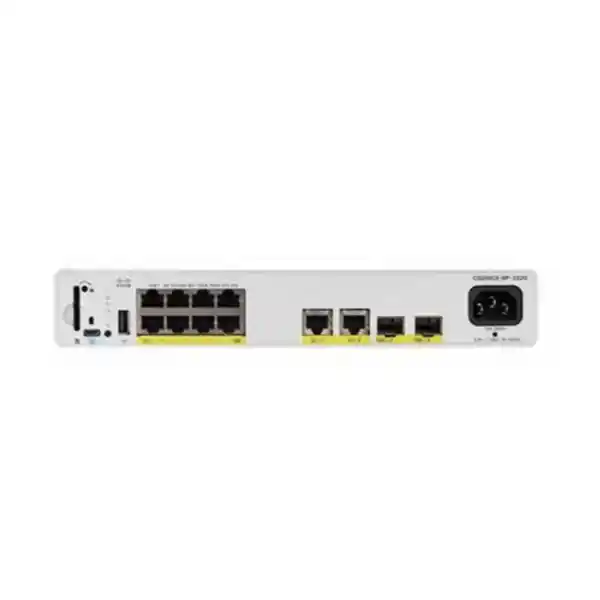
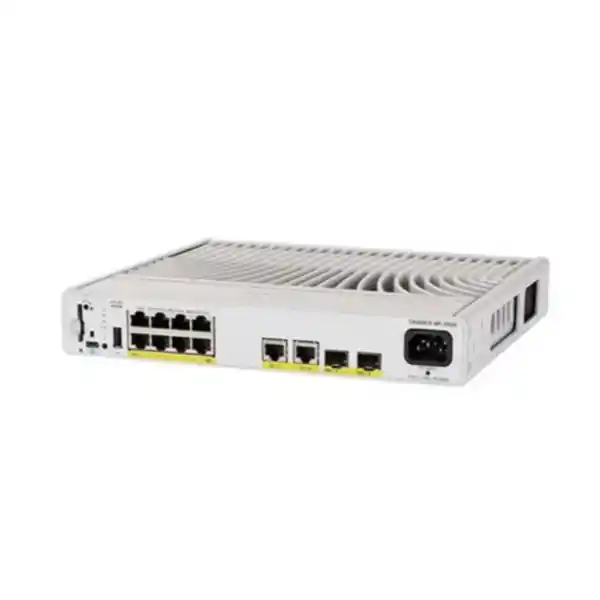
Cisco Catalyst C9200CX-8P-2X2G Network Switch
The Cisco Catalyst C9200CX-8P-2X2G brings enterprise Catalyst switching into locations where conventional access switches are too large, too noisy or operationally awkward. With eight 1 Gigabit PoE+ access ports, two fixed 10 Gigabit SFP+ uplinks, two fixed 1 Gigabit copper uplinks, fanless cooling and an internal AC power supply, it is designed for distributed access networks that need real campus policy, visibility and lifecycle control at the physical edge.
Direct answer: what is the C9200CX-8P-2X2G designed to solve?
The C9200CX-8P-2X2G is best understood as a small-footprint enterprise access-layer switch rather than a reduced-function small-business switch. Its role is to extend a managed Cisco campus into spaces where an ordinary 24-port or 48-port access switch would be physically excessive. Examples include hotel floors, retail back offices, executive suites, classrooms, clinic zones, control rooms, small branch offices, temporary project environments, meeting-room clusters, CCTV aggregation points and smart-building cabinets. In those locations, the requirement is often only four to eight powered endpoints, yet the network team still expects consistent VLAN design, authentication, traffic policy, Layer 2 protections, Layer 3 services, telemetry, automation and centralized operational discipline.
Cisco addresses that gap with a compact fixed-configuration platform based on the UADP 2.0 mini architecture and Cisco IOS XE Lite. The eight access ports support 10/100/1000 Ethernet and PoE+, while the uplink side provides two 10G SFP+ interfaces and two 1G copper interfaces. That port mix is particularly useful in distributed UAE deployments because the switch can sit close to endpoints while still backhauling over fiber at 10 Gigabit speeds to a building distribution layer. The two 1G copper uplinks can be useful for alternate copper handoffs, local routed connections, management designs or topology requirements where fiber is not necessary.
For organisations standardising on Cisco, the practical value is consistency. A compact switch can participate in the same architectural language as the wider Catalyst environment instead of creating an unmanaged or lightly managed island. Network engineers can keep common operational methods, configuration standards and troubleshooting workflows across headquarters, branches and edge rooms. FourTeck can align this switch with UAE campus, branch and smart-building requirements through the broader FourTeck UAE networking portfolio, including access design, optics planning, structured deployment and lifecycle support.
Verified hardware profile and port architecture
Access interfaces
Eight 10/100/1000BASE-T downlink ports provide standard Gigabit Ethernet connectivity and PoE+ power. The configuration suits Wi-Fi access points, IP phones, surveillance cameras, badge readers, thin clients, room systems and other powered edge devices that fit within the port and power envelope.
Fiber uplinks
Two fixed 10G SFP+ uplink ports provide high-speed connectivity toward aggregation or core switching. This is an important design feature because a compact access switch can still avoid an artificial 1G bottleneck when multiple endpoint flows converge toward shared services.
Copper uplinks
Two fixed 1G copper uplink ports complement the SFP+ interfaces. They offer practical flexibility where the upstream handoff is copper, where a local device requires a dedicated routed link, or where the topology needs a separate physical path without consuming an access PoE port.
Power and thermals
A 315W internal AC power supply supports the switch and PoE load. The platform is fanless, using passive heat dissipation through the chassis and heat-sink design. That makes placement possible in acoustically sensitive spaces but places greater importance on correct ventilation and ambient-temperature planning.
The model provides 60 Gbps of switching capacity and a forwarding rate of 44.64 million packets per second. Those values fit its physical interface mix and reinforce its role as a compact access platform rather than a high-density aggregation switch. For engineers, the relevant sizing question is not whether this switch can compete with a 48-port distribution chassis; it is whether eight 1G edge ports and up to 20G of SFP+ uplink connectivity are appropriate for the local traffic domain. In many branch and zone designs, they are more than sufficient, particularly when traffic is segmented across the two 10G uplinks or when one link is primary and the second is reserved for redundancy or an alternate distribution path.
PoE+ engineering: why the 240W budget matters
The eight access ports are PoE+ capable, with up to 30W available per port under the IEEE 802.3at PoE+ model, and Cisco specifies a maximum available PoE budget of 240W for the C9200CX-8P-2X2G. Numerically, that is a clean fit for eight ports at the 30W PoE+ ceiling. The practical implication is that a designer does not need to treat the switch as a heavily oversubscribed PoE platform when all eight ports are populated with ordinary PoE+ endpoints. Nevertheless, actual power planning should be based on each powered device’s negotiated class, worst-case consumption, operating mode and environmental conditions rather than on a simple port count.
Consider a hospitality floor where four ceiling access points draw approximately 18W each under typical load, two IP phones use 7W each, one camera peaks near 15W and a room controller uses 10W. The aggregate is comfortably below the switch budget. A different deployment with eight devices engineered to draw near the full PoE+ allocation approaches the 240W ceiling, so the bill of materials and port-power assumptions should be documented before installation. Power budgeting also matters when endpoints have transient peak requirements, optional USB peripherals, heaters, infrared illuminators or radios that increase consumption under specific conditions.
The switch does not provide the 60W UPOE capability associated with some other C9200CX variants. That distinction is essential. If the intended endpoint requires IEEE 802.3bt power levels, high-power Wi-Fi, pan-tilt-zoom cameras with accessories or other loads above the PoE+ envelope, the C9200CX-8P-2X2G may not be the right model even when the total wattage appears available. Port-level power capability and total chassis budget are separate design constraints. The correct selection process must validate both.
For UAE sites, PoE planning should also include UPS sizing, circuit protection, cabinet temperature and expected operating hours. A switch delivering substantial endpoint power is part of the electrical load, not merely a data device. In a small wall cabinet, the combined heat from the switch, optical modules, UPS, NVR equipment and adjacent security controllers can matter more than the switch’s fanless acoustic advantage. FourTeck’s UAE IT services team can incorporate switching, endpoint power and deployment considerations into a coordinated implementation plan.
Uplink design, fiber choices and traffic engineering
Two 10G SFP+ uplinks make the C9200CX-8P-2X2G unusually capable for a compact edge footprint. In practice, the uplink architecture can be designed in several ways. A single 10G link may connect the switch to a distribution switch, with the second SFP+ retained as a spare or used for a second physical path. Where the upstream architecture and software design permit, both uplinks can be used to increase resilience or aggregate bandwidth. The two additional 1G copper uplinks give the engineer another physical medium for local services or alternative network handoffs. The correct design depends on Layer 2 domain boundaries, spanning-tree policy, routing, upstream switch capability and the organisation’s failure-domain strategy.
Fiber selection should be treated as a complete optical path decision. The choice of SFP or SFP+ module must match link speed, fiber type, connector type, wavelength, reach and the capabilities at both ends. In a new building, multimode optics may be appropriate for short internal runs, while single-mode fiber can provide greater reach and a more consistent medium across floors, campuses or remote telecom rooms. Existing structured cabling should be tested rather than assumed. Loss budget, connector cleanliness, patch-panel condition and fiber polarity can determine whether an apparently simple 10G uplink performs reliably.
The 60 Gbps switching capacity is sufficient to support the physical topology without turning the switch into an obvious internal bottleneck under its intended access use. However, traffic engineering remains important. Eight user-facing ports can generate bursty traffic, especially when access points aggregate multiple wireless clients or surveillance cameras stream continuously. Designers should estimate peak and sustained throughput, not just average user traffic. A Wi-Fi access point connected at 1G cannot exceed that port rate, but several APs and cameras can converge simultaneously. A 10G upstream path offers ample headroom for this class of compact deployment.
Where dual upstream paths are used, the engineer should define the failure behaviour before production. Questions include which link carries which VLANs, whether Layer 3 routing is preferred over an extended Layer 2 domain, how convergence is expected to occur, how loops are prevented, and how monitoring detects degraded optics before a hard failure. The compact form factor does not remove the need for disciplined campus design; it simply relocates that design capability closer to endpoints.
UADP 2.0 mini architecture and forwarding scale
Programmable data plane foundation
Cisco’s C9200CX architecture is built around one UADP 2.0 mini ASIC for these PoE+ compact models. UADP is Cisco’s Unified Access Data Plane architecture, intended to support flexible forwarding pipelines and enterprise-scale policy functions in the access layer. This hardware foundation separates the C9200CX from low-cost unmanaged switches that rely on comparatively fixed feature sets and limited operational visibility.
For a network team, the value of a programmable access ASIC is not a marketing abstraction. It means the switch is engineered for the classification, forwarding, security and telemetry behaviours expected in a modern campus. Policy enforcement can occur at the edge, where devices connect, instead of forcing every decision into an upstream appliance.
Enterprise table scale
Cisco lists the C9200CX family with scale up to 32,000 MAC addresses and 14,000 IPv4 routes, comprising direct and indirect route capacity within the stated platform scale. Those figures are far beyond what a typical eight-port edge location will consume, but that is precisely the point: the compact model is not architected as a toy device.
The table scale provides design confidence when the switch participates in richer Layer 3 segmentation, dynamic environments or Cisco campus architectures. As always, feature combinations, software release, template choices and actual configuration can affect practical scale, so final designs should be validated against the software version selected for deployment.
Cisco also lists support for 16 virtual networks on C9200CX platforms in its current performance tables and identifies the compact family as SD-Access capable, subject to model, software and architecture requirements. For enterprises already operating Cisco campus fabric, this can matter because compact edge zones can remain part of the broader segmentation model instead of becoming exceptions. For organisations not using SD-Access, the same hardware still functions as a conventional managed access switch using familiar VLAN, Layer 2 and Layer 3 constructs. The purchasing decision therefore should not be based solely on fabric capability; it should be based on the complete operational model and the expected lifetime of the site.
Cisco IOS XE Lite: operations, programmability and lifecycle control
The C9200CX platform runs Cisco IOS XE Lite, bringing a structured enterprise software environment to compact access locations. The operational benefit is consistency. Engineers who already maintain Catalyst switching can use established concepts for configuration management, software maintenance, authentication, monitoring and policy. That reduces the operational fragmentation that occurs when every small branch or remote room uses a different class of switch with its own interface and feature vocabulary.
Model-driven programmability is especially relevant for organisations automating network changes. Modern operations increasingly depend on repeatable configuration, API-driven inventory, structured telemetry and compliance validation rather than manual CLI work on one device at a time. A compact switch may only serve eight edge ports, but if an enterprise deploys dozens or hundreds of these units across branches, hotels, retail stores or distributed facilities, automation becomes more important than raw port density. Consistent software behaviour allows small physical nodes to remain manageable as a large logical fleet.
Lifecycle control should include a defined software train, change window, backup method, configuration standard and rollback plan. Before deployment, the network owner should decide whether the switch will be managed directly, through an automation framework or as part of a wider Cisco management architecture. Security advisories and recommended software releases should be reviewed over the life of the hardware. A product page can identify software capability, but production readiness depends on disciplined operations after installation.
Licensing also requires deliberate selection. Cisco orders C9200CX-8P-2X2G hardware with Network Essentials or Network Advantage variants, represented by model suffixes such as -E and -A. The correct license should be chosen according to required routing, policy and feature depth rather than by assuming every Catalyst 9200CX license tier is identical. Procurement should capture the exact part number, selected network license, applicable Cisco software subscription requirements and support coverage on the quotation. This avoids the common problem of receiving the correct chassis with an incorrect entitlement for the intended architecture.
Security at the access edge
Access switching is one of the most important enforcement points in an enterprise network because it is where users, phones, cameras, access points, building systems and IoT devices enter the infrastructure. A compact switch should therefore be evaluated not only by port count and throughput but by how well it supports the organisation’s identity and segmentation model. The Catalyst 9200 family is designed for enterprise access use, giving engineers a platform for common controls such as authenticated access, VLAN assignment, access control, DHCP protection, Layer 2 safeguards, traffic classification and visibility features supported by the selected software release and license.
In a practical UAE deployment, security starts with port intent. A camera port should not be configured like an employee workstation port. An access point uplink may require trunking and a different trust model. A VoIP port may carry voice and data VLANs with specific quality-of-service behaviour. An unused port should not be left active without purpose. Compact switches frequently sit outside the main data room, making physical and logical port discipline even more important. Configuration templates should define allowed VLANs, authentication behaviour, edge protections, storm control, logging and administrative state based on endpoint role.
Segmentation is particularly valuable for IoT and operational technology. Smart-building controllers, CCTV cameras and badge systems may need network access but should not automatically share the same trust zone as corporate clients. The switch can form part of a layered design in which local edge policy, upstream routing and firewall enforcement work together. FourTeck’s Firewall Dubai solutions can be integrated with access-layer segmentation so that the switch delivers traffic into clearly defined security zones rather than an undifferentiated flat network.
Security design should also cover management access. Device administration should use controlled management subnets, authenticated administrator identities, secure management protocols, role separation where appropriate and central logging. Local console access remains important for recovery, but routine administration should be auditable. A compact switch installed in a public-facing or semi-public area deserves the same configuration governance as a switch in the main data centre because compromise at the edge can create a path toward the rest of the infrastructure.
Deployment patterns that fit the C9200CX-8P-2X2G
Hospitality floor zone
A hotel can place the switch in a controlled floor cabinet to power ceiling access points, IP phones or room systems while backhauling over 10G fiber. Fanless operation reduces acoustic concerns, and the compact chassis avoids dedicating a full-size access switch to a small endpoint count.
Retail branch
A store may need POS-adjacent network devices, wireless access, cameras, phones and local management connectivity without a full rack. Central configuration standards can keep the branch aligned with enterprise security while the fixed uplinks provide flexible WAN or aggregation handoff options.
Executive or meeting suite
High-end meeting rooms frequently include video endpoints, touch controllers, IP phones, room scheduling panels and wireless infrastructure. PoE+ can simplify power delivery and the fanless design avoids introducing fan noise near occupants or recording equipment.
CCTV edge cluster
A small camera zone can use PoE+ access ports for cameras while sending traffic upstream over 10G fiber. The design must confirm each camera’s peak draw, especially for PTZ, heaters or IR illumination, and ensure aggregate video throughput and retention architecture are sized correctly.
Education micro-zone
A classroom group or specialist lab can connect access points, phones, room controllers and wired clients without extending copper all the way back to a distant IDF. Fiber uplinks can reduce copper distance constraints and keep local endpoint wiring short.
Small branch office
For a branch with fewer than eight wired endpoints, this switch can deliver enterprise switching without wasting 16 or 40 unused access ports. The central team can preserve standards for VLANs, access policy and monitoring while keeping the branch equipment footprint modest.
These patterns all share one principle: deploy the switch where compactness and enterprise control intersect. The C9200CX-8P-2X2G is not intended to replace every access switch. If a site already needs 20 or 30 endpoints, buying several compact switches may create unnecessary management and cabling complexity compared with a higher-density Catalyst model. Conversely, installing a 48-port PoE switch for six endpoints can waste rack space, power and capital. Proper sizing starts with endpoint count, endpoint power, physical location, uplink medium, redundancy objectives and growth over the expected service life.
Fanless design: acoustic benefit with thermal responsibilities
One of the defining characteristics of the C9200CX-8P-2X2G is fanless operation. In a conventional access switch, fans move air through the chassis to remove heat, but they also create acoustic noise and introduce moving components. A fanless switch is better suited to locations where people work, sleep, meet or record audio. This can be significant in hospitality rooms, executive areas, reception spaces, classrooms, studios and compact retail environments.
Fanless does not mean thermally unconstrained. Cisco specifies the compact PoE+ model for operation up to 45°C under the stated environmental conditions, with a minimum operating range down to -5°C for most models and a minimum 0°C cold-start condition in the hardware guidance. Storage temperature extends well beyond the operating envelope. The switch dissipates heat through the chassis and heat sink, so airflow around the enclosure remains necessary even though no fan is pulling air through it. Installers should not bury the unit behind insulating material, pack it tightly against other hot equipment or assume a sealed cabinet is acceptable because the switch itself has no fan.
UAE deployments make ambient planning especially important. Outdoor kiosks, rooftop cabinets, service corridors and poorly ventilated communications closets can exceed comfortable electronics temperatures even when the air-conditioned office nearby is cool. Direct solar loading can make a small enclosure dramatically hotter than the surrounding environment. An installation survey should consider peak seasonal temperature, cabinet ventilation, adjacent equipment load, UPS heat, dust, cable congestion and the thermal effect of delivering a high PoE load.
Optics also require attention. The thermal tolerance of a specific transceiver can constrain the effective operating envelope of the installed system. The switch’s environmental rating should therefore not be read in isolation from the SFP/SFP+ module specification. A reliable design validates the complete assembly: switch, transceivers, power source, cabinet and environment. This is particularly important for continuously operating surveillance or hospitality networks where the cost of an intermittent thermal fault can exceed the cost of proper environmental preparation.
Physical dimensions, mounting and installation planning
Cisco lists the C9200CX-8P-2X2G at approximately 1.73 × 10.6 × 9.6 inches, or 4.4 × 26.9 × 24.4 centimetres, with a weight of about 6.6 pounds or 2.99 kilograms. The low height and compact width make it easier to place than a standard 19-inch access switch, but the installer still needs to plan mounting, service clearance, cable bend radius and access to the console and uplink interfaces. Compact installations often fail not because the switch is too large, but because power plugs, fiber patch cords and copper bundles require more working space than the chassis itself.
Before installation, the site should be surveyed for a stable mounting surface, controlled access, reliable AC power, grounding requirements and cable routing. Copper Ethernet runs must meet structured cabling limits and should be certified where the environment is sensitive. Fiber jumpers should be protected from tight bends and connector contamination. The 10G SFP+ ports are valuable only if the optical path is designed and maintained correctly; a dirty connector can create intermittent link errors that appear as application or switching problems.
The internal 315W power supply simplifies the physical build compared with designs that rely on external high-wattage bricks. However, the electrical feed should still be sized as part of the complete cabinet load. Where business continuity matters, the switch should be supported by a UPS with sufficient capacity for both the switch and the powered endpoints that must remain online. If the UPS only supports the switch while cameras, phones or access points depend on switch-delivered PoE, then the switch effectively carries those endpoint loads through the UPS as well.
Labelling is another small but high-value discipline. Identify the switch hostname, management address, circuit, uplink destination, optic type and connected endpoint role. In distributed buildings, technicians may encounter many visually similar compact devices. Accurate labels and updated network diagrams reduce mean time to repair. The physical deployment should be treated as part of the network architecture, not as a last-minute mounting exercise.
Technical specification table
| Category | C9200CX-8P-2X2G specification | Design implication |
|---|---|---|
| Access ports | 8 × 10/100/1000 PoE+ | Sized for small endpoint zones requiring Gigabit data and up to PoE+ class power. |
| Fiber uplinks | 2 × 10G SFP+ fixed | Supports high-speed fiber backhaul to distribution or core infrastructure. |
| Copper uplinks | 2 × 1G copper fixed | Adds flexible local or upstream copper connectivity. |
| PoE budget | 240W available | Can cover eight PoE+ ports at up to 30W each within the stated chassis budget. |
| Power supply | 315W AC internal, fixed | No field-replaceable redundant PSU; UPS and site power design may be important. |
| Cooling | Fanless | Suitable for noise-sensitive spaces; installation must preserve passive heat dissipation. |
| Switching capacity | 60 Gbps | Appropriate for the compact eight-port access role and fixed uplink architecture. |
| Forwarding rate | 44.64 Mpps | Enterprise-class packet forwarding for compact edge workloads. |
| Architecture | UADP 2.0 mini | Cisco programmable access data-plane foundation. |
| Software | Cisco IOS XE Lite | Supports enterprise operations, programmability and visibility. |
| MAC scale | Up to 32,000 on C9200CX family | Provides substantial headroom for enterprise access designs. |
| IPv4 route scale | Up to 14,000 on C9200CX family | Supports routed-access and segmented design use cases subject to software configuration. |
| Stacking | Not supported on this model | Design high availability through uplink/topology methods rather than StackWise. |
| Dimensions | 1.73 × 10.6 × 9.6 in / 4.4 × 26.9 × 24.4 cm | Compact form suits constrained edge locations. |
| Weight | 6.6 lb / 2.99 kg | Manageable for distributed installation and compact enclosures. |
Specifications should be validated against the exact Cisco orderable part number, chosen license, software release, optical module and regional bill of materials at quotation stage.
High availability without StackWise
A critical design point is that the C9200CX-8P-2X2G does not support Cisco StackWise stacking. This must not be overlooked when comparing it with larger Catalyst 9200 or 9200L models. Stacking allows multiple physical switches in supported families to operate with a unified stack architecture, but this compact model is intended to operate as a standalone switch. That does not make resilient networks impossible; it changes how resiliency must be engineered.
At the uplink layer, resilience can be created by connecting the switch to appropriately designed upstream infrastructure using its multiple fixed uplinks. The network architecture may use redundant upstream switches, redundant routed paths, Layer 2 mechanisms or other campus designs depending on the environment. The correct method depends on software capabilities, convergence objectives and the upstream topology. The key principle is to avoid assuming that two compact switches can simply be joined into a StackWise pair because they are members of the Catalyst 9200 family.
Power resilience requires a separate conversation. The C9200CX-8P-2X2G uses a fixed internal AC supply and does not provide the field-replaceable dual power-supply architecture associated with some larger access platforms. Where the switch supports phones, access points, cameras or building systems that must remain operational during utility disturbances, an external UPS is often the practical resilience layer. UPS sizing should include switch overhead and the expected PoE load, with realistic runtime objectives rather than nominal VA figures alone.
The broader availability design should also consider spare strategy. In a distributed estate, maintaining one or more pre-staged compact spares can be more effective than trying to engineer chassis-level redundancy at every eight-port location. A replacement unit can be preloaded with the correct software and configuration template so that a failed field device can be swapped quickly. This operational approach is particularly useful for retail, hospitality and branch networks where small nodes are geographically dispersed and technician travel time may dominate the outage duration.
Sizing methodology before you buy
The most reliable way to decide whether the C9200CX-8P-2X2G fits a site is to size the requirement from endpoints outward. Start with the physical port count. List every wired endpoint expected on day one, then add planned growth and service ports. If seven of eight access ports are already required at commissioning, the switch offers very little expansion margin. On the other hand, if the site will remain between four and six endpoints for its expected life, the eight-port density can be ideal.
Next, calculate PoE demand. Record each powered device’s standards requirement and peak wattage. Confirm that no endpoint needs more than PoE+ capability and that the aggregate remains within the 240W budget with sensible reserve. Access points should be checked carefully because some wireless models change radio capability or peripheral support when powered below their preferred level. Surveillance cameras should be checked for nighttime infrared load, PTZ motors, heaters and illuminators. Video collaboration systems may include multiple powered components rather than a single endpoint.
Then define uplink media and bandwidth. If the switch is located far from the distribution room, fiber may be the natural choice. Determine whether 1G or 10G is required based on endpoint traffic and growth. Validate optic type, fiber strand availability and upstream port capability. Where resilience matters, confirm that two physically diverse paths actually exist; two logical uplinks carried over the same damaged cable route are not true path diversity.
Finally, validate software and operations. Choose Network Essentials or Network Advantage according to required features. Confirm the software release, management platform, authentication design, telemetry method, logging destination and configuration template. For organisations with existing Catalyst networks, standardisation can materially reduce support effort. For greenfield networks, compare the C9200CX against other switch families based on the complete lifecycle, not only purchase price.
A FourTeck quotation can be scoped around the full design rather than the chassis alone: exact switch license, optics, patching, UPS requirements, mounting accessories, configuration, testing and handover. This reduces ambiguity between a hardware-only quote and a production-ready access solution.
Quality of service for voice, video, wireless and mixed edge traffic
Compact edge switches increasingly carry converged traffic. A single C9200CX-8P-2X2G may serve IP phones, wireless access points, cameras, room systems and ordinary wired clients simultaneously. These applications do not behave the same way. Voice is latency and jitter sensitive, interactive video can be bursty, surveillance streams are sustained, backups may be throughput intensive and guest wireless can produce unpredictable peaks. Quality of service is therefore a design requirement whenever the site has real-time traffic, constrained WAN links or shared uplinks.
The first QoS question is trust. Engineers should decide which endpoints are allowed to mark traffic and which markings must be rewritten at the access edge. An IP phone supplied and managed by the enterprise may be treated differently from an unmanaged endpoint. A wireless access point may transport multiple classes of client traffic over one physical interface. Classification and policy should reflect application intent, not simply accept every DSCP value received from the edge.
The second question is congestion location. With eight 1G access ports and 10G-capable uplinks, the switch-to-distribution link may have ample capacity, but congestion can still appear on a downstream 1G port, an upstream WAN circuit or a firewall interface. QoS design must therefore be end to end. Marking traffic at the access switch is only useful when subsequent devices preserve and act on those markings consistently. The C9200CX can participate in that enterprise policy, but it cannot compensate for an undersized WAN link or incorrectly configured upstream queueing.
For voice and collaboration deployments, the access switch should be coordinated with call-control, IP telephony and LAN design. The port may need voice VLAN configuration, power delivery and appropriate QoS policy. If the project also includes handsets or PBX infrastructure, FourTeck can align the switching layer with the relevant collaboration environment while maintaining a clean separation between access, security and voice services.
VLANs, routed access and segmentation strategy
Even an eight-port switch can support multiple business functions, which is why segmentation should be planned from the beginning. A typical compact deployment might have a corporate data VLAN, voice VLAN, camera VLAN, wireless management VLAN, guest wireless transport and switch-management network. The number of physical ports is small, but the logical environment can still be complex. Trunk links to access points or room systems may carry more than one VLAN, while simple endpoints may use a single access VLAN.
The architecture should define where Layer 3 boundaries live. Some organisations keep all inter-VLAN routing at the distribution layer or firewall, while others use routed access designs. The C9200CX family has substantial route scale for its physical size, but route scale alone does not dictate architecture. Security inspection requirements, policy ownership, failure domains, operational skills and existing Cisco standards should determine where routing occurs. If sensitive IoT or CCTV traffic must cross a firewall before reaching corporate resources, placing the inter-VLAN gateway at the access switch could bypass that intended control unless the wider design accounts for it.
Spanning-tree boundaries should also be deliberate in Layer 2 designs. Compact switches are often added incrementally, and ad hoc daisy chains can create avoidable loops or inefficient paths. Uplink redundancy should be mapped and tested, including failure of one upstream interface, one distribution device and one physical fiber route. Where Layer 3 routed links are practical, they can reduce Layer 2 fault domains; where Layer 2 extension is required, root placement and edge protections should be documented.
For SD-Access environments, Cisco lists C9200CX support for up to 16 virtual networks and fabric-edge use within stated software and architecture requirements. Organisations using Cisco fabric should validate the intended software release, feature requirements and access-tunnel limits during design. The important point is that this compact platform can participate in sophisticated segmentation strategies; its small chassis does not force a flat branch network.
Monitoring, telemetry and troubleshooting discipline
Distributed switches create an operational challenge: a failure may occur far from the network team, yet the site expects rapid diagnosis. The C9200CX should therefore be integrated into the same monitoring and logging framework as larger campus switches. At minimum, operations should track reachability, interface state, error counters, PoE status, uplink utilization, CPU and memory trends, environmental indicators supported by the platform, configuration changes and software health. Alerts should identify actionable conditions rather than simply produce noise.
PoE telemetry is particularly useful. A device that repeatedly renegotiates power or approaches port limits may appear to users as an application fault even though the root cause is electrical. Camera outages, access-point reboots and phone resets can often be correlated with switch port events. Likewise, increasing CRC errors on an uplink may indicate optic contamination, fiber damage or physical-layer degradation long before the link fails completely. Historical counters help distinguish a transient event from a persistent infrastructure problem.
Configuration management should be versioned and auditable. A known-good template can define NTP, DNS, AAA, logging, management ACLs, VLANs, port roles and telemetry. Site-specific variables are then inserted consistently. When many compact switches are deployed, the operational gain from templating is substantial. It reduces typographical mistakes, makes reviews easier and allows the team to compare live state against intended state.
Troubleshooting runbooks should account for the compact switch’s standalone nature. There is no StackWise peer to maintain local forwarding if the chassis fails. Therefore remote diagnostics, reliable out-of-band procedures where justified and a clear replacement process are important. A spare switch can be pre-staged with approved software so that a field technician only needs to connect labelled cables and apply the site-specific configuration. This approach turns a small branch device into a manageable component of an enterprise service rather than an isolated box.
UAE procurement and project-delivery considerations
Purchasing an enterprise switch in the UAE should begin with the exact orderable configuration, not only the base model name. The C9200CX-8P-2X2G is available in Network Essentials and Network Advantage orderable variants, so the quotation should state the suffix and entitlement clearly. Optics, power cables, support coverage, software subscription requirements and installation accessories should also be listed explicitly. A vague line item such as “Cisco 9200 compact switch” leaves room for mismatch between technical design and delivered hardware.
Lead time can be affected by exact SKU, license term, transceiver type and project quantity. Multi-site rollouts should standardise a small set of approved bills of materials wherever possible. For example, if all hotel floors use the same switch, same 10G optic type and same patching standard, staging and support become easier. Serial-number capture, asset tagging and configuration mapping can then be performed before devices reach site. This is more reliable than treating each floor or branch as an independent purchase.
Warranty and support should be aligned with operational criticality. A switch serving public Wi-Fi in a lounge may have a different business impact from one powering security cameras or access-control devices. The support plan, spare policy and replacement process should reflect that difference. For continuously operating environments, keeping local spares may complement vendor support by reducing the time required to restore service while an RMA is processed.
Project handover should include more than a delivery note. Useful deliverables include the final bill of materials, device serials, software versions, management addressing, port maps, optic details, VLAN assignments, uplink diagrams, test results, configuration backups and administrator credentials handled through the customer’s approved secure process. For installations integrated with compute or data-centre services, FourTeck’s Server Dubai infrastructure practice can coordinate switching requirements around server, virtualization and rack environments.
The objective is a supportable service, not merely a delivered chassis. A well-specified C9200CX-8P-2X2G can remain a consistent part of the enterprise access architecture for years, but that value depends on getting licensing, optics, configuration and operational ownership correct at the start.
When this model is the right choice — and when it is not
Strong fit
Choose the C9200CX-8P-2X2G when the site needs no more than eight 1G access ports, endpoints fit within PoE+ power levels, the total PoE demand is within 240W and fanless operation or compact mounting provides real value. It is also a strong fit when 10G fiber backhaul is desirable despite low edge-port density.
The model becomes especially compelling for organisations already standardized on Catalyst operations because compact branches can inherit enterprise policy, software practices and monitoring. A few ports can still be managed with the same discipline as a large campus access layer.
Consider another model
Select a different platform when endpoints require 2.5G, 5G or 10G multigigabit access, when individual devices need 60W-class power, when more than eight access ports are required, or when physical switch stacking is a mandatory high-availability feature. Other Catalyst 9200CX variants or higher-density Catalyst families may fit those requirements better.
A different model may also be preferable if field-replaceable redundant power supplies are mandatory or if the design expects rapid growth beyond the compact switch’s port count. Buying for the actual three-to-five-year requirement is usually cheaper than replacing an undersized switch soon after deployment.
The distinction between PoE+, UPOE and multigigabit variants deserves particular care. The C9200CX name covers several hardware configurations. A project that needs high-power Wi-Fi should not assume every C9200CX supports the same endpoint power or access speed. Likewise, the “2X2G” portion of this model reflects its fixed uplink arrangement and should not be interpreted as multigigabit downlink capability. Exact part-number validation prevents expensive mismatches.
Migration from unmanaged or small-business edge switches
Many compact locations begin with unmanaged or lightly managed switches because the initial network is small. As the site grows, this approach creates operational debt. VLANs may be inconsistent, ports may have no identity policy, camera traffic may share a flat segment with users, firmware may be managed manually, and troubleshooting may depend on physically visiting the site. Migrating to a Catalyst compact switch is an opportunity to correct those issues, but the migration should be planned rather than performed as a simple cable swap.
The first task is discovery. Record every connected device, MAC address, VLAN, IP addressing method, PoE requirement and upstream dependency. Identify devices with static addressing, hard-coded gateway settings or unusual Ethernet negotiation. Document whether any device depends on an untagged native VLAN or a specific trunk. If the old switch was unmanaged, traffic captures and endpoint configuration reviews may be required to understand hidden assumptions.
The second task is policy design. Decide the intended VLAN and security role for each port. Define management access, authentication, logging and monitoring before cutover. If network access control will be introduced, pilot it with representative endpoints rather than enabling strict authentication on every device at once. Cameras, printers and building systems may need MAC-based or device-specific treatment depending on the organisation’s policy platform.
The third task is controlled cutover. Preconfigure the switch, label ports, validate optics and test upstream connectivity in advance. Move endpoints in an order that preserves essential services. Verify PoE delivery, DHCP, DNS, gateway reachability and application function after each group. If a voice phone carries a workstation behind it, test both services. If a wireless access point transports multiple SSIDs, verify all mapped VLANs rather than only the AP management address.
Finally, capture the as-built state. Save configuration, diagrams, serial numbers and port labels. The real benefit of moving to an enterprise platform appears when the device becomes part of a managed operating model. The migration should end with visibility and standardisation, not simply a newer switch in the same undocumented environment.
Detailed design notes for wireless, CCTV, voice and IoT
Wireless: a 1G access port is appropriate for many access points, but newer high-performance APs may use multigigabit Ethernet and may require higher PoE classes. If the wireless design calls for 2.5G or 5G access or 60W power, choose a C9200CX multigigabit/UPOE variant instead. When 1G PoE+ is sufficient, the 10G SFP+ uplink gives the compact switch good aggregation headroom for several APs. Trunk configuration, native VLAN treatment and wireless management segmentation should match the controller or cloud architecture.
CCTV: calculate both bandwidth and power. Eight ordinary fixed cameras may fit comfortably, but high-resolution PTZ cameras can have materially different power profiles. Video bandwidth is usually sustained rather than bursty, so upstream utilization should be estimated from codec, resolution, frame rate and scene complexity. Cameras should be placed in a dedicated security zone with carefully controlled access to recorders, management stations and cloud services.
Voice: IP phones generally fit well within PoE+ capability. A voice VLAN, QoS policy and trusted call-control path should be defined. If a PC is connected through the phone, the access port may carry both voice and data roles, so authentication and VLAN handling should be tested with the exact handset model. During power planning, include any expansion modules or video features that increase handset consumption.
IoT and building systems: these endpoints often have long replacement cycles and inconsistent security capabilities. They benefit from network-level segmentation and strict communication paths. A building controller may need only a few protocols to a management server; it rarely needs broad access to corporate subnets. Edge switching should support that least-privilege architecture through VLAN assignment, ACLs or upstream security policy.
A mixed deployment may use all four endpoint types on one switch. In that case, treat the switch as a policy boundary. Document port purpose, endpoint identity, power draw and permitted network path. This prevents a compact switch from becoming a flat convenience bridge and preserves the enterprise security model at the smallest physical edge.
Performance interpretation: 60 Gbps and 44.64 Mpps in real networks
Switching-capacity figures are often quoted without context. For the C9200CX-8P-2X2G, Cisco specifies 60 Gbps switching capacity and 44.64 Mpps forwarding performance. The most useful interpretation is that the platform is engineered to forward traffic at the scale expected from its eight 1G access ports and fixed uplink arrangement. Packet-per-second capacity is relevant because many small packets can stress forwarding resources differently from a smaller number of large packets carrying the same number of bits.
A typical office does not generate worst-case minimum-size packets continuously on every port. Real traffic includes web applications, cloud sessions, file transfers, voice, video and wireless clients. In that environment, the limiting factor is often the endpoint’s 1G link, upstream WAN service or application server rather than the switch fabric. Nevertheless, published forwarding scale provides confidence that the switch is designed as an enterprise access device rather than an oversubscribed consumer bridge.
Wireless and surveillance deserve special attention because they can concentrate traffic. An access point may aggregate dozens of clients behind one 1G port. A camera consumes a continuous stream. Eight such ports can therefore generate substantial aggregate traffic even if no single interface exceeds 1G. A 10G SFP+ uplink provides ample headroom in many deployments. The second 10G interface can support alternate topology or additional uplink capacity depending on the approved architecture.
Performance should also be considered alongside policy. ACLs, routing, telemetry and security features consume platform resources and may have scale relationships defined by software. A design that approaches multiple table or feature limits should be validated against Cisco’s release-specific documentation rather than relying only on headline throughput. In normal eight-port access use, the platform’s published MAC and route scales are generous, but enterprise architects should still document assumptions when deploying advanced segmentation or fabric features.
Finally, application performance depends on the full path. A 10G uplink cannot compensate for a congested 200 Mbps WAN, an overloaded firewall or poor Wi-Fi radio design. The switch should be sized as one component in the service chain, with monitoring at each handoff so that future troubleshooting can identify the real bottleneck quickly.
Licensing and orderable variants
Cisco lists C9200CX-8P-2X2G orderable variants for Network Essentials and Network Advantage. In practical procurement language, that means the base hardware description is not enough to define the final bill of materials. A quotation should specify whether the project requires the -E or -A network-license variant and should include the applicable Cisco DNA or subscription entitlement required for the chosen ordering structure. License terms and Cisco commercial models can evolve over product life, so the final quote should be based on current Cisco ordering guidance at the time of purchase.
Network Essentials is commonly associated with core enterprise access capabilities, while Network Advantage provides additional feature depth for architectures that need more advanced functions. The right tier depends on the customer’s routing, segmentation, assurance and automation requirements. It is not efficient to buy the higher tier without a reason, but it is equally inefficient to deploy the lower tier and discover during implementation that a required feature is unavailable under that entitlement.
A license review should therefore be part of design sign-off. List every nontrivial feature the site expects: dynamic routing, advanced segmentation, fabric participation, telemetry, automation and any Cisco management integration. Map those requirements to the exact software tier and release. If the switch is joining an existing Catalyst estate, use the enterprise’s standard license policy so operations do not inherit a mix of inconsistent capabilities.
Support coverage should be quoted separately and clearly. Customers often confuse software entitlement, hardware warranty and technical support. These are different commercial and operational elements. The purchase record should identify the chassis SKU, license tier, subscription term if applicable, support level, optics and accessories. This documentation becomes valuable later during renewals, RMA processing and network audits.
Operational checklist for commissioning
1. Hardware and power
Confirm model label, license variant, AC feed, UPS path, grounding, cabinet clearance, passive ventilation and planned PoE load. Verify that high-power endpoints do not require capabilities beyond PoE+.
2. Optics and cabling
Validate SFP+ type, wavelength, fiber mode, connector cleanliness, link reach and upstream compatibility. Certify copper links where appropriate and ensure cable labels match the logical port map.
3. Software baseline
Install the approved IOS XE release, establish secure management access, configure time synchronization, logging, AAA, management ACLs and configuration backup before attaching production endpoints.
4. Access policy
Apply VLAN, voice, trunk, authentication, QoS and security settings according to endpoint role. Disable unused ports or place them into the organization’s approved unused-port posture.
5. Failure testing
Test loss of each uplink where redundant paths are configured, verify expected convergence, confirm UPS behaviour and document recovery procedures. Remember that this model is standalone and does not provide StackWise redundancy.
6. Handover
Capture serial numbers, configuration, diagrams, software version, optic inventory, port map and support details. Add the switch to monitoring and asset systems before the project is considered complete.
Decision recap for UAE buyers
The Cisco Catalyst C9200CX-8P-2X2G is a purpose-built compact enterprise access switch. Its defining combination is eight Gigabit PoE+ downlinks, a 240W PoE budget, two 10G SFP+ uplinks, two 1G copper uplinks, a 315W internal AC supply, fanless cooling and Catalyst software architecture. It is therefore best suited to small endpoint zones that still need enterprise management and security standards.
For a greenfield site, compare the cost of this compact switch with the cost of installing a larger rack, longer copper runs or noisy full-size hardware in an occupied room. For an existing Cisco estate, also count the operational value of keeping branch and edge switching inside the Catalyst management model. The lowest purchase price is not always the lowest lifecycle cost; consistency, faster troubleshooting and repeatable configuration can be worth more than unused ports.
Quotation input checklist
For an accurate UAE quotation, provide the information below. These inputs allow the switch, license, optics and implementation scope to be matched to the actual environment instead of quoting an incomplete chassis-only bundle.
Number of access points, phones, cameras, room systems, PCs and other wired devices.
Peak wattage and power standard for every powered endpoint, including future devices.
1G or 10G, copper or fiber, distance, connector type, fiber mode and required redundancy.
Network Essentials or Advantage needs, routing, segmentation, automation and management platform.
Cabinet size, ambient temperature, AC supply, UPS, access restrictions and mounting location.
Supply only, staging, configuration, installation, migration, testing, documentation and support.
Consultation and solution design
FourTeck can help determine whether the C9200CX-8P-2X2G is the correct compact Catalyst model for your UAE environment and build the surrounding bill of materials for optics, power protection, configuration and deployment. The objective is to match the access switch to the actual endpoint and architecture requirements rather than selecting hardware by model name alone.
For broader infrastructure projects, the FourTeck UAE team can coordinate switching with network design, security and implementation. Complex deployments can also incorporate operational services through FourTeck IT Services UAE, while server-facing network requirements can be aligned with Server Dubai. Where segmentation must extend through perimeter or internal security controls, Firewall Dubai can be included in the architecture.
Send the endpoint count, PoE loads, uplink distance, fiber type, preferred license tier and required support level. A technically complete quote can then be prepared around the exact deployment.

Reviews
There are no reviews yet.