
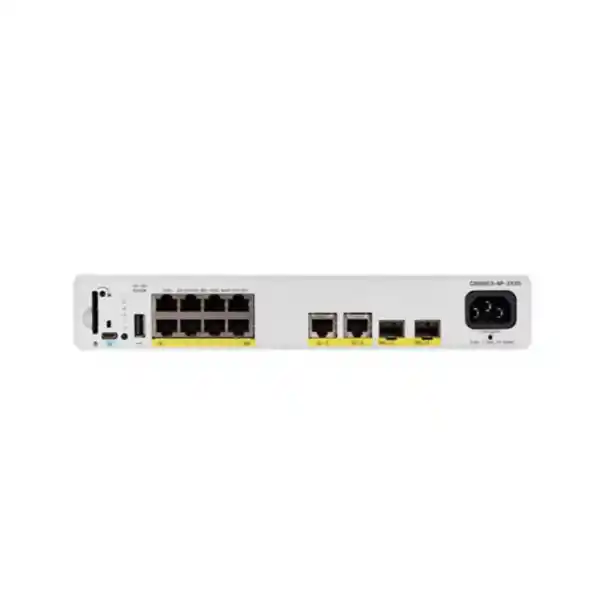
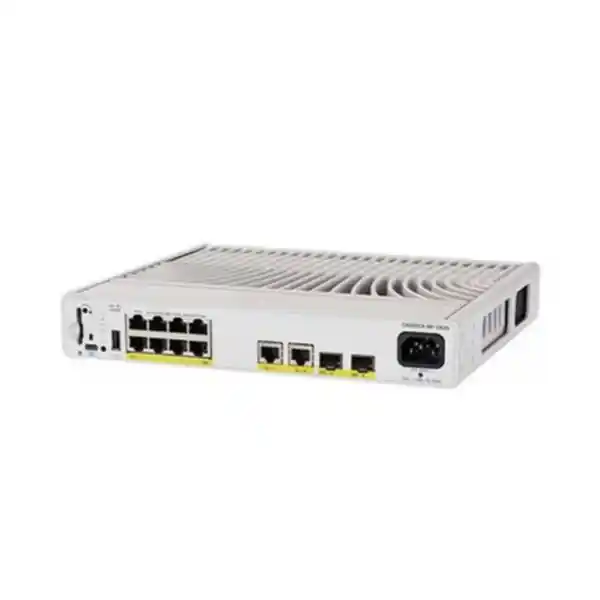
Cisco Catalyst C9200CX-8P-2XGH Network Switch
A compact, fanless Cisco IOS XE access switch engineered for locations that need enterprise policy, PoE+, fiber-ready uplinks and professional lifecycle management without the size and acoustics of a conventional 24- or 48-port access switch.
The C9200CX-8P-2XGH provides eight full PoE+ 1G access ports, two 1G copper and two 10G SFP+ fixed uplinks, 240W of available PoE power, 60Gbps switching capacity and 44.64Mpps forwarding in a fanless compact chassis with a fixed 315W HVDC/AC internal power supply.
Eight 10/100/1000 copper downlinks with IEEE 802.3at PoE+ support for powered endpoints.
Enough aggregate budget for dense phones, cameras, sensors and many access-point designs when correctly power-sized.
Fixed high-speed optical or DAC uplink interfaces for resilient access-to-distribution connectivity.
Designed for workspaces and edge locations where acoustic noise and physical footprint matter.
What the Cisco C9200CX-8P-2XGH is designed to solve
The Cisco Catalyst C9200CX-8P-2XGH addresses a common enterprise edge problem: many sites need only a handful of wired devices, but those devices still require enterprise-grade switching, managed PoE, secure segmentation, deterministic uplink behavior, automation and long-term operational consistency. A small branch reception area, point-of-sale island, meeting-room cluster, clinic department, warehouse control station or remote telecom cabinet may have only five to eight edge devices. Installing a conventional 24-port access switch can consume unnecessary rack space and power, introduce fan noise, and create more unused copper capacity than the location requires. Using an unmanaged desktop switch solves the port-count problem but removes the policy, visibility, lifecycle controls and standardized IOS XE operating model expected in a professional Cisco estate.
The C9200CX family sits between those extremes. It delivers compact access switching while retaining the operational philosophy of the Catalyst 9000 family. For UAE organizations that standardize campus and branch access on Cisco, this means distributed micro-sites can be brought under the same configuration templates, monitoring framework, security controls and change-management discipline as larger locations. The 8P-2XGH model specifically combines eight full PoE+ Gigabit Ethernet edge ports with four fixed uplink interfaces: two 1G copper ports and two 10G SFP+ ports. That mix is useful when a small access block must connect to a nearby copper aggregation point, a fiber distribution switch, or both for migration and resiliency planning.
The internal 315W HVDC/AC supply is another differentiator. The switch can operate from conventional line-voltage AC and is also intended for high-voltage DC environments where suitably engineered DC microgrid power is available. Cisco rates 240W of PoE power as available on this model. The result is an unusually capable compact edge switch: all eight access ports can provide standards-based PoE+ service, while the aggregate budget allows the designer to support combinations of phones, cameras, wireless access points, door controllers, sensors and other powered devices without immediately moving to a larger chassis.
FourTeck positions the C9200CX-8P-2XGH primarily for managed enterprise access rather than as a generic eight-port network switch. The value is not simply the number of ports. It is the combination of physical compactness, fanless operation, enterprise forwarding, Cisco IOS XE software, secure boot and trust capabilities, standards-based automation interfaces, PoE controls and the ability to place small network zones inside the same operational model as the wider campus or branch architecture. Organizations evaluating a broader access refresh can also use FourTeck UAE for design coordination across switching, routing, wireless, security and structured infrastructure.
Hardware architecture and physical design
Compact chassis for distributed access
The C9200CX-8P-2XGH chassis measures approximately 4.4 × 26.9 × 24.4cm and weighs about 2.99kg. Those dimensions make it suitable for locations where a full-width access chassis is impractical. Compact does not mean consumer-grade: the unit is intended to be installed as part of an enterprise network, with defined uplinks, management access, software lifecycle and security policies.
The physical footprint helps designers move switching closer to endpoints. This can reduce long copper home-runs, simplify localized PoE delivery and make it easier to create small network cells in retail, education, hospitality, healthcare, offices and industrial support environments.
Fanless thermal strategy
Cisco identifies the C9200CX compact models as fanless. In practice, that matters wherever the switch is mounted near occupants: conference rooms, front-of-house retail areas, classrooms, executive spaces, studio environments and quiet clinical zones. Eliminating fans also removes a moving component that otherwise becomes part of an acoustic and maintenance plan.
Fanless does not mean ventilation can be ignored. Installers still need adequate surrounding airflow, appropriate mounting clearance and an ambient environment within Cisco’s specified operating limits. Enclosures should not trap heat from PoE loads, UPS equipment or neighboring active devices.
Fixed internal 315W HVDC/AC supply
The 8P-2XGH model uses a fixed internal 315W HVDC/AC power supply. Cisco states that the HVDC models can operate from high-voltage DC as well as line-voltage AC, giving designers flexibility where DC microgrids are part of the facility strategy. For conventional installations, the AC input remains the normal choice.
Because the supply is fixed rather than a field-replaceable redundant pair, availability planning should be handled at the system level. Sites that demand power-path redundancy may use upstream UPS design, circuit strategy, spare-unit planning or a different Catalyst form factor if field-replaceable dual PSUs are a hard requirement.
Management and console access
The Catalyst 9200CX platform includes dedicated management capabilities and a compact console arrangement appropriate to the form factor. Cisco documents a Micro USB console on C9200CX, with an option to convert to RJ45 using the relevant console cable. This supports local staging and break-glass access while normal operations can use SSH, centralized management and automation interfaces.
For production deployments, FourTeck recommends documenting console access, management VLAN, device hostname, out-of-band strategy, AAA configuration, NTP, logging destinations and software baseline before the switch is dispatched to a remote site.
Port map: eight PoE+ access ports plus flexible uplinks
The port composition of the C9200CX-8P-2XGH is one of its strongest design attributes. The eight downlink ports are full PoE+ Gigabit Ethernet interfaces. They are intended for normal 10/100/1000BASE-T endpoint connectivity and can deliver IEEE 802.3at PoE+ power, up to 30W per port subject to the total power budget and endpoint negotiation. At the uplink side, the switch provides two 1G copper and two 10G SFP+ fixed uplinks. This gives network architects a practical mix for sites that may transition from copper to fiber, require two physically diverse uplinks, or need local connectivity to both a router/firewall and upstream switching infrastructure.
| Interface group | Count | Speed / media | Typical role |
|---|---|---|---|
| Access downlinks | 8 | 10/100/1000BASE-T with PoE+ | Phones, cameras, APs, PCs, IoT, controllers |
| Copper uplinks | 2 | 1G RJ45 | Local aggregation, router or transitional uplinks |
| SFP+ uplinks | 2 | Up to 10G | Fiber/DAC distribution connectivity and resilient uplinks |
A frequent design mistake with compact switches is to treat every uplink interface as interchangeable. The 1G copper ports and 10G SFP+ ports serve different practical purposes. Copper may be ideal when the upstream device is within structured-cabling distance and only Gigabit bandwidth is required. SFP+ becomes preferable when the distribution point is farther away, electrical isolation is desirable, the pathway already uses fiber, or the aggregate traffic from multiple edge devices could exceed a single Gigabit uplink. A dual-10G design can also provide headroom for burst traffic and future expansion even when the eight edge ports themselves remain at 1G.
The SFP+ interfaces should be designed with approved optics or supported direct-attach cabling. Selection depends on distance, fiber type, patching method, upstream optics, connector cleaning practice and environmental requirements. A 10G uplink is only as reliable as the complete optical channel. During quoting, it is useful to specify whether each uplink is intended for multimode fiber, single-mode fiber or a short rack/room DAC connection, and whether redundancy requires physically diverse pathways.
For UAE deployments, FourTeck can align switching with cabinet, fiber, server-room and structured infrastructure planning. Customers building a new distribution or compute room can coordinate the access-switch design with Server Dubai infrastructure solutions so that optics, racks, UPS capacity, patching and upstream interfaces are specified as one system rather than purchased as disconnected line items.
PoE engineering: how to use the 240W budget correctly
Cisco specifies 240W of available PoE power for the C9200CX-8P-2XGH. The eight access interfaces support PoE+; however, the correct sizing method is based on aggregate endpoint requirements, negotiated class behavior and engineering margin rather than simply multiplying eight ports by a nominal maximum. If every endpoint demanded the full 30W PoE+ limit simultaneously, the theoretical sum would be 240W, exactly equal to the published switch budget. Real projects should avoid planning every load at its absolute ceiling unless the endpoint specifications and power policy justify that assumption. Reserve should be considered for startup behavior, device replacement, future endpoint models and operational changes.
A practical branch might have four IP phones drawing 8W each, two cameras drawing 13W each, one wireless access point requiring 25W and one door controller drawing 10W. The calculated load in that example is only 93W, leaving substantial room for transients and later changes. A different site with eight high-performance access points near the upper end of PoE+ consumption could approach the available budget quickly. Therefore the purchase decision should be based on an endpoint power schedule, not just a port schedule.
Perpetual PoE
Catalyst 9200 supports Perpetual PoE, which is designed to maintain endpoint power during a switch reload. This can reduce disruption for powered endpoints when the network operating system is restarted.
Fast PoE
Fast PoE can restore power to attached devices before the switch operating system has fully completed its boot process, helping phones, cameras and other powered endpoints start sooner after power restoration.
Power policing
A managed PoE design allows power allocation and endpoint behavior to be controlled rather than leaving power distribution to an unmanaged injector strategy. This supports repeatable operations and troubleshooting.
Endpoint classification
Always record each powered device model, standard, expected draw and maximum draw. That makes the 240W total a design input instead of a late-stage deployment surprise.
PoE also changes the UPS calculation. When an access switch is powering phones, access points, cameras or building devices, the UPS is not protecting only the switch electronics; it is indirectly powering all attached devices. A 240W-capable PoE switch can therefore represent a much larger sustained UPS load than a non-PoE compact switch. The design should include actual switch consumption, expected PoE draw, UPS conversion efficiency, required runtime, battery aging, temperature and any additional equipment on the same protected circuit.
Where the switch supports business-critical endpoints, consider operational consequences of power loss. A reception switch could affect phones, door access and cameras at the same time. A classroom switch might drop wireless and AV control simultaneously. For those sites, a dedicated UPS, monitored power circuit and clear escalation process may be more valuable than simply choosing a larger PoE wattage. FourTeck’s IT Services UAE team can incorporate switch staging, UPS planning, VLAN design, monitoring and deployment documentation into the rollout.
Performance, scale and packet-forwarding profile
Cisco publishes a 60Gbps switching capacity and 44.64Mpps forwarding rate for the C9200CX-8P-2XGH. For an eight-port access platform, those numbers are appropriate for a device whose primary job is to provide local Gigabit Ethernet edge connectivity and aggregate traffic toward high-speed uplinks. The performance should be interpreted in context: the switch is not intended to replace a high-density distribution chassis. Its value is delivering Catalyst 9000 access functionality at a compact edge while retaining sufficient internal capacity for the intended port configuration.
Cisco lists 4GB of DRAM and 8GB of flash for the C9200CX class in its platform scalability information, along with support for up to 4094 VLAN IDs, 512 switched virtual interfaces and jumbo frames up to 9198 bytes. These figures illustrate that the compact format does not imply a stripped-down unmanaged operating model. The device can participate in sophisticated enterprise segmentation and routing designs, subject to the licensed feature set and validated software release. The 9200CX class also supports Flexible NetFlow resources and security-group-related scale appropriate to enterprise access use cases.
In real deployment sizing, the more important question is often oversubscription. Eight 1G edge ports can theoretically source 8Gbps in one direction, while a single 10G uplink can carry more than that aggregate without creating a simple line-rate bottleneck. If two 10G uplinks are used for resiliency or a port channel, uplink capacity is even less likely to be the limiting factor for ordinary office traffic. By contrast, using only one 1G copper uplink can create a clear aggregation constraint if several endpoints transmit heavily at the same time. That may be acceptable in a light-use branch but not for a camera recording cluster, media workspace or access point serving high client density.
Application behavior should guide design. IP phones consume little bandwidth but can be latency-sensitive. Surveillance cameras produce continuous upstream traffic. Wireless access points may generate asymmetric bursts and many concurrent client flows. PCs can create large file-transfer spikes. Access-control devices use little throughput but can be operationally critical. The C9200CX-8P-2XGH can service all of these endpoint types, but VLAN, QoS, uplink and failure-domain decisions should reflect the workload rather than treating all eight ports as equivalent.
Cisco’s published mean time between failures figure for this model is 734,030 hours. MTBF is a statistical reliability metric, not a promise that an individual unit will operate for a specific number of years, but it is useful for comparing platform reliability assumptions in fleet planning. For remote branches, holding regional spares, backing up configurations and standardizing software images often has more operational value than relying on any single reliability figure.
Cisco IOS XE: automation, telemetry and operational consistency
The C9200CX-8P-2XGH runs Cisco IOS XE, which is central to why this switch belongs in an enterprise design. IOS XE provides a common software foundation across much of the Catalyst 9000 switching portfolio. Organizations can therefore apply familiar CLI practices while also moving toward API-driven configuration, model-driven telemetry and controller-based operations. For network teams managing dozens or hundreds of branches, this consistency reduces the number of device-specific operating models that must be maintained.
Automated provisioning is especially useful for compact switches because they are often deployed in remote or semi-remote locations. Rather than sending a senior engineer to every small branch, the deployment process can standardize device naming, software release, management addressing, uplink VLANs, AAA, logging, NTP, SNMP or telemetry, and edge-port templates before shipment or through automated workflows. Cisco Plug and Play and other supported provisioning mechanisms can reduce manual staging effort when the wider architecture is prepared for them.
IOS XE exposes standards-based automation through NETCONF and RESTCONF with YANG data models. For organizations using Ansible, Python-based orchestration, network source-of-truth platforms or commercial management systems, these interfaces can make the switch part of a repeatable infrastructure-as-code workflow. A compact branch switch should not become an exception to configuration governance simply because it has only eight access ports. In fact, small distributed devices benefit disproportionately from automation because manual drift across many sites is difficult to audit.
Model-driven telemetry allows operational data to be streamed to management destinations according to subscriptions. This can improve visibility compared with periodic polling alone, particularly for interface state, utilization, errors and other operational signals. A mature monitoring design should define what telemetry is needed, where it is collected, how long it is retained and which events trigger an incident. Excessive telemetry without operational ownership merely creates noise; the objective is actionable visibility.
Cisco also highlights software patching capabilities within IOS XE, including cold patching for selected fixes that requires a reboot for activation. This reinforces the need for a maintenance strategy. Network teams should maintain a validated release policy, monitor Cisco advisories, test significant upgrades, retain rollback plans and schedule updates based on business risk. Perpetual PoE can help keep powered endpoints energized during a reload, but network forwarding is still affected while the switch software restarts. Change windows should therefore reflect the actual service impact.
From a lifecycle perspective, the switch should be onboarded into asset management with serial number, support entitlement, software release, license level, installation location, uplink details and endpoint role. A compact switch hidden above a ceiling, inside furniture or in a remote closet can be forgotten operationally. Good documentation ensures it remains part of patching, backup, monitoring and replacement plans.
Security foundation and segmentation options
Catalyst 9200 Series switches incorporate Cisco Trust Anchor technologies intended to provide a hardware-rooted foundation for software and platform authenticity. Cisco documents capabilities such as image signing, Secure Boot and Trust Anchor functions as part of the platform security model. These controls are important because the access layer is where user devices, phones, cameras, access points and IoT equipment first enter the enterprise network. Compromise or misconfiguration at this layer can bypass higher-level architectural assumptions.
Segmentation should begin with role definition. A small eight-port switch may serve several distinct trust zones: corporate users, voice devices, cameras, building-control endpoints and guest or contractor equipment. These should not automatically share a flat broadcast domain. VLAN separation, policy enforcement, authentication mechanisms, access-control lists and upstream firewall policy can be combined according to the organization’s security architecture. The switch can provide the local enforcement and classification point while the wider campus, WAN or firewall design determines where inter-zone traffic is permitted.
Port security should be tailored to endpoint behavior. Static infrastructure devices may justify tightly controlled access-port templates. User-facing ports may require 802.1X or MAC Authentication Bypass depending on the identity architecture. Trunk ports should be explicitly configured rather than relying on permissive defaults. Unused ports should be disabled or placed in a restricted state. DHCP snooping, Dynamic ARP Inspection, IP Source Guard and other access-layer protections may be appropriate depending on topology, software feature availability and licensing. The design goal is to reduce the trust granted merely because a device has physical access to a switch port.
Management-plane security is equally important. Administrative access should use SSH rather than insecure legacy protocols, authenticated users should be centrally managed where practical, privileges should be role-appropriate, and logging should be sent to a central system. SNMPv3 is preferable when SNMP is required. Management traffic should be separated from ordinary user traffic. NTP should be reliable so logs and security events correlate accurately. Configuration backups should be automated and encrypted where they contain secrets or sensitive network details.
For sites connected through firewalls or SD-WAN, treat the C9200CX as part of an end-to-end security design. The switch controls local access and segmentation; the firewall controls inter-zone and north-south traffic; identity and monitoring systems provide context. FourTeck’s Firewall Dubai practice can align the compact access switch with firewall interfaces, VLAN handoff, policy zones, VPN topology and secure branch segmentation.
Security features should always be validated against the selected Network Essentials or Network Advantage license and the intended IOS XE release. A procurement document that says only “Catalyst 9200CX” is incomplete because licensing can determine which routing, segmentation and automation features are available. The bill of materials should therefore state the exact hardware suffix, subscription choice, term and any required management platform entitlements.
Licensing: Network Essentials, Network Advantage and subscription choices
Cisco lists two primary hardware ordering variants for this model: C9200CX-8P-2XGH-E with Network Essentials and C9200CX-8P-2XGH-A with Network Advantage. The perpetual network license is associated with the selected hardware tier, while Cisco DNA or current Cisco switching subscription options are ordered as term-based software entitlements according to Cisco’s ordering model. Cisco continues to document three-, five- and seven-year terms for DNA subscriptions in the Catalyst 9200 family. Current ordering rules should be checked at the time of quotation because licensing programs evolve over the product lifecycle.
C9200CX-8P-2XGH-E
Appropriate where foundational Layer 2/Layer 3 access, automation, visibility and security functions meet the deployment requirement. Pair the hardware and subscription selections according to Cisco’s current ordering rules.
C9200CX-8P-2XGH-A
Selected when advanced routing, segmentation, scale or policy capabilities beyond the Essentials tier are required. The final feature requirement should be mapped to Cisco’s current licensing matrix before purchase.
The key procurement principle is to license from requirements, not from assumptions. If the switch will provide only Layer 2 access with simple static routing, an Essentials design may be sufficient. If the architecture calls for advanced routing, richer segmentation, software-defined access functions, advanced policy or other Advantage-only features, choosing the lower tier simply to reduce acquisition cost can create rework later. Conversely, purchasing Advantage without a defined feature need can increase cost without operational benefit.
Cisco’s Smart Licensing Using Policy framework is relevant to Catalyst 9000 operations. The licensing implementation and reporting process should be included in deployment planning, particularly for organizations with centralized Cisco Smart Accounts, partner-managed estates or disconnected environments. The network team should know who owns the Smart Account, which virtual account should receive the device, how license usage is reported, and how renewals are managed.
Subscription expiry does not mean the perpetual network base capability simply disappears, but subscription-based features and management capabilities are subject to the applicable entitlement. Renewal planning should therefore begin before expiry, especially in organizations that depend on Cisco Catalyst Center automation, assurance or policy features. Keep contract dates and license identifiers in the asset-management system rather than relying on email reminders.
When requesting a FourTeck quote, specify whether the target is Network Essentials or Network Advantage, the desired software subscription tier, term length, support requirement and whether the switch will be managed by Catalyst Center. This prevents a hardware-only quote from omitting the software and lifecycle components required for a compliant Cisco deployment.
Recommended UAE deployment scenarios
Branch office access cell
A branch with six to eight desks can place phones and PCs on the switch, use voice and data VLANs, power a local wireless AP, and connect to the branch router or firewall through copper or fiber uplinks. The compact footprint helps where the communications cabinet is small.
Retail and point-of-sale zone
POS terminals, printers, IP phones, cameras and wireless access points can be consolidated on one managed edge switch. VLANs and port controls keep payment, corporate, security and guest functions logically separated according to the wider compliance design.
Meeting and collaboration suite
A conference area may need a room codec, touch panel, IP phone, wireless AP, AV controller and occupancy sensors. Fanless operation is particularly attractive when the switch is installed close to meeting spaces and must remain acoustically unobtrusive.
Camera and security cluster
The eight PoE+ ports can power a localized camera group, while 10G fiber uplinks provide ample aggregate bandwidth toward the recording or security network. PoE and bandwidth calculations should use each camera’s maximum draw and configured stream profile.
Classroom or training room
The switch can support an AP, instructor station, IP phone, AV endpoint, digital signage and room-control equipment. A standardized template keeps the classroom edge consistent with the campus network while the fanless design suits occupied spaces.
Smart-building micro-zone
Door controllers, sensors, cameras, environmental devices and other IP building systems can be grouped locally and segmented from corporate users. The design should coordinate PoE requirements, physical security, OT policy and facilities ownership.
Topology patterns for the C9200CX-8P-2XGH
The switch can be inserted into several access topologies. The simplest is a single-uplink branch edge: one 10G SFP+ or 1G copper uplink connects the switch to a distribution switch, router or firewall, while all eight access ports serve local endpoints. This is inexpensive and easy to operate, but the uplink and upstream device form a single point of failure. It is suitable when the business impact of a local outage is low or where a spare path is not physically available.
A dual-uplink topology improves resilience. The two SFP+ interfaces can connect to redundant upstream devices or participate in an appropriate port-channel design when supported by the upstream architecture. The precise redundancy method depends on whether the upstream devices form one logical system, use Multi-Chassis EtherChannel or another supported architecture. Do not create parallel Layer 2 links without a deliberate loop-prevention and convergence design. Spanning Tree, EtherChannel, routing and upstream redundancy must be engineered together.
For routed access, Layer 3 uplinks can reduce the Layer 2 failure domain and simplify convergence, but the required routing features must match the selected license. Routed access is often attractive in larger enterprise designs where each access block should have a clear Layer 3 boundary. In smaller sites, VLAN trunks to a local firewall may be operationally simpler because the firewall can enforce policy between voice, user, camera and guest networks.
A firewall-on-a-stick or VLAN handoff design is common in branches. The switch creates access VLANs, the uplink carries tagged VLANs to a firewall, and the firewall provides gateway and policy enforcement. This is straightforward but places inter-VLAN traffic through the firewall. If local traffic volume is significant, the firewall throughput and interface design must be sized accordingly. Alternatively, the switch may host SVIs and route locally while selected traffic is sent to the firewall, depending on security and licensing requirements.
For IP telephony, the access port can be configured with voice and data VLAN behavior appropriate to the endpoint. A phone may receive PoE from the switch while a workstation connects through the phone’s integrated PC port. This can conserve physical switch ports, but it also means one access port affects two user devices. Quality of Service, LLDP/CDP behavior, DHCP options and call-control reachability should be validated as part of the design.
For wireless, an AP powered by the C9200CX should be checked for both power and Ethernet speed requirements. This model’s access ports are 1G, not multigigabit. If an AP requires 2.5G, 5G or 10G Ethernet to deliver its intended performance, a C9200CX multigigabit variant or another Catalyst model may be a better fit. The 8P-2XGH is strongest when the edge endpoints are correctly matched to Gigabit Ethernet while the upstream aggregate benefits from 10G.
Sizing methodology before you buy
Correct switch sizing starts with an endpoint inventory. List every device expected at the location during the next three to five years, not only what is installed today. Record whether each endpoint requires data only or PoE, its maximum Ethernet rate, expected average bandwidth, burst behavior, VLAN or security zone, business criticality and physical cable route. Then reserve ports for maintenance, temporary devices and foreseeable expansion. An eight-port switch is ideal when the planned endpoint count is genuinely compact; it is not ideal when eight ports are already fully committed on day one with no expansion path.
Second, create a PoE schedule. Record the powered device standard and maximum expected draw, not merely a vendor’s “typical” power figure. Sum the worst-case engineering values that are likely to occur simultaneously. Compare the result with the 240W available budget and retain reasonable headroom. Consider whether a future camera, AP or collaboration endpoint might need more power than the current model. If the site is likely to transition to UPOE devices that exceed PoE+ per-port capability, choose a different switch model now rather than planning injectors later.
Third, size uplinks. Calculate the traffic profile, not just the number of users. Eight office phones and PCs may operate comfortably behind a 1G uplink, but eight high-bitrate cameras or a cluster of Wi-Fi devices can justify 10G. If uplink resiliency is required, specify whether the design needs two optics, two fibers, diverse routes and redundant upstream switches. A bill of materials that includes the switch but omits optics, patch leads and upstream port availability is not deployment-ready.
Fourth, choose the software license tier. Map required features to Network Essentials or Network Advantage and the relevant Cisco subscription. Document the desired term and management platform. If the organization uses Catalyst Center, include device onboarding, discovery credentials, site hierarchy and template assignment in the deployment scope. If management is CLI-based, define configuration standards and backup procedures.
Fifth, plan power and environment. Confirm AC or HVDC input, plug and cable requirements, UPS sizing, mounting method, grounding, ambient temperature and ventilation. Fanless operation reduces noise but does not eliminate heat. The 240W PoE budget means the unit can deliver substantial power into endpoints, and that energy ultimately becomes heat somewhere in the local environment.
Finally, decide whether the compact form factor is operationally appropriate. If the site requires field-replaceable dual power supplies, switch stacking, 24 or 48 access ports, multigigabit downlinks, or higher PoE classes on many ports, another Catalyst 9200 family member may fit better. Good sizing avoids forcing a compact switch into a role it was not designed to fulfill.
Cabling, optics and installation planning
The eight Gigabit Ethernet access ports use standard copper structured cabling. Cat5e can support 1000BASE-T within standards-based channel limits, though many new UAE installations use Cat6 or Cat6A for improved headroom and alignment with future network upgrades. Cabling quality matters particularly for PoE because power and data share the same conductors. Poor terminations, excessive resistance, damaged pairs or substandard patch cords can create intermittent problems that are difficult to distinguish from switch or endpoint faults.
For new installations, certify permanent links and retain the test records. Label both ends of every cable using a consistent site/rack/patch-panel/port convention. Document which switch port maps to which patch-panel port and endpoint. This becomes invaluable when a camera, AP or phone fails months later. A compact switch is often installed outside the primary IT room, so remote support depends heavily on accurate physical documentation.
The 10G SFP+ uplinks require deliberate optic selection. Multimode fiber is common for short in-building runs; single-mode is common for longer runs and campus pathways. The optic must be supported by the switch and matched to the upstream optic, fiber type and distance. Connector cleanliness is critical at 10Gbps. A fiber link that appears physically intact can still suffer from excessive loss caused by contaminated connector end faces. Installers should clean and inspect connectors before insertion and protect unused ports with dust caps.
Direct-attach copper can be useful for short-distance 10G links inside the same cabinet or immediately adjacent rack, subject to compatibility. DAC reduces optic count and can be cost-effective, but it is not a substitute for building cabling. If the switch is mounted in a remote room, proper structured fiber is usually the better long-term choice.
Mounting should preserve access to power, console, network interfaces and cable bend radius. Do not mount the unit where patch cords are crushed, SFP+ modules are exposed to accidental impact, or ventilation openings are blocked. If the switch is placed above a ceiling or inside joinery, confirm that the location is permitted by facility and fire-safety requirements and remains serviceable without disruptive building work.
A complete commissioning test should verify every copper port, PoE negotiation, VLAN assignment, uplink redundancy, optical receive levels where available, management reachability, NTP, logging, AAA, configuration backup and monitoring. The objective is to validate the switch as an operational system, not merely confirm that its LEDs turn green.
UAE procurement and lifecycle considerations
Cisco network procurement in the UAE should be handled as a lifecycle decision rather than a one-time hardware purchase. The C9200CX-8P-2XGH may remain in service for years, during which software updates, support entitlement, optics, spares, configuration standards and license renewals all affect total cost. A low initial price is not necessarily the lowest lifecycle cost if the quote omits software, support, correct power components or compatible uplink accessories.
Start by confirming the exact orderable SKU. The base name C9200CX-8P-2XGH identifies the hardware family and port configuration, while the -E and -A suffixes distinguish Network Essentials and Network Advantage variants. The quote should also state the selected subscription term and any support service. If the deployment requires 10G fiber uplinks, include the optic part numbers and quantities. If spare optics are part of the operational model, include those as separate line items.
Lead time should be considered when a project includes many distributed branches. Rather than allowing every site to order ad hoc, standardize one or two approved bill-of-material templates. A typical template could define the switch SKU, license tier, subscription term, two approved uplink optics, power cord, mounting accessories, console adapter, patch leads and optional spare. Standardization makes procurement, staging and support more predictable.
For Dubai and wider UAE deployments, environmental conditions outside climate-controlled rooms deserve attention. The switch should not be exposed to outdoor heat, direct solar load, dust accumulation or uncontrolled humidity simply because it is fanless. Remote retail kiosks, guard rooms, warehouses and semi-conditioned utility areas can experience higher ambient temperature than central IT spaces. The equipment location should be assessed, not assumed.
Support planning should identify who opens vendor cases, who holds the device credentials, where configuration backups are stored and how a replacement unit is staged. For a remote branch, a preconfigured spare can reduce recovery time substantially. If the site is business-critical, keep the latest approved configuration and a documented replacement procedure accessible to the support team.
FourTeck can supply Cisco switching as part of a wider UAE network project, including access design, firewall integration, structured cabling coordination, device staging and rollout services. For multi-vendor and end-to-end infrastructure projects, the broader FourTeck global network can support regional standardization beyond a single UAE location.
When this switch is the right fit — and when it is not
Strong fit
Choose the C9200CX-8P-2XGH when the site needs up to eight Gigabit access ports, managed PoE+, silent operation and enterprise Cisco software in a compact footprint.
It is especially attractive when 10G fiber uplinks are useful, the access-port count is genuinely small, and the organization wants the site to conform to Catalyst 9000 operational standards.
Typical examples include micro-branches, retail pods, classrooms, meeting suites, clinic areas, camera clusters and smart-building zones.
Consider another model
Choose another Catalyst model when you need more than eight access ports, multigigabit edge interfaces, UPOE/UPOE+ on many ports, switch stacking, field-replaceable redundant power supplies or substantially greater expansion headroom.
Also reconsider this SKU when the endpoint roadmap includes Wi-Fi access points that require 2.5G or higher wired connections. The 8P-2XGH downlinks are Gigabit Ethernet.
A larger switch can be more economical than deploying multiple compact switches when many ports are concentrated in the same rack.
Operational deployment checklist
Record exact SKU, serial number, license tier, software subscription, support contract and installation location.
Select an approved IOS XE release based on enterprise policy, Cisco recommendations, feature needs and vulnerability management.
Configure management addressing, SSH, AAA, NTP, DNS, logging, SNMPv3 or telemetry, and restricted administrative access.
Define VLANs, voice VLANs, 802.1X/MAB behavior, port security, QoS and disabled-port policy through standard templates.
Verify endpoint power class, measured/expected draw, total budget, power-priority policy and UPS runtime.
Test fiber or copper uplinks, port channel or redundancy behavior, allowed VLANs, routing adjacency and failover convergence.
Decision recap for IT managers and network architects
The Cisco Catalyst C9200CX-8P-2XGH is best understood as an enterprise micro-access switch. It is not simply an eight-port alternative to an unmanaged desktop switch. It is a compact member of the Catalyst 9200 family with IOS XE, eight full PoE+ 1G access ports, 240W available PoE power, two 1G copper and two 10G SFP+ fixed uplinks, 60Gbps switching capacity, 44.64Mpps forwarding and a fanless chassis. These attributes make it particularly useful where enterprise controls must extend into small, distributed locations.
The strongest architectural reason to select this model is consistency. A large organization may have high-density Catalyst switches in headquarters and only six devices in a satellite room. The C9200CX lets that small site remain part of the same Cisco operating model rather than becoming an unmanaged exception. Centralized configuration, identity controls, telemetry, security policy and lifecycle practices can extend to the edge without installing a physically oversized switch.
The strongest physical reason is fanless compact deployment. In occupied rooms, noise can be a real constraint. In small closets, depth and mounting space can be a constraint. In distributed smart-building zones, running every endpoint back to a central room can be a cabling constraint. Moving the switch closer to endpoints can solve these issues while preserving enterprise management.
The strongest power reason is the 240W PoE budget across eight PoE+ ports. This allows a dense set of ordinary PoE endpoints to be supported without external injectors, provided the total and per-port requirements are correctly engineered. Perpetual PoE and Fast PoE capabilities add operational value for endpoints that should remain powered or recover power quickly during switch maintenance and restarts.
The strongest connectivity reason is the mixed uplink set. Two 10G SFP+ interfaces provide high-speed fiber-ready aggregation, while two 1G copper uplinks preserve flexibility for local or transitional designs. That combination is unusually useful in compact deployments because it avoids forcing the architect to choose a single uplink medium at purchase time.
The main limitations are equally clear: there are only eight Gigabit access ports, the model is not a multigigabit downlink platform, the compact family does not provide switch stacking, and the fixed internal power architecture is different from larger C9200 models with field-replaceable redundant supplies. If those limitations conflict with the requirement, use them as a signal to select a different Catalyst variant rather than forcing the project around the wrong hardware.
Quotation input checklist for the Cisco C9200CX-8P-2XGH
A precise quotation reduces both procurement delays and deployment surprises. Send the following information with your request so the FourTeck team can match hardware, software, optics, power and services to the actual UAE site requirement.
| Input | What to specify | Why it matters |
|---|---|---|
| Quantity | Number of switches and number of deployment sites | Determines staging, spares and logistics planning |
| License tier | Network Essentials (-E) or Network Advantage (-A) | Controls feature entitlement and hardware SKU |
| Subscription | Required Cisco software tier and 3/5/7-year term where applicable | Ensures compliant ordering and management capabilities |
| PoE endpoints | Models and quantities of phones, APs, cameras and IoT devices | Confirms the 240W budget and per-port PoE+ suitability |
| Uplink medium | Copper, multimode fiber, single-mode fiber or DAC; include distance | Determines optics, patching and upstream compatibility |
| Redundancy | Single uplink, dual uplink, dual upstream switches or routed design | Defines optic count and topology |
| Power | AC or engineered HVDC environment, UPS requirement and runtime target | Ensures compatible power design and service continuity |
| Management | Catalyst Center, CLI, third-party NMS or automation platform | Shapes onboarding, licensing and deployment scope |
| Services | Supply only, staging, configuration, installation, migration or managed support | Clarifies deliverables and project ownership |
Plan the switch as part of the network, not as an isolated SKU
For a reliable UAE deployment, the final bill of materials should connect six decisions: exact C9200CX-8P-2XGH license variant, software subscription term, endpoint PoE schedule, uplink optics, upstream topology and support model. FourTeck can turn those inputs into a site-ready configuration and quotation rather than a hardware-only line item.
Share your port count, endpoint models, fiber distance, VLAN/security requirements, current Cisco environment and preferred support term. The resulting design can cover switching, firewall handoff, optics, UPS, configuration, installation and post-deployment documentation as one coordinated scope.
What FourTeck can deliver
- Validated Cisco bill of materials
- Essentials vs Advantage licensing guidance
- PoE and UPS sizing
- 10G optic and fiber selection
- VLAN, QoS and security templates
- Staging, rollout and support options across the UAE

Reviews
There are no reviews yet.