
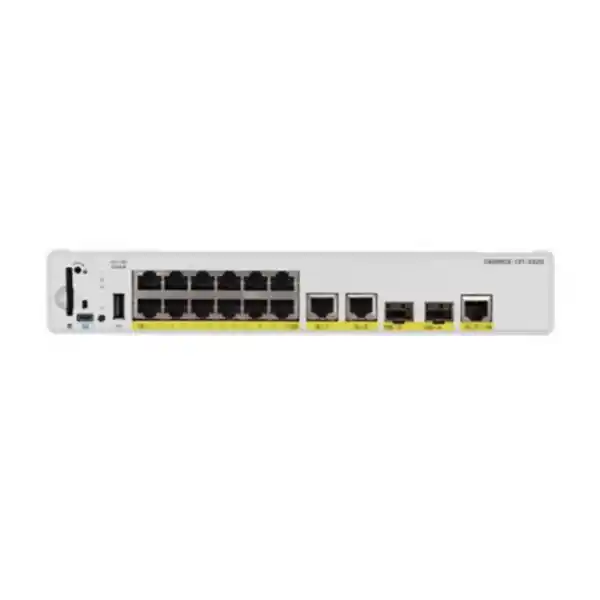
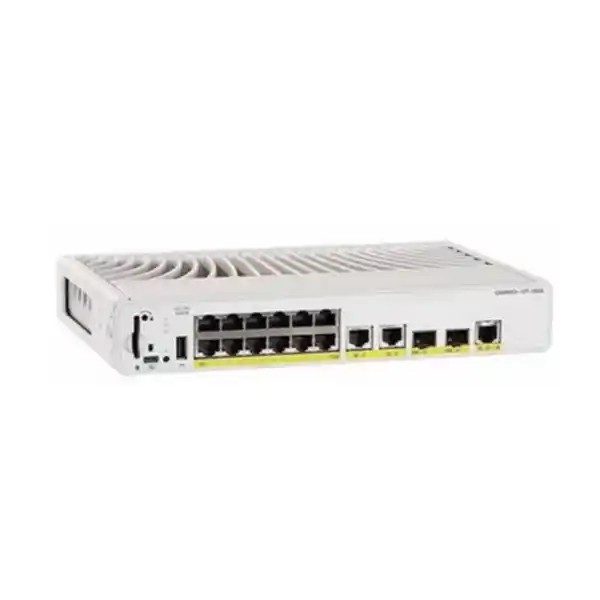
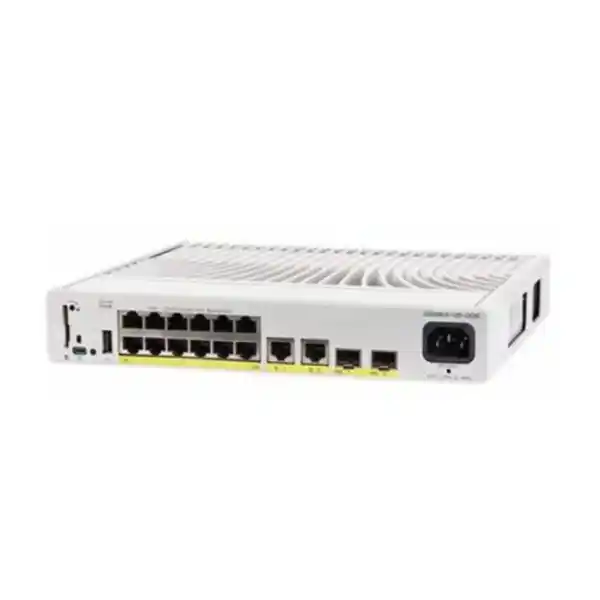
Cisco Catalyst C9200CX-8UXG-2X Network Switch UAE
A fanless Cisco Catalyst 9200CX access platform for organizations that need multigigabit copper, high-power UPOE, 10G optical uplinks, enterprise segmentation and IOS XE management in a compact edge form factor.
The multigigabit interfaces support 1G, 2.5G, 5G and 10G Ethernet for high-performance edge devices.
All eight downlink ports support IEEE 802.3bt Type 3 Class 6 UPOE, with a shared maximum power budget of 240W.
Designed to sustain demanding access workloads while preserving high-speed uplink and multigigabit edge headroom.
Enterprise policy, programmability, telemetry, security controls and lifecycle operations on a modern Cisco software foundation.
Direct answer: what is the Cisco Catalyst C9200CX-8UXG-2X?
The Cisco Catalyst C9200CX-8UXG-2X is a compact managed enterprise switch in the Catalyst 9200CX family. It is built for access-layer deployments that need substantially more capability than a conventional eight-port Gigabit switch. Four copper downlinks operate at 10/100/1000 Mbps, while four multigigabit copper interfaces can negotiate 1, 2.5, 5 or 10 Gigabit Ethernet in addition to lower legacy speeds. All eight downlink ports can provide 802.3bt Type 3 Class 6 UPOE power, and the chassis offers a maximum aggregate PoE power budget of 240W. Two fixed SFP+ interfaces provide 10G uplink connectivity toward aggregation or distribution switching.
This combination is especially valuable for modern edge devices whose bandwidth and power demands have increased at the same time. Wi-Fi access points can require multigigabit data rates because a 1G copper interface can become a bottleneck when aggregate wireless throughput exceeds traditional Ethernet speeds. High-end cameras, video collaboration endpoints, specialized IoT gateways, digital signage controllers, building systems and compact servers can also benefit from higher link rates or higher inline power. Rather than deploy a large 24- or 48-port chassis where only a handful of endpoints are required, the C9200CX-8UXG-2X places Cisco enterprise switching capability much closer to users and equipment.
For UAE organizations, that compact edge model can simplify designs in branches, executive areas, reception spaces, training rooms, retail sites, hospitality floors, clinics, warehouses and distributed buildings. FourTeck can position the switch as part of a broader campus or branch architecture, including compatible optics, copper cabling, uplink design, VLAN planning, PoE sizing and implementation services through FourTeck UAE.
Port architecture and practical bandwidth design
Four standard Gigabit downlinks
Ports in the standard Gigabit group are appropriate for phones, printers, controllers, cameras, payment terminals, conventional workstations and other devices that do not need more than 1G of Ethernet throughput. Keeping these interfaces separate from the higher-speed group makes it easier to reserve multigigabit ports for the endpoints that genuinely need them. Even though these links are limited to 1G data rates, they still participate in the switch’s UPOE power capability, so bandwidth and power requirements can be evaluated independently.
Four multigigabit downlinks
The four mGig ports support 10M/100M/1G/2.5G/5G/10G Ethernet. This provides a migration path for endpoints whose performance sits between traditional 1G and full 10G. A device can be installed at 2.5G or 5G today and later replaced with a 10G-capable endpoint without automatically requiring a switch replacement. For 10G over twisted-pair copper, infrastructure quality matters; Cisco specifies Category 6A or better for this 10G operating mode.
Two fixed 10G SFP+ uplinks
The dual SFP+ uplinks allow the access switch to connect upstream without consuming one of the eight powered copper downlinks. Depending on the physical topology and supported transceiver selection, these interfaces can be used for resilient uplink designs, dual-homing strategies or bandwidth aggregation. The uplink plan should be matched to the upstream switch, fiber type, distance, optics compatibility and required Layer 2 or Layer 3 behavior rather than treating an SFP+ cage as a generic optical port.
128 Gbps switching capacity
Cisco lists the C9200CX-8UXG-2X at 128 Gbps switching capacity. This is significant because the product is compact but is not architected like an unmanaged edge box. The bandwidth envelope is designed around simultaneous access and uplink traffic, allowing the unit to support demanding enterprise edge roles while retaining policy enforcement, telemetry and security functions associated with the Catalyst platform.
UPOE 60W and the 240W power-budget calculation
Power over Ethernet design should never be reduced to the statement that a switch “supports PoE.” The relevant engineering questions are which IEEE power class is available at each port, how much total power the chassis can allocate, how many endpoints are expected to draw near their negotiated maximum at the same time, and how much operational reserve should remain for future additions. The C9200CX-8UXG-2X supports IEEE 802.3bt Type 3 Class 6 UPOE on all eight downlink ports, with up to 60W class capability per port. The chassis, however, has a maximum PoE budget of 240W, so eight endpoints cannot all draw 60W simultaneously.
A simple sizing example illustrates the difference. Four high-performance wireless access points budgeted at 45W each consume 180W, leaving 60W for the remaining ports. If two additional endpoints are budgeted at 25W each, the planned allocation reaches 230W and leaves only 10W of margin. That configuration may be electrically valid, but it gives little flexibility for endpoint replacement or temporary power variation. By contrast, four 35W access points plus four 15W devices equal 200W, preserving 40W of headroom. Actual negotiation and device draw depend on the connected equipment, but procurement should be based on credible worst-case requirements rather than typical idle consumption.
This distinction is important for UAE smart-building and branch deployments. Wireless access points, pan-tilt-zoom cameras, room systems and specialized gateways may use more than the 15.4W or 30W commonly associated with earlier PoE generations. A 60W-capable access port can eliminate local power adapters, but only if the overall 240W chassis budget remains sufficient. For installations with many high-draw devices, multiple compact switches or a larger PoE platform may be a better design than forcing every endpoint onto one eight-port unit.
FourTeck can combine switching and endpoint power planning with structured cabling and deployment support. Organizations that also require broader onsite network, infrastructure or support work can coordinate those requirements through FourTeck IT Services UAE.
Fanless compact design: where it changes the deployment model
The Catalyst 9200CX line uses passive cooling rather than chassis fans. Cisco describes the top of the unit as an integrated heat-dissipation surface, with the enclosure designed to move heat away from the internal components without an acoustic fan system. This makes the C9200CX-8UXG-2X useful in occupied spaces where a conventional switch fan can be distracting: meeting rooms, hotel areas, executive offices, classrooms, clinics, reception zones and compact retail installations are typical examples.
Fanless does not mean thermal conditions can be ignored. Passive cooling relies on free airflow around the chassis and appropriate ambient temperature. Cisco specifies an operating range of -5°C to +40°C for the C9200CX-8UXG-2X, with cold start subject to the documented minimum condition. UAE deployments therefore require particular care when the switch is installed in wall boxes, ceiling spaces, AV cabinets, outdoor-adjacent enclosures, warehouses or non-conditioned technical rooms. A compact enclosure that traps heat can be more challenging than a large air-conditioned data room even when the network load is modest.
The correct installation approach leaves ventilation clearance, avoids placing heat-producing equipment directly against the switch and considers the combined thermal output of PoE endpoints, power conversion and surrounding devices. Cisco includes onboard thermal monitoring and protection behavior, but thermal safeguards should be treated as protection rather than an operating strategy. Stable environment design improves performance consistency and equipment life while reducing unexpected shutdown risk.
The physical chassis is approximately 4.4 × 26.9 × 24.4 cm and weighs about 3.18 kg for this model. Those dimensions enable placement options that are difficult with a full-width rack switch, but the mounting method must still protect cable bend radius, fiber connectors, power entry and service access.
UADP 2.0 Mini architecture: why the ASIC matters
The C9200CX family uses Cisco’s UADP 2.0 Mini application-specific integrated circuit. UADP, or Unified Access Data Plane, is central to the Catalyst design because forwarding, classification, access control, quality of service, telemetry and other data-plane functions can be implemented in purpose-built silicon rather than relying on a general-purpose processor for every packet. The “Mini” implementation is optimized for compact fixed access products while retaining the architectural model used across Cisco’s broader enterprise switching portfolio.
Cisco’s architecture documentation describes the UADP 2.0 Mini as a system-on-chip design with a single forwarding core, 6 MB of packet buffer and an embedded CPU complex. The C9200CX platform provides 4 GB of DRAM and 8 GB of flash storage. These resources support IOS XE operation, feature processing, telemetry, configuration storage and software lifecycle tasks. The product’s published platform scalability includes up to 32,000 MAC addresses, 14,000 combined IPv4 ARP and learned-route entries, 4,000 IPv4 routing entries, 2,000 IPv6 routing entries, 1,000 multicast routes, 1,600 ACL scale entries and 16,000 Flexible NetFlow flows for the C9200CX family.
The practical importance is policy consistency. A compact switch deployed behind a meeting room, on a retail floor or inside a branch can still participate in an enterprise operational model using VLANs, routed interfaces where appropriate, access control policy, telemetry and automated configuration. It does not have to become an unmanaged exception simply because the physical site has only a few network ports.
At the same time, engineering should be based on the exact C9200CX limits rather than assumptions taken from larger Catalyst platforms. The C9200CX family does not support StackWise stacking. Its hardware scale and physical redundancy characteristics are different from modular C9200 models, so the compact architecture should be selected because it fits the edge requirement, not because it is expected to behave identically to a full-size access stack.
Cisco IOS XE: operations, automation and telemetry
Cisco IOS XE gives the C9200CX-8UXG-2X an operational model consistent with modern Catalyst switching. Traditional CLI configuration remains available for network engineers, but the platform also supports programmable workflows that are important for organizations managing many branches or repeatable site designs. Cisco documents NETCONF and RESTCONF interfaces using YANG data models, allowing external systems to retrieve operational state and apply structured configuration through standards-based APIs.
Model-driven telemetry is another major capability. Instead of depending only on periodic polling, telemetry can stream selected operational data to collectors at defined intervals. This enables monitoring systems to observe interfaces, counters and state changes with greater granularity. In a distributed UAE environment, telemetry can help a central operations team distinguish access-port faults, uplink congestion, endpoint behavior and configuration drift without visiting every site.
Automated provisioning can also reduce deployment variance. When branches are rolled out in quantity, the objective is not merely to make each switch work; it is to make every switch conform to the intended software, naming, VLAN, security, authentication, logging, time, management and monitoring standards. Cisco’s Catalyst ecosystem supports automated onboarding approaches that can be combined with organization-specific templates and change controls.
Automation should nevertheless be implemented with governance. API access must be authenticated and restricted, configuration templates should be validated, and production changes should be logged. Compact switches are often installed in remote locations where a mistake may be harder to recover physically. A controlled automation workflow therefore reduces risk only when it includes versioning, review, rollback planning and clear ownership.
Layer 2 segmentation, VLAN scale and loop control
The C9200CX platform supports up to 4094 VLAN IDs and up to 512 switched virtual interfaces, with the actual feature set influenced by the selected software license and network design. In an eight-port edge switch, these scale numbers are rarely approached, but they demonstrate that the platform can participate in a segmented campus rather than operating as a simple flat LAN extension. A single unit may separate corporate users, voice, wireless infrastructure, cameras, building systems, guest services and management traffic even when only a small number of physical endpoints are connected.
Spanning-tree design remains important because compact switches are often connected in places where ad hoc patching can create accidental loops. The C9200CX family supports enterprise spanning-tree capabilities, including large logical scale for PVST and MST deployments. The correct mode should align with the upstream campus standard. Consistency is more important than choosing a protocol per closet; edge devices should inherit a clear topology policy covering root placement, port roles, protection features and recovery behavior.
Access ports should normally receive explicit endpoint-oriented configuration rather than default trunk behavior. Voice VLANs, endpoint authentication, storm control, DHCP protection, source validation, port security or policy-based controls can be applied where required by the organization’s architecture. Uplink ports should have a deliberate allowed-VLAN scope and native-VLAN strategy instead of carrying every VLAN unnecessarily.
For physically distributed sites, segmentation also helps fault containment. A broadcast issue, misconfigured endpoint or unmanaged appliance attached to one service VLAN is less likely to affect unrelated systems when the logical boundaries are correctly implemented. The C9200CX-8UXG-2X is compact in size, but its role should still be documented in the same network diagrams, IP plans, VLAN matrices and change processes as larger access switches.
Designing for Wi-Fi 6, Wi-Fi 6E and high-throughput access points
One of the strongest use cases for the C9200CX-8UXG-2X is high-performance wireless access. Modern enterprise access points can aggregate traffic from many radios and clients, making a traditional 1G wired interface a potential bottleneck. Multigigabit Ethernet allows a compatible access point to negotiate 2.5G, 5G or 10G over copper while preserving the familiar twisted-pair cabling model. The four mGig ports on this switch let an organization reserve high-speed connectivity for the APs that need it and use the four 1G ports for lower-bandwidth peripherals.
Wireless design must align three independent capacities: radio-side performance, wired Ethernet bandwidth and PoE power. A high-end AP connected at 5G but constrained by insufficient power may disable radios or features, while an adequately powered AP on a 1G wired link may face backhaul congestion. The C9200CX-8UXG-2X addresses both dimensions by combining multigigabit data rates and Type 3 Class 6 UPOE capability on the same interfaces. The shared 240W PoE budget still has to be calculated across all connected devices.
Cable quality is also part of wireless performance. A link that negotiates reliably at 1G is not automatically suitable for 5G or 10G operation over the same installed copper. Channel length, category, termination quality, patch leads, interference and certification affect the achievable rate. Cisco specifies Category 6A or higher for 10G use on these ports. During upgrades, it is sensible to certify the cabling rather than assuming an existing outlet will support the target mGig speed.
Where wireless is being paired with secure internet access, branch firewalls or segmentation gateways, FourTeck can also coordinate adjacent security requirements through Firewall Dubai, helping keep switching, uplink and security design aligned rather than specified in isolation.
Branch-office topology: compact access without unmanaged islands
Small branches often create an architectural dilemma. A full-width high-port-count switch may be excessive, yet a consumer or unmanaged device can undermine enterprise standards for VLAN separation, logging, authentication, visibility and lifecycle support. The C9200CX-8UXG-2X addresses this gap by delivering enterprise switching in an eight-port fanless chassis. It is particularly appropriate when the branch has a few critical powered endpoints but still needs central operational discipline.
A typical topology can place the C9200CX behind a branch firewall or routed distribution layer. The two SFP+ uplinks connect toward the upstream network, while copper downlinks serve access points, IP phones, video systems, workstations and cameras. VLAN trunks can preserve logical separation between corporate, voice, guest, security and management services. If resilient upstream connectivity is required, both uplinks can be engineered as part of the upstream design, subject to the selected topology and supported port-channel behavior.
The switch is not StackWise-capable, so high availability should be achieved through network topology rather than expecting multiple C9200CX units to operate as one physical stack. Two compact switches can still be deployed in a site, but they remain independent control-plane devices. Resilience design therefore needs separate management, independent configuration and appropriate upstream redundancy. In environments where a single switch failure cannot interrupt access, endpoint distribution and upstream design should reflect that requirement.
Branch standardization works best when the switch configuration is treated as a productized site template. Interface descriptions, VLAN assignments, authentication settings, management addresses, logging targets, NTP sources, SNMP or telemetry, admin access, backup and software versions should be specified before rollout. A compact switch can then become a repeatable building block rather than a one-off local installation.
Retail, hospitality and customer-facing environments
Retail and hospitality networks frequently require switching close to the service area rather than inside a central communications room. Point-of-sale systems, digital signage, wireless access points, cameras, access-control panels, IPTV devices and room technology may be distributed across a floor. Pulling every copper cable back to one closet can increase pathway congestion and limit flexibility. A compact access switch can aggregate local endpoints and use a higher-speed fiber uplink back to the central network.
The C9200CX-8UXG-2X is particularly well suited to these spaces because it is fanless. Silent operation is useful near guests, customers, front-desk personnel or meeting rooms. The compact enclosure also supports installation in restricted technical spaces, provided airflow and temperature limits are respected. For UAE hospitality projects, thermal planning is important when the switch is located above ceilings, behind displays or inside joinery where ambient temperature can exceed room temperature.
The eight powered ports also reduce the number of AC adapters required at the edge. A local access point, camera and collaboration endpoint can receive power through the network cabling, simplifying the outlet layout and enabling centralized UPS protection if the switch’s power feed is backed up. However, the 240W total PoE budget remains the governing limit; project bills of materials should include per-device power requirements rather than merely count the number of ports.
Because customer-facing networks may carry both operational and guest traffic, segmentation should be designed from the outset. Retail payment systems, staff devices, cameras, signage and guest Wi-Fi should not be placed into an undifferentiated broadcast domain. The switch’s enterprise feature set enables those services to remain logically separated while sharing the same compact physical platform.
Smart buildings, cameras, AV and operational technology
Smart-building projects increasingly converge devices that were previously installed on isolated control networks. Cameras, door controllers, sensors, room schedulers, IPTV endpoints, AV-over-IP devices, environmental gateways and wireless infrastructure can share structured Ethernet while remaining separated by policy. The C9200CX-8UXG-2X can function as a local aggregation point in these designs, especially where only a small group of high-value endpoints is present in each zone.
PoE simplifies installation because many edge devices can be powered from the switch rather than individual electrical outlets. This can improve serviceability and makes centralized backup power more practical. Yet operational-technology devices often have unusual power profiles, so the correct budget must use documented maximum consumption and power class. Some cameras draw substantially more power when heaters, infrared illuminators or motors are active; AV endpoints may peak under full load; access points can increase power requirements when all radios and USB features are enabled.
Multigigabit capacity is also relevant to AV and high-resolution video. While many cameras remain well below 1G, a concentrated video or AV-over-IP endpoint may need more bandwidth. The four mGig ports provide flexibility for those devices without converting the entire local access layer to 10G copper. The two 10G SFP+ uplinks then provide a suitable path toward a high-bandwidth aggregation layer when traffic from multiple edge systems is combined.
Operational technology should be isolated using explicit VLAN and security policy, with management access restricted to authorized systems. Device onboarding, MAC behavior, multicast needs and quality-of-service requirements can differ from ordinary office endpoints. The correct switch configuration therefore starts with an application inventory rather than copying a standard user-access port profile onto every interface.
Security foundation and trustworthy platform controls
Catalyst 9200 Series switches are designed with Cisco Trust Anchor technologies that help establish confidence in the hardware and software platform. Cisco documents capabilities including image signing, Secure Boot and a Trust Anchor module. These mechanisms are intended to protect the integrity of the boot process and software images, which is important because an access switch occupies a privileged position between endpoints and the rest of the enterprise network.
Platform trust should be combined with network access policy. The switch can participate in designs that classify endpoints, enforce VLAN or policy assignments, control Layer 2 behavior and restrict management access. The specific configuration depends on the chosen license, authentication architecture and the organization’s identity systems. In mature environments, the objective is to avoid treating physical connection as automatic authorization. A device plugged into an unused wall outlet should receive only the access that policy allows.
Management-plane hardening is equally important. Administrative protocols should be encrypted, local credentials should be minimized where centralized identity is available, unused services should be disabled, source networks for management access should be restricted and configuration backups should be protected. Logging and telemetry should be sent to systems where security and operations teams can correlate events across the network.
For procurement, authenticity also matters. Enterprise switching should be sourced through channels that can provide traceable hardware, correct regional power accessories, valid licensing and support entitlement. A low initial price can be misleading if the unit arrives with mismatched software entitlement, unclear ownership or unsupported components. FourTeck’s role is to align the physical switch, required licenses, compatible optics and deployment scope into one complete UAE quotation.
Performance and scalability reference
| Metric | C9200CX platform / C9200CX-8UXG-2X value |
|---|---|
| Switching capacity | 128 Gbps for C9200CX-8UXG-2X |
| MAC addresses | Up to 32,000 |
| IPv4 routes / ARP + learned routes | Up to 14,000 combined, including 10,000 direct and 4,000 indirect routes |
| IPv4 routing entries | Up to 4,000 |
| IPv6 routing entries | Up to 2,000 |
| Multicast routes | Up to 1,000 |
| ACL scale | Up to 1,600 entries |
| Flexible NetFlow | Up to 16,000 flows |
| Packet buffer | 6 MB |
| DRAM / Flash | 4 GB DRAM / 8 GB flash |
| VLAN IDs | Up to 4094 |
| SVIs | Up to 512 |
| Jumbo frame size | Up to 9198 bytes |
Published scale values describe the platform maximums and should not be interpreted as a recommendation to operate every resource at its ceiling. Feature interactions, software release, license level and design objectives should be reviewed for production sizing.
QoS planning for voice, video, wireless and critical traffic
Bandwidth alone does not guarantee application quality. An access switch can have high aggregate capacity yet still experience short periods of congestion on a specific uplink or endpoint interface. Quality of service provides a framework for classifying traffic, marking it consistently, queueing packets appropriately and preventing less important bursts from overwhelming latency-sensitive applications. The C9200CX platform supports enterprise QoS capabilities with published scale for up to 1,000 QoS entries.
Voice endpoints typically require low latency and predictable loss behavior. Interactive video also benefits from controlled delay and jitter, while business applications may need assured service without receiving strict priority treatment. Wireless traffic introduces another consideration because many client flows are aggregated behind an access point. The switch can see a high-speed mGig connection carrying voice, video, corporate data and guest traffic simultaneously, making consistent marking and trust policy important.
A good design starts by defining which devices are trusted to mark their own traffic and which markings should be rewritten at the access edge. Blindly trusting all endpoint DSCP values can allow an unmanaged device to claim high-priority treatment. Conversely, remarking everything to best effort discards useful application intent. The policy should align with the broader campus QoS architecture so that treatment remains consistent from the access switch through distribution, firewall and WAN boundaries.
QoS also matters for uplink sizing. If four multigigabit APs can each produce several gigabits of traffic, a single 10G uplink may be sufficient under typical conditions but can still become a convergence point during peaks. Traffic modeling should consider realistic concurrency, application mix and failure scenarios. Dual 10G uplinks give additional design flexibility, but the upstream switch and logical topology determine how that bandwidth is actually used.
Flexible NetFlow and visibility at the edge
Compact edge switches are often deployed precisely where troubleshooting visibility is most difficult. A user reports intermittent application delay, an access point appears busy, or a camera system generates unexpected traffic, but packet behavior is distributed across many small sites. The C9200CX platform includes Flexible NetFlow capability with published scale up to 16,000 flows. Flow records can provide structured insight into who is communicating, with whom, over which protocols and in what volume, depending on the configured monitor and export design.
NetFlow is not a replacement for packet capture, application telemetry or security analytics, but it can reduce the search space. A central collector can identify top talkers, unusual traffic direction, unexpected protocol use or shifts in utilization. In branch environments, this helps operations teams distinguish a local endpoint problem from an uplink or WAN issue before dispatching engineers.
Collection must be designed carefully because exported telemetry consumes processing, network and storage resources. The objective is to capture the data needed for operations and security, not to enable every possible field without purpose. Sampling, monitor placement, retention and collector capacity should be matched to the number of switches and expected flow volume.
Model-driven telemetry and flow export complement each other. Telemetry can report device and interface state, while flow information describes communication patterns. Together they create a stronger operational picture of a compact switch than conventional up/down monitoring. This is one reason a managed Catalyst edge design can provide better lifecycle value than unmanaged switching even when the raw port count is small.
10G SFP+ uplink design: optics, fiber and redundancy
The two fixed 10G SFP+ uplinks provide a clean separation between powered copper access and the upstream network. A correct bill of materials must identify the exact transceiver or compatible interconnect required at both ends. Fiber type, distance, connector standard, patching environment, optical budget and upstream platform support all affect the selection. “10G SFP+” describes the interface family, not a universal cable choice.
Inside a building, multimode fiber may be appropriate for short runs where compatible optics and existing infrastructure are available. Single-mode fiber is commonly selected for longer distances or where the structured cabling standard favors it. Direct-attach or other supported short-reach options may be applicable in equipment-room scenarios, but each deployment should follow Cisco compatibility guidance and the upstream switch’s supported transceiver matrix.
Redundancy can be implemented in several ways. Two uplinks may form a logical port channel to one upstream system, or they may connect into a topology that provides path diversity. The right design depends on whether the upstream switches operate as a logical pair, how spanning tree or Layer 3 is arranged, and what failure domains must be tolerated. Because the C9200CX itself does not support StackWise, two local compact switches remain separate devices even if each has redundant upstream connectivity.
Physical routing should avoid creating a single shared failure point. If true resilience is required, the two fibers should not simply follow the same vulnerable conduit to the same upstream device. Power, fiber path, upstream chassis and configuration all contribute to end-to-end availability. The switch’s two uplinks provide the interfaces, but resilience comes from the complete topology.
Licensing: Network Essentials, Network Advantage and subscription planning
Cisco lists C9200CX-8UXG-2X orderable variants with Network Essentials or Network Advantage. The switch model designation alone therefore does not fully define the software entitlement. A correct quotation should identify the intended license level and the associated Cisco software subscription term required for the organization. Cisco’s current ordering information includes C9200CX eight-port subscription options in Essentials and Advantage tiers with multiple term lengths.
The practical difference between license tiers should be evaluated against the features actually needed by the deployment. A branch that requires standard Layer 2 access and a limited routing design may not need the same entitlement as an environment using advanced segmentation, policy or automation capabilities. Conversely, buying only for today’s minimum configuration can create friction if the network architecture is expected to evolve.
Licensing should also be synchronized with management strategy. Organizations using Cisco Catalyst Center, cloud monitoring or other centralized workflows need to confirm software, platform compatibility and subscription requirements as one design decision. Procurement teams should avoid ordering hardware first and treating software as an afterthought, because licensing affects the usable feature set and total lifecycle cost.
FourTeck quotations can therefore specify the exact base SKU, license level, subscription duration, optics, power accessories and implementation requirements as separate line items. This makes commercial evaluation clearer and reduces the risk of comparing two quotations that appear to list the same switch but include different entitlements.
Physical installation, power and environmental engineering in the UAE
The C9200CX-8UXG-2X uses a built-in 315W AC power supply. The internal supply supports the switch electronics and enables the maximum 240W PoE budget. Installation planning should confirm the local AC feed, plug and power-cord requirement, UPS capacity and whether the selected site can sustain full PoE load during backup operation. A UPS sized only for the idle switch may provide far less runtime once several powered devices draw current through the chassis.
The model is fanless, so air movement around the heat-dissipation surfaces is important. Cisco specifies an operating temperature range of -5°C to +40°C for the C9200CX-8UXG-2X. In the UAE, the upper limit deserves careful attention because ceiling voids, outdoor-adjacent rooms, kiosks, warehouses and enclosed cabinets can be materially hotter than the occupied area. Environmental measurement should be taken near the planned switch location under realistic operating conditions, not solely from a building-management set point.
The switch also needs service clearance. Fiber jumpers should maintain bend radius, copper patch cords should not block the chassis surface, and technicians should be able to reach the console and service interfaces without disconnecting critical links. Secure mounting is recommended where the unit is accessible to the public or non-technical staff. The chassis includes a Kensington lock provision, but physical security design may also involve locked cabinets or controlled access.
For sites that combine switching with local compute, storage or server-room equipment, Server Dubai can support adjacent infrastructure requirements so that rack, UPS, cooling, server and network decisions are evaluated as one system.
Cabling methodology for 1G, 2.5G, 5G and 10G access
Multigigabit Ethernet is attractive because it can increase throughput over familiar copper media, but link speed still depends on the complete channel. The switch port, endpoint NIC, permanent link, patch panels, keystones and patch cords collectively determine whether a requested rate can be negotiated reliably. A cable plant that has carried 1G for years may contain marginal terminations or category limitations that become visible only when upgraded to 5G or 10G operation.
For the C9200CX-8UXG-2X, Cisco specifically calls for Category 6A or above for 10G operation on the mGig interfaces. That requirement should be reflected in new-build specifications. Existing sites should be tested with appropriate certification equipment when 10G copper is part of the design. Where only 2.5G is required for an access point, the installed plant may support the link successfully, but acceptance should still be based on measured performance rather than assumption.
PoE adds another cable consideration because current flows through the copper pairs. Connector quality, cable gauge, bundle size and ambient temperature affect heating and voltage drop. Higher-power 802.3bt deployments deserve more attention than low-power legacy PoE. Structured cabling design should follow applicable standards and the cable manufacturer’s installation guidance, particularly where many powered cables run in large bundles above ceilings or through warm service areas.
Documenting each outlet’s cable category and certification result makes future capacity planning easier. If a switch is purchased specifically to enable 5G or 10G endpoints, the organization should know which physical links can actually sustain those rates. The result is a predictable access layer rather than a collection of ports that negotiate differently for unexplained reasons.
Operational lifecycle: software, backups and change control
The useful life of an enterprise switch is determined as much by operational discipline as by hardware capability. Cisco IOS XE receives software maintenance and security updates, and Cisco supports cold patching workflows on the Catalyst 9200 family where applicable. A production plan should define approved software trains, testing procedures, maintenance windows and rollback steps before the first field deployment.
Configuration backup should be automated. Compact switches are often scattered across branches or floors, making manual backup unreliable. A central system can archive running or startup configurations, track differences and provide a known-good recovery point. Device inventory should include serial number, hostname, management address, physical location, software release, license information, uplink destination and connected critical endpoints.
Change control matters even when the switch serves only eight devices. A single incorrect VLAN or uplink change can disconnect an entire branch or wireless zone. Templates should separate common enterprise standards from site-specific variables such as management IP, hostname and local VLAN IDs. Changes can then be reviewed for intent before they are pushed through CLI or API workflows.
Monitoring should cover more than reachability. Interface errors, PoE allocation, temperature events, CPU and memory trends, uplink utilization, port state changes and security events can all indicate developing problems. Telemetry and logging should be integrated with the organization’s operational tools so the switch is visible as part of the network rather than treated as an appliance that is examined only after a complaint.
Lifecycle planning should also account for configuration ownership when a site is commissioned by a contractor. The customer should receive administrative access, configuration documentation and inventory details appropriate to its support model. Enterprise networks become easier to maintain when technical ownership is clear from day one.
When the C9200CX-8UXG-2X is the right choice — and when it is not
Strong fit
Choose this model when a site needs only a small number of ports but requires enterprise software, silent operation, high-power PoE and more than 1G access speeds. It is particularly compelling for two to four high-performance access points plus phones, cameras, AV devices or local controllers. Dual 10G uplinks suit edge aggregation where the upstream network has fiber or 10G capability. The compact enclosure is also valuable when a full rack switch is impractical.
Consider another model
A different switch may be better when the site needs substantially more than eight downlinks, requires StackWise physical stacking, needs field-replaceable redundant power supplies, or has a PoE requirement above the 240W chassis budget. A large wiring closet with dozens of endpoints is usually better served by a higher-port-count Catalyst access platform. Likewise, sites that cannot maintain the specified ambient temperature need environmental remediation rather than relying on a fanless chassis.
The key is to match architecture to the location. Compact switching should reduce unnecessary size without reducing operational standards. The C9200CX-8UXG-2X delivers the most value where its unique combination of four multigigabit ports, four 1G ports, high-power UPOE, two 10G uplinks and fanless design directly addresses a real site constraint.
Comparison logic inside the Catalyst 9200CX family
The C9200CX family includes several compact models, so the C9200CX-8UXG-2X should be selected for its specific interface and power profile rather than simply because it is an eight-port Catalyst. Models such as the C9200CX-8P variants provide eight 1G PoE+ downlinks rather than four 1G plus four mGig UPOE interfaces. They can be more economical for endpoints that do not require multigigabit speeds or 60W-class power.
The 12-port variants provide additional access density, which may better suit branches that have more endpoints but still want the compact fanless form factor. Conversely, the C9200CX-8UXG-2X is optimized for fewer but more demanding devices. Its four mGig ports and UPOE capability make it a better match for high-performance wireless, AV or specialized edge equipment than a purely 1G PoE+ configuration.
Power-input variants also matter. Cisco publishes both AC and HVDC versions of some 9200CX models. The exact orderable SKU should therefore be verified against the site’s electrical requirement rather than assuming every model suffix is interchangeable. The product discussed on this page is the C9200CX-8UXG-2X AC model with the built-in 315W AC supply.
A good quotation starts with endpoint requirements: port count, required copper speed, maximum power class, total PoE budget, uplink type, software features and environmental location. Once those variables are known, model selection becomes objective. This also reduces the risk of buying an apparently similar compact switch that later constrains a new wireless or AV deployment.
UAE procurement factors: what should be included in a complete quotation?
A complete UAE quote should identify more than the switch chassis. First, the exact software variant must be specified: Network Essentials or Network Advantage. Second, the associated Cisco subscription term should be stated clearly. Third, any required SFP+ transceivers or supported interconnects must be matched to the upstream device and fiber plant. Fourth, the correct regional power cord and installation accessories should be included. Fifth, the scope of configuration, testing and documentation should be explicit.
The quotation should also state assumptions. If fiber is existing, identify whether certification or testing is included. If the switch will power wireless access points, cameras or AV endpoints, list the intended devices and their budgeted power draw. If 10G copper is expected, specify Category 6A or better cabling and whether outlet certification is part of the project. If the customer expects centralized management, include the relevant management platform integration or licensing requirements.
Lead time and support entitlement should be verified at order stage because enterprise networking supply conditions change. Organizations should avoid basing a technical design on an informal availability assumption. The approved bill of materials should identify every hardware and software line that is necessary for deployment so there are no hidden blockers after delivery.
For organizations procuring across multiple countries, FourTeck can also coordinate broader regional requirements through FourTeck Global, while UAE-specific delivery and implementation can remain aligned with the local project team.
Example sizing scenario 1: high-performance wireless zone
Consider a training center with four high-capacity wireless access points and four auxiliary devices. Each AP requires a multigigabit link, so the four mGig downlinks are reserved for wireless. If the APs are conservatively budgeted at 40W each, the wireless portion consumes 160W of the 240W PoE budget. The remaining four 1G downlinks can support lower-bandwidth devices such as phones, room panels or cameras. If those devices are budgeted at 15W each, the total allocation becomes 220W, leaving 20W of chassis headroom.
On the bandwidth side, the APs can negotiate above 1G where supported by their Ethernet interfaces and the installed cabling. The aggregate wireless traffic then converges on the two 10G SFP+ uplinks. Whether one or both uplinks are used depends on the upstream topology. Even if every AP has a 5G physical link, that does not mean each AP continuously transmits 5 Gbps; capacity planning should use expected concurrency and application demand rather than adding interface line rates as though every endpoint is saturated simultaneously.
The cabling plan would certify the four AP links for the target multigigabit rate and validate the uplink fiber path. The switch would be configured with management, AP-management and user-service VLANs according to the wireless architecture. QoS trust boundaries would be aligned with the controller or AP design, and telemetry would be enabled for uplink and mGig utilization.
This is a strong C9200CX-8UXG-2X use case because all differentiating capabilities are used: four mGig ports, high-power PoE, silent placement and 10G uplinks. Buying a larger switch would add unused port count, while a basic eight-port PoE switch could restrict AP speed or power.
Example sizing scenario 2: executive meeting and AV suite
An executive meeting suite may need a high-performance wireless AP, an AV-over-IP endpoint, a room video system, a scheduling panel, an IP phone, a camera or sensor gateway and one or two spare connections. The switch can be located close to the room equipment, where fan noise is undesirable. The mGig ports can be reserved for the wireless and AV endpoints, while the 1G ports support the phone, room panel and control devices.
PoE planning is particularly important because room systems can have higher power requirements than standard phones. The project should list the maximum draw of every powered endpoint. If the combined budget approaches 240W, local power for one device or a different switch model may provide better reserve. The objective is not merely to fit under the published maximum but to maintain operational margin for device replacement and future upgrades.
The two SFP+ uplinks can carry the room’s aggregated traffic back to the floor distribution layer. AV flows may use multicast, so multicast control and upstream design need to be aligned with the AV vendor’s architecture. VLAN separation can isolate AV control, corporate data, voice and guest services. QoS can protect interactive voice and video during periods of heavy data transfer.
Because the switch is compact, installation can be hidden from room users, but serviceability should not be sacrificed. Engineers still need access to the chassis, patching and console interfaces. Heat must be allowed to dissipate from the enclosure. A decorative cabinet with no ventilation can undermine the very fanless design that makes the switch attractive for meeting spaces.
Example sizing scenario 3: retail branch with resilient fiber uplinks
A retail branch may have two wireless access points, two IP cameras, a payment terminal, digital-signage controller and one local management or service endpoint. The C9200CX-8UXG-2X provides sufficient port count and allows the APs to use mGig links while the remaining endpoints use 1G interfaces. The final mGig ports can remain available for future expansion or be assigned to high-throughput equipment.
The fiber uplinks can connect back to an upstream distribution pair if the site topology supports redundant paths. This provides a cleaner fault domain than daisy-chaining edge switches. Logical segmentation would normally separate payment-related systems, corporate devices, cameras, signage and guest services. Security policy can then be applied upstream and at the access edge according to the organization’s standards.
PoE calculations might budget the APs at 35W each and cameras at 20W each, totaling 110W before other powered devices. That leaves substantial reserve within the 240W budget. The spare capacity could accommodate replacement APs with higher power requirements later without changing the switch immediately. Nevertheless, the actual endpoint data sheets should drive the final number.
Retail sites are also sensitive to supportability. A centrally managed IOS XE switch with documented configuration gives the operations team visibility into port state and uplink health. When a local device fails, support staff can determine whether the switch sees link, PoE draw and traffic before sending someone onsite. That operational advantage can outweigh the cost difference between enterprise switching and a basic unmanaged device.
Migration from legacy 1G access switching
Replacing a legacy compact 1G switch with the C9200CX-8UXG-2X creates an opportunity to improve more than interface speed. The migration can introduce stronger segmentation, higher-power PoE, optical uplinks, standardized management and telemetry. A phased approach begins by documenting the current switch: connected devices, VLANs, uplink type, power sources, static addressing, trunks, voice settings and any locally configured exceptions.
Next, classify endpoints by future bandwidth. Devices that will remain at 1G can use the standard ports, while access points or high-throughput endpoints move to the mGig group. This preserves the premium interfaces for their intended use. Cable certification should be completed before assigning a 10G target rate, especially when the existing cabling was installed for older standards.
PoE migration also requires attention. A new switch may support a higher class than the previous device, but the 240W total budget still determines aggregate capacity. Endpoint power negotiation should be checked after cutover, and high-draw devices should be monitored under real load. UPS capacity may need to be increased because the new switch can deliver more power to attached devices.
Software migration should avoid simply copying every old command. IOS XE configuration should reflect current enterprise standards. Deprecated security settings, unused VLANs and historical workarounds can be removed if they are no longer required. The new deployment is an opportunity to standardize naming, authentication, management ACLs, telemetry, NTP, logging and configuration backup.
Cutover planning should include a rollback path. The old switch can remain physically available until endpoint testing is complete. Validate uplinks, VLAN reachability, PoE, DNS, DHCP, voice, wireless and critical applications before declaring the migration finished.
Troubleshooting framework for multigigabit and PoE edge issues
When an endpoint underperforms, troubleshooting should separate physical link, switching, power and application layers. For an mGig device, first confirm the negotiated Ethernet speed and duplex state. A 10G-capable endpoint that negotiates at 1G may indicate cable limitations, unsupported NIC configuration or a path component that does not meet the required category. Interface error counters can reveal physical-layer problems even when the link remains up.
For PoE problems, confirm whether the switch recognizes the powered device, which class is negotiated and how much chassis power remains available. A port may be data-up but unable to supply the expected power if the total budget is exhausted or the endpoint’s power negotiation is abnormal. Comparing requested versus allocated power helps distinguish a switch budget issue from an endpoint fault.
Uplink troubleshooting should examine both physical and logical state. Verify optics, receive/transmit levels where available, interface errors, VLAN trunking, port-channel consistency and upstream configuration. If only some services fail, the problem may be an allowed-VLAN or routing issue rather than fiber loss. Telemetry, logs and NetFlow can provide supporting evidence before physical intervention.
Thermal events deserve immediate attention in fanless deployments. If a switch located in an enclosure behaves unpredictably during hot periods, measure actual ambient temperature near the chassis and inspect airflow. The C9200CX-8UXG-2X has a documented +40°C operating limit. Moving the switch, improving ventilation or reducing cabinet heat load may be required.
A structured troubleshooting method reduces unnecessary replacement. Enterprise switches expose detailed operational state, so support teams should use that visibility to identify the failing layer rather than treating every problem as a generic “network issue.”
Frequently asked technical questions
Does every copper port support 10G?
No. Four downlink ports support standard 10/100/1000 Mbps Ethernet. The other four are multigigabit ports supporting 1G, 2.5G, 5G and 10G in addition to lower speeds. This split should be reflected in the endpoint port map.
Can all eight ports deliver 60W simultaneously?
Each downlink supports the 60W Type 3 Class 6 UPOE capability, but the switch has a maximum total PoE budget of 240W. Eight devices each drawing 60W would require 480W and therefore exceed the chassis budget.
Is the switch fanless?
Yes. The C9200CX family is designed for fanless cooling. That makes the platform attractive for occupied spaces, but it also means airflow and the documented ambient-temperature limit must be respected.
Does C9200CX support StackWise?
No. Cisco states that stacking is not available on C9200CX switches. Multiple units can be deployed in the same site, but each remains an independently managed switch.
What uplinks are included?
The C9200CX-8UXG-2X has two fixed 10G SFP+ uplink interfaces. Optics or supported interconnects should be selected according to distance, fiber type and the upstream platform.
What cable is recommended for 10G copper?
Cisco’s architecture guidance states that Category 6A cable or above should be used for 10G operation on the multigigabit RJ-45 ports. Existing links should be certified before relying on 10G service.
What is the switching capacity?
Cisco lists 128 Gbps switching capacity for the C9200CX-8UXG-2X. The platform is designed for line-rate enterprise access switching within its published interface and resource limits.
Which license should be ordered?
Cisco offers Network Essentials and Network Advantage variants. The correct choice depends on required features and management architecture. The associated software subscription term should be included in the final bill of materials.
Technical specification summary
| Product | Cisco Catalyst C9200CX-8UXG-2X Network Switch |
| Downlink interfaces | 4 × 10M/100M/1G RJ-45 plus 4 × 10M/100M/1G/2.5G/5G/10G mGig RJ-45 |
| PoE capability | 802.3bt Type 3 Class 6 UPOE, up to 60W class capability on all eight downlinks |
| Maximum PoE budget | 240W |
| Uplink interfaces | 2 × fixed 10G SFP+ |
| Power supply | 315W AC internal |
| Cooling | Fanless passive cooling |
| ASIC | Cisco UADP 2.0 Mini |
| Memory | 4 GB DRAM and 8 GB flash |
| Switching capacity | 128 Gbps |
| Operating temperature | -5°C to +40°C for this model, subject to Cisco environmental conditions |
| Approximate dimensions | 4.4 × 26.9 × 24.4 cm |
| Approximate weight | 3.18 kg |
| Stacking | StackWise stacking not supported on C9200CX |
Engineering checklist before purchase
Why enterprise buyers should evaluate lifecycle cost, not only purchase price
An eight-port switch can appear simple enough to evaluate by price alone, but the operational role of the C9200CX-8UXG-2X makes lifecycle factors more important. Its value comes from combining multigigabit connectivity, UPOE power, IOS XE, telemetry, security, programmability and 10G uplinks in a compact package. If those capabilities prevent a second switch, eliminate local power supplies, enable higher wireless performance or reduce site visits, the business impact can be greater than the chassis price difference.
Supportability also has a cost. A managed enterprise switch can expose interface state, errors, power allocation and operational telemetry remotely. A basic unmanaged unit may force technicians to visit a branch for faults that could otherwise be diagnosed centrally. Across many sites, even a small reduction in truck rolls can materially affect the total cost of ownership.
Standardization is another lifecycle benefit. When multiple branches use the same platform, teams can reuse templates, monitoring, spares strategy, documentation and training. The organization spends less time learning a different device at each location. Software updates and security policy can also be managed within a consistent Catalyst operating model.
The business case should therefore compare complete architectures. If a less capable switch requires additional power adapters, local media converters, unmanaged extensions or future replacement when Wi-Fi is upgraded, its apparent saving may disappear. The C9200CX-8UXG-2X is most economical when its higher-value capabilities are actually needed and used.
Implementation approach for a controlled rollout
A controlled rollout begins with a low-level design. The design records management addressing, VLANs, uplink topology, transceiver types, port assignments, PoE expectations, software release, license level, authentication, monitoring, logging and naming conventions. This document becomes the reference for both configuration and acceptance testing.
Before site installation, the switch can be staged with the target IOS XE release and baseline configuration. Interfaces can be pre-labeled in the configuration, management access can be tested and licenses can be verified. Where automation is used, the template should be validated against a lab or pilot switch before being deployed broadly.
Onsite work should verify power, environmental conditions, copper certification and uplink fiber before production cutover. After endpoints are connected, engineers should confirm negotiated speed, PoE class and power draw, VLAN membership, DHCP or static addressing, DNS, default gateway reachability and application access. Wireless APs should be checked for their expected Ethernet rate and full-power operating mode.
Acceptance testing should include failure conditions relevant to the topology. If dual uplinks are part of the design, test what happens when one path is disconnected. Confirm that spanning tree, port-channel or routing behavior converges as expected. Validate monitoring alarms and logging so the operations team can see the event.
Finally, update documentation with actual serial numbers, port maps and deviations discovered during installation. The result should be a supportable operational asset rather than a switch that works on installation day but lacks the information required for long-term maintenance.
Decision recap: who should shortlist the C9200CX-8UXG-2X?
The model is less appropriate when more than eight access ports are required, when StackWise stacking is mandatory, when field-replaceable power redundancy is a design requirement, or when the site needs more than 240W of total PoE. Those are signals to move to a different Catalyst platform rather than force the compact switch outside its intended role.
Quotation input checklist for FourTeck UAE
To prepare an accurate Cisco Catalyst C9200CX-8UXG-2X quotation, provide the project variables below. These details let the bill of materials include the correct software entitlement, optics, cabling assumptions and implementation scope rather than quoting only the chassis.
Dubai, Abu Dhabi, Sharjah or other UAE emirate, plus building/floor details.
Device type, quantity, required Ethernet speed and maximum PoE power.
Upstream switch model, fiber type, link distance and redundancy requirement.
Network Essentials or Network Advantage, including desired subscription term.
CLI, Catalyst Center, cloud monitoring, API automation or existing NMS integration.
Supply only, staging, onsite installation, migration, testing, documentation or support.
Final consultation panel
The Cisco Catalyst C9200CX-8UXG-2X is a specialized compact access switch rather than a generic eight-port device. It should be shortlisted when the network requires four multigigabit copper interfaces up to 10G, four additional 1G ports, 60W-class UPOE capability, a 240W shared PoE budget, two 10G SFP+ uplinks, fanless operation and the IOS XE enterprise management model.
FourTeck can prepare a UAE bill of materials covering the switch, software entitlement, subscription term, supported optics, cabling assumptions, configuration and deployment. For broader enterprise infrastructure planning, visit FourTeck UAE or coordinate international requirements through FourTeck Global.
- Confirm endpoint count and PoE draw.
- Identify which devices need mGig.
- Verify 10G copper cabling where required.
- Specify uplink optics and distance.
- Choose Network Essentials or Advantage.
- Define staging and installation scope.
Procurement note
Specifications, supported optics, software features, subscription requirements and orderable SKUs can change across Cisco releases and regional supply conditions. Final project design should therefore be validated against the exact Cisco configuration and software release ordered. FourTeck can review the complete requirement before supply so that interface speed, PoE, uplink media, licensing and environmental assumptions are aligned.

Reviews
There are no reviews yet.