
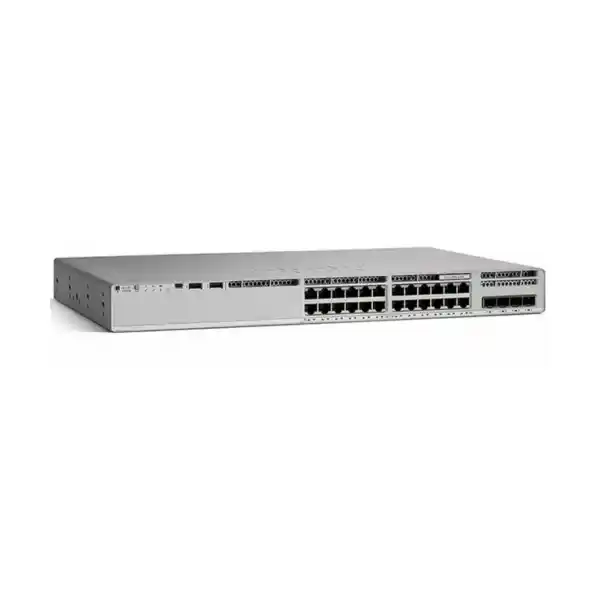
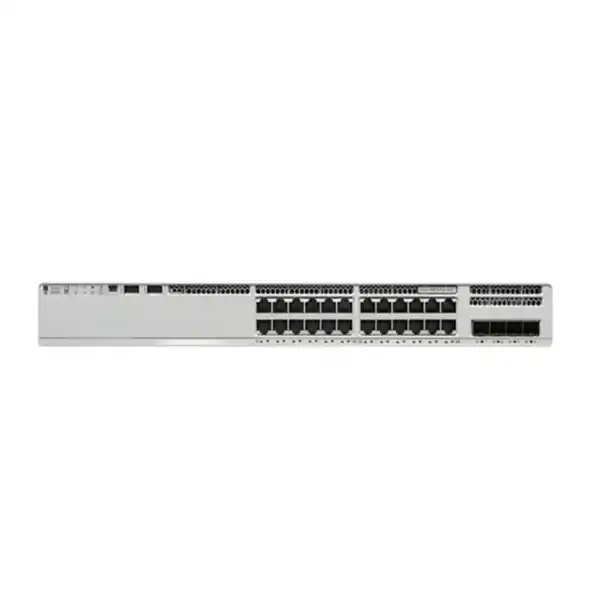
Cisco Catalyst C9200L-24T-4G Network Switch Dubai, UAE
The Cisco Catalyst C9200L-24T-4G is a fixed-uplink enterprise access switch built for organizations that need 24 reliable Gigabit Ethernet user or device connections, four dedicated 1G SFP uplinks, hardware-assisted policy enforcement, Cisco IOS XE operational consistency and StackWise-80 resiliency. It is particularly well suited to offices, branch sites, education buildings, retail back offices, government departments and distributed enterprise locations in Dubai and across the United Arab Emirates where wired endpoint density is moderate and Power over Ethernet is not required at the access layer.
10/100/1000BASE-T RJ-45 data interfaces for desktops, printers, servers, appliances and other powered endpoints.
Four fixed Gigabit SFP uplink interfaces for fiber or supported copper SFP connectivity to distribution, core or routed edge systems.
Standalone switching capacity specified for the C9200L-24T-4G, with 136 Gbps switch capacity when stacking is included.
Published standalone forwarding rate, increasing to 101 Mpps in the capacity specification that includes stacking.
Direct answer: what is the C9200L-24T-4G best used for?
Choose the Cisco Catalyst C9200L-24T-4G when the access layer needs twenty-four conventional Gigabit Ethernet data ports and the uplink design can be satisfied by four fixed 1G SFP interfaces. The model is deliberately different from the C9200L-24P-4G PoE+ variant and from the C9200L-24T-4X 10G-uplink variant. It does not provide PoE on the twenty-four access ports, so it is strongest where endpoints have their own local power or where powered devices such as IP phones, wireless access points and cameras are handled by separate PoE switches or injectors. For office floors with PCs, workstations, printers, access-control controllers, small servers, storage management ports, industrial controllers and other Ethernet devices, the switch offers a professional Cisco access-layer foundation without paying for an unused PoE budget.
Technical overview for UAE network designs
The Catalyst 9200L family occupies an important position in Cisco’s enterprise campus switching portfolio. It brings many operational characteristics associated with modern Catalyst access networks into a fixed-uplink platform intended to balance capability, lifecycle consistency and cost. The C9200L-24T-4G uses a Cisco UADP 2.0 mini forwarding architecture and runs Cisco IOS XE. In practical terms, that means packet forwarding, segmentation, access controls, QoS and telemetry are implemented on a hardware platform designed for enterprise policy rather than on a basic unmanaged or web-managed switch. This distinction matters in Dubai businesses where local sites may need to integrate cleanly with a head-office campus, an SD-WAN edge, centralized identity services, monitoring platforms, structured VLAN plans and formal change-control procedures.
The switch is a fixed configuration model, which simplifies the bill of materials. The twenty-four copper downlinks are built into the chassis and the four 1G SFP uplinks are also fixed. There is no requirement to purchase a separate uplink network module for this SKU. At the same time, fixed uplinks mean capacity planning should be done before ordering. If the branch or floor is expected to require 10G aggregation, high-density Wi-Fi 6/6E backhaul, large east-west server flows or future uplink growth beyond 1G per physical SFP, a 4X or higher-bandwidth Catalyst variant may be the better choice. Where traffic patterns are primarily user-to-application, SaaS, internet and ordinary business services, four 1G uplinks can be engineered effectively with EtherChannel, routing redundancy or diverse upstream paths.
For UAE projects, the model is frequently considered in structured refreshes from older access switches because it combines familiar Cisco command-line operations with newer IOS XE capabilities, model-driven automation, centralized management options and a defined stacking architecture. FourTeck can position the switch as part of a wider access-layer design rather than as an isolated box, including optics, patching, rack placement, UPS sizing, licensing, configuration templates and migration planning. Organizations reviewing broader switching, firewall and campus requirements can also use the FourTeck UAE portfolio as a starting point for integrated infrastructure planning.
Port architecture: twenty-four access ports plus four dedicated uplinks
The front-panel access role of the C9200L-24T-4G is straightforward: twenty-four 10/100/1000BASE-T interfaces terminate conventional copper Ethernet endpoints. Auto-negotiation allows legacy 10 Mbps and 100 Mbps devices to coexist with modern 1 Gbps hosts, although a well-designed enterprise environment normally aims to run user endpoints at Gigabit speed wherever cabling and NIC capability allow. For new UAE office deployments, Category 6 structured cabling is typically a sensible baseline even though Gigabit Ethernet can operate over standards-compliant Category 5e. The stronger cabling baseline provides practical headroom for future refreshes and simplifies certification documentation.
The four SFP interfaces are separate from the twenty-four copper downlinks. They can be allocated according to topology rather than being consumed by user devices. A common design uses two uplinks in a port-channel toward a distribution pair, leaving two interfaces for an alternate building path, migration link, firewall transit or future extension. Another design uses one or two uplinks per switch when bandwidth demand is modest, reserving remaining SFP slots for redundancy. Because these are 1G SFP uplinks rather than 10G SFP+ ports, optics and peer-interface choices must match the 1G design. The fixed nature of the uplink block is an advantage when the requirement is stable because there is no modular uplink card to select, install or stock, but it is also the central sizing constraint to evaluate before purchase.
Organizations sometimes select a switch only by access-port count and overlook the aggregation ratio. Twenty-four user-facing Gigabit ports can theoretically generate far more simultaneous traffic than a single 1G uplink can carry. In real business networks, however, endpoint traffic is bursty and not every desk transmits at line rate. The correct decision is based on observed utilization, application profile, oversubscription policy, backup windows, local-server traffic and growth expectations. FourTeck network engineers can use existing interface statistics or a traffic study to determine whether the 4G uplink version is appropriate or whether a 4X model with 10G uplink capability is safer for the lifecycle of the site.
Good fit
Twenty-four or fewer powered endpoints, moderate office traffic, 1G aggregation, structured VLAN segmentation, Cisco operational standards, branch access, redundant uplinks, and environments where StackWise-80 can simplify management and resiliency.
Re-evaluate the model if
You require PoE for phones, cameras or access points; 10G or 25G uplinks; multigigabit access; unusually heavy east-west traffic; high-throughput Wi-Fi backhaul; or a modular uplink strategy. Those requirements point toward different Catalyst 9200 family variants.
UADP 2.0 mini architecture and hardware forwarding
Cisco positions the Catalyst 9200 Series around its Unified Access Data Plane architecture. The C9200L Gigabit fixed-uplink models use a UADP 2.0 mini ASIC implementation. This is important because enterprise switching performance is not only a question of raw port speed. The forwarding silicon determines how packet lookup, policy, access controls, quality of service, telemetry and other network functions are processed at scale. A purpose-built switching ASIC enables the switch to apply enterprise features while forwarding traffic at predictable hardware rates within the published platform limits.
For the C9200L-24T-4G, Cisco publishes a standalone switching capacity of 56 Gbps and a forwarding rate of 41.67 million packets per second. Those values align with a system designed to forward traffic across twenty-four Gigabit access interfaces and four Gigabit uplinks without treating the switch as a software router. Cisco also publishes a switch capacity of 136 Gbps and forwarding rate of 101 Mpps when the stacking capacity specification is included. These metrics should be interpreted correctly: stacking creates an internal interconnect among compatible stack members; it does not transform the four physical 1G uplink ports into higher-speed Ethernet interfaces. Network designers should therefore separate three questions—local forwarding capacity, stack-ring capacity and northbound uplink capacity—when assessing performance.
The platform specification lists 6 MB of packet buffering for 24- or 48-port Gigabit C9200L models. Buffering helps absorb short traffic bursts and speed mismatches, but it is not a substitute for correct QoS or uplink sizing. In branch deployments carrying voice from externally powered phones, video meetings, transactional ERP traffic, cloud applications and backups on the same infrastructure, traffic classes should be identified, marked consistently and protected with an intentional queuing policy. The value of an enterprise Catalyst platform is that such control can be designed as part of the access architecture rather than left to best-effort behavior.
StackWise-80: one logical access system from multiple switches
C9200L models support Cisco StackWise-80 through the optional C9200L stack kit. Cisco specifies up to eight compatible C9200L members, with 80 Gbps stacking bandwidth. A stack is managed as a single logical switching system rather than as eight unrelated devices, reducing the number of independent management planes administrators need to operate. For a UAE office with several access switches in the same rack, this can make routine configuration, software planning, port provisioning and fault isolation more consistent.
Physical stacking also changes the resiliency design. Links from servers, firewalls or upstream distribution switches can be spread across different stack members while participating in one logical topology, depending on the supported feature and design. This allows the cabling plan to avoid placing every critical uplink on one chassis. If a member fails, other members remain part of the logical stack. Stacking also helps reduce Spanning Tree complexity because stacked units can behave as a single node in supported topologies. Nevertheless, a stack is not a replacement for all forms of redundancy. Power, upstream path diversity, rack environmental risk and software maintenance procedures still require design attention.
Compatibility is critical. Cisco states that C9200L fixed-uplink models stack with other C9200L models at the same license level; mixed stacking with modular C9200 models or older Catalyst families such as the 2960-X/2960-XR is not supported. Therefore, a migration project that intends to preserve an existing physical stack should not assume cross-generation compatibility. The stack should be treated as a planned system with matched hardware family, licensing, stack adapters and cable lengths. Cisco offers 0.5 m, 1 m and 3 m StackWise cabling options, allowing rack designers to choose cable lengths appropriate for the physical layout.
For sites deploying only one switch initially, ordering strategy can still account for future stacking. The network cabinet should reserve space, power outlets and cable routing for the second unit, and the IP addressing and management design should avoid assumptions that make later expansion awkward. Conversely, if two switches will always operate independently because they serve isolated networks or different security zones, stacking may not be necessary. FourTeck can review the operational objective and determine whether StackWise-80 delivers a real availability and management benefit for the specific site.
Capacity and scalability values that matter in enterprise access
Layer 2 design: VLANs, trunks, spanning tree and loop control
Most deployments place the C9200L-24T-4G at the access layer, where Layer 2 behavior must be predictable. User devices, printers, facilities systems, guest infrastructure and management endpoints are usually separated into VLANs according to security policy and broadcast-domain requirements. The platform supports up to 4,094 VLAN IDs and 128 PVST instances in the published C9200L scale. That is far beyond the VLAN count required by most 24-port branches, but the scale matters when the same standard design is used across larger enterprise sites or stacks.
Trunk links to distribution switches carry the required VLANs over one or more uplinks. Restricting each trunk to the VLANs that genuinely need to cross the link improves operational clarity and reduces unnecessary Layer 2 exposure. EtherChannel can combine compatible uplinks into a logical bundle, increasing aggregate bandwidth and providing link-level resiliency when the upstream design supports it. The exact channel protocol, load-distribution method and physical path selection should be standardized across the site so troubleshooting remains deterministic.
Cisco supports Rapid PVST+ and Multiple Spanning Tree capabilities in the Catalyst family. Proper Spanning Tree design is still essential even when switching hardware is modern. Access-facing ports can use edge behavior where appropriate, while infrastructure-facing ports should maintain loop-protection controls. Root bridge placement should be deliberate rather than left to MAC-address elections. Features such as BPDU-related protections, loop guard techniques and err-disable recovery can be incorporated according to organizational standards. The goal is to prevent an accidental patch cable, unmanaged switch or misconfigured downstream device from becoming a site-wide outage.
For a small standalone branch, these controls may look more sophisticated than necessary, but consistency pays off during growth and incident response. A standardized access template can define VLAN allocation, port descriptions, 802.1X behavior, storm control, DHCP security, unused-port shutdown and monitoring. The same template can then be adapted across dozens of UAE branches, reducing configuration drift and making centralized support more efficient.
Layer 3 access and routing considerations
The Catalyst 9200 Series is not limited to pure Layer 2 switching. Depending on software license and feature entitlement, the platform provides foundational and advanced Layer 3 capabilities appropriate for branch and campus access. The C9200L platform specification includes 3,000 IPv4 routing entries, 1,500 IPv6 routing entries and up to 512 switched virtual interfaces. This gives designers the option to terminate selected VLANs locally, use routed uplinks or participate in a hierarchical campus routing design instead of extending every broadcast domain to a distant core.
Local routing can reduce failure domains and improve convergence, but it should be introduced intentionally. A small branch with two VLANs and a security appliance acting as the default gateway may gain little from moving inter-VLAN routing into the access switch. A larger branch with many departmental networks, a distribution layer and strict routing policy may benefit substantially. The decision depends on firewall placement, segmentation requirements, WAN topology, multicast needs, first-hop redundancy architecture and the organization’s operational skill set.
Licensing is part of this design, not an afterthought. Cisco offers Network Essentials and Network Advantage product variants for the C9200L-24T-4G, represented by ordering SKUs ending in -E and -A respectively. Network Essentials provides foundational Layer 2 and Layer 3 switching functions, while Network Advantage extends capabilities for more advanced routing, segmentation, multicast, scale and security use cases. The exact software release and subscription model should be reviewed at quotation time because Cisco licensing has evolved, and current unified switching subscription options coexist with established Cisco DNA and perpetual network license constructs.
FourTeck therefore recommends defining the intended routing feature set before the purchase order is raised. Ordering only by base hardware model can create ambiguity over license tier, support and management subscription. A complete bill of materials should state the hardware SKU, required license level, subscription term where applicable, support coverage, optics, stack kit and any spare power components. This ensures the deployed switch matches the architecture approved during design rather than forcing feature compromises during implementation.
Security controls at the wired access edge
An enterprise access switch sits at one of the most exposed points in the network because users, contractors, printers, building systems and unattended devices all connect through it. The C9200L platform is designed to participate in a broader Cisco security architecture through access-control, segmentation, identity and telemetry capabilities. The precise feature set depends on licensing and software release, but the operational principle is consistent: the switch should enforce who or what can connect, which network segment is assigned, what traffic is permitted and how abnormal behavior is detected.
Common access-layer controls include 802.1X authentication, MAC-based fallback for devices that cannot run a supplicant, port security, DHCP snooping, Dynamic ARP Inspection design, IP Source Guard concepts, ACLs, device tracking and protected management access. These capabilities are most effective when integrated with a coherent identity and firewall strategy rather than enabled individually. For example, authenticated user access may assign a VLAN or policy dynamically, while the firewall enforces application-level controls between security zones. Organizations building that end-to-end model can review complementary perimeter and segmentation services through Firewall Dubai by FourTeck.
Physical access security also matters. Unused switch ports should not remain active with broad network access. Management interfaces should sit in controlled management networks, administrative protocols should use secure authentication and encrypted sessions, and configuration backups should be integrated into operational processes. Role-based administration, AAA integration, logging and time synchronization strengthen accountability. These measures are often more important than adding another feature because they reduce the likelihood that routine access-layer changes become an uncontrolled security path.
QoS for voice, collaboration and business-critical traffic
Although the C9200L-24T-4G does not provide PoE, it can still carry voice and collaboration traffic from endpoints that receive power elsewhere. Some organizations use locally powered conference systems, desk endpoints connected through external power adapters, or voice traffic traversing a data switch from downstream equipment. Quality of service remains relevant because a Gigabit access port can feed into a shared uplink where bursty traffic competes for transmission.
A sound QoS design starts with classification and trust boundaries. Traffic markings should be accepted only from devices or network segments that are authorized to set them. The access switch can classify, remark, police and queue traffic according to organizational policy and licensed capabilities. Delay-sensitive voice should not compete on identical terms with large backups, software distribution, cloud synchronization or video file transfers. At the same time, aggressive priority policies must be sized carefully so one class cannot starve ordinary applications.
Uplink oversubscription is where QoS policy becomes visible. With four 1G SFP uplinks, designers can increase aggregate capacity through channeling or distribute links across functions. Yet if twenty-four active users perform synchronized backups across a single 1G uplink, congestion is inevitable regardless of switch forwarding capacity. Application scheduling, traffic engineering and uplink design should therefore be considered together. QoS protects important traffic during contention; it does not manufacture bandwidth that is not present.
Flexible NetFlow, telemetry and operational visibility
Cisco lists a scale of 16,000 Flexible NetFlow entries for 24- and 48-port Gigabit C9200L models. Flow telemetry helps administrators understand which hosts communicate, where traffic is going, how much bandwidth different applications or address pairs consume and whether a branch behavior has changed. This is particularly valuable during uplink sizing, incident investigation and migration planning because interface utilization alone tells only part of the story.
Operational visibility should combine multiple data sources. SNMP and MIB support can feed traditional network management systems; syslog records events; streaming or model-driven telemetry can provide structured state information depending on the IOS XE release and management architecture; Flexible NetFlow can describe conversations; and centralized management platforms can correlate health, configuration and assurance data. The switch also supports an out-of-band Ethernet management interface and console access, giving engineers recovery paths when production data-plane connectivity is unavailable.
For organizations without an internal network operations team, the value of telemetry depends on whether someone actually monitors and acts on it. FourTeck’s UAE IT services can be incorporated into a deployment where configuration, monitoring, firmware planning, backup and incident response need a defined operational owner. The objective is not to collect every possible metric; it is to make sure the metrics chosen directly support availability, security, capacity management and faster troubleshooting.
Cisco IOS XE and automation
The Catalyst 9200 Series runs Cisco IOS XE, giving network teams a common operational framework with other modern Catalyst platforms. Cisco notes support from IOS XE 16.9.2 or later for the series, while currently supported releases and recommended trains depend on product lifecycle and Cisco guidance. For an enterprise deployment, software selection should be governed by compatibility, security advisories, feature requirements and the organization’s tested standard—not simply by installing the newest image without validation.
IOS XE supports model-driven programmability, allowing configurations and state to be integrated into automation workflows rather than managed exclusively through interactive CLI sessions. In larger networks, this enables templated provisioning, compliance checks and repeatable changes. A switch can be installed with standardized naming, VLANs, uplink definitions, management settings, logging, AAA and monitoring configuration, reducing the chance that one branch silently diverges from the enterprise baseline.
Automation should still include guardrails. Configuration generated by a script can make errors at machine speed if inventory data or logic is wrong. Mature operations use source-controlled templates, validation checks, staged rollouts, rollback procedures and maintenance windows. Device identity should be tied to an inventory record containing serial numbers, management addresses, rack location, software version, license state and support coverage. Those records become especially valuable when a business has dozens of similar 24-port switches across Dubai, Abu Dhabi, Sharjah and remote UAE sites.
The C9200L-24T-4G therefore fits both traditional CLI-centric operations and a gradual move toward controller or API-assisted management. The correct management approach depends on scale. A single branch can be managed efficiently with disciplined CLI and monitoring, whereas a large distributed estate benefits from centralized policy, automated provisioning and software-image governance. The hardware does not force one operational model, which helps organizations modernize at a pace that matches internal processes.
Licensing: Network Essentials, Network Advantage and current subscriptions
Cisco publishes two core ordering variants for this hardware: C9200L-24T-4G-E for Network Essentials and C9200L-24T-4G-A for Network Advantage. The hardware port configuration is the same—twenty-four Gigabit data ports and four fixed 1G uplinks—but software entitlements differ. Network Essentials is aimed at foundational Layer 2 and Layer 3 switching, automation, visibility and security. Network Advantage adds advanced routing, segmentation, multicast, scale and security capabilities. The correct tier should be chosen by required features, not by a generic assumption that Advantage is always necessary or that Essentials is always sufficient.
Cisco’s licensing landscape also includes subscription-based management and assurance. Cisco DNA subscriptions have historically been offered in Essentials and Advantage tiers with terms such as three, five or seven years, aligned to the corresponding network license. Cisco’s newer unified switching licensing approach also introduces Cisco Switching Essentials and Cisco Switching Advantage within the Cisco Networking Subscription model, with a standard minimum term stated by Cisco for new networking subscriptions. Availability and required combinations depend on software release, purchasing program and ordering date.
Because licensing evolves faster than the physical chassis, quotation documents should never describe the base switch alone as if that fully defines entitlements. FourTeck should confirm the exact Cisco part number, license tier, subscription term, support service and management expectations at the time of order. This is especially important for tenders and enterprise procurement where the delivered SKU must match a bill of quantities exactly. If the organization already has Cisco Smart Accounts, existing enterprise agreements or standardized subscription dates, the new switch should be aligned with those commercial structures where practical.
Licensing also influences stacking compatibility because Cisco states that C9200L stack members should use the same license level. A mixed purchasing process that orders some units as Essentials and others as Advantage without design coordination can complicate the intended stack. For multi-switch sites, the complete stack should therefore be quoted as one logical system, including consistent licensing and all stacking hardware.
Power design, redundant supplies and why non-PoE changes the calculation
The C9200L-24T-4G is a data-only switch, so its power design is considerably simpler than a PoE access switch. Cisco specifies the PWR-C5-125WAC as the default primary power supply. The chassis provides two power-supply slots, enabling a redundant power-supply design when the required secondary unit is installed. The internal supply is auto-ranging for 100 to 240 VAC input, making it appropriate for standard UAE enterprise electrical environments when connected through correctly rated power distribution and UPS systems.
Redundant power supplies improve resilience only if the upstream electrical path is also considered. Plugging both supplies into the same overloaded extension strip creates less protection than connecting them to independent PDU feeds backed by appropriate UPS circuits. In larger facilities, A/B power distribution may be available; in small branches, two UPS-backed outlets may be the realistic option. The power design should be documented so maintenance staff understand which feed protects which supply.
Because this model supplies no PoE power to endpoints, UPS sizing is based mainly on switch electronics, optics, peer devices and desired runtime rather than on hundreds of watts of phone, camera or access-point load. This can materially reduce branch UPS requirements. However, it also means IP endpoints that need continuous operation must receive power from somewhere else. If phones or cameras are connected through external power adapters, their UPS coverage must be assessed separately. If they are connected to another PoE switch, that switch’s power budget becomes part of the continuity calculation.
Energy and thermal planning are important in Dubai equipment rooms because ambient heat can accelerate risk when cooling is poor. Cisco specifies normal operating conditions up to 45°C at lower altitudes within stated limits and short-term exceptional conditions for the 9200L/9200 family, but those maximums are not a target operating temperature. Good rack design aims for a stable, controlled environment with adequate airflow, clean filters, correct cable management and enough clearance for front/side-to-back airflow. Running well below platform environmental ceilings supports reliability and makes fan behavior more predictable.
Cooling, physical dimensions and rack planning
The C9200L-24T-4G is a 1RU rack-mountable switch with chassis dimensions of approximately 1.73 × 17.5 × 11.3 inches, or 4.4 × 44.5 × 28.8 centimeters. Cisco lists the chassis plus power/fan depth at approximately 12.9 inches, or 32.9 centimeters. The published weight is about 9.59 pounds, or 4.35 kilograms. These compact dimensions make the model suitable for standard network cabinets, but cabinet depth should be evaluated based on installed power cords, fiber bend radius, copper patching and rear clearance—not chassis depth alone.
The fixed-uplink C9200L models use fixed redundant fans rather than field-replaceable fan modules. Airflow is designed from the front and sides toward the back. This means rack placement should avoid blocking side ventilation with solid shelf hardware or tightly packed cabling. Fiber and copper patch cords should be routed so they do not create a mat across ventilation openings. In dusty branch environments, cabinet cleanliness and room filtration become part of hardware reliability.
Cisco specifies a normal operating range that includes -5°C to +45°C up to 1,500 meters and -5°C to +40°C up to 3,000 meters, with a 0°C minimum ambient temperature for cold start. Storage temperature is specified from -40°C to +70°C, and relative humidity from 5% to 90% noncondensing. UAE installations are typically near sea level, but heat and humidity management remain operational concerns. A rack located in a conditioned communications room is preferable to one installed in an unventilated storeroom exposed to summer heat.
For small sites, engineers should verify cabinet grounding, UPS ventilation, front-to-rear service access, fiber patch-panel location and labeling before delivery. A switch that physically fits in the rack may still be difficult to service if the cabinet door presses against patch cords or if the power supplies cannot be removed without dismantling adjacent equipment. Proper mechanical planning is inexpensive compared with correcting a poorly arranged live rack later.
1G SFP uplink optics and cabling strategy
The four fixed uplink ports accept supported 1G SFP transceivers. That provides flexibility to use multimode fiber, single-mode fiber or supported copper SFP options according to distance and cabling plant. The optic should be selected as a matched system: transceiver type, wavelength, fiber grade, connector, patch cord, path loss and remote optic must all be compatible. An SFP slot alone does not define reach.
Within a building, multimode fiber is often used for short backbone links where existing OM3 or OM4 cabling is available. Single-mode fiber is common for campus, inter-building and longer-reach links because it provides greater distance flexibility and can support later higher-speed upgrades with appropriate optics. If a branch uplink remains within the same rack or adjacent cabinet, copper may be operationally simpler, but fiber offers electrical isolation and can be advantageous in environments with grounding differences or electromagnetic concerns.
Before ordering optics, the project team should inspect the installed fiber plant and identify connector type, strand availability, measured loss, patch-panel labeling and destination port. Existing fibers that are undocumented should be tested rather than assumed healthy. A 1G optic can appear to work initially while suffering intermittent errors because of contamination or marginal optical budget. Cleaning and inspection procedures should be part of commissioning, especially in older buildings where patch panels have been repeatedly reworked.
Uplink diversity is also physical. Two logical links are not truly redundant if both fibers run through the same conduit and terminate on the same upstream chassis. High-availability requirements may justify separate risers, diverse patch panels or uplinks to different distribution switches. The C9200L-24T-4G gives four uplink interfaces, but the value of those interfaces depends on how the rest of the path is engineered.
Management interfaces and out-of-band access
Cisco Catalyst enterprise switches provide dedicated management and console options so administrators can reach the device even when the production forwarding path is unavailable. The 9200/9200L platform includes an Ethernet management interface and console connectivity options. A mature deployment assigns the management interface to a protected out-of-band network where practical, separate from user VLANs and production routing. This can make remote recovery possible during incidents that affect the switching data plane.
Secure management policy should define SSH access, AAA servers, local emergency credentials, SNMP configuration, syslog targets, NTP sources and permitted management subnets. Access should follow least privilege, with named administrator accounts and centralized authentication where feasible. Configuration changes should be logged, and backup copies of known-good configurations should be maintained. For regulated or security-conscious organizations, these operational controls are often as important as hardware feature lists.
Console access remains critical during initial staging and major recovery. Rack documentation should identify the console method and preserve compatible cables or console-server connectivity. A remote branch that has no out-of-band management, no console server and no trained local contact may require a site visit for a simple recovery task. Planning management access during deployment therefore reduces long-term support cost.
Typical Dubai and UAE deployment scenarios
Corporate office floor
Twenty to twenty-four desks, printers and locally powered collaboration endpoints connect at Gigabit speed. Two SFP uplinks form a resilient path to a distribution stack. VLANs separate corporate users, printers and facilities devices. Central AAA, monitoring and configuration standards make the branch behave like the main campus.
Retail or service branch
POS back-office systems, workstations, printers, controller interfaces and local servers use the 24 copper ports. The upstream link reaches a security appliance or WAN edge. Because powered cameras and wireless access points are handled by a separate PoE switch, the non-PoE C9200L-24T-4G remains cost-effective for the data network.
Education administration network
Administrative PCs, printers, lab controllers and fixed infrastructure are segmented into managed VLANs. Stacking allows a second switch to be added in the same rack without introducing another independent management plane, while the SFP uplinks connect to a campus distribution layer.
Industrial or facilities IT zone
Building-management controllers, gateways and Ethernet-enabled systems often use their own local power and modest bandwidth. The Catalyst platform adds enterprise monitoring, VLAN separation and controlled uplinks. Environmental limits still need to be respected; the switch should be installed in a conditioned communications cabinet rather than an uncontrolled plant area.
When the C9200L-24T-4G is not the correct SKU
Good network design includes knowing when not to use a product. The C9200L-24T-4G should not be specified for a floor where most endpoints require switch-supplied power. If the design includes IP phones, Wi-Fi access points, CCTV cameras or IoT devices that depend on IEEE PoE, the 24P PoE+ variant or another suitable PoE model should be evaluated. Adding dozens of external injectors simply to preserve a non-PoE switch usually increases complexity, cabling and failure points.
The model should also be reconsidered when uplink bandwidth is expected to exceed 1G per interface. A high-density creative studio, virtualization lab, engineering office, large file-transfer environment or Wi-Fi aggregation point can drive sustained traffic that makes 10G uplinks preferable. The C9200L-24T-4X preserves twenty-four 1G data downlinks while providing four fixed 10G SFP+ uplinks, making it a natural comparison where aggregation headroom is the main concern.
Multigigabit requirements are another dividing line. Endpoints needing 2.5G, 5G or 10GBASE-T access cannot be served at those speeds by the 1G downlinks on this SKU. New Wi-Fi access points, high-performance workstations or specialized edge appliances may justify a multigigabit access platform. Port count is therefore only one sizing dimension; endpoint speed and power requirements must be captured during discovery.
Finally, organizations that require modular uplinks, higher stacking bandwidth or broader campus features may prefer the modular Catalyst 9200 models or other Catalyst families. The C9200L is intentionally optimized as a fixed-uplink access platform. Using it where the requirement matches that design can be highly effective; forcing it into a role that needs different hardware undermines the value of the architecture.
Migration from older Catalyst access switches
A replacement project should begin with configuration discovery rather than one-for-one physical swapping. Older switches may contain years of accumulated VLANs, trunks, static MAC settings, port security, voice VLANs, ACLs, QoS, SPAN sessions, SNMP communities and undocumented exceptions. Some configuration is still required; some is obsolete; some may be incompatible or represented differently in modern IOS XE. Copying everything blindly preserves technical debt.
The preferred method is to build a clean target configuration from an approved standard and then migrate only validated business requirements. Port-by-port mapping should identify endpoint name, VLAN, speed, authentication behavior, special security controls and whether the port is actually active. Uplink trunks should be reviewed for allowed VLANs and aggregation settings. Management addressing, NTP, DNS, syslog, AAA and monitoring should align with current standards rather than historical defaults.
Stack migration requires particular care because the C9200L cannot join stacks with older unrelated Catalyst families. If an existing stack is being replaced, the new C9200L stack should be staged as a separate logical system, configured and tested before the change window. A cutover plan then moves uplinks and access patching in controlled groups. This reduces the risk that compatibility assumptions create an outage midway through the migration.
Rollback should be practical. Engineers should label old and new patch positions, preserve a validated old configuration, record optics and fiber paths, and define a decision point for returning to the previous switch if critical services fail. After cutover, endpoint reachability, DHCP, DNS, authentication, routing, monitoring and application transactions should be tested—not merely link lights. A switch replacement is complete only when business services are confirmed.
Sizing methodology for a 24-port access switch
Start with endpoint inventory. Count current wired devices, planned additions and ports required for temporary equipment. Do not size exactly to today’s count if the cabinet has no alternate switching capacity. A site with twenty-three active devices on a 24-port switch has almost no maintenance flexibility. A reasonable spare-port allowance gives technicians room for troubleshooting, new hires, test devices and small growth. If expected demand will quickly exceed twenty-four ports, a 48-port model or a planned two-switch stack may be more economical than an immediate follow-up purchase.
Next evaluate power. If even a small subset of planned devices needs PoE, decide whether those devices will be served by a dedicated PoE access switch or whether the primary switch should be a PoE model. Splitting data and powered devices across separate switches can be intentional, but it should be driven by architecture, not by a late discovery that the selected T model cannot power phones or access points.
Then measure bandwidth. Gather current uplink utilization by average, 95th percentile and peak; identify backup and replication windows; estimate growth; and map local traffic that may stay within the switch. Four 1G uplinks provide design flexibility, but if the projected sustained aggregate traffic approaches the uplink envelope, select a higher-speed model before deployment. Capacity upgrades are more disruptive after a floor is live.
Finally define resiliency and management. Determine whether the switch will stand alone, stack with a peer, use one or multiple power supplies, connect to one or two upstream devices, and participate in centralized management. These choices drive the bill of materials beyond the base chassis. A technically complete quote can therefore include the exact -E or -A SKU, stack kit, correct stack cables, SFPs, fiber patch cords, secondary power supply, support, licensing and implementation services.
This sizing method avoids the common procurement error of asking only, “Do we need 24 or 48 ports?” The better question is, “What access system must this cabinet deliver for the next several years?” Port count, endpoint power, uplink capacity, availability, software entitlements and physical environment all contribute to the answer.
UAE procurement and bill-of-material guidance
A production-ready order should identify more than “Cisco C9200L 24-port switch.” The exact hardware and license suffix matters, as do optics and stacking accessories. Confirm whether Network Essentials or Network Advantage is required, whether the site needs a secondary power supply, whether StackWise-80 will be used, and which SFP optics match the installed fiber. Support coverage and subscription terms should be listed explicitly so procurement, IT and finance share the same understanding of the delivered solution.
For Dubai projects, logistics planning should also capture delivery location, rack readiness, change-window constraints, serial-number recording, asset tagging and staging requirements. If switches are deployed to multiple emirates, preconfiguration and labeling can reduce onsite work. Standardized shipping packs can include rack hardware, power cords, optics, patch leads, console details and a port map for each branch. This turns deployment into a repeatable rollout rather than a series of improvised installations.
Organizations with regional or international operations can coordinate related infrastructure through FourTeck’s global technology portfolio, while UAE-specific commercial and deployment planning can remain aligned to local requirements. The objective is a bill of materials that is technically complete at the time of quotation and traceable through delivery, staging and acceptance.
High availability beyond stacking
StackWise-80 is a valuable resiliency tool, but high availability depends on the full path. A stack connected through one fiber to one upstream switch still has a single northbound failure point. A switch with dual power supplies connected to one non-redundant UPS still depends on that UPS. Redundancy must be mapped from endpoint to application, including access chassis, stack ring, power, uplinks, distribution switches, firewall, WAN and critical services.
For a two-switch C9200L stack, access ports for critical dual-homed systems can be distributed across members where supported by the endpoint design. Northbound links can be spread across stack members and upstream devices. The physical stack cabling should form the supported resilient topology rather than a simple daisy chain that leaves unnecessary failure exposure. Power supplies should be distributed across available electrical feeds. Monitoring should alert not only when the stack fails, but also when redundancy is degraded—for example, when one stack link, one power supply or one uplink is down while service remains operational.
That degraded-state visibility is essential. Many outages occur because a system runs for weeks on its final surviving component after an earlier failure was ignored. Enterprise monitoring should therefore detect failed fans, power-supply state, stack health, link errors, optical problems and increasing interface utilization. Maintenance can then restore redundancy before the next fault becomes a service interruption.
Performance interpretation: 56 Gbps does not mean every design is unconstrained
The 56 Gbps switching-capacity figure represents the platform’s internal forwarding capability in standalone operation. It is useful because it shows that the switch is designed for line-rate class access switching within its port architecture. Yet users often misinterpret switching capacity as an end-to-end application throughput guarantee. Real application performance depends on the slowest relevant link, upstream congestion, firewall performance, WAN bandwidth, server capability, packet size, protocol behavior and QoS.
The published forwarding rate of 41.67 Mpps describes small-packet processing capability. In environments dominated by normal Ethernet frame sizes, throughput behavior differs from a synthetic minimum-packet test. Both switching capacity and packets-per-second metrics are therefore useful, but neither replaces workload analysis. A branch where users primarily access cloud applications over a 500 Mbps internet service will have a very different bottleneck from a local engineering environment transferring large files to a nearby storage system.
The four 1G uplinks deserve the greatest attention in most C9200L-24T-4G designs. If one uplink carries all northbound traffic, that single Gigabit path sets the ceiling regardless of the switch’s internal capacity. Link aggregation can increase aggregate bandwidth when traffic is distributed across flows, but a single flow generally follows one member based on hashing rather than being split packet-by-packet across all links. High-throughput single-session requirements may therefore justify a 10G uplink model even when aggregate average utilization looks modest.
This is why FourTeck treats the 4G variant as a specific architectural choice rather than a lower-cost substitute for every 24-port deployment. When bandwidth patterns fit the model, it is efficient and capable. When the uplink requirement is uncertain, traffic measurement or growth modeling is worth doing before procurement.
Network segmentation and policy design
Segmenting endpoints is one of the most important uses of an enterprise access switch. A flat network in which corporate laptops, printers, facilities controllers, guest systems and management devices share one VLAN creates unnecessary broadcast scope and security exposure. The C9200L platform supports the VLAN, SVI, ACL and policy scale required for much more structured designs. The objective is to group endpoints by trust level and function, then control communication according to business need.
For example, printers can be placed in a dedicated VLAN with access restricted to print servers and approved user networks. Building-management devices can be isolated from general user workstations. Network infrastructure management can use a separate subnet accessible only from administrative systems. Guest devices should remain outside internal trust zones. Where 802.1X and identity services are used, segmentation can become dynamic based on authenticated user or device profile rather than relying only on the physical wall socket.
Layer 2 segmentation and Layer 3 policy should align with firewall placement. If all inter-VLAN traffic is routed directly on the switch, some flows may bypass deep application inspection that would occur on a firewall. If every local flow is forced through a distant firewall, latency and bandwidth consumption may increase. The correct architecture classifies which traffic needs stateful security enforcement, which can be handled by switch ACLs or segmentation policy, and which must stay local for performance or availability.
The C9200L-24T-4G is therefore a building block in a security design rather than a standalone security product. Its access controls, telemetry and segmentation capabilities become more valuable when identity systems, firewalls, endpoint security and centralized monitoring share consistent policy goals.
Operational lifecycle: staging, deployment, maintenance and replacement
A reliable network lifecycle begins before the switch reaches the rack. During staging, engineers should verify the exact SKU, serial number, power supplies, optics, stack accessories and license information. The approved IOS XE release can be installed, the switch can be named and addressed, AAA and management settings can be applied, and a baseline configuration can be validated. Staging in a controlled environment reduces onsite change-window pressure and allows hardware issues to be discovered before business services depend on the device.
Deployment documentation should include rack position, switch number, management IP, stack role, uplink ports, optic types, remote termination points and access-port mappings. Photographs of final patching can be useful for remote support when labeling is visible. Asset systems should record serial numbers and support dates. Monitoring should be enabled before handover, not several weeks later, so post-cutover behavior is visible from day one.
Maintenance should follow a repeatable cadence. Review software advisories, configuration backups, stack health, power-supply status, interface errors, optic diagnostics, CPU and memory trends, environmental state and capacity. Firmware updates should be tested against required features and scheduled with a rollback plan. Changes should be documented. Over time, compare actual traffic and port utilization against original sizing assumptions; a site that was light at deployment may grow into a candidate for higher-speed uplinks.
Replacement planning should begin before end-of-support deadlines create urgency. Maintain an inventory of hardware age, software train, support entitlement and business criticality so refreshes can be budgeted. The strongest value from enterprise switching comes from managing the platform as part of an infrastructure lifecycle, not purchasing it once and forgetting it until failure.
Frequently asked technical questions
Does the C9200L-24T-4G provide PoE?
No. The “T” model is a data-only switch. It does not supply PoE or PoE+ power from its 24 access ports. If the deployment requires switch-powered phones, cameras, access points or IoT endpoints, evaluate a “P” PoE+ model or another appropriate powered-access platform.
Are the four uplinks 10 Gigabit?
No. The C9200L-24T-4G has four fixed 1G SFP uplink ports. The C9200L-24T-4X is the related 24-port data model with four fixed 10G SFP+ uplinks. Choose the model according to required aggregation capacity.
Can this switch be stacked?
Yes. C9200L models support StackWise-80 with the C9200L stack kit. Cisco specifies up to eight C9200L members, with compatibility requirements including the same license level. C9200L fixed models do not stack with modular C9200 models or unrelated Catalyst generations.
What is the switching capacity?
Cisco specifies 56 Gbps standalone switching capacity and 41.67 Mpps forwarding for the C9200L-24T-4G. The corresponding capacity figures including stacking are 136 Gbps and 101 Mpps.
Which power supply is standard?
Cisco lists the PWR-C5-125WAC as the default primary power supply for this data-only fixed-uplink model. The chassis has two power-supply slots, allowing a redundant supply design when the secondary unit is specified.
What license options exist?
The hardware is available in Network Essentials and Network Advantage ordering variants, commonly represented by -E and -A suffixes. Cisco also offers subscription-based management and assurance options. Exact current ordering requirements should be confirmed at quotation time.
Can it route between VLANs?
The platform supports Layer 3 capabilities and substantial SVI and route scale, but the exact routing features available depend on software license and release. Designers should decide whether inter-VLAN routing belongs on the access switch, distribution layer or firewall according to security and topology goals.
Is 1G uplink capacity sufficient for 24 users?
It can be, but the answer depends on workload. Office SaaS, email and general productivity traffic may fit comfortably, especially when multiple uplinks are engineered appropriately. Heavy local file transfers, backup traffic or high-throughput media workloads may justify 10G uplinks.
Detailed deployment example: two-switch branch access stack
Consider a Dubai office with thirty-six wired endpoints distributed across two patch panels. The organization wants Cisco enterprise switching, no PoE requirement on these ports, redundant power and resilient uplinks. Two C9200L-24T-4G switches can be installed as a StackWise-80 stack, providing forty-eight copper access ports while preserving one logical management system. Endpoints are distributed across both members so a single chassis fault affects only the ports physically connected to that member rather than the entire office.
The switches receive matching license tiers and the required C9200L stack kits. Stack cables are selected for rack position, and the physical stack topology is cabled for resilience. Each chassis receives primary and secondary power supplies connected to the best available independent UPS/PDU paths. The distribution layer presents two upstream switches. One or more 1G SFP links from each stack member are arranged into the chosen logical uplink design, subject to upstream compatibility and total bandwidth requirements.
The access configuration uses separate VLANs for corporate users, printers, facilities devices and network management. User ports receive standardized edge protections and authentication settings. Trunks allow only required VLANs. Management uses AAA, NTP, syslog and monitoring from protected administrative networks. Flexible NetFlow or other telemetry is enabled according to the organization’s visibility policy. Unused ports are administratively disabled or placed into a restricted state.
Before cutover, both stack members are staged, software versions are aligned, stack role and health are checked, uplink optics are tested and the configuration is peer reviewed. During the maintenance window, uplinks are established first, then access ports move by patch-panel group. Engineers validate DHCP, DNS, identity, routing, application access and monitoring after each batch. Once users are stable, the old switches remain available for a defined rollback interval before decommissioning.
This example illustrates why a switch quote can become a small systems-engineering exercise. The base chassis provides the ports and forwarding architecture, but reliable service depends on stack design, optics, power, configuration, management, testing and documentation. FourTeck can scope these elements together so the delivered network matches the operational objective rather than only the hardware specification.
Why choose FourTeck for Cisco switching in Dubai
Cisco access switching works best when product selection is tied to actual network requirements. FourTeck can help define the port count, endpoint power model, uplink bandwidth, fiber type, stack architecture, license tier, support coverage and migration plan before procurement. This reduces the chance of ordering a technically valid switch that does not fit the site’s bandwidth or power requirements.
For new branches, FourTeck can prepare a standardized design covering addressing, VLANs, routing, management, security, logging and rack documentation. For refresh projects, existing configurations can be reviewed and converted into a cleaner IOS XE baseline. Where multiple UAE locations are involved, staging and template-based deployment can improve consistency and reduce site time. Testing can include uplink redundancy, stack behavior, endpoint access, monitoring and business application validation.
The result is a deployable access solution rather than an isolated hardware sale. Customers can combine Cisco switching with broader security, server, wireless, telephony and IT-service requirements using FourTeck’s UAE and global capabilities, while maintaining a single technical conversation about how those systems interact.
Important model selection note
C9200L-24T-4G identifies a very specific configuration: 24 Gigabit data-only copper ports with four fixed 1G SFP uplinks. Do not substitute specifications from C9200L-24P-4G, which adds PoE+, or C9200L-24T-4X, which changes the uplink block to four 10G SFP+ interfaces. Likewise, modular C9200 models have different uplink and stacking characteristics. FourTeck quotation documents should state the complete Cisco ordering SKU, including the required licensing suffix, so the delivered hardware and software entitlements match the approved design.
Decision recap: should you buy the C9200L-24T-4G?
Choose it when
You need up to 24 enterprise Gigabit data ports, endpoints do not need PoE, four 1G SFP uplinks are sufficient, Cisco IOS XE is part of your operational standard, and StackWise-80 provides useful growth or resiliency.
Choose another variant when
You require PoE/PoE+, 10G or faster uplinks, multigigabit access, modular uplinks, or bandwidth growth that would make 1G aggregation a near-term bottleneck.
Confirm before ordering
Network Essentials versus Network Advantage, subscription requirements, stack kit, stack cable length, SFP optic type, redundant power supply, support coverage, rack readiness and installation scope.
Validate before cutover
IOS XE version, management access, VLANs, trunks, routing, authentication, logging, monitoring, optic health, stack state, power redundancy, endpoint reachability and rollback plan.
Quotation input checklist for Cisco Catalyst C9200L-24T-4G Dubai
Structured Cisco switching consultation
Send FourTeck your endpoint count, PoE requirements, expected uplink traffic, fiber type, upstream switch model and license preference. The technical team can confirm whether the C9200L-24T-4G is the correct access SKU or whether a PoE, 10G-uplink, multigigabit or modular alternative better matches the site.
For larger projects, include current switch configurations, rack photos, topology diagrams and recent interface utilization. These inputs allow the quotation to cover the full bill of materials and migration scope rather than only the base chassis.
FourTeck validation points
✓ Exact Cisco hardware and license suffix
✓ Correct 1G SFP optics for distance and fiber
✓ StackWise-80 accessories when required
✓ Power redundancy and rack readiness
✓ IOS XE staging, migration and acceptance testing

Reviews
There are no reviews yet.