
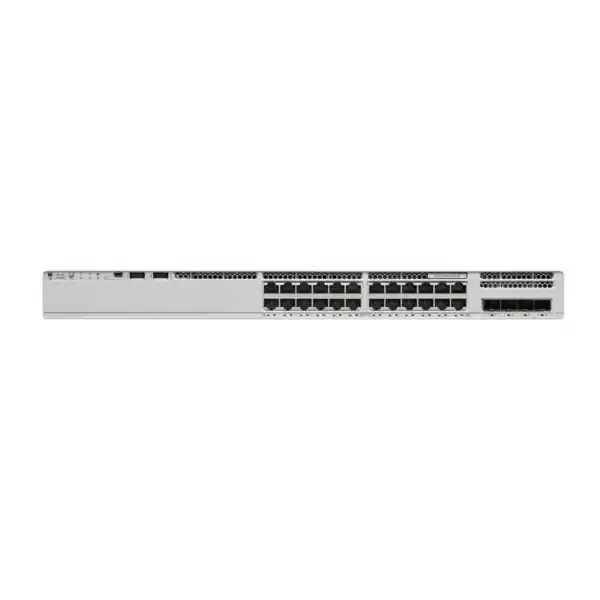
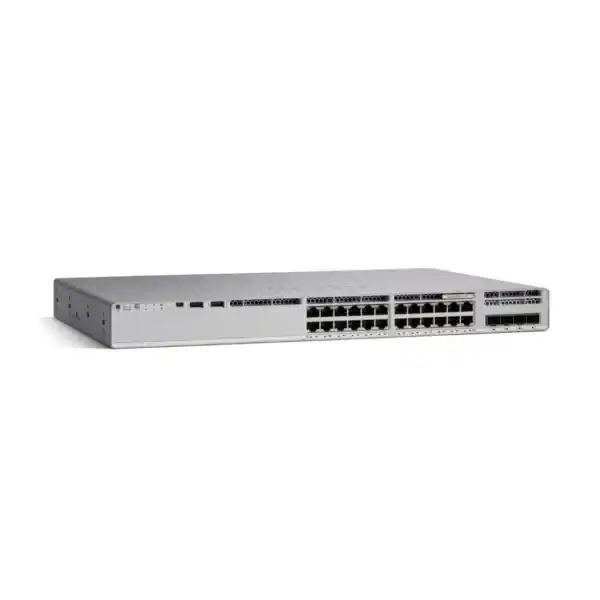
Cisco Catalyst C9200L-24T-4X Network Switch
A 24-port, data-only Catalyst 9200L access switch with four fixed 1/10G uplinks, Cisco IOS XE, StackWise-80 capability and enterprise policy, security, visibility and automation features for dependable campus and branch switching in the United Arab Emirates.
10/100/1000BASE-T access interfaces for wired endpoints and non-PoE edge devices.
Four SFP/SFP+ uplinks supporting 1G or 10G operation for aggregation and fiber connectivity.
Optional StackWise-80 architecture for a unified stack of compatible C9200L switches.
Designed for line-rate enterprise access with a 95.23 Mpps standalone forwarding rate.
Direct answer: what is the C9200L-24T-4X and when should you choose it?
The Cisco Catalyst C9200L-24T-4X is the fixed-uplink, 24-port data model in the Catalyst 9200L family. Its front-panel access interfaces are copper Gigabit Ethernet data ports, not PoE ports. That distinction matters in procurement: this model is intended for desktops, printers, workstations, servers, security appliances, industrial gateways, building-management interfaces and other devices that do not need the switch to supply electrical power. If the project must power IP phones, cameras or wireless access points directly from the access switch, a PoE-capable sibling such as a C9200L-24P-4X is normally the more appropriate bill-of-materials choice.
The 4X suffix is equally important. It identifies four fixed uplink interfaces capable of 1 or 10 Gigabit Ethernet using the appropriate supported optics or direct-attach media. For a 24-port access layer this gives network architects considerably more uplink headroom than a 4G model limited to 1G uplinks. A common UAE deployment is dual 10G links from the access closet toward a redundant distribution pair, leaving additional uplink ports available for design flexibility, migration, lab use or alternate aggregation paths. The uplinks are fixed rather than modular, so buyers should decide at design time whether four 1/10G interfaces are sufficient throughout the expected lifecycle.
Choose this model when the priority is enterprise Cisco switching, strong 10G uplink density, stackable operations and data-only edge connectivity in a compact 1RU platform. It fits especially well where the endpoint count is close to 24, where power is provided separately to attached equipment, or where a project wants to avoid purchasing a higher-wattage PoE platform that will never deliver endpoint power. FourTeck can align the switch, software entitlement, optics, stack accessories, power redundancy and implementation scope as one engineered UAE bill of materials rather than treating the switch chassis as an isolated line item.
Core hardware specification profile
| Design item | C9200L-24T-4X profile | Engineering implication |
|---|---|---|
| Access ports | 24 × 10/100/1000BASE-T data ports | Suitable for non-PoE endpoints and copper access at up to 1 Gbps per port. |
| Uplinks | 4 × fixed 1/10G SFP/SFP+ uplinks | Supports high-speed fiber or compatible direct-attach uplinks without a separate network module. |
| Standalone switching capacity | 128 Gbps | Provides capacity for the access-port and uplink profile without creating a low-speed internal bottleneck. |
| Standalone forwarding rate | 95.23 Mpps | A useful reference when sizing packet-processing requirements, especially with small frames. |
| Stacking | StackWise-80, up to eight compatible C9200L members | Enables one logical management and control domain across multiple access switches when the optional stack hardware is included. |
| Default primary power supply | PWR-C5-125WAC | Appropriate for a non-PoE platform; a second compatible supply can be specified for power redundancy. |
| Cooling | Dual fixed redundant fans | The C9200L fan assemblies are fixed, so rack environmental design and correct service planning remain important. |
| Memory | 2 GB DRAM, 4 GB flash | Supports the intended IOS XE software and feature scale of the C9200L fixed access platform. |
| Form factor | 1RU, approximately 4.4 × 44.5 × 28.8 cm chassis | Shallow depth is useful in many branch and access closets, subject to cable-management and power-clearance requirements. |
| Weight | Approximately 4.35 kg | Straightforward for standard rack installation while still requiring correct mounting hardware and support practice. |
UADP 2.0 Mini architecture
The Catalyst 9200L family is based on Cisco’s UADP 2.0 Mini architecture. In practical network design terms, the ASIC is not merely a packet-forwarding engine. It provides a programmable forwarding pipeline that allows Cisco to map Layer 2 forwarding, Layer 3 forwarding, access-control processing, quality-of-service policy and telemetry functions into hardware resources. That hardware-centric approach is important at the access layer because predictable forwarding should remain available while the switch applies policy and classification functions that would be costly if handled by a general-purpose CPU.
For architects standardizing on Catalyst 9000, UADP also creates operational consistency across a broader switching portfolio. The exact scale differs by platform, but the design philosophy is shared: policy and forwarding features are tied to a programmable data plane rather than a basic unmanaged forwarding fabric. This makes the C9200L-24T-4X a genuine enterprise access switch rather than a simple port-density appliance.
Cisco IOS XE operating model
Cisco IOS XE provides the management, routing, switching, security and programmability framework for the platform. Engineers who already operate Catalyst environments can use familiar CLI workflows while also adopting model-driven methods such as NETCONF, RESTCONF and YANG-based telemetry where supported by the selected software release and entitlement. This allows the same access switch to participate in traditional operations, controller-assisted automation or more API-driven infrastructure workflows.
The practical benefit is lifecycle flexibility. A UAE organization can deploy the switch first with carefully standardized CLI templates and later integrate automation, centralized assurance or cloud monitoring without replacing the access hardware simply because the operating model matures. Software release planning remains a design task: image selection should be aligned to approved feature requirements, security advisories, interoperability and the organization’s change-control policy rather than upgraded only because a newer release exists.
Port map engineering: 24 copper access ports plus four high-speed uplinks
The port arrangement is one of the strongest reasons to select this exact model. Twenty-four 10/100/1000BASE-T interfaces provide the user or device edge, while four fixed SFP/SFP+ interfaces provide the uplink plane. In a normal office access closet, the copper ports can serve desktops, printers, engineering workstations, local servers, appliance management interfaces, badge systems or other independently powered endpoints. Each copper link can negotiate to the attached device’s supported rate, allowing the switch to accommodate older 100 Mbps equipment during migration while presenting Gigabit connectivity to modern endpoints.
The four uplinks can operate at 1G or 10G, subject to supported transceivers, media and configuration. This lets a network team deploy 10G fiber toward a distribution layer while keeping access ports at 1G. The ratio is well matched to many 24-port user-access designs: even if every endpoint is physically capable of 1G, normal enterprise traffic is statistically multiplexed, so aggregate access demand is typically far below the sum of every port’s nominal line rate. Where workloads are unusually east-west intensive, such as media editing, dense virtualization or high-volume imaging, engineers should validate traffic profiles rather than assume a standard user-access oversubscription model.
Because the uplinks are fixed, there is no removable uplink module to exchange later for a different speed family. That reduces ordering complexity and gives the switch a clear purpose, but it also means the lifecycle design should be explicit. If a project expects 25G or 40G uplinks at the same physical access node, a modular C9200 or a higher Catalyst family may be a better long-term fit. If four 10G uplinks are sufficient, the C9200L-24T-4X offers a clean and cost-conscious path without paying for modular uplink capability that may never be used.
Switching capacity, forwarding rate and traffic behavior
Cisco specifies 128 Gbps of switching capacity and 95.23 million packets per second of forwarding performance for the C9200L-24T-4X in standalone operation. With stacking included in Cisco’s published platform figures, switch capacity is listed at 208 Gbps and forwarding at 155 Mpps. These numbers are most useful when interpreted in context. Switching capacity describes aggregate fabric throughput, while packet-forwarding rate reflects the platform’s ability to process frames at a defined packet size. Neither number should be treated as a direct application-throughput guarantee because actual traffic mixes include frame-size variation, protocol overhead, policy behavior, congestion and endpoint limitations.
For normal enterprise access, the more important question is whether the platform can forward concurrently across its intended access and uplink interfaces without an architectural mismatch. The 24 Gigabit downlinks and four 10G-capable uplinks make 128 Gbps a sensible design point for this fixed-port configuration. A properly engineered access layer should still account for congestion boundaries. If many users simultaneously transmit toward a single 10G destination, the egress link can become the constraining resource even though the switch fabric itself has spare capacity. Quality of service, link aggregation and distributed uplink design can help control or distribute that demand, but they do not create bandwidth beyond the physical links.
Packet buffers are also relevant. The C9200L Gigabit models use a 6 MB packet buffer profile. Buffers absorb short bursts and speed mismatches, but no finite buffer can compensate for sustained oversubscription. This is why FourTeck sizing focuses on traffic direction, application behavior, endpoint count, uplink topology and failure scenarios rather than simply comparing headline throughput. A design that is comfortable during normal conditions must also remain stable when one uplink, one distribution node or one stack member is unavailable.
StackWise-80 resilience
C9200L fixed models support StackWise-80 using the optional C9200L stack hardware. Up to eight compatible C9200L members of the same license level can be assembled into a logical stack, subject to Cisco’s compatibility rules. Stacking is valuable when a closet needs more than 24 ports but the operations team wants one management and control plane, a coordinated configuration and cross-stack resiliency rather than a collection of unrelated standalone switches.
The physical stack should be cabled as a resilient ring wherever possible. A ring allows traffic to continue over the remaining path if one stack connection is interrupted. Cable length, rack placement and serviceability matter: switches that are split across distant cabinets can make stack cabling awkward, and engineers should not sacrifice physical maintainability simply to force every access switch into one stack. The stack is an availability tool, not a substitute for sound rack and cable design.
Cross-stack uplink design
One of the most practical stack benefits is the ability to spread an EtherChannel across different members. In a two-member access stack, for example, one physical 10G uplink can originate from the first switch and another from the second switch. If the design, upstream platform and software configuration support the selected port-channel topology, this reduces dependence on a single access chassis and creates a cleaner failure domain than terminating every uplink on one member.
The upstream topology must be engineered at the same time. Connecting a stack to two independent distribution switches may require a distribution technology that presents the appropriate logical port-channel behavior, or the design may use routed uplinks instead. Spanning-tree assumptions, first-hop redundancy, routing adjacencies and failure convergence should be documented before deployment. Cabling extra links without a control-plane design can create loops or asymmetric failover rather than resilience.
Layer 2 switching for enterprise access
At the access layer, Layer 2 behavior determines how reliably endpoints join the network and how effectively broadcast domains are controlled. The C9200L platform supports the VLAN and spanning-tree scale expected from an enterprise access switch. Cisco lists up to 4094 VLAN IDs, 128 PVST instances and up to 512 switched virtual interfaces in the family performance profile. Those maximums are platform scale references, not design targets. A well-structured campus should use only the VLANs, SVIs and spanning-tree instances required for the intended segmentation model so troubleshooting remains understandable.
Rapid Per-VLAN Spanning Tree and Multiple Spanning Tree are common mechanisms for preventing Layer 2 loops. In a traditional access design, edge ports are normally classified explicitly as endpoint-facing interfaces, while trunk and infrastructure ports follow separate templates. Features such as BPDU Guard, Root Guard, loop protection and storm control can be applied according to the organization’s standard. The goal is to prevent an accidental patch cable, unmanaged downstream switch or misconfigured device from destabilizing a larger broadcast domain.
EtherChannel provides another important tool. Multiple physical links can operate as one logical connection, improving capacity and redundancy where the peer design supports it. LACP is generally preferred because both sides participate in link-negotiation logic. On a stack, cross-stack EtherChannel can distribute physical member links across chassis. The forwarding design should still consider hash behavior: a port-channel balances flows, not individual packet fragments, so one very large flow may remain limited to a single member link even when total aggregate bandwidth is higher.
For UAE enterprises migrating from older Catalyst access layers, this model can retain familiar VLAN and trunking methods while allowing a cleaner policy baseline. FourTeck’s IT Services UAE team can incorporate interface templates, VLAN plans, switch hardening and handover documentation into a deployment scope so the new switch does not inherit years of unreviewed legacy configuration by default.
Layer 3 routing and routed-access options
The Catalyst 9200 Series is not limited to Layer 2 access. Depending on the software entitlement and release, the platform supports Layer 3 capabilities such as static routing and dynamic routing protocols, allowing the C9200L-24T-4X to participate in routed access, branch aggregation or local inter-VLAN routing. Cisco’s current family data lists the C9200L scale at 11,000 combined IPv4 ARP plus learned routes, including 8,000 direct and 3,000 indirect routes, with 3,000 IPv4 routing entries and 1,500 IPv6 routing entries in the corresponding performance profile.
These numbers are far beyond the requirements of a typical 24-port office closet, but the capability matters because modern campus designs increasingly move Layer 3 boundaries toward the edge. A routed uplink can reduce spanning-tree scope and create more deterministic failure behavior. Instead of extending the same VLAN through multiple closets, each access block can own its local subnets and advertise routes upstream. The tradeoff is a greater requirement for routing discipline, IP addressing, monitoring and change control.
Dynamic routing should be chosen for the architecture, not enabled simply because it exists. OSPF is commonly used in enterprise networks; EIGRP may remain appropriate in established Cisco environments; other protocols depend on release and licensing. Route summarization, adjacency timers, authentication, default-route strategy and failure convergence all need design review. A branch with one upstream path may need only a static default route, while a dual-homed campus access layer may justify dynamic routing to achieve rapid and deterministic convergence.
IPv6 planning should be part of the same discussion even if the current LAN is predominantly IPv4. The switch supports IPv6 routing scale and security functions appropriate to the platform, allowing organizations to build dual-stack readiness into new projects. Treating IPv6 as a future bolt-on can create policy gaps, especially where endpoint operating systems already use IPv6 link-local or discovery traffic.
Important: this is a non-PoE model
The T in C9200L-24T-4X identifies data-only downlinks. The access ports do not provide PoE or PoE+ power to endpoints. This can be an advantage when every connected device has its own power source because the switch uses a lower-wattage power profile and avoids unnecessary PoE cost. It is a poor fit, however, if the access layer is expected to energize IP phones, Wi-Fi access points, cameras or other powered devices directly.
During quotation, count powered endpoints separately from simple Ethernet endpoints. If a closet has even a moderate number of PoE devices, compare the PoE-capable C9200L variants rather than planning injectors as an afterthought. External injectors can solve isolated cases but increase cabling, power outlets, inventory and troubleshooting points.
Power-supply redundancy
The C9200L-24T-4X ships with a 125W AC power-supply profile and supports a second compatible power supply for redundancy. In a critical access closet, dual supplies should be connected to independent power distribution paths where practical. Two supplies connected to the same single PDU protect against a PSU failure but do not protect against the loss of that PDU, branch circuit or upstream UPS.
Power resilience should therefore be considered as an end-to-end system: switch PSU, PDU, UPS, building circuit, generator policy and environmental cooling all contribute to availability. In the UAE, where equipment rooms may face demanding ambient conditions if cooling fails, UPS runtime and HVAC alarms are as important as redundant switch hardware.
Security controls at the access layer
Enterprise access security starts with controlling who or what is allowed onto each switch port and what traffic that identity may exchange. The Catalyst 9200 family supports Cisco’s broader access-security approach, including identity-aware policy integration, access control lists, segmentation capabilities and Trust Anchor technologies. Hardware and software trust mechanisms such as secure boot and signed software help establish confidence that the platform is running authorized code before higher-level network policies are even considered.
At the edge, 802.1X can be used with an identity platform such as Cisco ISE to authenticate users or devices before granting network access. MAC Authentication Bypass can assist with devices that cannot perform 802.1X, but it should be treated as a compatibility mechanism rather than equivalent proof of identity. Dynamic VLAN assignment, downloadable policy or security group policy can be layered according to the organization’s architecture and license capabilities. Where identity infrastructure is not deployed, carefully designed static port policies are still preferable to unrestricted access.
Layer 2 protections such as DHCP Snooping, Dynamic ARP Inspection and IP Source Guard can reduce common local-network attacks when deployed correctly. DHCP Snooping builds a trust boundary around legitimate DHCP server paths; Dynamic ARP Inspection can validate ARP messages against known bindings; IP Source Guard can restrict source addressing on access interfaces. These controls depend on accurate trust-port configuration, so deployment should be staged. An incorrect trust boundary can block legitimate clients just as effectively as it blocks malicious traffic.
Port security, ACLs and segmentation should be tied to endpoint classes. A finance workstation, CCTV recorder, building-management controller and guest-room device have different exposure and communication requirements. The goal is not to enable every possible security feature; it is to reduce attack paths while retaining stable operations and auditable policy. For projects that also require perimeter controls, FourTeck’s Firewall Dubai practice can align access segmentation with firewall zones, inter-VLAN inspection and site-to-site security so campus and perimeter policies reinforce each other.
Cisco’s published C9200L scale includes 1,500 ACL entries, 10K IP security-group-tag bindings and 2K SGT/DGT policies in the platform profile. These capacities are design ceilings rather than recommendations. The actual policy model should remain as simple as possible while meeting security requirements, because understandable policy is easier to test, monitor and recover during an incident.
QoS for voice, video and business-critical traffic
Although this model does not supply PoE, it can still carry voice, video and real-time traffic from independently powered devices or downstream systems. Quality of Service is therefore an important design topic. QoS does not manufacture bandwidth; it determines how traffic is classified, marked, queued and scheduled when a link becomes congested. On a lightly loaded network the queues may rarely matter. During a backup storm, software distribution event or uplink failure, they can determine whether voice and interactive applications remain usable.
A robust QoS design begins with a trust boundary. If every endpoint is allowed to mark its own traffic as high priority, the network has no meaningful policy. Many enterprises classify traffic at the access port based on device type, application identity, VLAN or access policy, then preserve or rewrite markings toward the distribution layer. Real-time classes should be narrowly sized to protect latency-sensitive traffic without starving transactional or bulk applications.
The C9200L platform provides hardware QoS resources within the UADP pipeline, and Cisco lists 1,000 QoS scale entries for the family profile. The design should account for ingress and egress behavior, not simply apply a copied template from an older Catalyst generation. Queue structure, scheduler behavior and available commands can differ across platforms and IOS XE releases. A migration is the right time to review old class maps and policy maps rather than assume that every legacy command remains useful.
In branch networks with constrained WAN bandwidth, the access-switch QoS policy should also align with router or SD-WAN policy. Prioritizing a packet on a 10G campus uplink does not help if the actual congestion occurs on a 100 Mbps WAN circuit. End-to-end classification consistency is what produces predictable application treatment.
Flexible NetFlow, telemetry and operational visibility
Troubleshooting an access network is much faster when the switch can report more than simple interface up/down state. The C9200L platform supports Flexible NetFlow and model-driven telemetry capabilities that can provide structured insight into traffic and device behavior. Cisco’s performance table lists 16,000 Flexible NetFlow entries for 24- and 48-port Gigabit C9200L models. The exact records, exporters and resource allocation should be validated against the selected IOS XE release and configuration template.
Traditional SNMP polling remains useful for inventory, interface counters, environmental monitoring and alerts. Streaming telemetry can complement polling by pushing selected operational data at defined intervals rather than waiting for a management platform to request every metric. This can improve time-to-detection for changing conditions and provide richer historical analysis when integrated with an appropriate collector.
Visibility should serve specific operational questions. Engineers may want to know which uplink is approaching sustained utilization, whether a particular endpoint is generating abnormal broadcast traffic, how often interfaces flap, whether stack members experience resource pressure, or whether errors increase after a cabling change. Collecting every available metric without a retention and alerting strategy can produce large volumes of data with little operational value.
FourTeck can integrate switch monitoring into a broader managed or project-based operations model through FourTeck UAE, including baseline health checks, configuration backup, alert design and escalation procedures. The objective is to turn telemetry into an actionable operations process rather than treat monitoring as a dashboard-only exercise.
Automation and APIs
Cisco IOS XE supports model-driven automation using mechanisms such as NETCONF, RESTCONF and YANG data models. These interfaces are valuable when an organization wants repeatable configuration, compliance checks or inventory extraction without relying entirely on interactive CLI sessions. They also make it easier to integrate the switch into modern infrastructure pipelines while preserving traditional CLI access for troubleshooting.
Automation should be introduced with guardrails. Configuration source control, peer review, lab validation, rollback logic, maintenance windows and credential handling are as important as the API itself. A fast automation tool can distribute a good standard quickly, but it can distribute an error just as quickly. Start with low-risk read-only inventory or compliance tasks, then expand into controlled change workflows.
Plug and Play deployment
Cisco Plug and Play can simplify rollout of new switches by reducing the need for device-by-device manual staging. In a multi-branch UAE deployment, a standardized onboarding process can reduce technician time and configuration drift. The actual workflow depends on the organization’s management platform, licensing, network reachability and security policy.
Zero-touch concepts do not remove the need for site readiness. Rack space, patching, optical paths, DHCP/DNS assumptions, management reachability and power must still be correct. A switch that can automatically obtain configuration is only useful if the physical and underlay network are prepared to let it reach the intended controller or provisioning service safely.
Licensing: Network Essentials, Network Advantage and subscription planning
The C9200L-24T-4X can be ordered in different software-license variants, commonly identified by suffixes such as -E for Network Essentials and -A for Network Advantage. The physical port arrangement remains the same, but available software capabilities differ. For that reason, a purchase request that says only C9200L-24T-4X is incomplete if the project depends on specific routing, segmentation or advanced services. The license level must be matched to the intended feature set before the purchase order is finalized.
Cisco’s licensing model has evolved over the lifecycle of Catalyst 9000, including Cisco DNA and newer Cisco Networking subscription packaging. The exact subscription requirement, term and entitlement should be validated at quotation time against Cisco’s then-current ordering rules. This is especially important for public-sector and enterprise procurement where renewal ownership, Smart Account administration and software support responsibilities must be documented from the start.
A good licensing discussion begins with use cases rather than part-number suffixes. Does the design require only standard Layer 2 access and basic routing? Will it use advanced routing? Is SD-Access planned? Will centralized assurance or cloud management be used? Is there an existing Cisco Smart Account? Who owns subscription renewal? Which support level is required? Answering these questions produces a defensible bill of materials and reduces the chance that a switch arrives with either insufficient entitlement or unnecessary software cost.
FourTeck quotations can distinguish the hardware SKU, software tier, subscription term, support service, optics and accessories so technical reviewers and procurement teams can see exactly what is included. This is preferable to presenting one blended line that makes it difficult to identify what will need renewal and what remains a perpetual hardware asset.
Optics and uplink media: design before you order
The four uplink ports are SFP/SFP+ interfaces, so the switch chassis alone does not define the physical media. The correct transceiver depends on speed, fiber type, distance, connector standard and peer-device compatibility. A 10G multimode link across a building may use a very different optic from a single-mode inter-building link. Direct-attach copper can be useful for short rack-to-rack or same-rack connections where supported. A 1G link may use an SFP selected for the fiber plant or copper requirement.
Before ordering, record the two endpoints of every uplink, the required speed, estimated path distance, installed fiber type, connector presentation and patch-panel path. Older buildings may contain a mixture of OM1, OM2, OM3, OM4 and single-mode fiber, and the label on a patch cord does not necessarily prove the end-to-end plant type. Where documentation is uncertain, optical testing can prevent a deployment day failure caused by an assumed reach that the existing plant cannot support.
Transceiver compatibility should also be controlled. Enterprise support teams generally benefit from using optics that are supported by the switch vendor and by the organization’s support policy. The lowest-cost transceiver is not always the lowest total-cost choice if it creates diagnostic alarms, unsupported states or inconsistent field inventory. Spare optics should be considered for critical sites because a small transceiver can be the single point that disconnects an otherwise healthy access switch.
For dual-homed designs, try to diversify the physical fiber path where the building allows it. Two 10G uplinks routed through the same conduit and patch panel may protect against a transceiver failure but not against a cable cut or panel incident. Logical redundancy is strongest when the physical path is also resilient.
Deployment scenarios in the UAE
Corporate office access
A 24-port data switch is a natural fit for an office zone where desktops, docking stations, printers and other independently powered devices need stable wired connectivity. Two 10G uplinks can be aggregated or distributed toward resilient distribution switches, while the remaining uplink interfaces provide migration flexibility. If desk phones or access points require PoE, keep them on a dedicated PoE access switch or select a PoE-capable C9200L model to avoid a mixed injector environment.
Branch office
In a branch, the switch can act as the primary wired access layer behind a firewall, router or SD-WAN appliance. Layer 3 functions can provide local VLAN gateways if the design calls for routed access, while centralized management and automation can reduce the operational burden across multiple UAE sites. A second power supply and dual uplinks are worth considering where the branch hosts revenue-critical operations.
School or training facility
Computer labs often have dense wired endpoints that are externally powered and do not need PoE. The 24T model can serve lab PCs while 10G uplinks carry imaging, software distribution and internet traffic toward the core. Administrators can segment staff, student, lab and management networks and apply edge security controls to reduce the impact of unmanaged or frequently changing endpoints.
Hospitality back office
Hotels and hospitality properties often separate guest-facing PoE systems from back-office systems. The C9200L-24T-4X can provide data connectivity for administration, finance, property-management interfaces and other non-PoE equipment, while dedicated PoE switches serve phones, cameras and wireless access points. VLAN and security policy should maintain strong separation between operational systems and guest networks.
Server-room edge
The switch can support management interfaces, backup appliances, monitoring devices and low-to-moderate bandwidth server connections where Gigabit access is sufficient. It is not a substitute for a high-density data-center top-of-rack switch when servers need 10G, 25G or faster downlinks. Use it where the endpoint speed profile genuinely matches Gigabit Ethernet and the 10G ports are primarily uplinks.
Multi-site standardization
Organizations with offices in Dubai, Abu Dhabi, Sharjah and other emirates can standardize this model for small non-PoE closets, building consistent templates, spares and monitoring. Where the same enterprise also operates across East Africa, FourTeck’s Africa network practice can help maintain a common design philosophy while adapting logistics and support to each country.
Sizing methodology: decide from endpoints, uplinks and failure states
Switch sizing should begin with an endpoint worksheet, not with a preferred model. Count every physical Ethernet connection expected at the site and separate them into categories: user devices, printers, servers, security appliances, management interfaces, building systems, cameras, phones, access points, IoT equipment and spare capacity. Mark which endpoints need PoE, their expected speed and whether they require special VLAN or security policy. This immediately reveals whether a data-only 24-port switch is appropriate.
Next apply growth and patching reality. A closet with 23 known devices technically fits a 24-port switch, but it leaves almost no operational headroom. Moves, adds and changes can consume ports quickly, and temporarily connecting a diagnostic device should not require unplugging production equipment. Depending on the site, a target of roughly 15 to 25 percent spare access capacity can be reasonable, though dense and stable environments may use a different threshold. If the expected endpoint count will soon exceed 24, a 48-port model or a planned two-switch stack may be more economical than an immediate secondary purchase.
Then model uplink demand. Estimate average and peak traffic, but also consider simultaneous events: operating-system deployment, endpoint backup, video sessions, cloud synchronization and large local transfers. A single 10G uplink may be more than adequate for typical office users, while two or more links provide capacity and redundancy. If the design requires all four 10G uplinks for production from day one, document what expansion path remains.
Finally model failures. What happens if one uplink fails? What happens if the distribution peer fails? What happens if one stack member loses power? Do surviving links have enough bandwidth? Are endpoints dual-homed, or will they necessarily lose connectivity with their local switch? Availability claims should be based on these failure-state answers, not on the simple presence of redundant parts.
FourTeck can use this sizing process before quotation so the selected model reflects the actual topology. This reduces two common mistakes: buying PoE where it will never be used, and buying a data-only switch where an endpoint-power requirement appears after installation.
UAE rack, power and environmental planning
The C9200L-24T-4X is a 1RU platform with a relatively shallow chassis, which helps in access closets where cabinet depth is constrained. The chassis itself is approximately 4.4 cm high, 44.5 cm wide and 28.8 cm deep before considering front-end projection and cabling. Rack planning must include more than the metal enclosure dimensions. SFP/SFP+ transceivers, fiber bend radius, copper patch cords, rear power cables, PDU plugs and stack cables all need physical clearance.
Airflow and room temperature deserve particular attention in the Gulf climate. Enterprise switches are designed for controlled equipment environments, not for sealed cupboards exposed to building heat. Cooling failure can raise rack inlet temperature quickly, especially in closets containing multiple switches, UPS systems and other active equipment. Environmental monitoring, proper ventilation and clear front-to-rear airflow paths should be part of the installation standard.
Power design should identify the circuit and UPS capacity for both present and future devices. Because this is a non-PoE switch, its power demand is much lower than a fully loaded PoE access switch, but the closet may still contain firewalls, routers, optical equipment and other loads. If a second switch or PoE platform will be added later, size the UPS and PDU with that future load in mind. Dual switch power supplies only create meaningful path diversity when they are connected to independent supported power paths.
Grounding and cable management should follow applicable site and vendor practices. Copper runs should be certified to the intended category and length; patch panels should be labeled consistently; fiber should be cleaned and inspected before connection. Many network incidents attributed to switch hardware are ultimately caused by damaged patch cords, contaminated fiber ends, excessive bend radius or undocumented cross-connects.
For new builds, coordinate network cabinets with MEP and fit-out teams early. It is far easier to correct cooling, circuit availability and fiber pathways before ceilings and joinery are closed than during switch commissioning.
Migration from older Catalyst access switches
Many organizations consider the Catalyst 9200L when refreshing older Catalyst 2960, 2960-X, 3560 or similar access estates. A successful migration should not be treated as a one-to-one configuration copy. Older switches may contain commands that are obsolete, redundant or inappropriate for IOS XE. Years of local changes can also accumulate unused VLANs, disabled trunks, stale descriptions and inconsistent security settings. A hardware refresh is an opportunity to simplify.
Start by exporting the old configuration and classifying its intent. Identify access VLANs, trunks, port channels, spanning-tree priorities, routing, management access, AAA, SNMP, syslog, NTP, DHCP relay, edge security and QoS. Then map each requirement to the C9200L’s supported configuration model and selected software release. Do not assume that identical command text is necessary to reproduce identical service behavior.
Physical migration needs equal discipline. Map old port numbers to new patch-panel destinations and label critical devices before maintenance begins. Pre-stage the switch with management IP, software image, credentials and baseline policy. Verify optics at both ends. Back up the old configuration and maintain a rollback plan. If the migration changes the topology from standalone to stack or from Layer 2 to routed access, test that design separately rather than combining multiple architectural changes without a validation window.
After cutover, validate more than ping. Confirm spanning-tree state, routing neighbors, port-channel members, VLAN reachability, authentication, DHCP, DNS, monitoring, syslog, NTP and application access. Check interface errors and optics diagnostics. Compare the expected MAC-address population with what the switch actually learns. A structured post-change checklist can catch partial failures before users report them.
FourTeck can support discovery, configuration translation, staging, physical cutover and acceptance testing as separate project phases, giving enterprise teams a clearer change record and reducing dependence on ad-hoc migration steps.
Operations, backup and lifecycle management
A switch should enter production with an operating standard, not just a working configuration. Define who owns configuration changes, where backups are stored, which management protocols are allowed and how alerts are routed. AAA should use centralized authentication where the environment supports it, with a controlled local recovery method. Management access should be limited to trusted networks rather than exposed broadly across user VLANs.
Configuration backups should be automated and versioned. A backup is most useful when operators can identify what changed, who approved the change and how to restore the last known good state. For stacked systems, inventory should record serial numbers and member roles so a replacement procedure is clear. Spare stack cables, optics or power supplies may be justified at critical sites depending on service-level objectives and supplier lead times.
Software lifecycle planning requires a balance between stability and security. An organization may standardize on a Cisco recommended release train after lab or pilot validation, monitor security advisories, and schedule upgrades through formal maintenance windows. Features used in production should be regression-tested against the target release, especially authentication, routing, stacking and automation integrations. Cold patching still requires a reboot for changes to take effect, so patch planning should be connected to redundancy and maintenance procedures.
Logs and time synchronization are foundational. Accurate NTP allows events from switches, firewalls, servers and identity systems to be correlated during troubleshooting. Syslog should be forwarded to a centralized platform with enough retention for operational and security investigations. SNMP or telemetry monitoring should track interface errors, utilization, CPU, memory, stack state, temperature and power-supply health according to the platform’s exposed metrics.
Documenting these controls at deployment makes the switch easier to support years later. The objective is a reproducible service, not a device that only the original installer understands.
Interoperability with firewalls, servers, wireless and voice networks
An access switch sits between many infrastructure domains, so interface design should be coordinated with the systems it connects. Toward a firewall, the link may be a routed interface, a VLAN trunk or part of a larger distribution architecture. The firewall should not be expected to compensate for an uncontrolled Layer 2 domain, and the switch should not duplicate security policy that is better enforced at an inter-zone inspection boundary. Clear ownership of gateway, routing and segmentation functions avoids overlapping configuration.
Toward servers, verify NIC speed, link aggregation mode, VLAN tagging and redundancy. A server using LACP requires a corresponding port-channel design; a hypervisor trunk may carry multiple VLANs and needs stricter change control than a single-access-port workstation. The switch downlinks are Gigabit Ethernet, so high-throughput servers requiring multi-gigabit access should use a different switching platform or connect through an architecture designed for those speeds.
Wireless access points often need PoE, which is why this exact 24T model is usually not selected as the primary AP access switch. It can still participate in the same campus, providing non-PoE user access while a separate PoE switch supports APs. Keep uplink and VLAN architecture consistent so wired and wireless policies integrate cleanly at the distribution layer. Cisco SD-Access and Catalyst Center capabilities may provide deeper policy integration where the organization has adopted that architecture, subject to the C9200L’s supported role and limits.
Voice endpoints present a similar question. An independently powered IP phone can use a data-only switch, but most enterprise phone deployments rely on PoE for simpler cabling and centralized power backup. If voice is part of the project, include PoE budget, voice VLAN, QoS trust and emergency-calling requirements in the switch selection instead of deciding only from port count.
The best campus designs assign each infrastructure function to the component built to perform it and then define clean interfaces between those components. That reduces configuration duplication and simplifies fault isolation.
How the C9200L-24T-4X compares with nearby choices
| Model choice | Choose it when | Do not choose it when |
|---|---|---|
| C9200L-24T-4X | You need 24 non-PoE Gigabit access ports and four 10G-capable fixed uplinks. | Most endpoints need PoE or the design requires uplinks faster than 10G. |
| C9200L-24T-4G | You need the same basic 24-port data profile but only 1G uplinks. | The access layer needs 10G uplink bandwidth or future 10G migration. |
| C9200L-24P-4X | You need 24 PoE+ access ports with four 10G-capable fixed uplinks. | PoE will not be used and a lower-power data-only model is more economical. |
| C9200L-48T-4X | You need approximately twice the data-port density in one 1RU switch. | A smaller fault domain or lower port count is preferred. |
| Modular C9200 family | You need modular uplink flexibility, different stacking capability or a feature profile beyond fixed C9200L requirements. | Four fixed 1/10G uplinks fully satisfy the lifecycle plan and cost efficiency is the priority. |
The comparison illustrates why exact suffixes matter. A one-character difference can change PoE behavior or uplink capability, while the -A and -E ordering variants can change the software tier. FourTeck should therefore quote the complete Cisco part number, not just the family name, and match accessories to that exact chassis.
Procurement considerations for Dubai and the wider UAE
Enterprise network procurement is not complete when the switch quantity is known. A usable bill of materials may also need software entitlement, subscription, support, stacking kits, stack cables of the correct length, primary and secondary power supplies, rack accessories, SFP/SFP+ optics, patch cords, console access and spares. Missing one low-cost accessory can delay a high-value deployment, particularly when installation is scheduled around a short maintenance window.
For UAE projects, procurement teams should align technical acceptance criteria with commercial documentation. Record the exact model suffix, license level, power-cord requirement, support coverage and delivery location. If serial-number registration or Cisco Smart Account association is required, decide who owns that activity. For multi-site rollouts, label shipments by site and closet rather than treating all switches and optics as a common pool; this simplifies field deployment and reduces accidental allocation of the wrong transceiver or cable.
Lead time should influence architecture only where necessary. Substituting a superficially similar model can introduce real design differences. A 4G model cannot deliver the same 10G uplink capability, and a 24T data-only model cannot replace a 24P PoE requirement without changing endpoint power. If an alternate part is proposed, the technical team should revalidate the complete requirement rather than accept it as equivalent based only on port count.
Warranty and support also need distinction. Hardware warranty coverage, Cisco support services, software entitlement and FourTeck implementation support address different needs. Critical networks may require vendor support for TAC access and replacement logistics as well as a local partner for onsite diagnosis, configuration and coordination. Procurement should know which layer of support is included in the price.
FourTeck can provide UAE quotation and deployment coordination through its main FourTeck UAE channel, with the switch positioned as part of an engineered network rather than an isolated box sale.
Common specification mistakes to avoid
- Assuming the 24T ports provide PoE. They do not. Treat every endpoint-power requirement separately.
- Confusing 4X with four 1G uplinks. The 4X model provides four fixed 1/10G uplink interfaces, while the 4G model is the 1G-uplink variant.
- Forgetting optics. Uplink interfaces require media that matches speed, fiber type, distance and the peer device.
- Assuming stacking accessories are included by default. StackWise functionality requires the appropriate C9200L stack hardware and cabling.
- Mixing incompatible stack families. C9200L fixed models follow C9200L stacking rules and cannot simply be mixed with modular C9200 or unrelated Catalyst families.
- Ignoring license tier. Hardware ports alone do not tell you whether every required routing or policy feature is licensed.
- Using switching capacity as an application SLA. User experience also depends on uplink congestion, WAN capacity, endpoint performance, QoS and application design.
- Designing redundancy only on paper. Dual uplinks in the same fiber path and dual PSUs on the same PDU still share physical failure points.
Frequently asked technical questions
Does the C9200L-24T-4X provide PoE?
No. It is a 24-port data-only model. If phones, access points, cameras or other powered devices must receive electricity from the switch, select an appropriate PoE-capable Catalyst variant.
How many 10G uplinks are available?
There are four fixed uplink interfaces that support 1G or 10G operation with supported SFP/SFP+ media. The exact optic must match the required distance and fiber or copper medium.
Can the switch be stacked?
Yes. C9200L fixed models support StackWise-80 with the correct optional C9200L stacking hardware. Cisco supports up to eight compatible members under the relevant stacking and license-level rules.
Can I mix C9200L and C9200 in one stack?
No. Fixed C9200L and modular C9200 platforms use different stacking families and are not intended to be mixed in the same stack.
What is the switching performance?
Cisco lists 128 Gbps switching capacity and 95.23 Mpps forwarding rate for the C9200L-24T-4X standalone, with published stacked figures of 208 Gbps switch capacity and 155 Mpps forwarding.
Is the uplink module replaceable?
No. This is a fixed-uplink C9200L model. If the project needs modular uplink options or faster future uplinks, compare the modular C9200 family or a higher Catalyst platform before purchase.
What power supply does it use?
The model’s default primary power-supply profile is PWR-C5-125WAC. A second compatible supply can be specified to improve power resilience in critical closets.
Is it suitable for a server access layer?
It can be suitable for servers and appliances that only require 1G copper downlinks. High-performance servers needing 10G, 25G or faster host connectivity should use a data-center or campus platform designed with faster downlinks.
Decision recap: is the Cisco C9200L-24T-4X the right switch?
The C9200L-24T-4X is a strong fit when the requirement is specifically twenty-four non-PoE Gigabit Ethernet access ports, four 1/10G uplinks, enterprise Cisco IOS XE operations and optional StackWise-80 resiliency. It is particularly attractive in access closets where endpoint power is handled elsewhere, because the buyer receives Catalyst enterprise features without paying for a large PoE power subsystem that will sit unused.
Choose this model when
- All or nearly all endpoints are independently powered.
- Twenty-four access ports provide adequate capacity with planned growth.
- 10G-capable uplinks are required for distribution connectivity.
- StackWise-80 aligns with the closet resilience plan.
- Fixed uplinks are acceptable for the expected lifecycle.
- Cisco IOS XE and Catalyst operational consistency are strategic requirements.
Choose another model when
- PoE or PoE+ is required for phones, APs or cameras.
- More than 24 ports are needed without stacking.
- Endpoints need multigigabit copper access.
- The uplink roadmap requires 25G, 40G or faster interfaces.
- Fan field replacement is a mandatory operational requirement.
- The software feature requirement exceeds the selected C9200L license tier.
Quotation input checklist for FourTeck UAE
Providing the information below allows the quotation to include the correct Cisco variant, optics and accessories from the beginning. It also gives the engineering team enough context to flag a mismatch before hardware is purchased.
1. Access requirements
Number of copper endpoints now, three-year growth estimate, required port speeds, VLAN count, special server or appliance interfaces, and confirmation that endpoints do not require PoE from this switch.
2. Uplink requirements
Number of uplinks, 1G or 10G speed, peer switch model, fiber type, estimated distance, connector type, patch-panel path and whether link aggregation or dual-homing is planned.
3. Stacking requirements
Standalone or stack design, number of members, rack placement, required stack-cable length, desired topology and whether existing C9200L units must join the new stack.
4. Software and management
Required license tier, routing protocols, 802.1X/ISE requirements, Catalyst Center or cloud-management plans, telemetry, Smart Account ownership and desired subscription term.
5. Resilience and support
Need for a second power supply, UPS/PDU arrangement, spare optics, support service level, replacement expectations and whether onsite implementation or managed support is required.
6. Site logistics
Emirate and site location, rack availability, cabinet depth, power outlets, cooling readiness, maintenance window, delivery restrictions and whether cabling or fiber testing is included in scope.
Structured consultation panel
A FourTeck consultation can be limited to supply-only validation or expanded into a complete network refresh. For supply-only requests, the team can validate model suffix, license tier, optics, stacking hardware and power redundancy. For implementation projects, the scope can include discovery, low-level design, configuration templates, staging, rack installation, migration, testing, documentation and operational handover.
Confirm whether 24 non-PoE ports and four 10G-capable uplinks fit endpoint demand, traffic load, stack growth and resilience requirements. Where the model is not appropriate, identify the nearest technical alternative before purchase.
Build a complete BOM covering switch SKU, software, subscriptions, support, stack kits, cables, power supplies and optics. This avoids discovering missing infrastructure components after the chassis reaches site.
Stage software and configuration, migrate ports in a controlled maintenance window, validate routing and switching state, test security and monitoring, and produce handover records for the operations team.
Plan configuration backup, monitoring, software maintenance, spare strategy and escalation. For larger estates, standardize templates and operational controls across multiple UAE sites and related regional deployments.
For organizations building a broader infrastructure roadmap, FourTeck can coordinate switching with security, server and network services through the approved FourTeck ecosystem. The objective is to make the C9200L-24T-4X one well-designed component of a supportable architecture rather than an isolated purchase decision.
Final recommendation for UAE buyers
The Cisco Catalyst C9200L-24T-4X is best understood as a purpose-built enterprise access switch: 24 Gigabit data ports, four fixed 1/10G uplinks, StackWise-80 capability, Cisco IOS XE operations, hardware-assisted policy processing, Layer 2 and Layer 3 services, telemetry and a low-power non-PoE design. It is not the universal answer for every access closet, and that is precisely why the model is attractive when its profile matches the requirement. Buyers avoid unnecessary PoE hardware while retaining the operational depth expected from the Catalyst 9000 family.
For a straightforward office with fewer than 24 independently powered devices, a pair of resilient 10G uplinks and standard enterprise segmentation, this model can provide an excellent balance of port density and uplink performance. For a growing closet, stacking can extend the same operational domain. For a design dominated by powered endpoints, multigigabit Wi-Fi access points or faster host links, the correct decision is to move to another Catalyst variant rather than force the 24T-4X into a role it was not designed to perform.
FourTeck UAE can validate the exact -A or -E ordering option, current licensing, supported optics, stack accessories, redundant power and deployment scope against the final architecture before quotation. That final validation is the difference between ordering a switch that merely has the right family name and ordering a complete access solution that is ready to install, support and scale.

Reviews
There are no reviews yet.