
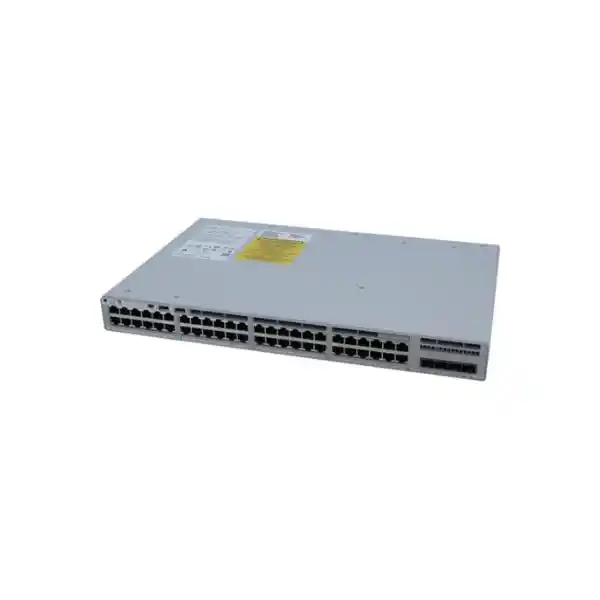
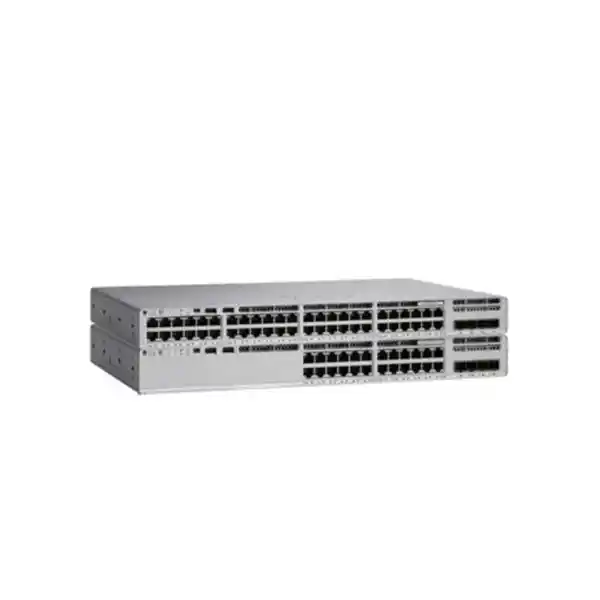
Cisco Catalyst C9200L-48PXG-2Y Network Switch for Dubai & UAE Networks
The Cisco Catalyst C9200L-48PXG-2Y is a 48-port PoE+ enterprise access switch engineered for organizations that need more bandwidth at the access edge without replacing every copper run with fiber. It combines 40 standard 1 Gigabit Ethernet access interfaces, 8 multigigabit copper interfaces that can negotiate 1, 2.5, 5 or 10 Gigabit rates, and two fixed 1/10/25G SFP28 uplinks. The platform is particularly well suited to Wi-Fi 6 and Wi-Fi 6E access-point aggregation, high-density office floors, schools, hotels, hospitals, retail sites, operational branches and distributed enterprises in Dubai and across the UAE.
Direct Answer: What Is the C9200L-48PXG-2Y?
The C9200L-48PXG-2Y is the fixed-uplink, multigigabit 48-port member of the Cisco Catalyst 9200L family. Its access-side port mix is intentionally asymmetric: 40 RJ-45 interfaces are intended for conventional 10/100/1000 Ethernet endpoints, while 8 RJ-45 multigigabit interfaces can operate at 100 Mbps, 1 Gbps, 2.5 Gbps, 5 Gbps or 10 Gbps according to endpoint capability and cabling conditions. All 48 access ports support PoE+, making the switch capable of providing data and power to wireless access points, IP phones, cameras, access-control devices and other powered endpoints from a single access-layer chassis.
On the uplink side, the model provides two fixed SFP28 interfaces that support 1, 10 or 25 Gigabit Ethernet. This is a key distinction from many access switches that top out at 10G uplinks. A pair of 25G uplinks creates more headroom for dense wireless traffic, east-west client activity, video, backups, cloud access and aggregated application flows. It also makes the model practical when the distribution layer already uses 25G ports and the design objective is to avoid an early uplink bottleneck.
For UAE buyers, the most important planning point is that C9200L is a fixed-uplink platform rather than the modular-uplink C9200 design. The choice therefore needs to be made correctly at procurement time. If two 25G-capable fixed uplinks, eight mGig copper ports and forty 1G copper ports match the intended floor or branch design, the C9200L-48PXG-2Y offers a strong balance of access density, PoE capability and uplink bandwidth. If the project needs a different uplink module strategy, more multigigabit ports, or a different stacking architecture, the bill of materials should be reviewed before ordering.
Core Hardware Specification Snapshot
| Parameter | C9200L-48PXG-2Y Value | Design Relevance |
|---|---|---|
| Access ports | 40 × 1G RJ-45 + 8 × multigigabit RJ-45 | Supports conventional endpoints plus high-bandwidth APs and specialist devices. |
| PoE | PoE+ across all 48 access interfaces | Centralizes power delivery for phones, APs, cameras and IoT endpoints. |
| Uplinks | 2 × 1/10/25G SFP28 fixed uplinks | Provides high-capacity fiber connectivity to distribution or core. |
| Switching capacity | 340 Gbps standalone; 420 Gbps with stacking | Appropriate for high-density access traffic and aggregated uplinks. |
| Forwarding rate | 252.97 Mpps standalone; 313 Mpps with stacking | Indicates packet-forwarding capability at access-layer scale. |
| Stacking | StackWise-80, up to 8 C9200L members of compatible license level | Simplifies operations and enables cross-stack resiliency. |
| Packet buffer | 12 MB for C9200L multigigabit models | Helps absorb microbursts and traffic-speed transitions. |
| Memory | 2 GB DRAM, 4 GB flash | Supports Cisco IOS XE functions, configuration and software storage. |
| Chassis | 1RU; approximately 4.4 × 44.5 × 35.0 cm chassis | Fits standard enterprise racks with sensible rear clearance planning. |
| Weight | Approximately 5.71 kg | Relevant for rack, shelf and transport planning. |
Specifications should be validated against the Cisco software release, license package, power-supply selection, optics and accessory bill of materials used for the final deployment.
Why the 8 Multigigabit Ports Matter
The multigigabit interfaces are the defining access-layer feature of this SKU. Traditional Gigabit Ethernet is often adequate for phones, printers, standard workstations and many IoT devices, but modern wireless access points can aggregate traffic from dozens or hundreds of clients. When an access point has a 2.5G, 5G or 10G Ethernet interface, connecting it to a 1G switch port can create an avoidable wired bottleneck. The eight mGig ports allow the access edge to match the capability of higher-performance APs while retaining copper cabling and PoE delivery.
This capability is especially useful in meeting rooms, auditoriums, training centers, hospitality venues, dense office zones and education environments where wireless concurrency is high. The network designer can reserve mGig interfaces for APs that genuinely need greater than 1G throughput and use the remaining forty 1G ports for conventional endpoints. That port allocation makes the model economically efficient: the organization does not pay for 48 multigigabit ports if only a smaller subset of endpoints need them.
Cabling Strategy for 2.5G, 5G and 10G
Multigigabit Ethernet is valuable because it can extend the life of existing structured cabling, but cabling quality still determines the practical result. For 2.5G and 5G links, many installed Category 5e and Category 6 channels can be serviceable when they meet standards and are properly terminated. For 10GBASE-T operation, Cisco specifically calls for Category 6A or Category 7 cabling on these multigigabit ports. A UAE project should therefore avoid assuming that every legacy copper run will support 10G simply because the switch port can negotiate it.
A proper migration plan starts with cable certification, distance review, patch-panel inspection and endpoint capability checks. In an older office tower, hotel, school or mixed-use building, it is often more cost-effective to certify existing runs and selectively replace only the links that need 10G. This approach protects the switching investment while controlling the civil and cabling scope.
25G Uplinks: Designing the Access-to-Distribution Boundary
The dual SFP28 uplinks are a major reason to choose the C9200L-48PXG-2Y over a fixed-uplink access switch limited to 10G. Each uplink can operate at 1G, 10G or 25G with supported optics and peer interfaces. The practical advantage is not simply a larger number on a specification sheet. Access switching is an aggregation problem. Forty-eight user-facing ports can generate bursts of traffic at the same time, and eight of those ports can each exceed 1G. If the uplink remains too small, endpoint upgrades merely move the congestion point from the edge port to the distribution link.
For a typical enterprise floor, one 25G uplink may be used as the active path while the second provides redundancy through an appropriate Layer 2 or Layer 3 design. In other environments, both links may participate in an EtherChannel where the upstream platform and topology support the required architecture. The final choice depends on fault-domain boundaries, spanning-tree strategy, routing design, distribution-switch capabilities and whether the access layer is stacked. The objective is to preserve predictable convergence and avoid creating a single physical path whose failure disconnects an entire floor.
The 25G capability also creates a smoother lifecycle path. An organization may initially connect at 10G because its existing distribution switch uses SFP+ interfaces, then migrate to 25G when the upstream platform is refreshed. That allows the access switch to stay in service through a broader network modernization cycle. Optics, DACs, fiber type, distance and compatibility still need to be engineered as a complete link; SFP28 form factor alone does not guarantee that any transceiver or cable will work in any topology.
When planning a new Dubai campus or branch, FourTeck recommends sizing uplinks from measured or estimated application demand rather than using a simplistic access-port-to-uplink ratio. Wireless density, cloud applications, backups, VDI, video surveillance, local server traffic and east-west transfers can produce very different utilization profiles even when two floors have the same number of users.
PoE+ Architecture and Power-Budget Engineering
All 48 access ports support Power over Ethernet Plus, allowing the switch to power network endpoints while carrying their data. This is operationally important because PoE shifts power control from hundreds of wall adapters to the communications rack, where power can be protected by centralized UPS systems and monitored by the network team. It also simplifies installation in ceilings, corridors, meeting rooms, reception areas and other locations where a local electrical outlet may be inconvenient or undesirable.
With the standard 1000W C5 AC power supply, Cisco lists up to 740W of available PoE power for the C9200L-48PXG-2Y. Adding a compatible second 1000W AC supply raises the available PoE power to as much as 1440W, subject to port and platform limits. The second supply therefore contributes both resilience and power capacity. This distinction matters during BOM preparation: a design that requires redundant power but consumes only 500W of endpoint PoE has a different objective from a design that requires more than 740W of powered-device budget.
A correct PoE budget should be calculated by endpoint class and worst-case draw rather than by multiplying the number of devices by their average observed consumption. Wireless access points can increase power draw when radios, USB functions or extra spatial streams are active. Cameras may consume more power when infrared illumination, heaters or pan-tilt-zoom motors are used. Phones may draw additional power when expansion modules are attached. A deployment that operates at 95 percent of the theoretical budget under normal conditions leaves very little margin for firmware changes, endpoint replacements or future growth.
Cisco features such as Perpetual PoE and Fast PoE can also improve endpoint availability. Perpetual PoE is designed to maintain power to supported endpoints during certain switch reload operations, while Fast PoE accelerates power delivery after switch power returns rather than waiting for the full operating system boot sequence. These capabilities can be useful for phones, access points and cameras where endpoint reboot time has a direct operational effect.
For UAE sites, the electrical design should include UPS capacity, expected runtime, rack power distribution, circuit loading, ambient temperature and whether the switch is fed from one or two independent power sources. A redundant network switch with both PSUs connected to the same single-point electrical feed is not truly protected from upstream power failure. The switching and electrical design should therefore be treated as one availability system.
Performance, Tables and Practical Scale
Cisco specifies 340 Gbps switching capacity and 252.97 million packets per second forwarding for the standalone C9200L-48PXG-2Y. With stacking included in the platform calculation, the listed values rise to 420 Gbps switching capacity and 313 Mpps forwarding. These figures demonstrate that the device is designed as a true enterprise access switch rather than as a lightly managed edge appliance. However, raw throughput numbers should not be treated as the only sizing criterion. Network scale depends on forwarding tables, policy scale, buffers, topology, feature configuration and operational requirements.
The C9200L family supports 16,000 MAC addresses and a total IPv4 route scale of 11,000 entries when direct and indirect routes are considered. Cisco lists 3,000 IPv4 routing entries, 1,500 IPv6 routing entries, 1,000 multicast routes, 1,000 QoS scale entries and 1,500 ACL scale entries for the C9200L platform. It also supports up to 512 switched virtual interfaces and VLAN IDs up to 4094. For the multigigabit 24- and 48-port models, Cisco specifies 12 MB of packet buffer and up to 32,000 Flexible NetFlow entries.
Those scale values are more meaningful when translated into design questions. How many VLANs will terminate on the access layer? Is routing performed locally or exclusively at distribution? How many security policies will be programmed into hardware? Does the monitoring architecture depend heavily on Flexible NetFlow? Are there many multicast sources? Is the switch part of a fabric deployment? Does the organization use extensive segmentation or identity-based policy? Answering these questions prevents a project from selecting hardware solely by physical port count.
The 12 MB buffer allocation on the multigigabit platform is also relevant where faster ingress ports feed slower egress paths or where microbursts occur. Buffering cannot compensate for a persistently undersized uplink, but it can help absorb short traffic bursts and reduce avoidable drops. In practical campus engineering, link utilization, queue behavior, drop counters and application sensitivity should be monitored together rather than interpreted in isolation.
StackWise-80: Building a Managed Access Stack
The C9200L platform supports Cisco StackWise-80 through an optional C9200L stack kit. Up to eight compatible C9200L members can operate as a stack, providing an 80 Gbps stacking bandwidth. For operations teams, the main benefit is not merely the backplane bandwidth; stacking allows multiple physical access switches to be managed as a more unified logical system. This can reduce the number of individual management targets, simplify configuration and enable resilient designs such as cross-stack EtherChannel.
A stack can be especially effective in a large wiring closet where more than 48 access ports are required. Instead of treating every switch as an isolated island, the engineer can build a controlled stack with deliberate member numbering, stack cabling, power diversity and uplink placement. Uplinks can be distributed across different members so that the failure of a single physical switch does not automatically remove every upstream path. The resulting topology can be easier to operate and troubleshoot than a collection of independent access switches, provided the stack is designed and documented properly.
There are important compatibility boundaries. Fixed C9200L switches cannot be mixed in the same stack with modular C9200 switches or unrelated Catalyst families. Cisco also requires compatible license levels among supported stack members. The stack kit and appropriate stack cables must be included in the BOM; stacking is not achieved merely by connecting front-panel Ethernet ports. Standard cable options include shorter and longer StackWise cables to accommodate rack layout, but cable routing should be planned before installation so the stack forms the intended resilient ring without stressed connectors or obstructed airflow.
Operational planning should include what happens when a stack member fails, how replacement switches are staged, how software versions are kept consistent, and how configuration backups are handled. A stack reduces management complexity, but it also creates a shared control construct whose maintenance procedures should be standardized. In critical sites, keep labeled spare stack components, document member priorities, record serial numbers and maintain a tested recovery procedure.
For a Dubai enterprise with several access closets, it may be appropriate to stack switches only within each physical closet rather than creating unusually long or complicated inter-rack designs. The fault domain should follow building layout, power distribution and cable reach. A technically possible stack is not always the most supportable stack.
UADP 2.0 Mini ASIC Architecture
Cisco’s Catalyst 9200L multigigabit architecture uses UADP 2.0 Mini ASIC technology. The C9200L-48PXG-2Y is built with two UADP 2.0 Mini ASICs, allowing the platform to combine high-speed multigigabit edge connectivity with hardware-based forwarding, policy and telemetry functions. The architecture matters because enterprise switching features are useful only when the platform can enforce them at line-rate scale without forcing ordinary traffic through a general-purpose CPU.
In practical design terms, the ASICs handle forwarding operations, access-control lookups, quality-of-service treatment and other data-plane functions, while the control plane manages protocols and system state. This separation is one reason enterprise switches can maintain deterministic forwarding behavior even when the network is running routing protocols, authentication, telemetry and management services.
Why Packet Buffers Still Matter
A 10G-capable access port can send traffic toward an endpoint or uplink operating at a lower instantaneous rate. Bursts can therefore arrive faster than they can leave a particular queue. The 12 MB buffer allocation on the C9200L multigigabit models provides space to absorb temporary bursts, helping the switch manage speed transitions and short periods of contention.
Buffer capacity does not eliminate the need for proper QoS or sufficient uplink bandwidth. If a link is continuously oversubscribed, queues will eventually fill. The right operational approach is to use interface counters, queue statistics, telemetry and application measurements to identify whether drops are transient, policy-related or caused by sustained congestion.
Layer 2, Layer 3 and Segmentation Capabilities
The C9200L-48PXG-2Y sits at the enterprise access layer but is not limited to basic Layer 2 forwarding. Cisco IOS XE provides VLANs, spanning-tree technologies, link aggregation, routed interfaces, switched virtual interfaces and a range of Layer 3 functions according to the active software license. This allows network architects to decide whether routing boundaries remain at a distribution layer or move closer to users and devices.
At Layer 2, common enterprise designs use access VLANs for user, voice, wireless, camera, building-management and guest traffic. The switch supports up to 4094 VLAN IDs, 128 PVST instances and 512 SVIs at the platform scale level. Multiple Spanning Tree can reduce control overhead where many VLANs share common topology requirements, while EtherChannel can aggregate parallel links and provide a logical interface for redundancy and load sharing.
At Layer 3, the architecture can support routed uplinks, static routing and dynamic routing capabilities depending on license tier and design. Routed access can reduce dependence on spanning tree across building layers and can make fault domains more deterministic. However, it also changes operational processes, IP addressing, first-hop gateway placement and policy enforcement. The choice should be driven by the organization’s topology and skill model rather than by an assumption that one design is universally better.
Segmentation is increasingly important in UAE enterprise environments because the same access switch may connect corporate laptops, BYOD clients, access points, cameras, IP phones, printers, badge readers and industrial or building-control devices. These endpoint classes should not automatically share identical trust levels. VLANs, ACLs, identity services, security group policy and fabric capabilities can be combined to reduce unnecessary lateral reachability.
For architects evaluating Software-Defined Access, the C9200L family supports a more limited virtual-network scale than modular C9200 models. That does not prevent many standard branch and campus deployments, but it should be factored into designs that need extensive fabric segmentation. A design review should map expected virtual networks, policy groups, route scale and growth before hardware is committed.
Security Foundation: Trust, Access Control and Endpoint Visibility
Modern access switching is a security control point as much as a connectivity function. The C9200L family incorporates Cisco Trust Anchor technologies designed to establish confidence in the hardware and software boot chain. Cisco identifies capabilities including image signing, Secure Boot and the Trust Anchor module. The objective is to help prevent unauthorized or tampered software from becoming a trusted operating state.
At the network edge, access control can be built using 802.1X authentication, MAC-based mechanisms for devices that cannot perform 802.1X, VLAN assignment, access-control lists and policy integrations. A mature access design distinguishes identity from physical port location. A user connecting in a meeting room should receive policy based on authorization, not simply because the wall jack belongs to a certain VLAN. Likewise, a camera or badge reader should be restricted to the services it actually needs rather than receiving broad east-west access.
Flexible NetFlow can contribute to visibility by recording traffic flow characteristics. Cisco lists up to 32,000 Flexible NetFlow entries for the 24- and 48-port C9200L multigigabit models. This can support troubleshooting, usage analysis and security investigations when paired with an appropriate collector. Flow telemetry should be planned carefully: export intervals, record templates, collector capacity and retention policy influence how useful the data will be during an incident.
Access-control scale also matters. The C9200L platform provides up to 1,500 ACL entries at the listed platform scale. Engineers should avoid building sprawling, duplicated ACL configurations when a cleaner policy hierarchy or identity-based approach is available. The goal is not to consume every available table entry; it is to express business policy in a form that is supportable, auditable and predictable.
For organizations with formal cybersecurity requirements, switch security should be integrated with AAA services, configuration management, vulnerability processes, secure management protocols, logging, time synchronization and privileged-access controls. A secure switch deployed with default credentials, unmonitored configuration drift or unmanaged administrative access is still a weak point. Hardware capability and operational governance must work together.
Cisco IOS XE Automation, APIs and Telemetry
Cisco IOS XE gives the Catalyst 9200 Series a programmable management foundation. Rather than relying exclusively on manual CLI sessions, network teams can use standards-based interfaces such as NETCONF and RESTCONF with YANG data models to automate configuration and retrieve structured operational state. This is valuable for organizations managing dozens or hundreds of switches because repeatable automation reduces configuration variance and makes changes easier to validate.
Automated provisioning can also reduce the effort required for new-site deployment. Cisco supports approaches such as Plug and Play and automated image or configuration workflows. In a rollout covering multiple UAE branches, a standardized staging process can be more reliable than hand-building each switch. The operational team can define templates for management addressing, VLANs, uplinks, authentication, logging, NTP, SNMP or telemetry, then apply controlled site-specific variables such as hostname, IP subnet and branch identifiers.
Model-driven telemetry enables the switch to stream selected state data to a collector at configured intervals. Streaming telemetry can offer more timely visibility than traditional polling for certain metrics. A monitoring platform can observe interface utilization, errors, environmental state and other operational data, then correlate changes across a broader network. This can shorten fault isolation when a branch reports intermittent performance rather than a complete outage.
Automation should be introduced with the same change-control discipline used for manual configuration. A script can reproduce a good configuration quickly, but it can also reproduce a mistake quickly. Mature teams use source control, peer review, test environments, configuration validation and rollback procedures. Device APIs should be protected with strong authentication and management-plane segmentation rather than exposed broadly.
For organizations that want to integrate switching with broader IT operations, FourTeck’s UAE IT services practice can align LAN deployment with monitoring, structured cabling, server, security and lifecycle processes rather than treating the switch as an isolated hardware purchase.
QoS for Voice, Video, Wireless and Business Applications
A converged access switch may carry voice calls, Teams or Webex sessions, video surveillance, wireless client traffic, backups, cloud applications and ordinary web access at the same time. These applications do not react equally to delay, jitter or packet loss. Quality of Service allows the network to classify and schedule traffic so that latency-sensitive applications receive predictable treatment during contention.
The first design principle is to establish a trustworthy classification boundary. Markings from a managed IP phone or access point may be trusted according to policy, while arbitrary DSCP values from an unmanaged user device should not automatically receive premium treatment. The switch can classify traffic by interface role, protocol or policy and place it into appropriate queues. The objective is to preserve real-time traffic without starving business-critical data or allowing one endpoint to monopolize a link.
Wireless traffic adds another consideration: traffic may already be aggregated and marked by the access point or wireless controller before reaching the wired switch. The campus QoS policy should therefore be coordinated across wireless, access switching, distribution, WAN and internet-edge devices. A perfectly configured access switch cannot protect voice quality if the WAN router later treats every packet identically during congestion.
The C9200L platform lists 1,000 QoS scale entries, which is ample for many enterprise access policies when rules are designed cleanly. Engineers should favor a small number of well-defined service classes over excessively granular classifications that are difficult to operate. A policy with clear intent—voice, interactive video, critical applications, default traffic and scavenger traffic, for example—is easier to monitor and troubleshoot than dozens of overlapping exceptions.
Capacity planning remains essential. QoS manages congestion; it does not create bandwidth. If a 25G uplink is consistently saturated, the long-term answer is usually additional capacity, traffic engineering or architectural change. QoS should protect the most sensitive applications while the underlying links are sized for realistic business demand.
Physical Design, Rack Integration and Environmental Planning
The C9200L-48PXG-2Y is a one-rack-unit access switch. Cisco lists chassis dimensions of approximately 1.73 × 17.5 × 13.8 inches, or 4.4 × 44.5 × 35.0 centimeters, with overall depth increasing when rear components are considered. The listed switch weight is approximately 12.6 pounds, or 5.71 kilograms. These dimensions make the platform suitable for standard enterprise cabinets, but the installer still needs sufficient rear clearance for power cords, stack adapters, stack cables and airflow.
The C9200L fixed-uplink models use field-replaceable power supplies and fixed redundant fans. That distinction should be captured in support documentation. A power supply can be replaced as a field-replaceable unit, while the fan design differs from modular C9200 models where fan units themselves are field replaceable. Cisco publishes acoustic specifications for the 9200 family; rack location should still consider local noise requirements, especially when switches are installed in small office communications rooms close to occupied spaces.
Cooling design is particularly important in the Gulf climate. The switch operates indoors in a conditioned telecommunications environment, and the rack must be designed to maintain acceptable inlet temperatures even when building load rises. A communications room should not be treated as a storage closet with incidental air conditioning. Heat from switches, PoE power conversion, UPS systems, servers and other equipment accumulates. Temperature monitoring and clean airflow paths reduce unexpected failures and extend equipment life.
Rack installation should reserve cable-management space so forty-eight copper patch leads do not obstruct the front panel or create excessive bend pressure. High-density access layers benefit from horizontal organizers, correctly sized patch cords and consistent labeling. On the rear, power cords and stacking cables should be routed separately enough to permit service access. The project should also document which PSU is fed from which PDU or UPS circuit.
For integrated infrastructure projects that also involve compute or rack refresh, FourTeck’s server and data-center solutions in Dubai can help coordinate rack, UPS, switching and server requirements as one physical design rather than as disconnected purchases.
High Availability Beyond the Second Power Supply
Availability is achieved through layers. A second power supply is useful, but it protects only one class of failure. A resilient access design considers power feed diversity, stack topology, uplink diversity, distribution-switch redundancy, routing or spanning-tree convergence, physical cable paths, configuration backup and spare strategy. The C9200L-48PXG-2Y provides building blocks for this model, including dual power-supply slots, redundant fixed fans, StackWise-80 and cross-stack EtherChannel support.
Consider a four-switch floor stack serving 150 users and several access points. If both uplinks originate from the same stack member, the failure of that member can remove upstream connectivity even though the other three switches remain powered. Distributing uplink members helps avoid that concentration. Similarly, if both uplink fibers share one tray or riser, a single physical cut may defeat logical redundancy. Documenting path diversity is therefore as important as configuring two interfaces.
Cross-stack EtherChannel allows links from different stack members to participate in a resilient logical connection where the upstream design supports it. This can improve both availability and maintenance flexibility. However, EtherChannel parameters must match across both ends, and the upstream topology must be designed to avoid loops or unsupported multi-chassis behavior. Engineers should verify the exact distribution architecture rather than assuming that two physical links automatically form a redundant pair.
Cisco lists an MTBF figure of approximately 337,260 hours for the C9200L-48PXG-2Y. MTBF is a statistical reliability metric, not a promise that an individual unit will operate for that number of hours. Operational availability also depends on repair time. Keeping compatible spare hardware, power supplies, stack components and optics in the region can reduce outage duration more effectively than relying only on a theoretical failure rate.
For critical environments such as hospitals, financial offices, control rooms and high-availability hospitality operations, the support model should define escalation contacts, software maintenance windows, backup procedures and spare replacement workflows before the switch enters production. Resiliency is strongest when hardware design and operational readiness are aligned.
Licensing: Network Essentials, Network Advantage and Current Cisco Subscription Planning
Cisco Catalyst 9200 ordering historically distinguishes Network Essentials and Network Advantage variants, including C9200L-48PXG-2Y-E and C9200L-48PXG-2Y-A product options. Network Essentials provides foundational Layer 2 and Layer 3 switching, automation, visibility and security functions, while Network Advantage adds advanced capabilities for routing, segmentation, multicast, scale and security. The correct tier should be chosen from the required feature set rather than from a generic preference for the higher or lower license.
Cisco’s licensing model continues to evolve. Current Cisco documentation also describes unified switching subscriptions with Cisco Switching Essentials and Cisco Switching Advantage tiers, while Cisco DNA Essentials and Cisco DNA Advantage subscriptions remain relevant for Catalyst deployments and particular software versions or procurement motions. Exact entitlements depend on the switch platform, software release, management platform and subscription package. Because licensing terms can change over the hardware lifecycle, the final commercial quotation should always map the requested capabilities to Cisco’s current ordering and entitlement rules.
This is particularly important for customers that plan to use assurance, segmentation, fabric management, advanced analytics or centralized automation. Buying only the hardware part number without considering management and subscription requirements can produce a technically functional switch that does not include the intended operational capability. Conversely, paying for advanced subscriptions without a plan to deploy the corresponding features can increase cost without delivering value.
The design workshop should therefore identify required features first: basic VLAN switching, static or dynamic routing, advanced routing protocols, SD-Access, assurance, application visibility, telemetry, cloud management requirements, security segmentation and lifecycle management. The licensing tier can then be selected against those documented needs. Smart licensing account ownership and operational responsibility should also be established so that renewals and entitlements do not depend on one individual administrator.
FourTeck can prepare quotations that separate chassis hardware, power supplies, stacking accessories, optics, support and software entitlements, making it easier for procurement teams to compare like-for-like proposals instead of evaluating only a headline switch price.
Wi-Fi 6 and Wi-Fi 6E Access-Layer Design
The C9200L-48PXG-2Y is particularly attractive for access-point deployments because it addresses two common bottlenecks at once: copper-port speed and PoE availability. Modern enterprise APs can connect above 1G and serve large numbers of clients. If a high-performance AP is connected to a 1G edge port, aggregate wireless traffic may be restricted even though radio capacity is higher. An mGig port lets the wired side negotiate a faster rate without requiring fiber to the AP.
Eight mGig ports can be allocated to eight high-demand AP locations on a floor while forty 1G ports serve users and fixed devices. The exact ratio depends on the wireless design. A branch with four APs may have mGig headroom for growth, while a convention floor with twelve high-performance APs may require a different access-switch mix. Switch selection should follow the wireless predictive design and cabling layout, not the other way around.
PoE planning is equally important. The switch can provide PoE+ across all access ports, but the total budget depends on installed power supplies. An AP may have reduced functionality if insufficient power is negotiated, depending on model. During design, record the maximum expected draw for each AP, confirm which switch ports will host them, and reserve margin for future radio or feature activation. Avoid relying only on present-day average consumption.
Uplink sizing should account for wireless aggregation. Eight APs connected at 2.5G do not necessarily generate 20G continuously, but their combined peaks may be significant when large meetings, software updates or cloud synchronization occur. Dual 25G uplinks provide a valuable ceiling, and actual utilization can be monitored after deployment to validate assumptions.
Where wireless, firewalls and switching are being refreshed together, review the complete data path. High-speed APs connected to mGig switch ports will not improve user experience if the internet firewall, WAN or upstream core becomes the new bottleneck. FourTeck’s Firewall Dubai solutions can be included in the same capacity discussion when edge security throughput must scale with the LAN upgrade.
UAE Deployment Scenarios
Corporate Office Floor
Use the forty 1G ports for workstations, phones and printers while reserving the eight mGig ports for Wi-Fi 6/6E APs, high-performance collaboration endpoints or specialist workstations. Dual 25G uplinks can connect the access layer to redundant distribution switches, while StackWise-80 can simplify multi-switch closets.
Hotel and Hospitality
The platform can aggregate guest Wi-Fi APs, IP phones, back-office devices, cameras and building systems. PoE centralization simplifies ceiling and corridor installations. Segmentation should separate guest, staff, voice, surveillance and building-control traffic, while UPS-backed rack power protects services during short utility interruptions.
Education Campus
Classrooms and lecture halls often create bursty wireless loads at class changes and examination periods. mGig AP connectivity and 25G uplinks help reduce oversubscription. Access control can separate students, faculty, labs, CCTV, building systems and guest devices across policy domains.
Healthcare and Clinics
A single switch can serve phones, wireless, administrative endpoints and selected medical or IoT systems while applying network segmentation. High availability should include dual power feeds, redundant uplinks and documented spare strategy because communications interruption can affect clinical and operational workflows.
Retail and Multi-Branch
Branches can standardize on a common IOS XE access design for POS support infrastructure, phones, APs, cameras and office users. Template-based automation can reduce deployment variance across locations, while centralized monitoring provides visibility into link, PoE and endpoint conditions.
High-Density Wireless Venue
Meeting facilities, auditoriums and public spaces can use the eight mGig ports for the highest-demand APs. The architecture should then validate AP count, client concurrency, uplink utilization, DHCP capacity, security inspection throughput and internet bandwidth as one end-to-end service chain.
A Practical Sizing Method for the C9200L-48PXG-2Y
A strong switch design begins with endpoints rather than with a preferred model number. Create a port schedule that lists every planned device by location and type. Separate ordinary data ports from PoE endpoints and identify which devices require more than 1G. For each endpoint, record expected link speed, maximum PoE draw, VLAN or policy role and criticality. This creates a defensible basis for deciding how many C9200L-48PXG-2Y units are actually required.
Next, reserve capacity. Installing exactly forty-eight endpoints on a forty-eight-port switch leaves no room for moves, temporary devices, troubleshooting or growth. Many enterprise designs maintain spare ports per closet, but the correct reserve depends on expansion plans and physical constraints. Spare mGig capacity is especially valuable because adding a new high-performance AP later should not require moving unrelated devices or replacing the switch.
Then calculate the PoE budget. Sum the maximum planned draw of phones, cameras, APs, access-control devices and other powered endpoints. Add engineering headroom. If the result approaches or exceeds the 740W available with one 1000W AC supply, include the secondary supply from the beginning. Even if total PoE remains under 740W, a second supply may still be justified for electrical redundancy.
After the access side is sized, model uplink demand. Consider ordinary business traffic, internet access, local servers, wireless aggregation, surveillance flows, backups, replication and software distribution. Decide whether 10G is adequate initially or whether 25G should be deployed from day one. If using 25G, verify that the distribution switch supports the intended interface type and that the selected optic, DAC or AOC is compatible at the required distance.
Finally, validate scale and features. Count VLANs, SVIs, routes, ACL rules, flow-monitoring requirements and expected segmentation constructs. Confirm the correct software license tier and management platform. This final step prevents an error where the physical ports fit perfectly but the intended routing, assurance or policy feature is unavailable under the purchased entitlement.
FourTeck can use this sizing process to produce a complete access-layer BOM through the FourTeck UAE network infrastructure team, including switches, power supplies, stack kits, transceivers, cabling and deployment services.
Optics, DACs and Fiber Planning for the 25G Uplinks
The fixed SFP28 uplinks provide flexibility, but the uplink is a complete optical or copper system rather than just a switch port. The selected transceiver must be supported by the switch and software release, matched to the peer device, and appropriate for the fiber type and distance. A short same-rack connection may be suited to a direct-attach cable, while a building or campus link may require multimode or single-mode optics. The fiber plant must also support the chosen optical standard.
Do not assume that existing 10G optics can simply operate at 25G. Some ports support multiple speeds, but the transceiver and peer must match the configured speed. If the project begins at 10G and plans to migrate to 25G later, document the optics that will need replacement so the future upgrade is budgeted accurately.
Connector cleanliness is another operational issue. High-speed fiber links can experience intermittent errors when patch leads or transceiver interfaces are contaminated. Installation procedures should include inspection and cleaning, correct polarity, bend-radius control and labeling. Link loss or CRC errors should be investigated physically before they are blamed on switching software.
For structured cabling between floors, record fiber type, strand count, patch-panel identifiers, tested loss and route. When redundancy requires diverse paths, confirm actual route diversity rather than relying on two differently colored patch cords that ultimately share the same riser. The physical layer determines whether logical redundancy survives construction work or cable damage.
Where the distribution layer is also being refreshed, match access uplink speed, optic type, port density and redundancy as one design. A 25G-capable access switch delivers its full architectural value only when the upstream network can terminate those links cleanly and route the resulting traffic without becoming the next congestion point.
Migration from Older Catalyst Access Switches
Organizations replacing older 2960, 2960-X or early-generation access switches often focus first on port count. A successful migration needs a broader comparison. The new switch may introduce higher uplink speeds, multigigabit copper, a different stacking system, new licensing, additional security controls and a newer IOS XE operational model. These changes are beneficial, but they can affect existing templates and accessories.
Stacking is one clear boundary. C9200L uses StackWise-80 and cannot be mixed in the same data stack with C9200 modular units or legacy Catalyst 2960-X/2960-XR platforms. Existing stack cables should therefore not be assumed reusable. A migration plan should include the correct C9200L stack kits, rack layout and planned member numbering.
Uplink optics require review as well. A legacy access switch may use 1G SFPs or 10G SFP+ modules. The C9200L-48PXG-2Y fixed uplinks can support 1, 10 and 25G, which provides migration flexibility, but transceiver compatibility should be verified against the Cisco compatibility information for the intended software release. This is a good opportunity to standardize optics inventory and retire unsupported third-party combinations that create troubleshooting uncertainty.
Configuration should not be copied blindly. VLAN and interface descriptions may transfer conceptually, but authentication, QoS, spanning tree, telemetry, management-plane security and automation should be reviewed against current design standards. A replacement project can remove years of configuration drift if engineers rebuild the template from intent rather than importing every historical command.
PoE capacity should be recalculated using the current endpoint inventory. Older switches may have been installed when most ports served desktops and phones; current floors may contain many APs, cameras and smart-building devices. The C9200L-48PXG-2Y can offer a larger PoE envelope with dual 1000W supplies, but the PSU choice must be included in the migration BOM.
Finally, stage the migration by closet and define rollback. Preconfigure management, uplinks, VLANs, authentication and monitoring. Test representative endpoints before moving an entire floor. Record old-to-new port mappings so help-desk teams can trace devices after cutover. This discipline reduces downtime and avoids a last-minute scramble during maintenance windows.
Operations, Monitoring and Day-2 Support
A production switch should enter service with monitoring already enabled. At minimum, the operations platform should track reachability, CPU and memory trends, interface utilization, errors, discards, uplink state, stack state, power-supply status, temperature and PoE consumption. Alert thresholds should distinguish meaningful conditions from normal variation; an alert that fires constantly becomes operational noise and is eventually ignored.
Interface counters are especially valuable on multigigabit ports. If an AP expected to negotiate at 5G is running at 1G, the switch may be functioning correctly while cabling or endpoint settings limit the link. Speed, duplex, error counters and PoE negotiation should be checked together. For 10GBASE-T, cable qualification is essential before replacing hardware.
Flexible NetFlow and streaming telemetry can add context beyond simple reachability. Flow data can show which sources and destinations dominate a congested uplink, while telemetry can reveal changing interface or environmental conditions over time. These data sources are most useful when retention and dashboards are planned before an incident, not enabled after users already report a problem.
Configuration backups should be automatic and versioned. If an unauthorized or accidental change occurs, operations should be able to compare the current configuration with a known-good baseline. Device backups also accelerate replacement when a switch fails. A spare chassis is far more useful when the team already has the correct software image, license process, saved configuration, stack plan and cabling record.
Software maintenance should follow an established policy. Cisco IOS XE releases include features, fixes and security updates, but upgrades should be evaluated for platform compatibility and operational impact. Test critical features such as 802.1X, PoE endpoints, stacking, routing and monitoring in a controlled sequence. Keep release notes and rollback instructions available during the change window.
For distributed UAE operations, standard naming and documentation improve support quality. A hostname should identify site, closet and switch role. Port descriptions should identify connected devices or patch-panel references. Uplink descriptions should show the peer interface. These small practices materially reduce troubleshooting time when an engineer is supporting a site remotely.
Procurement Considerations for Dubai and UAE Projects
Enterprise switching quotations can look similar while containing materially different components. For the C9200L-48PXG-2Y, procurement should verify the exact hardware suffix, licensing tier, subscription duration, primary and optional secondary power supplies, stack kits, stack cables, uplink optics and support coverage. A low headline chassis price may exclude components required to deliver the intended network architecture.
Confirm whether the project needs the Network Essentials or Network Advantage variant and how the current Cisco subscription model applies to the intended IOS XE release and management platform. If assurance, advanced segmentation, centralized management or fabric capabilities are part of the technical scope, they should appear explicitly in the commercial BOM. Software entitlements should not be left as an assumption between engineering and purchasing teams.
Power supplies deserve separate attention. The model typically uses a 1000W C5 AC supply and supports a second compatible supply. If the design requires 1440W of available PoE or true PSU redundancy, the secondary supply must be included. Confirm the correct UAE power cords and rack PDU compatibility, especially in projects with mixed IEC distribution.
Stacking accessories are also separate planning items. If multiple C9200L switches will operate as a stack, order the C9200L stack kit and the cable length that fits the rack layout. Do not assume a legacy Catalyst stack cable can be reused. Label and record stack accessories so replacements can be sourced accurately later.
For optics, specify quantity, speed, fiber type and distance. A quotation that says “25G uplink” without identifying the physical transceiver and peer compatibility is incomplete. Include spare optics for critical sites when outage duration is sensitive to local stock availability.
Finally, clarify delivery, warranty or support terms, serial-number registration, installation scope, configuration scope, testing and documentation. FourTeck can combine the network hardware with implementation and after-sales services so the handover contains configuration records, port maps and an operational baseline instead of only unopened equipment boxes.
Comparing the C9200L-48PXG-2Y with Nearby Access-Switch Choices
The C9200L-48PXG-2Y should be selected because its port mix matches the requirement, not because it is simply a higher-numbered Catalyst model. A standard C9200L 48-port PoE+ model with only 1G access ports may be more economical for floors where every endpoint is comfortably below 1G. Conversely, a model with more multigigabit ports may be preferable where wireless density is high enough that eight mGig interfaces are insufficient.
The “2Y” portion of the model is also meaningful. It identifies the dual 25G-capable fixed uplink design. Other C9200L multigigabit variants use four 10G fixed uplinks. Two 25G uplinks favor higher per-link bandwidth and future migration to a 25G distribution layer, while four 10G uplinks may offer a different physical fan-out. The right choice depends on how redundancy and aggregation are implemented upstream.
C9200 modular-uplink models differ from C9200L fixed-uplink models in architecture and stacking. The modular C9200 family supports field-replaceable fan units, modular uplinks and StackWise-160, while C9200L uses fixed uplinks, fixed redundant fans and StackWise-80. Buyers who anticipate changing uplink modules or need the additional stacking bandwidth should evaluate the modular platform rather than forcing the C9200L into a role it was not selected for.
At the other end of the spectrum, small compact switches may fit branches with far fewer ports, but they do not provide the same 48-port density and rack-oriented access architecture. A branch with fifteen users and two APs has different economics from a 150-user floor with multiple closets. Standardizing on one model can simplify sparing, but over-sizing every branch creates unnecessary cost and power consumption.
A FourTeck network assessment can compare these alternatives against endpoint density, uplink design, PoE budget and licensing so the selected Catalyst platform matches both current usage and the expected refresh cycle.
Design Example: 96-Port High-Density Office Closet
Consider a Dubai office floor requiring roughly ninety user and device ports, including twelve wireless access points. Two C9200L-48PXG-2Y switches provide ninety-six physical access ports and sixteen total mGig interfaces, enough to place all twelve APs on multigigabit links while retaining four mGig ports for growth. The remaining eighty 1G ports can serve phones, workstations, printers and room systems. If the actual endpoint count exceeds that mix, a third switch or a revised port distribution may be required.
A StackWise-80 stack can make the two switches operate under a unified stack construct. The engineer should install the appropriate C9200L stack kits and design the stack ring according to Cisco guidance. One 25G uplink can originate from the first member and the second uplink from the second member, reducing dependence on a single chassis. The exact upstream EtherChannel or routed design should match the distribution architecture.
PoE is calculated separately. Suppose each of the twelve APs is budgeted at 30W maximum, forty IP phones at 15W, and twenty cameras at 20W. The theoretical total is 1,360W across the two switches before additional margin. That load could be balanced so each switch remains within a planned budget, but the design should account for actual endpoint placement and future expansion. Dual power supplies may be selected for both resilience and higher PoE capacity.
The cabling team certifies the twelve AP runs for the intended mGig rates and uses Category 6A where 10G operation is required. Uplink fiber is tested for the chosen 25G optic. The operations team builds standardized templates for VLANs, voice policy, 802.1X, management access, NTP, logging and telemetry.
This example shows why switch selection should be tied to a complete closet design. Port count, mGig allocation, PoE, stack topology, uplink capacity, cabling and licensing are interdependent. A switch can be technically powerful yet poorly deployed if only one of those dimensions is considered.
Frequently Asked Technical Questions
Does every access port support 10G?
No. Eight RJ-45 access ports are multigigabit and can operate up to 10G. The remaining forty copper access ports operate up to 1G. This mixed design is intended to concentrate higher-speed copper where it is actually needed.
Are the uplinks modular?
No. C9200L is the fixed-uplink branch of the Catalyst 9200 family. The C9200L-48PXG-2Y provides two fixed 1/10/25G SFP28 uplink interfaces. If modular uplinks are required, evaluate the modular C9200 platform.
How much PoE power is available?
Cisco lists up to 740W with a single 1000W AC power supply and up to 1440W with a compatible additional 1000W AC supply. Endpoint and port limits still apply, so calculate the real device budget.
Can it stack with a C9200?
No. C9200L fixed models use StackWise-80 and cannot be mixed in a stack with modular C9200 models or legacy Catalyst families. Use compatible C9200L members and the correct license level.
Is it suitable for Wi-Fi 6E?
Yes. Cisco positions this model for high-bandwidth wired and wireless converged access, including Wi-Fi 6/6E environments. The eight mGig ports and dual 25G uplinks are especially useful for high-performance AP deployments.
Does it require Category 6A cabling?
For 10GBASE-T operation on the mGig interfaces, Cisco calls for Category 6A or Category 7 cabling. Lower mGig speeds may work on qualifying existing cabling, but installed channels should be tested rather than assumed.
What is the switching capacity?
Cisco lists 340 Gbps switching capacity and 252.97 Mpps forwarding standalone. With stacking included, the listed values are 420 Gbps and 313 Mpps.
Can FourTeck supply a complete BOM?
Yes. A complete quotation can include the exact switch license variant, second power supply, StackWise kit, stack cables, supported optics, patching, installation and support instead of quoting only the base chassis.
Decision Recap: When This Switch Is the Right Fit
The C9200L-48PXG-2Y is a strong fit when a wiring closet needs high 1G port density, a limited but important set of multigigabit copper ports, substantial PoE+ delivery and faster-than-10G uplink capability. It is particularly compelling for access layers transitioning from traditional wired desktops toward wireless-first usage without replacing all horizontal copper with fiber.
Quotation Input Checklist
To receive an accurate Cisco Catalyst C9200L-48PXG-2Y quotation for Dubai or another UAE emirate, provide the following design inputs. The more complete the information, the easier it is to avoid omitted accessories and mismatched licenses.
Plan Your Cisco Catalyst Access Layer with FourTeck UAE
FourTeck can supply the Cisco Catalyst C9200L-48PXG-2Y as part of a complete access-layer solution for Dubai and UAE organizations. The scope can include hardware selection, license mapping, power-supply sizing, StackWise-80 accessories, 10G or 25G optics, structured cabling validation, switch staging, configuration, migration and post-deployment support.
The most useful quotation is based on the intended topology rather than on a chassis part number alone. Share the number of users, access points, cameras, phones and other powered devices; the distribution-switch model; uplink distances; required availability level; and whether the site is new-build or migration. FourTeck can then build a BOM that reflects the actual access, power and uplink requirements.
For broader regional projects, the FourTeck global site provides a route for multi-location infrastructure discussions while UAE deployments can be coordinated through the local engineering team.

Reviews
There are no reviews yet.