
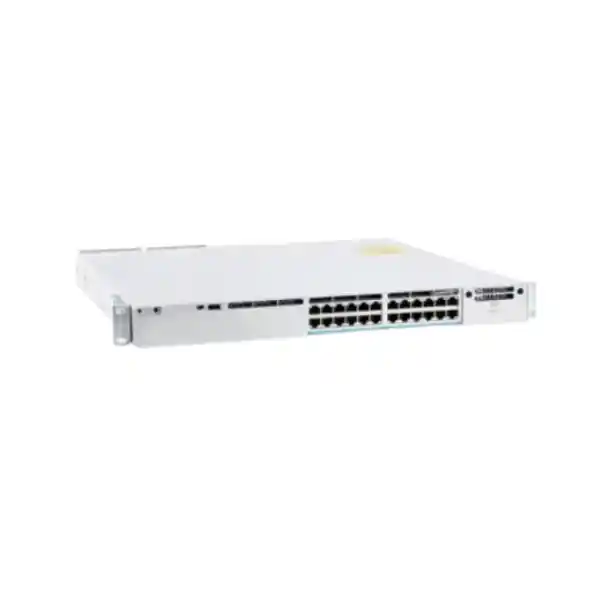
Cisco Catalyst C9300-24UX Network Switch
A 24-port multigigabit Cisco UPOE access platform designed for high-density enterprise edge networks, Wi-Fi 6/6E infrastructure, power-hungry endpoints and resilient campus architectures. The C9300-24UX combines 100M, 1G, 2.5G, 5G and 10G copper access, modular uplinks, StackWise-480, StackPower support and Cisco IOS XE software in a 1RU form factor.
High local switching throughput for dense multigigabit access.
Designed for wire-speed enterprise packet forwarding.
Switching capacity with StackWise-480 architecture.
Power architecture suited to high-power access endpoints.
Direct answer: what is the Cisco Catalyst C9300-24UX?
The Cisco Catalyst C9300-24UX is a stackable enterprise campus access switch with twenty-four copper multigigabit access interfaces. Each access interface can negotiate across 100 Mbps, 1 Gbps, 2.5 Gbps, 5 Gbps and 10 Gbps rates, making the platform particularly useful where wireless access points, engineering workstations, high-performance desktop systems, video endpoints and other edge devices can exceed the limits of conventional 1 Gigabit Ethernet. Cisco UPOE support allows the same access layer to deliver both data and substantial endpoint power, reducing the need for local electrical outlets for supported devices.
Unlike fixed-uplink access switches, the C9300-24UX uses a modular uplink bay. That design gives network architects flexibility to select uplink media and capacity according to the aggregation layer, available optics, cabling plant and migration roadmap. The platform is built around Cisco’s UADP 2.0 architecture and Cisco IOS XE, with enterprise functions for Layer 2 and Layer 3 segmentation, policy, telemetry, automation, quality of service, security and high availability. For UAE organizations planning high-speed wired access or Wi-Fi 6/6E rollouts, it is a strong fit when the access switch must deliver more than 1 Gbps per edge port without replacing existing balanced copper pathways unnecessarily.
Why the C9300-24UX matters in modern UAE networks
Beyond 1 Gigabit at the edge
Enterprises increasingly attach endpoints whose practical throughput can surpass 1 Gbps. High-spatial-stream wireless access points, content creation workstations, imaging systems, local data movers and specialized appliances can benefit from 2.5G, 5G or 10G access. The C9300-24UX can supply those intermediate rates over suitable twisted-pair cabling, helping avoid an immediate jump to fiber for every high-speed endpoint.
Power and data convergence
Cisco UPOE enables the access switch to become a centralized power distribution point for compatible network devices. This is valuable in offices, campuses and smart-building environments where IT teams want power control, monitoring and network policy under the same operational framework. Actual power design should always be calculated against the selected power supplies, redundancy requirement and endpoint draw.
Stack-based operational simplicity
StackWise-480 lets multiple compatible C9300 switches operate as one logical switching system with a common management and control construct. This can simplify access-layer administration while providing additional resiliency paths, distributed port capacity and flexible growth. Proper stack member compatibility and software alignment should be validated during design.
Modular uplink strategy
The modular network uplink slot separates access-port selection from aggregation connectivity. A project can begin with 1G or 10G optics, use 25G where supported by the chosen module and upstream platform, or deploy 40G links when the distribution layer requires higher capacity. This protects design flexibility across refresh cycles.
Core C9300-24UX hardware specifications
Multigigabit access: how 100M, 1G, 2.5G, 5G and 10G change edge design
A conventional access switch forces architects to choose between low-cost 1 Gigabit copper and more specialized high-speed media. The C9300-24UX removes much of that rigidity by supporting several Ethernet rates on every access port. In a mixed endpoint estate, one port can connect a legacy 100 Mbps device while another negotiates 1 Gbps, 2.5 Gbps, 5 Gbps or 10 Gbps according to endpoint capability and cabling conditions. That makes the switch suitable for staged modernization. Existing office devices can remain at their native speeds while wireless, creative, engineering or compute-heavy endpoints receive higher bandwidth without creating a separate access-switch island.
This multi-rate capability is particularly relevant to wireless access point deployments. Modern WLANs can aggregate client traffic well beyond one gigabit at the radio side, especially when multiple radios and wide channels are used. If an access point is connected to a traditional 1G switch port, the wired uplink may become the bottleneck even when RF conditions are excellent. A 2.5G or 5G wired link can often remove that constraint while still using suitable installed category cabling. For top-end access points, 10GBASE-T can provide additional headroom where cable type, length, thermal bundling and patching quality support it.
Multigigabit does not eliminate the need for disciplined cabling assessment. Actual attainable rate depends on channel quality, category rating, total length, connector condition, electromagnetic environment and installation practice. UAE projects should account for cable pathways exposed to higher ambient temperatures, dense bundles in risers, long horizontal runs and mixed-quality legacy patch cords. During migration, FourTeck can help map endpoint requirements to switch ports and identify where structured-cabling remediation is more sensible than forcing a high negotiated rate onto a marginal channel. For broader enterprise infrastructure planning, visit FourTeck UAE.
Cisco UPOE and endpoint power engineering
The C9300-24UX is not only a bandwidth platform; it is also a centralized power platform. Cisco UPOE extends the practical device classes that can be powered through network cabling compared with basic PoE and PoE+. That matters for high-performance wireless access points, video systems, building technology, advanced IP endpoints and devices with auxiliary functions that would otherwise need a nearby AC adapter. Central power allows the network team to combine endpoint connectivity and electrical delivery in one controlled infrastructure, while UPS-backed switching closets can keep selected devices operational through short utility disturbances.
PoE planning must be performed as a budget, not just as a per-port feature check. A switch may advertise high per-port power while the total available system budget is governed by installed power supplies, system consumption, redundancy mode and the number of powered endpoints. A design that expects twenty-four devices to draw near the maximum simultaneously can require a different PSU configuration than a design with a few high-power access points and many low-power phones. Endpoint maximum power is also different from average operating draw, so conservative designs account for boot-time peaks, future device upgrades and failure scenarios where a redundant PSU must assume the load.
For UAE deployments, power engineering should include rack PDU capacity, circuit allocation, UPS sizing, heat load and airflow. A switch feeding hundreds of watts to endpoints draws that energy through the rack and releases additional heat from conversion losses. In branch rooms or compact telecom closets, the electrical and cooling design can become as important as the port count. FourTeck can coordinate switching, rack, UPS and cabling requirements so that the installed access layer has usable power headroom rather than a theoretical PoE rating that cannot be sustained under real operating conditions.
Modular uplinks: choose aggregation capacity around the site design
C9300-NM-4G
Four 1 Gigabit SFP slots for lower-bandwidth aggregation, legacy distribution layers or specialized optical connectivity. This option can make sense where the access layer is lightly utilized, but it should be evaluated carefully on a 24-port multigigabit switch because aggregate edge demand can exceed a few gigabits quickly.
C9300-NM-8X
Eight 1G/10G SFP+ slots provide flexible fiber or DAC uplink designs and are a common fit where dual 10G or multiple 10G links are required. Link aggregation can be used where the upstream design and oversubscription model call for additional capacity or resiliency.
C9300-NM-2Y
Two SFP28 uplink slots supporting 25G, with compatible lower-rate optics as supported. Twenty-five gigabit uplinks can be attractive when 10G is too constrained but a move to 40G is unnecessary or inconsistent with the upstream switch design.
C9300-NM-2Q
Two 40 Gigabit QSFP+ slots for high-capacity campus aggregation. This can provide substantial headroom for dense wireless and high-speed wired edge traffic, particularly when multiple access switches converge on a distribution block.
C9300-NM-4M
Four multigigabit copper uplink interfaces where copper aggregation is operationally preferable and supported by the upstream design. It can be useful for specific migration or short-distance topologies, but fiber normally offers better reach and electrical isolation across building distribution paths.
Blanking and airflow
If no active network module is installed, the correct blank module should remain fitted to preserve designed airflow. Uplink selection therefore belongs in the bill of materials rather than being treated as an afterthought after the switch reaches site.
Uplink sizing methodology for a 24-port 10G-capable access switch
The fact that twenty-four access ports can each negotiate at up to 10 Gbps does not automatically mean a deployment needs 240 Gbps of uplink capacity. Access networks are engineered around concurrency, endpoint behavior, application profile, local switching patterns and acceptable oversubscription. A creative studio with many workstations moving large media files to centralized storage has a different traffic profile from a corporate floor where most devices use cloud productivity applications. Likewise, Wi-Fi access points may generate bursts that are much higher than their long-term averages. Uplink design should therefore start with measured or estimated traffic, not simply the sum of physical port speeds.
A practical method is to classify ports into workload groups. For example, reserve one class for high-throughput wired endpoints, another for multigigabit wireless access points, another for standard enterprise clients and another for low-bandwidth infrastructure. Estimate concurrent throughput for each class during the busiest business interval, then apply growth headroom. If the resulting sustained demand is comfortably below 10 Gbps, dual 10G uplinks may provide an acceptable balance of capacity and redundancy. If traffic frequently approaches that threshold or large local-to-core transfers are expected, 25G or 40G uplinks can reduce congestion risk and allow the access layer to grow without another hardware change.
The upstream switch must also have the right port type, optics, breakout behavior and forwarding capacity. Redundant uplinks should be placed according to the campus topology, whether that is a stack, virtual chassis, chassis pair or routed access design. Link aggregation is not a substitute for understanding hashing behavior: a single flow normally follows one member link, so adding links increases aggregate bandwidth rather than the maximum speed of an individual flow. FourTeck can help validate uplink modules, transceivers, fiber type, connector type and distribution-switch compatibility before order placement.
StackWise-480: scale and resilience as one logical access system
Cisco StackWise-480 is a defining capability of the modular-uplink Catalyst 9300 family. With appropriate StackWise cables, compatible switches can be interconnected so that the stack behaves operationally as one logical switch. The C9300 platform supports up to eight members within Cisco’s documented compatibility rules. This can simplify configuration, reduce the number of independently managed access devices and create resilient forwarding paths between members. For large UAE offices, hospitals, universities, hospitality facilities and mixed-use campuses, stacking can make incremental expansion easier: additional access capacity can be introduced into the existing logical system when rack space, power and compatibility allow.
The stack ring should be physically cabled for resilience, not as a simple chain with a single break point. Stack cable length also matters when switches occupy separate rack positions. Cisco offers StackWise cable options in multiple lengths, so the rack elevation and switch order should be finalized before choosing cables. Using unnecessarily long stack cables creates clutter; cables that are too short can force awkward bends or compromise serviceability. A professional bill of materials therefore includes not just the switches, but the exact number and length of stacking cables needed for the intended physical arrangement.
Stack compatibility deserves special attention during mixed-model expansions. Not every Catalyst 9300 variant can be mixed arbitrarily, and licensing level alignment can affect supported stack composition. Fixed-uplink C9300L switches do not simply join a C9300 modular-uplink stack. Higher-scale or newer C9300 variants can also have specific compatibility restrictions. Before adding the C9300-24UX to an existing stack, verify existing product IDs, current IOS XE releases, license levels, stack mode, power architecture and planned maintenance window. This avoids discovering an incompatibility only after hardware arrives on site.
StackPower and resilient power architecture
Catalyst 9300 platforms support StackPower architectures that can pool or coordinate power across compatible stack members when designed with the correct cables and power supplies. This can be valuable in access environments with significant PoE demand because the power system can be engineered at stack level instead of treating every switch as a completely isolated electrical island. Depending on the design, power capacity and redundancy can be distributed more flexibly, improving utilization of installed PSU capacity and providing options for fault tolerance.
Power resilience starts with failure scenarios. Ask what should happen if one AC circuit fails, one PSU fails, one switch fails or a UPS transfers to battery. If all critical access points and phones must remain powered, the available surviving power budget must cover them. That can lead to dual-PSU configurations, separate rack power feeds and UPS-backed circuits. If some noncritical powered devices can be shed during a fault, the design can prioritize endpoints by operational importance. The network configuration and physical power plan should support the same business continuity objective.
UAE sites often have reliable building power but still benefit from local UPS protection against short interruptions, transfer events and maintenance. In high-availability environments, separate A/B power distribution paths can reduce common-mode failures. When the switch is deployed in smaller communication rooms, check heat output, rack ventilation, PDU socket orientation and cable access because large power supplies extend chassis depth and require adequate rear clearance. Power design is a systems-engineering task encompassing switch, endpoint, rack, UPS, circuit and cooling capacity.
Cisco IOS XE: operational foundation for the enterprise edge
The C9300-24UX runs Cisco IOS XE, giving network teams a programmable operating environment with mature enterprise switching and routing functions. Exact feature availability depends on the selected software release, license level and deployment mode, so procurement should align hardware with the intended Network Essentials or Network Advantage feature set and any subscription requirements. The operating system supports traditional CLI workflows while also enabling model-driven automation, telemetry and controller-based operations for organizations that are standardizing network lifecycle processes.
At Layer 2, the platform can participate in VLAN-based segmentation, trunking, link aggregation, spanning-tree control and access policy. At Layer 3, supported routing features can be used to place routing boundaries closer to the edge when architecture requires it. This is increasingly common in large campuses because routed access can reduce some Layer 2 failure domains and provide clearer traffic engineering. However, a routed access design has different addressing, redundancy and operational implications from a traditional distribution-centric campus, so it should be planned across the entire site rather than enabled ad hoc on one closet.
Automation becomes especially valuable when many C9300 switches are deployed. Standardized configuration templates, interface profiles, policy objects and telemetry reduce the drift that occurs when every access switch is maintained manually. Even for organizations that remain CLI-centric, structured change control and version-aligned configuration are worthwhile. FourTeck’s IT Services UAE team can support implementation planning, migration activities, network documentation and post-installation operational services around the switching infrastructure.
Licensing: Network Essentials versus Network Advantage
Network Essentials alignment
Network Essentials is generally selected when the deployment requires mainstream enterprise access capabilities without the broader advanced feature set associated with Network Advantage. It can suit conventional Layer 2 access, standard campus functions and organizations that keep most advanced routing or policy logic in upstream layers. Exact functions vary with Cisco software release and licensing policy, so the project feature matrix should be checked against the intended IOS XE version rather than relying on a generic summary.
Network Advantage alignment
Network Advantage is intended for deployments that need a richer enterprise feature set, including advanced routing, segmentation or campus capabilities that exceed the Essentials tier. It is often chosen for core-to-access consistency, sophisticated routing designs or future flexibility. The hardware platform is the same C9300-24UX class, but the orderable SKU and software entitlement differ, so the correct edition should be defined before quoting.
Cisco licensing and software subscription packaging evolves over time. A quotation should therefore state the exact hardware PID, license tier, subscription term where applicable, support level, software image expectations and management mode. Organizations migrating from older Catalyst platforms should not assume that legacy perpetual feature terminology maps one-to-one to current ordering. FourTeck can quote the switch with the required license tier and related support options for UAE delivery.
Security architecture at the access layer
The access switch is the first network enforcement point for most users and devices. A C9300-24UX deployment should therefore be designed as part of the security architecture, not only as a high-speed connectivity upgrade. Enterprise controls can include authenticated access, VLAN or policy assignment, DHCP protections, source validation, control-plane protections, device profiling, logging, secure management access and segmentation. The exact combination depends on identity infrastructure, security policy, Cisco software entitlement and the organization’s operational maturity.
High-speed ports increase the importance of consistent policy. A compromised endpoint connected at 10 Gbps can generate or receive far more traffic than a legacy 100 Mbps device. Rate limiting, quality-of-service policy, storm control and segmentation should be considered where appropriate. Management interfaces should be isolated from ordinary user traffic, and administrative access should use secure protocols with centralized authentication. Configuration backups and role-based change controls are equally important because access-switch compromise or accidental misconfiguration can affect many users at once.
Switch security also interacts with perimeter and internal firewalls. The access layer should carry cleanly defined VLANs or routed segments toward security enforcement points, with addressing and tagging conventions documented end to end. For organizations reviewing firewall and switching together, Firewall Dubai by FourTeck provides a related regional resource for enterprise security infrastructure planning.
Quality of service for voice, video, wireless and high-speed users
A 10G-capable access port does not make congestion disappear; it moves congestion points. Traffic can still converge at uplinks, WAN edges, firewalls, wireless controllers, server interfaces or cloud circuits. QoS policy should identify which applications require deterministic treatment and where queues can form. Voice traffic typically needs low delay and jitter. Interactive video may require substantial bandwidth with sensitivity to loss. Bulk backup and software-distribution traffic can consume capacity aggressively but usually tolerates delay better than real-time applications.
Trust boundaries should be explicit. In some environments the switch trusts markings from managed phones or access points while rewriting or remarking user traffic. In others, application recognition or centralized policy determines treatment. The objective is not to mark everything as high priority; that simply recreates congestion inside the priority class. Instead, classify a small number of meaningful traffic groups, reserve adequate capacity for important real-time services and keep best-effort traffic able to use available bandwidth when priority queues are idle.
Multigigabit wireless uplinks add another consideration: a single access point can aggregate many clients and traffic types onto one wired port. QoS design must account for where classification happens on the wireless side and how markings are carried through the wired network. During migration, validate that existing access-layer QoS templates remain appropriate for the higher link rates and new endpoint mix rather than copying legacy 1G settings unchanged.
Wi-Fi 6 and Wi-Fi 6E access-layer fit
The C9300-24UX is particularly well matched to high-performance wireless access layers. Modern access points can use multiple radios, multiple spatial streams and broad channels to serve many clients concurrently. Their theoretical radio capacity can exceed a single Gigabit Ethernet connection, and real enterprise workloads can generate bursts that make a 1G wired bottleneck visible. Multigigabit Ethernet allows an AP to negotiate 2.5G, 5G or 10G without requiring a fiber transceiver at every ceiling or wall location.
Wireless design still needs to be holistic. The switch port speed must match the access point’s Ethernet capability; the PoE mode must support the AP’s full radio configuration; the cable channel must pass the required rate; and the upstream network must have enough capacity to carry aggregated wireless traffic. An AP that supports 5G Ethernet may downshift if cabling is unsuitable, while insufficient power can cause some access points to disable radios, USB functions or other features. A pre-deployment audit can identify these issues before users experience performance gaps.
For dense venues such as education facilities, convention spaces, hospitality sites, hospitals and large corporate floors, the twenty-four-port count can be useful because a single 1RU switch can serve a targeted set of high-capacity APs without dedicating forty-eight multigigabit ports where they are not needed. Where many more APs are concentrated in one closet, compare the C9300-24UX with 48-port family variants, considering total mGig port distribution, UPOE demand and uplink requirements rather than only purchase price.
Use cases across Dubai and the UAE
Corporate headquarters
Ideal for floors where premium wireless, collaboration systems and high-performance wired users coexist. Multigigabit ports can be selectively assigned while legacy clients continue to connect at lower negotiated speeds.
Education campuses
Supports dense classroom Wi-Fi, labs and specialist learning environments. StackWise can simplify closet-scale expansion and provide a consistent operational model across multiple access switches.
Healthcare networks
Useful where powered endpoints, wireless mobility and segmented access are important. Healthcare deployments should be planned with rigorous change control, redundancy and endpoint qualification.
Hospitality and mixed-use sites
Can feed high-density access points, video devices and building systems from centralized telecom rooms while maintaining room for higher-rate services in public, event and administration areas.
Media and engineering
10GBASE-T access can serve selected workstations that exchange large project files or datasets, reducing transfer times when storage, servers and uplinks are also sized for the traffic profile.
Smart buildings
UPOE can support selected building and IoT endpoints while segmentation, monitoring and centralized power control bring traditionally separate systems into a managed network framework.
Cabling considerations for 2.5G, 5G and 10GBASE-T
One of the strongest reasons to choose a multigigabit switch is the ability to extract more capacity from existing copper infrastructure. However, cabling must be treated as an engineered channel. Category rating, permanent-link length, patch-cord quality, connector workmanship, bundle size and environmental conditions all influence achievable performance. 2.5G and 5G Ethernet were designed to extend higher throughput over many installed cabling environments, while 10GBASE-T has stricter channel considerations. A cable marked with a category alone is not proof that the end-to-end installed channel will operate flawlessly at the target rate.
In the UAE, elevated temperatures in non-conditioned pathways can increase cable attenuation. Dense PoE bundles can also run warmer because DC current creates heat in conductors. When high-power PoE and 10G data are combined, cable selection and installation quality become more significant. Structured cabling should be routed with proper separation, bend radius and bundle management, and certification testing should match the intended application. Where long-term 10G access is a design goal, category 6A is commonly preferred for predictable channel performance.
During migration, do not assume every legacy jack needs immediate replacement. A targeted approach can identify which outlets serve high-speed devices, test those links, remediate only failed channels and leave ordinary 1G endpoints unchanged. This allows the C9300-24UX to provide a gradual path from existing office cabling toward higher access speeds. The switch’s multi-rate negotiation is valuable precisely because the entire floor does not have to operate at one uniform Ethernet speed.
Thermal, rack and physical installation planning
The C9300-24UX is a 1RU enterprise switch approximately 17.5 inches wide and, with an 1100W class power supply, about 20.2 inches deep. The switch is roughly 8.25 kg in a typical default-power configuration. These dimensions matter because some wall-mounted network cabinets have limited usable depth once front patch cords, rear power cables and door clearance are considered. A rack that comfortably holds shallow access switches may not provide enough working room for the C9300-24UX plus cable bend radius and dual power supplies.
Airflow paths must remain unobstructed. Blank covers, fan modules and power supplies are part of the intended thermal system. Cable bundles should not block exhaust paths, and rear clearance should allow field replacement of power supplies and fan modules. In UAE telecom rooms, air conditioning should be evaluated under peak summer building conditions and potential after-hours schedules. A room that is cooled adequately during office hours but allowed to warm significantly overnight can reduce equipment thermal margin.
Rack elevation should reserve logical positions for patch panels, horizontal managers, access switches, stack cables and PDUs. If two or more switches form a stack, placing them in a contiguous arrangement usually makes StackWise cabling cleaner. Keep service loops controlled so technicians can remove a switch or power supply without disconnecting unrelated circuits. Label each access port, uplink, stack connection, PSU feed and patch-panel mapping so future maintenance does not depend on institutional memory.
Campus topology options
The C9300-24UX can participate in several campus designs. In a traditional two-tier model, access switches uplink to a redundant distribution pair that provides routing, policy and upstream connectivity. This remains common because it creates clear operational boundaries. The access switch handles endpoints and VLAN attachment, while the distribution layer concentrates routing and redundancy. A modular uplink such as dual 10G, dual 25G or dual 40G can be selected according to the size of the access block and upstream platform.
In routed-access designs, Layer 3 adjacencies can extend to the access switch, reducing the spanning-tree domain and making traffic engineering more explicit. This can simplify some failure modes but requires disciplined IP addressing, routing policy and operational tooling. The C9300 platform’s software capabilities can support sophisticated designs, but the best architecture depends on organization scale, IT skills, application dependencies and security segmentation.
For branch or standalone sites, the C9300-24UX can act as the primary access switch below a firewall or router, especially when a limited number of endpoints require premium port speeds. In larger campuses, multiple C9300 stacks can connect to redundant distribution switches. The design should always avoid accidental single points of failure: dual uplinks are valuable only when their upstream paths, optics, line cards, power feeds and logical configuration do not converge on the same failure domain.
Performance engineering: interpreting 640 Gbps and 476.19 Mpps
Switching capacity describes the aggregate internal bandwidth available to move traffic through the system, while forwarding rate measures how many packets per second the platform can process under defined conditions. The C9300-24UX is specified at 640 Gbps switching capacity and 476.19 million packets per second forwarding. With StackWise-480 considered, Cisco lists 1,120 Gbps switching capacity and 833.33 Mpps forwarding. These figures show that the platform is engineered for a dense multigigabit role rather than simply being a 1G access chassis with faster physical connectors.
Raw capacity is only one part of application performance. A user’s experience can still be constrained by endpoint NIC capability, server storage, WAN bandwidth, firewall inspection throughput, wireless airtime, TCP behavior or application architecture. Network design should therefore look end to end. Upgrading the access switch may expose the next bottleneck in an older aggregation layer, while upgrading uplinks without improving server or storage interfaces may produce little visible benefit.
Packet-rate performance matters particularly for workloads with many small packets, where packets per second can become limiting before raw bits per second. Security telemetry, voice, transaction systems and certain infrastructure traffic can produce different packet-size distributions from bulk data transfers. When the deployment has unusual workloads, collect traffic statistics from the existing network and use those measurements to validate expected headroom instead of depending only on headline bandwidth values.
High availability without unnecessary complexity
Enterprise access availability should match business impact. A trading floor, hospital, contact center or hotel front-office network may justify more redundancy than a low-density back-office closet. The C9300-24UX gives architects several building blocks: stack redundancy, replaceable power supplies, modular uplinks, link aggregation and mature IOS XE high-availability functions. The design challenge is to combine them in a way that actually removes failure domains instead of merely adding components.
For example, two uplinks from one switch to the same upstream device can protect against a single optic or cable failure but not against upstream chassis failure. Two PSUs connected to the same PDU and electrical circuit protect against one PSU failure but not against the circuit. Two stack members can provide access-port diversity only if critical endpoint paths are distributed appropriately. Resilience should be tested against specific failures: switch reload, stack member loss, uplink loss, power-feed loss and maintenance events.
Operational simplicity is part of availability. A design that is theoretically redundant but too complex to troubleshoot can extend outages. Use consistent templates, keep topology diagrams current, document stack member numbering, label redundant paths and define recovery procedures. Schedule software upgrades with stack behavior and business maintenance windows in mind. A well-documented two-path architecture is often more reliable in practice than a complicated design with hidden dependencies.
Migration from Catalyst 3850, older Catalyst access or mixed 1G environments
Organizations frequently consider the C9300-24UX as part of a refresh from older Catalyst generations or from access switches that provide only 1G and PoE+. A successful migration begins with inventory. Record existing switch PIDs, IOS versions, uplink optics, VLANs, spanning-tree roles, port channels, authentication settings, voice VLANs, QoS policies, monitoring systems, PoE loads and special interface commands. Legacy configurations often contain years of exceptions, and blindly copying them to a new switch can preserve obsolete settings or introduce unsupported syntax.
Next, classify endpoints by speed and power. Many users may remain at 1G, while high-performance access points and specialist workstations can move to multigigabit service. This lets the organization gain value from the new hardware without forcing every NIC or cable to change. Uplink migration also needs planning: existing 1G SFPs may be reusable in an appropriate network module, but a new 10G, 25G or 40G design may require different optics, fiber type and upstream ports.
Finally, build a cutover sequence that protects critical services. Pre-stage the switch software and configuration, validate licenses, label cables, test management reachability, confirm stack operation and keep a rollback path. Migrate low-risk ports first when possible, then phones, APs and critical endpoints in controlled groups. After cutover, verify interface errors, negotiated speeds, PoE allocation, authentication status, routing adjacencies and monitoring. A technical refresh is complete only when the new platform is stable under real traffic, not when the last cable is moved.
Designing for surveillance, collaboration and smart-building endpoints
Although the C9300-24UX is frequently selected for high-speed wireless, its UPOE and policy capabilities also make it relevant to convergence projects. IP cameras, room systems, digital signage, access-control gateways, sensors and intelligent building equipment can all share the enterprise access infrastructure when segmentation and security policies are designed appropriately. Not every endpoint needs multigigabit speed, but the switch allows lower-rate devices to coexist with demanding 5G or 10G devices on the same chassis.
Convergence changes failure impact. When lighting controllers, security cameras, phones and Wi-Fi access points all depend on the same switch, a switch outage affects multiple operational systems. The response is not necessarily to build completely separate physical networks; rather, classify services by criticality and engineer redundancy, UPS runtime, spare strategy and maintenance processes accordingly. Some environments may dedicate certain switches or closets to life-safety-adjacent systems, while others use strong logical segmentation and redundant access architecture.
Power budgeting is again central. A floor with many cameras and access points may use a large share of the PoE budget even though bandwidth utilization is modest. Conversely, a media workspace may consume large bandwidth with little PoE draw. The C9300-24UX should be sized against both dimensions independently. The correct hardware BOM is the one that satisfies port count, speed, power, uplink, resilience and software requirements simultaneously.
Network management, telemetry and troubleshooting
A modern access switch generates extensive operational data: interface state, negotiated speed, PoE consumption, errors, queue statistics, CPU and memory utilization, environmental readings, stack state, routing status and event logs. The value of that data depends on whether it is collected and correlated. Enterprises should integrate the C9300-24UX into centralized monitoring so that faults are detected before users open tickets. Baselines are especially useful after a multigigabit upgrade because they reveal whether higher port speeds actually translate into changed utilization patterns.
Troubleshooting multigigabit Ethernet should begin at the physical layer. A port that repeatedly renegotiates from 10G to 5G or 2.5G may indicate channel quality issues rather than switch performance problems. Check interface counters, cable test results, patching, NIC drivers and endpoint settings. PoE faults should be analyzed with endpoint class, requested power, switch budget and cable condition in mind. High CRC or physical errors can corrupt the application experience even when the interface appears up.
Operational teams should preserve a known-good configuration baseline and capture pre-change state before upgrades. For stacked systems, monitor member health, stack ring status and power conditions rather than treating the stack only as one generic device. Logging should be time-synchronized so events across switches, firewalls, authentication servers and applications can be correlated. These practices reduce mean time to resolution and make the higher-capacity access layer easier to support over its lifecycle.
UAE procurement considerations: what should be included in the quote?
A C9300-24UX quote should identify more than the base chassis. Cisco hardware ordering can involve license tier, software subscription, power supplies, uplink network module, transceivers, stacking accessories, power stacking accessories, console or management needs and support coverage. Omitting one of these can delay deployment even when the switch itself is delivered. The quotation should therefore be generated from a site design or at least a structured requirements checklist.
Specify whether the switch needs Network Essentials or Network Advantage, then define uplinks by speed and media. If 10G fiber is required, identify quantity, fiber type, connector and distance. If a stack is planned, state the number of members and rack layout so StackWise cable length can be selected correctly. For UPOE, list endpoint quantities and maximum wattage, determine the desired PSU redundancy mode and verify rack PDU capacity. If the site uses separate A/B power feeds, ensure power cords and connector types match the local electrical installation.
Support should also be part of lifecycle planning. Organizations may require vendor support, software access, hardware replacement commitments and implementation assistance. UAE projects with strict maintenance windows should confirm spare strategy and replacement logistics before production rollout. FourTeck can prepare a consolidated bill of materials covering switch, uplink, optics, stacking, power, support and professional services. Global customers or multinational standards teams can also reference FourTeck Global for broader procurement coordination.
Bill-of-material sizing scenarios
Scenario A: 12 high-capacity APs + office endpoints
A single C9300-24UX can connect twelve multigigabit wireless APs and twelve wired endpoints. The PoE budget should be calculated from the AP’s worst-case power draw, not its idle consumption. Dual uplinks can be sized from expected aggregate wireless plus wired throughput. If users are primarily cloud-oriented, dual 10G may be sufficient; if the site hosts high-volume local services, 25G or 40G may be justified.
Scenario B: 20 creative workstations
Twenty workstations with 5G or 10G NICs can generate much more aggregate traffic than ordinary office clients. Storage and server interfaces become critical. A 40G uplink or multiple high-speed links may be appropriate depending on concurrency. PoE requirements may be low, but switching and uplink capacity become the dominant sizing factors.
Scenario C: smart-building aggregation
A mixed estate of cameras, building controllers, displays and access points may use moderate bandwidth but significant PoE. Here, redundant power supplies and StackPower design may matter more than 40G uplinks. Segmentation and operational monitoring should be defined before port migration.
Scenario D: two-switch resilient closet
Two C9300-24UX members can form a StackWise-480 access system with 48 multigigabit ports. Critical endpoints can be distributed across members, while uplinks can be placed across the stack toward resilient upstream devices. Power design can include separate feeds and appropriate StackPower components depending on the desired fault model.
How to decide between C9300-24UX and other Catalyst 9300 variants
Choose the C9300-24UX when you genuinely need a high proportion of access ports capable of multigigabit speeds up to 10G and UPOE. If most endpoints are 1G and only a small number of wireless APs require 2.5G or 5G, another 9300 family model with fewer mGig ports may be more cost efficient. Conversely, if a closet needs more than twenty-four high-speed access ports, compare 48-port multigigabit variants. The decision should be driven by port-speed distribution, not by the desire to buy the numerically highest specification.
The C9300-24UX should also be compared with newer C9300X models when uplink requirements extend into 100G, when higher StackWise bandwidth is required or when specific newer hardware capabilities are important. C9300X and C9300 can interoperate in some stack scenarios at StackWise-480 speeds, but compatibility rules are model- and license-dependent. A future expansion plan should therefore be discussed before standardizing on a stack architecture.
If the business prefers a simpler fixed-uplink platform, C9300L family models may be attractive, but they use a different stacking architecture and cannot simply be mixed into a modular-uplink C9300 stack. The C9300-24UX earns its place when modular uplinks, full-port mGig, UPOE and StackWise-480 are all useful capabilities rather than unused premiums.
Implementation methodology for production networks
A production rollout should move through discovery, design, staging, migration and validation. Discovery captures current topology, port inventory, PoE load, uplinks, routing, VLANs, security controls, monitoring and operational constraints. Design translates those facts into the target architecture, including exact switch PID, license, network module, optics, stacking, power supplies, rack positions and management model. Staging then verifies the software version, base configuration, licenses, stack membership, uplink operation and management reachability before the switch is connected to users.
Migration should be executed using a port map. Every existing port should have a target interface, VLAN or routed configuration, authentication behavior, expected speed, PoE requirement and endpoint description. For high-risk sites, migrate in small groups and validate after each group. Voice phones should place calls, access points should join their management system, printers should remain reachable, and specialized devices should pass application tests. Network validation includes interface errors, spanning-tree or routing state, uplink utilization, PoE allocation, stack status and log review.
After migration, collect a new performance baseline. Compare utilization and error statistics with the legacy environment. Confirm that multigigabit endpoints negotiate at expected rates and that cabling does not introduce instability. Update diagrams, rack elevations, asset records, software baselines and backup configurations. Handover should include a concise operational runbook covering reboot behavior, stack member replacement, PSU replacement, software upgrade process and escalation path. Good implementation converts advanced hardware into predictable service quality.
Operational checklist after installation
Frequently asked technical questions
Does every C9300-24UX access port support 10G?
Yes. The model is specified with twenty-four multigigabit copper ports capable of 100M, 1G, 2.5G, 5G and 10G operation. Actual negotiated speed depends on the connected endpoint and cabling channel.
Is the uplink fixed?
No. The C9300-24UX uses a modular uplink bay. Cisco offers C9300 network modules for several copper and fiber uplink combinations, allowing the aggregation design to be selected separately from the access ports.
Can it stack with C9300L?
No. C9300L fixed-uplink switches use a different StackWise architecture and do not form the same stack as modular-uplink C9300 models. Existing stack composition should be checked before expansion.
How many C9300 switches can be in a stack?
Cisco documents up to eight members for compatible C9300 StackWise deployments, subject to model compatibility, license level and software requirements.
Is 40G uplink available?
Yes, with the appropriate C9300 network module such as the two-port 40G QSFP+ option. Upstream switch support, optics, fiber and required software should be verified as part of the BOM.
Does the switch include enough power for every device?
That depends on endpoint draw, installed PSU configuration and redundancy target. UPOE capability does not mean the maximum wattage can be delivered to every port simultaneously from every PSU combination. A PoE budget calculation is essential.
Why source the Cisco Catalyst C9300-24UX through FourTeck UAE?
Enterprise switching projects often fail at the bill-of-material detail rather than the headline hardware choice. The base C9300-24UX may be correct, yet the project can still stall because an uplink module is missing, optics are mismatched, stack cables are the wrong length, power supplies do not meet the PoE target or licensing does not match the intended feature set. FourTeck approaches the product as part of an operational network rather than as an isolated chassis.
For UAE organizations, the quotation can be aligned to site topology, access-point count, workstation demand, PoE requirements, upstream switch interfaces and rack power. This helps ensure the delivered hardware can be staged and deployed without discovering avoidable incompatibilities. Where broader infrastructure is required, FourTeck can coordinate switching with routing, security, servers, structured cabling, wireless, UPS and implementation services.
FourTeck can also support organizations with multi-site standards that extend beyond the UAE. The objective is to keep model selection, licensing, optics, software baseline and documentation consistent enough to simplify support while allowing each site to size ports and uplinks appropriately. This balance is important for regional enterprises that want standard operating procedures without overbuying identical hardware in every branch.
Lifecycle planning: software, spares and capacity growth
A Catalyst access switch is commonly retained for many years, so the initial design should include a lifecycle view. Document the approved IOS XE release, maintenance policy, backup process, support entitlement and upgrade cadence. Keep configuration templates under change control. When the network uses stacks, test software upgrades and stack behavior in a lab or lower-risk site before rolling them into critical production closets. Software consistency across members is essential for predictable operations.
Spare strategy depends on business impact and replacement commitments. A site with many identical C9300-24UX switches may justify holding a local spare chassis, PSU or uplink module, particularly if downtime costs exceed the carrying cost of spare hardware. Smaller sites may rely on vendor support logistics. Stack architectures can provide some service continuity during member failure, but a failed member still removes its attached endpoint ports, so critical devices may need physical diversity.
Capacity growth should be tracked using actual data. Monitor uplink utilization, high-speed port count, PoE headroom and stack member consumption. When a closet approaches its limits, determine whether to add another compatible stack member, redistribute endpoints, increase uplink capacity or migrate to a higher-scale architecture. Planning from telemetry is more efficient than waiting until a user-facing congestion event forces an emergency change.
Technical comparison: full multigigabit versus selective multigigabit access
Full multigigabit access, as provided by the twenty-four C9300-24UX copper ports, is valuable when endpoint placement changes frequently or when a high proportion of users may need more than 1G over the switch’s lifetime. Any access port can be assigned to a high-speed AP or workstation without pre-planning around a small subset of mGig ports. This simplifies patching and reduces the operational friction of moving devices between desks, rooms or wireless locations.
Selective multigigabit switches can be more economical where only a predictable minority of endpoints need higher rates. For example, an office with eight Wi-Fi access points and thirty ordinary 1G user devices may not need forty-eight mGig ports. In that case, a model with a smaller number of multigigabit interfaces could provide a better cost profile. The comparison should include future AP density and expected wired workstation upgrades, not just today’s port map.
Full mGig also affects upstream planning because it raises the potential aggregate load. Installing twenty-four 10G-capable edge ports behind a 1G uplink would create a severe potential bottleneck, even if normal use initially seems light. The modular uplink architecture of the C9300-24UX is therefore an important companion feature: it lets the aggregation path scale with the edge without replacing the entire access chassis.
Technical design notes for UAE high-density offices
Dubai and Abu Dhabi office environments often combine cloud applications, unified communications, video collaboration, high-density wireless and centrally managed security services. The access layer may look lightly utilized in average bandwidth graphs while still experiencing short, intense bursts. A C9300-24UX can provide edge headroom, but the network should be measured during actual busy intervals, including video-heavy meetings, backups, software distribution and large file transfers. Peak behavior is more useful than daily averages for uplink sizing.
Floor telecom rooms should be designed with redundancy appropriate to tenancy and business continuity requirements. In premium offices, two access switches may be stacked with critical APs distributed across members and dual upstream paths. User ports can remain on one member without special redundancy if brief endpoint interruption is acceptable. The result is a tiered resilience model: infrastructure receives more protection than ordinary desktop access, keeping cost proportionate to operational value.
When high-density Wi-Fi is a major driver, coordinate the wireless site survey with switching. AP quantity, radio capability, Ethernet port speed and power requirement all influence the wired design. A wireless survey that stops at RF coverage can produce an access layer that is underpowered or undersized. Conversely, buying 10G switch ports for APs that only have 2.5G interfaces may add cost without benefit. FourTeck can align wired and wireless BOMs so the two layers are engineered together.
Sustainability and power-efficiency considerations
High-performance networking should be efficient as well as fast. Multigigabit Ethernet can allow organizations to consolidate functionality into fewer access switches when port counts and topology permit, reducing the number of individual devices that require rack space, fans, management and support. Centralized PoE can also reduce scattered AC adapters, though overall electrical consumption still depends on endpoint load. Energy planning should therefore be based on measured system and endpoint demand rather than assumptions.
A 10G-capable port does not continuously consume the power implied by its maximum data rate. Actual switch consumption varies with hardware configuration, active interfaces, transceivers, PoE load, fan speed and environment. Cooling is part of the energy equation: an inefficient telecom room can use substantial HVAC power to remove heat generated by networking and endpoint power conversion. Keeping air pathways clear and room temperature controlled can improve operational reliability and reduce unnecessary fan demand.
Lifecycle extension can be another sustainability benefit. The C9300-24UX supports multiple edge speeds, so a site can keep 1G endpoints today while enabling 2.5G, 5G or 10G devices later. Modular uplinks also provide options to change aggregation capacity without replacing the access chassis. This flexibility can reduce premature hardware replacement when traffic patterns evolve gradually.
What to validate before issuing a purchase order
First, confirm the exact product variant and license level. C9300-24UX hardware can be ordered with different license tiers, and an existing network standard may require one consistently. Second, identify the uplink network module. The switch’s modularity is an advantage only when the project chooses the correct module. Third, define optics or copper uplink media, distance and connector type. A 10G SFP+ module does not by itself provide the transceivers or fiber channel needed to connect to the distribution layer.
Fourth, calculate PoE. List each powered endpoint, expected maximum draw and quantity. Then decide whether the design must survive one PSU failure without dropping critical endpoints. Fifth, verify stack requirements. State whether the switch will operate standalone or join an existing C9300 stack. If joining, capture every existing stack member PID and license tier so compatibility can be checked. If building a new stack, define the physical order and stack cable lengths.
Finally, confirm software and support. Define an approved IOS XE train, maintenance approach, support level and desired replacement service. If the organization uses centralized management or automation, validate integration requirements. These details convert a simple product request into a deployment-ready BOM and reduce the probability of field changes after delivery.
C9300-24UX deployment example: premium wireless access floor
Consider a UAE corporate floor with sixteen Wi-Fi 6E access points, four high-performance meeting-room systems and a small number of 10G engineering workstations. A C9300-24UX can dedicate sixteen ports to the APs, with each link negotiating according to the AP’s multigigabit interface. Four additional ports can power collaboration endpoints, and remaining ports can connect engineering systems or local services. The access switch therefore supports several endpoint classes without separate 1G and mGig chassis.
The uplink decision depends on concurrency. If each AP has many clients and the floor moves significant traffic to local data-center services, dual 10G uplinks may be insufficient during peaks. A 25G or 40G modular uplink can provide more headroom. If most traffic exits through a 5G internet circuit and local east-west traffic is modest, smaller uplinks may be entirely adequate. The correct choice is driven by traffic path and destination, not radio headline speed.
Power design should aggregate AP and meeting-room worst-case requirements, add growth margin and then compare that total against the chosen PSU configuration. If the floor must remain wireless during one PSU failure, the surviving supply path must support the critical load. The rack UPS must in turn be sized for the switch and all powered endpoints because PoE transfers endpoint energy demand into the communications room.
C9300-24UX deployment example: high-speed workstation access
A design studio, engineering team or media-production area may have multiple workstations equipped with 5G or 10GBASE-T interfaces. Here the C9300-24UX’s value is predominantly data throughput rather than PoE. The access switch can provide ten-gigabit copper to selected desks while ordinary clients remain at 1G. This is especially attractive where the existing structured cabling can be certified for the required rate and where installing fiber NICs to each workstation would be operationally inconvenient.
The storage path must be designed to match. Twenty users each copying large files can saturate upstream links rapidly. A 40G uplink may be appropriate, and the server or storage system must have equivalent aggregate capacity. Network-attached storage with only one 10G interface can become the bottleneck no matter how fast the access switch is. Application profiling should distinguish local file transfers, internet usage and cloud workloads because only traffic that traverses the constrained path benefits from larger uplinks.
Jumbo-frame use, where considered, must be validated end to end rather than enabled on one segment. Many enterprise environments operate perfectly with standard MTU even at 10G, and consistency is more important than assuming larger frames are always better. Endpoint NIC drivers, switch configuration, server interfaces and application behavior should be tested under representative workloads before production rollout.
C9300-24UX deployment example: resilient two-member stack
A pair of C9300-24UX switches can create a forty-eight-port multigigabit access domain using StackWise-480. In a resilient design, stack connections form the intended ring and uplinks are distributed across members. Critical access points or infrastructure endpoints can also be distributed so the loss of one member does not remove every device of the same service type. The stack is managed as a logical system, simplifying many routine operations compared with two completely independent switches.
Power should be equally deliberate. Each member can use redundant PSU arrangements, and StackPower may be considered where appropriate. If separate electrical feeds exist, map supplies so one circuit failure does not remove all power from the stack. UPS runtime calculations must include endpoint PoE draw. A switch drawing several hundred watts on behalf of access points can discharge a small UPS much faster than a data-only access switch.
During maintenance, test the operational behavior of member reloads and upstream failures. Confirm that management remains reachable, routing or Layer 2 convergence occurs as designed, and monitoring alarms clearly identify the affected component. Resilience should be demonstrated by controlled testing, not inferred solely from the presence of redundant hardware.
Common design mistakes to avoid
Undersizing uplinks: deploying many multigigabit endpoints while retaining a legacy 1G or single 10G aggregation path can move the bottleneck rather than remove it. Size uplinks from real traffic and growth expectations.
Ignoring total PoE budget: per-port UPOE capability is not the same as unlimited system power. Calculate the simultaneous endpoint load and model PSU failure conditions.
Assuming cable labels guarantee 10G: installed-channel performance depends on workmanship, length, patching, heat and interference. Certify links serving high-speed endpoints.
Mixing stack families without checking rules: C9300, C9300X higher-scale variants and C9300L have compatibility limitations. Verify exact PIDs and licenses before ordering expansion members.
Forgetting the uplink module: the C9300-24UX uses modular uplinks. The network module, transceivers and cabling must be included in the BOM.
Treating software as an afterthought: approved IOS XE release, feature licensing, controller integration and change policy should be defined during design, not after hardware installation.
Technical procurement FAQ for UAE buyers
Should I buy the -A or -E license variant? Choose based on the required Network Advantage versus Network Essentials feature set and your organization’s Cisco licensing standard. A feature matrix should be checked against the intended IOS XE release and architecture. If advanced routing or segmentation capabilities are part of the plan, Network Advantage may be appropriate; for standard enterprise access, Essentials may be sufficient.
Which uplink module is best? There is no universal answer. 8x10G SFP+ is flexible for many campus designs, 2x25G can provide a strong capacity step with fewer fibers, and 2x40G can serve high-throughput aggregation. A 4x1G module is suited only where lower uplink capacity is acceptable. Select based on upstream interfaces, traffic demand and media.
Do I need a second 1100W power supply? A second supply may be required for redundancy or a higher usable PoE budget. The correct combination depends on endpoint load and failure objectives. Calculate the power plan rather than treating the second PSU as a generic accessory.
Can FourTeck supply related infrastructure? Yes. FourTeck can coordinate the switch with optics, cabling, UPS, racks, security and implementation services. This is useful where one supplier needs to validate the complete access-layer BOM instead of quoting only the chassis.
Detailed quotation input checklist
Hardware and software
- Quantity of C9300-24UX switches
- Network Essentials or Network Advantage
- Preferred IOS XE baseline
- Support and replacement requirement
- Standalone or stacked deployment
Uplink design
- Required uplink speed: 1G, 10G, 25G or 40G
- Fiber or copper preference
- Distance and fiber type
- Upstream switch PID and port type
- Redundant path topology
PoE and power
- Powered device types and quantities
- Maximum wattage per endpoint
- Required PSU redundancy level
- UPS runtime target
- Rack PDU and circuit details
Site readiness
- Rack depth and available RU
- Cable category and certification status
- Cooling and ventilation condition
- Patch-panel mapping
- Maintenance window and migration scope
Decision recap: when the C9300-24UX is the right choice
Select the Cisco Catalyst C9300-24UX when the network requires a compact 1RU switch with twenty-four access ports that can each scale from legacy rates through 10 Gigabit Ethernet, while also delivering Cisco UPOE and supporting resilient campus operations. It is especially compelling when wireless access points, specialist workstations and powered infrastructure share the same telecom room and the organization wants to avoid maintaining separate high-speed and standard access-switch platforms.
The model is also well suited where modular uplinks are strategically important. The ability to choose 1G, 10G, 25G, 40G or multigigabit uplink modules provides flexibility to match current distribution infrastructure and future capacity growth. StackWise-480 gives a path to expand access ports while preserving a single logical switching system, and the dual-PSU architecture supports power designs ranging from standard operation to higher resilience.
The C9300-24UX is less compelling when nearly every endpoint will remain at 1G for the foreseeable future, when fixed uplinks are preferred, or when 100G uplinks and newer-generation stacking speeds are mandatory. In those cases, another Catalyst 9300 family member may deliver a better cost or architecture fit. The best selection is based on an endpoint and uplink matrix, not simply the most advanced model number.
Structured consultation panel: information to send FourTeck
For an accurate UAE quotation, send the site name, required switch quantity, preferred license tier, planned access devices, expected PoE loads, target uplink speed, upstream switch model, stack requirement and desired support coverage. If the project is a migration, include the current switch model and configuration summary. If cabling is uncertain, identify the installed cable category and approximate age so testing or remediation can be planned.
FourTeck can help translate those inputs into a deployable C9300-24UX bill of materials for UAE enterprise networks, minimizing ordering gaps and aligning the switch with the real requirements of the access, aggregation, power and security architecture.
Cisco Catalyst C9300-24UX UAE: final technical summary
The Cisco Catalyst C9300-24UX is a purpose-built enterprise access switch for organizations that need significantly more edge bandwidth than traditional 1G platforms can deliver. Its twenty-four multigigabit copper ports support 100M through 10G speeds, while Cisco UPOE enables high-power connected devices. The system offers 640 Gbps switching capacity and 476.19 Mpps forwarding, and its StackWise-480 architecture supports high-capacity multi-switch deployments with up to eight compatible members under Cisco’s documented stacking rules.
Its modular uplink bay is central to long-term design flexibility. Projects can choose uplink modules according to upstream architecture instead of accepting a fixed port combination. The 1RU chassis, dual power-supply bays, StackPower support and IOS XE software foundation make it suitable for demanding campus environments where uptime, policy, automation and lifecycle management matter as much as raw port speed.
For Dubai and UAE procurement, treat the switch as one component in a complete engineered system. Validate license tier, uplink module, optics, StackWise cables, power supplies, PoE budget, rack depth, UPS capacity and cabling performance before order placement. FourTeck can provide product supply and deployment guidance while coordinating adjacent infrastructure through its UAE and global technology resources.

Reviews
There are no reviews yet.