
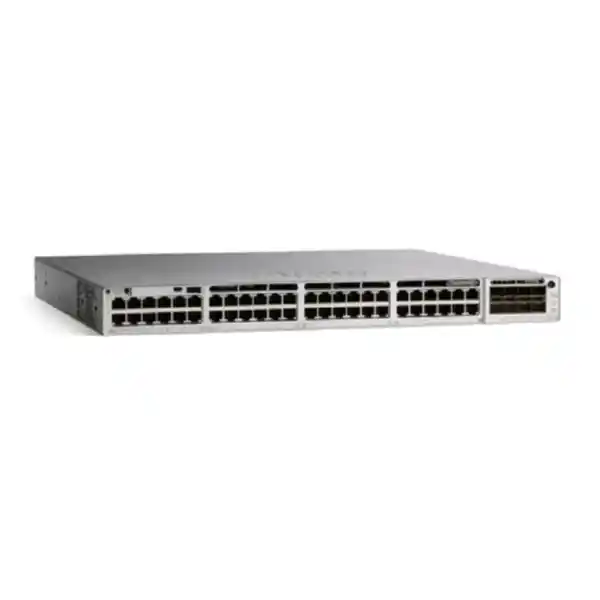
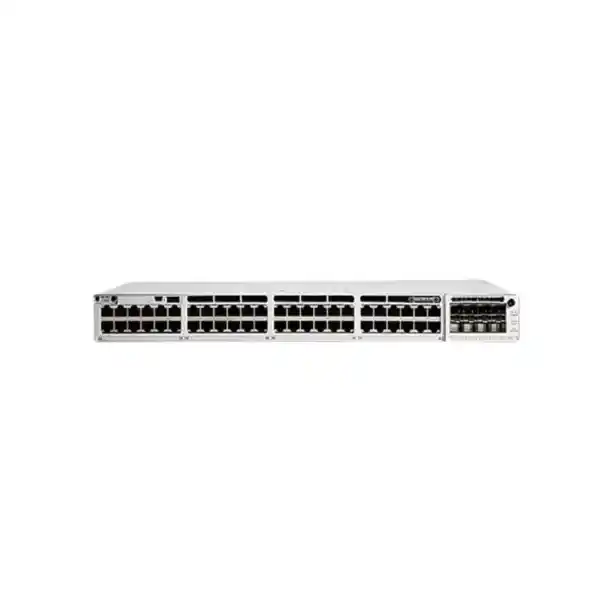
Cisco Catalyst C9300-48UXM Network Switch UAE
The Cisco Catalyst C9300-48UXM is built for campus and branch access layers where copper access speed, endpoint power, uplink flexibility, operational resilience and long-term network lifecycle matter more than entry-level port count alone. With 48 Cisco UPOE access interfaces, a mixed multigigabit port architecture, field-replaceable modular uplinks and StackWise-480 support, the platform is designed to consolidate demanding wired users, high-throughput wireless access points, IP endpoints and intelligent building devices on one enterprise switching foundation.
Choose the C9300-48UXM when a 48-port access switch must support a substantial 2.5G endpoint population plus a smaller group of endpoints that may require up to 5G or 10G over copper, while retaining Cisco enterprise stacking, UPOE and replaceable uplink options.
For UAE deployments, FourTeck can help align the base switch, software tier, uplink module, optics, power supplies, StackWise components and support coverage with the actual bill of materials.
High-density powered access for converged campus edge requirements.
Thirty-six ports scale to 2.5G; twelve scale through 5G to 10G.
Up to eight compatible C9300 members under one logical stack design.
Published standalone switching capacity, with higher aggregate capacity when stacked.
What the Cisco Catalyst C9300-48UXM is designed to solve
Modern access networks are no longer built around the assumption that every edge connection will remain at one gigabit. Wireless access points can exceed a 1G wired bottleneck, engineering workstations increasingly move large data sets, high-resolution media workflows can saturate conventional links, and connected building devices raise both PoE density and segmentation requirements. The C9300-48UXM addresses this transition by combining a large 2.5G-capable port population with twelve higher-speed multigigabit ports that can negotiate through 5G and 10G. This gives network architects a more graduated way to allocate access bandwidth instead of overprovisioning every endpoint or replacing all horizontal cabling at once.
For many UAE campus deployments, that distinction is important. Offices, schools, healthcare facilities, hospitality properties, warehouses and multi-floor commercial buildings often contain a mixture of cable categories, endpoint ages and traffic profiles. A switch that can negotiate multiple Ethernet rates allows the access layer to support new wireless infrastructure or performance-sensitive endpoints while continuing to serve conventional 1G devices. The result can be a lower-friction migration path from a legacy 1G access estate to a multigigabit design, especially where the organization wants to preserve existing structured cabling that is still electrically suitable for the negotiated speed and channel length.
The platform also targets operational concerns that become more significant as access switches carry more critical workloads. StackWise-480 provides a mechanism for joining compatible C9300 switches into a single logical stack, modular uplinks allow the aggregation interface choice to be changed as the distribution layer evolves, and redundant power architecture can be planned for higher availability. Cisco UPOE extends the usefulness of the access layer by allowing the switch to deliver data and power to supported endpoints, reducing the need for local electrical adapters at desks, ceilings or device mounting locations.
The practical value is not simply that the C9300-48UXM has fast ports. Its value is that it can function as a structured enterprise access platform around which bandwidth, power, redundancy, policy and operations are designed together. That makes it appropriate for organizations standardizing on Cisco campus switching and for projects where wired and wireless access need to share a predictable management, security and lifecycle model.
Verified C9300-48UXM hardware profile and technical interpretation
| Area | C9300-48UXM specification | Design significance |
|---|---|---|
| Access ports | 48 copper Cisco UPOE ports | One switch can power and connect dense edge-device populations while preserving enterprise access features. |
| Port speed mix | 36 ports at 100M/1G/2.5G; 12 ports at 100M/1G/2.5G/5G/10G | Supports conventional endpoints, 2.5G wireless uplinks and a selected group of higher-throughput 5G/10G copper endpoints. |
| Uplinks | Field-replaceable modular uplink architecture | Allows uplink strategy to be matched to current distribution requirements and upgraded later without replacing the whole access switch. |
| Stacking | StackWise-480, up to eight compatible members | Creates a resilient multi-switch access block with a shared management and control model. |
| Switching capacity | 580 Gbps standalone; 1.06 Tbps published with stacking | Provides headroom for a multigigabit edge and substantial uplink throughput. |
| Forwarding | 431.54 Mpps standalone; 788.69 Mpps with stacking | Useful for packet-intensive campus workloads where packets-per-second matters in addition to raw line rate. |
| Default power supply | 1100W AC class for the C9300-48UXM | PoE design must consider endpoint power, redundancy objective and secondary power-supply choice rather than switch wattage alone. |
| Form factor | 1RU class, approximately 4.4 × 44.5 × 48.5 cm with default supply; approximately 9.34 kg with default supply | Requires proper rack depth, rear clearance, airflow planning and load consideration in communications cabinets. |
These numbers should be interpreted as platform characteristics rather than a substitute for a complete solution bill of materials. Licensing, transceiver support, uplink module choice, power supply combination, software release, stack composition and endpoint classes can change what is appropriate for a specific deployment. A quotation should therefore identify not only the base switch but also the exact software tier, uplink module, optics or DACs, stack cables, secondary power supply, support entitlement and any accessories needed for the installation.
Multigigabit access-port architecture
The defining hardware characteristic of the C9300-48UXM is its asymmetric multigigabit access-port mix. Ports 1 through 36 support 100 Mbps, 1 Gbps and 2.5 Gbps Ethernet rates. Ports 37 through 48 support 100 Mbps, 1 Gbps, 2.5 Gbps, 5 Gbps and 10 Gbps. This structure is intentional: most modern access devices that exceed one gigabit do not require a full 10G copper interface, while a smaller subset of high-end access points, workstations, test equipment or specialized endpoints can benefit from 5G or 10G capability.
In a wireless refresh, for example, the network team can map mainstream access points onto the 2.5G-capable population and reserve the twelve higher-rate ports for the highest-radio-count access points, local data-processing nodes or future technology. This preserves premium access bandwidth where it is justified and creates a cleaner capacity plan than assigning every endpoint the same physical maximum.
The port mix also matters when reusing structured cabling. Multigigabit Ethernet was developed to provide intermediate rates over familiar twisted-pair infrastructure, reducing the all-or-nothing jump from 1G to 10G. Actual achievable rate depends on cable category, installation quality, distance, patching and electromagnetic conditions. For 10G operation, Cisco specifically recommends appropriate higher-category cabling such as Category 6A or better for predictable deployment. FourTeck can therefore scope the switch and cabling path together rather than treating the active network and passive infrastructure as unrelated procurement items.
Port allocation planning example
Consider a floor with 24 office users, eight Wi-Fi access points, four video collaboration endpoints, four IP surveillance or building devices, two engineering workstations and a small number of spare ports. Conventional users and lower-bandwidth endpoints can remain at 1G. Wireless access points can be assigned 2.5G interfaces where their aggregate radio throughput justifies it. The engineering workstations or highest-capacity access points can use the twelve 5G/10G-capable interfaces. This type of mapping creates a deliberate hierarchy inside a single 48-port switch.
A port map should also include endpoint power requirements, VLAN and segmentation policy, expected traffic direction, authentication method and failure impact. The highest-speed port is not always the correct port if the endpoint’s power class, redundancy or security profile demands a different arrangement. For critical devices, planners should avoid placing all members of a redundant endpoint pair on the same physical switch or power domain.
This is why procurement based only on the phrase “48-port 10G switch” can lead to incorrect expectations. The C9300-48UXM is a mixed-rate multigigabit access switch, not forty-eight 10G copper ports. Its strength lies in matching a realistic enterprise access population where most devices need 2.5G or less and a targeted group needs speeds up to 10G.
ASIC and traffic-path considerations for high-throughput access
The C9300-48UXM is not simply a collection of front-panel interfaces connected to a generic backplane. Cisco documents an internal architecture in which the access ports are distributed across two forwarding ASICs. Ports 1 through 18 in the 2.5G group and ports 37 through 42 in the 10G-capable group map to one ASIC, while ports 19 through 36 and ports 43 through 48 map to the other. The modular uplink path is likewise distributed, with high-speed uplink resources associated with the ASIC architecture. For most access-layer deployments the system handles these details transparently, but the architecture still informs advanced design thinking around traffic distribution and uplink utilization.
A campus switch frequently sees north-south traffic from endpoints toward core applications, internet services and data-center resources. It can also see east-west traffic between local devices, wireless infrastructure, collaboration systems, cameras, edge compute nodes and operational technology. The published 580 Gbps standalone switching capacity and 431.54 Mpps forwarding rate indicate that the platform is designed to process a significant multigigabit access workload, while StackWise-480 provides high-speed interconnection between stack members for systems built as a logical unit.
Designers should still avoid assuming that every access port will simultaneously transmit at its maximum negotiated rate to the same uplink. The real engineering task is to estimate oversubscription based on workload. Office users are bursty. Wireless access points aggregate many clients and can generate higher sustained utilization. Video endpoints can be predictable but continuous. Backup, imaging or engineering applications can create short high-volume periods. By categorizing endpoints and measuring existing traffic, the uplink can be selected to meet the required contention target instead of being chosen purely from the front-panel sum.
The architecture also reinforces the value of link aggregation and resilient uplink design. Where the distribution layer supports it, multiple uplink links can improve both bandwidth and failure tolerance. In a stack, designers can intentionally spread uplinks across stack members so that the access block remains connected after a member, cable or transceiver failure. The correct EtherChannel, routing or campus architecture depends on the upstream design, but the objective is consistent: remove unnecessary single points of failure while providing enough usable uplink capacity for the traffic profile.
Modular uplinks: protecting the access-switch investment
Unlike fixed-uplink access switches, the modular C9300 models use a replaceable network-module bay. This gives the C9300-48UXM a useful lifecycle advantage: the organization can select an uplink module appropriate to the current distribution switch and later change the module as aggregation capacity or optics standards evolve. Cisco lists C9300 network-module choices spanning 1G, multigigabit, 10G, 25G and 40G categories, with supported combinations depending on the exact module and software environment.
C9300-NM-4G
Four 1G SFP slots for environments where distribution remains at gigabit speeds or where low uplink capacity is sufficient.
C9300-NM-8X
Eight SFP+ interfaces supporting 1G or 10G connectivity, useful for dense 10G uplink designs and flexible link aggregation.
C9300-NM-2Y
Two 25G SFP28 slots, enabling higher-capacity uplinks where the distribution layer supports 25 Gigabit Ethernet.
C9300-NM-2Q
Two 40G QSFP+ slots for higher-bandwidth aggregation where 40 Gigabit Ethernet is part of the upstream design.
The uplink module should be selected only after confirming the upstream switch model, available port type, optic or DAC compatibility, required distance, fiber type and redundancy plan. A 25G module is not useful if the distribution layer has no compatible 25G interfaces, and a 40G optic path should not be ordered without validating the fiber plant and supported transceivers. Likewise, a multi-switch stack may need more than one physical uplink path so that resilience survives the loss of a switch member.
For UAE projects involving new racks or campus expansions, it is often economical to specify the access switch, distribution port capacity and fiber termination strategy in the same design review. FourTeck can coordinate switching requirements through the FourTeck UAE technology portfolio, allowing the quotation to account for optics, patching, rack planning and implementation rather than treating the switch as an isolated line item.
StackWise-480: resilience, scale and operational simplicity
Cisco positions the modular Catalyst 9300 models, including the C9300-48UXM, with StackWise-480 technology. Compatible switches can be connected through dedicated stack links to create a logical switching system with a shared management and control-plane model. Cisco documents support for up to eight compatible C9300 members in a stack, subject to model and license compatibility rules. For network operations teams, this can simplify an access block because multiple physical chassis can be configured and managed as a single logical system rather than as unrelated standalone devices.
The 480 Gbps stack interconnect is particularly relevant when access ports are multigigabit. If an endpoint connected to one member needs to reach an uplink physically attached to another, stack bandwidth becomes part of the forwarding path. A high-capacity dedicated stacking fabric therefore helps the system behave coherently under cross-member traffic. It also allows designers to spread uplinks and services across members, reducing the dependence on any one chassis.
Stacking should not be treated as automatic redundancy. A resilient stack requires deliberate component placement. Power feeds should be divided across independent PDUs or circuits where site design permits. Uplinks should terminate on different stack members. Critical endpoint pairs should be distributed. Stack cables should be connected in the supported ring topology so that a single stack-link failure does not unnecessarily partition the system. Software should be maintained at a supported release, and operational teams should understand the behavior of active and standby control functions during maintenance or failure events.
License compatibility also matters. Cisco stacking rules require compatible model and licensing arrangements. Mixing switch families or higher-scale variants without checking support can create deployment delays. A quotation for two or more C9300-48UXM switches should therefore identify stack cable quantity and length, software tier, power design and uplink distribution from the beginning.
From a capacity perspective, stacking can make access-layer growth easier to manage. Instead of replacing a 48-port switch when a floor expands, another compatible member can be added if the architecture, rack space, power and software standards permit. The resulting system gains ports while preserving a common operational context. For multi-floor or distributed telecom-room designs, however, stacking cable distance and physical topology may make separate routed access blocks more appropriate. FourTeck can help distinguish where stacking improves resilience and where an independent-switch design is operationally cleaner.
Cisco UPOE and endpoint power design
All 48 access ports on the C9300-48UXM support Cisco UPOE capability, enabling the switch to supply network connectivity and power to compatible endpoint classes. This is valuable for wireless access points, IP phones, cameras, sensors, digital signage, building controllers and other devices where local AC outlets would increase installation complexity. Power over Ethernet also centralizes endpoint power at the communications room, where the switching infrastructure can be protected by UPS systems and managed under a common operations process.
The engineering challenge is total PoE budget, not just per-port capability. The default 1100W-class supply does not mean every port can simultaneously draw the maximum supported UPOE power. Cisco publishes available PoE figures that vary with primary and secondary power-supply combinations. Therefore a bill of materials should be built from endpoint wattage, quantity and desired redundancy rather than from switch-port count alone.
A practical design begins by listing each powered device, its maximum requested power class, its normal operating draw and whether startup conditions create additional demand. Add growth margin for future devices. Then decide whether the switch must maintain all endpoint power after a single power-supply failure. This distinction changes the required secondary supply and can materially affect cost, rack power and heat output.
PoE sizing discipline for UAE projects
In hot-climate regions, electrical and cooling planning deserve additional attention even when the network room is conditioned. The switch itself is designed for enterprise environments, but PoE load contributes to power conversion and thermal output. Cabinets should have adequate front-to-back airflow, clean cable management, suitable rack depth and sufficient cooling capacity. UPS and PDU sizing should include both switch operating demand and the powered-device load supplied through Ethernet.
For large WLAN refreshes, the access-point power requirement should be checked against the exact AP model and enabled radio configuration. Some high-end access points may operate in reduced-capability modes if the negotiated power is insufficient. Similarly, cameras with heaters, pan-tilt-zoom motors or infrared arrays can have peak requirements that exceed their average draw.
FourTeck can support power and deployment planning alongside broader UAE IT infrastructure services, helping customers define endpoint counts, redundancy targets, rack power, UPS integration and commissioning checks before the switches are installed.
Why C9300-48UXM fits Wi-Fi 6 and high-density wireless access
A common reason to move from conventional 1G access switching to the C9300-48UXM is wireless infrastructure. Modern enterprise access points can aggregate traffic from many radios and users, and their wired interface may support 2.5G, 5G or higher Ethernet rates. If an access point capable of multi-gigabit throughput is connected to a 1G-only switch, the wired uplink can become an avoidable bottleneck even when wireless spectrum, client capability and upstream capacity are sufficient.
The C9300-48UXM gives the architect two practical tiers. Thirty-six ports can serve 2.5G-class access points, which covers a broad range of high-performance WLAN deployments, while twelve ports can support 5G or 10G where the selected AP and traffic model justify it. Because all ports support UPOE, data-rate planning and power delivery can be handled on the same access switch. This is especially useful in ceiling-mounted deployments where adding local power adapters would be undesirable.
Wireless switching design should still start with measured demand. A 5G or 10G Ethernet interface on an access point does not mean every AP will continuously generate that throughput. Client density, channel width, spectrum availability, application mix, roaming behavior and RF design all influence actual traffic. The goal is to eliminate avoidable wired bottlenecks while maintaining an economically rational uplink and PoE plan.
For a floor with many APs, uplink oversubscription becomes important. Eight access points each capable of several gigabits can theoretically create substantial aggregate traffic, but normal utilization may be far lower. Engineers should combine WLAN analytics and application requirements with wired traffic measurement to determine whether 10G, 25G or 40G uplinks are warranted. Resilient link aggregation to the distribution layer can then be sized around peak traffic, maintenance objectives and failure scenarios.
A high-quality WLAN access design also integrates segmentation, authentication, QoS and monitoring. The switch is not merely providing a fast electrical link to the AP. It is part of the policy and telemetry path that supports enterprise users, guests, IoT devices and operational services. This is where the C9300 platform’s enterprise software capabilities become as important as its multigigabit hardware.
Security architecture at the campus edge
Access switches sit at one of the most security-sensitive points in the enterprise network because they connect users, phones, cameras, printers, access points, IoT systems and building controls directly to the infrastructure. The C9300-48UXM belongs to the Catalyst 9000 family and runs Cisco IOS XE, giving organizations access to enterprise security and segmentation capabilities that can be incorporated into a wider campus architecture. The exact feature set depends on software version and license level, so project design should always reference the current Cisco feature matrix for the selected release.
At the practical level, campus access security normally includes identity-based admission, role or VLAN assignment, protection against common Layer 2 attacks, policy enforcement, encrypted or trusted management, secure software boot processes, control-plane protection and visibility into endpoint behavior. Cisco documents hardware-anchored trust capabilities for the Catalyst 9300 platform, including Secure Boot and Secure Unique Device Identification, which help verify hardware and software identity during platform operation and onboarding.
Segmentation is particularly important when the same physical switch serves corporate users, guest or wireless infrastructure, cameras and building devices. These populations should not automatically share the same security zone just because they terminate on the same access chassis. VLANs, virtual network constructs, access control and upstream firewall policy can be designed so that devices receive only the connectivity their function requires. For environments that need dedicated perimeter or inter-zone security, FourTeck also provides solutions through the Firewall Dubai practice, allowing switching and firewall policy to be scoped as one end-to-end architecture.
Operational security is equally important. Management interfaces should be restricted to authorized networks, administrative access should use centralized identity where possible, configuration changes should be logged, unused ports should be disabled or controlled, and software should follow an organization-approved patch and maintenance lifecycle. Network teams should also back up configurations, validate images before upgrades and preserve rollback procedures.
When the C9300-48UXM is deployed as part of a Cisco campus architecture, the benefit is therefore not simply port-level security commands. The value is the ability to integrate endpoint access, policy, telemetry, assurance and lifecycle practices into a consistent operating model. A secure deployment begins with a documented access policy and then uses the switch capabilities to enforce and observe that policy.
Cisco IOS XE, Network Essentials, Network Advantage and management choices
The C9300-48UXM is available in licensing variants associated with Cisco enterprise networking software. Common orderable configurations have historically included Network Essentials and Network Advantage tiers, while Cisco has also introduced Meraki-managed variants in the broader Catalyst 9300 portfolio. The right choice depends on the customer’s architecture, routing requirements, automation model, feature depth and preferred management platform. Licensing should therefore be confirmed against current Cisco ordering rules at quotation time rather than inferred from the base hardware name alone.
Network Essentials is generally aligned with standard enterprise access requirements, while Network Advantage extends capability for organizations needing more advanced networking functions. Exact differences evolve across Cisco software releases and subscription models. A buyer should specify required features such as advanced routing, segmentation architecture, telemetry, automation and controller integration before choosing the software tier. This prevents both under-licensing and unnecessary software cost.
Cisco IOS XE provides a programmable operating environment rather than a closed fixed-function firmware model. In mature enterprise deployments, this enables configuration automation, structured telemetry, API-driven operations and integration with Cisco management platforms. These capabilities can reduce configuration drift and improve consistency across large switch estates, but only when the organization has a clear operations model. Automation should be introduced with source-controlled templates, pre-deployment validation and rollback processes rather than ad hoc scripts.
For day-to-day operations, teams should define a standard switch baseline that includes management addressing, time synchronization, logging, AAA, SNMP or streaming telemetry, spanning-tree policy where applicable, VLAN and trunk conventions, interface templates, endpoint authentication, QoS, storm protection, DHCP security features and backup behavior. Building this baseline before installation makes large deployments repeatable and reduces troubleshooting variation between sites.
Customers who operate hybrid environments should also consider how the switch will be monitored alongside firewalls, servers, wireless controllers and applications. FourTeck can help connect switching projects with the wider Server Dubai infrastructure portfolio when campus switching is part of a broader data-center, virtualization or branch modernization project.
Deployment topologies for the C9300-48UXM
1. High-density office access
A pair or stack of C9300-48UXM switches can serve users, IP phones, collaboration devices and access points on a floor. The 2.5G population supports WLAN growth while twelve higher-rate ports can be reserved for premium endpoints. Dual uplinks to distribution can be spread across members for resilience.
2. Wi-Fi refresh access block
For organizations replacing older APs with Wi-Fi 6 or newer enterprise models, the switch can remove the 1G wired bottleneck without forcing every connection to 10G. PoE and multigigabit speed negotiation make the platform suitable for dense ceiling-mounted AP deployments.
3. Education campus
Classrooms, labs, lecture halls, CCTV, access points and administrative areas can share a standardized access platform while remaining logically segmented. High-bandwidth labs or wireless zones can use faster interfaces without changing the access-switch family.
4. Hospitality and mixed-use property
Guest Wi-Fi, IP telephony, cameras, building systems and back-office users create a diverse endpoint mix. The C9300-48UXM offers the port speed and power flexibility needed to consolidate services while segmentation policy separates trust zones.
5. Healthcare or clinical network edge
Medical offices and clinical facilities may combine user workstations, voice, wireless, imaging-support endpoints and building systems. The access design should prioritize redundancy, segmentation, change control and power continuity in addition to raw port speed.
6. Engineering and media workgroups
Teams handling large files can benefit from the twelve 10G-capable copper ports while standard office devices remain on 1G or 2.5G. Uplinks must be sized to prevent the distribution path from becoming the new bottleneck.
In each topology, the network architect should distinguish between physical capability and service requirement. A 10G-capable endpoint port does not automatically require a 40G uplink, and a 60W-capable PoE interface does not mean every endpoint needs that power. Capacity engineering should be based on measured or forecast traffic, endpoint class and acceptable oversubscription during normal operation and failure conditions.
Sizing methodology: how many C9300-48UXM switches should you deploy?
Switch count should not be calculated by dividing endpoint count by forty-eight and rounding up. A production design needs spare ports, power headroom, stack-member failure tolerance, uplink capacity, physical rack constraints and room for growth. The following methodology is more reliable.
- Inventory endpoints by function. Separate users, APs, phones, cameras, printers, IoT devices, building controllers, servers and special-purpose equipment. Record required speed and PoE class for each.
- Map speed tiers. Count how many devices need no more than 1G, how many need 2.5G and how many genuinely need 5G or 10G. The C9300-48UXM provides only twelve ports in the 5G/10G-capable tier, so this count is important.
- Add growth reserve. Reserve ports for future APs, desks, cameras and temporary connectivity. A switch that is delivered nearly full creates operational friction from the first expansion request.
- Calculate PoE budget. Add maximum endpoint requirements, apply sensible diversity if permitted by design policy, and then test the design under a power-supply failure scenario.
- Calculate uplink demand. Estimate normal and peak northbound traffic by endpoint class. Determine acceptable oversubscription and select uplink speed and quantity accordingly.
- Model failures. Ask what happens if one uplink, one stack member or one PSU fails. Critical services should remain within the organization’s availability objective.
- Validate physical constraints. Confirm rack units, cabinet depth, airflow, AC feeds, UPS capacity, cable reach and patch-panel density before finalizing quantity.
Suppose a floor requires 74 powered endpoints including ten access points. Two 48-port switches provide 96 ports, which appears sufficient. But if twenty endpoints are planned to move to high-throughput wireless or 5G/10G copper over the next two years, designers must verify that the twelve higher-speed ports per switch are distributed appropriately. They must also decide whether losing one switch can be tolerated. If not, endpoint placement and spare capacity need to be planned so essential services survive a member outage.
A second example is a 120-device floor. Three switches provide 144 ports, leaving 24 spare. That may be healthy, but if PoE demand is high and the rack has only one electrical circuit, the design still has a single power-domain risk. Likewise, if all three switches use one uplink bundle terminating on the same distribution chassis, the stack may remain a large failure domain. Physical count is only the first layer of sizing.
For this reason, FourTeck quotations can be structured around endpoint and topology requirements instead of a bare switch quantity. That approach helps ensure the ordered hardware, licenses, power modules, stacking components and uplink optics align with the intended service design.
UAE infrastructure, cabling and environmental planning
Deploying a high-density multigigabit access switch in the UAE requires attention to the physical environment as well as network configuration. Communications rooms should maintain controlled temperature and humidity, remain free from construction dust, provide unobstructed airflow and use cabinets with adequate depth for the chassis, power supplies, cable bend radius and rear service access. The C9300-48UXM is approximately one rack unit high, but its depth is greater than many compact access switches, so shallow wall-mounted cabinets should be checked carefully before procurement.
Copper cabling quality directly affects multigigabit results. Existing Category 5e or Category 6 installations may support certain NBASE-T rates depending on distance and condition, but project assumptions should be tested rather than guessed. For 10G copper, Category 6A is the safer enterprise standard for full-distance operation. Patch cords, keystone jacks and patch panels should be included in channel certification, because the weakest component can limit the negotiated rate.
Fiber uplinks require a parallel audit. Determine whether the building uses multimode or single-mode fiber, the optical budget, connector type, patch-panel arrangement and available strands. Then select a supported Cisco transceiver or DAC that matches the C9300 uplink module and distribution-side interface. Mixing incompatible optics, wavelengths or fiber types is a common cause of commissioning delays.
Power availability should be documented at rack level. Two power supplies improve chassis resilience only when they are connected to appropriately independent power sources. Connecting both supplies to the same nonredundant PDU does not eliminate upstream electrical risk. Where uptime is important, designers should consider A/B PDUs, suitable UPS protection and maintenance bypass arrangements. Total UPS sizing must include PoE load because powered endpoints draw energy through the switch.
Finally, spare optics, stack cables, power cords and transceivers can be important for sites where replacement lead time affects service. The correct spares policy depends on installed quantity and business criticality. A large campus may justify on-site cold spares, while a small office may rely on supplier support and service entitlement. These operational decisions should be captured in the procurement plan, not left until after a failure.
Performance engineering and uplink oversubscription
The front panel can represent a very large theoretical traffic sum. Thirty-six ports at 2.5G plus twelve ports at 10G would imply 210 Gbps of one-direction access bandwidth if every interface ran at maximum rate simultaneously. Real campus traffic rarely behaves that way, but the calculation illustrates why uplink design should be intentional.
For a conventional office, a pair of 10G uplinks may provide ample capacity because user traffic is bursty and many applications are cloud or internet limited. For a wireless-heavy floor, media lab or engineering environment, 25G or 40G uplinks may provide more appropriate headroom. The correct answer depends on measured peak utilization, expected growth and the amount of traffic that remains local versus moving upstream.
Oversubscription is not inherently a flaw. It is a normal network-design technique when endpoint peaks are statistically independent. The objective is to choose a ratio that remains acceptable during busy periods and after failures. If a dual-link bundle is designed for normal operation but one link fails, the surviving link must carry the reduced capacity without violating critical application requirements.
Traffic classes to model
Interactive business applications: usually latency-sensitive but not continuously high bandwidth. QoS and low loss can matter more than raw port speed.
Voice and video: predictable per-session demand but sensitive to congestion, jitter and packet loss. Policy should preserve service quality during bursts.
Wireless aggregation: potentially bursty at high scale because one AP concentrates many clients. AP count and radio capability influence peak demand.
Large file and engineering transfers: can consume every available gigabit for sustained periods and should be considered explicitly in uplink calculations.
Backups and imaging: often scheduled but can create predictable congestion windows. Traffic engineering or scheduling may be preferable to permanent overprovisioning.
Licensing and bill-of-materials accuracy: avoid ordering the switch in isolation
Cisco enterprise switching orders are composed of more than the chassis SKU. The base switch identifies the hardware family and access-port architecture, but the usable solution may also require a software entitlement, uplink network module, compatible transceivers, stack cables, secondary power supply, power cords, support service and mounting or cable-management accessories. Failing to include one of these can delay deployment even when the main switch arrives on time.
For the C9300-48UXM, the suffix used in the actual Cisco orderable part number matters because Network Essentials and Network Advantage configurations are not identical from a software-entitlement perspective. The product title “C9300-48UXM” should therefore be treated as the platform selection, after which the exact licensing SKU is matched to feature requirements. Customers should state whether they need advanced routing, specific segmentation functions, controller integration, cloud management options or other enterprise features before the purchase order is finalized.
The uplink module is a second critical line item. A switch ordered without the intended module cannot provide the planned SFP, SFP+, SFP28 or QSFP+ connectivity. The transceivers must then be matched to both the module and the upstream switch. Even when both ends support the same nominal speed, distance and fiber type still need to align.
Stacking has its own accessories. If two or more C9300 switches will operate as a StackWise system, supported stack cables of appropriate length should be included. The physical cabinet arrangement should be known so cable length is neither insufficient nor excessively difficult to manage. If cross-stack power sharing or other power architecture is planned, compatible components and support rules should also be confirmed.
A procurement-ready BOM is therefore a design output, not a shopping list assembled from independent part numbers. FourTeck can prepare the C9300-48UXM quotation around the intended topology so the hardware and accessories arrive as a coherent deployment set.
Migration from Catalyst 3850, legacy 1G access or mixed-vendor switching
Organizations considering the C9300-48UXM are often replacing older 1G access platforms rather than building a network from scratch. A successful migration should preserve service continuity while modernizing speed, power, policy and management. The first step is to export the current switch inventory and interface state: active ports, VLANs, trunks, EtherChannels, PoE draw, authentication settings, QoS, spanning-tree roles, routing, management addresses and connected-device descriptions.
Next, classify which existing configurations should be carried forward and which should be redesigned. Legacy networks often contain unused VLANs, inconsistent access-port templates or manually accumulated exceptions. A refresh is an opportunity to create standardized configurations rather than copying every historical setting. Network teams should define the target policy before converting syntax.
Physical cabling is then tested. If the goal is to use 2.5G, 5G or 10G copper, validate the channels that will carry those speeds. Wireless access points should be mapped to appropriate switch ports based on required speed and power. Uplinks should be upgraded in parallel if the new edge capacity would otherwise overwhelm the old distribution path.
For stacked environments, stage and validate the stack before the maintenance window. Confirm software versions, licenses, stack member numbering, priority, power supplies and uplink modules. Preconfigure interfaces where possible, label cables, and document the rollback plan. During migration, move services in logical groups rather than random patch-panel order so troubleshooting remains controlled.
Mixed-vendor migrations require extra attention to spanning-tree behavior, link aggregation, VLAN tagging, optics support and authentication. Standards-based interoperability is common, but vendor defaults can differ. Test representative uplinks and endpoint types before large-scale cutover.
After migration, validate more than link lights. Check negotiated access speeds, PoE status, uplink bundle state, routing adjacencies, authentication, DHCP behavior, DNS reachability, monitoring, logging and application performance. Record a post-change baseline so future operations teams can distinguish normal behavior from faults.
Operational practices for a reliable Catalyst 9300 access estate
The long-term value of an enterprise switch depends on operations after installation. Start with configuration standardization. Interface templates should define access VLAN, authentication, port security behavior, voice configuration, QoS trust, PoE policy, LLDP/CDP requirements and shutdown behavior for unused ports. Uplinks should use a consistent naming and aggregation convention. Management settings should be centrally governed.
Software lifecycle is equally important. Organizations should track the Cisco IOS XE release train selected for production, review security advisories, test maintenance releases in a lab or pilot group and schedule upgrades according to business impact. Stack upgrades require particular attention because multiple access switches may be affected by one maintenance event. Recovery images and configuration backups should be available before change windows.
Monitoring should include interface errors, port utilization, packet drops, CPU and memory trends, PoE consumption, power-supply status, fan state, stack health, temperature, uplink utilization and authentication failures. Thresholds should be tuned to the environment rather than left at generic defaults. A sudden rise in CRC errors on a 5G or 10G copper link may indicate cabling problems; repeated PoE negotiation issues may point to endpoint or cable faults.
Capacity reviews should be performed before the switch runs out of physical ports or uplink bandwidth. Track spare ports by speed tier, not only total spare count. A switch may have ten free ports but no remaining 10G-capable ports, which is a different capacity problem. Similarly, track PoE headroom and stack-member utilization.
Documentation should capture rack position, serial numbers, stack membership, management IPs, uplink destinations, power feeds, software versions, license tier and support contract. This information reduces recovery time when hardware or services fail and makes future expansion more predictable.
C9300-48UXM versus common alternative access-switch profiles
| Requirement | C9300-48UXM fit | When another model may be better |
|---|---|---|
| Mostly 1G users with basic PoE+ | Works, but may be more capability than needed. | A lower-cost 1G Catalyst 9300 model can be more economical if no multigigabit roadmap exists. |
| Large 2.5G AP population plus selected 5G/10G endpoints | Excellent alignment with 36 × 2.5G and 12 × up-to-10G port mix. | A different multigigabit model may be preferable if more than twelve endpoints require over 2.5G. |
| Every access port needs 5G | Not the ideal port distribution. | Consider a model designed with 5G capability across a larger portion or all access ports. |
| Every access port needs 10G and highest PoE class | Twelve ports support 10G; UPOE rather than the highest UPOE+ profile. | Catalyst 9300X high-end multigigabit/UPOE+ models may fit better. |
| Need flexible replaceable uplinks | Strong fit due to modular network-module bay. | Fixed-uplink models may be simpler when uplink requirements are stable and cost sensitivity is higher. |
| Need compact standalone branch switching | Enterprise capable but physically deeper and operationally richer than small branch switches. | A smaller fixed-uplink platform can be better for shallow racks or basic branch requirements. |
The key selection question is not whether the C9300-48UXM is powerful. It is whether its particular combination of 2.5G density, twelve 10G-capable ports, UPOE, modular uplinks and StackWise-480 matches the endpoint population. Correct model selection can reduce both capital cost and future migration work.
Technical FAQ for Cisco Catalyst C9300-48UXM buyers in UAE
Does the C9300-48UXM have forty-eight 10G copper ports?
No. It has 48 UPOE copper ports in a mixed multigigabit design. Thirty-six ports support up to 2.5G, while twelve ports support up to 10G.
Can it be stacked?
Yes. The modular C9300 family supports StackWise-480, and compatible C9300 members can form stacks of up to eight switches subject to Cisco compatibility and licensing rules.
Does the switch include fixed uplink ports?
The C9300-48UXM uses a modular uplink architecture. The network module is selected according to the desired uplink speed and interface type.
Is it suitable for Wi-Fi 6 access points?
Yes. Multigigabit access and UPOE make it a strong fit for enterprise AP deployments, provided the specific AP speed and power requirements are checked.
What is the default power-supply class?
Cisco lists a 1100W AC class default supply for the C9300-48UXM. PoE availability depends on the full power-supply configuration and redundancy design.
How should I choose Network Essentials or Advantage?
Base the choice on required routing, segmentation, automation and controller features, and confirm the current Cisco license matrix for the selected software release.
Procurement and support considerations in Dubai and across the UAE
Enterprise switching procurement should address authenticity, configuration accuracy and lifecycle support. The C9300-48UXM is available in several licensing and ordering variants, so buyers should verify the precise suffix and entitlement rather than assuming all C9300-48UXM listings are equivalent. A technically correct quotation should identify the switch variant, software tier, uplink module, optics, stacking accessories, power components and support requirements in one document.
Lead time can differ between chassis, power supplies, network modules and optics. For project schedules, the critical path may therefore be an accessory rather than the switch itself. If a deployment must happen during a fixed maintenance window, confirm availability of every required component before committing to the date. For larger rollouts, consider staged delivery so configuration templates and pilot validation can begin before all sites are ready.
Support coverage should match business criticality. Some organizations need next-business-day hardware replacement, while others require a more aggressive service objective. Software support and entitlement access can also be important for obtaining updates and technical assistance. These requirements should be discussed during procurement rather than after an incident.
FourTeck supports UAE customers with switching, security, wireless and data-center infrastructure sourcing. Customers managing operations outside the UAE can also reference the FourTeck global technology site for broader project coordination. For local projects, the recommended process is to provide an endpoint count, current topology, uplink environment and desired resilience level so the BOM can be checked before order submission.
This approach reduces the risk of receiving a switch that is technically capable but incomplete for the planned installation. It also makes commercial comparisons more meaningful because competing quotations can be evaluated against the same defined bill of materials instead of different accessory assumptions.
Decision recap: when the C9300-48UXM is the right choice
The Cisco Catalyst C9300-48UXM is a strong access-layer choice when the network needs more than a conventional 48-port 1G PoE switch but does not require forty-eight 10G copper interfaces. Its specific strength is the balance between a large 2.5G-capable population and twelve higher-speed multigigabit ports, combined with Cisco UPOE, modular uplinks and StackWise-480.
Choose it for
Wi-Fi modernization, multigigabit office access, converged UPOE endpoints, high-density campus floors and resilient stacked access blocks.
Validate first
Count how many endpoints need over 2.5G, verify copper cabling, define PoE budget, select uplink module and confirm software licensing.
Design for failure
Spread uplinks, power feeds and critical endpoints across stack members so that hardware redundancy translates into service resilience.
Avoid overbuying
If nearly every device is 1G and no multigigabit roadmap exists, a simpler Catalyst model may provide better value.
The strongest deployment is one where the switch’s port-speed distribution mirrors the real endpoint distribution. When that match exists, the C9300-48UXM can provide a long-lived access platform that supports wireless growth, powered devices and uplink evolution without forcing an immediate redesign of the entire campus.
Quotation input checklist
For an accurate Cisco Catalyst C9300-48UXM quotation, provide as much of the following information as available. Missing items can be reviewed during solution sizing, but the more complete the input, the more precise the bill of materials.
Number of switches, buildings, floors and telecom rooms.
Users, APs, phones, cameras, IoT, printers and high-bandwidth endpoints.
How many connections need 1G, 2.5G, 5G and 10G.
Device models or maximum wattage for powered endpoints.
Required 1G, 10G, 25G or 40G speed and upstream switch model.
Single-mode or multimode, distance, connector type and available strands.
Standalone, two-member stack or larger stack, including rack layout.
Single or dual PSUs, A/B feeds, UPS and required PoE survival on PSU failure.
Routing, segmentation, automation, controller integration and security requirements.
Desired hardware replacement and software-support coverage.
Final consultation panel: build the C9300-48UXM as a complete access solution
A reliable Cisco Catalyst C9300-48UXM deployment starts with the correct platform but finishes with the correct surrounding design. FourTeck can help determine whether the mixed 2.5G/10G port distribution suits the endpoint estate, select a compatible uplink module, calculate UPOE requirements, design StackWise-480 resilience, match optics to the distribution layer and align licensing with the required enterprise features.
For new builds, include rack, power, UPS, patching and fiber details in the same design conversation. For migrations, provide the current switch model, port count, uplink topology and access-point inventory. For expansion projects, provide existing stack membership and software version so compatibility can be checked before hardware is introduced.
This technical approach keeps the procurement focused on service outcomes: enough access bandwidth, sufficient endpoint power, resilient uplinks, maintainable software and a bill of materials that can be installed without last-minute accessory gaps.
Request pricing for the Cisco Catalyst C9300-48UXM with the exact software, uplink and power configuration required for your site.
Include switch quantity, AP count, uplink speed, stack requirement and redundancy target for faster technical validation.

Reviews
There are no reviews yet.