
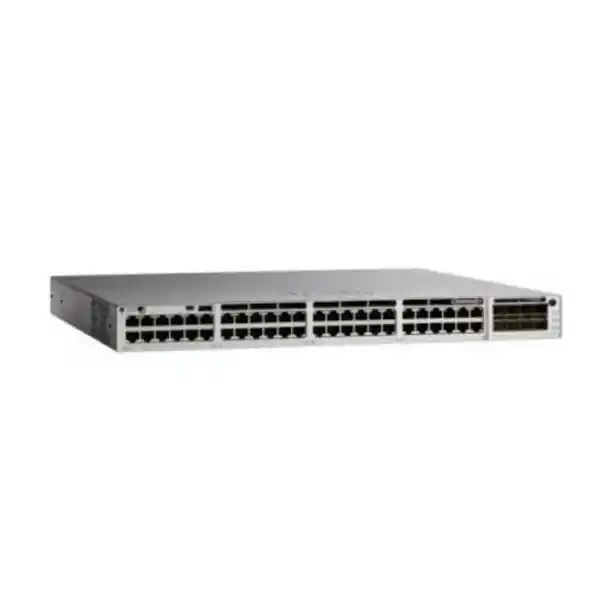
Cisco Catalyst C9300L-24P-4G Network Switch in UAE
The Cisco Catalyst C9300L-24P-4G is a fixed-uplink, stackable enterprise access switch built for branch, campus and distributed edge networks that need predictable Gigabit Ethernet access, IEEE PoE+ power, resilient operations and Cisco IOS XE programmability. The model combines twenty-four 10/100/1000 copper access interfaces with four fixed 1G SFP uplinks and optional 320 Gbps StackWise stacking. For UAE organizations standardizing access switching across offices, schools, hospitals, hospitality sites, warehouses, retail branches, CCTV networks and IP telephony estates, it offers a mature operational model without forcing every access closet into 10G uplinks where 1G fiber is sufficient.
What the C9300L-24P-4G is designed to do
At a practical design level, the C9300L-24P-4G is an enterprise access-layer switch for networks in which endpoints still attach at 1 Gigabit Ethernet and many of those endpoints also require electrical power from the access switch. Typical devices include Wi-Fi access points that fit within PoE+ power envelopes, IP phones, IP cameras, door controllers, intercoms, thin clients, small edge appliances and ordinary desktop systems. Because the uplink block is fixed at four 1G SFP interfaces, the model is especially appropriate when the upstream distribution design uses 1G fiber, redundant 1G EtherChannels, or moderate branch traffic levels where ten-gigabit uplinks would be unnecessary.
The model belongs to the Catalyst 9300L fixed-uplink family. That distinction matters. A C9300L-24P-4G should not be confused with the C9300L-24P-4X, which provides four fixed 10G/1G SFP+ uplinks. It should also not be confused with modular-uplink Catalyst 9300 models, which use different stacking characteristics and allow replaceable network uplink modules. FourTeck engineers can help buyers choose the right variant before ordering, especially where future uplink growth, fiber aggregation, access-point density or camera recording traffic may change the bandwidth calculation. For broader enterprise networking and infrastructure planning in the UAE, buyers can also review FourTeck UAE for related switching, security and infrastructure services.
Cisco positions the Catalyst 9300 family as a lead stackable enterprise access platform. The value of the platform is not simply port count. Its engineering advantage comes from the combination of a purpose-built UADP forwarding ASIC, an x86 control-plane complex, IOS XE software, hardware-assisted policy and telemetry, high availability capabilities, field-replaceable power and fan components, and the ability to manage multiple physical switches as one logical stack. For organizations with a multi-year campus standard, these platform characteristics can be more important than a small difference in unit purchase price.
Verified hardware profile and port map
| Item | C9300L-24P-4G detail | Design impact |
|---|---|---|
| Access interfaces | 24 x 10/100/1000BASE-T PoE+ copper | Supports powered enterprise edge devices and ordinary Ethernet clients |
| Fixed uplinks | 4 x 1G SFP | Optimized for 1G fiber or copper SFP uplink designs |
| PoE capability | PoE+ with 505W default budget using 715W AC PSU | Enough for a substantial mixed phone, camera and AP endpoint set when power is budgeted correctly |
| Stacking | Optional StackWise-320, up to eight members | Creates one logical switching system with shared operational control |
| Switching performance | 56 Gbps; 376 Gbps including stack bandwidth | Provides line-rate access switching within the model’s intended port-speed envelope |
| Forwarding | 41.66 Mpps; 279.76 Mpps including stacking | Supports high packet-rate campus access workloads |
| Memory | 8 GB DRAM and 16 GB flash for fixed-uplink family | Supports IOS XE services, management and operational state at enterprise scale |
| Form factor | 1U, 17.5-inch width, up to 19.2-inch installed depth with default PSU/fan FRUs | Fits standard enterprise racks with normal rear service clearance |
UADP 2.0 architecture: why the ASIC matters
The C9300L-24P-4G uses a Cisco UADP 2.0 application-specific integrated circuit. In practical terms, UADP is the hardware forwarding engine responsible for applying switching, routing, access-control, quality-of-service and telemetry decisions at wire speed. A switch built around a programmable enterprise ASIC can keep critical policy functions in the hardware data path instead of asking the general-purpose CPU to process ordinary production traffic. The CPU remains important for control-plane protocols, management, software processes, automation, stack coordination and system services, while the ASIC handles the repeatable high-speed packet treatment that defines access-switch performance.
For the 1G non-multigigabit Catalyst 9300L models, Cisco identifies a single UADP 2.0 ASIC design. The fixed-uplink family provides a 16 MB packet buffer, 32,000 MAC address scale, 32,000 total IPv4 routes in the documented family profile, 16,000 IPv6 routing entries, 8,000 multicast routing entries, 5,120 QoS scale entries and 5,120 ACL scale entries. These are platform-family scalability values rather than an instruction that every deployment should be driven to the limit. Good campus design preserves operational headroom, considers the active IOS XE template and feature mix, and validates actual forwarding resource utilization after configuration.
This hardware/software separation becomes particularly useful as security policy grows. An access port may simultaneously require VLAN classification, 802.1X or MAB admission logic, DHCP protections, QoS marking, voice VLAN treatment, ACL enforcement, telemetry and routing adjacency functions. A modern campus switch must execute these functions predictably without turning routine policy into a control-plane burden. That is one reason enterprises often standardize on a higher-tier access platform when they expect the edge to participate in security and automation architecture rather than act as a simple unmanaged port concentrator.
PoE+ engineering: turning 505 watts into a dependable endpoint plan
The 505W default PoE budget is one of the most important selection parameters for the C9300L-24P-4G. A common procurement mistake is to look only at the fact that all twenty-four access ports are PoE+ capable and assume that every attached device can simultaneously draw the maximum PoE+ allocation. That is not how a real power budget should be designed. The available switch power must be mapped against each endpoint’s negotiated or configured requirement, the number of active powered ports, expected future growth, any redundant power-supply strategy, and the behavior desired during a PSU fault.
As an example, a branch with eighteen IP phones at 8W each, four cameras at 12W each and two access points at 22W each would have a nominal endpoint draw of 236W before design margin. That is comfortably inside a 505W budget. A surveillance-heavy site with twenty-four PTZ cameras, heaters or illuminators could be completely different even though the physical port count is identical. The right design therefore starts with the powered-device data sheets and a port-by-port load model. Engineers should identify typical draw, maximum classification, boot-time behavior and the consequences of power renegotiation. They should also decide whether noncritical devices may be assigned lower PoE priority than emergency phones, access control or security cameras.
PoE planning in UAE environments should include cabinet thermal design. Delivering hundreds of watts to remote devices means additional electrical conversion and heat inside the switch and rack. The C9300L platform uses front/side intake and rear exhaust behavior, so rack airflow cannot be treated as cosmetic. Cabinets placed in utility rooms, guard houses, warehouses or telecom closets should have appropriate cooling, clean intake paths, rear clearance and monitored ambient conditions. Where UPS systems are used, the UPS must be sized for switch system load plus PoE output, not merely the idle consumption of the switching electronics. Runtime calculations should be based on expected production PoE draw during an outage.
For voice, wireless and surveillance integration work, FourTeck can combine switch configuration with broader UAE IT services so the power model, VLAN plan, rack design, UPS capacity, endpoint commissioning and monitoring approach are treated as one deployment rather than separate purchases.
Four fixed 1G SFP uplinks: when this is the correct choice
The four fixed 1G SFP uplinks define the intended role of the C9300L-24P-4G. In a typical office, two SFP interfaces can be used as a redundant EtherChannel toward a distribution pair, with additional uplinks reserved for another path, an adjacent network domain or future growth. The exact topology depends on whether the access design is Layer 2, routed access, stack-based, dual-homed or collapsed-core. The important point is that the physical uplinks are 1G SFP interfaces, not 10G SFP+ ports. Buyers expecting ten-gigabit optics should select the 4X variant or another Catalyst platform instead of assuming an SFP+ transceiver will upgrade a 1G-only cage.
A 1G uplink switch can still be an appropriate enterprise purchase. Many branch sites do not generate more than a few hundred megabits of sustained northbound traffic, even if twenty-four endpoints are connected at 1G. User traffic is bursty, voice bandwidth is small, cameras may record to a local appliance, and application flows may be shaped by WAN speeds well below a gigabit. In those cases, redundant 1G links can be operationally sufficient and economically sensible. The design question is not whether a larger number sounds better; it is whether measured or forecast demand, oversubscription tolerance and growth justify a higher uplink tier.
Conversely, high-density Wi-Fi 6/6E access, large local file movement, high-bitrate camera aggregation, virtualization-heavy offices and converged data-storage environments can exceed what 1G uplinks comfortably provide. FourTeck recommends reviewing utilization trends and growth horizons before committing to the 4G version across a new campus. A mixed estate may use C9300L-24P-4G in smaller closets and higher-uplink models in dense floors, maintaining IOS XE operational consistency while matching bandwidth to real demand.
StackWise-320: operational simplicity with scale
C9300L fixed-uplink switches support optional StackWise-320 stacking. Up to eight compatible Catalyst 9300L/9300LM members can participate, subject to Cisco’s model and license-level rules. The stack is built using dedicated rear stacking hardware rather than consuming the front-panel Ethernet uplinks. This creates a logical switching system with a shared management and control-plane model, which can simplify configuration, topology, software operations and uplink design across multiple physical switches in the same rack or closet.
A stack should still be engineered as a fault domain. Consolidating several switches under one logical control structure reduces management overhead, but it also means that software upgrades, stack cabling, member priorities, redundancy and compatibility deserve formal design. Stack cabling should be arranged as a resilient ring where supported, cables should be labeled at both ends, and stack member numbers should match rack documentation. Engineers should record switch serial numbers, power feeds, uplink assignments and the preferred active/standby roles so that replacement and maintenance activities remain deterministic.
Cisco states that C9300L stacking uses a 320 Gbps StackWise architecture. With the C9300L-24P-4G, the published switching capacity rises from 56 Gbps standalone to 376 Gbps when stack bandwidth is included, and the forwarding figure rises from 41.66 Mpps to 279.76 Mpps with stacking. These combined values describe the platform’s forwarding and stack fabric capability; they should not be misread as turning each 1G uplink into a higher-speed interface. Front-panel link speeds remain determined by the physical port type.
A practical benefit is uplink distribution. Two or more access switches in a stack can connect upstream links from different physical members while still presenting one logical port channel to the distribution layer where the selected architecture supports it. This reduces dependence on a single access chassis and makes cabling more resilient. For branch sites with two switches, stacking can also reduce the configuration duplication that otherwise comes from managing independent boxes.
Layer 2 services for enterprise access
A managed access switch is expected to do far more than move Ethernet frames. The C9300L platform supports the VLAN and spanning-tree functions needed to segment users, voice, cameras, wireless infrastructure, building systems, printers, guest services and management traffic. The documented Catalyst 9300L/LM platform scale includes 4094 VLAN IDs, up to 300 PVST instances and large spanning-tree virtual-port capacity. In production, the actual number of VLANs should be driven by security domains, operational boundaries and topology rather than by the maximum table size.
Voice VLAN deployment is a common use case. A desk phone can receive a voice VLAN while a PC connected through the phone’s pass-through port is placed in a data VLAN. QoS policy can identify voice signaling and media, preserve trust boundaries where appropriate and prevent uncontrolled endpoint markings from dominating the network. LLDP and related discovery functions make endpoint identification and provisioning easier when the voice platform supports them. On a well-designed campus, these access policies are templated so that the same logical port role is deployed consistently across floors and sites.
Loop prevention remains essential. Spanning Tree, root placement, portfast-style edge behavior, BPDU protection and storm-control policy should be deliberately configured rather than left as afterthoughts. An access port connected to a user endpoint has a different risk profile from a trunk toward an access point or another infrastructure device. Template-based role configuration reduces errors such as accidental trunks, native VLAN mismatch, unauthorized downstream switches or broadcast storms. Where the topology permits routed access, Layer 3 boundaries can further reduce spanning-tree domain size.
The switch can also be part of a first-hop security strategy using functions such as DHCP snooping, Dynamic ARP Inspection, IP source validation and port-security mechanisms, subject to the selected IOS XE release and license. These controls are most effective when addressing plans, trusted uplinks, DHCP paths and device onboarding processes are designed together. Turning on isolated protections without understanding the traffic path can interrupt legitimate clients; structured deployment and staged validation are therefore important.
Layer 3 routing and routed-access design
The Catalyst 9300L family can participate in Layer 3 designs, with the precise routing feature set governed by Network Essentials versus Network Advantage licensing and the IOS XE software level. Cisco documents separate perpetual base license tiers because not every customer needs the same routing depth. This matters during specification: a buyer should not select a cheaper license tier and assume every advanced routing function is included, nor should a branch that only needs basic routing automatically pay for features it will never use.
Routed access changes the failure and convergence model. Instead of extending multiple user VLANs from access to distribution, the access switch can terminate Layer 3 interfaces and exchange routes upstream. This reduces large Layer 2 fault domains and can provide deterministic ECMP or routed convergence when the broader architecture supports it. It also moves gateway functions closer to endpoints. However, it requires deliberate IP addressing, routing policy, authentication design and operational capability. A routed-access design is not inherently superior for every branch; it is one option among traditional Layer 2 access, SD-Access fabrics and hybrid architectures.
The published fixed-uplink platform scale includes 32,000 total IPv4 routes, consisting of direct and learned entries according to Cisco’s family table, plus 16,000 IPv6 routing entries and 1,000 switched virtual interfaces. These capacities are more than sufficient for most access deployments, but scale must always be checked against the active feature template and hardware resources. Networks with unusually large route tables or security policies may belong on distribution/core platforms designed for greater FIB and TCAM scale.
In UAE multi-site deployments, routing design often intersects with SD-WAN, firewall segmentation and cloud connectivity. The access switch should be configured so that route ownership and security boundaries are unambiguous. FourTeck can align access routing with security infrastructure sourced through Firewall Dubai, avoiding duplicated gateways or unclear policy enforcement between campus and perimeter layers.
Access security, identity and segmentation
Modern enterprise access security is based on identity and context as much as physical port location. The Catalyst 9300 platform is commonly deployed with 802.1X authentication, MAC Authentication Bypass for devices that cannot perform supplicant-based authentication, downloadable or locally defined access policies, device profiling and policy enforcement integrated with Cisco identity services. The exact feature combination depends on licenses, controller architecture and supporting products, but the C9300L has the hardware and IOS XE foundation expected for policy-driven campus access.
A strong onboarding design starts by classifying endpoint types. Corporate laptops may authenticate with certificates. IP phones may use an identity method integrated with the voice platform. Cameras, printers and building devices may require MAB and strict authorization profiles. Guest devices may be isolated to internet-only services. Network infrastructure ports should have separate templates and should not inherit end-user admission behavior. Each role should map to a known VLAN, security group, ACL or fabric policy with clear exception handling.
Segmentation is most useful when it follows business risk. Finance users, CCTV cameras, guest Wi-Fi, facilities controllers and server management interfaces do not need broad mutual reachability merely because they share a wiring closet. VLANs can create Layer 2 separation, while ACLs, firewalls or software-defined policy control communication between segments. Cisco TrustSec and scalable group concepts can extend policy beyond static IP subnets in suitable architectures. Buyers evaluating these capabilities should confirm the required license tier and surrounding controller or identity infrastructure before procurement.
Operational logging is equally important. Authentication failures, err-disabled ports, DHCP security violations, stack events and configuration changes should feed a centralized logging and monitoring platform. Access security that cannot be observed creates support problems. The objective is to know why a device was denied, which policy applied, whether the event is malicious or accidental and how rapidly service can be restored without weakening the security baseline.
QoS for voice, video and business-critical traffic
Quality of Service on an access switch protects latency-sensitive or business-critical traffic from congestion caused by bulk transfers and uncontrolled endpoint behavior. On the C9300L, the UADP 2.0 architecture provides hardware resources for classification, marking, policing, queuing and scheduling. The published platform family table lists 5,120 QoS scale entries. What matters in a real deployment is not the raw entry number but the consistency of the policy model across access, distribution, WAN and wireless domains.
Voice is the classic example. The access switch can identify a trusted phone, preserve or remark DSCP values according to policy and place voice media into a low-latency queue. The uplink should then carry those markings to the rest of the network. If the WAN edge discards or remaps them, the campus QoS policy alone cannot guarantee call quality. Similarly, video conferencing can create large bursts that deserve appropriate treatment but should not starve transactional traffic. QoS is an end-to-end architecture, not a single command applied at the closet.
Surveillance traffic also requires thought. Constant camera streams can consume sustained bandwidth and may share uplinks with user traffic. Rather than simply prioritizing every camera packet, engineers should examine recorder placement, multicast versus unicast behavior, bitrate profiles, retention architecture and failure scenarios. A local recording server can keep camera traffic within the access or local distribution domain, while a remote VMS can push continuous flows through upstream links. Switch selection should reflect that topology.
IOS XE operations, automation and telemetry
Cisco IOS XE provides the software operating environment for the Catalyst 9300L. For network teams already using IOS-style operational practices, this offers a familiar command-line workflow while also supporting model-driven programmability. Modern enterprise automation can use structured APIs and data models instead of relying exclusively on screen scraping or long sequences of interactive CLI commands. This matters when the number of switches grows from a handful to hundreds across a campus or distributed branch estate.
A production automation strategy typically defines desired-state templates, site variables, interface-role profiles, software versions and compliance checks. The C9300L can be incorporated into workflows that provision management addressing, NTP, DNS, AAA, logging, SNMP or telemetry, VLANs, routing, access policies and standard interface descriptions. Automation reduces configuration drift, but it must be built with safeguards. A bad template pushed consistently is still a bad configuration. Teams should use source control, change review, staged rollout, validation and rollback procedures.
Telemetry improves operations by exposing performance and state information to management systems. Instead of waiting for users to report slow service, network teams can watch interface errors, utilization, stack health, PoE consumption, CPU, memory, environmental readings and topology changes. Streaming telemetry and model-driven interfaces can provide richer and more frequent data than legacy polling alone. The right monitoring design depends on the organization’s NMS and analytics stack, but the switch should be onboarded into monitoring on day one, not after the first outage.
IOS XE lifecycle planning is equally important. Enterprises should select supported releases, test code before broad deployment, track Cisco security advisories, maintain configuration backups and schedule upgrades with a documented method. Stack environments require attention to member compatibility and upgrade sequencing. A stable access switch is an infrastructure service, and software maintenance should be treated with the same discipline as server and firewall patching.
Licensing: Network Essentials, Network Advantage and subscription capabilities
The C9300L-24P-4G can be ordered in Network Essentials or Network Advantage variants. Cisco identifies Network Essentials and Network Advantage as perpetual base license choices, while subscription capabilities are associated with separate term software offerings. Procurement teams should capture the exact license suffix and term in the quotation so there is no ambiguity about delivered functionality. A generic line item that says only C9300L-24P-4G is insufficient when licensing requirements are important.
Network Essentials is appropriate for many standard enterprise access designs that need fundamental switching and routing functions. Network Advantage extends the base feature set for environments that require more advanced routing, segmentation or enterprise policy capabilities. Because feature matrices can change by IOS XE release and licensing generation, a project should verify each required feature against the current Cisco feature navigator and ordering guidance rather than depending on assumptions inherited from older Catalyst generations.
Cisco’s licensing documentation also distinguishes perpetual network licenses from term software subscriptions. Organizations should understand what remains available if a subscription term expires and what functionality requires renewal. Asset records should include the Smart Account or licensing ownership model, switch serial numbers, purchase entitlements, subscription dates and support coverage. This prevents a common operational problem in which the hardware is installed correctly but software ownership or renewal responsibility is unclear.
FourTeck quotations can state the requested base license tier, software term, support requirement, power configuration, stack kit and optics as separate controlled items. This makes technical review easier and reduces the risk of approving a purchase order that contains the right switch chassis but the wrong license or accessories.
Physical design, power supplies and cooling
The C9300L-24P-4G is a 1U rack-mount switch. Cisco lists maximum installed dimensions with fan FRUs and default power supplies of approximately 1.73 x 17.5 x 19.2 inches, or 4.4 x 44.5 x 48.8 centimeters. The switch weight is approximately 14.99 pounds, or 6.81 kilograms, in Cisco’s model table. Those figures are useful when validating rack depth, mounting hardware, cabinet loading and rear service clearance. Network racks should allow enough depth for the chassis, power cord bend radius and airflow, not merely the front face of the switch.
The standard PoE configuration uses a 715W AC power supply, and the C9300L platform provides field-replaceable power-supply bays. Cisco’s platinum-rated 715W supply supports 100 to 240 VAC at 50 to 60 Hz, which aligns well with UAE commercial power environments when the correct regional power cord and upstream electrical circuit are used. Electrical planning should include circuit redundancy, PDU allocation, UPS load, breaker capacity and the desired behavior if one feed is lost.
The platform uses three field-replaceable fan modules and supports N+1 fan redundancy. Air enters from the port side and chassis sides and exhausts toward the rear through fan and power areas. Hot-aisle/cold-aisle discipline is therefore relevant even in small rooms. Blocking side vents, packing cable bundles against exhaust areas or installing the switch in a sealed uncooled cabinet can reduce thermal margin. The published normal operating envelope varies with altitude, with up to 45°C allowed at lower altitude under normal conditions for relevant models, but a professional design should not plan to run continuously at the upper boundary.
For complete rack and compute-room builds, buyers can coordinate switching with Server Dubai infrastructure solutions, including rack layout, UPS, servers, patching and environmental considerations. Treating these elements as one system reduces installation surprises.
Reliability and high-availability planning
Cisco publishes a mean time between failures figure of approximately 346,940 hours for the C9300L-24P-4G. MTBF is a statistical reliability metric, not a promise that an individual switch will run for that exact period. Enterprise availability still depends on topology, power, cooling, software quality, operational process and spare strategy. The useful design question is how quickly the network recovers when a component does fail.
At the access layer, redundancy can be added in several ways. A stack can provide multiple physical members under one logical control plane. Uplinks can be distributed across members and connected to redundant distribution devices. Power can be fed from protected circuits and UPS systems. Spare optics, fans, power supplies or switches can be held for critical sites. Configuration backups and standardized templates can shorten replacement time. None of these measures alone provides high availability; they work as a system.
Organizations should also define the business impact of access-switch failure. A staff office may tolerate a thirty-minute interruption while a security control room, hospital floor, hotel reception or industrial control area may require much stronger resilience. The switch architecture and support contract should reflect service criticality. In some locations a pair of smaller switches or a stack can reduce endpoint concentration and provide more flexible maintenance than one large access switch.
Maintenance windows should include pre-checks and post-checks. Before software upgrades, teams should confirm stack health, redundant uplinks, configuration backup, flash space, image integrity, boot variables and support status. After change, they should verify port states, PoE delivery, routing neighbors, authentication services, voice registration, wireless connectivity and monitoring. A disciplined runbook converts platform features into actual service reliability.
Use case: IP telephony and collaboration access
The C9300L-24P-4G is a strong fit for IP telephony because it combines dense Gigabit access with PoE+ and enterprise QoS. A twenty-four-seat office can power desk phones directly from the switch, place the phones in a dedicated voice VLAN and pass data connectivity through phone PC ports where required. This reduces the need for separate local power adapters and allows the UPS protecting the network rack to maintain phone service during short electrical interruptions, provided the UPS is sized for the full PoE load.
Voice design should reserve power and prioritize critical endpoints. Reception, security and emergency phones may deserve higher PoE priority than ordinary desks so they remain powered under constrained conditions. QoS trust should be limited to authenticated or known phone devices, and uplinks should maintain the markings required by the voice architecture. DHCP options, DNS, NTP and call-control reachability should be tested as part of commissioning. Phones often reveal small network inconsistencies quickly because they depend on multiple supporting services.
Where the voice platform is distributed across branches, the 1G uplink capacity is normally more than sufficient for audio traffic itself. The broader traffic mix still determines uplink sizing. Video meetings, desktop backups and local file transfers may share the same path, so QoS and utilization monitoring remain necessary. A switch should be selected based on the full application profile, not on voice bandwidth alone.
Use case: CCTV and physical-security networks
PoE+ makes the C9300L-24P-4G suitable for many IP-camera deployments, but surveillance networks need careful bandwidth and power calculations. Camera bitrate varies with resolution, frame rate, codec, scene complexity, analytics and low-light behavior. Twenty cameras at an average 8 Mbps represent about 160 Mbps of sustained video before overhead, which can fit within a 1G uplink. Higher-resolution or high-frame-rate cameras, multiple streams, bursts and server replication can increase that figure substantially. Recorder placement is therefore central to switch selection.
If the network video recorder is local to the same switch or local aggregation layer, much camera traffic may remain inside the site. If streams cross the uplink continuously to a remote data center, uplink utilization becomes much more important. Redundant uplinks can improve availability but do not automatically double throughput unless they are used in an appropriate port-channel design with traffic hashes that distribute flows effectively. A few large flows may not balance evenly across member links.
Camera power must also be verified. Fixed indoor cameras often draw modest power, while PTZ models, heaters, IR illuminators or environmental accessories can have higher requirements. The 505W PoE budget should be allocated using the camera manufacturer’s maximum or negotiated specifications, with design reserve. Security devices such as access-control readers and intercoms may share the same switch, so they must also be included in the load model.
From a cyber-security perspective, cameras should not be treated like ordinary user workstations. Dedicated VLANs, restricted management access, ACLs or firewall policy, secure time services, controlled DNS, and monitored firmware are important. The access switch provides the segmentation and enforcement foundation, but device hardening and recorder security remain separate responsibilities.
Use case: wireless access point aggregation
The C9300L-24P-4G can power and connect many enterprise access points that operate within 1G Ethernet and PoE+ requirements. It is particularly suitable for branches, classrooms, clinics or hospitality areas where individual AP uplinks do not need multigigabit speeds. Wireless design, however, should begin with the AP’s actual Ethernet and power specification. Modern high-end Wi-Fi access points may support 2.5G, 5G or higher copper speeds and may require higher PoE classes. Those devices are better matched to multigigabit UPOE/UPOE+ Catalyst models.
A frequent mistake is to select a switch based only on today’s AP count. Wireless refresh cycles can increase both power and uplink demand. A twenty-four-port access switch installed for a seven-year lifecycle may see several generations of endpoints. If the organization expects a near-term move to multigigabit APs, choosing a 1G-only access model can create an avoidable bottleneck. If the branch will remain on moderate-density Wi-Fi and WAN capacity is well below 1G, the C9300L-24P-4G may remain entirely appropriate.
Wireless segmentation often uses trunks from the switch to access points, controller integration and identity-aware policies. Native VLANs, allowed VLAN lists, AP management addresses, DHCP, discovery and controller reachability should be standardized. Monitoring should correlate wired port errors and PoE events with wireless health so that an apparent RF issue is not actually a failing cable or unstable power condition.
UAE deployment considerations: climate, power, logistics and standards
Enterprise switching in the UAE is usually installed in air-conditioned spaces, but branch and industrial environments can place equipment near much harsher conditions. High external temperatures, dust, building shutdowns and poorly ventilated cabinets can push access hardware beyond comfortable operating margins. The published environmental limits are not a substitute for room engineering. Telecom closets should be cooled, sealed against excessive dust, kept clear of water sources and monitored for temperature. Where building cooling is not reliable after business hours, the network team should confirm that the room remains inside the required range.
Electrical design should account for 230V commercial power, UPS systems, PDUs and redundant feeds. The 715W power supply accepts a wide AC input range, but the correct power cord, connector, breaker rating and PDU socket must be specified. A rack with several PoE switches can represent several kilowatts of potential load once endpoint power is included. UPS capacity and air-conditioning must be sized for the rack as a whole. Simple per-device nameplate addition is a starting point; measured and designed load profiles are better.
Procurement logistics also matter. A complete switch BOM may include the switch base SKU with selected license, software subscription, support coverage, stack kit, stack cables, SFP transceivers, fiber patch cords, power cords, rack accessories and spare components. Buying the chassis without the required optics is a common cause of delayed turn-up. Similarly, specifying an incorrect fiber type or connector can leave an otherwise correct switch unusable on installation day.
For multi-country organizations headquartered in Dubai, standardization can extend beyond the UAE. FourTeck also supports broader infrastructure planning through FourTeck Africa, useful when a common Catalyst access standard must be adapted to regional power, support, spares and deployment conditions.
Sizing methodology before you buy
A reliable switch selection can be made with a structured five-part sizing exercise. First, count physical endpoints by type and reserve growth ports. A twenty-four-port switch should not be planned at one hundred percent day-one occupancy unless the design intentionally accepts no local expansion. Second, calculate PoE using maximum or negotiated endpoint requirements and add headroom. Third, estimate uplink bandwidth from measured traffic, application behavior and future changes. Fourth, map software features to the required base license and subscription tier. Fifth, decide the availability design: standalone, stacked, redundant uplinks, dual power, local spare or combinations of these.
Port count should include infrastructure that is easy to forget: access points, cameras, phones, printers, door systems, time-attendance terminals, environmental sensors, out-of-band devices and temporary technician access. Patch-panel capacity should be checked at the same time. If a floor has thirty permanently cabled outlets even though only eighteen are active today, choosing a 24-port switch may shift costs into a second switch sooner than expected.
Uplink estimation should distinguish average utilization from peak concurrency. A branch may average 80 Mbps but briefly reach 900 Mbps during backup windows or software distribution. If large transfers are operationally flexible, scheduling may be enough. If traffic is business-critical and simultaneous, a 10G-uplink access model may be justified. Performance monitoring from the current network is the best input; in greenfield designs, use application and endpoint models with conservative assumptions.
Finally, convert the design into a controlled BOM. Specify exact Cisco PIDs, license suffixes, term lengths, optic types, fiber mode, stack accessories, power cords and support coverage. This ensures the approved architecture survives the handoff from engineering to procurement.
Optics and uplink transceiver planning
The four uplink cages on the C9300L-24P-4G are 1G SFP interfaces. The correct transceiver depends on distance, fiber type and the remote device. Multimode fiber links inside a building commonly use short-reach 1G optics; single-mode links between buildings or across longer campus distances use appropriate long-reach modules. Copper 1G SFP options may be usable in supported designs where short RJ45 uplinks are needed, but they should not be selected merely because copper seems simpler. Fiber provides electrical isolation and can be preferable between buildings.
Optics must be matched at both ends. The wavelength, standard and fiber type should be compatible. Existing plant documentation should identify whether the path is OM3/OM4 multimode, OS2 single-mode or another medium, along with connector type and measured loss. Patch cords should match the transceiver connector and polarity. For single-mode outdoor or inter-building paths, optical budget and loss testing are important; a link that is physically connected can still be marginal if attenuation is excessive.
The design should also consider spare strategy. A small number of spare SFP modules and patch leads can reduce mean time to restore service. Optics should be labeled by link and documented in the network inventory. When troubleshooting, engineers should check receive/transmit optical levels where available, interface counters, errors, speed/duplex state and physical cleanliness before replacing the switch itself.
Migration from older Catalyst access switches
Organizations replacing older Catalyst 2960, 3560, 3750, 3650 or 3850-era access switches should treat migration as a design review rather than a line-by-line configuration copy. IOS XE syntax may look familiar, but licensing, stacking, software packaging, telemetry, security defaults and supported features differ across generations. Legacy configurations often contain years of accumulated commands that no longer serve a purpose. A refresh is an opportunity to simplify and standardize.
The migration process should inventory VLANs, trunks, port channels, routing, spanning-tree root roles, DHCP security, ACLs, QoS, AAA, management services, SNMP, logging, NTP and endpoint-specific port configurations. Each item should be classified as required, obsolete or redesigned. Port descriptions should be reconciled with physical patching. If the old switch uses a 10G uplink, the C9300L-24P-4G is not a like-for-like replacement because its fixed uplinks are 1G. That single detail can invalidate an otherwise attractive quote.
Cutover plans should include a mapping from old port to new port, maintenance window, rollback method, spare optics, console access, verified configuration backup and post-migration test list. Powered devices should be checked for restart behavior because moving cables interrupts both data and power. For phones, cameras and access points, allow enough time for boot, authentication and controller registration before declaring the cutover complete.
A staged migration of one low-risk closet can reveal template or compatibility issues before a campus-wide rollout. Once the template is stable, automation and repeatable runbooks can accelerate the remaining sites while preserving consistency.
Configuration baseline for a production access switch
A production baseline should begin with secure management. Use centralized authentication, role-based authorization, protected management protocols, synchronized time, centralized logging, configuration archive and a dedicated management addressing plan. Disable legacy or unnecessary services. Restrict management access to trusted subnets or jump hosts. Ensure that local emergency credentials are controlled and documented. The management plane should not be reachable indiscriminately from user VLANs.
Layer 2 hardening should define edge-port behavior, spanning-tree protections, allowed VLANs, native VLAN policy, storm control and trunk restrictions. DHCP snooping trust should exist only on legitimate uplinks or DHCP paths. ARP and source protections should be enabled only after the binding and trust model is understood. Unused ports should be administratively disabled, placed in an unused VLAN if appropriate, and described clearly. Infrastructure ports such as access-point trunks should have their own templates.
PoE policy should identify mission-critical devices and, where needed, set priorities or limits. Interface descriptions should name the endpoint or outlet. LLDP/CDP behavior should match operational needs and security policy. QoS should be consistent with the enterprise trust boundary. Monitoring should include interface utilization, errors, flaps, PoE events, environmental alarms and stack status. Alert thresholds should avoid both silence and excessive noise.
Finally, the baseline should be validated with an automated compliance check or periodic audit. Configuration drift is inevitable in manually operated networks. A standard that exists only in a design document will gradually diverge from production unless the organization measures adherence.
Troubleshooting framework
When an endpoint fails on a C9300L-24P-4G, troubleshoot from physical layer upward. Check link state, negotiated speed, cable condition, interface errors and PoE status first. A device with no power cannot authenticate, and a marginal copper cable may create intermittent packet loss that looks like an application problem. For powered devices, compare delivered power with expected classification and look for denial or overload events.
Next verify Layer 2 placement. Confirm access VLAN or trunk configuration, spanning-tree state, port-channel membership where applicable and MAC learning. For authenticated access, inspect 802.1X or MAB session state and authorization result. A user may have a good physical link yet be placed in a restricted VLAN because identity services are unavailable or credentials failed. DHCP issues should be separated from VLAN issues by confirming whether the client’s requests reach the correct server and whether snooping policy permits the path.
For upstream connectivity, check SFP state, optical levels where supported, interface counters, EtherChannel consistency and routing adjacency. On stacked systems, verify stack ring health, member state and software consistency. A failed stack cable can reduce redundancy even if user ports continue working. Monitoring should alert on degraded states before they become outages.
The final step is correlation. Compare the timestamp of the user problem with logs, interface transitions, authentication events, routing changes, power alarms and upstream firewall or WAN behavior. Evidence-based troubleshooting is faster than replacing hardware without a fault diagnosis.
C9300L-24P-4G versus nearby Catalyst choices
Choose C9300L-24P-4G when
You need 24 Gigabit PoE+ access ports, four 1G fiber uplinks, enterprise IOS XE, optional stacking and a 505W default PoE budget. It is well aligned to branches and access closets where upstream demand is comfortably within 1G link architecture.
Choose C9300L-24P-4X when
You want a very similar 24-port PoE+ access role but need fixed 10G/1G SFP+ uplinks. This is the more appropriate choice for higher aggregate traffic or growth toward ten-gigabit distribution connectivity.
Choose multigigabit models when
Your Wi-Fi access points or other endpoints need 2.5G, 5G or 10G copper and potentially higher PoE classes. A 1G-only access switch can become the limiting factor even if its uplinks are otherwise adequate.
Choose modular-uplink C9300 when
You prefer field-selectable uplink modules, StackWise-480 characteristics or a different hardware flexibility profile. Modular-uplink and fixed-uplink Catalyst models are distinct design families and should be selected intentionally.
Example branch design
Consider a Dubai branch with sixty users across three small floors. Each floor has one telecom closet with approximately eighteen desk phones, twelve PCs connected through phone pass-through ports, four Wi-Fi access points and two cameras. A C9300L-24P-4G can serve each closet if the total physical attachment and PoE calculations fit. Phones, APs and cameras are powered from the switch; user workstations use the phone data ports or direct switch ports as required.
Each floor switch uses two 1G SFP uplinks in a port channel to a redundant or centralized distribution design. Voice, user, wireless and camera VLANs are separated, with ACL or firewall controls between higher-risk domains. Management resides in a restricted network. 802.1X authenticates corporate endpoints where supported, and MAB handles selected non-supplicant devices. QoS prioritizes voice media and signaling. DHCP snooping and related protections are applied using validated trust boundaries.
The PoE design totals the maximum expected draw of all phones, APs and cameras. If the figure remains below the 505W budget with reserve, the standard PSU configuration is adequate. UPS capacity is sized based on expected switch plus endpoint draw and the branch’s required runtime. If the branch later adopts high-end multigigabit access points, the network plan identifies those closets for a switch upgrade rather than assuming the existing 1G ports can deliver higher speeds.
This example illustrates the core selection logic: choose the switch to match endpoint speed, endpoint power, uplink demand, security policy and lifecycle growth. Model numbers are the conclusion of the design, not the starting point.
Example stacked access closet
A larger office may use two or four C9300L switches in a StackWise-320 stack. The stack is cabled with the correct Catalyst 9300L stack kit and arranged with physical redundancy. Member numbers correspond to rack positions. Uplinks are distributed across different stack members so that the loss of a single member does not remove all upstream connectivity. Access ports are assigned using consistent role templates.
Stacking reduces the number of independent management points and can simplify cross-member port channels. It also makes software maintenance more structured because the stack must be considered as one system. Before upgrades, engineers confirm stack topology, member readiness, image compatibility and available redundancy. During replacement, the spare switch must be prepared with compatible hardware, software and licensing. Documentation should show which physical switch corresponds to each logical member.
The stack should not become an excuse to ignore upstream resiliency. A perfectly healthy access stack with both uplinks connected to one failed distribution device is still isolated. High availability comes from end-to-end topology: power feeds, stack ring, access members, uplinks, distribution nodes, routing and services all need appropriate redundancy based on business requirements.
Bill of materials guidance
A complete quotation should identify the exact switch PID, typically an -E or -A ordering variant depending on Network Essentials or Network Advantage. It should also identify the required Cisco software subscription term, support service, stack kit if stacking is planned, and transceivers for every production uplink. Power cords should be appropriate for the deployment country and PDU. Fiber patch cords should match the selected optics and installed cabling.
For a two-switch stack, the BOM may include two switch units, two license/subscription sets, the correct stack hardware for both members, uplink optics, patch leads and support coverage. If a redundant power-supply strategy is required, specify the additional compatible PSU for each switch and confirm circuit/UPS capacity. Spare optics and one local replacement switch may be justified for critical estates.
Do not assume stacking accessories are included unless the line item explicitly says so. C9300L stacking is optional and uses dedicated kits. Likewise, do not assume SFP modules are included with the chassis. Optics are selected according to the physical media design. The quotation should list each accessory as a separate quantity so the delivery can be checked against the approved architecture.
For large rollouts, standardize BOM variants by site type. A small branch kit, medium branch stack and campus-floor stack can each have a predefined bundle. This simplifies procurement, sparing and support while preserving the ability to select a higher-uplink model where traffic demands it.
Lifecycle, software and support strategy
Enterprise access switching has a long lifecycle, so purchase decisions should include more than initial installation. Organizations should maintain an inventory of serial numbers, hostnames, site locations, stack members, software versions, license entitlements, support contracts, optics and power-supply details. This information accelerates troubleshooting, RMA and security response. It also makes refresh planning more predictable when hundreds of devices are involved.
Software strategy should identify a preferred IOS XE release train, validation process and patch cadence. Newer is not automatically better for every network; stability, feature support and security advisories must be balanced. Test environments or pilot sites are valuable for validating major upgrades. Configuration backups should be automated and stored outside the switch. Recovery procedures should be documented before they are needed.
Support coverage should reflect criticality and spare holdings. A business that keeps a tested local spare may tolerate a different replacement SLA than a site with no local stock. Stack designs can provide service continuity during a member failure, but they do not eliminate the need to replace failed hardware. Procurement should align support level, spare strategy and business recovery targets.
Security lifecycle is equally important. Network operating systems, management protocols, AAA integrations and certificates need periodic maintenance. Devices should be included in vulnerability management and configuration compliance processes. A switch is part of the security infrastructure and should not be left on an unsupported software image simply because packet forwarding still works.
Why enterprise buyers choose the Catalyst 9300L platform
The strongest reason to choose a Catalyst 9300L is architectural consistency. It brings IOS XE, UADP hardware forwarding, enterprise access controls, stacking, telemetry, field-serviceable components and Cisco ecosystem integration into a fixed-uplink platform. For organizations already standardized on Catalyst 9000, that consistency reduces the number of operational models the network team must maintain.
The C9300L-24P-4G specifically targets a sensible middle ground: twenty-four PoE+ access ports, enough default PoE budget for many mixed device populations, and four 1G uplinks for branches or closets where gigabit aggregation remains appropriate. It is not the right answer for every deployment. Networks needing multigigabit endpoint access or 10G uplinks should choose a different SKU. That clarity is a strength because the buyer can match capability to requirement instead of paying for unused bandwidth or discovering a mismatch after installation.
FourTeck’s role is to convert those technical options into a validated deployment package for the UAE: exact switch and license variant, optics, stacking, power, rack, UPS, configuration, migration and support. The result should be a switch that fits the network architecture on day one and remains operationally manageable throughout its service life.
Frequently asked technical questions
Does C9300L-24P-4G have 10G uplinks?
No. This 4G model has four fixed 1G SFP uplinks. The closely related 4X variant provides fixed 10G/1G SFP+ uplinks and should be selected when ten-gigabit uplink capability is required.
How much PoE power is available?
Cisco documents a 505W default PoE budget for C9300L-24P-4G when fitted with the standard 715W AC power supply. Actual endpoint planning should include per-device requirements and design reserve.
Can this switch be stacked?
Yes. C9300L fixed-uplink models support optional StackWise-320 stacking with the appropriate stack kit, with up to eight compatible members according to Cisco guidance.
Is the stack kit included?
Do not assume it is included. The C9300L stack kit is an optional accessory and should appear explicitly in the BOM when stacking is required.
What license should I choose?
Choose between Network Essentials and Network Advantage based on the required switching, routing and policy features, then specify the applicable term software subscription and support. Feature requirements should be checked against the current Cisco matrix.
Is it suitable for Wi-Fi 6 access points?
It can support APs that use 1G Ethernet and fit within PoE+ power. APs that need 2.5G/5G multigigabit links or higher power classes are better paired with a multigigabit Catalyst model.
Technical deployment notes for network architects
When the C9300L-24P-4G is used in a Layer 2 access design, place spanning-tree roots intentionally at the distribution layer and make edge-port safeguards part of the standard interface template. Where uplinks are bundled, confirm channel protocol, allowed VLANs and load-distribution assumptions. Do not oversize VLAN extension simply because the switch supports thousands of VLAN IDs. Smaller broadcast and failure domains are easier to operate.
In a routed design, determine where first-hop gateways live and which routing protocol is used. Summarize access prefixes where appropriate and keep infrastructure addressing separate from user addressing. Use authentication on routing adjacencies where supported and required. The fixed 1G uplinks make routed access viable for moderate branches but do not remove the need for bandwidth planning.
For high-security sites, combine switch policy with endpoint posture, identity and upstream segmentation. An access-list on a switch may reduce lateral reachability, while a firewall controls cross-zone inspection and logging. The policy model should state which layer owns each decision. Duplicate or conflicting controls across switch and firewall can make troubleshooting difficult.
For operations, define golden configurations and role-based templates before the first large rollout. A phone-plus-PC port, camera port, AP trunk, printer port, user port, uplink and management interface each need different behavior. Reusable templates reduce inconsistency and accelerate replacement. They also make compliance audits measurable because intended state is explicit.
Commercial and procurement checkpoints for UAE buyers
Before issuing a purchase order, verify the exact model suffix, quantity, software tier, subscription term, support level, stack accessories, uplink optics and power cords. Ask whether all items are new, correctly regioned and supplied with traceable serial numbers and standard documentation. The invoice and asset register should preserve the exact SKU rather than shortening the product to “Catalyst 9300 switch,” which is too broad for lifecycle management.
Lead time should be checked for the complete BOM, not only the chassis. A switch can arrive while optics or stack kits remain delayed, preventing installation. For project sites, sequence delivery with rack readiness, fiber testing, UPS commissioning and configuration preparation. Pre-stage software and configuration before engineers travel to remote locations where possible.
Warranty and support should be aligned with the organization’s SLA. Keep proof of purchase, serial numbers and support contract associations. If the deployment is business-critical, define whether failed hardware will be replaced through vendor support or local spares first. Large customers may combine both: immediate restoration from stock followed by RMA replenishment.
Technical acceptance criteria can be attached to the procurement package: verify PID, power-up, software version, license state, stack operation, optics, uplink connectivity, PoE delivery and monitoring before final handover. This converts procurement from a box-delivery event into an infrastructure commissioning process.
Decision recap: is C9300L-24P-4G the right switch?
Select the Cisco Catalyst C9300L-24P-4G when the access requirement is centered on twenty-four 1G copper endpoints, PoE+ power, four 1G SFP uplinks, enterprise IOS XE operation and optional StackWise-320. It is particularly well suited to offices, classrooms, clinics, hotels, retail branches, camera networks and IP telephony environments where 1G uplink architecture remains sufficient.
Do not select it if your stated requirement includes 10G uplinks; use a 4X or other appropriate model. Do not select it for multigigabit endpoint requirements; use a Catalyst model with 2.5G/5G/10G copper. Do not size PoE by port count alone; calculate endpoint power and reserve. Do not order the chassis without validating licensing, optics, stack kit and support.
When those checkpoints align, the C9300L-24P-4G provides a strong enterprise access foundation with hardware forwarding, resilient stacking options, mature management and a clear lifecycle path within the Catalyst 9000 ecosystem.
Quotation input checklist
Structured consultation for Cisco Catalyst C9300L-24P-4G in Dubai and UAE
FourTeck can prepare a switch quotation that includes the correct hardware PID, licensing, optics, stack accessories, power options and support. For deployment projects, the same engagement can extend to rack readiness, fiber validation, VLAN/routing design, access security, QoS, migration, testing and documentation. The objective is to eliminate hidden BOM gaps and ensure the selected 4G uplink model matches the actual site architecture.
Send the site count, endpoint list, PoE device power requirements, uplink media and distance, expected traffic, license features and redundancy target. Those inputs are enough to validate whether C9300L-24P-4G is the correct choice or whether a 4X, multigigabit or modular-uplink Catalyst model would be a better technical fit.

Reviews
There are no reviews yet.