
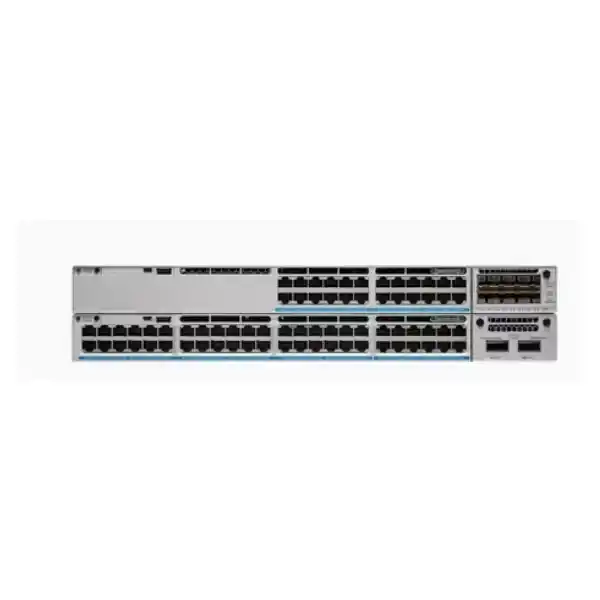
Cisco Catalyst C9300L-48PF-4X Network Switch
The Cisco Catalyst C9300L-48PF-4X is a fixed-uplink, full-PoE+ enterprise access switch engineered for dense edge connectivity. It combines 48 10/100/1000BASE-T PoE+ access ports with four fixed 10G/1G SFP+ uplinks, an 890 W available PoE budget from the default 1100 W AC power supply, Cisco UADP 2.0-based switching architecture, and optional StackWise-320 stacking. For UAE organizations standardizing campus, branch, hospitality, education, healthcare, retail, and mixed IT/OT access layers, it provides the port density, power headroom, uplink bandwidth, segmentation capability, operational visibility, and resilient design expected from the Catalyst 9300 family.
This page is designed for buyers, architects, consultants, IT managers, procurement teams, and implementation partners who need to determine whether C9300L-48PF-4X is the right model, how to size PoE and uplinks correctly, which license level to select, and what should be included in a UAE quotation.
Direct answer
Choose the C9300L-48PF-4X when your access layer needs 48 PoE+ ports with substantially more aggregate power than the standard 48P model, while four fixed 10G uplinks are sufficient for distribution or core connectivity.
- 48 × 1G copper PoE+ access ports
- 4 × 10G/1G SFP+ fixed uplinks
- 890 W available PoE with default 1100 W AC PSU
- StackWise-320, up to eight compatible fixed-uplink members
- 176 Gbps switching capacity and 130.95 Mpps forwarding rate
- 1RU enterprise access-layer form factor
What the C9300L-48PF-4X is designed to solve
Enterprise access switching is no longer only about connecting desktop PCs. A modern wiring closet may supply connectivity and power to Wi-Fi access points, IP telephones, cameras, badge readers, building controllers, digital signage players, thin clients, point-of-sale devices, industrial gateways, room-scheduling panels, and other intelligent endpoints. The practical limitation on a conventional 48-port switch is often not raw port count; it is the available PoE budget, uplink design, failure-domain strategy, and the operational tooling required to manage hundreds or thousands of attached devices.
The C9300L-48PF-4X addresses this by pairing 48 PoE+ capable Gigabit access interfaces with a much larger default power supply than lower-power 48-port variants. Cisco lists 890 W of available PoE power with the default 1100 W AC PSU. That matters because a theoretical 48 ports at the IEEE PoE+ maximum of 30 W would imply 1,440 W of port power. The C9300L-48PF-4X therefore gives designers a high baseline power pool while still requiring an intentional endpoint power calculation. In many real networks, phones may draw well below 15 W, cameras may be in a similar range, and access points may require more. The correct design sums realistic maximum requirements, adds expansion margin, and verifies that the selected switch and power configuration can support normal and failure conditions.
The “4X” element is equally important. It indicates four fixed 10G/1G SFP+ uplinks rather than the four 1G uplinks found on “4G” variants. That makes the model far more suitable for contemporary aggregation designs where multiple VLANs, wireless traffic, voice, video, cloud application sessions, backups, and east-west campus flows can converge on the access layer. Fixed uplinks reduce module-selection complexity and cost, but they also make pre-purchase topology validation essential: if you require 25G, 40G, or a different modular uplink strategy, a different Catalyst 9300 family member may be more appropriate.
Key technical specifications
| Specification | Cisco Catalyst C9300L-48PF-4X |
|---|---|
| Access interfaces | 48 × 10/100/1000BASE-T copper PoE+ ports |
| Uplink interfaces | 4 × fixed 10G/1G SFP+ uplinks |
| PoE class | PoE+ access capability, up to 30 W per port subject to overall power budget |
| Default power supply | 1100 W AC |
| Available PoE power | 890 W with default 1100 W AC power supply |
| Switching capacity | 176 Gbps standalone |
| Forwarding rate | 130.95 Mpps standalone, measured by Cisco using 64-byte IPv4 packets |
| Stacking | Optional Cisco StackWise-320; up to 8 compatible C9300L/C9300LM members subject to platform and license compatibility rules |
| Stack switching capacity figure | Cisco lists 496 Gbps switching capacity with stacking for this SKU |
| Forwarding rate with stacking | 369.05 Mpps |
| ASIC foundation | Cisco UADP 2.0-based Catalyst 9300L architecture |
| Form factor | 1RU rack-mount access switch |
| Dimensions | Approx. 1.73 × 17.5 × 19.2 in. / 4.4 × 44.5 × 48.8 cm |
| Weight | Approx. 15.48 lb / 7.03 kg with default PSU and fan configuration |
| Software family | Cisco IOS XE with Network Essentials or Network Advantage ordering options; Meraki-managed ordering options may also be available for supported 10G-uplink models |
48-port full PoE+ edge
The PF model is selected when the requirement is not merely “PoE on some ports” but a high aggregate power envelope across a densely populated 48-port switch. It is particularly relevant where cameras, phones, wireless APs, and access-control devices share the same closet.
10G fiber uplinks
Four SFP+ uplinks provide a practical path to redundant distribution switches, a collapsed core, or high-speed server and aggregation links. Each uplink can be planned for 10G or 1G operation with supported optics and cabling.
StackWise-320 option
Optional stacking can consolidate multiple access switches into a logical system for operational simplicity and resiliency. The required C9300L stack kit and cabling must be included in the bill of materials rather than assumed to be present.
Enterprise policy foundation
Catalyst access switching supports the segmentation, quality-of-service, authentication, telemetry, automation, routing, and high-availability functions expected in managed enterprise networks, with exact feature entitlement determined by software release and license level.
PoE engineering: why the “PF” designation matters
PoE design is frequently oversimplified by counting powered ports. The more reliable method is to build a power inventory. For every device class, record the expected quantity, negotiated PoE standard, nameplate or vendor maximum draw, typical draw where relevant, startup or heater loads for cameras, and future growth. A 48-port switch can physically accept 48 powered endpoints, but the number that can operate simultaneously at a given power level depends on the aggregate budget available from the power-supply configuration.
With 890 W of available PoE from the default power supply, the C9300L-48PF-4X is intentionally positioned above standard-power 48-port access configurations. A design containing twenty-four 8 W phones, twelve 18 W cameras, and twelve 22 W access points would have an illustrative maximum of 672 W before contingency. That leaves useful headroom inside an 890 W pool. By contrast, forty-eight devices each genuinely requiring the full 30 W PoE+ ceiling would exceed the default power budget. This is why FourTeck recommends attaching a PoE worksheet to the network bill of materials rather than purchasing purely from port count.
A second power supply can change both redundancy and available PoE capacity. Cisco’s published power tables show higher system PoE availability with supported secondary supplies, subject to the physical maximum imposed by the number of ports and each port’s rating. The exact redundancy strategy should be specified at quotation stage: N+1 or power-supply redundancy is not the same as increasing the usable endpoint power budget, and a failure-state design must decide which requirement takes priority. In a hospital, security deployment, hotel, or critical branch, maintaining endpoint power after a PSU or feed failure may be more important than maximizing normal-operation PoE capacity.
UAE deployments should also account for UPS-backed runtime. An access switch with a large PoE load can draw far more than a data-only switch, so UPS sizing should include switch consumption plus endpoint power delivered through PoE, conversion losses, battery aging, temperature, and the desired autonomy period. A closet with multiple high-PoE switches can therefore require materially more UPS capacity than an older LAN design. Facilities and network teams should jointly confirm rack power feeds, PDU socket types, circuit capacity, UPS load, cooling, and whether redundant power feeds originate from genuinely independent sources.
Finally, PoE is an operational tool as much as a cabling convenience. Central power allows network teams to restart supported endpoints remotely by cycling port power, standardizes power distribution through the closet, and removes many local power adapters. That can reduce desk and ceiling power complexity, but it makes the access switch and its electrical chain more critical. High-PoE designs should therefore be paired with disciplined monitoring, configuration backups, spare strategy, and tested failure procedures.
Uplink and traffic sizing for four 10G SFP+ ports
The four fixed SFP+ uplinks are a key reason to select the 4X model. They allow the access layer to aggregate up to four physical 10G connections, but the correct topology is not simply “use all four.” The design should identify distribution-switch pairs, link-aggregation strategy, spanning-tree or routed-access model, oversubscription target, redundancy behavior, optics type, fiber plant, and the expected traffic mix. Two 10G links in a port-channel to one upstream chassis may provide bandwidth but not device-level diversity; one or more links to each of two upstream systems can improve resilience when the upstream design supports the intended multichassis architecture.
Access-layer oversubscription should be calculated from actual workloads rather than the nominal sum of forty-eight 1G ports. Forty-eight simultaneous line-rate access ports represent 48 Gbps in one direction, while a pair of 10G uplinks provides 20 Gbps of nominal upstream bandwidth before protocol and traffic-pattern considerations. In office networks, that can be entirely appropriate because most clients are bursty and rarely transmit at line rate together. In a surveillance aggregation closet, media-production environment, backup-heavy site, or WLAN edge serving high-throughput access points, the traffic model may be more demanding. Four 10G uplinks give additional design flexibility, but if sustained aggregate traffic routinely approaches their practical capacity, a different switch family with faster uplinks may be warranted.
Optics selection requires equal attention. SFP+ interfaces can support different Cisco-qualified transceivers and direct-attach cabling depending on reach, media, and software support. Short in-rack or same-row connections may use suitable DACs where supported. Building backbone links commonly use multimode or single-mode fiber with optics chosen for distance and fiber type. Before ordering, record connector type, installed fiber grade, measured path length, patch-panel topology, number of cross-connects, and the optic type at both ends. A switch quotation without the transceiver and fiber-path decision is incomplete.
Because the uplinks are fixed, they also simplify lifecycle consistency. There is no separate network module to select or replace, reducing component permutations. The tradeoff is less expansion flexibility than modular-uplink Catalyst models. Buyers should therefore project the access-layer uplink requirement over the intended five- to seven-year infrastructure horizon rather than only matching today’s distribution links.
StackWise-320 architecture and operational resilience
Cisco Catalyst 9300L switches can use optional StackWise-320 connectivity. Cisco documents a 320 Gbps stacking solution for the fixed-uplink C9300L and C9300LM families, with up to eight compatible members in a stack and dedicated stack kits and cables. The architecture is valuable because multiple physical switches can be operated as one logical switching system, simplifying management, VLAN configuration, policy application, software administration, and many redundancy designs.
The C9300L stack kit is not merely a patch cable. Cisco documents optional rear stack adapters and dedicated StackWise cabling, so the bill of materials must include the correct stack kit for the chosen combination of models and the cable length needed by the rack layout. This point matters in UAE projects where switches may be installed in adjacent rack units, split across vertical rack zones, or preassembled by a systems integrator before delivery. Cable length should be selected against the actual physical placement, not guessed after installation.
A stack improves operational simplicity, but it should not be treated as a substitute for complete resiliency planning. Designers still need to define uplink diversity, power-feed independence, switch-member placement, configuration control, maintenance processes, software-upgrade method, and what happens if a stack cable or member fails. Redundant stack paths must be cabled correctly. Critical endpoints should be distributed across stack members where practical so that a single hardware failure does not remove all devices serving the same function or physical zone.
Mixed-model stacking also has rules. Cisco’s current documentation distinguishes fixed-uplink C9300L/C9300LM platforms from modular-uplink C9300 models and specifies compatibility and license-level conditions. A procurement team should therefore avoid assuming that any switch carrying the “Catalyst 9300” brand can join any existing stack. Existing stack member part numbers, software versions, license levels, stack-kit generation, and planned target release should be captured before adding a new C9300L-48PF-4X to an operational environment.
For greenfield access blocks, a common design is to deploy two or more C9300L switches as a stack and use physically diverse uplinks toward redundant distribution nodes. That creates a compact administrative unit while preserving multiple paths. Whether Layer 2 trunks, Layer 3 routed access, EtherChannel, or a software-defined campus model is preferable depends on the wider architecture, convergence requirements, policy model, and operational skills of the organization.
UADP 2.0 switching foundation
The C9300L platform is based on Cisco’s UADP 2.0 programmable ASIC architecture. At an enterprise-design level, this gives the platform a purpose-built forwarding foundation for campus switching rather than relying on a generic software-forwarding model. Packet forwarding, policy, quality of service, access control, segmentation, and telemetry are implemented around a hardware architecture intended for predictable line-rate operations.
Cisco publishes 176 Gbps standalone switching capacity and 130.95 Mpps forwarding for the C9300L-48PF-4X. Those figures are useful when comparing switch models, but architects should also evaluate table scale, enabled features, software release, traffic profiles, and the operational architecture. Peak packet-rate metrics alone do not define application performance.
IOS XE operational model
Catalyst 9300L uses Cisco IOS XE, providing a familiar enterprise network operating environment with programmatic and telemetry capabilities alongside traditional CLI-based administration. The exact command set and supported capabilities vary with software release and licensing, so upgrade planning should be tied to Cisco’s compatibility guidance rather than performed as a generic firmware exercise.
A production network should standardize golden configuration templates, AAA, secure management protocols, syslog, time synchronization, SNMP or telemetry collection, software-image governance, backup procedures, and change control. The switch should enter service as part of a managed platform lifecycle, not as an isolated appliance.
Security and segmentation at the enterprise access layer
The access switch is where user, device, and application intent meets physical connectivity. That makes it a critical control point for enterprise security. A C9300L-48PF-4X deployment can participate in a layered design that uses VLAN segmentation, authentication, access control, secure management, device classification, policy enforcement, and controlled routing to reduce the blast radius of compromised endpoints. The switch itself should be hardened as infrastructure: disable unused services, protect management access, use role-based administrator controls, authenticate management sessions, synchronize time, centralize logging, and separate management traffic from ordinary user traffic where architecture permits.
For endpoint access, organizations commonly use IEEE 802.1X where supported by their identity architecture, with MAC Authentication Bypass or other fallback mechanisms only where justified for devices that cannot perform interactive authentication. IP phones, printers, cameras, controllers, and legacy OT equipment often require differentiated onboarding policies. The design must be tested against real devices because support for supplicant behavior, VLAN assignment, voice VLAN operation, reauthentication, and failure modes varies widely among endpoint classes.
Layer 2 protections are equally important. Features such as DHCP snooping, Dynamic ARP Inspection, IP source validation techniques, storm control, BPDU protections, port security mechanisms, and root-guarding approaches can reduce common campus attack paths and accidental loops. However, these controls should be deployed from a validated template. Misconfigured snooping trust, incorrect spanning-tree edge settings, or aggressive rate limits can cause outages as easily as they can improve security.
Segmentation should reflect business risk rather than organizational convenience. Corporate laptops, guest devices, building-management systems, CCTV cameras, voice endpoints, payment terminals, wireless infrastructure, printers, and contractor equipment frequently deserve different trust levels. The switch can enforce local access policy and carry segmented traffic toward firewalls or routed policy boundaries. For organizations designing a broader secure edge, FourTeck’s Firewall Dubai solutions can be aligned with the LAN architecture so that VLAN and identity boundaries remain meaningful at the security gateway.
Security teams should also define how configuration compliance is verified over time. A secure day-one build can drift through troubleshooting changes, temporary access rules, and undocumented exceptions. Centralized monitoring, periodic audit, version-controlled templates, and change review are therefore part of the switch security model, not separate administrative chores.
QoS design for voice, video, Wi-Fi, surveillance, and business applications
A 48-port PoE access switch often carries exactly the traffic types that benefit from disciplined quality of service. IP voice is delay and jitter sensitive, interactive video can be bursty, surveillance cameras create sustained upstream flows, wireless APs aggregate traffic from many clients, and ordinary data applications compete for the same uplinks. QoS design should therefore begin with an application-classification model and an agreed trust boundary rather than with arbitrary queue settings.
At an IP phone port, for example, a deployment may trust markings from the managed phone while remarking untrusted PC traffic connected through the phone’s pass-through interface. At a wireless AP, the switch may receive traffic that already represents multiple SSIDs and application classes. Camera ports can be classified according to operational requirements, while backup or bulk-transfer traffic may intentionally receive lower priority. The objective is not to make every application “high priority”; it is to protect the small number of truly latency-sensitive classes while preventing them from consuming all resources.
Uplink congestion is the point where these decisions become visible. Even if each edge port is lightly utilized, dozens of endpoints can create simultaneous bursts toward an upstream 10G link. QoS policy must be consistent across the access and distribution path so that classification, DSCP markings, queue treatment, shaping, and policing do not contradict one another. For voice, the design also depends on call-control architecture, WAN behavior, and SBC or firewall treatment. For video surveillance, storage destination and camera bit rates must be understood. For WLAN, AP model, channel width, client density, and uplink architecture determine how much traffic the access switch will actually see.
The C9300L-48PF-4X provides the enterprise switching platform on which such policy can be implemented, but the final policy should be generated from application requirements and validated under load. FourTeck can integrate the switch within a wider UAE network-services engagement through FourTeck IT Services UAE, including assessment, configuration, migration, testing, and operational handover.
License selection: Network Essentials, Network Advantage, and management approach
Cisco ordering for Catalyst platforms is license-sensitive, and the suffix attached to a product configuration can materially affect feature entitlement. The C9300L-48PF-4X is available in Network Essentials and Network Advantage configurations, while Cisco also documents Meraki cloud-management ordering options for supported fixed 10G-uplink models. The correct choice depends on routing requirements, policy architecture, automation model, deployment standard, and how the organization intends to manage the lifecycle of the switch.
Network Essentials is generally positioned for foundational enterprise capabilities, whereas Network Advantage enables a broader advanced feature set. Buyers should not select purely on price or on an assumption that features can be “turned on later” without licensing consequences. Before quotation, list the required protocols and features: Layer 3 routing scale, advanced routing, segmentation architecture, campus-fabric participation, automation, telemetry, high-availability mechanisms, and any controller integration. Then validate those requirements against the current Cisco licensing and software documentation for the exact release intended for production.
Management architecture is another decision. Some customers maintain a traditional CLI plus network-management-system model. Others use Cisco Catalyst Center for automation, assurance, and software-defined campus workflows. Cisco also offers Meraki cloud-managed experience options on selected Catalyst models. These approaches have different operational processes, licensing implications, migration considerations, and feature matrices. A mixed environment can be supported, but should be designed rather than allowed to evolve accidentally.
The practical procurement rule is simple: quote the hardware part number, mandatory license level, subscription or support elements, optics, stacking accessories, redundant power if required, rack accessories, and services as one solution. A “switch-only” line item can appear cheaper while omitting components necessary for the intended deployment.
Physical installation, power, cooling, and UAE rack planning
Cisco lists the C9300L-48PF-4X at approximately 4.4 cm high, 44.5 cm wide, and 48.8 cm deep, with a weight of about 7.03 kg in the referenced default hardware configuration. It is therefore a conventional 1RU enterprise access switch, but rack suitability should still be checked against usable rail depth, cable-management space, rear power-supply clearance, airflow, and the position of vertical PDUs. Dense closets often fail operationally because cable bend radius and service clearance were not considered, not because the switch failed to fit between rack posts.
The 1100 W AC power supply makes electrical planning particularly important. The power-supply rating is not the same as constant draw, but branch circuits, UPS systems, and PDUs must be sized for the actual equipment population and worst credible load. If a secondary power supply is installed, document whether it is connected to an independent UPS or merely a second socket on the same source. True power-path redundancy generally requires separate upstream failure domains.
Thermal management is equally important in UAE environments. Although enterprise switches are specified for defined operating ranges, an inadequately cooled communications room can experience local hot spots well above the building thermostat reading. PoE load contributes to system heat, as do UPS systems, other switches, firewalls, servers, and power supplies in the same rack. Maintain front-to-rear airflow, keep intake and exhaust paths clear, use blanking practices where appropriate, and monitor environmental conditions near the equipment rather than relying only on room-level air-conditioning status.
Dust control and preventative maintenance matter in sites with construction activity, warehouses, industrial areas, or frequently opened doors. Network closets should be kept clean and access controlled. Fiber connectors need protective handling, patch cords need labeling, and copper patching should preserve category performance. High-density 48-port installations benefit from horizontal or vertical cable managers that allow ports, fans, PSUs, and stack connections to be serviced without dismantling unrelated cabling.
For projects that also include compute infrastructure, storage, racks, UPSs, or virtualization hosts, the switching design can be coordinated with FourTeck Server Dubai so that rack layout, uplink speed, VLANs, management networks, and power requirements are engineered as one environment rather than separate purchase orders.
Deployment patterns for the C9300L-48PF-4X
Corporate office access block
Use the switch to aggregate desks, IP phones, meeting-room devices, printers, APs, and security endpoints. Separate user, voice, guest, management, and facilities traffic into controlled segments. Redundant 10G uplinks can connect toward a distribution pair, while StackWise-320 can simplify multiple-switch closets.
Hospitality and hotel floors
High PoE availability is useful where APs, IP phones, cameras, IPTV-related endpoints, room-control gateways, and back-office systems share the access layer. Floor-by-floor power and cable planning should include growth, guest WLAN traffic, and security-device retention during outages.
Education campus
Classrooms may combine wireless APs, teacher systems, smart displays, phones, cameras, and lab equipment. Policy segmentation and identity-aware access help distinguish students, staff, guests, facilities, and administrative systems while 10G uplinks handle aggregated traffic between access and distribution.
Healthcare access network
The high PoE budget can support phones, APs, cameras, and network-attached clinical or building devices. Healthcare projects should emphasize change control, redundant power, authenticated access, segmentation, deterministic maintenance windows, and tested procedures for critical endpoint connectivity.
Surveillance and physical security
Forty-eight PoE+ ports and a substantial power pool make the model attractive for camera and access-control aggregation. Camera resolution, codec, frame rate, retention architecture, multicast behavior, and NVR path determine the upstream bandwidth requirement, so surveillance designs should verify 10G uplink utilization mathematically.
Retail, warehouse, and branch
The switch can consolidate APs, handheld-device WLAN traffic, scanners, POS systems, cameras, phones, label printers, access systems, and office endpoints. Segmentation between payment, guest, corporate, OT, and security systems should be coordinated with WAN and firewall policy.
How to size a C9300L-48PF-4X access block correctly
Sizing starts with endpoint inventory. Count every copper endpoint by room, floor, zone, or functional area and then add realistic spare capacity. A 48-port switch should not routinely be designed to 48 occupied ports on day one because moves, additions, temporary devices, failed cable runs, and new technology create demand. Many organizations target a usable occupancy threshold below full port count, but the correct margin depends on expansion expectations and the cost of adding another switch later.
Next, classify PoE requirements. Record which ports need no power, basic PoE, PoE+, and whether any future device may require power beyond what this model’s port class is intended to provide. Sum the maximum expected consumption and add contingency. If the calculated requirement approaches the available PoE budget, consider whether a second PSU, a different access model, or redistribution across switches provides a better failure-state design. Avoid using typical power draw alone for critical sizing if the endpoint vendor specifies a higher maximum under boot, heater, radio, or accessory load.
Then build the bandwidth model. Estimate traffic from wired clients, APs, cameras, voice, local servers, backups, internet usage, cloud applications, and east-west flows. Identify which traffic leaves the switch and which remains local. Determine peak concurrent behavior, not just average utilization. Select one, two, or more 10G uplinks according to resilience and throughput. If using port channels, confirm load-balancing expectations because a multi-link aggregate does not make a single flow exceed the bandwidth of one physical member.
After bandwidth, define Layer 2 and Layer 3 boundaries. Decide which VLANs terminate upstream, whether the access switch performs routing, how first-hop redundancy is handled, how spanning tree is controlled, and whether the campus uses a fabric or policy-controller architecture. This directly influences license requirements and the operational template. It also affects failure convergence and troubleshooting ownership between access and core teams.
Finally, size the rack and electrical system. Confirm rack units, depth, cable management, UPS capacity, PDU capacity, number and type of power feeds, environmental monitoring, patch panels, transceivers, fiber type, and stack cable lengths. A technically correct switch part number can still produce a failed installation if any of these dependencies are missing from the bill of materials.
FourTeck can supply the broader UAE networking requirement through FourTeck UAE, allowing switching, security, services, optics, accessories, servers, and implementation elements to be coordinated under one project scope.
C9300L-48PF-4X versus common alternatives
The most common buying mistake is choosing between these models from port count alone. The decisive variables are aggregate PoE requirement, copper access speed, uplink bandwidth, stack compatibility, license level, and the target architecture. The C9300L-48PF-4X is particularly strong when the access devices are predominantly 1G-capable but the closet needs a large shared PoE pool and 10G fiber aggregation.
Migration from older Catalyst access switches
Many UAE organizations evaluate the C9300L-48PF-4X while replacing older Catalyst 2960, 3560, 3650, or similar access platforms. A successful migration is more than copying a configuration. Legacy switches may use commands, defaults, licensing assumptions, QoS behavior, spanning-tree settings, authentication workflows, or uplink modules that do not map one-to-one to the new platform. The migration should start by documenting intended behavior rather than treating the current running configuration as the design specification.
Inventory VLANs, trunks, port channels, routed interfaces, helper addresses, access-control lists, QoS policy, voice VLANs, 802.1X and MAB behavior, DHCP snooping, static bindings, SPAN sessions, SNMP, syslog, NTP, AAA, local users, device-tracking functions, STP priorities, root protections, port security, multicast settings, and management routes. Mark commands that are historical remnants or temporary exceptions. Then create a clean target template for IOS XE on the selected release.
Physical migration planning should map old-to-new ports in advance. For high-PoE closets, capture each powered device and verify the new switch power budget. For fiber uplinks, confirm that existing optics are supported on both the new switch and upstream device; never assume that a transceiver working in an older chassis is automatically validated for a new platform or target software release. If stack architecture changes, recalculate stack cable lengths and member numbering.
A controlled cutover includes a rollback path. Keep the old configuration export, label old and new patch positions, pre-stage the replacement switch, verify image and license state, test management reachability, and define acceptance checks. Those checks should include endpoint connectivity, PoE delivery, voice registration, WLAN AP join state, DHCP, DNS, authentication, routing, uplink redundancy, monitoring, logs, and critical application reachability. For sensitive sites, migrate in logical groups so that troubleshooting remains bounded.
After cutover, remove temporary troubleshooting configuration, save the approved final state, update diagrams and asset records, and collect a baseline of interface errors, PoE consumption, CPU, memory, uplink utilization, environmental readings, and endpoint counts. That baseline is invaluable when diagnosing later changes.
Monitoring, telemetry, and lifecycle operations
Enterprise switching should be monitored as a service layer, not only for device up/down state. Useful operational metrics include access-port utilization, uplink utilization, packet drops, errors and discards, PoE consumption, power-supply status, fan and temperature state, stack health, interface flaps, spanning-tree changes, authentication failures, DHCP-security events, CPU and memory trends, and configuration changes. Baselines should distinguish ordinary daytime patterns from backup windows, shift changes, school start times, hotel peak periods, and other site-specific events.
PoE telemetry deserves special attention on the C9300L-48PF-4X. Track allocated and consumed power, identify ports operating near expected limits, and look for devices that repeatedly renegotiate or power-cycle. A rising PoE baseline can indicate that new endpoints are consuming the design margin. If a secondary PSU is part of the resiliency plan, monitor its state and test alerting so that a failed redundant component is repaired before the next failure turns redundancy into outage.
Uplink trends inform capacity management. A 10G interface that peaks briefly at high utilization may be healthy; one that remains heavily loaded during business hours may need an additional member, traffic engineering, or a higher-speed design. Analyze both directions because surveillance and backup traffic can create predominantly upstream load, while cloud application and content delivery patterns can differ. Packet drops and queue statistics are often more informative than average utilization alone.
Software lifecycle is another core responsibility. Maintain an approved release policy, security-advisory process, configuration backup, maintenance-window calendar, and tested upgrade method. Before upgrades, review Cisco release notes and compatibility requirements for the exact hardware, feature set, controller integrations, optics, and stack configuration. In stacked environments, consider how the upgrade process affects traffic and operational availability.
Finally, maintain a small set of standardized diagnostic commands and escalation evidence. Interface counters, logs, crash information, stack state, power status, transceiver detail, authentication state, and topology data can dramatically shorten vendor or integrator troubleshooting. Operational maturity turns the switch from a black box into a measurable part of service delivery.
Procurement considerations for Dubai, Abu Dhabi, and the wider UAE
Enterprise switch procurement in the UAE should separate the base chassis decision from the complete deployment bill of materials. For the C9300L-48PF-4X, clarify whether the requested configuration is Network Essentials or Network Advantage, whether the default 1100 W AC PSU is sufficient, whether a redundant PSU is required, whether stacking will be used, which stack kit and cable length are needed, how many SFP/SFP+ transceivers are required, and whether the rack already has suitable patch panels, fiber jumpers, PDUs, UPS capacity, and cable management.
Support and lifecycle terms should be specified in the purchase request rather than assumed. Organizations differ in required response times, access to software updates, escalation process, spare strategy, and maintenance ownership. A government entity, bank, healthcare provider, hotel operator, school, and small branch may all use the same hardware SKU but require very different operational support structures. The quotation should match the service criticality of the site.
Lead time and exact part-number matching are also important. Cisco product families can have visually similar suffixes representing different uplink, PoE, and licensing combinations. Procurement documents should state the full product ID and license intent. Substitutions should be technically reviewed before acceptance. A 48-port switch with four uplinks is not an equivalent substitute if those uplinks are only 1G, if the PoE pool is lower, if the stacking architecture differs, or if the software license does not meet requirements.
For multi-site projects, standardization reduces operational cost. Decide whether every wiring closet will use the same switch model or whether high-PoE closets receive PF variants while lower-power closets use standard P models. Standardize uplink optics, software release, configuration templates, rack layouts, labeling, monitoring, and spare holdings where practical. This can simplify replacement and troubleshooting while avoiding the cost of over-specifying every site.
FourTeck can coordinate UAE and cross-border technology requirements through its wider network, including FourTeck Global, while keeping the technical scope aligned to the local project’s rack, power, security, and support requirements.
Frequently asked technical questions
Does the C9300L-48PF-4X provide PoE+ on all 48 access ports?
Yes, the model is a 48-port PoE+ platform. However, simultaneous endpoint power is constrained by the aggregate available PoE budget. With the default 1100 W AC PSU, Cisco lists 890 W available PoE. Designers should calculate device demand instead of assuming forty-eight ports can all deliver their individual 30 W maximum at the same time under the default power configuration.
Are the four uplinks 10 Gigabit?
Yes. The 4X variant provides four fixed 10G/1G SFP+ uplinks. The exact speed and reach depend on the supported optic or cable and the configuration at both ends of the link.
Can the switch be stacked?
Yes. Catalyst 9300L fixed-uplink models support optional StackWise-320. The stack kit and cables are separate planning items, and mixed-model compatibility must be validated against Cisco’s current rules and license levels.
How many switches can be in a StackWise-320 stack?
Cisco documents up to eight compatible C9300L/C9300LM members in StackWise-320, subject to platform compatibility and licensing conditions. A real deployment should also consider rack layout, failure domains, software operations, and uplink design rather than maximizing member count automatically.
Is this a multigigabit access switch?
No. The C9300L-48PF-4X is primarily a 1G copper access model. If Wi-Fi APs or other endpoints require 2.5G, 5G, or 10G copper access, evaluate the multigigabit C9300L variants or other Catalyst models designed for that requirement.
Why choose PF instead of the regular 48P model?
The PF variant is aimed at higher aggregate PoE demand. It ships with a larger default power-supply configuration and Cisco lists 890 W available PoE, making it better suited to densely powered access layers where a standard-power 48P design may not provide enough headroom.
Does it support Layer 3?
Catalyst 9300L is an enterprise Layer 3-capable platform, but the exact routing protocols, scale, advanced functions, and policy features available to your deployment depend on Cisco IOS XE release and license level. Requirements should be mapped to Network Essentials or Network Advantage before ordering.
Can I connect the switch directly to a server?
Yes, where interface types and speeds match, but access-switch design should consider whether the server belongs on the campus access layer or a dedicated server/data-center fabric. For 10G server connections, optic and cabling compatibility, redundancy, VLAN design, and server NIC teaming all need to be verified.
Engineering checklist before configuration
Before the C9300L-48PF-4X is racked and connected, convert the design into a repeatable implementation checklist. This reduces installation errors and helps operations teams understand exactly what was intended.
Hostname, management IP, management VRF or VLAN, default route, DNS, NTP, AAA, SSH policy, administrator roles, SNMP or telemetry, syslog destinations, banners, and configuration-backup process.
VLAN list, voice VLAN, trunks, native VLAN policy, spanning-tree mode, root placement, BPDU protection, loop protection, storm control, port-channel assignments, and unused-port policy.
802.1X, MAB, RADIUS servers, authorization policy, DHCP snooping, ARP protections, device tracking, access lists, guest or remediation behavior, and exception handling for nonstandard devices.
Per-port device type, expected power, maximum requirement, priority for critical devices, total budget, redundancy state, UPS support, and alarm thresholds.
Optic type, fiber path, 1G or 10G speed, port channel, upstream switch, LACP settings, routed or trunk mode, allowed VLANs, MTU requirements, and failure testing.
Stack health, power status, PoE delivery, client addressing, DNS, authentication, voice, AP join, camera reachability, routing, internet access, application access, uplink failover, monitoring, and configuration save.
Decision recap: when this is the right Cisco access switch
The C9300L-48PF-4X is a strong fit when all of the following conditions are broadly true: you need a 48-port enterprise access switch; most attached copper endpoints require no more than 1G access speed; many devices need PoE or PoE+; the aggregate powered-device requirement benefits from an 890 W default PoE pool; four fixed 10G/1G SFP+ uplinks provide enough northbound capacity; optional StackWise-320 aligns with your resilience and operations model; and Cisco IOS XE with the selected license level supports the policy and routing functions in your design.
You should evaluate another model if a meaningful portion of access devices requires 2.5G, 5G, or 10G copper; if endpoints require a higher per-port PoE class than the switch provides; if you require 25G/40G uplinks or modular uplink flexibility; if the existing stack is a modular-uplink C9300 architecture that cannot accept this fixed-uplink platform; or if the desired software feature is not covered by the intended license tier.
The model is therefore best viewed as a high-PoE-density 1G access platform with modern 10G aggregation and enterprise stacking capability. It is not a universal answer for every Catalyst requirement, but it is a highly practical choice for the large installed base of offices, campuses, hotels, healthcare facilities, schools, security networks, warehouses, and branches that still have predominantly 1G edge devices while needing substantially better power and uplink capacity than legacy access switches.
Quotation input checklist for UAE buyers
For an accurate Cisco Catalyst C9300L-48PF-4X quotation, provide the information below. This prevents under-scoped quotes and helps ensure the delivered hardware can be installed without discovering missing optics, licenses, stack accessories, or power components.
1. Quantity and site
Number of switches, delivery emirate, number of wiring closets, rack locations, project timeline, and whether the equipment is for a new deployment, expansion, spare stock, or replacement of an existing stack.
2. License requirement
Network Essentials, Network Advantage, or a defined cloud-management requirement. Include routing, segmentation, controller, automation, and feature expectations so the license can be validated technically.
3. PoE device inventory
Counts and models of phones, APs, cameras, badge readers, sensors, panels, and other powered devices, together with maximum power requirement where available and expected growth.
4. Uplink requirement
Number of uplinks, 1G or 10G speed, multimode or single-mode fiber, approximate distance, upstream switch model, optic preference, port-channel design, and any requirement for spare transceivers.
5. Stack requirement
Standalone or stacked operation, number and model of existing stack members, software version, license level, rack placement, desired stack cable length, and whether the required C9300L stack kit is already available.
6. Power and support
Need for secondary PSU, UPS design, independent power feeds, required support coverage, configuration and installation services, migration assistance, documentation, testing, and post-deployment support.
Consult FourTeck for a deployment-ready Cisco C9300L-48PF-4X bill of materials
A complete access-switch quotation should match the actual LAN design: license tier, PoE load, redundant power, StackWise accessories, SFP+ optics, fiber media, uplink architecture, rack environment, support coverage, configuration, migration, and acceptance testing. FourTeck can help translate your port schedule and network topology into a deployment-ready scope for Dubai, Abu Dhabi, Sharjah, and projects across the UAE.
Send the endpoint count, PoE device list, upstream switch model, fiber type, desired redundancy, and license requirements to reduce revision cycles and improve quotation accuracy.
Hardware • Licensing • PoE • Optics • Stacking • Power • Installation • Migration • Support

Reviews
There are no reviews yet.