
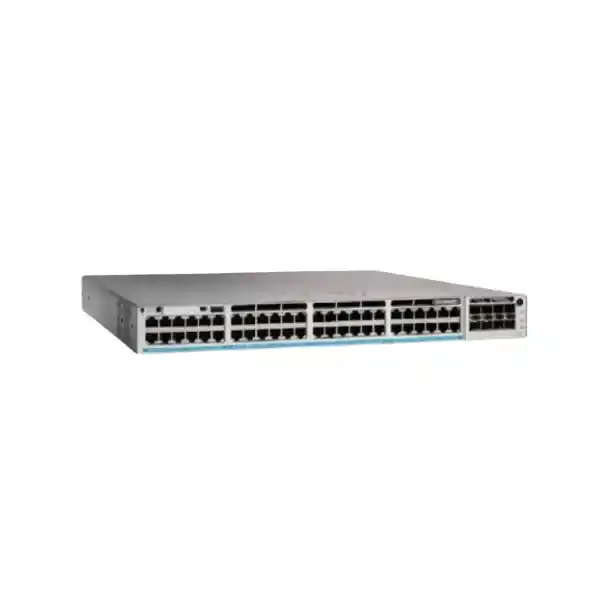
Cisco Catalyst C9300L-48UXG-4X Network Switch
The Cisco Catalyst C9300L-48UXG-4X is a fixed-uplink, high-density enterprise access switch engineered for modern wired and wireless campus networks. It delivers 48 powered copper access ports, including 12 multigigabit interfaces capable of operating at 100 Mbps, 1 Gbps, 2.5 Gbps, 5 Gbps or 10 Gbps, plus 36 conventional 10/100/1000 Mbps copper ports. Four fixed 10G/1G SFP+ uplinks provide resilient aggregation paths to distribution or core layers, while optional StackWise-320 enables up to eight compatible switches to operate as a unified switching system.
For organizations in Dubai, Abu Dhabi, Sharjah and other UAE locations, this platform is especially relevant where Wi-Fi 6/6E access points, IP surveillance, collaboration devices, building automation and high-performance endpoints must share a predictable, secure and manageable access-layer architecture. FourTeck can support architecture validation, licensing alignment, optics selection, PoE sizing, stacking design and deployment planning around the C9300L-48UXG-4X.
Direct answer: what is the C9300L-48UXG-4X designed to do?
The C9300L-48UXG-4X is designed to sit at the enterprise access layer, where user devices, access points, phones, cameras and IoT systems enter the network. Its defining advantage is that it does not force every access port into the same speed class. Thirty-six ports are optimized for mainstream Gigabit Ethernet workloads, while twelve multigigabit ports are available for endpoints that need substantially more than 1 Gbps over copper. That mixed-port architecture is useful for refresh projects because many offices still have large populations of 1G endpoints, yet new wireless access points and specialist workstations increasingly benefit from 2.5G, 5G or 10G copper connectivity.
The switch also provides Cisco UPOE on its access interfaces. This allows the same structured cabling used for Ethernet data to deliver electrical power to compatible powered devices. In practice, a properly sized C9300L-48UXG-4X deployment can reduce the number of local power adapters required at desks, ceilings, security positions or digital-signage locations. For a large Dubai office, hotel, school or healthcare site, centralizing power through the network switch can also simplify UPS strategy, maintenance and device replacement because the access-layer power source is concentrated in the communications room rather than dispersed throughout the building.
The platform belongs to Cisco’s Catalyst 9300 family and uses the fixed-uplink C9300L architecture. That matters during design: unlike Catalyst 9300 models with modular uplink bays, the C9300L-48UXG-4X ships with its four 10G/1G SFP+ uplink interfaces as part of the chassis. The fixed design lowers ambiguity during procurement and makes port planning straightforward. Architects should therefore confirm that four 10G uplinks are suitable for the projected access-to-distribution traffic profile. Where much larger uplink bandwidth is needed per switch, a different Catalyst 9300 variant may be more appropriate.
Core hardware specifications
Access interfaces
48 powered copper ports: 12 multigigabit ports plus 36 Gigabit Ethernet ports.
Multigigabit speeds
The 12 mGig ports can negotiate 100M, 1G, 2.5G, 5G and 10G Ethernet operation.
Fixed uplinks
Four 10G/1G SFP+ uplink interfaces for fiber or supported direct-attach connectivity.
Power architecture
1100W AC power supply class as the standard power platform, with redundant power design options.
Switching capacity
392 Gbps switching capacity; 712 Gbps switching capacity when stacking bandwidth is included.
Forwarding performance
Up to 291.66 Mpps standalone forwarding and 529.76 Mpps with stacking considered.
The combination of 392 Gbps of standalone switching capacity and a 291.66 Mpps forwarding rate gives the C9300L-48UXG-4X sufficient internal performance for dense enterprise access workloads when the switch is correctly designed and configured. The important distinction is that switching capacity is not the same as uplink capacity: the chassis can process substantial aggregate traffic internally, while upstream traffic from the access layer still exits through the four fixed 10G/1G SFP+ interfaces or across the stack fabric to other members of a StackWise-320 domain.
Port architecture: why 12 mGig plus 36 Gigabit ports is practical
A common network refresh problem is overbuilding. If an organization replaces every access switch with forty-eight 10G copper ports, the project may pay for capacity that most endpoints will never use. At the opposite extreme, installing a pure 1G access switch can create a bottleneck for modern wireless access points and high-performance workstations. The C9300L-48UXG-4X solves this with a deliberately mixed access layout. Twelve ports can negotiate above 1 Gbps, while thirty-six ports retain conventional Gigabit operation. This lets architects place multigigabit capacity exactly where it is needed without abandoning the large installed base of 1G devices.
The 12 multigigabit ports support 100 Mbps, 1 Gbps, 2.5 Gbps, 5 Gbps and 10 Gbps. This flexibility is especially useful in brownfield cabling environments. An access point or workstation may be able to use 2.5G or 5G on existing supported Category cabling even when a full 10G link is not practical over the installed distance or cable condition. During deployment, cabling quality should still be validated rather than assumed. Patch panels, horizontal runs, consolidation points and patch cords all affect whether the intended link speed can be achieved reliably.
The thirty-six standard copper ports support ordinary 10M/100M/1G operation, making them suitable for phones, printers, cameras, building controllers, desktop systems, thin clients and many industrial or facilities devices. Network teams can therefore reserve the premium mGig ports for endpoints with genuine bandwidth demand. This improves capacity planning and makes future upgrades easier because the highest-value ports remain visible as a defined resource rather than disappearing inside a homogeneous 48-port design.
In Wi-Fi 6 and Wi-Fi 6E projects, this port mix is particularly relevant. Modern access points can aggregate more wireless throughput than a single 1G wired uplink can carry. The 2.5G, 5G or 10G mGig interfaces reduce that access-layer bottleneck while preserving PoE delivery over the same Ethernet connection. For floor-by-floor deployments, twelve mGig ports often align well with the number of premium wireless APs or specialized endpoints assigned to a single telecommunications room, though actual density should be calculated from the site survey and cabling topology.
UPOE power design and endpoint planning
Cisco UPOE is a major reason to choose the C9300L-48UXG-4X. The switch is intended to provide both connectivity and centralized electrical power to compatible network endpoints. This is important for wireless access points, IP phones, surveillance cameras, door controllers, compact network devices, digital-signage components and certain building-automation systems. A powered access layer can reduce the need for separate electrical outlets at the endpoint, but the PoE design must be engineered with the same discipline as data capacity.
The primary 1100W AC power supply platform provides a defined pool of power that is shared between the switch itself and its powered devices. Cisco’s published power tables show that the available PoE budget changes with the secondary power-supply combination. For the C9300L-48UXG-4X, the default 1100W primary supply provides a lower standalone PoE budget than a design equipped with a second supply. Adding a secondary supply increases the available power pool and can also improve resilience. The correct power-supply combination should therefore be chosen from the required endpoint wattage, expected growth and redundancy objective rather than from port count alone.
For example, a 48-port switch populated mainly with low-power phones may need far less PoE budget than a switch serving high-performance wireless APs and powered building devices. The network bill of materials should list every powered endpoint class, its negotiated or maximum expected wattage, the number of devices per switch and the target engineering reserve. A sensible design also leaves spare capacity for replacement hardware and endpoint upgrades. If the switch is expected to run near its maximum PoE budget on day one, the project has no practical headroom.
The C9300L family also supports operational capabilities such as per-port power controls and PoE monitoring. These features help administrators see how much power endpoints are actually drawing, set limits where required and troubleshoot devices that fail to power correctly. In critical facilities, PoE behavior should also be tested during switch reloads and power events so the expected endpoint recovery sequence is understood before production cutover.
Fixed 4x10G SFP+ uplinks: designing the northbound path
The C9300L-48UXG-4X includes four fixed uplink interfaces capable of 10G or 1G operation with supported SFP/SFP+ optics and connectivity options. Because the uplinks are fixed, there is no separate modular network module to select. This simplifies procurement, but it also means the uplink ceiling is known at design time. Network architects should evaluate whether four 10G ports provide the correct balance of bandwidth, redundancy and topology for the target building or campus.
A common design is to use two uplinks toward a pair of distribution switches, with the remaining interfaces reserved for additional links, migration or future design changes. Link aggregation can increase bandwidth and resiliency when the upstream topology supports it. In a stacked access design, uplink placement can be distributed across different stack members so that a single member or local cable failure does not isolate the whole access block. The exact architecture should consider the behavior of spanning tree, routed access, port channels, gateway placement and the organization’s preferred high-availability model.
Optic selection should be based on medium, distance and upstream hardware. Short-range multimode fiber, single-mode fiber or supported direct-attach connectivity may all be appropriate in different scenarios. A Dubai office tower with distribution switches several floors away may have different optical requirements from a campus where building-to-building uplinks traverse longer single-mode fiber routes. Before ordering, the project team should verify connector type, fiber grade, patch-panel design, optical budget and transceiver compatibility at both ends.
The four 10G uplinks also influence oversubscription calculations. Forty-eight access ports can collectively generate more traffic than 40 Gbps. That is normal in enterprise access networks because endpoint traffic is bursty and rarely all flows northbound at line rate simultaneously. However, wireless aggregation, local data-transfer patterns, video, backup traffic and east-west application behavior can materially change the oversubscription profile. FourTeck can help model these flows so uplink design is driven by actual business use rather than by a generic ratio.
StackWise-320: scale and operational consistency
Catalyst 9300L fixed-uplink models support Cisco StackWise-320 through an optional stacking kit installed at the rear of the switch. StackWise-320 provides a 320 Gbps stack fabric and supports up to eight compatible switches in a stack, subject to Cisco’s compatibility and licensing rules. For the C9300L-48UXG-4X, stacking is useful when a telecommunications room requires more than forty-eight access ports but the organization wants the switches to function as a coordinated system rather than as isolated devices.
From an operational perspective, a stack can reduce the number of logical devices that administrators manage. It can also simplify cross-member EtherChannel designs and distribute uplinks or endpoint connections across chassis members. When one switch in the stack is taken out of service, correctly designed connectivity can preserve access for devices attached to other members. The stack fabric also contributes to the switching-capacity figure published for the platform: the C9300L-48UXG-4X is rated at 392 Gbps standalone switching capacity and 712 Gbps when stacking bandwidth is included.
Stacking should still be treated as a physical infrastructure design. The stack kit, adapters and cable lengths must be selected before installation. Rack placement determines whether standard 0.5 m cables are sufficient or whether 1 m or 3 m options are needed. Cables should be routed so they are protected from accidental removal and do not block airflow or service access. A stack ring should also be documented with member numbers, serial numbers, power feeds and uplink assignments so maintenance teams can work safely later.
Licensing level matters as well. Cisco documents stacking compatibility by model family and license level. A production design should therefore confirm the exact ordered software edition across all members instead of assuming that any C9300L can be added to any existing stack. This is particularly important when expanding a previously installed UAE site because the original switch order may have used Network Essentials, Network Advantage or a different management mode.
Performance and scale characteristics
Cisco publishes the C9300L-48UXG-4X with a 392 Gbps standalone switching capacity and a forwarding rate of 291.66 million packets per second. When the StackWise fabric is included, the corresponding published figures rise to 712 Gbps and 529.76 Mpps. These values help network designers confirm that the forwarding engine is appropriate for dense access workloads. They should not be interpreted as a promise that every application will achieve those rates, because real throughput also depends on packet sizes, traffic patterns, features enabled, uplink topology and endpoint behavior.
For the C9300L/LM fixed-uplink family, Cisco lists support for 32,000 MAC addresses, up to 32,000 IPv4 routes in the relevant platform category, 16,000 IPv6 routing entries, 8,000 multicast routing entries, 5,120 QoS scale entries and 5,120 ACL scale entries. The platform category also supports 4,094 VLAN IDs, up to 1,000 switched virtual interfaces and jumbo frames up to 9,198 bytes. These numbers are large enough for many enterprise campus deployments, but high-scale environments should compare the projected logical-table utilization against the official software release documentation and the features that will actually be enabled.
The fixed-uplink Catalyst 9300L platform is listed with 8 GB of DRAM and 16 GB of flash. Memory sizing is one part of the hardware architecture that supports IOS XE operation, software images, logging and network services. In change-control processes, administrators should still maintain appropriate free storage and follow Cisco guidance when planning image upgrades, package management or rollback options.
Packet forwarding at the access layer is also affected by design choices such as ACL complexity, QoS policy, telemetry, NetFlow, routing protocols and endpoint security functions. The right approach is not to disable useful features merely to preserve theoretical performance, but to validate scale and policy combinations against the actual requirement. FourTeck’s IT services practice in the UAE can assist with baseline configuration, policy design, migration planning and post-cutover validation for Catalyst access-layer deployments.
Layer 2 design considerations
At the Layer 2 level, the C9300L-48UXG-4X can form the foundation of a highly segmented enterprise access network. VLAN design should be based on security zones, operational boundaries and broadcast-domain requirements rather than simply mirroring physical floors. User workstations, corporate wireless, guest wireless, voice, CCTV, printers, facilities devices and management interfaces often deserve separate policy domains. The switch supports thousands of VLAN IDs, but a clean design normally uses only the segments needed for business and security objectives.
Spanning-tree design remains important where Layer 2 loops are possible. The platform supports PVST and MST scale suitable for enterprise deployments, but administrators should intentionally define root placement, edge-port behavior and protection features. Access ports should be configured according to endpoint type, with mechanisms such as BPDU Guard considered where appropriate. Trunk ports should carry only required VLANs. These practices reduce fault domains and make accidental loops easier to contain.
EtherChannel can be used to combine physical links into a logical interface for greater resiliency and bandwidth. In a stack, links can be distributed across physical members, which can reduce dependence on a single chassis. The upstream switches must be configured with a compatible aggregation design. When migrating an existing network, the port-channel hashing behavior, VLAN list, native VLAN settings and allowed trunk parameters should all be documented before cutover.
Access-layer policy also includes storm control, DHCP snooping, dynamic ARP inspection and other protections depending on the selected software capabilities and security model. The specific feature set should be validated against the ordered license level and software release. The objective is a predictable Layer 2 edge: endpoint ports should behave consistently, unauthorized infrastructure devices should be constrained, and failures should remain localized instead of propagating across the building.
Layer 3 and routed-access use cases
Many organizations deploy Catalyst 9300-class switches as more than simple Layer 2 access devices. Depending on licensing and architecture, the C9300L-48UXG-4X can participate in Layer 3 designs, allowing routed interfaces or switched virtual interfaces to move the routing boundary closer to the endpoint. Routed access can reduce dependence on spanning tree across large campus environments and can create clearer failure domains between access blocks.
The decision between Layer 2 access and routed access should be made at the architecture level. A conventional design may extend user VLANs to a distribution pair where the default gateways live. A routed-access design may instead place gateways on the access switch or stack and use dynamic routing toward the distribution layer. Each approach affects redundancy, troubleshooting, policy enforcement, addressing and operational procedures. The C9300L-48UXG-4X supports scale that can fit either model in many enterprise environments, but the software license must be aligned with the required routing features.
Routing-table capacity should be reviewed when a switch is expected to carry significant route scale. Cisco’s fixed-uplink platform data lists 32,000 IPv4 routes in the relevant scale category, with a published split between directly connected and indirect routes, plus 16,000 IPv6 routing entries. For a standard campus access block, that can be ample. For unusual designs with very large route tables, dense virtual routing or complex segmentation, the expected state should be quantified before hardware selection.
The best design is the one operations teams can support reliably. If the organization has mature Layer 3 campus practices, routed access may simplify convergence and containment. If the site depends on legacy Layer 2 services or has strict application constraints, a traditional distribution gateway may remain appropriate. FourTeck can review the existing topology and recommend how the C9300L-48UXG-4X should integrate without introducing unnecessary architectural change.
Security, segmentation and policy at the access edge
Modern access switching is a security function as much as a connectivity function. The C9300L-48UXG-4X sits directly in front of endpoints, which makes it a useful enforcement point for segmentation, authentication and traffic policy. The precise feature set depends on the Cisco software package, release and surrounding identity architecture, but the design principle is consistent: the access layer should know what type of device is connected, place it in the correct policy domain and restrict communication that does not match business intent.
A typical enterprise might separate corporate users from guests, printers, cameras, facilities systems and management infrastructure. Where identity services are deployed, authentication can make port access conditional rather than permanently open. Where static devices cannot participate in full user authentication, alternative profiling or controlled access methods may be used. The switch can also support ACL-based enforcement at the edge, with Cisco publishing a scale of 5,120 ACL entries for the fixed-uplink platform category.
Security design should also protect the switching infrastructure itself. Management interfaces should be isolated, administrative protocols should use secure transport, unnecessary services should be disabled and logging should be centralized. Device configuration should be backed up and version controlled according to the organization’s operations standard. Software maintenance should follow a planned lifecycle rather than leaving access switches on obsolete releases indefinitely.
For customers building a broader security architecture, the switch can be deployed alongside next-generation firewall platforms and centralized security monitoring. FourTeck’s Firewall Dubai solutions team can help align the access-layer segmentation model with upstream firewall zones, VPN services and perimeter policy so that campus switching and security controls operate as a coherent system instead of independent components.
Wireless access point aggregation for Wi-Fi 6 and Wi-Fi 6E
One of the strongest use cases for the C9300L-48UXG-4X is powering and connecting high-performance wireless access points. Wi-Fi 6 and Wi-Fi 6E increase the practical amount of wireless traffic an AP can serve, particularly in dense environments with many modern clients. A 1G wired uplink can become a constraint when the radio side is capable of higher aggregate throughput. The twelve mGig interfaces provide a wired path at 2.5G, 5G or 10G, depending on the AP, cabling and negotiated link.
The power requirement of modern APs is equally important. Advanced radios, multiple spatial streams, USB peripherals and integrated IoT functions can require more power than older PoE devices. UPOE support gives the switch the power-delivery flexibility needed for many enterprise AP classes, provided the total switch PoE budget is sized correctly. The design team should therefore pair every AP model with its required power class and expected wired speed before deciding how many APs belong on a single switch.
Cabling should be certified for the intended mGig rate. An AP may link at 1G even when plugged into a multigigabit switch port if the cabling cannot sustain the higher mode. For a new UAE build, specifying and testing structured cabling before ceiling closure can prevent expensive remediation. For an existing building, sampling and certification should be part of the wireless upgrade plan, especially where cable age, patch quality or undocumented extensions may affect performance.
Capacity planning should also consider upstream bandwidth. Twelve APs operating at multigigabit rates can generate a significant traffic concentration. The access switch’s four 10G uplinks and any stack design should therefore be included in the wireless traffic model. If AP traffic is locally switched or segmented differently, that may change northbound demand. The switch should be treated as part of the full wireless architecture, not merely as a power source.
IP surveillance, voice and smart-building deployments
The C9300L-48UXG-4X can consolidate several powered access technologies on one enterprise switching platform. IP cameras, phones, intercoms, badge readers, room systems and building controllers often share the same telecommunications spaces even when they belong to different application teams. Using a common Catalyst access platform can simplify spares, monitoring and lifecycle management while VLANs, QoS and security policy keep the services logically separated.
Surveillance networks benefit from predictable PoE and high port density. Most cameras do not need multigigabit connectivity, so the thirty-six 1G ports can serve a large camera population while preserving mGig ports for wireless or specialist devices. Video traffic is sustained rather than purely bursty, so uplink utilization should be calculated from the cameras’ configured bitrates, frame rates, codecs and recording model. If recordings are centralized, the access-to-distribution path may carry a continuous aggregate stream throughout the day.
IP voice introduces different requirements. Phones typically consume modest bandwidth but are sensitive to delay, jitter and packet loss. QoS policy should classify and protect voice traffic without allowing markings from untrusted endpoints to bypass policy. Many organizations also connect a workstation through the phone’s downstream port, so the switchport may need separate voice and data VLAN behavior. In addition, power recovery after an outage matters because the phone may be the user’s emergency communication device.
Smart-building devices bring their own design challenges. Some are installed in difficult-to-access ceiling or plant-room locations and may need remote power cycling. Others are operational technology assets with long replacement cycles and limited security capabilities. Central PoE control is valuable in these cases, but segmentation is essential. The access switch should separate facilities systems from corporate user networks and expose only the services required for operation.
Licensing: Network Essentials, Network Advantage and management options
The base model name C9300L-48UXG-4X identifies the hardware platform, but Cisco orderable SKUs include software or management suffixes. Current Cisco documentation lists C9300L-48UXG-4X-E for Network Essentials, C9300L-48UXG-4X-A for Network Advantage and a C9300L-48UXG-4X-M option associated with Meraki management licensing. Procurement should therefore never stop at the chassis name. The required feature set, management model and subscription terms need to be mapped to the exact orderable part number.
Network Essentials is typically aligned to baseline enterprise access requirements, while Network Advantage is used where more advanced routing, segmentation or policy functionality is needed. The exact feature difference can evolve across IOS XE releases and licensing programs, so the bill of materials should reference Cisco’s current licensing matrix rather than relying on an old feature comparison. If a site is being expanded, the new switch should also match the intended stack’s license level.
Management strategy is another consideration. Some organizations operate Catalyst switches through traditional IOS XE workflows and centralized Cisco enterprise management platforms. Others may standardize on a Meraki management experience where supported. The choice affects operational processes, troubleshooting tools, change control and staff training. A project should decide the management architecture before placing the order so that the hardware and license combination arrives in a deployable state.
FourTeck can quote the exact switch variant once the customer’s required feature set is known. This prevents a common procurement error in which the physical chassis is correct but the software edition does not match the intended routing, segmentation or management design. For regional procurement and broader enterprise sourcing, customers can also reference FourTeck UAE for complementary network, security, server and communications infrastructure.
Physical specifications, rack planning and serviceability
| Item | C9300L-48UXG-4X detail | Design implication |
|---|---|---|
| Form factor | 1RU class chassis | High access-port density per rack unit |
| Chassis dimensions | Approximately 4.4 × 44.5 × 40.9 cm chassis only | Allow additional depth for power supply, cabling and service clearance |
| Depth with 1100W PSU | Approximately 48.8 cm | Confirm cabinet depth before procurement |
| Weight | Approximately 7.65 kg with default power supply | Plan rack loading and installation handling |
| Cooling | Three field-replaceable fans with N+1 redundancy support | Maintain correct airflow and service access |
Rack depth is frequently overlooked in access-switch projects. The bare chassis is approximately 40.9 cm deep, but the installed depth with the 1100W power supply is approximately 48.8 cm. Patch cords, power leads and stacking cables require additional clearance. A cabinet that technically fits the chassis may still be unsuitable if doors cannot close without bending connectors or obstructing airflow. The cabinet should also provide sufficient vertical space for patch panels, cable managers and UPS or PDU infrastructure.
Cooling in UAE environments deserves particular attention. Telecommunications rooms must maintain acceptable temperature and airflow even during the hottest part of the year. The switch includes field-replaceable fans and supports an N+1 fan redundancy model, but that does not replace proper room cooling. Dust control, filter maintenance, rack spacing and power quality all influence long-term reliability.
For serviceability, power supplies and fans should be accessible without disturbing unrelated patching. Stack cables should be labeled, and uplinks should be routed separately from access patch cords where practical. Before installation, the implementation team should create a rack elevation showing switch positions, patch panels, PDUs and cable paths. This reduces installation errors and makes later expansion far easier.
Power redundancy and UPS sizing
The C9300L-48UXG-4X supports a dual-power-supply architecture. Redundant power design should be considered separately from PoE capacity. Installing a second supply can increase the available endpoint power budget, provide power resiliency or do both depending on the selected combination and operating mode. In critical environments, each power supply should ideally be fed from an independent protected source where the site electrical design permits it.
UPS sizing must include both switch consumption and powered endpoints. A switch serving dozens of high-power APs or cameras can draw much more than a lightly populated unit even though the chassis model is identical. The UPS calculation should therefore use the planned PoE load rather than a generic switch-only wattage. Runtime objectives also matter. A five-minute bridge to generator power requires a different battery design from a branch office that expects thirty or sixty minutes of autonomous operation.
For stacks, the calculation should be done at the rack or communications-room level. Sum the expected draw of all switches, optics, routers, firewalls and powered devices, then apply an engineering margin. If supplies are split across separate PDUs or UPS circuits, model the worst credible failure case. Losing one feed should not overload the surviving feed or cause an unexpected reduction in PoE that powers down critical devices.
This is especially important in hospitality, healthcare and security environments where wireless, telephony or surveillance services are expected to remain available during electrical events. The network switch is only one part of the availability chain; upstream power, cooling, distribution links and core services must be equally resilient.
Deployment sizing methodology for UAE projects
A reliable C9300L-48UXG-4X design starts with endpoint inventory rather than switch count. For each floor or telecommunications zone, list wired users, phones, access points, cameras, printers, meeting-room systems, IoT devices and spare ports. Then classify each endpoint by bandwidth requirement and PoE requirement. This immediately reveals how many of the twelve mGig ports are actually needed and how much of the total PoE budget will be consumed.
The next step is growth allowance. Office occupancy changes, wireless density increases and new smart-building devices are often added after the original project. A switch that is 98 percent full at handover is already an operational problem. Many organizations target a spare-port margin that reflects expected growth and the difficulty of adding new switches later. In premium commercial buildings where communications rooms are difficult to expand, additional spare capacity can be justified.
After port and PoE sizing, calculate uplink demand. Estimate sustained and peak northbound traffic from wireless APs, user VLANs, cameras and local services. Decide whether two, three or four of the 10G uplinks will be active, and whether links will be aggregated. If the switches are stacked, model traffic from all stack members rather than only one chassis. The design should also reserve ports for failure scenarios so that redundancy is real rather than theoretical.
Finally, validate physical infrastructure: rack units, depth, power feeds, UPS runtime, cooling, fiber paths, optic types and stack cable lengths. This structured approach prevents the most common project errors: insufficient mGig ports, insufficient PoE budget, oversubscribed uplinks, incompatible optics or racks that cannot accommodate the final hardware depth.
For multi-country rollouts or organizations using the UAE as a regional hub, FourTeck can coordinate standardization beyond the local market through its Africa technology infrastructure practice, helping maintain consistent switch, optic, configuration and documentation standards across branch locations.
Typical deployment topologies
Single-switch access block
One C9300L-48UXG-4X serves a small floor or branch, using dual 10G uplinks to redundant upstream switches. This is simple to operate and suits locations where fewer than 48 access ports are required.
Stacked floor distribution
Two to eight compatible C9300L/LM switches form a StackWise-320 domain. Endpoint and uplink connections are distributed across members for scale and chassis-level resilience.
Wireless-heavy floor
The twelve mGig ports connect high-performance APs while 1G ports support phones, cameras and users. Uplink bandwidth is sized from aggregate wireless traffic and local application demand.
Smart-building access
UPOE powers cameras, controllers, room devices and IoT endpoints. Segmentation policies separate facilities, security and corporate traffic while centralized power improves remote operations.
The topology should be selected from operational requirements, not from a preferred diagram. A stack is valuable when the access block needs common management or cross-member link aggregation, but a single switch may be more appropriate for a small isolated branch. Similarly, dual uplinks are only useful if the upstream topology is actually redundant. FourTeck can document the chosen design with port maps, VLAN plans, IP addressing, stack membership and optics schedules so installation and support teams work from the same source of truth.
When the C9300L-48UXG-4X is the right fit — and when it is not
This model is an excellent fit when the project needs a high-density access switch with a mixture of standard 1G and faster multigigabit copper ports, substantial PoE capability, fixed 10G uplinks and optional stacking. It is particularly strong in offices, campuses, hotels, schools, healthcare environments and smart buildings where only a subset of endpoints need more than 1 Gbps but those endpoints are strategically important, such as premium wireless access points.
It may not be the best fit when every endpoint needs multigigabit speed. In that case, a platform with more mGig interfaces should be evaluated. It may also be unsuitable where the access layer requires uplinks faster than 10G per interface, because this model’s fixed uplinks are 10G/1G SFP+. A different Catalyst 9300 variant with higher-speed uplink options can be a better architectural match for very high-density or aggregation-heavy environments.
Similarly, organizations that do not need UPOE may find a lower-power or data-only Catalyst model more cost-efficient. Buying high-power hardware without a powered-device requirement can add unnecessary cost. Conversely, projects with very high per-device power requirements should verify whether UPOE is sufficient or whether a UPOE+ platform is needed for selected endpoints.
The key procurement question is therefore not simply, “Is the C9300L-48UXG-4X powerful?” It is, “Does its exact combination of port speeds, PoE class, fixed uplinks, stack fabric and licensing align with the site’s endpoint mix and growth plan?” FourTeck’s role is to make that match explicit before the hardware is ordered.
Migration from legacy Catalyst access switches
Organizations replacing older Catalyst 2960, 3560, 3750 or earlier access platforms should treat the project as an architecture migration rather than a simple hardware swap. The physical port count may be similar, but the operational model, software, uplink speeds, PoE behavior and security capabilities can be significantly different. A structured migration starts by collecting the current switch configuration, interface descriptions, VLAN assignments, trunk settings, port channels, routing, ACLs, QoS and endpoint power requirements.
The old configuration should not be copied blindly. Legacy switches often accumulate years of unused VLANs, disabled interfaces, outdated SNMP settings, obsolete authentication commands and temporary workarounds. The refresh is an opportunity to clean the design. Each configuration line should be tied to a current requirement, translated into the supported IOS XE syntax and validated in the target license level.
Uplink migration deserves special planning. Older access switches may use 1G SFP uplinks while the new C9300L-48UXG-4X supports 10G/1G SFP+ ports. The project can often increase upstream bandwidth substantially, but only if the distribution switch, optics and fiber infrastructure support the new speed. A staged migration may temporarily run the uplinks at 1G before moving to 10G after upstream changes are complete.
PoE should also be validated port by port. Older phones and cameras may use lower power classes, while replacement APs may draw much more. The new switch’s power budget should be sized for the future endpoint set, not merely the devices connected during the migration window. Finally, the cutover plan should include rollback conditions, pre- and post-change testing, and clear ownership for application validation.
For enterprise refresh programs, FourTeck can support configuration translation, staging, labeling, rack installation, patch migration and after-hours cutover services. Broader solution sourcing and project coordination are available through FourTeck Global for organizations standardizing infrastructure across multiple offices.
Optics, cabling and accessories that should be included in the BOM
A complete switch bill of materials extends beyond the chassis. The four SFP+ uplinks require appropriate optics or supported direct-attach connectivity. The correct selection depends on distance, fiber type, connector type and the upstream switch. Multimode short-reach optics may suit intra-building links over appropriate fiber, while single-mode options can support longer campus distances. Procurement should confirm both ends of every link rather than ordering optics for the access switch in isolation.
Stacking accessories are separate as well. C9300L switches use optional StackWise-320 kits that include the required stack adapters and a stack cable. Cable lengths must match the rack arrangement. Adjacent 1RU switches can often use the standard short cable, while non-adjacent placement may require longer variants. A stack design should include enough kits and cables to form the intended ring without improvised routing.
Power-supply selection is another BOM decision. The switch’s default supply class supports a defined standalone PoE budget, while adding a secondary supply can increase available endpoint power and/or resilience. The second supply should therefore be ordered based on measured or calculated demand. Spare power supplies and fans may also be justified for sites with strict restoration targets or limited access to replacement stock.
Rack accessories, patch leads, console access, labels, cable managers and UPS/PDU capacity should be confirmed before installation. For multigigabit access ports, structured cabling quality is critical. A switch can support 10G mGig electrically, but the link will only negotiate the intended speed if the complete copper channel meets the required performance. Certification test results should be retained with project documentation for future troubleshooting.
Finally, software subscriptions, support coverage and any required management licenses belong in the same procurement package as the hardware. Separating them can create a situation where the physical switch arrives but cannot be integrated into the planned operational model on schedule.
Operations, monitoring and lifecycle management
Once deployed, the C9300L-48UXG-4X should be treated as a managed infrastructure asset with a defined operational baseline. That baseline includes hostname standards, management addressing, authentication, secure administrative protocols, time synchronization, logging, monitoring, configuration backups and software-release policy. Interface descriptions should identify the connected device or patch-panel location so troubleshooting does not depend on physical tracing alone.
Monitoring should cover more than reachability. Useful data includes interface utilization, errors, discards, duplex or speed changes, PoE consumption, temperature, fan status, power-supply state, stack health and uplink utilization. High error counts on a multigigabit port may indicate a cabling problem even if the endpoint still appears connected. Similarly, increasing PoE utilization can signal that a floor is approaching its designed power ceiling before devices begin to fail.
Software lifecycle should be planned. IOS XE releases evolve, and security fixes or feature updates may require scheduled upgrades. Before an upgrade, administrators should verify compatibility with the switch model, license, management tools, authentication infrastructure and neighboring devices. Stacked switches require additional planning because the maintenance method and expected traffic impact may differ from a standalone chassis.
Configuration changes should follow change control, especially for shared access stacks serving many users. A simple trunk modification can affect dozens of endpoints if applied incorrectly. Backups should be taken before significant changes, and rollback procedures should be documented. For critical sites, out-of-band or console access should be available so the switch can be recovered even when in-band management is disrupted.
Lifecycle planning also includes hardware support and spares. Organizations should define whether they need vendor support coverage, local spare stock, next-business-day replacement or a more aggressive restoration objective. The answer depends on the business impact of an access-layer outage and whether endpoints have any alternate connectivity.
Dubai and UAE procurement considerations
Enterprise switch procurement in the UAE should account for more than unit price. The exact Cisco orderable SKU, software edition, support entitlement, power-supply configuration and transceivers all affect the delivered solution. A quotation that lists only “C9300L-48UXG-4X” can be incomplete if the customer expects a specific Network Essentials, Network Advantage or management bundle. FourTeck therefore recommends defining the production architecture first and using that design to build the final bill of materials.
Lead time should also be considered for larger projects. Access switches, optics, stacking kits and power supplies may have different availability. If a project requires dozens of identical floor switches, partial delivery can complicate staging and installation schedules. Procurement planning should identify critical-path components and define whether equivalent approved optics or accessory alternatives are acceptable.
UAE sites often operate in mixed-use towers, warehouses, hotels, schools or campuses where telecommunications-room conditions vary widely. Before delivery, confirm the rack depth, power socket type, UPS capacity, cooling, grounding and fiber terminations at each location. The same switch may fit perfectly in one site and be difficult to install in another because of cabinet or power constraints.
For government, healthcare, finance or regulated customers, documentation and change records may be as important as hardware. Asset serials, software versions, support contracts, configuration backups and topology diagrams should be captured at handover. Where cybersecurity standards require specific hardening, those settings should be incorporated into the staging template before the switches are installed.
FourTeck can provide a consolidated UAE quotation that includes the switch, required software edition, optics, stack accessories, secondary power supplies, implementation services and related network infrastructure. This makes the commercial proposal traceable to the engineering design and reduces the likelihood of last-minute accessory gaps.
Frequently asked technical questions
How many multigigabit ports are included?
There are 12 mGig copper ports. They support 100M, 1G, 2.5G, 5G and 10G link speeds. The remaining 36 access ports support conventional 10M/100M/1G Ethernet.
Are the uplinks modular?
No. This C9300L model has four fixed 10G/1G SFP+ uplink ports integrated into the chassis. If different or faster uplink modules are required, another Catalyst 9300 family variant should be evaluated.
Does it support stacking?
Yes. C9300L models support optional StackWise-320 using dedicated rear stack adapters and cables. Cisco documents support for stacks of up to eight compatible members.
Can it power wireless access points?
Yes. The access ports support Cisco UPOE, PoE+ and PoE. The total number and power class of APs must fit within the configured switch PoE budget.
What is the switching capacity?
Cisco lists 392 Gbps standalone switching capacity and 712 Gbps when stacking bandwidth is included. Standalone forwarding is rated at 291.66 Mpps.
Which license should I order?
The correct license depends on required features and management mode. Current orderable variants include Network Essentials, Network Advantage and a Meraki-managed option. The bill of materials should specify the exact suffix.
Decision recap: where this switch creates the most value
Choose the Cisco Catalyst C9300L-48UXG-4X when the access layer needs a balanced mix of Gigabit and multigigabit copper, enterprise PoE, fixed 10G uplinks and stackable resilience. Its twelve 10G-capable mGig ports provide targeted performance for advanced wireless APs and other high-throughput endpoints, while thirty-six 1G ports efficiently serve the much larger population of conventional office, security and building devices. That combination avoids the cost of making every access port multigigabit while still creating a clear upgrade path for the devices that matter most.
The C9300L-48UXG-4X is therefore best understood as a purpose-built enterprise access switch rather than a generic 48-port model. Its value comes from matching the hardware to the endpoint mix and designing the surrounding optics, stack, power and software correctly.
Quotation input checklist
To quote the C9300L-48UXG-4X accurately for a Dubai or UAE deployment, provide the following information. These details allow the hardware, software, power and optics to be aligned in one bill of materials instead of being corrected after delivery.
FourTeck consultation for Cisco Catalyst C9300L-48UXG-4X in Dubai
FourTeck can supply and engineer the Cisco Catalyst C9300L-48UXG-4X as part of a complete enterprise access-layer solution. The engagement can include switch and license selection, secondary power-supply sizing, SFP/SFP+ optics, StackWise-320 accessories, rack and UPS validation, VLAN and routing design, configuration staging, migration and post-installation testing. The goal is to deliver a switch that fits the network architecture on the first deployment, not merely a chassis that matches a model number.
For new wireless deployments, the design can be mapped from AP quantity and PoE class through mGig access ports and 10G uplinks. For campus refreshes, legacy configurations can be reviewed and modernized before migration. For security-sensitive environments, segmentation and access policy can be aligned with upstream firewalls and identity systems. For multi-floor buildings, stack design, fiber paths and rack power can be documented in advance to reduce installation risk.
Send the site count, estimated endpoints, required software edition and uplink distances to begin a technical quotation. If any detail is unknown, FourTeck can help derive it from the current network, floor plan or existing switch inventory.

Reviews
There are no reviews yet.