
Enterprise Fiber Switching • Dubai & UAE
Cisco Catalyst C9300X-12Y Network Switch
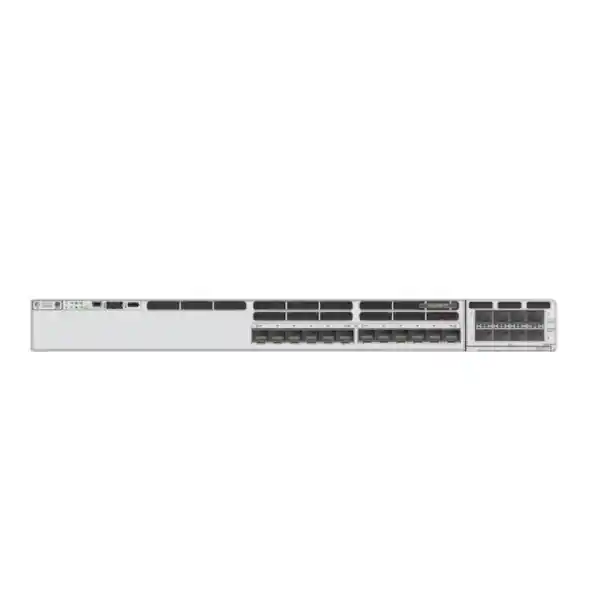
The Cisco Catalyst C9300X-12Y is a compact, high-throughput member of the Catalyst 9300X family built around twelve multi-rate SFP28 downlink ports that can operate at 1, 10 or 25 Gigabit Ethernet. It is particularly valuable where an enterprise needs fiber density, deterministic high-speed links, strong Layer 2 and Layer 3 control, secure segmentation, high-capacity stacking and modular uplink choices without moving to a physically larger chassis platform. In UAE deployments it fits campus distribution, aggregation, secure branch cores, data-room consolidation, firewall or appliance interconnection, server access, building-to-building fiber and migration projects that are transitioning from 1G or 10G optics toward 25G while preserving practical reuse of existing transceivers where compatibility allows.
Multi-rate 1G, 10G and 25G fiber-oriented connectivity.
Up to 1,000 Gbps standalone switching capacity.
High-bandwidth stack architecture for resilient campus designs.
Dual power-supply bays support redundancy planning.
What the C9300X-12Y is designed to solve
Many enterprise switching decisions are not really about port count. They are about where bandwidth converges, how many high-speed optical paths must be maintained, whether a failure can be isolated without taking down an entire building, and how easily the design can evolve over the next hardware lifecycle. The C9300X-12Y addresses those questions with a relatively focused set of twelve fiber-capable SFP28 interfaces rather than a large bank of copper access ports. That makes it attractive in aggregation closets, branch headquarters, secure network zones, server rooms and compact campus distribution layers where every interface may carry a meaningful amount of traffic.
Each downlink can be selected for 1G, 10G or 25G operation subject to supported Cisco optics, cabling and software conditions. This multi-rate behavior gives network architects a staged migration path. A site can retain a mixture of existing 1G or 10G fiber circuits while introducing 25G for bandwidth-intensive links, then progressively increase capacity as connected devices are refreshed. Instead of forcing a forklift upgrade of every optical endpoint, the switch can become a consolidation point that allows older and newer link speeds to coexist during the transition period.
The architecture is also suited to designs that need strong northbound bandwidth. Catalyst 9300X modular uplink options provide choices for high-speed connections, including 25G-oriented and 100G-oriented modules appropriate to supported C9300X platforms. For the C9300X-12Y, the exact network module, optics and breakout behavior should always be validated against the intended Cisco IOS XE release and hardware compatibility matrix before purchase. FourTeck treats uplink selection as a topology decision rather than an accessory choice: upstream core capacity, fiber type, distance, redundancy mode, oversubscription target and future growth are considered together.
For UAE organisations this matters because a single switch can sit at the intersection of multiple operational domains: data-center or server traffic, security appliances, campus access stacks, building fiber, WAN edge infrastructure, IP telephony services, wireless controller paths and critical management networks. The C9300X-12Y can be designed as a controlled, high-capacity transport and policy point without adding unnecessary copper density or PoE hardware to a location where those features are not required.
Port architecture and 25G migration
The front-panel identity of the C9300X-12Y is defined by twelve SFP28 downlink ports. SFP28 is mechanically related to the familiar SFP form factor but is engineered for 25 Gigabit Ethernet signaling. The value for an enterprise is not simply peak speed; it is the ability to use a compact optical form factor across multiple Ethernet generations. A properly planned deployment can therefore connect legacy 1G fiber, mainstream 10G server or distribution links and newer 25G connections on the same switching platform.
At 25G, twelve downlinks provide a substantial aggregate edge-facing capacity. In practice, traffic engineering must still account for uplink bandwidth, stack behavior, routing features, packet sizes, burst patterns and the actual load profile. A switch should never be sized only by multiplying interface speed by port count. FourTeck models expected sustained traffic, failure-state rerouting and oversubscription separately so the switch can accommodate both normal and degraded operating modes.
Optic selection is part of the design. Short-reach data-room links, multimode building fiber, long-reach single-mode circuits and direct-attach connections have different transceiver, patching and cleaning requirements. Mixing speed generations also requires correct optic type at both ends. The procurement bill of materials should state each link speed, connector format, fiber mode, distance, required optical budget and whether the link is intended to be redundant.
Standalone and stacked performance
Cisco publishes up to 1,000 Gbps of switching capacity and approximately 744.04 million packets per second of forwarding performance for the C9300X-12Y in standalone operation. With stacking, Cisco lists switching capacity reaching 2,000 Gbps and forwarding performance around 1,488 Mpps. These figures are useful for platform comparison, but successful design also depends on feature use, traffic distribution, software release, packet-size mix and the topology created around the switch.
StackWise-1T is especially relevant when two or more switches need to behave as a resilient operational system with a very high-capacity stacking fabric. This can simplify uplink resiliency, improve bandwidth distribution and reduce the number of independently managed devices compared with isolated switches. A stack is not a substitute for architecture, however. Power domains, rack placement, cable paths and upstream dependencies should be separated so a localized failure does not eliminate the benefits of logical redundancy.
For distribution or aggregation roles, design reviews should include the maximum traffic expected after a member failure. If one uplink or one stack member is unavailable, the remaining forwarding paths need enough headroom for critical applications. This failure-state sizing is often more important than peak marketing bandwidth and is a standard part of FourTeck enterprise switching assessments.
Performance, memory and forwarding resources
The Catalyst 9300X platform is designed for more than basic Ethernet frame switching. Cisco’s current platform data identifies 16 GB of DRAM and 16 GB of flash for the Catalyst 9300X family. For the twelve-port fiber model, Cisco also specifies a 16 MB packet buffer and up to 64,000 Flexible NetFlow entries. These resources support the operational features expected in a modern enterprise access and distribution platform: routing, telemetry, segmentation, security policy, control-plane protocols, software services and detailed traffic visibility.
Packet buffering deserves attention in high-speed aggregation. Microbursts can appear when multiple ingress interfaces simultaneously send traffic toward a smaller set of egress links. Buffer capacity, quality-of-service policy and upstream design all influence whether these bursts are absorbed or become packet loss. The correct approach is to map application behavior. Storage traffic, backup windows, virtualization mobility, east-west server flows, video, large file transfers and encrypted security inspection can create very different burst profiles. FourTeck engineers use interface statistics and expected application behavior to define queuing policy rather than applying a generic template to every port.
Cisco supports jumbo frames up to 9,198 bytes across the Catalyst 9300 family. Jumbo MTU can be beneficial for selected server, storage and overlay environments, but it should be treated as an end-to-end setting. A large MTU on only one switching hop can create confusing operational failures when an intermediate device does not support the same packet size. UAE data-room deployments should document the exact MTU used by server NICs, hypervisors, firewalls, routers, WAN equipment and storage systems before enabling larger frames across production VLANs.
Resource scale also matters when the device is used as a distribution switch rather than a simple Layer 2 aggregator. VLAN IDs, switched virtual interfaces, IPv4 and IPv6 routes, ACL entries, multicast state, QoS classifications and flow telemetry all consume platform resources. A proposed configuration should therefore be reviewed as a whole. The objective is not merely to confirm that a single feature is supported, but to ensure that the combined routing, policy and visibility requirements sit comfortably within the platform’s supported scale.
High-speed campus aggregation
Use the twelve SFP28 interfaces to collect fiber uplinks from access switches, buildings or remote communications rooms. A mixture of 10G and 25G can support staged modernization while modular northbound uplinks provide the headroom needed toward a core or data-center layer.
Server and appliance concentration
The platform can aggregate high-bandwidth servers, firewalls, load balancers, storage gateways and monitoring appliances where optical isolation or distance makes fiber preferable. Redundant attachment and port-channel design can remove single-link dependencies.
Secure branch core
A lean branch or regional office with several access stacks can use the C9300X-12Y as a compact core or aggregation device, combining Layer 3 routing, policy, telemetry and resilient uplinks without deploying a larger modular chassis.
Building-to-building fiber
Campus links between warehouses, offices, schools, clinics or industrial buildings often span distances where fiber is preferred. Multiple SFP28 ports allow separate paths, segmented services and redundant inter-building links in a compact rack footprint.
Modular uplinks: choosing the right northbound capacity
A major architectural advantage of the Catalyst 9300X modular design is that uplink capability is not permanently fixed at the time the switch chassis is selected. Cisco offers C9300X network modules that address different media and speed requirements. For the C9300X-12Y, commonly considered options include the C9300X-NM-2C for two 40/100 Gigabit Ethernet QSFP-class ports, the C9300X-NM-8Y for up to eight 1/10/25 Gigabit Ethernet SFP28-style uplink interfaces, and the C9300X-NM-8M for multigigabit copper-oriented connectivity. Exact module support, port activation and breakout behavior should be checked for the target switch model and software release before the order is finalized. The four-port 100G C9300X-NM-4C is not the default choice for this twelve-port fiber model and should not be assumed compatible simply because it belongs to the broader 9300X family.
The best uplink is determined by traffic math. Consider a C9300X-12Y aggregating eight 10G building links and four 25G high-priority appliance or server links. A pair of 25G northbound connections might be adequate for a lightly utilized branch but could be undersized for sustained traffic, backup windows or a single-uplink failure. Two 100G uplinks can provide much more headroom and a cleaner expansion path, especially when the upstream core already supports 100G. Conversely, purchasing 100G optics where the core is limited to 10G or 25G brings no immediate benefit and may create unnecessary cost.
Resiliency should be included in the module decision. A dual-uplink design can connect to separate upstream devices, separate line cards or separate stack members. Multi-chassis EtherChannel or routed equal-cost paths can be used when supported by the overall topology. The chosen design should define what happens if one optic, fiber pair, uplink module, power supply, stack member or upstream switch fails. It should also state how convergence will occur and whether traffic will temporarily exceed the capacity of the surviving path.
FourTeck prepares uplink bills of material by recording the endpoint hardware, port type, fiber category, connector, distance, target speed and redundancy relationship for every connection. This prevents a common procurement problem in which the correct switch is ordered but optics, patch leads, adapters, fiber polarity or upstream port availability are discovered too late in the deployment window.
StackWise-1T design for resilient operations
StackWise-1T gives the Catalyst 9300X family a stacking architecture designed for high-bandwidth campus and enterprise use. On the C9300X-12Y, stacking is valuable when the requirement is not simply to add more ports but to operate multiple switches as a coordinated system. A stack can provide distributed physical interfaces, resilient control and forwarding behavior, simplified configuration management and flexible uplink placement. This is particularly useful for aggregation closets where access switch uplinks must be divided across physical units so that maintenance or a local component failure does not disconnect the entire downstream environment.
A resilient stack should be physically designed, not merely logically configured. Stack members should use the supported stack cabling in a topology that maintains connectivity if one stack cable fails. Where possible, critical downstream systems should connect to different members, and northbound links should also be distributed. Power feeds should be separated across independent PDUs or UPS circuits if the facility supports them. The C9300X family also supports StackPower+ functionality, allowing power architecture to be considered at the stack level, although the exact power design must reflect the installed supplies, available circuits and Cisco support rules.
Operational procedures are equally important. Planned software maintenance should define the target Cisco IOS XE release, compatibility with optics and network modules, configuration backup, rollback plan, maintenance sequence and post-change validation. In a stacked environment, version consistency and stack member readiness must be confirmed before a production upgrade. Network teams should monitor stack state, ring health, member priority, power condition, temperature and fan status instead of assuming that a stack is healthy because interfaces are currently forwarding traffic.
For Dubai offices and UAE campus deployments, a stack often becomes part of the business continuity design. The value is strongest when physical diversity exists around it: separate upstream switches, diverse fiber routes, dual power, monitored environmental conditions and documented spare strategy. FourTeck can design the stack as part of an end-to-end failure-domain review so redundancy is present in the physical network rather than only on the logical diagram.
Layer 2, Layer 3 and segmentation role
The C9300X-12Y is suitable for environments where high-speed forwarding must be combined with mature enterprise control-plane features. At Layer 2, the design may include VLAN segmentation, IEEE spanning-tree variants, link aggregation, storm control, port security, quality of service and infrastructure protection. At Layer 3, the platform can participate in routed campus designs using static routing and dynamic routing features according to the purchased software tier. The choice between Layer 2 trunks and routed access or aggregation links should be made based on convergence, failure containment, operational maturity and policy requirements.
A routed distribution architecture can reduce the size of Layer 2 fault domains by moving routing closer to the access edge. This can improve convergence and remove some spanning-tree dependencies, especially between buildings. Traditional Layer 2 aggregation can still be appropriate where services require VLAN extension or where operational simplicity is a priority. The C9300X-12Y supports both approaches, but the configuration should be intentionally selected. A hybrid design without clear boundaries can become harder to troubleshoot than either model.
Network Essentials and Network Advantage are the two perpetual network license tiers associated with Catalyst 9300X ordering. Essentials provides the foundational switching, routing, security, automation and visibility capabilities, while Advantage adds more advanced routing, segmentation, multicast, scale and security functions. Cisco’s current licensing model also requires an eligible term-based Cisco Catalyst, Cisco DNA or supported Meraki software subscription when ordering new hardware with the corresponding network tier. Subscription terms, tier alignment and management platform choice should therefore be confirmed before quoting rather than treated as post-purchase paperwork.
For enterprises using Catalyst Center, the switch can participate in centralized assurance, automation and policy workflows. Organizations not deploying Catalyst Center can still operate the switch through traditional Cisco IOS XE methods, APIs and management systems. FourTeck maps licensing to the intended feature set so customers do not overbuy software for a simple aggregation role or discover that an advanced routing, segmentation or assurance requirement needs a higher tier after the hardware has been installed.
Security architecture
Catalyst 9300X includes enterprise security capabilities intended to protect the switching infrastructure itself and to enforce policy around connected traffic. Cisco documents hardware-anchored Secure Boot and Secure Unique Device Identification, helping establish trust in the platform during boot and device onboarding. MACsec with AES-256 support is available across the 9300 family, enabling link-layer encryption for supported Ethernet connections when the design requires protected traffic across campus or data-room links.
Encrypted Traffic Analytics can contribute to threat visibility by analyzing characteristics of encrypted flows without relying on full payload decryption. Flexible NetFlow, telemetry and access-control capabilities can also feed wider security monitoring and incident-response workflows. These functions are most effective when policy, logging and time synchronization are consistent across the network.
A switch should be hardened as an infrastructure device: restrict management access, use AAA, protect control-plane protocols, isolate management traffic, enforce secure SNMP or API practices, disable unused services and maintain a defined IOS XE patch cycle. FourTeck can align the C9300X-12Y with an existing security operations model rather than deploying it as an isolated switching component.
IPsec and secure transport
Catalyst 9300X platforms provide hardware-based IPsec capability, with Cisco documenting up to 100G IPsec support on the family when the required HSEC licensing or key is ordered. Actual encrypted throughput depends on feature use, packet profile and design. This capability can be relevant when the switch participates in secure transport architectures rather than operating solely as a conventional LAN switch.
It is important to distinguish MACsec and IPsec. MACsec protects Ethernet links at Layer 2 and is well suited to trusted point-to-point network segments. IPsec protects IP traffic and can be used across routed boundaries. The correct mechanism depends on the threat model, topology and interoperability of the devices at both ends.
Security licensing should be confirmed during bill-of-material preparation. If encryption, advanced segmentation or security analytics are part of the business requirement, those features need to be mapped to the correct network tier, subscription, key and target IOS XE release before deployment.
Power, cooling, rack and environmental planning
The C9300X-12Y ships with a 715W AC power supply as the standard power option and provides dual power-supply bays for redundancy. Because this model is fiber-focused and does not provide PoE on its twelve SFP28 downlinks, the power budget is not being consumed by endpoint power delivery in the way it would be on a UPOE+ access switch. That simplifies some calculations, but redundant supply planning is still important. A second power supply should be considered for production environments where a single PSU failure or maintenance event must not interrupt service.
Dual supplies offer the most value when they are connected to independent power paths. Plugging both PSUs into the same PDU, UPS output or circuit protects against a PSU failure but not against an upstream electrical fault. In data rooms with A and B feeds, each switch supply should be mapped to a separate feed consistent with site standards. The UPS design should account for the switch, optics, neighboring network devices and the intended runtime during utility failure. Power planning in the UAE should also account for generator transfer behavior and local facility practices rather than relying solely on nominal PSU wattage.
Cisco specifies three field-replaceable fans for the Catalyst 9300 Series and designs the platform for fan redundancy. Airflow should never be obstructed by cabling, blank panels or poor rack layout. Fiber patch leads are especially easy to route across fan or power-service areas if the rack has limited horizontal management. Proper vertical management, bend-radius control, clear labeling and front-to-rear service access reduce accidental disruption during maintenance.
The C9300X-12Y is approximately 1.73 inches high, 17.5 inches wide and up to 19.2 inches deep with installed fan and default power components, and Cisco lists the weight at about 15 pounds or 6.8 kilograms. It is a one-rack-unit platform, but installation planning should still confirm rack depth, rail or mounting method, rear clearance and cable-management space. The rack should provide reliable grounding and environmental monitoring.
Dubai and UAE equipment rooms vary widely—from well-conditioned data centers to small communications closets close to warehouses or building services. Temperature, dust, humidity and air-conditioning reliability can directly influence switch longevity. FourTeck site surveys can identify airflow restrictions, overloaded UPS systems, inadequate rack depth, single power dependencies and fiber-management risks before the migration window.
Optics, cabling and fiber engineering
A fiber switch is only as reliable as the optical path connected to it. The C9300X-12Y can support multiple Ethernet rates, but the selected transceiver must match the switch port, remote endpoint, fiber type and distance. Existing 1G SFP or 10G SFP+ optics should not be assumed reusable simply because they physically fit an SFP28 cage. Cisco’s transceiver compatibility guidance for the target IOS XE release should be checked for every optic PID. Third-party optics may operate in some environments, but support policy and operational risk must be considered before standardizing them in critical infrastructure.
Multimode fiber is commonly used for shorter in-building links, while single-mode fiber is preferred for longer campus spans and future bandwidth flexibility. The actual distance is only one factor. Connector loss, splice loss, patch-panel count, fiber age, contamination and the optical power budget affect reliability. A circuit that is technically within distance limits can still become unstable if connectors are dirty or the accumulated insertion loss is excessive. Optical receive and transmit levels should be checked during commissioning and recorded as a baseline.
For 25G deployments, patching quality becomes more important because higher signaling rates reduce tolerance for poor physical-layer conditions. Fiber cleaning, inspection and correct polarity should be part of the installation method. Links should be labeled at both ends with device, interface, destination, fiber pair and service role. Where diverse paths are required for redundancy, route diversity must be verified physically. Two fiber pairs inside the same tray or conduit are not truly independent if a single civil or building incident can damage both.
Direct-attach and active optical cables can be useful for short data-room connections where supported, especially between nearby switches, servers or appliances. Their fixed cable assemblies can simplify optic matching, but they reduce flexibility if equipment is later moved to a different rack. Structured fiber with separate transceivers is usually more adaptable in larger data rooms. FourTeck compares lifecycle flexibility, distance and support requirements rather than selecting media on purchase price alone.
A complete quotation should therefore list more than the C9300X-12Y chassis. It should identify every optic, patch cable, uplink module, stack cable, optional power supply, support entitlement and license term needed to produce a working design. This prevents incomplete deliveries and gives the implementation team a clear physical port map before installation begins.
Cisco IOS XE, automation and operational visibility
Catalyst 9300X runs Cisco IOS XE, giving enterprise teams a familiar operational model with modern programmability and telemetry. Traditional command-line administration remains available, but the platform can also participate in controller-led automation and API-driven workflows. This is important for larger UAE networks where configuration consistency, compliance and rapid troubleshooting matter more than the speed of manually changing one switch at a time.
Streaming telemetry and flow information can provide much richer visibility than periodic interface polling alone. Counters, events and flow records can be exported to monitoring platforms so teams can identify congestion, unusual traffic patterns, errors and capacity trends. Flexible NetFlow support on the C9300X can help map which applications, subnets or endpoints consume bandwidth, while syslog and SNMP remain useful for broad infrastructure monitoring. Reliable NTP is essential so events from switches, firewalls, servers and security systems can be correlated accurately.
Automation should be introduced with change control. Templates need versioning, variables must be validated and configuration drift should be monitored. In networks with Catalyst Center, the switch can participate in centralized assurance and policy operations. In networks using Ansible, APIs or other orchestration platforms, the same principle applies: automation should reduce inconsistency without removing engineering review. A mistake in a template can be replicated more quickly than a manual mistake, so pre-deployment validation and staged rollout remain important.
Software lifecycle planning should be included in procurement. The chosen IOS XE train must support the installed hardware, network modules, optics and required feature set. Organizations should decide whether they are following a conservative long-lived release strategy or a faster feature cadence. A production standard should define upgrade frequency, rollback procedure, configuration backup, image verification and post-upgrade tests.
FourTeck can integrate switch monitoring with existing UAE IT operations, including interface capacity dashboards, environmental alerts, redundant link checks and configuration backup. For broader infrastructure planning, our FourTeck IT Services UAE team can align switching changes with server, endpoint, security and support workflows rather than treating the network upgrade as a standalone activity.
Sizing the C9300X-12Y correctly
Correct switch sizing starts with the topology, not the model name. The C9300X-12Y has twelve downlink ports, so the first question is how those ports are consumed under normal and redundant conditions. A building aggregation design might use one or two links per access stack. A server-room design may use dual connections from each critical appliance. A firewall cluster may require inside, outside, management, synchronization and transit segments. Port-count headroom can disappear quickly when redundant interfaces are included.
FourTeck recommends keeping an explicit port budget. List every day-one circuit and identify speed, media, endpoint, redundancy partner and expected traffic. Then add future circuits expected within the hardware lifecycle. A switch installed with eleven of twelve ports already allocated may technically meet today’s requirement but leave no practical maintenance or expansion margin. Conversely, a customer needing only four fiber links may be better served by another platform if high switching capacity, stacking or 25G growth is not required.
Bandwidth sizing should be performed in both directions. Add expected traffic toward the core and traffic between local ports. Server or storage links can create significant east-west flows that never traverse the uplink. Building aggregation tends to create more north-south traffic toward data centers, Internet security stacks or shared services. Use actual monitoring data where possible rather than assuming that a 10G interface is heavily utilized just because it is configured at 10G.
Failure-state traffic is the next calculation. If two 100G uplinks normally share traffic, determine whether one 100G link can carry the critical load when the other fails. If a stack loses one member, determine which downstream paths converge to remaining members. If a firewall pair or core pair changes state, verify that routing or port channels reconverge within application tolerance. This analysis turns redundancy from a checkbox into measurable capacity.
Finally, consider feature scale. Routing tables, VRFs, multicast, ACLs, QoS entries, telemetry and segmentation requirements should be documented. The C9300X-12Y is powerful, but no fixed-form switch is infinite. Choosing the correct license and confirming scale before installation avoids later redesign when advanced routing or segmentation is introduced.
Deployment patterns for UAE enterprises
In a multi-floor Dubai office, a pair or stack of C9300X-12Y switches can aggregate fiber from access switches on each floor. Downlinks may begin at 10G and be upgraded selectively to 25G as wireless density, video collaboration and local compute demand increase. Northbound 100G uplinks can connect the aggregation layer to a capable campus core, while redundant fiber paths keep one building riser or upstream device from becoming a single point of failure.
In a warehouse or industrial campus, the switch can aggregate distant fiber-connected access cabinets where copper is unsuitable because of distance or electromagnetic considerations. Routed point-to-point links can contain Layer 2 failures between buildings, while VRFs or VLAN segmentation separate corporate, OT, surveillance and guest services. Environmental conditions should be reviewed carefully because communications rooms near industrial areas may experience higher dust and heat than office data rooms.
In a server room, the C9300X-12Y can connect application servers, virtualization hosts, backup appliances, firewalls or monitoring systems at 10G or 25G. This is not a direct replacement for every data-center switch architecture; latency, buffer behavior, EVPN requirements, storage protocol expectations and data-center fabric design may point to Cisco Nexus or another platform. The C9300X-12Y is strongest when the environment needs enterprise campus switching features and compact high-speed fiber aggregation rather than a specialized leaf-spine data-center fabric.
For branch headquarters, the model can consolidate several access switches and security appliances into a resilient distribution layer. A stacked pair can centralize VLAN gateways, routing and telemetry, reducing dependence on small unmanaged aggregation devices. When combined with a suitable UPS, redundant supplies and diverse WAN/security paths, the branch gains a cleaner operational boundary between user access and upstream services.
FourTeck supports these designs across the UAE through our main technology portfolio at FourTeck UAE. For security-centric topologies where the switch must integrate with perimeter and internal firewalls, customers can also review our Firewall Dubai solutions for coordinated network and security architecture.
Migration from older Catalyst or third-party aggregation switches
A successful migration is determined less by the new switch configuration than by how accurately the old environment is understood. Before replacing an existing Catalyst 3K, 4K, 6K, legacy HP/Aruba, Juniper or other aggregation platform, inventory every active interface, VLAN, trunk, routed SVI, static route, routing protocol adjacency, ACL, multicast dependency, QoS policy, port channel, spanning-tree role and management integration. Unused configuration should be identified rather than blindly copied forward.
Optics require special attention. Existing transceivers may be old, unsupported on the new platform, incorrectly coded or limited to speeds that constrain the design. Fiber patching should be traced physically so the migration sheet shows exactly which old interface maps to which C9300X-12Y port. For each connection, record the remote device, optic at both ends, speed, duplex where relevant, fiber pair and expected light levels. This avoids trial-and-error during a short maintenance window.
Layer 2 migration should identify the current spanning-tree root and any dependency on root placement. Moving trunks one by one can temporarily change topology and trigger unexpected reconvergence. Layer 3 migration should document gateway addresses, first-hop redundancy, routing metrics, route redistribution and default-route behavior. When migrating a distribution layer, temporary coexistence between old and new switches may be required, so loop prevention and routing boundaries must be designed in advance.
Testing should include more than ping. Validate application access, DNS, DHCP relay, authentication, Internet path, server connectivity, voice services, management reachability, monitoring, logging, redundancy and failover. High-speed links should be checked for errors, drops and optic thresholds after traffic is restored. Baseline CPU, memory and interface utilization should be captured so later anomalies can be compared against a known-good state.
A rollback plan should remain available until the new topology has passed agreed acceptance tests. FourTeck migration documentation typically includes pre-checks, labeled patch maps, configuration backups, execution sequence, validation steps and rollback criteria. This approach is especially valuable for UAE organizations with limited maintenance windows or sites where access to the communications room requires coordination with facilities, security or building management.
Common specification mistakes
- Treating all twelve SFP28 interfaces as automatically compatible with every third-party 1G, 10G or 25G optic.
- Ordering a chassis without the uplink module needed for the upstream core design.
- Assuming that two power supplies provide power-path redundancy when both are connected to one PDU.
- Sizing uplink bandwidth for normal load only and ignoring the surviving path after a failure.
- Selecting Network Essentials when advanced routing or segmentation requirements actually need Network Advantage.
- Migrating old configuration line-for-line without removing obsolete VLANs, trunks, ACLs or routing dependencies.
What a complete BOM should include
- C9300X-12Y switch SKU with the correct Network Essentials or Network Advantage variant.
- Required term-based Cisco software subscription aligned to the selected network license tier.
- Compatible C9300X uplink network module matched to the core and growth plan.
- Cisco-supported SFP, SFP+, SFP28 or QSFP-class optics with correct fiber and distance.
- Second 715W-class power supply where redundant PSU operation is required.
- Stack cables, patch leads, rack accessories, labels and support entitlement.
- Implementation, testing, migration and documentation services where the switch is replacing production infrastructure.
Licensing and software selection in practical terms
The C9300X-12Y is available in variants associated with different perpetual network feature tiers. C9300X-12Y-E corresponds to Network Essentials, while C9300X-12Y-A corresponds to Network Advantage. Cisco also publishes Meraki-managed ordering options in the broader Catalyst 9300 family. The important procurement point is that the hardware model alone does not define the software experience. The suffix, subscription, management platform and requested features all need to agree.
Network Essentials is generally appropriate for foundational enterprise switching and routing where advanced segmentation and higher-tier capabilities are not required. Network Advantage extends the feature set for organizations that need more advanced routing, segmentation, multicast, scale or security. Because feature requirements can change over the lifecycle, FourTeck reviews both day-one and planned use. A switch used today as a simple Layer 2 aggregator may become a routed distribution point after a campus redesign.
Cisco’s current ordering model requires a subscription software term for new Catalyst 9300 orders associated with Network Essentials or Network Advantage. Cisco publishes 3-, 5- and 7-year terms for Cisco Catalyst or Cisco DNA subscription choices, and the subscription tier must align with the network tier for new orders. The network license itself remains perpetual; after an eligible term expires, the organization can renew the subscription or continue with applicable base-license capabilities subject to Cisco’s licensing rules and the operational plan.
Smart Licensing centralizes entitlement visibility rather than using older node-locked product activation keys. The customer should have the appropriate Cisco Smart Account and operational ownership defined before installation. Licensing tasks should be included in the change plan so a switch is not racked and cabled before the team discovers that account access, registration method or subscription assignment is unresolved.
Support entitlement is a separate operational decision from software tier. Critical switches should have support aligned to the organization’s restoration objectives, spare strategy and change policy. FourTeck can quote hardware, eligible software subscriptions and support as one BOM so commercial approval reflects the complete lifecycle requirement rather than the bare chassis price.
Integration with firewalls, servers and core infrastructure
The C9300X-12Y often sits between security, compute and campus domains, so interface design should reflect how those systems fail and how much traffic they exchange. A firewall pair may use port channels or separate routed links to different stack members. A virtualization cluster may require dual 25G paths from each host. A core pair may receive 40G or 100G uplinks. Monitoring appliances may require dedicated SPAN or telemetry consideration. Designing these relationships before cabling makes the switch a predictable aggregation point rather than a collection of ad hoc connections.
When connecting firewalls, decide whether the handoff is Layer 2 or Layer 3 and whether the firewall or the switch owns the default gateway. Routed transit links can simplify failure domains and provide clear routing adjacencies, while VLAN trunks can be appropriate where multiple security zones must be carried to the firewall. The choice affects spanning tree, routing convergence, address planning and troubleshooting. High-bandwidth firewalls should be connected at a speed that matches their real inspected throughput rather than the maximum physical port speed advertised on the appliance.
Server connections should account for NIC bonding, LACP, hypervisor configuration and VLAN requirements. If two server NICs terminate on separate stack members, the switch stack and server bonding mode must be configured consistently. For storage or backup systems, MTU and burst behavior require additional testing. Organizations expanding compute capacity can coordinate network and server planning through Server Dubai by FourTeck so server NIC, optic and switch port choices are confirmed together.
Core connectivity should be sized for both aggregate throughput and resiliency. If the upstream core supports 100G, the C9300X-12Y can be paired with an appropriate supported C9300X 100G uplink module to create a compact high-capacity distribution design. If the core is 25G, the 8Y module can offer more granular uplink options. The final choice should preserve enough module and port headroom for expansion.
Management-plane integration completes the design. Add the switch to centralized monitoring, configuration backup, identity, logging, NTP, DNS and address-management systems. Define who owns software upgrades and alert response. A high-availability physical design can still suffer prolonged outages if operational ownership is unclear, so FourTeck includes management dependencies in implementation documentation.
Why the C9300X-12Y is different from a conventional access switch
A conventional access switch is usually optimized for endpoint density: dozens of copper ports, PoE for phones and access points, and uplinks toward a distribution layer. The C9300X-12Y takes a different position. Its twelve SFP28 ports make it fiber-centric and bandwidth-centric. It does not provide PoE on those fiber interfaces, and it is not intended to replace a 48-port user access switch where desks, phones and wireless access points need copper power delivery.
Its strength is the quality of each connection. One C9300X-12Y can provide a small number of very fast, long-distance or electrically isolated Ethernet paths. This is why the model makes sense at aggregation points, secure branch cores, server rooms or campus distribution layers. It can connect access stacks at 10G or 25G, then feed the core with even higher-speed modular uplinks. The same chassis can support a gradual speed transition and high-bandwidth stacking.
Compared with a fixed-uplink switch, the modular uplink bay gives the architect more control over the northbound design. If the organization’s core evolves from 25G to 100G, the uplink strategy can potentially change without replacing the entire access or distribution chassis, subject to platform compatibility. This extends the useful design life and can make capacity upgrades more targeted.
The tradeoff is that a fiber-centric model requires disciplined optics planning. A copper switch can often be commissioned with standard patch leads. A 25G fiber aggregation switch needs explicit transceiver selection, fiber type, distance verification and physical cleaning. The value of the platform is therefore highest when procurement and engineering are handled together.
For buyers comparing different Catalyst 9300 models, FourTeck starts with interface type, port density, PoE requirement, uplink speed, stacking, routing scale and software features. The C9300X-12Y should be selected because its twelve high-speed fiber ports and 9300X architecture solve the topology requirement—not simply because it is a premium model number.
Operations, monitoring and troubleshooting baseline
Commissioning should create a baseline that future engineers can compare against. Record switch serial numbers, software image, license state, stack membership, power supplies, fan state, temperature, uplink module, optic PIDs, interface descriptions, routed neighbors, spanning-tree role and expected traffic. Export a clean configuration after acceptance and store it in the organization’s approved backup system.
For each fiber interface, capture link speed, error counters, optical transmit power, receive power and any available threshold status. A link that comes up is not necessarily healthy. Marginal optical levels can create intermittent errors that appear only as temperature changes, patch leads are moved or traffic increases. Baseline readings make these faults easier to identify. Interface descriptions should name the far-end device and port so the network team does not have to trace fibers during an outage.
Monitor utilization over time to determine whether a 10G link should move to 25G or whether an uplink is approaching its safe operating range. Capacity alerts should trigger well before sustained saturation. Loss, queue drops and microbursts can affect applications even when average interface utilization looks modest, so queue statistics and flow analytics should be reviewed on critical ports.
Stack health deserves its own alerts. Monitor member state, stack links, role changes and power status. A stack that has silently lost one stack cable may continue forwarding but no longer have the redundancy expected by the design. Similarly, a redundant power supply that has failed can leave the switch exposed until the next event. Monitoring should detect degraded redundancy, not only complete outages.
Configuration changes should be logged and tied to tickets or approved maintenance work. AAA accounting, centralized syslog and configuration archives help reconstruct events after incidents. When troubleshooting, start with the physical layer, then interface counters, VLAN or routing state, policy and application path. The C9300X-12Y provides rich visibility, but disciplined operational processes are what turn those capabilities into shorter incident resolution times.
UAE procurement and lifecycle considerations
Enterprise switch procurement in the UAE should distinguish between the chassis, software, support and implementation components. A low headline price may omit the network module, second power supply, optics, subscription term or support required for the actual design. FourTeck structures quotations so each line item maps to a port, feature or lifecycle requirement. This makes technical approval easier and reduces the risk of receiving hardware that cannot be commissioned as planned.
Lead time matters for optics and modules as much as for the switch itself. If a migration depends on twelve specific 25G LR optics and a 100G uplink module, the maintenance date should not be committed until the entire bill of material is available and inspected. Spare strategy should also be decided in advance. Some organizations keep a complete spare chassis; others maintain common optics, power supplies and cables while relying on support replacement for the switch. The correct model depends on outage cost and support SLA.
Warranty and support entitlement should be validated against the organization’s recovery objective. A production aggregation switch at a hospital, financial office, logistics hub or large corporate headquarters may justify more aggressive support than a lab or backup site. Software maintenance is part of the lifecycle as well: security advisories, recommended IOS XE releases and compatibility changes should be reviewed periodically.
Asset management should record serial number, location, rack unit, support contract, Smart Account ownership, software version and installed modules. When equipment moves between Dubai, Abu Dhabi, Sharjah or another UAE site, records should be updated so support and operational teams know the current physical location. This becomes increasingly important for organizations with multiple branches and shared spare pools.
FourTeck can provide the C9300X-12Y as part of a complete switching project covering design review, bill of material, supply, staging, configuration, rack installation, fiber patching, migration, testing and handover. The objective is to deliver a supportable network state, not simply ship a sealed switch.
Technical specification summary
| Parameter | C9300X-12Y detail |
|---|---|
| Downlink ports | 12 × 1/10/25 Gigabit Ethernet SFP28 interfaces |
| Uplink architecture | Modular C9300X uplink network module bay; select module based on target speed and supported compatibility |
| Standalone switching capacity | Up to 1,000 Gbps |
| Standalone forwarding rate | Approximately 744.04 Mpps |
| Stacking | StackWise-1T; Cisco lists up to 2,000 Gbps switching capacity with stacking for this model |
| Power | 715W AC default power supply; dual power supply bays support redundancy |
| PoE | No PoE on the SFP28 fiber downlinks |
| Memory | Catalyst 9300X platform: 16 GB DRAM and 16 GB flash |
| Packet buffer | 16 MB for the 12-port fiber C9300X model |
| Jumbo frame | Up to 9,198 bytes |
| Dimensions | Approximately 1.73 × 17.5 × 19.2 in. maximum installed depth; 4.4 × 44.5 × 48.8 cm |
| Weight | Approximately 15.0 lb / 6.80 kg with default power supply |
| Network license variants | Network Essentials (C9300X-12Y-E) and Network Advantage (C9300X-12Y-A) |
| Operating system | Cisco IOS XE |
Specifications and feature availability depend on ordered SKU, software release, license, network module and optic compatibility. Confirm the final Cisco bill of material for the intended deployment before purchase.
Frequently asked technical questions
Is the C9300X-12Y a 25G switch?
Yes. Its twelve SFP28 downlinks support 25 Gigabit Ethernet and can also operate at supported 10G or 1G rates. That multi-rate capability makes the model useful for phased migration from older fiber links to 25G.
Can it provide 100G uplinks?
The C9300X platform supports modular 100G uplink options. For the C9300X-12Y, a supported module such as the C9300X-NM-2C can provide dual 40/100G interfaces. Final compatibility must be validated for the exact hardware and IOS XE release.
Does it support PoE?
No. The twelve front-panel downlinks are optical SFP28 interfaces and are not PoE ports. If phones, cameras or wireless access points need powered copper access, choose a PoE-capable Catalyst access model for those endpoints.
Can it be used as a branch core?
Yes, where port density and feature requirements fit. Its fiber interfaces, high switching capacity, stacking and Layer 3 capabilities can make it a strong compact core or distribution platform for lean branches and regional offices.
Should I choose Essentials or Advantage?
Choose based on routing, segmentation, multicast, security and scale requirements. Essentials covers foundational enterprise switching and routing; Advantage adds higher-tier capabilities. FourTeck can map the required features before the license is quoted.
Can existing 10G optics be reused?
Potentially, but only where the exact transceiver PID is supported on the C9300X-12Y and compatible with the remote endpoint and IOS XE release. Reuse should be confirmed against Cisco compatibility information rather than assumed from physical form factor.
Decision recap: when the C9300X-12Y is the right fit
Choose the Cisco Catalyst C9300X-12Y when the network needs a compact, enterprise-class switch centered on high-speed fiber rather than dozens of copper access ports. The strongest use cases involve aggregation, campus distribution, building fiber, server or appliance connectivity and lean branch core designs. Twelve 1/10/25G SFP28 ports provide a controlled amount of flexible high-speed density, while modular uplinks allow the northbound design to scale toward 25G or 100G depending on the chosen module and topology.
The model is particularly compelling when 25G migration is planned. Existing 10G services can remain during transition while selected links move to 25G. StackWise-1T provides a path to resilient stacked architectures, and dual power supplies can remove the individual PSU as a single point of failure. Cisco IOS XE adds the routing, automation, telemetry and security features required for managed enterprise infrastructure.
Do not choose the model simply because it has high performance. If the site mainly needs PoE copper access, another Catalyst 9300X or 9300 access model may be more suitable. If the requirement is a large leaf-spine data-center fabric with specialized data-center protocols, evaluate Cisco Nexus or an appropriate data-center architecture. If only a few low-speed fiber links are required and there is no stacking or 25G roadmap, a smaller platform may be more economical.
The best purchase decision combines the chassis with the correct uplink module, software tier, subscription term, optics, second power supply, stack accessories, support level and implementation scope. FourTeck can validate that complete design for Dubai and UAE projects before the order is released.
Quotation input checklist
To receive an accurate technical quotation, provide the deployment information below. Exact answers are not required for every item; FourTeck can help validate unknowns during design review.
- Number of C9300X-12Y switches and deployment locations.
- Required downlink count at 1G, 10G and 25G.
- Fiber type, connector, distance and existing optic PIDs.
- Required uplink speed: 25G, 40G, 100G or mixed.
- Standalone or StackWise-1T architecture.
- Single or dual power supplies and available A/B feeds.
- Network Essentials or Network Advantage feature requirement.
- Preferred Cisco subscription term and support level.
- Routing protocols, VRFs, multicast, MACsec or IPsec requirements.
- Migration requirement from an existing switch.
- Rack location, UPS condition and maintenance window.
- Need for configuration, installation, testing, documentation and handover.
FourTeck engineering deliverables
A complete C9300X-12Y project can include technical discovery, topology validation and a procurement-ready bill of material rather than a chassis-only quotation.
- Port-by-port design and optic compatibility review.
- Uplink module and oversubscription sizing.
- Stack, power and failure-domain design.
- License tier and subscription mapping.
- Configuration staging and standardized hardening.
- Fiber patch plan and rack installation guidance.
- Production migration and rollback procedure.
- Post-change validation and monitoring baseline.
- As-built documentation and configuration handover.
- Ongoing support coordination and software lifecycle planning.
Final consultation panel
Plan the C9300X-12Y as a complete network system
The switch should be quoted only after the connected topology is understood. Downlink speeds, optics, uplink capacity, stacking, power redundancy, software tier and support all influence the finished design. FourTeck can review an existing network diagram or a simple list of connected devices and convert it into an implementable Cisco bill of material.
For broader corporate and multi-country technology requirements, the FourTeck global team can coordinate standards across regional sites while maintaining a consistent enterprise architecture.
Before approval, confirm these four decisions
- Port plan: how many 1G, 10G and 25G connections are required now and later?
- Uplink plan: should the switch connect northbound at 25G, 40G or 100G?
- Resiliency plan: is a second switch, second PSU, dual path or stacked design required?
- Software plan: which routing, segmentation, telemetry and security functions determine the license tier?

Reviews
There are no reviews yet.