
Enterprise 25G Fiber Switching for Dubai and the UAE
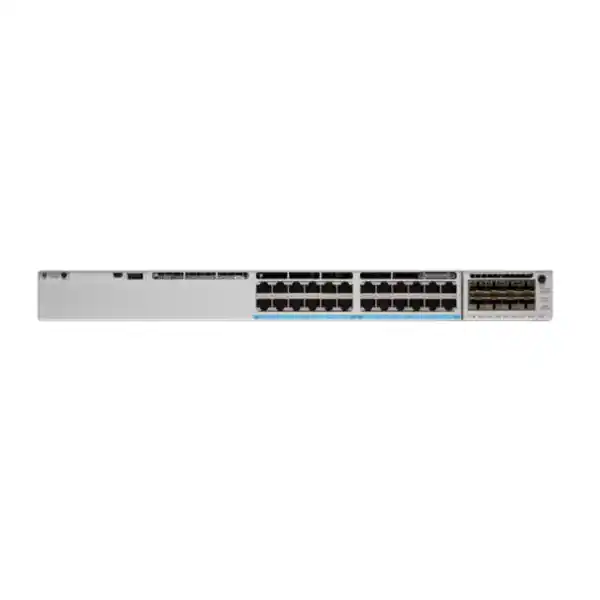
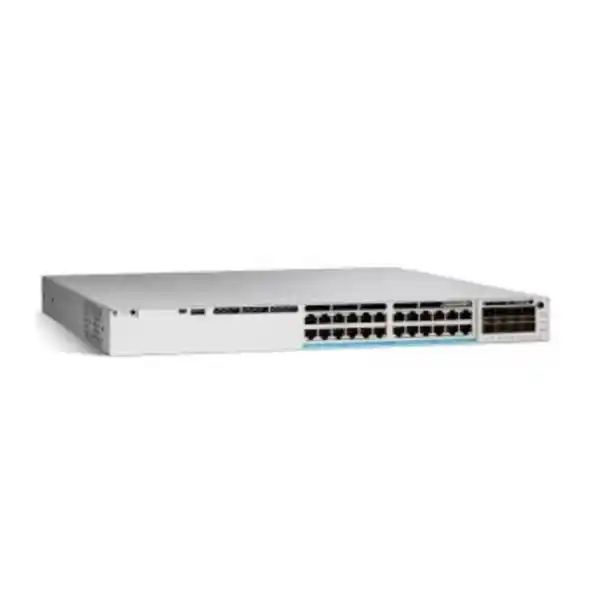
Cisco Catalyst C9300X-24Y Network Switch
The Cisco Catalyst C9300X-24Y is built for organizations that need substantially more fiber density, switching headroom and uplink flexibility than traditional 1G campus switches can provide. With twenty-four 1G, 10G and 25G SFP28 downlink interfaces, a modular uplink bay capable of high-speed 25G, 40G and 100G designs, dual UADP 2.0sec forwarding ASICs, StackWise-1T support and modern Cisco IOS XE capabilities, it can serve as a high-performance access switch, compact distribution platform, fiber aggregation layer or resilient building-block for larger campus networks.
Core platform snapshot
Downlinks: 24 × 1/10/25G SFP28
Stacking: StackWise-1T, up to 8 members
Default PSU: 715W AC
Memory: 16 GB DRAM, 16 GB flash
Primary fit: fiber access, aggregation and distribution
Direct answer: what is the Cisco Catalyst C9300X-24Y?
The Cisco Catalyst C9300X-24Y is a stackable, modular-uplink enterprise switch with twenty-four SFP28 downlink ports that can operate at 1 Gigabit Ethernet, 10 Gigabit Ethernet or 25 Gigabit Ethernet. In practical network design terms, this makes the platform especially useful when a campus, data center edge, large branch or building aggregation layer needs many fiber-connected devices without moving immediately to a chassis switch. It is also a strong migration platform for organizations that currently use 1G or 10G fiber but want a clean path to 25G at the access or distribution layer.
Unlike copper-oriented members of the Catalyst 9300X family, the C9300X-24Y is a fiber-first design. Its twenty-four downlink interfaces use SFP/SFP+/SFP28 optics as appropriate for the selected speed and media. A dedicated C9300X network-module slot provides uplink flexibility, including 25G/10G/1G SFP28 options and 100G/40G QSFP-class options. Cisco positions the model for high-density fiber access, aggregation and lean branch use cases, and its dual-ASIC architecture gives it the internal forwarding resources required to sustain demanding east-west and north-south traffic patterns.
24 × SFP28 downlinks
Each front-panel fiber port supports multi-rate 1G, 10G and 25G operation, allowing the same switch to aggregate mixed generations of fiber-connected endpoints, access switches and appliances.
Up to 1 Tbps stacking
StackWise-1T can join as many as eight compatible C9300X switches into one logical system, simplifying management while creating a very high-bandwidth resilient access or distribution layer.
Modular high-speed uplinks
C9300X uplink modules let architects select the uplink density and media that matches the topology, including 25G SFP28 or 40G/100G QSFP28-based designs.
Security-focused silicon
The C9300X family uses Cisco UADP 2.0sec silicon with MACsec capability, hardware-based encrypted traffic functions and an architecture designed for modern policy-rich enterprise networks.
Why UAE enterprises choose a 25G fiber access and aggregation switch
Fiber density is becoming a design requirement rather than a specialist feature in many UAE networks. Large office towers, hospitality properties, hospitals, education campuses, industrial sites and multi-building compounds often use fiber between communications rooms because of distance, electromagnetic isolation, pathway constraints or a desire to centralize active equipment. A conventional 24-port copper access switch does not solve that problem. The C9300X-24Y is designed specifically for environments where the access or aggregation interfaces themselves must be fiber and where 10G or 25G is increasingly required for uplinks from downstream switches, servers, storage nodes, security appliances or high-bandwidth building systems.
The 25G capability is especially relevant when organizations are modernizing 10G aggregation layers. A 25G link offers a substantial increase in per-port throughput while retaining a compact SFP28 form factor. This can reduce the number of physical links needed for a target bandwidth, lower the pressure to jump immediately to 40G everywhere and create a more granular upgrade path. In a building-distribution role, for example, selected downstream connections can remain at 10G while traffic-heavy zones move to 25G. The same chassis can therefore support a phased migration instead of forcing a disruptive all-at-once replacement.
For UAE procurement teams, the important point is that the switch itself is only one part of the architecture. Transceiver reach, fiber type, connector plant, link budget, uplink module selection, redundant power requirements, software entitlement and stack design all affect the finished solution. FourTeck approaches the C9300X-24Y as an engineered system rather than a standalone box, so the bill of materials can match the actual site topology.
Understanding the 24-port SFP28 downlink design
The defining characteristic of the C9300X-24Y is its front-panel fiber density. All twenty-four downlink ports can operate at 1G, 10G or 25G with supported optics and cabling. That multi-rate capability is operationally valuable because enterprise fiber estates rarely change at one speed everywhere. A campus might have older 1G single-mode links to small remote closets, 10G links to modern access stacks and 25G links to new high-density aggregation zones. Instead of deploying separate platforms for each generation, the network team can use one switching model and select optics according to individual link requirements.
SFP28 also preserves the familiar pluggable transceiver workflow used with SFP and SFP+ interfaces. The physical port can accept appropriate Cisco-supported optics for the desired Ethernet rate and reach. This allows architects to choose short-reach multimode modules for local equipment rooms, longer-reach single-mode optics for campus fiber, or direct-attach solutions for short inter-rack links where supported. The practical design task is to match both ends of each link: transceiver type, wavelength, fiber mode, connector presentation, patching method and configured speed must all agree.
For a 24-port fiber switch, optic selection can represent a significant portion of the overall project value. That makes an optics matrix essential during quotation. FourTeck can map each switch port to the intended remote device, desired data rate, approximate distance and fiber type before the order is finalized. This reduces the risk of receiving a technically correct switch with the wrong transceiver family for the installed cabling.
When 1G and 10G still matter
A 25G-capable port does not mean every connected device must immediately run at 25G. Many enterprise deployments retain large numbers of 1G and 10G fiber endpoints for years. Multi-rate SFP28 interfaces let the C9300X-24Y consolidate those connections while reserving the ability to upgrade selected links as bandwidth demand grows. This is especially useful in phased campus projects where cabling, downstream switches and application demand change on different replacement cycles.
During migration, the safest practice is to document each existing optic and link partner, identify unsupported or end-of-life modules, then create a target optics list. Port-by-port planning is more reliable than assuming all existing modules can simply be transferred.
Where 25G changes the design
25G offers an efficient step between 10G and 40G for building aggregation, server access, security appliances and high-throughput edge systems. A single 25G connection can provide more headroom than multiple lower-speed links while keeping the port format compact. It also enables cleaner oversubscription ratios when many 1G or 10G downstream connections feed a common distribution point.
The benefit is not only raw speed. Higher per-port bandwidth can simplify cabling, reduce port-channel complexity and preserve more interfaces for future growth. The correct design still depends on actual traffic patterns, redundancy targets and uplink capacity, so 25G should be introduced where it solves a measurable bottleneck or creates useful lifecycle headroom.
Dual UADP 2.0sec ASIC architecture and forwarding behavior
The C9300X-24Y uses two Cisco UADP 2.0sec ASICs. This matters because the platform is not simply a higher-speed collection of ports attached to a general-purpose processor. Packet forwarding, classification, policy enforcement and many security functions are handled in dedicated hardware. Cisco’s architecture documentation shows the twenty-four SFP28 downlinks distributed across the two forwarding ASICs and describes line-rate forwarding across downlink and uplink ports within the supported design.
A dedicated forwarding ASIC allows the switch to make common Layer 2 and Layer 3 decisions at very high speed while the control-plane CPU handles routing protocols, management, telemetry, orchestration and software processes. This separation is fundamental to enterprise switching. It means a burst of traffic does not have to be individually processed in software, and it lets policy features such as access control, quality of service and segmentation operate at scale in hardware tables.
For architects, ASIC distribution is also relevant when evaluating uplink modules and worst-case traffic patterns. The C9300X-24Y is a dual-ASIC model specifically intended to support substantial fiber and uplink capacity. Cisco documents support for four 100G uplink interfaces on this model when the appropriate C9300X-NM-4C network module is selected. The result is a compact switch that can aggregate a high volume of 10G and 25G edge traffic without forcing every design into a chassis architecture.
C9300X uplink modules: selecting the right network module
The C9300X-24Y uses a modular uplink architecture, which is one of its strongest lifecycle advantages. Rather than permanently committing the switch to a single uplink format, the design allows the network module to be selected for the site. Cisco’s current platform documentation identifies four C9300X network-module families: C9300X-NM-8M, C9300X-NM-8Y, C9300X-NM-2C and C9300X-NM-4C. These modules are specific to the C9300X family and should not be confused with earlier C9300 non-X uplink modules.
C9300X-NM-8Y
Eight 25G/10G/1G SFP28 interfaces. This is a natural choice when the distribution layer connects upstream using multiple 25G links or requires dense SFP-based handoffs.
C9300X-NM-2C
Two 100G/40G QSFP-class interfaces. Useful where a compact redundant pair of very high-speed uplinks is preferred over a larger number of lower-rate connections.
C9300X-NM-4C
Four 100G/40G interfaces. The C9300X-24Y is one of the models specifically supported with this module, making it suitable for very high-throughput aggregation designs.
C9300X-NM-8M
Eight multigigabit copper uplink interfaces. This module is useful when an otherwise fiber-centric C9300X design needs high-speed copper connectivity in the uplink bay.
The best uplink module is determined by architecture, not simply by the highest available port speed. A pair of 100G links may be appropriate for a busy aggregation switch, but eight 25G interfaces may be more useful when the device must connect to several upstream or peer systems. The bill of materials must also account for the required QSFP or SFP28 optics, breakout requirements where supported, patch leads and redundant path design.
StackWise-1T: building one logical switch from multiple units
Cisco StackWise-1T is a central reason to use the C9300X family for resilient campus switching. Up to eight compatible C9300X modular-uplink switches can be joined into a single logical stack with up to 1 Tbps of stack bandwidth. From an operational perspective, a stack behaves as one managed system rather than eight unrelated switches. This can simplify configuration consistency, routing adjacency design, software operations and troubleshooting while providing member-level redundancy.
A high-bandwidth stack is particularly valuable for the C9300X-24Y because each member can carry a large amount of fiber traffic. If an access switch, server or appliance connects across different stack members using an EtherChannel design, traffic can traverse the stack fabric while the logical system presents a consistent control plane. Cross-stack EtherChannel can therefore reduce dependency on any single member and create resilient attachment patterns without requiring a separate chassis backplane.
Stack design still requires discipline. All proposed members, license levels, software releases and stacking combinations should be checked before procurement. Cisco also supports mixed stacking between compatible C9300X and C9300 modular-uplink models, but the stack operates at StackWise-480 bandwidth rather than 1 Tbps. This can be useful during migration, although a homogeneous C9300X stack is generally cleaner when maximum stack performance is a core requirement.
StackPower+ and resilient power planning
The C9300X modular-uplink platform supports Cisco StackPower+, which allows power resources to be shared between supported stack members through dedicated power-stack connections. In traditional deployments, each switch is engineered as an isolated power domain. StackPower changes that model by allowing available power supplies to participate in a common power pool, which can improve redundancy and simplify spare-power planning when the stack is designed correctly.
Because the C9300X-24Y is a fiber, non-PoE model, its power planning is simpler than high-density UPOE+ copper variants, but redundancy still matters. The platform is supplied with a 715W AC power supply as the default configuration. Organizations with strict uptime requirements should evaluate a second compatible power supply, separate power feeds, separate UPS paths where available and the intended StackPower topology. A redundant PSU installed in the chassis is most useful when it is fed from an independent electrical path rather than the same single point of failure.
In UAE equipment rooms, thermal load and power density should also be included in planning. A switch with high-speed optics can have meaningful heat output, and a rack containing several 25G or 100G platforms needs sufficient front-to-back airflow, cooling capacity and cable clearance. Correct rack planning protects both hardware reliability and serviceability.
Switching capacity and forwarding headroom
Cisco publishes a switching capacity of 2,000 Gbps and a forwarding rate of 1,488 Mpps for the standalone C9300X-24Y, with higher aggregate figures when stacking is included. These numbers help indicate that the platform was designed for dense high-speed interfaces rather than as a lightly upgraded 1G access switch.
Raw capacity figures should not be treated as the only sizing metric. Real designs must also consider uplink oversubscription, traffic direction, multicast, routing scale, ACL usage, QoS policy, encrypted features, endpoint count and failure-state behavior.
32 MB packet buffer on the 24Y
Cisco lists a 32 MB packet buffer for the 24-port C9300X fiber model. Buffers help absorb temporary mismatches between ingress and egress rates, such as bursts from multiple 25G sources converging on a smaller set of uplinks.
Buffering cannot compensate for sustained congestion. QoS design, uplink bandwidth and application behavior still determine whether a network remains predictable under load. The buffer should be seen as one element of a broader capacity plan rather than a substitute for correct traffic engineering.
MACsec, encrypted traffic and hardware security capabilities
Modern enterprise switching is increasingly expected to provide security controls in the forwarding path rather than treating the LAN as inherently trusted. The C9300X family is based on Cisco UADP 2.0sec silicon and supports MACsec with 256-bit encryption on supported interfaces and configurations. MACsec is valuable for protecting Ethernet links where data confidentiality and integrity are required between capable devices. This can be relevant for inter-building links, sensitive distribution paths and regulated environments where network traffic should not traverse a physical link in clear text.
Cisco also documents hardware-based IPsec capability on C9300X models, with up to 100G of IPsec performance when the required hardware security entitlement is ordered and the feature is supported by the relevant software release and design. This should be treated as an advanced architecture option rather than assumed in every base bill of materials. The use case, HSEC requirement, license level, crypto design and Cisco software support need to be validated during solution engineering.
Beyond encryption, the platform supports the broader security capabilities associated with Cisco Catalyst 9000 and IOS XE, including policy enforcement, access control, secure boot mechanisms and hardware identity features. A secure deployment combines those platform features with segmentation, AAA, administrative access controls, monitoring, software maintenance and configuration standards.
Cisco Trustworthy Systems and device integrity
Enterprise buyers increasingly evaluate not only how a switch forwards traffic but also how the platform establishes trust in its own hardware and software. Cisco Catalyst 9300X platforms include hardware-anchored security mechanisms such as Secure Boot and Secure Unique Device Identification. Secure Boot is intended to help prevent unauthorized software from being executed during the boot process, while device identity mechanisms support workflows that verify the authenticity of the hardware during provisioning.
These capabilities are important in zero-trust and regulated environments because the management plane itself must be treated as a security asset. A compromised or counterfeit infrastructure component can undermine segmentation and monitoring controls above it. Hardware trust should therefore be paired with secure procurement, verified supply channels, controlled software images, signed updates, protected administrative credentials and logging into the organization’s monitoring platform.
For UAE organizations with formal cybersecurity policies, FourTeck can structure the deployment scope around a hardened baseline rather than a default configuration. That baseline can include management-plane ACLs, AAA integration, secure protocols, SNMPv3, time synchronization, syslog, role-based access, disabled legacy services and standardized image management.
Cisco IOS XE: programmable enterprise operations
The C9300X-24Y runs Cisco IOS XE, the software architecture used across the Catalyst 9000 switching family. IOS XE separates many software functions into modular processes while maintaining the familiar operational model expected by Cisco enterprise customers. For network teams, this supports established command-line workflows while also enabling APIs, model-driven telemetry, automation and controller-based operations.
This flexibility is useful in networks that are transitioning from manual configuration to infrastructure automation. Teams can continue to use traditional CLI procedures where appropriate while progressively introducing NETCONF, RESTCONF, YANG-based models, telemetry subscriptions and automation frameworks. The objective is not automation for its own sake; it is reducing configuration drift, making changes repeatable and improving the quality of operational data.
Software feature availability depends on the installed IOS XE release, the selected network license and any required subscriptions. For that reason, a C9300X-24Y quotation should identify not only the hardware SKU but also the required licensing tier, support entitlement and target operational model. FourTeck can align the bill of materials with whether the customer intends to manage the switch locally, through Cisco enterprise management platforms, or through supported cloud-managed experiences.
Network Essentials
C9300X-24Y can be ordered in a Network Essentials hardware/software package. This tier is intended for deployments whose routing, segmentation and advanced feature requirements fit the Essentials capability set.
The correct choice should be based on required protocols and features rather than price alone. Downgrading a license after design approval can create operational gaps that are more expensive to resolve later.
Network Advantage
Network Advantage is the higher feature tier and is commonly selected when more advanced Layer 3, policy or enterprise campus capabilities are required. Exact feature entitlement should be verified against Cisco’s current licensing matrix.
FourTeck can map routing protocols, segmentation requirements, telemetry and operational tooling to the appropriate license tier before the purchase order is raised.
Meraki-managed ordering option and hybrid operational models
Cisco also offers Meraki-managed ordering options for selected Catalyst 9300X models, including the C9300X-24Y. This gives enterprises another operational path when cloud-centric administration, simplified workflows and Meraki-style visibility fit the organization’s management model. The existence of a cloud-managed option does not mean every C9300X-24Y is delivered in that mode; the chosen SKU, entitlement and software experience must align with the intended deployment.
For organizations standardizing on traditional Cisco IOS XE operations, Network Essentials or Network Advantage may remain the preferred route. For environments with a strong Meraki operational model, a Meraki-managed variant can reduce the difference between campus switching and other cloud-managed infrastructure. Multi-site UAE customers should choose one operational strategy deliberately so that monitoring, change control, troubleshooting and support escalation remain consistent across locations.
A procurement exercise should therefore identify the management model before finalizing the switch SKU. It is easier to choose the correct software and license from the start than to redesign operational processes after hardware has been deployed.
Layer 2 design: VLANs, trunks, EtherChannel and resilient campus access
The C9300X-24Y is well suited to Layer 2 aggregation where multiple fiber-connected access switches need to be collected into a resilient pair or stack. Typical designs use VLAN trunks on the downlinks, EtherChannel for bandwidth and redundancy, and a controlled spanning-tree architecture to prevent loops. When access devices connect to separate members of a C9300X stack, cross-stack EtherChannel can provide a resilient logical port channel while the stack presents a single switching system.
The correct Layer 2 design depends on whether gateways remain upstream, are terminated on the C9300X stack, or are distributed through a routed-access architecture. Simply extending every VLAN everywhere is rarely the best design. Large broadcast domains increase fault scope, make troubleshooting harder and can force spanning-tree dependencies into places where routed boundaries would be cleaner.
FourTeck can help translate an existing VLAN plan into a migration sequence that limits disruption. The sequence typically identifies trunk definitions, native VLAN handling, allowed VLAN lists, EtherChannel modes, spanning-tree root placement, edge-port protections and gateway migration steps. For a high-speed fiber aggregation switch, configuration discipline is as important as interface capacity.
Layer 3 routing for distribution and collapsed-core designs
Many C9300X-24Y deployments are more effective when the switch is used as a Layer 3 distribution platform rather than as a pure Layer 2 aggregation device. Routed links reduce spanning-tree dependency, create clearer failure domains and allow traffic engineering decisions to be made with routing protocols. The appropriate design may use static routes for a small branch, dynamic routing for campus distribution or a routed-access model in which downstream access switches establish Layer 3 adjacencies directly to the distribution stack.
The routing feature set available to a particular switch depends on licensing and software release, so protocol requirements should be documented before the hardware order. Architects should identify whether the design needs only basic inter-VLAN routing, or whether it will depend on protocols such as OSPF, BGP, VRF-based segmentation, multicast routing or policy-rich services. Those choices can affect license selection and configuration complexity.
High-speed fiber downlinks make routed access particularly attractive in larger campuses because each building or floor can receive a deterministic Layer 3 connection. Redundant routed uplinks can converge without requiring a large Layer 2 domain, while summarization and route policy can keep the overall campus easier to operate.
Campus distribution
Use the C9300X-24Y as a compact fiber distribution layer for multiple access switches. Twenty-four 25G-capable downlinks provide enough density to aggregate many IDFs while leaving the modular uplink bay available for 40G or 100G connections to the core.
This approach works well in office campuses, universities, hospitals and large hospitality sites where intermediate distribution must be physically separated but centrally managed.
Collapsed core
Smaller enterprises can combine distribution and core functions in a resilient C9300X pair or stack when scale, routing and redundancy requirements fit the platform. This removes an entire layer of hardware while retaining high-speed 25G access and 100G-class uplinks.
Collapsed-core designs should still be engineered for maintenance, software upgrades and failure cases. Simplicity is valuable only when redundancy remains clear and testable.
Server, storage and appliance aggregation at the enterprise edge
Although Catalyst 9300X is primarily a campus switching family, the 24Y model’s fiber interface density makes it useful in selected server, storage and appliance aggregation scenarios. Security appliances, hyperconverged nodes, edge compute systems and specialized enterprise devices increasingly offer 10G or 25G SFP-class interfaces. The C9300X-24Y can consolidate those connections when the design requirements align with campus-oriented Cisco IOS XE features and the scale of the platform.
This does not make the switch a direct replacement for every data center switching platform. Dedicated data center families may offer different buffering, automation models, latency characteristics, VXLAN fabrics or storage-specific capabilities. The correct decision depends on the workload. If the requirement is primarily enterprise Layer 2/Layer 3 connectivity, campus policy, stacking and resilient 25G attachments, the C9300X-24Y can be a strong fit. If the requirement is a leaf-spine fabric with data-center-specific control planes, another platform family may be more appropriate.
FourTeck can review the application topology before recommending the switch role. The key is to match platform behavior to traffic requirements rather than selecting equipment by port count alone.
Optics engineering: multimode, single-mode and link-budget planning
A fiber switch purchase is incomplete until the optics plan is defined. The correct transceiver is chosen based on Ethernet speed, fiber type, wavelength, reach, connector interface and the capabilities of the far-end device. A short multimode connection inside a data room requires a different optical module from a campus single-mode run extending hundreds or thousands of meters. The two ends of the link must be compatible, and the installed cabling must meet the optical requirements of the selected standard.
For 25G deployment, existing fiber should be assessed rather than assumed to support the target reach. Patch-panel loss, connector quality, splice count, fiber grade and historical modifications can reduce optical margin. Where the route is critical, test results should be reviewed and a link budget created. The same discipline applies to 40G and 100G uplinks, where parallel or wavelength-based optics may introduce different cabling requirements.
FourTeck quotations can include an optics schedule showing local port, far-end device, speed, media type, approximate distance, selected optic and required patch lead. This turns a generic hardware quote into an implementation-ready bill of materials and reduces avoidable installation-day surprises.
100G uplinks: when to use them and how to size oversubscription
The C9300X-24Y can support very high-speed 100G uplinks with the appropriate C9300X network module. This is useful when twenty-four 10G or 25G downlinks create more aggregate demand than a small number of 10G or 25G uplinks can comfortably handle. A pair of 100G links to an upstream core can provide substantial headroom while maintaining path redundancy. With the C9300X-NM-4C, the C9300X-24Y can support four 100G/40G uplink ports, giving architects additional flexibility for dual-core designs, multiple upstream paths or high-capacity interconnects.
Oversubscription should be calculated based on expected concurrent traffic, not simply the theoretical sum of all access ports. Twenty-four 25G interfaces represent 600 Gbps of one-way edge capacity, but most enterprise networks do not transmit at line rate on every port simultaneously. The uplink design should account for peak utilization, application burstiness, backup windows, east-west traffic, failure conditions and future growth.
The failure-state calculation is critical. If two 100G uplinks normally share load but one fails, the remaining path must carry the surviving traffic without creating unacceptable congestion. This is why link utilization thresholds, QoS behavior and monitoring are part of high-availability design, not just day-to-day operations.
QoS for voice, video, storage and business-critical applications
Higher bandwidth does not eliminate the need for quality of service. A 25G link can still become congested during backup jobs, large file transfers, software distribution, video replication or traffic convergence after a link failure. QoS policies allow the switch to classify, mark, police and queue traffic so that business-critical applications behave predictably when contention occurs.
A good QoS design starts with application requirements rather than copied templates. Real-time voice requires low delay and jitter but usually modest bandwidth. Interactive video may need more bandwidth with controlled latency. Bulk backup traffic can tolerate delay but can otherwise consume large portions of a link. Control-plane and routing traffic should remain protected so that congestion does not destabilize the network itself.
The C9300X-24Y provides hardware resources for enterprise QoS policy, but queueing behavior should be validated against the selected topology and IOS XE release. FourTeck can help align trust boundaries, DSCP treatment, policing and uplink queue strategy with the customer’s application map, particularly when migrating from lower-speed links where historical QoS settings may no longer be appropriate.
Segmentation, ACLs and policy enforcement
A modern campus network carries far more than employee workstation traffic. Building management systems, CCTV, access control, guest networks, operational technology, servers, wireless infrastructure and third-party systems may all share physical switching resources. Segmentation keeps those trust zones separate while allowing only the required communication paths. On the C9300X-24Y, VLANs, routed interfaces, VRF-based designs and hardware access control policies can be combined to implement the selected architecture.
ACL design should be based on explicit traffic flows. Large unstructured rule sets become difficult to audit and can consume hardware resources inefficiently. A cleaner model defines source zones, destination zones, permitted services, logging requirements and exception ownership. Where segmentation is coordinated through Cisco enterprise policy tools, the switch can participate in a broader identity- and role-based campus architecture.
Because the C9300X-24Y is often deployed at distribution or aggregation points, policy changes can affect many downstream networks. Change control, staged testing and rollback procedures are therefore essential. High-performance hardware is most valuable when its policy is understandable and maintainable.
Telemetry
Model-driven telemetry can stream operational state to monitoring or analytics platforms at greater scale and frequency than traditional polling alone. Interface utilization, errors, queue behavior and system health become easier to correlate over time.
Automation
NETCONF, RESTCONF and structured YANG models can support repeatable configuration workflows. Automation is most effective when templates, version control and validation rules are defined before production changes are pushed.
Application hosting
Catalyst 9300X supports Cisco IOx application-hosting capabilities with dedicated compute resources. This can support selected edge applications without compromising the primary IOS XE forwarding and control functions.
Operational consistency
The most important management benefit is consistency across many switches. Standardized software, logging, AAA, NTP, monitoring and configuration patterns reduce troubleshooting time and support safer lifecycle operations.
Application hosting resources and edge compute options
Cisco Catalyst 9300X platforms include an x86-based control and application environment in addition to their dedicated packet-forwarding silicon. On the C9300X family, Cisco documents a 2.4 GHz quad-core x86 CPU and 16 GB of DRAM, along with 16 GB of internal flash. The platform can also support field-replaceable storage options for application hosting, depending on the configuration and software support.
The application-hosting capability is intended for selected edge functions that benefit from running close to the network. Examples can include visibility, telemetry processing or specialized enterprise services supported by the Cisco IOx framework. The forwarding plane remains handled by the ASICs, while compute resources are reserved for application workloads. This separation is important because an embedded application should not compete directly with packet-forwarding resources.
Application hosting should be treated as an architecture feature, not an assumption that every arbitrary workload belongs on the switch. CPU, memory, storage, supportability, software lifecycle and security review all matter. If a customer intends to use IOx or containerized edge functions, FourTeck can include the storage and software requirements in the design rather than discovering them after installation.
High availability beyond stacking
Stacking is only one component of a resilient network. A complete C9300X-24Y design should examine every dependency between the endpoint and the upstream service. Dual power supplies do not protect against a single UPS. Two uplink ports do not protect against a shared fiber route. Two switches in one rack do not protect against the loss of that room. High availability therefore starts by identifying failure domains, then ensuring the design creates independent paths across the failures that matter to the business.
At the switching level, Cisco supports features such as cross-stack EtherChannel, stateful failover capabilities for key protocols, spanning-tree options and software-maintenance mechanisms intended to reduce traffic impact. The exact behavior during upgrade or failure depends on topology, software version, feature set and whether the switch operates standalone or in a stack. Maintenance procedures should be tested rather than assumed.
For critical UAE sites, FourTeck can document redundancy as a path matrix: power A and B, stack links, uplink 1 and 2, physical fiber route, upstream core device, routing adjacency and service dependency. This makes resilience visible and prevents a design from looking redundant on a network diagram while still containing hidden single points of failure.
Migration from Catalyst 3850, older Catalyst 9000 or mixed fiber platforms
A common reason to consider C9300X-24Y is migration from an older fiber aggregation layer. The upgrade should be planned as a service transition rather than a chassis swap. Existing optics, interface speeds, EtherChannels, spanning-tree roles, routing adjacencies, VLAN databases, ACLs, QoS policies, management addressing and monitoring dependencies should be inventoried before the change window. Unsupported commands or deprecated features must be identified against the target IOS XE release.
If the existing network uses 1G or 10G fiber extensively, the multi-rate SFP28 ports can reduce migration risk because many links can remain at their current speed during the first stage. New uplinks can be introduced at 25G or 100G, followed by selected downstream upgrades. This separates the physical switch replacement from the bandwidth modernization and can keep the project manageable.
Where compatible C9300 and C9300X modular-uplink models need to coexist temporarily, Cisco supports mixed stacking at StackWise-480 bandwidth under supported conditions. That can be useful as a transition mechanism, but the final-state architecture should still be documented. Temporary compatibility should not become an accidental permanent design without verifying performance, licensing and lifecycle implications.
Sizing methodology for a C9300X-24Y deployment
Correct switch sizing starts with endpoints and traffic, not with a model number. For each proposed C9300X-24Y, list every downlink device, required speed, fiber type, redundancy method and expected peak utilization. Then identify the uplink target, required aggregate throughput, failure-state bandwidth and routing or Layer 2 role. This immediately shows whether a single switch, resilient pair or larger stack is appropriate and which uplink network module is required.
Next, evaluate scale and policy. Count VLANs, routed interfaces, routes, multicast groups, ACL requirements, telemetry flows, authentication needs and segmentation domains. A switch can have enough physical ports yet still be a poor fit if the control-plane scale or policy architecture exceeds the intended platform design. Conversely, a carefully segmented enterprise campus may use only a portion of raw switching capacity but depend heavily on routing, security and automation features.
Finally, size the lifecycle items: power supplies, stacking cables, optics, patch leads, rack space, support contract, license term, software image, spare strategy and implementation services. A complete bill of materials should be usable by the installation team without requiring last-minute procurement of missing optics or cables.
FourTeck can perform this sizing exercise from a topology diagram, interface inventory or structured requirements list. For wider networking projects, customers can also review enterprise infrastructure capabilities through FourTeck UAE.
Dubai and UAE procurement considerations
Enterprise network procurement in Dubai and the wider UAE often has practical constraints beyond the published switch specification. Project schedules may depend on approved vendor lists, site-access procedures, rack readiness, optical cabling completion, import lead times and coordination with facilities or security teams. For multi-site organizations, the same design may need to be repeated across Dubai, Abu Dhabi, Sharjah and other emirates while maintaining consistent licensing and support coverage.
The quotation should clearly distinguish the base switch, primary and redundant power supplies, network module, stack cables, StackPower cables where used, SFP/SFP+/SFP28 optics, QSFP optics, support entitlement and software licensing. Transceiver quantities should include both local and far-end requirements unless the remote equipment already has compatible optics. Spares can also be valuable for high-priority sites, especially for optic types that are deployed in large quantities.
FourTeck supports UAE customers with network equipment supply, solution sizing and implementation coordination. For adjacent security projects, customers can reference Firewall Dubai, while broader managed and project-based technology support is available through FourTeck IT Services UAE.
Use case: high-density building fiber aggregation
Consider a high-rise office building with multiple communications rooms connected to a main equipment room over single-mode fiber. Each floor may have an access-switch stack supporting users, wireless access points, IP phones, cameras and building systems. Historically, those floor stacks may uplink at 10G. A pair of C9300X-24Y switches in the main room can terminate many of those fiber uplinks, provide Layer 2 or Layer 3 distribution and connect to the core using 100G uplinks.
The architecture can be migrated gradually. Existing floor uplinks continue at 10G using supported optics, while floors with heavier wireless or application demand are upgraded to 25G as their access switches are refreshed. Because the aggregation layer already supports SFP28, the central switch does not need to be replaced during that migration. This is a practical example of why port-speed flexibility can have more long-term value than simply buying the lowest-cost switch that meets today’s bandwidth.
Redundancy can be implemented with cross-stack port channels or routed dual-homing depending on the access-layer capabilities. The final choice should consider failure isolation, convergence requirements and how maintenance will be performed without disrupting tenant or operational traffic.
Use case: campus distribution with routed access
In a larger campus, the C9300X-24Y can act as a distribution switch for several buildings or network zones. Instead of extending Layer 2 VLANs from the core to each access switch, routed point-to-point links can be created between access and distribution. Each access block advertises its local networks, while the distribution layer summarizes or forwards routes toward the core. This architecture reduces spanning-tree scope and can improve fault isolation.
Twenty-four fiber interfaces provide enough density to connect many routed access blocks, and 25G capability allows traffic-heavy zones to receive more bandwidth without changing the aggregation switch. Redundant 100G uplinks to the core can maintain a favorable oversubscription ratio even as edge speeds increase. Dynamic routing can select alternate paths if an uplink fails, provided the physical fiber routes and upstream core design are independently resilient.
This model is particularly useful for universities, hospitals, government campuses and industrial facilities with multiple buildings. The exact protocol design and license tier should be validated against the customer’s routing scale and segmentation requirements before procurement.
Use case: secure aggregation for firewalls and network services
The C9300X-24Y can also aggregate high-speed links from firewalls, load balancers, WAN routers, monitoring appliances and service platforms. In this role, the switch may carry multiple security zones or transit VLANs between an enterprise core and a resilient firewall cluster. The 10G and 25G downlink options make it possible to connect a mix of older and newer appliances, while 40G or 100G uplinks can preserve bandwidth toward the rest of the campus.
This is a sensitive design area because a switching error can bypass or disrupt security controls. VLAN membership, trunk permissions, port-channel configuration, spanning-tree behavior and routing adjacencies must be documented carefully. Where MACsec is used on upstream links, key-management and peer compatibility requirements need to be tested. If hardware IPsec is part of the architecture, the required entitlement and supported topology must be confirmed before the project is quoted.
FourTeck can coordinate switching and firewall design so interface speeds, optics, logical zones and redundancy are aligned rather than treated as separate purchases. This reduces the common risk of buying a firewall with 25G interfaces but discovering that the aggregation layer only has available 10G ports.
Use case: lean branch or compact high-performance core
A large branch can sometimes require high switching performance without enough endpoint density to justify a chassis platform. The C9300X-24Y is attractive in that scenario because it combines 25G fiber ports, advanced Layer 3 capabilities, modular 100G-class uplinks and stacking in a compact fixed-form-factor system. Two switches can be used as a resilient collapsed core for local servers, access-switch uplinks, WAN routers and security infrastructure.
The design can reduce the number of device tiers while still keeping strong separation between access, services and WAN zones. It also provides room for growth when a branch begins with 10G interconnects and later moves selected systems to 25G. StackWise-1T can simplify administration if a logical stack is preferred, while a routed pair can provide a different failure and maintenance model. There is no universal answer; the topology should reflect operational priorities.
Branches connected to international operations may also need procurement coordination outside the UAE. FourTeck’s broader regional reach can be reviewed through FourTeck Global when standardizing infrastructure across multiple countries.
Environmental, rack and physical deployment planning
High-speed switches should be installed in a rack environment that supports airflow, service access and cable management. The front panel can contain twenty-four fiber transceivers plus the uplink-module optics, so horizontal and vertical cable management is important. Fiber patch cords should be routed with appropriate bend radius and strain relief, and labeling should remain visible enough for troubleshooting. Dense bundles placed directly in front of optics can make module replacement difficult and can obstruct airflow.
Rear access is equally important because power supplies, stack connections and optional storage components may require service. If multiple C9300X switches form a stack, the physical rack order should be selected to keep stack cables practical and to avoid crossing power or data paths unnecessarily. Consistent PSU orientation and cable labeling help field engineers identify failed components quickly.
UAE sites must also account for room cooling, dust control and reliable conditioned power. Network equipment is designed for controlled technical environments, not general storage spaces. A well-engineered switch can still become unreliable if installed in an overheated, dusty or poorly powered room. Rack and facilities readiness should therefore be part of the pre-installation checklist.
Software lifecycle, support and maintenance strategy
A Catalyst switch should be treated as a long-lived software platform as well as a piece of network hardware. IOS XE releases contain new features, hardware support, bug fixes and security updates, but not every release should be deployed immediately into production. Enterprise teams normally maintain an approved software train, test critical features in a lab or pilot environment, review field notices and schedule upgrades under formal change control.
Support entitlement matters because a production outage may require access to software updates, Cisco technical assistance and replacement processes. The exact support contract should reflect business criticality. A branch switch supporting a small office may tolerate a different restoration target from a distribution stack carrying thousands of users. Spare hardware strategy can also differ: some organizations keep a cold spare locally, while others rely on service-level replacement.
FourTeck can include support coverage in the original procurement scope so hardware, licenses and services share a consistent lifecycle. This is preferable to discovering after deployment that software access or replacement coverage does not match the customer’s operational expectations.
Monitoring the C9300X-24Y in production
A high-performance switch should be monitored at several layers. Basic availability checks confirm whether the device is reachable, but they do not reveal emerging problems. Interface counters should be tracked for errors, discards, utilization and flaps. Optical diagnostics can help identify degrading fiber links. CPU and memory trends can expose unusual control-plane load. Environmental sensors can reveal thermal or power issues before they cause an outage.
Capacity monitoring is especially important on a 25G aggregation switch because individual links may appear lightly utilized while shared uplinks experience bursts. Historical traffic graphs should include normal business peaks, backup windows and failure events. Queue and QoS statistics can explain why an application experienced loss even when average interface utilization looked acceptable.
Operational telemetry should feed a process, not only a dashboard. Alert thresholds need owners, logs need retention, configuration changes need traceability and performance anomalies need a documented escalation path. FourTeck can integrate switch monitoring into broader UAE IT service workflows when customers require ongoing operational support.
C9300X-24Y versus copper C9300X models
The C9300X family includes both copper multigigabit models and the C9300X-12Y/24Y fiber models. The correct choice depends on what the switch connects to. Copper C9300X platforms are appropriate when the access layer must directly power and connect Wi-Fi access points, phones, cameras or workstations through RJ-45 interfaces. Those models can provide multigigabit Ethernet and, on PoE variants, high-power UPOE+ capability.
The C9300X-24Y serves a different role. Its twenty-four SFP28 downlinks are designed for fiber-connected infrastructure, so it does not provide PoE to edge devices. This makes it better suited to aggregating other switches, connecting servers and appliances, or forming a building-distribution layer. Using a fiber model for copper endpoint access would require external media conversion and would defeat the purpose of the platform.
A campus may use both types together: copper C9300X switches at the access layer and C9300X-24Y switches at distribution. That creates a consistent Catalyst 9300X operational family while matching interface media to each layer of the network.
C9300X-24Y versus C9300X-12Y
The C9300X-12Y provides twelve 1/10/25G SFP28 fiber ports, while the C9300X-24Y doubles the downlink density to twenty-four. The 24Y also uses dual forwarding ASICs and supports a larger uplink footprint, including the four-port 100G/40G C9300X-NM-4C network module. These differences make the 24Y better suited to dense aggregation and distribution roles where many fiber links terminate in a single rack.
The 12Y can be more economical for a lean branch or a small aggregation point where twelve interfaces provide sufficient growth. Choosing the 24Y simply because it is larger is not always necessary; however, under-sizing a distribution switch can create an avoidable replacement when additional buildings or access stacks are connected later.
A useful rule is to size not only current occupied ports but also resilient links, planned expansion and maintenance flexibility. Leaving some spare SFP28 interfaces can simplify migrations and temporary bypass connections during troubleshooting. The cost of modest port headroom is often lower than the operational cost of adding another aggregation switch unexpectedly.
Common procurement mistakes to avoid
Ordering the chassis without an uplink module: The C9300X-24Y uses a modular uplink bay, so the network module must be deliberately selected if uplink ports are required. A switch delivered without the intended module can delay installation even though the base chassis is correct.
Assuming optics are included: SFP28 and QSFP transceivers are separate design items. Every fiber link requires compatible optics at both ends, and high-speed modules can materially change the project budget.
Ignoring license requirements: Hardware capability and software entitlement are different. Routing, security and management requirements should be mapped to Network Essentials, Network Advantage or the selected Meraki-managed offering before ordering.
Designing only for normal operation: Uplinks and power should be sized for failure states as well as everyday load. A redundant topology that becomes severely congested after one link fails may not meet the real availability requirement.
Reusing old fiber assumptions: Existing fiber plant should be validated for the target 25G or 100G optics. Connector loss, fiber grade and distance can make a planned upgrade fail even when both network devices support the nominal speed.
Implementation workflow for a production deployment
A disciplined implementation begins with a validated low-level design. The document should include rack location, power feeds, switch numbering, stack topology, uplink modules, optic assignments, interface descriptions, VLANs, routed interfaces, routing protocols, ACLs, QoS, management addressing, AAA, logging and software version. Building these details before the change window turns installation into an execution task rather than an improvised design session.
Next, stage the equipment. Verify serial numbers and licenses, inspect optics, install the approved IOS XE release, apply the base configuration, confirm stack formation, test management access and validate redundant power. Where possible, connect representative optics and perform loop or peer tests before shipment to site. Staging is particularly valuable for stacks because cable order, member numbering and software consistency can be resolved in a controlled environment.
During cutover, migrate links in a defined sequence and validate each service group before moving to the next. Post-change checks should include routing neighbors, VLAN reachability, EtherChannel state, error counters, optical levels, monitoring visibility and application tests. Finally, capture the as-built configuration and update diagrams so operations teams inherit accurate documentation.
For complex rollouts, FourTeck can combine hardware supply with implementation services and post-deployment support, reducing handoff gaps between procurement and engineering.
Frequently asked technical questions
Does the C9300X-24Y provide PoE?
No. The C9300X-24Y is a fiber data switch with SFP28 downlink interfaces. It is intended for fiber-connected network devices rather than directly powering access points, phones or cameras. If PoE or UPOE+ is required at the user-access layer, a copper Catalyst 9300X model may be more appropriate.
Can all 24 ports run at 25G?
The twenty-four downlink ports are 1/10/25G SFP28 interfaces. Actual operation depends on supported transceivers, cabling and configuration. The platform is designed for line-rate forwarding across its downlink and uplink architecture, but overall network performance also depends on uplink sizing and traffic patterns.
Can it use 100G uplinks?
Yes. C9300X network modules include 100G/40G QSFP-class options. The C9300X-24Y supports both the two-port C9300X-NM-2C and the four-port C9300X-NM-4C, allowing resilient and very high-capacity uplink designs.
How many switches can be stacked?
Up to eight compatible C9300X modular-uplink switches can participate in a StackWise-1T stack. Stacking combinations and license levels should be validated for the planned software release.
Can C9300X stack with older C9300 models?
Cisco supports mixed stacking between compatible C9300X and C9300 modular-uplink models at StackWise-480 bandwidth, subject to model and license compatibility. Fixed-uplink C9300L models are not part of the same modular-uplink stack architecture.
Is the uplink module included by default?
The uplink network module is a selectable component. The project bill of materials should explicitly identify the required C9300X module and its optics. This is one of the most important checks during quotation.
Why source the Cisco Catalyst C9300X-24Y through FourTeck UAE?
A high-speed enterprise switch creates the most value when it arrives as part of a correct design. FourTeck can help customers move from a model request to a complete bill of materials covering switch variant, network license, support entitlement, uplink module, power redundancy, stacking accessories, transceivers and implementation needs. This is particularly important for the C9300X-24Y because a large portion of deployment success depends on optics and topology decisions that are not visible in the base chassis SKU.
The technical engagement can start from an existing network diagram, a list of fiber links or a simple description of the required access and uplink speeds. FourTeck can then identify likely oversubscription, redundancy, stacking and license requirements before the quote is finalized. Where the project includes broader infrastructure such as servers, firewalls, wireless or managed IT services, the switching design can be coordinated with those dependencies instead of treated as an isolated purchase.
This systems approach helps UAE organizations reduce compatibility issues, shorten deployment windows and preserve a cleaner upgrade path. The goal is not merely to supply a Catalyst switch, but to make sure the finished network behaves as expected on day one and can be operated efficiently over its lifecycle.
Decision recap: when the C9300X-24Y is the right switch
Choose it for dense fiber
Select the C9300X-24Y when a rack needs many 1G, 10G or 25G fiber interfaces for access-switch aggregation, building distribution, server or appliance connectivity. Its 24-port SFP28 layout is the core reason to choose this model over copper variants.
Choose it for 100G growth
Use its modular uplink bay when the network needs 40G or 100G upstream capacity now or in the next refresh cycle. The four-port 100G/40G module option is especially useful in dense aggregation designs.
Choose it for stackable resiliency
StackWise-1T provides a high-bandwidth logical stack for organizations that prefer simplified multi-switch management and cross-stack connectivity without moving to a chassis platform.
Choose another model when needed
If direct PoE endpoint access is the main requirement, use a copper C9300X PoE model. If only a small number of fiber ports are needed, C9300X-12Y may be sufficient. Platform selection should follow the role, not the product family name.
Quotation input checklist for Cisco C9300X-24Y UAE projects
Providing the following information allows FourTeck to prepare a more accurate and implementation-ready quote. Approximate values are acceptable at the first stage; unknown items can be resolved during technical review.
Number of 1G, 10G and 25G fiber downlinks required today and expected during the next three to five years.
Multimode or single-mode fiber, approximate link distances, connector type and any known optical test results.
Target uplink speed, number of paths, upstream switch model and whether 25G, 40G or 100G interfaces are preferred.
Standalone, two-member stack or larger stack; include any existing Catalyst 9300 models that may need temporary mixed stacking.
Required routing, segmentation, management and security features so the correct Network Essentials, Network Advantage or cloud-managed option can be selected.
Need for redundant PSUs, independent feeds, support contract level, spare hardware and implementation services.
FourTeck consultation panel: build the correct C9300X-24Y bill of materials
The Cisco Catalyst C9300X-24Y is most valuable when its fiber ports, uplink module, optics, stack design, software tier and power configuration are engineered as one solution. Share the planned topology, current switch model, fiber media and target interface speeds, and FourTeck can help identify the correct components for a Dubai or wider UAE deployment.
For organizations planning a larger network refresh, the same review can include firewall throughput, WAN handoff, wireless capacity, server connectivity, monitoring and managed-services requirements. This avoids mismatched interface speeds and prevents the distribution switch from becoming a bottleneck after other parts of the infrastructure are upgraded.
A technically complete quotation should state the exact switch license variant, network module, transceivers, stack cables, redundant power options, support coverage and implementation assumptions. FourTeck can provide that structure so procurement and engineering teams work from the same approved design.

Reviews
There are no reviews yet.