
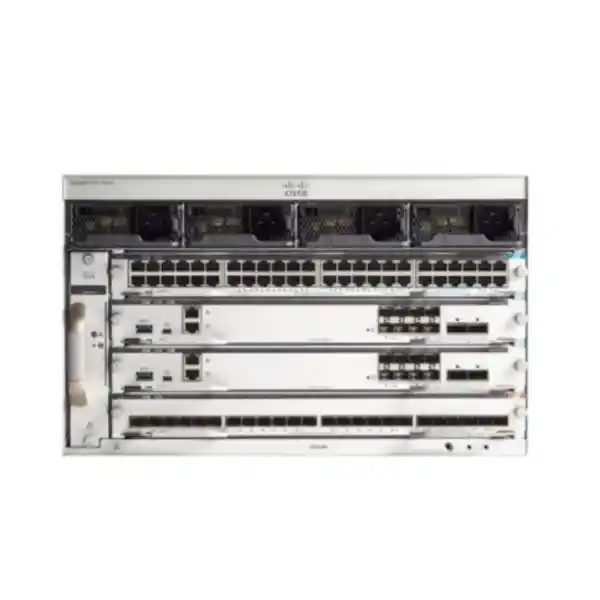
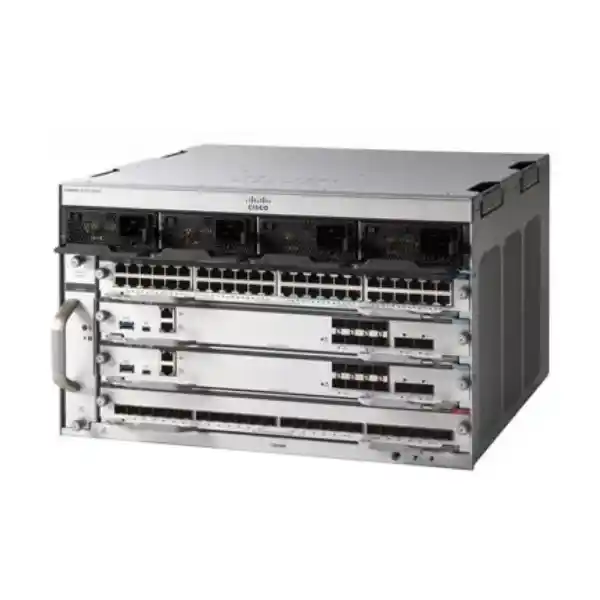
Cisco Catalyst C9404R Network Switch
A compact, redundant-supervisor Catalyst 9400 chassis for organizations that need modular access switching, high-power PoE, multigigabit edge connectivity, resilient control-plane design and Cisco IOS XE programmability without consuming the rack space of larger modular chassis.
The C9404R is the four-slot Catalyst 9400 chassis, not a fixed pre-populated switch. Slots 2 and 3 are reserved for supervisor engines; slots 1 and 4 accept line cards. A complete production system therefore requires a carefully selected supervisor, line cards, power supplies, software licensing, optics or cabling, and a support plan.
Two supervisor positions and two dedicated line-card positions create a compact modular architecture.
Two 48-port access line cards can provide up to 96 front-panel copper access interfaces, subject to card selection.
With C9400X-SUP-2XL, the C9404R supports up to 480 Gbps of bandwidth per line-card slot.
Power can be engineered for chassis load, PoE demand and the required redundancy policy.
What the Cisco Catalyst C9404R is designed to do
The Cisco Catalyst C9404R is the smallest chassis in the Catalyst 9400 modular switching family. Its value is not simply port count. The platform is built for enterprise networks that want modularity, supervisor redundancy, serviceable line cards, configurable power architecture and a common Cisco IOS XE operating model in a wiring-closet footprint. For a UAE enterprise, that can make the C9404R attractive in headquarters floors, branch aggregation rooms, premium hospitality environments, healthcare buildings, educational campuses, government facilities, large retail locations and other sites where outage impact is high but 240 or 384 copper ports in one chassis would be unnecessary.
The chassis provides four physical module positions. Slots 2 and 3 are dedicated to supervisor engines and are intended to support a single-supervisor or redundant-supervisor design. Slots 1 and 4 are dedicated to line cards. In a common access deployment, two 48-port line cards create up to 96 front-panel access interfaces. Because the forwarding architecture and uplink options are largely determined by the supervisor generation, the same chassis can be configured for different performance targets. A cost-sensitive access layer may use an appropriate supervisor and standard copper cards, while a modern high-density wireless or smart-building deployment may pair the chassis with a generation-2 supervisor, higher-performance multigigabit cards and a much larger PoE budget.
That modularity is why procurement should begin with the workload rather than with the chassis SKU alone. FourTeck sizes the solution from the number and type of endpoints, wireless access-point uplink speeds, PoE class, expected east-west traffic, uplink design, resiliency requirements, software feature set, rack and power constraints, then maps those requirements to a complete C9404R bill of materials. For general UAE enterprise infrastructure planning, customers can also review FourTeck UAE for complementary network, security and infrastructure services.
Core chassis specifications
| Specification | Cisco Catalyst C9404R | Design implication |
|---|---|---|
| Form factor | 6 rack units | Suitable for enterprise closets where rack space is constrained but chassis-level resiliency is desired. |
| Dimensions | 10.47 x 17.30 x 16.30 in. / 26.53 x 43.94 x 41.40 cm | The approximately 16.3-inch depth is useful in enterprise telecommunications rooms with limited cabinet depth. |
| Chassis weight | 39 lb / 17.2 kg with fan tray | Final rack loading must include supervisors, line cards, PSUs, optics and cabling, not chassis weight alone. |
| Supervisor slots | 2, dedicated slots 2 and 3 | Supports redundant supervisor architecture for control-plane and uplink resiliency. |
| Line-card slots | 2, slots 1 and 4 | Supports flexible copper, multigigabit or fiber combinations depending on compatibility and release. |
| Maximum slot bandwidth | Up to 480 Gbps per line-card slot | Requires the appropriate generation-2 supervisor, particularly C9400X-SUP-2XL for the maximum C9404R slot bandwidth. |
| Power bays | 4 | Allows capacity and redundancy to be engineered around chassis plus PoE demand. |
| Supported PSU classes | 3200W AC, 2100W AC, 3200W DC | Select based on facility input power, redundancy target and endpoint PoE budget. |
| Airflow and serviceability | Side-to-side airflow; fan tray serviceable from front or rear | Cable-management and cabinet planning should maintain clear intake and exhaust paths. |
Slot 1
Dedicated line-card slot. This can be populated with a compatible copper, multigigabit, high-power PoE or fiber line card according to the access-layer design.
Slots 2 and 3
Dedicated supervisor-engine positions. A single supervisor reduces component count, while dual supervisors are used when control-plane and uplink redundancy are business requirements.
Slot 4
Second dedicated line-card slot, enabling two-card combinations such as 48 copper plus 48 copper, copper plus fiber, or differentiated endpoint populations.
Power bays
Four PSU positions support designs that prioritize maximum PoE capacity, N+1 resilience, N+N resilience or other supported power modes based on the final system configuration.
Supervisor architecture: the most important C9404R sizing decision
The chassis does not define the complete forwarding behavior by itself. Supervisor selection determines the available bandwidth per line-card slot, uplink type, ASIC generation, processing scale and certain advanced capabilities. Cisco supports multiple Catalyst 9400 supervisors in the C9404R family. Generation-1 choices include C9400-SUP-1, C9400-SUP-1XL and C9400-SUP-1XL-Y. Generation-2 choices include C9400X-SUP-2 and C9400X-SUP-2XL. New deployments should not select a supervisor merely because it can boot in the chassis; they should evaluate lifecycle status, software release, required uplink speeds, encryption or security functionality, desired table scale and the bandwidth requirements of the planned line cards.
On the C9404R, the C9400-SUP-1 provides 80 Gbps per line-card slot. C9400-SUP-1XL and C9400-SUP-1XL-Y can provide 240 Gbps per line-card slot in this four-slot chassis. C9400X-SUP-2 also provides 240 Gbps per line-card slot, while C9400X-SUP-2XL raises that to 480 Gbps per slot. This makes the compact C9404R unusually capable when fitted with the higher-performance supervisor: two line-card positions can each access a substantial forwarding path without moving to the physically larger seven- or ten-slot platforms.
Uplink design also changes with supervisor generation. Generation-1 supervisor models support combinations of SFP/SFP+ and QSFP uplinks, while the SUP-1XL-Y adds 25G-capable options. Generation-2 SUP-2 and SUP-2XL models add modern uplink options including 25G and 40/100G interfaces and are the correct architectural direction when a site needs higher-speed campus aggregation, large wireless backhaul or small-distribution functionality. Final port combinations, optics support and software prerequisites should always be validated against the chosen Cisco IOS XE release and the exact supervisor part number.
UADP ASIC architecture and why it matters
Cisco Catalyst 9400 supervisors are built around Cisco Unified Access Data Plane ASIC technology. Generation-1 supervisors use the UADP 2.0 XL architecture, while generation-2 C9400X-SUP-2 and C9400X-SUP-2XL use UADP 3.0sec. For the buyer, the important point is that packet forwarding, policy enforcement, quality-of-service behavior, access-control processing and forwarding-table resources are implemented in programmable silicon rather than relying on general-purpose software forwarding for normal traffic. The result is an enterprise campus platform designed to combine feature richness with predictable line-rate behavior when engineered within the supported scale.
The programmable pipeline matters when networks evolve. A campus switch purchased for conventional VLAN access may later participate in policy-based segmentation, richer telemetry, secure access, automation, application visibility or fabric designs. UADP provides programmable forwarding resources and template-based allocation of Layer 2, Layer 3, ACL, QoS and related tables. That does not mean every feature has unlimited scale; it means the hardware is built so forwarding resources can be used deliberately according to the selected operating profile and software feature set. During design, table scale should therefore be checked against route counts, endpoint counts, security-group policy, ACL complexity, multicast state, NetFlow or telemetry requirements and the intended role of the chassis.
Generation-2 supervisors bring a newer UADP 3.0sec architecture and are especially relevant when the C9404R is expected to do more than basic closet switching. High-speed uplinks, larger access bandwidth, advanced security use cases and small-distribution roles can justify the SUP-2 family. Conversely, an installed base with generation-1 supervisors may still be operationally suitable for many access workloads when software support, capacity and lifecycle requirements are satisfied. FourTeck treats supervisor selection as a design choice, not a checkbox, because it governs both immediate network capability and the practical headroom available for future refresh cycles.
Line-card strategy: build the edge around actual endpoint types
The two line-card slots are where C9404R designs become highly specific. A traditional office floor may need 1G copper ports with PoE for IP phones, cameras and access points. A Wi-Fi 6, Wi-Fi 6E or newer wireless deployment may need multigigabit copper to prevent a 1G wired bottleneck. A building-automation environment may need large PoE budgets, while a campus aggregation location may favor fiber interfaces. Cisco offers multiple Catalyst 9400 line-card families, and compatibility depends on supervisor generation and Cisco IOS XE release. The correct approach is to map endpoints to port speed, media type and power class, then select line cards that satisfy that matrix.
For conventional access, 48-port RJ-45 line cards can produce up to 96 front-panel access ports in the C9404R. Depending on the selected line card, ports can support data only, standards-based PoE, PoE+, Cisco UPOE or higher-power IEEE 802.3bt and UPOE+ capabilities. Higher-power options are important for contemporary access points, pan-tilt-zoom cameras, digital signage, USB-C powered endpoints, thin clients and smart-building systems. The presence of a high-power line card does not automatically mean all ports can simultaneously draw maximum power; the system PoE budget is determined by the number and type of installed power supplies, input voltage, power redundancy mode and chassis consumption.
Multigigabit line cards are useful where endpoints negotiate at 2.5G, 5G or 10G over supported copper cabling. This is increasingly relevant for wireless access points whose aggregate radio capacity exceeds 1 Gbps. The network designer should not automatically deploy multigigabit to every desk because it increases cost and may increase upstream bandwidth and power requirements. A more economical design may reserve multigigabit ports for access points, high-performance workstations or local service devices while using standard 1G access for conventional user endpoints.
Fiber line-card options can support high-density optical access or aggregation use cases. Fiber design introduces another procurement layer: transceiver type, distance, fiber category, connector, wavelength, link budget, patching and spare policy. Optics must be matched to the line card and software support matrix. FourTeck can integrate the switching design with structured cabling, fiber uplinks and rack planning through its UAE IT services practice, allowing the chassis BOM to be validated against the physical deployment rather than ordered in isolation.
Standard office access
Use 48-port copper access cards sized for PCs, phones, printers, room systems and access points. Validate PoE demand, uplink bandwidth and whether 1G edge speeds are sufficient for the expected refresh horizon.
High-density wireless
Prioritize multigigabit interfaces and high-power PoE for access points. Size uplinks and supervisor bandwidth from aggregate WLAN traffic rather than simply matching the number of APs.
Smart buildings
Model sustained and peak PoE loads for cameras, lighting controllers, sensors, AV devices and other building endpoints. Include startup inrush and growth reserve in the power design.
Compact distribution
Select generation-2 supervisor and appropriate fiber line cards or supervisor uplinks when the C9404R is used beyond conventional access. Confirm routing scale, uplink redundancy and software feature tier.
PoE engineering for UAE campuses
Power over Ethernet is often the largest source of configuration mistakes in modular access switches. The chassis supports integrated PoE, but usable PoE power depends on the complete electrical design. Cisco currently lists 3200W AC, 2100W AC and 3200W DC power-supply options for the Catalyst 9400 family. The C9404R has four power-supply bays. The number of supplies, input voltage, supported operating mode and system load determine how much power remains available to endpoints after the chassis itself is powered. A BOM that simply multiplies endpoint nameplate wattage by port count can be wrong because endpoint draw varies by class and actual device behavior, while redundancy policies intentionally reserve capacity.
For UAE deployments, the facility team should confirm branch circuit rating, connector and power-cord requirements, UPS topology, generator-backed circuits, PDU capacity and whether the switch is fed from independent electrical sources. A redundant network architecture is weakened if all power supplies connect to the same PDU or the same upstream breaker. Where business continuity requires separation, the electrical architecture should mirror the network resiliency model. N+1 and N+N concepts should be evaluated using Cisco’s supported power modes and the final component list, not generic assumptions.
High-power devices make this even more important. Contemporary Wi-Fi access points and smart-building devices can use substantially more power than legacy phones. A 48-port card capable of high-power delivery can create a theoretical endpoint budget that exceeds what a lightly populated PSU configuration can provide. The designer should calculate worst-case concurrent demand, expected average demand and a practical growth reserve. For critical sites, maintain spare PSU and PoE capacity so that a single power failure does not force the chassis to shed endpoint power or violate the intended redundancy state.
The C9404R is capable of very high PoE delivery per line-card slot, and current Cisco platform documentation lists a maximum PoE figure of 4320W per slot for shipping line-card contexts while noting higher chassis capability. Those headline values should not be used as a promise that every deployment will deliver that amount. The actual limit is created by the installed line card, power supplies, input conditions, software support and redundancy mode. FourTeck therefore performs power-budget calculations at quote stage when endpoint quantities and power classes are known.
Cooling, cabinet depth and environmental planning
A modular switch is a thermal system as well as a packet-forwarding system. The C9404R chassis measures approximately 10.47 inches high, 17.30 inches wide and 16.30 inches deep, and occupies 6RU. The relatively shallow depth is advantageous in many enterprise communications rooms, but the cabinet must still provide room for front cabling, cable managers, power cords, service access and airflow. The platform is designed with side-to-side airflow, so rack layouts should not block intake or exhaust areas. Adjacent equipment should be positioned so hot exhaust does not recirculate directly into the switch intake.
Cisco specifies normal operating ranges that vary by altitude, including operation from -5°C to +45°C up to 1,800 metres and -5°C to +40°C up to 3,000 metres, with defined short-term exceptional ranges. In the UAE, the practical concern is not outdoor ambient temperature but telecommunications-room HVAC performance. A closet that is comfortable during normal occupancy can still overheat after-hours if building HVAC schedules are reduced. Network rooms should be included in the facility cooling plan with temperature monitoring and alerting.
The fan tray is a serviceable module and the platform is engineered with multiple independently controlled fans and fan redundancy within the tray. This improves fault tolerance, but it does not remove the need for preventive maintenance. Dust accumulation, blocked perforations, poor cabinet airflow and failed room cooling can raise fan speeds and thermal stress. For sites in dusty environments or locations with frequent construction activity, cabinet filtration and room cleanliness deserve additional attention.
The final rack design should account for the complete installed weight, not only the 17.2 kg chassis-and-fan-tray base figure. Supervisors, line cards and power supplies add mass. The rack should be securely anchored, appropriately rated and earthed. For data rooms that also host servers, storage and security appliances, FourTeck can align the switch deployment with broader rack and compute planning through Server Dubai infrastructure services.
High availability: what redundancy actually means
The strongest reason to select a modular platform over a fixed access switch is often fault-domain design. The C9404R supports redundant supervisor engines, allowing the control plane to be designed around active and standby components rather than depending on a single supervisor. Redundancy can reduce the impact of a supervisor failure and supports operational models where maintenance or software strategy is engineered for higher availability. The exact behavior, switchover characteristics and supported upgrade procedures depend on supervisor model, Cisco IOS XE release and configuration.
Power redundancy is a separate layer. Four PSU bays give architects the ability to install more than the minimum number of supplies and choose supported power modes that reserve capacity. This should be coordinated with independent input circuits where possible. A dual-supervisor chassis with four power supplies can still suffer a common-mode failure if both upstream network paths, all PSUs and the room cooling system depend on a single facility component.
Link redundancy is another independent layer. Supervisor uplinks can be diversified to separate upstream switches, and technologies such as EtherChannel or Multi-Chassis designs may be used as appropriate. StackWise Virtual is relevant in Catalyst 9400 designs where two chassis are combined logically for redundancy and simplified topology, subject to supported supervisor and software requirements. A pair of C9404R chassis can therefore be considered where a single chassis does not meet the site’s failure-domain requirements.
The design goal should be to identify every component whose failure can isolate users: supervisor, line card, uplink, optical transceiver, patch cord, PSU, PDU, breaker, upstream distribution switch, WAN path, firewall, DHCP or authentication service, and room cooling. The chassis provides tools for high availability, but availability is achieved by system architecture rather than by a single product feature.
Cisco IOS XE operational model
Catalyst 9400 runs Cisco IOS XE, giving the C9404R a modern software platform used across much of the Catalyst 9000 family. This matters for enterprises standardizing configuration, monitoring, automation and security controls across fixed and modular switching. Traditional CLI operations remain available, but IOS XE also supports model-driven programmability, structured telemetry and APIs that enable more systematic management than manual device-by-device configuration.
For an operations team, the first design question is software release strategy. The latest available release is not automatically the best choice for every production network. Organizations should select a release train based on hardware support, required features, vulnerability remediation, maintenance policy, interoperability and Cisco support guidance. Before deployment, the team should validate the selected supervisor and line-card combination against the release notes and minimum software requirements. For example, the C9404R was introduced with IOS XE 16.9.1 support for generation-1 supervisors, while generation-2 SUP-2 and SUP-2XL require later software. Newer line cards can also require more recent releases.
A lifecycle runbook should cover golden software version, ROMMON or firmware requirements where applicable, configuration backups, license visibility, rollback planning, upgrade windows and post-change validation. In redundant-supervisor deployments, the team should determine whether the selected upgrade method and release combination support the desired availability behavior. Network changes should be staged and validated in a representative environment for sites where outages have material business impact.
Configuration should also be standardized. Naming conventions, VLAN allocation, routed access policy, spanning-tree parameters, routing protocols, authentication, SNMP or telemetry, syslog, NTP, AAA, TACACS+, RADIUS, access-control policy and interface templates can be defined as reusable baselines. A modular switch with dozens of endpoint interfaces is significantly easier to operate when port configurations are generated from intent rather than assembled individually.
Automation, APIs and telemetry
Modern campus networks are too dynamic to depend exclusively on periodic CLI inspection. IOS XE supports programmatic workflows that can be integrated into provisioning systems, compliance tools and monitoring platforms. Depending on software release and management architecture, network teams can use model-driven interfaces, structured data and streaming telemetry to collect operational state with more precision than screen-scraped commands. The value is operational consistency: a change to hundreds of interfaces can be generated, reviewed and deployed from a controlled source rather than entered manually across devices.
Telemetry should be designed around outcomes. Interface utilization, errors, drops, queue behavior, power draw, environmental sensors, CPU and memory utilization, routing adjacencies, authentication failures and endpoint state all contribute to service health. High-speed wireless and multigigabit access can create bursts that are not visible in coarse five-minute averages, so teams should choose collection intervals and telemetry methods that expose meaningful congestion patterns. The C9404R’s programmable platform supports advanced visibility, but collectors and analytics must be configured to retain and interpret the data.
Automation also changes configuration governance. Infrastructure-as-code approaches can store intended configuration in version control, use templates for repeatable interface roles and validate changes before deployment. This is especially useful in branch or campus rollouts where multiple C9404R chassis share a common design but differ in site-specific addressing, VLANs or uplink parameters. An automation strategy should include exception handling because modular chassis can legitimately have different line-card combinations.
Organizations using Cisco Catalyst Center can extend automation into discovery, inventory, image management, policy and assurance workflows according to their licensing tier and architecture. The switch should therefore be considered part of an operational system consisting of hardware, software, identity services, telemetry, management and change control. Buying only the chassis and postponing those operational choices usually increases deployment time and long-term support cost.
SD-Access and policy-based campus design
The Catalyst 9400 family is a foundational platform for Cisco Software-Defined Access architectures. In a conventional campus, VLANs, routing boundaries and access-control lists are manually designed per location. In an SD-Access environment, the network can use fabric constructs and policy-based segmentation managed through Cisco’s campus management and policy ecosystem. The C9404R can participate in these architectures when the selected software, supervisor, license and design role support the required features.
The business reason to consider SD-Access is segmentation at scale. A university may need separate policy for students, staff, research equipment, building automation and guests. A healthcare campus may differentiate clinical systems, administrative endpoints, medical devices, cameras and third-party contractors. A hotel may isolate guest Wi-Fi, point-of-sale, IPTV, staff systems, cameras and building controls. Maintaining those boundaries exclusively through large VLAN and ACL structures can become difficult as networks grow. Policy-based segmentation can centralize intent and reduce dependence on topology-specific rules.
However, fabric adoption should not be treated as a default feature toggle. It changes operations, troubleshooting and dependency on management systems. Teams should evaluate identity sources, Cisco ISE design, IP addressing, routing underlay, wireless integration, policy ownership, migration sequence and skills. The C9404R can be an excellent physical platform for such a design, but the overall architecture determines success.
For sites not ready for SD-Access, the switch remains a capable conventional Layer 2 and Layer 3 platform. A phased roadmap can deploy the hardware with standardized IOS XE configuration and later introduce more advanced policy and automation as operational maturity increases. This protects the hardware investment without forcing a major architectural transition during the first installation window.
Security capabilities and trust-boundary design
A campus switch is often the first enforcement point between endpoints and the rest of the enterprise. The C9404R should therefore be configured as part of the security architecture, not merely as a connectivity device. Identity-based access, port authentication, device profiling, DHCP and ARP protections, access-control policy, segmentation, encrypted links where required and control-plane protection can all contribute to reducing lateral movement and unauthorized access. Exact feature availability depends on software release and license level.
IEEE 802.1X is commonly used to authenticate managed endpoints, with MAC Authentication Bypass or other mechanisms applied selectively for devices that cannot perform 802.1X. The policy system can map users or device types to VLANs, downloadable ACLs or security-group policy depending on architecture. This is especially useful in mixed environments where the same physical line card serves PCs, phones, cameras and IoT devices with very different risk profiles.
Layer 2 security controls are equally important. DHCP Snooping, Dynamic ARP Inspection, IP Source Guard, storm control and spanning-tree protections can reduce common campus attack paths and accidental outages when deployed correctly. These controls must be coordinated with trusted uplinks, DHCP relay design and legitimate network appliances. Enabling them without an implementation plan can block production traffic, so changes should be tested and rolled out by interface role.
MACsec capabilities can protect Ethernet links from interception or tampering on supported hardware and software combinations. Generation-2 supervisors also introduce stronger hardware security capabilities for certain high-speed use cases. The need for link encryption should be based on threat model and physical path. Links crossing shared facilities, carrier spaces or less-trusted pathways deserve different treatment from short patch connections inside a secured room.
The switching layer should also integrate with perimeter and segmentation firewalls where policy requires stateful inspection or threat prevention. FourTeck’s Firewall Dubai practice can align campus segmentation with north-south and inter-zone firewall controls so that access policy is coherent across the full traffic path.
QoS for voice, video, wireless and critical applications
Quality of Service becomes important when a 96-port access switch aggregates many traffic types onto a smaller number of uplinks. The C9404R can enforce classification, marking, policing and queueing policies in hardware according to the selected platform resources and software features. The objective is not to make every application faster. QoS protects latency-sensitive or business-critical traffic during congestion and prevents specific traffic classes from consuming disproportionate shared capacity.
A practical campus QoS design starts at the trust boundary. IP phones and managed collaboration endpoints may mark traffic correctly, while user workstations or unmanaged devices should not automatically be trusted to assign themselves high priority. Wireless traffic may arrive with classification from the WLAN architecture. Cameras create sustained upstream video streams, backup traffic can create high-volume bursts and software distribution can consume significant bandwidth during maintenance windows. Policies should reflect these patterns rather than using generic labels.
The move to multigigabit edge ports does not eliminate congestion. In fact, it can move the bottleneck upstream. Twenty access points connected at 5 Gbps each can theoretically present far more traffic than a single 10G uplink can carry, even though real utilization is typically much lower. Supervisor uplink selection should therefore be based on measured or modeled aggregate traffic, oversubscription tolerance and application criticality. High-speed 25G, 40G or 100G uplink capabilities on appropriate supervisors provide room for growth when justified.
During acceptance testing, teams should validate not only ping and throughput but also queue drops, DSCP preservation, voice quality, video behavior and failover under load. QoS errors are often invisible during quiet periods. A successful design is one in which congestion behavior is predictable before the network is under stress.
Layer 3 routing and campus topology choices
The C9404R can be deployed as a traditional Layer 2 access switch, a routed-access platform or a compact distribution device depending on supervisor, licensing and design. The correct topology depends on the size of the site and operational model. Layer 2 access remains common where default gateways live on distribution switches and where spanning-tree domains are carefully controlled. Routed access can reduce Layer 2 fault domains and use dynamic routing closer to the edge, but it changes how VLAN extension, first-hop redundancy and endpoint mobility are handled.
When the switch participates in dynamic routing, the routing protocol and table scale must be validated against the selected license and supervisor resources. OSPF and other enterprise routing capabilities may be used according to software entitlement. Advanced deployments can require multicast, policy routing, VRF segmentation or large route scale. These requirements should be declared during sizing because the appropriate license tier and supervisor model are not always obvious from port count alone.
Uplink topology should avoid hidden single points of failure. A C9404R with redundant supervisors but one uplink cable to one upstream chassis still has an upstream failure dependency. Dual-homing to a resilient distribution pair can improve availability. Where two C9404R chassis are deployed as a logical redundancy pair using supported Catalyst technologies, the upstream and downstream architecture should be designed as a system so that convergence behavior is understood.
For WAN-connected branches, the campus switch may connect to routers, SD-WAN appliances or firewalls. The demarcation between campus routing and WAN/security routing should be explicit. This simplifies troubleshooting and prevents accidental overlap between access-layer segmentation, firewall zones and WAN route policy.
StackWise Virtual and chassis-pair resiliency
Cisco StackWise Virtual can combine two supported Catalyst 9400 chassis into a single logical switching system for certain designs. This can simplify topology and enable multi-chassis link aggregation while keeping physical redundancy across two chassis. In a campus distribution or resilient access architecture, that can reduce dependence on spanning-tree convergence and make downstream connections appear as a single port channel even when links terminate on different physical switches.
The feature should not be viewed as a substitute for independent failure-domain analysis. The two chassis still need separate power paths, appropriate StackWise Virtual links, dual-active detection according to design, diverse upstream connectivity and a tested software strategy. Maintenance procedures also change because two physical systems operate as one logical entity. Teams must understand role election, failover behavior, reload impact and troubleshooting commands before production deployment.
For small sites, a single C9404R with redundant supervisors may already provide the required balance of cost and availability. For sites where a chassis failure cannot be tolerated, two chassis can eliminate additional single points of failure. The decision should consider service-level objective, number of users, critical applications, cost of downtime and whether endpoints themselves are dual-homed. A desktop connected by one cable to one line card remains dependent on that physical interface even if the rest of the network is fully redundant.
FourTeck can model both single-chassis and dual-chassis designs during presales so the customer can see which failure scenarios each architecture addresses. This prevents overbuying redundancy that does not improve endpoint availability and prevents under-designing sites where a single chassis outage would stop business operations.
Licensing: hardware capability is only part of the solution
Cisco Catalyst 9400 procurement includes software licensing decisions in addition to hardware. Current Cisco ordering uses perpetual network-stack capability combined with term-based software subscriptions or newer unified switching subscription constructs, depending on the order path and software generation. Essentials and Advantage tiers are used to differentiate feature scope. Exact ordering rules evolve, so the license BOM should be built against current Cisco Commerce guidance rather than copied from an old quote.
Network Essentials is oriented toward foundational switching and routing use cases, while Network Advantage adds advanced routing, segmentation, scale and security capabilities. Cisco DNA or Catalyst software subscriptions add management, automation, assurance and related features, with Essentials and Advantage tiers and multi-year terms. Cisco has also introduced unified Cisco Switching subscription tiers. Because licensing changes over time, organizations should document what operational features they actually need: CLI-only management, Catalyst Center automation, SD-Access, advanced assurance, advanced segmentation, telemetry, ISE integration or other capabilities.
Smart Account information is important at procurement stage. Cisco licensing uses Smart Licensing workflows, and the customer’s Smart Account structure should be identified before shipment where required. Large organizations should decide whether entitlements belong in a global account, regional virtual account or project-specific structure. Incorrect assignment can create administrative work later even when the switch itself is functioning.
Subscription term also affects total cost of ownership. A lower initial quote with a shorter term may not be lower cost over the planned hardware life. Conversely, purchasing advanced licenses for features the organization will not deploy can waste budget. FourTeck therefore aligns the software tier with the intended architecture and records the renewal date as part of the lifecycle plan.
Support entitlement is separate from feature licensing and should be selected according to operational requirements. Mission-critical sites may need faster replacement and vendor support response than noncritical offices. The appropriate Cisco support option should be validated at quote time with the desired service level and regional availability.
C9404R sizing methodology
A reliable C9404R quote can be produced from a structured set of inputs. First count physical endpoints by type: user desks, phones, wireless access points, cameras, printers, building controllers, audiovisual endpoints, security systems and local servers or appliances. Then classify each endpoint by media, speed and PoE requirement. A standard PC may need 1G data only; a phone may need 1G plus low-power PoE; a Wi-Fi access point may need 2.5G, 5G or 10G and higher-power PoE; a camera may need sustained upstream bandwidth and PoE+; a fiber-connected device requires an optical port and matching transceiver.
Second, calculate port growth. If current requirement is 72 copper ports, two 48-port cards provide 96 and leave 24 spare ports. That may be acceptable if growth is modest. If the requirement is already 92 ports and expansion is expected, the C9404R could become capacity-constrained even though it technically fits today. In that case, a C9407R with five line-card slots may provide a better lifecycle outcome. Chassis choice should be based on three-to-five-year growth, not the day-one patch-panel count.
Third, size PoE. Record each endpoint’s maximum requested power and expected population. Apply a design reserve, then compare the result with the power available under the desired redundancy mode. If a PSU failure would reduce available PoE below the live endpoint demand, add power capacity or adjust the redundancy requirement. This is especially important in surveillance and wireless environments where losing PoE means losing the service itself.
Fourth, size uplinks from aggregate demand and application sensitivity. Two 10G uplinks may be adequate for many office floors; dense Wi-Fi or content-heavy environments may justify 25G, 40G or 100G. Avoid using edge port theoretical rates as the only calculation because users rarely transmit at line rate simultaneously. Use measured utilization from the existing network where available, and add realistic headroom.
Fifth, define high availability. Decide whether the chassis needs one or two supervisors, how many PSUs, whether input circuits are independent, whether the site needs two physical chassis and how uplinks are split. Finally, map features to the software tier, support contract and lifecycle plan. This process yields a complete BOM rather than a chassis-only price that later expands with unplanned components.
The sizing output should include a port map and power map. A port map assigns endpoint groups to line-card interfaces and reserves ports for growth. A power map identifies expected PoE load per card and PSU redundancy state. These two documents make installation faster and simplify troubleshooting after handover.
Typical complete bill of materials
The C9404R chassis SKU is only the starting point. A production bill of materials usually includes the chassis, one or two supervisor engines, one or two line cards, power supplies, power cords, uplink optics or DAC/AOC cables where appropriate, access-layer optics for fiber cards, software licenses, support entitlement and rack accessories. Depending on design, the BOM may also include SSD storage for supported application-hosting use cases, spare transceivers, spare power supplies or a second chassis.
1. Chassis
C9404R four-slot chassis with rack hardware and fan-tray architecture appropriate to the Catalyst 9400 platform.
2. Supervisors
Select SUP-2, SUP-2XL or another supported supervisor based on lifecycle, bandwidth, uplink and feature requirements; choose single or redundant quantity.
3. Line cards
Choose two-card maximum from compatible copper, PoE, multigigabit or fiber families based on endpoint mapping and software support.
4. Power
Select PSU wattage and quantity for chassis load, endpoint PoE demand and redundancy mode; include correct regional or PDU power cords.
5. Uplinks and optics
Specify transceiver speed, fiber type, distance, connector and upstream compatibility. Reserve spares for critical optical links.
6. Software and support
Confirm network and subscription license tier, Smart Account details, term length, support level and renewal ownership.
Migration from legacy Catalyst platforms
Organizations often consider the C9404R when refreshing older Catalyst 4500, 4500-X, 3850 stacks or earlier campus platforms. A successful migration is not a one-for-one hardware replacement. The existing configuration may contain years of legacy commands, temporary ACLs, unused VLANs, inconsistent port descriptions, old QoS policy and workarounds that should not be copied blindly. The refresh is an opportunity to simplify the design and move to a standardized IOS XE baseline.
Discovery should capture current interfaces, VLANs, spanning-tree roles, EtherChannels, routing adjacencies, HSRP or VRRP, multicast, authentication, DHCP snooping, ACLs, QoS, SNMP, logging, NTP, AAA, NetFlow, PoE demand and uplink optics. Physical discovery must also identify patch-panel labeling, copper category, fiber type, connector, rack depth, PDU type and available circuits. The new switch may support higher speeds than the existing cabling can deliver, so cabling quality must be treated as part of the migration.
Configuration conversion should be role-based. Build templates for user ports, phone-plus-PC ports, access points, cameras, trunks, uplinks and infrastructure devices. Validate commands against the selected IOS XE version rather than assuming syntax equivalence with older IOS. Where security controls are being tightened, schedule phased rollout so authentication or DHCP protections do not unexpectedly isolate critical endpoints.
The cutover plan should define prechecks, maintenance start, rack changes, power sequencing, supervisor and line-card verification, uplink activation, VLAN and routing validation, endpoint testing, rollback point and post-change monitoring. For 24×7 sites, consider pre-staging the C9404R, loading software, applying configuration and testing optics before the maintenance window. This can turn the onsite work into a controlled cable migration rather than a live configuration exercise.
After cutover, compare interface counters, routing state, endpoint authentication, PoE draw and monitoring visibility to the baseline. Retain the old configuration and migration mapping long enough to support incident analysis, then update diagrams and asset records to reflect the new modular hardware.
Operations and lifecycle management
The operational cost of a chassis can exceed its purchase price over a long service life, so supportability should be designed from day one. Asset records should capture chassis serial number, supervisor serials, line cards, power supplies, optics, software version, license entitlements, Smart Account location, support contract and physical rack position. Modular hardware creates more field-replaceable components than a fixed switch, which makes accurate inventory especially valuable during faults.
Monitoring should include interface state and errors, PoE consumption, power-supply health, fan status, temperature, supervisor role, line-card status, uplink utilization, routing and neighbor state, authentication failures and system logs. Thresholds should distinguish warnings from conditions that require immediate action. A power supply failure in a fully redundant configuration may not interrupt users, but it reduces resilience and should trigger replacement before a second failure occurs.
Capacity review should happen periodically. Port utilization alone is not enough; track PoE growth, uplink peaks, wireless traffic, MAC and route scale where relevant, and software subscription renewals. A C9404R with 20 free copper ports can still be near capacity if the power budget is exhausted or uplinks are saturated. Conversely, high peak port speed does not mean the chassis needs replacement if sustained utilization remains low and quality-of-service behavior is healthy.
Spare strategy should reflect site criticality. A large organization may hold common optics, PSUs and possibly a spare supervisor regionally, while smaller customers may rely on vendor support contracts. The decision should compare spare carrying cost with business outage cost and hardware replacement lead times.
Lifecycle planning should also track Cisco end-of-sale and end-of-support milestones for supervisors, line cards and software trains. Individual modules can have different lifecycle dates even though the chassis remains supported. This is another reason to select the full configuration with a forward-looking architecture rather than choosing the lowest-cost available component.
UAE procurement and deployment considerations
Enterprise switching procurement in the UAE should account for more than list price. Lead time can vary by chassis, supervisor, line card, PSU and optics, and a missing component can delay the complete deployment even if the chassis arrives first. A quote should therefore be reviewed as a dependency chain. If redundant supervisors are required, both should be included. If a high-power line card is selected, the PSU configuration must support it. If 100G uplinks are planned, matching optics and upstream interfaces must be confirmed.
Power cords and PDU interfaces deserve early confirmation. Data-centre and enterprise racks may use IEC PDUs rather than standard wall outlets, and the final cable option should match both the selected PSU and facility. Likewise, rack depth, rail clearance, side airflow and cable managers should be checked before onsite installation. The chassis is relatively shallow, but dense copper patching can still create a large cable bundle that obstructs serviceability if unmanaged.
Support ownership should be explicit. The customer should know who opens Cisco cases, who holds Smart Account administration, who approves software upgrades, who manages configuration backup and who maintains facility power and cooling. Network outages often cross team boundaries, and incident response is faster when responsibilities are established before failure.
For distributed regional organizations, standardizing the C9404R configuration across UAE and African sites can simplify spares and operations, but local power, support and cabling conditions may differ. FourTeck can coordinate wider regional requirements through FourTeck Africa while keeping the technical baseline consistent across sites.
Procurement should also preserve the exact part-number configuration in the purchase record. Similar-sounding line-card or supervisor variants can differ in uplink speed, power capability, ASIC generation or lifecycle. A complete BOM with quantities and support terms is more reliable than a generic description such as “Catalyst 9400 switch.”
Common C9404R deployment patterns
Enterprise floor distribution
Two 48-port copper cards provide up to 96 access ports in one chassis. Redundant supervisors and diversified uplinks can provide a higher availability model than a single fixed switch, while preserving a compact 6RU footprint.
High-density Wi-Fi access
Multigigabit, high-power PoE line cards can connect modern access points without forcing all wired users onto expensive multigigabit ports. Generation-2 supervisor uplinks can provide high-capacity aggregation to the campus core.
Hospitality and mixed building systems
A single chassis can serve phones, access points, cameras, room systems and building endpoints when VLAN, security and PoE design are engineered carefully. Port templates keep different device classes operationally consistent.
Healthcare access layer
Redundant supervisors, resilient power and policy-based segmentation can support critical clinical and administrative networks, while dedicated controls isolate medical, guest, camera and facility device populations.
Education campus building
The platform can combine classroom wired access, wireless APs, cameras and AV systems with automation and centralized policy. Port growth and PoE should be sized for semester-driven expansion and future wireless upgrades.
Compact routed distribution
With an appropriate supervisor, licensing and fiber/uplink design, the C9404R can serve smaller distribution roles where a larger C9407R or C9410R would consume unnecessary rack space and budget.
C9404R vs C9407R vs C9410R: choosing the right chassis size
The key difference among Catalyst 9400 chassis is line-card scale. The C9404R has two line-card slots, the C9407R has five and the C9410R has eight. All support redundant supervisor architecture, but their rack size, power capacity, port density and slot-bandwidth behavior differ. The smallest chassis is not automatically the lowest total-cost choice if the site will outgrow two line cards quickly.
| Decision point | C9404R | C9407R | C9410R |
|---|---|---|---|
| Line-card slots | 2 | 5 | 8 |
| Rack size | 6RU | 10RU | 13RU |
| Common maximum with 48-port cards | 96 ports | 240 ports | 384 ports |
| Best fit | Compact resilient access or small distribution | Medium-to-large wiring closets | High-density campus access |
Choose the C9404R when two line cards provide adequate day-one capacity and meaningful growth reserve. Move to the C9407R when three or more line cards are likely within the planned lifecycle. Consider the C9410R for very high-density access where centralizing many ports in one chassis is operationally preferable. Redundancy strategy can also influence chassis count: two smaller chassis may sometimes provide a better failure-domain model than one larger chassis, although at higher hardware and operational cost.
Performance planning beyond headline bandwidth
Bandwidth per slot is an important specification, but it is only one part of performance. A network designer should consider packet size distribution, multicast, ACL and QoS processing, forwarding table scale, uplink topology and traffic direction. Campus traffic is often north-south from users to applications or internet services, but local east-west traffic can increase with collaboration systems, local servers, building platforms or backup traffic. The supervisor and line-card combination should be selected for the expected traffic model.
The C9404R has an architectural advantage because its smaller number of line-card slots allows certain supervisors to deliver higher per-slot bandwidth than the same generation in larger chassis. For example, SUP-1XL-class supervisors can provide 240 Gbps per slot in the C9404R, while their per-slot value is lower in larger chassis. SUP-2XL normalizes high performance across the family and supports up to 480 Gbps per line-card slot in the C9404R. This can make the small chassis appropriate for bandwidth-intensive access if 96 or fewer ports are sufficient.
Oversubscription should be intentional. Ninety-six 1G ports create 96 Gbps of nominal edge bandwidth, but users rarely consume all ports simultaneously. Two 25G or 40G uplinks may be sufficient for many offices depending on traffic patterns. Conversely, a dense multigigabit wireless environment could create much higher real throughput and justify 100G uplinks. Historical interface data from the existing network is the best sizing input when available.
Performance tests after deployment should include sustained throughput, microburst visibility, queue drops, error counters and failover behavior. A switch can pass basic throughput tests while still experiencing application problems from queue congestion or optical errors. Operational telemetry should be retained so future capacity upgrades are based on evidence rather than guesswork.
Structured cabling and optics considerations
Switch performance depends on the physical layer. Standard 1G copper is generally forgiving on properly installed Category 5e or better cabling, while multigigabit and 10G operation place greater demands on cable quality, length, alien crosstalk and termination. Before deploying multigigabit line cards, organizations should validate the installed cabling plant rather than assuming every legacy run can sustain the desired rate. Certification results are especially important in older buildings where patching has accumulated over multiple renovations.
PoE also interacts with cabling. Higher current increases heat in cable bundles, and large bundles of high-power PoE circuits should be designed according to applicable cabling standards and environmental conditions. Patch panels, connectors and cable category must be appropriate for the planned power and data rate. In UAE installations, telecommunications rooms can be warm, so thermal derating and cable-management quality deserve attention.
Fiber uplinks require exact transceiver matching. Define speed, distance, fiber type, wavelength and connector at both ends. A 100G uplink may use different optics from a 40G or 25G design, and breakout behavior depends on supported hardware and software. The upstream switch must support the same physical mode and transceiver type. When connecting between buildings, optical budget and pathway resilience are as important as port speed.
For critical links, keep a documented optic inventory and a tested spare strategy. Optical faults can resemble switching or routing problems, so acceptance testing should record transmit and receive levels where appropriate and verify interface error counters. Clear labeling of fiber pairs and patch-panel positions greatly reduces recovery time during incidents.
Endpoint onboarding and NAC integration
Large access switches concentrate many endpoint identities. Network Access Control should therefore be considered during the C9404R design rather than after users are connected. A mature onboarding model can distinguish corporate computers, IP phones, printers, access points, cameras, guest systems and unmanaged IoT devices. Each class can receive an appropriate access policy, reducing the risk that an untrusted device gains the same connectivity as a managed workstation.
IEEE 802.1X provides a strong authentication framework for compatible endpoints, while fallback methods can be used for devices without supplicant support. The switch interacts with RADIUS-based policy infrastructure, commonly Cisco ISE in Cisco-centric environments. Before enabling authentication globally, teams should build interface templates and exception handling. A camera that cannot authenticate should not cause a helpdesk emergency if its approved MAC-based policy has been planned.
Phone-plus-PC ports require special consideration because two devices may share one physical access interface through the phone. Voice VLAN, data VLAN, device authentication and QoS trust should be coordinated. Wireless access-point ports may carry management and user traffic according to the WLAN architecture and can require different trunk or access behavior. Building systems may use static addressing and be sensitive to authentication delays.
Rollout should be staged by device class and physical area. Start with monitoring or low-impact enforcement, validate logs, then progressively enable policy. The C9404R provides the hardware platform for enforcement, but a successful NAC deployment also requires clean identity data, policy ownership, exception workflow and operational monitoring.
Wireless-ready switching
Wireless upgrades are one of the strongest reasons to refresh campus access switching. Modern access points can exceed 1 Gbps of aggregate throughput and may require more power than earlier generations. A legacy 1G PoE+ switch can become the bottleneck even when the access point radios support far greater capacity. The C9404R can address this by combining multigigabit copper line cards, high-power PoE and higher-speed supervisor uplinks in one modular chassis.
The correct AP port speed should be based on the wireless design, not vendor marketing. A lightly loaded office AP may never exceed 1 Gbps in real use, while a high-density conference area or education environment may justify 2.5G or 5G access. Upgrading every AP port to 10G can add cost without improving user experience if the radio and application load do not need it. The switching design should use predicted client counts, channel width, radio capabilities and actual WLAN utilization.
PoE class is equally important. Access points with multiple radios, USB accessories or IoT modules may request higher power to enable all functions. If the switch supplies less than the requested class, the AP can reduce capability. Therefore, WLAN planners and switching planners should share one BOM model that includes AP quantity, power class, multigigabit requirement and uplink capacity.
Wireless resiliency also depends on how access points are distributed across line cards and chassis. Critical coverage areas should avoid concentrating all APs on one line card if a card failure would create an unacceptable outage. In high-availability sites, APs can be distributed across separate switches and power domains where the physical layout permits.
Surveillance, IoT and smart-building networks
The convergence of security cameras, access control, lighting, environmental sensors, AV systems and operational technology onto Ethernet increases the importance of modular PoE switching. These endpoints have different traffic and security characteristics from user computers. Cameras generate sustained upstream video, door controllers may require low bandwidth but high availability, lighting systems can create large port counts and AV endpoints may produce bursty high-bandwidth streams.
Segmentation should isolate device classes so compromise of an unmanaged IoT endpoint does not expose business systems. VLANs, VRFs, security-group policy and firewalls can be combined according to architecture. The access switch should also restrict unused ports, apply appropriate storm control, protect DHCP and ARP where possible and send logs to centralized monitoring.
PoE design must consider start-up behavior. Following a power outage, many endpoints can request power simultaneously. The available PSU capacity and power policy should support recovery without unstable cycling. UPS runtime should be calculated from the complete chassis and PoE load, not the switch chassis alone. A rack UPS sized for a traditional data-only switch may provide much less runtime after hundreds or thousands of watts of endpoint power are added.
For facilities teams, the network becomes part of building operations. Change windows, firmware upgrades and switch failover can affect physical security or lighting, not just IT applications. Operational procedures should therefore include facilities and security stakeholders. The C9404R can consolidate these functions efficiently, but governance must evolve with the technical convergence.
Application hosting and local extensibility
Catalyst 9400 supervisors use an x86-based control-plane architecture and support local storage options for specific application-hosting and container-based use cases. This allows certain services or agents to run closer to the network edge rather than requiring a separate appliance. Examples can include telemetry, diagnostics or other supported containerized applications. The feature is not required for normal switching, but it demonstrates that the platform is intended to be programmable and extensible over a long lifecycle.
Application hosting should be treated carefully in production. The network switch remains critical infrastructure, so any hosted application must be supported, resource-aware and operationally governed. Teams should define CPU, memory and storage expectations, software source, patching responsibility, logging and rollback. A poorly managed local application should never compromise core switching operations.
Local storage may also support operational workflows such as packet capture or software image management depending on platform capabilities and software release. The appropriate SSD size should be selected only when a defined use case exists. Adding storage “for future use” can increase cost without benefit if the organization has no plan to use application hosting.
For most C9404R buyers, the more immediate value of the x86 architecture is the broader IOS XE programmability and telemetry model. It supports modern automation and management approaches while preserving familiar enterprise switching functionality. The chassis can therefore fit both traditional network teams and organizations moving toward software-defined operations.
Design mistakes to avoid
Ordering the chassis alone
The C9404R is a modular chassis. It needs a complete component BOM. Chassis-only pricing is not a reliable estimate of the final deployable system.
Ignoring supervisor lifecycle
A supported older supervisor may meet immediate needs but provide less lifecycle headroom. Evaluate current Cisco lifecycle notices and the target software train before purchase.
Under-sizing PoE
High-power access points, cameras and building systems can exhaust the power budget even when many switch ports remain unused.
Overlooking uplink bottlenecks
Multigigabit edge ports are valuable only if aggregate uplinks, distribution switches and application paths can support the expected traffic.
Single electrical failure domain
Multiple PSUs do not provide full facility redundancy when every supply is connected to the same upstream PDU, breaker or UPS.
Copying legacy configuration
A refresh should modernize policy and remove obsolete commands. Translate the intended service, not every historical line of configuration.
Acceptance testing checklist
A new C9404R should be validated before it is declared production-ready. Hardware inventory should confirm chassis, supervisors, line cards, power supplies and optics. Both supervisors should show the expected redundancy state. Each power supply should report healthy input and output. Fan and temperature sensors should be normal. The running IOS XE release should match the approved version, and license state should be documented.
Interface testing should verify link speed, duplex, errors, PoE delivery and LLDP or CDP neighbor information where used. Multigigabit ports should be tested at the intended speed with actual cabling. Fiber uplinks should be checked for optical levels and errors. EtherChannels should show the intended member links and load distribution. If one uplink or supervisor is removed, traffic should follow the designed failover path.
Layer 2 and Layer 3 tests should confirm VLAN propagation, spanning-tree roles, default gateways, routing adjacencies, route preference, DHCP relay, multicast and VRF behavior where applicable. Security testing should validate 802.1X, fallback authentication, ACLs, DHCP Snooping and other controls on representative endpoint classes. QoS tests should confirm markings and queue behavior for voice and other prioritized traffic.
Monitoring integration should be tested before handover. The switch should appear in network management, syslog should reach collectors, time should synchronize, SNMP or telemetry should provide required metrics and configuration backup should complete successfully. Alerting should be triggered intentionally for at least one safe test condition so operators know the full event path works.
Finally, capture a baseline after several days of normal operation: uplink utilization, PoE load, temperature, CPU, memory, interface errors and authentication statistics. Future incidents can then be compared to known healthy behavior.
Who should choose the C9404R?
Choose the Cisco Catalyst C9404R when the site needs chassis-class availability and modularity but does not need more than two line-card slots within the expected lifecycle. It is especially compelling when rack depth and height are constrained, when up to 96 copper access ports are sufficient, when high-power PoE is required, or when a generation-2 supervisor is needed for modern high-speed uplinks in a small footprint.
It is also a strong option for organizations standardizing on Catalyst 9000 and IOS XE. Common software architecture can simplify operations across fixed access, modular access and distribution platforms. Automation, policy, telemetry and lifecycle processes can be standardized instead of creating a separate management model for each site.
Do not choose the C9404R solely because it has the lowest chassis count or smallest rack size. If the current requirement already consumes nearly all 96 common copper ports, the site may outgrow the chassis quickly. If the switch will host a very large number of APs or smart-building endpoints, the PoE and port-growth model may favor a larger chassis. If there is no requirement for modularity or supervisor redundancy, a fixed Catalyst platform may provide a lower-cost solution.
The right decision is based on failure impact, endpoint mix, port growth, power budget, uplink capacity, software architecture and operating model. FourTeck can compare the C9404R against larger Catalyst 9400 chassis and fixed-form-factor alternatives using the same requirement set so the choice is technically and commercially defensible.
Decision recap for UAE buyers
Choose C9404R when
Two line-card slots provide adequate capacity; redundant supervisors are valuable; rack space is limited; up to 96 conventional access ports are sufficient; and a modular Catalyst 9000 operating model is preferred.
Prioritize SUP-2XL when
Maximum 480 Gbps per-slot bandwidth, generation-2 UADP architecture, modern high-speed uplinks and additional future performance headroom are central design requirements.
Move to C9407R when
The lifecycle forecast is likely to exceed two line cards or 96 common 48-port interfaces. Extra chassis headroom can be more economical than adding another chassis later.
Validate before ordering
Supervisor, line-card software compatibility, PoE budget, PSU redundancy, optics, licensing tier, Smart Account, rack airflow, cabling and support entitlement.
Quotation input checklist
For an accurate Cisco Catalyst C9404R UAE quote, provide the following information. If some values are unknown, FourTeck can derive them during technical discovery, but identifying them early reduces BOM revisions.
Build a deployable C9404R BOM, not just a chassis quote
FourTeck can translate your endpoint list, wireless design, PoE load, uplink topology, rack constraints and software requirements into a complete Cisco Catalyst C9404R configuration. The goal is to identify the correct supervisor generation, line cards, PSU quantity, optics, licensing and support entitlement before purchase, reducing last-minute component gaps during installation.
For multi-site projects, we can also standardize port templates, VLAN and routing design, security policy, migration sequencing, acceptance tests and operations documentation so each installation follows the same engineering baseline.
• Supervisor and line-card selection
• PoE and PSU calculation
• Uplink and optics matrix
• License and support mapping
• Rack and power checklist
• Implementation scope
• Acceptance-test plan

Reviews
There are no reviews yet.