
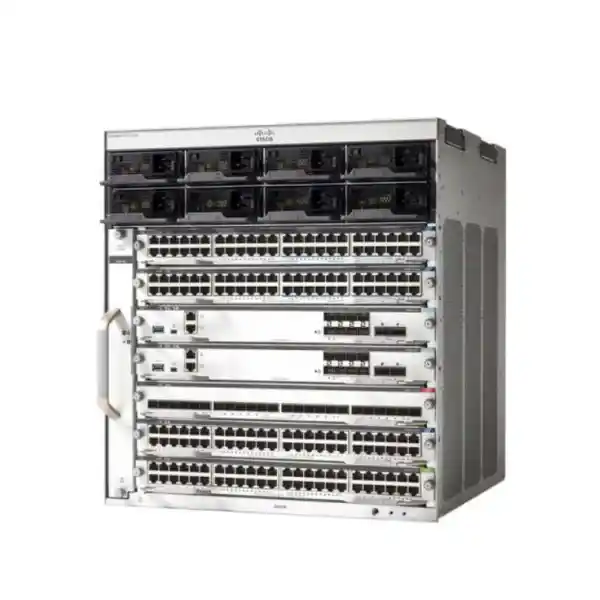
Cisco Catalyst C9407R Network Switch Dubai, UAE
The Cisco Catalyst C9407R is a seven-slot modular chassis engineered for enterprises that need resilient access, distribution or collapsed-core switching with flexible supervisor, line-card, power and software choices. It is especially relevant to UAE campus networks that must support dense wired users, multigigabit wireless access points, IP telephony, surveillance, building systems, high-power PoE endpoints and fast uplinks without replacing an entire switch whenever interface requirements change.
C9407R at a glance
*Maximum per-slot bandwidth depends on the installed supervisor engine and compatible line card.
Direct answer: who should choose the Cisco Catalyst C9407R?
Choose the Cisco Catalyst C9407R when a fixed-configuration access switch cannot provide the port-density, redundancy, PoE scale, interface mix or lifecycle flexibility your campus requires. The chassis is designed around two dedicated supervisor positions in slots 3 and 4 and five line-card positions in slots 1, 2, 5, 6 and 7. This separation is important because it lets an enterprise design control-plane and forwarding redundancy independently from the edge-interface mix. A project can start with copper access cards and later add fiber or high-speed aggregation cards, or it can move to a newer supervisor architecture while preserving compatible line-card investments.
In Dubai, the C9407R is a strong fit for headquarters buildings, banks, hospitals, universities, hotels, airports, government facilities, large retail environments, industrial administration campuses and multi-floor offices where dozens or hundreds of powered devices converge on each communications room. It is also appropriate where a single chassis must provide operational resilience through redundant supervisors, redundant power design, modular interfaces and high-density PoE, rather than relying only on a stack of separate 1RU switches.
The platform should not be sized as a bare chassis alone. A production bill of materials normally includes the C9407R chassis, one or two compatible supervisor engines, one to five line cards, the required power supplies, optics or direct-attach media, software subscriptions or network licenses, cables, rack accessories and support coverage. FourTeck can align these elements to the requested availability target, endpoint count, uplink architecture, PoE budget and Cisco software strategy through its UAE enterprise technology practice.
Chassis architecture and physical design
Seven-slot modular frame
The C9407R provides seven total module positions. Two are dedicated to supervisor engines and five accept supported Catalyst 9400 line cards. This physical split gives the chassis a clear role as a medium-density modular platform: substantially more scalable than a small modular chassis, but more compact than the larger ten-slot option.
10RU rack footprint
The chassis is approximately 17.41 x 17.30 x 16.30 inches, or 44.22 x 43.94 x 41.40 centimetres, and occupies 10 rack units. Chassis weight with the fan tray is about 63 lb or 28.58 kg before supervisors, line cards, power supplies and cables are added, so rack loading and handling plans should account for the finished configuration.
Five serviceable line-card slots
Slots 1, 2, 5, 6 and 7 are line-card positions. Depending on installed modules, the same chassis can be used for 1G copper, PoE+, UPOE, UPOE+, multigigabit copper, 1G or 10G fiber access, and higher-speed 25G, 40G or 100G aggregation use cases supported by the chosen supervisor and software release.
Enterprise serviceability
The chassis is designed for front accessibility to major field-replaceable components and uses side-to-side airflow. Fan servicing can also be supported from the rear depending on installation practice, which is useful in wiring closets where dense front-panel cabling makes maintenance planning important.
Supervisor engines: the decision that defines chassis performance
The C9407R should be thought of as a modular forwarding system rather than a chassis with one fixed performance number. Cisco supports multiple supervisor generations, and the supervisor determines important forwarding scale, uplink capability, feature capacity and line-card bandwidth. This is why an accurate quotation starts with the traffic model and software requirements rather than simply multiplying a port count.
| Supervisor | C9407R bandwidth per line-card slot | Typical design direction |
|---|---|---|
| C9400-SUP-1 | 80 Gbps | Legacy or established access designs where existing compatibility is important. |
| C9400-SUP-1XL | 120 Gbps | Higher-scale campus routing and policy use cases than the base Supervisor-1. |
| C9400-SUP-1XL-Y | 120 Gbps | Supervisor-1 generation with a different uplink profile; validate feature and optics requirements carefully. |
| C9400X-SUP-2 | 240 Gbps | Modern high-performance access, distribution and collapsed-core designs. |
| C9400X-SUP-2XL | 480 Gbps | Maximum per-slot bandwidth and demanding high-speed aggregation designs. |
A common mistake is to select a high-density line card and assume every port can operate simultaneously at full line rate regardless of supervisor. For example, a 48-port 10G-capable card represents 480 Gbps of front-panel bandwidth. The Supervisor-2XL can provide 480 Gbps per slot on the C9407R, while the Supervisor-2 provides 240 Gbps per slot. Both designs can be valid, but they serve different oversubscription goals. A user-access chassis may intentionally operate with statistical oversubscription because desktops and phones rarely transmit at full port rate at the same instant, while a server aggregation or collapsed-core deployment may require a much stricter nonblocking design.
Supervisor redundancy is equally important. The C9407R reserves slots 3 and 4 for supervisors and supports redundant supervisor deployment. For critical UAE networks, two supervisors are normally evaluated so planned maintenance or a supervisor fault does not make the whole chassis a single control-plane dependency. The final architecture should also consider stateful switchover behaviour, software release, feature configuration, routing protocol convergence, uplink placement and the implications of any upgrade workflow.
Line-card options and how to build the right port map
Five line-card slots give the C9407R a maximum of 240 front-panel access ports when populated with compatible 48-port modules. The useful number, however, is not simply 240. Engineers should classify endpoints by interface speed, media, PoE class, redundancy requirement and growth horizon. A typical building may combine office users, Wi-Fi access points, cameras, VoIP phones, digital signage, access-control panels, printers, building-management controllers and fiber-fed downstream switches. Those categories have different bandwidth and power behaviours and should not automatically be placed on the same card type.
1G copper access
C9400-LC-48T supports 48 data-only 10/100/1000 RJ-45 interfaces. C9400-LC-48P adds PoE+ capability, while C9400-LC-48U provides UPOE-class functionality. These are appropriate when endpoint speed is predominantly 1G and the key differentiator is power delivery.
High-power and multigigabit access
C9400-LC-48H, C9400-LC-48HN and C9400-LC-48HX address higher-power UPOE+ and multigigabit access scenarios. They are relevant where wireless APs, collaboration endpoints or specialist edge devices need more than conventional PoE+ power and may also require 2.5G, 5G or 10G Ethernet.
Fiber access and aggregation
1G SFP and 10G SFP+ line cards support fiber-heavy buildings, campus interconnects and aggregation roles. The exact choice should match transceiver type, optical reach, fiber plant, uplink redundancy and whether the line card is being used for access or backbone traffic.
25G, 40G and 100G designs
Newer high-speed modules such as 25G SFP28 and 40G/100G QSFP options can move the C9407R beyond traditional wiring-closet use. These cards require compatible Supervisor-2 generation hardware and appropriate Cisco IOS XE software, so the BOM must be checked as a complete system.
For campus access, port oversubscription is usually acceptable because endpoint traffic is bursty. For a high-density Wi-Fi environment, the model changes: many access points can aggregate substantial traffic, and multigigabit edge speed becomes meaningful only if uplinks and the supervisor fabric can carry the load. For surveillance, average traffic per camera may be modest but continuous, so recording windows and east-west flows may produce predictable sustained utilization. For an IP telephony floor, PoE budget and resilience can be more important than raw throughput. A proper port map therefore includes endpoint quantity, interface speed, negotiated PoE class, average and peak traffic, VLAN and VRF placement, security policy, uplink path and spare-port targets.
FourTeck can translate a floor schedule or endpoint list into a slot-by-slot design, then validate whether line-card choices are optimized for cost and growth. This is often more valuable than specifying every slot with the highest-capability module because a mixed configuration can align capital cost with actual use. Where related compute, rack or data-centre infrastructure is involved, the project can be coordinated with the FourTeck Server Dubai team so network uplinks, rack power, optics and server NIC speeds are designed together.
PoE engineering: size watts, not just ports
The C9407R can support large PoE deployments, but chassis capability does not eliminate the need for a power budget. Cisco publishes up to 4320 W of maximum PoE per line-card slot with current shipping line-card assumptions, while noting that the chassis architecture is capable of approximately 4800 W per slot. The practical budget available to powered devices depends on the line cards, power-supply population, AC or DC input, power mode, supervisor and chassis consumption, and configured redundancy strategy.
This distinction matters in modern UAE buildings. A conventional IP phone might require relatively little power. A Wi-Fi 6E or Wi-Fi 7 access point with multiple radios, IoT radios and USB peripherals may require substantially more. PTZ surveillance cameras with heaters or illuminators, large room collaboration devices, thin clients, badge systems and digital signage can also push the budget. If a design simply allocates 48 high-power endpoints to each card without checking the real requested watts, it can create a configuration that is physically populated but electrically underprovisioned.
For critical operations, the important number is the power available after a supply or feed failure, not the power available when every supply is healthy. This is why the C9407R supports different power operational modes including N+N, N+1 and combined approaches. N+N can protect against the loss of a matched group of input circuits; N+1 protects against a single additional circuit failure; combined mode maximizes usable power but provides a different redundancy posture. In Dubai deployments with dual PDUs, UPS systems or generator-backed feeds, the network power architecture should be coordinated with electrical facilities teams so the logical redundancy model reflects the actual upstream electrical topology.
Power supplies, feeds and UAE electrical planning
The C9407R provides eight power-supply bays and supports 3200W AC, 2100W AC and 3200W DC supply families, including newer high-efficiency 3200W AC options depending on software release. Power supplies are hot swappable. The system can also support mixed supply configurations, but mixing should be intentional and validated because usable output, redundancy behaviour and feed planning must be understood at the system level.
For a typical UAE enterprise communications room, 230V-class AC input allows the higher output range of the AC supplies compared with low-voltage 115V input. This makes local rack power design particularly important for high-PoE chassis configurations. Engineers should verify plug and cord types, PDU outlet rating, branch-circuit capacity, UPS headroom, generator capacity and phase distribution. A chassis populated with multiple 3200W supplies can represent a meaningful electrical load even when average utilization is lower than maximum, and the facilities calculation should include thermal implications and power-conversion losses.
The C9407R should be supplied from a rack whose grounding, cable management and service clearance are planned before installation. The bare chassis already weighs about 28.58 kg with its fan tray, and a fully configured chassis adds supervisors, multiple line cards, power supplies and copper or fiber cabling. Installation teams should therefore confirm rack static load, mounting hardware, safe lifting procedures and front/rear access. The 16.3-inch chassis depth is relatively compact for a modular platform, but real rack depth must include front fiber bend radius, copper cable management, rear power-cord routing and any PDU geometry.
Thermal design should reflect the actual room and not only a nominal equipment specification. Cisco provides side-to-side airflow on the platform. In a hot-climate region, adequate conditioned airflow and cabinet design are essential because room hotspots, blocked side ventilation, recirculated exhaust and dense adjacent equipment can raise inlet temperature. Where a project involves remediation of network rooms, cabling, UPS integration, migration planning or onsite deployment, FourTeck’s UAE IT services practice can coordinate the physical and logical workstreams.
Redundancy and high availability design
A modular chassis is often selected because downtime has a higher business cost than the incremental price of redundancy. The C9407R provides the building blocks for resilient designs, but redundancy is not automatic merely because the chassis has two supervisor slots and many power bays. A complete high-availability plan must identify failure domains and decide which ones the network is expected to survive without a user-visible outage.
At the chassis level, two supervisors can protect against a supervisor module fault and support maintenance strategies that would be impossible with a single control-plane module. Multiple power supplies can be arranged for power-feed redundancy. The fan assembly uses multiple independently controlled fans with N+1 fan redundancy so the system can compensate for a single fan failure. Uplinks can be diversified across physical interfaces and, in a broader architecture, across upstream switches. Access devices that have dual network interfaces can be connected to separate cards or separate chassis when the endpoint architecture supports that model.
For building access, two C9407R chassis can also participate in a virtualized campus design using Cisco StackWise Virtual where supported by the selected supervisors, software and interfaces. This can simplify the logical topology by operating two physical chassis as a single logical switching system for certain designs, while allowing link aggregation across chassis. The exact feature prerequisites and operational model should be validated against the intended software release before purchase; high availability must be designed from the complete hardware and software combination.
A practical resilience workshop should test at least six questions: What happens if one supervisor fails? What happens if one power circuit fails? What happens if an uplink optic fails? What happens if a full line card fails? What happens during a software maintenance window? What happens if the entire chassis or wiring closet becomes unavailable? The last question is especially important because no amount of in-chassis redundancy protects against a room-level event. Sites with very high continuity requirements may need dual chassis, diverse cable paths, diverse power, redundant distribution/core nodes and resilient WAN or internet services.
Forwarding architecture, ASIC capability and traffic behaviour
Catalyst 9400 uses a centralized architecture in which packet processing, queuing, buffering and quality-of-service functions are performed by the supervisor engine rather than duplicated independently on every line card. Each line-card slot has dedicated bandwidth toward the supervisor for processing. This architecture helps explain why changing the supervisor can change the effective performance and feature capability available to installed compatible line cards. It also means the supervisor should be selected for the future traffic model, not only for today’s access-port count.
Cisco’s Supervisor-1 and Supervisor-2 families use programmable Unified Access Data Plane technology. Programmability is relevant because enterprise campus requirements evolve faster than a traditional fixed forwarding design. Hardware resources must support Layer 2 forwarding, Layer 3 routing, ACLs, QoS policies, segmentation and telemetry at scale. The XL variants are generally selected when larger forwarding or policy scale is required, but exact table capacities should be matched to the software release and feature mix because maximum headline scale in one table is not necessarily available simultaneously with the maximum of every other function.
For design purposes, engineers should distinguish front-panel bandwidth from fabric bandwidth and actual application throughput. A 48-port 1G card offers 48 Gbps of edge bandwidth in one direction and is unlikely to stress even an 80 Gbps slot under ordinary access traffic. A 48-port 10G card can present far more front-panel capacity than a 240 Gbps slot, making oversubscription explicit. A 25G or 100G aggregation configuration can also place more sustained load on the fabric than typical user access. The right ratio depends on traffic distribution, not on a rule that every port must always be nonblocking.
Campus traffic also has directionality. Internet-centric offices often send most traffic north-south toward security and WAN services. Modern collaboration, wireless mobility, virtualization, local application services and distributed storage can increase east-west flows. CCTV may send continuous streams toward recorders, while backup or imaging systems create high-volume bursts. If the C9407R is used as a distribution or collapsed-core node instead of pure access, these patterns become more important because line-card uplinks may aggregate traffic from multiple downstream switches.
A high-quality design therefore models average and peak utilization, failure-state load, application sensitivity to latency and loss, and expected growth. It then places interfaces across line cards and supervisors so a single module failure does not produce an unacceptable concentration of traffic or endpoints. This slot-level thinking is one of the main advantages of a modular chassis: the hardware topology can be structured around failure domains and traffic domains rather than being constrained to one fixed set of ports.
Campus access, distribution and collapsed-core deployment models
High-density access chassis
Populate multiple 48-port copper or multigigabit cards to serve users, phones, APs and edge devices. Use redundant supervisors and appropriate power supplies when the wiring closet supports a business-critical floor or building zone. Fiber or high-speed uplinks then connect toward distribution or core.
Distribution switch
Use fiber-heavy line cards and high-performance supervisors to aggregate downstream access switches. This requires closer examination of route scale, uplink diversity, oversubscription and high-speed optical interfaces than a normal user-access deployment.
Collapsed core
In some small or medium campuses, a pair of C9407R systems can combine distribution and core functions. Supervisor-2 generation modules and 25G/40G/100G capable line cards can make this practical where the required scale fits the platform.
Converged services edge
A modular access chassis can consolidate data, voice, wireless, cameras and selected building systems while maintaining VLAN, VRF, ACL and QoS segmentation. The design must still consider security zones and operational ownership instead of placing every endpoint into one flat network.
For a multi-floor Dubai office tower, one common pattern is to place a modular access chassis in a main floor distribution room or building communications room and connect floor zones through copper or fiber depending on distance and cabling standards. In a university or hospital, the same chassis can aggregate many endpoint categories, but device onboarding, segmentation and QoS are more complex because clinical, research, student, guest, voice, IoT and security systems have different policy requirements. In hospitality, high PoE density may be driven by APs, cameras, phones, room systems and digital signage. In industrial administration environments, rugged field networks may remain separate while the C9407R provides the enterprise campus aggregation layer.
The modular form factor is particularly useful where port technology will change during the building lifecycle. Structured cabling may remain in place for many years, but AP uplinks can move from 1G to 2.5G, 5G or 10G, surveillance requirements can increase, and backbone links may migrate from 10G to 25G or 100G. A chassis allows that change to be absorbed through compatible line cards and supervisors rather than replacing an entire set of access switches solely because one interface category has evolved.
Cisco IOS XE, licensing and operational architecture
The C9407R operates on Cisco IOS XE, and software planning should be treated as part of the hardware BOM. Minimum software differs by supervisor and line card. For example, the C9407R platform supports early Supervisor-1 releases from the 16.x train, while Supervisor-2 generation modules require later 17.x software. Newer line cards such as 25G, 40G/100G and 10G multigigabit models also have their own minimum releases. A chassis ordered with modern modules therefore needs a consistent software baseline that supports every component in the system.
Licensing should be aligned to desired routing, segmentation, automation, assurance and management capabilities. Cisco Catalyst software packaging has evolved over time, so a procurement team should avoid copying an old license line from a previous Catalyst 9400 project without checking the current ordering structure. The requirement should start with features: Layer 2 access only or advanced Layer 3 routing, SD-Access participation or conventional campus design, telemetry and assurance expectations, encrypted traffic requirements, automation, policy scale and management platform integration. The resulting subscription and perpetual network feature entitlement can then be mapped to Cisco’s current commercial structure.
Operationally, IOS XE allows enterprises to standardize campus workflows around familiar Cisco routing, switching and automation interfaces. Configuration can include VLANs, routed interfaces, EtherChannel, spanning-tree controls, first-hop redundancy, routing protocols, ACLs, QoS, multicast, device tracking, identity integrations and telemetry, subject to the installed license and software support. NETCONF, RESTCONF and model-driven telemetry can be used in automation-oriented environments so repetitive configuration or state collection does not depend entirely on manual CLI processes.
For long-lived campus infrastructure, software lifecycle governance is as important as initial deployment. The selected release should be evaluated for hardware support, feature maturity, security advisories, maintenance window policy and organizational standards. Enterprises often benefit from designating a preferred software train, validating it in a lab or pilot chassis, backing up configuration and state, and documenting rollback procedures before broad production upgrades. Redundant supervisors can improve maintenance flexibility, but the exact upgrade behaviour depends on software capabilities and topology.
FourTeck can assist with configuration templates, migration planning, staged cutovers and post-deployment validation. For organizations operating across the Middle East or Africa, architecture can also be standardized beyond the UAE through FourTeck’s Africa technology delivery network, helping multinational teams maintain consistent Catalyst design principles while adapting logistics and onsite execution to each country.
Segmentation, security and policy design
A campus switch is part of the security architecture because every endpoint enters the network through an access or aggregation interface. The C9407R can enforce Layer 2 and Layer 3 policies, access control lists, QoS and segmentation capabilities supported by the selected software and supervisor. However, security value comes from a coherent policy model rather than from enabling isolated features on individual ports.
A useful starting point is to classify devices by trust and business function. Corporate managed endpoints may use one identity workflow, employee BYOD another, guest devices another, cameras another, voice endpoints another, and building-control or IoT devices another. These groups should not automatically share the same broadcast or routing domain. VLAN and VRF segmentation, identity-based policy, ACLs, route controls and upstream firewall zones can be combined so compromise of a low-trust device does not provide unrestricted lateral reach.
Port-level controls can include 802.1X authentication, MAC Authentication Bypass for devices that cannot perform 802.1X, DHCP snooping, IP source validation, dynamic ARP protections, storm control, spanning-tree protections and carefully designed port-security policy. The exact mix depends on the endpoint estate. For example, camera networks often include fixed devices that can be profiled and segmented, while hot-desk user ports may require dynamic identity and policy assignment. Voice endpoints frequently require dedicated QoS treatment and may share a physical port with a workstation.
Encryption can also be relevant on selected links. Some Catalyst 9400 supervisors and line cards provide hardware MACsec capabilities, but support must be checked at the exact module combination because not every supervisor or line card implements the same hardware functions. MACsec is most useful where link confidentiality and integrity are required over campus fiber, provider handoffs or inter-building connections and where peer devices support a compatible design.
Security operations should include logging, time synchronization, AAA, configuration control, role-based administration, secure management protocols, SNMPv3 or modern telemetry where applicable, and integration with monitoring and incident-response systems. Management interfaces should be reachable only from authorized administrative networks. Unused ports should be disabled or placed in a restricted state. Device software should be kept within a supported lifecycle, and configuration changes should be auditable. This operational discipline often provides more protection than any single feature toggle.
Wireless readiness: designing for Wi-Fi 6, Wi-Fi 6E and Wi-Fi 7
Modern wireless is one of the strongest reasons to deploy a modular multigigabit access chassis. A high-performance access point can exceed a 1G wired uplink, especially when many client devices, wide channels and multiple radios are active. The C9407R can accommodate multigigabit line cards that support 2.5G, 5G or 10G Ethernet and high-power PoE options, allowing the wired edge to keep pace with newer AP generations.
The correct design begins with AP specifications and radio planning, not with a generic statement that every AP needs 10G. Many real deployments will not drive sustained traffic near the maximum Ethernet rate of every AP. However, if the building is intended for high-density collaboration, large file movement, low-latency applications or future wireless growth, multigigabit uplinks provide useful headroom. PoE class is equally important because high-end APs may require more than conventional 30W PoE+ to operate all radios and features without restrictions.
A 48-port multigigabit card can therefore create both a bandwidth and a power-planning challenge. If many APs negotiate 5G or 10G and can generate substantial aggregate traffic, the supervisor-slot bandwidth ratio should be examined. If many APs request high PoE, the power-supply population must be sized for normal and failure states. The uplinks from the chassis toward distribution, core, firewalls and internet services must also be scaled so multigigabit access does not terminate at an undersized 10G or 20G aggregate path.
Wireless projects also require VLAN, QoS, multicast, DHCP, routing and policy integration. AP management traffic, user traffic, guest services and IoT networks may take different paths. Where centralized or cloud-managed wireless controllers are used, the switching architecture should account for tunneling and control traffic. FourTeck can combine WLAN capacity planning with the C9407R slot map so the wired and wireless layers are engineered as one system rather than purchased as separate components.
Optics, uplinks and fiber infrastructure
Optics are often treated as accessories, but they can determine whether a Catalyst deployment works on the first maintenance window. The C9407R ecosystem includes SFP, SFP+, SFP28, QSFP+ and QSFP28 interface families depending on line card and supervisor. Each optic must be matched to interface speed, connector type, fiber mode, wavelength, distance, patching method and software support. Third-party transceivers can introduce support-policy considerations, so enterprises should decide their optic sourcing standard deliberately.
For intra-building links, multimode fiber may be appropriate when distance and existing cabling support the required Ethernet standard. For inter-building or longer campus links, single-mode fiber is often preferred because it provides greater reach and a more flexible migration path to higher speeds. Existing fiber should be audited for strand count, connector type, loss budget, cleanliness and polarity before a cutover. A 100G port on a line card does not guarantee 100G service if the installed fiber plant cannot support the selected optic and distance.
Redundant uplinks should be designed across separate physical interfaces and, where practical, separate line cards, supervisors, cable paths and upstream switches. If two links share the same patch panel, conduit, line card or upstream chassis, they may still share a common failure domain. The appropriate level of physical diversity depends on the business impact of downtime and the building’s available pathways.
When the C9407R is used as a collapsed-core or distribution system, 25G, 40G and 100G line cards can provide significant aggregation capacity. Their use should be tied to a traffic model and upstream architecture rather than selected only for headline speed. A branch of ten access switches each with a pair of 10G uplinks may fit comfortably into a 40G or 100G aggregate design, but failure-state traffic should also be modeled so the remaining links are not saturated when one path is unavailable.
QoS for voice, video, collaboration and critical applications
The C9407R’s centralized forwarding architecture applies QoS functions through the supervisor engine, allowing a campus design to classify, mark, queue and police traffic based on business policy. QoS is not a substitute for adequate bandwidth, but it is important when links become congested or when delay-sensitive traffic must receive predictable treatment.
A practical enterprise policy usually begins at the trust boundary. Managed IP phones may be trusted for voice markings while user workstations are not allowed to claim arbitrary priority. Video-conferencing systems can be identified and marked according to the collaboration architecture. Network control traffic should receive appropriate protection. Bulk backup, software distribution or guest traffic may be assigned lower priority so it does not disrupt voice or interactive applications during congestion.
The policy must be end-to-end. Marking a packet on an access port is ineffective if an upstream firewall, WAN router or service-provider handoff ignores or rewrites the class. Similarly, over-prioritizing too much traffic defeats the purpose of prioritization. Engineers should calculate realistic class bandwidth, observe production telemetry, and adjust policies based on application behaviour rather than copying a generic template unchanged.
Large Dubai campuses often combine Microsoft Teams, Webex or other conferencing services with cloud applications, SIP telephony, CCTV and guest internet on shared infrastructure. The switch configuration should therefore coordinate VLAN design, wireless QoS mapping, WAN edge policy and firewall treatment. This ensures that the modular capacity of the C9407R is translated into predictable user experience, not just raw port availability.
Sizing methodology for a C9407R project
A reliable C9407R design can be produced from a structured sizing worksheet. The first input is endpoint quantity. Count active endpoints and planned growth separately, then classify them by port speed, copper or fiber media, and PoE requirement. Include devices that are often forgotten in office counts: access points, printers, cameras, door controllers, building gateways, meeting-room appliances, digital signage, management ports and spare ports reserved for operational replacement.
The second input is traffic behaviour. Estimate typical and peak throughput for each endpoint category, then identify concentrated flows such as CCTV-to-recorder traffic, backup windows, large software distribution, VDI, local server access and wireless aggregation. This determines whether an 80, 120, 240 or 480 Gbps per-slot supervisor architecture is appropriate and how much uplink capacity is needed from the chassis.
The third input is power. Sum expected PoE demand by line card and chassis. Use endpoint maximums when the business requires worst-case assurance, or use defensible negotiated/observed values plus margin where a statistical model is acceptable. Decide the required survival state: full PoE after one PSU loss, full service after one electrical feed loss, or reduced noncritical PoE during a power event. The answer drives the supply count and redundancy mode.
The fourth input is availability. Determine whether redundant supervisors are required, whether uplinks must be distributed across cards, whether two chassis are needed, and whether StackWise Virtual or another dual-chassis design is appropriate. Include software maintenance in the availability target; an architecture that survives hardware failure but requires a full outage for routine change may not meet the business requirement.
The fifth input is scale and policy. Count VLANs, VRFs, routing prefixes, access-control entries, multicast requirements, endpoint identities and telemetry needs. If the switch is only access, these values may be modest. If it performs distribution or collapsed-core roles, scale may become a supervisor-selection factor. XL supervisor variants can be appropriate when larger tables or advanced policy scale are required.
The sixth input is lifecycle. Plan for three to seven years of endpoint and bandwidth growth, depending on the organization’s refresh cycle. A chassis that is perfectly sized for day one but has no remaining slots, power headroom or uplink capacity can create an expensive early upgrade. Conversely, buying maximum capacity in every slot where no credible requirement exists can waste budget. The goal is justified headroom: enough to absorb known projects and probable growth without turning the BOM into speculative overdesign.
Example slot plans for common UAE scenarios
Corporate headquarters access
Slots 3 and 4: redundant supervisors. Slots 1 and 2: high-power multigigabit cards for Wi-Fi APs and collaboration devices. Slots 5 and 6: PoE+/UPOE copper for users, phones and cameras. Slot 7: spare growth, fiber access or additional copper.
This model prioritizes endpoint diversity and growth. Uplinks can be delivered through supervisor interfaces or supported line-card interfaces depending on architecture.
Hotel or mixed-use property
Slots are populated around PoE demand from APs, IP phones, cameras, access systems and signage. Multigigabit capability is concentrated where newer APs need it, while standard PoE+ cards serve lower-bandwidth endpoints.
Power supplies are sized for a defined failure state because guest wireless, telephony and surveillance may all depend on chassis PoE.
Distribution aggregation
Supervisor-2 or Supervisor-2XL generation modules are paired with high-speed fiber line cards. Downstream access switches connect at 10G, 25G or higher speeds as required, with diverse paths to core or firewall infrastructure.
Here, forwarding bandwidth and route or policy scale are more important than PoE.
Collapsed core pair
Two C9407R chassis use high-performance supervisors and 25G/40G/100G line cards to aggregate access, servers or service appliances. Virtualized dual-chassis operation may be considered where supported and operationally appropriate.
This design requires detailed failure-state traffic modeling and careful optic selection.
Migration from Catalyst 4500, stacked access switches or older campus platforms
Many C9407R projects are refreshes rather than greenfield deployments. A migration should begin with discovery of the existing environment: switch models, software releases, VLANs, trunks, routing protocols, spanning-tree roots, EtherChannels, port descriptions, endpoint MAC addresses, PoE consumption, optics, uplink utilization and physical cable labels. The goal is to distinguish configuration that is still required from historical configuration that should not be carried forward.
When replacing an older modular chassis, engineers should map old line-card ports to new C9407R slots and ports before the cutover. The map should include access VLAN, voice VLAN, authentication settings, PoE requirement, speed/duplex exceptions, port-channel membership and any special QoS or ACL policy. Fiber links should record optic type and remote peer. This reduces troubleshooting time because the migration team knows whether an unexpected link state is caused by configuration, optic compatibility, patching or the remote device.
When consolidating several fixed switches into one chassis, the failure-domain model changes. A stack of separate switches may distribute hardware risk across multiple units, while a single modular chassis centralizes more ports in one frame but can provide supervisor and power redundancy. The decision should therefore evaluate the business impact of a chassis-level outage and whether a dual-chassis architecture is warranted for critical floors or buildings.
Cutover sequencing should preserve management access. Out-of-band access, console connectivity, pre-staged software, validated licenses, backups and a rollback path are recommended. Core-facing trunks or routed uplinks are normally migrated in a controlled sequence, followed by representative pilot endpoints, then batches of access ports. PoE devices may take several minutes to reboot and re-register after a move, so validation should include application state rather than only link LEDs.
After migration, the team should compare endpoint counts, spanning-tree topology, route tables, EtherChannel state, CPU and memory, PoE draw, environmental status, interface errors and monitoring alarms against the baseline. Configuration should then be cleaned of temporary cutover commands, and as-built documentation should record final slot assignments, serials, optics, power feeds, software versions and cable paths.
Operations, telemetry and lifecycle management
A modular switch should be monitored as a system. Interface utilization is important, but so are supervisor health, environmental state, fan status, power-supply state, PoE allocation, line-card state, temperature, optical diagnostics, CPU, memory, routing adjacencies and error counters. Baselines help operations teams distinguish normal peaks from an emerging problem.
Optical receive power trends can identify contaminated connectors or degrading fiber before a link fails. Rising CRC errors can indicate cabling problems, duplex issues or physical-layer faults. Unexpected PoE denial events can reveal power-budget pressure. Repeated supervisor or line-card resets require investigation rather than being treated as isolated alarms. Network telemetry should therefore feed an alerting platform with thresholds tied to business impact.
Configuration governance is equally important. Use standardized templates, AAA integration, secure management, version control or configuration backup, and change records. Where automation is used, test changes against a lab or representative device and use idempotent workflows when possible. Avoid manual one-off commands that create silent drift between similar chassis across different buildings.
Hardware spares should be planned according to support SLA and business criticality. An organization with next-business-day vendor support may still keep local optics, a power supply or a compatible line card if the operational impact of waiting is high. For very large estates, spare strategy can be centralized across sites as long as logistics can meet the recovery objective.
Lifecycle planning should track Cisco field notices, security advisories, software maintenance releases and end-of-life announcements. The C9407R chassis itself is designed for long-term modularity, but individual supervisors, line cards and software trains can have different lifecycles. A roadmap should therefore identify when hardware or software components need refresh so changes can be budgeted and staged instead of becoming emergency projects.
Common design mistakes to avoid
Technical specifications summary
| Product | Cisco Catalyst C9407R modular switch chassis |
| Total slots | 7 |
| Supervisor slots | 2 dedicated slots, positions 3 and 4; redundant supervisor capability |
| Line-card slots | 5, positions 1, 2, 5, 6 and 7 |
| Maximum 48-port line-card density | Up to 240 front-panel access ports, depending on supported line cards |
| Per-slot bandwidth | 80 Gbps with SUP-1; 120 Gbps with SUP-1XL/SUP-1XL-Y; 240 Gbps with SUP-2; up to 480 Gbps with SUP-2XL |
| Power-supply bays | 8 |
| Supported supply families | 3200W AC, 2100W AC and 3200W DC families; exact ordering option and software support should be validated |
| Maximum PoE per slot | Up to 4320 W with current shipping line-card assumptions; actual available budget depends on complete system design |
| Dimensions | 17.41 x 17.30 x 16.30 in. / 44.22 x 43.94 x 41.40 cm (H x W x D) |
| Rack height | 10 RU |
| Chassis weight with fan tray | Approximately 63 lb / 28.58 kg before modules and power supplies |
| Airflow | Side-to-side chassis airflow with serviceable fan architecture |
| Chassis MTBF | Published rated MTBF approximately 1,571,010 hours |
| Software | Cisco IOS XE; minimum release depends on supervisor and line card |
Specifications are chassis-level or module-dependent values. Final supported capability must be validated against the exact supervisor, line cards, optics, software release, licensing and power configuration in the proposed bill of materials.
Procurement considerations for Dubai and the UAE
Enterprise switching procurement should be treated as a configuration-control exercise. The same C9407R chassis part number can support many different outcomes depending on supervisor generation, line cards, power supplies and licenses. A quotation should therefore list every component explicitly and identify whether items are factory-configured, field-installed, spare units or subscription entitlements. This makes technical review and later support much easier than a single-line quote that simply says “Catalyst 9407R switch.”
Lead time can differ materially by component. Chassis availability does not guarantee the selected supervisor, a specific high-power line card or a preferred optic is available on the same schedule. For project delivery, the complete BOM should be checked for compatible alternatives that do not change the intended architecture. For example, changing a line card to solve an availability issue may also change minimum IOS XE, PoE capability, port speed or supervisor prerequisites.
Support coverage should match business importance. Critical sites may require a faster replacement or engineering response level than noncritical offices. Serial-number entitlement and subscription registration should be completed as part of project closure so support access is available before a fault occurs. The procurement record should retain the approved BOM, software entitlement details, license term, support term, delivery serials and installation location.
For UAE customers, FourTeck can support supply, configuration review, staging, onsite implementation and lifecycle services through its local delivery framework. Where firewalls, wireless, servers, IP telephony or structured-cabling work are part of the same project, one coordinated design review can prevent mismatches between switch ports, transceivers, rack power and upstream devices.
Why a modular C9407R can be more economical than repeated fixed-switch refreshes
A modular chassis often has a higher initial acquisition cost than a small number of fixed switches, so the financial comparison should use lifecycle cost rather than only day-one hardware price. The C9407R can preserve the chassis and compatible line-card investment while supervisors, interface mixes or power requirements evolve. It can also reduce the number of individual switch management points in a large wiring closet and consolidate redundant power and control-plane capabilities into a modular system.
That does not mean modular is always cheaper. For a small office with 48 or 96 ports, a fixed access stack may be more appropriate. The C9407R becomes compelling when density, high-power PoE, multigigabit access, mixed media, supervisor redundancy or slot-level growth justify the platform. Organizations should compare rack space, support contracts, spare strategy, uplink optics, power, operational effort and refresh frequency in addition to chassis price.
An important economic advantage is selective upgrade. If a building has three line cards of ordinary 1G desk ports and two line cards serving high-performance APs, a wireless refresh may require changing only the AP-facing cards and perhaps the supervisor, not every user-facing port. Likewise, a backbone migration can add 25G or 100G capabilities without replacing copper access cards that still meet requirements.
Capacity planning remains essential because a poorly sized modular chassis can still waste money. Buying five premium multigigabit cards for endpoints that will remain 1G for the entire lifecycle provides little value, while buying a low-end supervisor and then replacing it immediately when high-speed cards are added creates avoidable cost. FourTeck’s role is to match configuration to a realistic roadmap so the modularity is used strategically.
Frequently asked technical questions
How many usable line-card slots does the C9407R have?
Five. Slots 1, 2, 5, 6 and 7 are for line cards. Slots 3 and 4 are dedicated to supervisor engines.
Can it support 240 access ports?
Yes, when all five line-card slots are populated with compatible 48-port cards. Port type, speed and PoE capability depend on the selected modules.
Does every C9407R provide 480 Gbps per slot?
No. Per-slot bandwidth depends on supervisor. Supervisor-2XL provides up to 480 Gbps per slot on this chassis; other supervisors provide lower values.
Can the chassis use redundant supervisors?
Yes. The C9407R has two dedicated supervisor positions and supports redundant supervisor operation when configured with compatible modules and software.
Can it power high-end wireless APs?
Yes, with compatible UPOE/UPOE+ multigigabit line cards and a power-supply configuration sized for the AP power draw and required redundancy.
Can it be used as a core switch?
It can serve distribution or collapsed-core roles in appropriately sized networks, particularly with Supervisor-2 generation modules and high-speed fiber line cards. Scale and redundancy should be validated for the specific design.
Does it support 100G?
Supported high-speed line-card options can provide 100G interfaces when paired with compatible Supervisor-2 generation hardware and required IOS XE software.
What is the rack size?
The C9407R occupies 10RU and is designed for standard 19-inch rack installation.
Decision recap: when the C9407R is the right platform
The Cisco Catalyst C9407R is a strong choice when the network needs more than raw Ethernet port count. Its value comes from modularity: five line-card slots can mix access and aggregation media; two supervisor slots can provide control-plane redundancy; eight power-supply bays support large PoE and resilient power designs; and supervisor options let the chassis scale from established campus access use cases to much higher per-slot performance.
For Dubai and UAE deployments, the chassis is especially relevant to dense, high-availability sites where Wi-Fi, voice, cameras and business endpoints depend on the same wiring closet. It can also reduce the disruption of future access-speed changes because multigigabit or higher-speed line cards can be introduced selectively. The best configuration is not necessarily the largest one; it is the configuration that meets day-one traffic, failure-state power and availability targets while leaving justified headroom for future projects.
Quotation input checklist
For an accurate Cisco Catalyst C9407R quotation, send as many of the following items as available. FourTeck can work from a high-level requirement, but these inputs reduce redesign and help produce a technically aligned BOM.
FourTeck consultation for Cisco Catalyst C9407R Dubai projects
FourTeck can review your current network, endpoint inventory, floor plans or existing switch configuration and create a slot-level C9407R architecture. The design can cover supervisor selection, line-card mix, PoE budget, power-supply redundancy, optics, software licensing, uplink topology, rack integration and migration sequencing.
For UAE campus programs, this approach helps procurement teams compare like-for-like configurations and gives engineering teams a clear deployment baseline. It also reduces the risk of receiving a chassis whose individual components are technically valid but do not collectively satisfy the project’s performance or resilience objective.
What FourTeck can deliver
- Validated C9407R bill of materials and compatible module selection
- Supervisor and slot-bandwidth sizing
- PoE and redundant power calculations
- Optics, uplink and fiber mapping
- IOS XE and licensing alignment
- Staging, configuration, migration and onsite implementation
- Post-cutover validation, documentation and lifecycle support

Reviews
There are no reviews yet.