
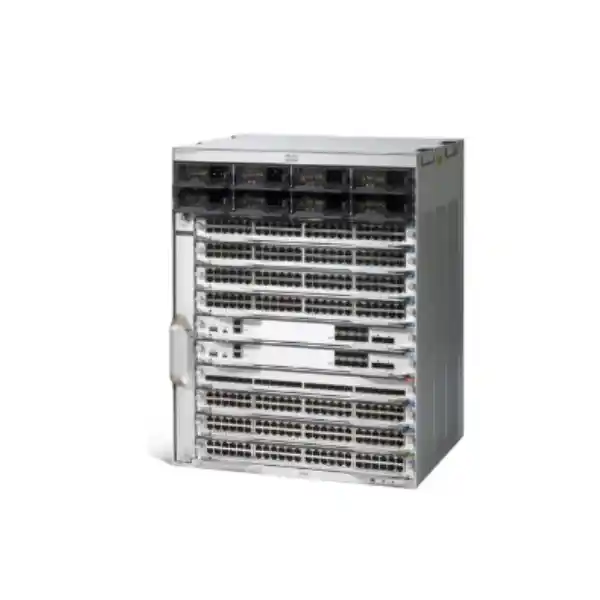
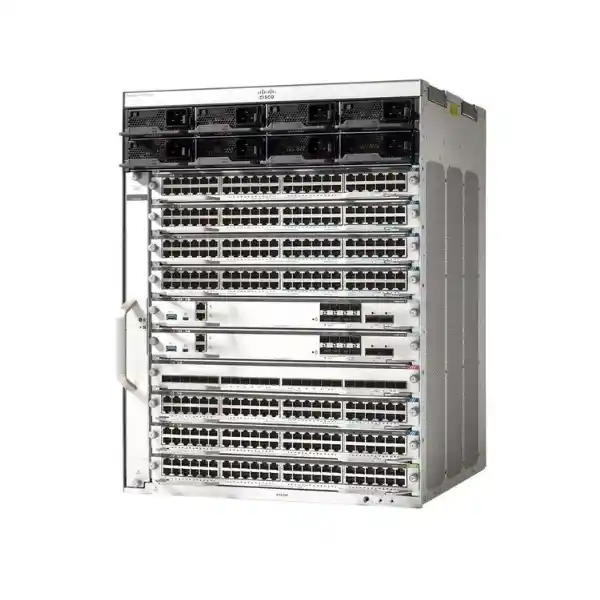
Cisco Catalyst C9410R Network Switch
The Cisco Catalyst C9410R is the ten-slot chassis in the Catalyst 9400 modular campus family, engineered for organizations that need high port density, supervisor redundancy, extensive PoE capacity, flexible copper and fiber line cards, and a platform that can be built for long service life. For UAE enterprises, the important design question is not simply whether the C9410R is powerful enough. It is how to configure the chassis correctly for user density, Wi-Fi generations, power requirements, uplink speeds, routing scale, software licensing, availability targets, rack power, cooling, optics, and future expansion. FourTeck approaches the C9410R as a modular system whose final capabilities are determined by the complete bill of materials.
8 line-card slots
2 supervisor slots
Up to 384 access ports
Up to 480 Gbps per line-card slot with Sup-2XL
A 19-inch rack-compatible chassis measuring approximately 22.61 × 17.30 × 16.30 inches.
Maximum density for several 48-port copper, multigigabit and SFP/SFP+ line-card combinations.
Supervisor positions 5 and 6 can be populated for chassis-level control-plane redundancy.
Supports scalable AC or DC power configurations with redundant and combined operating modes.
What the C9410R is designed to solve
Large campus networks often reach a point where fixed-configuration access switches become operationally expensive. A building may require hundreds of user ports, dozens of Wi-Fi access points, IP phones, cameras, meeting-room systems, badge readers, IoT gateways and uplinks to distribution or core. When these requirements are spread across many independent fixed switches, the network team manages more power cords, more uplink bundles, more software instances, more maintenance events and more physical devices. The C9410R consolidates a substantial amount of access or distribution capacity into a single modular chassis while preserving the ability to choose different interface types and power profiles by slot.
The chassis provides ten physical module positions. Slots 5 and 6 are reserved for supervisor engines, while slots 1 through 4 and 7 through 10 accept line cards. That layout gives eight line-card slots. With 48-port access modules, a fully populated chassis can reach 384 front-panel access ports. The platform can also be assembled with fiber, multigigabit, 25G, 40G and 100G line cards where the supervisor and software combination supports them. This makes the C9410R useful not only for traditional office access but also for high-density wireless aggregation, high-speed campus distribution, converged building systems and environments where a single closet serves many floors or departments.
The modular design matters because the life cycle of a campus network is rarely uniform. A UAE headquarters may begin with predominantly 1G wired users, then add Wi-Fi 7 access points that need multigigabit Ethernet and higher PoE, while selected engineering or media teams require 10G copper or fiber. A chassis can be expanded by replacing or adding line cards instead of replacing every access switch at once. The C9410R therefore becomes an infrastructure platform rather than a single-purpose port box. Correct design still requires careful sizing: the chassis alone does not define switching bandwidth, uplink capacity, routing scale or power delivery. Those characteristics come from the selected supervisor engine, line cards, power supplies, optics, licenses and software release.
C9410R chassis architecture and slot map
Line-card zones
Slots 1, 2, 3, 4, 7, 8, 9 and 10 are available for supported Catalyst 9400 line cards. This eight-slot arrangement makes symmetrical port planning easy: for example, four user-access modules plus four high-power wireless or IoT modules.
Supervisor zone
Slots 5 and 6 are dedicated supervisor positions. A design may use one supervisor, but dual supervisors are the normal choice when chassis-level control-plane resiliency is a business requirement.
Power and cooling
The chassis provides eight power-supply bays and an enterprise closet-oriented cooling design. Power and thermal planning must consider data load, PoE load, redundancy mode, input circuits and environmental conditions together.
Backplane investment
The chassis supports supervisor-dependent line-card bandwidth scaling. A Sup-2XL can provide up to 480 Gbps per line-card slot on C9410R, substantially changing the performance envelope versus earlier supervisor choices.
The physical chassis is approximately 13 rack units high, 17.30 inches wide and 16.30 inches deep, with a chassis-and-fan-tray weight of roughly 65 pounds before supervisors, line cards, power supplies and cabling are added. Rack planning therefore needs to account for the final installed weight, safe lifting practice, PDU placement, patch-panel clearance and cable-bend radius. The chassis is 19-inch rack compatible, but a production installation should be planned as an integrated rack system rather than as an isolated piece of hardware.
For a new build, FourTeck typically starts with a slot plan before selecting individual SKUs. The slot plan identifies which modules will serve standard 1G users, which will serve multigigabit access points, which will carry high-power endpoints, which will provide fiber access or local aggregation, and which ports must remain spare. This avoids a common mistake: filling every slot with the same line card and later discovering that wireless power, uplink or interface requirements have changed. A modular chassis creates value only when its modularity is reflected in the design.
Supervisor engines: the performance decision that shapes the whole chassis
The supervisor engine provides the control plane and the central forwarding architecture for the C9410R. Cisco supports Supervisor-1 family options and the newer C9400X Supervisor-2 family, but they do not deliver the same per-slot bandwidth on a C9410R. With the C9400-SUP-1, C9400-SUP-1XL or C9400-SUP-1XL-Y, the C9410R operates at up to 80 Gbps per line-card slot. The C9400X-SUP-2 raises that ceiling to up to 240 Gbps per line-card slot, while the C9400X-SUP-2XL raises it to up to 480 Gbps per line-card slot. For a chassis with eight line-card slots, this difference can materially affect the amount of high-speed traffic the platform can sustain without oversubscription at the module-to-fabric level.
This is why supervisor selection should follow traffic modeling rather than brand familiarity. If the C9410R is used mainly for 1G office access, a lower per-slot bandwidth profile may still be sufficient because many user ports are lightly utilized and oversubscription is acceptable. If the chassis will host dense 10G multigigabit access, 25G fiber interfaces, 40G or 100G aggregation, large east-west flows or high-performance wireless, a Sup-2 or Sup-2XL can be a more appropriate foundation. The correct choice should be calculated from worst-case and normal traffic patterns, not simply from the maximum port speed printed on a line-card datasheet.
The supervisor also affects uplink choices and advanced platform capabilities. Newer Supervisor-2 options are intended for higher-speed campus designs and support 100G/25G uplink use cases. The Sup-2 family is based on Cisco’s programmable Unified Access Data Plane architecture and x86 control-plane processing, supporting modern IOS XE functionality, programmability, telemetry and serviceability. In practical terms, the supervisor determines how much headroom the chassis has for future line cards and traffic growth, so it is often more economical to choose a supervisor with an appropriate five-to-seven-year growth horizon than to optimize only for day-one utilization.
| Supervisor option | C9410R bandwidth per line-card slot | Typical design positioning |
|---|---|---|
| C9400-SUP-1 / SUP-1XL / SUP-1XL-Y | Up to 80 Gbps | Established campus access designs where interface and traffic profiles fit the lower per-slot bandwidth. |
| C9400X-SUP-2 | Up to 240 Gbps | Higher-speed access and distribution with 25G/100G-oriented uplink requirements and additional growth headroom. |
| C9400X-SUP-2XL | Up to 480 Gbps | Maximum fabric headroom for dense high-speed line cards, advanced aggregation and long-life campus designs. |
Line-card portfolio and interface planning
The strength of the C9410R is its ability to mix interface types. Cisco’s Catalyst 9400 line-card family includes 48-port 1G copper, PoE+, UPOE and UPOE+ variants; multigigabit modules; 1G SFP fiber; 10G SFP+ fiber; and newer high-speed 25G, 40G and 100G options. Not every card behaves identically with every supervisor, and some high-speed modules require Supervisor-2 or Supervisor-2XL. A technically correct bill of materials therefore validates the exact supervisor-to-line-card compatibility and the minimum IOS XE release before purchase.
Standard 1G copper
48-port RJ-45 modules suit desks, printers, phones, building controllers and conventional 1G endpoints. Data-only, PoE+, UPOE and UPOE+ variants allow the slot to be matched to endpoint power needs.
Multigigabit copper
5G and 10G mGig-capable cards are relevant for modern Wi-Fi access points and high-performance edge devices that need more than 1G while retaining structured copper cabling.
1G / 10G fiber
SFP and SFP+ cards can connect remote closets, fiber-to-the-desk environments, security systems, industrial areas or local aggregation points where optical reach and electrical isolation are useful.
25G / 40G / 100G
High-speed line cards can move the C9410R beyond conventional access switching into aggregation and high-capacity campus roles. These designs require Supervisor-2 family validation and careful optical planning.
For maximum access density, Cisco lists up to 384 10/100/1000BASE-T ports, 384 PoE+ or UPOE access ports, 384 5G or 10G multigigabit ports, and 384 1G SFP or 10G SFP+ line-card ports in the C9410R platform. With the appropriate Supervisor-2 family, the platform also supports high-speed density figures reaching 168 25G ports when supervisor uplinks are included, 96 40G line-card ports, and up to 36 100G ports when supervisor uplinks are included. These maximums describe platform capability; a mixed real-world chassis will have a different port count based on the module combination.
A useful design technique is to classify every endpoint into four attributes: required physical medium, required data speed, required inline power and required availability. A Wi-Fi access point might need mGig plus 60W or 90W power. A desk phone may need only 1G and modest PoE. A camera may need 1G PoE+ but be spread across many floors. A distribution uplink may need redundant 25G or 100G fiber. Once each endpoint is classified, the line-card mix becomes a mathematical exercise instead of a guess. FourTeck can then reserve a sensible percentage of spare ports per type so that future growth does not force premature module replacement.
PoE, UPOE and UPOE+ sizing for wireless, phones, cameras and IoT
Power over Ethernet is one of the areas where a large modular chassis can provide major operational value, but only when the PoE budget is engineered correctly. Catalyst 9400 line cards support combinations of IEEE 802.3af PoE, IEEE 802.3at PoE+, Cisco UPOE and IEEE 802.3bt-based UPOE+ capabilities depending on the exact module. At the top end, UPOE+ can provide up to 90 watts to a supported powered device. This can support high-performance wireless access points, pan-tilt-zoom cameras, digital signage, advanced collaboration endpoints, thin clients and specialized building systems that would otherwise require local electrical outlets.
A frequent procurement error is to calculate only the number of PoE-capable ports and ignore simultaneous power demand. Cisco lists the C9410R as capable of very high PoE port density, but the maximum number of ports that can simultaneously receive the full 90W depends on the installed power supplies and overall chassis consumption. Cisco publishes a maximum of 260 ports at the full 90W level with maximum power. This distinction is important: a chassis may physically host 384 UPOE+ capable ports, yet a design in which every endpoint is budgeted at 90W must be evaluated against the total available PoE budget, power redundancy mode and actual powered-device negotiation.
Good PoE sizing uses measured or manufacturer-specified endpoint draw instead of automatically reserving maximum power for every port. For example, a Wi-Fi access point may negotiate a high class but normally consume less than the maximum. However, a resilient design still leaves headroom for startup conditions, future radio features, USB accessories, camera heaters or other loads. The bill of materials should therefore include a port-by-port or device-class power model, plus a contingency margin. Where the network must survive a power-supply or input-circuit failure without shedding critical endpoints, the redundancy mode must be included in the calculation.
PoE priority is also operationally useful. Critical devices such as security cameras, access-control controllers, emergency phones and essential wireless access points can be treated differently from convenience endpoints. During a constrained power condition, the design objective is not merely to keep the switch running; it is to preserve the services that matter most. FourTeck can map endpoint categories to port policies, UPS coverage and power redundancy so that the electrical architecture supports the network availability target rather than undermining it.
Power-supply design for UAE racks and data rooms
The C9410R provides eight power-supply bays and supports multiple power-supply types, including 3200W AC, 2100W AC and 3200W DC options. Cisco documents three operating approaches: N+N redundancy, N+1 redundancy and combined mode. These modes determine how much power remains usable during a supply or input-circuit failure. Combined mode maximizes aggregate available output, while N+1 and N+N reserve capacity for resilience. The correct mode depends on whether the design priority is maximum PoE density, maximum fault tolerance or a balance of both.
For UAE deployments, site electrical details should be confirmed before the switch ships. A rack may have redundant A and B PDUs, UPS-backed circuits, generator-backed power or a mixture of protected and unprotected feeds. The C9410R design should align power supplies across independent circuits where redundancy is required. The exact Cisco power cords and PDU receptacles also need to match. Because high-wattage supplies use enterprise power connectors rather than ordinary low-current desk-equipment leads, the facilities team should confirm connector type, circuit rating, breaker capacity and PDU outlet count during the procurement stage.
Power planning must include more than the nominal wattage of the supplies. The chassis consumes power for supervisors, line cards, fans and optics before any PoE budget is allocated. High-power PoE endpoints then consume the remaining capacity. If redundancy is enabled, part of the installed capacity is intentionally held in reserve. A correct calculation therefore starts with the selected hardware, adds the powered-device demand, applies the intended redundancy rule, adds operational margin and confirms that the input circuits can support the resulting load. This is especially important in older communications rooms where rack power was originally designed for low-density 1G switches.
Thermal load follows electrical load. A densely populated C9410R delivering substantial PoE can place a meaningful cooling burden on the room. Cisco’s chassis uses enterprise closet-oriented airflow and dynamically controlled fans with redundancy, but room HVAC must still remove the generated heat. FourTeck recommends validating the finished rack, not only the switch: UPS capacity, PDU capacity, circuit diversity, ambient temperature, hot-air path, rack depth, front clearance, rear access and cable congestion all influence long-term reliability.
High availability: supervisor redundancy, power resilience and StackWise Virtual
A modular chassis is often selected because a large number of users or services depend on it, so high availability must be designed at several layers. Inside a C9410R, dual supervisors can provide active and standby control-plane redundancy. When the second supervisor is installed and the feature set is configured appropriately, stateful switchover mechanisms reduce the disruption associated with a supervisor failure. Nonstop Forwarding can help routing protocols preserve forwarding while the control plane recovers, subject to feature and neighbor support. Power supplies can also be distributed across redundant input feeds and configured in N+1 or N+N patterns.
Chassis redundancy does not eliminate the chassis itself as a shared fault domain. For campuses that cannot tolerate the loss of an entire wiring closet chassis, Cisco StackWise Virtual can be used in supported configurations to operate two physical switches as a coordinated logical system. The architecture uses a StackWise Virtual Link for synchronization and supports stateful switchover between the active and standby switch roles. Both physical chassis continue to forward traffic, and multichassis EtherChannel designs can provide link and chassis diversity to downstream or upstream systems.
A resilient C9410R design therefore asks a series of failure-domain questions. What happens if one supervisor fails? What happens if one line card fails? What happens if one PDU fails? What happens if the UPS path fails? What happens if the entire chassis loses power? What happens if one uplink fiber is cut? What happens if a software change must be rolled back? The answers determine whether the design needs one or two supervisors, one or two chassis, how power supplies are split, how uplinks are routed, and whether downstream devices use single or dual network attachments.
FourTeck can also plan maintenance behavior. A network may technically contain redundant hardware yet still experience outages if software upgrades, line-card changes or upstream routing are not engineered for failover. High availability is therefore a combination of hardware, software, topology and operating process. The C9410R provides the building blocks, but the finished service level comes from how those blocks are assembled and tested.
Cisco IOS XE, programmability and campus operations
The Catalyst 9400 family runs Cisco IOS XE, which separates the familiar IOS-style network functions from a modern underlying software architecture. For enterprise operations, this provides a consistent configuration model across much of the Catalyst 9000 portfolio while also supporting APIs, structured telemetry, automation and model-driven management. Network teams can continue using CLI workflows where appropriate, but they are not limited to manual device-by-device administration.
Programmability becomes increasingly valuable on a chassis with hundreds of ports. Repetitive tasks such as VLAN assignment, interface descriptions, QoS templates, access policies and monitoring settings are less error-prone when standardized. RESTCONF, NETCONF and YANG-based automation can be used in supported releases to integrate the switch with configuration-management systems. Streaming telemetry can feed observability platforms with operational data more efficiently than traditional polling-only approaches. The exact feature availability depends on IOS XE release and licensing, so an implementation plan should map required capabilities to a tested software version.
Cisco Catalyst Center can add centralized discovery, inventory, software-image management, assurance, policy and automation functions depending on the subscription tier. This is particularly relevant in distributed UAE enterprises with headquarters, branches, warehouses or campuses where individual CLI management becomes difficult to scale. Centralized workflows can help maintain software consistency and provide a broader view of client experience, device health and network changes.
The operational design should still preserve practical troubleshooting access. Console access, out-of-band management, configuration backups, AAA redundancy, time synchronization, logging, SNMP or telemetry destinations, and software repositories should all be planned before production cutover. A high-end chassis should not become dependent on a single management server or authentication path. FourTeck can build the implementation around both centralized automation and controlled local recovery so that the network remains supportable during partial outages.
Security functions at the campus switching layer
The C9410R is a campus switch, not a replacement for a dedicated next-generation firewall, but it plays an important role in enforcing trust boundaries inside the LAN. Access-control lists, 802.1X, device authentication, DHCP protections, segmentation, Cisco TrustSec capabilities, MACsec on supported interfaces and software, and control-plane security can be combined to reduce lateral movement and enforce policy close to the endpoint. The platform’s programmable forwarding architecture supports extensive Layer 2, Layer 3, ACL and QoS resources, with actual scale determined by the supervisor and template configuration.
Identity-based access is particularly valuable in large offices where a physical wall port should not automatically imply trusted network access. 802.1X can authenticate managed endpoints, while fallback methods may be used for devices that do not support supplicant-based authentication. VLANs, scalable groups and policy can then place users, phones, cameras, building systems and guests into distinct security contexts. This reduces dependence on physical cabling as the only segmentation mechanism.
Encryption at the switching layer can also be relevant where sensitive traffic crosses shared campus fiber. MACsec can protect supported Ethernet links, while newer supervisor families provide additional high-speed security capabilities. Because cryptographic feature support can vary by supervisor, interface, license, software release and regional entitlement, it should be validated against the exact bill of materials instead of assumed from a family-level feature list.
For perimeter inspection, remote-access VPN, application control and internet security, FourTeck can integrate the campus switching design with the security stack available through Firewall Dubai. The architectural objective is clear separation of responsibilities: the C9410R provides resilient campus connectivity and local policy enforcement, while dedicated security platforms handle stateful threat prevention, internet-edge inspection and other firewall-specific services.
Routing, segmentation and QoS for converged campuses
Many C9410R deployments operate as Layer 3 access or distribution systems rather than simple Layer 2 switches. Routed access can reduce spanning-tree fault domains and allow each access block to participate directly in the campus routing design. Network Advantage-class capabilities are relevant where advanced routing, segmentation, multicast or policy requirements exceed entry-level switching. The exact protocol and scale requirements should be matched to the selected software tier and supervisor resources.
Quality of Service is equally important in a converged network. Voice, interactive video, wireless control traffic, business applications, backups and bulk transfers do not have the same latency or loss sensitivity. A 384-port chassis can aggregate many traffic classes at once, so classification and queueing should be consistent from edge port to uplink. Trust boundaries must be defined carefully: an IP phone may be allowed to mark voice traffic, while an unmanaged endpoint should not be allowed to declare all of its traffic as high priority.
Segmentation design can begin conventionally with VLANs and VRFs or progress to policy-based campus fabrics where the organization has the licensing, management platform and operational maturity to support them. The deciding factor should be business policy. If departments, contractors, building systems and guest networks require independent routing and security controls, a structured segmentation model prevents the switch configuration from becoming an unmanageable collection of ad hoc VLANs and ACLs.
FourTeck’s design process documents address plans, VLAN and VRF conventions, routing adjacencies, first-hop redundancy where required, multicast requirements, QoS classes and failure behavior before implementation. This documentation is especially useful when a C9410R replaces an older Catalyst 4500-class chassis because legacy networks often contain years of accumulated configuration. A clean migration should distinguish current business requirements from historical commands that no longer need to be carried forward.
Wireless-ready access for Wi-Fi 6, 6E and high-performance APs
Modern wireless changes the economics of campus switching. A high-performance access point may exceed 1 Gbps of aggregate traffic and may require more power than legacy PoE+ designs anticipated. The C9410R can accommodate multigigabit copper line cards and high-power UPOE+ modules, allowing a wiring closet to evolve without replacing the entire chassis. This is one of the strongest arguments for modular switching in large buildings where wireless standards change faster than structured cabling or rack infrastructure.
Wireless sizing should not assume that every access point immediately consumes its maximum Ethernet rate, but uplink and fabric oversubscription must still be evaluated. If dozens of mGig APs share one line card, the selected supervisor’s per-slot bandwidth matters. With a Sup-2XL, the C9410R can provide up to 480 Gbps of line-card slot bandwidth, providing far more headroom for dense high-speed access than the 80 Gbps profile of Supervisor-1 family options in this chassis. The right choice depends on radio count, expected concurrency, application mix and how much growth is planned.
Power is the second wireless constraint. Higher-end APs may require IEEE 802.3bt power classes for full functionality, especially when multiple radios, USB accessories or advanced sensing features are active. The PoE model should therefore use the chosen AP SKU and its power requirements, not a generic assumption. In a redundant power design, enough reserve must remain to keep essential wireless service active after the loss of a supply or feed.
The physical cabling path must also be checked. Multigigabit Ethernet can often extend the life of installed copper, but cable category, length, patching quality and electromagnetic environment influence achievable rates. FourTeck can coordinate switching, AP connectivity and structured cabling requirements through broader UAE infrastructure services available at FourTeck IT Services UAE, helping ensure that the network edge, power design and physical medium are engineered as one system.
A practical C9410R sizing methodology
A reliable bill of materials starts with demand, not with module names. First, count every endpoint by location and type: standard users, phones, APs, cameras, printers, conference systems, building controllers, access-control devices, IoT gateways, fiber endpoints and uplinks. Add planned growth for the expected service life. For a headquarters undergoing expansion, reserving only one or two spare ports per floor is rarely sufficient. Capacity should be allocated by interface type because spare 1G non-PoE ports cannot satisfy a future need for mGig UPOE+.
Second, calculate PoE by endpoint class. Record normal draw, maximum negotiated class and business criticality. Determine how much power must remain after the failure of a power supply or feed. This step translates endpoint counts into the number and wattage of power supplies, not merely the number of PoE line cards. Third, model traffic. Estimate access-to-uplink oversubscription, large local flows, wireless peaks, backup windows, video traffic and any server-facing workloads. Use that model to choose the supervisor and uplink speeds.
Fourth, define availability. Decide whether a single chassis with dual supervisors is acceptable or whether a dual-chassis StackWise Virtual architecture is required. Decide how many physical uplinks are needed and whether they terminate on independent upstream devices. Determine whether power feeds are truly independent or merely two outlets on the same circuit. Fifth, define software features: routing protocols, segmentation, automation, assurance, identity integration, telemetry and security requirements. These determine the licensing and management architecture.
Finally, turn the design into a slot-level bill of materials. Each slot should have an intended purpose, port count, media type, power requirement and growth allowance. Optics and cables should be listed per link, power cords per supply, blanks for unused positions, rack accessories, support coverage and software terms. This methodology prevents hidden gaps such as ordering a 100G-capable line card without compatible optics, ordering sufficient PoE ports without enough power supplies, or choosing a software tier that does not include a required operational feature.
Sample deployment patterns
Large building access
Use multiple 48-port PoE or UPOE+ line cards for users, phones, cameras and APs, dual supervisors for control-plane redundancy, redundant power supplies across independent feeds and high-speed fiber uplinks toward campus distribution.
Wireless-dense headquarters
Prioritize mGig UPOE+ cards, model each AP’s power class, use Sup-2 or Sup-2XL for greater line-card bandwidth and size uplinks to avoid concentrating high-throughput wireless traffic onto an undersized distribution path.
Campus distribution
Mix high-speed fiber cards with advanced routing, segmentation and resilient uplinks. Supervisor-2 family options are especially relevant where 25G and 100G connectivity or higher fabric capacity is required.
Dual-chassis resilient block
Deploy two C9410R systems with StackWise Virtual in a supported design, split downstream and upstream links across chassis, separate power domains and test switchover behavior before production acceptance.
These patterns are starting points, not fixed templates. A hospital, school, logistics facility, hotel, financial office and government campus can have very different traffic and power characteristics even if each needs approximately 300 access ports. Healthcare may prioritize medical-device segmentation and nonstop voice. Hospitality may prioritize high-density wireless and IP telephony. Logistics may require cameras, ruggedized edge links and warehouse wireless. Financial services may prioritize segmentation, telemetry, encryption and tightly controlled change windows.
The C9410R is attractive precisely because the same chassis can be tailored to these different roles. The design should preserve that flexibility instead of forcing every environment into one generic bundle. FourTeck can provide UAE-focused scoping through FourTeck UAE, including product selection, infrastructure integration and deployment planning around the organization’s actual topology.
Migrating from Catalyst 4500E and other legacy modular switches
Many organizations evaluating the C9410R are replacing a Catalyst 4500E-era platform. The physical resemblance of a large modular chassis can make migration appear straightforward, but the architectural transition deserves a clean design. The C9410R uses modern Catalyst 9000 software, programmable UADP forwarding, current supervisor options, contemporary licensing and much higher access and uplink capabilities. A migration should therefore treat the old configuration as a source of requirements, not as a script to copy line by line.
The first migration step is configuration rationalization. Identify active VLANs, routed interfaces, first-hop redundancy, routing neighbors, ACLs, QoS policies, multicast, DHCP relay, spanning-tree roles, EtherChannels, authentication, SNMP, syslog, NTP, TACACS or RADIUS and any special services. Remove references to retired subnets, unused VLANs, disabled ports and historical workarounds. The new system should start with a documented intended state.
The second step is physical mapping. Existing 48-port modules do not necessarily map one-for-one to new line cards because endpoint speeds and PoE requirements may have changed. Use the migration to separate high-power APs from conventional endpoints where that improves power and capacity planning. Check fiber types and connector standards, and verify whether legacy 1G uplinks should be replaced by 10G, 25G, 40G or 100G links. Optics should be selected from current compatibility data for the exact interface.
The third step is cutover strategy. Depending on the site, migration can be floor-by-floor, VLAN-by-VLAN, closet-by-closet or performed in a full maintenance window. Temporary interconnections may allow old and new systems to coexist. The plan should include rollback conditions, console access, backup configurations, verification commands, endpoint test cases and post-change monitoring. Large chassis migrations succeed when each dependency has an owner and acceptance criterion.
Finally, licensing and management should be modernized rather than inherited. Catalyst 9400 ordering now combines the hardware with network software and a Cisco DNA or Catalyst software subscription choice. Organizations should evaluate current Essentials versus Advantage requirements, Smart Licensing processes and management-platform integration rather than relying on legacy entitlement assumptions.
Licensing and software subscription planning
Cisco’s current Catalyst 9400 ordering model requires software choices to be considered as part of the switch purchase. The platform supports Network Essentials and Network Advantage capability tiers, while Cisco DNA or Catalyst software subscriptions are available in Essentials and Advantage levels with term options. Cisco’s current ordering guidance describes three-, five- and seven-year subscription choices. The precise ordering combination, included support and feature rights can evolve, so the final quote should be validated in Cisco Commerce for the specific purchase date and customer entitlement.
Network Essentials is aimed at foundational switching and routing requirements, while Network Advantage adds more advanced routing, segmentation, multicast, scale and security functionality. Subscription tiers add management, automation, analytics and assurance capabilities, especially when Cisco Catalyst Center is used. The important procurement rule is to map features to licenses before ordering. Selecting an expensive tier without a defined use case wastes budget; selecting a lower tier and later discovering that a required routing or segmentation function is unavailable creates change risk.
Smart Licensing should also be part of the operational plan. The network team should know which Smart Account and Virtual Account will own the entitlements, who has administrative access, how the device will communicate licensing information under the organization’s security policy, and what happens when a subscription term expires. Licensing should not be left as a post-installation task because ownership and account access can delay production handover.
FourTeck can align the hardware BOM with the selected licensing model, but feature-critical designs should always be checked against the exact current Cisco feature matrix and target IOS XE release. This is especially important for advanced routing, encryption, segmentation, telemetry and automation features. The goal is a quote that is technically complete on day one and commercially understandable over the intended service term.
Uplink and optic design: where many chassis BOMs fail
A C9410R can provide hundreds of edge ports, which means its uplinks must be engineered as carefully as its access interfaces. A common mistake is to deploy a high-density chassis with uplinks sized only by port count rather than by application demand. For example, 300 office users with ordinary SaaS traffic may operate comfortably with less aggregate bandwidth than 100 wireless users transferring large media files. Uplink design therefore uses concurrency and traffic profiles, not a simplistic ratio.
Supervisor-2 and Supervisor-2XL options support modern high-speed uplink use cases including 25G and 100G. High-speed line cards can also be used for additional aggregation where supported. When selecting the uplink, determine whether the upstream switch or router supports the same speed, optic type, breakout mode and protocol configuration. The complete path matters: transceiver, fiber type, connector, patch panel, distance, polarity and upstream interface must all be compatible.
Redundancy should be physical as well as logical. Two uplinks in the same fiber tray, entering the same riser and terminating on the same upstream chassis may protect against an optic failure but not against a cable cut or upstream outage. Where availability justifies it, route diverse fibers and terminate them on independent upstream systems. EtherChannel or routed equal-cost paths can then use the available links according to the campus design.
Optics should not be treated as generic accessories. Cisco compatibility, wavelength, reach, connector, temperature rating and software support all need verification. Third-party optics can introduce support and interoperability considerations that should be understood before purchase. FourTeck’s quotation process can list each optic and cable against a specific source and destination port, reducing the risk of receiving a chassis that is complete on paper but cannot be connected on installation day.
Performance engineering beyond headline port counts
High port density is useful only when the forwarding architecture matches the workload. The C9410R can host eight line cards, but supervisor selection determines the bandwidth available to each slot. With Supervisor-1 family options, the C9410R is limited to 80 Gbps per slot. With Sup-2, that increases to 240 Gbps; with Sup-2XL, to 480 Gbps. The practical consequence is easiest to see on a high-speed line card. If the theoretical sum of front-panel interfaces exceeds the fabric connection, the module has an oversubscription ratio under simultaneous full-rate load. This may be perfectly acceptable for access traffic but inappropriate for certain aggregation or server-facing workloads.
Performance design should therefore distinguish between line rate at an individual port and sustained aggregate slot throughput. Office access is bursty; most desks do not drive 1G continuously. Wireless traffic is also variable, although dense deployments can generate higher aggregate peaks. Backup networks, storage traffic, media workflows and large east-west transfers may be more sustained. By categorizing workloads, the network architect can place demanding interfaces on suitable modules and choose a supervisor with appropriate headroom.
Forwarding table resources also matter. The UADP architecture uses configurable hardware resources for Layer 2, Layer 3, ACL and QoS entries. Very large route tables, extensive policy, large host counts or heavy Flexible NetFlow use can consume different resource pools. Template selection and scale should therefore be validated during design for unusual deployments. A normal enterprise access network is different from a large routed aggregation node or a security-policy-heavy campus edge.
A useful acceptance test measures the intended service rather than a single synthetic number. Validate link speeds, LACP or routing behavior, failover, CPU health, hardware resource utilization, PoE draw, client authentication, multicast where used, telemetry, uplink utilization and application experience during representative load. This turns the C9410R from a collection of impressive specifications into a verified production platform.
Physical installation, cabling and serviceability
The 13RU C9410R is a substantial chassis. Installation planning should reserve appropriate rack space and consider the weight added by supervisors, line cards, power supplies and cabling. The chassis itself with fan tray is roughly 65 pounds, so lifting and mounting should follow safe procedures. A high-density configuration can also generate a large cable bundle; 384 copper ports can mean eight 48-port patch fields converging on a single chassis.
Cable management should preserve access to replaceable modules and maintain airflow. Copper patch leads need clean vertical and horizontal routing, while fiber jumpers require bend-radius control and protection from accidental snagging. Power cables should be routed separately from data where practical and clearly labeled by supply bay and PDU feed. In dual-feed designs, labels should show which supplies use feed A and which use feed B so maintenance staff can verify resilience before disconnecting anything.
Cisco’s fan architecture is designed for enterprise closet serviceability, with multiple independently controlled fans and redundancy within the fan system. The chassis uses side-to-side airflow, which is an important detail in racks or rooms designed primarily around front-to-back airflow. The room layout must allow unobstructed intake and exhaust paths. Blocking side vents with adjacent equipment, cable bundles or rack walls can undermine thermal performance even if the room temperature appears acceptable.
Operational serviceability also depends on labeling. Every line card, supervisor, power supply, uplink, StackWise Virtual Link, dual-active-detection link and critical access port should be documented. Spare optics, power supplies or fan components can be held according to the organization’s risk profile. For multi-site customers, standardized rack elevations and labeling conventions simplify remote support. FourTeck can extend the same design discipline across broader infrastructure projects through FourTeck Global where projects span multiple regions.
Monitoring, telemetry and operational visibility
A chassis that serves hundreds of endpoints must be monitored as a service platform, not merely pinged for reachability. Useful telemetry includes supervisor status, line-card health, temperature, fan state, power-supply input and output, PoE allocation, interface errors, optical levels, uplink utilization, queue drops, spanning-tree events, routing adjacencies, authentication failures and hardware resource consumption. These signals help the operations team detect developing problems before they become user-visible outages.
Cisco IOS XE supports traditional SNMP and syslog alongside model-driven telemetry and APIs. Organizations can integrate these feeds with an existing NMS, SIEM, observability stack or Cisco Catalyst Center depending on policy and licensing. Telemetry design should be selective: sending every available counter at a very high frequency can create unnecessary load and storage cost. Instead, collect high-value health and performance metrics at intervals aligned with troubleshooting and capacity-planning requirements.
Capacity trending is particularly valuable for a modular switch. If uplink utilization is growing steadily, additional bandwidth can be planned before congestion appears. If PoE utilization approaches the redundant budget, more power capacity can be evaluated before new APs are installed. If a line card approaches port exhaustion, the next slot can be reserved. If one wiring closet repeatedly sees authentication failures or CRC errors, cabling or endpoint issues can be investigated systematically.
Monitoring should also validate redundancy. A standby supervisor that is not synchronized, a power supply that has lost its input feed or a StackWise Virtual Link operating in a degraded state can remain unnoticed until a second fault occurs. Alerts should therefore focus on the loss of redundancy, not only total service failure. This is one of the most important operational differences between owning redundant components and actually operating a resilient network.
Change management and software lifecycle
Cisco IOS XE is actively maintained, and the C9410R’s long service life means the software will be upgraded many times. A production design should therefore include a lifecycle process from the beginning. Standardize on a qualified release, document the reasons for choosing it, track Cisco advisories and field notices, test upgrades where practical, back up configurations and maintain a rollback plan. Feature requirements, security fixes, hardware support and interoperability can all influence release selection.
Not every newest release should be deployed immediately to every production campus. Organizations should balance security and feature requirements with stability and validation. A lab or pilot switch can be used to test AAA, routing, wireless connectivity, management integrations, automation and monitoring before broad rollout. For highly available designs, verify the supported upgrade behavior for the exact supervisor and redundancy topology rather than assuming an upgrade is non-disruptive.
Configuration management is equally important. Store version-controlled backups, define approved templates and audit changes. When automation is used, include safeguards against applying a campus-wide error at machine speed. Change windows should identify pre-checks, implementation commands, validation tests, rollback triggers and responsible engineers. Large chassis concentrate services, so disciplined change control has a disproportionate effect on reliability.
FourTeck can provide an implementation handover that includes the final hardware inventory, software version, license state, interface schedule, power map, uplink diagram, management addresses and baseline health checks. The purpose is to ensure that the customer’s operations team receives an understandable system rather than a black box that only the installer can support.
UAE procurement considerations: quote the complete system, not only C9410R
The part number C9410R identifies the chassis, but a deployable switch normally requires far more. The bill of materials may include one or two supervisors, line cards, power supplies, power cords, optics, fiber or DAC cables, blanks, software subscriptions, support coverage and installation services. A quote that lists only the chassis can appear attractive but provides little information about the final network. FourTeck structures the proposal around the required service, then lists the hardware that delivers it.
Lead time should be checked across the complete BOM. A chassis may be available while a particular line card or optic has a different delivery schedule. For phased projects, this can influence whether hardware is staged centrally or delivered by building. Serial-number recording, Smart Account ownership and support entitlement should be organized before installation so that troubleshooting and RMA processes are not delayed later.
UAE customers should also confirm where the equipment will be installed and whether the project has site-specific requirements for power connectors, structured cabling, security clearance, change windows or after-hours access. Dubai office towers, Abu Dhabi campuses, Sharjah industrial sites, logistics facilities and hospitality properties can have very different access and facilities constraints even when the network architecture is similar.
A strong quotation therefore combines commercial and technical completeness. It states the intended supervisor, line-card quantities, spare capacity, PoE design, power redundancy, uplink optics, subscription term, support level and implementation scope. This lets procurement compare proposals on a like-for-like basis and reduces the risk of discovering missing components after the purchase order has been issued.
Technical specification summary for Cisco Catalyst C9410R
| Item | C9410R design detail |
|---|---|
| Chassis type | 10-slot modular Catalyst 9400 chassis |
| Supervisor slots | 2 dedicated slots: positions 5 and 6 |
| Line-card slots | 8 slots: positions 1–4 and 7–10 |
| Maximum 48-port access density | Up to 384 ports depending on line-card type |
| Maximum line-card slot bandwidth | 80 Gbps with Supervisor-1 family on C9410R; 240 Gbps with Sup-2; 480 Gbps with Sup-2XL |
| High-speed interface support | 1G, 10G, 25G, 40G and 100G options depending on line card and supervisor compatibility |
| PoE capability | PoE+, UPOE and UPOE+ line-card options; up to 90W on supported UPOE+ ports |
| Full 90W simultaneous maximum | Cisco specifies up to 260 ports at full 90W with maximum power configuration |
| Power-supply bays | 8 |
| Power-supply options | 3200W AC, 2100W AC and 3200W DC options; verify exact orderable SKU and software requirement |
| Power operating modes | N+N redundancy, N+1 redundancy and combined mode |
| Dimensions | Approximately 22.61 × 17.30 × 16.30 in. / 57.43 × 43.94 × 41.40 cm |
| Rack height | 13 RU |
| Chassis weight | Approximately 65 lb / 29.48 kg with fan tray, before modules and PSUs |
| Software | Cisco IOS XE; minimum release depends on supervisor and line card |
Specification values describe platform capabilities and may depend on supervisor, line card, power configuration, software release and licensing. Final quotations should validate the exact Cisco configuration and currently orderable components.
Frequently asked technical questions
Is C9410R a complete switch by itself?
No. C9410R is the chassis. A production system needs an appropriate supervisor, line cards, power supplies, power cords, software/licensing and usually optics or uplink cables. Redundant designs add a second supervisor and additional power capacity.
How many access ports can it provide?
With eight supported 48-port line cards, the chassis can provide up to 384 access interfaces for several copper, multigigabit and fiber configurations. Mixed modules change the final count.
Can it provide 90W PoE on all 384 ports?
The chassis can host large numbers of UPOE+ capable interfaces, but Cisco specifies up to 260 ports simultaneously at the full 90W level with maximum power. Actual device draw and redundancy mode must be calculated.
Which supervisor gives the most bandwidth?
For the C9410R, the C9400X-SUP-2XL provides up to 480 Gbps per line-card slot. The C9400X-SUP-2 provides up to 240 Gbps per slot, while Supervisor-1 family options provide up to 80 Gbps per slot in this chassis.
Does the C9410R support redundant supervisors?
Yes. Slots 5 and 6 are dedicated supervisor positions, allowing a dual-supervisor design. Availability also depends on software configuration, power resilience and uplink topology.
Can two C9410R chassis work together?
Supported StackWise Virtual designs can pair two Catalyst 9400 systems into a coordinated logical topology with SSO behavior and multichassis link designs, subject to compatible hardware and software configuration.
Is it suitable for Wi-Fi 7 access?
The platform offers multigigabit and high-power UPOE+ line cards appropriate for modern high-performance APs. The exact AP model, data rate, power class, cabling and uplink capacity must be validated together.
What license should we buy?
Choose based on required routing, segmentation, automation, assurance and support features. Current Cisco ordering supports Essentials and Advantage approaches with term subscription choices. FourTeck can map the requirements to the BOM.
Why source the C9410R through FourTeck UAE
A modular Catalyst chassis is a configuration project, not a single-SKU transaction. FourTeck can help translate floor plans, endpoint counts, wireless requirements, PoE loads, uplink topology, redundancy targets and licensing requirements into a complete C9410R bill of materials. This reduces the risk of incompatible supervisors and line cards, insufficient power capacity, missing optics, unsuitable license tiers or unplanned rack dependencies.
For UAE projects, the same team can coordinate network switching with broader infrastructure requirements such as firewalls, structured connectivity, server-room integration and deployment services. This is useful when a campus refresh affects multiple technology layers at once. Rather than treating each component as an isolated purchase, the design can be reviewed end to end for power, bandwidth, segmentation and operational ownership.
The result should be a switch architecture that is understandable before purchase: defined slot map, supervisor choice, port types, PoE budget, redundancy mode, uplink speeds, optics, license term, software baseline and implementation plan. That documentation creates a stronger basis for internal approval, vendor comparison, installation and future expansion.
Decision recap: when the C9410R is the right platform
Choose it for density
Eight line-card slots and up to 384 access ports make sense when a wiring closet or distribution block would otherwise require many independent fixed switches.
Choose it for modular growth
Mix 1G, mGig, PoE, UPOE+, fiber and high-speed line cards as the campus evolves rather than replacing the full switching platform for each access-generation change.
Choose it for resilience
Dual supervisors, multiple power supplies and supported StackWise Virtual architectures provide building blocks for high-availability campus designs.
Size it for the future
Supervisor choice, power capacity, uplink speed and license tier should reflect the expected five-to-seven-year service profile, not only today’s endpoint count.
Quotation input checklist
A precise quotation can be prepared faster when the following information is available. Approximate values are acceptable for an initial design; FourTeck can refine them during technical review.
Build the C9410R configuration around your actual campus requirements
Send your port count, AP and PoE requirements, uplink speed, redundancy target and preferred license term. FourTeck can convert those inputs into a chassis-level BOM covering supervisors, line cards, power supplies, optics, software and implementation dependencies. The objective is a technically complete proposal that can move from procurement to installation without discovering missing design elements late in the project.
• AP and PoE device list
• Uplink speed and fiber distance
• Supervisor redundancy requirement
• Power-feed arrangement
• Cisco software / management needs

Reviews
There are no reviews yet.