
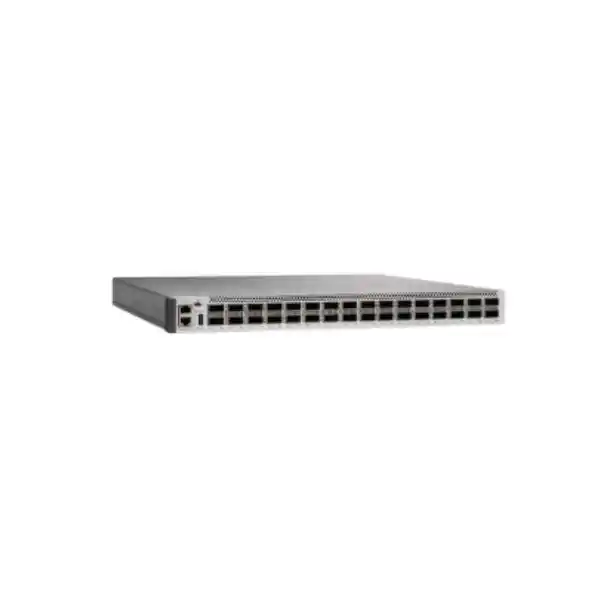
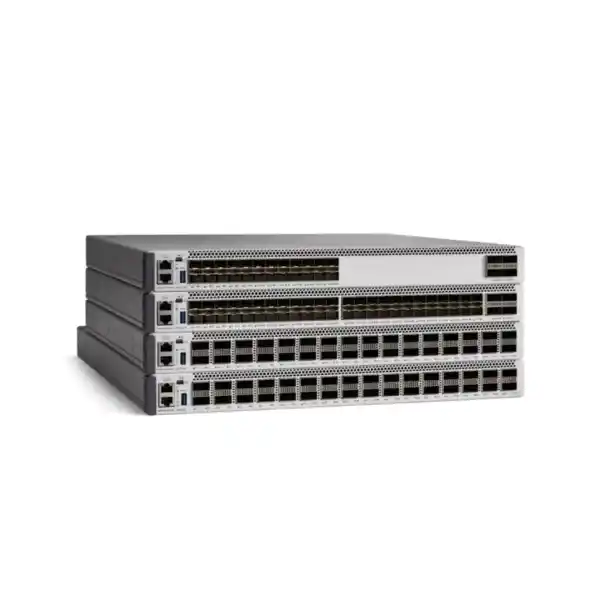
Cisco Catalyst C9500-32QC Network Switch
A high-performance fixed 1RU campus core and distribution switch engineered for organizations that need dense 40 Gigabit Ethernet today, practical 100 Gigabit Ethernet migration paths, resilient dual-switch architecture, programmable Cisco IOS XE operations, and a long-term enterprise switching platform for demanding UAE environments.
QSFP28-based flexible port architecture
Up to 3.2 Tbps switching capacity
Up to 1 Bpps forwarding performance
What the C9500-32QC is designed to do
The Cisco Catalyst C9500-32QC is part of the high-performance Catalyst 9500 family, a fixed-configuration switching platform positioned for enterprise campus core and aggregation roles. Its value is not simply that it offers many fast ports in one rack unit. The platform combines a programmable control plane, a purpose-built forwarding ASIC, high route and policy scale, redundant field-replaceable components, and software functions normally associated with larger chassis systems. For UAE organizations modernizing a traditional three-tier campus, building a collapsed core, aggregating large access blocks, or interconnecting server and security zones at 40G and 100G speeds, this combination can simplify the physical design without forcing the network team to give up routing, segmentation, telemetry, automation, or resilient multi-chassis operation.
The C9500-32QC uses Cisco UADP 3.0 forwarding silicon and supports a flexible front-panel layout based on QSFP28 cages. Cisco specifies the platform for up to 32 ports of 40 Gigabit Ethernet or up to 16 ports of 100 Gigabit Ethernet, with supported mixed configurations allowing designers to choose a practical balance between 40G links and 100G uplinks. This matters in real projects because few organizations migrate every distribution block, firewall, data-center edge, and backbone link at the same time. A switch that can carry legacy 40G aggregation while introducing selected 100G paths allows migration to be staged around business windows, optic availability, fiber readiness, and budget cycles.
For procurement teams, the model should be treated as an engineered system rather than as a bare Ethernet box. Correct design includes the switch license tier, current Cisco software subscription requirement, optical transceivers or direct-attach cabling, power-supply selection, power cords, rack accessories, airflow confirmation, StackWise Virtual link design when used as a pair, and support coverage. FourTeck can align these items with the installed access layer, WAN or firewall interfaces, fiber plant, routing policy, and expected growth so that the delivered bill of materials is usable on day one rather than merely matching a model number.
C9500-32QC technical specifications at a glance
| Specification | Cisco Catalyst C9500-32QC |
|---|---|
| Form factor | Fixed 1RU enterprise core / aggregation switch |
| Primary port density | Up to 32 × 40 Gigabit Ethernet using QSFP+ optics in QSFP28 cages |
| 100G port density | Up to 16 × 100 Gigabit Ethernet with supported QSFP28 optics and port configuration |
| Switching capacity | Up to 3.2 Tbps |
| Forwarding rate | Up to 1 Bpps |
| Forwarding ASIC | Cisco UADP 3.0, single-ASIC high-performance design |
| Packet buffer | 36 MB unified packet buffer |
| System CPU | 2.4 GHz quad-core x86 CPU |
| System memory | 16 GB DRAM and 16 GB boot flash |
| High availability | StackWise Virtual, dual power-supply slots, redundant fan-tray architecture, EtherChannel and multi-chassis designs |
| Operating system | Cisco IOS XE |
| Dimensions | Approximately 1.73 × 17.5 × 18.0 in. (4.39 × 44.45 × 45.72 cm) |
| Weight | Approximately 21.85 lb (9.91 kg) in Cisco’s two-power-supply configuration reference |
| AC input range | 90 to 264 VAC; final PSU and cord must match the ordered configuration |
Performance, scale, optic compatibility and feature availability depend on Cisco IOS XE release, licensing, selected SDM template and exact hardware configuration. Validate the final design against the software train and transceiver matrix used for the project.
Flexible 40G and 100G port architecture
The defining characteristic of the C9500-32QC is the way its QSFP28 front panel is mapped to the UADP 3.0 forwarding complex. The chassis presents 16 physical QSFP28 cages in a two-high arrangement, exposing logical interfaces that can be assigned to supported 40G and 100G operating modes. Cisco documents 32 QSFP28 Ethernet interfaces at the logical level. For 40G operation each cage can support the appropriate QSFP+ transceiver mode, while 100G operation uses the higher-speed QSFP28 path. Because the same physical face can represent different logical port combinations, engineers should design from the intended port mode rather than counting cage openings alone.
Cisco’s architecture documentation identifies several important operating profiles. The default profile is a mixed configuration of 24 active 40G interfaces plus four active 100G interfaces. Alternative profiles include 32 ports of 40G and 16 ports of 100G, and additional mix-and-match combinations are supported within the platform’s lane mapping rules. This flexibility is valuable during migration. A campus can retain 40G connections toward existing distribution or legacy core systems while reserving 100G interfaces for new server blocks, data-center links, firewall clusters, WAN aggregation, or the StackWise Virtual interconnect. When a larger portion of the network upgrades to 100G, the same chassis can be reprofiled subject to supported optics and software configuration.
Port planning must therefore include lane allocation, transceiver type, fiber mode, connector type, optical budget, distance, and the desired high-availability topology. It is also important not to assume that a breakout cable can be used in the same way as on every other QSFP platform. Cisco’s published standalone port-density table does not list native 10G or 25G breakout density for the C9500-32QC. Lower-speed connectivity can be supported in specific cases with compatible conversion adapters and optics, but a project that requires large numbers of 1G, 10G, or 25G links should generally be evaluated against other Catalyst 9500 models rather than forcing the C9500-32QC into an access-style role.
UADP 3.0 forwarding architecture and why it matters
Single high-performance ASIC
The C9500-32QC uses one Cisco UADP 3.0 ASIC with two forwarding cores. Ports 1 through 16 map to one forwarding core and ports 17 through 32 map to the other. This architecture keeps switching, routing, policy lookup, rewrite and queue operations in hardware while the x86 CPU handles control-plane and management functions. The result is a fixed core switch able to perform enterprise Layer 2 and Layer 3 services at high packet rates without treating advanced policy as a software-only afterthought.
36 MB unified packet buffer
Cisco documents a 36 MB packet buffer for this high-performance design. Buffering is important where several fast ingress links converge on a smaller number of egress paths, where microbursts occur, or where traffic classes contend for output queues. Buffer capacity is only one part of congestion design; queue configuration, oversubscription ratios, QoS policy, application behavior, and link speed transitions also determine whether bursts are absorbed cleanly or translated into drops and retransmissions.
Hardware resource programmability
The UADP architecture supports SDM templates that allocate forwarding resources according to deployment priorities. Core-oriented deployments emphasize IP and multicast routing, distribution templates provide different balance for MAC and policy resources, NAT templates allocate additional translation capacity, and custom templates on supported releases provide finer control. Selecting the right template is part of sizing because maximum scale values are not simultaneously available for every feature.
Independent control plane
A 2.4 GHz quad-core x86 CPU with 16 GB DRAM gives IOS XE a substantial control-plane environment for routing protocols, telemetry, automation agents, event processing, software upgrades and management tasks. The separation between control plane and ASIC forwarding means ordinary packet forwarding continues in silicon while protocols and orchestration operate through the CPU complex. Correct control-plane policing, management isolation and software lifecycle discipline remain essential for production stability.
Switching capacity, forwarding rate and real-world sizing
Cisco rates the C9500-32QC at up to 3.2 Tbps switching capacity and up to 1 billion packets per second of forwarding. Those headline figures indicate that the platform is designed for high-speed core use, but a professional design should translate them into actual traffic patterns. A 32-port 40G profile represents 1.28 Tbps of one-directional front-panel line rate, while 16 ports at 100G represent 1.6 Tbps. The published switching-capacity figure reflects bidirectional switching throughput. In practical terms, this allows the chassis to serve as a nonblocking high-speed aggregation point within supported port profiles, provided the rest of the design does not introduce external bottlenecks.
Packet-rate capability becomes particularly important when traffic consists of small frames. A network that primarily carries large storage transfers, backups, virtual machine images, or data replication can consume enormous bit rate while generating fewer packets than a highly transactional environment with short flows and small frames. The 1 Bpps platform rating gives the switch substantial packet-handling headroom, but architects should still assess features that consume hardware table resources, including access lists, NetFlow entries, policy-based routing, multicast state, VXLAN endpoints, labels, and routes. Capacity planning is more reliable when it combines bandwidth, packet rate, table scale, convergence requirements, and policy complexity rather than choosing a switch by port count alone.
For a UAE campus core, a useful exercise is to model each access or distribution block by peak traffic, oversubscription ratio, uplink type, and failure condition. A design that is comfortable during normal operation may become oversubscribed when one member of a port-channel or one core switch fails. The same applies to a firewall pair or data-center connection: normal-state utilization of 35 percent can rise toward 70 percent after a link or chassis failure. The C9500-32QC has the raw switching performance to accommodate substantial redundancy, but the links, optics, EtherChannels and upstream devices must be sized so that failover does not turn into chronic congestion.
StackWise Virtual for resilient dual-core designs
StackWise Virtual is one of the most important reasons to deploy the C9500-32QC as a pair. The technology allows two physical Catalyst 9500 switches to operate with a unified logical control architecture for many campus design purposes. Instead of building every downstream connection as an independent Layer 3 adjacency or relying on spanning tree to block redundant Layer 2 links, access or distribution devices can form multi-chassis EtherChannels across both core members. This lets both physical paths remain active while preserving device-level redundancy and simplifying the topology seen by connected equipment.
Cisco supports StackWise Virtual on the high-performance C9500-32QC, and eligible front-panel ports in the default mode can be used for StackWise Virtual links. A separate dual-active-detection mechanism is designed to identify conditions in which both chassis might otherwise attempt to operate as active simultaneously. Cisco documentation identifies support for substantial multi-chassis EtherChannel scale on the platform. The engineering decision is not simply whether StackWise Virtual is available, but how many high-speed links should be allocated to the virtual stack interconnect, which physical paths should be diverse, and how downstream port-channels should be distributed between forwarding cores and chassis.
A well-designed C9500-32QC pair normally uses redundant power sources, redundant upstream paths, diverse fiber routes where possible, and a maintenance plan that recognizes software dependencies between the two members. The StackWise Virtual link must have enough capacity to carry traffic that crosses between chassis during normal operation and after failures. Dual-active detection should use a supported path that does not share the exact same failure domain as the primary virtual links. Downstream devices should use LACP or another supported EtherChannel method and have their hashing behavior reviewed so that high-volume flows do not concentrate on a single member link.
For organizations replacing two standalone legacy core switches, StackWise Virtual can significantly reduce topology complexity, but it does not eliminate architectural discipline. Change control, synchronized software, configuration backups, out-of-band management, failure testing, and documented recovery procedures remain essential. FourTeck can design and stage dual-C9500 topologies through its UAE IT services practice, including predeployment configuration, migration planning, port-channel validation, routing adjacency checks, and rollback steps.
Cisco IOS XE: routing, switching and programmability in one operating system
The C9500-32QC runs Cisco IOS XE, giving network teams a familiar enterprise CLI while also exposing modern programmable interfaces. In a conventional campus, IOS XE can provide VLAN and trunk services, spanning-tree controls, EtherChannel, first-hop redundancy where applicable, routed interfaces, switch virtual interfaces, DHCP relay, multicast control, quality of service, policy-based routing, access control and multiple dynamic routing protocols. In a more automated environment, the same platform can be managed with model-driven configuration and telemetry using YANG-based interfaces, NETCONF, RESTCONF and supported streaming telemetry mechanisms. This dual operational model helps organizations transition from manual CLI processes to automation without replacing the switching hardware.
Routing design should match license tier and operational requirements. Enterprises commonly use OSPF or IS-IS for campus underlays, BGP for policy-rich interconnects, or a combination of internal and external routing protocols at core boundaries. Cisco IOS XE supports extensive route policy, route filtering, equal-cost paths, VRFs and multicast functions, but the exact feature set and scale are tied to the installed Network Essentials or Network Advantage level and software release. Advanced technologies such as MPLS, expanded segmentation, EVPN/VXLAN functions, and certain automation or assurance capabilities can require the higher license tier or associated subscription entitlements.
Programmability is especially valuable in large UAE estates with multiple campuses, branch concentration points or data-center links. Configuration templates can enforce consistent interface descriptions, AAA policy, NTP, syslog, SNMP, telemetry, routing authentication, QoS and access lists. APIs can collect operational state without screen-scraping CLI output, while event-driven automation can identify configuration drift or interface anomalies. The goal is not automation for its own sake. The benefit is repeatability: changes become testable, reviewable and easier to reproduce across a pair of core switches, reducing dependence on one-off manual commands during critical maintenance windows.
Layer 2 and Layer 3 campus core design
The C9500-32QC can support several campus design models. In a traditional three-tier network, it can function as the core that interconnects multiple distribution blocks. In a medium-size campus, two C9500-32QC switches can form a collapsed core and distribution layer, terminating access-layer uplinks, SVIs and routing toward data centers, Internet edges and WAN routers. In modern routed-access designs, Layer 3 can be extended closer to the edge, allowing the core to operate primarily as a high-speed IP transport layer. Each model changes how many VLANs, MAC addresses, routes, multicast states and policy entries the core must hold.
If Layer 2 is extended to the core, spanning-tree root placement, VLAN pruning and failure-domain boundaries must be deliberate. The physical speed of the C9500-32QC can hide design weaknesses until a failure causes a broadcast domain or loop to spread at 40G or 100G. Where possible, use port-channels for deterministic link utilization, restrict VLAN propagation to required paths, protect edge boundaries with the appropriate spanning-tree and control-plane mechanisms, and maintain clear ownership of default gateway functions. If routed access is used, invest equal care in route summarization, adjacency scale, fast convergence and consistency of IP addressing.
The C9500 high-performance family supports multiple SDM resource profiles so the hardware tables can be aligned with the deployment. A core template allocates more resources to IP and multicast routing, while a distribution-oriented template provides a different balance that can better suit larger MAC tables and policy requirements. NAT and custom templates address specialized deployments. This is significant because marketing scale numbers are often unidimensional maxima; a real network consumes several resource types at once. Engineers should record current MAC counts, ARP and NDP entries, IPv4 and IPv6 routes, multicast groups, ACL lines, NetFlow entries and VRFs before choosing the template.
For a new build, FourTeck can model the core against expected access growth rather than only current load. A campus adding Wi-Fi 6/6E/7 access points, multigigabit access switches, IP surveillance, building automation and high-capacity servers may see core traffic increase much faster than user headcount. The C9500-32QC’s 40G and 100G orientation provides room for that growth, especially where existing distribution systems can retain 40G links during an incremental migration.
EVPN/VXLAN and modern fabric options
Cisco introduced BGP EVPN/VXLAN support on the high-performance C9500 models, including the C9500-32QC, in IOS XE releases beginning with the Gibraltar 16.10 train and expanded the feature set in later releases. This gives the switch a role beyond a conventional VLAN-and-SVI core. In supported designs, VXLAN can provide an overlay that decouples tenant or segment identifiers from the physical underlay, while BGP EVPN distributes endpoint and reachability information through a standards-based control plane. Integrated routing and bridging, distributed gateway functions and multi-tenant forwarding can be used in fabric designs where software version, license and validated architecture are aligned.
The appeal of EVPN/VXLAN is operational scale and segmentation, but it introduces new dependencies. The underlay must be stable before the overlay is added. MTU must account for VXLAN encapsulation. BGP design, route-target policy, VNI allocation, anycast gateway behavior, multicast or ingress-replication strategy, and border connectivity must be documented. Troubleshooting also changes: engineers need visibility into both the IP underlay and the EVPN control plane rather than treating a missing endpoint as a simple VLAN problem. The C9500-32QC provides the hardware and IOS XE foundation, but successful deployment depends on disciplined fabric design.
For most campus customers, EVPN/VXLAN should be chosen because it solves a defined requirement such as scalable segmentation, tenant separation, mobility, consistent policy, or a routed spine-leaf style topology. It should not be enabled simply because the switch supports it. Where an existing network is stable with straightforward routed links and a limited number of VRFs, a simpler design may remain the better operational choice. FourTeck can assess the migration boundary, software train, supported feature matrix, route scale and interoperability with firewalls or data-center fabrics before a fabric architecture is committed.
Security architecture: segmentation, policy and link encryption
MACsec-capable secure links
Catalyst 9500 supports IEEE 802.1AE MACsec with MKA for encrypted Ethernet links in supported topologies and software releases. This can protect traffic between capable network devices over fiber paths that pass through shared facilities or service-provider demarcations. MACsec design requires compatible peers, key-management planning, correct policy mode and review of release-specific restrictions. It should be validated on the exact port speed and topology rather than assumed from a generic feature list.
VRF and policy segmentation
VRFs create independent routing domains for business units, OT networks, guest services, shared infrastructure or regulated environments. Access control lists, route policies and service insertion can then define which domains may communicate. The core should enforce only policies appropriate to its role; application-aware security is usually better placed on dedicated firewalls, while the C9500 handles high-speed segmentation, routing boundaries and deterministic forwarding.
Control-plane protection
Core availability depends on protecting both data and control planes. IOS XE provides mechanisms for control-plane policing, infrastructure ACLs, routing-protocol authentication, management-plane restrictions, AAA integration, secure remote access, SNMPv3 and logging. A production build should use separate management addressing, tightly controlled administrative sources, centralized authentication and time synchronization so operational events can be traced accurately.
TrustSec and identity-aware policy
Cisco TrustSec and security-group concepts can reduce dependence on large topology-specific ACLs in environments using Cisco identity and policy infrastructure. Whether this is appropriate depends on the organization’s ISE deployment, license tier and segmentation model. The C9500 can participate in these designs, but policy should be developed from business communication requirements and tested against application flows before enforcement is activated.
Quality of Service for voice, video, storage and critical applications
High bandwidth does not eliminate the need for quality of service. A 100G core can still experience congestion when multiple 40G distribution links, backup systems, replication jobs, Internet edges and server blocks converge on the same output path. The important distinction is that congestion may be brief and bursty rather than continuous. Those microbursts can still affect real-time voice, interactive video, trading applications, industrial control or latency-sensitive virtual desktop sessions if every packet is treated identically.
A sound C9500 QoS design begins with a small number of business-relevant traffic classes. Marking should ideally occur near the edge where the application or endpoint can be identified. The core should trust only known boundaries, preserve or rewrite markings according to policy, and provide queue behavior that protects genuinely sensitive traffic without starving best-effort applications. Policing is useful for limiting classes that should not exceed defined rates, while shaping is generally performed where a lower-speed egress or service-provider handoff requires a controlled transmit profile. Queue thresholds should be reviewed against the switch architecture rather than copied from an unrelated model.
For storage and backup traffic, the goal is often to prevent large sequential transfers from dominating shared paths during business hours. For collaboration traffic, the requirement is predictable delay and loss rather than raw bandwidth. For network control protocols, a dedicated class or control-plane protection keeps routing and convergence traffic available during data-plane congestion. The C9500-32QC supplies the hardware capability to enforce these policies at high speed, but the quality of the outcome depends on traffic classification, end-to-end marking consistency and realistic testing under failover conditions.
Telemetry, NetFlow and operational visibility
Core switches should be observable without requiring engineers to log in manually during every incident. Cisco IOS XE supports a broad operational toolset including syslog, SNMP, Flexible NetFlow, IP SLA, model-driven telemetry, event management and programmable state retrieval. On the C9500-32QC, this visibility can help answer practical questions: which distribution block is generating a burst, whether an uplink is dropping packets, how a route changed, whether a transceiver is approaching optical thresholds, or which policy is consuming a large amount of hardware table space.
Flexible NetFlow is useful for traffic characterization because it summarizes conversations rather than storing full packets. Exported flow records can show top sources, destinations, protocols and traffic volumes, helping identify unexpected backups, malware scanning patterns, large east-west transfers or misrouted workloads. NetFlow capacity is not infinite, so sampling strategy, record definition and export frequency should be aligned with the size of the environment. Telemetry provides another path for high-frequency operational metrics and can be integrated with monitoring platforms that understand YANG-modeled data.
Optical monitoring is equally important in 40G and 100G environments. Many compatible transceivers expose transmit and receive power, temperature and voltage values. Trend these readings rather than waiting for a hard link failure. A degrading fiber path, contaminated connector or marginal optical budget may appear first as reduced receive power or increasing errors. In Dubai data centers and campuses where fiber runs pass through multiple patch panels, preventive optical hygiene and baseline measurements can save significant outage time.
Operational design should also include centralized configuration backups, version-controlled templates and a documented set of pre- and post-change checks. Before an upgrade or migration, capture routing neighbors, interface counters, port-channel state, spanning-tree status, StackWise Virtual health, hardware environmental readings and license state. After the change, compare those same indicators. This simple discipline catches many partial failures before users report them.
Power, cooling and rack planning for UAE installations
The C9500-32QC is a 1RU platform approximately 18 inches deep, which makes it easier to install in standard enterprise racks than many modular core systems. Cisco lists an input-voltage range of 90 to 264 VAC for the Catalyst 9500 high-performance family reference configuration. The C9500-32QC has two field-replaceable power-supply slots and is commonly deployed with redundant supplies so each PSU can be fed from an independent PDU or UPS path. Cisco has documented 650W AC and 930W DC supply options for this model family; the final supported part number, airflow and cord type should be confirmed against the current ordering guide at time of purchase.
Cooling should be treated as part of the network design, particularly in the UAE where high ambient temperatures make data-center environmental control critical. Cisco specifies 0°C to 40°C operation for the relevant Catalyst 9500 reference range, with altitude considerations. The C9500-32QC uses redundant fan-tray units with dual-stacked fans. Airflow direction must match the rack hot-aisle/cold-aisle design, and blanking panels should be used to prevent recirculation in partially filled racks. Do not install the switch immediately above equipment that exhausts unusually hot air into its intake path.
Power sizing should consider more than the chassis. Optical transceivers consume power, and a densely populated 40G or 100G system can have materially different load than a lightly populated one. UPS runtime calculations should include both switches in a redundant pair, optics, management appliances and the upstream security or routing devices needed to preserve service. If each core switch is connected to two PDUs, verify that either PDU can carry the surviving load during maintenance or failure. Label both power feeds clearly so technicians do not disconnect redundant sources during rack work.
For server-room modernization projects, FourTeck’s Server Dubai infrastructure team can coordinate rack layout, power distribution, fiber pathways, server aggregation and network handoff planning so the core switch is installed as part of an integrated environment rather than as an isolated device.
Optics, fiber and cabling design
A C9500-32QC purchase is incomplete until the optical layer is engineered. QSFP+ and QSFP28 transceivers are available for multiple fiber types and distances, and the correct module depends on whether the link is 40G or 100G, whether the plant is multimode or single-mode, the number of fiber strands available, connector type, path length and optical loss. Two transceivers that physically fit the same cage can require very different fiber plants. For example, short-reach multimode links typically use different optics and connector arrangements from long-reach single-mode campus backbones.
Before ordering optics, document every intended link in a matrix: source port, destination device and port, speed, fiber type, estimated length, number of patch panels, connector format, optic SKU and whether the link is production, StackWise Virtual, dual-active detection or spare capacity. This prevents common procurement errors such as ordering 100G optics for a peer that supports only 40G, mixing incompatible wavelength technologies, or overlooking the need for conversion adapters on lower-speed interfaces.
Existing fiber should be tested if it will carry higher speeds than before. A link that ran 10G reliably for years may not automatically satisfy the loss and modal bandwidth requirements of a new 40G or 100G optic. Clean connectors, inspect end faces, verify polarity, and measure optical levels after installation. If the design uses single-mode fiber between buildings, account for splice loss, patch panels and future cross-connect changes. Maintain a reasonable optical margin rather than designing at the edge of the transceiver’s receive range.
Direct-attach or active optical cables can be attractive inside a rack or between adjacent racks because they reduce the number of separate transceiver components. Their reach and serviceability differ from structured fiber, however. In a long-lived core, modular optics plus structured cabling may provide easier replacement and migration. FourTeck can source compatible Cisco optics and validate the physical layer as part of a complete FourTeck UAE network infrastructure bill of materials.
Licensing: Network Essentials, Network Advantage and subscriptions
Cisco Catalyst 9500 ordering includes both the hardware and a network software tier. The C9500-32QC is available in Network Essentials and Network Advantage variants, conventionally represented by -E and -A product identifiers. The selected tier determines the perpetual network feature entitlement available on the switch. Cisco’s current ordering guidance also requires a matching software subscription at the time of a new order. Depending on the current Cisco commercial program, this may be a Catalyst Software Subscription or Cisco DNA subscription, offered in term lengths such as three, five or seven years.
Network Essentials is suitable for deployments that need foundational enterprise Layer 2 and Layer 3 functions, while Network Advantage is intended for organizations requiring more advanced routing, segmentation, scale, multicast and security capabilities. Because feature packaging evolves across Cisco IOS XE and licensing generations, the safest procurement method is to begin with required functions rather than selecting a license by name. List the routing protocols, VRF scale, StackWise Virtual requirements, EVPN/VXLAN functions, MPLS needs, TrustSec functions, application hosting or assurance integrations, then map those requirements to the current Cisco feature matrix.
Smart Licensing provides centralized entitlement management. Production deployments should have a documented Smart Account and Virtual Account ownership model before installation, especially when equipment will be managed by an integrator but owned by the customer. Decide who will register the switch, who will retain account access after handover, and how disconnected or restricted Internet environments will report license usage. These governance details prevent a technically successful installation from becoming an administrative problem later.
For quotations, request the exact hardware license suffix and subscription term together. A C9500-32QC-E and C9500-32QC-A may look physically identical, but they represent different software entitlements. FourTeck can quote the switch, relevant subscription, optics, support and deployment services as one controlled BOM so commercial review can see which capabilities are included rather than comparing only chassis prices.
Where the C9500-32QC fits best
Campus core
Pair two C9500-32QC switches as a resilient core for multiple buildings or distribution blocks. Use 40G toward established distribution systems and introduce 100G on the heaviest paths. Dynamic routing or StackWise Virtual can provide fast failover while redundant power and cooling reduce single-component risk.
Collapsed core
For medium-size headquarters, the C9500-32QC can combine core and distribution roles. High-density 40G links aggregate access stacks while 100G interfaces connect firewalls, server networks or data-center fabric. This reduces chassis count while preserving enterprise routing, segmentation and high availability.
Server and security aggregation
Organizations with many 40G server, firewall or appliance links can use the C9500-32QC as a high-speed aggregation layer. VRFs and routed interfaces separate zones, while 100G uplinks provide capacity toward a core or data-center backbone. This is especially useful where the requirement is enterprise campus operational behavior rather than a dedicated data-center switching OS.
Metro or building interconnect
Single-mode 40G or 100G optics can connect campus buildings or nearby facilities when the fiber plant and optical budget support the chosen module. MACsec may be used where supported and required for link-layer confidentiality. Routing boundaries are generally recommended to contain failure domains across longer physical paths.
When another Catalyst 9500 model may be a better choice
The C9500-32QC is optimized for customers with meaningful 40G requirements and a desire for flexible 100G migration. It is not automatically the best Catalyst 9500 for every core. If the design is already dominated by 100G links and expects little or no 40G, the C9500-32C offers a 32-port 100G-oriented architecture with higher aggregate capacity and may provide a cleaner long-term fit. If the distribution layer requires many 10G or 25G interfaces, the C9500-24Y4C or C9500-48Y4C can reduce the need for adapters by providing native SFP28 downlinks plus 40/100G uplinks.
Newer Catalyst 9500X models extend the family into much higher-speed territory with Cisco Silicon One architecture, 400G interfaces, larger buffers and much larger forwarding-table scale. They are appropriate where the project needs 400G backbone capacity, very deep buffering, very high route scale, or a longer runway for future bandwidth growth. The tradeoff is not simply purchase price. Power, optics, port granularity, license tier and the capabilities of connected devices should be considered. Buying a 400G platform for a network that will remain 40G for years may spend budget without producing operational value, while buying a 40G-focused platform for a site that will migrate to 100G everywhere within twelve months may create an early refresh.
FourTeck evaluates the C9500 family by interface mix rather than by model prestige. A practical comparison should include the number of 10G, 25G, 40G, 100G and 400G links on day one; expected ports after three to five years; route and policy scale; high-availability method; optics cost; rack and power constraints; and the software functions actually required. This produces a defensible model selection and prevents overbuying or underbuying.
Migration from legacy Catalyst core platforms
Many C9500-32QC projects replace older Catalyst 4500-X, 6500/6800, 3850 aggregation pairs, or mixed fixed-core systems. The mechanical replacement is usually the easiest part. The real migration work is understanding which functions are hidden inside the existing configuration: first-hop redundancy, spanning-tree root roles, route redistribution, multicast rendezvous points, DHCP relay, ACLs, QoS, policy-based routing, IP SLA tracking, NetFlow exports, SNMP filters, AAA, static routes, port-channels and undocumented dependencies. A line-by-line configuration conversion can reproduce years of technical debt, so migration is an opportunity to separate required behavior from obsolete syntax.
A low-risk migration begins with discovery. Capture interface descriptions and utilization, MAC and ARP tables, routing neighbors, VLAN-to-SVI mappings, port-channel members, transceiver types, current optics power levels, spanning-tree state and management integrations. Map each physical cable to its destination and label both ends before the change window. Build the new C9500 configuration offline, validate syntax for the chosen IOS XE release, and stage license registration plus management access before production traffic is moved.
The cutover sequence should be deterministic. For a pair, establish StackWise Virtual or the chosen Layer 3 redundancy model first. Confirm the inter-switch or virtual-stack links, dual-active detection, management reachability and routing baseline. Move low-risk links before critical server or firewall paths where possible. After each group, verify port-channel state, route adjacency, gateway reachability and application flows. Keep the rollback plan physically achievable; if old optics or patch cords are removed too early, a logical rollback may be impossible even when the old configuration is available.
Post-migration testing should include device failure, uplink failure and power-supply failure scenarios, not only a successful ping. Core resilience exists to protect users during faults. A design that has never been failed deliberately is only assumed to be redundant. FourTeck can perform staged migration and acceptance testing for Dubai and UAE customers through its Firewall Dubai and network security integration practice where core switching must interoperate with firewall HA clusters and segmented perimeter networks.
High availability beyond StackWise Virtual
Resilience is a system property, not a single feature. Even when two C9500-32QC switches operate as a StackWise Virtual pair, the design can still have common failure points in power, fiber routing, upstream firewalls, WAN routers, DNS, DHCP, authentication or management systems. Each layer should be reviewed for failure-domain independence. Two power supplies connected to the same PDU are not power redundancy. Two fiber links routed through the same tray are not path diversity. Two core switches running the same untested software image are not protection against a software defect.
At the switching layer, use link aggregation so individual physical failures do not remove connectivity. Distribute member links across chassis where supported. At the routing layer, use appropriate protocol timers and equal-cost paths rather than extremely aggressive tuning that can create instability. For upstream firewall pairs, verify whether the firewalls use LACP, routed links, first-hop redundancy or a proprietary cluster interface, then design the C9500 side around the vendor-supported model. For WAN routers, maintain independent routed adjacencies where practical so a failure is detected by the routing protocol rather than by user traffic.
Operational resilience is equally important. Store backups outside the switch, maintain out-of-band or console access, retain compatible spare optics, document PSU and fan-tray part numbers, and know the process for replacing a failed unit without disturbing the surviving path. Cisco supports field-replaceable fan trays and power supplies on this platform, but replacement should follow hardware guide procedures and environmental requirements. Keep support entitlement and serial-number inventory current so an emergency replacement is not delayed by asset ambiguity.
Finally, schedule controlled resilience tests after major changes. Pull one member of a downstream EtherChannel, disable one routing adjacency, simulate loss of a core member during a maintenance window, and confirm application behavior. Measure convergence instead of assuming it. Document any sessions that reset so application owners understand the difference between network path recovery and stateful session continuity.
UAE procurement and deployment considerations
Buying an enterprise core switch in the UAE involves more than locating a chassis. Lead time can vary by hardware, license term, support level and optical module. The C9500-32QC should be quoted as a complete project BOM with the exact hardware suffix, software subscription, redundant power supplies, UAE-compatible power cords, optics or DAC/AOC assemblies, support, rack accessories and any required storage or service components. If the site has a fixed change window, procurement should include time for staging and software validation before the planned cutover date.
Regional environment also matters. Data centers in Dubai and Abu Dhabi are typically well controlled, but smaller equipment rooms can experience higher temperature, dust ingress or unstable power if facilities maintenance is inconsistent. Verify rack depth, front-to-back airflow, PDU socket type, available UPS capacity and earthing. Keep network racks away from building-service heat sources and ensure cold-air delivery remains adequate when new high-density optical equipment is added. A 1RU chassis is compact, but it can still be operationally critical enough to justify environmental monitoring.
For multi-country organizations, standardize where practical but do not assume every site needs the same port profile. A UAE headquarters may require 100G core links while a regional office uses only 40G. Standard configurations, software versions and monitoring can remain common even if exact optics differ. If equipment will later be moved between sites, record optic standards, license ownership and power-cord variants in the asset system. FourTeck also supports broader deployments through its global network at FourTeck Global for organizations coordinating infrastructure across multiple regions.
Commercial comparison should consider lifecycle cost. A lower chassis price can be offset by expensive optics, insufficient license entitlement, lack of redundant PSUs, or an unsupported migration design that requires additional hardware later. Conversely, purchasing the highest license and fastest optics everywhere may be unnecessary. A requirements-led BOM provides the clearest basis for comparing quotes from different suppliers.
Configuration and commissioning checklist
A production C9500-32QC should be commissioned from a controlled baseline. Start with hardware inventory and verify chassis PID, serial number, PSU modules, fan trays and optics. Confirm the software image and ROMMON compatibility with the selected IOS XE release. Set the boot variable correctly, verify install mode where required, and record the golden image in the organization’s standard. Configure management addressing, hostname, domain settings, DNS, NTP, secure SSH, AAA, role-based access and logging before connecting production uplinks.
Next establish Layer 2 and Layer 3 foundations: VLAN definitions, trunk allow-lists, port-channel configuration, routed interfaces, SVIs, VRFs, routing protocols and route policy. If StackWise Virtual is used, configure the virtual domain, StackWise Virtual links and dual-active detection using Cisco-supported interfaces and confirm the expected active/standby roles. Verify that port profiles on the C9500-32QC match the installed 40G and 100G optics; do not assume an interface is active simply because a transceiver is inserted.
Apply QoS, security and management policies after basic connectivity is stable. This sequencing simplifies troubleshooting because each layer can be validated independently. Add ACLs, control-plane protection, MACsec where required, NetFlow, telemetry and monitoring. Confirm SNMP or API credentials from the actual network-management platform rather than only from a local test. Check environmental readings and optical diagnostics once the rack reaches normal operating load.
Before handover, capture a commissioning record containing interface status, port-channel state, StackWise Virtual health, routing neighbors, route counts, spanning-tree root information, power status, fan status, temperatures, transceiver details, license state and software versions. This baseline becomes invaluable months later when an engineer needs to determine whether a changed value is normal or evidence of a fault.
Operations, maintenance and software lifecycle
Core-switch stability depends on disciplined lifecycle management. Cisco IOS XE releases have different feature sets, security fixes, caveats and recommended maintenance paths. Avoid changing software solely to obtain the newest version number. Choose a release that supports the required hardware, optics, licensing and features, review Cisco advisories and release notes, and test it on a representative system where possible. For StackWise Virtual pairs, follow the documented upgrade procedure and confirm whether the selected release supports the desired high-availability or in-service upgrade behavior.
Configuration management should be automated or at least centrally archived. Every change should produce a backup and a ticket or version-control record that explains why it was made. When a routing policy or ACL is modified, include intended traffic behavior and an explicit rollback. Use consistent interface descriptions that identify the remote device, remote port, circuit or fiber identifier and purpose. At 32 high-speed ports, accurate labeling is far cheaper than tracing fiber under outage pressure.
Monitor hardware health continuously. Environmental alarms, fan state, PSU input, interface errors, CRCs, discarded packets, queue drops, optical receive levels and route-neighbor changes should feed the monitoring platform. Alert thresholds should distinguish between informational events and conditions that require action. A single corrected error should not trigger the same escalation as a rising CRC rate on a 100G backbone. Trend data is more useful than isolated snapshots because gradual deterioration becomes visible before a hard failure.
Keep a small spares strategy aligned with business criticality. For an organization with several C9500-32QC switches, spare compatible optics, fiber patch cords and possibly a PSU or fan tray can reduce recovery time. Whether to hold a full spare chassis depends on support SLA, replacement lead time and the business impact of losing redundancy. Document serial numbers and support contracts so escalation can begin immediately if hardware replacement is required.
Frequently asked technical questions
Is the C9500-32QC a 40G switch or a 100G switch?
It is best described as a flexible high-performance model optimized for 40G density with supported 100G operation. Cisco specifies up to 32 × 40G or up to 16 × 100G, plus supported mixed port profiles such as the documented default combination of 24 × 40G and 4 × 100G. The correct description depends on the configured port mode and installed optics.
Does the switch support StackWise Virtual?
Yes. C9500-32QC is one of the high-performance Catalyst 9500 models that supports StackWise Virtual. A production design should allocate supported high-speed interfaces for the virtual links and configure dual-active detection, then validate the topology on the target IOS XE release.
Can it be used in a data center?
Yes, particularly for enterprise server aggregation, security aggregation, building data rooms, campus data centers and edge/interconnect roles where Cisco IOS XE operational consistency is desirable. For very deep-buffered storage fabrics, extremely high route scale or 400G-heavy designs, compare the requirement with Catalyst 9500X or purpose-built data-center platforms before final selection.
Does it support EVPN/VXLAN?
The high-performance C9500-32QC has supported BGP EVPN/VXLAN capabilities since Cisco IOS XE Gibraltar 16.10.1, with functions expanded in later software trains. Exact feature availability, scale and licensing must be checked against the target release.
What license should we buy?
Choose Network Essentials when foundational enterprise routing and switching meets the design, and Network Advantage when advanced routing, segmentation, scale or feature requirements demand it. New Cisco orders also require a corresponding software subscription. The feature list should be mapped to the current Cisco licensing matrix before the order is placed.
Can FourTeck supply optics, licenses and installation together?
Yes. A complete project can include the C9500-32QC chassis, selected network license, subscription term, redundant PSUs, compatible optics, structured cabling or patching requirements, staging, configuration, StackWise Virtual setup, migration assistance, testing and documentation.
Decision recap: choose the C9500-32QC when these conditions are true
The C9500-32QC is a strong choice when an organization needs a compact 1RU enterprise core with a large number of 40G interfaces, selected 100G uplinks, high packet-forwarding performance and Cisco IOS XE operational consistency. It is particularly compelling for staged migrations in which existing distribution blocks remain at 40G but new backbone, firewall or server connections move to 100G. Its StackWise Virtual support makes a pair suitable for resilient collapsed-core or campus-core designs without forcing every connected device to maintain two independent Layer 3 relationships.
Good fit
Dense 40G aggregation, mixed 40/100G migration, enterprise campus core, StackWise Virtual pair, high-speed routed core, firewall or server aggregation, EVPN/VXLAN-capable fabric edge, and organizations standardized on IOS XE.
Compare alternatives
Mostly 10/25G links, 100G on nearly every interface, planned 400G backbone, very deep-buffer requirements, unusual table-scale demands, or designs that require a different data-center operating model.
Quotation input checklist for an accurate UAE BOM
Providing the following information lets FourTeck quote the correct chassis, software, optics and services without unnecessary components. Where information is unknown, the engineering team can help determine it from existing switch configurations, photographs, optic labels or network diagrams.
Number of 40G links, number of 100G links, expected growth and whether mixed port profiles are required.
Multimode or single-mode fiber, approximate distance, connector type, patch-panel count and required optic standard.
Single switch, two independent routed cores, or StackWise Virtual pair with desired interconnect capacity.
Routing protocols, VRFs, EVPN/VXLAN, MPLS, TrustSec, MACsec, telemetry, automation and assurance requirements.
AC or DC, redundant PDU paths, rack depth, airflow direction and UAE power-cord requirements.
Supply only, preconfiguration, onsite installation, migration, after-hours cutover, testing, documentation and support.
FourTeck consultation panel for Cisco C9500-32QC projects
A core-switch quotation should answer the engineering questions before hardware arrives. FourTeck can review the existing topology, confirm whether the C9500-32QC is the right member of the Catalyst 9500 family, define 40G and 100G port modes, validate optics and fiber, select the appropriate network license and subscription, design StackWise Virtual or routed redundancy, and produce a migration sequence with acceptance checks.
For greenfield campuses, the design can start from access-switch counts, wireless growth, server and firewall interfaces, WAN capacity and expected east-west traffic. For refresh projects, FourTeck can use current route tables, MAC counts, interface utilization and existing configurations to choose SDM templates and estimate headroom. This avoids purchasing a platform solely from headline bandwidth while overlooking table scale, fiber compatibility or license features.
For procurement, provide the required quantity, preferred license tier if known, support term, delivery city in the UAE and whether optics are needed. For deployment, add the current core model, maintenance-window constraints and whether the network must remain online during staged migration. The result is a BOM and implementation plan aligned to the real environment.
Engineering deliverables can include
• Hardware and licensing BOM review
• 40G/100G optic and port map
• StackWise Virtual topology
• IOS XE baseline configuration
• Migration and rollback runbook
• Routing and failover validation
• Handover documentation and monitoring baseline

Reviews
There are no reviews yet.