
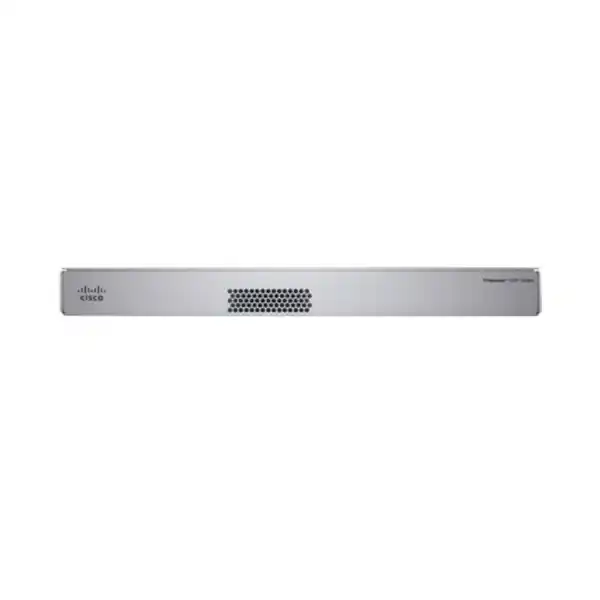
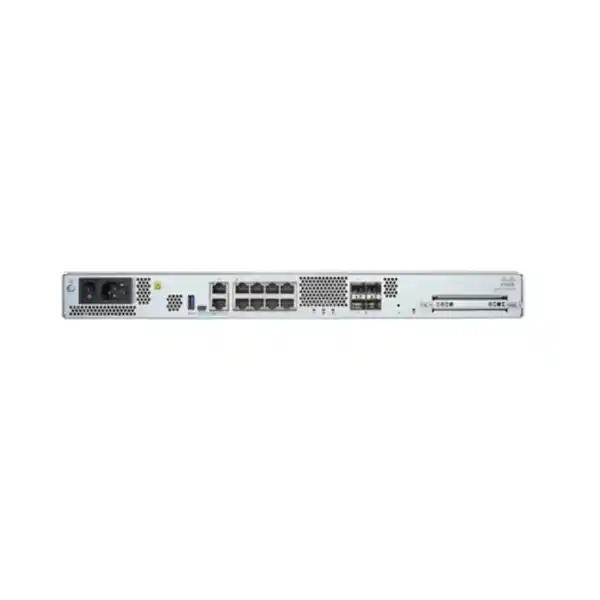
Cisco Firepower 1140 Firewall Dubai
A practical buyer guide to the Cisco Firepower 1140 for UAE organisations that need a rack-mount next-generation firewall with application visibility, intrusion prevention, secure remote connectivity and a manageable path from branch security to centrally governed enterprise policy.
Direct Answer: What Is the Cisco Firepower 1140?
The Cisco Firepower 1140, commonly identified by the FPR-1140 platform name and the appliance PID FPR1140-NGFW-K9, is a 1U rack-mount security appliance in Cisco’s Firepower 1000 family. It can run Cisco Secure Firewall Threat Defense software or Cisco ASA software. In a Threat Defense deployment, the appliance combines stateful firewalling with application visibility, intrusion prevention, security intelligence and optional licensed services such as URL filtering and malware defense.
Its main use is protecting a midsize business edge, substantial branch, regional office, service location or other network segment where a desktop firewall is too limited but a larger data-centre platform would be excessive. It is especially relevant when the organisation wants a rack-mount chassis, multiple copper and fibre interfaces, several hundred thousand concurrent sessions and room for site-to-site or remote-access VPN growth.
The most important factor to confirm is the real inspected traffic profile rather than the internet circuit speed alone. SSL/TLS decryption, IPS, application control, VPN, logging and security subscriptions can materially change the capacity required. A 1 Gbps or 2 Gbps internet connection does not automatically mean that an appliance with a higher headline number is oversized.
FourTeck can help map user count, application mix, WAN bandwidth, encrypted traffic, VPN requirements, interface media, management method, subscription term and high-availability expectations to the correct Firepower 1140 configuration or a better-sized alternative.
Where the Firepower 1140 Fits in the 1000 Series
The Firepower 1140 sits between the 1120 and 1150 in the rack-mount portion of the Firepower 1000 family. That position matters because the best choice is rarely determined by purchase price alone. A buyer should look at both current security load and the growth margin expected over the useful life of the deployment. The 1120 can be attractive for lighter branches, while the 1150 provides more headroom for sites with heavier inspected traffic or faster growth. The 1140 is the middle option for organisations that need more capacity than an entry rack-mount model without immediately moving to the top of the family.
Cisco’s own published performance data is based on controlled traffic profiles and specifies that results vary with packet size, protocol mix and enabled features. That caveat is especially important for UAE businesses replacing older ASA appliances, basic UTM devices or routers that have been carrying firewall duties. Modern security inspection places different demands on hardware. A design that enables IPS, application control, TLS inspection, multiple VPN tunnels and extensive logging should be sized against that feature set rather than against a simple stateful-firewall number.
Good Fit for Midsize Sites
The 1140 is most compelling when a branch or office has moved beyond lightweight firewall requirements and needs a dedicated 1U platform with room for richer inspection, more concurrent sessions and a broader interface mix. It is a natural candidate for corporate offices, larger retail or service hubs, education locations, distribution facilities and multi-department branches where internet access is business critical.
Not Automatically the Right Size
A site with low inspected throughput and modest VPN usage may be better served by a smaller platform. Conversely, a site expecting multi-gigabit encrypted traffic, unusually high connection rates, demanding SSL decryption or rapid growth should compare a larger model. The objective is to preserve security controls during busy periods, not to fit the smallest possible appliance onto a circuit.
Useful for Cisco-Centric Operations
Organisations already using Cisco network infrastructure, identity services, Secure Client, central monitoring or Cisco security operations tools may value architectural consistency. The benefit should still be tested against operational skills, licensing expectations and the management model. Standardisation can reduce complexity, but only when the firewall is designed and administered in a way that matches the organisation’s actual operating model.
Cisco Firepower 1140 Published Performance
Cisco publishes several different performance measurements for the 1140. They answer different questions, so they should not be treated as interchangeable. The figures below are useful for initial screening, while final sizing should consider the intended software release, inspection policy, traffic profile and growth margin.
| Metric | Firepower 1140 | Buyer Interpretation |
|---|---|---|
| Firewall + application visibility/control | 3.3 Gbps | Useful baseline for application-aware Threat Defense operation, but not a guarantee for every inspection mix. |
| Firewall + AVC + IPS | 3.3 Gbps | Relevant when intrusion prevention is part of the intended security policy. |
| NGIPS throughput | 3.5 Gbps | Indicates the platform’s published intrusion-prevention processing level under Cisco test conditions. |
| TLS throughput | 1.2 Gbps | Particularly important when the policy includes inspection of encrypted sessions. |
| IPsec VPN throughput | 1.4 Gbps | A planning reference for encrypted site-to-site or remote connectivity; real designs depend on tunnel mix and policy. |
| Concurrent sessions with AVC | 400,000 | Useful for busy client environments, NAT-heavy networks and applications that open many simultaneous sessions. |
| New connections per second with AVC | 22,000 | Important for bursty traffic, web-heavy environments and sites with large numbers of short-lived sessions. |
| Maximum VPN peers | 400 | A platform ceiling that should be checked against remote-access and site-to-site design requirements. |
Performance figures are vendor-published reference values, not a substitute for workload-specific sizing. Packet size, protocols, decryption, software version, inspection depth and concurrent services can change observed throughput.
Why the 3.3 Gbps Number Needs Context
Firewall buyers often begin with the WAN circuit because it is an easy number to identify. That is sensible, but it is only the first input. A business with a 1 Gbps internet service may assume that a 3.3 Gbps firewall offers more than three times the required capacity. The actual margin can be narrower once encrypted web traffic is decrypted for inspection, IPS policies are applied, VPN traffic is processed, security events are logged and several internal zones are routed through the appliance.
Encrypted traffic is particularly significant. The 1140’s published TLS figure is lower than its headline Threat Defense figure. That does not mean encrypted inspection is unsuitable; it means the organisation should estimate how much traffic will actually be decrypted and which destinations or applications will be bypassed for privacy, compatibility or performance reasons. Banking, healthcare, certificate-pinned applications and other sensitive services may need policy exceptions, while ordinary web and SaaS traffic may be candidates for inspection depending on company policy.
Growth should also be deliberate. If an office expects an internet upgrade, additional users, SD-WAN expansion, more remote workers, cloud migration or new high-bandwidth services, the firewall should be evaluated against the expected environment during the desired service life. A platform that looks generous on day one can become constrained after several business changes. Conversely, buying far beyond a realistic growth profile can raise cost without improving security outcomes.
Traffic Mix
Small packets and large numbers of short sessions stress a firewall differently from long, predictable file transfers. Voice, video, SaaS, cloud storage, guest Wi-Fi, IoT and server publishing can all change the connection profile. Sizing should therefore include application behaviour, not only Mbps or Gbps.
Inspection Depth
IPS, malware analysis, URL categorisation and decryption add security value but also consume resources. The correct design is the one that can sustain the controls the business intends to use. Disabling protection later to recover throughput defeats the purpose of buying a next-generation firewall.
Concurrency
User count alone does not predict session count. A single employee may maintain dozens or hundreds of web, messaging, update and cloud connections. Branches hosting services or large guest networks can generate even more. The 400,000-session platform figure should be considered alongside connection creation rate and application behaviour.
Interfaces, Rack Deployment and Physical Planning
The Firepower 1140 is a 1U rack-mount appliance with eight Gigabit Ethernet RJ-45 network interfaces and four SFP interfaces. It also includes a dedicated Gigabit Ethernet management port, console access and USB connectivity. This combination is useful in branch and campus designs where copper access or WAN handoffs coexist with fibre uplinks, DMZ segments or internal distribution links.
The presence of SFP interfaces should not be interpreted as automatic compatibility with every optic. Fibre type, wavelength, distance, connector, switch compatibility and supported Cisco transceiver options must be checked before ordering. If the ISP or building backbone delivers a specific single-mode or multimode handoff, include that information in the quotation request. It is better to identify required optics and patch leads during design than during installation.
Cisco lists a 1.72-inch rack height, approximately 17.2-inch width and 10.58-inch depth for the rack-mount 1100 models, with an approximate weight of 8 lb. The 1140 uses an integrated single AC power input rather than a redundant hot-swappable power system. That is an important resilience consideration. Organisations requiring power-supply redundancy at the appliance level should not assume it is available on this chassis.
Rack preparation in Dubai should include adequate ventilation, stable power, appropriate UPS capacity, grounding, cable management and an environmental plan that keeps the equipment within its supported operating range. Cisco publishes an operating temperature range of 0 to 40°C. In air-conditioned server rooms this is usually straightforward, but network closets near external walls, warehouses or utility spaces deserve closer attention, especially during UAE summer conditions or building AC interruptions.
Firepower 1140 Hardware Snapshot
| Item | Published / Practical Detail |
|---|---|
| Product family | Cisco Firepower 1000 Series |
| Appliance PID | FPR1140-NGFW-K9 |
| Form factor | 1U rack mount |
| Network interfaces | 8 x Gigabit Ethernet RJ-45 plus 4 x SFP |
| Management | Dedicated 1000BASE-T management plus console access |
| Storage | 200 GB SSD |
| Power input | Integrated single AC input, 100 to 240V AC, 50 to 60 Hz |
| Maximum published AC draw | 100 W |
| Operating temperature | 0 to 40°C under Cisco’s published hardware specification |
Licensing Is Part of the Firewall Design
A Firepower 1140 quotation should identify more than the appliance. Cisco’s Threat Defense licensing separates the required base or Essentials capability from additional security services. Current Cisco documentation identifies IPS, Malware Defense, URL Filtering and Cisco Secure Client as licensing areas that may apply, depending on the deployment. The exact entitlement names and ordering structure can vary with management method and software generation, so a quotation should clearly state what is included instead of relying on a generic phrase such as “full license.”
For the 1140, Cisco publishes term-based subscription part numbers for combined IPS, Malware Defense and URL filtering bundles, including one-, three- and five-year terms under the L-FPR1140T-TMC family. This is relevant to total cost of ownership because the appliance purchase and security subscription are different commercial decisions. A lower initial hardware price can be misleading if the required threat services have not been included.
The features required should be tied to policy. If the organisation only needs stateful firewalling and routing, the licensing profile differs from an environment that expects intrusion prevention, reputation-based blocking, advanced malware controls and category-based web filtering. Remote access also has its own entitlement considerations through Cisco Secure Client. The number and type of remote users should therefore be stated when requesting a proposal.
Subscription term is another procurement decision. A longer term can simplify renewal planning, while a shorter term may suit projects with uncertain lifespan or organisations that prefer annual budgeting. The correct choice depends on finance policy, refresh timing and expected security architecture. What matters operationally is that security services do not unexpectedly expire because renewal responsibility was unclear.
Threat Defense or ASA Software?
Cisco documents the Firepower 1100 series as capable of running Secure Firewall Threat Defense or Cisco ASA software. These are not simply two visual skins for the same operating model. They support different management approaches and security feature strategies, so the choice should be made before migration planning begins.
Threat Defense is the natural option when the requirement includes next-generation firewall capabilities such as application-aware policy, integrated IPS, malware controls, URL filtering and central security management. It is usually the better match for organisations replacing a traditional perimeter firewall with a security platform that must inspect modern application traffic and correlate security events.
ASA software remains relevant for environments with established ASA operational practices, particular feature dependencies or migration requirements that favour the ASA model. However, a buyer should not select ASA mode solely because an older configuration already exists. The desired future-state security capabilities should drive the software choice, because moving later can add another migration project.
A proper design review should identify current firewall rules, NAT, site-to-site VPNs, remote-access VPNs, routing, high availability, object structures, authentication dependencies and logging integrations. From there, the organisation can choose the software and management approach that best preserves required functions while improving security operations.
Local Management
Cisco Device Manager can suit smaller standalone Threat Defense deployments where local administration is appropriate. It reduces dependence on a separate management centre, but buyers should examine whether local management matches the organisation’s policy governance, reporting, change-control and multi-site requirements.
Central Management
Cisco Secure Firewall Management Center supports central configuration, monitoring, logging and reporting. This can be more appropriate for several firewalls, formal change management or security teams that need one operational view. The management platform itself must be sized, licensed and deployed appropriately.
Cloud-Delivered Management
Cisco’s management portfolio also includes cloud-delivered options. Organisations considering cloud management should confirm current feature support, connectivity, licensing, compliance needs and operational ownership. The advantage is not merely avoiding an on-premises manager; it is changing how policy and lifecycle operations are delivered.
Application Visibility and Access-Control Policy
A next-generation firewall is valuable when policy reflects what users and applications are actually doing. Traditional port-based rules remain necessary, but modern applications frequently use common ports, encrypted sessions and cloud infrastructure that make port numbers alone a poor indicator of business purpose. Firepower’s application visibility allows policy to distinguish traffic more intelligently and can support rules based on applications, users, networks and security context.
The practical challenge is policy quality. Turning on application identification does not automatically produce a secure rulebase. Existing broad rules such as “inside to internet any” should be reviewed to identify business-critical applications, sanctioned SaaS, risky categories, guest traffic and exceptions. Excessively aggressive blocking can interrupt operations, while overly permissive rules reduce the value of the platform.
A phased deployment is often safer. First establish visibility and logging, then identify normal usage, then tighten policies with clear business owners. This is especially useful in organisations with legacy applications, outsourced services or undocumented dependencies. A firewall migration can reveal traffic that nobody knew existed; blocking it without analysis may cause avoidable downtime.
The 1140 should therefore be viewed as a policy enforcement platform rather than a bandwidth appliance. Hardware capacity matters, but the operational result depends on rule design, identity integration, change management and continuous review. A well-sized firewall with poor policy can still leave a business exposed.
Intrusion Prevention: Capacity and Policy Both Matter
Cisco publishes 3.5 Gbps NGIPS throughput for the Firepower 1140 and 3.3 Gbps for firewall plus AVC plus IPS under its stated test methodology. Those values make the appliance a credible option for midsize inspected networks, but the usefulness of IPS depends on how it is tuned. Applying every available signature with the most aggressive action is not the same as deploying an effective intrusion-prevention policy.
Good IPS design considers the assets being protected, operating systems, exposed services, application mix and acceptable risk. A public-facing web server DMZ, corporate user network, OT segment and guest Wi-Fi zone do not necessarily need identical inspection profiles. The objective is to detect and block meaningful threats while controlling false positives and preserving predictable application behaviour.
Change management is important because intrusion rules evolve. New signatures can protect against emerging vulnerabilities, but they can also alter inspection behaviour. Security teams should monitor events after rule or software updates, maintain an exception process and ensure that critical business traffic can be restored quickly if a false positive occurs.
For procurement, IPS should be treated as both a subscription decision and an operational commitment. Buying the entitlement without defining who will monitor alerts, tune policy and manage updates can leave significant value unused. Managed-security or support services may be appropriate when internal teams do not have time to operate the controls continuously.
TLS Decryption Planning for Modern UAE Traffic
A large percentage of normal business traffic is encrypted. Without a decryption strategy, a firewall can identify some connection characteristics but cannot inspect the full content of many sessions. The Firepower 1140’s published TLS figure of 1.2 Gbps is therefore one of the most relevant sizing metrics for organisations that plan to decrypt a significant share of outbound traffic.
Decryption is not an all-or-nothing switch. A sensible policy identifies which traffic is appropriate to inspect, which destinations should be exempt, how certificates are distributed to managed endpoints and how unsupported or pinned applications are handled. Privacy, regulation and employee policy also matter. Certain categories may need bypass rules, and technical teams should coordinate with HR, legal or compliance stakeholders where inspection policy affects sensitive data.
Endpoint readiness is another dependency. Outbound decryption typically requires managed devices to trust an enterprise certificate authority used by the firewall. Unmanaged BYOD, guest devices, mobile applications and embedded systems may not accept that trust chain. A network with many unmanaged devices may therefore need different decryption zones or segmentation rather than a single universal policy.
When requesting a Firepower 1140 design, estimate not only total internet bandwidth but also the percentage of traffic expected to be decrypted. If the requirement approaches the platform’s practical inspected capacity with little growth margin, compare a larger appliance before deployment. It is cheaper to size correctly than to redesign after business users report performance degradation.
URL Filtering
Category and reputation-based URL controls can support acceptable-use policies, reduce exposure to known malicious destinations and simplify broad browsing restrictions. The subscription should be matched to actual policy goals. Blocking categories without a business exception process can create operational friction.
Malware Defense
Malware controls add file-oriented detection and analysis capabilities. Their value is strongest when events are monitored and investigated rather than treated as another checkbox. Organisations should define who receives alerts, how infected endpoints are handled and how incidents connect to broader security operations.
Security Intelligence
Reputation and threat-intelligence feeds can block or flag known malicious infrastructure earlier in the processing path. They reduce unnecessary exposure but should not be viewed as a substitute for strong access policy, endpoint security, patching, MFA and identity controls.
VPN Capacity: Beyond the 1.4 Gbps Headline
Cisco publishes 1.4 Gbps IPsec VPN throughput and a maximum of 400 VPN peers for the Firepower 1140 under the referenced Threat Defense performance data. Those figures are useful for initial screening, but VPN design should begin with the type of connectivity required. A handful of high-volume site-to-site tunnels behaves differently from hundreds of remote workers creating many shorter sessions.
For site-to-site VPN, document every branch, cloud environment, partner connection and disaster-recovery tunnel. Include routing expectations, overlapping address space, high availability and whether dynamic routing is required. If the firewall is replacing another vendor, encryption domains and phase settings should be reviewed carefully. A tunnel that works technically can still create asymmetric routing or policy problems if the underlying network design is unclear.
Remote access adds identity, endpoint software, MFA and user-experience considerations. Cisco Secure Client licensing should be confirmed separately. The organisation should estimate simultaneous users rather than total employee count, define authentication sources, consider split-tunnel policy and identify applications that need full-tunnel access. Video conferencing and cloud SaaS can consume significant bandwidth if every remote session backhauls through the office.
VPN resilience should also be discussed. If the office loses its ISP, power or firewall, remote users may lose access even when the appliance itself is functioning correctly. Dual WAN, redundant firewalls, backup connectivity and tested failover procedures can be more important to business continuity than additional raw VPN throughput.
High Availability and the Single-Power-Supply Reality
Cisco’s Threat Defense performance table lists active/standby high availability for the Firepower 1000 family. A pair of 1140 appliances can therefore be used where firewall continuity is important. High availability is not simply “two boxes”; it is a design that must consider state synchronization, interface connectivity, upstream and downstream switching, routing, management, software version consistency and failure testing.
The 1140 hardware itself uses a single integrated AC power supply. That means one chassis cannot provide internal power-supply redundancy. In a high-availability deployment, resilience is achieved at the system level by using two appliances and placing them on appropriately protected power paths. Where practical, each unit can be connected to a separate UPS or power distribution path, provided the facility supports it.
Network design must avoid hidden single points of failure. Two firewalls connected to one access switch, one ISP device or one unprotected power circuit may look redundant in a diagram but still fail together. The topology should identify every dependency from carrier handoff to core switching. For sites where internet access supports transactions, call centres, cloud applications or remote operations, that exercise is commercially important.
Failover should be tested under controlled conditions after installation and after major changes. A pair that has never been tested is only theoretical redundancy. The test plan should include firewall failover, link failure, ISP failure where dual carriers exist, VPN recovery and application validation.
Segmentation, DMZ and Internal Firewalling
The Firepower 1140 can be used for more than internet edge filtering. Its multiple interfaces make it possible to create distinct security zones for users, servers, guest Wi-Fi, voice infrastructure, public services, management networks or other trusted and untrusted segments. The value of segmentation is limiting how far an attacker or compromised endpoint can move after the initial breach.
Good segmentation starts with business purpose. A finance subnet, server VLAN and guest network should not be separated merely because they have different IP ranges; they should have defined communication requirements. The firewall then enforces only the traffic that is necessary. This is more sustainable than building dozens of arbitrary zones with unclear ownership.
Internal firewalling can also increase appliance load. Traffic between local segments may pass through the firewall even when it never reaches the internet. A company with a 1 Gbps WAN can therefore process much more than 1 Gbps of aggregate traffic if east-west inspection is included. This is another reason to size from architecture rather than circuit bandwidth.
For a DMZ, identify published services, reverse proxies, mail gateways, VPN portals or vendor-access systems and document their inbound and outbound requirements. Avoid broad “DMZ to any” rules. Public exposure should be deliberate, logged and reviewed, with server hardening and patching managed as separate controls.
Migration from ASA or Another Firewall
A firewall replacement is not simply a hardware swap. The existing configuration represents years of network decisions, exceptions, temporary rules, NAT mappings, VPN settings and operational assumptions. Migrating all of it unchanged may preserve obsolete risk, while redesigning everything at once can create downtime. The best approach is controlled translation combined with targeted cleanup.
Start by inventorying interfaces, VLANs, routes, dynamic routing, NAT rules, access lists, objects, object groups, site-to-site VPNs, remote-access settings, authentication, certificates, DNS dependencies, logging, SNMP, syslog and administrative access. Identify rules with no hits or unclear owners, but do not delete them during migration purely because they look old. Confirm business ownership first.
Cisco provides migration tooling for several firewall platforms, and its current installation resources include migration guidance from products such as Check Point, Palo Alto Networks and Fortinet to Secure Firewall Threat Defense. Automation can reduce manual work, but a converted rulebase still needs technical review. Vendor platforms express objects, NAT, application controls and security profiles differently.
The cutover plan should define maintenance window, pre-staging, configuration backup, cable mapping, rollback criteria, verification tests and business contacts. Critical services should have explicit test cases: internet access, published applications, branch tunnels, remote access, DNS, email, ERP, payment systems and cloud services. After cutover, monitor logs for denied traffic and performance anomalies rather than assuming silence means success.
For organisations moving from ASA to Threat Defense, the migration is also an operating-model change. Security teams may need new workflows for policy, events, software upgrades and subscriptions. Training and documentation can be as important as the configuration conversion itself.
Before Cutover
Collect backups, confirm software and license readiness, stage management access, validate interface mapping, preconfigure approved policy, check optics and cables, document WAN addressing and ensure console access is available. Confirm rollback requirements with business owners.
During Cutover
Change one controlled element at a time, verify link status, routing, NAT and core application paths, then validate VPN and external services. Record any emergency rule changes so they can be reviewed after the window rather than becoming permanent undocumented exceptions.
After Cutover
Monitor denies, IPS events, CPU and memory indicators, VPN stability and user reports. Confirm scheduled backups, alerting, log retention and administrative access. Complete handover documentation and remove temporary migration rules that are no longer needed.
Management Architecture for One Firewall or Many
A single 1140 in one office can be operated differently from ten or fifty firewalls across a group. Local management may be appropriate for a standalone site with straightforward policy and a small operations team. As the number of sites grows, central policy, common objects, reporting and coordinated upgrades become more valuable.
Central management can improve governance by giving security teams one place to review policy and events, but it introduces its own design requirements. The manager must be reachable, protected, backed up and sized for the number of devices and event volume. Administrative roles should be separated according to responsibility, and change records should identify who approved and deployed significant policy modifications.
Cloud-delivered management can simplify infrastructure for some organisations, particularly those with distributed sites and limited appetite for another management server. However, cloud management should be evaluated against current feature parity, data-handling requirements, connectivity and internal policy. Some buyers prefer on-premises management for control or integration reasons; others prefer cloud delivery for operational simplicity.
The important procurement point is to decide the management model early. It affects licenses, deployment steps, network access, administrator training and future scale. Buying hardware first and choosing management later can create unnecessary rework.
Logging, Monitoring and Security Operations
A firewall should provide evidence, not just enforcement. The Firepower 1140 can generate connection, security, VPN and system events that help operations teams understand what happened before, during and after an incident. The challenge is deciding which events to retain, where to send them and who reviews them.
Logging every possible event indefinitely is rarely practical. Event volume can become expensive and difficult to search. A useful logging plan identifies regulatory requirements, incident-response needs, operational troubleshooting and retention periods. High-value events may be forwarded to a SIEM or managed SOC, while lower-value operational logs may remain in the firewall management platform for a shorter period.
Time synchronisation is foundational. Firewalls, identity systems, switches, endpoints and servers should use reliable time sources so investigators can correlate activity accurately. Administrative changes should be attributable to named users where possible, and privileged access should follow the organisation’s identity and MFA standards.
Monitoring should include health as well as threats. Interface errors, high utilisation, VPN failures, storage issues, policy deployment errors and license status can all affect service. A security appliance that is only reviewed after users complain is not being operated as critical infrastructure.
When the Firepower 1140 May Be Too Small
The 1140 should be compared with a larger platform when expected inspected throughput is close to its practical limit, when TLS decryption will cover a large multi-gigabit traffic volume, when connection rates are unusually high or when growth is likely to push the site beyond comfortable headroom. A firewall that runs near saturation during normal periods leaves little room for attack traffic, software overhead, new services or unexpected business demand.
It may also be unsuitable when hardware-level redundancy requirements include field-replaceable dual power supplies. The 1140 uses a single integrated AC power supply, so those requirements need either system-level redundancy through an HA pair or evaluation of another platform family with different hardware characteristics.
Interface requirements can also force a different choice. If a design requires many 10 Gigabit ports, specialised high-speed interfaces or more physical segments than the 1140 provides, the right answer is not to improvise around the limitation. The appliance should match the network architecture, including future uplink plans.
Finally, a site that will become a regional aggregation point for many branches, large VPN communities or substantial internal segmentation may outgrow the operational role expected of a midsize appliance even if today’s internet circuit looks modest. Architecture should lead sizing.
When the Firepower 1140 May Be More Than You Need
A smaller appliance may be more economical for a light branch with a modest WAN, few users, limited VPN requirements and no expectation of significant growth. If the organisation does not plan to enable advanced inspection and primarily needs basic routing, NAT and firewalling, the 1140’s capacity may not deliver a meaningful business advantage.
The 1120 is worth comparing when the desired form factor and general interface pattern are similar but the site has lower throughput needs. The decision should not be made from headline figures alone; the same inspection, TLS, VPN and growth analysis still applies. A smaller model that maintains adequate headroom can reduce capital and subscription cost without compromising the intended control set.
Right-sizing is a security practice as well as a procurement practice. Oversizing can consume budget that would be better spent on high availability, support, endpoint security, logging or implementation quality. Undersizing can force controls to be disabled. The best design balances performance margin with the complete security architecture.
Firepower 1120, 1140 and 1150: Buyer Comparison
The three rack-mount models address different levels of demand. The comparison below is intended for shortlist logic, not final sizing. Cisco performance values depend on test methodology and enabled features.
| Decision Area | 1120 | 1140 | 1150 |
|---|---|---|---|
| Threat Defense throughput | 2.3 Gbps | 3.3 Gbps | 5.3 Gbps in Cisco’s data-sheet summary |
| IPS throughput | 2.6 Gbps | 3.5 Gbps | 6.1 Gbps |
| Concurrent sessions with AVC | 200,000 | 400,000 | 600,000 |
| VPN peers | 150 | 400 | 800 |
| Typical shortlist logic | Lighter rack-mount branch requirement | Midsize branch or office needing stronger headroom | Higher-capacity branch, aggregation or faster-growth requirement |
UAE Deployment Considerations
Deploying the Firepower 1140 in Dubai is technically similar to deploying it elsewhere, but local infrastructure conditions still affect the project. The firewall may terminate services from Etisalat by e& or du, connect to managed WAN services, protect workloads in local data centres, support Microsoft 365 and other cloud applications, or serve branches across the Emirates. The WAN design should document how the carrier handoff is delivered, whether public IP addresses are static, who controls the upstream router and how failover works.
Environmental control deserves attention in small network rooms. Cisco’s operating range tops out at 40°C, and UAE facilities can exceed that quickly when cooling fails. An office may be comfortably air-conditioned while a closed communications cabinet remains substantially warmer. UPS monitoring and temperature alerts can prevent a security device from becoming the first indication of a facilities problem.
Installation access can also affect project timing. Some offices require building permits, after-hours work, data-centre visitor approval or coordination with multiple service providers. If the existing firewall is managed by an ISP or another vendor, configuration export and credentials should be requested before the scheduled cutover. A migration window should not depend on discovering access rights at midnight.
For broader UAE technology planning, buyers can also review FourTeck UAE for infrastructure solutions and FourTeck IT Services UAE when the firewall project is part of a wider support, network or managed-services requirement.
What Should Be Included in a Firepower 1140 Quote?
A useful quotation should make the commercial scope obvious. The appliance part number is only one line. The proposal should identify required subscriptions and their term, management requirements, optics, rack accessories, support coverage, installation, migration and any high-availability hardware. Ambiguous bundles make it difficult to compare vendors because one quote may include three years of threat services while another includes only the chassis.
For a single firewall, confirm whether the price includes the FPR1140-NGFW-K9 appliance and any selected security subscriptions. If URL filtering, malware defense or IPS are part of the requirement, the quote should state them clearly. If remote access is required, include the relevant Cisco Secure Client licensing rather than assuming VPN users are covered automatically.
For fibre connectivity, list each required transceiver and patch lead. For high availability, count two appliances and confirm the physical and logical topology. If the management architecture requires a separate appliance, virtual manager or cloud-delivered service, include that scope. Support and software entitlement terms should also be explicit.
Professional services should be separated into understandable tasks: discovery, design, configuration, migration, onsite installation, remote implementation, testing, documentation and post-cutover support. This lets the buyer compare not only hardware cost but also the implementation quality needed to reach a stable production state.
Appliance
Confirm exact platform PID, quantity, rack mounting requirements and whether the design uses one unit or an HA pair.
Subscriptions
List the required IPS, malware, URL and remote-access entitlements with term length. Avoid generic “licensed” wording.
Interfaces
State copper and fibre handoffs, optic type, distance, connector and upstream device compatibility.
Management
Identify local, central or cloud-delivered management and any separate platform requirements.
Support
Define desired vendor support level, response expectations, software access and renewal ownership.
Services
Clarify whether discovery, configuration, migration, onsite work, testing and documentation are included.
Support, Software Updates and Lifecycle Planning
A firewall is not a one-time configuration. Security signatures, software fixes, vulnerability remediation and compatibility changes continue throughout its service life. The support model should define how the organisation obtains Cisco software, raises hardware or technical cases and schedules upgrades. If those responsibilities are shared between an internal team and an IT provider, ownership should be documented.
Software upgrades should be planned rather than performed reactively. Review release notes, supported upgrade paths, known issues, management compatibility and rollback options. High-availability pairs can reduce disruption but still need controlled sequencing and validation. A maintenance window should include time to confirm routing, VPN, applications and security events after the upgrade.
Lifecycle planning also means watching Cisco end-of-sale and end-of-life announcements for the hardware, software release train and management platforms. A firewall can remain operational while a particular software version or management appliance approaches end of support. Procurement teams should therefore track the whole security stack rather than only the chassis serial number.
Configuration backups should be tested and stored according to the organisation’s disaster-recovery policy. Recovery documentation should include management access, licensing steps, certificates, VPN dependencies and upstream network information. During an incident, a backup file without the surrounding operational knowledge may not be enough.
Common Purchasing Mistakes to Avoid
Sizing Only to ISP Speed
Internal segmentation, decryption, VPN and future upgrades can produce a different load from the internet circuit alone.
Ignoring Subscription Scope
A chassis-only quote may not deliver the IPS, URL or malware controls the buyer expects. Entitlements and term should be explicit.
Assuming Fibre Means Plug-and-Play
SFP type, fibre mode, wavelength, connector and support must match the actual handoff. Optics are a design item, not an afterthought.
Treating HA as Two Appliances
True resilience includes power, switching, carriers, management, routing and tested failure behaviour across the complete path.
Migrating Every Old Rule
Blind migration preserves obsolete exposure. Review policy ownership and remove unnecessary access through a controlled process.
Use Case: Corporate Office Internet Edge
A Dubai corporate office with several hundred users, cloud productivity applications, guest Wi-Fi, site-to-site VPNs and a 1 to 2 Gbps internet connection is a typical scenario where the Firepower 1140 deserves evaluation. The exact fit depends on decryption and inspection. If most outbound traffic is encrypted and the security policy intends to decrypt a substantial portion, the 1.2 Gbps published TLS figure becomes more relevant than the 3.3 Gbps headline.
The design could use separate zones for corporate users, guest access, servers and management. Application policy can restrict risky or unsanctioned services, while IPS and threat intelligence inspect permitted traffic. Site-to-site VPNs may connect to regional offices or cloud networks. Central management can provide consistent policy and reporting if other Cisco firewalls exist in the organisation.
If the company expects a near-term move to 5 Gbps internet, extensive east-west inspection or significantly more users, the 1140 may not offer enough long-term margin. The project should compare a larger platform before purchase rather than planning to replace the firewall shortly after a bandwidth upgrade.
Use Case: Branch with Business-Critical VPN
A branch that reaches ERP, voice, private cloud or data-centre services through IPsec VPN has different priorities from an office using mostly public SaaS. Tunnel stability, routing, failover and latency may matter more than raw internet browsing performance. The Firepower 1140’s published 1.4 Gbps IPsec figure and 400-peer ceiling provide useful headroom for many branch designs, but the actual requirement should be based on simultaneous encrypted traffic.
If the branch has dual providers, decide whether both links are active, standby or policy-routed. VPN design must define how tunnels move after an ISP failure and how remote networks learn the new path. Monitoring should alert on tunnel degradation before users open tickets. The firewall configuration is only one part of this; carrier equipment and upstream routing may determine whether failover works.
Where branch downtime has a direct revenue impact, deploy an HA pair and remove other single points of failure. For low-impact branches, a single appliance with rapid replacement support may be commercially reasonable. The decision should be based on business downtime cost rather than a universal rule that every firewall must be paired.
Use Case: Segmented Server and User Networks
Some organisations want the firewall to inspect traffic between local zones in addition to the internet edge. A Firepower 1140 can support this role when capacity is appropriate, but the traffic calculation must include east-west flows. Server backups, database connections, application traffic and file transfers can create sustained load that never appears on the ISP bill.
Segmentation policy should start with application dependencies. For example, a user VLAN may need HTTPS access to an internal application, while the application tier needs database access on specific ports and management access is restricted to administrators. The firewall can enforce these boundaries and produce logs that show unexpected attempts. This is stronger than relying only on VLAN separation.
However, placing every internal flow through one firewall can create a concentration point. If server traffic is multi-gigabit or latency-sensitive, a larger firewall or different segmentation architecture may be better. The 1140 should be selected because it fits the traffic path, not because it is already present at the internet edge.
Implementation Journey
Collect current topology, circuits, users, traffic, VPNs, security policy, licenses, management method and operational constraints.
Map inspected traffic, TLS decryption, session profile, VPN and growth to the Firepower 1140 or a more suitable model.
Define zones, interfaces, routes, NAT, access rules, IPS, decryption, management, logging, HA and rollback strategy.
Register licenses, load the intended software, build policy, prepare certificates, configure management and test offline where possible.
Install the appliance, move connections in a controlled sequence and validate critical applications, VPNs and monitoring.
Review logs, tune IPS, remove temporary rules, confirm backups, document the final configuration and establish lifecycle ownership.
Installation Details That Affect the Project
Physical installation should be prepared before configuration day. Confirm rack space, mounting hardware, front and rear clearance, power socket type, UPS capacity, grounding and cable length. Label every WAN, LAN, management, HA and DMZ connection. If fibre is involved, verify optic type and clean connectors before assuming a link problem is caused by configuration.
Management access should be isolated from ordinary user traffic where practical. Decide which administrator networks can reach the appliance and how emergency console access is provided. Store credentials in the organisation’s approved privileged-access system and avoid shared generic administrator accounts when named access is available.
Before connecting production traffic, confirm software version and compatibility with the chosen management platform. Register required licenses, set NTP and DNS, configure secure administrative protocols and establish logging. A firewall that begins production without time synchronisation, backups or monitoring creates avoidable operational debt.
The final commissioning checklist should include link negotiation, routing, NAT, access policy, IPS event generation, VPN, DNS, application tests, external reachability, HA failover if applicable and monitoring alerts. Documentation should reflect the production state, not the original design document if changes were made during cutover.
Operational Security After Go-Live
The firewall’s value depends on ongoing administration. Review rule changes, security events, software advisories and license status on a defined schedule. Temporary access should have expiry or review dates. Administrative accounts should be removed promptly when staff or contractors leave.
IPS and threat events should feed an incident process. A blocked exploit may still indicate that an endpoint is vulnerable or that an attacker reached a sensitive zone. Repeated malware connections may show an infected device even when the firewall blocks the destination. Security operations should therefore use events to drive investigation rather than counting blocks as proof that no incident occurred.
Policy recertification is useful in fast-changing organisations. New SaaS tools, cloud migrations, office moves and vendor integrations can leave stale rules behind. Quarterly or semi-annual review of high-risk access, public services and broad exceptions can reduce accumulated exposure.
Capacity should also be revisited. If the company upgrades internet service, adds a major branch, turns on TLS decryption or introduces new segmentation, compare utilisation and throughput requirements again. The firewall was sized for a particular architecture; when that architecture changes, the sizing assumptions change too.
Frequently Asked Buyer Questions
Is the Firepower 1140 suitable for a 1 Gbps internet line?
Often, but the answer depends on the controls enabled. Cisco publishes 3.3 Gbps Threat Defense throughput and 1.2 Gbps TLS throughput. If a large percentage of traffic will be decrypted and deeply inspected, the TLS and mixed-feature profile becomes more relevant than the circuit alone.
Does the 1140 include IPS, URL and malware features automatically?
The platform supports these capabilities, but optional security services require appropriate licensing. A quotation should identify the selected subscriptions and term. Do not assume a chassis price includes every advanced service.
Can the Firepower 1140 run ASA software?
Yes. Cisco’s current Firepower 1100 hardware guidance states that the series supports Secure Firewall Threat Defense and Cisco Secure Firewall ASA software. The best software mode depends on required features and migration strategy.
How many VPN peers does the 1140 support?
Cisco publishes a maximum of 400 VPN peers for the 1140 in its Firepower 1000 performance data. Remote-access licensing, simultaneous usage and real traffic volume still need to be considered.
Does it have fibre ports?
Yes. The published interface specification includes four SFP interfaces alongside eight Gigabit Ethernet RJ-45 ports. The correct optic must match the fibre environment and be supported by the platform.
Does the 1140 have redundant power supplies?
No. Cisco lists a single integrated AC input for the 1140. If power resilience is required, plan an HA pair with resilient external power paths or evaluate a different platform family.
Can one 1140 protect multiple internal zones?
Yes, subject to interface and performance requirements. Segmentation can be used for users, servers, guest networks, DMZs and management, but internal traffic must be included in sizing because it may never traverse the WAN circuit.
Should I choose the 1140 or 1150?
Choose based on inspected traffic, decryption, VPN, connection rates, interfaces and growth. If the 1140 leaves little operational margin or the site will become an aggregation point, the 1150 or a larger family may be a better investment.
Can FourTeck migrate an existing firewall configuration?
Migration scope can include discovery, rule and object review, NAT, VPN, routing, staging, cutover, testing and documentation. The exact effort depends on the source platform and the quality and complexity of the existing configuration.
Buyer Decision Matrix
| Question | If the Answer Is Yes | What to Confirm |
|---|---|---|
| Will TLS decryption be widely enabled? | Treat decryption capacity as a primary sizing input. | Encrypted traffic volume, bypass policy, certificate deployment and growth. |
| Are IPS, URL and malware controls required? | Include subscriptions and operational ownership. | License combination, term, renewal date and monitoring process. |
| Is branch uptime business critical? | Evaluate active/standby HA and external redundancy. | Two appliances, power paths, switches, carriers and failover testing. |
| Does the design use fibre? | Select supported optics before installation. | Single/multimode, wavelength, distance, connector and peer device. |
| Will this become a regional aggregation firewall? | Compare higher-capacity models. | Future branches, VPN peers, east-west traffic and WAN roadmap. |
Procurement Guidance for Dubai and UAE Buyers
When evaluating offers, compare scope line by line. One supplier may quote the appliance alone, another may include a three-year security bundle, and a third may add installation and support. A lower total price can therefore represent a narrower deliverable rather than better value. Ask each proposal to state hardware PID, subscriptions, term, support, accessories and services.
Lead time and regional availability can change, so stock statements should be confirmed at quotation time. If a project has a fixed go-live date, identify acceptable alternatives in advance. The decision might be another model in the same family, a temporary appliance or a phased deployment, but each option should preserve the intended security policy and management architecture.
Warranty and Cisco support entitlement should be checked for the exact supply channel and commercial package. Organisations with formal procurement requirements may also need serial tracking, asset tagging, delivery documentation and project sign-off. Include those requirements before purchase rather than after equipment arrives.
For organisations operating outside the UAE or coordinating a broader regional rollout, FourTeck can provide a wider company reference point alongside the UAE-focused firewall and infrastructure resources.
Decision Recap: Is the Cisco Firepower 1140 Right for You?
Model Fit
Strong candidate for midsize rack-mount deployments needing more capacity than an entry branch firewall, but compare a larger model when decryption, aggregation or growth reduces headroom.
Capacity
Use 3.3 Gbps Threat Defense, 3.5 Gbps NGIPS, 1.2 Gbps TLS and 1.4 Gbps IPsec figures as screening references, then size to real traffic and policy.
Licensing
Confirm IPS, URL, malware and Secure Client requirements with the desired term. Appliance-only pricing does not describe the complete security solution.
Compatibility
Validate SFP optics, carrier handoff, switching, management platform, software version, authentication systems and VPN peers before ordering.
Resilience
The chassis uses one integrated power supply. For higher availability, plan a pair and remove external single points of failure across power, switching and WAN paths.
Implementation
Treat migration as a network and policy project with discovery, staging, rollback, application tests, tuning and documentation rather than a simple chassis replacement.
What FourTeck Needs for an Accurate Firepower 1140 Quotation
Providing the details below helps avoid a quote that is technically incomplete or commercially difficult to compare. Exact answers are ideal, but reasonable estimates are enough for an initial sizing discussion.
Current speed, expected upgrade and number of carriers.
Approximate employees, guests, servers, phones, cameras and IoT endpoints.
IPS, URL filtering, malware defense, TLS decryption and application policy expectations.
Site-to-site tunnels, simultaneous remote users, cloud VPNs and MFA requirements.
Copper/fibre handoffs, SFP type, VLAN count and high-speed uplink expectations.
Single firewall or HA pair, dual ISP, UPS and switching resilience.
Local, Firewall Management Center or cloud-delivered management preference.
Existing firewall brand/model, rule count, NAT, VPN, routing and preferred cutover window.
One-, three- or five-year preference and renewal policy.
Desired vendor support, managed service, onsite support and response expectations.
Related FourTeck Resources
A firewall project often touches switching, internet connectivity, endpoint access, server infrastructure and ongoing support. Keep the scope coordinated so security policy, physical networking and operational support are designed together rather than purchased as isolated components.
Plan the Cisco Firepower 1140 Around Your Real Security Workload
The Firepower 1140 can be a strong midsize firewall when its 3.3 Gbps Threat Defense class, 1.2 Gbps TLS performance, 1.4 Gbps IPsec VPN capacity, interface mix and licensing model align with the site. A useful proposal should show that alignment clearly: current and future traffic, subscriptions, management, optics, VPN scale, high availability, migration and support. FourTeck can prepare a Dubai/UAE configuration based on those inputs and identify whether the 1140, a smaller model or a higher-capacity alternative gives the safer long-term fit.

Reviews
There are no reviews yet.