
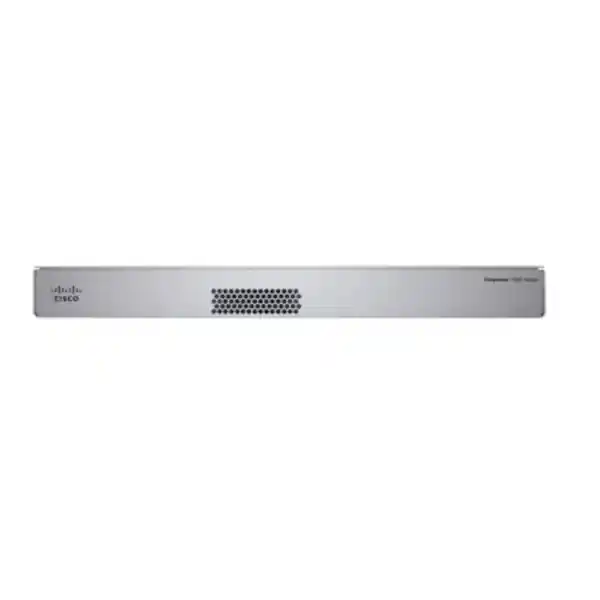
Cisco Firepower 1150 Firewall Dubai
A high-capacity 1RU security appliance for organisations that need strong branch or campus-edge firewall performance, application visibility, intrusion prevention, VPN capacity and a practical mix of Gigabit copper, 1 Gigabit fibre and 10 Gigabit-capable SFP connectivity.
The FPR-1150 sits above the Firepower 1120 and 1140 in Cisco’s 1100 Series. Its value is not simply a larger headline throughput number: it gives buyers more room for inspected traffic, more concurrent sessions, more VPN peers and faster uplink options. Correct selection still depends on the security services enabled, traffic mix, packet size, encrypted traffic, growth expectations, management design and resilience requirements.
Direct answer: what is the Cisco Firepower 1150?
The Cisco Firepower 1150, product family identifier FPR-1150 and commonly ordered as FPR1150-NGFW-K9, is the highest-performance appliance in the Firepower 1100 family. It is a 1RU rack-mount firewall platform that supports Cisco Secure Firewall Threat Defense as well as Cisco ASA software. With Threat Defense, Cisco publishes 5.3 Gbps firewall plus Application Visibility and Control throughput, 4.9 Gbps firewall plus AVC plus IPS throughput, 6.1 Gbps NGIPS throughput, 2.4 Gbps IPsec VPN throughput under Cisco’s listed test profile, up to 600,000 concurrent sessions with AVC and up to 800 VPN peers.
It is mainly used where a smaller branch firewall would be too constrained but a larger enterprise chassis would be unnecessary. Typical candidates include larger offices, distributed enterprise branches, regional hubs, campus edges, Internet perimeter refreshes, SD-WAN/security projects, and organisations consolidating firewall, intrusion prevention, application control, remote-access or site-to-site VPN requirements into a centrally managed Cisco security architecture.
The most important factor to confirm is not the Internet circuit speed alone. Buyers need to determine the expected inspected traffic after enabling the actual services they intend to use, especially IPS, URL filtering, malware-related features, application inspection, TLS decryption and VPN. Cisco explicitly notes that realised performance varies with enabled features, traffic protocol mix, packet size and software releases. A 1 Gbps or 2 Gbps WAN does not automatically mean a smaller appliance is sufficient, and a 5 Gbps WAN does not automatically mean the 1150 is sufficient once demanding inspection or future growth is included.
FourTeck can help map the FPR-1150 to interface media, traffic volumes, subscription needs, management model, VPN requirements, high-availability design and migration scope so that the quotation reflects the real deployment rather than only the chassis.
Why the Firepower 1150 occupies a distinct place in the 1100 Series
The Firepower 1100 family is often discussed as a single group, but the individual models are not interchangeable. The 1010 is a compact desktop-oriented model, while the 1120, 1140 and 1150 are rack-mount systems. The 1150 is the step to consider when inspection load, session counts, connection rates, VPN scale or higher-speed uplinks have moved beyond what the 1120 and 1140 comfortably provide. This matters for UAE organisations refreshing an older ASA, consolidating security services, adding higher-bandwidth Internet connectivity, or turning a branch into a regional aggregation point.
Cisco’s published Threat Defense figures illustrate the progression. The 1120 is listed at 2.3 Gbps FW+AVC, the 1140 at 3.3 Gbps, and the 1150 at 5.3 Gbps. For FW+AVC+IPS, the 1150 is listed at 4.9 Gbps. NGIPS throughput rises to 6.1 Gbps on the 1150. Concurrent sessions with AVC increase to 600,000, and Cisco lists up to 28,000 new connections per second with AVC. These values make the 1150 materially different from the lower models for environments with many users, cloud applications, east-west dependencies across routed zones, or workloads that generate large numbers of short-lived sessions.
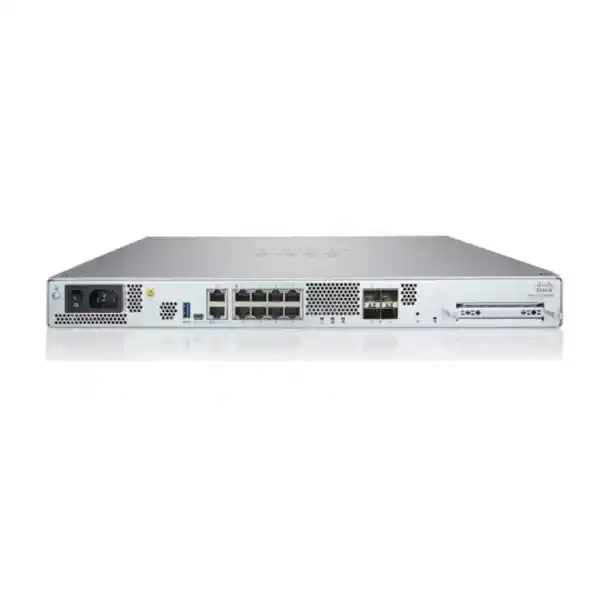
The interface mix is also distinctive. The appliance provides eight Gigabit Ethernet RJ-45 data ports, four fixed SFP positions, with two of those SFP ports supporting 10 Gbps on the 1150. Cisco’s data sheet summarises the arrangement as eight RJ-45, two SFP and two 10G SFP+ interfaces. This is useful when a design needs copper access or handoff ports plus fibre uplinks, and particularly where a 10 Gigabit connection to a core switch, distribution layer or upstream environment is required. Optics and cabling must be selected for the actual fibre type, distance, transceiver support and switch-side interface.
The 1150 therefore deserves its own buying decision rather than being treated as simply a faster 1140. Its higher throughput, VPN allowance, session scale and 10G-capable ports can solve practical bottlenecks, but those strengths only create value when the rest of the network is designed around them. A buyer with a low-bandwidth branch and modest inspection needs may be better served by a smaller model; a buyer expecting multi-gigabit encrypted inspection, heavy TLS decryption, substantial future growth, redundant power requirements or substantially higher density may need to evaluate a newer or larger Cisco Secure Firewall platform instead.
Cisco Firepower 1150 key specifications
| Specification | Cisco Firepower 1150 |
|---|---|
| Threat Defense FW + AVC | 5.3 Gbps with Cisco’s stated 1024-byte test profile |
| FW + AVC + IPS | 4.9 Gbps with the stated 1024-byte profile |
| NGIPS throughput | 6.1 Gbps |
| TLS throughput | 1.4 Gbps in Cisco’s published Firepower 1000 data-sheet profile |
| IPsec VPN throughput | 2.4 Gbps, 1024B TCP with Fastpath in the published Threat Defense table |
| Concurrent sessions with AVC | Up to 600,000 |
| New connections per second with AVC | Up to 28,000 |
| Maximum VPN peers | Up to 800 |
| Network ports | 8 × Gigabit Ethernet RJ-45 plus 4 fixed SFP positions; on the 1150, two SFP positions support 10 Gbps. Cisco’s summary lists 8 × RJ-45, 2 × SFP and 2 × 10G SFP+. |
| Management port | 1 × Gigabit Ethernet RJ-45 10/100/1000 BaseT, intended for management access |
| Console | RJ-45 console and USB Mini-B console access |
| USB | 1 × USB 3.0 Type-A |
| Storage | 200 GB 2.5-inch SATA SSD; Cisco’s current hardware guide identifies the drive as field-replaceable |
| Form factor | 1 RU rack-mount appliance |
| Dimensions | Approximately 1.72 × 10.58 × 17.2 inches (H × W × D) |
| Weight | Approximately 8 lb / 3.63 kg |
| Power | One fixed internal AC power supply; no redundant power supply |
| Software support | Cisco Secure Firewall Threat Defense or Cisco Secure Firewall ASA software |
Performance figures are laboratory-oriented reference values, not guaranteed application throughput. Cisco states that performance varies according to enabled features, traffic protocol mix, packet sizes and software release. A useful design therefore treats published throughput as a sizing input rather than a promise that every production environment will reach the headline number.
Understanding performance before you size the FPR-1150
Firewall throughput is only one layer
A simple stateful firewall workload, an application-aware policy and an IPS-enforced policy are not equivalent. When buyers compare appliances solely on the WAN circuit rate, they can miss the processing impact of security controls. The 1150’s 5.3 Gbps FW+AVC and 4.9 Gbps FW+AVC+IPS figures are useful because they show that Cisco tests multiple service combinations rather than presenting one universal number. Production sizing should match the intended security stack.
TLS inspection can become the real constraint
Encrypted application traffic has grown across web, SaaS and cloud services. If an organisation plans to decrypt a large share of outbound or inbound TLS traffic for inspection, the relevant capacity may be very different from ordinary firewall throughput. Cisco publishes a 1.4 Gbps TLS figure for the 1150 in its Firepower 1000 data sheet. The practical result depends on cipher suites, software, policy and traffic characteristics, so a decryption-heavy design deserves explicit modelling.
Sessions and connection rate matter too
Cloud applications, DNS activity, browser tabs, collaboration tools, mobile devices, guest networks, API traffic and modern web architectures can generate many concurrent flows. The 1150 is published for up to 600,000 concurrent sessions with AVC and up to 28,000 new connections per second with AVC. An environment with moderate bandwidth but very high connection churn can stress a firewall differently from a large sequential file-transfer workload.
A sound sizing exercise starts with peak rather than average demand. Review current WAN utilisation, inter-zone traffic that will cross the firewall, expected Internet growth, site-to-site VPN traffic, remote-access VPN users, cloud on-ramps, guest traffic, backup flows, software distribution, voice and video paths, and any data-centre or server traffic routed through the security policy. Then identify which services will inspect those flows. If the deployment is replacing an existing appliance, collect performance counters and connection statistics over representative business periods rather than relying on a single snapshot.
Capacity headroom should also be deliberate. Buying an appliance that operates close to a design limit on day one leaves less room for feature additions, software changes, traffic growth or incident-driven load. Conversely, oversizing without a clear reason can waste budget that might be better spent on licensing, redundant appliances, appropriate optics, support, management capacity or implementation services. The correct question is not “Is the 1150 fast?” but “Does the 1150 have the right inspected capacity for this policy, this traffic mix and the next stage of the organisation’s network?”
Ports, optics and physical network design
The Firepower 1150’s port layout is one of its strongest practical differentiators. Eight Gigabit Ethernet RJ-45 interfaces can accommodate copper handoffs, routed inside zones, DMZ links, management-adjacent network segments or connections to switches and service devices. Four fixed SFP positions add fibre flexibility; on the 1150, two of those ports support 10 Gbps. This enables a design in which the firewall connects to a 10 Gigabit core while still servicing one-gigabit links elsewhere.
The presence of an SFP or SFP+ slot does not mean any optic can be inserted. Transceiver selection must match supported Cisco optics, required speed, single-mode or multimode fibre, connector type, link distance and the configuration of the device at the far end. Cisco’s current Firepower 1100 hardware documentation lists supported transceiver families for the fixed ports and identifies software-release dependencies for some optics. A quotation should therefore specify not only the firewall chassis but also the required transceiver part numbers and patching where fibre connectivity is part of the design.
Port-count planning should distinguish physical ports from logical segmentation. A VLAN design may allow one physical trunk to carry many security zones, while some architectures require dedicated physical interfaces for operational, performance, compliance or troubleshooting reasons. Current Cisco documentation lists the Firepower 1140 and 1150 with support for up to 1024 VLAN subinterfaces under applicable Threat Defense management. That does not mean a design should create hundreds of zones without governance; it means the platform has considerable logical segmentation capability when the architecture genuinely calls for it.
EtherChannel and redundancy decisions also need to be checked against the intended software and topology. Current Cisco documentation notes support for multiple EtherChannel interfaces on Firepower 1120/1140/1150 platforms, with platform-specific behaviour. If the firewall is connecting to stacked switches, virtual chassis, a data-centre fabric or separate upstream devices, determine whether the switching architecture, LACP design and failure domains align with the firewall configuration. High link availability is not automatically the same as firewall high availability.
Finally, reserve the dedicated management interface for its intended role rather than treating it as an extra arbitrary data port. Management-plane reachability, DNS, NTP, licence communication, logging, backup, monitoring and administrative access should be designed as part of the deployment. A firewall that passes traffic correctly but has fragile management connectivity becomes harder to maintain during upgrades, incidents and recovery work.
Threat Defense or ASA: choose the operating model deliberately
The FPR-1150 hardware can run Cisco Secure Firewall Threat Defense or Cisco Secure Firewall ASA software, but these are different operational choices. Threat Defense is the natural path when the objective includes Cisco’s next-generation firewall capabilities such as application visibility and control, intrusion prevention, Security Intelligence, URL controls and malware-related functions subject to the appropriate licence entitlements. ASA software may be relevant where an organisation has established ASA operational practices, specific feature dependencies or a migration path that requires the ASA software model.
The decision should be made before the implementation plan is finalised because it affects licensing, management, configuration workflow, migration method and feature availability. It also affects how the team will operate the firewall after go-live. A security team standardised on Firewall Management Center may prefer Threat Defense for centralised policy, event visibility and management across multiple devices. A smaller environment may use local management where supported. Cloud-delivered management options may also be relevant depending on the software release, organisational standards and current Cisco service architecture.
Existing ASA customers should avoid assuming that every configuration line translates directly into an identical Threat Defense function. Object structures, NAT logic, VPN design, access control, intrusion policy, routing, identity integration and logging workflows may need deliberate migration work. A technically successful hardware replacement can still cause operational problems if policy semantics, management responsibilities and change procedures are not mapped in advance.
For a new deployment, the software choice should follow the security outcome and operating model rather than nostalgia for an older platform. For a refresh, document the existing software version, current feature set, active VPN types, routing protocols, NAT policy, failover configuration, third-party integrations, authentication dependencies and logging destinations. Those details often determine the migration effort more than the act of racking the new appliance.
Security capabilities that influence the buying decision
Application visibility and control
Cisco lists AVC as a standard capability for Threat Defense in the Firepower 1000 data sheet, supporting recognition of thousands of applications and contextual policy decisions. Buyer value comes from controlling traffic according to application identity and risk rather than relying only on port numbers. Policy quality still depends on careful rule design, identity context and exception handling.
Intrusion prevention
IPS capability can inspect traffic for exploit patterns and malicious activity using Cisco’s security intelligence and signature ecosystem. The practical requirement is to tune protection to the network being defended. Overly permissive policy weakens protection; poorly understood aggressive blocking can interrupt legitimate services. Capacity planning should use an inspection profile, not only stateful firewall throughput.
Security Intelligence
Security Intelligence can use reputation and threat intelligence for IP, URL and DNS-related decisions. This can stop or classify known-bad activity earlier in the policy path. Organisations should still define update access, DNS architecture, exception processes and monitoring so reputation controls support operations rather than becoming an opaque block list.
URL filtering
URL categorisation can support acceptable-use policy, risk reduction and differentiated Internet access when the necessary subscription is in place. Buyers should define whether the goal is simple category blocking, more granular web policy, user-aware controls or security enforcement. HTTPS behaviour and decryption strategy can materially affect visibility.
Malware-related protection
Cisco offers malware defence and analysis capabilities as licensed functions within the broader security stack. These can add file reputation, analysis and tracking functions depending on the entitlement and software. A procurement request should specify whether malware defence is required so the quote includes the proper subscription rather than only the appliance.
Licensing and subscriptions: do not treat the chassis as the whole solution
A Cisco Firepower 1150 quotation can look incomplete if the buyer focuses only on the hardware PID. Cisco licensing differs according to whether the appliance runs Threat Defense or ASA, how it is managed and which security functions are required. Current Cisco Threat Defense documentation identifies a required base entitlement and separate feature areas such as IPS, Malware Defense, URL Filtering and Cisco Secure Client. Terminology can evolve across software and licensing generations, so the exact entitlement names and ordering structure should be validated against the software version and current Cisco ordering system at the time of purchase.
For Threat Defense, a buyer wanting only basic firewalling does not have the same subscription requirement as a buyer wanting full intrusion prevention, URL controls, malware-related features and remote-access VPN. The business should define desired capabilities first, then choose an appropriate term and bundle. One-year, three-year and five-year approaches are common in Cisco subscription structures, but availability and SKU composition should be checked at quotation time rather than copied from an old bill of materials.
Remote-access VPN adds another licensing dimension. The appliance’s published maximum VPN peer count is a platform capacity reference, not a statement that every remote user entitlement is automatically included. Cisco Secure Client licensing, user counts, authentication platform, MFA integration, posture requirements and remote-access design must be considered separately. For site-to-site VPN, validate tunnel count, crypto requirements, expected aggregate encrypted throughput, route design and whether VPN traffic also receives deeper inspection.
Centralised management can also introduce its own commercial and architectural requirements. A customer using Firewall Management Center hardware, virtual FMC or cloud-delivered management should confirm the management entitlement and device capacity relevant to that design. Existing Cisco customers may already have a Smart Account and virtual account structure; new customers should plan who owns licensing administration, who can generate registration tokens and how assets will be assigned. This avoids delays where hardware has arrived but the implementation team lacks licensing access.
Support coverage is another line item worth treating separately from subscriptions. A firewall is a business-critical control point, so the desired hardware replacement response, software support access, upgrade entitlement and escalation path should match business risk. A low-cost quote that omits the required subscriptions, management entitlements, optics or service coverage is not necessarily a comparable quote.
High availability and resilience planning
The Firepower 1150 can participate in high-availability designs, but resilience begins with identifying failure domains. Two firewall appliances can protect against a chassis failure, yet an implementation can remain vulnerable to a single upstream switch, a single ISP circuit, one power distribution path, one fibre route or one management dependency. The HA conversation should therefore extend beyond buying a second firewall.
Under Threat Defense, Cisco publishes active/standby high availability for the Firepower 1000 family. Under ASA, Cisco’s Firepower 1000 data sheet lists active/active and active/standby capabilities for the 1120, 1140 and 1150, subject to the ASA feature and licensing model. Do not assume that an HA method used on an existing ASA deployment translates unchanged into Threat Defense. The target software image is essential to the design.
A proper HA bill of materials accounts for two appliances, comparable licences or subscriptions as required, matching interfaces and optics, appropriate switch ports, failover/state links, rack space and power. The design should also consider how software upgrades will be conducted, how state is synchronised, what happens during a link failure, and how upstream routing converges. If the organisation expects maintenance without a noticeable business outage, upgrade methodology and application sensitivity should be discussed before go-live.
The 1150 has one fixed internal AC power supply and does not provide a redundant power supply within a single chassis. This is an important physical limitation. In environments where power resilience is critical, a pair of appliances connected to appropriately independent power paths can provide better system-level resilience than a single unit, but the exact arrangement depends on rack power design and site infrastructure. Organisations that require redundant hot-swappable power supplies within each firewall should evaluate a different Cisco platform whose hardware architecture meets that requirement.
Typical Cisco Firepower 1150 deployment scenarios
Large branch or regional office edge
A large branch may carry ordinary Internet access, collaboration, SaaS, guest traffic, cloud applications, site-to-site VPN and local server traffic. The 1150 can be attractive when the office has outgrown entry-level firewall capacity or needs higher session scale. The design should confirm whether local breakout or central backhaul is used, how many security zones are needed, and whether the branch will aggregate smaller sites.
Campus Internet perimeter
A campus with several access and distribution switches may need a firewall that can connect upstream at 10 Gigabit while enforcing policy for multiple internal segments. The 1150’s two 10G-capable SFP positions can make it more suitable than models limited to 1 Gigabit fibre. Actual inspection demand, redundancy and future bandwidth should be tested against the intended security stack.
VPN aggregation
Cisco publishes up to 800 VPN peers and a 2.4 Gbps IPsec VPN throughput reference for Threat Defense under its stated test method. This can suit organisations aggregating branch tunnels or supporting a sizeable remote-access population. The design still needs to distinguish site-to-site and remote-access licensing, encryption standards, authentication, MFA, routing, split-tunnel policy and expected concurrent traffic.
Security consolidation
An organisation replacing separate firewall, IPS and web-control tools may consider Threat Defense to consolidate enforcement and visibility. Consolidation can simplify policy ownership but it also places multiple services on the same appliance. Capacity must be modelled with those features active, and the security team should decide how alerts, changes and exceptions will be handled centrally.
ASA refresh with migration planning
Customers moving from older ASA appliances may choose the 1150 for better hardware performance while preserving an ASA software path, or use the refresh as an opportunity to adopt Threat Defense. The right option depends on required features, operational skills, change appetite and migration complexity. Policy translation, NAT, VPN and routing should be validated in a staged plan rather than treated as a chassis swap.
Segmented internal security
The platform can also sit between internal zones where organisations need controlled access between user networks, server segments, DMZs, partner links or regulated environments. This can increase traffic crossing the appliance well beyond Internet bandwidth. East-west flow volume, application dependencies and logging load should be understood before sizing.
Management, monitoring and operational ownership
A firewall’s operational model is as important as its hardware. Threat Defense can be managed locally or through centralised Cisco management options depending on the deployment and software release. Cisco documents Firewall Management Center for centralised configuration, logging, monitoring and reporting, along with cloud-delivered management options. The organisation should decide where policy authority lives before the rollout, because ad hoc mixed management can complicate change control and troubleshooting.
For one standalone branch, local management may seem attractive because it reduces infrastructure. For multiple sites, central management can provide a common object model, standard policy, shared visibility and more consistent operations. Yet centralisation also creates requirements around FMC sizing, licensing, reachability, backup, upgrades and administrator roles. If the business already has an FMC deployment, confirm its software compatibility and managed-device capacity before adding the FPR-1150.
Logging volume deserves attention. Security policies can produce large event streams, especially when IPS, URL, connection and file logging are enabled broadly. Decide which events need long-term retention, where they will be stored, how they are searched, and whether a SIEM or SOC consumes them. Logging everything indefinitely is not automatically better; it can create storage and analysis burden. The goal is to retain the events required for investigation, compliance, operational troubleshooting and threat detection.
Administrative access should be integrated with the organisation’s identity and security standards where practical. Define privileged accounts, MFA requirements, role separation, break-glass access, management network restrictions, change approval and configuration backup. NTP and DNS must also be reliable. Incorrect time breaks event correlation and certificate validation; poor DNS design can interfere with licensing, updates and management services.
Finally, assign ownership. The network team may control routing and interfaces, the security team may own access and inspection policy, and an SOC may own alert response. If responsibilities are unclear, firewall changes become slow or risky. A deployment plan should specify who approves rules, who performs upgrades, who handles certificate renewals, who responds to security events and who owns vendor support cases.
VPN design considerations for Dubai and multi-site UAE networks
Many UAE organisations operate more than one office, warehouse, retail location, clinic, school, branch or cloud environment. A Firepower 1150 may act as a hub for site-to-site IPsec tunnels, a termination point for remote users, or both. The published capacity of up to 800 VPN peers gives useful scale, but the correct design depends on tunnel topology and traffic patterns. Hundreds of mostly idle tunnels are a different workload from a smaller number of continuously busy encrypted links.
For site-to-site VPN, document the peer devices, IKE versions, encryption algorithms, route model, overlapping networks, NAT requirements, failover behaviour and whether dynamic routing will cross the tunnels. If cloud connectivity is part of the project, determine whether the firewall connects directly to cloud VPN gateways or whether a dedicated SD-WAN or cloud-edge architecture is more appropriate. The design should also account for whether decrypted VPN traffic receives IPS, URL or application inspection after termination.
Remote-access VPN requires identity architecture. Cisco Secure Client entitlement, user counts, authentication source, multi-factor authentication, endpoint posture expectations and split-tunnel policy all affect the solution. For a workforce using SaaS and cloud services, sending all remote traffic through a central firewall can create bandwidth and latency implications. A split-tunnel model can reduce central load but requires a deliberate security policy for directly accessed cloud services.
Availability is equally important. If remote access is business-critical, a single firewall and single ISP may be inconsistent with continuity goals. An HA firewall pair, multiple circuits or DNS/failover mechanisms may be appropriate. The correct pattern depends on public IP addressing, upstream routing, application requirements and user expectations. Testing should include more than successful login; validate failover, DNS, MFA, application access, large file transfer, voice/video behaviour and recovery after network interruption.
The Firepower 1150 can provide substantial VPN capacity for its class, but the business outcome depends on a complete design. Procurement should therefore distinguish hardware capacity from user licensing and from the engineering required to deliver a resilient remote-access or branch-connectivity service.
Migration from an existing firewall: what to inventory first
A firewall migration is usually a policy and dependency project disguised as a hardware project. Before replacing an ASA, Firepower, Fortinet, Palo Alto, Sophos or another perimeter device with the FPR-1150, build a current-state inventory. Start with physical interfaces, VLANs, IP addressing, routing, NAT, access rules, VPNs, DHCP or relay functions, DNS dependencies, object groups, certificates, authentication servers, monitoring systems, syslog targets and any policy-based routing or special application handling.
Then identify which rules are actually used. Old firewalls often accumulate obsolete objects and permissive access rules. Simply translating every legacy rule into the new appliance carries technical debt forward and can reduce security. Migration is a good opportunity to remove expired services, consolidate duplicates and document business owners, provided the cleanup is controlled and does not create unplanned outages.
VPNs deserve their own workbook because they often depend on third parties. A tunnel to a bank, supplier, logistics provider, cloud platform or overseas office may require coordination that cannot be completed instantly during a change window. Record peer addresses, encryption domains, pre-shared keys or certificate methods, IKE/IPsec proposals, tunnel monitoring and contact details. If public IP addresses will change, notify counterparties early.
Certificates also cause avoidable migration delays. Determine which certificates are used for remote-access VPN, TLS inspection, management interfaces or site-to-site authentication. Check expiry dates, private-key availability and trust chains. If TLS decryption is introduced as part of the upgrade, endpoint trust distribution and application exceptions need testing because certificate pinning and privacy-sensitive applications can behave differently.
A change plan should define pre-checks, configuration freeze, backup, rack and cabling steps, test cases, decision points and rollback. Test not only basic Internet access but also inbound services, SaaS applications, ERP connectivity, branch tunnels, DNS, voice, printing, monitoring, backups and remote administration. The fastest migration is not always the one with the shortest outage window; it is the one that discovers dependencies before the outage begins.
For larger environments, a staged migration can reduce risk. Install and register the new firewall, load policy, validate management, prepare interfaces and licences, then cut over during a controlled window. Where topology permits, selected services can sometimes be migrated gradually. The appropriate method depends on IP addressing, routing and physical network design.
Installation environment and physical deployment checks
The Firepower 1150 is a 1RU rack-mount appliance. Current Cisco hardware documentation specifies rear-to-front airflow, so rack placement should respect the site’s hot-aisle/cold-aisle arrangement and leave the airflow path unobstructed. Do not treat the appliance as an ordinary desktop firewall. It belongs in a controlled rack environment with appropriate power, grounding, cooling, cable management and administrative access.
Cisco lists an operating temperature range of 0 to 40°C for the Firepower 1100 rack-mount models. In Dubai and the UAE, external climate makes reliable conditioned equipment-room cooling especially important. A room that is comfortable during normal operation may still exceed safe temperature if cooling fails. Monitoring rack temperature and UPS status is therefore part of maintaining the firewall, not merely a facilities concern.
The appliance uses a single fixed internal AC power supply. Plan the UPS and power distribution accordingly. If the organisation has dual power feeds, one chassis cannot independently connect to both because there is no redundant internal power supply. A two-appliance HA design can distribute units across separate protected power paths when site infrastructure permits, reducing the risk from a single chassis or feed failure.
Rack depth and cable routing should be verified before delivery, especially in compact wall cabinets. Cisco lists approximate chassis dimensions of 1.72 × 10.58 × 17.2 inches. The physical depth of cables and power connectors adds practical clearance. Fibre patch cords should respect bend radius and be labelled to avoid accidental cross-connects during maintenance.
The 200 GB SATA SSD is field-replaceable according to Cisco’s current hardware guide, while the fixed fan and power supply are internal and not user-replaceable. This matters for service planning: not every hardware fault can be solved by swapping a component onsite. Appropriate Cisco support and an agreed RMA process are therefore important for sites where extended downtime is unacceptable.
FPR-1120 vs FPR-1140 vs FPR-1150: when the 1150 is worth the step up
| Buyer factor | FPR-1120 | FPR-1140 | FPR-1150 |
|---|---|---|---|
| FW + AVC | 2.3 Gbps | 3.3 Gbps | 5.3 Gbps |
| FW + AVC + IPS | 2.3 Gbps | 3.3 Gbps | 4.9 Gbps |
| Concurrent sessions with AVC | 200K | 400K | 600K |
| Maximum VPN peers | 150 | 400 | 800 |
| Fibre / higher-speed emphasis | 4 × 1G SFP | 4 × 1G SFP | 2 × 1G SFP + 2 × 10G-capable SFP positions |
The 1120 can be a strong fit when a branch needs rack-mount hardware, Gigabit fibre and moderate inspected throughput. The 1140 roughly doubles the 1120’s concurrent-session allowance and raises inspection performance. The 1150 makes the clearest case where 10 Gigabit uplink capability, materially higher inspection throughput, 600,000-session scale or a larger VPN requirement justifies the additional hardware cost.
A smaller model can be the better choice when the environment has modest bandwidth and no realistic growth path that would use the 1150’s extra capacity. A larger or newer Cisco Secure Firewall platform should be evaluated if the required inspected throughput approaches the 1150’s limits, if TLS decryption demand is high, if redundant power inside each appliance is mandatory, if interface density is insufficient, or if the project standardises on a newer product generation with a longer intended lifecycle. The comparison should therefore include business lifecycle and architecture, not only purchase price.
When the Cisco Firepower 1150 may be the wrong choice
Balanced product selection requires identifying limitations. The FPR-1150 is not automatically the best firewall because it is the highest model in the 1100 Series. It may be oversized for a small office where Internet bandwidth, users and security inspection are modest. In that case, the budget difference could be better used for an HA pair, stronger support coverage, professional migration or longer subscriptions.
It may also be undersized for a demanding perimeter. Organisations expecting several gigabits of TLS-decrypted traffic, large volumes of advanced inspection, very high session churn, significant east-west traffic or rapid bandwidth growth should compare the 1150 against higher-performance Cisco platforms. Headline FW+AVC throughput is not the right capacity measure when decryption and multiple security services dominate the workload.
The single fixed power supply can be a decisive limitation for certain data-centre standards. If a requirement states that every network appliance must have dual hot-swappable power supplies connected to independent PDUs, the 1150 does not meet that hardware condition. An HA pair improves overall service resilience but does not change the physical power architecture of each chassis.
Port architecture can also rule it out. The two 10G-capable SFP positions are valuable, but a design needing many 10G interfaces, network modules or higher-density fibre connectivity may fit a larger platform more naturally. Similarly, organisations standardising on a later Cisco Secure Firewall generation should compare software support horizon, feature roadmap and operational consistency before buying an older platform solely because it is familiar.
Finally, product availability and lifecycle must be checked at quotation time. Enterprise security hardware evolves, and procurement decisions should consider current Cisco ordering status, recommended replacements, software compatibility and support horizon. A technically capable appliance can still be the wrong long-term investment if the organisation’s refresh cycle extends beyond the practical support window.
Procurement checklist for an accurate Firepower 1150 quotation
A useful request for quotation contains enough technical context to prevent important components from being omitted. The following checklist is more valuable than asking only for “one Cisco Firepower 1150” because the appliance is one part of a deployable security solution.
Sizing questions FourTeck uses to qualify the requirement
Good firewall sizing is an engineering conversation. The most useful input is a picture of the traffic and policy rather than a single broadband speed. FourTeck will typically need to understand how many users and devices the site supports, how traffic changes at peak time, whether the firewall protects only Internet access or also internal routed segments, and which security services will be active.
The Internet circuit should be described by current and planned bandwidth, including secondary links. If the site has two 1 Gbps circuits configured active/active, the firewall may need to process more than a single 1 Gbps circuit. If a future upgrade to 5 Gbps is planned, the design should account for that. If significant inter-VLAN or server traffic crosses the firewall, that load should be added to the perimeter demand rather than ignored.
Security policy depth is next. A basic access-control deployment has a different performance profile from one using IPS on most traffic, URL filtering for users, malware inspection, file policy and broad TLS decryption. If only selected categories are decrypted, describe them. If privacy, regulatory or application compatibility requirements create exclusions, include those too. This helps build a realistic inspected-throughput model.
Connection behaviour should be considered where available. Large user populations, guest Wi-Fi, IoT systems, development environments or high-volume SaaS use can create many sessions. Existing firewall counters for concurrent connections and connections per second are useful evidence. Where those values are unknown, user/device count, application mix and growth plans provide a starting point.
VPN sizing needs concurrent users, number of site-to-site tunnels, expected encrypted bandwidth and authentication requirements. Remote-access users may generate voice/video, virtual desktop or file-transfer traffic that is far heavier than occasional email access. Site-to-site links may carry backups or replication overnight even if daytime use is modest.
Finally, availability and lifecycle shape the recommendation. A site that can tolerate a maintenance outage may accept one appliance; a critical location may need HA. A buyer planning a long five- to seven-year lifecycle should consider capacity growth and current product lifecycle information. The result may validate the 1150, point to a smaller 1100 model, or justify comparison with a newer/higher Cisco Secure Firewall platform.
Operational lifecycle: upgrades, backups and support readiness
A firewall is not finished when the implementation ticket is closed. Software updates, vulnerability fixes, intrusion signatures, threat intelligence, certificates, subscriptions and configuration changes continue throughout its life. The organisation should create a maintenance rhythm from the beginning. That includes tracking recommended software releases, reviewing release notes, testing major upgrades, validating configuration backup and confirming that support entitlements remain active.
Upgrade planning should account for the management platform and HA design. In an HA environment, maintenance procedures can reduce outage risk, but application sessions and routing behaviour still need testing. A pre-upgrade backup, documented rollback decision and post-upgrade validation list are basic controls. Critical VPNs, NAT services, inbound publishing, dynamic routing, DNS and monitoring should be explicitly checked after maintenance.
Security policy should also be reviewed. Organisations often add temporary firewall rules during projects and never remove them. Quarterly or semi-annual rule review can identify expired access, unused objects and overly broad exceptions. IPS and URL policies also deserve periodic tuning as applications and risk change. A clean policy is easier to troubleshoot, audit and migrate later.
Configuration and event backups should be stored where the recovery team can access them during an incident. Do not assume that the firewall itself is the only copy needed. Central manager backups, device configuration, certificates, VPN secrets under proper secure handling, topology documentation, licence details and support contract information all contribute to recoverability.
Support readiness is practical rather than administrative. Know the appliance serial number, Cisco Smart Account ownership, support contract, software version, management version and escalation contact before a failure occurs. This reduces time lost during an incident. For remote branches, also document who can provide physical access, console connectivity and power-cycle assistance if central administrators cannot reach the firewall.
Frequently asked buyer questions
Is the Firepower 1150 suitable for a 5 Gbps Internet connection?
It may be, but the answer depends on the active security stack. Cisco publishes 5.3 Gbps for FW+AVC and 4.9 Gbps for FW+AVC+IPS under a 1024-byte test profile. TLS inspection is listed at a lower figure. A 5 Gbps circuit with heavy decryption or multi-service inspection can therefore require a larger platform or a more detailed traffic model. Growth and peak utilisation should also be included.
Does the FPR-1150 have 10 Gigabit interfaces?
Yes. Cisco documents four fixed SFP positions on the platform, with two of the 1150’s SFP ports supporting 10 Gbps. The data-sheet summary describes the interface mix as eight RJ-45, two SFP and two 10G SFP+. Supported optics, fibre type and far-end compatibility must still be selected correctly.
Can it run ASA software?
Yes. Cisco’s current Firepower 1100 hardware documentation states support for Secure Firewall Threat Defense and Secure Firewall ASA software. The right image depends on required features, management model, licensing and migration strategy. Do not assume Threat Defense and ASA provide identical workflows or HA behaviour.
How many VPN peers can the Firepower 1150 support?
Cisco publishes a maximum of 800 VPN peers for the 1150. That is a platform reference. Actual deployment design must also consider VPN throughput, remote-access user licensing, authentication, encryption choices and the amount of traffic each tunnel carries.
Does it include redundant power supplies?
No. The 1150 uses one fixed internal AC power supply. Cisco states that redundant power is not supported on the 1100 rack-mount chassis. If redundant power within each device is mandatory, evaluate another platform. If service resilience is the goal, an HA pair connected to separate protected power paths may reduce broader failure risk.
Does the firewall include all security subscriptions?
No. The appliance hardware and the desired security subscriptions should be treated separately. Threat Defense feature requirements such as IPS, URL filtering, malware defence and remote-access client use can create additional entitlement needs. The software image, management method and subscription term should be specified in the quotation.
Can the Firepower 1150 be managed centrally?
Yes. Cisco documents centralised management for Threat Defense using Firewall Management Center and supported cloud-delivered management options. Existing FMC customers should verify manager software compatibility and device capacity. New deployments should include management ownership, licensing, backups and reachability in the design.
Is the 200 GB SSD replaceable?
Cisco’s current Firepower 1100 hardware guide identifies the 200 GB 2.5-inch SATA SSD as field-replaceable and lists spare PIDs. The internal fan and fixed power supply are not field-replaceable in the same manner, which is relevant when planning support and RMA procedures.
Should I buy the 1150 instead of the 1140?
Choose the 1150 when its higher inspected throughput, larger session and VPN capacity, or 10G-capable SFP ports address a real design need. If the 1140 has adequate headroom for the expected lifecycle and interfaces, it may be more economical. If the 1150 is already close to the design ceiling, compare a larger or newer Cisco platform rather than stretching the appliance.
What information is needed for a Dubai installation quote?
Provide quantity, location, rack details, WAN speeds, interface media, optics, user and device counts, security feature requirements, VPN needs, management method, HA requirement, support level and migration scope. If the project replaces another firewall, a sanitized configuration summary or interface/rule inventory greatly improves quotation accuracy.
UAE availability, implementation and specialist resources
For Cisco Firepower 1150 requirements in Dubai and across the UAE, availability should be confirmed against the exact hardware, subscription term, optics and support package. Enterprise firewall supply can vary by distributor stock, product lifecycle and licence configuration, so the most reliable quotation is tied to a complete bill of materials rather than a generic chassis listing.
Customers can use FourTeck UAE for broader UAE technology requirements and infrastructure coordination. For projects that combine firewall deployment with onsite support, network remediation, migration or managed operational work, FourTeck IT Services UAE provides a relevant service path. Organisations with regional or international requirements can also review FourTeck for broader group capabilities.
A complete UAE deployment may include firewall supply, licences, transceivers, rack installation, cabling, configuration, migration, VPN setup, high-availability configuration, policy review, testing and documentation. The scope can be reduced to supply-only where an internal team will implement the appliance, or expanded when the customer needs end-to-end responsibility. Defining the boundary early avoids duplicated work between customer, reseller and implementation partner.
For urgent replacements, share the failed or existing model, current software, interface layout and whether configuration backup is available. For planned refreshes, share growth targets and desired security outcomes. Planned projects generally produce a better long-term design because there is time to validate licensing, optics, management integration and application dependencies before the cutover.
Decision recap: six points that should drive the final shortlist
What FourTeck needs from the buyer
For an accurate Cisco Firepower 1150 Dubai quotation, send the following practical inputs. Exact data is ideal, but reasonable estimates are enough to start the sizing discussion.
Confirm whether the Firepower 1150 is the right firewall for your UAE network
The FPR-1150 is a capable 1RU firewall with a useful combination of multi-gigabit inspection performance, strong session scale, VPN capacity and two 10G-capable SFP ports. Its best fit is a deployment that can use that capacity without exceeding the platform’s limits once real security services are enabled. Share your bandwidth, users, inspection requirements, interfaces, VPN design, management model and resilience expectations to build a bill of materials that reflects the actual project.

Reviews
There are no reviews yet.