
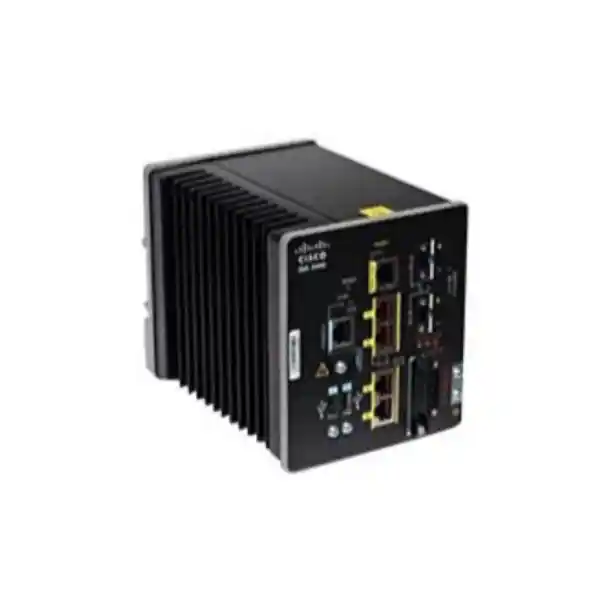
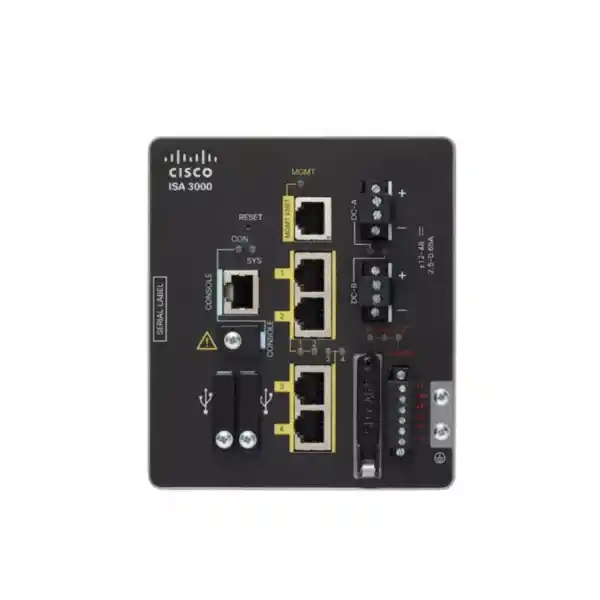
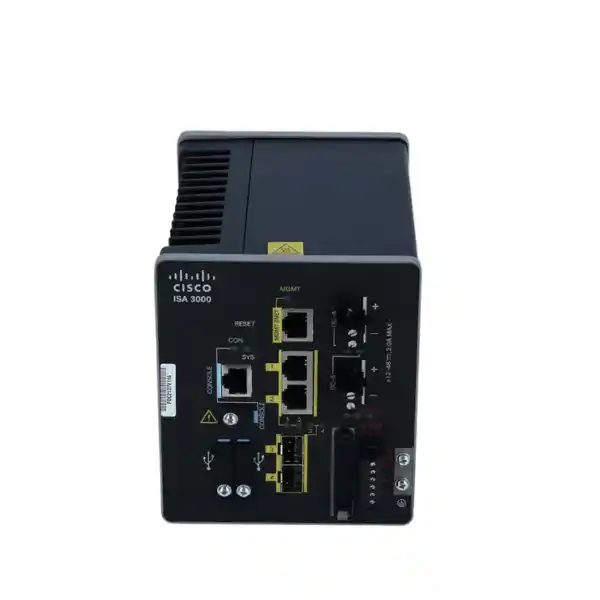
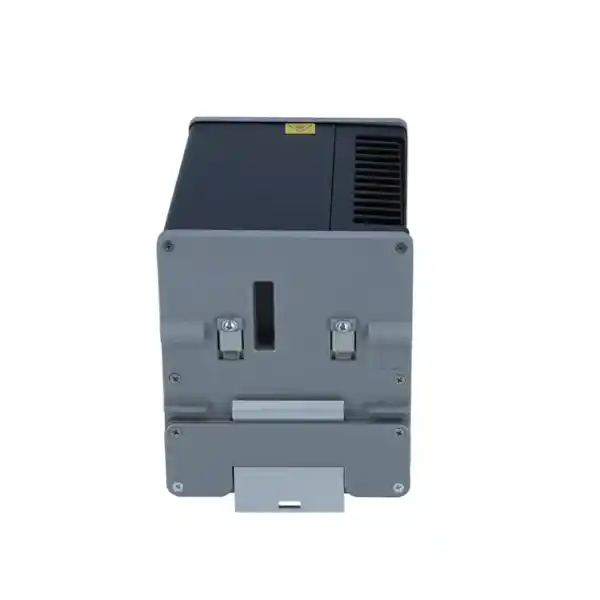
Cisco ISA-3000-2C2F Industrial Firewall
A ruggedized Cisco Secure Firewall ISA3000 variant with two copper Gigabit Ethernet data ports and two 1GbE SFP fiber data ports, built for industrial environments where network segmentation, controlled IT/OT connectivity, secure remote access and resilient physical deployment matter as much as firewall policy.
Direct answer for buyers
What is it? The Cisco ISA-3000-2C2F is the mixed-media fiber model in the ISA3000 industrial security appliance family. Cisco identifies the fiber SKU as providing two 10/100/1000Base-T copper data interfaces and two 1GbE SFP data interfaces, in addition to a dedicated management port.
What is it mainly used for? It is designed to place firewall policy, segmentation, threat controls, routing, VPN and industrial application visibility close to operational technology assets in plants, utilities, transport systems, remote sites and other industrial networks.
Who should consider it? Organizations that need a compact DIN-rail security appliance in industrial conditions, particularly where a topology requires both copper device connectivity and fiber uplinks or inter-zone links.
What must be confirmed first? Confirm the exact orderable software identity: Cisco documentation lists ISA-3000-2C2F-K9 with ASA base software and ISA-3000-2C2F-FTD with Threat Defense. Licensing, management and feature planning depend on that choice.
What can FourTeck determine? FourTeck can help map required ports, optics, software, licenses, traffic profile, VPN needs, redundancy, installation, power, grounding and migration scope to the correct bill of materials.
Understanding the exact ISA-3000-2C2F model identity
The model name matters because the ISA3000 family contains physically similar appliances with different interface arrangements and software identities. In Cisco ordering documentation, the ISA-3000-2C2F designation identifies the hardware arrangement with two copper data ports and two SFP fiber ports. The nearby ISA-3000-4C alternative uses four copper data ports and no SFP fiber ports. That distinction is fundamental: it affects cabling, optics, uplink design, spare strategy and whether the appliance can connect directly to fiber distribution without an external media converter or adjacent switch providing the conversion.
The model string shown on a request for quotation is often abbreviated to ISA-3000-2C2F, but Cisco lists separate orderable forms for ASA and Threat Defense software. That means a buyer should not treat the abbreviated hardware family name as a complete bill of materials. The intended operating system, feature subscriptions, management architecture and high-availability requirement all need to be attached to the hardware decision. A technically correct quotation starts by identifying the deployment objective, then resolving the exact SKU and software path rather than assuming that every ISA-3000-2C2F request is interchangeable.
This is especially important in OT environments because firewall replacement is rarely an isolated hardware swap. Industrial sites may have maintenance windows, fixed cabinet dimensions, DC power schemes, fiber standards, bypass expectations, legacy routing, VLAN boundaries, remote-access dependencies and monitoring integrations that have remained stable for years. Treating the model identity as the first checkpoint reduces the risk of buying the right chassis with the wrong software, optics or licensing.
Verified hardware and platform specifications
| Specification | Cisco ISA-3000-2C2F detail | Buyer relevance |
|---|---|---|
| Data ports | 2 × 10/100/1000Base-T copper plus 2 × 1GbE SFP | Supports mixed copper/fiber industrial topologies without using all-copper data interfaces. |
| Management | Dedicated 10/100/1000 management port | Plan a management network, address, access controls and reachability separate from data interfaces where appropriate. |
| Console | RJ-45 console plus mini-USB console | Useful for commissioning and local recovery where remote management is unavailable. |
| Processor / memory | 4-core Intel Atom industrial-temperature processor, 8 GB DRAM | Platform capacity must still be assessed using Cisco performance figures and the intended security services, not CPU labels alone. |
| Storage | 16 GB onboard flash, 64 GB mSATA, removable industrial SD flash support | Relevant to platform operation and field-service procedures; do not treat storage as user-expandable application capacity without checking Cisco guidance. |
| Mounting / cooling | DIN-rail mounted, fanless, convection-cooled | Suitable for many industrial cabinets, but airflow and temperature limits still need to be respected. |
| Dimensions | Approximately 11.2 × 13 × 16 cm (W × H × D) | Check actual cabinet clearance for connectors, fiber bend radius, DC wiring and service access. |
| Power | Dual internal DC inputs; nominal ±12, 24 or 48 VDC; operating range 9.6–60 VDC; 24 W consumption | Confirm plant DC supply, redundancy, protective devices, conductor sizing and grounding design. |
| Environmental | Industrial operating ranges, with Cisco installation guidance listing -40°C to 60°C at 0 LFM and higher maximum temperatures with specified airflow; 0–95% RH non-condensing; IP30 | Temperature ratings are conditional. Cabinet design, airflow and ambient conditions must be assessed rather than quoting a single maximum temperature in isolation. |
| Alarm I/O | Two alarm inputs and one Form C alarm output relay | Can support integration with local industrial alarm or monitoring workflows when engineered correctly. |
Why the 2C2F interface mix is significant
The two-copper/two-fiber arrangement is not merely a cosmetic port variation. It gives system designers flexibility at locations where local machines, PLC-facing switches or service devices use copper while the site backbone, inter-building link or control-center connection uses fiber. Fiber can be attractive in industrial environments because it provides electrical isolation and can support longer distances than standard copper Ethernet, but the actual benefit depends on the selected SFP type, fiber plant, connector standard, link budget and installation practice.
Cisco lists ruggedized SFP options for the ISA3000 family, including 1000BASE-SX and 1000BASE-LX/LH models as well as ruggedized Fast Ethernet fiber options. Those optics are separate design decisions. A quotation should not simply say “two fiber ports” and assume the existing optical plant is compatible. The engineering team needs to know whether the installed fiber is multimode or single-mode, the approximate distance, patch-panel arrangement, connector and patch-cord requirements, and whether the site’s standard optics have already been validated for the appliance.
The copper ports have an additional continuity characteristic: Cisco documentation identifies bypass capability on the UTP data ports. In certain industrial designs, bypass behavior can be important because a failure of the security appliance should not automatically become a hard physical break in a critical path. However, bypass does not mean that every deployment will preserve the same security posture during a failure. A bypassed path may maintain traffic flow while reducing or removing firewall enforcement, so operational risk, process safety and cybersecurity policy must determine whether bypass is acceptable and how alarms should be handled.
For new deployments, the 2C2F model is therefore best selected after drawing the physical path: what is on each side of the firewall, which links are copper, which are fiber, whether traffic continuity is required, where management resides, and how local technicians will access the device. That topology-first method prevents the common mistake of selecting an appliance solely from an interface count without confirming media, role and failure behavior.
Performance: read the security profile, not just the port speed
Gigabit Ethernet interfaces do not imply a gigabit of inspected application traffic. Cisco publishes performance figures for the ISA3000 using Firepower Threat Defense, and these figures should be treated as platform reference points rather than guarantees for every production traffic mix.
| FTD performance metric | Published figure | Planning interpretation |
|---|---|---|
| NGIPS throughput, 1024-byte packets | 500 Mbps | Useful ceiling reference for intrusion-prevention-focused traffic, not a substitute for site-specific sizing. |
| Firewall + AVC throughput | 375 Mbps | Application visibility and control changes the performance context from basic packet forwarding. |
| Firewall + AVC + IPS throughput | 350 Mbps | A more relevant planning figure when the design expects policy enforcement plus application inspection and IPS. |
| Concurrent sessions with AVC | 50,000 | Session count matters in distributed or chatty systems even when aggregate bandwidth appears modest. |
| New connections per second with AVC | 2,700 | Burst behavior, polling patterns and supervisory applications can make connection rate relevant. |
| IPsec VPN throughput, 1024-byte TCP with Fastpath | 50 Mbps | Remote-site backhaul and encrypted replication should be checked against expected sustained and burst traffic. |
| Maximum VPN peers | 25 | Confirm peer count, topology and software/license requirements before using the platform as a VPN concentrator. |
Real throughput depends on packet size, protocol mix, enabled security features, encrypted traffic, inspection policy, logging, software release and network behavior. In an OT environment, a low average bandwidth figure can be misleading because deterministic control traffic, bursts, historian transfers, engineering downloads, backups, cameras or maintenance sessions may share a path. A sizing discussion should therefore review both normal production flows and unusual maintenance or incident conditions.
Industrial protocol visibility and policy relevance
The ISA3000 is positioned for OT because its security functions can understand more than generic IP addresses and TCP or UDP ports. Cisco documentation lists support for a broad set of industrial and building-automation protocols, including BACnet, CIP, DNP3, EtherNet/IP, IEC 60870-5-104, IEC 61850 MMS, Modbus, OPC UA, Omron FINS and Siemens S7 among others. This matters because industrial security policy often needs to distinguish a permitted process-control flow from other traffic using the same network segments.
Protocol awareness can support more precise control, but it should not be confused with automatic process safety. The firewall needs a well-understood traffic baseline, correct policy design and careful change control. For example, allowing “Modbus” broadly may be too coarse where only specific controller-to-controller paths should exist. Conversely, blocking a command simply because it looks unusual can interrupt a legitimate maintenance process if the policy was built without operations input. The strongest projects bring control engineers, network engineers and security teams together so rules reflect actual process relationships.
Industrial visibility is also useful during segmentation projects because many brownfield sites contain undocumented dependencies. A passive or learning-oriented phase can reveal which devices communicate, what services they use and how frequently they exchange traffic. That information can be converted into a zone-and-conduit design and eventually into explicit firewall policy. The goal is not to deploy the most restrictive rules on day one; it is to move from unknown connectivity toward controlled, documented and monitored connectivity without creating avoidable production risk.
Organizations considering the Cisco ISA-3000-2C2F should identify which industrial protocols actually matter at the target site and check the selected software release, inspection capabilities and policy requirements. Protocol support lists evolve across software versions, so the desired control should be validated against the intended release rather than inferred solely from a family-level datasheet.
Where the Cisco ISA-3000-2C2F fits in an OT security architecture
Industrial DMZ boundary
The appliance can be used to create or protect a demilitarized zone between enterprise IT and industrial control networks. This is appropriate when historian replicas, jump hosts, patch repositories, remote-access services or other shared systems need controlled connectivity without directly bridging business and control zones.
Cell or zone segmentation
A plant can use industrial firewalls to separate production areas, lines, machine cells or safety-relevant network zones so lateral movement is constrained. The actual placement should follow process dependencies and operational recovery requirements, not arbitrary VLAN boundaries.
Remote industrial site
Substations, pumping stations, pipeline locations, street cabinets and distributed industrial assets may use the ISA3000 to enforce local policy and establish controlled VPN connectivity back to a central network. Power, temperature, WAN resilience and remote support become central design questions.
Inline protection of legacy assets
Older PLCs, HMIs, controllers or engineering systems may not support modern endpoint security controls. An industrial firewall can provide network-level restrictions around such assets, though it does not eliminate the need for patch, backup, hardening and lifecycle planning.
Fiber-connected zone boundary
The 2C2F variant is particularly useful where the firewall itself should terminate fiber on one or both sides of a security zone. The correct SFP selection, cable plant and distance still need engineering confirmation.
Secure maintenance access path
The appliance can participate in architectures that control remote engineering or vendor access through VPN and policy. Mature designs normally add identity, jump-host, approval, logging and session-governance controls rather than exposing industrial endpoints directly.
ASA or Threat Defense: the software choice changes the project
Cisco ordering information distinguishes ISA-3000-2C2F-K9, which is associated with ASA base software, from ISA-3000-2C2F-FTD, which is associated with Firepower Threat Defense. Buyers should therefore specify the desired software path rather than using the hardware family name alone. An existing site that has standardized on ASA operational processes may have different priorities from a new deployment centered on Threat Defense inspection, centralized management and modern Cisco Secure Firewall policy workflows.
The software selection affects feature behavior, licensing, management tools, migration tasks and performance interpretation. Cisco’s published performance table in the ISA3000 datasheet is explicitly labeled for Firepower Threat Defense. Where an organization wants to compare ASA-specific limits or feature support, the intended ASA release and license tier should be checked in current Cisco documentation. This is particularly important because old procurement notes may reference legacy Firepower Services terminology that does not represent the same lifecycle path as current Threat Defense.
For brownfield migration, the decision should begin with the current configuration. Document interface modes, VLANs, routes, NAT rules, access lists, VPN tunnels, certificates, authentication dependencies, logging targets, high-availability settings and any industrial protocol controls. Then map each function to the target software. A configuration migration can be more complex than moving a text file because object models, inspection features and management concepts differ across platforms and releases.
For greenfield deployments, Threat Defense may be attractive when the project is designed around application visibility, IPS, centralized policy and Cisco’s broader Secure Firewall management ecosystem. However, the correct choice should follow the customer’s architecture, operational skills, approved software standards and lifecycle plan. FourTeck can use those requirements to prepare a quotation that identifies the hardware SKU separately from any subscription, management or support components.
Licensing and subscriptions: what needs to be clarified
Industrial firewall buyers often concentrate on the appliance price first, but the usable solution depends on the software and licenses attached to it. Cisco documentation for the ISA3000 lists optional ASA Security Plus functionality and separate subscription families for threat/application, malware protection and URL filtering. Cisco also notes that Firepower Services 7.0 was the last Firepower Services release to run on Cisco ASA Firewall, which is one reason legacy licensing descriptions must be interpreted in lifecycle context rather than copied into a new quote without validation.
The practical first step is to define the required controls. If the appliance is being used primarily as a stateful segmentation firewall with routing and VPN, the necessary licensing profile may differ from a deployment that requires advanced intrusion prevention, URL filtering, malware analysis or centrally managed application policy. High availability can introduce another dependency. Cisco lists Security Plus as enabling capabilities such as HA, SSL VPN, greater connection counts and VLAN trunking in the ASA context, so an ASA design should confirm which feature set and license applies to the intended release.
Subscription term is also a procurement decision. One-, three- and five-year terms are common in Cisco security portfolios, but the exact purchasable part numbers and renewal structure should be confirmed at quotation time. Multi-year terms can simplify budgeting and reduce renewal events, while shorter terms may fit a transitional project or a site scheduled for modernization. The right answer depends on asset lifecycle, support policy and how long the organization expects this platform to remain in the architecture.
A good bill of materials therefore separates chassis, software identity, security subscriptions, management dependencies, support, SFP optics, power accessories and professional services. That structure makes the quotation auditable and allows a buyer to see which line items are permanent hardware, which are term-based entitlements, and which exist because of a particular deployment decision.
SFP selection for the two fiber interfaces
The two SFP sockets are one of the main reasons to choose the 2C2F model, but the appliance is not a complete fiber solution until the optics and fiber plant are matched. Cisco lists ruggedized SFPs for the ISA3000 family, including GLC-SX-MM-RGD for 1000BASE-SX and GLC-LX-SM-RGD for 1000BASE-LX/LH, along with ruggedized 100BASE-FX and 100BASE-LX options. These references illustrate that both speed and optical medium matter.
A 1000BASE-SX design normally aligns with multimode fiber and shorter reach, while 1000BASE-LX/LH is typically considered for single-mode or appropriate supported multimode scenarios. The actual link must be designed from Cisco optic specifications and the installed cabling, not from the firewall name. Fiber type, core size, distance, patch-panel losses, connector cleanliness, bend radius, spare strands and environmental exposure can all affect reliability.
Industrial cabinets add practical constraints. Fiber patch cords need protected routing and sufficient service loop without violating bend limits. The front-panel area should remain accessible for replacement, and technicians should be able to identify which fiber corresponds to which security zone. Where the site uses non-Cisco optics as a corporate standard, compatibility and support implications must be checked rather than assumed. The safest procurement path is to specify the required optical link and let the bill of materials identify validated optics explicitly.
If the project does not require direct fiber termination, the ISA-3000-4C may be a simpler alternative because all four data ports are copper. Conversely, if two native fiber links remove media converters, reduce cabinet complexity or align with a fiber backbone, the 2C2F can be the more coherent choice. That is a topology decision, not a marketing preference.
Power, grounding and cabinet engineering
Cisco designed the ISA3000 for industrial DC environments. The platform uses dual internal DC inputs, with a nominal range around ±12, 24 or 48 VDC and a published maximum operating range of 9.6 to 60 VDC. Power consumption is listed at 24 W. Those numbers make the appliance easier to integrate into many control cabinets than an AC-only rack firewall, but they do not remove the need for a proper power design.
The installer should confirm the available DC source, polarity, redundancy objective, upstream protective devices, conductor gauge, terminal arrangement and whether the two inputs are supplied from genuinely independent sources or simply duplicated from one supply. If uptime requirements justify dual feeds, the design should ensure a single upstream fault does not defeat both inputs. Site electrical standards and local engineering practices govern the final implementation.
Grounding is equally important in industrial settings. The hardware includes a grounding point, and installation should follow Cisco’s hardware guide and the facility’s electrical practices. The purpose is not only human safety; a disciplined grounding and bonding approach supports predictable behavior in environments with electrical noise, surge exposure and nearby high-power equipment. Improvised grounding can create faults that are difficult to diagnose because the symptoms may look like intermittent network instability rather than an obvious electrical problem.
Cabinet layout should account for more than the published chassis dimensions. Allow room for DC terminal access, fiber patching, copper bend radius, console access, alarm wiring, labels and removal from the DIN rail. Because thermal limits depend on ambient temperature and airflow, avoid treating a small chassis as permission to pack it into the hottest available corner of an enclosure. The site survey should record enclosure temperature, ventilation, dust conditions and nearby heat-generating equipment.
Environmental ratings: use the conditions, not only the headline number
Cisco’s hardware installation documentation lists industrial operating conditions that are more demanding than typical office firewalls. The guide states operating temperatures of -40°C to 60°C at 0 linear feet per minute airflow, -40°C to 70°C at 40 LFM and -34°C to 75°C at 200 LFM, with 0 to 95 percent relative humidity non-condensing and an IP30 ingress-protection rating. These figures are useful, but the airflow conditions are part of the specification and should remain attached to the temperature figure.
In Dubai and the wider UAE, outdoor or semi-outdoor industrial cabinets can experience high ambient temperatures, solar loading and dust. The ISA3000’s rugged design is beneficial, yet a system integrator still needs to determine whether the enclosure maintains the required internal conditions. A firewall rated for industrial temperature is not automatically suitable for an unventilated cabinet exposed to direct summer sun. Enclosure insulation, shade, ventilation, filtration or active cooling may be required depending on site conditions.
IP30 also has a precise meaning and should not be interpreted as a weatherproof enclosure. Where a site requires protection from water, fine dust or aggressive contaminants, the surrounding cabinet must provide the necessary environmental protection. Similarly, shock and vibration certifications help the appliance tolerate industrial conditions, but cable retention and mounting quality still matter because poorly secured fiber or power conductors can fail before the chassis itself does.
A practical site survey therefore records the actual enclosure, ambient range, heat sources, airflow, dust, moisture risk, vibration, mounting rail, DC power and cable entry points. This turns the environmental specification into an engineering decision instead of a generic claim that the firewall is “rugged.”
Traffic continuity and copper bypass considerations
Cisco documentation describes the ISA3000’s UTP data ports as having bypass capability and highlights traffic continuity as part of the industrial design. Bypass can be valuable in an inline architecture where losing process communications may have serious operational consequences. If the appliance fails or enters a condition in which the configured bypass behavior activates, the copper path can be designed to preserve connectivity rather than becoming an immediate open circuit.
However, availability and security are not the same objective. A bypassed connection may allow traffic to continue without the same inspection or policy enforcement. That creates an explicit risk tradeoff: is it safer for a particular process to keep communicating temporarily without firewall enforcement, or safer to fail closed? The answer varies by industrial process, safety architecture, regulatory requirement and incident-response policy.
The decision should be documented during design and tested during commissioning. Operations personnel need to understand what alarms occur, which traffic path remains, how the event is logged, what remote monitoring sees and how service is restored. If the firewall is part of a safety-related control path, cybersecurity design must be coordinated with the process safety team rather than making bypass assumptions from a network perspective alone.
The 2C2F model adds another nuance: bypass behavior applies to the UTP copper data ports, not the SFP fiber sockets in the same way. A topology that relies on fiber paths for continuity may therefore require a different resilience design, such as redundant links, redundant appliances, alternate network paths or a high-availability architecture. This is one reason the physical diagram should be reviewed before the product is ordered.
High availability: define the failure you are trying to survive
Cisco lists active/standby failover for the ISA3000 platform. High availability can reduce the impact of an appliance failure, but a pair of firewalls does not automatically create end-to-end resilience. A robust design asks which failures must be tolerated: firewall hardware, DC supply, switch port, fiber strand, upstream WAN circuit, management path, software upgrade or entire cabinet.
If both appliances share the same power source, same enclosure and same upstream switch, the design may still have several common points of failure. An HA architecture should therefore be drawn with power, links and switching components visible. In industrial environments, physical separation may be limited, but even modest improvements such as independent DC feeds, diverse switch ports and correctly arranged fiber paths can make the redundancy meaningful.
Software and licensing also need attention. Cisco documentation associates Security Plus with HA enablement in the ASA context, while Threat Defense has its own licensing and management requirements. The correct entitlement should be confirmed for the selected software release. Configurations, certificates, interface addressing and monitoring must also be designed so a failover event does not leave the standby unit logically isolated.
Finally, failover must be tested against real industrial traffic. A successful state change in the management interface is not enough if PLC sessions, historian flows, VPN tunnels or supervisory communications experience unacceptable interruption. Commissioning should record the behavior of representative critical flows so operations teams know what to expect during a real fault.
VPN and remote industrial access planning
The ISA3000 supports site-to-site and remote-access VPN capabilities, which can make it suitable for distributed industrial sites and controlled engineering access. Cisco’s FTD performance table lists 50 Mbps of IPsec VPN throughput using its stated 1024-byte TCP Fastpath test and a maximum of 25 VPN peers. These figures help determine whether the platform is an appropriate endpoint for the intended number and volume of encrypted connections.
A remote pumping station that sends telemetry and receives occasional engineering access may have very different requirements from a site that backhauls camera streams, historian replication and large software images over VPN. Average bandwidth should not be the only sizing input. The team should identify peak encrypted traffic, number of peers, tunnel topology, expected concurrent maintenance sessions, certificate or authentication design, and whether failover must preserve VPN service.
Security architecture is equally important. Direct vendor VPN access to a control network is rarely a complete governance model. Mature designs may require multifactor authentication, identity integration, a jump host, approval windows, time-limited access, command or session monitoring, and explicit network policy that limits each vendor to required assets. The firewall provides important controls, but the remote-access process also depends on identity and operational procedures.
For UAE sites managed from a central operations center, latency and carrier reliability should also be considered. A secure tunnel does not fix an unstable last-mile link. Where remote access is critical to maintenance, the network design may need secondary WAN connectivity or a local emergency-access procedure that remains controlled and auditable.
Routing, NAT, VLANs and network services
Cisco describes the ISA3000 as more than a transparent bump-in-the-wire firewall. Networking capabilities include IPv4 static routing and several dynamic routing protocols, NAT and PAT, IPv6 support, 802.1Q trunking, DHCP and DNS services, logging, and hardware-enabled IEEE 1588 Precision Time Protocol support. This flexibility allows the appliance to take different roles depending on the industrial architecture.
The presence of a routing feature does not mean it should automatically be enabled. Industrial networks often contain long-lived address plans, controller dependencies and vendor assumptions that can be disrupted by topology changes. A routed firewall may create clearer security boundaries and simplify policy interpretation, while transparent deployment can reduce addressing changes during segmentation. The right mode should be selected from migration risk, routing ownership and the desired visibility of security zones.
VLAN planning requires software and licensing awareness. Cisco’s published FTD performance table lists up to 100 VLANs for FTD and shows different ASA counts depending on Security Plus. Buyers who need trunking and multiple virtual interfaces should therefore confirm the exact ASA or FTD release and license rather than relying on a generic “supports VLANs” statement.
NAT can also be useful during brownfield projects when overlapping address spaces or legacy systems make renumbering difficult. Yet excessive NAT can hide topology and complicate troubleshooting. Each translation should have a clear reason, and engineering documentation should preserve both original and translated addresses so operations teams can trace an incident without reverse-engineering the rule set.
Management, logging and operational ownership
Cisco describes several management approaches for the ISA3000 family, including local device management, centralized firewall management and cloud-based management options depending on software and release. The right method depends on the size of the deployment and organizational operating model. A single isolated site may value local management simplicity, while a fleet of industrial firewalls normally benefits from centralized policy, software lifecycle control, event visibility and consistent backup procedures.
Management architecture should be designed as part of the network, not added after commissioning. Determine whether the dedicated management interface connects to an out-of-band network, whether remote industrial sites can reliably reach the manager, what happens during WAN failure, which administrative identities are allowed, and how configuration changes are approved. OT teams often require stricter maintenance-window coordination than office IT because a policy change can affect production communications.
Logging is also a capacity and operations question. Cisco documents local logging, syslog and integration with security monitoring ecosystems. A useful design sends actionable security events to the organization’s monitoring platform while retaining enough local context for troubleshooting. Logging every permitted industrial packet may create noise and unnecessary volume; logging too little may make incident investigation impossible. Policy should distinguish security-significant events, denied communications, administrative changes, VPN activity and health alarms.
Ownership needs to be explicit. Decide who can change firewall rules, who can approve industrial communication changes, who responds to an IPS alert, who maintains certificates, and who performs software upgrades. The technical platform works best when those responsibilities are documented before the site becomes dependent on it.
A practical deployment journey for an industrial site
1. Discover the existing traffic
Build an asset and communication inventory. Identify controllers, HMIs, engineering workstations, historians, gateways, switches, remote users, routing paths and recurring maintenance flows. Capture both normal production traffic and periodic activities such as firmware updates or backups.
2. Define zones and trust boundaries
Translate the asset inventory into security zones. Separate enterprise IT, industrial DMZ, supervisory systems, machine cells, vendor access and safety-relevant systems where the process architecture supports such separation.
3. Validate the physical topology
Confirm whether each firewall link is copper or fiber, identify the required SFP types, check cabinet space, DC power, grounding, environment and bypass expectations. This is where the 2C2F versus 4C decision becomes concrete.
4. Size the security workload
Measure normal and peak traffic, sessions, new connection rates, VPN volume and inspection requirements. Compare those values with Cisco’s published performance profile while leaving sensible headroom for growth and maintenance bursts.
5. Choose software and licensing
Decide between the applicable ASA and Threat Defense path, then identify management, subscriptions, HA dependencies, VPN needs and support. The orderable hardware string alone is not enough.
6. Stage and test before cutover
Build the configuration in a controlled environment, verify management and logging, confirm optics and cabling, test representative industrial flows and document a rollback method. Commissioning should include operations personnel who understand the process.
Migration from an existing industrial firewall
Replacing an existing firewall with the Cisco ISA-3000-2C2F should start with a configuration and dependency audit. Export or document interfaces, VLANs, routes, NAT, access rules, service objects, VPN parameters, certificates, authentication sources, NTP, DNS, syslog, SNMP, management addresses and any high-availability settings. Then identify which rules are still valid. Industrial firewalls often accumulate exceptions over years, and blindly copying them can preserve risks that the refresh project is intended to reduce.
The physical side needs the same discipline. Verify whether existing copper links are auto-negotiated or fixed, whether fiber links use compatible optics, whether patch leads and connectors are in good condition, and whether the cabinet has correct DC wiring. A configuration may be perfect while the project fails because an old fiber path uses an unexpected wavelength or because the new appliance cannot be serviced comfortably within the existing enclosure.
Cutover planning should distinguish reversible steps from disruptive ones. Pre-stage objects, routes and policies; validate monitoring; prepare labeled cables; record old and new port mappings; and define rollback criteria. During the maintenance window, test communications from the perspective of the industrial process, not only with ping. A PLC-to-HMI session, historian upload, engineering connection or time synchronization flow may expose policy issues that a simple ICMP test does not.
After cutover, keep heightened monitoring for a defined observation period. Denied traffic should be reviewed carefully because it may represent either a legitimate dependency missed during discovery or unwanted communication that the new segmentation is correctly blocking. The objective is stable operations with a cleaner, documented policy—not merely a successful device replacement.
When the ISA-3000-2C2F is a strong fit
- You need a DIN-rail industrial firewall rather than a climate-controlled rack appliance. The platform is designed for industrial temperature, vibration and electrical conditions, subject to Cisco’s installation limits.
- Your topology genuinely benefits from two native fiber data ports. The 2C2F model is differentiated from the 4C variant by those SFP interfaces, making it useful where fiber is part of the security boundary.
- You require OT-aware security controls. Cisco documents visibility and control for many industrial protocols, with Threat Defense inspection capabilities and Talos-based threat protections available according to software and licensing.
- Your inspected throughput is within the platform’s realistic range. The published FTD figures—350 Mbps for firewall + AVC + IPS and 500 Mbps for NGIPS under Cisco’s stated test conditions—must be compared with actual traffic and headroom requirements.
- You need segmentation, routing, NAT and VPN in a compact industrial appliance. The ISA3000 can serve as a zone firewall, remote-site security gateway or industrial DMZ component depending on the architecture.
- You have an operational model capable of managing an industrial security appliance. The device adds value when rule ownership, software lifecycle, monitoring and incident handling are defined—not when it is installed and forgotten.
When another firewall should be evaluated
The supplied model should not be recommended automatically. A different platform may be more appropriate if the site needs substantially higher inspected throughput, more VPN capacity, a larger interface count, faster-than-Gigabit data ports, different physical media, a rack form factor, broader clustering options or a longer future growth runway. The ISA3000’s strengths are rugged industrial deployment and OT-focused security; they do not make it a universal replacement for high-capacity data-center firewalls.
The ISA-3000-4C should be compared when all four required data links are copper. Choosing 2C2F and then filling fiber ports with unnecessary media conversion adds complexity without benefit. The reverse is also true: choosing 4C when the design needs direct fiber termination may require extra equipment that the 2C2F could avoid.
A newer Cisco industrial security platform may also deserve evaluation when lifecycle horizon, software roadmap or feature requirements extend beyond the ISA3000 design. Procurement should confirm current Cisco orderability, support milestones, recommended software releases and product migration guidance at the time of purchase. A platform that technically fits today can still be a weak investment if its lifecycle does not align with the expected service life of the industrial project.
Finally, some segmentation requirements can be met by existing industrial switches, centralized firewalls or a different zone architecture with fewer inline appliances. Security architecture should determine the device count. Adding firewalls everywhere without operational capacity to maintain policy can create configuration drift and troubleshooting burden.
Cisco ISA-3000-2C2F versus ISA-3000-4C
| Decision point | ISA-3000-2C2F | ISA-3000-4C |
|---|---|---|
| Data interface mix | 2 copper 10/100/1000 + 2 SFP fiber | 4 copper 10/100/1000 |
| Best physical fit | Mixed copper/fiber topology or direct fiber zone links | All-copper topology |
| Optics requirement | SFP selection required when fiber ports are used | No SFP needed for the four copper data links |
| Copper bypass availability | Applies to the two UTP data ports; fiber paths need separate resilience planning | All four data interfaces are copper and are described by Cisco as bypass enabled |
| Primary buying question | Do we need native fiber at the firewall boundary? | Are all data links copper and likely to remain so? |
The two models share the industrial platform concept, so selection should generally be driven by interface media and topology rather than presumed security differences. Software identity remains a separate choice because Cisco lists ASA and FTD variants for both interface layouts.
Industry use cases in the UAE
Oil and gas
Remote stations, process areas and pipeline infrastructure may use rugged firewalls to segment control assets, control engineering access and secure routed or VPN links. Hazardous-location and cabinet requirements must be reviewed separately for the exact installation area.
Power and utilities
Substations and distributed utility assets often combine fiber backbones with industrial Ethernet. The 2C2F interface mix can align well with such topologies when security boundaries need native fiber termination.
Water and wastewater
Pumping stations, treatment plants and remote telemetry locations can benefit from local segmentation and secure central connectivity. WAN resilience and remote maintenance procedures are often as important as firewall throughput.
Manufacturing
Production lines and machine cells can be segmented to reduce lateral movement and restrict engineering access. Policy design should be based on observed controller, HMI, historian and vendor communication patterns.
Transportation
Roadside, rail, tunnel and traffic-management infrastructure can require fanless DIN-rail equipment with remote monitoring. Environmental enclosure design and communications redundancy should be considered from the start.
Critical facilities
Building-management, energy and industrial support systems may need separation from enterprise networks. The firewall can enforce a clear conduit, but asset inventory and ownership must be established before rules are tightened.
Security policy design for OT networks
An industrial firewall produces the most value when policy is based on allowed business and process relationships rather than a long list of generic denies. Start with zones: enterprise IT, industrial DMZ, supervisory control, process cells, vendor access and management. For each zone pair, identify which initiator needs to reach which destination, on what service or industrial protocol, and for what operational purpose. This produces rules that can be reviewed by both cybersecurity and operations teams.
The ISA3000’s industrial protocol awareness can make some rules more precise, but rule granularity should match operational understanding. If a plant does not know which Modbus functions a legacy device actually uses, aggressive command-level blocking may introduce unnecessary risk. The project can begin with visibility and logging, then tighten controls after traffic has been observed through representative production cycles.
Rule order and object hygiene matter. Use meaningful names for zones, hosts, networks and services. Avoid rules such as “any to any allow” unless they are explicitly temporary and governed by a removal date. Separate emergency exceptions from normal production policy. Document why each rule exists and who owns the application or process dependency. That information becomes invaluable during audits, migrations and incident response.
Policy should also anticipate degraded conditions. What happens during a management outage, a link failure, a bypass event, an expired certificate or an unavailable identity service? OT networks often continue operating during partial infrastructure failure. A security design should preserve necessary process continuity while avoiding hidden permanent exceptions created during incidents.
Threat inspection without disrupting production
Cisco positions the ISA3000 with Talos-developed threat intelligence, intrusion-prevention rules and industrial-focused detection. These controls can help identify exploit attempts, protocol abuse and suspicious behavior around systems that may be difficult to patch. That is particularly valuable in OT environments where controller firmware or application upgrades cannot be deployed as quickly as ordinary endpoint patches.
Inspection still requires staged tuning. IPS policies that are appropriate for enterprise user traffic may not map cleanly to deterministic control networks. Before blocking is enabled broadly, security teams should understand the asset types, protocol behavior and operational consequences of false positives. A common approach is to establish visibility, review alerts, suppress known benign patterns where justified and then enforce higher-confidence protections.
Encrypted traffic creates another planning question. Cisco lists TLS decryption support, but decryption in an OT network must be evaluated carefully because certificate handling, application compatibility and performance can be sensitive. Some industrial applications use proprietary or certificate-pinned communications that should not be intercepted. Others may run in cleartext and be inspectable without decryption. The inspection policy should follow the actual application inventory.
Security teams should also distinguish prevention from detection. Blocking every suspicious event is not always the correct operational response, especially during commissioning. For some critical systems, high-confidence alerts routed to a SOC may be the safer first control while the organization validates traffic behavior. The ISA3000 supports a layered program; it does not require every capability to be enabled at maximum strictness from the first day.
Installation checklist before the engineer arrives
Having these details available before installation reduces maintenance-window risk. It also allows staging to be completed off-site, so the engineer arrives with a tested baseline instead of building the firewall configuration beside a live production process.
Procurement details that make a Cisco ISA3000 quotation accurate
A complete RFQ should describe the technical outcome, not only the abbreviated model. The following information prevents avoidable revisions and makes it easier to distinguish hardware from licenses, optics and services.
Dubai and UAE deployment considerations
Industrial security projects in the UAE frequently span different site conditions: air-conditioned control rooms, outdoor utility cabinets, substations, warehouses, production floors, infrastructure corridors and remote desert locations. The ISA3000’s industrial construction is useful across many of these environments, but the surrounding enclosure and installation method determine whether the deployed system actually remains within specification.
For outdoor or semi-outdoor cabinets, engineers should evaluate summer ambient temperature, direct solar loading, dust ingress, ventilation, corrosion exposure and maintenance access. An IP30 appliance needs the enclosure to provide any higher level of environmental sealing required by the site. Where active cabinet cooling is used, its failure state should be considered because the network security appliance may continue to draw power after the cooling system stops.
Fiber availability can make the 2C2F particularly relevant in utility and campus-style industrial networks, where electrical isolation and distance favor optical links. At the same time, spare optics and patch leads should be planned as service items. A remote site can be difficult to restore quickly if a simple SFP failure requires a special trip and the correct ruggedized optic is not stocked.
For local consultation, procurement and deployment coordination, buyers can use FourTeck UAE for broader infrastructure requirements and FourTeck IT Services UAE where the firewall project is part of a larger migration, support or infrastructure engagement.
Support, software lifecycle and long-service industrial assets
Industrial networks often keep equipment in service for much longer than office IT, so firewall lifecycle planning should be explicit. Before purchase, confirm current Cisco orderability, software support, recommended release trains, security update availability, entitlement requirements and any announced migration path. Cisco’s support resources continue to publish ISA3000 installation and software documentation, including current ASA and Threat Defense upgrade guidance, but the exact lifecycle status should always be checked at the time of quotation because it can change.
Software upgrades in OT need a different change-management rhythm from ordinary user networks. The organization should establish a tested version strategy, maintenance windows, configuration backups, rollback procedures and compatibility checks with management systems. If the appliance performs industrial protocol inspection, release notes should be reviewed for inspection changes that could affect traffic classification or policy behavior.
Spares are another lifecycle question. A remote industrial site may justify a locally stored spare appliance, SFPs, power-terminal components or patch cables even when formal vendor replacement service is available. The cost of a spare should be compared with travel time, process impact and the difficulty of obtaining the exact component during an outage.
Documentation should be treated as part of the asset. Keep the bill of materials, serial numbers, license identifiers, configuration backups, network diagram, port map, power source, SFP type, installed software and support details in the maintenance record. A well-documented industrial firewall is dramatically easier to recover, migrate and audit years later.
Common buyer questions about the Cisco ISA-3000-2C2F
Does ISA-3000-2C2F have four data ports?
Yes. Cisco documents four data links on the ISA3000. On the 2C2F variant, two are 10/100/1000Base-T copper and two are 1GbE SFP fiber. There is also a dedicated management interface, which should not be confused with the four data ports.
Are the SFP modules included automatically?
The design should treat optics as separately specified components unless the quotation explicitly bundles them. Cisco lists supported ruggedized SFP options, and the correct optic depends on fiber type, distance and speed.
Can this firewall run ASA?
Cisco ordering information lists ISA-3000-2C2F-K9 with ASA base software. The required ASA release, license features and lifecycle should be confirmed for the intended deployment.
Can this firewall run Threat Defense?
Yes. Cisco lists ISA-3000-2C2F-FTD as the Threat Defense orderable model. Management architecture and security subscriptions should be specified with the hardware.
Is the firewall suitable for 1 Gbps inspected traffic?
Do not size it from interface speed alone. Cisco’s published FTD figures are 500 Mbps NGIPS, 375 Mbps firewall plus AVC, and 350 Mbps firewall plus AVC plus IPS under stated test conditions. A requirement close to 1 Gbps of inspected production traffic should trigger evaluation of a higher-capacity platform.
What is the published IPsec performance?
Cisco lists 50 Mbps IPsec VPN throughput for FTD using 1024-byte TCP with Fastpath and up to 25 VPN peers. Real design should account for the actual encryption profile, traffic mix and software release.
Does it support industrial protocols?
Cisco documents visibility and/or control for numerous OT protocols, including CIP, DNP3, EtherNet/IP, IEC 60870-5-104, IEC 61850 MMS, Modbus, OPC UA and Siemens S7. Required protocol support should be checked against the selected software release.
Is it fanless?
Yes. Cisco describes the ISA3000 as fanless and convection-cooled. Environmental limits still depend on ambient conditions and airflow, so enclosure design remains important.
What power does it require?
Cisco lists dual DC inputs, nominal ±12, 24 or 48 VDC, with a maximum operating range of 9.6 to 60 VDC and 24 W power consumption. Site power, protection and grounding should be engineered before installation.
Can it be used in high availability?
Cisco lists active/standby failover. The design must also account for software licensing, independent power, redundant links, management reachability and realistic failover testing.
Is the 2C2F always better than the 4C?
No. The 2C2F is preferable when native fiber interfaces are useful. If every link is copper, the 4C model may be simpler. Selection should follow the physical topology and spare strategy.
Can FourTeck install and migrate the firewall?
The project can be scoped for supply only or for a broader engagement covering site survey, staging, rule migration, installation, testing, documentation and operational handover. Accurate scope depends on the current firewall, network diagram and permitted maintenance window.
Building a maintainable ruleset
The initial configuration should be treated as the beginning of a lifecycle, not the end of a project. Industrial rulesets become difficult to manage when objects are named inconsistently, temporary access remains permanently enabled, old vendor exceptions are never removed and no one can explain why a rule exists. The firewall should therefore be commissioned with a naming standard, documented rule owner and review process.
A strong rule description records the business or process purpose, source zone, destination zone, required service or industrial application, requester and approval reference. Where access is temporary, add an expiry or review date in the change system. When a vendor no longer supports a machine, remove the associated remote-access path rather than leaving it dormant indefinitely.
Periodic review should compare configured policy with observed traffic. A rule that has not been used for a long period may be obsolete, but it should not be deleted automatically without checking the process calendar. Some industrial communications occur only during annual testing, emergency modes or shutdown maintenance. Operations knowledge is required to distinguish obsolete access from infrequent but legitimate access.
Centralized management can make review easier when multiple ISA3000 units are deployed, but governance still matters. A central console does not guarantee consistent policy if different administrators use different conventions. Define who owns global standards and which local exceptions are permitted so a fleet of firewalls remains understandable over time.
Monitoring the appliance as industrial infrastructure
A production ISA3000 should be monitored for more than security events. Operations teams need visibility into interface state, power status, environmental alarms where applicable, resource health, VPN status, failover state, time synchronization and management reachability. The platform’s alarm inputs and output relay can also be incorporated into site monitoring designs when appropriate.
Alert thresholds should be actionable. A SOC may care about repeated blocked exploit attempts or unusual industrial commands, while a network operations team may care about interface flaps, tunnel loss or high resource utilization. Sending every event to every team creates alarm fatigue. Define routing so each alert reaches the group capable of responding, and document escalation for events that may affect production.
Time synchronization deserves attention because incident reconstruction depends on accurate timestamps across PLC logs, firewall events, server logs and SIEM data. Cisco lists IEEE 1588 hardware-enabled PTP support along with ordinary network time capabilities, but the actual time architecture should follow site standards. A firewall clock that drifts from controller and historian systems can make a short industrial incident much harder to analyze.
Finally, monitor the monitoring path. Remote sites often depend on a WAN link to send logs centrally. If that link fails, the absence of logs should generate a health event rather than look like a quiet network. Local retention and recovery procedures should be sized so important evidence is not lost during an outage.
How to size beyond the datasheet numbers
Datasheet throughput provides a comparison baseline, but production sizing should use a traffic profile. Measure the current firewall if one exists. Record average and peak throughput by direction, packet rate, concurrent sessions, new connections per second, protocol mix, VPN volume and major periodic transfers. Then identify which security services will be enabled on the new appliance.
Industrial networks can have deceptively low average utilization. A historian export, controller image transfer, video stream, backup or engineering workstation update may create short peaks far above normal control traffic. If those activities occur during a narrow maintenance window, slow transfer speed may extend downtime even though routine production traffic is small. Capacity planning should therefore include maintenance and recovery scenarios.
Growth also needs a horizon. If the site will add production lines, cameras, additional remote assets or centralized logging, the firewall may need more headroom than today’s measurements suggest. It is usually less disruptive to choose adequate capacity initially than to replace an inline industrial firewall shortly after commissioning.
Conversely, oversizing is not automatically better. A larger enterprise firewall may require a different rack, power source, cooling environment or physical footprint that does not fit the industrial location. The best platform balances inspected performance, interfaces, environmental design, lifecycle and operational simplicity. The ISA-3000-2C2F is compelling when those factors point toward a compact rugged device with mixed copper and fiber—not merely because it carries an industrial label.
What should be documented after commissioning
A complete handover package should include the physical topology, logical zone diagram, interface map, IP addressing, VLANs, routing, NAT, policy summary, VPN details, management path, logging destinations, time sources, HA design, power feeds, SFP models and software version. The purpose is to make the installation understandable to a qualified engineer who was not present during the project.
The document should also contain operational procedures: how to perform a configuration backup, how to access the console, how to identify an HA failure, how to replace an optic, how to open a vendor support case, and which team approves rule changes. If bypass behavior is used, describe what traffic continues during bypass and how operations are notified that security enforcement may be reduced.
Credential information should be handled securely and should not be placed casually in the same handover document. Instead, identify the approved password vault, certificate repository or privileged-access process. The goal is to preserve operational knowledge without creating a sensitive document that becomes a new security risk.
Finally, schedule the first review. New segmentation often reveals unexpected traffic after several weeks of real operations. A post-implementation review can remove temporary rules, tune alerts, confirm backups and capture lessons from the maintenance window. That closes the project with a cleaner operational baseline rather than leaving all commissioning exceptions in place.
Commercial and service planning with FourTeck
A Cisco ISA3000 requirement can be quoted as hardware supply, but many industrial projects benefit from separating the commercial request into supply, subscriptions, optics, support and professional services. This makes it clear which parts of the cost are tied to the appliance, which recur with license terms, and which relate to migration or installation effort.
For a replacement project, provide the existing firewall make and model, current software, exported configuration where permitted, interface map, number of rules, VPN tunnels and maintenance-window constraints. For a new project, provide the network drawing, expected traffic, industrial protocols, fiber details and security zones. FourTeck can then determine whether the ISA-3000-2C2F is appropriately sized or whether another model should be compared.
If the engagement includes broader networking or server infrastructure, FourTeck can be referenced for wider technology capabilities. The product-specific security path remains available through the Firewall Dubai specialist site, while the UAE main site can support a combined local procurement conversation.
The objective is a bill of materials that can be implemented without hidden assumptions. A low hardware price is not useful if the project later discovers missing optics, wrong software, insufficient licensing or an installation scope that was never included. Procurement quality is measured by how few critical questions remain unresolved after the purchase order.
Decision recap
What FourTeck needs from you for an accurate quotation
Number of appliances, number of locations and whether each site requires a spare or HA pair.
Current software standard, desired target and any migration constraints.
Multimode or single-mode, approximate distance, speed and required number of active SFP links.
Peak inspected bandwidth, session scale, number of VPN peers and remote-access requirements.
Required IPS, application, malware or URL controls and preferred subscription term.
Supply only, staging, site survey, migration, installation, testing, documentation, training or ongoing support.
Plan the Cisco ISA-3000-2C2F around your actual industrial network
The right ISA3000 quotation should answer more than “is the firewall available?” It should identify the correct 2C2F software SKU, validated SFP optics, required subscriptions, realistic inspected capacity, power and environmental conditions, migration effort and operational support model. That approach protects both production continuity and cybersecurity objectives.

Reviews
There are no reviews yet.