

Cisco Meraki MX68W Dubai
Cloud-managed security, SD-WAN, wired connectivity and integrated Wi-Fi in one compact branch appliance for organizations that want centralized control without maintaining a traditional on-site firewall management platform.
Direct answer: what is the Cisco Meraki MX68W?
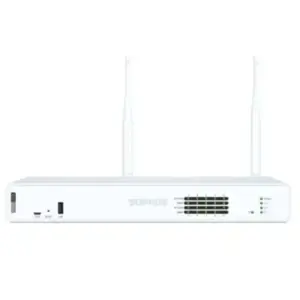
The Cisco Meraki MX68W is a compact cloud-managed security and SD-WAN appliance intended mainly for small branches, retail locations, professional offices, satellite sites and other distributed business environments. Cisco positions it for deployments of up to 50 users. The appliance combines security gateway functions, SD-WAN, two Gigabit Ethernet WAN interfaces, ten Gigabit Ethernet LAN interfaces, two PoE+ LAN ports and integrated dual-band 802.11ac Wave 2 Wi-Fi.
It is mainly used to secure Internet access, connect branch locations through Meraki Auto VPN, manage multiple WAN links, apply application-aware security and traffic policies, provide local Ethernet connectivity, and deliver basic integrated wireless coverage from the same device. It is especially relevant when an organization already uses Cisco Meraki Dashboard or wants a centrally managed branch architecture with straightforward remote provisioning.
The MX68W should be considered by buyers who need a small-branch appliance rather than a high-throughput campus or data-centre firewall. The most important factor to confirm is not simply the number of employees. Internet bandwidth, encrypted VPN traffic, security services, application mix, number of devices, expected growth, wireless coverage, licensing edition and resilience requirements all influence whether the MX68W is the correct model.
FourTeck can help determine whether the MX68W is appropriately sized, which Meraki license tier fits the intended security and SD-WAN features, whether integrated Wi-Fi is sufficient, whether a dedicated access-point design is more suitable, and what installation, migration or support work should be included in the Dubai or UAE quotation.
Why the MX68W is different from a basic branch firewall
The MX68W is not simply a router with an access-control list. Its value comes from combining several branch functions into the Meraki cloud-managed operating model. Security policies, uplink status, VPN connectivity, client visibility, application information and firmware management are handled through the Meraki Dashboard rather than through a traditional local command-line or device-by-device management workflow. For an organization with several branches, this can reduce the operational effort required to keep configurations consistent and to troubleshoot remote sites.
That management model changes the way the appliance should be evaluated. A buyer should consider the MX68W as part of an ongoing Meraki platform deployment, not as a one-time hardware purchase that can be fully separated from licensing and cloud management. The hardware choice, license edition, license term and Dashboard organization design all matter. Where the organization already has Meraki networks, the new appliance may need to follow existing licensing rules and configuration templates. Where Meraki is being introduced for the first time, the buyer should decide who will own the Dashboard organization, who will have administrative access, how configuration changes will be approved, and how the appliance will be monitored after handover.
Integrated Wi-Fi also makes the MX68W distinct from the non-wireless MX68. It can be useful in a small office where the firewall location is also a sensible wireless position and where a limited number of SSIDs can satisfy coverage needs. It should not, however, be assumed that a firewall mounted in a comms cabinet or wiring area automatically provides good office-wide Wi-Fi. RF coverage depends on placement, walls, interference, client density and the shape of the premises. If the firewall must be installed in a poor radio location, dedicated Meraki MR access points may produce a much better wireless design.
For many Dubai buyers, therefore, the best reason to choose the MX68W is consolidation: security, SD-WAN, local switching ports, two PoE+ outputs and wireless can be delivered from one cloud-managed platform at a smaller site. The same consolidation can become a limitation when the branch needs higher throughput, broader wireless coverage, more PoE capacity, more sophisticated switching, or substantially more users. Those are the points to resolve before purchase rather than after installation.
Core MX68W capabilities and what they mean for a buyer
Dual Gigabit WAN
Two dedicated GbE RJ45 WAN interfaces allow the appliance to connect to two Internet services. This supports designs that need failover or uplink load balancing. The presence of two WAN ports does not automatically mean both circuits will always be used equally; policy, application behavior and the configured uplink strategy determine how traffic is distributed.
Ten Gigabit LAN ports
The MX68W provides ten GbE RJ45 LAN interfaces in total. Eight are standard dedicated LAN ports and two provide PoE+. This can simplify very small branches by connecting endpoints or a small downstream switch directly, but larger offices will normally still use a managed access switch for port density, VLAN distribution and structured cabling.
Two PoE+ ports
The two PoE+ LAN ports can each deliver up to 30 W according to the installation guide. They can be useful for a compatible access point, IP phone, camera or other powered endpoint. Buyers should validate the device power requirement and total design rather than treating the MX68W as a substitute for a multi-port PoE switch.
Integrated Wi-Fi
The wireless version includes 802.11a/b/g/n/ac Wave 2 support, 2×2 MU-MIMO and an aggregate maximum data rate stated at 1.3 Gbps. It is practical for compact sites, guest access and light office coverage, but RF design still depends on the environment and should not be sized from the firewall user count alone.
Meraki Auto VPN
Auto VPN is designed to simplify site-to-site connectivity between Meraki networks. The MX68W has a published maximum site-to-site VPN throughput of 300 Mbps. Actual encrypted traffic demand, topology, Internet circuit quality and feature load should be considered when assessing whether that figure provides enough headroom.
Cloud-managed operations
Centralized Dashboard management supports remote monitoring, configuration, firmware management, APIs and zero-touch deployment workflows. This is a strong fit for distributed businesses, but it also means licensing and Dashboard administration are essential parts of the product decision, not optional extras.
Cisco Meraki MX68W technical specifications
The following values are useful for initial planning, but they should be interpreted as product specifications rather than a guarantee that every real deployment will achieve the same application experience. Security inspection, traffic composition, VPN encryption, WAN quality, client behavior and topology can materially influence observed performance.
| Specification | Cisco Meraki MX68W |
|---|---|
| Recommended use case | Small branch deployment with up to 50 users |
| NGFW / firewall throughput | Up to 700 Mbps |
| Maximum site-to-site VPN throughput | Up to 300 Mbps |
| Maximum site-to-site VPN tunnels | 50, based on Cisco lab test conditions; production sizing should consider traffic and topology |
| WAN interfaces | 2 x Gigabit Ethernet RJ45 dedicated WAN interfaces |
| LAN interfaces | 10 x Gigabit Ethernet RJ45, including 2 x PoE+ |
| PoE+ | 2 ports, up to 30 W output per port |
| Integrated wireless | 802.11a/b/g/n/ac Wave 2; 2.4 GHz and 5 GHz; 2×2 MU-MIMO with two spatial streams |
| Wireless maximum data rate | 1.3 Gbps aggregate |
| Wireless antennas | 2 external dual-band dipole antennas using RP-SMA connectors |
| SSIDs | Up to 4 integrated wireless SSIDs |
| USB | USB 2.0 for supported 3G/4G wireless modem use |
| Mounting | Desktop or wall mount |
| Dimensions | Approximately 284 mm x 172 mm x 27 mm |
| Weight | Approximately 1.16 kg |
| Power supply | 100 W DC |
| Typical published power load | 19 W idle / up to 87 W maximum |
| Operating temperature | 0°C to 45°C |
| Operating humidity | 5% to 95% |
Sizing the MX68W correctly for a Dubai branch
A common purchasing mistake is to treat the “up to 50 users” recommendation as the only sizing metric. User count is useful, but it is only a starting point. A 35-person architectural office transferring large project files, using cloud collaboration, making frequent video calls and sending most traffic through an IPsec tunnel may create a heavier firewall and VPN workload than a 50-person retail back office with modest web and SaaS use. The appliance should therefore be selected from traffic and security requirements as well as headcount.
Start with the actual Internet circuits. If a site has or plans to install a connection that substantially exceeds the appliance’s 700 Mbps published firewall throughput, the MX68W may prevent the organization from using the full circuit capacity under some conditions. That does not automatically make the device unusable, because real utilization may be lower than the service speed, but it is a strong signal to compare a higher MX model. If the branch expects a major bandwidth upgrade during the hardware lifecycle, size for the future circuit rather than today’s minimum.
Next, separate ordinary Internet traffic from encrypted site-to-site traffic. The published maximum site-to-site VPN throughput is 300 Mbps. A branch that sends most business applications to a headquarters data centre, private cloud or another Meraki site may be constrained by VPN capacity earlier than a branch that accesses SaaS services directly over the Internet. Application routing policy, local Internet breakout and cloud architecture can therefore affect model selection even when the user count is identical.
Security inspection is another sizing factor. An organization using only base connectivity functions has a different workload from an organization enabling advanced threat protection, intrusion prevention and detailed content controls. Cisco notes that advanced security services can operate at the same listed NGFW level in defined circumstances, including use of trusted traffic exclusions, but production design should still leave practical headroom for peak demand and future features. A firewall operating near its limit on day one gives little room for growth, new applications or security-policy changes.
Device count also deserves attention. A branch with 40 employees may have far more than 40 active IP devices once laptops, smartphones, desk phones, printers, cameras, meeting-room systems, access points and building systems are included. This does not mean every endpoint creates the same traffic load, but it changes the number of clients the IT team must monitor, segment and support. If IoT or guest traffic is significant, VLAN and policy design should be planned before the appliance is ordered.
Finally, assess resilience. The MX68W supports two WAN interfaces and Meraki high-availability options, but a resilient solution requires more than a checkbox. The second circuit should ideally have a failure path that is genuinely independent where business continuity matters. If high availability uses a warm-spare MX design, switching, power, cabling and upstream network topology also need to avoid common failure points. For critical sites, it may be more appropriate to choose a higher platform and design the branch around redundancy from the beginning.
Meraki licensing is part of the MX68W purchase
The MX68W should not be quoted as hardware alone unless the buyer already has a valid licensing plan that covers the appliance. Cisco Meraki licensing provides Dashboard access and is tied to support, software and feature entitlements. The appropriate licensing model and edition depend on the existing Meraki organization and the security capabilities required. This is one of the most important points to confirm before placing an order because the wrong edition can create operational or commercial complications after the hardware arrives.
Under the traditional co-termination model, MX appliances are commonly licensed using Enterprise, Advanced Security or Secure SD-WAN Plus editions. Enterprise covers core connectivity, centralized management, VPN and base firewall capabilities. Advanced Security adds the security services expected when the branch connects directly to the Internet and requires stronger threat controls, including functions such as intrusion prevention, malware protection and content filtering. Secure SD-WAN Plus extends the higher security tier with additional application and WAN intelligence capabilities intended for organizations where application experience across SaaS, IaaS and private infrastructure is especially important.
Cisco also supports subscription licensing, with tier terminology that differs from co-termination licensing. New or renewing customers should therefore not assume that a license name from an older bill of materials is still the correct commercial construct for a new order. The existing Dashboard organization, current licensing model, renewal strategy and Cisco quotation should be reviewed together. Subscription and co-termination licensing cannot simply be mixed inside the same Dashboard organization, so an expansion project may involve organizational planning in addition to ordering a SKU.
Another important consideration is license uniformity in some Meraki licensing models. In co-termination environments, the MX organization typically follows a common license edition rather than allowing arbitrary combinations of Enterprise, Advanced Security and Secure SD-WAN Plus across devices. If a Dubai branch is being added to a global Meraki estate, the branch license should be checked against the organization’s existing tier. Upgrading an edition can affect more than one appliance and may change licensing value or duration, which is why the purchase should be coordinated with the administrator responsible for the existing Meraki tenant.
For quotation accuracy, provide the intended license term, the current licensing model if known, the existing Meraki organization status, and the security features required. If these details are uncertain, FourTeck can structure the discussion around business requirements first and then map those requirements to the currently applicable Cisco Meraki licensing options.
Integrated Wi-Fi: useful capability, but placement decides the result
The “W” in MX68W matters because the appliance includes integrated Wi-Fi. Cisco specifies dual-band 802.11ac Wave 2 wireless with 2×2 MU-MIMO, two spatial streams and an aggregate maximum data rate of 1.3 Gbps. Two external dual-band dipole antennas are used, and up to four SSIDs can be configured. For a compact branch, reception desk, boutique office, small retail unit or temporary location, this can remove the immediate need for a separate wireless access point.
However, the firewall location is often chosen for cabling and security rather than radio coverage. A device installed in a metal rack, locked communication room, ceiling void or service area may be poorly positioned to provide reliable Wi-Fi to meeting rooms and workspaces. Thick walls, coated glass, neighbouring WLANs, microwave interference, physical distance and user density all affect radio performance. The published wireless data rate should therefore not be treated as guaranteed application throughput or as a substitute for an RF design.
A branch that relies heavily on wireless collaboration should consider whether dedicated Meraki MR access points are more appropriate. Dedicated APs can be positioned according to coverage and capacity, while the MX remains where WAN and structured cabling terminate. This separation can also make later expansion easier because the wireless layer can grow independently from the firewall. Conversely, if the premises are genuinely small, the firewall can be placed in an open central area, and wireless requirements are light, the integrated radio may be a sensible consolidation feature.
The four-SSID support can accommodate common small-site patterns such as corporate access, guest access, an IoT segment and a dedicated operational network. The number of SSIDs should still be kept purposeful. Creating many wireless networks can add management overhead and radio airtime usage. VLAN design, DHCP, firewall policy and guest isolation should be planned as part of the branch architecture rather than added informally after users start connecting.
When requesting a quote, mention whether the MX68W is expected to be the site’s primary Wi-Fi source. If it is, floor plan, construction type, approximate coverage area, expected concurrent wireless clients and the intended mounting position are valuable inputs. If those conditions point to weak coverage, choosing the non-wireless MX68 with dedicated access points may be a better design than paying for integrated Wi-Fi that cannot be used effectively.
Security functions and license-dependent protection
At its core, the MX68W provides the branch security and routing capabilities expected from the Meraki MX family: application-aware firewalling, site-to-site VPN, client VPN support, branch routing, DHCP functions, application visibility and centralized management. These capabilities make it suitable as the Internet edge for many small offices. The level of advanced threat protection, however, depends on the selected license tier and the feature set active in the Meraki environment.
Advanced Security licensing adds controls such as URL content filtering, intrusion prevention and malware protection. These are important when the branch is directly exposed to general Internet use and the business wants the firewall to provide more than connection control. Secure SD-WAN Plus includes the advanced security feature set and adds higher-level WAN and application analytics. The right choice depends on how the organization divides responsibility between endpoint security, cloud security, firewall inspection and SD-WAN monitoring.
A license upgrade should not be interpreted as a complete security strategy by itself. Network segmentation, DNS security, identity, endpoint protection, email security, cloud application governance, backups and user awareness still matter. The MX68W is most effective when it participates in a defined security architecture rather than being expected to compensate for weak controls elsewhere. For example, a guest wireless network should normally be isolated from business resources regardless of whether advanced threat protection is licensed.
Policy design also matters. Layer 7 application controls are useful for visibility and governance, but they should be configured according to business requirements. Overly aggressive rules can disrupt legitimate cloud services, while permissive rules reduce the value of the security platform. Likewise, intrusion-prevention settings should be introduced with awareness of the applications and traffic paths used by the branch. A migration plan should include testing for business-critical services after policy is applied.
For organizations using Cisco’s wider security ecosystem, Meraki integrations can add additional value, but the exact entitlement and platform support should be checked against the current software and license position. Cisco documentation indicates that MX67 and MX68 family variations can participate in supported Cisco XDR integration under qualifying licensing. If XDR or another integration is part of the requirement, it should be listed explicitly in the quotation brief instead of assumed from the firewall model name.
The practical buying question is therefore not “Does the MX68W have security?” but “Which security functions must this branch enforce, and which license and surrounding controls are required to deliver them?” Answering that before the order produces a cleaner bill of materials and a more predictable deployment.
SD-WAN, Auto VPN and branch connectivity planning
Meraki Auto VPN is one of the main reasons organizations standardize on MX appliances across branch networks. It is designed to simplify encrypted site-to-site connectivity between Meraki locations, reducing the amount of manual tunnel configuration normally associated with traditional IPsec deployments. For an enterprise with a Dubai branch and headquarters or cloud connectivity elsewhere, this can make rollout and ongoing topology changes easier to manage centrally.
The MX68W’s published maximum site-to-site VPN throughput is 300 Mbps. This is an important planning number. If the branch uses local Internet breakout for Microsoft 365, web applications and other SaaS traffic while only selected private services traverse VPN, 300 Mbps may provide comfortable headroom for a small office. If virtually all traffic is backhauled through a regional data centre or headquarters, the same appliance may reach its practical VPN limit much sooner. The traffic architecture can therefore change the correct hardware choice without changing the number of staff.
Dual WAN adds another design option. Two Internet circuits can be used to improve availability and to steer traffic according to defined policies. A second circuit is most valuable when it is meaningfully diverse from the first. Two services delivered over the same last-mile infrastructure can still fail together. For a business where Internet loss stops sales, contact-centre activity or cloud applications, the backup path should be evaluated from a continuity perspective rather than selected only by advertised speed.
Cellular backup can also be relevant. The MX68W includes a USB 2.0 interface for supported 3G/4G modem use; unlike the MX68CW, it does not have the integrated cellular modem described for that variant. If cellular failover is a requirement, confirm current modem compatibility, carrier support, SIM and data plan, signal conditions and the physical installation before assuming USB cellular will satisfy the recovery objective. In some cases, a dedicated cellular gateway or a model with integrated cellular capability may be cleaner.
For multi-site networks, topology also matters. A hub-and-spoke design concentrates traffic differently from a mesh arrangement. Cloud-hosted applications, public-cloud virtual MX designs and private data-centre hubs create different latency and throughput characteristics. The appliance should be selected as one component in that topology. The branch design should identify which traffic remains local, which traffic is tunneled, where security inspection takes place and what should happen when the primary uplink or VPN path fails.
If the project is an existing Meraki expansion, provide the current hub models, WAN speeds, routing approach and template details with the quotation request. If it is a new deployment, a simple network diagram showing Internet circuits, required remote sites and cloud or data-centre destinations can prevent under-sizing and configuration surprises.
Ports, PoE and local network design
The MX68W has unusually useful local connectivity for a compact security appliance: ten Gigabit Ethernet RJ45 LAN interfaces, two of which provide PoE+. This can reduce hardware at a very small branch, but it is important to understand the role of those ports. They provide Ethernet connectivity from the security appliance; they do not turn the MX68W into a full enterprise access-switch replacement for larger offices.
The two PoE+ ports can each supply up to 30 W to compatible devices. This can be convenient for a dedicated wireless access point, IP phone, camera or another powered device where the overall power requirement fits. A buyer planning several PoE endpoints should generally use a suitable PoE switch rather than chaining design decisions around the two available ports. The switch can then provide adequate PoE budget, port count, VLAN assignment and structured cabling flexibility.
When the branch has only a few wired endpoints, direct connection may be practical. An example could be a small office with a printer, a local server or NAS, one access point, a reception phone and a compact unmanaged device set. Even then, consider future expansion and network segmentation. If corporate, voice, guest, camera and IoT devices must be separated into different VLANs, a managed switch can make operations clearer and easier to scale.
The two dedicated WAN ports are Gigabit Ethernet RJ45. If an Internet provider delivers service over optical fibre, the handoff may still be an Ethernet connection from an ONT or provider router, but this should be confirmed. The MX68W does not provide an SFP WAN interface. Where direct optical handoff is required, another MX model or an external media device may be necessary. This small interface detail can determine whether a proposed appliance connects cleanly to the carrier service.
Cable category and patching should also be checked during installation. Gigabit copper links depend on suitable structured cabling and termination. If the appliance is wall-mounted or placed on a desktop, power and cable strain should be managed so that the unit remains secure. If it is installed in a communications cabinet, the physical layout should preserve airflow and should not bury the Wi-Fi antennas behind metalwork if integrated wireless is expected to be used.
The best bill of materials therefore includes more than the firewall. It may need patch cords, a small rack or shelf, a UPS, an access switch, additional access points, structured cabling, a cellular backup device or ISP handoff equipment. Listing the existing network infrastructure with the request makes it easier to distinguish what is already available from what the MX68W deployment actually needs.
Dashboard management and zero-touch branch deployment
The Meraki Dashboard is central to the MX68W operating model. Administrators can manage branch security and SD-WAN configuration through a web-based platform, monitor uplinks and clients, review application visibility, apply policy and coordinate firmware updates. This centralized approach is particularly useful when a UAE company operates several offices and does not want a network engineer physically present at every location for routine changes.
Zero-touch provisioning can simplify rollout, but successful zero-touch deployment still requires planning. The device must be claimed to the correct Dashboard organization and network, licensing must be in order, and an initial configuration should be prepared. The branch then needs a working Internet connection so that the appliance can reach the Meraki cloud. For remote sites, it is sensible to define what local staff must connect, which WAN port should be used, how the provider handoff is configured and what to do if the device does not come online.
Configuration templates can improve consistency across multiple branches. Standard VLANs, firewall rules, traffic shaping, site-to-site VPN settings and other policies can be applied systematically. Templates also mean the branch appliance must fit the wider architecture. A locally convenient change may have consequences across several sites if it is controlled by a shared template. Administration should therefore include change governance and role-based access rather than giving broad rights to every person who needs visibility.
Remote troubleshooting is one of the practical operational benefits. Administrators can examine client status, connectivity, utilization and other Dashboard information without immediately dispatching an engineer. That does not eliminate the need for physical support. Power faults, damaged cabling, ISP equipment issues and failed local hardware can still require on-site intervention. A support plan should define who can access the branch, who can contact the Internet provider and how replacement hardware is handled.
The ownership of the Dashboard organization deserves explicit attention during outsourced installations. The customer should know which email domain or administrative identities control the organization, which partner accounts have access, and how access will be removed or changed later. This is an important governance detail because the Dashboard contains configurations for the business network. Handover documentation should include administrative ownership, network naming, license position and the final implemented topology.
When FourTeck is asked to supply and configure the MX68W, sharing the existing Meraki organization details, network naming standards, IP plan and intended policy structure can significantly streamline deployment. If the customer is new to Meraki, these items can be defined during the design stage rather than improvised during installation.
Deployment journey for an MX68W branch
Confirm user count, Internet speeds, VPN demand, security services, Wi-Fi expectations, port requirements and growth. Compare another MX model if the branch is close to the MX68W’s performance or port limits.
Identify the Meraki licensing model, edition and term. Existing organizations should be checked for compatibility with the new license. New deployments should decide administration ownership and renewal responsibility.
Define WAN handoffs, VLANs, IP addressing, DHCP, DNS, VPN topology, guest separation, traffic policy, switching and access-point requirements. Record what existing equipment will remain.
Claim the appliance into the correct Meraki organization, create or select the network, apply configuration or template settings, and verify administrator roles before the site cutover.
Connect power, WAN links, LAN uplinks and antennas; confirm cloud connectivity; migrate services in a controlled order; test routing, VPN, policy, DNS, voice, printing and critical applications.
Document final settings, license status, ISP details, support contacts and administrative ownership. Observe traffic and application performance after go-live to confirm the appliance is operating with suitable capacity headroom.
Migration from an existing firewall
Replacing a firewall is not only a physical swap. The existing device may contain years of business logic: VLAN interfaces, DHCP scopes, static routes, NAT rules, inbound publishing, site-to-site tunnels, remote-access configuration, content policies, traffic shaping and exceptions that support specific applications. A controlled migration begins by identifying which of those settings are still required and which can be retired rather than copying every historic rule into the new platform.
For a Dubai office with a single Internet circuit and a simple flat LAN, the cutover may be straightforward. A branch with two ISPs, multiple VLANs, voice services, third-party VPNs and externally published servers requires a more detailed plan. If the existing firewall uses public IP addresses directly, confirm whether the provider can move the IPs to the MX68W without changing service. If the provider uses a managed router, understand whether the Meraki will receive a public address or operate behind NAT.
Third-party VPNs deserve special attention. Meraki supports standard IPsec in addition to Auto VPN, but the exact tunnel parameters, peer capabilities, routing and security policy must be matched. A tunnel to a non-Meraki firewall should be tested with the remote administrator available. When multiple partners own different remote gateways, the migration schedule may need coordination across organizations.
Remote-user access should also be assessed separately from site-to-site VPN. The business should identify how staff currently connect, which identity method is used, whether multi-factor authentication is required and whether the user population is changing. A branch firewall migration is an opportunity to remove obsolete remote-access accounts and document the supported process, but it should not unintentionally cut off staff who depend on remote connectivity.
DNS and DHCP are frequent sources of post-migration trouble. If the firewall currently provides DHCP, the new scopes and options should be prepared before cutover. If internal DNS servers are used, clients must continue to receive the correct resolver addresses and domain settings. Voice systems may require DHCP options or specific VLAN behavior. Printers, building systems and fixed IP devices should be recorded so that changes to subnetting do not create hidden outages.
A rollback plan is equally important. The old firewall should not be wiped or removed from site before the new appliance has passed the agreed tests. WAN connectivity, branch-to-headquarters applications, public services, voice, wireless, printing and key SaaS services should be validated. If the cutover must be reversed, the team should know how to restore the old network quickly and which changes at the ISP or remote VPN peers need to be undone.
For a managed migration, provide an export or documented summary of the current firewall configuration, network diagram, ISP details, VPN peer information and application dependencies. The aim is not to reproduce an old configuration line by line; it is to preserve required business behavior while taking advantage of the cleaner Meraki operating model.
High availability, power and business continuity
The MX family supports high-availability designs, and the MX68W can participate in a warm-spare configuration. Buyers should distinguish appliance redundancy from complete branch resilience. Two firewalls connected to one ISP, one access switch and one power strip still share multiple failure points. A continuity design should consider the full path from user device to application, including Internet services, provider equipment, local switching, power, cabling and remote VPN hubs.
Licensing has an advantage in a traditional warm-spare arrangement because Cisco Meraki documentation states that two MX appliances acting in warm spare require a single license. The exact deployment and licensing model should still be confirmed at quotation time. Hardware cost, duplicate power supplies and physical installation remain necessary even where the license entitlement covers the HA pair.
Power protection is frequently overlooked at small branches. A UPS can keep the MX68W, ISP handoff and perhaps a small access switch operating through short power disturbances and can reduce the risk of abrupt shutdown. The UPS should be sized for the total protected load and desired runtime, not only the firewall’s typical consumption. If PoE devices depend on the MX68W or a PoE switch, their load also needs to be included.
Dual WAN can reduce dependence on one Internet service, but provider diversity should be checked. Two circuits from different commercial brands may still share the same building entry path, fibre route or upstream carrier. Where Internet availability is operationally critical, ask the providers about last-mile diversity and consider cellular connectivity as another failure mode. Cellular should be tested at the actual installation location because indoor signal can vary significantly.
The Meraki Dashboard can make link status and failover behavior visible, but monitoring only helps if alerts reach someone who can act. The support process should specify who receives outage notifications, who opens ISP tickets, who can visit the branch, and which business contacts authorize changes. For organizations with several UAE locations, a consistent escalation process is often more valuable than ad hoc troubleshooting at each site.
If downtime has a measurable business cost, include the desired recovery behavior in the request for quotation. A simple statement such as “the branch must maintain cloud POS and VoIP during a primary ISP failure” provides much more design guidance than asking only for “dual WAN.”
When the MX68W may not be the right choice
A balanced evaluation includes situations where the supplied model should not be the default recommendation. The first warning sign is performance. If the branch has an Internet service or realistic near-term requirement materially above 700 Mbps, or if encrypted site-to-site traffic is expected to approach the published 300 Mbps VPN figure, another MX model should be compared. Running a security appliance close to its design ceiling leaves little tolerance for peak traffic and growth.
The second warning sign is user and device growth. Cisco positions the MX68W for up to 50 users. A site already near that level, especially one with many additional IoT, guest, voice and mobile clients, may be better served by a larger platform. Purchasing slightly above today’s requirement can be more economical than replacing the appliance early because a branch expanded faster than expected.
The third is WAN interface requirement. The MX68W uses copper Gigabit Ethernet WAN ports and does not provide an SFP WAN interface. A carrier handoff that must connect directly over fibre can require a different appliance or an external conversion device. Likewise, if multi-gigabit Internet is part of the plan, a Gigabit WAN interface becomes a basic physical limit regardless of firewall processing capability.
The fourth is wireless design. Integrated Wi-Fi is convenient, but it does not replace a multi-access-point design for larger or difficult environments. A warehouse, villa-style office, multi-floor workplace, clinic with many enclosed rooms or high-density meeting area may need dedicated APs. In those scenarios the buyer should decide whether an MX68 plus separate wireless is cleaner than an MX68W whose built-in radio contributes little.
The fifth is PoE and switching requirement. Two PoE+ ports are useful, but a branch with many IP phones, cameras or access points needs a real PoE access switch. If the network design already includes managed switching and multiple APs, some of the MX68W’s consolidation advantages are less important. The firewall should then be chosen on security, SD-WAN, throughput and lifecycle factors rather than on its local port count.
The correct product is the smallest platform that comfortably meets the full requirement with sensible headroom, not necessarily the least expensive appliance that can technically be made to work. A quote should therefore compare alternatives whenever the MX68W sits close to a capacity, interface or architecture boundary.
MX68W versus nearby deployment choices
MX68W vs MX68
The core wired security appliance capabilities are closely related, but the MX68W adds integrated Wi-Fi. Choose the wireless model when the appliance can be placed where its radio is useful and the site only needs modest WLAN coverage. If dedicated APs are already planned, the non-wireless model may avoid paying for a radio that will not be used.
MX68W vs MX68CW
The MX68CW variant combines Wi-Fi with integrated cellular capability, while the MX68W uses external USB cellular options when supported. A branch that considers cellular failover a primary design requirement may prefer a model with integrated cellular, subject to current product availability, carrier compatibility and lifecycle checks.
MX68W vs higher MX models
A higher model should be assessed when the branch needs more users, higher firewall or VPN throughput, different WAN interfaces, more resilient architecture or more growth headroom. Model selection should be based on the branch traffic profile and planned service speeds rather than the name of the existing firewall being replaced.
The nearest comparison is not always determined by model numbering. A branch may need a higher platform because of one specific factor, such as a 1 Gbps-plus Internet service, while remaining small in every other respect. Another site may have fewer users but heavy VPN backhaul. A third may have 45 users with only moderate throughput but a requirement for many access points and phones, making the access-switch design more important than the firewall’s built-in LAN ports.
For procurement, ask for an alternative recommendation when any requirement is close to the stated MX68W limits. A comparison should explain the reason for the alternative—throughput, interface, cellular, user scale, resilience or growth—not merely present a more expensive model without context.
Use cases where the MX68W fits well
Small professional office
A legal, consulting, design or services office with moderate cloud application usage can benefit from centralized security, dual WAN and integrated Wi-Fi, provided throughput and coverage are comfortably within the appliance’s capabilities.
Retail or showroom branch
The appliance can secure Internet access, connect point-of-sale and business systems over VPN, provide a guest or staff SSID and support a backup WAN design. Segmentation between POS, guest and administrative devices should be planned carefully.
Remote branch in a Meraki estate
Organizations already using Meraki can add the MX68W to a standardized Dashboard, apply templates and establish Auto VPN to existing hubs. Licensing compatibility and template design should be verified before the device is claimed.
Temporary or project office
For project teams that need a manageable branch edge without a large local IT footprint, cloud administration and integrated wireless can simplify deployment. Internet handoff, licensing period and later reuse of the appliance should be considered from the start.
Small customer-facing site
A clinic, service centre or boutique branch can separate guest access from operational systems, maintain secure connectivity to central services and use centralized monitoring. Privacy, application availability and Wi-Fi coverage requirements should be documented.
Procurement checklist for Cisco Meraki MX68W in Dubai
A useful quotation should be based on a complete requirement rather than a hardware code alone. The following items reduce the risk of missing licenses, accessories or deployment work.
- Exact appliance: confirm Cisco Meraki MX68W rather than MX68, MX68CW or another nearby model.
- Quantity: state whether the order is one branch, several branches or an HA pair.
- License model and tier: identify co-termination, subscription or the existing organization model, plus required security edition and term.
- Internet circuits: provide primary and secondary WAN speeds, handoff type, static IP information and any provider-managed router details.
- VPN requirement: list Meraki hubs, third-party VPN peers, expected encrypted traffic and whether cloud or data-centre applications are reached through the tunnel.
- Wi-Fi expectation: explain whether integrated Wi-Fi should cover the whole premises or whether dedicated access points are planned.
- LAN and PoE: list the number of wired endpoints, VLANs, PoE devices and existing switch infrastructure.
- Installation location: note wall, desk or cabinet installation, power availability, UPS requirement and antenna placement constraints.
- Migration scope: identify existing firewall, routing, DHCP, NAT, VPN and policy that must be transferred or redesigned.
- Support requirement: specify whether the request is supply only, staging, installation, after-hours cutover, documentation or ongoing managed support.
Physical installation considerations in UAE environments
Cisco specifies an operating temperature range of 0°C to 45°C for the MX68W. In Dubai and other UAE locations, indoor communications rooms can become much warmer than occupied office space if air conditioning is switched off overnight, if the cabinet is poorly ventilated or if the room is exposed to external heat. The appliance should be installed where ambient conditions remain within specification, with adequate airflow and access for maintenance.
The device can be desktop or wall mounted. That flexibility is useful in small sites, but mounting should still protect cables and allow the antennas to be positioned correctly. A desktop placement behind paperwork, under a metal desk or beside electrical equipment may be convenient but can reduce Wi-Fi effectiveness. Wall mounting can improve organization and antenna exposure if the cabling route is suitable.
Power should be taken from a stable source, ideally backed by an appropriately sized UPS if branch availability matters. The appliance uses its supplied power system, and the overall protected load may include the ISP ONT, router, switch and any powered endpoints. If the firewall is the PoE source for a critical access point or phone, loss of MX power also removes power from that endpoint.
WAN provider equipment should be positioned so that handoff cabling is straightforward and clearly labelled. If two WAN circuits are present, label each provider and record the account or circuit reference in the handover documentation. Troubleshooting is much faster when local staff can identify which cable belongs to which service without tracing an undocumented patch lead through a cabinet.
For sites using the integrated wireless radio, avoid placing the MX68W deep inside a closed metal rack. If the security requirement demands that the firewall remain in a locked cabinet, dedicated access points are usually a cleaner way to provide Wi-Fi. External antennas help, but they do not remove the basic RF disadvantage of a poor mounting location.
An installation survey does not need to be elaborate for every small office. Even a brief check of the comms location, power, ISP handoff, cable routes, switch capacity and expected Wi-Fi area can reveal issues before the cutover date and prevent a simple product installation from becoming a longer network repair exercise.
Operational monitoring and support after go-live
A well-sized MX68W should be monitored after deployment rather than treated as finished once Internet access works. The early operating period is the best time to verify uplink utilization, VPN traffic, client behavior and application patterns. Actual usage may differ from assumptions made during procurement. If the site is already running close to expected capacity, the organization can plan a model upgrade or traffic redesign before users experience a persistent bottleneck.
Dashboard visibility can help distinguish firewall issues from other problems. A slow cloud application may be caused by WAN packet loss, congestion, DNS delays, VPN routing or an application-side problem rather than the MX hardware. Centralized data makes it easier to investigate these layers, but interpretation still benefits from a documented baseline. Record normal circuit speeds, typical latency, the expected VPN topology and the main business applications at handover.
Firmware management should be part of operations. Meraki provides cloud-coordinated software updates, but organizations should still define maintenance windows, business blackout periods and validation steps. A branch that supports customer transactions may require more careful scheduling than an administrative office. Where several branches share templates or common application dependencies, updates can be staged and monitored rather than applied without operational context.
License renewal is another operational responsibility. Because Meraki licensing is integral to the platform, renewal dates should be tracked centrally. The customer should know whether procurement, IT operations or a service partner owns the renewal process. For organizations with many Meraki devices, aligning renewal strategy can reduce administrative effort, but the commercial implications should be reviewed before changing licensing models or tiers.
Hardware support and replacement procedures should be known before an outage occurs. Meraki licensing includes support and RMA-related entitlement according to Cisco’s licensing documentation, but the real recovery time also depends on diagnosis, logistics, access to the site and whether a spare is available. A critical branch may justify a stronger local continuity plan than a small non-critical office.
For customers that prefer outsourced operations, FourTeck IT Services UAE can be considered alongside the hardware requirement for implementation, support and broader infrastructure assistance. The service scope should be defined separately from the Meraki vendor entitlement so that everyone understands who is responsible for monitoring, changes, ISP escalation and on-site intervention.
Questions buyers commonly ask about the MX68W
Is the MX68W suitable for 50 users?
Cisco recommends the model for small branches with up to 50 users, but user count is only one sizing factor. Internet speed, VPN traffic, inspection features, device count and future growth should be considered. A heavily used 40-person site can justify a larger appliance.
Does the MX68W include Wi-Fi?
Yes. It includes dual-band 802.11ac Wave 2 wireless with 2×2 MU-MIMO and supports up to four SSIDs. Coverage depends on the installation location and building conditions, so dedicated APs may still be required.
Does it have PoE ports?
Yes. Two of the ten LAN ports support PoE+, with up to 30 W per port according to the installation guide. This is useful for a small number of compatible devices but is not a substitute for a PoE switch when many powered endpoints are required.
Can it use two Internet links?
Yes. The MX68W provides two dedicated Gigabit Ethernet WAN interfaces and supports WAN failover and load-balancing capabilities under Meraki’s feature set. Proper diversity of the two Internet services is important for resilience.
Is a Meraki license required?
Yes, the Meraki platform is licensed. The correct licensing model, edition and term must be included in planning. Existing Meraki organizations should be checked so that the new appliance follows the organization’s current licensing structure.
Can it connect to non-Meraki VPN peers?
Yes, standard IPsec VPN is supported in addition to Meraki Auto VPN. The remote peer’s supported parameters, routing, authentication and security requirements should be reviewed before migration.
Can the MX68W connect directly to fibre?
Its WAN interfaces are Gigabit Ethernet RJ45 rather than SFP. Many fibre services are delivered through an ONT with copper Ethernet handoff, which can connect normally. If direct optical handoff is mandatory, another model or conversion device may be needed.
Does the MX68W have built-in cellular?
The MX68W has a USB 2.0 interface for supported external 3G/4G modems. The MX68CW is the related model with integrated cellular capability. Current availability and modem or carrier compatibility should be checked for the intended UAE deployment.
Dubai and UAE supply considerations
For a UAE quotation, the hardware model should be paired with the correct current license and any required services. Availability can change by distribution channel and time, so stock, lead time and commercial validity should be confirmed when the quote is issued rather than assumed from an older bill of materials. Where the appliance is being added to an existing Cisco Meraki estate, provide the organization and licensing context so that the quotation does not treat the branch as an isolated new deployment.
FourTeck can also evaluate adjacent requirements such as access switching, wireless access points, structured cabling, UPS protection, ISP failover, migration and support. For regional company information and infrastructure supply, visit FourTeck UAE. For broader company capabilities and international engagement, visit FourTeck. These resources are useful when the MX68W is only one element of a multi-site infrastructure project.
A quote is more useful when it identifies the appliance, license edition and term, quantity, installation requirements, Internet handoff, VPN topology and any support services as separate line items. That structure helps procurement compare like with like and makes later renewal planning clearer.
Decision recap before ordering the Cisco Meraki MX68W
Use the MX68W when a small branch fits comfortably within its user, firewall and VPN profile and the integrated Wi-Fi is genuinely useful. Compare a higher model when capacity or interface needs are close to the limits.
Confirm the current Meraki licensing model, required feature tier and term. Existing organizations should be checked before ordering because license structure can affect the wider estate.
Compare the two Gigabit WAN interfaces and 700 Mbps firewall figure against current and planned Internet services. Separate ordinary Internet demand from encrypted VPN traffic.
Integrated 802.11ac Wave 2 is convenient for compact sites, but the firewall must be mounted where radio coverage is useful. Otherwise, plan dedicated access points.
Ten GbE LAN ports and two PoE+ outputs can simplify small branches. Use proper managed switching when the office needs more ports, more PoE budget or structured VLAN access.
Document the existing firewall, VPNs, VLANs, DHCP, NAT, ISP services and business-critical applications. Decide whether the requirement includes staging, cutover, documentation and ongoing support.
What FourTeck needs for an accurate MX68W quotation
The fastest route to a useful quotation is to send the technical and commercial facts that influence the bill of materials. A short requirement is enough if it covers the important decisions.
Number of appliances and whether any site requires high availability.
Approximate staff, client devices, guest endpoints, phones, cameras and IoT systems.
Primary and backup circuit speeds, handoff type, static IPs and provider equipment.
Remote Meraki hubs, third-party peers, cloud services and expected tunnel traffic.
Existing organization model, desired security tier and preferred license term.
Supply only, staging, cabling, migration, after-hours cutover, support and documentation.
Plan the Cisco Meraki MX68W around your branch requirement
The MX68W is a strong small-branch option when its 700 Mbps firewall performance, 300 Mbps site-to-site VPN capacity, Gigabit WAN interfaces, integrated Wi-Fi and licensing model align with the real environment. The most useful next step is to validate those limits against your Internet circuits, VPN topology, security features and expected growth, then quote the appliance together with the correct license and any installation or support services.

Reviews
There are no reviews yet.