
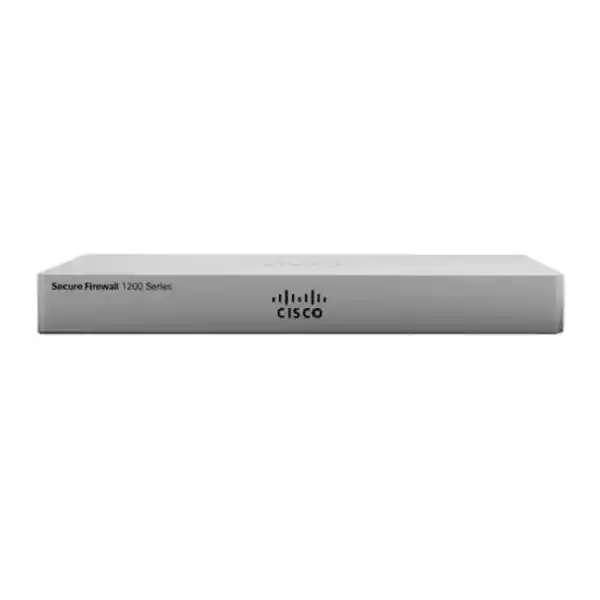
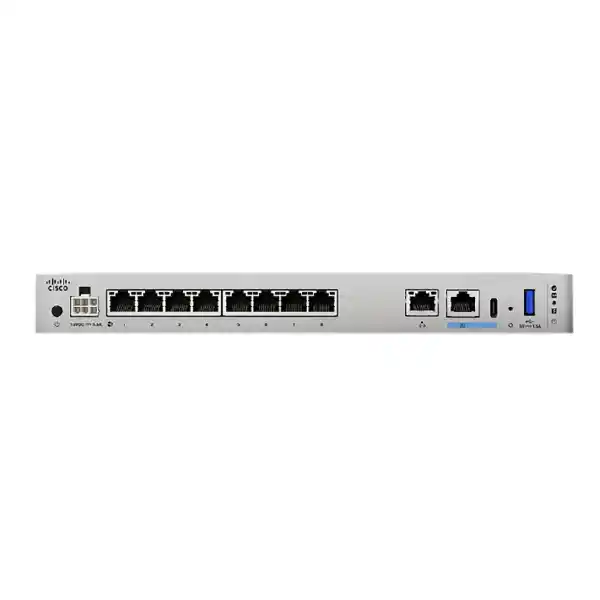
Cisco Secure Firewall 1210CE Dubai
A compact eight-port security appliance for UAE branch offices that need enterprise-class firewalling, threat inspection, VPN and SD-WAN capabilities without the footprint of a 1U platform. The important buying decision is not simply whether the chassis is fast enough, but whether its copper-only interface design, inspected-traffic performance, software mode, licensing and resilience model match the branch architecture.
6.0 Gbps FW + AVC + IPS
5.0 Gbps IPsec VPN
Desktop / wall / rack-shelf capable
Direct answer: what is the Cisco Secure Firewall 1210CE?
The Cisco Secure Firewall 1210CE is the compact, non-PoE entry model in Cisco’s Secure Firewall 1200 Series. It is mainly used to protect branch networks, distributed offices, retail or service locations, remote corporate sites and similar environments where direct internet connectivity, application-aware firewall policy, intrusion prevention, VPN and secure branch routing may be required. It provides eight integrated 10/100/1000BASE-T Ethernet data interfaces and does not provide the PoE ports of the 1210CP or the SFP+ interfaces of the 1220CX.
It should be considered by organisations that want a modern Cisco branch firewall in a small chassis and whose WAN, LAN and interconnect requirements can be met with 1GbE copper. The most important factor to confirm is the real inspected traffic profile: encrypted traffic, enabled security services, packet sizes, concurrent sessions, VPN load and future growth can matter more than the highest headline firewall figure.
FourTeck can help determine the correct appliance size, software image, management approach, subscription bundle, support term, deployment accessories and high-availability design for a Dubai or UAE site. That assessment is especially useful when the 1210CE is being compared with the 1210CP, 1220CX or a rack-mounted 1230.
Exact model identity and where the 1210CE fits
The 1210CE belongs to the Cisco Secure Firewall 1200 Series, a family positioned for distributed enterprise and branch security. Within the compact part of the family, the practical distinction between models is unusually important because the chassis choices are not simply performance steps. The 1210CE and 1210CP share the same broad 1210 performance class, while the 1210CP adds Power over Ethernet capability on four ports. The 1220CX moves to a higher performance class and adds two SFP+ interfaces for 1/10GbE connectivity. Above them, the 1230, 1240 and 1250 are 1U appliances intended for larger branches and higher throughput requirements.
For the 1210CE itself, Cisco publishes a desktop/compact form factor and eight 1000BASE-T Gigabit Ethernet interfaces supporting 10/100/1000 Mbps operation. This matters because a buyer should not assume that every model in the 1200 family provides fibre uplinks, 10GbE or PoE. The 1210CE is specifically the straightforward copper-only compact model. If a branch must terminate an optical ISP handoff directly, connect to a 10GbE distribution switch, or power access points and phones from the firewall, another architecture or another model may be preferable.
The model is currently supported by Cisco documentation for both Secure Firewall Threat Defense software and Adaptive Security Appliance software. That dual-software option can be useful for organisations with established operational standards, but it also means the software choice must be explicit in the bill of materials and implementation plan. Threat Defense and ASA are not simply different names for the same operating experience; their management, feature licensing and security-service models differ materially.
Cisco Secure Firewall 1210CE key specifications
| Specification | Cisco 1210CE detail | Buyer relevance |
|---|---|---|
| Form factor | Desktop / compact | Suitable where space is limited; mounting method still needs to be planned. |
| Integrated data interfaces | 8 × 1000BASE-T, 10/100/1000 Mbps | Good for copper WAN/LAN designs; no native SFP/SFP+ slots on this model. |
| Dedicated management | 1 × 1000BASE-T management port | Allows management connectivity to be separated from production data interfaces where the design requires it. |
| Console / USB | RJ-45 serial or USB Type-C console; USB Type-A service port | Useful for commissioning and recovery; confirm the correct local console cable for field teams. |
| Published firewall throughput | Up to 6.5 Gbps in Cisco’s model summary | Do not use this figure alone for sizing a security-enabled production design. |
| FW + AVC | 6.0 Gbps at Cisco’s stated 1024-byte test profile | More representative when application visibility is part of the policy. |
| NGIPS / FW + AVC + IPS | 6.0 Gbps | Relevant for branches where intrusion prevention is continuously enabled. |
| IPsec VPN throughput | 5.0 Gbps, 1024-byte TCP with Fastpath in Cisco testing | Useful for site-to-site traffic sizing, but tunnel count, crypto mix and real packet sizes still matter. |
| TLS decryption | 1.0 Gbps | A major sizing figure for environments that decrypt significant HTTPS traffic. |
| New connections | Up to 35,000 per second with AVC in Cisco’s published table | Important for busy branches, guest traffic and transaction-heavy applications. |
| High availability | Active/standby HA supported with Threat Defense | Two appliances and a suitable topology are needed where firewall hardware resilience is required. |
| Onboard storage | 480 GB SSD listed for the 1210CE platform | Supports appliance software and local operational requirements; it is not a general-purpose server disk. |
| Typical / maximum power | 32 W typical / 40 W maximum | Low branch power demand, but UPS capacity and external power-adapter placement should still be planned. |
| Operating temperature | 0 to 40°C, with altitude derating above 6,000 ft | Air-conditioned telecom spaces are strongly preferred in UAE deployments; do not treat a compact firewall as an outdoor-rated device. |
Performance figures are vendor laboratory results and can change with software releases, enabled services, traffic mix and packet characteristics. Production sizing should include headroom rather than treating a published maximum as a guaranteed site throughput.
How to read the 1210CE performance numbers
The most common procurement error with a next-generation firewall is to compare the internet circuit speed directly with the largest firewall throughput figure. That method can produce an undersized design because the appliance may be asked to do much more than stateful forwarding. Application visibility, intrusion prevention, URL controls, file inspection, malware functions, VPN encryption and TLS decryption all consume processing resources. Cisco therefore publishes several distinct measurements for the 1210 class rather than one universal speed.
For the 1210CE, Cisco’s model summary lists 6.5 Gbps firewall throughput, while the detailed Threat Defense performance table lists 6.0 Gbps for FW + AVC, 6.0 Gbps for NGIPS and 6.0 Gbps for FW + AVC + IPS under the vendor’s stated 1024-byte profile. IPsec VPN is listed at 5.0 Gbps with the specified Fastpath test, and TLS decryption is 1.0 Gbps. The difference between 6.0 Gbps inspected traffic and 1.0 Gbps decrypted TLS traffic illustrates why a 1 Gbps internet service can still require careful sizing when a high percentage of HTTPS sessions will be decrypted and inspected.
A realistic branch assessment should therefore look at peak internet utilisation, internal east-west traffic that might cross the firewall, site-to-site VPN traffic, remote-access use, percentage of encrypted traffic selected for decryption, connection creation rates, user count, device count, guest Wi-Fi, cloud application patterns, large software updates and growth over the planned support term. Short bursts can also matter. A branch that averages 250 Mbps but regularly bursts close to 1 Gbps with decryption and IPS enabled should not be evaluated in the same way as a site with a stable 250 Mbps workload.
Where the calculated requirement approaches the practical ceiling of the 1210CE, the 1220CX or a 1U 1230 can provide more capacity and, in the case of the 1220CX and larger models, more flexible uplink choices. Buying headroom is generally more economical than replacing a newly deployed firewall because a circuit upgrade or security-policy change exceeded the original assumptions.
Ports: where the 1210CE is strong
Eight integrated 1GbE copper data interfaces make the appliance flexible for ordinary branch topologies. A small office may use separate interfaces for primary WAN, secondary WAN, corporate LAN, guest network, voice, DMZ or other security zones without immediately requiring VLAN trunks for every segment. The dedicated 1GbE management interface can also support a separated management design.
For copper-based access and ISP handoffs, this is straightforward and operationally familiar. It can be especially attractive in branches where existing switches and carrier equipment already present RJ-45 Ethernet and where there is no requirement to power endpoint devices from the firewall.
Ports: what must be checked
The 1210CE has no native SFP or SFP+ transceiver slots and no PoE capability. If the service provider delivers fibre directly, a suitable carrier device, media conversion method or different firewall model may be required. If the branch design expects 10GbE connectivity to a core or distribution switch, the 1210CE is not the right direct-interface choice.
Likewise, if a compact branch firewall is expected to power access points, IP phones, cameras or other PoE devices, compare the 1210CP instead of assuming the 1210CE can provide endpoint power. These interface distinctions should be resolved before ordering because they affect both the firewall model and the surrounding network bill of materials.
Compact chassis, mounting and UAE environmental planning
Cisco positions the 1210CE as a compact appliance that can be deployed on a desktop, wall-mounted, rack-mounted using the appropriate arrangement, or placed in a suitable cabinet. That flexibility is useful for small branches, but it should not encourage improvised installation. Security appliances need stable power, predictable airflow, service access and physical protection. A firewall sitting loose on a shelf among power adapters and patch leads can become difficult to maintain and is more vulnerable to accidental disconnection.
The current Cisco hardware installation guide lists the compact chassis at approximately 1.17 × 10.8 × 6.8 inches excluding rubber feet, with a weight of about 3.04 lb / 1.38 kg for the 1210CE. Some Cisco collateral revisions have shown a slightly different nominal height value, so an installer working with very tight cabinet clearances should use the current mechanical drawing rather than relying on a marketing table alone. The appliance uses an external AC power adapter and is specified for 100-240 V AC, 50-60 Hz input, with 32 W typical and 40 W maximum system power for the 1210CE.
The stated operating temperature range is 0 to 40°C, with altitude-related derating above 6,000 ft. This is particularly relevant in the UAE. A telecom room or branch equipment cabinet can become significantly hotter than the office area if ventilation or air conditioning is poor. The appliance should not be treated as suitable for an unconditioned outdoor enclosure, warehouse roof space or sun-exposed cabinet simply because its power consumption is modest. Ambient conditions, dust, cabinet airflow and UPS placement should be reviewed during the site survey.
For branches where acoustic conditions matter, Cisco publishes a low normal noise figure for the compact models and a higher value at maximum fan speed. In a quiet reception or executive area, however, even a small actively cooled appliance and its power adapter are usually better located in a secure communications cabinet than on an open desk.
Threat Defense or ASA: make the software choice intentionally
Cisco documents the Secure Firewall 1200 Series for both Secure Firewall Threat Defense and Adaptive Security Appliance software. That flexibility can support different operational requirements, but a quotation should never leave the software mode ambiguous. Threat Defense is generally selected when the organisation wants the current Cisco Secure Firewall security stack, application-aware access control, intrusion prevention, malware-related capabilities, URL filtering options and management through Firewall Management Center, cloud-delivered management or local Device Manager. ASA may be selected by organisations that have a specific ASA operational standard, configuration model or migration requirement.
The management tools, feature entitlements and migration procedures differ between these modes. A team standardised on centralized Firewall Management Center policy may value Threat Defense for consistent multi-site operations. A team with a large ASA estate may instead need to examine configuration compatibility, supported ASA features, remote-access VPN requirements and the migration path before deciding whether to remain with ASA or move to Threat Defense.
The correct choice should be based on security services, management architecture, existing skills, automation, VPN design and lifecycle strategy rather than on familiarity alone. Changing software direction after deployment can involve reimaging, reconfiguration, policy conversion and a new test cycle, so this decision belongs at the procurement stage.
Management choices for the 1210CE
Cisco publishes getting-started paths for the compact 1210/1220 platforms using cloud-delivered Firewall Management Center, Firewall Device Manager, Firewall Management Center located at a central headquarters and Firewall Management Center on a local management network. This provides useful architectural flexibility. A single small branch may be comfortable with local management, while an organisation operating tens or hundreds of branches will normally give greater weight to centralised policy, templates, visibility, configuration governance and coordinated upgrades.
The management platform should be selected together with the firewall rather than after the appliances arrive. Centralized management affects licensing, reachability, policy workflow, administrator roles, logging architecture, change control and the way devices are onboarded. Cloud-delivered management can reduce the need to deploy a management appliance at each site or headquarters, but the organisation still needs to confirm internet reachability, account ownership, administrative controls and any internal policy governing cloud management. On-premises Firewall Management Center can align with organisations that prefer local control or already operate a Cisco firewall management estate.
Local Firewall Device Manager can be suitable for simpler deployments where the appliance is managed individually, but the operational cost of local management increases as the site count grows. A policy change that must be repeated manually across many devices is harder to govern and audit than a centrally deployed change. Multi-branch buyers should therefore think about the entire estate, not just the first firewall.
For a UAE rollout, FourTeck can document the intended management topology, required management IP addressing, DNS and NTP dependencies, administrative access path, remote support method and onboarding sequence before installation. This reduces the risk of a site being physically installed but not manageable from the security operations workflow that will own it.
Licensing and subscriptions: what the hardware price does not tell you
A 1210CE quotation can vary substantially depending on the security services and term. For Threat Defense deployments, Cisco identifies an Essentials entitlement associated with the platform and offers additional subscriptions for services such as intrusion prevention, malware defense and URL filtering. Cisco’s current ordering information lists 1210CE subscription combinations that include IPS only, IPS plus Malware Defense, IPS plus URL Filtering, IPS plus Malware Defense plus URL Filtering, as well as standalone Malware Defense and URL Filtering options where applicable to the licensing dependencies.
Cisco currently lists Threat Defense subscription terms of one, three and five years for the 1200 Series. The choice should align with the organisation’s budget cycle, support strategy and expected hardware lifecycle. A longer term can simplify renewal administration, while a shorter term may fit a project with uncertain future architecture. The right commercial structure depends on the buyer’s contract model and should be stated clearly in the quote rather than reduced to a single appliance line item.
Licensing also affects what security policy can actually be deployed. For example, an appliance may be physically capable of inspection while the corresponding subscription determines whether a particular service can be used with current signatures and entitlement. Buyers should separate three questions: what the chassis can process, what the software supports, and what the purchased license authorises. Those questions are related but not interchangeable.
Remote-access VPN deserves its own review. Cisco Secure Client licensing is separate from simply owning the firewall, and the required licence family should match the number of users and features. Under ASA, Cisco publishes platform limits for the 1210 class, including up to 200 combined VPN peers and optional Secure Client entitlement subject to the chosen license. That number is a platform maximum, not a recommendation to size every 200-user remote-access design on the 1210CE without considering authentication, encryption, internet bandwidth and concurrent traffic.
For procurement, provide the desired software mode, security services, subscription term, remote-access user requirement, support term and Smart Account details early. That information allows a more accurate bill of materials and reduces the chance that the appliance arrives without the entitlements expected by the security policy.
Security capability: translate features into branch outcomes
The value of a branch firewall is not the number of feature names on a datasheet; it is the policy outcome those features create. In a typical Threat Defense design, stateful firewalling controls connections between WAN, LAN, guest, DMZ and other security zones. Application visibility can help identify traffic beyond simple port numbers. Intrusion prevention can inspect traffic for exploit patterns and policy violations. Security intelligence and reputation-based controls can reduce exposure to known malicious destinations. URL controls can support acceptable-use and risk-reduction policies, while malware-related services can inspect eligible file flows and connect the branch policy to broader threat intelligence functions.
Each additional inspection layer has design consequences. Intrusion rules need to be selected and maintained. URL policy must reflect business requirements rather than blocking categories indiscriminately. File inspection can affect user experience for large downloads. TLS decryption requires certificate planning, exception policies and legal or privacy review. Logging must be sized so that security events are useful without overwhelming the management platform. The firewall should therefore be implemented as part of a security policy, not just inserted inline with default settings.
For distributed enterprises, consistency is often as important as individual appliance performance. A branch network that uses a different rule philosophy at every site becomes difficult to audit. Centralised policy and templates can help establish common zones, internet controls, VPN standards, object naming and logging practices while still allowing local exceptions where justified. This is one reason the management architecture should be considered early in multi-site projects.
The 1210CE is most compelling when its compact form factor and 1GbE interface set are sufficient and the security stack can be sized with comfortable headroom. Where requirements include heavy decryption, high-speed east-west inspection, 10GbE uplinks or rapid near-term circuit growth, a larger model can be the more responsible choice even if the 1210CE appears less expensive initially.
SD-WAN and secure branch connectivity
Cisco positions the Secure Firewall 1200 Series for secure branch connectivity and documents SD-WAN use cases for the family. In practical terms, that means the firewall can participate in architectures where branch routing, multiple ISP links, secure tunnels and security policy are managed as a coordinated edge function rather than as independent router and firewall projects. This can reduce hardware sprawl in suitable branches, although it also makes correct design more important because a single edge platform is carrying several responsibilities.
For dual-ISP branches, planners should confirm physical interface requirements, provider handoff types, public addressing, dynamic routing or static routing needs, failover behaviour, path selection policy, VPN topology and how traffic should behave when one circuit is degraded rather than completely down. A second WAN port alone does not create a resilient WAN. Health monitoring, routing logic, tunnel design, DNS dependencies and application behaviour all affect the user experience during a carrier event.
Centralised templates can be useful when the same branch pattern is repeated across many locations. A standard build might define interface roles, addressing conventions, routing, VPN, security zones, logging and baseline access policies, while variables such as site subnet and provider addresses change per branch. This approach can speed deployment and reduce configuration drift, but templates should be tested against representative sites before broad rollout.
The 1210CE’s lack of SFP+ should be considered carefully in SD-WAN designs. Many business internet circuits still present copper Ethernet, making the model entirely suitable, but fibre handoffs and high-speed campus links may require upstream carrier equipment or a different firewall model. Connectivity decisions should be based on the actual demarcation at the site, not on an assumption about how the provider normally delivers service.
High availability: when one 1210CE is not enough
Cisco lists active/standby high availability support for the 1200 Series with Threat Defense. For a branch where firewall downtime would stop sales, warehouse operations, call-centre activity, cloud application access or connectivity to headquarters, an HA pair may be justified. High availability requires two compatible appliances and a network topology that allows either unit to take over the required links and addresses. It also requires operational discipline: both units need consistent software, configuration, licensing and cabling.
HA does not remove every single point of failure. A pair of firewalls connected to one ISP router, one access switch and one UPS still depends on those components. A resilience review should therefore map the complete path from carrier handoff through firewall, switching, power and management. In some branches, dual firewalls connected to dual carriers and redundant switching are appropriate. In others, the cost and complexity cannot be justified, and a single appliance with a documented replacement or failover procedure may be the rational choice.
The compact size of the 1210CE can make an HA pair physically easier to accommodate than two full 1U appliances, but cabinet space and power-adapter management still need attention. Both units should be labelled clearly and cabled so that a technician can identify active, standby, WAN, LAN, management and failover-related connections without tracing an unstructured bundle under pressure.
For procurement, state whether the quote is for a single appliance or an HA pair. An HA design may also affect support quantities, power protection, switch port allocation, carrier design and implementation effort. Treating the second unit as an afterthought often leads to missing accessories or unplanned network changes.
Site-to-site VPN
The published 5.0 Gbps IPsec VPN figure makes the 1210 class capable of substantial encrypted branch traffic under Cisco’s test conditions. Actual design should include tunnel count, encryption settings, packet size, inspection applied before or after decryption, WAN quality and whether traffic is hub-and-spoke or direct branch-to-branch.
Remote-access VPN
Remote users introduce different requirements: Secure Client licensing, authentication, MFA integration, DNS behaviour, split-tunnel policy, posture or advanced client features where required, internet bandwidth and help-desk support. Platform peer limits should not be confused with a guaranteed user-experience figure.
Cloud connectivity
Where branches connect to cloud networks, the firewall design should account for tunnel redundancy, routing convergence, cloud-side gateway limits and the volume of SaaS traffic that may bypass private tunnels and go directly to the internet. The desired traffic path determines both security policy and WAN sizing.
Sizing checklist for a Dubai branch
A useful sizing exercise starts with measured traffic and business plans rather than user count alone. Two offices with 100 people can produce very different firewall loads. One may primarily use browser-based SaaS applications on a 500 Mbps circuit, while the other transfers large design files, runs video collaboration throughout the day, maintains several VPNs and decrypts most internet traffic. The second site may need considerably more inspection capacity even though the headcount is identical.
Traffic profile
Record current peak and average WAN use, expected circuit upgrades, internal traffic that traverses the firewall, major SaaS flows, backups, software distribution and guest-network demand.
Inspection profile
Define which zones use IPS, which traffic is decrypted, where URL controls apply, whether file and malware inspection are required, and which applications are exempt for privacy or compatibility reasons.
Connections and devices
Count users, servers, phones, IoT devices, cameras, wireless clients and guest devices. Transaction-heavy applications may create many short-lived connections even when bandwidth is modest.
VPN requirement
Measure site-to-site throughput, remote-access concurrency, number of tunnels, cryptographic requirements and failover expectations. Include traffic that may move between branches through a hub.
Growth and headroom
Include planned staff growth, new cloud workloads, higher-speed broadband, additional branches and stricter inspection. A firewall purchased today may need to serve through several subscription years.
If these inputs put normal operation close to the 1210CE’s published inspected or decryption performance, evaluate the 1220CX or 1230 rather than assuming the branch will remain at today’s load. Headroom improves resilience to traffic bursts, software changes and future security policy.
1210CE vs 1210CP vs 1220CX vs 1230
The nearest alternatives answer different design questions. The table below is intended as a shortlisting tool rather than an automatic recommendation. Interface requirements can be just as decisive as performance.
| Model | Interface distinction | Published security class | When to consider |
|---|---|---|---|
| 1210CE | 8 × 1GbE copper; no PoE; no SFP+ | 6.0 Gbps FW + AVC + IPS; 1.0 Gbps TLS | Compact copper-only branch with no need for firewall-delivered PoE or optical/10GbE uplinks. |
| 1210CP | 8 × 1GbE copper with PoE on four ports, up to 120 W total | Same 1210 performance class | Branch that benefits from directly powering selected APs, phones or other PoE endpoints. |
| 1220CX | 8 × 1GbE copper plus 2 × SFP+ 1/10GbE | 9.0 Gbps FW + AVC + IPS; 1.5 Gbps TLS | Compact site needing more security throughput or fibre/10GbE uplink flexibility. |
| 1230 | 1U; 8 × 1GbE copper plus 4 × SFP+ 1/10GbE | 13 Gbps FW + AVC; 9 Gbps FW + AVC + IPS; 2.5 Gbps TLS | Larger branch needing rack form factor, greater interface scale, more decryption capacity or stronger growth headroom. |
The 1210CE should therefore be selected because its exact characteristics fit the site, not because it is the first model in the family. A buyer who needs PoE may find the 1210CP more elegant. A buyer who needs 10GbE or fibre may find the 1220CX avoids extra media conversion. A site approaching the compact platform’s decryption or interface limits may be better served by the 1230 despite the larger chassis.
Deployment patterns where the 1210CE can make sense
Corporate branch
A branch uses dual copper internet links, one or more LAN/VLAN connections, site-to-site VPN to headquarters and centrally managed security policy. The 1210CE is attractive when inspected throughput and decryption requirements remain comfortably within its class.
Retail or service site
The firewall separates corporate, payment-related, guest and IoT networks while providing secure connectivity to central services. Port mapping, segmentation and logging are usually more important than headline bandwidth.
Professional office
A law, finance, consulting or engineering office may need strong web inspection, VPN, guest separation and central visibility in a small equipment footprint. TLS decryption capacity should be assessed if encrypted inspection is extensive.
Warehouse or light industrial branch
The device can separate office, scanner, IoT and operational networks where environmental conditions remain within specification. In hotter or dusty spaces, an air-conditioned communications enclosure is essential.
Managed multi-site rollout
A standard branch design can be repeated across locations using central management and templates. The model works best when most sites share similar copper interfaces and traffic expectations, with larger exceptions assigned higher models.
Small data-facing edge
A modest office DMZ or controlled public service can be segmented behind the firewall, provided capacity, availability and interface requirements are compatible. High-volume public hosting may justify a rack-mount platform instead.
Installation planning: turn a correct SKU into a reliable deployment
A firewall installation is successful only when the physical, network and policy layers are all ready. Before the site visit, confirm the carrier handoff, LAN switch ports, VLAN plan, management addressing, DNS and NTP sources, public IP information, routing requirements, VPN peers, device software mode, management platform, licenses and administrator access. Missing any one of these can turn a short installation into an extended outage window.
For a replacement project, document the current firewall configuration and identify which objects, rules, NAT statements, routes, VPNs and services are actually in use. Old configurations often contain years of abandoned rules. Copying everything into the new platform can preserve unnecessary risk and complexity. A migration is a good opportunity to remove obsolete entries, standardise naming and validate business owners for sensitive access.
A practical implementation sequence normally includes staging the appliance, applying the intended software release, registering it to the chosen management environment, validating licensing, building interfaces and zones, loading policies, configuring routing and VPN, checking logging, backing up the configuration, performing pre-cutover tests, completing the physical change, validating critical applications and monitoring the new firewall after traffic is live. An HA pair needs additional failover testing before the change is considered complete.
Rollback planning is equally important. The team should know how to restore the previous firewall or network path if an unexpected application dependency appears. That means retaining the old device and its cables during the cutover, documenting the original port mapping, and defining objective criteria for when to troubleshoot forward versus when to roll back.
FourTeck’s IT Services UAE resources can support buyers who need the firewall purchase coordinated with implementation, migration or wider infrastructure work rather than supplied as hardware alone.
Migration considerations from an older Cisco firewall
Replacing an older Firepower, ASA or other firewall with a 1210CE should begin with a supported migration assessment rather than a direct configuration copy. Cisco’s management tooling supports migration paths for selected source and target platforms and software releases, but the exact source version, target version, operating mode and license state matter. Cisco documentation for migrations into the Secure Firewall 1200 family specifies prerequisites such as registering source and target devices appropriately and ensuring the target device is in the required clean state before migration.
Even when automated migration tools are available, they do not remove the need for design review. Interface names may change, unsupported features can require redesign, NAT and VPN behaviour should be validated, and policy objects may need cleanup. Remote-access VPN deserves particular attention because client licensing, authentication integrations and user profiles can be business-critical. A migration project should include application owners, not only the network team.
Version strategy matters as well. The target firewall should run a software release supported by the chosen management platform and approved by the organisation. Installing the latest available release without checking compatibility can be just as problematic as deploying an outdated release. Review release notes for known issues, feature changes and upgrade paths, especially when the firewall will integrate with central logging, identity services, Secure Client, dynamic routing or automation.
Where the existing firewall is already operating near its performance limit, use measured production data from that device to size the replacement. The migration project is an opportunity to account for circuit upgrades and stronger security policies rather than reproducing the capacity of the old appliance.
Compatibility questions that should be answered before ordering
Compatibility is broader than whether the firewall can connect to an Ethernet cable. The WAN provider must present a compatible handoff or an appropriate conversion device. The LAN switches must support the required VLAN and link design. The management platform must support the intended device software release. Authentication systems must be compatible with the chosen VPN and administrative access methods. Monitoring systems need appropriate logging or telemetry integration. Certificate infrastructure is needed if the organisation plans significant TLS decryption or certificate-based VPN authentication.
Routing should also be reviewed. Static routing is simple but may not meet multi-path or complex enterprise requirements. Dynamic routing can provide scale and convergence but introduces protocol design, route filtering and operational dependencies. If the branch participates in SD-WAN, the controller or management workflow and supported software versions become part of compatibility. If the firewall sits behind carrier NAT or another security appliance, VPN and management reachability may require special treatment.
Power and rack compatibility are often overlooked. The 1210CE uses an external power brick, so an installer needs a suitable AC outlet, UPS capacity and a way to secure the adapter. If mounted in a rack or cabinet, plan the correct shelf or mounting arrangement and leave room for cables and ventilation. In compact cabinets, the bend radius and connector depth of eight copper patch leads can consume more space than the chassis itself.
Finally, check organisational compatibility: who will manage the firewall, which team owns licenses, who can access the Cisco Smart Account, what change process applies, where backups are stored and who receives security alerts. A technically compatible appliance can still become an operational problem if ownership is unclear.
Logging, monitoring and day-two operations
The firewall should be designed for ongoing operations from the beginning. Security events, connection logs, health alarms, VPN status, interface errors, high utilisation and failed updates all need an owner. A centrally managed branch fleet can provide strong visibility, but only if logging levels are tuned and operations staff know which alerts are actionable. Logging everything indefinitely is not necessarily useful; it can increase storage, search complexity and noise.
Define retention requirements based on operational, compliance and incident-response needs. Determine whether logs stay in the Cisco management environment, are forwarded to a SIEM, or both. Confirm time synchronisation because accurate timestamps are critical when correlating firewall events with identity, server and endpoint logs. DNS and NTP are small dependencies that have outsized impact on troubleshooting.
Operational procedures should include configuration backup, software maintenance, subscription renewal tracking, certificate renewal, rule review, object cleanup, VPN credential maintenance, HA testing and periodic capacity review. The firewall that was correctly sized at deployment can become constrained later if a branch doubles its internet speed or turns on TLS decryption for most web traffic. Monitoring utilisation trends gives the organisation time to plan an upgrade before users experience degradation.
Security policy also ages. Temporary access rules can become permanent by accident, unused NAT entries accumulate, and application behaviour changes. A scheduled rule recertification process keeps the configuration aligned with actual business requirements. The 1210CE should therefore be treated as an actively managed security control rather than an appliance installed once and forgotten.
When the Cisco Secure Firewall 1210CE may be the wrong choice
A balanced product decision includes reasons not to buy. The 1210CE may be unsuitable when the branch needs native fibre or 10GbE interfaces, because the model provides only integrated 1GbE copper data ports. It may be unsuitable when the firewall is expected to provide PoE to branch endpoints, because that capability belongs to the 1210CP. It may also be a weak choice for a site expecting rapid growth beyond the 1210 performance class or for an environment where TLS decryption demand could exceed the model’s 1.0 Gbps published figure.
A larger branch with high connection rates, multiple high-speed uplinks, extensive encrypted inspection or a requirement for more interface flexibility should compare the 1220CX or 1230. The 1220CX remains compact but adds SFP+ and higher throughput. The 1230 moves to 1U rack format and provides more uplink interfaces and greater decryption headroom. Buying the larger model may also reduce architectural complexity by eliminating media converters or intermediate switching that would otherwise be required around the 1210CE.
The 1210CE is also not a substitute for a complete resilience design. A single unit remains a single firewall hardware point of failure. Active/standby HA can address that layer, but carrier, switch and power redundancy must still be evaluated. Similarly, advanced security services require correct licensing and policy; the hardware alone does not automatically deliver every Threat Defense function.
The best reason to choose the 1210CE is that the site genuinely needs a compact, copper-focused Cisco firewall with this capacity and software ecosystem. That is a stronger procurement rationale than simply selecting the smallest current appliance in the family.
Dubai and UAE deployment considerations
For Dubai and wider UAE deployments, the technical specification is only part of the purchase. Branches may be located in office towers, malls, free zones, warehouses, clinics, schools, hospitality sites or mixed-use facilities, each with different carrier handoffs, access restrictions and equipment-room conditions. A site survey can confirm whether the firewall will receive copper Ethernet directly, whether the building carrier requires an intermediate device, and whether installation work must be scheduled through facilities management.
Power quality and cooling should be included in the branch standard. The 1210CE itself has modest power consumption, but the firewall should still be protected by an appropriately sized UPS where service continuity matters. Avoid placing the appliance in unventilated cupboards that can exceed the 0 to 40°C operating range. In dusty environments, use a clean communications cabinet and maintain airflow rather than exposing the appliance directly to the room.
Carrier diversity should be verified rather than assumed. Two internet services can share building risers, local infrastructure or upstream providers. If the business requires true WAN resilience, ask the carriers about physical and upstream diversity and test failover behaviour after installation. For branches using public services or inbound VPN, document how public addressing is allocated and whether provider NAT or managed CPE affects the design.
Buyers looking for UAE-wide sourcing can review FourTeck UAE, while firewall-focused projects can use Firewall Dubai by FourTeck for specialist context. For organisations with regional or multinational procurement requirements, FourTeck provides a broader corporate reference point.
For an accurate UAE quotation, specify delivery location, quantity, required software mode, subscriptions, term, support, installation scope and any after-hours cutover requirement. These details affect the commercial and implementation plan far more than the city name alone.
Procurement checklist for the 1210CE
A complete procurement request should distinguish the base appliance from everything needed to make it operational. Start with the exact model: Cisco Secure Firewall 1210CE. State whether the appliance will run Threat Defense or ASA software. For Threat Defense, specify the required security subscriptions and term. If remote-access VPN is part of the project, specify the Secure Client requirement separately. If high availability is required, order and support two appliances and plan the surrounding network accordingly.
Then list physical requirements. Confirm whether the eight integrated copper ports are sufficient, whether any fibre conversion is required upstream, how the unit will be mounted, where the external power adapter will be secured and which UPS will support it. If the site requires PoE or SFP+, consider another model before creating workarounds. A clean bill of materials usually produces a cleaner operational result.
Software and management details should include the intended Cisco software release, the management platform, Smart Account ownership, administrative access model and support entitlement. For centralized deployments, state whether the firewall will connect to an existing Firewall Management Center environment or whether a new management service is part of the project. For cloud-delivered management, confirm organisational account ownership and onboarding process.
Finally, define services. Hardware supply, staging, policy configuration, migration, rack or wall mounting, patching, VPN setup, HA configuration, cutover, testing, documentation and post-change monitoring are separate work items. A buyer who wants a turnkey deployment should say so explicitly rather than assuming all services are included in the hardware price.
This level of detail also makes competing quotations easier to compare. Two quotes with the same appliance name may include different subscription terms, support levels and implementation scope, so price alone can be misleading unless the underlying bill of materials is normalised.
Support and lifecycle planning
Cisco currently lists the Secure Firewall 1200 Series as available for order, and the family is part of the active Secure Firewall portfolio. Buyers should still plan lifecycle around the intended support period rather than assuming any network appliance will remain unchanged indefinitely. The selected Cisco support entitlement affects access to hardware replacement, software and technical assistance according to the purchased service level. The correct choice depends on how critical the branch is and how quickly the organisation needs a failed appliance restored.
Software lifecycle is equally important. Secure Firewall software receives updates that can introduce features, security fixes, behavioural changes and new platform support. A production organisation should maintain a tested upgrade process and avoid long periods on obsolete software. At the same time, immediate adoption of every new release is rarely appropriate for critical branches; compatibility and release notes should be reviewed first.
Subscription renewal dates should be tracked centrally. If a three-year IPS, malware or URL term is purchased across many branches at different times, renewal administration can become fragmented. Some organisations therefore align renewal dates or purchase standard terms for branch waves. This is a commercial planning choice, but it can reduce operational overhead.
Capacity should also be reviewed annually. A firewall selected for a 500 Mbps circuit may remain in place when the carrier upgrades the branch to 2 Gbps. If inspection policy, VPN use or TLS decryption has also increased, the original headroom can disappear quickly. Periodic capacity review turns an emergency hardware replacement into a planned lifecycle decision.
Frequently asked buyer questions
Is the Cisco 1210CE a 10GbE firewall?
Its data interfaces are eight 10/100/1000BASE-T copper ports. The 1210CE does not provide SFP+ ports. If the design requires a direct 10GbE or fibre uplink, compare the 1220CX or a larger 1200 Series model.
Does the 1210CE provide PoE?
No. The 1210CP is the compact 1210 variant with PoE on four ports and up to 120 W total. Choose the 1210CE when PoE is not needed from the firewall itself.
Can the 1210CE run Threat Defense?
Yes. Cisco publishes Threat Defense documentation for the 1210CE, including local Device Manager, centralized Firewall Management Center and cloud-delivered management paths. The exact software release and management compatibility should be confirmed for the deployment.
Can it run ASA software?
Yes, Cisco supports ASA software on the Secure Firewall 1210/1220 platforms. Buyers should choose ASA only after checking required ASA features, licensing, VPN needs and the long-term management strategy.
What throughput should I use for sizing?
Use the metric closest to the intended policy. Cisco publishes 6.0 Gbps for FW + AVC + IPS, 5.0 Gbps for IPsec VPN and 1.0 Gbps for TLS decryption on the 1210 class under stated test conditions. Real traffic and enabled services must be assessed with headroom.
Does it support high availability?
Cisco lists active/standby HA support for the 1200 Series with Threat Defense. A resilient branch design still needs to consider ISP, switch and power redundancy rather than relying on the firewall pair alone.
How many VPN users can it support?
Under ASA, Cisco publishes a maximum of 200 combined VPN peers for the 1210 class, with Secure Client rights depending on separate licensing. A production remote-access design should be sized by concurrent traffic, authentication, features and WAN capacity, not only the platform maximum.
Which security subscription should I buy?
That depends on policy. Cisco offers 1210CE Threat Defense subscription combinations for IPS, Malware Defense and URL Filtering, with one-, three- and five-year terms. Define the required services before requesting a quote so the license bundle matches the intended policy.
Is it suitable for a 1 Gbps internet circuit?
Often, but not automatically. If most of the circuit is subject to TLS decryption, the published 1.0 Gbps decryption figure becomes highly relevant, and comfortable production headroom may point to a larger model. Traffic mix and policy must be reviewed.
What should I provide for a Dubai quotation?
Provide quantity, software mode, internet speeds, expected inspected traffic, interface requirements, HA requirement, security subscriptions, term, remote-access users, management approach, delivery location, installation scope and desired support level.
Decision recap: six points that determine whether 1210CE is the right model
1. Interface fit
Eight 1GbE copper ports must satisfy the WAN and LAN design. No PoE and no SFP+ are built into the 1210CE.
2. Security throughput
Size against the services actually enabled, especially IPS and TLS decryption, and keep practical headroom for bursts and growth.
3. Software mode
Choose Threat Defense or ASA deliberately. Management, security services, migration and licensing differ.
4. Licensing
Specify IPS, Malware Defense, URL Filtering, term and Secure Client needs rather than pricing the chassis alone.
5. Resilience
Decide whether active/standby HA, dual ISP and redundant switching are required by the branch business impact.
6. Lifecycle headroom
Include planned circuit upgrades, site growth and stronger inspection policies across the intended support period.
What FourTeck needs from the buyer for an accurate 1210CE quotation
Number of appliances, delivery locations and whether sites are standalone or part of a rollout.
Current and planned circuit speeds, peak use, inspected traffic and significant east-west flows.
Copper or fibre handoff, number of WAN/LAN ports, VLAN design and any PoE or 10GbE requirement.
IPS, malware, URL filtering, TLS decryption and logging requirements.
Site-to-site tunnels, remote-access users, Secure Client needs and authentication integrations.
Threat Defense or ASA, existing management platform, target release and Smart Account ownership.
Single appliance or HA pair, dual ISP requirement, UPS and switching redundancy.
Required subscription length, support level and any contract or renewal alignment requirement.
Supply only, staging, migration, installation, after-hours cutover, testing, documentation and post-change support.
Plan the Cisco 1210CE around the branch, not around a single datasheet number
The 1210CE can be an excellent fit for a compact UAE branch when eight 1GbE copper ports are sufficient and the inspected, VPN and decrypted traffic remains comfortably within its performance envelope. A sound quotation should also define software mode, subscriptions, management, high availability, mounting, support and implementation scope. FourTeck can help turn those requirements into a practical bill of materials and deployment plan, or identify when the 1210CP, 1220CX or 1230 is the safer choice.

Reviews
There are no reviews yet.