
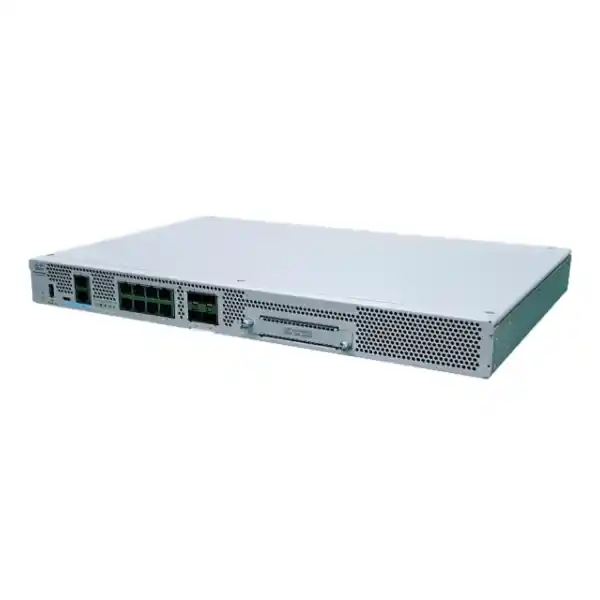
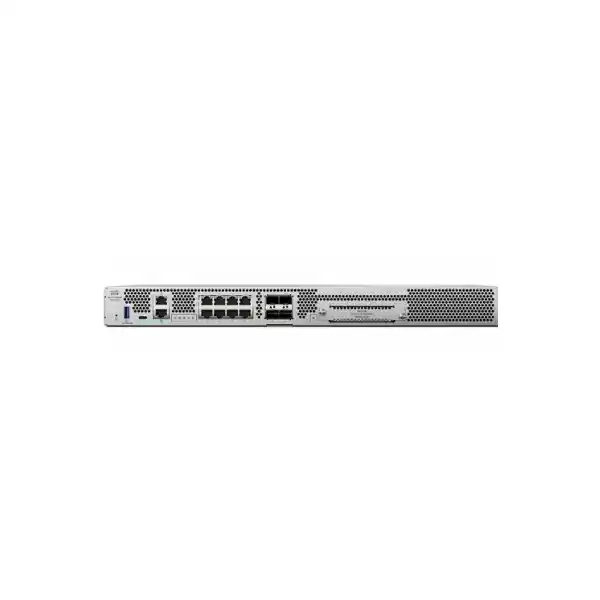
Cisco Secure Firewall 1230 Dubai
A rack-mount branch security platform for organisations that need multiple Gigabit copper links, 1/10Gbps SFP+ connectivity, strong firewall and VPN headroom, and a choice between Cisco Secure Firewall Threat Defense and ASA software. The 1230 is best evaluated as part of a complete traffic, inspection, licensing and resilience design rather than by headline throughput alone.
9 Gbps FW + AVC + IPS
4 × 1/10G SFP+
1U Rack Mount
Direct answer: what is the Cisco Secure Firewall 1230?
The Cisco Secure Firewall 1230 is a 1U rack-mount network security appliance in Cisco’s Secure Firewall 1200 Series. Cisco positions the 1200 Series for enterprise branches and smaller sites, and the 1230 is the first rack-mount model in the family above the compact 1210 and 1220 platforms. It can run Cisco Secure Firewall Threat Defense or Cisco Secure Firewall ASA software, so the same hardware family can support different operational approaches depending on the buyer’s security policy, management architecture, feature needs and migration path.
Its primary role is to secure branch internet access, WAN connectivity, inter-site traffic, remote-access or site-to-site VPN requirements, and segmented internal networks while providing higher performance than compact branch appliances. The 1230 includes eight 1000BASE-T Gigabit Ethernet interfaces and four SFP+ slots that support 1Gbps and 10Gbps transceivers, giving a useful mix of copper access, routed or switched handoffs and fibre or high-speed uplinks.
Organisations should consider the 1230 when they need a rack-mounted firewall with meaningful security-inspection headroom but do not yet require the higher performance envelope of the 1240 or 1250. The most important factor to confirm is not the raw firewall number; it is the expected throughput after the exact security services, encrypted-traffic inspection, VPN load, application visibility, logging, connection rate and growth margin are considered together.
FourTeck can help determine whether the 1230 has the right performance margin, whether Threat Defense or ASA is the appropriate software choice, which licenses and subscription terms are required, whether 1G or 10G optics are needed, how high availability should be designed, and what information must appear on the final UAE quotation.
Where the 1230 fits in the Cisco Secure Firewall 1200 Series
The Secure Firewall 1200 Series spans compact desktop appliances and rack-mounted branch systems. The Cisco Secure Firewall 1230 occupies an important transition point: it moves from the compact form factor of the 1210 and 1220 to a 1U rack appliance while adding four SFP+ slots and a higher performance ceiling. That makes it relevant for branches that have outgrown simple edge-firewall designs or that need to connect to distribution switches, metro Ethernet services, fibre handoffs or 10Gbps local infrastructure without immediately stepping into a larger enterprise firewall family.
For Threat Defense, Cisco publishes 13 Gbps for firewall plus application visibility and control using 1024-byte traffic, 11 Gbps for NGIPS, 9 Gbps for firewall plus application visibility and IPS, 13 Gbps for IPsec VPN in Cisco’s stated test profile, and 2.5 Gbps for TLS decryption. It also publishes 400,000 maximum concurrent sessions with application visibility and control, 50,000 maximum new connections per second with AVC, up to 500 VPN peers and up to 10 VRF instances. Those numbers are useful as platform reference points, but they should never be treated as a promise that every real deployment will deliver those exact rates simultaneously.
The deciding question is whether the branch workload sits comfortably inside the 1230 envelope after inspection and future growth are included. A buyer with a 1Gbps internet circuit may still need considerable firewall headroom if east-west segmentation, multiple VPN tunnels, decryption and extensive intrusion prevention are planned. Conversely, a site with a fast WAN link may not require the 1240 if actual inspected traffic is modest and the 1230 still preserves sensible engineering margin.
Key published specifications
| Specification | Cisco Secure Firewall 1230 |
|---|---|
| Form factor | 1U rack-mount appliance |
| Integrated network interfaces | 8 × 1000BASE-T Gigabit Ethernet |
| SFP+ slots | 4 × SFP+ supporting appropriate 1Gbps and 10Gbps transceivers |
| Dedicated management | 1 × 1000BASE-T management port |
| Console | Cisco serial RJ-45 and USB Type-C console; the hardware guide notes the console interfaces are not used simultaneously |
| USB | USB Type-A port |
| Storage | 960GB field-replaceable SSD / U.2 NVMe slot as documented for the 1U family |
| System memory | 16GB for the CSF-1230 hardware |
| Power | Single integrated AC power supply; no redundant power supply |
| Maximum power consumption | 57W |
| Dimensions | 1.72 × 11.22 × 17.25 in (4.37 × 28.49 × 43.81 cm), H × W × D |
| Weight | 9.35 lb (4.24 kg) |
| Operating temperature | 0 to 40°C (32 to 104°F) |
Published performance figures depend on software, features, packet size and traffic characteristics. Cisco explicitly notes that performance varies when security services and real traffic profiles change, so sizing should include measured or estimated workload rather than using a single table value in isolation.
Performance explained for business buyers
13 Gbps FW + AVC
Cisco’s Threat Defense test figure for firewall plus application visibility and control shows the processing capacity available in a relatively defined test profile. It is useful for comparing models, but it is not the same as a fully enabled security-services number. Sites that expect intrusion prevention, decryption and heavy logging should size against those workloads instead of assuming the firewall-only figure represents everyday inspected throughput.
9 Gbps FW + AVC + IPS
This is usually the more relevant published reference for organisations planning broad intrusion-prevention coverage on Threat Defense. Even then, traffic size, protocol mix, connection churn, rule design, encrypted sessions and additional services affect observed performance. A branch with a multi-gigabit internet service should preserve margin rather than plan to operate continuously near a laboratory maximum.
2.5 Gbps TLS decryption
Encrypted traffic inspection can become a separate sizing constraint. If a large proportion of internet or application traffic is decrypted for inspection, the 2.5 Gbps published TLS figure deserves specific attention. Decryption policy also introduces certificate, privacy, application-compatibility and exception-management considerations, so buyers should define what actually needs decryption before selecting a platform.
Performance planning works best when the traffic path is divided into meaningful categories. Internet browsing, SaaS access, data-centre applications, site-to-site VPNs, remote users, voice, collaboration, backups and replication can have very different inspection and latency characteristics. A headline internet bandwidth number does not reveal how many concurrent sessions the firewall will maintain, how rapidly new sessions arrive, how much of the traffic is encrypted, or how much east-west traffic may traverse the appliance because of segmentation policy.
The 1230 supports a maximum of 400,000 concurrent Threat Defense sessions with AVC in Cisco’s published scalability table and 50,000 maximum new connections per second with AVC. Those values matter for sites with many users, IoT devices, web-heavy workloads, short-lived cloud connections or network address translation at scale. A branch with 300 employees can sometimes create more session pressure than a much larger traditional office if endpoints run numerous cloud agents, browser tabs, software updates and collaboration applications.
For ASA software, Cisco publishes a different set of performance figures because the software and test methodology differ. The 1230 is listed at 18 Gbps stateful inspection firewall throughput, 15 Gbps multiprotocol stateful inspection, 15 Gbps IPsec VPN throughput in the stated ASA test and 350,000 new connections per second. Buyers comparing ASA and Threat Defense should therefore avoid mixing numbers across software modes. The correct comparison starts with the required security capabilities and management model, then checks the performance table applicable to that software.
Threat Defense or ASA: choose the software before you finalise the order
Cisco offers the Secure Firewall 1230 as an appliance with Secure Firewall Threat Defense or ASA software. That choice affects configuration workflow, available security services, management tooling, licensing and migration planning. It should be treated as a design decision, not as a cosmetic SKU preference. Cisco lists appliance product IDs including CSF1230-TD-K9 for Threat Defense and CSF1230-ASA-K9 for ASA, so the quotation should reflect the intended operating model from the start.
Threat Defense is the natural path when the project requires Cisco’s modern next-generation firewall capabilities such as application visibility and control, intrusion prevention and subscription-based security services. It may be managed locally in supported scenarios or through an appropriate Firewall Management Center architecture depending on the chosen release and operational model. The detailed feature set varies by software release, management method and licensing, so a buyer should define the required controls before deciding how the device will be administered.
ASA remains relevant where an organisation has established ASA policies, operations, skills or compatibility requirements and where the desired deployment aligns with the capabilities of the current ASA software supported on the 1200 Series. A migration from an older ASA platform can still require careful review because interface names, software versions, crypto settings, NAT behaviour, VPN features and management practices may differ from an existing device.
The safest procurement sequence is to document the intended software, management platform, major security functions, VPN role and subscription scope before the hardware order is released. That sequence reduces the chance of receiving the right chassis with the wrong software or incomplete entitlements.
Ports, uplinks and transceiver planning
The Cisco Secure Firewall 1230 provides eight fixed 1000BASE-T Gigabit Ethernet ports and four SFP+ slots. This combination is one of the clearest reasons to consider the 1230 instead of a compact model. The copper ports can serve common routed Ethernet connections, while the SFP+ slots can support appropriate 1Gbps or 10Gbps transceivers for fibre or compatible copper/DAC connectivity. That flexibility is valuable when a branch has separate internet circuits, an MPLS or SD-WAN handoff, a pair of core or distribution switches, DMZ links and management networks.
SFP+ slots do not mean the required optics are automatically included. The transceiver choice must match the physical medium, speed, connector type, fibre type, wavelength, distance and the switch or provider equipment at the far end. Cisco’s current hardware guide lists supported 1G and 10G transceiver families and warns that third-party optics may create support issues if interoperability problems occur. For a business quotation, the buyer should identify every intended SFP+ connection and whether each link needs short-range multimode optics, long-range single-mode optics, copper, direct-attach cable or another supported medium.
The 1230’s eight integrated data ports are 1Gbps, not multigigabit copper. That is an important distinction from the higher 1250, which introduces 2.5GBASE-T interfaces. If a branch expects 2.5GbE copper handoffs from access switches or WAN devices and does not want to use SFP+ for those links, the 1250 may deserve evaluation even when raw firewall performance is not the only driver.
Port count should also be considered after high availability is designed. An HA pair may consume specific interfaces for failover or state links depending on the software and topology. Do not allocate every physical interface to production networks on paper and then discover later that the resilience design needs dedicated connectivity.
Licensing and subscription scope
The hardware purchase and the security-service entitlement are separate parts of the decision. Cisco’s ordering documentation lists model-specific Threat Defense license combinations for the 1230, including IPS, malware defense, URL filtering and combinations of those services. Examples in the current ordering guide include CSF1230T-T for IPS, CSF1230T-TM for IPS plus malware defense, CSF1230T-TC for IPS plus URL filtering and CSF1230T-TMC for IPS, malware and URL filtering. The exact commercial subscription term and ordering structure should be confirmed at quote time because Cisco packaging and software entitlement rules can evolve.
This matters because buyers often compare firewall appliances only by chassis price. Two quotations for the same Cisco 1230 can represent very different operational capabilities if one contains the required security subscriptions, management entitlement and support while another contains little more than the appliance. A technically correct comparison therefore needs line-item clarity: base appliance, software image, security services, term, management, support, optics, rack accessories and professional services should be identifiable.
Subscription selection should follow policy. If the organisation needs intrusion prevention at the branch, the required entitlement should be part of the design. If malware protection or URL-category controls are mandatory, they should be specified instead of assumed. Conversely, a buyer should not automatically add every possible subscription simply because it exists. The right bundle depends on the control objectives, existing security stack, centralised services, regulatory requirements and whether another layer already performs a particular inspection function.
License duration also affects procurement planning. Multi-year subscriptions may simplify renewal management and budget forecasting, while shorter terms can provide flexibility when a branch is temporary, a wider network refresh is planned, or the organisation expects a change in security architecture. The commercial decision should be made alongside lifecycle and support planning rather than after the appliance arrives.
How to size the Cisco Secure Firewall 1230 properly
A practical sizing exercise starts with current measured traffic and then adds the security functions the firewall will actually perform. Internet circuit capacity is only the first number. Record average and peak throughput, the ratio of inbound to outbound traffic, busy-hour patterns, concurrent sessions, new connection rates, packet sizes, VPN volumes, encrypted traffic, application mix and expected growth. If a replacement firewall is already installed, monitoring data from that device can provide a much stronger basis than user count alone.
Next define inspection. A branch that only applies stateful policy has a different workload from one running application control, intrusion prevention, URL classification, malware defense and extensive TLS decryption. Cisco’s own performance table shows why this matters: the 1230’s published FW + AVC result is 13 Gbps, while the combined FW + AVC + IPS figure is 9 Gbps and TLS decryption is 2.5 Gbps. The security policy changes which ceiling becomes relevant.
Then separate traffic that traverses the firewall from traffic that stays within the local switching environment. Many branch designs route multiple VLANs through the firewall to enforce segmentation between users, servers, guest networks, voice, cameras, IoT and operational technology. In that architecture, the firewall may process more aggregate traffic than the WAN circuit alone would suggest. A site with a 1Gbps internet connection can still need several gigabits of internal inspected capacity.
VPN planning deserves its own calculation. Site-to-site IPsec, remote-access sessions and cloud connectivity can create sustained crypto workload and large numbers of peers. Cisco publishes up to 500 VPN peers for the 1230 in its scalability tables. The raw peer limit is not a sizing target; it is a platform maximum. Actual design should consider tunnel throughput, route design, encryption settings, remote-access concurrency, authentication dependencies, failover behaviour and the operational impact of terminating many sites on one branch appliance.
Growth margin should be explicit. If the 1230 only meets a projected three-year requirement at the top of its published envelope, the 1240 may be a more defensible choice. The 1240 raises published Threat Defense FW + AVC throughput to 18 Gbps, FW + AVC + IPS to 12 Gbps, TLS decryption to 3.2 Gbps, concurrent sessions to 600,000 and VPN peers to 1,000. Those increments can provide resilience against traffic growth and policy expansion even if the branch does not need them on day one.
On the other hand, oversizing every branch can increase hardware and subscription costs without improving security. A correct design balances measurable demand, security policy, resilience and realistic growth. FourTeck can review those inputs and show where the 1230 sits relative to the 1220, 1240 and 1250 before the final bill of materials is prepared.
Important limitation: the 1230 does not have redundant power
The Cisco Secure Firewall 1230 uses a single integrated AC power supply, and Cisco’s hardware documentation lists redundant power as unavailable for the 1230/1240/1250 1U family. The power supply is an internal component rather than a field-replaceable unit. This does not make the product unsuitable for branch use, but it changes how availability should be designed and how the buyer should think about hardware fault tolerance.
If the branch requires strong service continuity, an active/standby high-availability pair can protect against a single appliance failure when properly designed, but each chassis still relies on its own single PSU. Power architecture should therefore consider separate PDUs or UPS paths where available, rack power distribution, generator coverage, environmental monitoring and the consequence of a power-supply fault. High availability only provides its intended benefit when the surrounding switches, circuits, power and cabling are also designed to avoid common points of failure.
This is a useful example of why product selection should not be reduced to throughput. A buyer whose primary requirement is dual hot-swappable power supplies may need to evaluate a different Cisco platform even if the 1230 has sufficient inspection performance.
TLS decryption: why the 2.5 Gbps figure deserves separate attention
Modern branch traffic is heavily encrypted. Security teams may therefore consider decrypting selected outbound or inbound TLS sessions so the firewall can inspect content that would otherwise be opaque. On the Cisco Secure Firewall 1230, the published Threat Defense TLS decryption performance is 2.5 Gbps. That number is materially lower than the headline firewall throughput, which means decryption can become the dominant sizing factor in an environment where a large percentage of high-bandwidth traffic is inspected.
A decryption project should define policy scope before platform selection. Some traffic may be excluded because of privacy, certificate pinning, application compatibility, regulatory requirements or operational risk. Other traffic may be prioritised because it carries the highest threat exposure. The resulting inspected volume, not the site’s total bandwidth, is what should be compared with decryption capacity.
Certificate distribution, user trust stores, exception management and troubleshooting are also part of the deployment. A technically capable appliance can still create user disruption if the organisation enables broad decryption without preparing endpoints and business applications. Buyers should therefore treat TLS inspection as an implementation workstream with measurable success criteria, not a feature checkbox.
High availability and branch resilience
Cisco documents active/standby high availability support for the Secure Firewall 1200 Series with Threat Defense. A two-appliance design is appropriate when a branch cannot tolerate a single firewall chassis failure, but the HA pair is only one part of the resilience story. WAN circuits, upstream routers, downstream switches, power, transceivers and cabling should be mapped so that a failover does not simply move traffic to another firewall that depends on the same failed component.
HA design also influences port allocation and licensing. The physical topology must leave suitable connections for the required failover and state communication while still providing the production interfaces the site needs. If four SFP+ slots are already planned for two WAN circuits and two core-switch links, the complete HA cabling model should be verified before optics are ordered.
Change control is another resilience issue. An HA pair can make software maintenance less disruptive, but only when software compatibility, upgrade sequencing, state synchronisation and rollback procedures are understood. Buyers who intend to deploy high availability should include configuration, testing and acceptance criteria in the professional-services scope rather than treating the second chassis as a simple spare.
For smaller branches, a single 1230 may be entirely reasonable when business impact is low and replacement processes are strong. The correct choice depends on the cost of downtime, not on a blanket rule that every firewall must be deployed as a pair.
Management architecture and operational ownership
Before deployment, decide who will manage the firewall, from where, and with which management platform. Cisco supports different workflows for Threat Defense and ASA, and the feature set available through each management method can vary by software release. A small standalone branch may prioritise local management simplicity, while an organisation with dozens or hundreds of sites usually needs central policy, consistent object definitions, change control, auditability and consolidated visibility.
Central management is not merely an administrative convenience. It affects how policy is structured, how configuration changes are approved, how events are searched, how software upgrades are coordinated and how multiple branches maintain consistent controls. If the Cisco 1230 is being added to an existing Cisco firewall estate, compatibility with the current management platform and software release should be confirmed before installation.
Operational ownership should be explicit as well. Decide whether day-to-day policy is handled by an internal security team, network operations, a managed service provider or a joint model. Define who responds to security alerts, who approves rule changes, who manages certificates and VPN users, who monitors capacity, and who renews subscriptions. A firewall project is more successful when those responsibilities are documented before go-live.
For UAE organisations that want ongoing assistance beyond the hardware purchase, FourTeck IT Services UAE can be considered for related infrastructure and support requirements alongside the firewall project.
Deployment planning for a Dubai or UAE branch
A reliable branch deployment begins with the physical environment. The 1230 is a 1U rack-mount appliance designed for a 19-inch rack using the documented mounting method. Check rack depth, available rack units, front-to-back airflow, cable-management space, grounding, PDU availability and the path for copper and fibre cabling. Cisco lists operating temperature from 0 to 40°C and operating humidity from 5 to 85 percent noncondensing. In UAE equipment rooms, cooling and dust control should be treated as real engineering requirements rather than assumed conditions.
The appliance has a maximum documented power consumption of 57W, but the UPS and PDU plan must account for the entire branch stack, not just the firewall. In a high-availability design, each firewall should be connected in a way that avoids a single local power failure where the facility architecture permits it. Power cords should be ordered correctly for the installation environment; Cisco’s hardware documentation notes that supported power cords or jumper cords must be selected appropriately.
Next map every logical network to a physical or virtual interface design. Identify WAN1, WAN2, internet, MPLS, SD-WAN transport, LAN core, server segment, guest, voice, DMZ, management and any dedicated HA links. Decide which will use 1GbE copper and which require SFP+. This map makes it possible to build an accurate optics list and reveals whether the 1230 has enough physical connectivity without relying on last-minute compromises.
Addressing and routing should be documented before cutover. Record existing public IPs, provider gateways, private subnets, VLAN IDs, dynamic-routing protocols, static routes, NAT rules and any overlapping networks. Branch migrations often fail because a firewall rule was copied correctly but a provider route, NAT exemption, asymmetric path or return route was overlooked.
Finally, plan the acceptance test. It should cover internet access, critical SaaS applications, site-to-site VPNs, remote access if used, DNS, identity integration, business applications, voice, failover behaviour, logging, alerting and performance. A cutover is not complete merely because users can browse the web.
For procurement and implementation in the UAE, buyers can also review FourTeck UAE for broader network, infrastructure and business technology support.
Migration from an existing firewall
Replacing an existing firewall with a Cisco Secure Firewall 1230 is not only a policy-copy exercise. The migration should begin with an inventory of current interfaces, zones, address objects, network objects, service objects, access rules, NAT, VPN definitions, routing, DHCP or relay services, identity integrations, certificates, authentication servers, logging destinations and monitoring dependencies. Remove obsolete rules rather than carrying every historical exception into the new platform.
If the existing device runs Cisco ASA, the 1230 can be attractive because ASA software is supported, but software release and feature compatibility still need review. If the project is moving from ASA to Threat Defense, the migration also changes the operational and inspection model. The team should validate which rules and objects can be migrated, which security policies need redesign, and how management will work after cutover.
If the source firewall is another vendor, avoid trying to reproduce syntax line by line. Translate business intent instead: which users may reach which applications, which inbound services must remain exposed, which VPN partners must connect, and which security controls are mandatory. A clean policy can reduce rule count and make future troubleshooting easier.
Cutover planning should include rollback. Preserve the previous configuration, document cable positions, keep old public addressing and provider details available, and define measurable success criteria. If the migration includes ISP changes, switch upgrades or IP renumbering at the same time, isolate which changes can be staged in advance so troubleshooting remains manageable.
A well-designed migration also captures a post-cutover baseline: interface utilisation, CPU and memory behaviour, concurrent sessions, VPN throughput, event rates and common application response. Those figures create evidence for future capacity planning instead of relying on anecdotal reports that the network feels faster or slower.
1230 vs 1220, 1240 and 1250
| Model | Form factor | FW + AVC | FW + AVC + IPS | TLS | Interfaces |
|---|---|---|---|---|---|
| 1220CX | Compact | 9 Gbps | 9 Gbps | 1.5 Gbps | 8 × 1GbE, 2 × SFP+ |
| 1230 | 1U | 13 Gbps | 9 Gbps | 2.5 Gbps | 8 × 1GbE, 4 × SFP+ |
| 1240 | 1U | 18 Gbps | 12 Gbps | 3.2 Gbps | 8 × 1GbE, 4 × SFP+ |
| 1250 | 1U | 24 Gbps | 18 Gbps | 4.1 Gbps | 8 × 2.5GbE, 4 × SFP+ |
The 1220CX is worth considering where a compact form factor is preferable, two SFP+ slots are enough and the site does not need the 1230’s higher firewall headroom. Notably, Cisco publishes the same 9 Gbps FW + AVC + IPS figure for the 1220 and 1230, so buyers whose dominant workload is that exact inspection profile should look beyond headline firewall throughput and assess interfaces, TLS decryption, VPN, rack design and growth. The 1230’s advantage is broader than one security-performance number.
The 1240 is the natural comparison when the 1230 approaches its expected capacity. It keeps the same basic eight 1GbE plus four SFP+ interface pattern but raises multiple performance and scalability limits. A growing regional office, aggregation branch or site with heavy encrypted inspection may justify the additional headroom.
The 1250 moves higher again and adds eight 2.5GBASE-T interfaces. It should be evaluated when multigigabit copper access is a requirement or when the project needs the higher published security and VPN performance. Selecting the 1250 only because it is the biggest model may be unnecessary; selecting the 1230 solely because it is cheaper may be equally short-sighted if the growth profile clearly points upward.
Typical business use cases
Regional branch edge
A branch with dual WAN services, several internal zones and centralised security policy can use the 1230 as the main security edge. Four SFP+ slots provide useful flexibility for high-speed switch or service-provider connections, while the eight copper interfaces support conventional branch networking. The correct fit depends on inspected traffic and resilience rather than employee count alone.
Site-to-site VPN hub
The platform can support substantial IPsec VPN throughput and up to 500 VPN peers in Cisco’s published scalability figures for the 1230. A hub design should still account for aggregate tunnel traffic, routing, failover and the operational consequence of concentrating many remote sites on one pair of appliances.
Segmented office or campus building
When users, servers, guest Wi-Fi, cameras, voice and IoT networks require security policy between VLANs, the firewall can process considerable internal traffic in addition to internet traffic. The 1230 may fit when the calculated east-west and north-south inspection load stays within a sensible margin.
Secure internet breakout
A branch moving away from backhauling all internet traffic can use a local firewall to enforce application, intrusion-prevention and URL policy near the users. Sizing must reflect the volume of SaaS and encrypted web traffic, particularly when TLS inspection is part of the design.
Firewall refresh from older Cisco platforms
The 1230 can be considered when older ASA or Firepower-class branch appliances are reaching lifecycle, capacity or interface limits. Migration planning should verify current software, VPN requirements, NAT, routing, policy objects and management before choosing the final software mode and bill of materials.
When the Cisco Secure Firewall 1230 may be the wrong choice
The 1230 is not automatically the right firewall simply because a branch needs a rack-mounted Cisco appliance. It may be undersized when planned inspected throughput approaches the published limits, especially for TLS decryption or a broad set of security services. It may also be the wrong hardware when the branch requires 2.5GbE copper ports, a capability offered on the 1250 rather than the 1230.
The single integrated power supply can be a disqualifying factor for buyers whose hardware standard requires redundant power within each chassis. High availability across two appliances can mitigate chassis failure but does not change the fact that each appliance has one PSU. Sites with strict data-centre hardware standards should make that requirement explicit early in the selection process.
The 1230 may also be more than a small site needs. A compact 1210 or 1220 can be preferable when rack space is limited, throughput is lower and the smaller interface set is sufficient. The 1220CX still offers SFP+ connectivity and strong branch performance in a compact form factor. Buying a larger chassis without a traffic, interface or resilience reason adds cost without necessarily improving security outcomes.
Multi-instance capability is not supported on the 1200 Series according to Cisco’s published feature table. Organisations that require multiple independent firewall instances on the same physical platform should evaluate a different architecture. Similarly, specialised clustering, modular-interface or data-centre requirements can point to other Cisco Secure Firewall families.
A balanced recommendation therefore asks what the branch must do, not whether the model is popular. The 1230 is compelling when its 1U format, twelve data interfaces, Threat Defense or ASA choice and performance envelope align with the actual branch design.
Procurement details that should appear in the quotation
A useful Cisco Secure Firewall 1230 quotation should identify the appliance software variant, not only the marketing model name. Cisco documents distinct appliance PIDs for Threat Defense and ASA. If a buyer asks simply for “Cisco 1230,” the seller should confirm whether the required line is CSF1230-TD-K9 or CSF1230-ASA-K9 and then build the remaining licenses and accessories around that decision.
The quote should separately identify any Threat Defense security-service entitlement required by policy, the chosen subscription term, Cisco support, management components where applicable, and every transceiver or cable needed for the planned SFP+ links. Power cord requirements should match the UAE installation. If rack cable-management brackets, spare SSD or other listed accessories are required, include them explicitly rather than assuming they are part of the base chassis.
For a two-firewall HA design, quantities should be doubled where necessary and the subscription model should be checked carefully so both appliances are correctly entitled. The BOM should also identify whether the project includes installation, configuration, migration, testing, documentation and after-hours cutover. Mixing hardware and services into one undifferentiated total makes later support and renewal work harder.
Availability and commercial terms can change. A Dubai buyer should therefore treat online descriptions as technical guidance rather than a guarantee of local stock, lead time or final price. The quotation should state validity, delivery assumptions, warranty/support scope, installation location and any dependencies on Cisco account or smart-licensing processes.
For organisations operating beyond the UAE, FourTeck provides a broader reference point for regional and international technology requirements.
Support, software release and lifecycle planning
Firewall procurement should include a software and support plan for the expected service life. Cisco continues to publish compatibility guides, release notes, upgrade guides, security notices and field notices for the Secure Firewall 1200 Series. Before deployment, verify the target software release against the chosen management platform, transceivers, VPN features and other required functionality. Do not assume that the latest available software is automatically the best maintenance release for every environment.
Operational teams should define how frequently software is reviewed, who monitors Cisco security advisories, how upgrade windows are scheduled and what the rollback plan is. High-availability pairs can reduce disruption during maintenance, but upgrade compatibility and sequence still matter. A single-appliance branch may need a planned outage or alternative connectivity for some upgrades.
Support entitlement also affects incident response. The business should know who opens vendor cases, where serial numbers and contracts are recorded, who is authorised on the Cisco account, and what replacement process applies if hardware fails. The 1230’s internal power supply and fans are not field-replaceable according to Cisco’s hardware guide, so RMA planning is especially relevant for organisations with remote branches.
Lifecycle planning is not only about an eventual end-of-sale announcement. Capacity should be reviewed periodically as internet speeds, cloud usage, encrypted traffic and segmentation increase. A firewall that was correctly sized at purchase can become the bottleneck several years later even while it remains fully supported.
Installation journey: from requirement to production
1. Baseline the existing network
Capture WAN speeds, peak throughput, session counts, VPNs, routing, NAT, security rules, VLANs, applications, logging destinations and current pain points. This evidence determines whether the 1230 is appropriately sized and reveals migration dependencies before equipment is purchased.
2. Choose Threat Defense or ASA
Select the software based on required security capabilities, existing operational model, management tooling and migration strategy. Confirm the corresponding appliance SKU and any software-release compatibility requirements.
3. Build the license and accessory list
Define the Threat Defense security services where applicable, subscription term, support, optics, DACs, rack accessories and power cord. Identify HA quantities and management dependencies. The goal is a complete BOM rather than a bare chassis quote.
4. Stage and test configuration
Load the approved software, register licensing, establish management, configure interfaces, routing, NAT, security policies, VPNs and logging, then test representative applications in a controlled environment wherever possible.
5. Cut over with rollback available
Move production circuits using a documented cable and IP plan. Validate internet, critical applications, VPNs, DNS, authentication, monitoring and failover. Keep the old platform available until the defined acceptance criteria are met.
6. Monitor the new baseline
Review throughput, sessions, connection rates, drops, VPN utilisation, security events and user-impact reports during the early production period. The baseline confirms that the platform has the expected margin and provides data for future tuning.
Buyer questions about the Cisco Secure Firewall 1230
Is 13 Gbps the real-world firewall speed?
It is Cisco’s published Threat Defense FW + AVC figure under a defined test methodology. Real throughput depends on packet size, protocols, enabled security services and traffic characteristics. The same data sheet publishes 9 Gbps for FW + AVC + IPS and 2.5 Gbps for TLS decryption, showing why the correct sizing figure depends on the intended policy.
Does the 1230 support 10GbE?
Yes. It has four SFP+ slots that support appropriate 1Gbps and 10Gbps transceivers. The eight fixed copper data ports are 1GbE. The required SFP/SFP+ optic, DAC or copper transceiver must be chosen for the actual medium and distance and is not something to assume is included with the base appliance.
Can I order the 1230 with ASA?
Yes. Cisco documents separate 1230 appliance product IDs for ASA and Threat Defense. The software choice should be confirmed before quotation because it changes management, capabilities, licensing and migration planning.
Does it include redundant power supplies?
No. Cisco lists a single integrated AC power supply and no redundant power option for the 1230. Buyers requiring chassis-level dual power should take that limitation seriously and may need a different platform. An HA pair can improve service resilience but does not give each individual chassis two PSUs.
How many VPN peers can it support?
Cisco publishes a maximum of 500 VPN peers for the 1230 in the 1200 Series scalability tables. Actual VPN design should still consider aggregate throughput, user concurrency, tunnel types, encryption settings, routing, authentication and failover rather than planning directly to the maximum count.
Does it support high availability?
Cisco documents active/standby HA support for the 1200 Series with Threat Defense. The design requires two appliances and proper interface, licensing, switch, WAN and power planning. HA should be tested as part of acceptance rather than assumed to work simply because a second chassis is installed.
Is the SSD replaceable?
Cisco lists a 960GB field-replaceable SSD for the 1U models and provides a spare SSD product ID. By contrast, internal components such as the power supply and fans are not field-replaceable, which affects hardware support and RMA planning.
Should I choose the 1240 instead?
Choose the 1240 when the 1230 leaves insufficient margin for inspected traffic, sessions, VPN peers or decryption, or when growth forecasts make the larger platform more economical over the project life. Cisco publishes higher 1240 performance while retaining the same general 1U eight-1GbE and four-SFP+ interface pattern.
UAE quotation and availability guidance
For a Cisco Secure Firewall 1230 quotation in Dubai or elsewhere in the UAE, provide enough project detail to avoid a chassis-only estimate that later changes when licensing, optics and implementation are added. Useful inputs include the preferred Threat Defense or ASA software, quantity, HA requirement, current and planned WAN speeds, estimated inspected throughput, expected TLS-decryption scope, VPN peer count, local interface requirements, SFP+ media, subscription services, support term and whether migration or installation is required.
Stock and lead time should be confirmed at the time of request. Cisco channel availability, software packaging and commercial subscription structures can change, so the final quotation is the correct place to establish current delivery, validity and entitlement details. Avoid treating a generic online price as equivalent to a production-ready bill of materials.
For related firewall consultation, visit Firewall Dubai by FourTeck. Broader infrastructure requirements can be coordinated through FourTeck UAE or FourTeck IT Services UAE depending on project scope.
Decision recap
Model fit
Use the 1230 when a 1U rack format, eight 1GbE ports, four SFP+ slots and its published inspection envelope match the branch. Compare 1240/1250 if growth, decryption or multigigabit copper requirements are higher.
Software
Decide Threat Defense versus ASA before ordering. The choice affects the appliance PID, security capabilities, performance table, management, licensing and migration plan.
Licensing
Match IPS, malware and URL controls to the security policy and confirm the current subscription term and support requirements. Do not assume the bare chassis includes every advanced security service.
Interfaces
Document every copper and SFP+ connection, speed, fibre type and distance. Include supported optics or DACs in the bill of materials instead of treating SFP+ slots as complete links.
Resilience
The appliance has a single integrated power supply. If uptime is important, design HA, circuits, switching and power together and verify the result against the organisation’s availability requirement.
Implementation
Treat migration, staging, testing, documentation, monitoring and rollback as part of the project. Successful firewall replacement depends on preserving application connectivity while enforcing the intended new security policy.
What FourTeck needs for an accurate Cisco 1230 quotation
Plan the Cisco Secure Firewall 1230 around your real branch workload
The Cisco Secure Firewall 1230 can be a strong fit for a Dubai or UAE branch that needs rack-mount deployment, flexible copper and SFP+ connectivity, modern threat inspection and substantial VPN capacity. The most valuable next step is to translate business traffic, security policy, licensing, optics and availability requirements into one complete bill of materials. That avoids both under-sizing and paying for capacity or subscriptions that the branch does not need.

Reviews
There are no reviews yet.