
Cisco Secure Firewall 1200 Series • Dubai & UAE
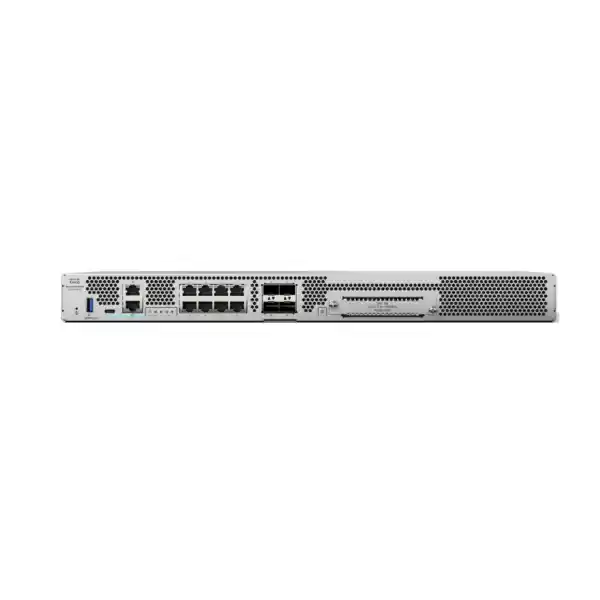
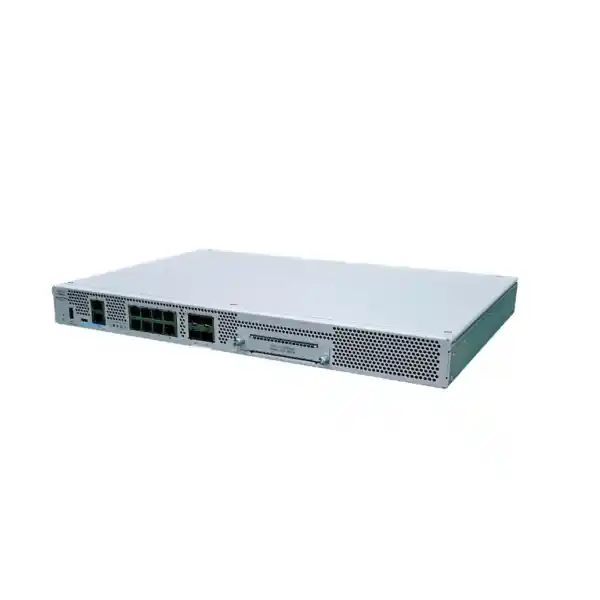
Cisco Secure Firewall 1250 Dubai
A high-performance 1U branch firewall for organizations that need multigigabit copper interfaces, 1/10Gbps SFP+ uplinks, strong threat-inspection headroom and a clear migration path into Cisco Secure Firewall management. The 1250 sits at the top of Cisco’s Secure Firewall 1200 Series and is intended for larger branch, distributed-enterprise and performance-sensitive edge deployments rather than basic small-office use.
Direct answer for buyers considering the Cisco Secure Firewall 1250
The Cisco Secure Firewall 1250 is the highest-performance 1U rack-mount appliance in the Secure Firewall 1200 Series. It can run Cisco Secure Firewall Threat Defense or Cisco Secure Firewall ASA software, depending on the deployment design and required features.
It is mainly used to secure larger branches, distributed sites, internet edges and VPN-connected locations where ordinary gigabit-only branch appliances may leave too little inspection or interface headroom.
Organizations with multigigabit WAN or LAN requirements, substantial encrypted traffic, large VPN populations, dense branch traffic, high east-west routing needs, or a policy requirement to standardize on Cisco security should evaluate the 1250.
Size against the security services you will actually enable, not just the headline firewall figure. IPS, application visibility, VPN, TLS decryption, logging and traffic characteristics all influence real deployment capacity.
FourTeck can help define the correct software mode, management architecture, subscription term, transceivers, rack and power requirements, high-availability design, migration scope, support coverage and bill of materials for a UAE deployment.
Where the Secure Firewall 1250 fits in Cisco’s branch firewall portfolio
The 1250 is not simply a faster version of an entry-level firewall. Cisco positions the Secure Firewall 1200 Series for the distributed enterprise, with compact models for smaller sites and three 1U rack-mount models—1230, 1240 and 1250—for larger branches. Within that rack-mount group, the 1250 is the model that introduces eight integrated 2.5GBASE-T multigigabit interfaces while retaining four SFP+ slots that support 1Gbps and 10Gbps transceivers. That interface profile matters in practical network design because it allows the firewall to sit between modern access switching, multigigabit WAN handoffs, servers, wireless aggregation or internal routed segments without forcing every high-speed connection onto an optical slot.
Cisco’s published Threat Defense performance figures also distinguish the model clearly from the 1230 and 1240. For the 1250, Cisco lists 24 Gbps for FW + AVC at the stated packet size, 22 Gbps for NGIPS, 18 Gbps for FW + AVC + IPS, 22 Gbps for IPsec VPN with Fastpath, and 4.1 Gbps for TLS decryption. The corresponding 1240 values are lower, so buyers who expect sustained inspection growth, larger VPN traffic or more encrypted application flows have a real reason to compare the 1250 rather than selecting purely on port count. At the same time, those published laboratory figures are not a promise that every production network will see the same throughput. Cisco explicitly notes that activated features, protocol mix, packet sizes and software releases affect performance.
For Dubai and UAE buyers, this family position is useful because many projects combine high-speed internet, site-to-site VPN, cloud applications, segmented campus networks, voice, video, wireless traffic and growing encrypted workloads. A branch may only have a 2 Gbps internet circuit today but still require more firewall headroom because of internal routed traffic, multiple WAN paths, TLS inspection, remote-access VPN, application control and future circuit upgrades. Conversely, buying a 1250 for a small office with a few hundred megabits of traffic may be unnecessary if a smaller model satisfies every capacity, interface and resilience requirement. Accurate selection starts with the traffic and security design, not with the assumption that the largest 1200 Series model is automatically the best choice.
Verified performance and hardware profile
| Specification | Cisco Secure Firewall 1250 | Buyer interpretation |
|---|---|---|
| Form factor | 1U rack mount | Designed for structured rack deployment rather than desktop placement. |
| FW + AVC throughput | 24 Gbps | Useful as a reference point, but production sizing must consider enabled inspection services and traffic characteristics. |
| NGIPS throughput | 22 Gbps | Relevant for deployments where intrusion-prevention inspection is a primary workload. |
| FW + AVC + IPS | 18 Gbps | A more conservative reference than the firewall-only figure when application control and IPS will both be active. |
| IPsec VPN throughput | 22 Gbps, Cisco test condition | Important for hub-and-spoke branches, large site-to-site tunnels and encrypted inter-site traffic. |
| TLS decryption | 4.1 Gbps | Encrypted traffic inspection can become the deciding sizing constraint even when raw firewall throughput is much higher. |
| New connections per second with AVC | 100,000 | Relevant for busy internet edges and applications that create many short-lived sessions. |
| Concurrent sessions with AVC | 1,000,000 | Provides substantial session scale for a branch platform, but application behavior still matters. |
| Maximum VPN peers | 1,500 | Useful for remote-access and VPN planning; exact design and licensing should be validated. |
| Integrated data interfaces | 8 × 2.5GBASE-T | Supports copper multigigabit handoffs without consuming SFP+ slots. |
| Transceiver slots | 4 × SFP+, 1/10Gbps | Optics or DAC choices must match the connected equipment and Cisco compatibility guidance. |
| Management Ethernet | 1 × 1000BASE-T | Enables separation of management traffic where the design calls for a dedicated management network. |
| Storage | 960GB field-replaceable SSD | Supports appliance operations and local storage requirements defined by the platform. |
| Power | Single integrated power supply, 100–240V AC, 50–60 Hz; maximum published consumption 88W | The single integrated PSU should be considered in site power and resilience planning. |
| Dimensions and weight | 1.72 × 11.22 × 17.25 in; approximately 9.52 lb / 4.32 kg | Confirm rack depth, rail/accessory requirements, airflow and cable clearance before installation. |
Published performance is test-condition dependent. Production results vary with feature activation, packet sizes, protocol mix, encrypted traffic, inspection policy, software release and traffic direction. For a business purchase, treat the table as a model-comparison reference, then size against measured or forecast workloads.
Why the 2.5GBASE-T and SFP+ combination matters
Interface design is one of the strongest reasons to choose the Secure Firewall 1250 over a smaller 1200 Series model. Eight integrated 2.5GBASE-T ports can be valuable in networks where the firewall connects directly to multigigabit switching, higher-speed internet CPE, SD-WAN underlay devices, server segments or campus distribution links over copper. The benefit is not merely that each copper port can negotiate above 1 Gbps. It is that the design can reserve the four SFP+ slots for genuine fibre, DAC or 10Gbps uplink requirements instead of consuming them for every connection that exceeds ordinary Gigabit Ethernet.
The four SFP+ slots provide flexibility for 1Gbps and 10Gbps transceivers, but transceivers are a separate selection decision. Buyers should specify whether each link is single-mode fibre, multimode fibre, short-reach copper DAC, or another supported medium, and should match connector type, distance, wavelength and the peer device. A firewall quotation that lists only the chassis can be incomplete if the intended design relies on optical connections. The right BOM may also need compatible patch leads, fibre trays, DAC cables, switch-side optics and spares, depending on the site.
Port speed alone does not define topology. The team should document which interfaces will carry outside, inside, DMZ, guest, server, WAN, backup ISP, HA, management and transit roles. It should also determine whether VLAN trunking will consolidate logical segments onto fewer physical interfaces or whether separate physical interfaces are required by policy or operational practice. This is especially important on a high-capacity appliance because it is easy to create an apparently generous port map that later becomes constrained by resilience, link aggregation, dedicated management or segmentation requirements.
A useful procurement exercise is to draw the proposed physical topology before ordering. Label every firewall port, speed, medium and peer device. Then verify whether the chosen switch ports and transceivers support the same link mode. That simple step often prevents last-minute installation problems and makes it easier to decide whether the 1250’s interface mix is genuinely valuable for the project or whether a smaller 1200 model can deliver the same practical connectivity.
Threat Defense or ASA: decide the software operating model before you buy
Cisco Secure Firewall Threat Defense
Threat Defense is the natural choice when the project requires Cisco’s integrated next-generation firewall capabilities, including application-aware policy, intrusion prevention and the broader subscription-driven security feature set. It can be managed centrally with Secure Firewall Management Center, on-box with Firewall Device Manager, or through supported cloud-delivered management workflows.
For organizations already using Cisco Secure Firewall Management Center, the 1250 can fit into a standardized policy, event and operational model. For a new deployment, the management platform itself must be part of the architecture and commercial scope. A central manager can improve consistency across many branches, while local management can be more appropriate for a simple standalone environment. The choice affects deployment workflow, licensing, administrative roles, logging and long-term operations.
Cisco Secure Firewall ASA
ASA software remains relevant for organizations whose requirements are centered on ASA capabilities, established ASA operational practices, security contexts or migration continuity. Cisco publishes separate ASA performance figures for the 1250, including stateful firewall and IPsec metrics, and the platform supports multiple-context mode within the documented ASA limits.
Choosing ASA should be a deliberate architectural decision, not a default based on administrator familiarity. If the business expects next-generation inspection, integrated application control, URL filtering or malware-oriented subscriptions, Threat Defense may align better. If the project is specifically an ASA replacement or continuation, confirm exact feature parity and software-release support before assuming configurations can be transferred unchanged.
The two software paths make the hardware more flexible, but they also create a procurement dependency: the quotation should reflect the software mode you intend to operate, the management platform you intend to use, and the security services you actually require. Reimaging is possible in supported workflows, yet it is better to make the target operating model explicit before deployment so that licensing, migration planning, training and acceptance testing all align.
Licensing and subscriptions: what the chassis price does not tell you
A Cisco Secure Firewall 1250 project should not be budgeted from the chassis alone. Under Threat Defense, Cisco documents a required base or Essentials entitlement and separate capabilities associated with IPS, Malware Defense, URL Filtering and Cisco Secure Client. Cisco’s current ordering guidance lists a combined threat subscription PID for the 1250 and term options of one, three or five years for the applicable IPS, Malware and URL package. The exact subscription combination should be confirmed against the security policy and the current Cisco ordering tools at the time of purchase, because commercial packaging and software entitlements can evolve.
The practical question is not “Do we need a license?” but “Which security functions must remain active throughout the appliance’s operating life?” If the firewall will enforce IPS and URL policy from day one, the subscription term becomes part of the project’s security baseline. If remote-access users require Cisco Secure Client, that requirement should be sized and licensed as a separate workstream rather than assumed to be included because the appliance supports VPN. If management will be through a virtual Secure Firewall Management Center, the manager’s device entitlement and infrastructure requirements also need to be accounted for.
Subscription term affects total cost of ownership and renewal risk. A one-year term can suit projects with short budgeting cycles or uncertain future architecture, while a three- or five-year term can reduce renewal administration and align coverage with hardware planning. The correct choice depends on procurement policy, expected firewall lifecycle, support strategy and the likelihood of a major network redesign. Buyers should also distinguish security subscription coverage from technical support coverage; they solve different commercial and operational needs.
For ASA software, licensing follows a different feature model. Cisco documents Essentials as included and supports additional security-context licensing, with Cisco Secure Client handled under its own ordering model. Organizations migrating from older ASA platforms should compare required context counts, VPN users, encryption requirements and any legacy features against the exact target software release. Licensing should therefore be treated as part of architecture validation, not as an administrative detail added after the hardware decision.
How to size the Cisco Secure Firewall 1250 for real traffic
1. Measure WAN and inter-zone traffic
Document current peak and 95th-percentile traffic, not only contracted circuit speed. Include internet, MPLS, SD-WAN, private cloud, data-center and internal routed flows that cross the firewall.
2. Identify inspection policy
Separate simple stateful flows from traffic that will use application control, IPS, URL policy, malware inspection or TLS decryption. The security stack changes the relevant throughput reference.
3. Quantify encrypted traffic
If HTTPS inspection is planned, estimate what percentage of traffic is eligible for decryption and what must be bypassed for privacy, compatibility or policy reasons. TLS capacity can become the decisive constraint.
4. Model VPN load
Include site-to-site tunnels, remote-access users, tunnel encryption overhead, backup-path operation and potential concentration of traffic during failover. A VPN-heavy branch can have a very different profile from an internet-only branch.
5. Include session behavior
Busy SaaS, web, DNS, API and microservice environments can create large numbers of short-lived sessions even when bandwidth is moderate. New-connection rate and concurrent-session scale should not be ignored.
6. Add growth and failover headroom
Plan for circuit upgrades, new sites, more inspection, cloud migration and the possibility that one HA member must temporarily carry the full production load. Sizing at today’s exact peak leaves little operational margin.
A useful rule for procurement is to choose the performance metric closest to the intended security policy. If IPS and application visibility will be consistently active, the combined FW + AVC + IPS figure is more relevant than the headline firewall number. If significant TLS inspection is required, the 4.1 Gbps published TLS figure deserves separate attention. If remote-access and site-to-site VPN are major workloads, VPN throughput and peer/session scale matter. This multi-metric method produces a more defensible design than dividing the internet circuit speed by a single data-sheet number.
TLS decryption can change the sizing decision
Modern business traffic is predominantly encrypted, so a firewall that performs well on ordinary stateful inspection can still become constrained when security policy requires decryption and inspection of HTTPS flows. Cisco publishes a TLS decryption figure of 4.1 Gbps for the Secure Firewall 1250 under its stated test methodology. That number is significantly lower than the 24 Gbps FW + AVC figure because cryptographic processing and deeper inspection are much more demanding workloads. For organizations evaluating the 1250 specifically for secure internet access, this difference should be treated as a design input rather than a footnote.
The first question is how much traffic will actually be decrypted. Many organizations exempt selected categories, financial services, health-related sites, certificate-pinned applications, unsupported applications or privacy-sensitive traffic. Others apply decryption only to managed users, specific network segments or internet-bound traffic. The percentage of eligible traffic therefore varies widely. A reliable estimate combines current traffic telemetry with the proposed decryption policy and expected user behavior.
The second question is operational readiness. TLS inspection requires certificate planning, endpoint trust, application testing, exception management and incident workflows. A project can fail even when the appliance has enough raw capacity if endpoints do not trust the inspection certificate or critical applications break under interception. The deployment plan should include staged policy rollout, bypass criteria, testing with representative business applications and a documented process for troubleshooting certificate and compatibility issues.
If forecast decrypted traffic approaches the platform’s tested capacity with little headroom, evaluate a larger Cisco platform rather than assuming the 1250’s firewall throughput will compensate. Conversely, if only a limited subset of traffic is decrypted and total inspected load is moderate, the 1250 may provide substantial branch headroom. The correct conclusion depends on the traffic policy, not merely on whether “SSL inspection” appears in the project requirements.
High availability, power and resilience planning
Cisco Secure Firewall 1200 hardware supports high availability, and Threat Defense supports active/standby HA for the platform. For a business-critical UAE site, that can be more important than choosing the highest throughput model. An HA pair protects against a single appliance failure and enables a more resilient firewall design, but it also doubles chassis count and introduces additional interface, addressing, synchronization, licensing, cabling and operational considerations. The design should be documented before quotation so that the two units, transceivers and connected switching infrastructure are ordered consistently.
The 1250 uses a single integrated power supply rather than field-redundant dual PSUs. That makes upstream power design important. In a single-appliance deployment, a UPS can reduce the risk of abrupt power loss and file-system damage. In an HA deployment, each firewall should ideally connect to an appropriately designed power path so that a single PDU, outlet or UPS event does not remove both members. Rack placement, airflow and cable routing should also allow a failed unit to be serviced without disturbing the surviving appliance.
High availability must be considered together with the management and provisioning method. Cisco’s current deployment guidance notes specific considerations when zero-touch provisioning is used and recommends use of the management interface in relevant HA scenarios. Teams should therefore decide whether the branch will be commissioned locally, centrally or through a cloud-delivered workflow, and how management reachability will survive WAN and firewall state changes.
Resilience also extends beyond the firewall pair. Dual ISPs are useful only if routing, NAT, VPN, DNS, monitoring and application failover behavior are designed for them. Dual switches are useful only if physical links and VLANs avoid hidden single points of failure. The 1250 has enough interface capacity to support sophisticated topologies, but redundancy comes from architecture, not from unused ports. A quotation for an HA project should therefore be based on a topology diagram and failover requirements, not simply “quantity two.”
Management architecture: local, centralized or cloud-delivered
The operating model should be selected with the same care as the appliance. Cisco supports multiple management approaches for Secure Firewall Threat Defense. Centralized Secure Firewall Management Center can provide consistent policy, visibility and administration across multiple firewalls. Firewall Device Manager provides an on-box option for supported standalone deployments. Cisco also supports cloud-delivered management workflows through Security Cloud Control. Each approach can fit a different organization, and the 1250 should be quoted with the target management design in mind.
For a single UAE branch with a small security team and no existing Cisco manager, local management may reduce infrastructure overhead, provided the required features and operational workflows are supported. For an organization with several branches, centralized policy, shared objects, coordinated software maintenance and consolidated event analysis can make a central management platform more valuable. A multinational organization may instead prefer cloud-delivered operations to reduce dependence on a local management server. The decision should consider network reachability, security policy, administrative separation, change-control processes and disaster recovery.
Management is also a licensing and infrastructure question. A virtual manager may require its own entitlement and compute resources. A hardware manager is a separate platform decision. Cloud-managed operation introduces service connectivity and organizational-account requirements. Local management can simplify architecture but may not provide the same multi-device operational model. None of these options should be assumed to be “included” simply because the firewall hardware supports them.
Before deployment, define who will administer the 1250, where policy will be created, where logs will be retained, how alerts will be monitored, how configuration backups will be protected, and how software updates will be approved. Those answers determine whether the firewall becomes an integrated security control or an isolated appliance that is difficult to operate. FourTeck can help map the desired administration model to the corresponding hardware, software and deployment scope.
Branch, campus and edge use cases where the 1250 can make sense
Large enterprise branch
A branch with multigigabit internet, many users, segmented networks, cloud applications and heavy SaaS usage can use the 1250 as an inspection and VPN edge while retaining substantial interface flexibility.
Regional office with VPN concentration
A regional office aggregating site-to-site tunnels or supporting a significant remote workforce may value the 22 Gbps published IPsec figure and up to 1,500 documented VPN peers, subject to the final VPN design and licenses.
Campus internet edge
A mid-sized campus can use the 2.5G copper and 10G optical options to connect distribution switching, internet routers and DMZ networks while enforcing centralized security policy.
Secure SD-WAN branch
Organizations using direct internet connectivity at branches can combine routing and security policy around the firewall where the chosen Cisco software release and architecture support the required networking functions.
Migration from older Cisco firewall hardware
The 1250 may be a candidate when replacing aging lower-capacity branch platforms, especially where interface speed, encrypted traffic and central management requirements have grown beyond the old design.
High-throughput segmented site
Sites that route substantial traffic between trusted, server, OT, guest, wireless or partner segments can benefit from a firewall sized for inter-zone inspection rather than only internet bandwidth.
When the Cisco Secure Firewall 1250 may be more than you need
A balanced product page should make clear that the 1250 is not automatically the right answer for every Cisco firewall requirement. If the site has a modest internet connection, limited internal segmentation, low VPN demand and no realistic multigigabit growth, a smaller Secure Firewall 1200 Series model may deliver the required security at a lower acquisition and subscription cost. The 1230 and 1240 remain 1U rack-mount platforms with 1/10Gbps SFP+ options, so organizations that need rack deployment but not the 1250’s full performance should compare them carefully.
The 1250 can also be the wrong choice in the opposite direction. A project may need more TLS inspection capacity, higher remote-access scale, larger growth headroom, clustering, dual field-replaceable power supplies, more high-speed interfaces or data-center-class resilience than the 1200 Series provides. Cisco’s compatibility documentation indicates that the 1200 Series supports high availability but not the clustering capabilities available on selected larger Secure Firewall platforms. If the design requirement is horizontal scale-out clustering or advanced data-center architecture, evaluation should move beyond the 1250 rather than trying to force the branch platform into that role.
Another warning sign is an undefined security policy. If the procurement team knows only the internet speed but cannot say whether IPS, TLS decryption, URL filtering, malware defense, remote access, site-to-site VPN or centralized management will be used, it is premature to confirm the model. The same is true if the interface media are unknown. The 1250 may appear attractive because it has ample ports and strong numbers, but a correct selection needs a workload and topology baseline.
The most defensible purchase is therefore the smallest platform that meets the required security policy, performance, resilience, interfaces and forecast growth with reasonable headroom. Sometimes that is the 1250; sometimes it is a smaller 1200 model; and sometimes the project belongs on a larger Cisco Secure Firewall family. FourTeck can structure the comparison around measurable requirements so the recommendation is based on the deployment rather than the product name.
Cisco Secure Firewall 1230 vs 1240 vs 1250: practical buying comparison
| Metric | 1230 | 1240 | 1250 |
|---|---|---|---|
| FW + AVC | 13 Gbps | 18 Gbps | 24 Gbps |
| FW + AVC + IPS | 9 Gbps | 12 Gbps | 18 Gbps |
| NGIPS | 11 Gbps | 15 Gbps | 22 Gbps |
| IPsec VPN | 13 Gbps | 18 Gbps | 22 Gbps |
| TLS decryption | 2.5 Gbps | 3.2 Gbps | 4.1 Gbps |
| Copper data ports | 8 × 1G | 8 × 1G | 8 × 2.5G |
| SFP+ slots | 4 × 1/10G | 4 × 1/10G | 4 × 1/10G |
The comparison shows why the 1250 has its own buying case. It offers the strongest published inspection and VPN figures in the three-model rack-mount set and is the only one of these three with eight integrated 2.5GBASE-T data interfaces. A buyer who needs only 1G copper and moderate inspected throughput should examine the 1230 or 1240. A buyer who expects multigigabit copper connections, higher encrypted traffic or more headroom may find that the 1250 avoids an earlier replacement. The price difference should therefore be evaluated against expected service life and network growth, not in isolation.
Migration planning from an existing ASA, Firepower or third-party firewall
Replacing a firewall is a policy and application migration project, not just a hardware swap. Begin by inventorying the current interfaces, VLANs, routes, NAT rules, access rules, VPNs, certificates, objects, public IP dependencies, DHCP services, DNS behavior, identity integrations, logging targets and monitoring systems. Remove obsolete rules before migration where governance permits. A smaller, cleaner policy is easier to validate and reduces the risk of recreating years of unused configuration on the new platform.
For an ASA-to-ASA transition, administrators may be able to preserve more of the operational model, but model-specific behavior and software-version differences still require review. For a move from ASA to Threat Defense, the team should treat policy mapping, object conversion, VPN behavior, management workflows and licensing as separate validation areas. For migrations from another vendor, terminology and security constructs can differ significantly; a rule that appears equivalent on paper may behave differently once application identification, NAT order, object groups or VPN negotiation are considered.
A staged migration plan should include configuration build, peer review, lab or offline validation where possible, change-window preparation, rollback criteria, stakeholder communication and post-cutover testing. The test plan should cover internet browsing, published services, critical SaaS, site-to-site VPN, remote access, DNS, voice, email, ERP, payment systems, partner links and monitoring. It should also include performance checks so that any unexpected CPU, session, packet-drop or inspection behavior is identified before users experience prolonged disruption.
Optics and cabling should be validated before the change window. The 1250’s 2.5G copper ports may connect differently from an older appliance, and new SFP+ modules may be needed if the project upgrades link speeds. Rack depth, grounding, power, console access and management addressing should also be prepared in advance. If HA is being introduced during the same migration, test failover before production acceptance rather than treating the standby unit as an unverified spare.
FourTeck can scope migration as a separate service from hardware supply. That distinction helps buyers compare quotations accurately: one quote may cover only the appliance and subscription, while another may include design review, configuration, migration, on-site installation, policy cleanup, testing, documentation and post-cutover support. Defining the migration deliverables in writing prevents gaps between procurement expectations and implementation reality.
Installation and data-center-room readiness in Dubai and the UAE
Rack and physical space
The 1250 is a 1U appliance with published dimensions of about 4.37 × 28.49 × 43.81 cm. Confirm rack depth, mounting hardware, door clearance, cable bend radius and front-to-back airflow before delivery.
Power quality
Cisco specifies 100–240V AC and 50–60 Hz input for the rack-mount models. Use suitable UPS and PDU infrastructure for business-critical deployments, especially because the 1250 has a single integrated power supply.
Cooling
The appliance uses integrated front-to-back blower cooling. Avoid blocking intake or exhaust paths, and confirm that the rack environment remains inside Cisco’s documented operating temperature and humidity ranges.
Cabling and labeling
Prepare copper patch leads, fibre jumpers, DACs and console cables in advance. Label both ends and record the connected switch/router port so future troubleshooting does not depend on tracing live cables.
Management access
Reserve management addressing, routing, DNS, NTP and any required manager connectivity before installation. Out-of-band or dedicated management design can substantially simplify recovery and remote administration.
Change-window preparation
Document rollback steps, configuration backups, contact details, ISP handoff information and success criteria. Installation should end with a signed test checklist rather than merely a powered-on appliance.
Performance dependencies buyers should understand before comparing quotations
Firewall quotations often list a headline throughput number without explaining what it represents. For the Cisco Secure Firewall 1250, the distinction between 24 Gbps FW + AVC, 18 Gbps FW + AVC + IPS and 4.1 Gbps TLS decryption is critical. These are different workloads. A buyer comparing the 1250 with another model or brand should match like-for-like test categories as closely as possible and should understand that vendor methodologies are not always identical. A “20 Gbps firewall” label from two different products does not necessarily imply equivalent inspected performance.
Packet size matters because processing a very large number of small packets can be more demanding than moving the same bandwidth in larger packets. Application mix matters because short-lived web sessions, DNS requests, APIs and SaaS connections can create high connection rates. Security policy matters because IPS signatures, application control, URL decisions, malware inspection and decryption add work. Logging policy matters because detailed event generation and external forwarding can increase operational load. Software release matters because performance and feature behavior can change as code evolves.
Network architecture can also create load that is invisible in an internet-circuit comparison. If the firewall routes between internal VLANs, secures a server farm, terminates multiple WAN links, handles VPN traffic and inspects east-west connections, the total processed traffic may be several times the public internet bandwidth. High availability can add another sizing requirement because one unit must be able to carry the full expected load after failover. Maintenance windows, backups and re-convergence can create temporary peaks that are not reflected in normal averages.
For these reasons, FourTeck’s recommended quotation inputs include measured peak throughput, security services, encryption percentage, VPN count, session scale, port map and growth horizon. When those inputs are available, the 1250 can be evaluated against a realistic workload rather than against a marketing headline. That makes the resulting purchase easier to defend technically and financially.
Security subscriptions should map to policy, not to a generic bundle
A useful way to select Cisco security subscriptions is to start with the policy outcomes. If the business requires intrusion prevention for internet and inter-zone traffic, plan the IPS entitlement and operational process for signature updates, event review and tuning. If URL categories must be enforced for users, include URL filtering and define how exceptions will be approved. If malware-focused inspection is required, include the corresponding entitlement and determine which file types, directions and user groups are in scope. If remote users need secure access, size Cisco Secure Client separately and define authentication, posture and identity requirements.
This policy-first method avoids two common mistakes. The first is under-buying—ordering only the chassis and later discovering that required security services need additional commercial coverage. The second is over-buying—purchasing a broad subscription package without any plan to enable, tune or monitor the associated controls. Security value comes from configured policy and operational response, not from the existence of an entitlement on a purchase order.
Subscription terms should also align with lifecycle planning. A firewall expected to remain in service for several years should have a renewal roadmap that avoids unexpected expiration of important services. Procurement teams should record subscription start and end dates, Cisco Smart Account ownership, renewal contacts and budget responsibility. Technical teams should know which features are dependent on active entitlement and what operational impact occurs if coverage lapses.
For a new 1250 deployment in the UAE, the most useful quotation request therefore states the target security functions and preferred term rather than simply asking for “full license.” That phrase is ambiguous. A precise request might specify Threat Defense, IPS, URL and malware security services, three-year term, centralized management, Cisco Secure Client for a defined user count, and the required support level. This yields a BOM that can be checked against the intended policy.
Remote-access VPN and site-to-site VPN planning
Cisco documents up to 1,500 VPN peers for the Secure Firewall 1250 under Threat Defense scalability guidance, and current remote-access documentation lists a maximum of 1,500 concurrent remote-access VPN sessions for the platform. Those figures make the 1250 suitable for substantial branch or regional VPN use, but the maximum should not be treated as the only sizing metric. Real deployments vary in user traffic, authentication method, tunnel duration, split-tunneling policy, internet breakout design and whether security inspection continues after traffic enters the VPN.
Remote-access planning should identify the expected concurrent-user population rather than total employee count. It should also estimate average and peak bandwidth per user, application mix, video-conferencing behavior, software distribution, file access and SaaS usage. If all remote internet traffic is hairpinned through the firewall, the traffic model can be very different from a split-tunnel design. Identity systems, MFA, certificate services and endpoint client deployment must be included in the project plan because a firewall alone does not provide a complete remote-access service.
Site-to-site VPN planning should inventory peer count, encryption domains, dynamic or static routing, failover behavior, cloud gateways and third-party compatibility. The 22 Gbps published IPsec figure is helpful for model comparison, but the final design should consider whether encrypted traffic will also be inspected, whether multiple tunnels share the same WAN circuit, and whether an HA failover event could concentrate more traffic onto one appliance or one ISP path.
For quotations, specify whether the 1250 will act as a branch spoke, regional hub, remote-access concentrator or mixed VPN endpoint. Include the approximate number of tunnels, expected concurrent users, internet speed, authentication method, current VPN platform and migration requirement. These details determine whether the 1250 is comfortably sized and which licenses and services belong in the project.
Procurement risks that can delay a Secure Firewall 1250 deployment
Wrong software assumption
Ordering without deciding between Threat Defense and ASA can create a mismatch between licensing, migration procedures and operational expectations.
Missing subscriptions
If IPS, URL, malware or remote-access capabilities are part of the security requirement, they must be represented correctly in the commercial scope.
Unspecified optics
SFP+ slots are not useful until the required medium, speed, distance and compatible transceiver are known. Chassis-only quotations can leave this gap.
No HA topology
An HA pair may require additional interfaces, cabling, switch capacity, IP addressing and power planning beyond simply buying two appliances.
Undefined management platform
Central, local and cloud-delivered management have different infrastructure and operational implications. The project should name the chosen management method.
Migration omitted from scope
Hardware supply does not automatically include policy conversion, VPN migration, cutover, testing, documentation or rollback planning. Ask for these services explicitly if required.
Operational lifecycle: what happens after the firewall is installed
The value of the Secure Firewall 1250 depends on continuous operations after the initial cutover. Define who reviews security events, who approves policy changes, how frequently software updates are assessed, how configuration backups are protected, and how renewal dates are tracked. In many organizations, the firewall is installed successfully but gradually becomes difficult to manage because rules accumulate, objects become inconsistent and subscriptions approach expiry without clear ownership.
Software maintenance deserves a documented process. Cisco publishes release notes, compatibility information, security advisories and field notices for Secure Firewall platforms. Teams should evaluate new releases against required features and known issues before production upgrade. High availability can reduce outage risk during maintenance, but upgrade procedure and failover behavior still need planning. A backup and rollback approach should be part of every major change.
Policy hygiene matters just as much as software. Access rules should have owners and business reasons where possible. Temporary rules should have expiry dates. Unused objects and stale NAT entries should be reviewed. IPS and URL policies should be tuned against actual events rather than left permanently at defaults. TLS decryption exceptions should be documented so that security posture does not erode through ad-hoc bypasses. VPN accounts, certificates and partner tunnels should be included in periodic access reviews.
Monitoring should cover availability, interface errors, packet drops, CPU and memory indicators, session counts, VPN status, high-availability state, event-processing health and subscription status. The monitoring destination can be Cisco’s own management platform, a SIEM, NMS or a combination. The key is to decide which events require action and who receives them. Alerting without ownership creates noise rather than resilience.
For UAE customers that prefer outsourced operations, managed firewall or IT support can be scoped around these lifecycle tasks. FourTeck IT Services UAE can be considered where the requirement extends beyond hardware supply into ongoing infrastructure support. The service scope should still define responsibilities, response targets, maintenance windows, escalation paths and exclusions so both technical and commercial expectations are clear.
UAE purchasing and quotation guidance
A useful Cisco Secure Firewall 1250 quotation should identify the exact chassis, software mode, subscription package and term, support coverage, optics, quantities and any implementation services. If the deployment is an HA pair, the quotation should make the paired design obvious rather than leaving the buyer to infer it from quantity. If a central manager is required, include the relevant management platform and entitlement in the commercial discussion. If migration is required, describe the existing firewall and the services expected during the change.
Availability and lead time can vary by distribution channel, software bundle, subscription term and project quantity. For that reason, product pages should not make unsupported promises about stock or delivery. A current quotation should confirm availability at the time of request. UAE buyers should also specify the delivery emirate and whether installation is required, because site access, scheduling and on-site support may affect the project scope.
For business customers, procurement documentation may need serial tracking, warranty/support information, VAT-compliant invoicing, delivery note handling and asset details. Large projects may require a formal bill of materials, statement of work and acceptance criteria. These items are easier to prepare when the technical design is already stable. A rushed purchase based on only the firewall model often creates follow-up orders for optics, licenses, rack accessories or services.
FourTeck’s UAE resources can support broader infrastructure planning around the firewall. Visit FourTeck UAE for regional technology solutions, or FourTeck for the wider company portfolio. For this product specifically, the firewall specialist site remains the most directly relevant source for Dubai firewall consultation.
A technically complete request usually receives a more useful commercial response than “best price for Cisco 1250.” Include the intended software, desired subscription term, internet/WAN speed, security services, HA requirement, optics, installation location, migration scope and support requirement. That gives the supplier enough information to identify missing items before the order becomes an installation problem.
Detailed buyer questions and answers
Is the Cisco Secure Firewall 1250 suitable for a 10Gbps internet connection?
It can be a candidate because Cisco publishes security throughput figures above 10 Gbps for several workloads and the appliance includes 10Gbps-capable SFP+ slots. Suitability still depends on the services enabled. If a large percentage of a 10Gbps circuit must undergo TLS decryption, the published 4.1 Gbps TLS figure becomes a major constraint. If traffic is mostly stateful firewall plus application visibility, the published reference is much higher. Size against the actual security policy.
Does the 1250 have 10Gbps copper ports?
The integrated copper data interfaces are eight 2.5GBASE-T multigigabit ports. For 10Gbps connectivity, the 1250 provides four SFP+ slots that support 1Gbps and 10Gbps transceivers. If the design requires native 10GBASE-T copper, confirm the supported media options and peer-side design rather than assuming the 2.5GBASE-T ports operate at 10Gbps.
Does the 1250 support high availability?
Yes. Cisco documents high-availability support for the Secure Firewall 1200 Series, including active/standby HA for Threat Defense. However, an HA project requires two correctly licensed and connected appliances plus a complete failover design. Cisco’s compatibility guidance distinguishes HA support from clustering; the 1200 Series does not provide the clustering capability available on selected larger platforms.
Can the 1250 run ASA software?
Yes. Cisco documents the 1200 Series as available with Threat Defense or ASA software. The feature set, management, licensing and published performance differ between the two modes. Organizations should confirm which software is required before ordering and should validate migration requirements against the intended release.
How many remote-access VPN users can it support?
Cisco’s current documentation lists a maximum of 1,500 concurrent remote-access VPN sessions for the Secure Firewall 1250. That maximum does not guarantee that every 1,500-user workload is equivalent. User bandwidth, split tunneling, application mix, security inspection and authentication architecture all affect the design, and Cisco Secure Client licensing must be planned separately.
Are SFP+ modules included?
Do not assume transceivers are included with the base chassis. The four SFP+ slots support a range of compatible 1Gbps and 10Gbps transceivers, and the correct module depends on fibre type, distance, connector, peer equipment and Cisco compatibility. Specify the link requirements in the quotation so optics can be selected deliberately.
Is the 1250 appropriate for a small office?
Usually it should be compared with smaller 1200 Series models unless the office has unusually high throughput, multigigabit interfaces, dense VPN traffic, heavy inspection or a short-term growth requirement. The 1250 is a 1U high-capacity branch model; choosing it for a low-demand office may provide little practical benefit.
What should be included in a Dubai installation scope?
A complete scope can include rack mounting, power and UPS checks, interface cabling, transceiver installation, management setup, software validation, licensing registration, policy configuration, VPN setup, HA commissioning, migration, testing, documentation and handover. The exact list depends on whether this is a new site, replacement or expansion.
What is the biggest sizing mistake?
Using only internet circuit speed and the highest firewall throughput number. A better design also considers IPS, TLS decryption, VPN, session rate, internal routed traffic, HA failover load, logging, future circuit upgrades and the percentage of traffic that receives deeper inspection.
What information is needed for an accurate quotation?
Provide quantity, target software mode, security subscriptions and term, WAN speed, expected inspected traffic, VPN users and tunnels, required ports and optics, HA requirement, management method, migration source, installation location, support preference and desired implementation services.
A practical implementation journey for the Secure Firewall 1250
Discovery
Collect topology, traffic, security policy, circuits, VPNs, user counts, existing firewall details and growth expectations.
Sizing
Compare the 1250’s relevant inspected, TLS, VPN, session and interface metrics against real workload and forecast headroom.
BOM definition
Confirm chassis quantity, software, subscriptions, term, management, optics, cables, support and any HA or rack accessories.
Design
Define physical ports, VLANs, zones, routing, NAT, VPN, management, logging, HA and rollback requirements.
Build
Prepare software, licenses, manager registration, objects, access policy, NAT, VPN and monitoring before the cutover where possible.
Cutover
Install, cable, migrate, validate business applications, test VPN and failover, monitor performance and retain rollback readiness.
Handover
Document addressing, policies, subscriptions, serials, backups, admin access, support contacts and maintenance procedures.
Operate
Review events, tune policy, track renewals, assess updates, test backups and periodically revisit capacity as traffic changes.
Decision recap: six points that determine whether the 1250 is the right model
Choose the 1250 when its performance and 2.5G/10G interface profile solve a real branch or edge requirement. Compare 1230 and 1240 when the site is smaller.
Use the metric that matches the policy. FW + AVC + IPS and TLS decryption can be more relevant than the headline firewall number.
Define Threat Defense or ASA, security subscriptions, term, Cisco Secure Client requirements and management entitlements before finalizing the BOM.
Map each 2.5GBASE-T and SFP+ interface to a peer device, speed and medium. Include compatible optics and cabling where needed.
If downtime matters, evaluate an HA pair, upstream switch redundancy, dual WAN design and independent power paths rather than relying on one appliance.
Separate hardware supply from migration, installation, configuration, testing, documentation and managed support so quotations can be compared fairly.
What FourTeck needs from the buyer for an accurate Cisco 1250 quotation
If some values are not yet known, send the available topology and current firewall details. The missing inputs can be identified during technical review. That is preferable to choosing subscriptions, optics or services by guesswork.
Plan the Cisco Secure Firewall 1250 around your real UAE network
The Secure Firewall 1250 is a strong branch platform when its 24 Gbps FW + AVC reference performance, 18 Gbps combined FW + AVC + IPS performance, 4.1 Gbps TLS decryption capacity, 22 Gbps IPsec figure, eight 2.5GBASE-T ports and four 1/10Gbps SFP+ slots align with the actual design. The best quotation will also account for software mode, subscriptions, management, optics, HA, migration and support. Share those requirements and FourTeck can structure a product and deployment scope that is easier to approve, install and operate.
For security-focused deployments, you can also review Firewall Dubai by FourTeck. Broader project support is available through the FourTeck regional and IT-services resources linked above.

Reviews
There are no reviews yet.