
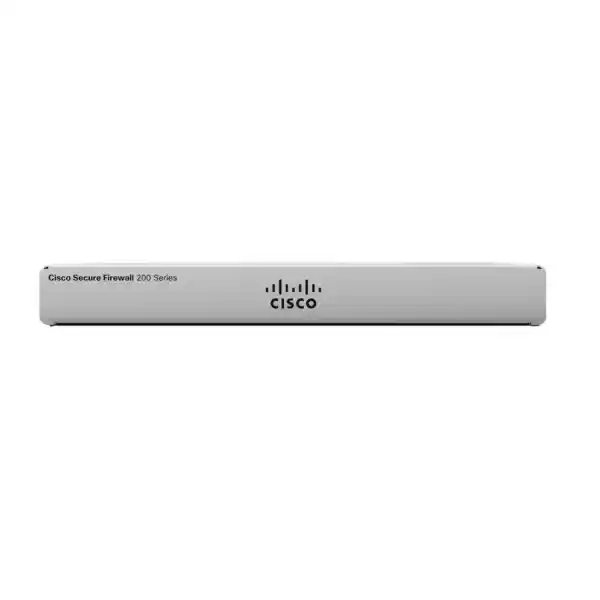
Cisco Secure Firewall 220 Dubai
A compact, fanless Cisco branch firewall for organizations that need enterprise policy, threat inspection, VPN connectivity and centralized operations without moving to a larger rack appliance. The key buying decision is not simply the headline 1.5 Gbps figure: it is whether the 220 has the right inspected throughput, port mix, VPN scale, licensing and resilience for the actual site.
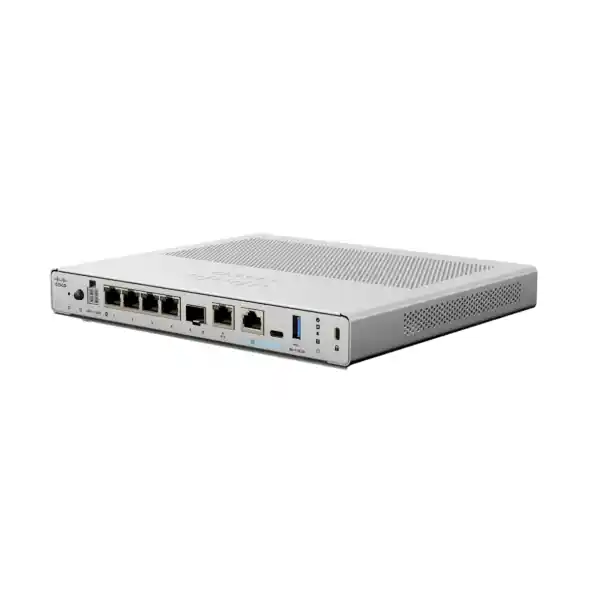
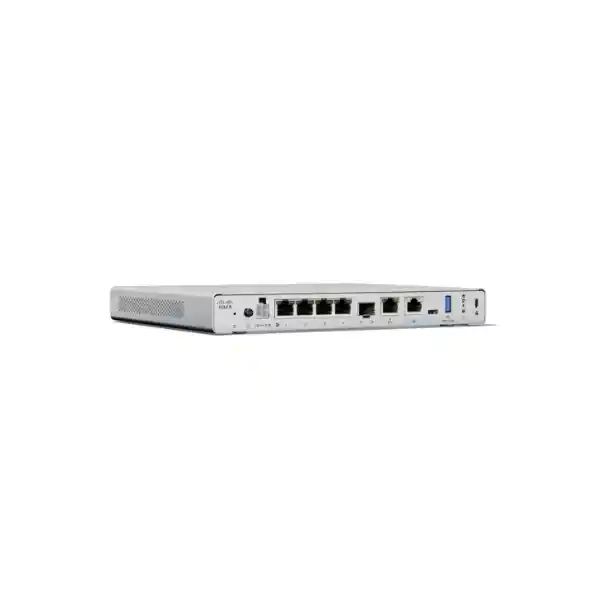
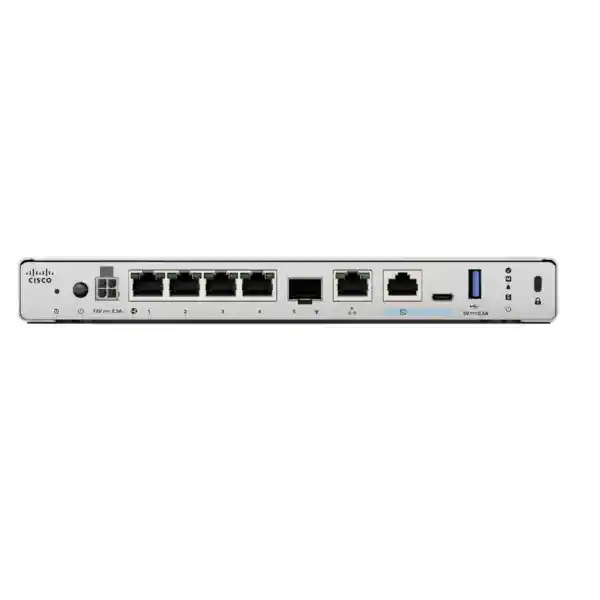
4 × 1G RJ-45 + 1 × 1G SFP
Active/Standby HA
Fanless desktop platform
Direct answer: what is the Cisco Secure Firewall 220?
What exactly is it?
Cisco Secure Firewall 220 is the first model in Cisco’s Secure Firewall 200 Series. It is a compact network-security appliance that can run Cisco Firewall Threat Defense or Cisco Secure ASA software. It is intended for the lower-capacity edge of distributed enterprise environments rather than for high-throughput campus cores or data centers.
What is it mainly used for?
Its main jobs are branch perimeter protection, application-aware firewall policy, intrusion prevention, site-to-site VPN, controlled internet access, segmentation and secure branch connectivity. With Threat Defense it is positioned as a next-generation firewall; with ASA it can be chosen where classic stateful firewall behavior and ASA operating requirements are the priority.
Who should consider it?
Small branch offices, retail outlets, remote operational sites, professional offices and distributed enterprises with moderate WAN speeds are the clearest candidates. It is also relevant when a business wants a quiet fanless appliance and can work within the fixed 1 Gigabit interface set and documented session limits.
What matters most before ordering?
Confirm the security software, expected inspected traffic, Internet/WAN speed, connection rate, VPN requirements, port topology, license features and resilience target. A 1.5 Gbps performance headline does not by itself prove that the appliance is right for every 1 Gbps or multi-WAN branch.
What can FourTeck help determine?
FourTeck can translate the site requirement into a quotation scope: appliance software option, quantity, subscription term, security services, compatible SFP selection, high-availability pair design, migration effort, installation needs and support expectations. That prevents a quote from being based only on a model name when the real project depends on licenses and topology.
Verified Cisco Secure Firewall 220 specification snapshot
Cisco introduced the Secure Firewall 200 Series in 2026, with the 220 as the first model. The table below separates the hardware facts from the design decisions that a UAE buyer should make. Performance figures are laboratory specifications and Cisco notes that real results vary with enabled features, packet sizes and the traffic mix.
| Specification | Cisco Secure Firewall 220 | Buyer interpretation |
|---|---|---|
| Form factor | Compact desktop; optional rack and wall mounting | Good for branches with limited rack space, but mounting accessories should be quoted when needed. |
| Threat Defense NGFW throughput | 1.5 Gbps firewall + AVC + IPS | Size against inspected traffic and future growth, not just current ISP circuit speed. |
| Threat Defense IPsec VPN | 1.2 Gbps in Cisco’s stated test | Useful for branch-to-HQ encrypted links, but topology, cipher settings and real traffic still matter. |
| TLS decryption | 0.7 Gbps | A key sizing figure if the security policy will decrypt a substantial portion of encrypted web traffic. |
| ASA stateful firewall throughput | 2 Gbps | Do not compare this directly with Threat Defense NGFW throughput because the inspection feature set differs. |
| Fixed data interfaces | 4 × 1000BASE-T and 1 × 1G SFP | Confirm WAN, LAN, DMZ, HA and fiber needs because there are no network-module expansion slots. |
| Management and console | 1G management; USB-C and RJ-45 console; USB 3 Type-A | Plan an out-of-band or management network when operational policy requires separation from data traffic. |
| Storage | 64 GB | Operational logging architecture should still be planned around the chosen Cisco management platform and retention requirements. |
| Cooling | Passive, fanless; 0 dBA | Suitable for quiet offices, but environmental temperature limits still apply. |
| Power | External 30 W AC supply; 12.7 W typical, 19 W maximum device consumption | No power-supply redundancy; use site UPS design where power continuity matters. |
| Dimensions / weight | 2.9 × 23.4 × 19.8 cm; approximately 1.17 kg | Compact enough for many branch cabinets, shelves and desks when ventilation and cable clearance are respected. |
| Operating environment | 0°C to 40°C; 5% to 85% noncondensing humidity | For UAE deployments, place it in a controlled indoor environment rather than an unconditioned outdoor or hot utility enclosure. |
Where the 220 sits in Cisco’s firewall portfolio
The Secure Firewall 220 is an entry-level branch platform, not a scaled-down data-center firewall. That distinction is useful. It gives a distributed enterprise a compact appliance for smaller sites while preserving Cisco’s security architecture and management options. The 220 is therefore most compelling when many branch sites need consistent policy and operational treatment but do not need multi-gigabit interfaces, modular expansion, clustering or large session scale at each location.
Cisco also lists the Secure Firewall 240P within the 200 Series, while the 1200 Series offers larger compact and rack models for materially higher throughput and broader interface choices. A buyer should not move upward merely because a larger number sounds safer. The right comparison is driven by inspected traffic, user/device density, WAN growth, interface speed, decryption policy, VPN load and high-availability expectations.
A simple fit test
- Choose the 220 shortlist when the branch can live within 1G fixed interfaces and the documented Threat Defense scale.
- Re-evaluate if your design requires 2.5G, 5G or 10G access/uplink interfaces, higher inspected throughput or materially more connection scale.
- Re-evaluate if clustering, multi-instance segmentation or redundant internal power supplies are mandatory architecture requirements.
- Consider an HA pair when a single appliance failure is unacceptable, remembering that upstream switches, WAN circuits and power also need resilient design.
- Confirm the software and license combination before treating any hardware quotation as complete.
Understanding the 1.5 Gbps performance figure
For Cisco Firewall Threat Defense, the 220 is specified at 1.5 Gbps for firewall plus Application Visibility and Control, 1.5 Gbps for AVC plus intrusion prevention, and 1.5 Gbps for the combined next-generation firewall measurement using Cisco’s stated test conditions. This is the figure most relevant when the appliance will be purchased as an NGFW rather than as a classic stateful firewall. Cisco separately states 1.2 Gbps IPsec VPN throughput and 0.7 Gbps TLS decryption throughput.
Those figures should be interpreted as sizing references, not guaranteed branch application throughput. Real traffic contains a mixture of packet sizes, long-lived and short-lived sessions, SaaS flows, DNS, voice, backups, video meetings, file transfers and encrypted web traffic. Security policies may enable intrusion prevention, URL controls, malware inspection and decryption selectively. Logging and management choices also shape operations. Cisco explicitly notes that performance varies with enabled features, protocol mix, packet characteristics and software versions. For procurement, the practical question is therefore how much inspected traffic the site is expected to generate during busy periods, with a reasonable allowance for growth.
A branch with a 1 Gbps Internet service is not automatically a perfect 220 deployment. If nearly all user traffic is decrypted and inspected, the 0.7 Gbps TLS-decryption number may become more relevant than the 1.5 Gbps NGFW headline. On the other hand, a branch with lower Internet usage but multiple site-to-site VPNs, internal segmentation and business-critical applications may be limited by session behavior or topology before raw throughput. This is why a quote request should include the number of users and devices, the WAN services, peak utilization, important application categories and whether TLS inspection is planned.
The ASA numbers tell a different story. Cisco lists 2 Gbps stateful inspection firewall throughput and 1.8 Gbps IPsec VPN throughput for ASA under its stated tests. That does not mean ASA is simply a faster setting for the same security result. Threat Defense and ASA are different software choices with different operational and feature objectives. Buyers should decide which software aligns with the organization’s policy, management and security requirements first, then size the appliance within that software’s published characteristics.
Threat Defense or ASA: choose the operating model before the SKU
Cisco Firewall Threat Defense
Threat Defense is the natural choice when the project is being evaluated as a next-generation firewall deployment. Cisco’s 220 data sheet associates it with application visibility and control, intrusion prevention, encrypted-traffic visibility technologies, integrations into the Cisco security ecosystem and centralized security operations. The model is first supported from Threat Defense 10.0.0.
When requesting Threat Defense, define which licensed security services are required, how the appliance will be managed, whether the branch is part of a larger fleet, whether zero-touch rollout matters, and whether security inspection will be applied to all or only selected traffic. Those decisions can affect subscription scope, implementation effort and sizing.
Cisco Secure ASA
ASA is available on the 220 for organizations whose design specifically requires Cisco ASA software. Cisco states 2 Gbps stateful firewall throughput and 1.8 Gbps IPsec VPN throughput in its specified tests. The platform supports ASA 9.24.1 and later compatible releases according to current Cisco hardware documentation.
ASA should not be selected solely because the stateful throughput number is higher. Confirm required security functions, migration path, policy model, management practices and future roadmap. The 220 does not support ASA security contexts or clustering, so designs that depend on those capabilities need another platform or architecture.
Ports, fiber and topology planning
The 220 provides four fixed 1000BASE-T copper data interfaces and one fixed 1 Gigabit SFP interface. It also provides a dedicated 1000BASE-T management port. There are no network-module expansion slots, and the appliance does not provide Power over Ethernet. This is a deliberately simple port layout, which works well when the branch design is modest and known in advance. It also means a topology should be checked before purchase, because additional physical data interfaces cannot be added later through a network module.
A common small-branch design might need one interface for an ISP handoff, one for the internal switching environment, one for a DMZ or secondary WAN, and one for another routed or segmented connection. The SFP port may be useful where an Ethernet fiber handoff or fiber link is appropriate, but the transceiver is a separate compatibility decision. Cisco directs buyers to the hardware installation guide for supported transceivers. Do not assume that any 1G optical module already on the shelf is supported merely because it fits physically.
High availability adds another topology consideration. The appliance supports active/standby HA, but the overall design must have enough interfaces and upstream connectivity to make failover meaningful. An HA pair connected to a single unmanaged switch, a single ISP circuit and a single power source may protect against some appliance faults while leaving several larger single points of failure. The firewall quotation and the network diagram should therefore be reviewed together.
The dedicated management interface can support an operations design that separates management reachability from normal production data paths. Whether that is necessary depends on the organization’s security policy and management architecture. The unit also includes USB Type-C and RJ-45 console connectivity and a USB 3 Type-A port, useful for local administrative and service tasks. For a multi-site rollout, however, the goal should usually be to minimize dependence on physical console access by planning onboarding, management reachability and zero-touch procedures correctly.
Sessions, connection rate, VPN peers and VRFs
With Threat Defense and AVC, Cisco documents a maximum of 30,000 concurrent sessions and 6,000 new connections per second for the 220. The same table lists a maximum of 50 VPN peers and five virtual routing and forwarding instances. These values matter because a small office can generate a surprising number of concurrent sessions, particularly where users run many browser tabs, SaaS applications, cloud synchronization tools, IoT devices, guest Wi-Fi and automated software agents at the same time.
Connection rate can also be more important than average bandwidth for certain workloads. Retail systems, DNS-heavy traffic, public-facing services, IoT fleets or applications that establish frequent short-lived sessions can create a high connections-per-second demand without consuming a multi-gigabit WAN link. During sizing, ask for both traffic volume and workload behavior. If the expected environment approaches documented limits, choose a larger appliance rather than designing around a theoretical maximum with no operational headroom.
The 50 VPN-peer limit needs context. Site-to-site tunnels, remote-access architecture and the way peers are counted should be confirmed against the exact software configuration and Cisco licensing. A business with ten branches and a few partner VPNs may be comfortable; an aggregation point expected to terminate many branch tunnels may not be an appropriate role for the 220. Remote-access users can also introduce separate Cisco Secure Client license considerations, so “50 VPN peers” should not be interpreted as an all-inclusive remote-access entitlement.
ASA has a different scalability profile on the same hardware: Cisco documents up to 100,000 concurrent firewall connections and 80,000 new connections per second, with 50 maximum VPN peers and active/standby high availability. Those larger stateful numbers again demonstrate why software mode must be part of every specification discussion. The security result and operational model are not interchangeable merely because the chassis is the same.
High availability: useful, but understand what it does not provide
Cisco Secure Firewall 220 supports active/standby high availability with both Threat Defense and ASA. For a branch that cannot accept a single firewall as a failure point, two appliances can therefore be considered as an HA pair. This is a meaningful capability in a compact platform, but it should be treated as one layer in a resilient branch design rather than as a complete availability solution.
The 220 has a single external AC power supply per appliance and no redundant power-supply option. In an HA deployment, each firewall should therefore be considered separately in the power design. A site may use separate UPS feeds or protected power circuits where practical. WAN resilience may require two carrier services or an alternate access path. LAN-side switching can also become a dependency. The objective is to prevent one upstream component from defeating the value of having two firewalls.
The 220 does not support clustering. Threat Defense also does not support multi-instance on this model, while ASA security contexts are not supported. Those limitations matter for designs that need horizontal scale-out, multi-tenant appliance partitioning or more advanced consolidation. The 220 is best viewed as a straightforward branch firewall, with optional active/standby resiliency, rather than as a platform for complex logical appliance virtualization.
If a quotation requests “HA,” FourTeck should receive the expected failover topology, number of ISP links, switching design and installation scope. That makes it possible to quote two appliances and the appropriate licenses while also identifying SFPs, cables, mounting parts or adjacent network work that the failover design may require.
Management, zero-touch deployment and Cisco security integration
One reason to consider the 220 for distributed environments is the operating model around the hardware. Cisco positions the 200 Series for simplified branch deployment and centralized policy. Current Cisco material describes centralized management options and zero-touch provisioning for repeatable rollout. This is especially relevant when the organization has many sites, because the cost of a branch firewall is not only the appliance: it includes the operational effort required to stage, configure, monitor, update and troubleshoot every location.
Before selecting a management method, establish whether the site is independent or part of an existing Cisco Secure Firewall estate. An organization already using Firewall Management Center or Cisco’s cloud-delivered management architecture may prioritize common policy and logging. A small standalone site may have a different management requirement. The exact supported workflow should be matched to the software version and current Cisco compatibility documentation rather than assumed from an older Firepower deployment.
Cisco also describes integration of Secure Firewall with other security services, including cloud security and endpoint-related capabilities. Integration can create useful policy context and reduce isolated security operations, but it should not be treated as automatic value. Buyers should identify which Cisco services they already license, how identities are represented, where logs are analyzed, and whether security teams actually plan to consume those integrations. A feature that is technically available but operationally unused should not drive the appliance decision.
Zero-touch provisioning can be particularly valuable for remote branches that have no resident network engineer. The rollout process still needs a disciplined template: site naming, addressing, WAN assumptions, management reachability, certificates, VPN parameters, security zones, failover behavior and rollback procedures. Standardization is what turns zero-touch from a convenience into an operational advantage. For a mixed environment, build a pilot branch first and use its results to refine the template before mass deployment.
Licensing: hardware alone is not the complete solution
For Threat Defense, Cisco’s current licensing guidance for Secure Firewall 200 identifies Essentials as required and lists additional capabilities such as IPS, Malware Defense, URL Filtering and Cisco Secure Client. Cisco also provides an IPS, Malware Defense and URL combination for the 220 under the CSF220T-TMC ordering family, with one-, three- and five-year term options in the current documentation. Licensing details can evolve, so the commercial quotation should use the current Cisco ordering guide and the customer’s Smart Account requirements at the time of purchase.
This has an important procurement consequence: two quotes for “Cisco Secure Firewall 220” may not be commercially comparable if one contains only the base appliance while another includes a multi-year security subscription, management-related entitlements, Secure Client requirements and support. When evaluating suppliers, compare the exact hardware PID, software image, subscription term, included security services, support contract, accessories, installation and migration scope. The lowest appliance line price may not be the lowest complete project cost.
IPS licensing is relevant when intrusion prevention is part of the intended security policy. Malware Defense and URL Filtering address different control requirements and should be selected according to the organization’s threat and acceptable-use policies. Cisco Secure Client licensing becomes important when remote-access users or related client capabilities are in scope. An accurate quote therefore starts with security objectives rather than a generic request for “full license.” The term “full license” is ambiguous and often leads to mismatched expectations.
Cisco Smart Software Manager and the customer’s Cisco Smart Account are also part of the operational picture. Licensing should be associated with the correct organization and virtual account so that activation and ongoing administration do not depend on a reseller’s account or an unknown legacy tenant. For a new customer, confirm who will own the Smart Account, who can approve tokens or registrations, and who will retain administrative access after deployment.
A useful quotation request states the desired license term, required services and support duration explicitly. If the security team has not yet decided, FourTeck can quote alternatives such as one-year versus three-year subscriptions and show which security services are included. This supports a real decision instead of hiding licensing inside a single bundled number.
How to size the Cisco Secure Firewall 220 for a Dubai or UAE branch
1. Measure peak traffic
Use real WAN utilization where available. Note Internet, MPLS, SD-WAN, site-to-site VPN and inter-zone flows separately. Size for busy periods and growth rather than average daily utilization.
2. Define inspection depth
Document whether IPS, application control, URL policy, malware controls and TLS decryption will apply broadly or only to selected traffic. Decryption can be a major sizing factor because its published throughput is lower than the NGFW figure.
3. Count users and devices
Include employees, phones, printers, cameras, access-control systems, IoT, guest users and servers. Device count helps estimate session behavior and segmentation complexity, not just bandwidth.
4. Review VPN roles
Record branch-to-HQ tunnels, partner tunnels and remote-access expectations. If the appliance is intended as a VPN aggregation point, check peer limits and encrypted throughput carefully.
5. Map interfaces
Draw the intended WAN, LAN, DMZ, transit, HA and management connections. Confirm that four copper data ports plus one 1G SFP are sufficient with room for planned topology changes.
6. Reserve growth headroom
A firewall should not be purchased to operate permanently at its documented maximum. Allow for ISP upgrades, new SaaS use, additional branches, security features and unexpected traffic bursts.
In practice, the 220 is a strong candidate when the branch is genuinely an entry-level or modest edge site and the 1G interface architecture aligns with the network. If the site is expected to move to multi-gigabit access, 10G uplinks or substantially higher inspection demand, it is usually more efficient to compare a larger Cisco platform during procurement than to replace an undersized firewall shortly after deployment.
Practical use cases
Small enterprise branch
A branch with business Internet, an internal access switch, site-to-HQ VPN and centralized policy can be a good 220 scenario when measured traffic and session levels fit the platform. The compact appliance reduces local infrastructure while preserving enterprise security controls.
Retail outlet
Retail sites often combine point-of-sale systems, corporate devices, guest access and IoT. The 220 can separate and inspect these zones, but the policy should prioritize payment-system isolation, least-privilege access and resilient connectivity rather than relying on one broad inside-to-outside rule set.
Professional office
Law firms, consultancies, clinics and similar offices may value the fanless 0 dBA operation because the firewall can sit in a small communications area without adding fan noise. Environmental control and physical security remain important even when the hardware is quiet.
Remote operational site
A remote site can use VPN, application control and centralized management while reducing local engineering effort through standardized onboarding. Confirm environmental conditions carefully if the communications cabinet is near warehouses, workshops or other warm areas.
Distributed organization rollout
The 220 can serve as a common small-site platform within a larger Cisco estate. Standard templates, naming, licensing and logging can simplify operations. Larger sites can use higher-capacity Cisco appliances while preserving policy and operational consistency.
HA-protected branch
Two 220 appliances can be deployed active/standby where firewall hardware redundancy is justified. The rest of the branch design must also address carrier, switching and power dependencies for high availability to deliver meaningful business continuity.
When the Cisco Secure Firewall 220 may be the wrong choice
A balanced product evaluation should identify exclusion conditions early. The 220 is not the right answer when the branch needs interface speeds above 1 Gigabit on the firewall, because its data ports are fixed at 1G copper plus a 1G SFP. It is also a poor fit when expansion modules are part of the design, because the platform has no network-module capability. If a future ISP or campus link will require 10G connectivity, compare the appropriate Secure Firewall 1200 Series or another Cisco platform before ordering.
The appliance is also unsuitable for designs that require clustering, Threat Defense multi-instance, or ASA security contexts. These are architectural limitations, not license upgrades. If the project depends on multiple isolated logical firewalls, horizontal clustering or high-end scale-out, a larger model should be evaluated. Similarly, the single external power-supply design may be unacceptable for sites that specifically require redundant internal PSUs within each appliance.
Traffic growth can make the 220 inappropriate even when today’s utilization is low. A branch planning a major cloud migration, high-volume backup replication, additional users, widespread TLS decryption or a multi-gigabit WAN should model future conditions. Replacing a firewall because the Internet circuit was upgraded six months later can cost more than selecting a properly sized platform at the start.
Finally, do not choose the 220 simply because the organization uses Cisco switches. Firewall selection should follow security policy, operations, licensing, management and application requirements. Cisco ecosystem alignment can be valuable, but it is not a substitute for sizing and architecture.
Physical deployment in UAE offices and branch cabinets
The 220 measures about 2.9 cm high, 23.4 cm wide and 19.8 cm deep and weighs approximately 1.17 kg according to Cisco’s data sheet. It can sit on a desktop and can also be installed using optional rack-mount or wall-mount accessories. Its passive cooling design means there is no fan noise, and Cisco specifies 0 dBA acoustic output. These characteristics make it convenient for small offices where a traditional rack appliance would be unnecessarily large or audible.
Compact does not mean environment-proof. Cisco specifies an operating temperature range of 0°C to 40°C and operating humidity of 5% to 85% noncondensing. In Dubai and other UAE locations, communications equipment should be located in a conditioned indoor space. A cabinet exposed to direct sunlight, an unconditioned warehouse corner, a rooftop enclosure or a utility room that regularly exceeds the rated temperature can undermine reliability. For higher-altitude installations, Cisco’s installation guide also describes temperature derating considerations.
Power is supplied by a single external 30 W AC adapter. Cisco states typical device consumption of 12.7 W and maximum consumption of 19 W. The appliance accepts 100–240 V AC, 50–60 Hz through the power supply. Even with modest consumption, a business-critical firewall should be connected to appropriately protected power. UPS runtime should be sized with the branch switch, ISP equipment and any fiber converter or modem, because keeping only the firewall powered does not preserve connectivity.
Cable management matters in small cabinets. Leave sufficient space for the external power adapter, copper patch leads, SFP/fiber bend radius where used, management cabling and console access. If wall mounting or rack mounting is required, include the correct Cisco accessory in the quotation rather than improvising mounting after delivery.
SFP selection and accessory planning
The single 1G SFP interface gives the 220 useful fiber flexibility, but the transceiver should be selected from Cisco’s supported hardware list for the exact deployment. Fiber type, wavelength, connector type, link distance and the equipment at the opposite end all matter. A short multimode building link and a longer single-mode service-provider handoff are not the same requirement. The safest quotation process is to provide the existing optic type or the fiber specification and link distance so compatibility can be checked.
The SFP is not the only accessory decision. A desktop unit may need no mounting hardware, while a branch cabinet may need a rack-mount shelf or wall-mount option. HA deployments may require duplicated mounting, power and transceiver parts. Console cables, patch leads, fiber jumpers and cable-management items should be included only where the installation scope calls for them.
Because the 220 has no PoE, do not plan to power access points, cameras, phones or other devices from the firewall. Those endpoints require a PoE switch or separate power source. This sounds obvious, but it becomes important in very small branches where buyers sometimes expect an all-in-one edge appliance to replace switching and power functions as well as security.
A disciplined deployment journey
Discovery
Collect current topology, WAN circuits, user/device counts, traffic utilization, security requirements, VPNs, public services, existing licenses, management tools and the desired cutover window.
Sizing and software choice
Compare the measured requirement with Threat Defense or ASA performance and scalability. Decide whether the 220 remains appropriate with growth margin or whether a larger platform should be evaluated.
Licensing and BOM
Select the exact appliance PID, subscription services, term, support, SFPs, mounting accessories and quantity. For HA, build a complete two-appliance bill of materials.
Policy and addressing design
Define interfaces, zones, routes, NAT, objects, access policy, inspection, decryption, VPNs, logging and management reachability. Agree naming conventions before configuration begins.
Stage and test
Register licensing and management, load the approved software, apply policy, confirm interfaces and validate representative traffic. For migration, compare translated rules with the intended business access rather than accepting them blindly.
Cutover and validate
Move circuits during the agreed window, verify routing, NAT, DNS, VPN, authentication and critical applications, and monitor logs for unexpected blocks or path changes.
Operational handover
Document the final configuration, license ownership, support details, software version, management access, backup process, monitoring responsibilities and escalation path.
Migration from an existing firewall
A firewall refresh should not be treated as a cable-for-cable hardware swap. The old appliance may contain years of accumulated NAT rules, temporary exceptions, stale objects, unused VPNs and broad access policies. Migrating all of that without review reproduces technical debt on a new platform. Start by identifying the business services that must survive the move, then use the existing configuration as evidence rather than as the only design authority.
For each interface, confirm VLANs, IP addressing, dynamic or static routing, ISP handoff details and failover behavior. For NAT, document public addresses and the applications that depend on them. For access policy, separate genuinely required flows from historical rules. For site-to-site VPNs, capture peer addresses, interesting traffic, encryption parameters, authentication method, route dependencies and ownership of the remote endpoint. For remote access, identify identity sources, client versions, certificates, MFA and user groups.
Cisco provides migration tooling for Secure Firewall environments, but automated translation still needs engineering validation. Different firewall vendors and software families express objects, NAT, route behavior, application controls and inspection differently. A translated configuration can be syntactically valid while preserving a weak rule or missing an operational dependency. Testing must therefore be based on expected application behavior.
Plan rollback before cutover. Keep the old firewall configuration, cabling map and access method available until the new environment has passed agreed validation. Define what condition triggers rollback and how long the old device remains recoverable. For a 24/7 branch or retail site, this operational discipline matters as much as the choice of firewall model.
Security policy design: use the platform to reduce risk, not just pass traffic
A new Cisco Secure Firewall 220 should begin with a policy model that reflects business roles. Separate user networks, servers, guest access, voice, cameras, building systems and point-of-sale where those categories have different trust levels. Use specific rules between zones and avoid turning every internal segment into one broad trusted network. The appliance supports the enforcement point, but segmentation only adds value if switching, VLAN design, routing and identity are planned consistently.
Application visibility and intrusion prevention should be used deliberately. Start with business-critical applications and common user traffic, then tune based on logs and operational impact. Overly permissive rules reduce the value of an NGFW; overly aggressive blocking without testing can interrupt valid business activity. A staged approach allows the security team to observe traffic, build exceptions with justification and tighten controls over time.
TLS decryption deserves a separate policy decision. It can improve visibility into encrypted threats but adds processing demand, certificate-management responsibilities, privacy considerations and application exceptions. Because the 220’s published TLS-decryption throughput is lower than its headline NGFW throughput, the expected percentage of decrypted traffic should be included in sizing. Some organizations may decrypt selected categories while using other visibility methods for traffic that should remain encrypted.
Logging should answer operational questions: what was blocked, why was it blocked, which user or device was involved, what policy matched and whether the event needs investigation. The right retention period depends on compliance, incident-response and storage requirements. A branch firewall should feed a management and monitoring process rather than becoming a device that is configured once and rarely reviewed.
SD-WAN and distributed branch design
Cisco positions the 200 Series within its distributed-enterprise and Hybrid Mesh Firewall strategy, and the 220 supports integrated SD-WAN capabilities. For a branch organization, this can reduce the separation between routing, application-aware path selection and security enforcement. The business value is strongest when the network team has clear WAN policies and the security team wants consistent controls across locations.
An SD-WAN project still begins with circuits and applications. Identify which branches have one or multiple WAN links, how Internet breakout should operate, which applications require preferred paths, what happens during circuit degradation and how tunnels are established to hubs or cloud services. The firewall model must have enough physical interfaces for the selected design, which returns the discussion to the 220’s four 1G copper ports and one 1G SFP.
For a large distributed estate, standardization can be more valuable than configuring each site for maximum flexibility. A common small-site pattern using the 220, a documented medium-site pattern using a larger platform and a consistent management model can simplify templates, spares, support and troubleshooting. The architecture should define where each class begins and ends so that a growing branch can be upgraded before capacity becomes a production problem.
Operational monitoring, software lifecycle and support
A firewall purchase is the start of an operational lifecycle. Define who monitors security events, who owns policy changes, how emergency rules are approved, how configuration backups are protected and how software updates are tested. For multiple branches, maintenance windows and staged upgrades can reduce the risk of a software issue affecting every site at once.
Cisco’s compatibility documentation should be checked before each major software change, particularly where management platforms, VPN clients, integrations or hardware dependencies are involved. The 220 entered the portfolio with Threat Defense 10.0.0 and ASA 9.24.1 support. Later releases may add fixes or capabilities, but production upgrades should follow the organization’s change process rather than simply installing the newest image immediately.
Support entitlement is another procurement input. Organizations that depend on Cisco TAC, replacement services and software access should include the appropriate Cisco support coverage in the quotation. Service level should reflect the business impact of a firewall failure and the availability of HA or local spares. A small noncritical office may accept a different support strategy from a revenue-generating retail branch.
Operational ownership should be explicit. If the customer manages the firewall internally, handover should include administrator access, licensing records, diagrams, configuration documentation and monitoring procedures. If managed support is required, define response scope, change request process, monitoring hours and escalation. FourTeck’s IT Services UAE site is a relevant resource for broader infrastructure and support requirements that may sit around the firewall project.
Cisco Secure Firewall 220 versus larger branch platforms
The 220 should be compared with larger Cisco branch firewalls when a requirement sits near its performance or interface boundary. Cisco’s Secure Firewall 1200 Series includes compact and rack models with materially higher throughput. For example, Cisco publishes 6.5 Gbps firewall throughput for the compact 1210 variants, 9 Gbps for the 1220CX, and higher figures for the rack-mounted 1230, 1240 and 1250. The 1220CX also includes 1/10G SFP+ connectivity, while the 1250 adds multigigabit copper interfaces. These models serve a different branch capacity tier from the 220.
| Decision | 220 is attractive when… | Compare a larger model when… |
|---|---|---|
| Throughput | Measured inspected traffic fits comfortably below the 220’s documented envelope. | Growth, decryption or multi-gigabit WAN demand could consume available headroom. |
| Interfaces | 1G copper and a 1G SFP meet the full topology. | The design needs SFP+, 10G or multigigabit access. |
| Form factor | A fanless desktop device is operationally convenient. | The site is already a rack-based higher-capacity network edge. |
| Scale | 30K Threat Defense sessions, 6K new connections/s and 50 VPN peers provide sufficient margin. | Workload or tunnel aggregation approaches those limits. |
| Architecture | A straightforward single appliance or active/standby branch design is appropriate. | Clustering, logical multi-instance, advanced expansion or higher resilience requirements are mandatory. |
The purpose of the comparison is not to push buyers toward the bigger appliance. It is to prevent capacity and interface requirements from being discovered after purchase. If the 220 comfortably meets measured needs, its compact size and lower branch positioning can be exactly the right design choice.
Procurement checklist for an accurate UAE quotation
A usable firewall quotation should be reproducible: another engineer should be able to read it and understand exactly what is being purchased and why. Include the following information with the request. If some values are unknown, mark them as decisions to be confirmed rather than allowing assumptions to become hidden project risks.
Threat Defense or ASA. If undecided, state the required security features and current platform so the options can be compared.
One appliance or an active/standby pair. Include the number of branches if this is a multi-site rollout.
IPS, Malware Defense, URL Filtering and desired subscription term, plus Cisco Secure Client requirements where applicable.
Circuit speeds, measured peak usage, expected growth, traffic that will be decrypted and major VPN flows.
Copper and fiber handoffs, SFP type, VLANs, DMZs, secondary WAN, dedicated management and any HA links.
Desktop, wall or rack. Confirm accessories instead of assuming the branch can improvise installation.
Current firewall vendor/model, existing rule count, VPNs, public services, routing, outage window and rollback requirements.
Cisco support coverage, installation, configuration, migration, documentation, training or managed support expectations.
Commercial evaluation: compare complete scope, not just appliance price
Cisco firewall pricing can differ substantially based on software image, subscription duration, service licenses, support coverage, transceivers and implementation. For that reason, a “price for Cisco Secure Firewall 220 Dubai” request should be converted into a bill of materials before suppliers are compared. Ask each supplier to identify the hardware PID and subscription lines clearly. If one quotation uses CSF220-TD-K9 and another uses CSF220-ASA-K9, they are not the same solution even though the chassis family is shared.
For Threat Defense, check whether the quote contains the required Essentials entitlement and the selected IPS, Malware Defense or URL Filtering subscription combination. Confirm the term—one, three or five years where offered under the current ordering structure—and identify Cisco Secure Client licensing separately if remote access is in scope. Include Cisco support or service coverage at the level the business requires.
Accessories can also explain price differences. One supplier may include a compatible SFP, rack shelf, power cord requirement and installation while another provides only the appliance. HA doubles the appliance requirement and may also duplicate subscriptions and physical accessories. Migration services can range from a basic configuration load to a full discovery, policy cleanup, test plan and after-hours cutover.
FourTeck can prepare the quotation around the intended outcome rather than around an isolated part number. Buyers can also review the broader UAE portfolio at FourTeck UAE or the international company site at FourTeck. These normal resource links are separate from the product-specific firewall consultation path.
Frequently asked buyer questions
Is the Cisco Secure Firewall 220 a current model?
Yes. Cisco lists the Secure Firewall 200 Series with a 2026 release date and identifies the 220 as the first model in the series. It is supported as a current orderable Secure Firewall platform in Cisco’s published support information. Availability, lead time and country-specific ordering details should still be confirmed on the actual UAE quotation.
Is Cisco Secure Firewall 220 the same as Secure Firewall 1220?
No. They belong to different Cisco families. The 220 is in the Secure Firewall 200 Series and is specified at 1.5 Gbps NGFW throughput with 1G interfaces. The 1220CX is a Secure Firewall 1200 Series compact model with substantially higher throughput and SFP+ connectivity. A quotation should use the exact model name to avoid ordering the wrong platform.
What throughput does the 220 provide?
With Threat Defense, Cisco specifies 1.5 Gbps for firewall plus AVC, 1.5 Gbps for AVC plus IPS, and 1.5 Gbps for combined NGFW throughput under its test conditions. It also lists 1.2 Gbps IPsec VPN and 0.7 Gbps TLS decryption. ASA has separate stateful performance figures of 2 Gbps firewall and 1.8 Gbps IPsec VPN in Cisco’s tests.
Can I use it on a 1 Gbps Internet connection?
Potentially, but the Internet line speed alone is not enough for sizing. If most traffic is subjected to TLS decryption, the 0.7 Gbps decryption figure may become more important. Session rate, VPN load, security services and growth also matter. Use real utilization and the planned inspection policy before deciding.
Does the Cisco 220 have 10 Gigabit ports?
No. The documented fixed data interfaces are four 1000BASE-T copper ports and one 1 Gigabit SFP port. If the branch needs SFP+ or 10G connectivity, compare a larger Secure Firewall model rather than assuming an adapter will change the interface capability.
Does it provide PoE for phones or access points?
No. Cisco’s 220 hardware specification lists Power over Ethernet as not available. Use a PoE-capable switch or separate power for access points, IP phones, cameras and other powered devices.
Can it be rack mounted?
Yes. The appliance is compact enough for desktop placement, and Cisco states that rack-mount and wall-mount accessories are available. Include the required mounting option in the bill of materials because the intended physical installation can affect the accessory requirement.
Is it fanless?
Yes. Cisco specifies passive cooling and 0 dBA acoustic noise. That is useful in quiet offices, but the device must still operate within its environmental limits. Fanless operation is not permission to place the unit in an unconditioned hot enclosure.
Does the 220 support high availability?
Yes, active/standby high availability is supported. It does not support clustering. HA design should include two appliances and should also address upstream switching, WAN paths and power if the business wants real end-to-end resilience.
How many VPN peers can it support?
Cisco documents a maximum of 50 VPN peers for both Threat Defense and ASA on the 220. The correct remote-access and site-to-site design should still account for licensing, encrypted throughput, topology and how the deployed software counts peers.
What licenses should I buy?
For Threat Defense, Cisco identifies Essentials as required and lists IPS, Malware Defense, URL Filtering and Cisco Secure Client as licensing components. The right combination depends on the controls you will actually deploy. State the required security outcomes and preferred term so the quotation can show the correct subscription rather than an ambiguous “full license.”
Can I reuse an existing SFP?
Only after checking compatibility. Physical fit is not enough. Match Cisco support, optic type, fiber medium, wavelength, connector, link distance and the device at the far end. Provide the existing transceiver part number or link specification when requesting the quote.
Is the 220 suitable for a data center?
It is primarily positioned for small branches, retail and distributed edge locations. A data center normally has higher throughput, interface, segmentation, clustering and resilience requirements. Use the 220 for a role only when those measured requirements genuinely fit; otherwise compare an appropriate higher-tier Cisco platform.
Can the 220 replace my router and firewall?
It can provide firewalling plus routing and SD-WAN functions, but whether it should replace a dedicated router depends on WAN handoff, routing protocols, carrier requirements, resilience and operational ownership. Review the existing edge architecture instead of assuming every router function should move to the firewall.
What information speeds up a Dubai quote?
Provide software choice, quantity, HA requirement, subscription term, WAN speeds, user/device count, VPN needs, interface and SFP requirements, mounting preference, existing firewall details and whether installation or migration is required. These inputs turn a generic price request into a usable bill of materials.
UAE availability and project planning
For buyers in Dubai, Abu Dhabi, Sharjah and other UAE locations, the commercial scope should distinguish product supply from installation services. Appliance availability and lead time can change, especially for a model introduced recently, so they should be confirmed at quotation time rather than implied as permanent stock. Country-specific regulatory, power-cord and support details should also be checked on the final order.
A straightforward supply request may need only the exact appliance, subscription and accessories. A deployment request can include discovery, configuration, migration, rack or wall installation, SFP/fiber work, HA design, cutover and documentation. Multi-branch projects benefit from pilot deployment and a standardized branch template before wider rollout.
For firewall-specific UAE information, use Firewall Dubai by FourTeck. For broader technology sourcing and infrastructure context, FourTeck UAE, FourTeck IT Services UAE and FourTeck provide complementary routes. The exact project quote should remain focused on the Cisco 220 requirement rather than mixing unrelated equipment into the firewall bill of materials.
Decision recap before you approve a Cisco Secure Firewall 220 purchase
Model fit
Confirm the site is genuinely in the small-branch performance tier and does not require multi-gigabit interfaces, clustering or logical multi-instance functions.
Capacity
Use inspected traffic, TLS-decryption demand, sessions, connections per second and VPN load. Leave operational and growth headroom.
Licensing
Specify Threat Defense or ASA, then define security subscriptions, Secure Client needs, support and term. Hardware alone is not a complete NGFW project.
Interfaces
Verify that 4 × 1G copper, 1 × 1G SFP and the dedicated management port fit the topology. Check the exact SFP separately.
Resilience
Decide whether a single appliance is acceptable or active/standby HA is required, then address power, switch and carrier single points of failure.
Implementation
Define migration, policy cleanup, staging, cutover, rollback, documentation and operational ownership before the installation date.
What FourTeck needs from the buyer
To prepare an accurate Cisco Secure Firewall 220 Dubai quotation, send the information you already know. Unknown items can be resolved during technical review.
Quantity / HA pair
User and device count
WAN speed and peak utilization
TLS decryption requirement
VPN peers / remote users
Copper and SFP topology
Subscription term
Mounting preference
Existing firewall / migration scope
Cisco support requirement
Installation location in UAE
Confirm whether the Cisco Secure Firewall 220 is the right branch firewall
Send the branch size, WAN speed, required security services, VPN scope and interface plan. FourTeck can turn those inputs into a UAE quotation with the correct Cisco 220 software option, subscription term, accessories and implementation scope—and can recommend a larger platform when the measured requirement exceeds the 220’s practical fit.

Reviews
There are no reviews yet.