
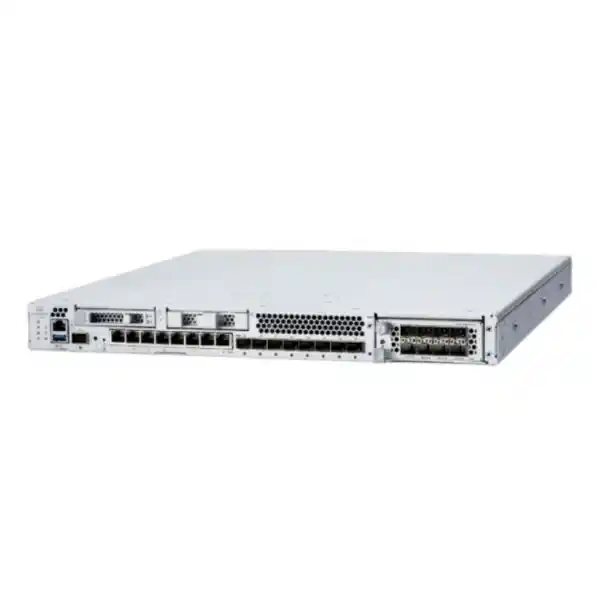
Cisco Secure Firewall 3110 Dubai
A 1RU Cisco Secure Firewall 3100 Series appliance designed for midsize enterprise perimeter, data-center edge and secure hybrid-network roles where inspected throughput, interface flexibility, resilient deployment and centralized security operations matter more than simple port-count buying.
Direct answer: what is the Cisco Secure Firewall 3110?
The Cisco Secure Firewall 3110 is a physical 1RU midrange security appliance in Cisco’s Secure Firewall 3100 Series. It can run Cisco Secure Firewall Threat Defense, commonly abbreviated FTD, or Cisco Secure ASA software. In an FTD deployment it can combine stateful firewalling, application visibility and control, intrusion prevention, security intelligence, VPN and optional malware and URL-security functions under a single policy architecture. In an ASA deployment it can serve organizations that need the ASA operating model and associated features while using current 3100 Series hardware.
Its main use is to protect enterprise internet edges, WAN boundaries, data-center segments, private-cloud connections and other network trust boundaries where a smaller branch appliance may be undersized but the higher 3130 or 3140 performance and interface options are not yet justified. Cisco positions the 3110 and 3120 for midsize enterprises. The 3110 is especially relevant when organizations need approximately the 17 Gbps FTD inspection class, substantial session capacity, 10 Gigabit Ethernet connectivity, VPN services and the option to scale through high availability or clustering.
Organizations should consider it when they have measured or forecast traffic that fits comfortably inside its inspected-security envelope, and when the appliance’s fixed 1/10G SFP+ connectivity aligns with the switching, ISP and data-center environment. The most important factor to confirm is real workload sizing: enabling IPS, TLS decryption, malware inspection, URL controls, VPN, logging and other policy functions changes resource demand. Cisco explicitly notes that performance varies according to features, packet size and protocol mix, so headline throughput must not be treated as a guaranteed production result.
FourTeck can help determine whether the 3110 is the right model, whether the 3120 or a higher 3100 Series appliance should be evaluated, which copper or optical interfaces are required, whether a network module is appropriate, how many power supplies are needed, which FTD or ASA image should be ordered, which Cisco security subscription applies, and what migration or installation work must be included in the Dubai or UAE quotation.
Why the 3110 is a distinct buying decision inside the 3100 Series
The 3110 is not simply a generic “Cisco firewall” with a model number attached. Its useful position comes from the combination of a specific performance tier, a specific fixed-interface design and a specific expansion ceiling. That combination can be attractive for a midsize enterprise, a regional headquarters, a busy campus perimeter or a data-center edge with mostly 1G and 10G connectivity. It can also be the wrong choice when a design depends on native 25G, 40G or 100G interfaces, or when the security architecture will push sustained inspected traffic beyond the 3110’s practical headroom.
Cisco lists the 3110 at 17 Gbps for FTD firewall plus Application Visibility and Control, and the same 17 Gbps for firewall plus AVC plus IPS using Cisco’s stated 1024-byte test profile. It supports a maximum of 2 million concurrent sessions with AVC and 130,000 new connections per second with AVC. TLS throughput is listed at 4.8 Gbps under Cisco’s documented test conditions. These numbers matter because two networks with the same internet line rate can load a firewall very differently. A network carrying many short-lived encrypted sessions, for example, can be more demanding than a network with fewer long-lived flows even when average bandwidth looks similar.
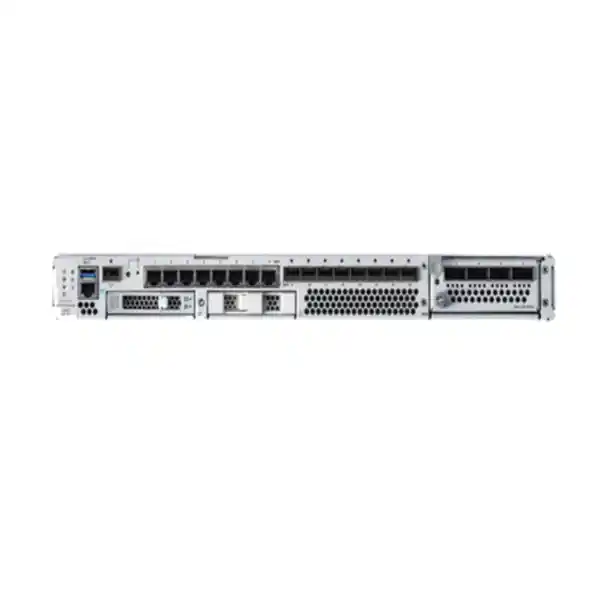
The physical design is equally important. The 3110 provides eight 10M/100M/1GBASE-T RJ-45 interfaces and eight fixed 1/10 Gigabit SFP+ interfaces. Cisco’s 3100 Series data sheet lists an optional 10G SFP+ network-module class for the 3110 and a maximum of up to 24 Ethernet ports when the supported network module is included. This is materially different from the 3130 and 3140, which move into 25G fixed-port capability and support higher-speed network-module options. A buyer expecting to reuse a 25G, 40G or 100G design should therefore not assume the 3110 can accept those modules simply because the chassis family shares a mechanical form factor.
That distinction makes the 3110 a sensible shortlist candidate for organizations whose network remains centered on 1G access and 10G uplinks and whose security workload fits the model’s inspection tier. It also gives a clear trigger for moving up: if the project requires higher inspected throughput, more growth reserve, 25G server or spine connectivity, or higher-speed module options, compare the 3120, 3130 or 3140 before finalizing the bill of materials.
Cisco Secure Firewall 3110 key specifications
| Specification | Cisco Secure Firewall 3110 |
|---|---|
| FTD FW + AVC throughput | 17.0 Gbps using Cisco’s 1024-byte test profile |
| FTD FW + AVC + IPS throughput | 17.0 Gbps using Cisco’s 1024-byte test profile |
| NGIPS throughput | 17.0 Gbps using Cisco’s 1024-byte test profile |
| Maximum concurrent sessions with AVC | 2 million |
| Maximum new connections per second with AVC | 130,000 |
| TLS throughput | 4.8 Gbps in Cisco’s published TLS test |
| IPsec VPN throughput | 8 Gbps in Cisco’s stated FTD fast-path test; Cisco also publishes a projected 11 Gbps figure with VPN offload for the referenced software generation |
| Maximum VPN peers | 3,000 |
| Fixed copper interfaces | 8 × 10M/100M/1GBASE-T RJ-45 |
| Fixed optical/DAC-capable interfaces | 8 × 1/10G SFP+ Ethernet interfaces |
| Management interface | 1 × 1/10G SFP management port |
| Console / USB | RJ-45 serial console and USB 3.1 Type-A port |
| System memory | 128 GB |
| Form factor | 1RU; approximately 1.75 × 17 × 20 in. (4.4 × 43.3 × 50.8 cm) |
| Airflow | Front to rear, I/O side to non-I/O side |
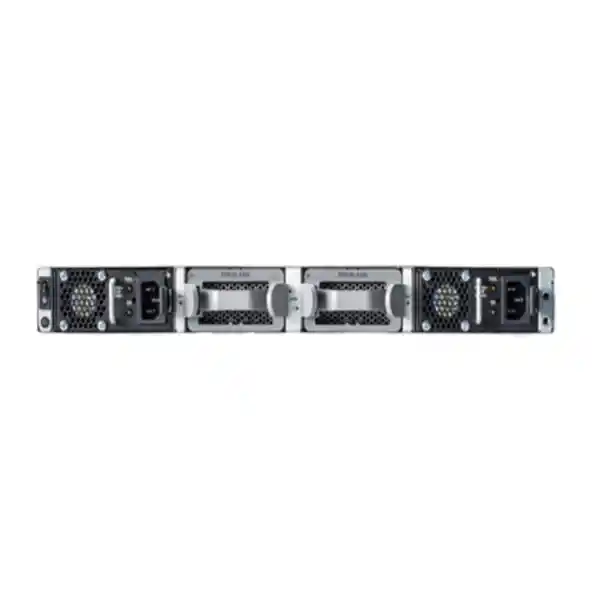
| Power supplies | Supports two hot-swappable AC power supplies for redundancy; 3110 normally ships with one AC PSU and a second can be ordered |
| Software choices | Cisco Secure Firewall Threat Defense or Cisco Secure ASA, subject to supported release compatibility |
Published performance is a sizing reference, not a promise of identical production throughput. Packet sizes, protocol mix, enabled inspections, encryption, logging, software release and policy design can materially change the result.
Performance sizing: translate Cisco test figures into your real traffic
A common procurement mistake is to compare the organization’s ISP speed directly with the firewall’s maximum published throughput. That comparison is useful as a first filter, but it is not enough to size an enterprise security appliance. The 3110’s 17 Gbps FTD figure for firewall plus AVC plus IPS is measured using a defined lab profile. Real networks contain small and large packets, interactive SaaS traffic, backups, DNS, voice, video, remote-access sessions, branch tunnels, east-west flows and encrypted connections that impose different processing costs. The security policy may also apply different inspection depth to different traffic classes.
Start with the traffic that will actually cross the appliance, not the sum of every switch-port speed in the building. Document current peak throughput in both directions, expected growth, the number of internet or private-WAN circuits, traffic that will bypass deep inspection, and traffic that will be inspected. Then distinguish average throughput from short peak bursts. A firewall that looks comfortable at today’s average can become constrained during backups, software distribution, cloud migration, large data transfers or incident-response activity if there is insufficient headroom.
Session behavior is another sizing dimension. The 3110 supports up to 2 million concurrent sessions with AVC in Cisco’s published FTD table and up to 130,000 new connections per second with AVC. Those values are particularly relevant for organizations with large user populations, public-facing applications, busy SaaS environments, network address translation, web proxies or workloads that create many short-lived connections. A design should consider both bandwidth and connection rate because a high number of connection establishments can stress a security device even when aggregate throughput appears moderate.
Encrypted traffic deserves its own estimate. Cisco publishes 4.8 Gbps TLS throughput for the 3110 under its stated test methodology. If your security policy will decrypt a meaningful percentage of outbound browsing or inbound application traffic, identify the expected encrypted volume and the categories that will be exempted from decryption for privacy, application compatibility or regulatory reasons. The decryption policy, certificate handling, cryptographic suite and traffic behavior can materially influence resource consumption. An internet circuit below 4.8 Gbps does not automatically guarantee comfortable TLS inspection, just as a faster circuit does not automatically make the platform unsuitable if only a controlled subset is decrypted.
VPN should also be separated from general firewall traffic. Cisco lists 8 Gbps IPsec VPN throughput for the 3110 in its FTD fast-path test and publishes a higher projected value with VPN offload for the referenced software release. Use those values cautiously. Determine the number of site-to-site tunnels, expected aggregate encrypted traffic, remote-office backup behavior, cloud VPN requirements and whether remote access will be provided through Cisco Secure Client. For a UAE headquarters concentrating traffic from many branches, VPN encryption may be a major sizing driver even when the local internet breakout is not.
A robust sizing exercise therefore uses at least six inputs: peak inspected throughput, concurrent sessions, connection rate, decryption demand, VPN load and expected growth. Add high availability, logging architecture and software features on top of those inputs. If the predicted production workload leaves little reserve under the 3110, evaluate the 3120 or a higher model before purchase. Buying some headroom is generally less disruptive than replacing a perimeter platform shortly after deployment.
Interface planning: where the 3110 fits and where it does not
Eight fixed RJ-45 ports
The fixed copper interfaces support 10M/100M/1GBASE-T. They are useful for 1G handoffs, management-adjacent networks, lower-speed WAN circuits and security zones that do not require optical media. Do not plan native multi-gigabit copper speeds from these ports; confirm the exact handoff with the ISP, core switch and server environment.
Eight fixed 1/10G SFP+ ports
These ports are a major reason to consider the 3110 for 10G-centric enterprise designs. The exact transceiver, DAC or active optical cable must match distance, fibre type and the equipment on the far end. Optics are a bill-of-materials decision, not an afterthought.
Dedicated 1/10G SFP management
The management interface is separate from normal data-plane planning. Decide whether management will live on an out-of-band network, a dedicated management VLAN or another controlled segment, and include the appropriate management transceiver or copper SFP if required.
Optional network-module capacity
Cisco’s data sheet lists an optional 10G SFP+ interface class for the 3110 and a total interface ceiling of up to 24 Ethernet ports when the supported network module is included. The exact module PID and software support should be validated in the final configuration.
Do not assume 25/40/100G expansion
Cisco’s hardware guide explicitly warns that certain higher-speed 3100 Series modules can be physically installed in the 3110 but are not recognized because they are unsupported. If native 25G, 40G or 100G connectivity is a design requirement, compare the 3130/3140 class rather than treating the 3110 chassis as universally modular.
Port-count planning should map every physical connection before ordering: primary ISP, secondary ISP, WAN, core switch pair, DMZ switches, server or data-center segments, dedicated management, HA interconnect requirements where applicable, monitoring connections and any future reserved links. Record speed, connector type, fibre mode, distance and redundancy for each. That exercise prevents a surprisingly common project delay: the firewall arrives on time but the correct SFPs, patch leads, switch optics or module options are missing.
FTD or ASA: decide the software operating model before you order
The Cisco Secure Firewall 3110 supports both Cisco Secure Firewall Threat Defense and Cisco Secure ASA software. That flexibility is valuable, but it also means the hardware model alone does not describe the final solution. The image choice determines the security feature set, management workflow, migration path, licensing details and operational skills required after go-live.
Firewall Threat Defense
FTD is the natural choice when the project requires Cisco’s integrated next-generation firewall functions such as application-aware access control, IPS, security intelligence and optional malware and URL-security services under the Secure Firewall management architecture. It can be managed locally in supported scenarios or centrally through Cisco management platforms, depending on the selected architecture and current software support.
Choose FTD only after identifying which licensed functions will actually be deployed. An FTD chassis without the intended security subscriptions can be technically functional yet commercially incomplete for the project’s security objectives.
Cisco Secure ASA
ASA can be relevant for organizations standardizing on the ASA operating model, maintaining established ASA policy and VPN practices, or following a migration plan that does not immediately move to the FTD feature set. Cisco publishes separate ASA performance figures for the 3110, including 18 Gbps stateful-inspection throughput in its ideal 1500-byte UDP test and 15 Gbps in its multiprotocol profile.
Do not treat the ASA and FTD throughput figures as directly interchangeable. They represent different software stacks and test methodologies. The correct comparison is the workload and features required by the intended deployment.
For a new enterprise perimeter project, document the target software image in the request for quotation. For a replacement project, also document the current firewall platform, software version, policy size, VPN types, NAT behavior, identity integrations, routing protocols and any application dependencies. The migration scope can influence both the design and the service effort more than the physical rack installation.
Cisco licensing and subscriptions: build the security outcome, not just the chassis
Cisco Secure Firewall licensing should be defined at the same time as hardware sizing. For current 3100 Series FTD guidance, Cisco lists an Essentials entitlement as required and identifies optional or feature-specific licenses for IPS, Malware Defense, URL Filtering, Cisco Secure Client and Carrier capabilities. Cisco’s 3110 ordering guidance includes subscription combinations with one-, three- and five-year terms. The exact commercial bundle and entitlement names can change over the product lifecycle, so the final quotation should use current Cisco ordering information rather than an old bill of materials copied from another project.
Essentials
The required base entitlement supports the core firewall and networking foundation. It should not be mistaken for every advanced threat capability a buyer may expect from a next-generation firewall project.
IPS
The IPS license enables intrusion detection and prevention functions and is a key decision when the firewall is expected to inspect traffic for exploit and attack patterns rather than act only as a stateful policy enforcement device.
Malware Defense
Malware-related services support file and malware analysis capabilities. Cisco licensing documentation notes prerequisite relationships with IPS for certain malware functions, so the feature set should be assembled as a valid combination.
URL Filtering
URL Filtering supports category- and reputation-based web controls. It is relevant when acceptable-use, risk-reduction or browsing-policy requirements form part of the deployment. Cisco documentation also identifies an IPS prerequisite for this feature.
Cisco Secure Client
Remote-access user licensing and Cisco Secure Client requirements should be priced according to the number and type of users, deployment model and current Cisco ordering rules. A firewall peer limit is not the same thing as a complete remote-access licensing entitlement.
Carrier features
Specialized carrier-protocol inspection such as Diameter, GTP/GPRS, M3UA and SCTP is licensed separately. Most ordinary enterprise buyers do not need this, but telecom and service-provider environments should define it explicitly.
For the 3110, Cisco lists the combined IPS, Malware Defense and URL subscription family under the L-FPR3110T-TMC ordering line with term options including one, three and five years. That is useful as a procurement reference, but the final order should still be validated against Cisco’s current commerce tools because renewals, promotions, software packaging and entitlement naming can evolve. A quotation should state the subscription term in plain language so the buyer can compare total cost over the expected ownership period rather than comparing chassis prices with unequal license periods.
Also separate security subscriptions from support coverage. Cisco support, software entitlement, subscription services, partner installation and managed operational services are related but different commercial components. A low hardware-only price can become misleading if a second proposal includes the required security subscription, support, optics, redundant power and migration work. Compare like with like.
High availability, clustering and resilience
A perimeter firewall often becomes a critical dependency for internet access, cloud connectivity, partner traffic and remote branches. The 3110 therefore deserves a resilience decision at design time. Cisco lists active/standby and active/active high-availability capabilities in the 3100 Series documentation and supports clustering of up to eight chassis on models including the 3110. The right architecture depends on the software mode, feature requirements, traffic topology and operational objective; “supports HA” does not mean every deployment should use the same pair design.
For many midsize enterprises, a pair of identically configured 3110 appliances is easier to operate than a single firewall because it provides a maintenance and failure path without relying on emergency hardware replacement. Yet true resilience requires more than two chassis. The design should also consider dual upstream links, redundant core or distribution switches, diverse power feeds, redundant optics where appropriate, switch-port configuration, routing convergence, state synchronization, management reachability and the behavior of NAT and VPN during failover.
Power redundancy needs explicit attention on the 3110 because Cisco’s hardware guide states that the 3105, 3110 and 3120 ship with one AC power supply while the chassis supports a second. The power supplies are hot-swappable. For a high-availability firewall pair in a data center, many buyers will want two PSUs per appliance connected to independent PDUs or power sources. Ordering two firewalls but leaving each on a single PSU can undermine the resilience objective.
Clustering can provide scale beyond a simple pair, but it adds architecture and operational complexity. It should be selected for a measured requirement rather than because the platform supports it. Confirm supported topologies, feature behavior, software release, switching design and expected scaling characteristics for the specific deployment. If the organization only needs redundancy and maintenance continuity, a well-designed HA pair may be the more straightforward answer.
Resilience should also be tested. A commissioning plan should include controlled loss of an ISP link, a firewall unit, a power feed and selected internal paths where safe. Verify session behavior, routing, VPN recovery, monitoring alarms and management access. A documented failover test provides far more confidence than simply observing that both appliances show a healthy status on the installation day.
TLS inspection and encrypted traffic: the hidden sizing question
Modern enterprise traffic is predominantly encrypted, so firewall evaluation increasingly depends on what happens inside TLS rather than only on clear-text packet forwarding. Cisco publishes a 4.8 Gbps TLS figure for the 3110 using its documented methodology. That figure is valuable because it provides a specific reference point, but a production decryption design should be based on the organization’s actual policy and application mix.
First define why decryption is being used. Common goals include applying IPS and malware controls to otherwise opaque web sessions, improving visibility into risky applications and enforcing security policy consistently. Then identify traffic that should not be decrypted. Financial services, healthcare portals, certificate-pinned applications, privacy-sensitive categories and certain business applications may need exemptions depending on policy, law and compatibility. The exact list is organization-specific.
Certificate lifecycle is part of the project. Endpoint trust must be planned, certificate distribution may need Active Directory or device-management integration, and unmanaged devices may require a different policy. An appliance can have ample processing headroom and still deliver a poor user experience if certificate trust, application exceptions or troubleshooting procedures are not ready.
For a 3110 shortlist, estimate the peak volume of traffic expected to be actively decrypted rather than assuming all internet traffic will follow the same path. If decryption demand approaches the platform’s practical envelope after applying a prudent growth reserve, move the model comparison upward. If only selected high-risk categories or managed endpoints are decrypted, the 3110 may remain a strong fit even on a larger aggregate internet service.
VPN design for branches, cloud and remote users
The 3110 can serve as a VPN concentration point for site-to-site connectivity and, with the appropriate Cisco Secure Client licensing and design, remote-access use cases. Cisco lists a maximum of 3,000 VPN peers for the 3110 in its 3100 Series performance tables. That limit is a platform-scale reference, not a recommendation to design every installation near the maximum. Real VPN planning should examine throughput, tunnel count, cryptographic settings, authentication, identity systems, address pools, redundancy and the operational impact of tunnel reconvergence.
For branch connectivity, inventory every site and classify expected bandwidth. A small sales office and a data-rich remote warehouse should not be represented as identical “one tunnel” entries. Account for scheduled backups, application replication, voice, CCTV backhaul where applicable, and software updates that can create peaks. If the firewall becomes the central hub for many branches, simultaneous peak behavior matters more than the nominal branch circuit sizes individually.
For cloud connectivity, determine whether the 3110 will terminate IPsec to public-cloud gateways, private-cloud environments, colocation sites or partner networks. Cloud providers may have tunnel and routing constraints of their own. Dynamic routing, BGP design, failover between tunnels and asymmetric paths should be reviewed alongside the firewall policy. A tunnel that comes up is not necessarily a resilient production design.
Remote access introduces identity and endpoint considerations. Authentication may involve SAML, RADIUS, multifactor services, certificate-based authentication or directory systems depending on the architecture. Split tunneling, posture, DNS behavior and internet breakout policy affect both security and firewall load. A remote-work design should also define what happens when the primary firewall or ISP link fails.
When requesting a quotation, state whether VPN is site-to-site only, remote access only or both. Include approximate tunnel count, remote-user count, expected aggregate VPN throughput, authentication method and whether existing VPN configurations need migration. These details influence licensing, service scope and test planning.
Management, logging and day-two operations
The firewall is only one component of a security operating model. Cisco’s 3100 Series can participate in centralized management architectures, and current Cisco documentation describes Firewall Management Center and cloud-delivered management options for FTD deployments. The right choice depends on the number of firewalls, desired operational consistency, logging requirements, deployment model and internal skills.
A single appliance can sometimes be managed locally, but organizations with multiple firewalls generally benefit from centralized policy, objects, software management, event review and reporting. Before ordering, determine whether an existing Firewall Management Center has sufficient device capacity and runs a compatible software release. If there is no management platform, include one in the architecture rather than discovering the requirement during commissioning.
Logging volume deserves planning because rich security inspection generates substantial telemetry. Decide which events remain on the Cisco management platform, which are forwarded to a SIEM, how long they are retained and who reviews them. Forwarding every possible event without a filtering and retention strategy can increase storage and operational noise; logging too little can undermine incident response. The policy should align high-value events with the organization’s monitoring process.
Operational ownership also matters. Define who approves firewall changes, who tunes IPS, who handles false positives, who maintains URL categories and decryption exceptions, who renews licenses, who applies software updates and who responds to hardware alarms. If the internal team does not want to own those tasks, managed support can be scoped separately from the initial installation. FourTeck’s broader UAE service capabilities can be reviewed through FourTeck IT Services UAE when the requirement includes ongoing infrastructure or security operations rather than product supply alone.
Finally, establish a maintenance procedure before production cutover. A change window, configuration backup, rollback plan, release-validation process and post-change checks reduce the risk of routine upgrades becoming outages. Enterprise firewall operations are safer when software lifecycle work is treated as planned infrastructure maintenance, not an ad-hoc task.
Deployment scenarios where the Cisco 3110 may fit
Midsize enterprise internet edge
A head office with multi-gigabit internet, substantial SaaS use and a requirement for IPS, application control, URL policy and VPN can be a natural 3110 candidate when measured inspection demand leaves adequate headroom. The 10G SFP+ ports suit many enterprise core and ISP handoffs.
Regional headquarters VPN hub
Organizations concentrating IPsec traffic from offices across the UAE, GCC or other regions can consider the 3110 if aggregate encrypted traffic, peer count and failover requirements fit. Dual appliances and redundant WAN paths may be more important than raw chassis throughput.
Data-center perimeter or segmentation edge
The appliance can protect selected data-center zones where 1G/10G connectivity is sufficient. If the fabric has moved to 25G or above, verify whether the 3110’s port architecture creates an unnecessary bottleneck and compare higher models.
Private-cloud or colocation boundary
A 1RU footprint and 10G interfaces can suit colocation designs that need firewall policy, VPN and threat inspection without moving immediately to the highest 3100 Series tier. Rack power, remote management and cross-connect optics should be planned before shipment.
When to look smaller
If the site has modest traffic, low session counts, limited VPN use and no requirement for the 3110’s performance or port density, the 3105 or another smaller Cisco platform may deliver better economics. Over-sizing can raise subscription and support cost without improving the actual security policy.
When to look larger
If expected inspection, TLS load, 25G/40G/100G connectivity, session growth or future consolidation exceeds the 3110 design envelope, compare the 3120, 3130 or 3140. The cost of a larger model can be justified when it avoids an early platform replacement or architectural workaround.
3110 versus nearby Cisco Secure Firewall 3100 models
Model selection is easier when the 3110 is compared with its nearest alternatives using the same Cisco performance table. The 3105 sits below it, the 3120 is the closest step up, and the 3130 changes the interface and performance class more substantially. The following comparison focuses on the decision-driving numbers rather than trying to reproduce every feature in the series.
| Model | FTD FW + AVC + IPS | Sessions with AVC | Fixed high-speed interfaces | Buyer signal |
|---|---|---|---|---|
| 3105 | 10 Gbps | 1.5 million | 8 × 1/10G SFP+ | Consider for lower traffic and branch/enterprise edge needs where 3110 headroom is unnecessary. |
| 3110 | 17 Gbps | 2 million | 8 × 1/10G SFP+ | Balanced midrange choice for 10G-centric midsize enterprise designs. |
| 3120 | 21 Gbps | 4 million | 8 × 1/10G SFP+ | Closest upgrade when more inspection or session capacity is needed but 25G fixed ports are not. |
| 3130 | 38 Gbps | 6 million | 8 × 1/10/25G SFP class | Evaluate when performance moves into a materially higher tier or 25G/higher-speed module options matter. |
The 3120 is the most important alternative to the 3110 because it preserves a similar 1/10G fixed-port profile while raising FTD inspection throughput from 17 to 21 Gbps and doubling the maximum concurrent-session figure with AVC from 2 million to 4 million. If a buyer’s forecast lands uncomfortably close to the 3110’s session or inspection capacity, the 3120 deserves a cost comparison even when the current circuit speed does not seem to require it.
The 3130 becomes relevant for a different reason: it changes the high-speed interface class as well as performance. An enterprise refreshing its data center to 25G may find that choosing the 3130 avoids external speed conversion or a second replacement cycle. Conversely, a normal 10G enterprise edge should not pay for a higher tier merely because it is newer or faster; the correct model is the one that meets measured demand with sensible reserve.
Migration planning from an existing Cisco ASA, Firepower or third-party firewall
Replacing a perimeter firewall is primarily a policy and network migration project, not a rack-mount exercise. The implementation team needs to understand what the existing firewall is doing today, which functions should be preserved, which should be redesigned and which obsolete rules should be removed. Copying a large legacy policy without review can transfer years of technical debt to the new platform.
Begin with an inventory of interfaces, VLANs, routing, static routes, dynamic routing protocols, NAT, access-control rules, VPN tunnels, remote-access configuration, objects, object groups, certificates, authentication, DNS dependencies, logging destinations, monitoring systems and any special inspection behavior. Identify rules that have not been used recently where reliable hit-count data exists. Migration is a good opportunity to reduce policy sprawl, but removals should be governed by business ownership rather than made automatically.
Cisco-to-Cisco migration can still involve semantic differences between ASA and FTD. A rule that appears simple in ASA may need a different representation in an application-aware FTD policy. NAT ordering, VPN behavior, identity integration and management workflows can also differ. If the source platform is from another vendor, object models and security profiles may require more manual interpretation. The target policy should be validated against the intended security outcome, not judged only by whether the number of rules matches the old firewall.
Plan address and routing changes around the cutover method. A parallel migration with staged interfaces can reduce risk where topology permits. In other environments, the same public IP addresses or physical circuits must move during a single change window. Document the rollback trigger, physical reconnection steps, configuration backup and responsible contacts before the window begins. ISP coordination may be necessary when handoff settings, routed subnets, ARP behavior or BGP sessions change.
Certificates and VPNs often determine how long the migration really takes. Site-to-site peers may be owned by external partners or branches in different time zones, and remote-access users can be sensitive to client or authentication changes. Build a tunnel matrix with peer addresses, protected networks, cryptographic parameters, ownership and test contacts. For public services, list each inbound NAT and application owner so that validation is not reduced to a basic ping test.
A successful firewall migration ends with evidence: approved business applications work, internet and cloud connectivity are stable, expected security inspection is active, VPNs are up, logging reaches the monitoring systems, high availability has been tested and the old platform remains available for rollback only for the agreed retention period. That operational validation is a more meaningful completion criterion than simply seeing green interface LEDs.
Physical installation and Dubai data-center considerations
The 3110 is a 1RU appliance designed for a standard 19-inch rack. Cisco’s hardware guide recommends ordering slide rails for the Secure Firewall 3100, and the chassis airflow runs from the I/O side toward the non-I/O side, corresponding to a cold-aisle to hot-aisle arrangement. These details should be checked against the actual rack before installation, particularly in colocation facilities where rail type, cabinet depth and airflow policy are controlled by the operator.
The chassis dimensions are approximately 1.75 inches high, 17 inches wide and 20 inches deep. The published chassis weight for the 3105/3110/3120 configuration class is about 23 lb with one power supply, one network module, two dual fan modules and one SSD. Allow room for cabling and service access rather than evaluating cabinet fit from chassis depth alone. Dense front-panel fibre connections benefit from organized patching and clear port labels.
Cisco lists 100/240 VAC system power at 50 to 60 Hz for the 3100 Series and supports dual power supplies for redundancy. For UAE deployment, the final power cord, PDU connector and rack-power arrangement should be confirmed against the site. A data center may use IEC outlets on intelligent PDUs even when office facilities use local wall receptacles. The correct ordering decision is the one that matches the rack, not the country plug used elsewhere in the building.
Environmental controls remain important in the Gulf climate even though enterprise equipment is normally installed in conditioned rooms. Cisco publishes an operating temperature range of 0°C to 40°C for the platform and operating humidity of 5% to 85% noncondensing. A properly maintained server room should stay comfortably within those limits. During transport, staging or temporary installation, avoid exposing the appliance to hot, dusty or condensing environments and allow it to acclimatize before power-on when moving between markedly different temperatures.
Optical connectivity should be tested before the migration window. Confirm fibre type, connector cleanliness, polarity, transceiver compatibility and receive power where relevant. If the ISP or data-center provider supplies a cross-connect, obtain the handoff specification in writing. A 10G SFP+ port is only one part of the link; the optic, wavelength, fibre path and far-end device must all match.
For broader UAE procurement, logistics and technology support, buyers can reference FourTeck UAE. The commercial proposal should state whether delivery is product-only, rack-and-stack, full configuration, migration, after-hours cutover, onsite support or an ongoing managed arrangement, because those scopes require different resources.
A practical implementation journey
Discover the workload
Measure peak traffic, sessions, connection rate, encrypted traffic, VPN demand, critical applications, user count and growth. Document the current firewall and every external dependency.
Validate model fit
Compare the workload with 3110 inspected throughput, TLS, VPN, session and interface limits. Evaluate the 3120 or 3130 where growth reserve or port speed makes them more appropriate.
Build the bill of materials
Select FTD or ASA, security subscriptions, support, optics, network module if required, second PSU, rails, management architecture and any Cisco Secure Client licensing.
Prepare configuration
Clean objects and rules, create routing and NAT, define security profiles, prepare certificates, map VPNs, integrate identity and logging, and create a tested rollback plan.
Stage and test
Rack, cable, upgrade to the approved software release, register licensing and management, verify interfaces, confirm monitoring and test policy before production cutover where possible.
Cut over and validate
Move links during the change window, test internet and business applications, verify VPNs and public services, inspect logs, exercise failover and retain rollback capability until acceptance.
Procurement details that should appear on the quotation
A Cisco 3110 proposal should be detailed enough that the buyer can understand exactly what is included. The chassis PID alone does not describe a complete security solution. At minimum, the bill of materials should identify the software image, security subscription, subscription term, support coverage, quantity, power-supply configuration, network module where required, optics or DACs, rack accessories and any management-platform component that is not already available.
Cisco identifies separate chassis PIDs for ASA and next-generation firewall configurations, including FPR3110-ASA-K9 and FPR3110-NGFW-K9 in its hardware documentation. Those PIDs help show why “Cisco 3110” is insufficient as an order description. The final quote should reflect the intended image and current Cisco orderability, and the reseller should validate substitutions or bundle changes if Cisco’s commerce system has evolved since an earlier reference document was created.
Redundant-power requirements should be visible rather than implied. Cisco’s 3110 class ships with one AC PSU and supports a second. If the project requires dual power, make sure the second supply is a line item or is clearly included in the bundle. The same principle applies to slide rails and cable-management accessories. A rack-ready enterprise order should not depend on assumptions about what another project happened to receive.
For optics, list the interface use case next to the transceiver. “10G SFP” is not specific enough to distinguish short-range multimode, long-range single-mode, copper or direct-attach options. The cabling environment and far-end equipment determine the correct transceiver. Unsupported third-party optics can also create operational and support issues, so the transceiver policy should be agreed before purchase.
If professional services are included, define deliverables. Examples include design review, configuration build, rule migration, VPN migration, rack installation, HA commissioning, software upgrade, logging integration, cutover support, rollback assistance, documentation and post-change monitoring. “Installation included” can otherwise mean anything from physically mounting the appliance to a complete security migration.
For organizations sourcing across more than one geography, FourTeck global provides another business-facing route into the wider FourTeck network. Use the same technical bill of materials across locations where possible, but confirm local power, support and logistics requirements for each country.
Security policy design after the hardware arrives
A powerful appliance does not create a strong security posture by itself. The value of the 3110 depends on how access control, IPS, application visibility, URL policy, malware controls, decryption, identity and logging are designed. A permissive rule base on a high-performance firewall remains permissive. Conversely, an excessively aggressive policy introduced without application testing can disrupt legitimate business traffic.
Start with network trust zones that reflect actual business boundaries. Internet, corporate users, servers, guest networks, voice, management, DMZ, partner links and cloud segments may require different policy. Avoid creating dozens of zones without an operational reason, but also avoid collapsing clearly different trust levels into one broad “inside” zone simply to shorten the configuration. The policy should be understandable to the team that will maintain it later.
Application-aware controls should be introduced with visibility. Observe which applications users and systems actually require before blocking broad categories. IPS policies should be tuned for the protected environment and updated as Cisco threat intelligence evolves. Critical servers may justify stricter inspection than low-risk outbound traffic, while latency-sensitive or certificate-pinned applications may need tailored handling.
URL policy should reflect company policy and risk, not a copied list of categories. Some organizations require broad productivity controls; others focus mainly on malware, newly observed domains and high-risk categories. Decryption policy should align with legal and privacy guidance. Any exception should have an owner and a reason so that temporary bypasses do not become permanent blind spots.
Logging should be designed for action. High-severity security events, administrative changes, VPN authentication failures and important access-control events often deserve stronger retention or SIEM correlation than low-value noise. Define alert ownership, escalation thresholds and operational response. A firewall generating thousands of alerts that nobody reviews is not an effective control.
Finally, schedule policy review. Business applications change, SaaS use grows, IP ranges move to cloud platforms and old rules outlive projects. Quarterly or risk-based review of rules, objects, VPNs, certificates and license status can keep the 3110 aligned with the network it is actually protecting rather than the network that existed on installation day.
Support, software lifecycle and change control
Cisco Secure Firewall is a software-driven security platform, so the operating lifecycle matters as much as the initial hardware specification. Cisco continues to publish software, security and hardware documentation for the 3100 Series, and the platform remains listed by Cisco as available to order at the time this page was prepared. Buyers should still verify current orderability, recommended software release, support term and any announced lifecycle notices at quotation time because those details can change after publication.
Choose a software version based on Cisco support guidance and required features, not simply the newest version number. A mature enterprise may standardize on a release train that has completed internal testing. New deployments should verify compatibility among the firewall, management platform, VPN client, identity services, network modules and automation integrations. An upgrade that introduces a desired feature can also impose a management-platform or client prerequisite.
Keep configuration backups and export critical operational data before major changes. Record the current software version, image files, management-center version, device registration state and license status. For HA pairs, follow the supported upgrade procedure so state and traffic behavior remain predictable. Avoid making unrelated policy changes in the same window as a major software upgrade unless there is a compelling reason.
Hardware support should be matched to business impact. A high-availability pair can reduce the urgency of single-unit replacement, but it does not eliminate the need for support. A single 3110 at a critical site may justify more aggressive replacement coverage. If spares are held internally, include the operational process for software alignment, licensing and configuration restore; a boxed spare with an unknown software state is not immediately interchangeable.
Change control should include pre-checks and post-checks. Before maintenance, verify backups, HA health, route state, VPN state, licensing and management reachability. After maintenance, confirm the same items plus application tests and logging. Simple repeatable checklists reduce human error and make troubleshooting faster when a change does not behave as expected.
Buyer questions about Cisco Secure Firewall 3110 in Dubai
Is the 3110 a next-generation firewall?
When deployed with Cisco Secure Firewall Threat Defense and the appropriate subscriptions, it supports next-generation firewall capabilities including application visibility, IPS, security intelligence and optional malware and URL-security services. The exact enabled functions depend on licensing and policy.
What is the 3110 firewall throughput?
Cisco publishes 17 Gbps for FTD firewall plus AVC and 17 Gbps for firewall plus AVC plus IPS using its 1024-byte test profile. Cisco publishes separate ASA figures. Production results vary with packet mix, enabled features and software.
How many sessions can it handle?
Cisco lists up to 2 million concurrent sessions with AVC for the 3110 in its FTD table and up to 130,000 new connections per second with AVC. Real sizing should include a growth reserve rather than targeting published maxima.
Does it support 10 Gigabit Ethernet?
Yes. The 3110 has eight fixed 1/10G SFP+ interfaces in addition to eight 1G copper RJ-45 ports. The exact SFP+, DAC or optical media must match the network design.
Can I use 25G or 40G modules in a 3110?
Do not assume so. Cisco’s hardware guide states that some higher-speed modules can be physically inserted into 3105/3110/3120 chassis but are not recognized because they are unsupported. Use the supported 3110 module list for the target software release.
Does the 3110 support high availability?
Yes. Cisco lists active/standby and active/active HA capabilities for the 3100 Series. The exact supported topology and feature behavior should be validated for the selected software mode and release.
Does one appliance include redundant power?
The 3110 supports two power supplies, but Cisco’s hardware guide states that 3105/3110/3120 units ship with one AC power supply and a second can be ordered. Specify dual power explicitly if the design requires it.
Can it run ASA?
Yes. Cisco documents support for both Secure Firewall Threat Defense and Secure ASA software on the 3100 Series. The chosen image should be included in the design and bill of materials because the operating model and licensing differ.
Which subscription term should we choose?
Cisco offers term-based security subscriptions for the 3110, commonly including one-, three- and five-year options in current ordering guidance. Compare total ownership cost, refresh plans and budget cycle rather than selecting a term only from the lowest first-year price.
Is 17 Gbps enough for a 10 Gbps internet link?
Possibly, but the answer depends on TLS decryption, IPS, VPN, session rate, traffic direction, growth and policy. A 10 Gbps circuit can produce a workload that is easy or difficult depending on what the firewall must inspect. Use measured traffic and a sizing reserve.
What should be ordered with the chassis?
Typical dependencies include security subscriptions, support, correct optics or DACs, optional network module, second PSU for redundant-power designs, rails, management licensing or appliance capacity, Cisco Secure Client licensing and installation or migration services.
Can FourTeck supply and install it in Dubai?
FourTeck can scope Cisco Secure Firewall 3110 supply, sizing, licensing, optics, rack installation, configuration and migration according to the project requirement. The final service scope should state whether after-hours cutover, HA testing, VPN migration and documentation are included.
What can make the Cisco 3110 unsuitable?
A balanced product page should make it clear when the model may not be the right choice. The first concern is insufficient performance reserve. If expected inspected traffic is close to the 17 Gbps FTD class before allowing for growth, decryption, burst behavior and future security functions, the 3120 or a higher model deserves consideration. A firewall should not be designed to live permanently at the edge of its lab-rated capacity.
The second concern is interface architecture. The 3110 is fundamentally a 1G/10G platform at its fixed data ports. If the network requires native 25G connections to modern data-center switches, or 40/100G uplinks, the higher 3100 models are a more natural architectural fit. Using extra switching or conversion purely to make a lower firewall model fit can add complexity and failure points.
The third concern is commercial over-sizing. A small site may not need the 3110’s performance, memory, port density or associated subscription tier. If the workload is far below its capacity and growth expectations are modest, a smaller model may reduce capital, subscription and support costs while meeting the same security policy.
A fourth concern is operational mismatch. An organization may buy advanced subscriptions but lack the team or service model needed to tune IPS, maintain decryption exceptions, review alerts, manage upgrades and renew licenses. That does not make the 3110 technically unsuitable, but it means the project should include operational ownership. Security controls that are enabled once and then ignored lose value over time.
Finally, migration constraints can alter model selection. If the existing environment has specialized interfaces, unusual routing, very large VPN concentration, carrier protocols or strict certification requirements, verify them against the target software release and licensing before purchase. A good shortlist is built from requirements first, not from a preferred model name.
Dubai and UAE availability guidance
For Cisco Secure Firewall 3110 projects in Dubai, Abu Dhabi and other UAE locations, availability should be checked against the exact configured bill of materials rather than the chassis name alone. A base appliance may be available while a specific subscription term, network module, power supply, rail kit or optical transceiver has a different lead time. The best procurement request therefore identifies all dependencies at the beginning.
Where the appliance will be installed also affects service planning. A corporate server room may permit daytime access and straightforward cabling. A data-center or colocation facility can require access approvals, method statements, remote-hands coordination, rack-elevation details and after-hours cutover windows. Branch installations may need travel planning and local contact availability. Include the deployment location and access restrictions in the initial request so the implementation scope is realistic.
FourTeck can provide a project-specific quotation for the Cisco 3110 through the Firewall Dubai by FourTeck specialist site, while broader company information is available from the other FourTeck resources linked on this page. Quotations can be structured around product supply only or can incorporate licensing review, optics, HA design, installation and migration depending on the requirement.
Do not rely on generic online “in stock” labels for enterprise firewall procurement. The commercially meaningful question is whether the correct Cisco SKU, licenses, support, accessories and service window can be delivered together for the target deployment date.
Decision recap: the six choices that determine whether the 3110 is right
1. Model fit
Use measured inspected traffic, sessions, TLS, VPN and growth to decide whether the 17 Gbps FTD tier provides comfortable reserve.
2. Interface fit
Confirm that eight 1G copper and eight 1/10G SFP+ fixed ports, plus supported 10G expansion where needed, match the network topology.
3. Software mode
Choose FTD or ASA intentionally. The image affects management, features, licensing, migration and the way performance figures should be interpreted.
4. Licensing
Define IPS, malware, URL filtering, Secure Client and subscription term from required security outcomes. Do not compare hardware-only and fully licensed quotes as equivalent.
5. Resilience
Decide single appliance, HA pair or cluster; include redundant power, switching, ISP paths and failover testing instead of treating chassis redundancy in isolation.
6. Migration scope
Inventory policies, NAT, routes, VPNs, certificates, identity and logging. The migration effort may be a larger project driver than the physical installation.
What FourTeck needs for an accurate Cisco 3110 quotation
A useful quotation starts with a compact set of technical and commercial inputs. Exact answers are not required for every item; where measurements are unavailable, FourTeck can use the existing environment and growth plan to help build a sizing assumption. The more of the following information that is available, the more accurately the bill of materials can be aligned to the project.
Current and planned ISP/WAN speeds, measured peak traffic and expected growth.
IPS, malware controls, URL filtering, TLS decryption, application control and any special inspection.
Number of links, copper or fibre, speed, transceiver type, switch models and distance where known.
Site-to-site tunnel count, remote-user count, expected VPN throughput and authentication approach.
Single unit, HA pair or cluster; dual ISP, redundant power and failover requirements.
FTD or ASA preference, existing FMC or cloud management, software version and device capacity.
Preferred one-, three- or five-year security subscription and required Cisco support coverage.
Existing firewall make/model, rule count, NAT, VPNs, routing and any known application dependencies.
Dubai/UAE site, rack details, data-center access restrictions and required change window.
Plan the Cisco Secure Firewall 3110 around your real Dubai network
The 3110 is strongest when its 17 Gbps FTD inspection class, 2 million-session capacity and 1/10G interface design align with measured traffic and a clearly licensed security policy. A complete project should also account for optics, redundant power, management, support, migration, VPN, decryption and future growth. FourTeck can turn those inputs into a specific Cisco bill of materials and deployment scope rather than a generic chassis quote.
Supply, licensing, HA design, optics, installation and migration scope can be quoted separately or together.

Reviews
There are no reviews yet.