
Cisco Secure Firewall 3130 Dubai
A high-capacity 1RU security appliance for enterprises that need strong firewall and IPS performance, substantial session scale, high-speed SFP connectivity, flexible network-module choices, centralized security operations and room for growth without immediately moving into a larger chassis class.
Direct answer: what is the Cisco Secure Firewall 3130?
The Cisco Secure Firewall 3130 is a high-performance enterprise firewall appliance in Cisco’s Secure Firewall 3100 Series. Cisco positions the 3130 and 3140 for large-enterprise deployments requiring higher throughput and higher-performance network-module options. The 3130 can run Cisco Secure Firewall Threat Defense software for next-generation firewall, application visibility, IPS, malware and URL-control workflows, or ASA software where a traditional ASA operating model is required.
Where the 3130 fits in the Cisco Secure Firewall 3100 family
The 3130 is not simply a faster version of a branch firewall. Its position in the 3100 Series matters because it marks a substantial step up from the 3120 in inspection capacity and interface flexibility while remaining in the same compact 1RU physical class. For buyers designing a refresh, that means the decision is often less about rack space and more about traffic growth, east-west segmentation, VPN load, encrypted-traffic policy, link speeds and the performance headroom required during peak conditions.
Cisco publishes 38 Gbps for Firewall Threat Defense with Firewall + AVC + IPS on the 3130, compared with 21 Gbps on the 3120 and 45 Gbps on the 3140. Maximum concurrent sessions with AVC rise from 4 million on the 3120 to 6 million on the 3130 and 10 million on the 3140. This makes the 3130 particularly interesting where the 3120 is too close to the projected ceiling, but the 3140’s additional capacity is not justified by the workload or budget.
There is also an interface distinction. The 3130 and 3140 integrate eight 1/10/25G SFP-based Ethernet interfaces, while the lower 3100 models use 1/10G SFP interfaces. Cisco further limits recognition of the 1/10/25G and 4x40G network modules to the 3130 and 3140. That can make the 3130 the first model in the family that fits a design built around native 25G links or certain 40G aggregation requirements.
| Decision point | Secure Firewall 3120 | Secure Firewall 3130 | Secure Firewall 3140 |
|---|---|---|---|
| FTD FW + AVC + IPS | 21 Gbps | 38 Gbps | 45 Gbps |
| Concurrent sessions with AVC | 4 million | 6 million | 10 million |
| New connections/sec with AVC | 170,000 | 240,000 | 300,000 |
| Integrated SFP interfaces | 8 x 1/10G | 8 x 1/10/25G | 8 x 1/10/25G |
| Typical shortlist logic | When 21 Gbps class capacity and 10G optics are sufficient. | When 38 Gbps class inspection and 25G/40G flexibility are needed without moving beyond 1RU. | When the 3130 leaves too little headroom for sessions, inspection or future growth. |
Performance: read the numbers in the context of your traffic
Cisco publishes several performance figures for the 3130 because firewall behavior changes with software mode, enabled security functions, protocol mix and packet size. Under Firewall Threat Defense, Cisco lists 38 Gbps for Firewall + AVC and the same 38 Gbps for Firewall + AVC + IPS using its stated 1024-byte test conditions. NGIPS throughput is also listed at 38 Gbps. The platform is rated for up to 6 million concurrent sessions with AVC and up to 240,000 new connections per second with AVC.
Those figures are valuable for family comparison, but they should not be treated as a guaranteed application-level number for every production environment. Cisco explicitly notes that performance varies with enabled features, the network protocol mix and packet-size characteristics, and that performance can change with software releases. A Dubai enterprise carrying mostly large packets on clean north-south flows will behave differently from a data-center security zone processing many small packets, high connection churn, extensive IPS inspection and a large proportion of TLS traffic.
The TLS figure is especially useful as a warning against sizing only from the 38 Gbps headline. Cisco publishes 9.1 Gbps for the 3130 under its stated TLS test methodology, which uses 50 percent TLS 1.2 traffic with AES256-SHA and RSA 2048-bit keys. Real decryption designs vary significantly according to TLS versions, cipher suites, certificate handling, bypass rules, application behavior and the percentage of traffic actually decrypted. If decryption is central to the security policy, the sizing conversation should start with the encrypted-traffic profile rather than with raw Internet bandwidth.
VPN sizing needs the same care. Cisco lists 17.8 Gbps IPsec VPN throughput for FTD using 1024-byte TCP with Fastpath, along with a projected 33 Gbps figure with VPN offload under FTD 7.2 test assumptions. ASA figures are different because the test profile and software behavior differ. The platform is also listed for a maximum of 15,000 VPN peers. A buyer should therefore define whether the project is mainly site-to-site IPsec, remote-access connectivity, a mixed VPN concentrator role, or a firewall where VPN is only a secondary workload.
For ASA deployments, Cisco publishes stateful inspection firewall throughput of 42 Gbps under its ideal 1500-byte UDP test and 39 Gbps under the multiprotocol profile, with up to 6 million concurrent firewall connections and 875,000 new connections per second. These ASA figures are not interchangeable with FTD numbers. The right operating image should be chosen according to required security services, operational model, migration path and application dependencies, not because one headline test appears larger.
Internet bandwidth is only the first input
Record peak and normal WAN throughput, but also identify east-west traffic that will traverse the appliance, backup windows, SaaS bursts, inter-site flows and expected growth. A 10 Gbps Internet circuit can still justify a larger firewall if inspection, VPN and segmentation loads are substantial.
Connection rate can dominate
Web platforms, API gateways, public applications and NAT-heavy architectures can create far more new connections per second than user-count estimates suggest. Capture peak connection rates from the existing firewall where possible instead of relying only on headcount.
Security policy changes capacity
IPS, file inspection, malware controls, URL filtering, TLS decryption and complex policy sets each affect the workload differently. Size for the services that will actually be enabled on day one and for realistic future adoption.
Headroom is operational insurance
Do not design a new firewall to live continuously near its maximum expected load. Capacity margin helps absorb traffic growth, software changes, incident conditions, temporary asymmetric routing and maintenance scenarios in an HA pair.
Interfaces, network modules and physical design
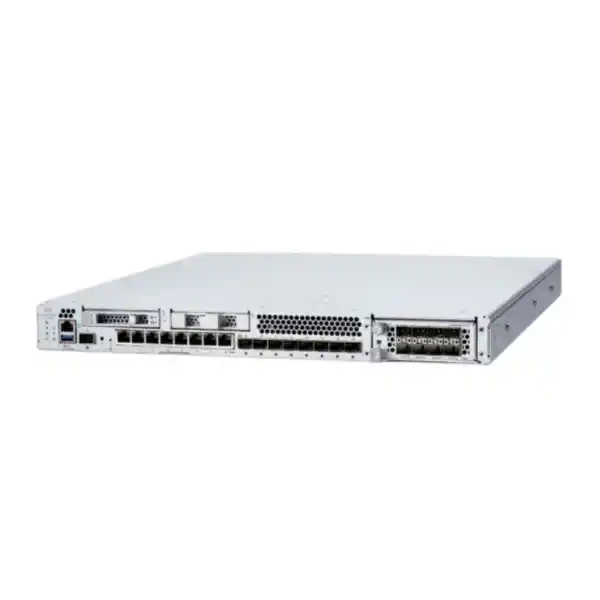
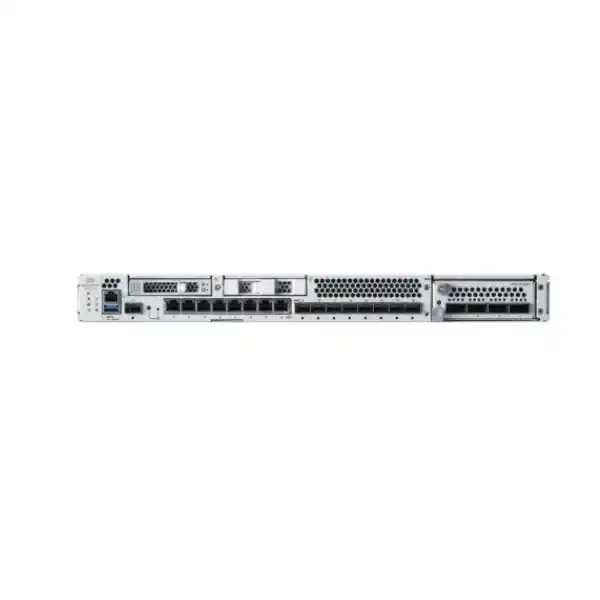
The Cisco Secure Firewall 3130 combines fixed copper and pluggable high-speed interfaces in a 1RU chassis. Cisco lists eight 10M/100M/1GBASE-T RJ-45 Ethernet interfaces and eight 1/10/25G SFP-based Ethernet interfaces as integrated I/O. An integrated 1/10G SFP management port, an RJ-45 serial console port and a USB 3.0 Type-A port are also present. With a network module installed, Cisco lists up to 24 total Ethernet ports.
For the 3130, network-module options include eight 1/10/25G ports or four 40G ports. This is a decisive difference when compared with the lower 3100 models: Cisco’s hardware documentation states that the 1/10/25G module and 4x40G module are recognized only on the 3130 and 3140. An organization that needs 25G server or aggregation connectivity should therefore include physical link design early in the model-selection process rather than treating transceivers and network modules as last-minute accessories.
Optics are a procurement dependency, not merely a cabling detail. A complete bill of materials may need SFP, SFP+, SFP28 or QSFP-class components depending on the selected interfaces and network module, along with compatible fiber type, reach, patching and upstream switch ports. The firewall can have the correct interface speed yet still be unusable on installation day if the optical standard, connector type or fiber plant does not match the adjacent equipment.
The chassis dimensions are approximately 1.75 x 17 x 20 inches, or 4.4 x 43.3 x 50.8 cm. Cisco lists rack mounting with included rails for a four-post EIA-310-D rack, while fixed-mount brackets for two-post mounting are optional. In a UAE data-center or comms-room project, confirm usable rack depth, front-to-back airflow planning, PDU outlet type, cable bend radius and service clearance. A nominal 1RU size does not remove these practical installation checks.
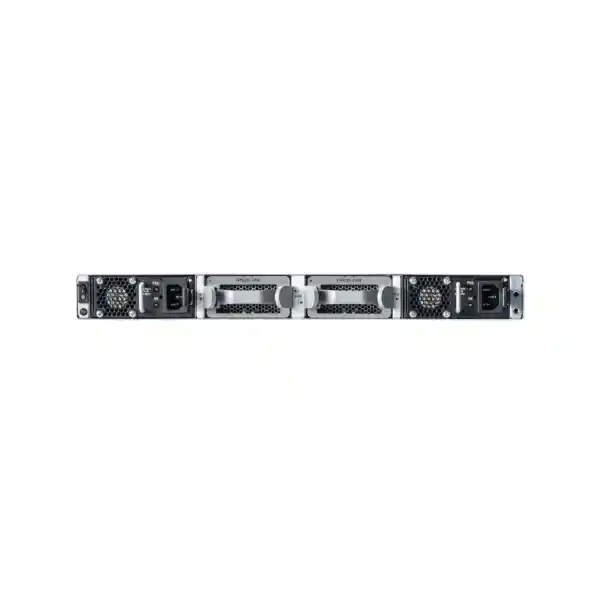
Storage is listed as one 900 GB drive with one spare slot. The 3130 is supplied with dual 400W AC power according to the current Cisco data sheet, with optional single or dual 400W DC configurations; with dual supplies, 1+1 power redundancy is supported. Cisco also specifies two hot-swappable fan modules, each containing two fans. These resilience features are useful, but the surrounding design should match them: redundant PSUs provide limited value if both are connected to the same PDU, UPS, circuit or failure domain.
| 3130 hardware item | Published detail | Buyer implication |
|---|---|---|
| Integrated copper | 8 x 10/100/1000BASE-T RJ-45 | Useful for 1G handoffs, management-adjacent roles and legacy copper connectivity. |
| Integrated fiber-capable I/O | 8 x 1/10/25G SFP | Supports high-speed uplinks without consuming the optional module slot, subject to compatible optics. |
| Optional network module | 8 x 1/10/25G or 4 x 40G options | Choose from the target topology and switch-port speeds; do not order modules by port count alone. |
| Power | Dual 400W AC; optional DC choices | Plan diverse power paths if the project requires genuine appliance-level resilience. |
| Form factor | 1RU, about 20 inches deep | Compact, but rack depth, rails, PDU layout and airflow still need confirmation. |
Threat Defense capabilities: what the platform can do
When deployed with Cisco Secure Firewall Threat Defense, the 3130 is designed to combine stateful firewall enforcement with application visibility and control, intrusion prevention, threat intelligence integration and optional security services. Cisco lists Application Visibility and Control as standard and describes support for more than 4,000 applications, together with geolocation, user and website context. OpenAppID support allows custom and open-source application detectors where the organization has specialized traffic that is not covered adequately by default identification.
Cisco Security Intelligence is listed as standard with IP, URL and DNS threat-intelligence inputs. Secure IPS is available for intrusion detection and prevention, while Malware Defense and Secure Malware Analytics are available for malware-oriented workflows. URL Filtering provides category and reputation-based control when licensed. The practical value of these capabilities comes from policy design rather than from enabling every checkbox. A strong implementation distinguishes business-critical applications, trusted update paths, unknown traffic, server zones, user groups and externally exposed services so that inspection is appropriately strict without generating excessive noise or bypass pressure.
Encrypted traffic deserves its own policy. Decrypting TLS can improve visibility into threats hidden inside encrypted sessions, but it also introduces certificate, privacy, application-compatibility and performance considerations. Some applications use certificate pinning or other mechanisms that can break under decryption. Sensitive categories may need explicit bypass policies. Internal certificate distribution must be planned for endpoints where outbound inspection is used. The 3130’s published TLS number provides a sizing reference, but the design must determine how much traffic will actually be decrypted and how exceptions are governed.
Threat prevention also depends on operational discipline. Intrusion signatures, reputation feeds and security intelligence evolve over time; the appliance is only one part of the control plane. Teams need a process for change review, false-positive handling, rule cleanup, event investigation, upgrade planning and tuning after application changes. A 3130 deployed with default policies and minimal monitoring can deliver far less value than a correctly sized appliance integrated into a repeatable security-operations workflow.
For organizations with existing Cisco security tools, the platform may fit into a wider architecture, but integration should be validated by exact product versions and desired workflows. Avoid assuming that a common vendor logo guarantees every telemetry, identity, endpoint or cloud integration is automatically enabled. During design, list the systems that should exchange context with the firewall, define the purpose of each integration and confirm the required licenses, versions and management method.
Licensing and subscriptions: define the security outcome before the SKU list
Cisco’s current Secure Firewall 3100 guidance identifies Essentials as the required Threat Defense license, with optional IPS, Malware Defense, URL Filtering, Cisco Secure Client and Carrier capabilities. Cisco also provides a combined 3130 threat-services ordering path with one-, three- and five-year subscription terms. The exact commercial bundle and product identifiers should be validated at quotation time because Cisco ordering structures and software packaging can evolve.
For a buyer, the key question is not simply whether the firewall hardware is available. It is which security services the organization expects to use throughout the term. If the project requires IPS, malware inspection and category-based URL controls from launch, the quotation should include the appropriate subscriptions instead of leaving advanced capabilities for a later purchase. Conversely, an organization migrating a traditional ASA policy may not need the same day-one bundle as a new Internet-edge Threat Defense deployment. The commercial configuration should follow the target operating model.
Cisco’s ordering documentation indicates that the IPS capability is a prerequisite for Malware Defense or URL Filtering in the relevant Threat Defense licensing model. That dependency matters when comparing quotations. A lower-cost quote can appear attractive if one or more required service entitlements are missing. Buyers should compare complete bills of materials, including appliance, power choices where applicable, network modules, optics, subscriptions, support coverage, management components, implementation services and migration effort.
Remote-access requirements also need separate attention. Cisco Secure Client licensing is identified independently in Cisco’s licensing guidance. If the 3130 will terminate remote-access sessions, define the number of users, authentication method, MFA integration, posture requirements if any, VPN profile design, split-tunnel policy, geographic usage and endpoint platforms. The firewall’s maximum VPN-peer rating does not itself grant the required client entitlements or guarantee that the chosen remote-access architecture meets user-experience expectations.
For ASA deployments, licensing differs from Threat Defense. Cisco’s current 3100 ASA guidance lists Essentials as required, with additional options including Security Contexts, Carrier features and Cisco Secure Client. The 3130 supports multiple security contexts, with Cisco publishing two included and up to 100 maximum for ASA. Organizations considering multi-context ASA should verify the exact number of contexts, failover design and migration behavior rather than assuming a one-to-one mapping from an older ASA platform.
Smart licensing account readiness is another implementation item. Cisco expects licenses to be associated with the relevant Smart Software Manager account and virtual account. Procurement teams should identify the end customer’s Cisco account structure before deployment, especially where a managed service provider, systems integrator and customer security team are all involved. Resolving ownership after installation can delay registration and complicate support.
Essentials / base capability
Required for the platform’s core Threat Defense licensing model. Confirm that the entitlement is assigned to the correct customer smart account and virtual account.
Security subscriptions
IPS, Malware Defense and URL Filtering should be selected from actual policy requirements. Compare quotations on equivalent security functionality and subscription duration.
Secure Client
Remote-access projects require separate licensing and design checks. User count, authentication, endpoint platforms and tunnel policy belong in the quotation brief.
Support coverage
Hardware and software support requirements should be confirmed with the desired service level, term and responsible support organization so that operational escalation is clear after go-live.
Management licensing
If using a centralized management platform, validate appliance or virtual manager capacity, cloud-management requirements and any separate commercial components in the target architecture.
Management architecture: local, centralized or cloud-delivered
The 3130 supports local on-device management, and Cisco also supports centralized management for Threat Defense through Firewall Management Center and cloud-delivered management options. The correct choice depends on firewall count, policy governance, logging requirements, team structure, change-control process, operational location and the need to manage multiple security devices consistently.
A single firewall or small environment may value local management for simplicity, but a large enterprise purchasing a 3130 often has broader requirements. Centralized policy can reduce configuration drift between HA peers and sites, simplify reuse of objects and access-control structures, provide more consistent event analysis and improve governance across multiple firewalls. It can also create a management dependency that needs its own capacity, backup, upgrade and access-control design.
Cloud-delivered management can reduce the need to maintain a dedicated on-premises manager in some architectures, but it changes connectivity, access, operations and compliance considerations. Organizations with data-residency or highly restrictive management-network policies should assess whether the chosen management architecture aligns with internal governance. The decision should be made during design, not after the appliance arrives, because management method influences initial provisioning, migration tooling and operational handover.
Whichever approach is selected, define administrative roles, MFA, logging destinations, backup ownership, configuration review, emergency access, upgrade authority and monitoring responsibilities. Firewall security depends not only on packet inspection but also on how safely policy changes are authorized and how quickly operators can detect and investigate abnormal behavior.
High availability, clustering and resilience planning
Cisco lists active/standby and active/active high-availability options across the Secure Firewall 3100 Series and supports clustering of up to eight chassis on the 3130. These capabilities create several possible resilience architectures, but the correct design depends on software mode, traffic topology, failure domains, maintenance objectives and operational experience. A pair of appliances is common for enterprise perimeter use because it provides appliance redundancy without immediately introducing the complexity of a larger cluster.
HA sizing should consider the failure state, not only normal load. If two firewalls normally share traffic in an architecture where one can fail, the remaining unit must be able to carry the required workload within acceptable performance and connection limits. Maintenance windows can produce the same condition during software upgrades. This is why a design that appears comfortable at 55 or 60 percent aggregate utilization can still be risky if failover would push the surviving device beyond a safe operating margin.
Physical diversity is equally important. Connect redundant power supplies to independent power paths where infrastructure allows. Use separate upstream and downstream switch members or fabrics when the network design supports it. Confirm link aggregation and routing behavior during failover, including dynamic routing convergence, NAT state expectations, VPN behavior and asymmetric traffic risks. The firewall pair should not be the only redundant component in an otherwise single-path design.
Clustering can provide additional scale, but it increases design and operational complexity. Before choosing a multi-chassis cluster, define the traffic distribution model, supported features for the selected software release, switch-side architecture, control and data interfaces, maintenance procedure, logging architecture and failure handling. Clustering should solve a measurable capacity or resiliency requirement; it should not be added simply because the platform supports it.
For business-critical environments in Dubai or elsewhere in the UAE, the project plan should include a documented failover test. The team should verify not only that the secondary appliance becomes active, but also that critical applications, VPNs, routing neighbors, public services and monitoring recover as expected. A technically successful HA status change is not the same as an application-level continuity test.
Migration to Cisco Secure Firewall 3130: what has to be mapped
A firewall refresh is not just a hardware replacement. Existing rules often contain years of exceptions, temporary objects, unused services, duplicated NAT statements and undocumented dependencies. Moving to a 3130 is an opportunity to rationalize policy, but cleanup must be controlled so that the migration does not unintentionally change business behavior.
Start by inventorying the source firewall: interfaces and VLANs, IP addresses, zones, routing, static and dynamic NAT, access-control rules, object groups, VPNs, identity integrations, certificates, decryption policies, IPS or threat settings, logging, syslog destinations, SNMP or monitoring, administrative access and any special service-policy behavior. Record rule hit counts where available, but do not delete low-hit rules automatically; some may protect monthly, quarterly or disaster-recovery processes.
If the source is an older Cisco ASA, decide whether the target will remain ASA or move to Threat Defense. That choice changes policy structure, management tools and available security services. A migration into Threat Defense should include functional validation rather than assuming every ASA command has a direct equivalent. If the source is a third-party firewall, object and rule translation may require even more normalization because zone models, NAT order, application identification and VPN definitions differ between vendors.
Create a cutover plan with clearly defined prechecks, change freeze, backup, configuration export, cable map, implementation sequence, validation tests and rollback conditions. For high-throughput interfaces, verify transceiver readiness and switch configuration before the outage begins. For public services, confirm DNS and NAT dependencies. For VPNs, coordinate with remote peers if proposals or endpoint addresses are changing.
Testing should be application-led. Validate Internet browsing, DNS, email, SaaS access, public inbound applications, site-to-site VPNs, remote access, authentication, management access, logging, business integrations and any voice or real-time services. Where practical, compare session counts, interface errors and system health before and after migration. The objective is not merely to pass packets but to confirm that security controls work without disrupting legitimate operations.
Post-cutover tuning is part of migration. New IPS policies, application controls or decryption rules may reveal traffic that the old firewall never inspected. Plan time to investigate events, adjust documented exceptions and remove temporary troubleshooting rules. A clean handover should leave the customer with updated diagrams, licensing records, configuration backups, administrative access procedures and a record of the final validated policy state.
Common deployment patterns for the 3130
Large Internet edge
The 3130 can suit organizations with multi-gigabit Internet connectivity that need IPS, application control, threat intelligence and substantial connection capacity. The design should include realistic TLS inspection, public NAT, remote access and growth rather than sizing from circuit speed alone.
Data-center perimeter
Native 25G interfaces and optional high-speed modules make the 3130 relevant where security zones connect to modern switching fabrics. Session scale, east-west traffic, east-to-north traffic and application burstiness should be measured carefully.
VPN aggregation
With a published maximum of 15,000 VPN peers and strong IPsec performance references, the 3130 can be considered for large site-to-site or mixed VPN roles. Authentication, Secure Client licensing, cryptographic settings and failure-mode capacity remain essential design inputs.
Campus or core segmentation
Enterprises can use the platform to enforce policy between major network zones where traffic rates exceed the comfort range of smaller appliances. Routing design, failure convergence, inspection policy and interface density are often more important than user count.
Private-cloud boundary
The 3130 may fit private-cloud environments that require physical firewall enforcement around tenant, management or shared-services boundaries. Interface speeds, virtual network architecture and east-west traffic patterns should be mapped before selecting the appliance.
Enterprise refresh from older ASA
Organizations replacing older ASA appliances can retain an ASA operating model or evaluate Threat Defense. The project should separate hardware sizing from software-platform decisions and validate feature parity before migration.
When the Cisco Secure Firewall 3130 may not be the best choice
A balanced procurement decision includes reasons not to buy the supplied model. The 3130 can be excessive for a site with modest traffic, limited security inspection and no foreseeable need for 25G connectivity or large session scale. In that case, the 3110 or 3120 may deliver the required security outcome at a more appropriate cost. Paying for unused capacity does not improve security if the project budget would be better spent on correct licensing, HA, implementation or monitoring.
The opposite can also be true. If modeling shows that 38 Gbps inspection, 6 million sessions or the 3130’s connection rate leaves limited failure-state headroom, the 3140 should be evaluated. A buyer expecting rapid data-center growth, large east-west flows or a major increase in encrypted inspection may prefer the larger model even when today’s steady-state load fits within the 3130.
The platform may also be the wrong architectural choice when the primary requirement is a form factor, management model, interface type or deployment location better served by another Cisco firewall family or by a virtual/cloud-native control. Physical appliance selection should follow the traffic path. If the protected workload is moving to public cloud and only limited on-premises traffic remains, it may be worth reviewing where enforcement should live before investing in a large edge appliance.
Finally, do not choose the 3130 solely because an older firewall is nearing capacity. High utilization may be caused by unexpected decryption scope, inefficient rules, routing loops, scanning activity, attack traffic or a topology that sends unnecessary flows through the firewall. Capacity upgrades are sometimes necessary, but a short performance assessment can prevent buying a larger appliance to mask an architectural issue.
Installation planning for Dubai and UAE environments
The UAE location does not change the Cisco 3130’s core specifications, but local deployment conditions influence project readiness. Enterprise installations commonly involve controlled data-center access, coordinated maintenance windows, structured cabling teams, approved transceiver lists, rack and power reservations, change-management approvals and multiple stakeholders. These dependencies should be included in the schedule before hardware delivery.
Cisco specifies an operating temperature range up to 40°C for the Secure Firewall 3100 hardware. A properly conditioned rack environment is therefore essential; the appliance should not be treated as suitable for an uncontrolled hot room simply because it is sold in a warm climate. Confirm cooling, airflow, dust management and environmental monitoring for branch or industrial comms rooms. The published non-operating range is not an acceptable substitute for operating conditions.
Power planning should consider the actual rack PDU and plug arrangement used at the facility. The 3130 supports dual AC supplies for redundancy, but both feeds should ideally terminate on separate protected paths. In co-location facilities, confirm the available A/B feeds, outlet types and circuit allocation. Where DC power is required, validate the exact DC power-supply configuration and installation requirements as a separate BOM item.
For fiber connectivity, document each path from firewall port to switch port: speed, optical type, wavelength, fiber category, connector, patch-panel path and transceiver ownership. This is particularly important for 25G and 40G designs because a mismatch can be expensive and can delay a maintenance window. If using direct-attach or active optical cables where supported by the surrounding design, confirm compatibility and reach instead of substituting them informally for optical modules.
Before racking, label the unit, rails, power leads and planned data links. Confirm console access and out-of-band management reachability. Pre-stage software and licensing where the deployment process allows. If the firewall will be centrally managed, verify management-center connectivity before moving production traffic. These steps reduce the number of unknowns during the actual cutover.
For organizations that want assistance beyond hardware supply, FourTeck IT Services UAE can be considered for infrastructure and implementation-related requirements. The exact scope should distinguish supply, configuration, migration, on-site installation, after-hours cutover, documentation, training and ongoing support so responsibilities are clear.
Procurement checklist: build a complete 3130 bill of materials
A useful quotation should describe the complete solution rather than list only the chassis. This matters with the 3130 because interface options, optics, subscriptions, support and management choices can materially change both cost and deployment readiness. The lowest appliance-only price is not necessarily the lowest project cost if required components are discovered later.
Technical specifications for Cisco Secure Firewall 3130
The following figures summarize key published Cisco specifications relevant to a 3130 purchasing decision. They should be used for comparison and initial sizing, then validated against the intended software release, enabled features and production traffic profile.
| Specification | Cisco Secure Firewall 3130 |
|---|---|
| Form factor | 1RU rack-mount appliance |
| Dimensions | 1.75 x 17 x 20 in. (4.4 x 43.3 x 50.8 cm) |
| FTD Firewall + AVC throughput | 38 Gbps under Cisco’s stated 1024-byte test conditions |
| FTD Firewall + AVC + IPS throughput | 38 Gbps under Cisco’s stated 1024-byte test conditions |
| NGIPS throughput | 38 Gbps |
| Concurrent sessions with AVC | Up to 6 million |
| New connections per second with AVC | Up to 240,000 |
| TLS throughput reference | 9.1 Gbps under Cisco’s specified TLS test profile |
| IPsec VPN throughput, FTD Fastpath | 17.8 Gbps under Cisco’s 1024-byte TCP test profile |
| Projected VPN throughput with offload | 33.0 Gbps under Cisco’s FTD 7.2 projection/test context |
| Maximum VPN peers | 15,000 |
| ASA stateful firewall throughput | 42 Gbps under Cisco’s ideal 1500-byte UDP test |
| ASA multiprotocol firewall throughput | 39 Gbps |
| Integrated Ethernet I/O | 8 x 10/100/1000BASE-T RJ-45 plus 8 x 1/10/25G SFP-based Ethernet |
| Network module options | 8 x 1/10/25G or 4 x 40G options |
| Maximum Ethernet ports | Up to 24 total Ethernet ports with network module |
| Management port | 1 x 1/10G SFP |
| Console / USB | 1 x RJ-45 serial console, 1 x USB 3.0 Type-A |
| Storage | 1 x 900 GB installed, 1 spare slot |
| Power configuration | Dual 400W AC; optional single/dual 400W DC configurations |
| Power redundancy | 1+1 with dual AC or DC power supplies |
| Cooling | 2 hot-swappable fan modules, 2 fans per module |
| Operating temperature | 0°C to 40°C (32°F to 104°F) |
| HA / clustering | Active/active, active/standby; clustering up to 8 chassis on supported designs |
Security policy design: extracting value from the hardware
A 3130 purchase is justified by the security outcomes it enables, not simply by interface speed. Policy should begin with zones and business trust relationships. Internet edge, DMZ, user networks, server networks, management infrastructure, partner links, guest services and cloud connectivity should not be treated as one undifferentiated rule base. Clear zoning allows the firewall to apply tighter controls where risk is higher and keeps routine traffic from being buried inside overbroad policies.
Rule design should favor explicit business intent. Instead of hundreds of rules named after change tickets, organize access around documented services, application owners and source/destination roles. Use object groups consistently and remove duplicates during migration. Logging should be selective enough to support investigation without overwhelming storage or analysts. Deny events at important boundaries are useful, but logging every benign packet can reduce signal quality.
IPS policy needs tuning around actual applications. Servers exposed to the Internet may justify stricter inspection than trusted backup replication between known internal systems. Signature updates can introduce new detections, so teams should have a process for reviewing high-impact changes and applying exceptions with evidence. A bypass created during an incident should have an owner and expiry review rather than becoming permanent through neglect.
Application control can improve visibility where port-based rules are too broad, but application identification may depend on seeing enough of the session. Encrypted applications can limit visibility without decryption, and custom or proprietary protocols may need different handling. The policy should account for business continuity when application signatures change. Critical systems should not depend on assumptions that have never been tested under software updates.
URL control is most effective when linked to organizational policy rather than deployed as a generic blocklist. Define how uncategorized sites, newly registered domains, risky categories, business exceptions and guest users are handled. Where user identity is part of policy, validate the identity source, group mapping, failover behavior and logging so that access rules do not silently become broader if identity information is unavailable.
Finally, measure policy quality after deployment. Useful indicators include rule hit patterns, high-frequency denies, IPS event trends, decryption bypass growth, application changes, VPN load, interface drops and CPU or memory health. The goal is a security platform that remains understandable and maintainable as the network evolves, not a one-time configuration that becomes increasingly opaque.
Sizing worksheet for a Cisco 3130 quotation
Accurate sizing is easier when the customer can provide measurements from the current environment. Even partial data is useful. The purpose is to distinguish average traffic from peak traffic, raw forwarding from inspected traffic, and current requirements from realistic three-to-five-year growth.
Traffic
Peak inbound and outbound Internet throughput, inter-zone traffic, private WAN traffic, cloud connectivity and any internal flows expected to cross the firewall.
Connections
Current concurrent session count, peak new connections per second, NAT translation volume and any unusually bursty public or API workloads.
Encrypted traffic
Percentage of TLS traffic, planned decryption scope, key application exemptions, internal PKI readiness and expected growth in encrypted application use.
VPN
Number of site-to-site peers, remote-access users, peak concurrent tunnels, encryption settings, MFA requirements and expected failover behavior.
Interfaces
Required 1G, 10G, 25G or 40G connections, copper versus fiber, link aggregation, VLAN count, routed interfaces, switch compatibility and optics.
Growth
WAN upgrades, new data-center workloads, mergers, branch growth, cloud changes, inspection expansion and the desired service life before the next major refresh.
UAE sourcing and quotation considerations
When requesting Cisco Secure Firewall 3130 pricing in Dubai or the wider UAE, ask for a model-specific bill of materials rather than a generic firewall quote. The product name alone does not identify the software image, network module, transceivers, subscriptions, support term, management architecture or implementation scope. Two quotations that both say “Cisco 3130” can therefore represent materially different solutions.
Specify whether the requirement is supply only or a complete deployment. Supply-only projects should still clarify licensing and optics so that the appliance is usable when handed to the customer’s engineering team. Full projects should define configuration, rack installation, cabling, policy migration, VPN migration, testing, change-window attendance, rollback support, documentation and post-cutover tuning. If work is required outside normal business hours, include that expectation at the quotation stage.
Availability should be confirmed against the exact Cisco SKU and required accessories at order time. Cisco currently lists the Secure Firewall 3100 Series as available to order, but local stock, distributor allocation, subscription processing and specialized modules can have different lead times. Avoid promising a cutover date until the complete bill of materials has an agreed delivery position.
Organizations buying for regulated or controlled environments should also identify any compliance or cryptographic requirements early. Export-controlled functionality, FIPS-related requirements, data-handling policy and customer security standards can affect account setup, configuration or accessory choices. These are project inputs that need validation; they should not be assumed from the customer industry alone.
For a UAE-focused technology procurement route, buyers can also review FourTeck UAE. For broader multi-country projects, FourTeck global provides another company reference point. The firewall-specific requirement should still be scoped against the exact deployment rather than treated as a catalogue transaction.
A useful RFQ therefore includes model, quantity, software mode, HA requirement, interface speeds, network-module need, optics, subscription package and term, remote-access requirements, management approach, support coverage, destination location, migration source and installation scope. With those inputs, quotations become easier to compare and project risk becomes much more visible before purchase.
Operational lifecycle after deployment
A firewall is a long-lived operational control, so lifecycle planning should begin during procurement. Decide who owns software upgrades, content updates, vulnerability review, rule changes, backup, licensing renewals and support-case escalation. Where responsibilities are shared between an internal team and a service provider, document boundaries clearly. Ambiguity during an outage can cost more time than the technical fault itself.
Software upgrades should be treated as controlled changes. Review Cisco release notes, resolved caveats, open caveats, compatibility with the management platform and any field notices relevant to the deployed release. A version should not be selected solely because it is newest. Organizations often prefer a release that meets required features and has been validated in their environment. HA pairs can reduce outage risk, but failover behavior and session impact still need planning.
Configuration backups should be tested for usability, not simply scheduled. Store them securely with access controls appropriate to sensitive network configurations. Record device serial numbers, support contracts, license ownership and smart-account details in the operational inventory. If a hardware replacement is required, the team should know how entitlements, configuration and management registration will be transferred.
Capacity should be reviewed periodically. Track interface utilization, concurrent sessions, connection rates, VPN usage, decryption volume and system health. If traffic grows faster than expected, early measurements provide time to redesign or expand rather than waiting for user impact. Conversely, if resource usage remains very low, that information can guide future refresh decisions and help avoid overprovisioning elsewhere.
Policy hygiene is equally important. Old objects, expired temporary rules and unused VPNs accumulate unless the team has a review process. Periodic recertification of privileged access and public exposure can reduce risk without changing the hardware. Security subscriptions should be renewed deliberately, with confirmation that the organization still needs the covered services and understands any changes in licensing terms.
Lifecycle planning also means watching Cisco advisories and hardware/software notices relevant to the 3100 Series. The platform is currently orderable, but products and software releases evolve. Build the refresh timeline around vendor lifecycle information, security requirements and capacity trends rather than waiting until support or hardware availability becomes urgent.
Frequently asked buyer questions about the Cisco Secure Firewall 3130
Is the Cisco 3130 a next-generation firewall?
Yes. With Cisco Secure Firewall Threat Defense, the 3130 supports next-generation firewall capabilities including application visibility and control, IPS and optional malware and URL-control services. It can also run ASA software where that operating model is required.
What is the published firewall throughput?
Cisco lists 38 Gbps for FTD Firewall + AVC and 38 Gbps for Firewall + AVC + IPS under its 1024-byte test conditions. ASA stateful inspection is listed at 42 Gbps under Cisco’s ideal 1500-byte UDP test. These are different test contexts and should not be compared as identical workloads.
How many sessions can the 3130 handle?
Cisco publishes up to 6 million concurrent sessions with AVC for Threat Defense and up to 6 million concurrent firewall connections for ASA. Actual safe operating capacity should include performance headroom and the security services enabled in production.
Does the 3130 support 25G interfaces?
Yes. Cisco lists eight integrated 1/10/25G SFP-based Ethernet interfaces. The 3130 also supports an optional eight-port 1/10/25G network module. Optics and switch-side compatibility must be selected separately for the actual link design.
Can it use 40G ports?
Cisco provides a 4x40G network-module option for the 3130 and 3140. The hardware guide specifically notes that the 4x40G and 1/10/25G network modules are recognized only by these two models within the 3100 Series.
How many VPN peers are supported?
Cisco lists a maximum of 15,000 VPN peers for the 3130. VPN design also depends on throughput, tunnel type, encryption settings, remote-access licensing, authentication and the capacity required when an HA peer is unavailable.
Does it support high availability?
Yes. Cisco lists active/active and active/standby HA for the 3100 Series and clustering up to eight chassis for the 3130. The exact deployment mode should be validated against software, topology and required features.
Does the 3130 include dual power supplies?
Cisco’s data sheet lists dual 400W AC power for the 3130, with optional single or dual 400W DC configurations. Dual supplies can provide 1+1 redundancy, but resilient deployment also requires separate upstream power paths.
Which licenses should I buy?
That depends on the intended security policy. Cisco identifies required Essentials licensing and optional IPS, Malware Defense, URL Filtering, Cisco Secure Client and Carrier capabilities for Threat Defense. A quotation should map each subscription to an actual control requirement and desired term.
Is 38 Gbps enough for a 10 or 20 Gbps Internet connection?
It may be, but Internet bandwidth alone is not sufficient evidence. TLS inspection, IPS, east-west traffic, connection rates, VPN, HA failover and future growth can make the effective requirement much larger. Use measured traffic and the planned security policy for sizing.
Should I choose the 3120 instead?
The 3120 can be more economical when 21 Gbps-class FTD inspection, 4 million sessions and 1/10G SFP connectivity provide adequate headroom. The 3130 becomes more compelling when higher inspection capacity or native 25G/40G flexibility is required.
When should I consider the 3140?
Evaluate the 3140 when the 3130’s 38 Gbps FTD inspection, 6 million sessions or connection rate leaves insufficient growth or failure-state margin. Cisco publishes 45 Gbps FTD FW + AVC + IPS and up to 10 million sessions with AVC for the 3140.
Can FourTeck supply only, without installation?
A supply-only request can be quoted, but the buyer should still provide interface, licensing and software requirements so the delivered BOM is complete. Installation and migration can be scoped separately where required.
What information gives the fastest accurate quote?
Provide quantity, target software mode, HA requirement, peak traffic, interface speeds, module and optics needs, security subscriptions, term, VPN users, management method, support level, deployment location and migration or installation scope.
Decision recap: six points that determine whether the 3130 is the right firewall
What FourTeck needs from the buyer for an accurate Cisco 3130 quotation
You do not need a finished network design before requesting a quote. The most useful inputs are the facts that drive sizing and the bill of materials. Where a value is unknown, it can be identified as a design item instead of being guessed.
Plan the Cisco Secure Firewall 3130 around your real UAE traffic and security policy
The 3130 is a strong large-enterprise option when its 38 Gbps-class Threat Defense inspection, high session scale and 25G/40G connectivity match the design. The best quotation starts with sizing, licensing, interface and migration facts so the delivered solution is complete rather than merely the correct chassis name.
For wider enterprise infrastructure requirements, FourTeck can align firewall supply with implementation, migration and support scope.

Reviews
There are no reviews yet.