
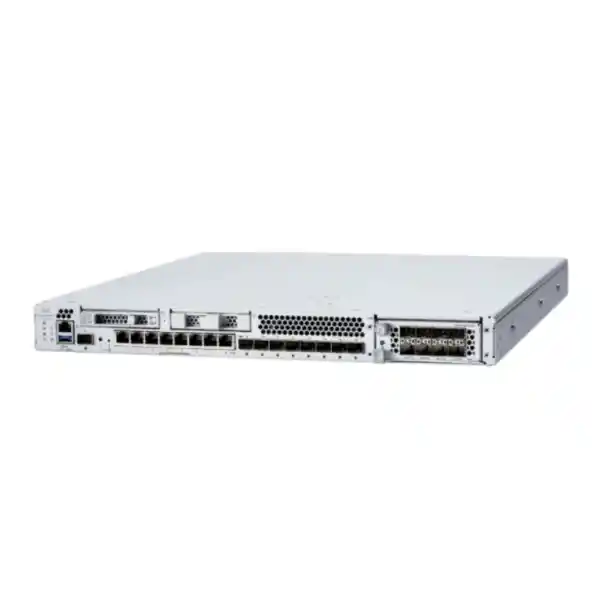
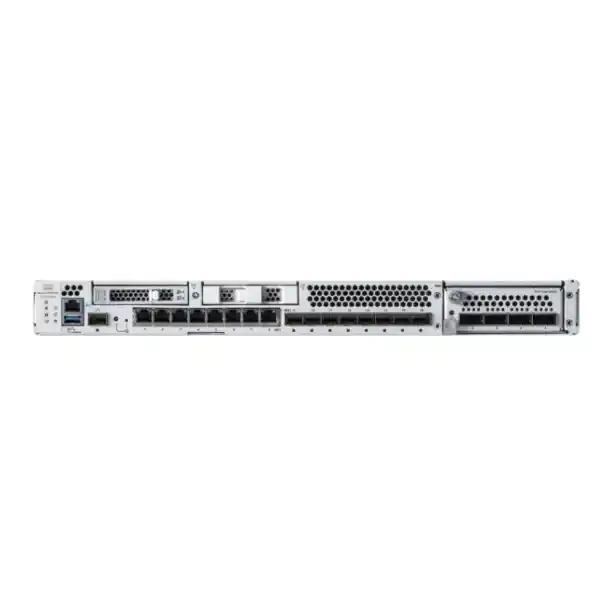
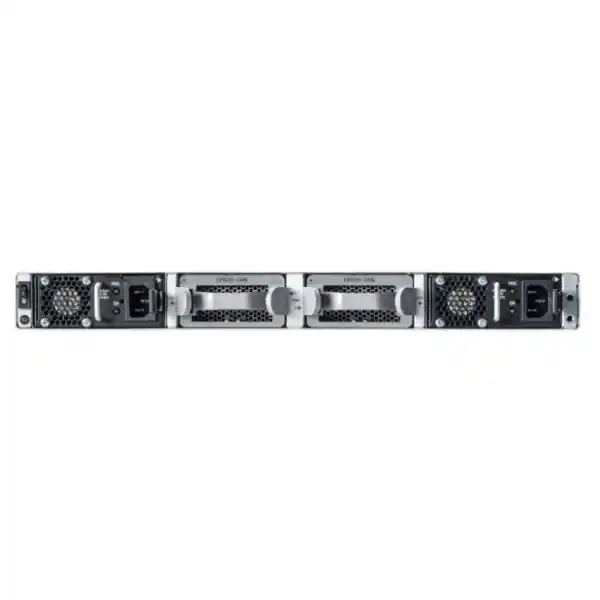
Cisco Secure Firewall 3140 in Dubai
A high-capacity 1RU Cisco firewall for large enterprises that need strong threat inspection, high session scale, flexible 25G/40G/100G connectivity options, resilient edge design and a clear path to centralized security management.
Direct answer: what the Cisco Secure Firewall 3140 is and who should consider it
What exactly is it?
The Cisco Secure Firewall 3140 is one of the higher-performance models in the Cisco Secure Firewall 3100 Series. It is a physical 1RU security appliance that can run Cisco Firewall Threat Defense software or Cisco ASA software, depending on the ordered platform variant and intended architecture.
What is it mainly used for?
Typical roles include large-enterprise Internet-edge protection, high-throughput campus perimeter security, data-center segmentation, dedicated intrusion-prevention use cases, site-to-site VPN concentration, remote-access VPN termination and resilient firewall pairs where performance must remain strong with inspection features enabled.
Who should consider it?
Organizations that have multi-gigabit WAN or Internet services, many simultaneous sessions, significant encrypted traffic, demanding VPN requirements, 25G or faster switching links, or a requirement for clustered firewall scaling should shortlist the 3140 rather than sizing from nominal Internet bandwidth alone.
What must be confirmed first?
The most important first step is a realistic traffic and feature profile: peak inspected throughput, packet sizes, TLS decryption expectations, application mix, VPN encryption load, concurrent sessions, connection rate, logging volume, required ports and future growth. These variables determine whether a 3140 is correctly sized.
What can FourTeck determine?
FourTeck can help translate the business requirement into a bill of materials covering the chassis software type, subscriptions, Secure Client needs, network modules, transceivers, rack and power considerations, management method, high availability, migration services and support scope.
Where the Cisco Secure Firewall 3140 fits in the 3100 Series
The Secure Firewall 3100 family spans models intended for growing branches through large-enterprise environments. Within that family, the 3140 sits at the high end beside the 3130 and is designed for organizations that need substantially more inspection capacity and session scale than the 3110 or 3120. Cisco publishes a 45 Gbps Firewall Threat Defense rating for firewall plus application visibility and control plus intrusion prevention on the 3140. That is not simply a raw packet-forwarding figure; it is useful because it reflects a security-services combination closer to a real next-generation firewall deployment. Cisco also publishes up to 10 million concurrent sessions with AVC and up to 300,000 new connections per second with AVC for the 3140 under its stated test conditions.
Those numbers make the 3140 attractive when the perimeter has moved beyond a basic Internet gateway. Large UAE organizations often combine multiple Internet circuits, SD-WAN or MPLS handoffs, cloud connectivity, business-to-business links, remote-access VPN users and east-west data-center traffic on the same security platform. The relevant question is not whether the appliance can pass the line rate of one circuit. The question is whether it can sustain the intended security policy while traffic is mixed, bursty and increasingly encrypted, and while logs and events are exported to the chosen management platform.
The 3140 is also differentiated by interface flexibility. Its integrated data-plane I/O includes eight 10/100/1000BASE-T RJ-45 Ethernet interfaces and eight 1/10/25G SFP-family Ethernet interfaces. A network module can add another group of interfaces. Cisco currently lists 3100 Series modules including eight-port 1/10G, eight-port 1/10/25G, four-port 40G and two-port 100G options. That makes the 3140 suitable for designs where the firewall must connect directly to high-speed distribution, core or data-center switching rather than relying on 1G copper handoffs.
The model should nevertheless be selected from a design, not from a desire to buy the largest device in a family. If peak inspected traffic is well below the 3140 range and the expected session count is moderate, a 3130, 3120 or other Cisco platform may be more economical. Conversely, if the organization expects sustained throughput beyond the tested envelope, unusually high TLS decryption demand, extensive multi-instance segmentation, or aggressive growth, it can be prudent to compare larger Cisco Secure Firewall platforms or a clustered design before the bill of materials is fixed.
Key Cisco Secure Firewall 3140 specifications
| Specification | Cisco Secure Firewall 3140 | Buyer relevance |
|---|---|---|
| FTD FW + AVC throughput | 45 Gbps | Useful for sizing inspected traffic when AVC is part of policy. |
| FTD FW + AVC + IPS throughput | 45 Gbps | Indicates Cisco’s tested next-generation firewall performance with IPS in the stated profile. |
| FTD concurrent sessions with AVC | 10 million | Important for large user populations, data-center flows, NAT-heavy environments and busy Internet edges. |
| FTD new connections per second with AVC | 300,000 | Relevant where applications create many short-lived sessions or during connection bursts. |
| FTD TLS throughput | 11.5 Gbps under Cisco’s stated test profile | A reminder that decryption can be a separate sizing constraint from firewall throughput. |
| NGIPS throughput | 45 Gbps | Supports designs where intrusion prevention is a primary control objective. |
| IPsec VPN throughput, FTD | 22.4 Gbps in Cisco’s standard fastpath figure; higher projected figure is published with VPN offload in the stated software context | Check the intended software release, encryption profile and topology rather than quoting one number in isolation. |
| Maximum remote-access VPN sessions | 20,000 | Useful for large remote-work deployments; Secure Client licensing and authentication design remain separate decisions. |
| Integrated data interfaces | 8 x 1G RJ-45 plus 8 x 1/10/25G SFP-family | Allows mixed copper access and high-speed optical or DAC connections. |
| Maximum Ethernet interfaces | Up to 24 with network module | The chosen module determines high-speed port density and connector type. |
| Management interface | 1 x 1/10G SFP | Plan management-network optics and connectivity separately from data links. |
| Storage | 1 x 900 GB, one spare slot | Operational logging and platform functions still require a broader retention architecture where long-term records are required. |
| Form factor | 1RU; 1.75 x 17 x 20 in. (4.4 x 43.3 x 50.8 cm) | Verify rack depth, cable bend radius and airflow before installation. |
| Power | Dual 400W AC on 3140; 1+1 redundancy with dual supplies | A resilient pair should normally use independent PDUs or protected circuits where facility design permits. |
Performance figures are Cisco published values under defined test conditions. Real throughput changes with packet size, enabled services, traffic mix, encryption, software release, policy complexity and platform utilization. Production sizing should include margin rather than treating a laboratory maximum as a guaranteed sustained workload.
Performance sizing: why 45 Gbps does not mean every deployment should be designed for 45 Gbps
Cisco’s 45 Gbps figure for Firewall Threat Defense with firewall, application visibility and IPS makes the 3140 a powerful mid-range enterprise appliance, but the published headline is the beginning of a sizing discussion rather than the end of one. A production firewall processes a mixture of packet sizes and protocols. It may perform network address translation, access control, intrusion inspection, file policy, URL filtering, malware analysis, VPN encryption, TLS decryption, user identity correlation, dynamic routing and logging at the same time. Each environment creates a different resource profile.
Packet size matters because a given bandwidth can represent dramatically different packet rates. A 10 Gbps stream of large packets places a different processing burden on a firewall than 10 Gbps composed of smaller packets and rapidly changing connections. Connection rate matters when applications open and close many sessions quickly, such as busy web farms, API gateways, container platforms, DNS-heavy networks, transaction systems and high-volume client browsing. The 3140’s published new-connection capability provides useful headroom, but the architecture should still be tested against the organization’s actual application behaviour.
Encrypted traffic is another distinct sizing dimension. TLS decryption requires the firewall to terminate or intercept encrypted sessions, inspect the clear-text content according to policy and then re-encrypt traffic. Cisco publishes a separate TLS performance figure for the 3140 because decryption is computationally different from basic stateful forwarding. If a security policy expects broad inbound or outbound TLS decryption, a buyer should estimate what percentage of peak traffic will actually be decrypted and which applications will be exempt because of privacy, certificate pinning, technical incompatibility or organizational policy. A platform that appears oversized for raw Internet bandwidth can be correctly sized once decryption and growth are considered.
Traffic direction also matters. A firewall at the enterprise Internet edge may see North-South traffic, but a data-center deployment can also carry high-volume East-West flows between application tiers. Some organizations route backup, replication, software distribution or storage-related traffic through security zones. These flows can create large peaks that do not appear in ISP bandwidth reports. The sizing exercise should therefore include switch-interface counters, flow analytics and traffic trends, not just the contracted speed of the WAN circuit.
High availability introduces another planning decision. An active/standby pair should normally be sized so one appliance can carry the intended production load during failover, including reasonable growth. If the design only works when two devices are sharing load under normal conditions, maintenance or failure may create an unacceptable performance drop. Active/active and clustering can be valid for appropriate designs, but they add architectural complexity and should be selected because they solve a specific scale or segmentation requirement, not because they make a spreadsheet number look larger.
For a Dubai quotation, useful sizing inputs include current peak and 95th-percentile Internet traffic, expected annual growth, number of users and servers, concurrent connection count if available, new-connection rate if available, percentage of encrypted traffic to decrypt, site-to-site VPN bandwidth, remote-access VPN concurrency, expected IPS and malware features, internal segmentation throughput, logging destinations and whether the organization wants a three-to-five-year performance horizon. With those inputs, the 3140 can be judged against both smaller and larger alternatives with a defensible capacity margin.
Interface architecture and network-module choices
The Secure Firewall 3140 provides eight integrated 10/100/1000BASE-T RJ-45 interfaces and eight integrated 1/10/25G SFP-family interfaces. Cisco lists up to 24 Ethernet ports when an appropriate network module is installed. This combination is useful because many enterprise racks still contain a mixture of 1G copper handoffs, 10G server or distribution links and newer 25G or faster core connections.
8-port 1/10G module
A practical fit when the design needs additional SFP/SFP+ density for 1G or 10G handoffs. It can simplify migrations from older 10G perimeter designs without forcing a change to higher-speed switching on day one.
8-port 1/10/25G module
Suitable where multiple 25G uplinks or segmented high-speed zones are planned. It also gives a smoother path when switching infrastructure is moving from 10G to 25G.
4-port 40G module
Useful for environments with existing 40G core or data-center switching. The decision should include transceiver type, fibre plant, breakout expectations and switch compatibility.
2-port 100G module
Relevant when the firewall must attach to 100G-capable infrastructure. A 100G physical link does not mean the appliance inspects 100 Gbps of every traffic mix; interface speed and security-processing capacity are separate design concepts.
Optics and cabling should be treated as part of the firewall design rather than an afterthought. Cisco documents supported transceivers for the 3140 fixed ports, including 1G, 10G and 25G options. The correct optic depends on link speed, wavelength, fibre type, distance, connector, switch-side compatibility and software support. Direct-attach copper and active optical cable options may also be appropriate for short rack-to-rack or same-row links. A quotation should identify each physical path so the correct transceiver or cable can be specified on both ends.
The dedicated management interface is also SFP-based at 1/10G. That detail can be missed when a buyer assumes management will be an ordinary RJ-45 copper port. If the operations network is copper-only, the management design and compatible interface option need to be checked in advance. Likewise, the RJ-45 console and USB port serve operational purposes but do not replace a planned out-of-band management path.
When migrating from another firewall, interface mapping should be documented before cutover. List every physical port, port-channel, VLAN trunk, routed subinterface, high-availability link, management connection, DMZ, transit network and cross-connect. That exercise often reveals whether the integrated 16 data ports are sufficient or whether the deployment genuinely requires a network module.
Firewall Threat Defense capabilities: what the hardware can support and what licensing controls
A Cisco Secure Firewall 3140 ordered with Firewall Threat Defense is not just a packet-filtering appliance. The platform can provide stateful firewalling, routing, network address translation, application-aware access control, intrusion prevention, file controls, malware-related security functions, URL filtering, security intelligence and VPN services. The exact functions available to the organization depend on the software release, management architecture, entitlement set and policy configuration.
Cisco currently describes Essentials as the required base entitlement for Secure Firewall 3100 Threat Defense. Essentials supports foundational networking and security functions such as switching and routing, NAT, high availability, clustering, user and application control, and selected database updates. Intrusion-prevention capability is controlled separately. An IPS entitlement enables intrusion detection and prevention functions and associated file-control and security-intelligence capabilities. Malware Defense and URL Filtering are separate subscription-driven features, and Cisco Secure Client licensing is relevant where remote-access or endpoint capabilities are required.
For procurement, this means the phrase “Cisco Secure Firewall 3140” is not enough to produce an accurate commercial comparison. Two quotes can contain the same chassis but represent very different security outcomes if one includes the appropriate IPS, malware and URL entitlements and the other contains only base functionality. Subscription term also affects the commercial picture. Cisco currently lists one-year, three-year and five-year term options for the combined IPS, Malware Defense and URL subscription family associated with the FPR3140 Threat Defense platform.
The policy should determine the subscription rather than the other way around. If the organization wants the firewall to detect and block network exploits, intrusion prevention must be part of the requirement. If file and malware analysis are important, the relevant malware functions and prerequisites should be included. If acceptable-use policy or web-category controls are needed, URL Filtering should be specified. If the firewall is mainly providing segmentation or routing between trusted zones with limited advanced inspection, a different entitlement mix may be appropriate.
Licensing also affects operations over the lifecycle. The buyer should identify the Smart Account that will own the entitlements, decide who is responsible for license registration, confirm renewal ownership, document subscription expiry dates and understand the business impact of letting a required subscription lapse. Large enterprises frequently encounter avoidable delays because hardware arrives before the correct Smart Account, virtual account or responsible administrator has been identified.
For quotations in Dubai, it is useful to separate the bill of materials into chassis, power and rack items, network module, optics or cables, security subscriptions, management components where required, Secure Client licensing, support contracts and professional services. This makes it easier to compare like-for-like offers and prevents a lower hardware price from hiding an incomplete security or support scope.
FTD or ASA: confirm the software personality before ordering
The Secure Firewall 3140 platform can be ordered for Firewall Threat Defense or ASA use. Cisco currently lists FPR3140-NGFW-K9 for the 3140 appliance with Threat Defense software and FPR3140-ASA-K9 for the ASA appliance. These are not merely two names for the same purchasing decision. They support different operational models, security-feature expectations, licensing approaches and migration paths.
Firewall Threat Defense is generally the path for organizations that want Cisco’s integrated next-generation firewall capabilities, intrusion prevention, modern application-aware policy, malware-related functions, URL controls and centralized Secure Firewall management workflows. ASA remains relevant in environments that have established ASA configuration models, security contexts, specific VPN requirements, or operational practices that have not yet moved to Threat Defense. Cisco publishes separate performance tables for FTD and ASA because the software and test profiles differ.
A migration from an older ASA should not automatically lead to an ASA-configured 3140. It may be the correct choice, but it should be intentional. The project team should assess whether the target architecture is retaining ASA syntax and behavior or moving to Firewall Threat Defense policy and management. Configuration conversion can require redesign of NAT, access rules, object structures, VPN settings, routing, logging and operational workflows. Some features map directly; others need testing or a different implementation approach.
The software choice also affects how the firewall is managed. FTD can be managed through Cisco’s supported management-center options or, in appropriate deployments, a local device-management approach. ASA has its own management tooling and operational model. A buyer planning a high-availability pair, multi-device policy, centralized event analysis or broader Cisco security integration should decide the management architecture before the hardware is commissioned, because it influences licensing, IP addressing, firewall onboarding and the cutover sequence.
High availability, clustering and multi-instance design
Resilience is one of the main reasons organizations deploy an enterprise firewall pair rather than a single appliance. Cisco documents active/standby and active/active high-availability capabilities for the 3100 family, and the 3140 also supports clustering of up to eight chassis in supported designs. These are different technologies that solve different problems. High availability is usually chosen to maintain service through an appliance failure or maintenance event. Clustering is used when a design needs scale beyond one chassis or requires a specific multi-chassis architecture.
A high-availability project should verify more than the quantity of firewalls. The two devices need matching model and compatible software. Interface assignments and network connectivity must be symmetrical. Switch-side port channels, VLANs, routing adjacencies and failover behavior need to be designed so that traffic converges predictably. Power should ideally be diversified between separate PDUs or protected feeds where the facility supports it. Management and monitoring systems should understand which device is active and whether configuration synchronization is healthy.
Capacity planning for a pair should consider the failover state. If the production traffic load is already close to the safe operating margin of a single 3140, an active/standby pair does not solve the sizing problem because one device may need to process the full load after failover. A good design leaves enough headroom for peak traffic, inspection features, software overhead and foreseeable growth while one unit carries the critical workload.
The 3140 also supports multi-instance capabilities in supported FTD designs, allowing resources to be divided into multiple logical firewall instances. Cisco’s current documentation lists up to 10 container instances and 62 available resource units for the Secure Firewall 3140. Multi-instance can be useful for service-provider, multi-tenant or strongly segmented enterprise environments where teams or security domains require operational separation. It is not automatically necessary for every enterprise deployment. Resource allocation, interface ownership, management, high availability and change-control procedures become more complex when multiple instances share one chassis.
For buyers considering clustering or multi-instance mode, the design workshop should happen before the purchase order. The required number of physical interfaces, network modules, management licenses, resource allocations and switch-side architecture can change materially once the logical topology is drawn. Buying two 3140 appliances first and deciding the architecture later can create avoidable rework.
VPN capacity and secure remote access
The Cisco Secure Firewall 3140 can serve as a substantial VPN platform, but site-to-site encryption and remote-access VPN should be sized separately. Cisco publishes 22.4 Gbps of IPsec VPN throughput for FTD using its stated 1024-byte TCP fastpath test, with a higher projected figure when VPN offload is used in the documented software context. Cisco also documents a maximum of 20,000 concurrent remote-access VPN sessions for the 3140. These values show the platform’s scale, but they do not replace a VPN design.
For site-to-site VPN, the project team should list each tunnel, expected encrypted bandwidth, cryptographic standards, routing model, redundancy requirement, NAT interaction, dynamic-tunnel needs and whether the traffic will also pass through IPS or other inspection functions. A hub firewall serving many branches may see aggregate encryption load far above any single tunnel. Cloud VPNs can add another layer because Azure, AWS or other cloud gateways have their own throughput, tunnel and route limitations.
Remote-access planning starts with concurrency rather than total employee count. A company with 30,000 employees may have only a fraction connected simultaneously, while a call center, emergency-work policy or distributed workforce can push concurrency much higher. Authentication architecture matters too: identity providers, MFA, certificates, RADIUS, SAML or other mechanisms must be compatible with the target software design. Cisco Secure Client entitlement and endpoint deployment should be treated as part of the solution rather than assumed to be included simply because the firewall can terminate sessions.
User experience depends on more than the firewall’s maximum VPN figure. Internet uplink capacity, packet loss, DNS behavior, split-tunnel policy, SaaS routing, endpoint posture functions, authentication latency and geographic path selection all influence performance. If thousands of users connect from outside the UAE, the optimal architecture may involve multiple gateways, regional entry points or cloud-delivered controls instead of concentrating every session on one physical location.
During migration, existing VPN profiles should be inventoried carefully. Site-to-site pre-shared keys or certificates, crypto domains, dynamic routing, remote-access profiles, group policies, address pools, DNS servers, split routes and MFA dependencies all need validation. A successful cutover preserves the business function, not just the tunnel status light.
Management, visibility and operational workflow
A high-performance firewall is only useful if the security team can operate it consistently. For Firewall Threat Defense deployments, management architecture should address policy configuration, software upgrades, event monitoring, threat analysis, backup, role-based access, change control and integration with the organization’s wider security operations. Cisco supports on-premises Firewall Management Center and cloud-delivered management options for supported versions and devices. Local management can be appropriate for some smaller or isolated use cases, but a 3140 is frequently deployed in an environment where centralized workflows provide more operational value.
The management decision should consider the number of firewalls, geographic distribution, compliance requirements, Internet reachability, data residency expectations, administrator roles and existing Cisco investments. An on-premises management center gives the organization direct control of the management platform and its infrastructure. A cloud-delivered approach can reduce some platform-maintenance tasks and align with organizations already using Cisco’s cloud security control plane. Neither choice should be made only on interface preference; it should fit the operational and governance model.
Logging volume deserves explicit design. Firewalls can generate connection events, intrusion events, file events, malware events, VPN logs, system messages and audit records. Retention requirements vary by business and regulatory context. The 3140’s local storage should not be mistaken for a complete enterprise log-retention strategy. Security teams commonly forward or centralize events for longer retention, correlation and investigation. The chosen management and SIEM architecture must be sized for event rate and storage, especially if logging is enabled broadly.
Operational roles also matter. Large enterprises may separate network, security, SOC and compliance teams. The access model should determine who can change policy, who can manage objects, who can acknowledge events, who can perform upgrades and who can review audit logs. A clear role model reduces the risk that the firewall becomes a shared administrative bottleneck or that emergency changes bypass governance.
Before go-live, define the routine operating tasks: software lifecycle, signature and database updates, configuration backup, certificate renewal, license renewal, health monitoring, failover testing, capacity review and incident-response procedures. These tasks are part of the effective security control. A technically powerful appliance that is not maintained becomes less valuable over time.
Deployment and migration journey
Discover the current environment
Collect topology diagrams, firewall rules, NAT, VPNs, routing, VLANs, interface utilization, peak traffic, existing licenses, authentication systems, logging destinations and known application dependencies. The objective is to understand what the existing firewall actually does, including undocumented exceptions.
Choose software and management
Decide whether the 3140 will run FTD or ASA, identify the supported target release and choose the management architecture. This decision affects conversion effort, feature availability, licensing, administrator training and the cutover plan.
Validate sizing and interfaces
Match inspection requirements to the 3140’s performance envelope, then map every physical and logical connection. Choose the correct network module, transceivers, cabling, management link and HA connectivity.
Build and stage
Install the hardware, confirm power and cooling, load the approved software, register licensing, apply the base configuration, build policy objects, configure routing and VPN, and establish management and logging before the production cutover.
Test business flows
Test representative applications, inbound publishing, outbound access, DNS, identity, VPN, partner links, voice and video, cloud services and monitoring. Policy validation should include both allowed and intentionally blocked traffic.
Cut over with rollback control
Schedule the change, back up configurations, define rollback triggers, coordinate ISPs and switch teams, migrate traffic in a controlled order, validate security events and performance, then monitor closely after the change window.
For an existing ASA or third-party firewall, rule migration is rarely a pure one-to-one conversion. Legacy rule bases often contain duplicates, unused objects, obsolete NAT statements and temporary exceptions that became permanent. A migration is a good opportunity to rationalize policy, but cleanup should be controlled. Removing a rule because it appears unused can still break a monthly process, disaster-recovery workflow or rarely used partner connection. When evidence is incomplete, migrate conservatively and schedule policy optimization after production stability is proven.
Use cases where the 3140 can be a strong fit
Large enterprise Internet edge
Organizations with multiple high-speed Internet circuits can use the 3140 as an inspection point for outbound browsing, inbound services, SaaS access and business-to-business connectivity. The design should account for encrypted traffic, connection bursts and HA failover capacity.
Data-center segmentation
The 25G-capable fixed interfaces and high-speed network-module choices make the platform relevant where application tiers or security zones need multi-gigabit inspection. East-West throughput and application dependency mapping become critical sizing inputs.
Remote-access VPN concentration
The documented 20,000-session maximum gives the 3140 a strong ceiling for large remote-work populations. Actual design still depends on concurrent users, authentication, Internet capacity, Secure Client entitlement and per-user traffic.
VPN hub for many sites
A headquarters or regional data center terminating many encrypted branch links can benefit from the 3140’s VPN performance and session scale. Route design, tunnel count, aggregate encryption throughput and resiliency must be assessed together.
Multi-instance security domains
Where an enterprise needs logical separation between business units, environments or customers, supported multi-instance capabilities can provide stronger operational boundaries than a single shared policy. Resource allocation and interface planning must be explicit.
When the Cisco Secure Firewall 3140 may be more than you need
The 3140 is a high-capacity appliance, and that can create the impression that it is automatically the safest purchase. Oversizing can be reasonable when growth is certain, but it can also increase hardware, subscription and support costs without creating practical value. A branch or mid-size enterprise with a few gigabits of inspected traffic, modest VPN requirements and limited session scale may be better served by a smaller model once an adequate growth margin is included.
The 3130 is the nearest 3100-series comparison for many buyers. Cisco publishes 38 Gbps of FTD FW + AVC + IPS throughput for the 3130 versus 45 Gbps for the 3140. The 3130 supports up to 6 million concurrent sessions with AVC, while the 3140 is rated at 10 million. Both provide the higher-speed 1/10/25G fixed interfaces associated with the upper 3100 models and support the same broad network-module families. If a design fits comfortably within the 3130 envelope, the extra 3140 capacity should be justified by session scale, VPN needs, growth or risk tolerance.
The comparison should also look upward. If the requirement approaches the 3140’s tested limits after enabling the planned services, if broad TLS decryption is mandatory, if the data center has sustained very-high-speed East-West traffic, or if the organization expects major growth over the support life, a larger Cisco Secure Firewall platform can provide more headroom. In that situation, selecting the 3140 because it is the largest 3100 model may be less prudent than comparing the next platform family.
The right model is therefore the one that meets the required security functions and traffic profile with operational margin at an acceptable lifecycle cost. Procurement teams should ask for the sizing assumptions behind a recommendation. A quote that states only “45 Gbps firewall” without listing feature load, VPN, TLS, traffic mix and growth assumptions is incomplete.
Rack, power, cooling and physical installation
The Secure Firewall 3140 is a 1RU appliance measuring approximately 1.75 x 17 x 20 inches, or 4.4 x 43.3 x 50.8 cm. Cisco’s published weight for the 3130/3140 configuration in the data sheet is about 25 lb or 11.4 kg with two power supplies, a network module, fan modules and SSD. These figures are modest for an enterprise rack, but physical planning still matters because security appliances are often installed in crowded network cabinets with dense fibre and copper patching.
Cisco includes 4-post EIA-310-D rack rails and lists fixed brackets as an option for 2-post mounting. The selected cabinet should have adequate depth and front/rear clearance for rail operation, power cables, fibre bend radius and airflow. Dense high-speed optics can create cable-management challenges, particularly when the appliance sits between core switches and ISP cross-connects. Labelling every interface and cable at installation reduces troubleshooting time during failover or later maintenance.
The 3140 uses dual 400W AC power supplies in the standard published hardware configuration, with supported DC options also documented. Cisco states 1+1 redundancy with dual supplies. In a resilient facility, each power supply should normally connect to a separate protected feed or PDU when available. Plugging both supplies into the same PDU preserves PSU redundancy but not power-path redundancy.
Cisco publishes an operating temperature range of 0 to 40°C for the 3140 and operating humidity of 10 to 85 percent non-condensing in the data sheet. UAE data rooms should be properly conditioned and monitored; these limits are not a substitute for disciplined environmental control. Hot spots, blocked airflow, overloaded rack PDUs or poorly maintained cooling can reduce reliability even when the room’s average temperature appears acceptable.
Before commissioning, verify rack position, rail compatibility, power feeds, PDU socket type, cable lengths, optic types, management-network reachability and console access. These are small details compared with firewall policy, but they are common causes of installation delays when the appliance arrives before the rack plan is complete.
Security policy design: converting capabilities into usable control
Buying an appliance with advanced features does not automatically improve security. The value comes from a policy that is understandable, maintainable and aligned with application requirements. A 3140 deployment should start with security zones and traffic flows. Internet, user LAN, server networks, management, DMZs, partner networks, cloud connections and critical systems should be separated according to risk and business need rather than accumulated into one large trusted zone.
Application-aware access rules can improve visibility and reduce dependence on port numbers alone, but they should be introduced carefully. Some applications change behavior after initial connection, use encrypted traffic or depend on supporting services. Rule order, identity mapping and exception handling affect outcomes. Logging should be set at a level that supports investigation without generating unnecessary event volume from every low-value flow.
Intrusion prevention should be tuned to the assets and exposure. A default policy can provide immediate protection, but the best long-term result comes from understanding what services are actually exposed and which signatures create meaningful risk. Security teams should establish a workflow for reviewing high-priority intrusion events, false positives and policy changes. Simply enabling every possible rule can produce noise and operational resistance.
TLS decryption needs explicit governance. Organizations should define which traffic can be decrypted, which destinations or application categories are excluded, how certificates are distributed, how privacy requirements are handled and how applications that break under interception are managed. The technical decision interacts with legal, HR and compliance policies, so it should be documented rather than left to an administrator during implementation.
NAT and published services deserve particular attention during migration. Internet-facing applications often depend on static translations, load balancers, public DNS, certificates and upstream access-control lists. A change in translation behavior can affect inbound reachability even when the firewall rule is correct. For high-value services, test from an external network and validate application logs rather than relying only on a ping or port check.
The resulting configuration should be readable enough that a new administrator can understand why each major rule exists. Use clear object naming, comments where supported, change references and regular policy review. Strong hardware capacity gives the organization room to enforce policy; governance makes that capacity defensible.
UAE procurement and deployment considerations
For a Dubai or UAE deployment, the quotation should clearly identify the exact Cisco part number and software personality. FPR3140-NGFW-K9 is the current Cisco ordering identifier for a Secure Firewall 3140 appliance with Threat Defense software, while FPR3140-ASA-K9 is the ASA variant. Where the proposal includes a network module, transceivers, subscriptions, Secure Client, management components or support, each should appear as a separate line item or clearly described bundle so the buyer can audit what is included.
Availability and lead time can change, particularly for specific network modules or optics. A buyer should therefore distinguish between “platform available” and “complete configuration available.” Receiving the chassis without the required 25G optics or network module does not produce an installable solution. The same is true for licenses: hardware delivery should be coordinated with Smart Account readiness and subscription activation.
Warranty and support level also matter. Enterprise firewalls typically protect revenue-producing and business-critical systems. The support contract should match the organization’s recovery objectives, spare strategy and access to internal technical staff. Some businesses can tolerate next-business-day hardware replacement because they run a properly tested HA pair. Others require more aggressive support because a failure would create a critical service impact. The contract should be selected from business continuity requirements rather than added automatically at the lowest tier.
Professional services can include architecture validation, staging, migration, rack installation, configuration, HA testing, VPN migration, policy optimization, logging integration, documentation and post-cutover support. These services should have defined scope. A fixed-price migration is only meaningful when the number of rules, VPNs, interfaces, sites, applications and change windows are understood. For complex legacy environments, a discovery phase can reduce change risk before implementation pricing is finalized.
Organizations evaluating local sourcing can use Firewall Dubai by FourTeck for firewall-focused consultation and FourTeck UAE for broader UAE technology requirements. Where the firewall project also includes switching, servers, backup, identity or infrastructure support, FourTeck IT Services UAE can be considered for related implementation scope. International organizations coordinating standards across regions can also reference FourTeck for wider coverage.
The commercial objective should be a complete, deployable configuration with clear ownership. The chassis, subscriptions, interfaces, optics, support and implementation plan should all align with the same design assumptions. That is more valuable than comparing firewall hardware prices in isolation.
Compatibility checklist before placing an order
Switch interfaces
Confirm line speed, transceiver, fibre type, connector, LACP or port-channel design, VLAN trunking and switch-side support. A 25G port still needs a compatible optic or DAC on both ends.
Routing
Document static routes and dynamic routing protocols, route redistribution, ECMP expectations and upstream/downstream failover behavior. Routing convergence should be tested during HA events.
Identity and authentication
Check directory services, RADIUS, SAML, MFA, certificates and identity integrations required by remote access or user-aware policy.
Management platform
Verify the selected management method supports the planned software release and feature set. Include IP addressing, DNS, NTP, reachability and administrator access.
Logging and SIEM
Estimate event volume and confirm transport, collector capacity, retention and parsing. High event rates can expose weaknesses in the monitoring platform rather than the firewall.
Applications
Identify systems sensitive to NAT, asymmetric routing, TLS interception, MTU, session timeout or source-IP changes. Test business applications, not just network reachability.
Lifecycle, software and field-notice discipline
Enterprise firewalls are long-lived infrastructure, but their security value depends on software maintenance. Cisco releases new Firewall Threat Defense, ASA and management-center software over time, and supported combinations matter. An upgrade plan should verify target-version compatibility, required intermediate upgrades, management-center support, FXOS requirements where applicable, configuration changes and known caveats before a production maintenance window.
Field notices and security advisories should be part of routine operations. Cisco currently lists 3100-series notices covering software conditions and certificate-related management risks, among other items. The existence of a notice does not mean every 3140 is affected; administrators need to compare the notice’s affected software or configuration conditions with their environment and follow Cisco’s recommended remediation where applicable.
Certificate lifecycle deserves special attention because security appliances rely on certificates for management, VPN, TLS decryption, device identity and integrations. Expired or untrusted certificates can cause outages that appear to be firewall failures even though packet processing is healthy. Maintain an inventory of certificates, issuing authorities, expiration dates and renewal owners.
Upgrade testing should include HA behavior, routing, VPN, identity, application inspection and logging. A lab or staged appliance is ideal, but where that is not available the organization should at least review release notes, back up configurations, verify rollback options and schedule an appropriate change window. Major upgrades should not be treated as routine patching when the firewall is an Internet gateway for critical services.
Lifecycle planning also includes subscription renewals, support-contract dates, spare strategy and capacity review. A 3140 that was comfortably sized at purchase may become constrained after additional Internet circuits, cloud migrations, acquisitions or broader TLS decryption. Reviewing utilization trends annually provides time to plan an upgrade or clustering strategy before performance becomes an incident.
Buyer questions and practical answers
Is 45 Gbps the guaranteed real-world throughput?
No. It is Cisco’s published FTD performance under defined test conditions. Real throughput changes with traffic mix, packet sizes, enabled security services, TLS decryption, VPN, policy complexity and software release. Size with operational margin.
Does the 3140 include IPS, malware and URL filtering automatically?
The base Essentials entitlement provides foundational capabilities, but IPS, Malware Defense and URL Filtering are subscription-controlled. The quotation should state the term and exact entitlement mix.
Can it run ASA instead of FTD?
Yes. Cisco offers separate 3140 ordering variants for Threat Defense and ASA. The choice affects management, licensing and migration strategy, so it should be made before ordering.
Are 25G ports built in?
Yes. The 3140’s eight integrated SFP-family data interfaces support 1/10/25G. Compatible transceivers or cables still need to be selected for the specific link.
Can the 3140 connect at 100G?
Cisco lists a two-port 100G QSFP28 network module for the 3100 Series. A 100G physical interface does not increase the appliance’s published inspection performance to 100 Gbps; link speed and security throughput are different metrics.
How many remote-access VPN sessions can it support?
Cisco currently documents a maximum of 20,000 concurrent remote-access VPN sessions for the 3140. Actual user experience also depends on Internet bandwidth, authentication, Secure Client licensing and per-user traffic.
Detailed FAQ for Cisco Secure Firewall 3140 buyers in Dubai
What is the main difference between the Cisco Secure Firewall 3130 and 3140?
Both models sit at the upper end of the 3100 family and share similar high-speed interface options, but the 3140 provides more published performance and session scale. Cisco lists 38 Gbps FTD FW + AVC + IPS throughput for the 3130 and 45 Gbps for the 3140. Concurrent sessions with AVC increase from 6 million on the 3130 to 10 million on the 3140, while new connections per second rise from 240,000 to 300,000. The right choice depends on traffic, session profile, VPN, TLS and growth rather than the model number alone.
Should I buy one 3140 or two?
For business-critical perimeter security, two appliances in a supported high-availability design are often preferable because maintenance or a hardware failure does not need to become a complete outage. The answer still depends on business continuity requirements and budget. If a single appliance is acceptable, the organization should have a documented recovery plan. If an HA pair is deployed, each device should be capable of handling the required load during failover.
Do I need a network module?
Not always. The chassis already provides eight 1G RJ-45 data interfaces and eight 1/10/25G SFP-family data interfaces. A network module is required when you need additional port density or specific 40G/100G connectivity beyond the fixed ports. Build an interface map first, including HA, transit, inside, outside, DMZ and any segmented zones, then choose the module.
Are SFPs included with the firewall?
Do not assume so. The required optics or direct-attach cables should be specified as part of the bill of materials based on link speed, distance, fibre type, connector and switch compatibility. Cisco publishes supported transceiver lists for the 3140 fixed ports and network modules. A procurement review should match every optical port to its intended transceiver and peer device.
Can the Cisco 3140 be used only as an IPS?
Cisco states that 3100-series appliances can be deployed in firewall or dedicated IPS modes, and the 3140 has a published 45 Gbps NGIPS throughput figure. Whether a dedicated IPS design is appropriate depends on topology, inspection requirements and management. Many buyers use the same platform as a next-generation firewall rather than dedicating it exclusively to IPS.
What information is needed to quote Cisco Secure Firewall 3140 accurately?
Provide the desired software type, quantity, HA requirement, Internet and internal throughput, percentage of TLS traffic to decrypt, VPN requirements, remote-user concurrency, network-module need, port speeds, optic types, subscription term, management preference, support level and implementation scope. If replacing an existing firewall, include the current model, rule count, VPN count, interfaces and migration window.
Can I reuse existing Cisco optics?
Possibly, but reuse should be validated against Cisco’s supported transceiver list for the exact fixed port or network module and the intended software release. Speed, wavelength and form factor must also match the peer switch. An optic that works in a Cisco switch is not automatically supported in every firewall port.
Does the 3140 support clustering?
Yes. Cisco documents clustering support for up to eight chassis on the 3110, 3120, 3130 and 3140, while the 3105 is excluded. Clustering is an advanced design choice that requires careful attention to topology, software support, switching, load distribution and failure behavior. It should be selected for a defined scale requirement rather than treated as a default HA method.
Is the 3140 suitable for a 25G Internet circuit?
It can physically connect using 25G-capable interfaces and has published FTD inspection performance above 25 Gbps in Cisco’s stated test profile. That does not automatically guarantee every 25G production workload. If the circuit may run near full utilization with broad TLS decryption, heavy IPS, VPN and complex policy, the exact workload should be modeled and headroom confirmed.
Can the 3140 be deployed in a data center for East-West traffic?
Yes, provided the traffic profile fits the performance and interface design. High-speed fixed ports and optional modules make the platform suitable for segmented data-center connectivity. East-West deployments often create higher sustained throughput than Internet-edge deployments, so application traffic, replication flows and service dependencies should be measured before final sizing.
Decision recap: the six points that should drive a 3140 purchase
What FourTeck needs from the buyer for an accurate quotation
Plan the Cisco Secure Firewall 3140 around your real traffic, not a headline number
Share your expected throughput, VPN scale, interface requirements, security subscriptions, HA objective and migration scope. FourTeck can build a Dubai/UAE quotation that identifies the correct 3140 software variant, network module, optics, subscription term, support and implementation services while also checking whether a nearby Cisco model offers a better fit.

Reviews
There are no reviews yet.