
Cisco Secure Firewall 4215 Dubai
A high-end 1RU firewall platform for large enterprise campuses that need strong inspected throughput, high session scale, encrypted-traffic visibility, modular 25/40/100/200/400GbE connectivity choices, substantial VPN capacity, and a clear path to resilient deployment.
Direct answer: what the Cisco Secure Firewall 4215 is and who should consider it
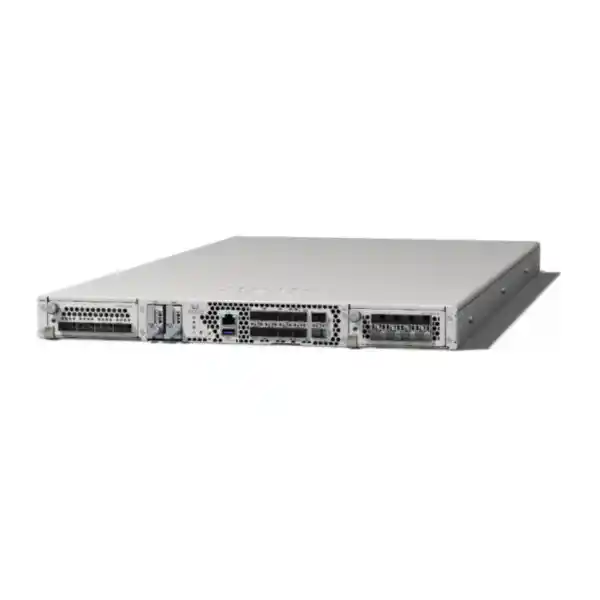
Cisco Secure Firewall 4215, commonly referenced by FPR4215 product identifiers, is the entry model in Cisco’s high-end Secure Firewall 4200 Series. It is a 1RU modular security services platform that can run Cisco Secure Firewall Threat Defense software and, in supported configurations, Cisco Secure ASA software.
Its principal role is protecting large enterprise campus edges, major aggregation points, high-capacity internet connections, east-west or north-south security boundaries, and VPN environments where inspection performance, session scale, modular interfaces, and operational resilience matter together.
Organizations with sustained multi-gigabit traffic, demanding security-service profiles, large numbers of simultaneous connections, substantial site-to-site or remote-access VPN requirements, and a need for 25GbE or higher-speed uplink options should include the 4215 in a structured firewall sizing exercise.
Do not size the appliance from internet bandwidth alone. Confirm the real traffic mix after enabling intrusion prevention, application visibility, TLS inspection, VPN encryption, logging, segmentation, and growth headroom. Cisco explicitly notes that performance varies with activated features, protocols, packet sizes, and software releases.
FourTeck can help translate actual traffic, interface, optics, licensing, management, high-availability, rack, power, migration, and support requirements into an orderable Cisco 4215 configuration for a Dubai or UAE deployment.
Where the 4215 fits in the Secure Firewall 4200 family
The Cisco Secure Firewall 4200 Series is aimed above routine branch or mid-market firewall use. It consists of the 4215, 4225, and 4245, all built around a compact 1RU design with fixed high-speed ports and two network-module bays. The 4215 is the lowest-performance model of the three, but “lowest” in this family still means enterprise-scale capacity. Cisco positions it for large enterprise campuses with room to grow, while the 4225 and 4245 move further toward data-center and service-provider performance envelopes.
That family position is important when preparing a UAE quotation. A buyer should not choose the 4215 only because it is the least expensive 4200 model, and should not jump to a 4245 merely because it has the largest numbers. The correct decision depends on the inspected traffic level, the proportion of encrypted traffic that must be decrypted, session concurrency, new-connection rate, VPN needs, interface architecture, resilience strategy, software image, subscription set, and growth period expected before the next refresh.
For a campus with 10, 20, or even more gigabits of current internet connectivity, the 4215 may provide generous headroom when the security-services profile is understood. In a data center where east-west inspection, high connection churn, or extensive TLS decryption dominates, the 4225 or 4245 may deserve evaluation even when the nominal link speed looks similar. Capacity planning therefore starts with workload behavior, not a single WAN-speed number.
Cisco Secure Firewall 4215 performance profile
| Metric | Cisco 4215 documented value | Buyer meaning |
|---|---|---|
| FW + AVC throughput | 65 Gbps at the cited 1024-byte profile | A better starting point for next-generation policy sizing than raw stateful-firewall throughput alone. |
| FW + AVC + IPS | 65 Gbps | Shows the platform’s inspected performance under Cisco’s stated test profile; production results depend on traffic and policy. |
| Concurrent sessions with AVC | 15 million | Relevant to large campuses, internet edges, shared services, and environments with many long-lived flows. |
| New connections per second with AVC | 350,000 | Connection churn can be the limiting factor for busy applications even when aggregate bandwidth remains moderate. |
| Hardware TLS decryption | 20 Gbps | Critical when a meaningful portion of web or application traffic must be decrypted for inspection. |
| IPsec VPN throughput | 45 Gbps using Cisco’s cited TCP fastpath profile | Useful for high-capacity site-to-site encryption, but tunnel count, algorithms, traffic size, and inspection policy still matter. |
| Maximum VPN peers | 20,000 | A platform ceiling rather than a recommendation; authentication, licenses, operational design, and user profile must be validated. |
| Multi-instance | Up to 10 instances | Allows segmentation into independent logical firewall instances when supported by the selected software and design. |
Performance figures are laboratory reference points, not guaranteed production throughput. Cisco states that results vary with enabled features, traffic protocol mix, packet size, and software release. For procurement, the safe practice is to map actual and forecast workloads to the relevant inspected metric rather than compare only headline firewall throughput.
Hardware architecture and physical platform
1RU chassis
The 4215 occupies one rack unit and is designed for a standard 19-inch four-post rack. Its chassis is deep, at roughly 32 inches, so rack depth, rail clearance, cable bend radius, power-cord routing, and front-to-rear airflow should all be checked before installation. A fully equipped chassis is approximately 43 lb / 19.5 kg.
256 GB system memory
Cisco’s current hardware guide lists 256 GB of system memory for the 4215. Memory is part of the platform design rather than a buyer sizing substitute: session scale, inspection workload, logging architecture, and software behavior still need to be considered as one system.
Redundant power and cooling
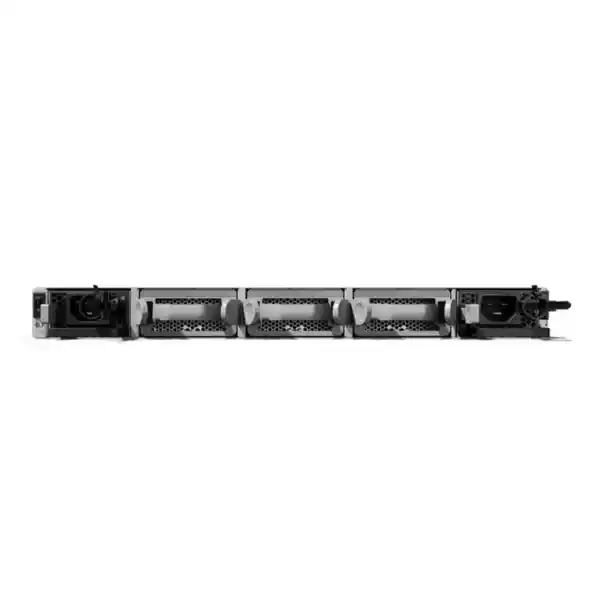
The platform uses dual power supplies in a 1+1 arrangement and three field-replaceable dual-fan modules. The 4215 system input figure in Cisco documentation is 770 W, while installed power-supply module ratings are higher; data-center electrical design should use the correct feed, voltage, redundancy, and worst-case planning values for the ordered configuration.
Two storage devices
Cisco’s 4200 data sheet lists 1.8 TB x 2 storage for the platform. Storage supports appliance operations and local functions, but organizations should still decide where long-term security events, reporting data, and compliance records will be retained, especially when centralized management is used.
Fixed interfaces, management ports, and network-module strategy
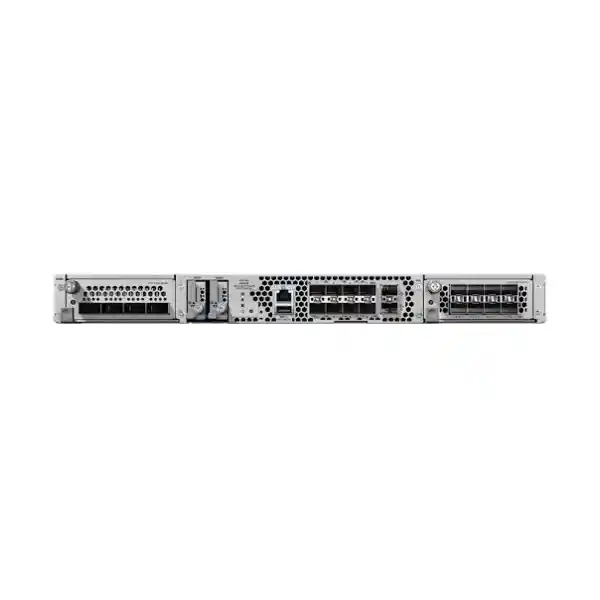
The base 4215 provides eight fixed 1/10/25 Gigabit Ethernet SFP28 network ports. Cisco’s current hardware guide also lists two integrated 1/10/25GbE SFP28 management ports and two hot-swappable network-module slots. This combination makes interface planning unusually important: a buyer may not need a network module at all for a straightforward 10GbE or 25GbE campus-edge design, while a mixed copper/fibre environment or a high-speed data-center boundary can require one or two modules.
| Interface option | Typical planning use | What must be confirmed |
|---|---|---|
| 8 fixed 1/10/25GbE SFP28 ports | Core, distribution, WAN, internet-edge, or server-switch uplinks without consuming module bays. | Optic/DAC support, switch-side speed, fibre type, breakout assumptions, and whether port count remains sufficient after HA and segmentation. |
| 8-port 1GbE copper FTW module | Legacy copper handoffs and hardware bypass/fail-to-wire designs where the specific deployment requires it. | Which ports are intended for fail-to-wire behavior versus ordinary 1Gb copper use, and whether the operational design benefits from bypass. |
| 8-port 1/10GbE SFP+ module | Additional 10GbE density for campus or data-center zones. | Required port count, optics, link aggregation, and future transition to 25GbE. |
| 8-port 1/10/25GbE SFP28 module | Higher-density 25GbE designs and mixed-speed environments. | Transceiver support and whether the opposite switch/router interface supports the same physical layer and speed. |
| 40/100/200GbE module choices | High-capacity aggregation, large data centers, or consolidated security boundaries. | Exact module PID, supported port modes, optics, breakout behavior, peer compatibility, and whether appliance inspection capacity—not port speed—becomes the constraint. |
| 400GbE module choices | Very high-speed physical connectivity where a 400GbE handoff is needed even though inspected traffic may be much lower than line rate. | Use case, optic type, cabling, breakout requirements, software support, and realistic throughput expectations. A 400GbE port does not imply 400Gbps firewall inspection. |
Cisco supports hot-swapping an identical network module, but replacing a module with a different type requires a system reboot so the new hardware is recognized. That operational detail matters for maintenance planning. It is better to choose the correct module set during design than to treat network-module selection as a minor accessory decision after the firewall has entered production.
Security capabilities: from application control to intrusion prevention
When the 4215 runs Cisco Secure Firewall Threat Defense, the value of the platform is not simply packet forwarding. Cisco’s data sheet describes Application Visibility and Control as a standard capability, supporting identification of thousands of applications together with user, web, and geolocation context. OpenAppID support provides a mechanism for custom or community application detectors. The practical buyer value is policy precision: security teams can control traffic based on application and identity context rather than relying only on IP addresses and ports.
Cisco Secure IPS can add intrusion prevention and threat correlation. For a large campus this is particularly relevant at the internet edge, partner boundaries, shared-services zones, and high-value application paths where prevention needs to be enforced without creating an inspection bottleneck. Malware protection, URL filtering, threat intelligence, and related security services depend on the chosen software and subscriptions, so the commercial configuration must match the intended policy. Buying a chassis and assuming every advanced security service is automatically included is a common procurement error.
The 4215 also benefits from Cisco Talos intelligence and the broader Cisco security ecosystem. Open APIs and supported integrations can be useful in environments with SIEM, SOC automation, identity services, endpoint security, or third-party monitoring platforms. These integrations should be planned based on operational objectives rather than enabled indiscriminately. Each added event stream, automation rule, or inspection feature has an operational cost in tuning, storage, change control, and analyst attention.
For buyers comparing firewall platforms, the right question is therefore not “does it have IPS?” Most enterprise firewalls do. More useful questions are: what traffic will be inspected, how policies will be managed, how exceptions are governed, which telemetry must be retained, how quickly signatures and intelligence are updated, who will tune detections, and what happens to throughput when the required inspection stack is enabled.
TLS decryption is often the hidden sizing constraint
The 4215 has a documented hardware TLS decryption figure of 20 Gbps. That number deserves separate attention because modern enterprise traffic is heavily encrypted. A firewall may appear comfortably sized against aggregate WAN bandwidth yet become constrained when a large share of user or application traffic is decrypted, inspected, and re-encrypted. The decryption policy can therefore matter as much as the basic firewall policy.
A useful sizing exercise categorizes traffic rather than treating all encrypted sessions the same. Some flows may be intentionally exempt because of privacy, legal, certificate-pinning, or application-compatibility concerns. Other traffic may require inspection because it is a major malware delivery path or because policy requires visibility. The team should estimate the percentage of traffic eligible for decryption, expected peak throughput, average and burst connection rates, certificate behavior, and future growth.
This is one area where the neighboring 4225 or 4245 may be justified even when 65 Gbps of general inspected throughput appears ample. Cisco documents higher decryption capacity on those models. If a Dubai organization expects a rapid increase in SaaS usage, encrypted web traffic, or high-volume application publishing, the decryption requirement should be modelled explicitly before the 4215 is approved.
VPN capacity and encrypted connectivity planning
Cisco lists 45 Gbps of IPsec VPN throughput for the 4215 under its cited 1024-byte TCP fastpath test profile and a maximum of 20,000 VPN peers. These figures make the platform viable for large site-to-site encryption estates and significant remote-access deployments, but they are not a substitute for solution design. The effective requirement depends on tunnel topology, cryptographic settings, packet size, inspection policy, authentication architecture, address allocation, routing, redundancy, and user behavior.
A hub firewall receiving encrypted traffic from many branches may face very different connection and throughput patterns from a remote-access gateway serving thousands of knowledge workers. A disaster-recovery design may also require the secondary unit or site to carry the full VPN load during a failover. If the 4215 is being purchased primarily as a VPN concentrator, the design should include peak concurrent users, average and maximum bandwidth per user, authentication dependencies, split-tunnel or full-tunnel policy, posture or endpoint requirements where applicable, and operational procedures for certificate renewal.
For site-to-site VPN, include routing convergence and failover behavior in the design. High-capacity encryption is useful only if the upstream and downstream routing, security zones, NAT rules, monitoring, and change process can support it. FourTeck can use this information to determine whether the 4215 is appropriately sized or whether the 4225/4245 should be compared.
Management, logging, and operational ownership
Cisco documents centralized configuration, logging, monitoring, and reporting for Secure Firewall deployments through Firewall Management Center, with cloud management options also available in the Cisco portfolio. The exact management path must be aligned with the selected software release, feature requirements, existing Cisco tooling, change-management process, and organizational preference for on-premises or cloud-based control.
For a single large firewall pair, centralized management may still be valuable because policy governance, event analysis, software updates, certificate workflows, and reporting quickly become operationally significant. For a multi-site organization it becomes more important: consistent object naming, access-control policy, intrusion rules, platform settings, and deployment workflows reduce configuration drift and make change review easier.
Logging design should be decided before production traffic is moved. The team should identify which events require local visibility, which must be forwarded to SIEM or SOC platforms, how long logs must be retained, what volume is expected, and how an incident responder will trace a session across firewall, identity, endpoint, DNS, and application records. Excessive logging can create storage and analyst burden, while insufficient logging can make incident reconstruction impossible.
Operational ownership matters equally. A powerful firewall is not self-maintaining. Define who approves rule changes, who handles signature tuning, who owns VPN certificates, who monitors health and capacity, who performs software upgrades, and who responds to Cisco field notices or security advisories. The procurement decision should include those ongoing responsibilities, not only appliance hardware.
Multi-instance segmentation: when up to 10 logical instances can help
Cisco documents support for up to 10 multi-instances on the 4215 under its Secure Firewall Threat Defense capabilities. Multi-instance architecture can be valuable when separate business units, tenants, security domains, or operational teams require stronger logical separation than a single shared policy provides. It can also help service-provider or shared-infrastructure teams delegate operational responsibility while retaining common physical hardware.
The maximum instance count is not a recommended default. Dividing the appliance creates resource and operational considerations. Each instance needs policies, interfaces, routing, logging, software governance, backup, and troubleshooting procedures. Network modules and physical ports also need to be mapped carefully so the logical design is supported by real connectivity. A multi-instance deployment that looks elegant on a diagram can become difficult to operate if responsibilities or resource boundaries are unclear.
When segmentation is the goal, compare multi-instance design with alternatives such as security zones, virtual routing constructs, separate appliance pairs, or architectural changes elsewhere in the network. The correct choice depends on isolation requirements, change-control boundaries, fault domains, compliance, traffic volume, and the number of teams involved.
High availability and clustering
For Secure Firewall Threat Defense deployments, Cisco documents active/standby high availability and active/active behavior through clustering, with support for clusters of up to 16 chassis in the 4200 family. ASA configurations have their own supported HA behavior. The architecture should be selected around the business continuity objective, not simply because a feature exists.
A common enterprise campus design is a two-appliance active/standby pair. This provides hardware redundancy and a more straightforward operational model than a large cluster. The surrounding network must still be designed for resilient links, dual power feeds, redundant upstream and downstream switches or routers, appropriate routing convergence, and failure-domain separation. Two firewalls connected to a single switch or single power source do not create end-to-end resilience.
Clustering becomes relevant when scaling beyond a single chassis, increasing aggregate capacity, or meeting specific availability requirements. It also increases design complexity. Traffic distribution, state handling, interface architecture, maintenance, software compatibility, and failure scenarios need to be tested carefully. The phrase “up to 16” is a platform capability, not an instruction to deploy 16 devices.
For Dubai data centers and large campuses, an availability workshop should identify the recovery-time objective, acceptable packet loss during failover, maintenance windows, dual-site requirements, dependency on upstream BGP or internal routing, and whether an HA pair at one site is sufficient. Those decisions affect the chassis count, subscription quantities, optics, cabling, rack space, power, and project scope.
Threat Defense or ASA: confirm the intended software image before ordering
The Cisco Secure Firewall 4215 supports Secure Firewall Threat Defense and Cisco Secure ASA software. Cisco lists distinct chassis product identifiers such as FPR4215-NGFW-K9 and FPR4215-ASA-K9, and ordering bundles are built around the intended software and subscription model. This makes software-image choice a purchasing decision, not merely a post-delivery configuration preference.
Threat Defense is the natural choice when the project is centered on next-generation firewall services such as application visibility, intrusion prevention, malware-related controls, URL filtering, modern centralized policy, and the broader Secure Firewall feature set. ASA remains relevant where an organization has a specific ASA operational model, compatibility requirement, migration path, or feature dependency. The two modes have different performance tables, management workflows, license implications, and software-compatibility considerations.
Do not compare the 90 Gbps stateful ASA figure directly with the 65 Gbps FW + AVC or FW + AVC + IPS Threat Defense figure as if they represented the same workload. They describe different test conditions and security functions. A buyer who intends to run Threat Defense should size from Threat Defense metrics. A buyer with an ASA requirement should use the relevant ASA performance and compatibility information.
If the project is a migration from an older ASA or Firepower appliance, record the current software image, feature set, management platform, routing, NAT, VPN, identity integration, and policy structure. This helps determine whether the goal is a like-for-like migration, a security-policy modernization, or an architecture redesign.
Licensing and subscriptions: specify services, term, and management together
Cisco firewall licensing is one of the most important quotation dependencies. Current ordering information for the 4200 family includes term-based subscription choices such as one-, three-, and five-year options, while advanced security capabilities are tied to the relevant license packages. Cisco’s ordering guidance also notes that Threat/IPS licensing is required for certain malware or URL-related license combinations. Exact commercial bundles can change over the product lifecycle, so the final quote should be built from Cisco’s current configurator and entitlement rules rather than an old bill of materials.
Start with policy requirements. If the organization needs intrusion prevention, URL-category enforcement, malware-related protection, or other subscription-enabled services, list those requirements explicitly. If the firewall is used primarily for traditional stateful policy and VPN, the license design may differ. The management architecture also affects the bill of materials: an existing Firewall Management Center environment may be reused if compatible and correctly sized, while a new deployment may require management capacity and associated entitlements.
Term length should be aligned with procurement and lifecycle planning. A longer subscription can simplify renewals and budget predictability, while a shorter term may be appropriate where the broader network strategy is changing. Neither option is universally better. The organization should also define who owns renewal tracking and what operational impact occurs if a subscription or support entitlement expires.
Cisco Smart Licensing and account ownership should be addressed during procurement. The end customer should know which Smart Account or Virtual Account will hold entitlements, who has administrative access, and how the firewall will reach the required licensing services where applicable. For highly restricted networks, licensing connectivity and update workflows may need special design.
A useful quotation request therefore states the desired software image, security services, management method, subscription term, support level, HA quantity, and whether the customer already has relevant Cisco licensing infrastructure. This avoids the common situation where a competitively priced chassis quote is incomplete because essential software or management components were omitted.
A practical sizing method for Cisco Secure Firewall 4215
Firewall sizing should produce a defensible capacity model rather than a guess. Begin with measured peak traffic at the intended security boundary. Use monitoring data from routers, existing firewalls, NetFlow/IPFIX, load balancers, WAN systems, or cloud gateways where possible. Capture normal peaks and exceptional events such as backups, software distribution, month-end processing, disaster-recovery replication, major video meetings, and application releases.
Next, classify the traffic by security treatment. Estimate what proportion requires application visibility, intrusion prevention, TLS decryption, VPN encryption, URL policy, or other advanced inspection. The 4215’s 65 Gbps inspected figures and 20 Gbps TLS decryption figure serve different workload categories. A network carrying 25 Gbps at peak may be easy for the firewall when only part of it is decrypted, or demanding if nearly all traffic is subject to heavyweight encrypted inspection.
Session behavior is equally important. Cisco documents up to 15 million concurrent sessions with AVC and 350,000 new connections per second. Large user populations, web proxies, NAT-heavy environments, API gateways, IoT systems, e-commerce services, and microservice architectures can create high connection rates even when bandwidth is not extreme. Measure existing session counts and connection rates if the current platform exposes them.
Then add resiliency and growth assumptions. An HA secondary must be able to carry the production load after failover. A cluster should be modeled for degraded conditions, not only when every node is healthy. Capacity growth should include expected new sites, cloud adoption, user growth, bandwidth upgrades, application changes, and increasing encryption. A three-year design often needs more headroom than a one-year tactical replacement.
Interface design comes next. Count physical and logical links, required speeds, transceiver types, LAGs, routed links, HA links, management connectivity, bypass requirements, and future ports. A 65 Gbps firewall can still be the wrong appliance if the required copper/fibre mix or port architecture is awkward. Conversely, 100GbE or 400GbE physical ports may be useful for topology without implying that every packet on those links can be fully inspected at line rate.
Finally, examine the software and feature compatibility matrix for the intended release. Cisco continues to update Secure Firewall Threat Defense and ASA support, and not every module, feature, management method, or migration path should be assumed from historical documentation. The production design should be validated against the exact release planned for deployment.
If the resulting model approaches the 4215’s limits in normal operation rather than unusual bursts, compare the 4225 or 4245. Headroom is not wasted capacity when it protects the business from policy growth, encryption growth, failover conditions, and upgrade-related performance changes.
Strong-fit use cases for the 4215
Large enterprise campus edge
The 4215 is explicitly positioned by Cisco for large enterprise campuses. It can combine high inspected throughput, large session scale, VPN capacity, modular links, and HA in one compact appliance family. This is a good fit when a headquarters or campus aggregates many users, internet circuits, SaaS flows, and branch VPNs.
High-capacity internet perimeter
Organizations upgrading from 10GbE toward 25GbE links can benefit from the fixed SFP28 ports and substantial next-generation inspection capacity. The design should still isolate TLS decryption demand and new-connection rate, because these may become the limiting metrics before raw bandwidth.
VPN aggregation
With Cisco-documented 45 Gbps IPsec throughput and up to 20,000 VPN peers, the 4215 can support demanding encrypted connectivity. This is especially relevant for regional hubs connecting branch offices, partner networks, disaster-recovery sites, or large remote-work populations.
Segmented shared infrastructure
Multi-instance support can help separate business units or security domains on shared hardware. It is most useful when organizational boundaries, policy independence, and traffic volumes justify the added operating complexity.
Data-center security boundary
The 4215 can protect selected data-center north-south or east-west boundaries when the workload falls inside its inspected capacity. Buyers should compare the 4225 or 4245 when decryption, session churn, or east-west throughput is expected to grow quickly.
When the Cisco 4215 may not be the right choice
The 4215 is powerful, but there are cases where another model or architecture is more appropriate. If the project is a small branch or modest office edge, the 4215 may be unnecessarily large, costly, power-hungry, and operationally complex. A lower Cisco firewall family could meet the requirement more efficiently.
At the opposite end, if sustained inspected traffic, TLS decryption, session count, connection rate, or VPN load approaches the documented 4215 capacity during normal business operation, the 4225 or 4245 should be evaluated. The same applies where growth, failover, or maintenance scenarios leave too little headroom. It is better to justify a larger platform during design than discover after deployment that a new security feature cannot be enabled without performance risk.
The 4215 can accept very high-speed network modules, including options for 100GbE, 200GbE, and 400GbE physical connectivity, but this should not be confused with equivalent inspected firewall throughput. If the architecture genuinely requires hundreds of gigabits of security processing, a different model, cluster, or distributed security design is likely necessary.
Finally, compatibility can make a technically capable platform unsuitable. Legacy routing behavior, specific VPN dependencies, unsupported transceivers, older management software, bespoke automation, or regulatory requirements may need validation. A successful firewall replacement is as much about compatibility and operations as benchmark performance.
Migration planning from an existing firewall
A Cisco Secure Firewall 4215 migration should begin with discovery. Export or document the existing access rules, objects, NAT, routing, VPN tunnels, certificates, interfaces, VLANs, high-availability settings, identity integrations, intrusion policies, URL policies, syslog destinations, SNMP monitoring, NTP, DNS, authentication servers, and administrative access. The objective is to understand which configuration is still required, which rules are obsolete, and which technical dependencies are hidden in day-to-day operation.
Rule cleanup is often one of the highest-value parts of a migration. Old firewalls may contain duplicate objects, temporary rules that became permanent, disabled policies, shadowed rules, unused VPNs, and broad source/destination definitions. Moving every legacy line unchanged can reproduce years of technical debt on new hardware. Instead, classify rules by owner, business purpose, last use where evidence exists, and future necessity.
Interface migration requires detailed mapping. A new 4215 may use SFP28 fibre or DAC connections where an older firewall used copper, or it may consolidate multiple links through higher-speed uplinks. Confirm switch ports, VLAN trunks, port channels, optics, fibre type, link speed, duplex assumptions, and routing neighbors. For HA deployments, also map failover and state communication paths according to the selected architecture.
VPN migration needs its own workstream. Record peer IP addresses, tunnel selectors, IKE and IPsec parameters, pre-shared keys or certificates, routing dependencies, NAT exemptions, tunnel monitoring, and business owners. For remote access, document authentication, MFA, client versions, posture requirements, address pools, DNS behavior, split-tunnel rules, and user groups. A firewall cutover that succeeds for internet traffic but fails VPN users is still a failed migration.
Testing should be based on business services. Create a validation matrix that covers inbound applications, outbound internet access, DNS, email, SaaS, remote access, site-to-site VPNs, partner links, management tools, monitoring, logging, backups, and critical internal applications. Where possible, test representative traffic before the final cutover and define a rollback path with a clear decision point.
Cisco provides migration tooling for supported scenarios, but automation does not remove the need for engineering review. Converted objects and policies should be checked for semantic differences, unsupported features, overly broad translations, and ordering effects. The most reliable migration combines automation where useful with human validation of the security intent.
Rack, power, airflow, and environmental planning in UAE data rooms
The 4215 is a 1RU platform, but the installation footprint is more than one rack unit. Cisco specifies front-to-rear airflow, so the rack should preserve cold-aisle to hot-aisle orientation and avoid recirculation. The chassis depth is about 32 inches, making cabinet depth and rear clearance important. Rails, patching, fibre management, and power distribution should be checked before the delivery date rather than discovered during installation.
Cisco lists an operating temperature range up to 40°C for standard operation and environmental limits that vary by specific conditions. A properly managed UAE server room or data center should not be designed near the upper limit. Cooling failures, maintenance events, hot spots, dust loading, and high ambient outdoor temperatures can make thermal margin important even when the facility normally operates well below the equipment maximum.
The platform uses redundant power supplies, and resilient installations should connect them to separate protected feeds or PDUs where the site architecture supports it. UPS runtime, generator transition, PDU capacity, connector type, and power-cord specification should be checked against the ordered PSU and local electrical environment. The appliance’s system power figure and the power-supply module’s rated capacity are not the same thing, so electrical planning should use the correct engineering value.
Acoustic output is also notable because this is data-center-class equipment. It is not intended to sit quietly beside staff in an ordinary office. If the proposed location is a small communications room near occupied space, cooling and noise should be evaluated as part of site readiness.
Transceivers, fibre, DACs, and switch compatibility
SFP28, QSFP-family, and other high-speed ports only become useful when the physical layer is engineered correctly. The firewall, optic, cable plant, patch panel, and peer switch or router must support compatible speed, wavelength, fibre type, connector, and distance. An assumption that “25G is 25G” is not enough when one side expects a particular optic or the structured cabling cannot support the intended standard.
For short in-rack connections, supported direct-attach or active optical cables may reduce cost and complexity. For longer runs, the design may require multimode or single-mode transceivers. Breakout from higher-speed ports can offer useful density, but exact breakout modes and software support must be checked for the selected module and release. The bill of materials should list optics and cables explicitly rather than leave them as “customer supplied” unless that is genuinely the plan.
Switch compatibility is also operational. If the 4215 connects to a redundant core pair, define whether links are routed, switched, bundled, or individually addressed. Confirm VLAN tagging, port-channel behavior, MTU, routing protocol, equal-cost paths, and failover. For internet edges, confirm handoff type with the carrier. For partner circuits, confirm demarcation and any media conversion.
These details have a direct commercial impact. A quotation with the right chassis but the wrong network module or missing optics is not deployment-ready. FourTeck can build the interface bill of materials after receiving the link count, speed, media, distance, and peer-device information.
Compatibility, software release, and lifecycle discipline
Cisco continues to update Threat Defense and ASA compatibility information for the Secure Firewall 4200 family. This is good for platform longevity, but it means a static product page cannot replace a release-specific compatibility check. Before implementation, validate the desired software version, management platform, network-module support, transceiver support, VPN client dependencies, high-availability behavior, and any external integrations.
Production software should be chosen by policy, not simply because it is the newest image available. Organizations commonly require a release that meets Cisco support guidance, addresses relevant security advisories, works with the management environment, and has been validated against local operational requirements. Upgrade planning should include backups, configuration compatibility, HA sequencing, maintenance windows, rollback procedures, and post-upgrade verification.
Cisco publishes field notices and security notices for its firewall portfolio. Operational teams should subscribe to relevant notifications and review them as part of lifecycle management. Hardware reliability is only one element of security availability; software defects, certificate changes, third-party service changes, and management dependencies can also create service impact if ignored.
For buyers, this means support entitlement is part of the design. The exact Cisco support service should be chosen based on replacement expectations, access to software, technical assistance requirements, and internal capability. A critical internet edge with strict uptime objectives generally warrants a different support posture from a lab or noncritical environment.
4215 vs 4225 vs 4245: which model deserves the shortlist?
| Model | FW + AVC + IPS | TLS decryption | IPsec VPN | Concurrent sessions with AVC | Best comparison reason |
|---|---|---|---|---|---|
| 4215 | 65 Gbps | 20 Gbps | 45 Gbps | 15 million | Large enterprise campus and substantial edge requirements where 4215 headroom is comfortable. |
| 4225 | 80 Gbps | 30 Gbps | 80 Gbps | 30 million | Worth evaluating when VPN, decryption, session scale, or data-center growth pushes beyond a comfortable 4215 envelope. |
| 4245 | 140 Gbps | 45 Gbps | 140 Gbps | 60 million | For much higher-volume environments, service-provider-style scale, or designs where 4215/4225 would leave insufficient growth margin. |
All three models share the 4200 family’s modular 1RU approach, so the decision is driven primarily by workload rather than rack density. The 4225 offers a particularly large step in VPN and session capacity over the 4215, while the 4245 provides a larger jump in general inspected throughput. A comparison should use the metric most likely to constrain the actual deployment.
Procurement checklist for a complete Cisco 4215 quotation
Implementation journey: from design to production
Collect traffic, session, connection-rate, VPN, decryption, interface, growth, and availability data. The output should be a documented sizing basis that explains why 4215 capacity is appropriate.
Select chassis identity, quantity, network modules, optics, cables, subscriptions, management, support, and any required spare components. Validate current Cisco ordering rules before purchase.
Define addressing, interfaces, routing, VLANs, HA, zones, access policy, NAT, VPN, management, logging, identity, certificates, and integrations. Establish rollback and test criteria before configuration begins.
Install the approved software release, register licensing, apply baseline hardening, build policies, validate HA, test management connectivity, and confirm physical interfaces with the intended switches and optics.
Move services in a controlled window, validate routing and security policy, test business applications and VPNs, monitor errors and performance, and retain a usable rollback path until acceptance criteria are met.
Document the final configuration, license ownership, software version, backups, support details, monitoring, log destinations, admin roles, renewal dates, upgrade process, and escalation procedure.
Dubai and UAE deployment considerations
For UAE organizations, the buying process often spans technical, commercial, logistics, and site-readiness decisions. Local stock status can vary by exact chassis, network module, optic, support level, and subscription term, so “Cisco 4215 availability” should be understood as configuration-specific rather than a promise that every component is immediately stocked. A complete bill of materials makes lead-time discussions far more accurate.
Site planning should identify the delivery location, data-center access rules, rack availability, power feeds, fibre routes, patch-panel requirements, change window, and whether installation must occur after hours. If the project involves migration from an existing firewall, engineer access to both old and new systems may be necessary during the cutover. Remote management access and console procedures should be agreed in advance.
For local firewall guidance and related security services, buyers can review Firewall Dubai by FourTeck. Broader infrastructure and procurement information is available through FourTeck UAE. Organizations planning a wider migration, managed support, or infrastructure project may also use FourTeck IT Services UAE, while international buyers can reference FourTeck global.
The best quotation request includes both the target product and the deployment context. That allows the supplier to identify missing modules, subscriptions, optics, support, or implementation services before the purchase order rather than during installation.
Frequently asked buyer questions about Cisco Secure Firewall 4215
Is the Cisco 4215 a 65 Gbps or 90 Gbps firewall?
Both numbers can appear in Cisco documentation because they describe different software/test profiles. For Threat Defense, Cisco lists 65 Gbps for FW + AVC and 65 Gbps for FW + AVC + IPS using its stated 1024-byte test profile. For ASA, Cisco lists up to 90 Gbps stateful inspection under a different test condition. If you plan to run Threat Defense, size from the Threat Defense metrics rather than the ASA headline figure.
Does the 4215 include 25GbE ports?
Yes. Cisco’s current hardware guide lists eight fixed 1/10/25GbE SFP28 network ports plus two 1/10/25GbE SFP28 management ports. The correct transceivers or cables must still be selected, and the connected switch/router must support the intended speed and physical standard.
Can I add 100GbE or 400GbE interfaces?
The 4200 platform supports network-module options that include high-speed interfaces up to 400GbE. The exact module, port mode, optics, breakout support, and software compatibility must be confirmed. Physical port speed does not increase the appliance’s documented security-inspection throughput, so a 400GbE interface should not be interpreted as 400 Gbps of inspected firewall capacity.
How much TLS decryption can the 4215 handle?
Cisco documents 20 Gbps of hardware TLS decryption for the 4215. Because real results depend on cipher suites, session behavior, software, and policy, this should be treated as a sizing reference. If decryption is a major requirement, quantify the expected decrypted traffic separately from general firewall throughput.
What is the maximum VPN capacity?
Cisco lists up to 45 Gbps IPsec VPN throughput for the 4215 under its cited Threat Defense test profile and up to 20,000 VPN peers. A production design should also account for remote-access licensing, authentication, encryption settings, full- versus split-tunnel behavior, inspection, and failover conditions.
Does the 4215 support high availability?
Yes. Secure Firewall Threat Defense supports active/standby high availability and clustering-based scale/resilience, while Cisco also documents HA capabilities for ASA. The surrounding network, power, routing, and management architecture must be redundant as well; two appliances alone do not remove every single point of failure.
How many firewalls can be clustered?
Cisco states that the Secure Firewall 4200 Series can cluster up to 16 chassis. That is a maximum capability, not a default architecture. Most enterprise buyers should first determine whether a two-unit HA pair meets their resilience and throughput goals before considering a larger cluster.
Can the 4215 run multiple logical firewalls?
Cisco documents up to 10 multi-instances for the 4215 in the relevant Threat Defense capability table. Multi-instance can help separate tenants or security domains, but the resource, interface, management, and operational model should be designed before deciding that logical partitioning is preferable to separate hardware.
Do I need extra network modules?
Not necessarily. The eight fixed SFP28 ports may be sufficient for many campus-edge designs. Network modules are useful when you need more ports, copper 1GbE, fail-to-wire functionality, or higher-speed interfaces. Decide from the physical topology and future expansion plan instead of adding modules automatically.
Are optics included with the firewall?
Optics should be treated as separate bill-of-material items unless the exact bundle explicitly includes them. The required transceiver depends on interface speed, fibre type, distance, peer equipment, and Cisco support. A complete quote should state every optic and cable required for production links.
What subscriptions should I buy?
Choose subscriptions from the security services the organization actually needs—such as intrusion prevention, URL controls, or malware-related protection—and select a term aligned with procurement policy. Exact bundle names and entitlements can change, so the final configuration should be validated in Cisco’s current ordering system rather than copied from an old quotation.
Should I buy the 4225 instead?
Consider the 4225 if the 4215 would operate too close to its normal inspected, decryption, VPN, session, or connection-rate limits, or if growth is substantial. Cisco documents 80 Gbps FW + AVC + IPS, 30 Gbps TLS decryption, 80 Gbps IPsec VPN, and 30 million concurrent sessions for the 4225, giving materially more headroom in several dimensions.
Can the 4215 be used in a data center?
Yes, provided the actual workload fits. The 4215 has modular high-speed connectivity and enterprise-scale inspection. However, Cisco positions the 4225 more directly for data-center use, so high east-west throughput, very high VPN load, heavy TLS decryption, or fast growth may justify comparing the larger model.
What should I provide for an accurate Dubai quote?
Provide quantity, target software image, current and forecast traffic, required security services, session or user scale, VPN use, interface speeds and media, HA requirement, network modules, optics, management method, subscription term, support expectation, installation site, and migration scope. This allows the quote to represent a deployable solution rather than a bare chassis.
Decision recap: the six things that determine whether 4215 is the right model
What FourTeck needs from you for a precise quotation
A short technical brief is enough to begin. The most useful inputs are listed below. If some values are unknown, existing-firewall monitoring data or a network diagram can often fill the gap.
Build the Cisco Secure Firewall 4215 configuration around your real traffic—not just the model number
The 4215 is a strong large-enterprise firewall when its 65 Gbps inspected capacity, 20 Gbps TLS decryption, 45 Gbps IPsec performance, session scale, interfaces, subscriptions, and management model align with the deployment. Share your current firewall details, traffic profile, required links, licensing needs, and resilience target so the quotation can include the correct chassis, modules, optics, subscriptions, support, and implementation scope.

Reviews
There are no reviews yet.