
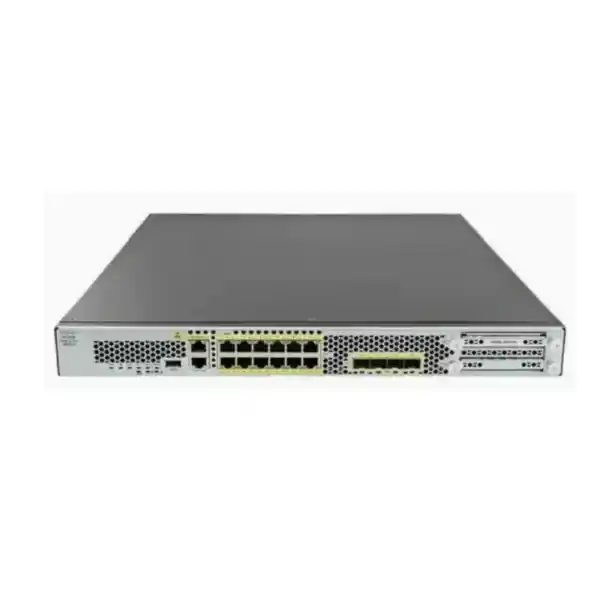
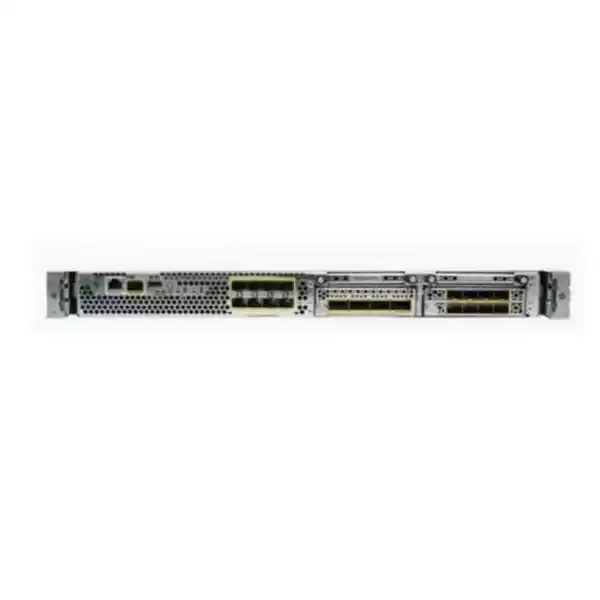
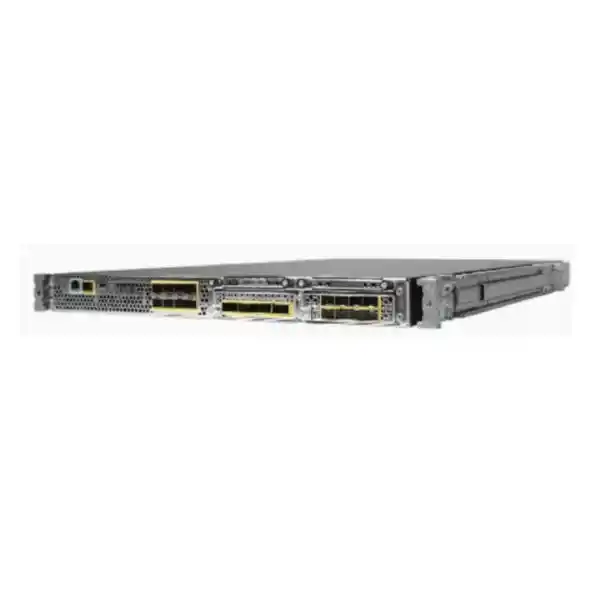
Cisco Secure Firewall 4225 in Dubai, UAE
A buyer-focused guide to the Cisco Secure Firewall 4225: verified performance, 1RU hardware, high-speed interfaces, licensing dependencies, encrypted-traffic inspection, VPN scale, resilience, installation planning and UAE quotation inputs.
Direct answer: what is the Cisco Secure Firewall 4225?
The Cisco Secure Firewall 4225 is a high-end 1RU physical firewall in Cisco’s Secure Firewall 4200 Series, mainly used for data-center, large enterprise and high-scale security-edge environments. Cisco publishes 80 Gbps Firewall + AVC + IPS throughput for the 4225 under its FTD 1024-byte test profile, 30 Gbps hardware TLS decryption, 30 million concurrent sessions with AVC, 600,000 new connections per second with AVC and up to 25,000 VPN peers.
The most important factor to confirm before ordering is the real production workload: enabled inspections, encrypted-traffic percentage, packet sizes, new connection rate, VPN demand, link speeds, HA design and growth margin. FourTeck can help determine whether the 4225, 4215 or 4245 best fits the requirement and what modules, optics, subscriptions, management and migration scope belong in the quotation.
Where the 4225 fits in the 4200 Series
The 4200 Series contains the 4215, 4225 and 4245 in a 1RU chassis family. Cisco’s published FTD Firewall + AVC + IPS figures are 65 Gbps for the 4215, 80 Gbps for the 4225 and 140 Gbps for the 4245. The 4225 therefore occupies the middle capacity tier and is relevant when the 4215 leaves insufficient inspection headroom but the 4245 is materially beyond the design need.
Firewall sizing should not be based only on a single internet circuit. Data centers may aggregate multiple carriers, WAN traffic, east-west segmentation, cloud links, remote access and site-to-site encryption. The correct model is the one that retains margin across throughput, decryption, session scale and connection rate while matching the physical topology.
Verified performance summary
| Metric | 4225 figure |
|---|---|
| FW + AVC + IPS | 80 Gbps, 1024-byte FTD profile |
| Hardware TLS decryption | 30 Gbps |
| Concurrent sessions with AVC | 30 million |
| New connections per second with AVC | 600,000 |
| IPSec VPN throughput | 80 Gbps in Cisco’s published FTD Fastpath profile |
| Maximum VPN peers | 25,000 |
These are laboratory references, not universal production guarantees. Cisco states that performance varies with features, packet sizes, protocols and software. The production design should size against the metric most likely to become the first bottleneck.
Interfaces, modules and optics
The 4225 provides eight fixed 1/10/25 Gigabit Ethernet SFP28 data ports, two integrated 1/10/25 Gigabit Ethernet SFP28 management ports and two network-module bays. The broader 4200-Series module portfolio supports multiple copper, SFP+, SFP28, 40G, 100G, 200G and 400G connectivity options depending on the module and software release.
A complete bill of materials should identify each firewall-facing link, switch counterpart, speed, media type, optic or cable, redundancy role and any breakout requirement. Connector shape alone is not enough to prove compatibility. Module and transceiver support should be checked against the intended Cisco software release and surrounding switch hardware.
Hardware and installation profile
The 4225 is a 1RU appliance measuring approximately 1.73 x 16.89 x 32.0 inches (4.39 x 42.9 x 81.28 cm). Cisco lists approximately 43 lb / 19.5 kg for a fully configured example with dual power supplies, two network modules and three fan modules. Storage is listed as two 1.8 TB SSDs.
Cisco specifies 200–240 VAC AC input for the 4225, dual hot-swappable power supplies with 1+1 redundancy and 870 W maximum AC input power in the datasheet. UAE projects should confirm rack depth, four-post rail fit, A/B PDU feeds, UPS capacity, grounding, cooling, management switching and cable routes before the change window.
Licensing and security services
For Secure Firewall Threat Defense, Cisco’s current documentation identifies Essentials as required and lists additional entitlements for IPS, Malware Defense, URL Filtering, Cisco Secure Client and Carrier capabilities. The exact subscription combination depends on the controls the organization intends to operate.
Remote-access VPN capacity and licensing are separate questions. The maximum VPN peer figure does not automatically license every user. Cisco Secure Client entitlement, authentication, MFA, posture and expected concurrent users should be included in the design. Subscription term should also be normalized when comparing quotations so a short-term license is not compared with a multi-year bundle as if they were equivalent.
Encrypted-traffic inspection
Cisco publishes 30 Gbps hardware TLS decryption performance for the 4225 under its stated test conditions. This figure can be more important than headline firewall throughput when a large share of internet or application traffic must be decrypted, inspected and re-encrypted.
Organizations should classify what traffic will actually be decrypted after privacy exclusions, certificate pinning, application compatibility and regulatory requirements are considered. Certificate trust, bypass governance, inbound private-key handling and application testing are implementation dependencies. If the expected decrypt-and-inspect load approaches the 4225’s capacity after growth is included, the 4245 should be evaluated.
High availability, clustering and resilience
The 4200 Series supports active/standby high availability and clustering in supported architectures, with Cisco documenting clustering up to 16 chassis for the family. Two firewalls alone do not create end-to-end resilience. Redundant upstream and downstream paths, independent power, HA links, software compatibility, management access and degraded-mode capacity must all be designed.
In an HA pair, a single surviving appliance may need to carry the full production load during maintenance or failure. The 4225 should therefore be sized against that state, not only against normal conditions. Clustering can increase scale but also adds switching, traffic-distribution, maintenance and operational complexity.
Five practical use cases
High inspected throughput, large session scale and flexible high-speed links can make the 4225 suitable for central perimeter protection.
Useful where campuses, cloud connectivity, WAN services and shared internet access converge on a central security layer.
Relevant to large site-to-site and remote-access designs, provided peer count, encryption load, licensing and identity systems are validated.
Can protect substantial east-west or inter-zone traffic where routing symmetry, application dependencies and inspection requirements are known.
Can replace multiple smaller platforms where capacity, tenancy and failure-domain implications are properly assessed.
When another model should be evaluated
The 4215 may be more economical when measured traffic, TLS inspection, session scale and growth remain comfortably inside its published limits. The 4245 should be compared when the 4225 would begin service with limited headroom, especially for decryption-heavy, connection-heavy or rapidly growing environments.
Facility limitations can also make the 4225 unsuitable. Its 32-inch depth, high-line power requirement and data-center orientation make it a poor fit for many small communications closets. Port density and media requirements can point to a different platform or module design even when raw firewall throughput is sufficient.
Migration planning
Migration should not be treated as a blind copy of the old firewall. Inventory interfaces, zones, routing, NAT, VPNs, certificates, identity sources, logging, objects and access rules. Retire obsolete rules and objects rather than reproducing technical debt on the new platform.
Routing and VPN behavior deserve explicit testing. Document static and dynamic routes, asymmetric paths, default-route ownership, tunnel proposals, identities, traffic selectors, partner dependencies and remote-access behavior. Define pre-staging, application tests, rollback thresholds and named owners for the change window.
After cutover, verify routing, NAT, VPN status, application reachability, IPS events, interface errors, connection behavior, decryption policy and logging. For high-value data centers, phased migration may reduce blast radius when topology permits.
Management, logging and operations
Secure Firewall Threat Defense deployments can be centrally managed through Firewall Management Center, while supported cloud-delivered management options may also be available depending on the chosen architecture and software. Existing management infrastructure should be checked for version and licensing compatibility before the firewall is added.
Define logging retention, SIEM forwarding, alert ownership, administrator identity, MFA, backup, software maintenance and change approval before go-live. High-capacity security hardware creates little value if policy, updates and events are not operationally owned.
Post-deployment monitoring
Monitor interface utilization, inspected throughput, connection tables, new connection rate, VPN usage, decryption volume, IPS events, hardware alarms, power-supply status and licensing. Trend data across business peaks rather than relying on quiet-period snapshots.
In HA designs, test and measure the surviving node under intended failure load. Policy reviews should identify unused rules, unexpectedly broad access, growing TLS bypass lists and recurring IPS noise. Capacity thresholds can then trigger planned expansion before performance becomes a user-visible problem.
UAE procurement guidance
A complete Dubai/UAE quotation should distinguish chassis, network modules, optics or cables, subscriptions, support, rack installation, configuration, migration, testing, documentation and post-cutover assistance. Lead time should be checked against the full bill of materials because a chassis and a specific module or optic may have different availability.
For local infrastructure planning, buyers can review FourTeck UAE, FourTeck IT Services UAE and FourTeck. These links supplement the specialist Firewall Dubai by FourTeck resource for security-focused projects.
Specification summary
| Form factor | 1RU |
|---|---|
| Dimensions | 1.73 x 16.89 x 32.0 in / 4.39 x 42.9 x 81.28 cm |
| Storage | 2 x 1.8 TB SSD |
| Fixed data ports | 8 x 1/10/25GE SFP28 |
| Management ports | 2 x 1/10/25GE SFP28 |
| Expansion | 2 network-module bays |
| AC input | 200–240 VAC |
| Power redundancy | Dual hot-swappable supplies, 1+1 |
Decision recap
Model fit: preserve headroom on inspected throughput, TLS decryption, sessions and connection rate.
Interfaces: verify modules, optics, switch compatibility and redundancy.
Licensing: align Cisco entitlements with the security controls and VPN services required.
Resilience: design HA, power and network failure domains end to end.
Installation: confirm rack depth, 200–240 VAC power, cooling, grounding and management access.
Operations: define management, logging, updates, backup, policy ownership and support escalation.
What FourTeck needs for an accurate quotation
Please provide the required quantity and topology, current and forecast traffic, expected TLS decryption, security services, interface speeds and media, VPN peer or user counts, management approach, preferred subscription term, Dubai/UAE installation location, support expectations and migration scope. For replacements, the existing firewall model and a sanitized summary of routing, NAT, VPN and rulebase complexity are especially useful.
Plan the Cisco Secure Firewall 4225 around your real traffic
A strong 4225 proposal combines verified sizing, the correct modules and optics, appropriate Cisco security entitlements, resilient power and topology, a practical migration plan and an operational management model. FourTeck can review these inputs and prepare a Dubai/UAE quotation aligned to the actual deployment.

Reviews
There are no reviews yet.