
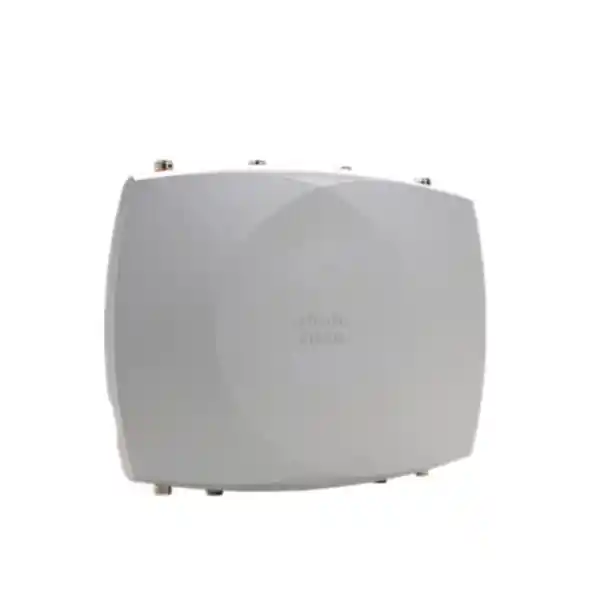
Cisco Wireless CW9177E Wi-Fi 7 Access Point for Dubai and the UAE
The Cisco Wireless CW9177E is the external-antenna member of Cisco’s 9177 Series outdoor Wi-Fi 7 platform. It is designed for organizations that need enterprise wireless beyond indoor ceilings: campuses, ports, distribution yards, resorts, transportation environments, utilities, industrial sites, education estates, healthcare grounds, large public venues and smart-city infrastructure. The platform combines a hardened outdoor enclosure, tri-radio Wi-Fi 7 capability, up to twelve spatial streams, flexible 2.4/5/6 GHz or dual-5 GHz radio operation, high-speed wired uplinks, dedicated scanning capability, integrated Bluetooth Low Energy and GNSS/GPS functions, and a unified hardware approach that can operate with Cisco Catalyst controller architecture or Meraki cloud management.
External N-type antenna connectivity allows the RF system to be shaped for open yards, aisles, roadways, courtyards, loading areas, perimeter zones or focused high-density sectors instead of forcing a fixed integrated pattern.
Direct answer: what the Cisco CW9177E is built to do
The CW9177E is an enterprise outdoor access point for projects where radio placement and antenna geometry matter as much as raw wireless speed. Cisco positions the 9177 Series as a rugged, tri-radio, tri-band Wi-Fi 7 platform, and the E model specifically exposes external antenna connectors so engineers can choose directional or omnidirectional antenna systems. In practical network design, that makes the model especially relevant when the AP must serve an area that is not well represented by a conventional indoor cell. A warehouse yard can require a long rectangular service area; a port may need coverage along lanes and container blocks; a resort may need discreet coverage across paths and pool areas; an industrial site may need controlled RF around machinery and metal structures; and a campus may need outdoor roaming between buildings. The CW9177E gives the RF designer a platform on which the antenna system can be selected to suit those geometries.
At the radio layer, the platform supports Wi-Fi 7 using 4×4 uplink and downlink MU-MIMO with four spatial streams on each client-serving radio. It can operate as 2.4 GHz, 5 GHz and 6 GHz tri-band or in a 2.4 GHz plus dual-5 GHz arrangement where local regulatory rules and software support allow. Across the three radios the architecture reaches twelve spatial streams. Cisco documents 20 MHz channels at 2.4 GHz, up to 160 MHz at 5 GHz and up to 320 MHz at 6 GHz, with Wi-Fi 7 features including 4096-QAM, Multi-Link Operation, preamble puncturing, uplink and downlink OFDMA, Target Wake Time and BSS coloring. The important design point is not the largest theoretical PHY number by itself; it is that the AP has enough radio, spectrum and wired-uplink headroom to support demanding enterprise cells when client capability, channel availability and interference conditions justify it.
For UAE deployments, the RF plan must still follow the regulatory settings, allowed channels, transmit-power limits and software support applicable to the installed country configuration. Cisco explicitly notes that the 6 GHz radio can be disabled in countries where 6 GHz use is not permitted or where current software support is unavailable, and that dual-5 GHz operation depends on allowed outdoor use of the required UNII ranges. FourTeck therefore treats country compliance, controller or cloud software release, antenna gain, mounting position and transmit power as one integrated design problem rather than selling the AP as a standalone speed upgrade.
Three 4×4 client-serving radios support a tri-band 2.4/5/6 GHz design or a 2.4 GHz plus dual-5 GHz mode where permitted.
One 100M/1G/2.5G/5G/10G multigigabit RJ-45 interface and one 1/10G SFP/SFP+ Ethernet interface provide deployment flexibility.
The enclosure is designed for harsh environments with documented ingress, temperature, wind, corrosion, icing and solar-radiation tolerances.
Unified hardware can be used with Cisco Catalyst 9800 controller architecture or Meraki cloud management according to the selected software and licensing model.
Core CW9177E specifications that matter in real projects
| Model | CW9177E, external-antenna outdoor Wi-Fi 7 access point |
| Client-serving radios | Three radios, each supporting 4×4 MU-MIMO with four spatial streams; up to twelve spatial streams total |
| Radio modes | 2.4 GHz + 5 GHz + 6 GHz, or 2.4 GHz + 5 GHz low band + 5 GHz high band where supported |
| Wi-Fi 7 capabilities | 4096-QAM, Multi-Link Operation, preamble puncturing, uplink/downlink OFDMA, Target Wake Time, BSS coloring and related 802.11be features |
| Channel widths | 20 MHz at 2.4 GHz; up to 160 MHz at 5 GHz; up to 320 MHz at 6 GHz subject to regulatory and software conditions |
| Copper uplink | 100M/1G/2.5G/5G/10G multigigabit Ethernet over RJ-45 |
| Fiber uplink | 1/10G Ethernet SFP/SFP+ |
| Power | 802.3bt / Cisco UPOE, 802.3at PoE+, limited 802.3af staging capability, or supported DC input; full 4×4 operation is designed around higher power availability |
| Maximum documented PoE draw | Up to 45.1 W with IEEE 802.3bt Class 6 / UPOE+ / PoE++ configurations |
| Enclosure | IEC 60529 IP66/IP67 outdoor construction |
| Dimensions | Approximately 352.2 x 270 x 76.2 mm without mounting brackets |
| Weight | Approximately 4.12 kg for the CW9177E access point |
Wi-Fi 7 architecture: capacity, determinism and spectrum efficiency
Wi-Fi 7 is often marketed through peak speed figures, but enterprise outdoor design benefits more from understanding how the 802.11be feature set changes airtime behavior. The CW9177E supports 4096-QAM, which can increase bits per symbol when signal quality is exceptionally strong. That matters most in portions of the cell with high signal-to-noise ratio and modern clients. It does not mean every endpoint will receive a 4096-QAM rate at long distance. In outdoor deployments the engineer must expect SNR to vary with client location, antenna pattern, elevation, obstructions, reflections, vehicle movement and weather. A strong design therefore uses the higher modulation modes as a capacity benefit in good RF conditions rather than assuming they are a substitute for correct AP placement.
Multi-Link Operation is another important Wi-Fi 7 capability because it creates a framework in which compatible clients can use multiple links more intelligently. Depending on client support and network implementation, MLO can help improve throughput, reduce latency sensitivity or provide greater resilience compared with a single-link relationship. In a mixed estate, however, the WLAN still has to support older Wi-Fi generations. The practical advantage of the CW9177E is its ability to host Wi-Fi 7 clients while continuing to provide standards-based service for previous generations, allowing an organization to refresh outdoor infrastructure without forcing every handheld, scanner, phone, tablet, laptop, camera or industrial endpoint to change simultaneously.
Preamble puncturing is especially useful in wide channels. Traditional channel usage can be constrained when a portion of a wide channel is affected by interference. Preamble puncturing allows compatible Wi-Fi 7 operation to work around affected subchannels instead of treating the entire wide channel as unusable. In dense or unpredictable RF environments this can improve spectrum efficiency, although results depend on client capability and real interference conditions. Likewise, OFDMA divides channel resources into smaller resource units so multiple clients can be scheduled efficiently, while BSS coloring helps devices distinguish overlapping basic service sets and improves spatial reuse behavior in compatible networks.
The CW9177E therefore should be sized using airtime and application demand, not only client count. A hundred mostly idle handhelds are a different workload from a hundred devices carrying high-resolution video, voice, telemetry and large uploads. FourTeck designs the cell by looking at expected simultaneous clients, application mix, upstream bandwidth, latency sensitivity, retry rates, RF contention, roaming behavior and required minimum data rates. That methodology produces a more reliable bill of materials than dividing a theoretical maximum AP throughput by an assumed per-user bandwidth number.
External antenna engineering: the main reason to choose CW9177E
The CW9177E is not simply a CW9177 with antennas omitted. Its value is that the external connectors make antenna choice part of the wireless architecture. Cisco documents eight external N-type connectors identified as ports A through H. In the 2.4/5 full-band plus 6 GHz tri-radio mode, ports A through D serve 2.4 GHz and full-band 5 GHz while ports E through H serve 6 GHz. In the dual-5 GHz arrangement, ports A through D support 2.4 GHz and lower 5 GHz while ports E through H support the higher 5 GHz band. This port mapping is fundamental when cable bundles, surge protection, antenna polarization and mounting geometry are planned. Connecting the wrong antenna group or treating all eight ports as interchangeable can compromise the intended RF design.
Cisco lists multiple compatible antenna options, including tri-band directional and omnidirectional designs. The CW-ANT-T-D4-N is a tri-band directional antenna with eight N-type connections, while the CW-ANT-T-O3-N provides a tri-band omnidirectional option. Cisco’s published peak gain figures for these antennas vary by band; for example, the D4 directional option is documented around 8 dBi-class gain across the supported Wi-Fi bands, while the O3 omnidirectional option is lower-gain and intended to spread coverage more broadly. Antenna gain is not free power. Higher directional gain concentrates energy into a narrower pattern, which can extend usable range or improve SNR in the intended sector but reduces coverage outside that beam. That is why an antenna decision should be based on a coverage drawing, mounting height and target client zone rather than on the largest dBi value.
Outdoor antenna systems also introduce loss and protection components that are easy to overlook. Coaxial cable loss rises with frequency and cable length. Connectors add insertion loss. Lightning protection can add additional loss but is often necessary in exposed installations. Cisco specifically recommends lightning arrestor protection for the CW9177E external-antenna deployment to help protect the AP against overvoltage transients from lightning or static discharge, with proper grounding to a reliable earth path. In the UAE, where many APs are mounted on poles, roofs, facades and open industrial structures, surge design and bonding should be included in the installation scope rather than treated as optional finishing work.
FourTeck’s RF design approach therefore models the full link budget: AP transmit power, selected antenna gain, cable and connector loss, regulatory EIRP limits, free-space and obstruction loss, client transmit capability, receiver sensitivity and required SNR for the application. The return path is particularly important because mobile clients often transmit at less power than the AP. An oversized high-gain AP antenna can make a client hear the network at a distance where the AP cannot reliably hear the client. Balanced two-way RF performance is the objective.
2.4 GHz, 5 GHz, 6 GHz and dual-5 GHz planning
A Wi-Fi 7 AP with three high-capacity radios gives the designer options, not permission to use every possible channel width everywhere. In 2.4 GHz, the CW9177E supports 20 MHz operation, which aligns with the need to protect limited spectrum and compatibility. The 2.4 GHz band continues to matter for legacy devices and some IoT endpoints, but it is normally the most constrained by interference and the smallest set of clean non-overlapping channels. A modern outdoor network often uses 2.4 GHz selectively, with careful power control and minimum-data-rate policies, while steering capable clients toward higher bands.
The 5 GHz band remains a central enterprise workhorse because it has broad client support and more channel options. The CW9177E supports channel widths up to 160 MHz at 5 GHz, but wider is not always better. A 160 MHz channel consumes a large portion of the available spectrum and can reduce reuse options in multi-AP deployments. In a high-density campus or yard, 40 or 80 MHz may deliver more aggregate system capacity because more cells can operate independently. For a lower-density point-to-area design with clean spectrum, a wider channel can make sense. Channel width should be chosen by the number of APs, interference levels, client capabilities and target application bandwidth.
At 6 GHz, the platform supports Wi-Fi 7 channel widths up to 320 MHz where regulatory authorization and software support permit. The band can offer a large amount of cleaner spectrum and fewer legacy-client constraints, but outdoor 6 GHz rules differ by country and can involve specific automated frequency coordination or power classes. Cisco integrates GNSS/GPS capability that supports location intelligence and regulatory-domain behavior, yet the project still must be designed according to local rules. For a Dubai or wider UAE deployment, FourTeck validates the regulatory state applicable to the product, software version and intended outdoor use before a 6 GHz coverage promise is made.
The alternative dual-5 GHz mode can be valuable where 6 GHz is unavailable, unnecessary, or not supported by the installed client base, because the third radio can be repurposed into an additional 5 GHz capacity layer using separated lower and higher 5 GHz ranges. This can improve capacity in dense outdoor spaces but is also subject to country-specific channel availability. The right architecture may therefore differ across sites even when the same CW9177E hardware is used. That flexibility protects the investment as spectrum policy and client adoption evolve.
10 Gigabit uplink design: copper, fiber and the switching layer
A Wi-Fi 7 access point can only deliver useful capacity when the wired edge is engineered to carry it. The CW9177E provides two high-value uplink options: a multigigabit RJ-45 Ethernet interface that negotiates from 100 Mbps through 1, 2.5, 5 and 10 Gbps, and a 1/10G SFP/SFP+ Ethernet interface. This makes the product adaptable to both conventional structured copper and fiber-led outdoor distribution architectures. The choice should be driven by distance, surge exposure, existing cabling, switch capability, power strategy and physical topology.
For a building-adjacent AP with a short copper route, 10G multigigabit Ethernet can simplify installation because data and PoE can share the same cable when the switching platform and cabling support the required speed and power. Cabling quality matters. Outdoor routes must respect maximum Ethernet distances, environmental jacket requirements, bend radius, termination quality and surge separation. Where the AP is mounted far from the nearest communications room or where copper would cross an exposed outdoor path, fiber can be preferable because it provides electrical isolation and can cover much longer distances. The SFP/SFP+ port gives architects that option, although a separate power method still has to be designed because optical fiber does not deliver PoE.
The switch should not be selected only by port count. A deployment of high-capacity CW9177E APs can create significant uplink demand and PoE load. The access switch needs the correct number of multigigabit ports, adequate 802.3bt power budget, sufficient switching fabric, appropriate uplinks to distribution or core, and resilient power where availability matters. If a site has ten APs and every AP can draw up to the mid-forty-watt range at full 802.3bt capability, the switch power budget must include realistic headroom rather than using a nominal chassis wattage that is shared by many other devices.
FourTeck can align the CW9177E with the wider LAN architecture through FourTeck UAE for switching, structured cabling and enterprise networking, while complex integration and managed operations can be coordinated through FourTeck IT Services UAE. This matters because a wireless refresh that ignores the wired edge commonly produces a situation where new AP radios are faster than the network path feeding them.
PoE behavior and why full performance requires the right power source
The CW9177E supports several power conditions, but they do not all provide the same radio and uplink capability. Cisco documents full 4×4 operation with IEEE 802.3bt Class 6 / UPOE+ / PoE++ power, with maximum PoE consumption up to 45.1 W in the listed full-performance modes. At 802.3at PoE+, the access point can operate with reduced radio capability: Cisco documents 2×2 operation on each radio in a tri-band PoE+ mode with a 2.5 Gbps copper link, or 2×2 on 2.4 GHz plus 4×4 on 5 GHz in a dual-band mode. 802.3af is significantly constrained and should not be mistaken for a normal production power plan; Cisco describes it for limited staging or reduced operation depending on the referenced guidance.
This has a direct procurement implication. Replacing an older Wi-Fi 5 or Wi-Fi 6 outdoor AP with a CW9177E on an existing PoE switch can produce a working access point but not necessarily the intended Wi-Fi 7 radio configuration. Before deployment, the engineer should confirm the exact switch model, power-supply capacity, per-port PoE standard, LLDP or Cisco Discovery Protocol negotiation, cable category and length, and the aggregate PoE load on the chassis. Cisco recommends LLDP or CDP to support proper power negotiation because actual consumption varies with AP usage.
A dedicated DC power option can be appropriate where fiber is used for data or where site power is delivered through an outdoor cabinet. The electrical design then becomes part of the infrastructure project: voltage range, grounding, weatherproof entry, surge protection, backup power and maintenance access must all be addressed. In ports, logistics parks, utility compounds and transport environments, it is common for the network team to work with electrical contractors. The demarcation between low-voltage networking and site electrical work should be documented before installation begins.
The decision rule is simple: if the business case depends on twelve spatial streams, the highest radio capability and 10G uplink potential, design around the power class that enables that performance. Do not quote a full-capability Wi-Fi 7 solution and then power it from an edge switch that forces a lower mode. FourTeck includes PoE validation in BOM design so the AP, switch, power supply and cabling are specified as a system.
Security architecture for enterprise outdoor WLANs
The CW9177E supports the security mechanisms expected in a contemporary enterprise WLAN, including WPA2 and WPA3 under 802.11i, 802.1X authentication, Enhanced Open/OWE, and modern AES-based encryption suites such as GCMP and CCMP variants. Cisco also documents support for enterprise EAP methods including EAP-TLS, tunneled TLS, PEAP, EAP-FAST and SIM-related methods. The access point therefore fits architectures that use RADIUS, digital certificates, identity-based policy and centralized authentication rather than a shared pre-shared key across an outdoor estate.
Security design still extends well beyond the AP specification. A guest SSID, employee SSID, operational-technology SSID and contractor SSID should not automatically land in the same VLAN or share the same trust level. Network segmentation, firewall policy, DNS security, device posture and identity context determine what a successfully connected client can reach. For customers designing the wireless edge as part of a zero-trust or segmented campus, FourTeck can integrate the WLAN with security infrastructure and routing policy. Related enterprise firewall and perimeter work can be coordinated through Firewall Dubai by FourTeck.
Outdoor networks deserve extra attention because the RF signal intentionally crosses open space. Physical proximity to a building is no longer a meaningful security boundary. Strong authentication, protected management, rogue detection, client isolation where appropriate, certificate lifecycle management and logging are therefore important. Dedicated scanning capability and Cisco CleanAir Pro are designed to help monitor the RF environment and identify interference behavior, but policy teams still need an incident workflow: who receives alerts, which events trigger investigation, how rogue devices are classified, and how repeated RF anomalies are correlated with physical security or operational activity.
For high-security environments, WPA3-Enterprise and certificate-based EAP-TLS can reduce reliance on user passwords, but certificate deployment requires PKI planning and endpoint management. The best design balances technical strength with operational supportability. A security configuration that endpoints cannot reliably use becomes a helpdesk problem; a simple shared key that never changes becomes a control weakness. FourTeck aligns WLAN security with the client’s identity platform, device mix and risk model rather than applying a one-template configuration to every site.
Catalyst controller or Meraki cloud: one hardware platform, two operational models
One of the most strategic features of the 9177 family is Cisco’s unified hardware direction. The CW9177E can be managed in an on-premises Cisco Catalyst wireless architecture or through Meraki cloud management, using the appropriate supported software and subscription model. Cisco’s current data sheet lists IOS XE releases in the 26.x generation and Meraki MR 32.2.x or later as software baselines, while support matrices should always be checked during deployment because releases evolve. The choice between controller-led Catalyst and Meraki should be based on operational requirements, not on a belief that the physical AP must be replaced to change management philosophy.
Catalyst 9800 architecture is well suited to organizations that already operate Cisco enterprise campus switching and want deep integration with controller policies, RF optimization, identity services and complex site architectures. It can fit large campuses, government environments, universities, industrial estates and enterprises with established network operations teams. The controller may be physical or virtual depending on the design. Cisco also references Catalyst 9000 switching with embedded wireless controller capabilities in relevant SDA scenarios. The design must account for control-plane reachability, high availability, software release strategy, telemetry and change management.
Meraki cloud management is attractive when organizations value centralized web-based operations, distributed site visibility and a simplified operational model across many branches or campuses. It can reduce the need to maintain dedicated controller appliances at each location and offers a consistent cloud-managed workflow. The correct choice is organizational. Some customers have a central NOC with mature Cisco IOS XE skills; others have lean IT teams and prefer cloud operations. Multi-country customers may also prioritize remote troubleshooting and standardized templates.
Licensing should be scoped with the chosen operating model from the start. Cisco has moved toward a networking subscription framework that is intended to support unified hardware and flexible management, but exact entitlement, term and feature availability depend on the purchased subscription and current Cisco ordering rules. FourTeck therefore quotes the AP, licenses, support and required controller or cloud components together, reducing the risk of receiving hardware without the software entitlement needed for production onboarding.
Dedicated scanning, CleanAir Pro, BLE 6.0 and GNSS/GPS
The CW9177E is more than three client radios. Cisco includes a dedicated scanning radio and CleanAir Pro capability to support RF intelligence and proactive interference analysis. In practical operations, a dedicated scan function is valuable because spectrum observation does not have to depend entirely on a client-serving radio leaving its channel. The result can be better RF awareness for features such as interference classification, channel optimization and rogue monitoring. In busy outdoor environments, non-Wi-Fi interference can come from industrial equipment, temporary event systems, point-to-point links, machinery, consumer devices or poorly planned neighboring networks. Visibility helps the operations team distinguish a coverage problem from an interference problem.
The integrated Bluetooth Low Energy 6.0 radio supports location-oriented and IoT use cases such as asset presence, wayfinding and analytics when used with the appropriate ecosystem and applications. BLE should be treated as an enabling radio rather than a complete asset-tracking solution by itself. Accuracy and business value depend on tag selection, density, placement, calibration, application software and environmental conditions. A logistics facility can use BLE to improve asset visibility, but the network design should first establish the required location granularity and update interval.
GNSS/GPS capability provides location intelligence and supports regulatory functions including automated frequency coordination workflows where relevant. Location data can also help inventory systems understand where an AP is physically installed, which is useful in large outdoor estates where visual identification is difficult. As with any satellite-reception function, the installation should consider sky visibility and antenna requirements defined by Cisco. A product mounted deep inside a metal structure may have different GNSS reception conditions from a roof- or pole-mounted AP.
These auxiliary radios become most useful when operations teams have a workflow for the data. FourTeck can integrate wireless monitoring with broader infrastructure support through FourTeck Global, especially for organizations that standardize network operations across the UAE and other regions. The objective is to make telemetry actionable: baseline the RF environment, detect deviation, identify the affected site and user group, and route the issue to the correct support owner.
Outdoor survivability in UAE conditions
Outdoor wireless equipment in the UAE has to tolerate more than rain. High ambient temperature, direct solar loading, fine dust, coastal salt, wind, vibration, repeated thermal cycling and exposed cable routes all affect reliability. Cisco specifies the 9177 Series with IEC 60529 IP66/IP67 ingress protection and an operating temperature range extending to 65°C without solar load, with a lower documented upper limit under solar-load conditions. The product is also rated for strong sustained wind and gust conditions, corrosion exposure, icing tests and solar-radiation testing. These specifications make the platform suitable for harsh environments, but site engineering is still required to keep the installation within documented operating conditions.
Direct sun can raise enclosure temperature above ambient air temperature. A Dubai rooftop at midday can therefore create a different thermal scenario from a shaded pole at the same reported weather temperature. Mounting orientation, airflow, nearby reflective surfaces and enclosure proximity matter. Communications cabinets serving the AP also need thermal consideration. Putting an industrial switch and power supply in an unventilated metal box can create a failure point even if the AP itself is outdoor-rated.
Dust protection depends on installation integrity. Cable glands, unused ports, antenna connectors and service openings must be correctly sealed. A product can carry an IP rating and still fail if field installation leaves a gland loose or uses an incompatible connector. Grounding and lightning protection are equally important. The CW9177E’s external antenna system increases the number of exposed RF paths, making high-quality weatherproofing and surge protection essential. Cisco recommends N-type lightning arrestor protection for external-antenna deployments, and the arrestor must itself be grounded properly to provide a discharge path.
Coastal and industrial sites need material compatibility and periodic inspection. Salt deposits, airborne contaminants and UV exposure can degrade cable jackets, mounts and connectors over time. A maintenance plan should include visual inspection, torque checks where specified, cable condition, grounding continuity, water-ingress signs and RF performance trends. Rugged hardware reduces environmental risk, but lifecycle reliability comes from rugged hardware plus disciplined installation and maintenance.
RF sizing methodology for campuses, yards and industrial sites
The number of CW9177E access points required for a site cannot be derived accurately from square meters alone. Outdoor RF cells are shaped by antenna gain, mounting height, obstacles, client transmit power, required data rate, channel plan and noise. Two sites with the same area can require very different AP counts. An empty vehicle yard with clear line of sight may need fewer cells than a container yard full of stacked metal boxes. A resort with landscaping, masonry walls and irregular paths may require a different pattern again. FourTeck uses a design process that starts with application requirements and physical geometry.
First, define the application. Voice roaming needs consistent cell overlap, low latency and reliable handoff. Barcode scanners may require modest throughput but can have limited radio capability and roaming behavior. Video surveillance can consume high sustained upstream bandwidth. Guest Wi-Fi in a public venue is driven by simultaneous users and airtime contention. Industrial telemetry may prioritize availability over speed. Once application requirements are known, the engineer can define minimum RSSI and SNR targets, supported data rates, expected client density and roaming thresholds.
Second, map the physical environment. Building outlines, roads, racks, containers, tanks, machinery, vegetation, fences and elevation affect propagation. Mounting points must be practical for power, data, maintenance and safety. The external antenna capability of the CW9177E is especially useful here because a directional antenna can place energy along an aisle or across a yard while limiting unnecessary overspill behind the antenna. An omnidirectional antenna may be better at the center of an open area when clients surround the pole.
Third, create the channel and power plan. High-density networks need controlled cell size and enough channel reuse. Maximum transmit power is rarely the correct default because it can increase co-channel contention and create asymmetric links with lower-power clients. The design should also reserve spectrum for neighboring cells and account for DFS or regulatory restrictions. Where 6 GHz is available, it can add valuable spectrum but may have different propagation and client-adoption characteristics.
Finally, validate after installation. Predictive modelling is not a substitute for field measurement. Post-installation surveys should check actual signal levels, SNR, throughput, retries, roaming and interference. Outdoor environments change: containers move, temporary structures appear, trees grow and adjacent networks change channel usage. A professional wireless design includes a process for revalidation when site geometry or business use materially changes.
Deployment patterns where the CW9177E is especially strong
Ports and logistics yards
Directional antennas can shape coverage along lanes, loading zones or container rows. Fiber uplinks are useful across long outdoor distances, while rugged construction and surge planning address exposed infrastructure. Client devices may include tablets, vehicle terminals, handheld scanners and IoT equipment, so the design should prioritize roaming and uplink reliability as well as capacity.
University and enterprise campuses
Outdoor paths, courtyards, parking areas and inter-building spaces need a continuation of the corporate WLAN. The CW9177E can extend identity-based access and policy outdoors while custom antenna patterns reduce RF spill into areas that do not need service. Central Catalyst or Meraki operations can keep indoor and outdoor estates under a consistent management model.
Hotels, resorts and hospitality estates
Pools, gardens, event lawns, beach areas and staff zones can create irregular coverage shapes. External antennas allow discreet AP placement with directional or omnidirectional RF chosen for the guest area. The design should keep guest traffic segmented from property systems and should account for peak-event density rather than average occupancy only.
Industrial and utility environments
Metal structures, process areas and moving equipment can produce severe multipath and shadowing. A focused antenna design can improve predictability. Ruggedness, grounding, maintenance access and coordination with operational-technology security policy are especially important. Coverage validation should be performed during representative production conditions.
Stadiums and public venues
High-density outdoor cells require strict channel reuse, minimum data rates, capacity modelling and controlled antenna sectors. Wi-Fi 7 provides additional efficiency and spectrum options, but user experience depends on RF containment and backhaul capacity. Large venues should be designed from seat or zone demand, not from AP coverage radius.
Smart infrastructure and municipal sites
Outdoor Wi-Fi can support public access, field operations, sensors and location applications. The CW9177E’s high-speed uplinks, BLE capability and flexible antenna choices make it useful where one rugged platform needs to serve multiple digital-infrastructure roles, subject to security segmentation and regulatory design.
Migration from Wi-Fi 5, Wi-Fi 6 or Wi-Fi 6E outdoor networks
A CW9177E deployment can be a direct technology refresh, but the strongest projects use the refresh to correct old architectural constraints. Legacy outdoor networks may have 1G uplinks, 802.3at-only power, older cabling, fixed antenna patterns, limited monitoring and a channel plan designed for fewer clients. Installing Wi-Fi 7 APs without revisiting those assumptions can leave much of the new capability unused. Migration planning should therefore inventory the current access layer, controller or cloud platform, licenses, fiber paths, PoE class, AP mounting points and endpoint generations.
Client compatibility makes phased migration possible. Wi-Fi 7 APs continue to support earlier 802.11 generations, so organizations can upgrade infrastructure before every endpoint has been replaced. This is valuable in industrial and logistics environments where rugged scanners or terminals can have long refresh cycles. The WLAN can serve legacy clients while providing new spectrum and higher capability to newer devices. The design should nevertheless test the oldest critical clients because older firmware can expose roaming, cipher or channel-support limitations that are not visible in laptop testing.
Antenna migration requires special attention. An existing outdoor antenna may have the correct connector type but not the correct band support, gain, port count or pattern for a Wi-Fi 7 tri-band design. Reusing an old 2.4/5 GHz antenna on a project that expects 6 GHz service can invalidate the RF plan. Likewise, cable bundles and lightning protectors must support the required frequencies and connector mapping. FourTeck reviews existing antenna assets against Cisco’s supported options before recommending reuse.
Controller and licensing migration should be staged with rollback options. Software compatibility, AP discovery, certificates, DHCP options where used, VLAN reachability and firewall rules should be validated before a large cutover. For mission-critical sites, a pilot area lets the team compare client behavior, application performance and roaming under real conditions. A successful pilot then becomes the template for the wider rollout.
UAE procurement, regulatory and lifecycle considerations
Enterprise wireless procurement in the UAE should include more than the AP part number. The bill of materials may need antennas, antenna cable assemblies, mounting kits, lightning arrestors, grounding accessories, SFP+ optics or DACs where appropriate, outdoor-rated Ethernet cabling, PoE switching, power supplies, controller or cloud licenses, support entitlement and installation materials. Missing one small component can delay an outdoor project because the AP may be physically installed before the correct antenna cable or surge device is available.
Country regulation is equally important. Cisco’s 9177 series uses a unified global hardware direction, but radio operation is still controlled by local rules and software. The project team should verify that the exact frequencies, channel widths, transmit powers and outdoor 6 GHz functions intended for the design are authorized in the UAE at the time of deployment. Regulatory rules can change, and software releases may enable features after local certification. FourTeck therefore distinguishes between hardware capability and locally usable capability in quotations and design documents.
Lead time and lifecycle support matter for large deployments. A pilot can proceed with a small quantity while the full rollout is being scheduled, but antenna and mounting choices should be standardized before bulk ordering. Spare strategy should also be considered. Keeping one configured spare AP for a critical remote site may reduce outage duration more than relying on emergency procurement. For large estates, standardizing mount types, cable assemblies and optics can simplify field maintenance.
FourTeck can support local UAE procurement through its enterprise networking practice and can extend project coordination internationally when the customer operates across several countries. Customers planning multi-site rollouts can start from FourTeck UAE for local delivery and use FourTeck Global for broader infrastructure coordination. Internal links on this page are intentionally limited to relevant FourTeck resources so the product description remains focused on the CW9177E architecture rather than becoming a directory.
Warranty and support should be aligned with the business criticality of the WLAN. Outdoor AP replacement can require elevated-access equipment, security permits or coordination with facilities teams, so restoration time is not determined only by hardware RMA speed. A lifecycle plan should document spare locations, configuration backup, license ownership, software maintenance windows and the physical access procedure for each AP type.
Technical specification interpretation: what not to assume
Cisco publishes detailed radio, interface, environmental and standards information for the CW9177E, but it does not publicly describe every internal silicon block in the way a semiconductor data sheet would. It is therefore more accurate to discuss the architecture in terms of observable functions: three 4×4 client-serving radios, dedicated scan capability, integrated BLE and GNSS/GPS functions, multigigabit packet interfaces, supported encryption and controller or cloud software. Claims about an unnamed proprietary ASIC, packet-processing core count or undocumented hardware accelerator should not be added to a product page unless Cisco publishes that information for the specific model.
The same discipline applies to throughput. Cisco documents PHY data rates up to 18 Gbps in the tri-band configuration and up to 12.2 Gbps in the dual-5 GHz configuration under the stated radio assumptions. These are aggregate physical-layer figures, not guaranteed application throughput to a single client. Real traffic is lower because Wi-Fi uses shared airtime and carries protocol overhead, acknowledgements, management frames, encryption overhead and retransmissions. Client radio capability, distance, channel width, modulation, interference and application protocol all change the result.
Coverage radius should not be quoted as a fixed number either. An outdoor access point with an external directional antenna can achieve very different range from the same AP using an omnidirectional antenna. Regulatory EIRP limits, client power, mounting height and required data rate further change the cell edge. A low-bandwidth IoT endpoint may remain connected at a distance where a video application is no longer usable. FourTeck therefore does not specify a universal CW9177E coverage radius without a site context.
Finally, 6 GHz operation should not be represented as universally available. Cisco’s documentation explicitly states that the 6 GHz radio is disabled where local rules or current software do not allow its use. A technically accurate UAE proposal should state whether 6 GHz is included in the planned design after the applicable regulatory and software checks are completed. This protects both the customer and the project team from a mismatch between global product capability and local deployment authority.
Operational design after go-live
Wireless performance is dynamic, so the deployment should include operational baselines. At handover, record channel assignment, transmit power, client distribution, retry rate, noise floor, expected throughput at representative points and roaming behavior along critical paths. Those measurements become a reference for future troubleshooting. If users report poor performance six months later, the NOC can compare current telemetry with the acceptance baseline instead of guessing whether the cause is new interference, client growth, a damaged antenna cable or a configuration change.
Software maintenance is part of reliability. Catalyst IOS XE or Meraki firmware updates can add features, regulatory changes, bug fixes and security patches, but upgrades should be tested against critical client types. A staged rollout policy can update a pilot group first, then expand after validation. In distributed estates, maintenance windows should consider the operational schedule of each site rather than upgrading every region simultaneously.
Capacity trends are equally important. The network may be correctly sized at launch and become congested after new applications or devices are introduced. Monitoring should track airtime utilization, associated clients, application throughput, channel changes and error trends. If one cell consistently carries disproportionate load, the answer may be a new AP, a different antenna pattern, lower transmit power, channel redesign or client steering policy. Because the CW9177E supports external antennas, physical RF adjustments can sometimes solve a problem more cleanly than adding raw transmit power.
Power optimization can also contribute to operating efficiency. Cisco documents AP Power Save functions that can reduce consumption by shutting down radios during off-hours while allowing features to return when needed. Whether that is appropriate depends on the site. A 24×7 logistics yard should not sacrifice operational coverage for energy savings, while an education campus may have predictable low-use periods. Policies should therefore be tied to business hours and emergency requirements.
Why buy the Cisco CW9177E through FourTeck UAE
The value in an enterprise outdoor Wi-Fi project is not only in sourcing an access point. It is in turning a radio platform into a reliable service area. FourTeck can provide pre-sales design, BOM validation, antenna selection, switching and PoE alignment, controller or Meraki planning, installation guidance, security integration, RF survey services, migration planning and post-deployment support. That integrated approach is especially important with the CW9177E because the external antenna option creates design freedom that must be used correctly.
A quotation can be structured around the customer’s deployment model. A small site may need a limited number of APs, directional antennas, one multigigabit PoE switch and cloud management. A campus may require dozens of APs, fiber distribution, resilient core switching, Catalyst 9800 controllers, identity services and centralized monitoring. A port or industrial estate may need rugged cabinets, surge protection, long fiber runs, special mounts and coordinated installation permits. FourTeck builds the BOM from the topology rather than forcing every project into the same bundle.
For customers already operating firewalls, servers, voice platforms or managed IT services, wireless can be integrated into the broader infrastructure roadmap. The IT Services UAE team can support project and operational integration, while the Firewall Dubai practice can coordinate network segmentation and perimeter controls where the WLAN must connect to protected corporate or OT environments. The result is a design in which wireless, wired, power and security layers are treated as one system.
FourTeck can also document assumptions explicitly: which radio mode is intended, whether 6 GHz operation is included, which antenna model is selected, what cable length is assumed, which power class is supplied, what management platform is used and which licenses are required. Clear assumptions make quotations easier to compare and reduce scope disputes during deployment.
Decision recap: when CW9177E is the right Cisco outdoor AP
Choose it for custom coverage
External N-type antenna connectors make the CW9177E the strongest 9177-series choice when RF must be shaped using directional or external omnidirectional antennas.
Choose it for high-capacity outdoor cells
Three 4×4 radios, twelve spatial streams and Wi-Fi 7 features provide capacity for demanding outdoor environments when the channel plan and client population can use it.
Choose it when 10G matters
10G multigigabit copper and 1/10G SFP/SFP+ uplinks let the wired edge scale with Wi-Fi 7 rather than forcing every outdoor AP through a 1G bottleneck.
Choose it for harsh environments
IP66/IP67 construction, broad environmental specifications and outdoor mounting options make the platform suitable for exposed enterprise infrastructure.
Choose it for operational flexibility
Unified hardware can fit a Catalyst-controller strategy or a Meraki cloud strategy, protecting hardware investment as management architecture evolves.
Do not choose it by speed alone
If the site does not need external antennas, high-capacity radios or outdoor hardening, an integrated-antenna or lower-tier model may be simpler and more economical.
Quotation input checklist for an accurate CW9177E BOM
A useful quotation can be produced much faster when the project team provides the information below. If some details are unknown, FourTeck can help determine them during discovery or site survey.
Dubai campus, Abu Dhabi industrial facility, logistics yard, resort, school, healthcare site, public venue or other environment; include approximate outdoor area and critical coverage zones.
Expected simultaneous users, handheld scanners, laptops, phones, IoT devices, cameras, voice handsets, vehicles or specialized terminals, plus the applications they run.
Current Cisco controller, Meraki organization, switching models, uplink speeds, PoE capability, VLAN design, identity system and any existing wireless licenses.
Pole, wall, roof or structure mounting; cable distances; copper or fiber availability; outdoor cabinet details; grounding points; and any access restrictions such as lifts or permits.
Omnidirectional versus directional intent, target coverage shape, mounting height, long aisles or lanes, obstacles, desired sector direction and whether existing antennas are proposed for reuse.
Required uptime, redundancy, guest separation, WPA3 or 802.1X requirements, firewall segmentation, monitoring expectations, maintenance windows and support response objectives.
Final consultation panel: plan the complete outdoor Wi-Fi 7 system
A CW9177E project should end with a design package, not only a box count. FourTeck can prepare an architecture covering access point quantity, antenna type, RF zones, mounting positions, surge protection, multigigabit or fiber uplinks, PoE class, switch power budget, controller or Meraki management, software and licensing, WLAN security, VLAN mapping, testing and acceptance criteria. For existing sites, the same process can determine which parts of the old infrastructure can be retained and which would limit Wi-Fi 7 performance.
For technical evaluation, the most important early decision is whether the external-antenna CW9177E is needed or whether an integrated CW9177I or CW9177D pattern would achieve the same result with less installation complexity. If the site requires custom beam shaping, long lanes, unusual geometry, antenna separation or the ability to select among supported external patterns, the E model provides the necessary flexibility. If coverage is simple and symmetrical, an integrated antenna can reduce cable and surge components.
The next decision is the radio operating strategy. A tri-band 2.4/5/6 GHz design can unlock Wi-Fi 7 spectrum advantages where local rules and client support permit, while a dual-5 GHz design can add capacity in environments where 6 GHz is not currently used. That choice influences antenna mapping, channel planning, expected client behavior and acceptance testing. It should be documented before installation so the field team knows which external connectors and antenna groups serve each radio.
Finally, confirm wired and power readiness. A 10G-capable AP should not be installed on legacy access infrastructure by accident. Verify multigigabit switch ports, PoE++ power, fiber options, uplink aggregation and controller or cloud reachability. Once those elements are aligned, the CW9177E can operate as part of a balanced end-to-end architecture rather than as an isolated high-performance device. Contact FourTeck with site drawings, AP quantities or an existing wireless inventory to begin the design and quotation process.

Reviews
There are no reviews yet.