
XGS-PON Business Security Router • Dubai & UAE
DrayTek Vigor1220ax – 10G Fibre, Multi-WAN, VPN and DrayOS 5 Security
The DrayTek Vigor1220ax product page is prepared for organisations in Dubai and across the UAE that are moving beyond conventional gigabit edge routing and need a platform designed around XGS-PON access, 10GbE handoff options, 2.5GbE connectivity, policy-based multi-WAN operation, business VPN, segmentation, identity-aware controls and centralised management. FourTeck treats the router as part of a complete network design rather than as an isolated appliance, matching WAN optics, ISP presentation, switching capacity, VLAN design, VPN requirements, access-point density and security policy to the actual site.
Important Vigor1220ax model-name validation
This listing preserves the requested commercial product name DrayTek Vigor1220ax. At the time this page was prepared, DrayTek’s current global Vigor1220 series material identifies the wired Vigor1220 and the wireless Vigor1220be model, with the latter documented for Wi-Fi 7 operation. A separately published Vigor1220ax model is not shown in that global matrix. For that reason, FourTeck does not invent an 802.11ax radio specification, antenna count or wireless throughput figure for the requested “ax” suffix.
All core platform information below is written against the currently documented Vigor1220 series architecture, including XGS-PON, 10GbE, 2.5GbE, multi-WAN, 100K-class session handling, up to 50 VPN tunnels, DrayOS 5 services, security controls and management capabilities. Before order release, FourTeck validates the exact regional manufacturer part number, hardware suffix, power kit, firmware branch and wireless capability. This is especially important for UAE projects where a bill of materials may be locked to a tender specification, ISP interface type or wireless standard.
Why the Vigor1220 platform fits modern UAE fibre networks
The edge of a business network is changing quickly. Internet circuits that were once delivered at 100 Mbps or 500 Mbps are increasingly being replaced by gigabit and multi-gigabit fibre, while internal traffic has also grown because of cloud applications, video collaboration, off-site backups, IP surveillance, high-density Wi-Fi, software distribution and data replication. A router that was designed only for gigabit forwarding can become the bottleneck even when the ISP circuit and core switch are significantly faster. The Vigor1220 series addresses that problem with a design built around XGS-PON and multi-gigabit Ethernet interfaces rather than treating faster WAN connectivity as an afterthought.
For Dubai offices, warehouses, clinics, schools, hospitality sites, professional services firms and distributed SMB environments, the practical benefit is architectural headroom. The platform can terminate or participate in a 10G-class fibre edge, provide a 10GbE copper interface that can be assigned as WAN or LAN, use a 10G SFP+ interface for high-speed downstream connectivity, and retain conventional gigabit interfaces for existing devices. A 2.5GbE switchable interface adds a useful intermediate speed for modern access switching, Wi-Fi infrastructure or alternate WAN handoff.
This combination lets a network designer avoid an unnecessary all-or-nothing migration. Existing gigabit switches can remain in service where appropriate, while the high-capacity uplinks, server aggregation paths and WAN interfaces are upgraded first. FourTeck can integrate the router into a broader UAE infrastructure project through FourTeck UAE, including switching, wireless, structured network design and security implementation.
10G XGS-PON edge
The series is designed around an XGS-PON WAN interface using SC/APC connectivity, supporting symmetrical 10G-class passive optical network architecture. DrayTek publishes maximum PON forwarding performance up to approximately 8.1 Gbps under its test conditions.
Multi-gigabit Ethernet
A switchable 10GbE RJ-45 port, 10G SFP+ LAN, switchable 2.5GbE interface and three fixed 1GbE LAN ports support mixed-speed networks without forcing every connected device to operate at the same link speed.
Business VPN
The platform supports up to 50 concurrent VPN tunnels and DrayTek publishes IPsec throughput of up to 500 Mbps for the Vigor1220 series, with support for IPsec, OpenVPN and WireGuard deployment models.
High session capacity
The current series is positioned for approximately 100,000 NAT sessions, giving growing networks more tolerance for browsers, SaaS applications, IoT devices, collaboration platforms and other session-intensive workloads.
DrayOS 5 controls
Routing, firewalling, IAM-oriented access controls, content filtering, VPN, hotspot, QoS, VLAN, management and monitoring functions are integrated into DrayOS 5, reducing the number of separate appliances required at smaller sites.
On-device management
Virtual Controller functions can manage compatible DrayTek access points and switches locally, helping sites that want unified operational visibility without making cloud management a prerequisite for routine network administration.
Port architecture and physical connectivity
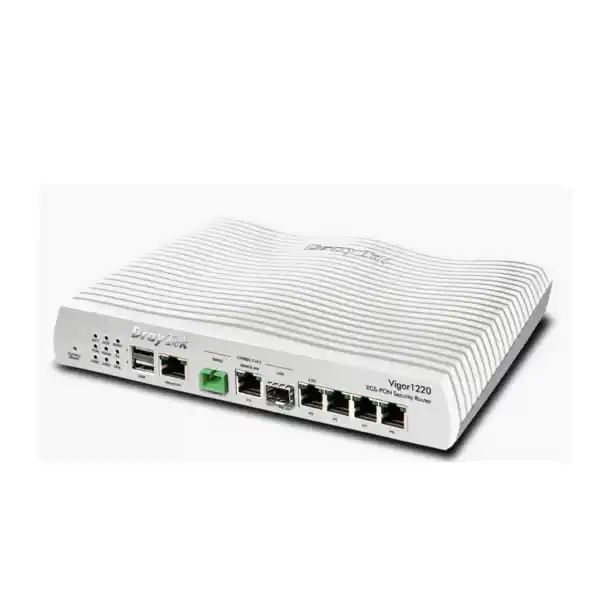
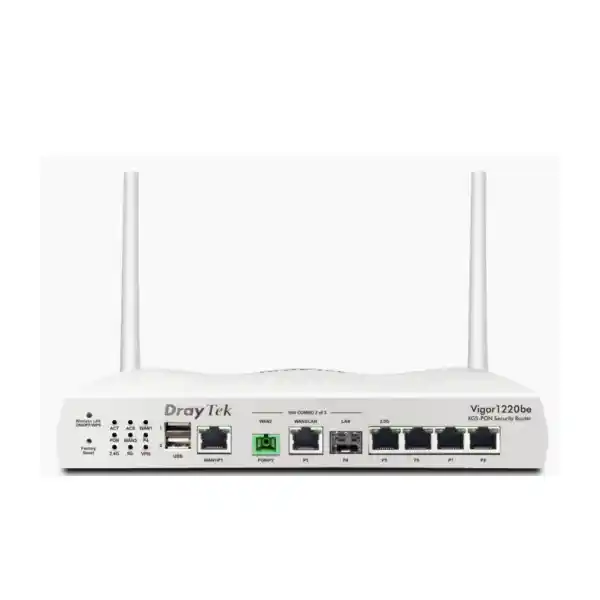
The usefulness of a multi-gigabit router depends heavily on its physical interface map. In the Vigor1220 family, the port layout is unusually flexible for an SMB-class appliance. The documented hardware includes a fixed 1GbE RJ-45 WAN interface, an XGS-PON WAN interface using SC/APC, a 10GbE RJ-45 interface that can be assigned as WAN or LAN, a fixed 10G SFP+ LAN interface, a 2.5GbE RJ-45 interface that can be assigned as LAN or WAN, three fixed 1GbE RJ-45 LAN interfaces and two USB 2.0 ports. DrayTek also notes interface activation constraints among selected 10G-class ports, which is why a deployment should be designed from the required traffic paths rather than by assuming every high-speed interface can always be active in every role simultaneously.
For a typical Dubai office with an XGS-PON service, the PON interface may act as the primary WAN while the 10G SFP+ port feeds a capable aggregation switch. The 2.5GbE port can then provide an additional high-speed path to a Wi-Fi aggregation segment or an alternate WAN handoff. In another deployment, the service provider may deliver Ethernet rather than direct PON, making the 10GbE RJ-45 port a better WAN choice. The fixed 1GbE WAN remains useful for a secondary circuit, legacy ISP handoff or temporary migration path.
The port flexibility is therefore more valuable than simply counting interfaces. Good design considers transceiver type, cable distance, copper category, optical budget, switch uplink capability, VLAN trunk requirements and failure modes. A 10GbE port connected to an underpowered downstream switch does not create an end-to-end 10G network; likewise, a 10G LAN path can be wasted if the firewall policy, VPN encryption load or application servers become the real bottleneck.
XGS-PON: what it changes at the business edge
XGS-PON is designed for symmetrical 10-gigabit-class passive optical networking, and that symmetry matters for modern businesses. Traditional broadband planning often focused on download performance because most user activity consumed more data than it transmitted. Cloud backup, remote file synchronisation, hosted video, multi-site replication, off-site CCTV access, large design-file uploads and business continuity workflows have made upstream bandwidth increasingly important. A symmetrical fibre architecture reduces the disparity between sending and receiving data, provided the ISP service profile and upstream network are provisioned accordingly.
The Vigor1220 series integrates an XGS-PON interface rather than requiring a separate external optical network terminal in every possible design. Whether that interface can be used directly on a specific UAE carrier circuit depends on provider authentication, serial-number registration, OMCI requirements, optical class, service VLAN configuration and ISP policy. A router being electrically or optically compatible with XGS-PON does not automatically mean an operator will authorise a third-party endpoint on its PON infrastructure.
FourTeck therefore treats direct PON termination as a compatibility question that must be validated with the circuit details. Where direct termination is not permitted, the Vigor1220 can still participate in a multi-gigabit design using an Ethernet handoff from the provider’s ONT or CPE. The important procurement question is not simply “does the router have XGS-PON?” but “how does this specific carrier present the service, and which interface on the router should be used to preserve throughput, manageability and supportability?”
Published forwarding figures
DrayTek’s current series specification reports maximum PON performance around 8100 Mbps and maximum NAT performance around 9260 Mbps under the vendor’s test conditions. These are laboratory maximums rather than guaranteed application throughput.
Real results depend on frame sizes, traffic direction, enabled security features, QoS, concurrent flows, firmware, WAN encapsulation and the capabilities of endpoints used for testing.
Sizing beyond speed tests
A router should be sized around worst-case production policy, not an empty configuration. VPN, content controls, detailed logging, inter-VLAN filtering and high session churn can influence usable throughput.
For critical sites, FourTeck maps expected user count, application mix, remote-access load, branch tunnels and security services before confirming whether the Vigor1220 class has sufficient headroom.
NAT sessions and why 100K-class capacity matters
A common mistake in router selection is to compare only headline WAN throughput. Connection state is equally important. Each browser tab, collaboration client, cloud sync process, mobile application, smart device, security camera service and background update mechanism can create multiple concurrent connections. In an office of fifty users, the number of active sessions can be far higher than the number of employees, especially when every user has a laptop and phone and the building contains printers, access-control devices, cameras, IoT sensors and meeting-room systems.
The Vigor1220 series is positioned around 100,000 NAT sessions, providing substantially more state-table capacity than entry-level small-office routers. This helps the platform remain responsive when traffic is bursty or session-heavy. It does not mean that 100,000 sessions should be treated as a target operating level. Network engineering normally preserves margin for abnormal traffic, software updates, temporary spikes, threat events and future growth.
Session capacity also interacts with security. Rate limits, session limits, firewall policy and anomaly detection can prevent a compromised host or poorly behaved application from consuming an excessive share of state-table resources. In business environments, the most useful outcome is not merely that the router can track many connections, but that administrators can impose policy around who may create them, how traffic is prioritised and which destinations are acceptable.
Multi-WAN load balancing, failover and policy routing
The Vigor1220 series supports multiple WAN paths, allowing a business to combine resilience with traffic engineering. Load balancing can distribute eligible sessions across active Internet connections, while failover can move traffic away from an unavailable path. The important distinction is that load balancing is usually session-based rather than a method of combining two unrelated Internet circuits into one universally faster single flow. A large file transfer tied to one session may remain on one WAN, while many simultaneous sessions can be spread across multiple links.
Policy-based routing makes the design more deterministic. Voice traffic can be directed to a low-latency circuit, corporate SaaS can use the primary fibre service, guest traffic can be sent through a secondary provider, and backup replication can be constrained to a specific WAN or schedule. For a business with hosted telephony, SD-WAN-like application preferences or strict public-IP dependencies, this policy layer is more useful than indiscriminate balancing.
Failover design should also include detection logic. A physical link can remain up even when the Internet path beyond the provider gateway is broken. Health checks using ARP, ping or other supported mechanisms help the router determine whether a WAN is actually usable. FourTeck configures WAN monitoring thresholds carefully to avoid both slow failure detection and unnecessary route flapping caused by transient packet loss.
VPN architecture for branches, remote users and hybrid work
DrayTek positions the Vigor1220 series for up to 50 concurrent VPN tunnels and publishes IPsec throughput up to 500 Mbps. The platform supports established business VPN approaches including IPsec with IKEv1/IKEv2 options, OpenVPN and WireGuard. The correct protocol depends on interoperability, remote-user platform, security policy, throughput requirement and the equipment at the opposite endpoint.
For site-to-site connectivity, IPsec remains common because it is widely supported by firewalls and routers from many manufacturers. A Dubai headquarters can maintain encrypted tunnels to warehouses, retail branches, temporary project offices or overseas sites, with route policy determining which networks are reachable through each tunnel. WireGuard is attractive where simple modern configuration and efficient encryption are desired, while OpenVPN can be appropriate for remote-user access and environments with existing client workflows.
VPN throughput should never be equated to raw NAT throughput. Encryption, authentication, packet encapsulation and CPU processing add overhead. A 10G WAN interface therefore does not imply multi-gigabit IPsec performance. If an organisation requires encrypted replication at several gigabits per second, the edge security platform should be selected for that specific encrypted workload rather than for port speed alone.
DrayTek’s EasyVPN capability is intended to reduce configuration complexity for supported remote-access workflows. FourTeck can design the full remote-access policy, including user groups, authentication, address pools, split-tunnel rules, DNS behaviour, MFA-related integration where applicable and restricted access to internal applications. For broader firewall and security architecture in Dubai, customers can also review FourTeck Firewall Dubai.
Site-to-site VPN
Connect branch subnets securely, define route reachability, apply tunnel-specific policy and use WAN binding to control which Internet path carries the encrypted session.
Remote user VPN
Provide authorised staff with encrypted access to applications, file shares, management systems or internal web services without exposing those services directly to the public Internet.
VPN policy control
Combine identity, source subnet, destination, protocol and WAN conditions so a tunnel does not become an unrestricted bridge between sites.
Operational visibility
Monitor tunnel status, logs and routing behaviour so support teams can distinguish authentication failures, ISP faults, route conflicts and remote-end configuration issues.
Firewall policy, content control and VigorShield services
A business router at the Internet edge must do more than translate addresses. The Vigor1220 series includes stateful firewall capabilities, service filtering, access rules, anti-spoofing controls, DoS-related protections, content filtering and reputation-oriented security services. DrayTek’s VigorShield ecosystem can use URL and IP reputation intelligence to help block access to known malicious destinations. Depending on the selected security service and subscription status, this can add a threat-intelligence layer beyond manually maintained domain and address lists.
Firewall design should follow least-privilege principles. Guest networks should not reach finance systems. IoT devices should not automatically communicate with server subnets. CCTV recorders may need outbound vendor access but should not have unrestricted lateral reach. Administrative management should be limited to trusted networks or VPN users. Inter-VLAN rules are therefore as important as Internet-facing policy, because many security incidents spread laterally after the first endpoint is compromised.
The series also includes mechanisms such as port knocking and management access controls that can reduce exposure of administrative services. These are useful supporting measures, but they do not replace strong credentials, current firmware, restricted management source networks and secure remote-access design. FourTeck normally separates management traffic from normal user traffic and documents the management path so future support teams do not have to weaken the firewall simply to regain access.
For UAE organisations outsourcing parts of their operational support, the router can be incorporated into a wider managed infrastructure scope through FourTeck IT Services UAE, including configuration governance, change control and troubleshooting support.
Threat Protection Guardian and layered defence
DrayTek’s current Vigor1220 series material describes Threat Protection Guardian as an AI-assisted security layer combining router protection, network protection, unmanaged-device defence and web protection. Functions described for the platform include detection or mitigation of DoS/DDoS behaviour, port scanning and brute-force attempts, IP/URL reputation checks, device fingerprinting, anomaly detection, risky-device quarantine, exploit-oriented inspection for selected unmanaged and IoT traffic, safe-browsing controls and category or service filtering.
In practical network engineering, these features should be treated as layers rather than as a single guarantee. A router can reduce exposure and detect suspicious behaviour, but endpoint security, patch management, backup, identity controls and user awareness remain necessary. The most resilient design combines edge policy with internal segmentation so that a compromised device does not automatically gain trusted access to every system.
Cloud-assisted threat intelligence can improve the speed at which known malicious IP addresses and URLs are recognised, while local policy determines how those events are handled. Before deployment, FourTeck confirms which threat services are included by default, which may require licensing or activation, how logs will be retained and whether the customer expects alerting through email, SNMP, central management or another operational channel.
Identity and Access Management for controlled network admission
DrayOS 5 introduces stronger identity-oriented capabilities into the Vigor1220 family. Traditional network policy often relied only on IP addresses, but addresses can change and may not clearly identify the person or device behind the traffic. DrayTek’s IAM-oriented design combines device attributes, user identity and role-based access concepts so policies can be made more specific.
For example, an employee device can be associated with a known IP/MAC relationship and an authorised user role, while guest devices are placed in a separate access context. Administrative users may receive access to management networks that ordinary users cannot reach. Contractors can be restricted to a specific application set or time window. Hotspot authentication can use methods such as click-through, local IAM user login, RADIUS and external portal integration depending on the configuration.
The phrase “Zero Trust ready” should be interpreted carefully. A single router does not create a complete Zero Trust architecture by itself. Zero Trust requires identity assurance, device posture, least privilege, segmentation, continuous policy evaluation and organisational process. The Vigor1220 can contribute useful enforcement and visibility components at the branch or SMB edge, particularly when policies are designed around user and device context rather than broad flat-network assumptions.
VLAN design and segmentation strategy
The documented Vigor1220 platform supports 802.1Q tag-based VLANs and up to eight VLANs in the current specification. That is enough for many SMB and branch deployments when the segmentation plan is deliberate. A typical design might separate corporate users, voice, guest Wi-Fi, CCTV, building systems, servers, network management and a dedicated services or laboratory network. The number of VLANs should be driven by security and operations rather than by creating a separate segment for every small device category.
Each VLAN can be associated with its own IP subnet, DHCP scope, gateway policy and firewall restrictions. Trunk ports carry tagged VLANs between the router and managed switches, while access ports present a single untagged network to endpoints that do not understand VLAN tags. Access points can map different SSIDs to different VLANs, allowing employee and guest wireless traffic to be separated even though both use the same physical AP infrastructure.
Inter-VLAN routing must be governed by firewall rules. Without restrictions, multiple VLANs can become logically separate but still freely reachable, which defeats much of the security purpose. FourTeck generally starts with denied or limited east-west access and then permits the exact services required, such as users reaching DNS, DHCP, directory services and business applications while guest and IoT networks remain isolated.
For sites with more complex data-centre segmentation or large server estates, the router can be integrated with higher-capacity switching and compute infrastructure. Customers planning server-side upgrades can review FourTeck Server Dubai for complementary server and infrastructure options.
Corporate users
Normal business endpoints with controlled access to SaaS, printers, approved internal applications and shared services.
Guest access
Internet-only or portal-controlled connectivity, isolated from private business subnets and management interfaces.
IoT and CCTV
Restricted device networks that can reach only required controllers, cloud services, NVRs or DNS/NTP resources.
Management
A dedicated administrative segment for router, switch, AP, server and infrastructure management, reachable only by authorised staff or VPN users.
Quality of Service, bandwidth limits and application fairness
High bandwidth does not eliminate the need for traffic management. A 10G-capable edge can still experience congestion if the downstream Internet service is smaller, if one WAN link is temporarily degraded or if multiple high-volume applications run simultaneously. Voice, interactive video and remote-desktop traffic are sensitive to latency and jitter, while backups and software downloads generally tolerate delay. QoS and bandwidth policies allow the network to protect the applications that are most sensitive to congestion.
DrayTek’s bandwidth management functions include bandwidth limits, session limits and QoS policy. Per-user or per-subnet controls can prevent a guest device from monopolising an Internet circuit. Session limits can reduce the impact of peer-to-peer software, malware or misconfigured applications that open excessive connections. QoS classification can prioritise voice or critical business applications when the WAN is busy.
The most effective QoS design is based on the real bottleneck speed, not the interface speed printed on the router. If the primary ISP circuit is 2 Gbps, the shaping policy should be aligned with that service and its actual achievable rate. If failover moves traffic to a 500 Mbps backup circuit, the router may need a different traffic policy for that WAN. FourTeck documents these assumptions so future circuit upgrades do not leave outdated shaping values in place.
Routing features for more advanced networks
The Vigor1220 platform is not limited to a simple default route. DrayTek’s specification includes static routing, policy routing, inter-VLAN routing and dynamic routing protocols such as RIP, BGP and OSPF v2/v3. These options expand the range of topologies in which the router can operate, particularly when a site has multiple internal routers, redundant upstream paths or a need to exchange routes dynamically.
BGP can be useful in specialised business environments with multiple autonomous-system relationships or more advanced provider routing requirements, while OSPF is more common inside enterprise networks where routes need to be learned dynamically between routers. Most SMB sites do not need these protocols, and enabling them without a clear design can create unnecessary complexity. The value is that the platform can support them when the topology genuinely requires it.
IPv6 is also part of the platform’s routing capability, with support for IPv6 addressing and several transition or tunnel mechanisms. UAE organisations should increasingly treat IPv6 readiness as a design requirement even if day-to-day business traffic remains predominantly IPv4. A clean IPv6 policy includes address assignment, DNS behaviour, firewall rules and monitoring rather than simply enabling IPv6 and assuming IPv4 controls will automatically apply in the same way.
Virtual Controller for DrayTek access points and switches
One of the operational advantages of the Vigor1220 series is its ability to act as a local management point for compatible DrayTek infrastructure. DrayTek’s Virtual Controller combines access-point and switch management functions so smaller organisations can gain centralised visibility without deploying a separate controller appliance for every site.
The current series documentation describes mesh management for a root plus up to seven node APs in supported wireless deployments, and AP Management mode for up to twenty access points when the network exceeds the smaller mesh scale. Switch Management can monitor and manage up to ten supported DrayTek switches. Administrators can view device status, firmware state and uptime, create port profiles, apply VLAN and QoS settings, manage PoE-related profiles on compatible hardware, perform maintenance actions and back up or restore configuration.
This approach is especially useful for a single office or a small number of branches where the IT team wants one operational dashboard but prefers local control. Larger fleets can also use DrayTek’s VigorACS 3 platform for centralised provisioning and management, subject to licensing and deployment requirements. Features may include zero-touch provisioning, Auto VPN, interface SLA visibility, application-aware policy and hotspot analytics depending on the environment.
FourTeck evaluates whether local Virtual Controller management is sufficient or whether central ACS-based management is more appropriate. The decision depends on site count, change frequency, reporting requirements, remote support model and whether configuration templates must be standardised across many routers.
Wireless planning for the requested “Vigor1220ax” name
Because the requested product name includes the “ax” suffix, it would be easy to assume that the device contains integrated Wi-Fi 6. That assumption is not made on this page. DrayTek’s currently published global Vigor1220 family identifies a non-wireless Vigor1220 and a Vigor1220be variant with Wi-Fi 7 features. The public matrix does not currently show a Vigor1220ax variant. FourTeck therefore validates the actual manufacturer part number before promising integrated radio capability.
If the project requirement is specifically for Wi-Fi 6 rather than Wi-Fi 7, the network can still use the Vigor1220 routing platform with separate Wi-Fi 6 access points. In many business deployments, separate APs are preferable because access points can be positioned based on RF coverage rather than where the ISP fibre enters the building. Ceiling-mounted AP placement, PoE switching, channel planning and roaming design often produce better results than relying on a router’s built-in radio from a communications room.
If integrated Wi-Fi is required, the final quote should specify the exact wireless model and confirm frequency bands, regulatory domain, antenna arrangement, channel-width support and client features. For the currently documented Vigor1220be, DrayTek describes Wi-Fi 7 technologies such as Multi-Link Operation, enhanced OFDMA/MRU and Zero-Wait DFS. Those features belong to the documented “be” model and are not automatically attributed to a requested “ax” name without manufacturer confirmation.
USB, monitoring and administrative services
The Vigor1220 hardware includes two USB 2.0 ports. Depending on supported firmware functions and compatible accessories, USB services can be used for features such as external storage-related functions, printer services, device monitoring, temperature sensors or USB WAN scenarios. The practical use should be checked against the intended accessory and current firmware compatibility rather than assuming every USB peripheral is supported.
Monitoring functions are extensive for an SMB router. Administrators can inspect client lists, ARP information, routing tables, DHCP information, IPv6 neighbour state, DNS cache, WAN condition, XGS-PON information, SFP information, session tables and running services. SNMP support provides another route for integrating status into broader network monitoring platforms. Logging can help diagnose recurring WAN failures, authentication problems, denied firewall traffic and unusual connection patterns.
Operational discipline matters as much as feature availability. FourTeck recommends configuring time synchronisation, log retention, alert destinations, administrative access restrictions and configuration backups during the initial deployment. Without these basics, troubleshooting after an outage becomes unnecessarily difficult. A current configuration export should be stored securely after major changes, and the change record should note firmware version, interface roles, VLAN IDs, public IP assignments and VPN dependencies.
Physical specifications and installation environment
DrayTek publishes dimensions of approximately 241 × 165 × 43 mm for the Vigor1220 series and a 12V DC, 1.5A power input with maximum power consumption around 18 watts. The documented operating temperature range is 0 to 45°C with non-condensing operating humidity from 10 to 90 percent. These figures make the appliance compact, but environmental planning is still important in the UAE, where poorly ventilated communications cupboards can exceed comfortable equipment temperatures.
The router should be installed in a clean, ventilated area with stable power and appropriate surge protection. It should not be placed directly on top of heat-generating devices or enclosed in an unventilated metal cabinet exposed to high ambient temperature. Fibre patch cords should have proper bend radius and strain relief, and SC/APC connectors should be kept clean because contamination can increase optical loss.
For business-critical installations, FourTeck also considers UPS runtime, PDU layout, rack or shelf mounting, cable labelling, patch-panel organisation and serviceability. A compact router is easy to deploy physically, but a professional installation leaves enough slack and documentation for replacement, testing and fault isolation without disconnecting unrelated circuits.
Typical deployment topology 1: XGS-PON primary with Ethernet backup
A strong use case for the Vigor1220 family is a site with an XGS-PON primary connection and a second Internet circuit delivered over Ethernet. The primary PON path can carry normal corporate traffic, SaaS applications and cloud services, while the secondary WAN is configured for failover or selective load balancing. Health monitoring checks whether the primary route is genuinely reaching the Internet rather than simply seeing an optical link.
The 10G SFP+ LAN can connect to the core switch, preserving bandwidth from the high-speed WAN into the campus LAN. VLAN trunks carry corporate, voice, guest and IoT segments between the router and switch. Firewall rules isolate the segments and policy routing sends selected traffic through the most appropriate WAN. VPN tunnels can be bound to the preferred WAN and configured to re-establish over the backup path where the remote topology supports it.
This topology is suitable for organisations that want high primary bandwidth but cannot accept complete loss of Internet access during an ISP outage. The backup link may be slower; its job is continuity. FourTeck can create a degraded-mode QoS policy so that essential voice, VPN and business traffic receives priority when the network has failed over to the lower-capacity circuit.
Typical deployment topology 2: Ethernet handoff from carrier ONT
Not every provider allows third-party equipment to terminate directly on its PON. In those cases, the ISP’s ONT or managed CPE remains in place and presents Ethernet to the customer. The Vigor1220 can then use its multi-gigabit Ethernet interface as the WAN, preserving much of the platform’s routing and security value without requiring direct optical registration on the provider network.
This design can actually simplify support because the carrier retains responsibility for optical registration and line diagnostics, while the customer router begins at a clearly defined Ethernet demarcation. The key is to avoid unnecessary double NAT. Where possible, the provider device should present a routed public subnet, bridge mode or another business handoff that allows the Vigor1220 to control firewalling, VPN and policy routing directly.
If double NAT cannot be avoided, VPN and inbound-service design requires additional care. Port forwarding, IPsec negotiation, public-address dependencies and some SIP applications can behave differently behind multiple translation layers. FourTeck captures the carrier topology during pre-sales discovery so the final configuration reflects the actual demarcation rather than an idealised diagram.
Typical deployment topology 3: branch edge with central VPN
A branch office may not need every available 10G interface on day one, but the Vigor1220 can still make sense when the site expects growth or has a high-speed fibre service. The branch router can provide local Internet breakout, create an encrypted tunnel to headquarters, segment users and devices, and apply consistent firewall policy. Local access to SaaS applications can be kept off the tunnel, while internal ERP, file, voice or management traffic uses encrypted routes back to the central site.
Policy routing allows the organisation to decide which traffic should remain local and which should traverse the VPN. This reduces unnecessary bandwidth consumption on the headquarters circuit and can improve performance for cloud applications. If the branch has a backup WAN, critical VPN routes can be configured to recover over the secondary path.
For multi-branch rollouts, the operational challenge is configuration consistency. Addressing, VLAN IDs, firewall objects, naming conventions and VPN parameters should follow a template. DrayTek management tools can help with standardisation, while FourTeck can build site-specific variables such as public IP, branch subnet and local ISP credentials into a repeatable deployment plan.
Capacity planning: how to size the router correctly
Sizing begins with the actual service profile. Record primary and backup WAN speeds, expected future upgrades, user count, endpoint count, public services, number of VLANs, VPN tunnel count, remote-user concurrency, encrypted traffic volume, logging requirements and security features. The most demanding parameter is often not the obvious one. A site with 5 Gbps Internet may generate only modest VPN traffic, while a design studio with a 1 Gbps circuit may need several hundred megabits of encrypted site-to-site replication at night.
Next, identify peak simultaneous use rather than average consumption. Internet links and routers are stressed by peaks. Software deployment day, cloud backup windows, major video meetings and off-site replication can overlap. Session counts can spike even when bandwidth does not. Guest Wi-Fi events can create hundreds of transient devices. Capacity planning should preserve headroom for these periods and for future applications that are not yet deployed.
Security services must be included in the performance model. Raw NAT benchmarks generally represent an optimised forwarding scenario. Stateful inspection, content categorisation, threat services, QoS and VPN encryption can reduce application throughput. FourTeck therefore avoids selecting a router purely because the published NAT number exceeds the ISP speed. The question is whether the appliance can meet the production policy under expected concurrency.
Finally, confirm downstream infrastructure. If the router has a 10G LAN uplink but the switch has only 1G uplinks, the LAN becomes the bottleneck. If servers use 1G interfaces, a 10G Internet circuit will not make a single server transfer faster than its own network stack allows. Balanced design considers the entire path.
Licensing and subscription planning
Many core routing, VLAN, QoS, firewall and VPN functions are part of the platform, while selected reputation, threat-intelligence, cloud management or advanced security services may depend on subscription or service activation. The exact entitlement can vary by region, firmware and bundle. Procurement teams should therefore request a quote that separates hardware, included services, optional security subscriptions, management licensing and support terms.
This matters because an appliance can operate normally after an optional subscription expires while losing the cloud-fed intelligence or categorisation layer that the organisation expected to rely on. Renewal planning should be part of the operational calendar, especially when a security service is a documented control in an audit or compliance process.
FourTeck validates the required features against the current DrayTek licensing model at quotation time. The goal is to avoid both under-licensing, where expected services are absent, and over-purchasing, where a customer pays for capabilities that the design does not use.
Firmware lifecycle, secure administration and change control
Edge routers are exposed to hostile traffic and should be maintained as security infrastructure. DrayTek currently lists the Vigor1220 series as an available product with active support, and firmware resources are published for the platform. FourTeck recommends reviewing release notes before upgrades, backing up configuration, scheduling a maintenance window and confirming that critical VPN, PON and management functions are supported by the target firmware.
Administrative access should use HTTPS or SSH where appropriate and should be restricted to trusted source networks. Telnet and other legacy methods should be disabled unless a specific controlled requirement exists. Remote management from the public Internet should be avoided or tightly source-restricted; a management VPN is generally safer. Default credentials must be changed, administrator accounts should be limited, and authentication methods should follow the customer’s security policy.
Configuration changes should be documented. WAN interface roles, public IP assignments, VLAN IDs, DHCP scopes, static routes, policy routes, VPN peer addresses, firewall rules and management restrictions form an interdependent system. An undocumented “small change” can create a routing loop, expose a management service or break a tunnel weeks later when failover occurs.
For organisations standardising across multiple countries or sites, FourTeck can also support broader design and procurement through FourTeck Global, while the Dubai deployment remains aligned with the local ISP and site requirements.
UAE ISP and XGS-PON compatibility considerations
The presence of an XGS-PON interface should not be interpreted as universal plug-and-play compatibility with every fibre service. Passive optical networks are managed systems. The provider’s OLT may authenticate an ONT by serial number, registration identifier, vendor profile or other mechanism. Service VLANs, PPPoE, DHCP options and management channels may also be operator-specific. Some providers require their own ONT to remain connected even when the customer uses a separate enterprise router behind it.
Before promising direct fibre termination in Dubai or another UAE emirate, FourTeck asks for the carrier name, service type, current CPE model, handoff method, subscribed speed, public IP arrangement and any ISP-provided configuration details. Where the carrier supports customer-owned PON termination, the optical and registration parameters can be reviewed. Where it does not, the design uses the carrier’s ONT and selects the best Ethernet interface on the Vigor1220 for the subscribed speed.
Static public IP blocks also need route planning. Some providers route a subnet toward the customer CPE rather than assigning all public addresses directly to the WAN interface. NAT, one-to-one mappings, inbound services and VPNs should be designed around the provider’s actual allocation method. This discovery work prevents deployment-day surprises.
10GbE copper versus 10G SFP+: choosing the right LAN handoff
The Vigor1220 family gives designers both 10GbE copper and 10G SFP+ options, but they serve different cabling environments. 10GBASE-T over RJ-45 is convenient when the downstream switch provides multi-gigabit copper ports and the cable plant is suitable. It uses familiar connectors and can support negotiated lower speeds on compatible interfaces. Power consumption and heat can be higher than short-reach optical or direct-attach alternatives, and cable category and length must be checked carefully for reliable 10G operation.
SFP+ is often preferred for switch uplinks because it supports fibre transceivers or direct-attach copper cables, depending on the equipment and distance. Fibre provides electrical isolation and long reach, while DAC is cost-effective for short rack-level connections. Transceiver compatibility should be confirmed rather than assuming every third-party SFP+ module will behave identically.
In a communications room, a short SFP+ DAC from the router to the core switch can be clean and efficient if both sides support the module type. Between rooms, optical fibre may be better. If the router connects directly to a server or storage appliance, the media choice depends on the NIC. FourTeck selects the handoff based on distance, switch model, spare interface inventory and future topology.
Security segmentation for CCTV, IoT and building systems
Modern offices contain many devices that are not traditional user computers: IP cameras, NVRs, access-control panels, attendance systems, smart TVs, meeting-room controllers, environmental sensors, digital signage and building automation gateways. These devices often have different patch cycles and vendor cloud dependencies, so they should not share unrestricted access with finance, HR or server networks.
The Vigor1220 can provide VLAN gateways and firewall policy to separate these device classes. CCTV cameras may be allowed to reach only the NVR and selected NTP/DNS services. The NVR may be permitted outbound access for vendor updates while inbound remote viewing occurs through VPN rather than exposed port forwarding. Building controllers may communicate only with a specific management workstation. Guest devices can be denied all private address ranges.
Segmentation reduces the blast radius of a compromise and makes traffic easier to understand. It also improves troubleshooting because unusual cross-segment communication becomes visible in policy logs. FourTeck maps device dependencies before enforcing strict rules so essential vendor services are not accidentally blocked.
Voice, video and collaboration traffic
Unified communications traffic is sensitive to packet loss, delay and jitter. A network may have abundant total bandwidth and still produce poor call quality if a busy uplink queue introduces latency. The Vigor1220’s QoS and policy-routing functions can help keep voice and interactive video stable, especially when multiple WANs are available.
A practical design identifies the voice VLAN, PBX or cloud calling destinations, DSCP markings, expected call volume and failover behaviour. If the primary circuit fails, the backup WAN should have enough capacity for critical calls even if nonessential downloads are throttled. SIP-related ALG behaviour should be tested with the actual provider because some hosted voice platforms work better with ALG functions disabled, while other legacy designs may depend on them.
Video conferencing has different traffic characteristics from traditional voice because bandwidth per session is higher and can change dynamically with resolution and participant count. QoS should therefore protect interactive traffic without permanently reserving excessive bandwidth that sits unused. Monitoring real utilisation after deployment helps refine policy.
Business continuity and failover testing
Redundant WANs provide value only when failover works under real conditions. After deployment, FourTeck recommends controlled testing that simulates failure of the primary path. The test should confirm Internet routing, DNS resolution, VPN recovery, hosted voice behaviour, public services, monitoring alerts and return-to-primary behaviour. If the backup WAN uses a different public IP, applications that whitelist the primary address may still fail even though general Internet access continues.
The return path is also important. Some routers immediately move sessions back to the preferred WAN when it recovers, while existing sessions may continue on the backup until they expire. Policy should be chosen based on application sensitivity. Repeated flapping on an unstable circuit can be worse than remaining on a slower but stable backup link.
Documented failover tests turn redundancy from a marketing feature into an operational control. Results should state which services survived, which required reconnection and which depend on public IP consistency. This evidence helps the business understand what the backup circuit actually protects.
Migration from a gigabit router to the Vigor1220 platform
Replacing an existing edge router is not just a hardware swap. The current configuration may contain years of accumulated DHCP reservations, static routes, inbound NAT rules, VPN peers, QoS settings, custom DNS, VLANs and provider-specific parameters. A clean migration begins with an inventory of these dependencies and identifies which rules are still required.
The new Vigor1220 design should be built deliberately rather than blindly reproducing legacy policy. Obsolete port forwards can be removed, flat networks can be segmented, management access can be tightened and WAN failover can be re-tested. If IP addressing changes, dependent servers, printers, cameras and access-control systems must be updated or temporarily supported with transition routes.
A rollback plan is essential for business-critical sites. The old router can be retained with its configuration intact until the new platform passes acceptance tests. Change windows should allow enough time to verify Internet access, DNS, VPN, public applications, voice, printing and core business systems before the old device is removed from service.
What FourTeck validates before quoting
A correct quote for the DrayTek Vigor1220ax name requires more than price and availability. FourTeck first validates the exact manufacturer model suffix because the global documentation currently lists Vigor1220 and Vigor1220be rather than a separately published Vigor1220ax. The quotation therefore records the exact part number and wireless capability so procurement receives the intended hardware.
The second validation area is WAN presentation. The team checks whether the Internet service is direct XGS-PON, Ethernet from a provider ONT, PPPoE, DHCP, static IP or another handoff, and whether a backup circuit is included. Required optical components, patch cords, SFP+ modules, copper cabling and switch uplinks are then matched to the physical design.
Finally, FourTeck confirms VPN requirements, VLAN count, user and device scale, desired security services, management platform, installation environment and support scope. This turns a generic router purchase into a bill of materials that can actually be implemented.
Specification summary for procurement teams
| Area | Current Vigor1220 series information | Deployment note |
|---|---|---|
| Primary fibre | XGS-PON WAN, SC/APC, 10G-class symmetrical PON architecture | Direct use depends on ISP registration and service policy. |
| Ethernet WAN/LAN | 10GbE RJ-45 switchable WAN/LAN, 2.5GbE RJ-45 switchable LAN/WAN, fixed 1GbE WAN | Interface-role constraints should be checked in final design. |
| High-speed LAN | Fixed 10G SFP+ plus three fixed 1GbE RJ-45 LAN ports | Useful for core-switch uplink and mixed-speed access. |
| NAT performance | Vendor maximum around 9.26 Gbps in published series testing | Production throughput varies with policy and traffic profile. |
| PON performance | Vendor maximum around 8.1 Gbps in published series testing | ISP service profile and optical environment also matter. |
| Sessions | 100K-class NAT session positioning | Preserve capacity headroom for bursts and future growth. |
| VPN | Up to 50 concurrent tunnels; IPsec up to 500 Mbps; IPsec, OpenVPN, WireGuard | Encrypted throughput is distinct from raw NAT throughput. |
| VLAN | 802.1Q tag-based VLAN, up to eight VLANs in current specification | Plan segmentation around security zones and operations. |
| Management | Virtual Controller, AP management, switch management, VigorACS support | Choose local or central management based on site count. |
| Power | 12V DC @ 1.5A; maximum consumption around 18W | Use stable power and UPS for critical sites. |
| Chassis environment | Approx. 241 × 165 × 43 mm; 0–45°C operating range | Maintain ventilation in UAE communications rooms. |
Who should consider the Vigor1220 class?
The Vigor1220 class is well suited to small and mid-sized organisations that have outgrown gigabit-only routing but do not need a large data-centre firewall platform. It is particularly relevant where the Internet service is XGS-PON or multi-gigabit Ethernet, where a 10G uplink to the LAN is desirable, or where the business wants one appliance to combine routing, VPN, VLAN gateways, multi-WAN and security policy.
It is also attractive for organisations already using compatible DrayTek switches or access points because Virtual Controller can simplify local operations. Branches that need around fifty VPN tunnels or fewer, a manageable number of VLANs and strong session capacity can consolidate several functions at the edge.
The platform is less appropriate if the project requires several gigabits per second of encrypted VPN throughput, hundreds of VLANs, very large dynamic-routing tables, high-availability clustering with stateful failover at enterprise scale, or a security stack that depends on advanced inspection beyond the platform’s design target. FourTeck identifies these cases during sizing and can recommend a different firewall or routing architecture when required.
Decision recap: when the Vigor1220ax request is a strong fit
Choose it for multi-gigabit edge capacity
The Vigor1220 series is designed around XGS-PON, 10GbE and 2.5GbE rather than a gigabit-only architecture, making it suitable where the ISP circuit or core network is already beyond 1 Gbps.
Choose it for integrated branch functions
Routing, multi-WAN, VPN, VLAN gateways, QoS, firewall policy, content controls and local infrastructure management can be combined in one platform for a compact SMB deployment.
Validate the exact wireless suffix
The requested Vigor1220ax name requires part-number confirmation because the current global DrayTek matrix publishes Vigor1220 and Vigor1220be. Do not assume Wi-Fi 6 without written SKU confirmation.
Validate ISP PON policy
Direct XGS-PON termination depends on the carrier. If the ISP requires its ONT, the router can still use a high-speed Ethernet handoff and provide the routing/security layer behind it.
Quotation input checklist
For an accurate DrayTek Vigor1220ax Dubai quotation, provide the following information. The more complete the input, the more precisely FourTeck can confirm the hardware suffix, optics, licenses and configuration effort.
Carrier name, subscribed speed, XGS-PON or Ethernet handoff, PPPoE/DHCP/static IP and current ONT/CPE model.
Confirm whether integrated Wi-Fi 6 is mandatory, Wi-Fi 7 is acceptable, or separate access points are preferred.
Staff, laptops, phones, cameras, IoT devices, printers, servers and expected growth over the next three years.
Number of branch tunnels, remote users, required protocols and expected encrypted throughput during busy periods.
Corporate, guest, voice, CCTV, IoT, server and management networks plus required inter-zone access.
Core switch model, available 10G/2.5G ports, fibre type, cable distance and preferred SFP+ or RJ-45 handoff.
Deployment acceptance checklist
A successful installation should be tested against business outcomes, not only link lights. FourTeck’s acceptance process can include confirmation of WAN speed, failover timing, public IP routing, DNS, DHCP, VLAN isolation, VPN connectivity, QoS behaviour, management restrictions, logging and configuration backup. Where direct XGS-PON is used, optical state and registration are also verified.
Security testing confirms that guest and IoT segments cannot reach protected business networks, that router administration is limited to authorised paths, and that inbound services expose only the ports explicitly approved. Remote access is tested from an external network so results are not distorted by local routing.
The final handover should record the router serial number and exact model suffix, firmware version, interface map, VLAN IDs, IP subnets, WAN credentials or static details, VPN dependencies, subscription information and a secure location for the configuration backup. This documentation is what allows the network to remain supportable after the original installation team has left the site.
FourTeck consultation for DrayTek Vigor1220ax Dubai and UAE projects
FourTeck can supply the DrayTek Vigor1220 series as part of a complete edge-network project covering ISP handoff validation, XGS-PON assessment, 10GbE switching integration, VLAN segmentation, VPN design, firewall policy, WAN failover, QoS, management and documentation. The exact “Vigor1220ax” SKU is confirmed during quotation so the delivered unit matches the required wireless standard and regional part number.
Customers can use the Vigor1220 platform for new multi-gigabit deployments or as part of a phased migration from gigabit infrastructure. FourTeck’s role is to ensure that the router’s interfaces and feature set fit the entire path from ISP to switch, access points, servers and remote sites, avoiding hidden bottlenecks and unsupported assumptions.
For procurement, share the circuit handoff, target WAN speed, switch model, VPN count, wireless requirement and security scope. FourTeck will map these inputs to the correct hardware, accessories and implementation plan.

Reviews
There are no reviews yet.