
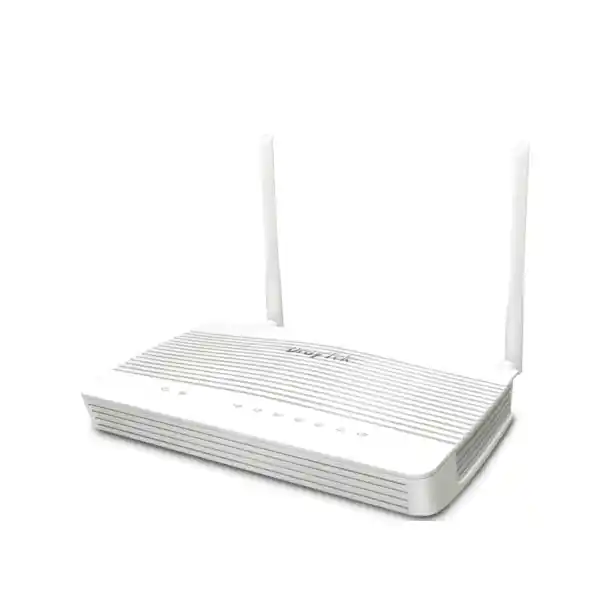
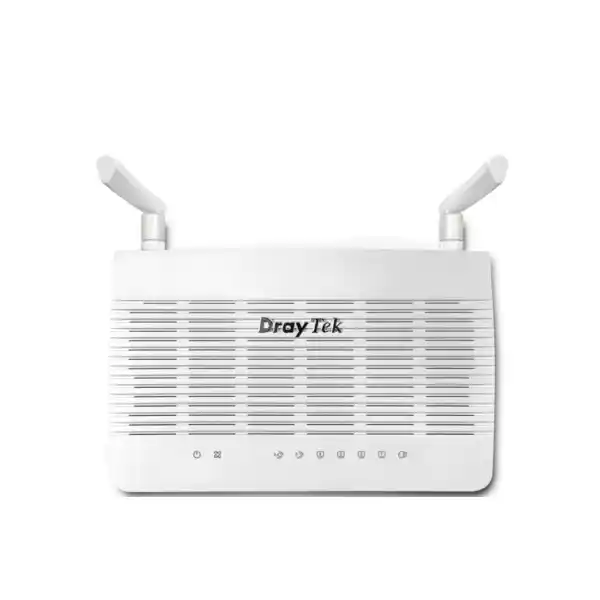
DrayTek Vigor2767 in UAE
The DrayTek Vigor2767 is a compact wired security router built for organizations that still depend on DSL access but do not want the LAN, VPN, segmentation and policy-control limitations of a basic ISP gateway. It integrates a VDSL2 profile 35b / ADSL2+ modem with a 2.5GbE switchable LAN/WAN port, three Gigabit LAN ports, USB expansion, advanced routing and practical business security controls.
Choose the Vigor2767 when you need an integrated VDSL2 35b modem and a business router in one appliance, especially where VLANs, policy routing, VPN and traffic control matter.
The base Vigor2767 is the wired model. If built-in Wi-Fi 6 is required, evaluate the Vigor2767ax variant instead.
What the DrayTek Vigor2767 is designed to solve
Many UAE branch offices, warehouses, professional practices, retail sites and managed residential networks sit in an awkward transition period. The access circuit may still be delivered over copper DSL, while the internal network has already moved to faster switching, cloud applications, encrypted tunnels, IP telephony, multiple VLANs and stricter segmentation. A basic carrier-supplied modem-router can terminate the line, but it often provides limited control over routing policy, traffic classes, network isolation, remote access and managed deployment. The Vigor2767 addresses that gap by combining the modem function and a business-oriented routing stack in one compact appliance.
The integrated DSL interface supports VDSL2 profiles including 8a, 8b, 8c, 8d, 12a, 12b, 17a, 30a and 35b, together with common ADSL standards such as G.dmt, ADSL2 and ADSL2+. That makes the platform useful where the service handoff is directly on an RJ-11 copper pair. Profile 35b, often associated with supervectoring deployments, extends the usable VDSL frequency range and can provide substantially higher rates than older VDSL2 profiles when the provider network, loop length and copper condition support it. DrayTek rates the Vigor2767 family for VDSL2 35b download link speeds up to 300 Mbps, but DSL performance is always line-dependent rather than guaranteed by the router alone.
The second design problem is migration. Organizations rarely want to replace an otherwise capable edge router the day they upgrade from DSL to an Ethernet-delivered circuit. The Vigor2767 includes one 2.5GbE RJ-45 interface that can operate as LAN or WAN, allowing the same device to participate in an Ethernet WAN design. That flexibility means the appliance can begin life as a DSL router, later accept a faster Ethernet handoff, or be engineered around primary/backup connectivity depending on the final topology and supported firmware configuration. For UAE deployments where provider migration schedules, temporary circuits or site-by-site upgrades are common, that flexibility can be operationally valuable.
Hardware and interface architecture
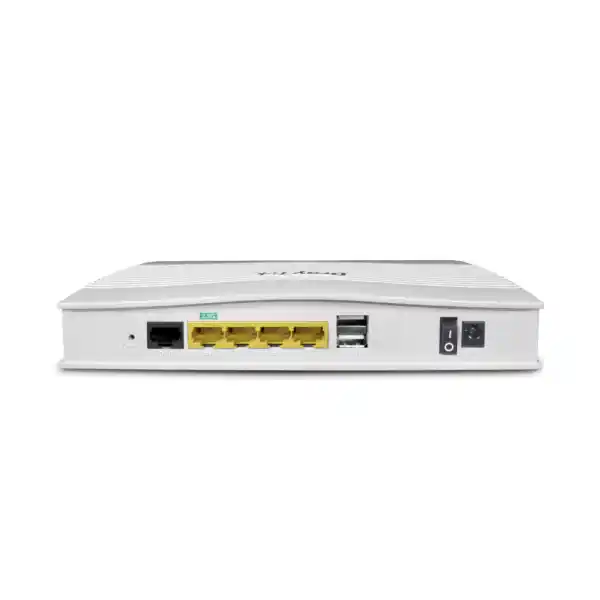
The Vigor2767 keeps its physical design intentionally compact. The dedicated RJ-11 xDSL port terminates VDSL2 or ADSL service. Beside it, the 2.5GbE RJ-45 port provides the important high-speed LAN/WAN role, while three additional fixed Gigabit Ethernet LAN ports serve local switching requirements. Two USB 2.0 ports support compatible expansion functions defined by firmware and accessory compatibility. The appliance uses an external DC power adapter and is designed for desk, shelf or communications-cabinet deployment rather than for rack-native installation.
For the base Vigor2767, the absence of integrated wireless is an advantage in environments where WLAN is handled by dedicated access points. Separating routing from Wi-Fi allows AP placement to be driven by RF design rather than by where the DSL line enters the premises. It also avoids replacing the router merely because wireless standards evolve. A branch can deploy ceiling or wall-mounted business APs in the correct coverage zones, connect them through the wired LAN, and retain the Vigor2767 as the gateway and policy device. Where integrated wireless is specifically desired, the Vigor2767ax is the related Wi-Fi 6 model and should be treated as a separate SKU for procurement.
DrayTek lists the chassis at approximately 207 × 131 × 42 mm. The vendor product specification for the wired unit lists DC 12V at 1.15A input and maximum power consumption around 13.7 W. These figures are useful when planning a small UPS, cabinet power budget or remote-site runtime. As with any network edge appliance in the Gulf, install it in a ventilated, temperature-controlled area and avoid enclosed locations where heat accumulates. Line protection, structured cabling quality and stable power are equally important for long-term DSL and Ethernet stability.
Port map at a glance
VDSL2 profile 35b and ADSL compatibility
The key reason to choose the Vigor2767 instead of a generic Ethernet-only firewall is its integrated copper broadband modem. VDSL2 profile 35b expands the frequency plan used by the DSL system and is intended to deliver higher throughput on sufficiently short and clean copper loops when the carrier DSLAM or access node supports the same profile. In a real deployment, attainable rate depends on loop length, cable gauge, joints, interference, crosstalk, provider configuration and whether vectoring or other line-management technologies are active. Therefore, the router’s “up to” DSL rate should be considered a capability ceiling rather than an expected speed at every site.
Backward compatibility matters just as much as peak capability. The Vigor2767 supports a broad set of VDSL2 profiles, so it can work on installations where the provider has not enabled profile 35b. It also supports legacy ADSL technologies, including ITU-T G.992.1, G.992.3 and G.992.5 families. Annex support published for the series covers common Annex A, B, J and M modes. This is useful for organizations with mixed estates because a standardized router platform can potentially be used across multiple sites with different copper access technologies, subject to country, line and ISP interoperability.
For UAE procurement, FourTeck recommends validating the service handoff before shipment. The important questions are: is the circuit true DSL on an RJ-11 pair, an Ethernet handoff from an ONT, or a managed CPE service where the provider requires its own modem? What encapsulation is used? Is the service PPPoE, DHCP/IPoE, routed static addressing, or a bridge arrangement? Are VLAN tags required on the WAN? Is the voice service separate from the data circuit? The answers determine whether the Vigor2767 should terminate the access line directly, sit behind a provider device, or use its Ethernet WAN interface.
Where the ISP mandates a specific modem or ONT, the Vigor2767 can still be relevant as the downstream business router if the handoff is Ethernet and the 2.5GbE port is configured appropriately. This is one reason not to view the Vigor2767 purely as a DSL modem. Its value is the combination of access flexibility and routing policy. A correct site survey avoids buying a modem function that cannot be used, while also preventing under-specification of the routing, segmentation and VPN functions that the site actually needs.
Routing performance and the 2.5GbE design
Aggregate NAT throughput
DrayTek publishes up to 2.3 Gbps aggregate NAT throughput for the Vigor2767 Series under its internal test conditions. This figure shows that the platform is not limited to DSL-class routing speeds and helps explain the inclusion of a 2.5GbE Ethernet port. Actual throughput can be lower when VPN encryption, filtering, traffic analysis, QoS, logging or other packet-processing functions are enabled.
Single-client reality
The vendor states that a single 1GbE client can reach approximately 950 Mbps in its routing test context. This reflects the practical payload ceiling of Gigabit Ethernet after protocol overhead. The 2.5GbE port becomes more valuable when traffic is aggregated from several clients or when connected to a multi-gigabit switch, faster WAN handoff or high-capacity downstream device.
Hardware acceleration
Published maximum routing figures assume favorable conditions and, where applicable, accelerated forwarding. Engineers should size on the intended feature set rather than headline NAT numbers. A site that uses multiple VPN tunnels, strict QoS, URL reputation, extensive logging and complex policies should be validated against realistic traffic patterns before rollout.
Migration path
Because the 2.5GbE interface can be repurposed as WAN, the router can remain useful after a copper-to-Ethernet service migration. This is attractive for phased branch upgrades: deploy the standard policy template now on DSL, then change the WAN design later without rebuilding every VLAN, DHCP reservation, VPN profile and access policy from a different platform.
The practical sizing question is not “can the router pass 2.3 Gbps?” but “what is the sustained traffic profile with the exact services we intend to enable?” A small accounting office with a 200 Mbps DSL connection and one IPsec tunnel has different requirements from a branch using a 1 Gbps Ethernet service, several simultaneous VPNs, application-aware QoS, web filtering and frequent large cloud backups. FourTeck can help map the expected traffic mix to the correct DrayTek platform rather than choosing solely by port speed.
VPN architecture for branches, remote users and managed access
The Vigor2767 is designed to serve as more than an Internet breakout router. DrayTek specifies support for up to 16 VPN tunnels on the series and publishes IPsec throughput up to 300 Mbps under its test conditions. Supported VPN approaches include IPsec, WireGuard and OpenVPN, while EasyVPN features are intended to reduce the configuration burden for teleworkers. These options let network designers choose between established site-to-site interoperability, modern lightweight tunneling and client-oriented remote access according to policy and endpoint compatibility.
For site-to-site networking, a common design is to connect a UAE branch to a headquarters firewall, data center, cloud gateway or another DrayTek router. The tunnel should be scoped to the exact internal prefixes that need communication. VLANs containing guest devices or unmanaged IoT equipment should normally be excluded unless there is a documented business requirement. When overlapping RFC1918 address ranges exist between locations, the addressing plan should be corrected before deployment where possible; relying on translation workarounds makes troubleshooting harder and creates long-term operational debt.
Remote-user design is different. Users may connect from home broadband, hotel Wi-Fi or mobile networks, so authentication, endpoint security, split-tunnel policy and DNS behavior matter as much as raw tunnel establishment. WireGuard can offer a simple, efficient tunnel model, while IPsec remains valuable for broad standards-based interoperability. OpenVPN can be useful where its client ecosystem matches the business requirement. EasyVPN can simplify profile deployment for supported scenarios, but the final choice should follow organizational security policy rather than convenience alone.
The 300 Mbps published IPsec figure is a laboratory maximum, not a guarantee for every cipher suite, packet size or bidirectional workload. Encryption algorithms, tunnel count, concurrent flows, logging and additional inspection all consume resources. If a branch has a 1 Gbps circuit but expects most traffic to traverse encrypted site-to-site tunnels, a higher-performance security platform may be more appropriate. Conversely, a 100–250 Mbps branch with modest VPN demand may find the Vigor2767 well aligned to its throughput class.
FourTeck can assist with VPN topology design, tunnel parameter standardization, secure management addressing and migration from ad-hoc remote-access configurations. For broader network and infrastructure assistance in the UAE, see FourTeck IT Services UAE. The goal is not merely to make a tunnel come up, but to ensure that routing, DNS, segmentation, failover behavior and support documentation remain predictable after deployment.
VLAN segmentation and multi-network design
A modern small office may look simple physically while containing very different security zones logically. Staff workstations, finance systems, IP phones, CCTV cameras, access-control panels, printers, guest Wi-Fi, building-management devices and administrator laptops should not automatically share one flat broadcast domain. The Vigor2767 provides VLAN and multi-subnet functions that allow a more deliberate design when paired with managed switching and, where required, business access points.
The first step is to define trust zones rather than VLAN numbers. A practical design might separate corporate users, voice, surveillance, guest access and infrastructure management. The router then becomes the Layer-3 policy point between those segments. Corporate users may need access to printers and specific internal applications. Guest clients usually need Internet access only. CCTV cameras may need to reach an NVR and time server but should not initiate connections to user devices. Infrastructure management should be restricted to IT administrators or a management jump host. By writing policy around these relationships, segmentation becomes understandable and auditable.
802.1Q tagging is especially relevant when a single router port must carry several logical networks to a managed switch. The switch can then present untagged access ports to endpoints and tagged trunks to APs, additional switches or the router as required. Correct native VLAN and PVID configuration is essential; mismatched tagging often causes intermittent connectivity that appears to be a routing problem. DHCP scopes, gateway addresses and DNS options must also be designed for each subnet.
Segmentation is not automatically security. If every inter-VLAN rule is set to “allow any,” the network is merely divided into more broadcast domains. The benefit comes from explicit policy. Start with the traffic flows the business requires, permit those flows, and restrict the rest. Logging should focus on important deny events and administrator activity rather than producing an unmanageable volume of noise. Where advanced threat prevention, full SSL inspection or enterprise-grade NGFW controls are required, the Vigor2767 should be evaluated as part of a wider architecture rather than assumed to replace a dedicated next-generation firewall.
For organizations comparing branch-edge routing with dedicated firewall platforms, FourTeck’s Firewall Dubai resource can help frame the difference between a feature-rich security router and a higher-end NGFW. The correct choice depends on threat model, compliance obligations, encrypted-traffic inspection requirements, bandwidth and operational complexity.
QoS, application control and bandwidth fairness
Bandwidth problems are not always caused by an undersized Internet circuit. A single cloud backup, operating-system update or bulk file transfer can fill a constrained upstream link and make voice, video meetings or interactive applications feel unreliable. The Vigor2767 includes bandwidth management features such as IP-based bandwidth limits, session limits, traditional QoS and application-aware QoS tools. These controls can protect latency-sensitive traffic and prevent a small number of clients from monopolizing the available capacity.
Good QoS starts with measurement. Classify traffic according to business importance, then reserve or prioritize only what actually needs protection. Voice signaling and RTP media, for example, should receive predictable treatment, but assigning every business application to the highest class defeats the scheduler. Bulk cloud synchronization, software updates and guest downloads can be given lower priority without blocking them completely. The objective is graceful congestion behavior, not arbitrary throttling.
On DSL, upstream bandwidth is often the tighter constraint. Even when downstream performance looks healthy, a saturated upload can create queueing delay and degrade interactive traffic in both directions. Engineers should therefore shape traffic against measured line rates rather than nominal package speeds. After deployment, test voice quality and application latency while deliberately generating upload and download load; this validates the policy under congestion instead of only during quiet periods.
Route policy and controlled WAN behavior
Policy-based routing allows traffic decisions to use more context than a single default route. In a dual-access or migration scenario, selected subnets, applications or destinations can be steered toward a preferred WAN path. This is useful when a site retains DSL as a backup while a new Ethernet service is introduced, or when business-critical services need deterministic egress behavior for source-IP whitelisting.
The design must still account for return-path symmetry, NAT state and VPN routing. Sending outbound packets through one interface while the corresponding return traffic arrives on another can break stateful sessions. Static public IP services and inbound NAT mappings also require careful failover planning because a backup circuit usually has a different public address. Dynamic DNS can help in some remote-access designs, but it does not replace application-level resilience or proper DNS TTL planning.
For branch standardization, document policy rules in plain language before implementing them. An entry such as “Finance VLAN to ERP cloud prefix via WAN2, fall back to WAN1 if health check fails” is easier to review than an unexplained sequence of router rule numbers. Documentation reduces configuration drift and helps support teams distinguish intended behavior from accidental routing changes.
Security features: what the Vigor2767 can and cannot replace
DrayTek positions the Vigor2767 as a security router and includes firewall-oriented controls such as stateful packet handling, NAT policy, URL/IP reputation functions, access rules and network segmentation. For a small branch, these capabilities can provide a substantial improvement over an unmanaged ISP router. They are particularly effective when combined with disciplined configuration: close unnecessary inbound services, restrict management access, keep firmware current, disable unused features, segment untrusted devices and use strong VPN authentication.
However, “security router” and “enterprise next-generation firewall” are not interchangeable categories. Organizations that require full TLS decryption, sandboxing, advanced malware inspection, large commercial threat-intelligence feeds, application control at high encrypted throughput or formal compliance reporting should compare the Vigor2767 with dedicated NGFW platforms. The right architecture may place a separate firewall behind a carrier modem, or may use an integrated higher-end firewall with a different WAN termination method.
URL and IP reputation functions are useful for reducing exposure to known risky destinations, but reputation should be treated as one layer. It does not replace endpoint detection, DNS protection, secure email, application patching, identity controls or user awareness. Similarly, a default-deny inbound firewall does not prevent a compromised internal endpoint from initiating allowed outbound sessions. Small organizations obtain the best result when router policy, endpoint security, backups and identity controls are designed together.
Management-plane security deserves special attention. The router’s administrative UI should be limited to trusted internal networks or secure VPN access. Avoid exposing administration directly to the public Internet unless there is a documented, hardened requirement. Use role separation where supported, back up configuration after approved changes, and retain firmware and change-management records. Syslog or SNMP integration can improve visibility if the organization operates centralized monitoring.
FourTeck can review whether the Vigor2767 is sufficient for the intended risk profile or whether the project should use a dedicated firewall platform. UAE customers can also explore broader network, security and infrastructure options through FourTeck UAE. Product selection should follow the security requirement, not the other way around.
Centralized management with VigorACS 3
Managing one branch router manually is straightforward; managing dozens across different Emirates, customers or remote sites is a different operational problem. DrayTek supports VigorACS 3 for centralized lifecycle management of compatible devices. The platform is intended to help with provisioning, monitoring, configuration, firmware operations and service visibility across distributed DrayTek estates. For managed service providers or organizations with many small branches, centralization can reduce the cost and risk of router-by-router administration.
The operational advantage starts before the device is installed. A standard configuration template can define address plans, WAN assumptions, DNS policy, admin access, VPN objects, VLANs and monitoring settings. Site-specific values are then applied in a controlled way. When every branch follows the same baseline, incident resolution is faster because support staff know what “normal” should look like. Configuration drift becomes easier to identify, and replacement hardware can be restored more predictably.
Central management does not remove the need for change control. Automated deployment can also automate mistakes. Separate lab and production templates, test firmware before broad release, keep recovery copies of known-good configurations and schedule maintenance windows for disruptive changes. For DSL sites, remember that a firmware reboot also interrupts line synchronization, so the actual outage can be longer than the reboot timer alone suggests.
Monitoring should focus on indicators that drive action: WAN link state, DSL synchronization, error trends, latency, packet loss, VPN status, resource pressure and interface utilization. Alerting on every minor event creates fatigue. A useful managed service combines threshold-based alerts with periodic health review and configuration backup. Where a site has unstable DSL, historical line information can help separate local LAN issues from copper-line degradation or provider-side faults.
If the project extends beyond a single UAE site, FourTeck can support standardized rollout and broader infrastructure planning through its global FourTeck platform. This is useful for organizations that want consistent naming, documentation and support practices across multiple countries while retaining local deployment considerations.
Deployment patterns in UAE environments
Professional office on DSL
The Vigor2767 terminates the VDSL2 line directly. Corporate PCs, printers and VoIP endpoints sit on separate VLANs through a managed switch. A site-to-site VPN connects the office to a head office or cloud environment. QoS protects voice and interactive SaaS traffic when the upstream DSL rate is busy. Dedicated Wi-Fi APs provide wireless coverage independently from the router.
Retail branch with backup access
A primary fixed circuit supports point-of-sale, inventory and cloud applications, while a compatible secondary access path is retained for resilience. Route policy prioritizes business systems and keeps guest traffic from consuming critical bandwidth. VPN connectivity to headquarters is monitored as a service, not just assumed because the WAN link is up.
Managed villa or premium home office
The wired router is placed near the service entry and core switch, while ceiling APs are located for coverage. Work, guest, CCTV and smart-home devices receive separate subnets. Remote administration is available only through VPN. The router remains hidden in the communications area rather than being placed in the living space merely to improve Wi-Fi signal.
Temporary or migrating branch
A site begins with DSL during fit-out, construction or provider lead time. Once an Ethernet handoff becomes available, the 2.5GbE port is reassigned as WAN and the existing routing, VLAN, DHCP and VPN framework is retained. This reduces migration effort and avoids replacing a router solely because the access medium changed.
Small warehouse or workshop
Handheld devices, office PCs, cameras and access-control equipment are segmented into distinct networks. The gateway applies inter-VLAN rules and sends monitoring logs to a central service. Because industrial sites may expose network hardware to heat and dust, the router is installed inside a cooled, protected cabinet with proper power conditioning.
Multi-site SMB standard
Several branches use the same router family, address plan and VPN template. VigorACS-compatible management supports standardized administration. The organization keeps one documented baseline and applies only site-specific WAN, subnet and tunnel parameters, simplifying support compared with a mixture of unrelated consumer routers.
Sizing the Vigor2767 correctly
Router sizing should start with measured or forecast traffic, not user count alone. Ten software developers moving large repositories and cloud images can generate more traffic than fifty administrative users working mainly in browser-based applications. Likewise, a small CCTV system can create significant continuous traffic if recordings cross the router, while local switching of camera traffic may have very little impact on WAN bandwidth. Build a traffic model that separates Internet, inter-VLAN, VPN and local switching flows.
For the WAN, record both download and upload rates. DSL packages are often asymmetric, and the lower upstream rate can be the point at which voice quality or remote desktop performance begins to suffer. If the site will migrate to Ethernet later, size for the future circuit rather than only the current DSL connection. The 2.5GbE interface gives headroom at the port level, but feature processing still needs to match the intended throughput.
For VPN, estimate the proportion of traffic that will be encrypted. A branch where only ERP traffic traverses one tunnel may have modest VPN load even on a fast Internet circuit. A branch using full-tunnel SD-WAN-like routing back to headquarters can push nearly all traffic through encryption. Compare that requirement with the vendor’s published VPN performance and apply engineering margin. Do not size production at the absolute laboratory maximum.
For ports, the Vigor2767 provides three fixed Gigabit LAN ports plus the flexible 2.5GbE interface. Most business deployments should connect the router to a managed switch rather than treat the router as the only access switch. That allows PoE, more ports, VLAN trunks, link aggregation where needed and cleaner cable management. If the 2.5GbE port is used as WAN, LAN uplink choices should be reviewed so the internal switching design does not become the bottleneck.
For wireless, remember that the standard Vigor2767 has no built-in radio. This is usually acceptable or preferable in offices that already use managed APs. If a single-box router with Wi-Fi is required, evaluate the Vigor2767ax. Do not buy the wired model expecting a firmware switch to enable WLAN; the hardware variants are different.
Finally, include operational features in the sizing decision. Logging, content reputation, QoS, VPN and complex rule sets consume resources differently. The best pre-sales test is a representative configuration running a representative traffic mix. Where this is not possible, select with margin and a clear upgrade path.
Technical specification summary
| Product | DrayTek Vigor2767 wired 35b security router |
| DSL WAN | 1 × RJ-11, VDSL2 including profile 35b, backward-compatible VDSL2 and ADSL modes |
| VDSL2 profiles | 8a, 8b, 8c, 8d, 12a, 12b, 17a, 30a, 35b |
| ADSL family | T1.413 Issue 2, G.992.1 ADSL, G.992.3 ADSL2, G.992.5 ADSL2+; regional compatibility should be confirmed |
| Flexible Ethernet | 1 × 2.5GbE RJ-45, switchable LAN/WAN |
| Fixed LAN | 3 × Gigabit Ethernet RJ-45 |
| USB | 2 × USB 2.0 |
| NAT performance | Up to 2.3 Gbps aggregate under DrayTek test conditions |
| VDSL2 35b link rate | Up to 300 Mbps downstream capability under suitable service and line conditions |
| VPN capacity | Up to 16 tunnels; IPsec throughput up to 300 Mbps in vendor tests |
| VPN technologies | IPsec, WireGuard, OpenVPN and EasyVPN-supported deployment workflows |
| Network controls | VLANs, route policy, DHCP, IPv4/IPv6 functions, QoS, bandwidth/session controls, NAT and firewall policies |
| Central management | VigorACS 3 compatibility for supported centralized management workflows |
| Wireless | None on standard Vigor2767; Wi-Fi 6 is associated with the Vigor2767ax variant |
| Dimensions | Approximately 207 × 131 × 42 mm |
| Power | DC 12V input; vendor web specification lists maximum consumption around 13.7 W for the wired model |
Published performance values are maximum vendor test results and can vary with firmware, enabled applications, packet size, traffic direction, line conditions and configuration. Confirm the current regional datasheet and firmware feature set before final project sign-off.
How to design the LAN around a Vigor2767
The router should normally sit at the edge of a structured LAN rather than act as the whole LAN. In a small branch, connect a managed switch to an appropriate LAN interface, then build access ports and trunks according to the VLAN plan. If the organization needs PoE for phones, cameras or access points, use a PoE switch sized for both port count and wattage. The Vigor2767 itself is not a substitute for a PoE access switch.
Use a dedicated management VLAN for switches, APs and infrastructure devices where operational complexity justifies it. Restrict that network so normal users cannot browse directly to administrative interfaces. Give infrastructure predictable addresses using static assignments or controlled DHCP reservations. Consistent naming, for example BR01-SW01 or DXB-OFFICE-AP03, helps support teams identify devices quickly in monitoring tools.
If the 2.5GbE port is used as a LAN uplink, pair it with a switch that actually supports 2.5GbE if the higher rate is needed. Connecting it to a 1GbE port is valid but will negotiate at the lower common speed. If the 2.5GbE interface is used for Ethernet WAN, then the LAN design will rely on the remaining Gigabit interfaces, so aggregate internal-to-WAN capacity should be considered. In many DSL deployments this is not a limitation because the WAN rate is far below 1 Gbps.
For Wi-Fi, place access points according to RF coverage and capacity. One centrally placed router in a cabinet rarely provides the best wireless result even when the router includes Wi-Fi. The wired Vigor2767 therefore pairs naturally with distributed APs. Trunk the required VLANs to APs so corporate and guest SSIDs can map to different security zones. Apply guest isolation at both the wireless and routing layers where appropriate.
Avoid creating unnecessarily complex networks in very small sites. Segmentation should reduce risk without becoming impossible to support. A four-VLAN design with clear policy often performs better operationally than a fifteen-VLAN design nobody documents. The right architecture is the simplest one that satisfies security, performance and business requirements.
ISP and UAE deployment considerations
Before using the Vigor2767 as the direct WAN termination device, confirm that the local service is compatible with customer-owned CPE. UAE fixed-broadband services can be delivered through different access technologies and provider-managed devices. A building may use fibre to an ONT even if internal cabling resembles older phone infrastructure. Another site may have a provider router that also carries voice or managed services. Replacing or bypassing that equipment without understanding the service can interrupt connectivity.
Collect the existing WAN parameters before change day. Record PPP usernames where used, VLAN IDs, static IP allocations, gateway details, DNS settings, MTU requirements and any MAC-based service assumptions. If the provider device is currently performing NAT, decide whether it will be bridged, retained in front of the Vigor2767 or removed entirely. Double NAT may be acceptable for a temporary setup but can complicate inbound services, IPsec and remote access.
Power and environmental design matter in the UAE climate. Network devices should be installed in cooled indoor spaces with air movement, especially when enclosed in wall cabinets. A compact UPS can keep the router, ONT or modem, core switch and one access point alive during short power interruptions, preserving remote access and business communications. UPS runtime should be calculated for the whole connectivity chain; protecting only the router does not help if the upstream ONT loses power.
Copper DSL lines are also sensitive to physical conditions. Poor internal telephone wiring, unnecessary splitters, oxidized joints and long extension cables can reduce synchronization rate or increase errors. Where direct DSL termination is planned, use the cleanest possible path from the provider demarcation to the router and separate data cabling from electrical interference sources. A router upgrade cannot compensate for severely degraded copper.
For larger UAE projects, FourTeck can coordinate router supply with switching, wireless, firewalling, structured network design and deployment services. This reduces the risk of treating the router as an isolated purchase when the real requirement is an end-to-end branch network.
Best fit
Small and medium offices, professional home offices, retail branches, managed residential networks, clinics, workshops and other sites that need direct VDSL2/ADSL termination plus business routing, VLANs, QoS and moderate VPN capacity.
Review carefully
Sites with sustained multi-gigabit security inspection, heavy encrypted traffic, advanced threat-prevention requirements, large numbers of users, extensive SSL inspection or strict regulatory controls may require a higher-end firewall/router platform.
Strong migration use case
Branches that start on DSL but expect an Ethernet service later can benefit from the switchable 2.5GbE LAN/WAN port, retaining much of the router configuration when the access medium changes.
Not the right SKU if
You require integrated Wi-Fi from the router. The standard Vigor2767 is wired; choose the Vigor2767ax or pair the Vigor2767 with external business access points according to coverage requirements.
Configuration methodology for a clean deployment
A reliable deployment starts with a written low-level design, even for a small branch. Record the WAN type, addressing, VLANs, DHCP scopes, DNS servers, route policies, VPN peers, firewall rules, management networks and monitoring destinations. Identify which items are global standards and which are unique to the site. This document becomes the checklist for staging, testing and future support.
Stage the router off-site where possible. Upgrade to an approved firmware version, change default administrative credentials, set system time and NTP, configure management restrictions, build VLAN interfaces, create DHCP scopes and prepare VPN objects. If a DSL circuit cannot be reproduced in the lab, at least validate the LAN, routing and policy behavior before traveling to site. Pre-staging reduces downtime and limits the number of changes made under pressure.
During cutover, establish the WAN first and confirm public addressing, DNS resolution and MTU-sensitive applications. Next validate each VLAN from a representative access port or SSID. Confirm DHCP options, default gateway, DNS, inter-VLAN restrictions and Internet access. Then test VPNs in both directions. Do not consider a site-to-site tunnel complete simply because the status page shows “up”; test the actual application flows and confirm that prohibited networks remain blocked.
Generate controlled congestion to test QoS. Make a voice or video call while running large uploads and downloads. If call quality collapses, adjust shaping to the real line rate and verify class matching. Test WAN failure where a backup path is part of the design, and confirm not only that Internet access returns but that DNS, VPN and critical applications recover as intended.
After acceptance, export a configuration backup and record the firmware version, device serial number, circuit details and support contacts. Store the backup securely with the site documentation. If centralized management is used, confirm the device is checking in correctly and alerts are routed to the right support team. A technically correct configuration that nobody can recover after a hardware failure is not an operationally complete deployment.
FourTeck can provide supply-only or assisted deployment depending on project scope. For organizations building a broader UAE network stack, the main FourTeck UAE site provides additional access to infrastructure categories and services.
Operational security baseline
A small-router deployment often fails operationally because routine practices are ignored, not because the hardware lacks features. A consistent baseline turns the Vigor2767 from a standalone appliance into a manageable part of the organization’s network control plane.
Frequently asked technical questions
Does the standard Vigor2767 include Wi-Fi?
No. The standard Vigor2767 is the wired model. The Vigor2767ax is the related variant with Wi-Fi 6. For many offices, using the wired router with dedicated business access points provides better placement, scalability and lifecycle independence.
Can it be used if the site later moves from DSL to Ethernet Internet?
Yes, that is one of its useful design characteristics. The 2.5GbE RJ-45 interface is switchable between LAN and WAN roles, so an Ethernet handoff can be incorporated. The exact cutover design should consider how the remaining LAN ports, addressing and failover requirements are affected.
Will it always deliver 300 Mbps over VDSL2?
No. DrayTek lists up to 300 Mbps capability for VDSL2 35b, but actual synchronization depends on the provider profile, copper loop length, line quality, crosstalk and network conditions. The router cannot create 35b performance if the carrier circuit or physical line does not support it.
Is 2.3 Gbps the guaranteed Internet throughput?
No. It is a vendor maximum aggregate NAT result under test conditions. Real performance varies with enabled services and traffic. Internet speed is also limited by the WAN service and link speed. Engineers should size using the intended security, QoS and VPN configuration rather than a single headline number.
How many VPN tunnels are supported?
DrayTek lists up to 16 VPN tunnels for the Vigor2767 Series. The platform supports IPsec, WireGuard and OpenVPN use cases, with published IPsec throughput up to 300 Mbps in vendor testing.
Can it replace an enterprise firewall?
It depends on the requirement. The Vigor2767 provides business routing, stateful firewall controls, segmentation, reputation-oriented features, VPN and QoS. Organizations requiring advanced NGFW inspection, high-throughput TLS decryption, sandboxing or specialized compliance reporting should compare dedicated firewall platforms.
Can FourTeck help verify ISP compatibility?
Yes. Provide the current service type, provider equipment, WAN handoff, authentication method, public IP requirement and any VLAN information. This allows the deployment design to be checked before ordering or cutover.
What should be connected to the 2.5GbE port?
That depends on topology. It can operate as Ethernet WAN or as a faster LAN interface. In LAN mode it is useful for an uplink to a multi-gigabit switch or other high-speed device; in WAN mode it supports migration beyond DSL. Port role should be finalized before cabling and VLAN design.
Why source DrayTek Vigor2767 through FourTeck UAE
A router purchase is only successful when the chosen model matches the access circuit, security requirement and operational plan. FourTeck approaches the Vigor2767 as part of a branch architecture rather than as an isolated hardware SKU. Before quotation, the team can review whether the service is DSL or Ethernet, whether built-in Wi-Fi is needed, how many VLANs are planned, the expected VPN load, public-IP requirements and whether the site needs managed switching or dedicated access points.
This is particularly useful when customers are comparing similar model names. The Vigor2767 and Vigor2767ax are not interchangeable descriptions; the base model is wired and the ax variant adds Wi-Fi 6 hardware. Ordering by family name without confirming the exact variant can lead to a deployment mismatch. FourTeck can align the quoted SKU with the project’s actual wireless and WAN design.
For multi-site projects, the value extends to standardization. A consistent template for branch addressing, VPN, VLANs, naming and monitoring reduces deployment time and support complexity. Equipment can be staged, documented and rolled out with site-specific parameters rather than configured from scratch at every location. When requirements exceed the Vigor2767’s class, the project can be escalated to a more suitable firewall or routing platform instead of forcing an undersized device into service.
FourTeck supports UAE customers with networking, security, servers, communications and managed infrastructure services. If the project includes a broader infrastructure refresh, visit FourTeck global or the UAE-focused resources already linked on this page for related solutions.
Decision recap: when the Vigor2767 is the right router
Choose it when
Your site uses VDSL2/ADSL or needs a router that can bridge the transition from DSL to Ethernet WAN.
You need VLANs, policy routing, business VPN and traffic management beyond typical ISP gateways.
You prefer dedicated wireless APs and therefore do not need Wi-Fi built into the router.
Reconsider it when
Your security policy requires full next-generation firewall inspection, sandboxing or high-throughput TLS decryption.
Your VPN demand is likely to exceed the platform’s performance class by a large margin.
You require integrated wireless and do not want to deploy separate APs; in that case evaluate the Vigor2767ax.
Validate before order
Exact WAN handoff and ISP compatibility.
Required firmware features, VPN method and management approach.
Whether the 2.5GbE port will be used as WAN or LAN, because this influences the physical LAN design.
Quotation input checklist
For the fastest accurate quotation and deployment recommendation, send the information below. Complete data helps distinguish a simple hardware supply request from a branch-network design that requires configuration, switching, access points or firewall alternatives.
Consult with FourTeck before finalizing the Vigor2767
The DrayTek Vigor2767 is a strong fit when the project needs direct VDSL2 35b termination, an upgrade path to Ethernet WAN, practical branch security, VLAN segmentation, bandwidth control and moderate VPN capacity in a compact wired platform. Its most important strength is balance: it combines the access modem and business router functions without forcing the network to depend on integrated Wi-Fi.
For a clean UAE deployment, verify the ISP handoff, future circuit plan, VPN throughput, security expectations and LAN topology before ordering. This ensures the 2.5GbE interface is assigned correctly and that the router is paired with the right switches, access points and protection platform. If the requirement moves into advanced NGFW territory or higher encrypted throughput, FourTeck can recommend an alternative rather than overextending the Vigor2767.
Send the quotation checklist details and FourTeck can prepare the appropriate hardware, configuration and service scope for Dubai, Abu Dhabi, Sharjah and other UAE locations.
Confirm whether you need the wired Vigor2767 or the Wi-Fi 6 Vigor2767ax.
Confirm direct DSL compatibility or Ethernet WAN handoff.
Confirm VPN, VLAN and firewall expectations against the performance class.

Reviews
There are no reviews yet.