
DrayTek Vigor2865L LTE & VDSL2 35b Multi-WAN VPN Router
A resilient branch-edge router for organizations that need DSL, Gigabit Ethernet and built-in 4G LTE connectivity in one platform, with policy-based routing, VPN, firewall, bandwidth management, high availability and centralized DrayTek management capabilities.
Designed for environments where business continuity depends on having more than one practical path to the Internet.
Direct answer: what the Vigor2865L is and where it fits
The DrayTek Vigor2865L is the non-wireless member of the Vigor2865 LTE family. Its defining value is WAN diversity: it integrates a VDSL2/ADSL2+ modem, a Gigabit Ethernet port that can be used as WAN or LAN, and an embedded LTE modem with two SIM slots. The cellular module is designed for 4G LTE Cat 6 operation, and one SIM is active at a time. This makes the appliance useful for organizations that do not want their edge connectivity strategy to depend on a single fixed line, a single carrier or a USB modem dangling from a router.
In a UAE deployment, the Vigor2865L can be positioned behind a business broadband service, connected directly to a compatible DSL service, used with mobile broadband as an immediate-primary connection for a new location, or configured with LTE as an automatic failover path. A common branch design uses VDSL2 or Ethernet broadband for day-to-day traffic, with the embedded LTE connection held in standby. If the primary circuit stops passing traffic, the router can move selected or all sessions to mobile broadband according to administrator-defined policies. When the fixed connection returns, the router can restore the preferred path without requiring staff at the branch to reconnect cables or reboot a consumer router.
The platform is also built for managed business networks rather than simple Internet sharing. DrayTek positions the family with support for multi-WAN load balancing, route policy, stateful packet inspection firewall functions, web content controls, Quality of Service, bandwidth and session controls, VPN, high-availability features, DrayDDNS, central management of compatible Vigor access points and switches, and registration to VigorACS for remote management. Those features make the Vigor2865L useful when the router must participate in an operational network design that includes remote sites, segmented LANs, voice traffic, cloud applications and centralized administration.
For UAE buyers comparing branch routers, the most important distinction is that the Vigor2865L is not a Wi‑Fi router. It is intended to sit at the network edge and work with separate access points when wireless coverage is required. That architecture can be an advantage for professional deployments because routing and WAN resilience can be planned independently from radio placement. Organizations can place ceiling-mounted access points where coverage is needed while keeping the router in a secure communications cabinet, rack or structured cabling location.
VDSL2 profile 35b
Integrated DSL interface supporting VDSL2 profiles including 35b and compatibility with ADSL-class services.
LTE Cat 6
Embedded LTE connectivity with two SIM slots, designed for mobile broadband backup or primary connectivity.
Up to 32 tunnels
Suitable for branch-to-head-office VPN and remote-access designs, subject to configuration and encryption load.
60,000 NAT sessions
A practical session capacity for small and mid-sized branch environments with many concurrent cloud and web connections.
Hardware architecture and physical interfaces
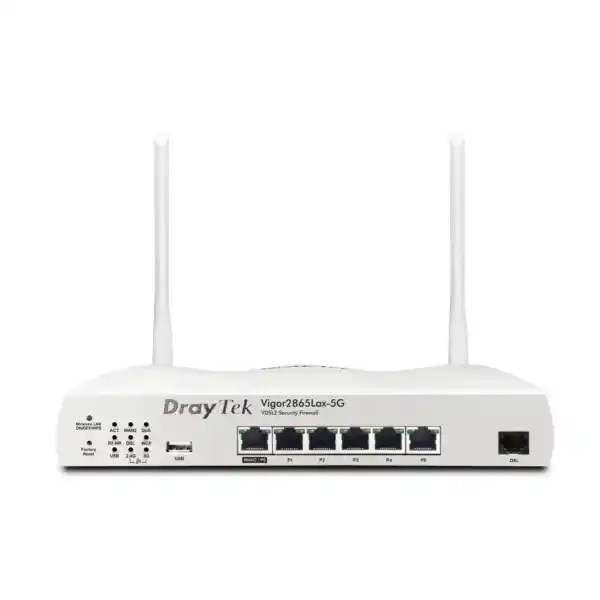
The physical design reflects the router’s role as a multi-access branch gateway. On the WAN side, the integrated RJ‑11 DSL interface provides the direct path for VDSL2 and ADSL-class services. DrayTek identifies support for VDSL2 profiles 8a, 8b, 8c, 8d, 12a, 12b, 17a, 30a and 35b, giving the unit flexibility across a variety of copper broadband deployments. Profile 35b, often associated with supervectoring deployments, extends the usable spectrum compared with older VDSL profiles and can permit significantly higher link rates where the local provider infrastructure, line quality and distance support it. Actual DSL sync rate remains dependent on the operator, copper loop, cabinet technology, interference environment and service profile.
A separate Gigabit Ethernet interface can operate as WAN or LAN. In a UAE office this is particularly useful when the Internet service arrives from an external fiber ONT, metro-Ethernet handoff, managed CPE device or another broadband modem. Instead of replacing the router when the site migrates from DSL to fiber, administrators can continue using the Vigor2865L as the security and policy gateway by moving the primary service to Ethernet WAN. This reduces disruption during access-technology changes and preserves configuration investments such as VPN, VLAN, firewall and route policies.
For the internal network, the chassis provides five fixed Gigabit Ethernet LAN ports in addition to the switchable Gigabit WAN/LAN port. That is enough for a compact office to connect a core switch, IP-PBX, server, access-point uplink or local workstation segment directly, but professional installations will normally connect the router to a managed switch and use VLANs to scale port density and segmentation. The Vigor2865L can then act as the routed policy boundary between trusted users, voice devices, guest access, IoT devices, management networks and other logical zones.
The LTE hardware is integrated into the platform instead of relying on an external USB dongle. Two standard-sized SIM slots are provided, while one SIM is online at a time. Dual-SIM capability is valuable for continuity planning because organizations can provision SIM cards from two mobile operators, subject to local compatibility and service availability. If the preferred mobile service is unavailable or unsuitable, administrators can change the active SIM according to the operational plan. This is not the same as bonding two LTE services simultaneously; it is a resilience feature that gives the router more than one provisioned mobile option.
The device includes a USB 2.0 interface for supported auxiliary functions. The chassis measures approximately 241 x 166 x 46 mm, accepts 12 V DC at 2 A, has a stated maximum power consumption of 24 W, and is specified for operation from 0 to 45°C with non-condensing humidity in the 10 to 90 percent range. Those limits are important for UAE installations: the router should be placed in a conditioned indoor environment with adequate ventilation, not in an uncooled roof enclosure, outdoor box or closed cabinet exposed to excessive heat. Power should be protected by an appropriate UPS where WAN continuity is a business requirement, because a backup LTE path is of little use if the router loses power during a mains interruption.
Performance planning: interpret headline figures correctly
DrayTek publishes performance figures for the Vigor2865 LTE family that include maximum NAT throughput around 800 Mbps in standard operation and up to about 1.3 Gbps where hardware acceleration is applicable, alongside up to 300 Mbps IPsec VPN throughput and a recommended 60,000 NAT-session capacity. These figures should be treated as platform capability indicators, not guaranteed application throughput. Real-world performance depends on packet size, enabled security features, QoS, traffic direction, encryption algorithm, number of tunnels, inspection policies, logging, WAN encapsulation and the characteristics of the service itself.
The LTE Cat 6 modem is described with a maximum cellular download rate of up to 300 Mbps. LTE category numbers are radio capability classifications, not promises of a fixed user speed. Mobile throughput in Dubai, Abu Dhabi, Sharjah or other UAE locations can vary sharply with signal quality, carrier aggregation availability, cell loading, building penetration, antenna position, subscription policy and the bands used by the operator. For resilient networking, stable latency and consistent signal can matter more than a short speed-test peak.
Likewise, VDSL2 profile 35b can support high DSL link rates under favorable conditions, but actual copper performance is driven by loop length and line quality. A site close to the DSL access equipment may achieve a substantially different result from a site served over a longer or noisier copper run. FourTeck therefore recommends sizing the Vigor2865L around the required application mix and continuity design rather than selecting it solely from theoretical port or radio maximums.
Multi-WAN design: primary, backup and balanced connectivity
Multi-WAN capability is the operational center of the Vigor2865L. A business router should not merely have multiple sockets; it should be able to determine which path is usable, decide which traffic belongs on which path and react when a service fails. The Vigor2865L provides mechanisms for failover, load balancing, active-on-demand behavior, route policy and connection detection. In practice, these tools allow an administrator to create a deterministic WAN strategy rather than leaving path selection to ad hoc manual changes.
Consider a retail branch with a fixed broadband circuit used for POS synchronization, cloud accounting, staff browsing and IP telephony. LTE can be configured as standby connectivity. Connection detection should be designed to identify not only whether the Ethernet or DSL interface is physically up, but whether useful upstream reachability still exists. If the access circuit fails beyond the local modem, a properly configured health check can trigger LTE failover. Critical traffic can then continue while nonessential services are restricted to protect the mobile data allowance.
In another deployment, DSL and Ethernet WAN may both be active. Load balancing can distribute sessions to improve aggregate use of available bandwidth, but administrators need to understand that session-based balancing is not the same as combining two links into one larger single flow. A large single download typically remains associated with one WAN path, while multiple sessions can be shared across paths. SaaS platforms that bind sessions to source IP addresses may also require persistence rules so that related connections stay on the same WAN.
Route policy provides more precise control. Voice, payment processing, management traffic or a head-office VPN can be pinned to a preferred WAN, while guest browsing uses a different path. Backup rules can define what happens if the preferred path becomes unavailable. For example, SIP traffic may normally use the lower-latency fixed service, but move to LTE during an outage. A cloud backup job could be prevented from using LTE entirely to avoid exhausting a capped mobile plan. Executive or operational traffic can be prioritized while low-priority updates are rate-limited during failover.
These policies are especially important when the mobile service is a continuity path rather than an unlimited primary connection. WAN data-budget controls can help organizations govern consumption. The correct threshold depends on the mobile package, business criticality and expected outage duration. Administrators should test failover before a real incident, verify DNS behavior, confirm VPN re-establishment, validate voice quality and document which applications continue during degraded operation.
LTE resilience and dual-SIM operating strategy
Integrated cellular networking simplifies a branch-resilience design because antenna, SIM and modem control are part of the router platform. There is no separate USB modem to source, power, update or accidentally disconnect. The Vigor2865L’s LTE Cat 6 capability gives the device a practical mobile path for emergency Internet access, temporary offices, kiosks, project locations and sites waiting for fixed service activation.
Dual SIM slots make it possible to keep two mobile subscriptions installed, although one SIM operates online at a time. This can be useful for carrier diversity. A business continuity plan may use one operator as the normal LTE backup and provision a second operator for contingencies where coverage or service conditions differ. The effectiveness of this approach depends on local signal conditions and the purchased plans, so a pre-deployment survey should check both carriers at the exact router location rather than assuming that city-wide coverage maps reflect indoor performance.
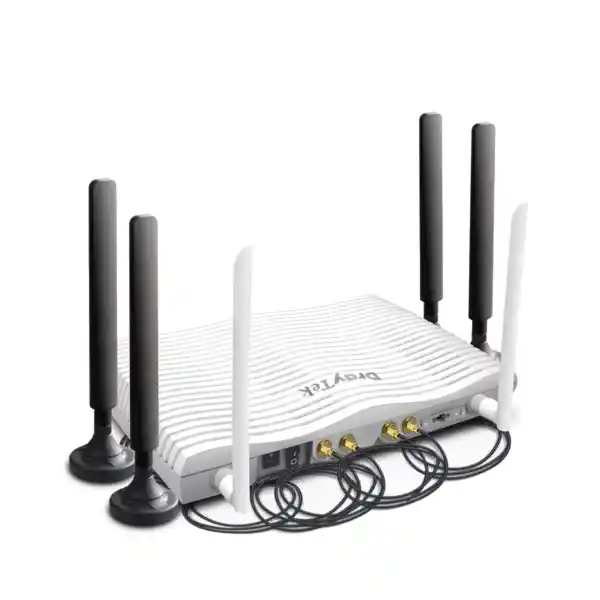
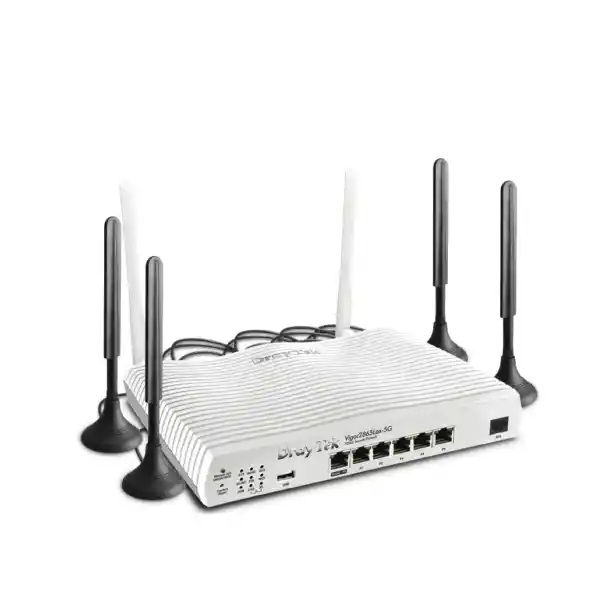
Antenna placement matters. Radio signals can be attenuated by reinforced concrete, low-emissivity glass, metal equipment racks, elevator cores and internal building geometry. The router should be installed where the LTE antennas can obtain stable signal without compromising physical security. If the communications room is deep inside a building and signal is poor, installers should evaluate a different router position, approved antenna arrangements or an alternative WAN method rather than assuming that higher-gain accessories will automatically solve the problem.
For temporary project offices, the Vigor2865L can start with LTE as the primary WAN while waiting for a wired service. Once fiber or DSL is commissioned, the configuration can be changed so the fixed circuit becomes primary and LTE becomes standby. This avoids replacing the gateway when the project transitions from temporary to permanent connectivity. The same concept works for pop-up retail, mobile offices and construction administration sites that need a secure routed LAN before local fixed infrastructure is ready.
Where uptime requirements are high, LTE should be considered one layer in a broader continuity architecture. Power protection, DNS resilience, cloud-service redundancy, switch reliability, access-point coverage and VPN architecture all influence actual service availability. The Vigor2865L provides the WAN mechanisms, but the complete design should be validated end to end.
VPN architecture for branches and remote access
The Vigor2865L supports business VPN functions and is positioned for up to 32 VPN tunnels, with DrayTek publishing IPsec throughput up to approximately 300 Mbps under test conditions. This allows the router to serve as a branch endpoint for encrypted connectivity to a head office, data center, cloud VPN gateway or other supported peer. It can also support remote-access use cases for authorized staff, depending on the chosen VPN method and client environment.
Branch-to-branch IPsec is a common design. Each location receives local LAN subnets that do not overlap, and the VPN policy defines which networks can communicate. Firewall rules should then restrict traffic to required services instead of treating the encrypted tunnel as an unrestricted trusted zone. An accounts branch may need ERP, DNS and authentication access but no direct access to engineering systems. A retail branch may need only the POS application, management systems and voice services. Least-privilege routing keeps the VPN useful without turning every remote site into a flat extension of the corporate LAN.
WAN failover introduces additional VPN considerations. If the primary Internet connection uses one public IP and LTE failover uses another, the remote peer must be able to accept tunnel re-establishment from the backup address or use an identity method that does not depend entirely on a fixed source IP. Dynamic DNS may help in some architectures, but design details depend on the remote gateway, NAT environment and carrier behavior. Mobile networks can use carrier-grade NAT, so organizations should test inbound and outbound VPN requirements on the selected mobile service instead of assuming that public addressing is available.
The router also supports SSL VPN capabilities intended to simplify remote connectivity through networks where traditional VPN protocols may encounter restrictions. Remote-access policy still requires strong authentication, safe credential handling, endpoint security and prompt firmware maintenance. VPN encryption protects data in transit; it does not compensate for compromised user devices or weak passwords.
For sizing, consider simultaneous tunnels, expected encrypted throughput, latency, packet sizes and the impact of other enabled features. A branch carrying voice, file synchronization and remote desktop traffic through a tunnel has different requirements from a site that uses VPN only for periodic management. FourTeck can assist with topology design across UAE branch networks through FourTeck IT Services UAE, including addressing plans, segmentation, migration sequencing and operational documentation.
Firewall, segmentation and policy control
The Vigor2865L includes a stateful firewall feature set intended for small and mid-sized business edge security. A stateful packet inspection design tracks connection state so return traffic for legitimate sessions can be differentiated from unsolicited inbound traffic. Administrators can build policies around source network, destination, service, schedule and other supported criteria. The goal is not to create hundreds of arbitrary rules but to establish clear network trust boundaries.
VLAN segmentation is central to a good branch design. A typical UAE office might have separate networks for corporate users, IP phones, guest wireless, CCTV, building systems and IT management. The Vigor2865L can route between these logical segments while firewall rules determine which flows are permitted. Guest devices, for example, can be allowed to reach the Internet while being blocked from internal servers and management interfaces. CCTV equipment can be limited to its recorder, time services and approved cloud endpoints. Voice devices can be separated from general PCs and given higher traffic priority.
This segmentation also improves troubleshooting. When networks have clear purposes, administrators can identify whether a connectivity problem is caused by routing, firewall policy, DNS, DHCP, switching or the upstream WAN. It also reduces broadcast-domain size and limits the lateral movement opportunities that exist in a completely flat LAN. The router’s policy tools are most effective when complemented by VLAN-capable managed switches and appropriately configured access points.
Content filtering and web access policies can be applied where required by organizational policy. Such controls should be planned with realistic expectations: category filtering is one layer, while endpoint protection, DNS security, application security and user awareness remain important. Encrypted web traffic also means that modern security architectures often rely on several controls operating together rather than a single router rule.
Firewall configuration should be reviewed whenever a new service is introduced. Temporary port forwards created for testing have a habit of becoming permanent if they are not documented and removed. Administrators should avoid exposing management interfaces directly to the public Internet and should restrict remote administration to approved sources or VPN paths wherever feasible.
QoS, bandwidth management and application experience
Quality of Service becomes important when a branch shares limited bandwidth among voice, interactive cloud applications, software updates, video meetings and bulk transfers. The Vigor2865L provides QoS and bandwidth-management controls that can prioritize important classes, enforce bandwidth limits and control excessive session use. These features are especially valuable during LTE failover because the backup link may have lower capacity, higher latency or a data allowance.
A practical policy begins with application requirements rather than arbitrary percentages. IP telephony needs low delay, low jitter and consistent packet delivery, but consumes relatively modest bandwidth per call. Cloud backup can consume large bandwidth but usually tolerates delay. Interactive remote desktop is sensitive to latency, while operating-system updates can be deferred. By classifying these workloads, the network can preserve business functions when total demand exceeds available WAN capacity.
Per-user or per-subnet bandwidth limits prevent one device from consuming the entire connection. Session limits can also protect router resources and improve fairness when certain applications open very large numbers of concurrent connections. However, limits should be set with care. Modern web browsers, collaboration tools and cloud applications legitimately create many sessions, so overly aggressive thresholds can cause confusing intermittent failures.
QoS should be validated on both normal and failover paths. A policy that works on a 500 Mbps Ethernet service may behave differently when traffic moves to a cellular connection delivering a fraction of that throughput. Where possible, bandwidth values should reflect realistic measured capacity rather than headline service rates. For LTE, administrators may need to use conservative values because available bandwidth changes with radio conditions and cell utilization.
Organizations deploying voice and unified communications can integrate the router into a wider architecture that includes managed switching, PoE and IP telephony. FourTeck’s IP Phone solutions can be considered alongside VLAN and QoS planning so the WAN, LAN and endpoint layers are designed as one system.
Central management with VigorACS, AP management and switch management
A router becomes significantly more useful in multi-site networks when administrators can monitor and manage it consistently. The Vigor2865 LTE platform can register to DrayTek VigorACS for centralized management, subject to software version and service arrangements. Central management can reduce the operational cost of branch networking by giving IT teams a common place to review status, configuration, firmware and alerts rather than logging into each site individually.
The platform can also act as a controller for compatible Vigor access points and VigorSwitch devices. This does not turn the router into a substitute for every enterprise management system, but it can simplify smaller distributed environments. A branch can have routing, WAN failover, switching and wireless components that follow a coordinated DrayTek management model. That is valuable for businesses with several stores, clinics, service centers or offices that need repeatable configuration but do not operate a large dedicated network-operations platform.
Standardization matters. If every branch uses different VLAN IDs, SSIDs, DHCP ranges and firewall conventions, troubleshooting becomes slow and risky. A deployment template can define a common structure while leaving site-specific values such as WAN credentials, LAN subnets and mobile SIM details as controlled variables. Configuration backups should be taken after commissioning and after major changes. Firmware management should follow a documented process with change windows, release-note review and rollback planning.
For organizations buying multiple routers in the UAE, FourTeck can help build a repeatable branch bill of materials through FourTeck UAE, combining the Vigor2865L with suitable managed switches, access points, racks, UPS units and structured cabling components.
Deployment topologies for UAE businesses
The Vigor2865L supports several practical topologies. The first is DSL-primary with LTE backup. The RJ‑11 DSL interface terminates the provider service, the LAN uplinks to a managed switch and the embedded LTE modem is configured as standby. This is a compact design for sites where VDSL is the available wired service and business continuity is required without adding a separate cellular gateway.
The second is Ethernet-primary with LTE backup. A fiber ONT or provider CPE connects to the Gigabit Ethernet WAN/LAN port configured as WAN. This is likely to be the preferred layout for many modern UAE business locations. The integrated DSL port can remain unused or be retained as an alternative where a secondary DSL service is available. LTE provides another level of path diversity, ideally through a carrier whose infrastructure is operationally independent from the fixed service path.
The third topology is temporary LTE-primary. A new branch can begin operating before the fixed circuit is installed. Staff receive a routed LAN, VPN, firewall and policy controls from day one. When fixed service arrives, the router is reconfigured so LTE becomes backup. This staged approach is useful for retail openings, project offices and temporary sites where waiting for a wired carrier activation would delay operations.
The fourth topology uses two wired paths plus cellular contingency. Depending on the service design, Ethernet WAN and DSL can be used together with LTE held for exceptional failover. This provides a deeper resilience model, though it should be engineered carefully to avoid unnecessary complexity. Each WAN should have a defined role, cost model and failure-detection method.
A fifth topology places the Vigor2865L as the routed edge behind an operator device. This may be required when a carrier-managed router, firewall or ONT cannot be bypassed. In that case, NAT layering, VPN pass-through and addressing should be reviewed. Double NAT can be acceptable for simple outbound Internet access but may complicate inbound services and some VPN designs. Where possible, bridge or pass-through modes may provide a cleaner architecture, subject to the provider equipment and service contract.
For larger networks that also require dedicated server infrastructure, storage or virtualization, the router can form the branch edge while local compute is designed separately. FourTeck’s Server Dubai portfolio can support projects where branch connectivity is part of a broader on-premises or hybrid infrastructure rollout.
LAN segmentation example: corporate, voice, guest and IoT
A practical segmented deployment can use four primary VLANs. The corporate VLAN hosts managed laptops, desktops and approved printers. The voice VLAN contains IP phones and voice gateways. The guest VLAN provides Internet access for visitors without internal network reachability. The IoT VLAN contains CCTV cameras, access-control panels, smart displays, environmental sensors or other devices that require connectivity but should not share the same trust level as business endpoints.
The Vigor2865L routes between these VLANs and applies policy. Corporate users may reach specific servers, cloud services and printers. Voice endpoints may be permitted to contact the IP-PBX, DNS, NTP and SIP provider only. Guest users should usually be denied access to RFC1918 private networks and allowed to use the Internet according to business policy. IoT devices can be restricted to required controllers or cloud endpoints. The management VLAN can be accessible only from IT workstations or through VPN.
DHCP scopes should match the addressing plan and reserve space for infrastructure. Avoid using the same subnet at multiple branches if site-to-site VPN is planned, because overlapping networks complicate routing. An example branch numbering scheme might allocate a site identifier within the second or third octet and use consistent VLAN-to-subnet mappings. The exact plan depends on organization size and existing address allocations.
DNS configuration should also be intentional. Internal domain resolution may need requests forwarded to corporate DNS across VPN, while guest networks should use public resolvers or approved filtering services. During WAN failover, ensure DNS remains reachable through the backup path. Many apparent failover failures are actually DNS failures: Internet routing works, but clients cannot resolve names because their configured resolver was reachable only over the primary tunnel.
For branch voice systems, the network team should confirm VLAN tagging, DHCP options where required, SIP behavior, NAT handling and QoS end to end. FourTeck’s IP PBX Dubai resources can complement router deployment where the project includes IP telephony and unified communications.
Security hardening checklist for production installation
A secure router is the result of configuration discipline, not simply the presence of a firewall feature. The default administrator password should be changed to a strong unique credential during commissioning. Management access should be limited to trusted LANs or VPN, and unnecessary remote-management services should be disabled. If remote administration is required, restrict source addresses where feasible and use secure protocols.
Firmware should be brought to an appropriate supported release after reviewing the vendor documentation. Administrators should keep a record of the installed version and subscribe to relevant vendor advisories. Firmware upgrades should be tested or scheduled during maintenance windows where the router is business critical. Configuration backups should be exported before major changes so recovery does not depend on rebuilding policies from memory.
UPnP and automatic port-opening behavior should be disabled or tightly controlled in business environments unless there is a documented requirement. Inbound NAT rules should be minimized. Exposing DVR interfaces, remote-desktop services or device web portals directly to the Internet can create unnecessary attack paths. Prefer VPN access or application-specific secure gateways.
Administrator accounts should be separated from normal user credentials, and logging should be configured at a level useful for troubleshooting and auditing. Time synchronization matters because inaccurate timestamps make event correlation difficult. If the organization uses a central syslog or monitoring service, route relevant events there and ensure that the monitoring path remains available during WAN failover.
Network segmentation should be enforced by default-deny thinking between trust zones. If a guest VLAN has no business reason to reach the corporate VLAN, the rule should block it explicitly. If CCTV cameras need to reach only the NVR and DNS server, permit only those services. This reduces the impact of compromised or poorly secured endpoints.
Finally, test recovery. Save a known-good configuration, document ISP credentials, record SIM information securely, label WAN connections and maintain contact details for service providers. A resilient router design is most valuable when the support team can understand and restore it during an outage.
Sizing methodology: when the Vigor2865L is a good fit
DrayTek positions the family around small and mid-sized business use and publishes a recommendation of approximately 50 hosts for the platform. Host count is only a starting point. Fifty light office users browsing and using SaaS applications may create less stress than twenty users performing high-volume VPN transfers, running many cloud synchronization tasks and hosting externally accessible services.
Start by measuring Internet service speed, but do not stop there. Determine peak simultaneous users, expected NAT-session volume, encrypted VPN demand, voice call count, number of VLANs, expected firewall complexity, content-filtering requirements and whether the router will manage access points or switches. Identify the busiest hour and the business processes that must remain operational if the primary WAN fails.
For a small office with a 100 to 300 Mbps Internet service, moderate VPN use, several VLANs and a need for LTE backup, the Vigor2865L can be a strong architectural match. For a branch with near-gigabit encrypted traffic, extensive security inspection, hundreds of users or large numbers of tunnels, a higher-performance platform may be more appropriate even if the raw Ethernet port speed appears sufficient. Router selection should leave headroom for growth and feature activation.
Also consider the no-Wi‑Fi design. If the site needs integrated wireless in the same appliance, another model in the broader family may be more appropriate. If the site uses dedicated business access points, the Vigor2865L is often preferable because the router can remain in the communications area while APs are installed where RF coverage requires them.
For organizations that operate branches across multiple countries, standardization can simplify support, but carrier interfaces and LTE band compatibility must be checked for each market. FourTeck’s Africa technology portfolio can support regional projects where a common branch architecture is being evaluated outside the UAE as well.
UAE procurement, ISP and installation considerations
A business router should be selected together with the services around it. Before procurement, confirm whether the site’s primary service is delivered as DSL, Ethernet from an ONT, managed router handoff or another format. Obtain the required PPPoE details, VLAN tags, static IP information or bridge-mode requirements from the service provider. If the provider mandates its own CPE, determine whether the Vigor2865L will receive a public IP, a private transit address or a NATed handoff.
For LTE, confirm SIM form factor, data plan, APN requirements, allowed use, traffic limits and carrier policies. A business continuity SIM should have enough data to carry essential operations during the expected outage window. If a branch normally consumes hundreds of gigabytes each day, a small mobile bundle may last only minutes once the fixed link fails unless QoS and policy restrictions are applied.
The physical installation deserves equal attention. Mount or place the router in a secure, ventilated environment. Use surge-protected power and preferably a UPS. Label DSL, Ethernet WAN, LAN uplinks and LTE antennas. Keep the serial number, configuration backup and support documentation in the asset record. Verify that the communications cabinet does not exceed the specified operating temperature.
If cellular is part of the resilience plan, test it during business hours and at different times if the location experiences variable radio load. Check latency as well as throughput. Confirm that critical SaaS services, VPNs, SIP registration and cloud-management connections operate when traffic is moved to LTE. Test failback to the fixed service to ensure long-lived sessions and tunnels recover as expected.
Procurement should also identify the right accessories and adjacent components: managed switches, access points, patch panels, rack power, UPS capacity and structured cabling. A router alone cannot compensate for a single unprotected switch or poorly placed access point. FourTeck can help assemble a complete bill of materials for UAE branch deployments.
Technical specification summary
| Product | DrayTek Vigor2865L |
|---|---|
| Positioning | Multi-WAN VDSL2/ADSL2+ and 4G LTE VPN firewall router for SMB and branch networks |
| DSL WAN | 1 x RJ‑11, including VDSL2 profile 35b support and ADSL compatibility |
| Ethernet WAN/LAN | 1 x Gigabit Ethernet switchable WAN/LAN port |
| Fixed LAN | 5 x Gigabit Ethernet LAN ports |
| Cellular | Built-in LTE Cat 6, up to 300 Mbps theoretical maximum download rate |
| SIM | 2 x standard-size SIM slots, one SIM online at a time |
| USB | 1 x USB 2.0 |
| VPN | Up to 32 VPN tunnels; published IPsec throughput up to approximately 300 Mbps under vendor test conditions |
| NAT sessions | Up to 60,000 recommended session capacity |
| Routing features | Load balancing, failover, route policy, WAN active-on-demand, connection detection and IPv4/IPv6 features |
| Network controls | SPI firewall, QoS, bandwidth limit, session limit, content-control functions and VLAN support |
| Management | VigorACS support plus central management capabilities for compatible VigorAP and VigorSwitch devices |
| Wireless LAN | None on Vigor2865L; use external access points for Wi‑Fi |
| Dimensions | Approx. 241 x 166 x 46 mm |
| Power | 12 V DC, 2 A; up to 24 W maximum stated consumption |
| Environment | 0 to 45°C operating temperature; 10 to 90% non-condensing operating humidity |
Published performance figures are maximum values from vendor testing under defined conditions. Actual throughput varies with WAN conditions, configuration and enabled features.
Frequently asked technical questions
Does the Vigor2865L include Wi‑Fi?
No. The Vigor2865L is the non-Wi‑Fi model. In professional deployments, connect compatible standalone access points through the LAN switching infrastructure.
Can both SIM cards be online simultaneously?
The router provides two SIM slots for redundancy, with one SIM online at a time. It is intended to simplify mobile-carrier continuity rather than bond two active LTE SIM connections.
Can LTE be the primary WAN?
Yes. LTE can be used as primary connectivity for temporary or mobile deployments, then reconfigured as backup when a fixed circuit becomes available.
Can it work with fiber broadband?
Yes, where the fiber service provides an Ethernet handoff through an ONT or provider device. The Gigabit WAN/LAN port can be configured for Ethernet WAN use.
Is the router suitable for VPN branches?
Yes. It supports business VPN functions and up to 32 tunnels. Real throughput depends on encryption, traffic profile, enabled features and WAN quality.
What happens when the fixed WAN fails?
With failover configured and health checks operating correctly, traffic can move to an alternate WAN such as LTE. Application behavior should be tested because source IP changes can reset sessions.
Operational testing before handover
A production handover should include more than a successful speed test. Verify that each VLAN receives the correct DHCP parameters and can reach only the intended networks. Confirm DNS resolution for internal and external names. Test NTP, monitoring and remote administration. Check that port-forwarding rules, if any, expose only required services and that management interfaces are not unnecessarily public.
Next, test WAN behavior. Disconnect or disable the primary WAN and measure how long it takes the router to detect the failure. Confirm that important applications recover over LTE or the secondary path. If a VPN is required, verify that it re-establishes and that the remote peer accepts the new source path. Test return to the preferred WAN and check whether voice registrations, tunnels and SaaS sessions normalize.
LTE testing should record signal metrics, latency, upload and download performance, and stability over time. If the branch is heavily dependent on mobile backup, repeat the test at peak usage times. Ensure that the SIM plan is correctly provisioned and that APN settings are documented. Where dual SIMs are installed, verify the process for switching to the secondary SIM and record which carrier each slot uses.
QoS testing should include a controlled congestion scenario. Run a large download or backup while making a voice call or interactive application session. If the priority policy is effective, real-time traffic should remain usable even when the WAN is busy. Repeat the test on LTE because a policy tuned only for the primary circuit may not protect applications on a lower-capacity backup connection.
Finally, export the configuration, record firmware details, label cables, document addressing and store credentials securely. The support team should receive a network diagram that identifies WAN types, provider contacts, SIM assignments, VLANs, VPN peers and failover logic.
Why separate routing from Wi‑Fi can improve network design
Some buyers initially see the absence of integrated Wi‑Fi as a limitation, but in professional networks it often creates a cleaner architecture. The best physical location for a router is usually near the service handoff, patch panel, managed switch and UPS. The best location for a wireless access point is usually determined by RF coverage, user density and building geometry. Combining those roles in one box forces a compromise.
With the Vigor2865L, the router can remain protected in a communications cabinet while one or more access points are placed on ceilings or central walls. As the office expands, additional APs can be added without replacing the gateway. Wireless technology can also be upgraded on its own cycle. If the organization later moves from Wi‑Fi 5 to Wi‑Fi 6 or a newer standard, the WAN router does not necessarily need to change.
This architecture also improves segmentation. SSIDs can map to different VLANs, and the router can enforce inter-VLAN policy. Corporate Wi‑Fi joins the trusted user VLAN, guests join an Internet-only VLAN, and IoT devices use another segment. The managed switch carries tagged VLANs between the router and APs. Troubleshooting becomes easier because each layer has a clear role.
For branch standardization, a repeatable bundle can include the Vigor2865L, a managed PoE switch and one or more ceiling access points. The number of APs is chosen from a coverage survey rather than from the location of the Internet circuit.
Migration path from consumer routers or legacy DSL equipment
Businesses often arrive at the Vigor2865L after outgrowing an ISP-provided or consumer-grade router. The migration should begin by documenting the existing environment: WAN credentials, public IP addressing, DHCP scope, static reservations, port forwards, VPNs, DNS settings, voice devices and any applications that depend on source IP or inbound access. This inventory prevents hidden dependencies from surfacing after cutover.
If the current device terminates DSL, confirm the exact service and provider parameters before moving the line. If an ONT or carrier router provides Ethernet, determine whether the service uses PPPoE, DHCP, static addressing or VLAN tagging. The Vigor2865L can then be staged offline with LAN addressing, VLANs, firewall policies and management settings before the maintenance window.
During cutover, move the WAN first, verify basic Internet access, then enable internal routing and services in a controlled sequence. Test business-critical applications before reconnecting lower-priority devices. If the branch uses site-to-site VPN, validate reachability to all required remote networks and confirm that no subnet overlaps exist.
After the fixed connection is stable, add LTE. Establish the SIM, APN and health-check configuration, then perform a real failover test. Do not assume backup is working simply because the LTE status page shows a signal. The relevant test is whether business applications continue when the primary path is physically disconnected.
Keep the old router available until acceptance testing is complete, but avoid leaving it connected in a way that creates rogue DHCP or unintended routing. Once the new gateway is approved, archive the final configuration and update network documentation.
Decision recap: when to shortlist DrayTek Vigor2865L
Choose it for WAN resilience
A strong fit when a branch needs fixed broadband plus integrated LTE backup, with policy-based failover and load balancing.
Choose it for branch VPN
Useful when a small or mid-sized site needs secure tunnels to head office, cloud resources or authorized remote users.
Choose it for staged connectivity
Ideal when LTE must bring a new site online immediately and later become backup after Ethernet or DSL is installed.
Choose it with dedicated APs
The non-Wi‑Fi design suits managed networks where wireless access points are positioned independently for better coverage.
Quotation input checklist
For an accurate UAE quotation and deployment recommendation, provide the following project details. These inputs help determine whether the Vigor2865L is the right router and which accessories are required.
Plan the Vigor2865L as part of a complete branch network
FourTeck can assist with router sizing, WAN design, LTE failover, VPN topology, managed switching, Wi‑Fi access points, IP telephony, UPS selection and migration planning. For broader firewall and branch-security solutions, visit Firewall Dubai by FourTeck.

Reviews
There are no reviews yet.