
Business Connectivity • LTE Resilience • WiFi 6 • Secure Branch Routing
DrayTek Vigor2865Lax in UAE
The DrayTek Vigor2865Lax is a multi-WAN business router for organizations that want one platform to coordinate fixed broadband, cellular backup, secure VPN access, network segmentation, traffic policy, and high-efficiency wireless networking. For UAE offices and distributed sites, the practical value of the Vigor2865Lax is not a single headline speed. Its value is the way several connectivity methods can be engineered together so that a branch remains reachable when a primary circuit degrades, a service provider is delayed, or a temporary site must come online before its permanent line is ready.
Cat 6 LTE
Dual SIM
WiFi 6
32 VPN Tunnels
16 VLANs
Integrated mobile broadband with dual SIM support for resilience planning and temporary connectivity.
Integrated DSL modem with VDSL2 profile 35b support and ADSL family backward compatibility.
Suitable for branch-to-HQ tunnels, site links, administrators, and controlled teleworker access.
Modern WiFi 6 radio architecture for efficient client handling in small and midsize business environments.
What the Vigor2865Lax is designed to solve
Business Internet design in the UAE often has to account for more than the nominal speed of a primary circuit. A retail outlet may need point-of-sale connectivity during an ISP outage. A warehouse may require cloud ERP access even if a fixed line is damaged. A project office may need Internet service immediately while a permanent circuit is still being provisioned. A professional office may need secure remote access, isolated guest WiFi, protected voice traffic, and clear bandwidth policies without deploying several independent appliances. The Vigor2865Lax is designed for this kind of operational requirement: one router can accept DSL, Ethernet broadband, and cellular connectivity, then apply routing policies and failover logic across those paths.
That architecture gives network administrators more control over how a site behaves when conditions change. LTE can be reserved as a standby path instead of consuming data continuously. Critical services can be prioritized so that voice, business applications, or payment systems are not crowded out by bulk downloads. Separate VLANs can be assigned to employees, guests, IP phones, cameras, printers, or operational technology. VPN connections can link the site to headquarters or authorized remote users. Central management features can coordinate compatible DrayTek access points and switches so that a small IT team does not need to configure every component independently.
The result is a practical edge platform for small and midsize sites where availability, segmentation, and manageability matter at least as much as peak throughput. A correct deployment still depends on the service provider, LTE bands available in the local network, signal conditions, firmware, traffic mix, and the applications enabled on the router. FourTeck therefore treats the Vigor2865Lax as a design component rather than as a universal plug-and-play answer. The right WAN order, failover timer, VLAN plan, wireless channel strategy, firewall policy, and VPN profile should be selected around the site rather than copied from a generic template.
Multi-WAN architecture for fixed and mobile connectivity
The defining capability of the Vigor2865Lax is its ability to operate with several WAN technologies. The integrated RJ-11 DSL interface supports VDSL2 and ADSL-family services, including VDSL2 profile 35b where the access network provides it. A Gigabit Ethernet port can be used for an Ethernet-delivered Internet service or, depending on the configured role, as part of the LAN design. Integrated LTE adds a separate carrier path through the mobile network. The USB interface can also be used for supported auxiliary functions and, in appropriate configurations, another cellular connection. This combination allows a network designer to create resilience without installing a separate LTE gateway beside the router.
For a normal UAE branch design, the fixed service would typically remain the preferred WAN because it usually offers predictable data allowances, stable public addressing options, and lower recurring cost per gigabyte. LTE would be configured for failover or selective policy routing. If the fixed service loses reachability, the router can move selected traffic to the cellular path according to the configured detection and routing rules. When the main path recovers, administrators can define how service should return. This is more useful than a simple physical-link check because an Ethernet port can remain electrically up even when upstream Internet connectivity is unavailable.
Load balancing can also be used where the application design supports it. In a load-balanced topology, separate sessions may be distributed across available WANs rather than treating one line purely as a standby. This can increase aggregate utilization, but it does not bond two independent Internet links into one faster connection for a single ordinary session. Applications that depend on source-IP consistency, inbound NAT, strict session persistence, or provider-specific security controls may need route policies that keep them on one WAN. The network plan should therefore define which applications can move freely and which must stay pinned to a specific path.
The Vigor2865 family also supports traffic and session controls that help preserve stability when failover occurs. This is especially important for LTE backup. A branch that normally has a high-capacity fixed connection can overwhelm a mobile backup if every workstation immediately resumes cloud synchronization, video streaming, software updates, and large transfers. Bandwidth limits, application-aware QoS, route policy, and WAN data-budget controls can be combined so that essential services remain usable during the backup period. This turns LTE from a basic emergency connection into a managed continuity path.
Integrated Cat 6 LTE and dual-SIM planning
The Vigor2865 LTE platform uses an integrated Cat 6 cellular modem with dual SIM capability. DrayTek documentation for the LTE family lists theoretical link rates up to 300 Mbps downlink and 50 Mbps uplink for the applicable Cat 6 implementation, subject to mobile network conditions, carrier aggregation, radio quality, tower load, operator configuration, and the LTE bands supported by the specific regional hardware. Two SIM slots give administrators the option to maintain service with more than one mobile subscription while keeping one SIM active at a time. This can be useful when a business wants provider diversity rather than relying on a single mobile operator for backup.
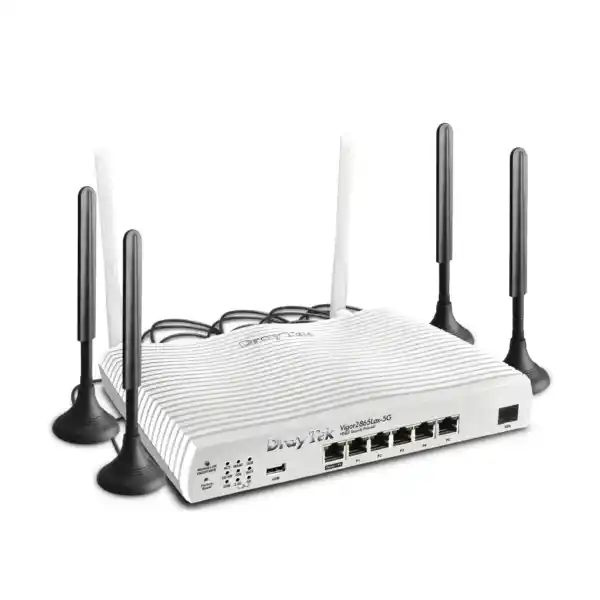
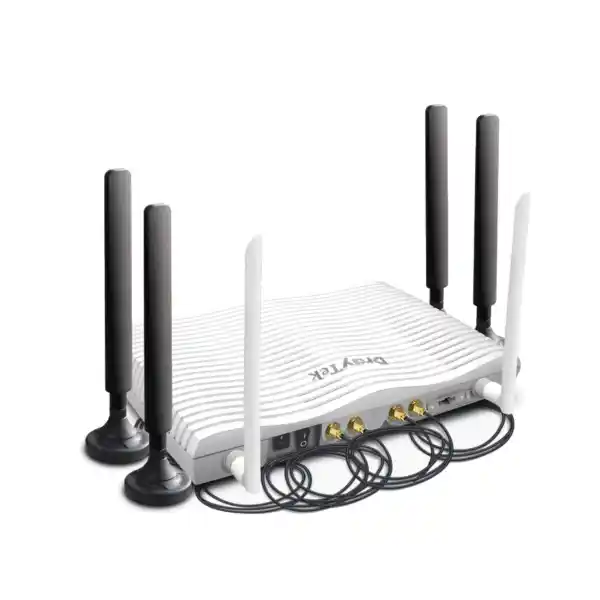
Dual-SIM design should be treated as a continuity tool, not as a guarantee that two carriers will always provide independent infrastructure. Two mobile operators may share towers, backhaul, power, or local coverage constraints in some locations. For business-critical sites, FourTeck recommends checking the actual radio conditions at the installation point, identifying the strongest and most reliable carrier paths, and validating failover under load. Antenna placement matters. A router installed in a closed metal cabinet, basement, or shielded service room can have significantly worse LTE performance than one positioned where the external antennas have a cleaner radio path.
Data-plan behavior must also be considered. Some mobile subscriptions use private addressing or carrier-grade NAT, which can affect inbound services and certain VPN designs. Public static IP availability, APN configuration, roaming restrictions, fair-use policies, and SIM security can vary by operator and business plan. If inbound reachability through LTE is required, this should be confirmed with the mobile provider before finalizing the architecture. For many branches, the simplest and most reliable backup design is outbound connectivity plus site-to-site VPN initiation from the branch, rather than expecting unsolicited inbound access to a mobile IP address.
The router’s SMS-related cellular functions can also support operational workflows in some deployments, but messaging capability should not be treated as a substitute for network monitoring. A professional deployment should combine connectivity alerts with logging, SNMP or centralized management, and a documented escalation process. The goal is not merely to know that LTE exists; it is to know when the router moved to LTE, why it moved, whether critical applications remained available, and how much cellular data the site consumed during the event.
VDSL2 35b and ADSL compatibility
For sites that still use copper-based access, the integrated modem is a major operational advantage. The Vigor2865 family supports VDSL2, including profile 35b supervectoring where the provider and local loop support it, together with ADSL and ADSL2+ compatibility. This means the router can terminate many common DSL services directly without requiring a separate bridge modem. A smaller device count reduces power supplies, patch leads, potential failure points, and configuration layers at a branch location.
DSL performance is highly dependent on line length, copper quality, crosstalk, cabinet technology, vectoring support, and the provider’s configured profile. The frequently referenced “up to 300 Mbps” VDSL2 35b figure describes a technology capability under favorable conditions rather than a promise for every line. During design and commissioning, the useful measurements are actual negotiated sync rate, signal-to-noise margin, attenuation, error counters, retransmission behavior, and stability over time. A stable line at a lower rate can be operationally preferable to an aggressively tuned line that repeatedly retrains.
A business migrating from DSL to fiber or another Ethernet-delivered service can continue using the router by moving the primary Internet connection to its Gigabit Ethernet WAN function. This extends the useful life of the platform when the access technology changes. The integrated DSL port can then be repurposed as an alternate path if the organization retains the legacy circuit for resilience. Conversely, a new site waiting for a fixed service can begin operation on LTE and later add DSL or Ethernet Internet without replacing the edge router.
When DSL is deployed alongside LTE, failover detection should be tuned carefully. A DSL layer can remain synchronized while the provider has an upstream outage. Therefore, WAN health monitoring should test meaningful reachability rather than assuming that DSL synchronization equals working Internet access. Similarly, a flapping DSL circuit can cause repeated WAN transitions unless thresholds and recovery behavior are configured sensibly. FourTeck’s deployment approach is to verify both link-layer and service-layer behavior so that failover supports the business rather than creating unnecessary route changes.
WiFi 6 for a modern branch LAN
The “ax” designation identifies the wireless generation used by the Vigor2865Lax. WiFi 6, based on IEEE 802.11ax, is designed to improve efficiency when many client devices share the same radio environment. Compared with older wireless generations, technologies such as OFDMA and improved scheduling can use airtime more efficiently, while MU-MIMO capabilities help the access point communicate with multiple compatible clients more effectively. These improvements are especially relevant in offices where laptops, phones, tablets, scanners, collaboration devices, smart displays, and IoT endpoints all compete for airtime.
The wireless platform should still be sized according to coverage and capacity. One router does not automatically replace a proper multi-AP design in a large office, concrete-heavy building, warehouse, or multi-floor site. RF propagation in UAE buildings can be affected by reinforced concrete, reflective surfaces, lift cores, insulated glass, shelving, equipment rooms, and dense neighboring WiFi. For a small office the integrated wireless radio may provide practical coverage. For larger environments, the router can operate as the edge gateway while compatible access points are placed where users actually need them.
DrayTek’s Vigor2865 ax-class platform supports multiple SSIDs and modern security modes, enabling the wireless design to align with VLAN segmentation. For example, the corporate SSID can place managed laptops in an employee VLAN, a guest SSID can reach only the Internet, and an IoT SSID can be isolated from sensitive business systems. WPA3 can be considered for capable devices, while compatibility requirements may lead to mixed policies during transition periods. Authentication strategy can range from pre-shared keys for simple sites to 802.1X designs integrated with an appropriate authentication service.
Wireless tuning matters as much as advertised link rate. A client with a weak signal, congested channel, legacy radio, power-saving limitation, or poor driver will not achieve theoretical speed. Wider channels can increase peak throughput but may reduce the number of clean channels available in busy environments. The correct channel width, band steering behavior, SSID count, transmit power, roaming design, and client isolation policies should be chosen based on a site survey and operational needs. For business WiFi, consistency and predictable roaming are usually more valuable than chasing the highest laboratory link rate.
Firewall policy and controlled Internet access
The Vigor2865Lax functions as a stateful business firewall in addition to its routing role. Administrators can create policy rules based on source, destination, services, interfaces, and network segments, then use NAT and port-handling features where inbound access is required. The practical security benefit comes from minimizing unnecessary reachability between zones. Employee computers generally do not need unrestricted access to guest devices. Cameras do not need broad access to finance systems. Printers do not need to initiate connections to every server. A segmented network reduces the blast radius of a compromised endpoint and makes troubleshooting easier.
Content filtering and application controls can be used to implement acceptable-use requirements, but those functions should be designed with realistic expectations. Category databases and application identification may require subscriptions, firmware support, or specific traffic visibility, and encrypted applications can limit what a perimeter device can inspect. Firewall rules therefore remain the foundation. DNS policy, endpoint protection, identity controls, secure application configuration, patch management, and user awareness should complement the router rather than being replaced by it.
DoS and spoofing defenses help protect the edge against common malformed or abusive traffic patterns. However, no branch router can absorb an arbitrarily large upstream distributed denial-of-service attack because the provider circuit itself can be saturated before traffic reaches the appliance. For organizations with public-facing services or higher risk, upstream protections from the ISP or a cloud security service may be necessary. The Vigor2865Lax is most effective when it forms one layer of a broader defense strategy.
Administrative access should also be hardened. Management from the Internet should be disabled unless there is a specific requirement, and then restricted to trusted source networks or protected through VPN. Strong credentials, role separation where supported, configuration backups, firmware maintenance, time synchronization, logging, and review of remote-management exposure are basic controls. A resilient router that is poorly administered can still become a business risk. FourTeck deployment therefore treats management-plane security as part of the installation, not as an optional afterthought.
VPN for branches, remote users, and protected service paths
The Vigor2865 family supports a broad set of VPN technologies for linking locations and remote workers. Depending on firmware and deployment requirements, supported technologies include IPsec, SSL-based remote access, OpenVPN, WireGuard, L2TP over IPsec, IKEv2, and other established mechanisms. The platform supports up to 32 VPN tunnels in the relevant family specifications, with a subset allocated to SSL/OpenVPN-type sessions according to model and firmware. This capacity fits many small and midsize branch designs, but tunnel count is only one dimension of sizing.
Encryption throughput, packet size, WAN latency, CPU load, hardware acceleration, concurrent services, and traffic direction all influence real VPN performance. DrayTek documents substantial hardware-assisted IPsec capability for the Vigor2865 platform, but real results should be validated with the exact configuration. A site carrying continuous backup traffic, cloud replication, voice, and remote-desktop sessions across several tunnels has a different workload from a branch that uses one low-volume tunnel to a headquarters firewall.
For site-to-site connectivity, the design should define local and remote subnets, route preference, failover behavior, encryption parameters, key lifecycle, monitoring, and how traffic should behave if the primary WAN changes. If the branch switches from fixed Internet to LTE, NAT and addressing may change. A properly designed tunnel should be able to re-establish over the backup path without requiring manual intervention. Route-based policy and dynamic hostname mechanisms can help in environments where public addresses are not static, but the design must account for mobile-provider NAT limitations.
Remote-user VPN should be combined with strong authentication and least-privilege access. A VPN should not automatically make every internal network reachable. Remote administrators may need access to management VLANs, while general staff may need only business applications. Contractors may require temporary access to one server. Segmenting VPN users into appropriate policy groups reduces risk and improves auditability. Where identity systems and second-factor options are available, FourTeck recommends incorporating them into the remote-access strategy rather than relying on a shared credential model.
VLANs, LAN subnets, and branch segmentation
A flat LAN is easy to build but becomes harder to secure and manage as a business adds users, phones, cameras, printers, wireless guests, servers, and IoT devices. The Vigor2865 platform supports multiple LAN subnets and up to 16 VLANs in the published family specifications. This allows a branch to separate traffic logically even when devices share the same switching infrastructure. IEEE 802.1Q tagging can carry several VLANs over a trunk to compatible managed switches and access points.
A typical UAE office might create an employee VLAN, voice VLAN, guest VLAN, CCTV VLAN, infrastructure-management VLAN, and IoT or building-services VLAN. The router then controls routing between them. Employees may be allowed to reach approved printers and internal applications. Guests may receive Internet access only. Cameras may send streams to an NVR but have no need to reach finance computers. Network-management interfaces may be reachable only from IT administrator addresses. These rules make the network easier to reason about because each device class has an intentional trust boundary.
DHCP scopes, DNS behavior, address reservations, and IP planning should be documented alongside VLAN IDs. A technically valid VLAN design can still become difficult to operate if addresses are inconsistent or labels are unclear. FourTeck recommends selecting a repeatable branch scheme that can be reused across locations while avoiding overlaps with headquarters, cloud networks, and VPN-connected sites. Overlapping subnets are a common cause of VPN routing problems when companies grow organically without an address plan.
Segmentation also supports better QoS and monitoring. Voice devices can be identified by VLAN and given appropriate priority. Guest bandwidth can be capped. CCTV traffic can be prevented from consuming resources needed by business applications. Logs can show which zone generated a connection. When access points and switches are centrally coordinated through the DrayTek ecosystem, the VLAN plan can extend from the router to wired ports and SSIDs with less manual inconsistency.
Quality of Service and bandwidth management
Bandwidth is a shared resource. Even a fast Internet line can feel unreliable if large transfers, cloud backup, operating-system updates, or recreational traffic consume capacity at the wrong time. The Vigor2865 platform includes Quality of Service, IP-based bandwidth limits, session limits, and application-aware controls that can be used to protect business-critical traffic. QoS is particularly important during failover because the available bandwidth may drop sharply when a fixed circuit moves to LTE.
Voice is a common example. Real-time audio does not need huge bandwidth, but it is sensitive to delay, jitter, and packet loss. Giving voice traffic priority can preserve call quality while lower-priority transfers slow down. The same principle can be applied to interactive remote desktops, transaction systems, ERP traffic, or business-critical SaaS applications. Priority should not be given indiscriminately; if everything is marked high priority, the queue has no meaningful hierarchy.
Session limits are useful when a single client or application opens excessive connections. This can happen with peer-to-peer traffic, infected endpoints, scanning tools, or poorly behaved software. Limiting sessions can prevent one device from consuming disproportionate router resources. Per-IP bandwidth controls can also enforce fair usage on guest or contractor networks. For LTE backup, a dedicated policy can reduce nonessential traffic so that the site remains functional within the backup link’s capacity and data plan.
QoS works best when the bottleneck is under the router’s control. If congestion occurs upstream in a provider network, local scheduling cannot solve every problem. Accurate WAN rate configuration, realistic class design, and testing under load are therefore important. FourTeck commissioning can include simulated saturation tests so that call quality, VPN responsiveness, and critical application performance are observed before the configuration is considered complete.
Hardware acceleration and performance sizing
DrayTek documents hardware acceleration on the Vigor2865 platform to increase routing, NAT, QoS, and IPsec performance under supported conditions. Published family figures include up to approximately 940 Mbps on a single Ethernet WAN and up to 1.3 Gbps combined across Ethernet and DSL in certain hardware-accelerated scenarios, with hardware-assisted IPsec figures reaching significantly above software-only operation. These figures are useful for platform comparison, but they must be interpreted as controlled test results rather than guaranteed application throughput.
Real-world performance changes when additional services are enabled. Complex firewall policies, content filtering, VPN encryption, high session counts, logging, application classification, and mixed packet sizes all affect processing. Wireless clients introduce their own radio overhead. LTE and DSL rates are constrained by access networks. For this reason, FourTeck sizes the router against the expected traffic profile instead of comparing only the ISP package speed with one maximum NAT number.
A branch with 25 users doing normal cloud productivity, voice, browsing, and moderate VPN traffic may have very different needs from a site with the same user count continuously moving large design files or replicating backups. The Vigor2865 series is commonly positioned for small and midsize environments, with DrayTek documentation referencing around 60,000 NAT sessions and approximately 50 hosts as a general sizing indicator for the platform. This should be treated as guidance, not a strict boundary. Device count alone does not capture workload intensity.
When a customer expects near-gigabit encrypted traffic, very high east-west segmentation demands, large numbers of concurrent remote users, advanced threat inspection, or extensive public services, a higher-capacity firewall platform may be more appropriate. The Vigor2865Lax is strongest where multi-WAN flexibility, integrated LTE, DSL compatibility, business routing, and manageable security must be combined at a branch edge without unnecessary appliance complexity.
Port and interface planning
| Interface | Business Use | Design Note |
|---|---|---|
| RJ-11 DSL WAN | VDSL2 35b / VDSL2 / ADSL family | Use line statistics and provider profile information during commissioning. |
| Gigabit Ethernet WAN/LAN | Fiber ONT, cable modem, leased Internet handoff, or LAN role | Confirm the configured role and VLAN tagging required by the ISP. |
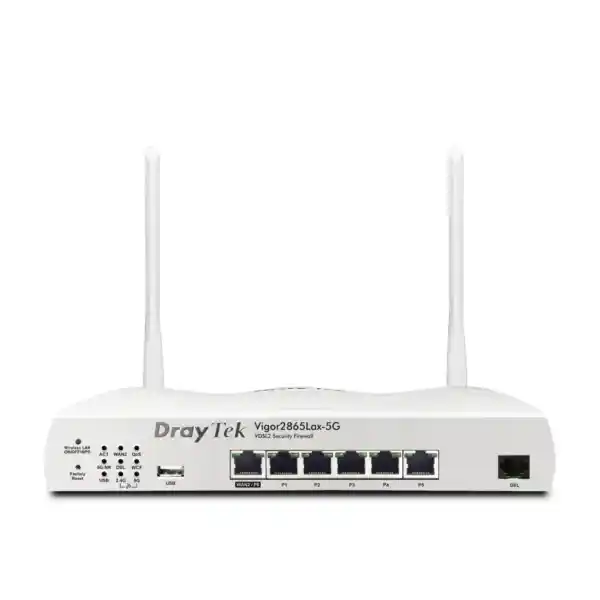
| Five Gigabit LAN ports | Local switches, servers, APs, voice, or direct endpoints | Use managed switching for larger VLAN-based deployments. |
| Dual SIM | Cellular diversity and backup | Validate carrier coverage, APN, addressing, and data-plan policy. |
| USB 2.0 | Supported modem, storage, printer, or ancillary functions | Check current firmware compatibility before procurement. |
The five fixed Gigabit LAN ports provide useful flexibility for small sites, but they should not be mistaken for a full enterprise access layer. If the office needs many wired endpoints, PoE access points, IP phones, cameras, redundant uplinks, or structured VLAN distribution, a managed switch is normally the right design. The router should remain the policy and WAN edge while switching handles local port density. This keeps the architecture scalable and prevents the router’s integrated ports from becoming a cabling bottleneck.
The switchable WAN/LAN function is particularly valuable during migration. A business may start with DSL and later receive an Ethernet service from an ONT. Another site may use Ethernet as primary and LTE as backup. A temporary office may use LTE first and add fixed broadband later. Because the platform can accept different access types, the same router configuration framework can be reused across branches with different carrier availability.
Central management of DrayTek access points and switches
One reason the Vigor2865Lax is attractive for smaller IT teams is its ability to participate in the wider DrayTek management ecosystem. The router can centrally manage a defined number of compatible VigorAP access points and VigorSwitch devices, while VigorACS can provide broader centralized monitoring and configuration across distributed deployments. Published Vigor2865 family specifications list management capacity for up to 20 access points and up to 10 switches, subject to model, firmware, and supported device compatibility.
Centralized control simplifies common changes. A new VLAN can be defined at the edge and then reflected through compatible switch trunks and wireless SSIDs. WiFi configuration can be kept more consistent across multiple APs. Administrators can review device status without logging independently into every unit. Configuration templates and remote management reduce the operational effort required when a business operates several branches across Dubai, Abu Dhabi, Sharjah, or other UAE locations.
Centralization does not remove the need for network design. The management system can push a bad configuration just as efficiently as a good one. VLAN numbering, DHCP scopes, SSID naming, switch-port roles, AP placement, and firmware policy should be standardized before they are automated. Configuration backups and change records are also important so that administrators can identify what changed if service is disrupted.
For organizations with a larger mixed-vendor environment, the Vigor2865Lax can still operate as an edge router without forcing every LAN component to be DrayTek. The choice depends on the existing network, feature requirements, support model, and lifecycle strategy. FourTeck can integrate the router into an established switching or wireless environment or design an end-to-end DrayTek branch stack when centralized compatibility provides operational benefit.
Deployment scenarios in the UAE
Branch Office
Use Ethernet or DSL as primary WAN, LTE as controlled backup, IPsec or WireGuard for branch-to-HQ connectivity, corporate and guest VLANs, and QoS for collaboration and voice. This is the classic Vigor2865Lax deployment: resilient access with enough policy depth for a professional office.
Retail and POS
Prioritize payment and ERP traffic, isolate guest WiFi from POS terminals, and preserve transaction connectivity during a fixed-line outage through LTE. Bandwidth policies can restrict nonessential usage while the site runs on mobile backup.
Warehouse
Support scanners, inventory terminals, office users, cameras, and wireless devices on separate segments. LTE provides an alternate route for cloud inventory systems when the main circuit is interrupted, while managed APs extend coverage beyond the router location.
Temporary Project Site
Start operations on cellular service before permanent broadband is installed. Add DSL or Ethernet later without redesigning the entire edge. VPN can securely link the temporary site to head office resources while local VLANs keep contractors and corporate devices separate.
Clinic or Professional Practice
Separate administrative systems, guest wireless, voice, printers, and connected equipment. Use VPN for approved remote support and enforce policy-based access between zones. The emphasis is controlled connectivity and continuity rather than raw Internet speed.
Multi-Site SME
Standardize addressing, VLANs, VPN templates, WAN priority, and monitoring across several locations. Centralized management can reduce repetitive configuration and make support easier for a small IT team overseeing geographically distributed branches.
UAE carrier and LTE compatibility considerations
Cellular procurement should always include a regional compatibility check. The Vigor2865 LTE family supports a defined set of LTE FDD and TDD bands, but exact band availability can vary by regional hardware release. The mobile operator’s network uses specific bands by area, technology generation, indoor coverage, and spectrum plan. FourTeck therefore recommends verifying the exact product SKU and supported bands against the intended UAE SIM provider before purchase, especially when the router will be installed in a critical location.
Signal quality should be tested where the router will actually operate. Mobile signal shown on a phone near a window may not represent performance inside the communications room. Received signal strength, quality, interference, carrier aggregation, and cell loading all affect throughput. A site can have strong signal bars but poor capacity during busy hours. For important deployments, testing should include peak business periods and failover traffic rather than a single speed test during installation.
The SIM plan must support the required use case. Business backup traffic can spike quickly if cloud synchronization and updates continue during an outage. A low data allowance may be consumed before the fixed line is restored. Data-budget controls can help, but the commercial plan should still reflect realistic continuity requirements. If the branch depends on VPN, the plan should also be checked for addressing behavior and any restrictions that affect IPsec, UDP, inbound traffic, or long-lived sessions.
For projects where the cellular service is the primary connection, consider whether Cat 6 LTE provides enough sustained throughput and latency for the application mix. The Vigor2865Lax is a strong choice when LTE is primarily a resilient or moderate-capacity path. Sites requiring sustained multi-gigabit mobile broadband should evaluate newer 5G variants or dedicated 5G gateways instead of assuming that a Cat 6 LTE router will perform like a modern 5G service.
Security architecture for a business deployment
A secure Vigor2865Lax deployment begins with a clear trust model. The Internet is untrusted. Guest devices should be treated as untrusted. IoT and CCTV devices should usually have limited privileges. Administrative interfaces belong in a more trusted management zone. Employee endpoints may need access to business applications but not to every infrastructure device. Once these zones are defined, firewall policy can be written to allow required flows and block the rest.
The WAN side should expose as little as possible. Port forwarding should be used only when the business has a documented application requirement and understands the security implications. Where remote management is needed, VPN is normally safer than exposing a web interface directly to the Internet. If an inbound service must be published, source restrictions, strong authentication, application hardening, logging, and upstream protections should be considered. The existence of a firewall rule should never be treated as the only security control for a public service.
The LAN side should use segmentation and predictable addressing. Management services should not be reachable from guest WiFi. Cameras should not browse the Internet freely unless their operation requires specific destinations. Printers can be restricted to approved user networks. Voice gateways can be isolated from general endpoints. DNS and NTP behavior can be controlled so that devices use known services. These rules reduce unnecessary communication and improve the value of logs because traffic patterns become more intentional.
Firmware maintenance is essential. Routers are security-sensitive devices exposed at the network edge, so security advisories and supported firmware releases should be reviewed. Updates should be tested appropriately, configuration backups should be maintained, and a rollback plan should exist for important sites. Passwords and administrative accounts should follow organizational policy, and unused management protocols should be disabled. Remote administration should use encrypted protocols and trusted source restrictions.
Finally, the router should be integrated into monitoring. Logs, SNMP, syslog, VigorACS, or another management platform can provide visibility into WAN changes, VPN state, interface health, and operational events. The objective is to detect failures before users report them. A branch that silently runs on LTE for days because a fixed circuit failed is technically online but operationally unmanaged. Monitoring turns resilience into an accountable service.
High availability and resilience beyond one router
Multiple WAN links protect against carrier failures, but they do not protect against every failure. If the single router loses power or develops a hardware fault, all attached WAN paths become unavailable. Organizations with a stricter availability target should therefore consider router redundancy, dual power sources where supported by the surrounding infrastructure, UPS protection, redundant switching, and diverse carrier entry paths. The Vigor2865 platform includes high-availability functions such as VRRP-related capabilities in the family feature set, which can support a more resilient edge design when paired with an appropriate second router.
Redundancy needs careful state and configuration planning. Two routers should not accidentally provide conflicting DHCP services or asymmetric routing. VPN behavior must be designed so that tunnels recover through the active unit. WAN circuits may need to be available to both routers or deliberately split. Monitoring must identify which unit is active and whether the standby is healthy. A redundant pair that is never tested can create false confidence.
Power resilience is particularly important in communications cabinets. LTE backup is of little value if the router, ONT, switch, or access points lose power during the same event. A properly sized UPS should support the essential network stack long enough to cover brief outages or allow a controlled shutdown. For sites with generators, the network should be included in the protected power distribution design. Battery runtime should be tested periodically because UPS batteries degrade over time.
Carrier diversity should also be physical where possible. Two services from different providers may still enter the building through the same duct or exchange path. For truly critical locations, the resilience plan should consider physical path diversity, mobile backup from a different infrastructure, and operational procedures for extended outages. The Vigor2865Lax provides the policy tools to use multiple paths, but the independence of those paths depends on the underlying telecom design.
Sizing methodology: when the Vigor2865Lax fits
The right way to size a branch router is to collect requirements in four areas: WAN bandwidth, encrypted traffic, connection count, and security services. WAN bandwidth describes the fastest expected fixed and mobile circuits. Encrypted traffic describes how much of that capacity will cross VPNs. Connection count reflects user and device behavior rather than only headcount. Security services include firewall complexity, content controls, QoS, logging, filtering, and management features that consume processing resources.
A site with 40 employees can be easy to serve if most traffic is ordinary web and cloud productivity. A site with 15 video editors can be much more demanding. Likewise, 50 IoT devices may create little throughput but many persistent connections. A busy guest network can cause high session churn. Cloud backup can create sustained upload traffic. Voice requires low latency even though bandwidth use is modest. Sizing must capture these different patterns.
The Vigor2865Lax is a strong fit where the organization values integrated DSL and LTE, needs business-class policy controls, wants WiFi 6 for a small or moderate local area, and operates within the performance envelope of the 2865 platform. It is particularly compelling when LTE continuity and multi-WAN flexibility are more important than very high next-generation firewall inspection throughput. The ability to manage compatible DrayTek APs and switches can further reduce operational overhead.
A higher-end platform may be preferable when the branch has multi-gigabit Internet, extensive SSL inspection, sophisticated threat-prevention subscriptions, hundreds of high-bandwidth users, many high-speed VPNs, 10GbE LAN requirements, or strict active-active redundancy needs. FourTeck can compare the Vigor2865Lax with other DrayTek, Fortinet, or enterprise firewall options according to the customer’s actual workload rather than forcing one product into every design.
For procurement, the most useful inputs are user count, device count, current and planned WAN services, approximate peak traffic, VPN topology, VLAN count, wireless coverage area, number of sites, public services, and availability target. With those details, the router can be sized with much more confidence than by selecting a model from a speed chart alone.
Migration from an existing router
Replacing a router is not just a cable swap. The existing device may contain DHCP reservations, NAT rules, VPN keys, DNS settings, VLAN definitions, static routes, remote-management restrictions, QoS classes, and monitoring targets accumulated over years. A successful Vigor2865Lax migration starts by documenting those functions before the old router is removed. Unused legacy rules can then be eliminated instead of copied blindly.
The cutover plan should define the new LAN gateway addresses, DHCP behavior, WAN credentials, ISP VLAN tags if applicable, LTE APN details, VPN peer settings, and firewall policy. If the LAN IP scheme changes, dependent devices such as printers, servers, cameras, PBXs, and access-control systems may require updates. Static routes at headquarters or cloud VPN gateways may also need modification. Planning prevents the common situation where Internet access works after replacement but one critical internal service does not.
For a low-risk migration, the new router can be staged offsite or on a bench with a temporary WAN. Core policies can be built and reviewed before the installation window. Configuration backups can be taken at each milestone. During cutover, the fixed WAN is tested first, then LTE failover, VPN, VLAN routing, guest isolation, QoS, and administrative access. The old device should remain available for rollback until acceptance testing is complete.
FourTeck can support this process through its broader UAE IT services capability, allowing router deployment to be coordinated with switching, wireless, structured cabling, endpoint changes, and site support rather than treated as an isolated box installation.
Operational monitoring and troubleshooting
A branch router should provide enough visibility to answer common operational questions: which WAN is active, why did failover occur, what is the DSL sync state, how is LTE performing, which clients are using bandwidth, are VPN tunnels established, and are interface errors increasing? The Vigor2865 platform provides status, traffic, logging, SNMP, syslog, and centralized-management options that can contribute to this visibility. Monitoring should be configured before an outage, not after one.
For DSL troubleshooting, collect sync rate, SNR margin, attenuation, error counts, and retrain history. For LTE, review signal metrics, registration status, APN, SIM state, assigned address, and sustained throughput at different times of day. For Ethernet WAN, check physical negotiation, packet errors, upstream gateway reachability, and provider handoff requirements. For VPN, confirm phase establishment, routes, encryption proposals, NAT traversal, and whether the correct WAN is being used.
Traffic problems should be approached methodically. High latency may result from WAN congestion rather than the router. Poor WiFi may be caused by RF interference rather than Internet speed. A cloud application may be slow because of DNS or remote service issues. Packet captures, traffic graphs, route tracing, and policy review can help isolate the layer where the problem occurs. The router should be part of a diagnostic process instead of becoming the default suspect whenever users report “slow Internet.”
For multi-site organizations, centralized logs and consistent naming make support much faster. A router named only “Vigor” is difficult to identify during an alert. Site codes, WAN labels, VLAN descriptions, and documented IP ranges let remote engineers understand a branch without physical access. FourTeck recommends including this operational documentation in the deployment deliverables so that the environment remains supportable after installation.
Procurement and lifecycle considerations
Business router procurement should confirm more than the model name. Regional radio variants, power supplies, annex support, warranty terms, firmware availability, accessories, rack-mount options, and local support can differ. For the Vigor2865Lax, cellular band compatibility is especially important because the integrated modem is part of the buying decision. The exact unit supplied should therefore be checked against the intended UAE operator and service type.
Firmware lifecycle should also be considered. DrayTek continues to publish firmware and documentation for the Vigor2865 family, but organizations should maintain a process for reviewing security advisories and eventual end-of-life notices. A router installed today may remain in service for years, so configuration quality and documentation matter. Administrator credentials, VPN certificates, backup files, and change records should be stored according to company policy rather than being left only on one engineer’s laptop.
Spares can reduce recovery time for important branches. Because a router configuration can be backed up, a pre-positioned compatible spare may restore service faster than waiting for emergency procurement. The feasibility of restoring a configuration to a replacement unit depends on firmware and model compatibility, so the spare policy should be tested. For organizations with several identical branches, standardizing on a small set of supported router models simplifies spares and engineer training.
Customers can work with FourTeck UAE for local network design and procurement, use the Firewall Dubai team for security-edge requirements, and coordinate wider multi-country projects through FourTeck Africa where regional expansion requires a repeatable branch architecture. These links are intended to support related deployment requirements rather than replace model-specific technical validation.
Technical feature reference
| Area | Vigor2865Lax capability and deployment interpretation |
|---|---|
| DSL | VDSL2 including profile 35b support with ADSL/ADSL2/ADSL2+ compatibility. Actual sync rate depends on provider profile and copper conditions. |
| Ethernet WAN | Gigabit Ethernet WAN/LAN flexibility for ONT, modem, or Ethernet-delivered Internet services. |
| Cellular | Integrated Cat 6 LTE platform with dual SIM capability; theoretical cellular rate and usable throughput depend on regional bands, operator network, radio quality, and plan. |
| LAN | Five fixed Gigabit Ethernet LAN ports plus support for multiple subnets and VLAN segmentation. |
| Wireless | 802.11ax WiFi 6 architecture with dual-band operation, multiple SSIDs, modern security modes, and business WLAN controls. |
| VPN | Up to 32 tunnels in family specifications with IPsec and multiple remote-access options; performance depends on encryption, firmware, acceleration, and traffic profile. |
| Firewall | Stateful firewall, NAT, policy controls, DoS/spoofing defenses, content and application policy features subject to firmware and subscription requirements. |
| Routing | Static, policy-based, inter-VLAN, and dynamic routing capabilities for branch designs, plus multi-WAN load balancing and failover logic. |
| QoS | Bandwidth limits, session limits, DSCP/802.1p-related classification, application prioritization, and VoIP priority options. |
| Management | Web administration, secure remote management options, SNMP, syslog, VigorACS integration, and centralized management of compatible DrayTek APs and switches. |
What to verify before ordering
The first check is the exact hardware variant. DrayTek model families can include wired, wireless, LTE, 5G, and voice-enabled versions with similar names. The required product here is the DrayTek Vigor2865Lax, so procurement should confirm that the supplied unit is the LTE plus 802.11ax variant and not a different 2865 model. If 5G is required, the customer should specify the Vigor2865Lax-5G rather than assuming the non-5G Vigor2865Lax supports 5G New Radio.
Second, verify the UAE mobile bands and the intended carrier. Cellular hardware may be manufactured in regional variants. The operator should support the bands needed at the actual installation location. Third, identify the fixed-WAN handoff: DSL, Ethernet from an ONT, or another modem. If the ISP uses VLAN tagging, PPPoE credentials, static addressing, or other access parameters, obtain those details before installation.
Fourth, define the LAN. Count wired users, wireless users, IP phones, cameras, printers, servers, IoT devices, switches, and access points. Decide how many VLANs are needed and whether the existing switches support 802.1Q tagging. Fifth, define VPN requirements: number of sites, remote users, peer vendors, expected encrypted bandwidth, and authentication method. Sixth, define availability expectations so that LTE data plans, UPS runtime, redundant hardware, and monitoring can be sized appropriately.
Finally, confirm any subscription-dependent filtering or cloud-management requirements. Core routing and firewall capabilities can be used without turning the deployment into a subscription-heavy architecture, but certain category-based security or centralized services may have licensing implications. A quotation should separate hardware, accessories, licenses, installation, configuration, migration, testing, and ongoing support so that the customer understands the complete solution cost.
Implementation blueprint
A well-structured implementation can be divided into discovery, staging, installation, testing, and handover. During discovery, FourTeck records WAN services, carrier credentials, LTE provider details, public addressing, site topology, existing subnets, VPN peers, wireless requirements, and security policies. The objective is to identify dependencies before any live changes are made.
During staging, the router is upgraded to the approved firmware, administrative access is hardened, interfaces are labeled, WAN profiles are created, VLANs and DHCP scopes are built, firewall policies are entered, and VPN parameters are prepared. Configuration is backed up before and after major steps. Where possible, the staged router is tested on a temporary Internet connection to verify remote management and basic routing.
Installation begins with physical inspection and antenna placement. The router should have ventilation, stable power, accessible cabling, and a sensible LTE radio position. If the communications cabinet blocks signal, antenna options or router placement should be reconsidered. WAN links are connected one at a time and verified independently before failover logic is enabled. This prevents a secondary path from hiding a primary-path configuration error.
Testing should include Internet access from each authorized VLAN, blocked access from restricted VLANs, DNS, DHCP, NAT, inbound services if any, VPN establishment, LTE registration, primary-WAN failure, recovery to primary, QoS under load, wireless authentication, guest isolation, and monitoring alerts. A simple “website opens” test is not enough for a business edge router because many failures appear only when the preferred WAN is removed or a specific route is exercised.
Handover includes the final configuration backup, administrator documentation, WAN and SIM details, network diagram, VLAN and address plan, VPN peer list, escalation contacts, firmware baseline, and recovery instructions. This documentation reduces support time and prevents the network from becoming dependent on the memory of one installer.
Why organizations choose the Vigor2865Lax instead of a basic router
A consumer router usually assumes one Internet connection, one trusted LAN, a small number of wireless users, and minimal routing policy. The Vigor2865Lax is built around a different assumption: a business may need multiple WANs, several trust zones, remote connectivity, traffic prioritization, monitoring, and centralized management. Those capabilities are what justify using a business router even when the raw ISP speed could be handled by cheaper hardware.
The integrated LTE modem is particularly valuable. A separate USB dongle or mobile hotspot can provide emergency access, but it often lacks predictable management, external antenna flexibility, policy control, and clean failover integration. With LTE built into the routing platform, the same firewall, VLAN, QoS, VPN, and route policy framework can apply when the WAN changes. Users do not need to manually reconnect devices to another WiFi hotspot during an outage.
The integrated DSL modem also reduces complexity for sites that still use VDSL2. Rather than placing a modem in front of the router and troubleshooting two separate devices, the edge can terminate the line directly. At the same time, the Ethernet WAN function preserves flexibility for fiber or other handoffs. This makes the router useful during access-network transitions.
The business feature set becomes more valuable as the site grows. A small office may initially use only the default LAN and one SSID. Later it may add guest WiFi, IP phones, cameras, a second carrier, a branch VPN, and managed APs. The Vigor2865Lax can support those additions without being replaced immediately. This growth path is one of the reasons a properly sized business router often has a lower operational cost than repeatedly replacing basic hardware.
The limitation is that advanced features need competent configuration. Multi-WAN routing, VLANs, VPNs, and security rules create power and complexity at the same time. FourTeck’s role is to turn those functions into a coherent branch design with documented policies, tested failover, and supportable settings rather than leaving the customer with a feature-rich device running mostly on defaults.
Decision recap: is the DrayTek Vigor2865Lax suitable for your site?
Strong Fit
Choose this platform when you need VDSL2 or Ethernet Internet, integrated Cat 6 LTE backup, WiFi 6, business VPN, VLAN segmentation, QoS, and centralized DrayTek management in a small or midsize branch.
Check Carefully
Validate the exact UAE LTE bands, carrier APN and addressing, expected VPN load, number of wireless users, building coverage, subscription-dependent filtering, and compatibility with existing switches and access points.
Consider a Higher Platform
Look at 5G or higher-end firewall options if you need sustained multi-gigabit WAN, advanced threat inspection at high throughput, large-scale remote access, 10GbE switching integration, or a more demanding redundancy architecture.
Deployment Priority
Treat failover, segmentation, monitoring, and configuration documentation as part of the purchase. The value of the Vigor2865Lax comes from engineering the features into a reliable operating design.
Quotation input checklist
For an accurate FourTeck quotation and configuration scope, prepare the following information. Complete details reduce redesign, avoid incompatible accessories, and allow the proposal to include the right installation and support services.
ISP name, DSL/Ethernet handoff, package speed, PPPoE or static IP details, provider VLAN tags, public IP requirements.
Preferred UAE operator, primary or backup role, expected data usage, APN, public IP requirements, SIM availability, signal conditions.
Users, wired devices, phones, cameras, printers, servers, access points, switches, guest users, and expected growth.
Required VLANs, inter-VLAN access rules, guest policy, IoT isolation, management network, published services, and logging needs.
Head-office peer, remote sites, user count, preferred VPN type, remote subnets, authentication method, and expected encrypted throughput.
Floor area, construction, user density, SSIDs, security method, roaming expectations, existing APs, and areas requiring coverage.
Acceptable outage duration, UPS requirement, need for dual router, carrier diversity, on-site spare, and support response target.
Supply only, pre-configuration, on-site installation, migration, testing, documentation, monitoring, AMC, or multi-site rollout.
FourTeck UAE Network Consultation
Plan the Vigor2865Lax around your actual WAN, users, and failover requirements
FourTeck can supply the DrayTek Vigor2865Lax and design the surrounding branch network, including LTE backup, fixed-WAN migration, VLANs, VPN, firewall rules, QoS, managed switching, WiFi coverage, monitoring, and handover documentation. The consultation focuses on how the site must operate during normal service and during a failure, not just on installing the router.
For multi-site rollouts, we can create a repeatable template covering IP addressing, VLAN numbering, SSID policy, VPN naming, WAN preference, alerting, and configuration backup. This makes future branches faster to deploy and easier to support while retaining site-specific carrier and wireless settings.

Reviews
There are no reviews yet.