
Business Connectivity • Dubai • UAE
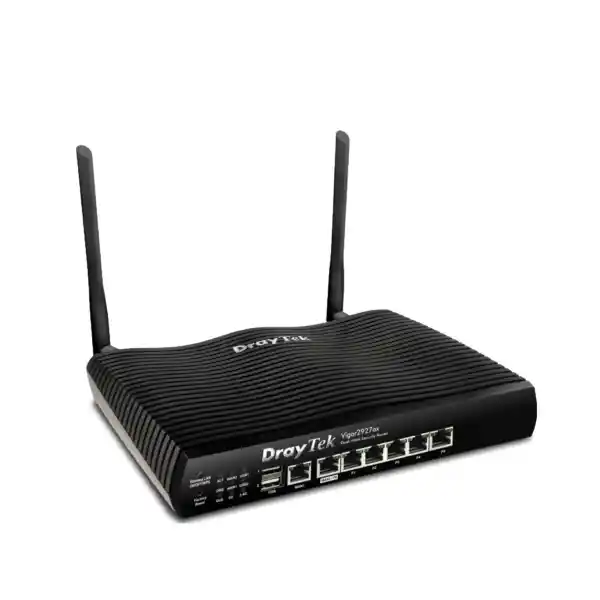
DrayTek Vigor2927ax Dual-WAN WiFi 6 VPN Router
The DrayTek Vigor2927ax is a high-capacity business router for organizations that want two independent Gigabit Ethernet WAN paths, resilient failover, policy-driven load balancing, enterprise VPN services, granular traffic control and integrated WiFi 6 in a single appliance. For UAE offices, retail branches, clinics, training centers, hospitality sites and distributed businesses, it provides a practical platform for combining primary fiber, secondary broadband and supported USB cellular connectivity while keeping user groups, guest access, business applications and remote users under consistent routing and security policies.
What the DrayTek Vigor2927ax is designed to solve
Modern branch networks rarely fail because they lack raw routing capability. They fail because there is no clean plan for Internet redundancy, application prioritization, secure remote access, guest isolation, wireless capacity, monitoring and recovery. The Vigor2927ax addresses those operational problems in one platform. Its two Gigabit Ethernet WAN interfaces can be used with independent Internet services, allowing administrators to create failover or load-balancing policies. A business can, for example, connect an enterprise fiber circuit to one WAN port and a second broadband service to the other. Traffic can then be distributed according to source, destination, protocol, application requirement or availability conditions rather than relying on a single undifferentiated default route.
This approach is especially useful in Dubai and across the UAE where a branch may run cloud ERP, Microsoft 365, hosted voice, payment terminals, video meetings, IP surveillance, remote desktop sessions and guest WiFi simultaneously. Each service has a different tolerance for latency, jitter, packet loss and address changes. The router therefore needs more than a simple backup-WAN switch. The Vigor2927ax combines WAN health detection, route policy, quality of service, VLAN segmentation and VPN capabilities so that the failover design can reflect actual business priorities.
DrayTek specifies the platform for up to 60,000 NAT sessions and recommends it for networks around 50 hosts, although practical sizing should always consider traffic behavior rather than endpoint count alone. A fifty-user accounting office dominated by browser and SaaS activity creates a very different load from a twenty-user design studio transferring large media files, or a small hospitality property supporting hundreds of transient wireless clients over the course of a day. FourTeck therefore treats the published capacity as an engineering reference point, then sizes the deployment around WAN speed, concurrent sessions, VPN usage, content filtering, wireless density and expected growth.
WAN resilience
Two 1GbE WAN-capable interfaces support failover and load balancing, helping a site remain reachable when one upstream connection experiences loss or instability.
VPN concentration
Support for up to 50 VPN tunnels and 25 SSL VPN tunnels makes the router suitable for branch-to-HQ links, administrator access and remote-worker connectivity.
WiFi 6 access
Integrated dual-band 802.11ax provides up to 574 Mbps link rate on 2.4 GHz and 2.4 Gbps on 5 GHz, with a maximum 160 MHz channel width.
Segmentation
VLAN, multiple LAN subnet and inter-VLAN routing capabilities allow business, voice, guest, IoT and management traffic to be separated by policy.
Verified hardware and performance profile
| Area | Vigor2927ax capability | Deployment meaning |
|---|---|---|
| WAN | 2 × Gigabit Ethernet, including one fixed WAN and one WAN/LAN switchable port | Build dual-provider designs without a separate edge load balancer. |
| LAN | 5 × fixed Gigabit Ethernet LAN ports | Connect switching, servers, voice gateways or direct endpoints at Gigabit speed. |
| NAT | Up to 940 Mbps single-WAN and 1,800 Mbps dual-WAN with hardware acceleration under vendor test conditions | Suited to high-speed Internet access when configuration and traffic patterns allow acceleration. |
| Sessions | 60,000 NAT sessions | Provides session headroom for multi-user business browsing, SaaS and cloud applications. |
| VPN | 50 VPN tunnels, 25 SSL VPN tunnels; IPsec throughput up to 800 Mbps; SSL VPN up to 120 Mbps | Supports branch connectivity, remote access and hybrid-work requirements. |
| Wireless | 2.4 GHz 802.11ax 2×2 MIMO up to 574 Mbps; 5 GHz 802.11ax 2×2 MU-MIMO up to 2402 Mbps | Integrated AX3000-class coverage for offices that do not require a separate access point at the router location. |
| USB | 2 × USB 2.0 | Can support compatible external devices including supported cellular connectivity and storage-oriented functions. |
| Physical | 241 × 165 × 44 mm; 12 V DC at 2.5 A; maximum published consumption 26.4 W | Compact desktop format that can be incorporated into branch communication cabinets with appropriate ventilation. |
Published throughput figures are maximum values obtained under vendor test conditions. Real performance varies with enabled services, packet sizes, VPN encryption, filtering, route policies, wireless conditions, ISP behavior and traffic mix.
Dual-WAN architecture for UAE business continuity
A resilient Internet design begins with failure-domain separation. Connecting two Internet services to the same router is useful, but the real continuity benefit depends on how independent those services are upstream. In a Dubai office, for example, using two logical circuits that traverse the same building riser, carrier aggregation point or provider infrastructure may still leave a common point of failure. The Vigor2927ax gives the network edge the technical ability to use two WAN links; the deployment design should then consider carrier diversity, physical path diversity where available, service-level agreements, static IP requirements and how quickly critical applications can tolerate an address change.
The router supports WAN failover and load balancing, with connection detection mechanisms including ARP, strict ARP and ping. It also supports traffic-threshold conditions and active-on-demand behavior. These tools make it possible to avoid treating every interruption as a complete link failure. An administrator can define health checks that reflect reachable upstream resources and can decide whether a secondary connection is always active, used for overflow, or reserved for outage conditions. That is important for organizations whose secondary link is metered or intentionally lower capacity.
Load balancing can be session based or IP based. Session-based balancing distributes new sessions across available WAN paths according to policy and link state. IP-based balancing can help maintain consistency for clients or services that react poorly when successive connections appear from different public addresses. Route policy adds another layer by allowing traffic to be matched according to protocol, IP address, port, domain or country criteria. A finance application can be directed through the circuit with the most stable static address, while general web traffic is allowed to use either link. Voice and conferencing can receive a preferred path, and bulk updates can be steered away from a constrained circuit.
This is where the Vigor2927ax becomes more valuable than an entry-level dual-WAN router. The practical objective is not simply “two connections.” It is predictable application behavior when one path changes state. A properly designed policy set should document which applications are pinned to a specific WAN, which can balance freely, which require NAT consistency, which inbound services depend on a public IP, and what happens when the preferred path returns. FourTeck can integrate this edge design with switching and broader UAE network services available through FourTeck UAE.
NAT performance, acceleration and realistic sizing
DrayTek publishes up to 940 Mbps NAT throughput on a single WAN and up to 1.8 Gbps when dual-WAN traffic is used with hardware acceleration under optimal test conditions. Those figures describe forwarding potential; they are not a guarantee that every security configuration will sustain the same rate. Router performance is shaped by packet size, session count, inspection features, QoS rules, VPN encryption, logging, policy routing, traffic direction and the proportion of flows eligible for acceleration. In a production network, the safest sizing method is therefore to start from the applications and policies that will actually run rather than from the nominal broadband speed alone.
The platform supports up to 60,000 NAT sessions. Session capacity matters because a modern endpoint can generate many simultaneous connections through browsers, collaboration applications, cloud storage clients, software update services and background telemetry. Guest devices and IoT platforms can add further session churn. A site with only a few dozen employees may still create a substantial connection table during peak periods. Administrators should monitor concurrent sessions, CPU utilization, WAN utilization and latency after deployment and retain headroom for growth rather than operating continuously near theoretical limits.
For Internet plans close to one Gigabit per second, configuration discipline is particularly important. Features should be enabled because they address a defined requirement, not simply because they are available. QoS classification should focus on high-value traffic. Logs should be useful enough for troubleshooting without overwhelming storage or management platforms. VPN cipher choices should balance security requirements and endpoint compatibility. Content controls should be aligned with policy. This produces a network that is easier to troubleshoot and gives the router the best opportunity to deliver consistent performance.
WiFi 6: integrated AX3000-class wireless for branch environments
The “ax” designation identifies the Vigor2927ax as the WiFi 6 model in the Vigor2927 family. It uses dual-band 2×2 wireless. On 2.4 GHz, the router supports 802.11b/g/n/ax with a maximum link rate of 574 Mbps. On 5 GHz, it supports 802.11a/n/ac/ax with a maximum link rate of approximately 2.4 Gbps and a maximum channel width of 160 MHz. The platform includes two external dual-band antennas rated by DrayTek at 2.5 dBi for 2.4 GHz and 3 dBi for 5 GHz.
Those link rates are physical-layer values, not application throughput guarantees. Real wireless throughput is lower because WiFi is a shared medium with protocol overhead, contention, interference, retransmissions and client-specific capability limits. A phone supporting only 80 MHz channels will not use a 160 MHz link. A laptop at the edge of coverage may negotiate a lower modulation rate. Neighboring networks, building materials, reflections and local spectrum conditions can influence performance. For that reason, FourTeck treats the integrated radio as part of a wireless design rather than assuming that one router can cover an entire office simply because the quoted link rate is high.
WiFi 6 capabilities include OFDMA, helping the access point schedule smaller units of airtime more efficiently when multiple compatible clients are active. The 5 GHz radio supports MU-MIMO, and the platform provides AirTime Fairness, Band Steering and WMM. AirTime Fairness can reduce the impact of slower clients monopolizing transmission time. Band Steering encourages capable dual-band devices toward 5 GHz where conditions allow. WMM provides wireless traffic prioritization for latency-sensitive applications. These features are useful in meeting rooms, reception areas, small offices and retail environments where many endpoints may share the same radio.
Security options include WPA3 alongside WPA2 and other compatibility modes. In a modern business deployment, WPA3 or WPA2 with strong authentication should be preferred according to client support and organizational policy. 802.1X authentication can be used where a RADIUS-based identity design is required. Guest SSIDs should be separated from internal resources using VLAN and firewall policy, not merely by using a different wireless password. Client isolation can further reduce peer-to-peer exposure on public or semi-public wireless segments.
The router can operate as a root for DrayTek mesh functions on 5 GHz and supports management of multiple access points. For larger UAE offices, multi-floor properties or sites with concrete walls and complex RF conditions, dedicated access points are usually the appropriate approach. The Vigor2927ax can remain the routing, security and management edge while additional APs provide properly planned coverage and capacity.
2.4 GHz use case
Best reserved for wider reach, low-bandwidth IoT devices and legacy clients when necessary. Because the band has fewer non-overlapping channels and more interference, capacity planning should prevent it from becoming the default home for every dual-band endpoint.
5 GHz use case
Preferred for capable business laptops, smartphones and high-throughput applications when signal quality is good. Wider channels can increase peak link rate, but narrower channel plans may provide better reuse in busy multi-AP environments.
VPN services for branches, remote users and hybrid work
The Vigor2927ax supports a broad set of VPN technologies including IPsec, IKEv2, L2TP over IPsec, SSL VPN, GRE, OpenVPN and WireGuard, along with compatibility-oriented protocols for legacy environments. DrayTek lists up to 50 concurrent VPN tunnels and up to 25 SSL VPN tunnels. Published performance reaches up to 800 Mbps for IPsec and up to 120 Mbps for SSL VPN under vendor test conditions. Actual VPN throughput depends heavily on encryption settings, packet size, tunnel count, endpoint performance and whether other router services are active at the same time.
For site-to-site connectivity, an IPsec or IKEv2 tunnel can securely link a Dubai branch to a head office, data center or cloud-connected location. Policy routing can determine which internal subnets use the tunnel and which continue directly to the Internet. This avoids forcing every branch application through headquarters when local breakout is preferable. A branch can keep SaaS traffic local while routing ERP, file services or administrative networks through the corporate tunnel.
Remote-access design should begin with identity and endpoint requirements. The router supports local RADIUS and can work with external authentication systems such as LDAP and TACACS+ in appropriate management scenarios. Pre-shared keys and X.509 certificates are supported for VPN authentication. For a small organization, a carefully controlled local configuration may be sufficient. For a larger environment, centralized identity, certificate lifecycle management, MFA strategy and user offboarding become more important than the basic tunnel count.
A secure remote-access policy should limit users to the resources they need. An employee connecting to an internal application should not automatically receive unrestricted access to every VLAN. VPN address pools can be placed into dedicated policy contexts, and firewall rules can limit permitted services. Logging should capture successful and failed authentication events. Administrative interfaces should be restricted to trusted networks or management VPNs rather than exposed broadly to the Internet.
For organizations planning firewall refreshes, managed security and remote-access standardization across several UAE sites, FourTeck’s specialized resources at Firewall Dubai can support design discussions around edge security, policy migration and branch connectivity.
VLAN and subnet segmentation: building a cleaner internal security model
The Vigor2927ax supports both 802.1Q tag-based VLANs and port-based VLANs, with up to 16 VLANs and multiple LAN subnets. This allows a business to separate devices according to role rather than placing everything into one flat broadcast domain. Typical segments include corporate users, management interfaces, IP phones, CCTV, printers, point-of-sale devices, guest WiFi and building automation. Separating these groups does not automatically make the environment secure, but it creates the structure required for meaningful access control.
A common branch design uses the router as the default gateway for multiple VLAN interfaces while a managed switch carries 802.1Q trunks to access points and downstream switches. Inter-VLAN routing is then governed by firewall policy. Corporate users may be allowed to reach printers and selected servers. Guest devices may be restricted to Internet access only. CCTV cameras may communicate with the recorder but not with staff laptops. Management interfaces may be reachable only from an IT administration subnet. The router supports inter-VLAN routing, static routes and routing-policy features to implement these relationships.
DHCP can be customized by subnet, and Bind-IP-to-MAC capabilities can help create more predictable addressing for selected devices. Administrators should still maintain proper IP documentation instead of depending entirely on leases. For voice deployments, keeping IP phones in a dedicated VLAN can simplify QoS classification and troubleshooting. For wireless networks, mapping each SSID to the appropriate VLAN ensures that the access policy follows the user group rather than the physical access point.
Segmentation also reduces the blast radius of operational mistakes. A broadcast issue in an IoT network should not overwhelm employee endpoints. A poorly configured guest device should not be able to discover internal printers. A camera subnet can be constrained even if the cameras themselves offer limited security controls. This structured approach is more maintainable than accumulating individual host exceptions on one large LAN.
Firewall policy, content controls and application governance
The Vigor2927ax includes a stateful firewall with policy controls that can be combined with network segmentation, NAT and routing. Practical firewall design starts from explicit communication requirements. The router should permit necessary traffic, deny or restrict unnecessary paths and produce logs that help administrators understand unexpected behavior. Rules should be grouped and documented by purpose, such as guest Internet access, voice services, server publishing, VPN users, management access and inter-VLAN communication.
Content filtering capabilities include application, URL, keyword, DNS keyword, web feature and category-oriented controls. Some category services may require subscription. Content controls can support acceptable-use policy, reduce casual exposure to known unwanted categories and help administrators shape browsing behavior, but they should not be treated as a substitute for endpoint protection, DNS security, email security or user awareness. An effective security stack uses several layers, each addressing a different control point.
NAT functions include port redirection, open ports, port triggering, port knocking, DMZ host and UPnP options. In business networks, inbound exposure should be minimized. Port forwarding should only be used when there is a documented need and when the published service is appropriately secured. UPnP is generally unsuitable for tightly controlled corporate segments because it allows endpoints to request mappings dynamically. Where remote administration or internal application access is needed, VPN is usually preferable to directly exposing management services.
Port knocking support can reduce casual scanning visibility for selected local services, but it is not a replacement for strong authentication, restricted source networks and encrypted administration. HTTPS and SSH should be preferred over clear-text management protocols where possible. Telnet and FTP support exists for compatibility, yet a security-focused deployment should disable or restrict legacy services unless a specific operational dependency requires them.
DrayTek also lists DNSSEC-related DNS security capability, local DNS functions and conditional DNS forwarding. These features are useful in branch networks that need internal name resolution alongside public DNS. Conditional forwarding can send queries for corporate namespaces toward internal resolvers while public names use approved external DNS services. This is often important in hybrid environments where branch users access both cloud services and private resources.
QoS and bandwidth management for voice, video and cloud applications
Bandwidth is only one component of application experience. Voice calls and interactive meetings are sensitive to delay, jitter and packet loss even when the total WAN link is not fully saturated for long periods. Large uploads, cloud backups or software updates can create short bursts that increase queueing delay. The Vigor2927ax provides QoS classification and bandwidth-management tools that allow an administrator to identify important traffic and give it predictable treatment.
Classification can use DSCP, 802.1p, IP address, port and application criteria. In a managed voice environment, the network should preserve or remark trusted QoS values according to policy and avoid letting arbitrary endpoints claim top priority. Voice traffic can be assigned low-latency treatment, while bulk backup traffic is allowed to use available capacity without dominating the queue during busy periods. The same principle can be applied to ERP, video conferencing or other applications that have measurable business impact.
Bandwidth limits are also useful for guest access. A visitor network should not consume the entire Internet circuit simply because one guest begins a large download. Per-network or policy-based controls can preserve capacity for business traffic while still providing a usable guest experience. In a retail or hospitality site, this can be combined with captive portal features, social login, voucher PIN, SMS PIN, RADIUS or an external portal server according to deployment needs.
QoS should be validated with real traffic. Administrators should measure latency under load, confirm classification counters, and test failover conditions because QoS behavior can change when traffic moves to a slower secondary link. If the backup circuit has materially less capacity than the primary connection, the router’s shaping values and priority expectations may need to reflect the reduced bandwidth during failover.
Routing flexibility for multi-site and hybrid networks
Beyond default Internet routing, the Vigor2927ax supports IPv4 and IPv6 static routing, policy routing, inter-VLAN routing, RIP v1/v2 and BGP. The inclusion of BGP can be useful in specific branch or provider-edge scenarios, but the presence of a routing protocol does not automatically mean it should be enabled. BGP requires a clear topology, route policy, filtering and operational ownership. In many SMB deployments, static and policy-based routing remain simpler and easier to audit.
Policy routes are especially valuable when a branch has multiple exits. Traffic can be matched by protocol, IP address, port, domain or country-related criteria and then directed through a chosen WAN or VPN path. For example, a private application can be routed through a site-to-site tunnel, Microsoft 365 can break out locally, and guest traffic can use the secondary broadband service. This reduces unnecessary hairpinning and allows a site to use available connectivity more efficiently.
When designing policy routing, rule order and fallback behavior must be documented. An overly broad rule can unexpectedly capture traffic intended for a VPN. A domain-based rule can behave differently if an application uses content-delivery networks or rapidly changing hostnames. Country-based classification is useful for some governance cases but should not be viewed as a perfect identity mechanism. IP geolocation databases and cloud hosting patterns can introduce ambiguity. Critical business routing decisions are generally more robust when based on known address ranges, ports, tunnels and application architecture.
IPv6 support includes static IPv6, DHCPv6-related options and multiple transition or tunnel mechanisms. Organizations enabling IPv6 should apply the same discipline used for IPv4: firewall policy, DNS planning, monitoring, routing and endpoint controls must all be considered. Simply enabling IPv6 without equivalent policy can create a path that is less governed than the IPv4 network.
Centralized management, logging and operational visibility
A business router should be evaluated on how it is operated after installation, not only on the number of features available on day one. The Vigor2927ax provides browser-based management and supports services including HTTPS, SSH, SNMP, syslog and TR-069-oriented management. Firmware can be upgraded through the web interface, TFTP and TR-069 workflows. Configuration backup and restore features allow administrators to preserve known-good states before major changes.
SNMP v1, v2c and v3 support enables performance and health monitoring. For security-conscious deployments, SNMPv3 should be preferred because it offers stronger authentication and privacy controls than legacy community-string approaches. Syslog can send event data to a centralized collector, where router logs can be retained alongside switch, server, VPN and security-system events. NetFlow v5, v9 and IPFIX support can provide traffic-flow visibility for capacity planning and incident analysis.
DrayTek lists management capacity for up to 20 access points, 7 mesh nodes and 10 switches, as well as VigorACS support. These numbers help define the scale of a DrayTek-centric branch environment. Centralized tools become particularly useful when a business has several UAE branches and wants consistent configuration, firmware visibility and performance monitoring without logging into each device individually.
Operational discipline should include a configuration baseline, named administrators, controlled change windows and a rollback plan. Backup files should be stored securely because they may contain sensitive configuration information. Firmware changes should be tested against important VPN clients, WAN services and wireless devices. Monitoring should alert on WAN failure, unusual utilization, VPN instability and device resource pressure rather than producing notifications for every minor event.
For customers who want the router incorporated into broader managed infrastructure, cabling, switching, wireless, server and support projects, FourTeck IT Services UAE provides a natural integration path beyond the edge-router installation itself.
High availability and continuity planning
DrayTek lists High Availability capability for the Vigor2927ax. High availability should be understood as part of a larger continuity design. Redundant routers do not protect against a shared failed power source, a single upstream optical path, a damaged core switch or an incorrectly propagated configuration. A resilient branch therefore examines the complete chain from ISP handoff to router, switching, wireless, power, DNS and application dependencies.
For critical environments, the router and upstream modem or ONT should be connected to appropriately sized UPS protection. If two WAN providers are used, their termination equipment should also be protected. Where building design allows, physical cable routes should avoid sharing the same vulnerable pathway. Management access should remain available during a primary circuit outage, either through the secondary WAN, an out-of-band method or a secure remote path.
Failover testing should be scheduled rather than assumed. An administrator can disconnect the primary service during a maintenance window and confirm how long critical applications take to recover, whether VPN tunnels renegotiate, whether inbound services remain available, and whether DNS or source-address dependencies cause unexpected failure. Restoring the primary path should be tested as carefully as losing it because route flapping or stateful applications can behave differently during failback.
Business continuity plans should distinguish between Internet continuity and application continuity. Dual WAN can keep outbound Internet access working, but a self-hosted service published on a single static public IP may still become unreachable unless secondary addressing, DNS failover or application-level redundancy is designed. The Vigor2927ax provides the routing mechanisms; the complete solution depends on how public services, VPN peers and cloud systems are architected around them.
UAE deployment considerations
Deployments in Dubai and the wider UAE should begin with the exact ISP handoff and addressing model. The router supports common IPv4 Internet connection types including PPPoE, DHCP and static IP, as well as IPv6 options. The installation team should confirm whether the service requires VLAN tagging, provider-supplied credentials, a fixed public address, routed public subnet or specific MTU behavior. These details should be collected before the migration window so the new router can be preconfigured and tested as far as possible.
Environmental conditions also matter. DrayTek specifies an operating range of 0 to 45°C and 10 to 90 percent non-condensing humidity. The router should be installed in a ventilated indoor location, away from direct heat sources and not placed loosely on top of high-temperature equipment. In communication cabinets, cable routing should leave the ventilation area unobstructed. Power adapters should be secured and clearly labeled to avoid accidental disconnection during maintenance.
Wireless planning should account for local building construction. Reinforced concrete, metalized glass, lift cores, equipment rooms and dense partitions can reduce 5 GHz propagation. A central router location that is ideal for WAN cabling may not be the best RF location. In larger offices, using the Vigor2927ax as the gateway with separate managed access points often delivers more predictable coverage than trying to position the gateway solely for WiFi.
Procurement should also verify the regional power adapter, warranty channel, firmware branch and any required subscriptions. FourTeck can align the router with switches, structured cabling, access points, UPS capacity and security policy rather than treating it as an isolated box purchase.
Use cases that fit the Vigor2927ax well
Professional offices: Accounting, consulting, legal, engineering and service companies can use dual WAN for continuity, segmented wireless for staff and guests, VPN for remote workers, and QoS for cloud telephony and video meetings. A typical design places employee devices on a corporate VLAN, IP phones on a voice VLAN, guests on an Internet-only network and management interfaces on a restricted administrator segment.
Retail branches: A store can separate point-of-sale terminals, back-office systems, CCTV, staff devices and guest WiFi. The primary WAN can carry normal operations while a second circuit provides business continuity. Policies can prioritize payment and operational traffic over guest browsing. VPN can connect selected systems to headquarters without backhauling all Internet traffic.
Clinics and small healthcare facilities: Segmentation can isolate administrative workstations, clinical systems, guest devices and building or surveillance equipment. VPN can provide controlled connectivity to central services. The design should be aligned with the organization’s data-protection requirements and should include endpoint, identity and logging controls beyond the router itself.
Training centers and education branches: The integrated WiFi 6 radio can serve smaller spaces, while managed APs can extend coverage in larger classrooms. User groups can be separated by SSID and VLAN. Bandwidth controls can prevent guest or student traffic from degrading administrative and conferencing services.
Hospitality and serviced offices: Captive portal features, guest isolation and multiple SSIDs can support visitor connectivity. Business systems should remain segmented from public access. Where wireless density is high, dedicated APs should be used and the Vigor2927ax should focus on routing, policy and WAN resilience.
Multi-site SMEs: Organizations with branches across the UAE can standardize VPN templates, VLAN numbering, firewall objects and monitoring conventions. Consistent design reduces troubleshooting time and makes future expansion easier. For businesses with operations extending beyond the UAE, FourTeck’s global technology site can provide a broader reference point for multi-region infrastructure needs.
Detailed port and interface planning
The physical interface layout supports one fixed Gigabit Ethernet WAN port, one Gigabit Ethernet port that can operate as WAN or LAN, five fixed Gigabit Ethernet LAN ports, two USB 2.0 ports, two external wireless antennas, a reset control and a WLAN/WPS control. The absence of built-in multi-gigabit Ethernet means the router should be positioned where Gigabit port speeds match the access and Internet architecture. If the internal network uses 2.5GbE or 10GbE switching for servers and storage, those high-speed east-west transfers can remain on the switch fabric while the router handles Internet and inter-policy traffic within its interface capabilities.
The switchable WAN/LAN port provides flexibility. In a dual-WAN design, it becomes the second Internet interface. In a single-WAN design, it can remain available to the LAN. The final port map should be documented during commissioning so later technicians know which interface is connected to each provider, switch or local service. Physical labels are inexpensive and significantly reduce troubleshooting errors during an outage.
USB ports can support compatible cellular modems and other functions. If cellular backup is required, modem compatibility and local carrier support should be confirmed before procurement. Cellular should also be tested from the actual equipment-room location because signal quality can be poor inside metal cabinets or deep inside buildings. Where needed, an external cellular gateway positioned for better reception may provide a more reliable backup than a USB modem attached directly to the router.
For LAN expansion, a managed switch is normally preferable to using every router port as an independent access port. A switch provides additional ports, PoE options, clearer VLAN distribution and easier cable management. The router can then use one or more uplinks to the switching layer while concentrating on routing, firewall, VPN and WAN functions.
Wireless security and guest access design
The Vigor2927ax supports multiple SSIDs per band, with security modes including WPA3, WPA2 and compatibility options. A business should map wireless identity to network policy. The corporate SSID can use strong authentication and place approved users into the corporate VLAN. A separate guest SSID can terminate in a dedicated guest VLAN with client isolation and Internet-only firewall rules. IoT or operational devices may need their own SSID and subnet where legacy security constraints can be contained.
Captive portal options include click-through acceptance, social login, SMS PIN, voucher PIN, RADIUS and external portal integration. The right choice depends on the organization’s privacy policy, guest experience and operational model. A reception-driven office may prefer voucher codes. A public-facing venue may use a branded portal. An internal BYOD network may use RADIUS rather than a public-style captive portal.
WPS is supported, but organizations that prioritize strict control should decide whether it is necessary. Convenience functions can introduce operational shortcuts that do not align with formal onboarding. In managed environments, client credentials, 802.1X or controlled pre-shared-key distribution are easier to audit than ad-hoc pairing.
Guest bandwidth policy should prevent one visitor from degrading business traffic. Rate limits can be paired with QoS and WAN policy. If dual WAN is available, guest Internet traffic may be directed toward a secondary service while business applications prefer the primary connection. This creates a clean separation between availability priorities even before application-level QoS is considered.
Migration approach from an existing router
Replacing an existing edge router should be treated as a controlled network change. Before installation, record the current WAN settings, public IP information, ISP credentials, VLAN IDs, DHCP scopes, DNS settings, port forwards, VPN peers, static routes, firewall exceptions and wireless SSIDs. Old configurations often contain years of undocumented exceptions. The migration is an opportunity to distinguish business requirements from obsolete rules rather than blindly reproducing everything.
Build the Vigor2927ax configuration offline where practical. Define the management address, administrator credentials, LAN subnets, VLANs, DHCP scopes and baseline firewall policy. Configure WAN services using verified provider information. Create VPN tunnels and route policies with clear names. If the old router is still in production, avoid address conflicts by keeping the new device isolated until the maintenance window.
During cutover, test in layers. First verify physical WAN link and Internet reachability. Then confirm DNS, DHCP and general user browsing. Test business-critical applications, voice services and VPN tunnels. Validate inbound services if any exist. Confirm guest isolation and inter-VLAN rules. Finally, simulate failover to the secondary WAN and verify that monitoring detects the state change.
After the network stabilizes, export a configuration backup and store it in a controlled repository with the deployment documentation. Capture the final port map, ISP details, VLAN plan, VPN peers and administrative access method. A short, accurate runbook is often more valuable during an outage than a long generic manual because it explains how this specific site was built.
If the router is part of a broader server, virtualization or branch-infrastructure refresh, related solutions can also be coordinated through Server Dubai by FourTeck.
Security hardening checklist for production deployment
The first hardening step is administrative access. Change default credentials immediately and use unique, strong administrator passwords. Restrict management interfaces to trusted subnets or VPN users. Prefer HTTPS and SSH. Disable unnecessary legacy services. If remote administration is required, limit source networks where possible and use VPN access rather than exposing the web interface globally.
Update firmware to an approved stable release after reviewing release notes and compatibility. Firmware management should be continuous, not a one-time installation task. Maintain a record of the running version and review vendor security advisories. Before major upgrades, save a configuration backup and verify that a rollback process is available.
Segment trusted users, guests, IoT, surveillance and management systems. Use explicit firewall rules between VLANs. Avoid broad “any-to-any” inter-VLAN policies. If a camera subnet only needs to communicate with a recorder, permit that path and deny unnecessary lateral communication. If printers need access from corporate users but should not initiate sessions toward workstations, structure policy accordingly.
Review NAT exposure. Remove unused port forwards and avoid publishing router administration services. Disable UPnP on business segments unless there is a documented requirement. Where an application can operate through outbound connections or VPN, prefer those models over direct inbound exposure.
Centralize logs and monitoring when the environment justifies it. SNMPv3, syslog and flow telemetry can help identify WAN saturation, unusual communication patterns and recurring failures. Alerts should focus on events that require action: WAN down, VPN down, device unreachable, sustained high utilization, configuration changes and repeated authentication failures.
Finally, treat router hardening as one layer. Endpoint security, MFA, backup, email protection, DNS policy, identity governance and user training remain essential. The Vigor2927ax can enforce strong network boundaries, but it cannot compensate for weak credentials, unpatched endpoints or poorly protected cloud accounts.
Sizing methodology: when the Vigor2927ax is the right class of router
A correct sizing decision combines at least six variables: Internet bandwidth, number of active users, concurrent sessions, VPN workload, enabled security features and growth horizon. The Vigor2927ax is positioned for SMB use and DrayTek references networks around 50 hosts. That guideline is useful, but endpoint count should not be treated as a hard limit. Ten developers pulling container images and large repositories may drive more throughput than fifty administrative users. A retail branch with many guest devices may create more sessions than a professional office with more employees but lighter browsing patterns.
Start by measuring the current environment. Record peak WAN utilization, 95th-percentile utilization, concurrent sessions, VPN bandwidth and latency during busy periods. Identify growth expected over the next three years. If the site is moving from 300 Mbps to 1 Gbps Internet, confirm which policies and inspection features must remain active at the higher rate. If the organization expects several hundred remote VPN users, this model may not be the appropriate concentrator even if general Internet throughput is sufficient.
Wireless capacity should be sized separately. The integrated AX3000-class radio is valuable for a small office or as local coverage near the communications area, but it does not replace a multi-AP design in a large floor plate. Count concurrent wireless clients, estimate airtime demand, study floor materials and choose AP placement accordingly. Router selection and wireless design are related but distinct engineering tasks.
Port-speed architecture is another consideration. Because the WAN and LAN Ethernet interfaces are Gigabit-class, organizations with multi-gigabit Internet service or designs requiring multi-gigabit routed links should evaluate a different platform. Conversely, a business with sub-gigabit primary and secondary services, moderate user count, substantial VPN needs and a requirement for integrated WiFi 6 may find the Vigor2927ax well matched.
The final sizing choice should leave operating headroom. A router that is only adequate under today’s average load may become a constraint after cloud adoption, additional cameras, remote users or a WAN upgrade. FourTeck can use current traffic information and planned services to determine whether the Vigor2927ax fits comfortably or whether a higher-capacity platform is more appropriate.
Procurement, licensing and lifecycle questions to confirm
The base Vigor2927ax includes extensive routing, VPN, firewall, wireless and management functions, while some content-category services can involve subscription requirements. Before purchase, identify which features are essential and verify whether any optional service needs a recurring license. This avoids discovering after installation that a desired filtering category or cloud-management function depends on a separate entitlement.
Confirm warranty coverage, local support path, power adapter and hardware revision. Enterprise buyers should record serial numbers, purchase dates, firmware baselines and installed locations. If several branches use the same router family, keeping a standardized spare can reduce replacement time during a hardware fault. Configuration backups should be maintained per site so a replacement can be restored quickly.
Lifecycle planning also matters. Network equipment should not be left in service indefinitely after security support or firmware maintenance ends. Organizations should track vendor support notices and create a refresh plan before equipment becomes operationally risky. A planned refresh is less disruptive than an emergency replacement triggered by an unsupported feature, unavailable spare or urgent security concern.
When requesting a quotation, provide the WAN service details, user count, VPN requirements, wireless scope and any existing managed switches or access points. This information allows the supplier to quote the router along with the correct accessories, installation effort and optional services rather than producing a box-only price that omits deployment requirements.
Decision recap: where the Vigor2927ax delivers the most value
The strongest fit is a small or medium business site that needs resilient dual-WAN connectivity, Gigabit-class edge performance, a rich VPN feature set, structured VLAN segmentation, traffic-management controls and integrated WiFi 6 without moving immediately to a much larger enterprise firewall platform. Its value is highest when those features are actually designed together: WAN policy linked to application needs, VLANs linked to firewall rules, QoS linked to measured traffic, wireless linked to segmentation, and VPN linked to identity and least-privilege access.
Choose it when
You have up to Gigabit-class WAN services, want two providers, need dozens of VPN tunnels, require VLAN-aware policy and want integrated WiFi 6 at the gateway location.
Reassess when
You require multi-gigabit Ethernet interfaces, substantially higher VPN concentration, very large user populations, intensive inspection workloads or a wireless design that depends on many high-density APs.
Plan alongside it
Managed switching, UPS protection, structured cabling, centralized logs, endpoint security, identity controls, configuration backup and a documented ISP failover procedure.
Validate before cutover
ISP handoff details, public IP requirements, VLAN tags, VPN peers, port forwards, DNS behavior, guest isolation, QoS and application recovery during WAN failover.
Quotation input checklist for Dubai and UAE projects
Providing the following information helps FourTeck prepare a more accurate recommendation and quotation instead of assuming a generic office profile.
Provider names, circuit speeds, static or dynamic IP, PPPoE details, VLAN tags, modem/ONT model and whether two independent providers are planned.
Employees, IP phones, cameras, printers, servers, IoT devices, guest users and expected three-year growth.
Number of branch tunnels, remote users, peer vendors, required protocols, authentication method and target applications.
Floor area, wall type, number of rooms, expected concurrent clients, guest SSIDs and whether additional APs already exist.
Required VLANs for staff, voice, guest, CCTV, servers, management, POS, IoT or other operational systems.
Supply only, installation, migration, after-hours cutover, remote support, monitoring, documentation or ongoing managed service.
Consultation panel: build the router into a complete branch design
A reliable Vigor2927ax deployment is not simply a matter of entering ISP credentials and enabling WiFi. The best results come from a documented topology that maps users and applications to VLANs, selects a primary and secondary WAN strategy, defines route-policy behavior, establishes VPN trust boundaries, prioritizes real-time traffic and provides administrators with monitoring and recovery procedures. FourTeck can assist with that complete design, from supply and staging through migration, validation and handover.
For a new Dubai office, the consultation can begin with the ISP handoff, rack or cabinet layout, switch count, AP placement and security zones. For a replacement project, it can begin with the current router configuration and a list of problems the business wants to eliminate. For a multi-branch rollout, the emphasis can shift toward standard templates, consistent VLAN numbering, centralized monitoring and repeatable deployment documentation.
When the requirement includes wider regional connectivity, FourTeck also supports technology projects beyond the UAE through selected regional platforms, including FourTeck Africa. This page intentionally focuses on the DrayTek Vigor2927ax for UAE branch use and should be paired with project-specific validation before final procurement.
Technical summary
The DrayTek Vigor2927ax combines dual Gigabit Ethernet WAN capability, up to 60,000 NAT sessions, hardware-accelerated NAT figures reaching 940 Mbps on a single WAN and 1.8 Gbps across dual WAN under vendor test conditions, up to 50 VPN tunnels, up to 25 SSL VPN tunnels, AX3000-class dual-band WiFi 6, five fixed Gigabit LAN ports, 16 VLAN capability, policy routing, QoS, captive portal options, SNMP, syslog, NetFlow/IPFIX and centralized DrayTek management functions. It is a feature-dense platform for SMB and branch deployments that value resilience and control more than extreme interface speed.
Final performance and feature availability depend on firmware, configuration, client capability, subscription status where applicable, ISP service, encryption settings and network conditions. Technical specifications should be reconfirmed at order stage for the exact supplied hardware and firmware revision.

Reviews
There are no reviews yet.